EP4530800A1 - Vorrichtung zur berechnung eines koordinatensystemversatzes, verfahren und nichttransitorisches computerlesbares speichermedium dafür - Google Patents
Vorrichtung zur berechnung eines koordinatensystemversatzes, verfahren und nichttransitorisches computerlesbares speichermedium dafür Download PDFInfo
- Publication number
- EP4530800A1 EP4530800A1 EP24172262.8A EP24172262A EP4530800A1 EP 4530800 A1 EP4530800 A1 EP 4530800A1 EP 24172262 A EP24172262 A EP 24172262A EP 4530800 A1 EP4530800 A1 EP 4530800A1
- Authority
- EP
- European Patent Office
- Prior art keywords
- coordinate system
- coordinate
- coordinates
- sensing
- virtual calibration
- Prior art date
- Legal status (The legal status is an assumption and is not a legal conclusion. Google has not performed a legal analysis and makes no representation as to the accuracy of the status listed.)
- Granted
Links
Images


Classifications
-
- G—PHYSICS
- G06—COMPUTING OR CALCULATING; COUNTING
- G06F—ELECTRIC DIGITAL DATA PROCESSING
- G06F3/00—Input arrangements for transferring data to be processed into a form capable of being handled by the computer; Output arrangements for transferring data from processing unit to output unit, e.g. interface arrangements
- G06F3/01—Input arrangements or combined input and output arrangements for interaction between user and computer
- G06F3/011—Arrangements for interaction with the human body, e.g. for user immersion in virtual reality
-
- G—PHYSICS
- G06—COMPUTING OR CALCULATING; COUNTING
- G06T—IMAGE DATA PROCESSING OR GENERATION, IN GENERAL
- G06T7/00—Image analysis
- G06T7/20—Analysis of motion
- G06T7/246—Analysis of motion using feature-based methods, e.g. the tracking of corners or segments
- G06T7/248—Analysis of motion using feature-based methods, e.g. the tracking of corners or segments involving reference images or patches
-
- G—PHYSICS
- G06—COMPUTING OR CALCULATING; COUNTING
- G06F—ELECTRIC DIGITAL DATA PROCESSING
- G06F3/00—Input arrangements for transferring data to be processed into a form capable of being handled by the computer; Output arrangements for transferring data from processing unit to output unit, e.g. interface arrangements
- G06F3/01—Input arrangements or combined input and output arrangements for interaction between user and computer
- G06F3/03—Arrangements for converting the position or the displacement of a member into a coded form
- G06F3/033—Pointing devices displaced or positioned by the user, e.g. mice, trackballs, pens or joysticks; Accessories therefor
- G06F3/0346—Pointing devices displaced or positioned by the user, e.g. mice, trackballs, pens or joysticks; Accessories therefor with detection of the device orientation or free movement in a three-dimensional [3D] space, e.g. 3D mice, 6-DOF [six degrees of freedom] pointers using gyroscopes, accelerometers or tilt-sensors
-
- G—PHYSICS
- G06—COMPUTING OR CALCULATING; COUNTING
- G06T—IMAGE DATA PROCESSING OR GENERATION, IN GENERAL
- G06T19/00—Manipulating three-dimensional [3D] models or images for computer graphics
-
- G—PHYSICS
- G06—COMPUTING OR CALCULATING; COUNTING
- G06T—IMAGE DATA PROCESSING OR GENERATION, IN GENERAL
- G06T7/00—Image analysis
- G06T7/60—Analysis of geometric attributes
-
- G—PHYSICS
- G06—COMPUTING OR CALCULATING; COUNTING
- G06T—IMAGE DATA PROCESSING OR GENERATION, IN GENERAL
- G06T7/00—Image analysis
- G06T7/80—Analysis of captured images to determine intrinsic or extrinsic camera parameters, i.e. camera calibration
-
- G—PHYSICS
- G06—COMPUTING OR CALCULATING; COUNTING
- G06T—IMAGE DATA PROCESSING OR GENERATION, IN GENERAL
- G06T7/00—Image analysis
- G06T7/97—Determining parameters from multiple pictures
Definitions
- the present invention relates to a coordinate system offset calculating apparatus, method, and non-transitory computer readable storage medium thereof. More particularly, the present invention relates to a coordinate system offset calculating apparatus, method, and non-transitory computer readable storage medium thereof for calculating a coordinate system offset of different coordinate systems.
- a user can assist the interactive device (e.g., a head-mounted device) to perform various interactive operations through the tracking apparatus in the environment.
- the interactive device e.g., a head-mounted device
- each of the interactive device and the tracking apparatus may be positioned through a variety of positioning methods (e.g., vision-based inside-out positioning or infrared-based outside-in positioning, etc.) and may have different initial positioning conditions, different devices have different coordinate systems (e.g., different original points, displacement, angle, etc.).
- positioning methods e.g., vision-based inside-out positioning or infrared-based outside-in positioning, etc.
- different devices have different coordinate systems (e.g., different original points, displacement, angle, etc.).
- the auxiliary data generated by the tracking apparatus may not be correctly provided to the interactive device for use, thus reducing the user's service experience.
- the coordinate system offset calculating apparatus comprises a transceiver interface and a processor, and the processor is electrically connected to the transceiver interface.
- the processor generates at least two virtual calibration coordinates, wherein the at least two virtual calibration coordinates correspond to a first coordinate system.
- the processor receives at least two sensing coordinates from a tracking apparatus in response to the tracking apparatus moving to the at least two virtual calibration coordinates, wherein the at least two sensing coordinates are generated by the tracking apparatus, and the at least two sensing coordinates correspond to a second coordinate system.
- the processor calculates a coordinate system offset corresponding to the first coordinate system and the second coordinate system based on the at least two virtual calibration coordinates and the at least two sensing coordinates.
- the coordinate system offset calculating method comprises the following steps: generating at least two virtual calibration coordinates, wherein the at least two virtual calibration coordinates correspond to a first coordinate system; receiving at least two sensing coordinates from a tracking apparatus in response to the tracking apparatus moving to the at least two virtual calibration coordinates, wherein the at least two sensing coordinates are generated by the tracking apparatus, and the at least two sensing coordinates correspond to a second coordinate system; and calculating a coordinate system offset corresponding to the first coordinate system and the second coordinate system based on the at least two virtual calibration coordinates and the at least two sensing coordinates.
- a further objective of the present disclosure is to provide a non-transitory computer readable storage medium having a computer program stored therein.
- the computer program comprises a plurality of codes, the computer program executes a coordinate system offset calculating method after being loaded into an electronic apparatus.
- the coordinate system offset calculating method comprises the following steps: generating at least two virtual calibration coordinates, wherein the at least two virtual calibration coordinates correspond to a first coordinate system; receiving at least two sensing coordinates from a tracking apparatus in response to the tracking apparatus moving to the at least two virtual calibration coordinates, wherein the at least two sensing coordinates are generated by the tracking apparatus, and the at least two sensing coordinates correspond to a second coordinate system; and calculating a coordinate system offset corresponding to the first coordinate system and the second coordinate system based on the at least two virtual calibration coordinates and the at least two sensing coordinates.
- the coordinate system offset calculating technology (at least including the apparatus, the method, and the non-transitory computer readable storage medium) provided by the present disclosure calculates the coordinate system offset corresponding to the first coordinate system and the second coordinate system through at least two virtual calibration coordinates and at least two sensing coordinates generated by the tracking apparatus. Since the coordinate system offset calculating technology provided by the present disclosure can calculate the coordinate system offset of different coordinate systems, it improves the accuracy of interaction device and improves the user's service experience.
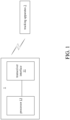
- a first embodiment of the present disclosure is a coordinate system offset calculating apparatus 1 and a schematic view of which is depicted in FIG. 1 .
- the coordinate system offset calculating apparatus 1 comprises a transceiver interface 11 and a processor 13, wherein the processor 13 is electrically connected to the transceiver interface 11.
- the processor 13 may be any of various processors, Central Processing Units (CPUs), microprocessors, digital signal processors or other coordinate system offset calculating apparatuses known to those of ordinary skill in the art.
- the transceiver interface 11 is an interface capable of receiving and transmitting data or other interfaces capable of receiving and transmitting data and known to those of ordinary skill in the art.
- the transceiver interface 11 can be directly connected to the tracking apparatus 2 through communication.
- the transceiver interface 11 of the coordinate system offset calculating apparatus 1 can be connected to the tracking apparatus 2 through communication with other devices.
- the tracking apparatus 2 may have an image capturing function (e.g., a plurality of depth camera lenses) to generate a plurality of real-time images corresponding to a field of view (FOV) to perform a self-positioning operation of inside-out tracking.
- an image capturing function e.g., a plurality of depth camera lenses
- FOV field of view
- the tracking apparatus 2 may also perform a self-positioning operation of outside-in tracking through externally transmitted auxiliary data.
- the tracking apparatus 2 may be assisted in positioning through an infrared device installed in the environment.
- the coordinate system offset calculating apparatus 1 may be installed in other devices or combined with a device having computing capabilities (e.g., using processor 13 with the device).
- the coordinate system offset calculating apparatus 1 may be installed in the head-mounted device HMD
- the processor 13 may be a built-in processor in the head-mounted device HMD
- the transceiver interface 11 may be a built-in transceiver interface in the head-mounted device HMD.
- the tracking apparatus 2 and the head-mounted device HMD have been aligned in one of the directional dimensions (e.g., the vertical directional dimension), only the values of the other two directional dimensions need to be considered, which can further improve the efficiency of calculating coordinate system offsets.
- the details of the coordinate system offset calculation will be detailed later.
- the tracking apparatus 2 and the head-mounted device HMD comprise an inertial sensor with a gravity sensor.
- the tracking apparatus 2 and the head-mounted device HMD generate one of the coordinate values through the gravity sensor (i.e., the direction of gravity is -G).
- the tracking apparatus 2 and the head-mounted device HMD may also be aligned in one of the direction dimensions (e.g., both of the vertical directional dimensions are -G) through tracking pose data of simultaneous localization and mapping (SLAM).
- SLAM simultaneous localization and mapping
- the coordinate system offset calculating apparatus 1 uses the coordinate system corresponding to the head-mounted device HMD (hereinafter referred to as: the first coordinate system), and the tracking apparatus 2 uses the coordinate system corresponding to the tracking apparatus 2 (hereinafter referred to as: the second coordinate system).
- the coordinate system offset calculating apparatus 1 of the present disclosure generates virtual calibration coordinates and instructs user to move the tracking apparatus 2 to the virtual calibration coordinates.
- the coordinate system offset calculating apparatus 1 obtains the actual sensing coordinates generated by the tracking apparatus 2 to calculate a coordinate system offset corresponding to the first coordinate system and the second coordinate system.
- the coordinate system offset calculating apparatus 1 may generate a plurality of virtual calibration coordinates (i.e., at least two virtual calibration coordinates) to calculate the coordinate system offset.
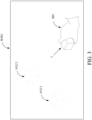
- the processor 13 generates a first virtual calibration coordinate VCC1 and a second virtual calibration coordinate VCC2.
- the first virtual calibration coordinate VCC1 and the second virtual calibration coordinate VCC2 correspond to the first coordinate system of the head-mounted device HMD.
- the virtual images corresponding to the tracking apparatus 2 are respectively displayed at the positions of the first virtual calibration coordinate VCC1 and the second virtual calibration coordinate VCC2.
- the hand HD of the user using the head-mounted device HMD holds the tracking apparatus 2 and prepares to move the tracking apparatus 2 to the positions of the first virtual calibration coordinate VCC1 and the second virtual calibration coordinate VCC2.
- the head-mounted device HMD may be a VR/MR/AR head-mounted device HMD, and the head-mounted device HMD can allow the user to see the hand HD through an optical see-through operation or a video see-through operation.
- the processor 13 determines whether the tracking apparatus 2 has moved to the first virtual calibration coordinate VCC1 (e.g., the tracking apparatus 2 is overlapped with the virtual image). In response to the processor 13 determining that the tracking apparatus 2 has moved to the first virtual calibration coordinate VCC1, the processor 13 receives/records/stores the first sensing coordinate SC1 corresponding to the first virtual calibration coordinate VCC1 from the tracking apparatus 2 (i.e., the actual coordinates sensed by the tracking apparatus 2 at this location).
- the processor 13 may continuously receive pose data from the tracking apparatus 2.
- the processor 13 determines a time point that the tracking apparatus 2 moves to the first virtual calibration coordinate VCC1
- the processor 13 records/stores the pose data (i.e., including the first sensing coordinate SC1 corresponding to the first virtual calibration coordinate VCC1) at the time point.
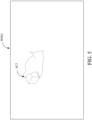
- the processor 13 determines whether the tracking apparatus 2 has moved to the second virtual calibration coordinate VCC2. In response to the processor 13 determining that the tracking apparatus 2 has moved to the second virtual calibration coordinate VCC2, the processor 13 receives/records/stores the second sensing coordinate SC2 corresponding to the second virtual calibration coordinate VCC2 from the tracking apparatus 2 (i.e., the actual coordinates sensed by the tracking apparatus 2 at this location).
- the processor 13 may determine that the tracking apparatus 2 has moved to the virtual calibration coordinates through different preset methods. For example, in some embodiments, the processor 13 may determine that the tracking apparatus 2 has moved to the virtual calibration coordinates through images captured by the head-mounted device HMD. For another example, the processor 13 may determine that the tracking apparatus 2 has moved to the virtual calibration coordinates by determining that the tracking apparatus 2 has stopped returning movement information.
- a button can be further provided on the tracking apparatus 2. After the user moves the position of the tracking apparatus 2, the user touches the button to send a notification signal to the coordinate system offset calculating apparatus 1 to notify the coordinate system offset calculating apparatus 1 that the movement operation is completed.
- the processor 13 since positioning is performed through at least two specific positions (i.e., virtual calibration coordinates), the processor 13 does not need to perform orientation positioning on the tracking apparatus 2 (i.e., it is not necessary to align the facing direction of the tracking apparatus 2) when determining whether to move to the virtual calibration coordinates (i.e., the alignment operation), but only needs to determine whether the positions of the tracking apparatus 2 have overlapped.
- the coordinate system offset calculating apparatus 1 may use a plurality of virtual calibration coordinates to perform offset calculation operations, the tracking apparatus 2 may generate a plurality of corresponding sensing coordinates, and each of the virtual calibration coordinates corresponds to one of the sensing coordinates.
- the virtual calibration coordinates comprise a first virtual calibration coordinate and a second virtual calibration coordinate
- the sensing coordinates comprise a first sensing coordinate and a second sensing coordinate
- the first virtual calibration coordinate corresponds to the first sensing coordinate
- the second virtual calibration coordinate corresponds to the second sensing coordinate.
- FIG. 3 is only an example.
- the actual operations can be carried out according to different virtual calibration coordinate movement sequences without affecting the results of the operations.
- the processor 13 determines whether the tracking apparatus 2 has moved to the first virtual calibration coordinate VCC1 and the second virtual calibration coordinate VCC2.
- the processor 13 receives/records/stores the first sensing coordinate SC1 and the second sensing coordinate SC2 corresponding to the first virtual calibration coordinate VCC1 and the second virtual calibration coordinate VCC2 from the tracking apparatus 2.
- the first sensing coordinate SC1 and the second sensing coordinate SC2 are generated by the tracking apparatus 2, and the first sensing coordinate SC1 and the second sensing coordinate SC2 correspond to a second coordinate system.
- the processor 13 calculates a coordinate system offset corresponding to the first coordinate system and the second coordinate system based on the virtual calibration coordinates (i.e., the first virtual calibration coordinates VCC1 and the second virtual calibration coordinates VCC2) and the sensing coordinates (i.e., the first sensing coordinate SC1 and the second sensing coordinate SC2).
- the coordinate system offset calculated by the processor 13 comprises a displacement difference and an angle difference. Specifically, the processor 13 calculates a displacement difference and an angle difference based on the virtual calibration coordinates and the sensing coordinates. Next, the processor 13 calculates the coordinate system offset based on the displacement difference (i.e., movement value) and the angle difference (i.e., rotation value).
- the coordinate system offset can be represented by a transformation matrix to perform a transformation operation.
- the processor 13 can transform the coordinate values from the second coordinate system to the first coordinate system through the transformation matrix.
- the processor 13 calculates a first-dimensional displacement difference, a second-dimensional displacement difference, and a third-dimensional displacement difference corresponding to a three-dimensional space based on the first virtual calibration coordinate VCC1 and the first sensing coordinate SC1. Next, the processor 13 calculates the displacement difference based on the first-dimensional displacement difference, the second-dimensional displacement difference, and the third-dimensional displacement difference.
- the processor 13 calculates a vector angle difference between a virtual calibration vector and a sensing vector in a two-dimensional space, wherein the virtual calibration vector is composed of the first virtual calibration coordinate VCC1 and the second virtual calibration coordinate VCC2, and the sensing vector is composed of the first sensing coordinate SC1 and the second sensing coordinate SC2. Next, the processor 13 calculates the angle difference based on the vector angle difference.
- the tracking apparatus 2 and the head-mounted device HMD have been aligned in one of the directional dimensions (e.g., the vertical directional dimension), only the values of the other two directional dimensions need to be considered.
- the directions with respect to the vertical dimension (e.g., the gravity dimension in the third dimension) in the coordinate systems they generate are the same (i.e., both of the direction of gravity are -G).
- the third dimensional direction corresponding to the first coordinate system is the same as the third dimensional direction corresponding to the second coordinate system. Therefore, when calculating the angle difference, the processor 13 only needs to consider the values of the other two direction dimensions.
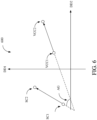
- the schematic view 600 depicting the top view of corresponding coordinates in FIG. 6 .
- the schematic view 600 is a top view in a three-dimensional space (i.e., the vertical dimension is not considered), the Y-axis is the direction dimension DD1, and the X-axis is the direction dimension DD2.
- the schematic view 600 shows the actual positions of the first virtual calibration coordinate VCC1 and the second virtual calibration coordinate VCC2 in the space and the actual positions of the first sensing coordinate SC1 and the second sensing coordinate SC2 in the space. It shall be appreciated that the schematic view 600 is only a top view without losing the information on the vertical dimension.
- the first virtual calibration coordinate VCC1, the second virtual calibration coordinate VCC2, the first sensing coordinate SC1, and the second sensing coordinate SC2 are still coordinate values in a three-dimensional space.
- the processor 13 may calculate the displacement difference between the first virtual calibration coordinate VCC1 and the first sensing coordinate SC1 in the X dimension (i.e., the direction dimension DD2), the Y dimension (i.e., the direction dimension DD1), and the Z dimension (i.e., the vertical direction dimension) based on the coordinate difference between the first virtual calibration coordinate VCC1 and the first sensing coordinate SC1 in the three-dimensional space.
- the X dimension i.e., the direction dimension DD2
- the Y dimension i.e., the direction dimension DD1
- the Z dimension i.e., the vertical direction dimension
- the processor 13 may calculate the angle value that needs to be rotated (i.e., the angle difference) based on the vector angle difference AG of the virtual calibration vector (i.e., composed of the first virtual calibration coordinate VCC1 and the second virtual calibration coordinate VCC2) and the sensing vector (i.e., composed of the first sensing coordinate SC1 and the second sensing coordinate SC2).
- the processor 13 may further calculate the offset of the scale difference. Specifically, the processor 13 calculates a vector length difference between a virtual calibration vector and a sensing vector, wherein the virtual calibration vector is composed of the first virtual calibration coordinate and the second virtual calibration coordinate, and the sensing vector is composed of the first sensing coordinate and the second sensing coordinate. Next, the processor 13 calculates the scale difference based on the vector length difference.
- the processor 13 calculates a scale difference based on the at least two virtual calibration coordinates and the at least two sensing coordinates. Next, the processor 13 calculates the coordinate system offset based on the displacement difference, the angle difference, and the scale difference.
- the sensing coordinates are generated by the tracking apparatus 2 based on a plurality of positioning information.
- the sensing coordinates can be generated by the tracking apparatus 2 based on the positioning information of a plurality of real-time images (e.g., the operation of simultaneous localization and mapping (SLAM)).
- the sensing coordinates may be generated by the tracking apparatus 2 based on positioning information (e.g., the lighthouse positioning technology provided by HTC) received from an external device (e.g., an infrared device).
- the coordinate system offset calculating apparatus 1 provided by the present disclosure calculates the coordinate system offset corresponding to the first coordinate system and the second coordinate system through at least two virtual calibration coordinates and at least two sensing coordinates generated by the tracking apparatus. Since the coordinate system offset calculating apparatus 1 provided by the present disclosure can calculate the coordinate system offset of different coordinate systems, it improves the accuracy of interaction device and improves the user's service experience.
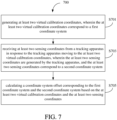
- a second embodiment of the present disclosure is a coordinate system offset calculating method and a flowchart thereof is depicted in FIG. 7 .
- the coordinate system offset calculating method 700 is adapted for an electronic apparatus (e.g., the coordinate system offset calculating apparatus 1 of the first embodiment).
- the coordinate system offset calculating method 700 calculates a coordinate system offset through the steps S701 to S705.
- the electronic apparatus In the step S701, the electronic apparatus generates at least two virtual calibration coordinates, wherein the at least two virtual calibration coordinates correspond to a first coordinate system.
- the electronic apparatus receives at least two sensing coordinates from a tracking apparatus in response to the tracking apparatus moving to the at least two virtual calibration coordinates, wherein the at least two sensing coordinates are generated by the tracking apparatus, and the at least two sensing coordinates correspond to a second coordinate system.
- the electronic apparatus calculates a coordinate system offset corresponding to the first coordinate system and the second coordinate system based on the at least two virtual calibration coordinates and the at least two sensing coordinates.
- the coordinate system offset calculating method 700 further comprises the following steps: in response to determining the tracking apparatus moves to a first virtual calibration coordinate among the at least two virtual calibration coordinates, receiving/recording/storing a first sensing coordinate corresponding to the first virtual calibration coordinate from the tracking apparatus; and in response to determining the tracking apparatus moves to a second virtual calibration coordinate among the at least two virtual calibration coordinates, receiving/recording/storing a second sensing coordinate corresponding to the second virtual calibration coordinate from the tracking apparatus.
- a third dimensional direction corresponding to the first coordinate system is the same as the third dimensional direction corresponding to the second coordinate system.
- step of calculating the coordinate system offset further comprises the following steps: calculating a displacement difference and an angle difference based on the at least two virtual calibration coordinates and the at least two sensing coordinates; and calculating the coordinate system offset based on the displacement difference and the angle difference.
- the at least two virtual calibration coordinates comprise a first virtual calibration coordinate and a second virtual calibration coordinate
- the at least two sensing coordinates comprise a first sensing coordinate and a second sensing coordinate
- the first virtual calibration coordinate corresponds to the first sensing coordinate
- the second virtual calibration coordinate corresponds to the second sensing coordinate
- step of calculating the displacement difference further comprises the following steps: calculating a first-dimensional displacement difference, a second-dimensional displacement difference, and a third-dimensional displacement difference corresponding to a three-dimensional space based on the first virtual calibration coordinate and the first sensing coordinate; and calculating the displacement difference based on the first-dimensional displacement difference, the second-dimensional displacement difference, and the third-dimensional displacement difference.
- the step of calculating the angle difference further comprises the following steps: calculating a vector angle difference between a virtual calibration vector and a sensing vector in a two-dimensional space, wherein the virtual calibration vector is composed of the first virtual calibration coordinate and the second virtual calibration coordinate, and the sensing vector is composed of the first sensing coordinate and the second sensing coordinate; and calculating the angle difference based on the vector angle difference.
- step of calculating the coordinate system offset further comprises the following steps: calculating a scale difference based on the at least two virtual calibration coordinates and the at least two sensing coordinates; and calculating the coordinate system offset based on the displacement difference, the angle difference, and the scale difference.
- the step of calculating the scale difference further comprises the following steps: calculating a vector length difference between a virtual calibration vector and a sensing vector, wherein the virtual calibration vector is composed of the first virtual calibration coordinate and the second virtual calibration coordinate, and the sensing vector is composed of the first sensing coordinate and the second sensing coordinate; and calculating the scale difference based on the vector length difference.
- the second embodiment can also execute all the operations and steps of the coordinate system offset calculating apparatus 1 set forth in the first embodiment, have the same functions, and deliver the same technical effects as the first embodiment. How the second embodiment executes these operations and steps, has the same functions, and delivers the same technical effects will be readily appreciated by those of ordinary skill in the art based on the explanation of the first embodiment. Therefore, the details will not be repeated herein.
- the coordinate system offset calculating method described in the second embodiment may be implemented by a computer program having a plurality of codes.
- the computer program may be a file that can be transmitted over the network, or may be stored into a non-transitory computer readable storage medium.
- the codes of the computer program are loaded into an electronic apparatus (e.g., the coordinate system offset calculating apparatus 1), the computer program executes the coordinate system offset calculating method as described in the second embodiment.
- the non-transitory computer readable storage medium may be an electronic product, e.g., a read only memory (ROM), a flash memory, a floppy disk, a hard disk, a compact disk (CD), a mobile disk, a database accessible to networks, or any other storage medium with the same function and well known to those of ordinary skill in the art.
- ROM read only memory
- flash memory e.g., a hard disk, a compact disk (CD), a mobile disk, a database accessible to networks, or any other storage medium with the same function and well known to those of ordinary skill in the art.
- CD compact disk
- the coordinate system offset calculating technology (at least including the apparatus, the method, and the non-transitory computer readable storage medium) provided by the present disclosure calculates the coordinate system offset corresponding to the first coordinate system and the second coordinate system through at least two virtual calibration coordinates and at least two sensing coordinates generated by the tracking apparatus. Since the coordinate system offset calculating technology provided by the present disclosure can calculate the coordinate system offset of different coordinate systems, it improves the accuracy of interaction device and improves the user's service experience.
Landscapes
- Engineering & Computer Science (AREA)
- Theoretical Computer Science (AREA)
- Physics & Mathematics (AREA)
- General Physics & Mathematics (AREA)
- General Engineering & Computer Science (AREA)
- Computer Vision & Pattern Recognition (AREA)
- Human Computer Interaction (AREA)
- Geometry (AREA)
- Software Systems (AREA)
- Computer Hardware Design (AREA)
- Multimedia (AREA)
- Computer Graphics (AREA)
- User Interface Of Digital Computer (AREA)
- Length Measuring Devices By Optical Means (AREA)
- Navigation (AREA)
- Position Input By Displaying (AREA)
- Image Analysis (AREA)
Applications Claiming Priority (1)
| Application Number | Priority Date | Filing Date | Title |
|---|---|---|---|
| US18/476,334 US12511763B2 (en) | 2023-09-28 | 2023-09-28 | Coordinate system offset calculating apparatus, method, and non-transitory computer readable storage medium thereof |
Publications (3)
| Publication Number | Publication Date |
|---|---|
| EP4530800A1 true EP4530800A1 (de) | 2025-04-02 |
| EP4530800C0 EP4530800C0 (de) | 2025-12-10 |
| EP4530800B1 EP4530800B1 (de) | 2025-12-10 |
Family
ID=90880669
Family Applications (1)
| Application Number | Title | Priority Date | Filing Date |
|---|---|---|---|
| EP24172262.8A Active EP4530800B1 (de) | 2023-09-28 | 2024-04-24 | Vorrichtung zur berechnung eines koordinatensystemversatzes, verfahren und nichttransitorisches computerlesbares speichermedium dafür |
Country Status (4)
| Country | Link |
|---|---|
| US (1) | US12511763B2 (de) |
| EP (1) | EP4530800B1 (de) |
| CN (1) | CN119714152A (de) |
| TW (1) | TWI885733B (de) |
Families Citing this family (2)
| Publication number | Priority date | Publication date | Assignee | Title |
|---|---|---|---|---|
| US12511763B2 (en) * | 2023-09-28 | 2025-12-30 | Htc Corporation | Coordinate system offset calculating apparatus, method, and non-transitory computer readable storage medium thereof |
| CN117475007A (zh) * | 2023-10-08 | 2024-01-30 | 北京字跳网络技术有限公司 | 一种环境标定方法、装置、设备及存储介质 |
Citations (3)
| Publication number | Priority date | Publication date | Assignee | Title |
|---|---|---|---|---|
| US20020113756A1 (en) * | 2000-09-25 | 2002-08-22 | Mihran Tuceryan | System and method for calibrating a stereo optical see-through head-mounted display system for augmented reality |
| US20170357334A1 (en) * | 2016-06-09 | 2017-12-14 | Alexandru Octavian Balan | Modular extension of inertial controller for six dof mixed reality input |
| US20180329484A1 (en) * | 2017-05-09 | 2018-11-15 | Microsoft Technology Licensing, Llc | Object and environment tracking via shared sensor |
Family Cites Families (27)
| Publication number | Priority date | Publication date | Assignee | Title |
|---|---|---|---|---|
| JP2812978B2 (ja) * | 1989-03-27 | 1998-10-22 | キヤノン株式会社 | 座標入力装置及びその入力座標の較正方法 |
| JPH11212714A (ja) * | 1998-01-27 | 1999-08-06 | Sanyo Electric Co Ltd | 座標検出装置および座標検出方法 |
| US6757068B2 (en) * | 2000-01-28 | 2004-06-29 | Intersense, Inc. | Self-referenced tracking |
| US6809726B2 (en) * | 2000-12-11 | 2004-10-26 | Xerox Corporation | Touchscreen display calibration using results history |
| US7542040B2 (en) * | 2004-08-11 | 2009-06-02 | The United States Of America As Represented By The Secretary Of The Navy | Simulated locomotion method and apparatus |
| JP5230114B2 (ja) * | 2007-03-13 | 2013-07-10 | キヤノン株式会社 | 情報処理装置、情報処理方法 |
| US9067097B2 (en) * | 2009-04-10 | 2015-06-30 | Sovoz, Inc. | Virtual locomotion controller apparatus and methods |
| US8854433B1 (en) * | 2012-02-03 | 2014-10-07 | Aquifi, Inc. | Method and system enabling natural user interface gestures with an electronic system |
| US10304248B2 (en) * | 2014-06-26 | 2019-05-28 | Korea Advanced Institute Of Science And Technology | Apparatus and method for providing augmented reality interaction service |
| US10310595B2 (en) * | 2014-06-30 | 2019-06-04 | Sony Corporation | Information processing apparatus, information processing method, computer program, and image processing system |
| US10324522B2 (en) * | 2015-11-25 | 2019-06-18 | Jakob Balslev | Methods and systems of a motion-capture body suit with wearable body-position sensors |
| US10592048B2 (en) * | 2016-05-17 | 2020-03-17 | Google Llc | Auto-aligner for virtual reality display |
| CN108733206B (zh) | 2017-04-25 | 2020-10-30 | 广东虚拟现实科技有限公司 | 一种坐标对齐方法、系统和虚拟现实系统 |
| KR102670987B1 (ko) * | 2017-05-31 | 2024-05-30 | 매직 립, 인코포레이티드 | 눈 추적 교정 기술들 |
| CN110494792B (zh) * | 2018-03-07 | 2021-07-09 | 奇跃公司 | 外围设备的视觉跟踪 |
| CN112106103B (zh) * | 2018-05-11 | 2024-09-06 | 莱斯特有限公司 | 用于确定坐标系之间的近似变换的系统和方法 |
| US10535199B1 (en) * | 2018-06-18 | 2020-01-14 | Facebook Technologies, Llc | Systems and methods for determining a safety boundary for a mobile artificial reality user |
| CN110636506A (zh) * | 2018-06-22 | 2019-12-31 | 维沃移动通信有限公司 | 网络接入方法、终端及网络侧网元 |
| KR102503976B1 (ko) * | 2018-07-02 | 2023-02-28 | 한국전자통신연구원 | 증강현실 영상 보정 장치 및 방법 |
| CN109145566A (zh) | 2018-09-08 | 2019-01-04 | 太若科技(北京)有限公司 | 基于注视点信息解锁ar眼镜的方法、装置及ar眼镜 |
| US10817047B2 (en) | 2018-09-19 | 2020-10-27 | XRSpace CO., LTD. | Tracking system and tacking method using the same |
| US11756259B2 (en) * | 2019-04-17 | 2023-09-12 | Rakuten Group, Inc. | Display controlling device, display controlling method, program, and non-transitory computer-readable information recording medium |
| CN114730482B (zh) * | 2019-11-27 | 2025-02-14 | Oppo广东移动通信有限公司 | 关联多人增强现实系统中的设备坐标系 |
| TWI755765B (zh) * | 2020-06-22 | 2022-02-21 | 中強光電股份有限公司 | 視覺與深度座標系的校正系統、校正方法及校正裝置 |
| US11567163B2 (en) * | 2021-04-07 | 2023-01-31 | Zebra Technologies Corporation | Mobile device locationing |
| WO2023043442A1 (en) | 2021-09-16 | 2023-03-23 | Hewlett-Packard Development Company, L.P. | Correcting raw coordinates of facial feature point |
| US12511763B2 (en) * | 2023-09-28 | 2025-12-30 | Htc Corporation | Coordinate system offset calculating apparatus, method, and non-transitory computer readable storage medium thereof |
-
2023
- 2023-09-28 US US18/476,334 patent/US12511763B2/en active Active
-
2024
- 2024-02-02 TW TW113104266A patent/TWI885733B/zh active
- 2024-02-02 CN CN202410152881.2A patent/CN119714152A/zh active Pending
- 2024-04-24 EP EP24172262.8A patent/EP4530800B1/de active Active
Patent Citations (3)
| Publication number | Priority date | Publication date | Assignee | Title |
|---|---|---|---|---|
| US20020113756A1 (en) * | 2000-09-25 | 2002-08-22 | Mihran Tuceryan | System and method for calibrating a stereo optical see-through head-mounted display system for augmented reality |
| US20170357334A1 (en) * | 2016-06-09 | 2017-12-14 | Alexandru Octavian Balan | Modular extension of inertial controller for six dof mixed reality input |
| US20180329484A1 (en) * | 2017-05-09 | 2018-11-15 | Microsoft Technology Licensing, Llc | Object and environment tracking via shared sensor |
Also Published As
| Publication number | Publication date |
|---|---|
| EP4530800C0 (de) | 2025-12-10 |
| US12511763B2 (en) | 2025-12-30 |
| TWI885733B (zh) | 2025-06-01 |
| US20250111522A1 (en) | 2025-04-03 |
| TW202514332A (zh) | 2025-04-01 |
| EP4530800B1 (de) | 2025-12-10 |
| CN119714152A (zh) | 2025-03-28 |
Similar Documents
| Publication | Publication Date | Title |
|---|---|---|
| EP3786895B1 (de) | Verfahren, vorrichtung und einrichtung zur neupositionierung in einem kameraausrichtungsverfolgungsverfahren und speichermedium | |
| US11625841B2 (en) | Localization and tracking method and platform, head-mounted display system, and computer-readable storage medium | |
| EP4530800A1 (de) | Vorrichtung zur berechnung eines koordinatensystemversatzes, verfahren und nichttransitorisches computerlesbares speichermedium dafür | |
| EP4026092B1 (de) | Szenenverriegelungsmodus zur aufnahme von kamerabildern | |
| WO2022073427A1 (zh) | 物体抓取点的视觉定位方法、装置、存储介质及电子设备 | |
| CN110986969B (zh) | 地图融合方法及装置、设备、存储介质 | |
| CN110322500A (zh) | 即时定位与地图构建的优化方法及装置、介质和电子设备 | |
| WO2014176054A1 (en) | Localization systems and methods | |
| KR20240145034A (ko) | 가상 장면에서의 입력 식별 방법, 기기 및 저장 매체 | |
| EP3343242B1 (de) | Verfolgungssystem, verfolgungsvorrichtung und verfolgungsverfahren | |
| US20230316677A1 (en) | Methods, devices, apparatuses, and storage media for virtualization of input devices | |
| CN110349212A (zh) | 即时定位与地图构建的优化方法及装置、介质和电子设备 | |
| WO2022147655A1 (zh) | 定位方法、空间信息获取方法、装置、拍摄设备 | |
| CN110570465A (zh) | 实时定位与地图构建方法、装置及计算机可读存储介质 | |
| WO2023160301A1 (zh) | 物体信息确定方法、移动机器人系统及电子设备 | |
| US11366450B2 (en) | Robot localization in a workspace via detection of a datum | |
| US12332432B2 (en) | Tracking apparatus, method, and non-transitory computer readable storage medium thereof | |
| US11501459B2 (en) | Information processing apparatus, method of information processing, and information processing system | |
| CN113432620B (zh) | 误差估计方法、装置、车载终端及存储介质 | |
| CN108734721B (zh) | 追踪系统以及追踪方法 | |
| CN114187509B (zh) | 对象定位方法、装置、电子设备以及存储介质 | |
| WO2016018330A1 (en) | Accurately positioning instruments | |
| KR102084161B1 (ko) | 이미지를 보정하는 전자 장치 및 그 제어 방법 | |
| US12260498B1 (en) | Method and system for identifying and tracking an object in space and generating digital twin contents including a corresponding object with regard to the space | |
| KR20230127830A (ko) | 전자 기기에 의해 수행되는 방법, 전자 기기 및 저장 매체 |
Legal Events
| Date | Code | Title | Description |
|---|---|---|---|
| STAA | Information on the status of an ep patent application or granted ep patent |
Free format text: STATUS: EXAMINATION IS IN PROGRESS |
|
| PUAI | Public reference made under article 153(3) epc to a published international application that has entered the european phase |
Free format text: ORIGINAL CODE: 0009012 |
|
| 17P | Request for examination filed |
Effective date: 20240424 |
|
| AK | Designated contracting states |
Kind code of ref document: A1 Designated state(s): AL AT BE BG CH CY CZ DE DK EE ES FI FR GB GR HR HU IE IS IT LI LT LU LV MC ME MK MT NL NO PL PT RO RS SE SI SK SM TR |
|
| GRAP | Despatch of communication of intention to grant a patent |
Free format text: ORIGINAL CODE: EPIDOSNIGR1 |
|
| STAA | Information on the status of an ep patent application or granted ep patent |
Free format text: STATUS: GRANT OF PATENT IS INTENDED |
|
| GRAJ | Information related to disapproval of communication of intention to grant by the applicant or resumption of examination proceedings by the epo deleted |
Free format text: ORIGINAL CODE: EPIDOSDIGR1 |
|
| STAA | Information on the status of an ep patent application or granted ep patent |
Free format text: STATUS: EXAMINATION IS IN PROGRESS |
|
| GRAP | Despatch of communication of intention to grant a patent |
Free format text: ORIGINAL CODE: EPIDOSNIGR1 |
|
| STAA | Information on the status of an ep patent application or granted ep patent |
Free format text: STATUS: GRANT OF PATENT IS INTENDED |
|
| INTG | Intention to grant announced |
Effective date: 20250530 |
|
| INTC | Intention to grant announced (deleted) | ||
| INTG | Intention to grant announced |
Effective date: 20250702 |
|
| GRAS | Grant fee paid |
Free format text: ORIGINAL CODE: EPIDOSNIGR3 |
|
| GRAA | (expected) grant |
Free format text: ORIGINAL CODE: 0009210 |
|
| STAA | Information on the status of an ep patent application or granted ep patent |
Free format text: STATUS: THE PATENT HAS BEEN GRANTED |
|
| AK | Designated contracting states |
Kind code of ref document: B1 Designated state(s): AL AT BE BG CH CY CZ DE DK EE ES FI FR GB GR HR HU IE IS IT LI LT LU LV MC ME MK MT NL NO PL PT RO RS SE SI SK SM TR |
|
| REG | Reference to a national code |
Ref country code: CH Ref legal event code: F10 Free format text: ST27 STATUS EVENT CODE: U-0-0-F10-F00 (AS PROVIDED BY THE NATIONAL OFFICE) Effective date: 20251210 Ref country code: GB Ref legal event code: FG4D |
|
| REG | Reference to a national code |
Ref country code: DE Ref legal event code: R096 Ref document number: 602024001587 Country of ref document: DE |
|
| REG | Reference to a national code |
Ref country code: IE Ref legal event code: FG4D |
|
| U01 | Request for unitary effect filed |
Effective date: 20260107 |
|
| U07 | Unitary effect registered |
Designated state(s): AT BE BG DE DK EE FI FR IT LT LU LV MT NL PT RO SE SI Effective date: 20260113 |
|
| PG25 | Lapsed in a contracting state [announced via postgrant information from national office to epo] |
Ref country code: ES Free format text: LAPSE BECAUSE OF FAILURE TO SUBMIT A TRANSLATION OF THE DESCRIPTION OR TO PAY THE FEE WITHIN THE PRESCRIBED TIME-LIMIT Effective date: 20251210 |
|
| PG25 | Lapsed in a contracting state [announced via postgrant information from national office to epo] |
Ref country code: NO Free format text: LAPSE BECAUSE OF FAILURE TO SUBMIT A TRANSLATION OF THE DESCRIPTION OR TO PAY THE FEE WITHIN THE PRESCRIBED TIME-LIMIT Effective date: 20260310 |
|
| PG25 | Lapsed in a contracting state [announced via postgrant information from national office to epo] |
Ref country code: HR Free format text: LAPSE BECAUSE OF FAILURE TO SUBMIT A TRANSLATION OF THE DESCRIPTION OR TO PAY THE FEE WITHIN THE PRESCRIBED TIME-LIMIT Effective date: 20251210 |
|
| U20 | Renewal fee for the european patent with unitary effect paid |
Year of fee payment: 3 Effective date: 20260310 |
|
| PG25 | Lapsed in a contracting state [announced via postgrant information from national office to epo] |
Ref country code: RS Free format text: LAPSE BECAUSE OF FAILURE TO SUBMIT A TRANSLATION OF THE DESCRIPTION OR TO PAY THE FEE WITHIN THE PRESCRIBED TIME-LIMIT Effective date: 20260310 |