EP4530754A1 - Entwicklungsvorrichtung und bilderzeugungsvorrichtung - Google Patents
Entwicklungsvorrichtung und bilderzeugungsvorrichtung Download PDFInfo
- Publication number
- EP4530754A1 EP4530754A1 EP24156329.5A EP24156329A EP4530754A1 EP 4530754 A1 EP4530754 A1 EP 4530754A1 EP 24156329 A EP24156329 A EP 24156329A EP 4530754 A1 EP4530754 A1 EP 4530754A1
- Authority
- EP
- European Patent Office
- Prior art keywords
- unit
- developing
- guide path
- developing unit
- image carrier
- Prior art date
- Legal status (The legal status is an assumption and is not a legal conclusion. Google has not performed a legal analysis and makes no representation as to the accuracy of the status listed.)
- Pending
Links
Images








Classifications
-
- G—PHYSICS
- G03—PHOTOGRAPHY; CINEMATOGRAPHY; ANALOGOUS TECHNIQUES USING WAVES OTHER THAN OPTICAL WAVES; ELECTROGRAPHY; HOLOGRAPHY
- G03G—ELECTROGRAPHY; ELECTROPHOTOGRAPHY; MAGNETOGRAPHY
- G03G21/00—Arrangements not provided for by groups G03G13/00 - G03G19/00, e.g. cleaning, elimination of residual charge
- G03G21/16—Mechanical means for facilitating the maintenance of the apparatus, e.g. modular arrangements
- G03G21/18—Mechanical means for facilitating the maintenance of the apparatus, e.g. modular arrangements using a processing cartridge, whereby the process cartridge comprises at least two image processing means in a single unit
- G03G21/1803—Arrangements or disposition of the complete process cartridge or parts thereof
- G03G21/1817—Arrangements or disposition of the complete process cartridge or parts thereof having a submodular arrangement
- G03G21/1821—Arrangements or disposition of the complete process cartridge or parts thereof having a submodular arrangement means for connecting the different parts of the process cartridge, e.g. attachment, positioning of parts with each other, pressure/distance regulation
-
- G—PHYSICS
- G03—PHOTOGRAPHY; CINEMATOGRAPHY; ANALOGOUS TECHNIQUES USING WAVES OTHER THAN OPTICAL WAVES; ELECTROGRAPHY; HOLOGRAPHY
- G03G—ELECTROGRAPHY; ELECTROPHOTOGRAPHY; MAGNETOGRAPHY
- G03G15/00—Apparatus for electrographic processes using a charge pattern
- G03G15/06—Apparatus for electrographic processes using a charge pattern for developing
- G03G15/08—Apparatus for electrographic processes using a charge pattern for developing using a solid developer, e.g. powder developer
- G03G15/0896—Arrangements or disposition of the complete developer unit or parts thereof not provided for by groups G03G15/08 - G03G15/0894
-
- G—PHYSICS
- G03—PHOTOGRAPHY; CINEMATOGRAPHY; ANALOGOUS TECHNIQUES USING WAVES OTHER THAN OPTICAL WAVES; ELECTROGRAPHY; HOLOGRAPHY
- G03G—ELECTROGRAPHY; ELECTROPHOTOGRAPHY; MAGNETOGRAPHY
- G03G15/00—Apparatus for electrographic processes using a charge pattern
- G03G15/06—Apparatus for electrographic processes using a charge pattern for developing
- G03G15/08—Apparatus for electrographic processes using a charge pattern for developing using a solid developer, e.g. powder developer
- G03G15/0822—Arrangements for preparing, mixing, supplying or dispensing developer
- G03G15/0865—Arrangements for supplying new developer
- G03G15/0867—Arrangements for supplying new developer cylindrical developer cartridges, e.g. toner bottles for the developer replenishing opening
- G03G15/087—Developer cartridges having a longitudinal rotational axis, around which at least one part is rotated when mounting or using the cartridge
- G03G15/0872—Developer cartridges having a longitudinal rotational axis, around which at least one part is rotated when mounting or using the cartridge the developer cartridges being generally horizontally mounted parallel to its longitudinal rotational axis
-
- G—PHYSICS
- G03—PHOTOGRAPHY; CINEMATOGRAPHY; ANALOGOUS TECHNIQUES USING WAVES OTHER THAN OPTICAL WAVES; ELECTROGRAPHY; HOLOGRAPHY
- G03G—ELECTROGRAPHY; ELECTROPHOTOGRAPHY; MAGNETOGRAPHY
- G03G21/00—Arrangements not provided for by groups G03G13/00 - G03G19/00, e.g. cleaning, elimination of residual charge
- G03G21/16—Mechanical means for facilitating the maintenance of the apparatus, e.g. modular arrangements
- G03G21/1661—Mechanical means for facilitating the maintenance of the apparatus, e.g. modular arrangements means for handling parts of the apparatus in the apparatus
- G03G21/1676—Mechanical means for facilitating the maintenance of the apparatus, e.g. modular arrangements means for handling parts of the apparatus in the apparatus for the developer unit
Definitions
- the present disclosure relates to a developing device and an image forming apparatus.
- An electrophotographic image forming apparatus includes an image carrier unit including an image carrier, and a developing unit including a developer holder. To provide an accurate interval (hereinafter referred to as a "clearance") between the image carrier and the developer holder, the image carrier unit and the developing unit are abutted against each other so that the developing unit is positioned and fixed.
- the image forming apparatus according to the related art is structured such that the developing unit is pressed against the image carrier unit by its own weight to prevent variations in the clearance due to a reaction force generated while a developing member is driven or an external force applied by another component of the image forming apparatus.
- Japanese Patent No. 4655569 describes an image forming apparatus including a developing-member support member that is restrained from moving in an up-down direction and movable in a left-right direction; a pressing-force generating member that presses the developing member against a photoconductor drum; and a tracking mechanism that maintains a distance between the photoconductor drum (image carrier) and a developing roller (developer holder) at a predetermined distance while a pressing force is applied by the pressing-force generating member.
- a center position of a photoconductor unit is at a height equal to or lower than a height of the developing roller, so that the developing-roller tracking member presses the photoconductor tracking member from above.
- a large image forming apparatus includes a large developing member, and therefore a large reaction force is generated when the developing member is driven. Accordingly, a complex mechanism is used to press the developing member against the photoconductor drum against the reaction force generated when the developing member is driven.
- a developing device including: an image carrier unit including an image carrier; a developing unit including a developer holder that supplies developer to the image carrier on which an electrostatic latent image is formed; a support unit that supports the developing unit such that the developing unit is movable back and forth toward and away from the image carrier unit; a first positioning unit provided on an end portion of the support unit, the end portion being adjacent to the image carrier unit, the first positioning unit positioning the developing unit; and a second positioning unit that positions the developing unit with a predetermined gap provided between the developer holder and the image carrier when the developing unit is positioned by the first positioning unit and leans toward the image carrier unit.
- the support unit includes a guide path that guides the developing unit, and the first positioning unit is structured such that the guide path includes an end portion inclined downward toward the image carrier unit, the first positioning unit including an abutting portion against which the developing unit is abutted at a location at which the guide path is inclined.
- the first positioning unit further includes a pressing member that restrains movement of the developing unit when the developing unit is abutted against the abutting portion.
- the guide path of the support unit includes two rails disposed parallel to each other and extending in a direction in which the developing unit moves back and forth, and the first positioning unit is structured such that each of the two rails includes an end portion that is inclined, and the abutting portion is provided on the end portion of one of the two rails.
- the developing unit is not fixed on one of the two rails of the first positioning unit that is not provided with the abutting portion.
- the support unit includes a lower guide path that supports and guides a lower portion of the developing unit and includes the first positioning unit, and an upper guide path that supports and guides an upper portion of the developing unit.
- the developing unit is separated from the upper guide path and leans toward the image carrier unit when the developing unit is positioned by the first positioning unit of the lower guide path.
- the upper guide path of the support unit is switchable between a contact state in which the upper guide path supports the developing unit and a retracted state in which the upper guide path is separated from the developing unit at least when the developing unit is positioned by the first positioning unit of the lower guide path.
- the upper guide path of the support unit includes two rails disposed parallel to each other and extending in a direction in which the developing unit moves back and forth.
- One of the two rails of the upper guide path is switchable between the contact state and the retracted state, and another one of the two rails of the upper guide path is shorter than a distance by which the developing unit moves and is not in contact with the developing unit when the developing unit is positioned by the first positioning unit of the lower guide path.
- the developing device further includes a drive mechanism that rotates a drive shaft of the developing unit to transmit a driving force to the developing unit.
- the drive mechanism is capable of changing a position of an axis center of a coupling portion that is connected to the drive shaft and that rotates the drive shaft.
- An image forming apparatus includes the developing device according to any one of the first to ninth aspects.
- the developing device of the first aspect of the present disclosure includes a structure for pressing the developing member against the photoconductor drum using the weight of the developing unit, the structure being simpler than a structure including a member for generating a pressing force for pressing the developing member against the photoconductor drum.
- the structure can be simplified compared to a structure including a mechanism for fixing the developing unit because the developing unit is positioned by its own weight.
- the movement of the developing unit can be more reliably restrained compared to when the movement of the developing unit is restrained only by the inclination of the guide path and the abutting portion.
- the structure can be simplified compared to a structure in which the abutting portion is provided on each rail.
- the developing unit can be more easily positioned and the load applied to the developing unit and the first positioning unit can be reduced compared to when the developing unit is fixed on each rail.
- the structure can be simplified compared to a structure including a mechanism for fixing the developing unit because the developing unit is positioned by its own weight.
- the leaning of the developing unit can be controlled.
- the structure can be simplified compared to a structure in which each rail is switchable between the contact state and the retracted state.
- the developing device of the ninth aspect of the present disclosure unlike the structure in which the position of the axis center of the drive mechanism is fixed, displacements in the axis center due to individual differences and changes over time in the developing unit can be compensated for.
- the image forming apparatus of the tenth aspect of the present disclosure includes the developing device including a structure for pressing the developing member against the photoconductor drum using the weight of the developing unit, the structure being simpler than a structure including a member for generating a pressing force for pressing the developing member against the photoconductor drum.
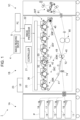
- Fig. 1 illustrates an image forming apparatus 1 to which the present exemplary embodiment is applied.
- the image forming apparatus 1 includes a paper feed unit 1A, a print unit 1B, and a paper output unit 1C.
- the paper feed unit 1A includes first to fourth paper storage members 11 to 14 that store paper sheets P serving as examples of recording media.
- the paper feed unit 1A includes feed rollers 15 to 18 provided for the first to fourth paper storage members 11 to 14, respectively, to deliver the paper sheets P stored in the respective paper storage members to a transport path connected to the print unit 1B.
- the print unit 1B includes an image forming section 20 in which an image is formed on each paper sheet P.
- the print unit 1B also includes a controller 21 that controls components of the image forming apparatus 1.
- the print unit 1B also includes an image processor 22.
- the image processor 22 performs an image process on image data transmitted from an image reading device 4 or a personal computer (PC) 5.
- the print unit 1B also includes a user interface (UI) 23 composed of, for example, a touch panel for presenting information to a user and receiving information from the user.
- UI user interface
- the image forming section 20, which is an example of image forming means, includes six image forming units 30T, 30P, 30Y, 30M, 30C, and 30K (hereinafter sometimes referred to simply as "image forming units 30") arranged in parallel with uniform spacing therebetween.
- Each image forming unit 30 includes a photoconductor drum 31 on which an electrostatic latent image is formed while the photoconductor drum 31 rotates in the direction of arrow A; a charging roller 32 that charges a surface of the photoconductor drum 31; a developing member 33 that develops the electrostatic latent image formed on the photoconductor drum 31; and a drum cleaner 34 the removes toner and the like from the surface of the photoconductor drum 31.
- the image forming section 20 also includes an exposure device 26 that exposes the photoconductor drum 31 of each image forming unit 30 to laser light.
- the light to which the photoconductor drum 31 is exposed by the exposure device 26 is not limited to laser light.
- a light source such as a light emitting diode (LED) may be provided for each image forming unit 30, and the photoconductor drum 31 may be exposed to light emitted from the light source.
- LED light emitting diode
- the image forming units 30 have the same structure except for the toner contained in the developing members 33.
- the image forming units 30Y, 30M, 30C, and 30K respectively form yellow (Y), magenta (M), cyan (C), and black (K) toner images.
- the image forming units 30T and 30P form toner images using, for example, toner of a corporate color, foaming toner for printing Braille characters, toner of a fluorescent color, or toner used to improve glossiness. In other words, the image forming units 30T and 30P form toner images using toners of special colors.
- the image forming section 20 also includes an intermediate transfer belt 41 to which the toner images of respective colors formed on the photoconductor drums 31 of the image forming units 30 are transferred.
- the image forming section 20 also includes first transfer rollers 42 that transfer the toner images of the respective colors formed by the image forming units 30 onto the intermediate transfer belt 41 in first transfer regions T1.
- the image forming section 20 also includes a second transfer roller 40 that simultaneously transfers the toner images transferred to the intermediate transfer belt 41 to the paper sheet P in a second transfer region T2.
- the image forming section 20 also includes a belt cleaner 45 that removes toners and the like from a surface of the intermediate transfer belt 41, and a fixing device 80 that fixes the images transferred to the paper sheet P in the second transfer process to the paper sheet P.
- the image forming section 20 performs an image forming operation based on a control signal transmitted from the controller 21. More specifically, first, the image forming section 20 causes the image processor 22 to perform the image process on the image data received from the image reading device 4 or the PC 5 and supply the resulting image data to the exposure device 26. Then, in, for example, the magenta (M) image forming unit 30M, the charging roller 32 charges the surface of the photoconductor drum 31, and the exposure device 26 irradiates the photoconductor drum 31 with laser light modulated based on the image data obtained from the image processor 22.
- M magenta
- an electrostatic latent image is formed on the photoconductor drum 31.
- the formed electrostatic latent image is developed by the developing member 33, so that a magenta toner image is formed on the photoconductor drum 31.
- the image forming units 30Y, 30C, and 30K respectively form yellow, cyan, and black toner images, and the image forming units 30T and 30P form toner images of special colors.
- the toner images of the respective colors formed by the image forming units 30 are successively electrostatically transferred to the intermediate transfer belt 41 rotating in the direction of arrow C in Fig. 1 by the first transfer rollers 42, so that the toner images are superposed on the intermediate transfer belt 41.
- the superposed toner images on the intermediate transfer belt 41 are transported toward the second transfer region T2 including the second transfer roller 40 and a backup roller 49 as the intermediate transfer belt 41 moves.
- the paper sheet P is fed from, for example, the first paper storage member 11 by the feed roller 15, and then is transported to the position of the registration roller 74 along the transport path.
- the registration roller 74 supplies the paper sheet P to the second transfer region T2 at the time when the superposed toner images are transported to the second transfer region T2.
- the superposed toner images are simultaneously electrostatically transferred to the paper sheet P by a transferring electric field formed between the second transfer roller 40 and the backup roller 49 in the second transfer region T2.
- the paper sheet P to which the superposed toner images have been electrostatically transferred is transported to the fixing device 80.
- the fixing device 80 performs a fixing process in which the paper sheet P having the unfixed toner images formed thereon is heated and pressed so that the toner images are fixed to the paper sheet P.
- the paper sheet P that has undergone the fixing process passes through a paper straightening section 81 provided in the paper output unit 1C, and is transported to a paper stacking portion (not illustrated).
- Fig. 2 illustrates the internal structure of the developing member 33.
- Fig. 2 is a perspective view of the developing member 33 viewed in the direction from the front (near side of Fig. 1 ) to the rear (far side of Fig. 1 ) of the print unit 1B included in the image forming apparatus 1 illustrated in Fig. 1 , and illustrates a sectional view taken at a location near the front end.
- the developing member 33 includes an accommodating unit 331 disposed adjacent to the photoconductor drum 31 and composed of a housing extending in the front-to-rear direction of the print unit 1B.
- the accommodating unit 331 has an opening 331a at a position facing the photoconductor drum 31.
- the accommodating unit 331 accommodates a developing roller 332, a pick-up roller 333, a first transport unit 334, a second transport unit 335, a third transport unit 336, a regulating member 337, and a removal member 338 together with developer.
- the members accommodated in the accommodating unit 331 are elongated members having similar lengths, and are disposed substantially parallel to each other.
- the developer contained in the accommodating unit 331 is a mixture of toner used to form an image and carrier composed of magnetic particles for carrying the toner.
- the developing member 33 is an example of a developing unit.
- the developing roller 332 includes a solid cylindrical shaft member and a hollow cylindrical sleeve that covers the shaft member.
- the developing roller 332 is disposed such that a side surface thereof is partially exposed at the opening 331a in the accommodating unit 331 and that the exposed surface faces the photoconductor drum 31.
- the shaft member of the developing roller 332 exerts a magnetic force, and the sleeve rotates around the shaft member in the direction shown by the arrow.
- the developing roller 332 causes the developer to adhere to the surface of the sleeve in response to the magnetic force of the shaft member, and rotates the sleeve to convey the developer to the opening 331a, so that the toner adheres to the charged photoconductor drum 31 to develop an electrostatic latent image.
- the developing roller 332 is an example of a developer holder.
- the pick-up roller 333 is disposed adjacent and parallel to the developing roller 332.
- the pick-up roller 333 includes a solid cylindrical shaft member and a hollow cylindrical sleeve that covers the shaft member.
- the shaft member exerts a magnetic force, and the sleeve rotates around the shaft member.
- the pick-up roller 333 causes the developer to adhere to the surface of the sleeve in response to the magnetic force of the shaft member, and rotates the sleeve to convey and transfer the developer to the developing roller 332.
- Each of the first transport unit 334, the second transport unit 335, and the third transport unit 336 is an auger having a helical blade around a rotating shaft.
- the first transport unit 334, the second transport unit 335, and the third transport unit 336 are disposed in the accommodating unit 331 such that rotating shafts thereof are parallel to the developing roller 332 and the pick-up roller 333.
- the first transport unit 334, the second transport unit 335, and the third transport unit 336 are rotated around the rotating shafts thereof so that the developer is stirred and transported in the directions along the rotating shafts of the transport units 334 to 336.
- the developer is transported along the first transport unit 334, the second transport unit 335, and the third transport unit 336 in that order as the first transport unit 334, the second transport unit 335, and the third transport unit 336 rotate, and is supplied from the third transport unit 336 to the pick-up roller 333.
- the regulating member 337 is disposed downstream of the position at which the developing roller 332 faces the pick-up roller 333 and upstream of the position at which the developing roller 332 faces the photoconductor drum 31 along the side surface of the developing roller 332.
- downstream and upstream respectively refer to downstream and upstream in the direction in which the developing roller 332 rotates.
- the regulating member 337 levels off the developer supplied by the pick-up roller 333 and held on the surface of the developing roller 332 so that the height of the developer is constant.
- the developer removed by the regulating member 337 is collected in the accommodating unit 331 and returned to the transport path composed of the first transport unit 334, the second transport unit 335, and the third transport unit 336.
- the removal member 338 is disposed downstream of the position at which the developing roller 332 faces the photoconductor drum 31 along the side surface of the developing roller 332.
- the term "downstream” refers to downstream in the direction in which the developing roller 332 rotates.
- the removal member 338 scrapes off the developer remaining on the surface of the developing roller 332 after the developer is supplied from the developing roller 332 to the photoconductor drum 31.
- the developer removed from the developing roller 332 by the removal member 338 is collected in the accommodating unit 331 and returned to the transport path composed of the first transport unit 334, the second transport unit 335, and the third transport unit 336.
- Fig. 3 illustrates an example of the structure of each image forming unit 30.
- Fig. 3 illustrates the photoconductor drum 31, the developing member 33, and the drum cleaner 34, but does not illustrate the charging roller 32.
- the photoconductor drum 31, the developing member 33, the drum cleaner 34, and the charging roller 32 extend in the front-to-rear direction of the print unit 1B.
- the photoconductor drum 31 and the developing member 33 are disposed adjacent to each other. More specifically, the photoconductor drum 31 and the developing member 33 are disposed so that axial directions of the photoconductor drum 31 and the developing roller 332 (see Fig. 2 ) of the developing member 33 are parallel and that a predetermined gap is provided between the surfaces of the photoconductor drum 31 and the developing roller 332.
- the gap between the photoconductor drum 31 and the developing roller 332 is, for example, 0.2 mm with a tolerance of about 30 ⁇ m.
- the drum cleaner 34 is disposed to face the developing member 33 with the photoconductor drum 31 disposed therebetween.
- the photoconductor drum 31 is rotatably supported at front and rear end portions by drum holders 311.
- Each of the front and rear drum holders 311 includes a contact support 312 used to position the developing member 33.
- Fig. 3 illustrates the contact support 312 included in the front drum holder 311.
- the photoconductor drum 31 and the drum holders 311 constitute an example of an image carrier unit.
- the contact support 312 is included in each of the front and rear drum holders 311, the contact support 312 may be included in only one of the front and rear drum holders 311.
- the developing member 33 is supported by a frame 330.
- the frame 330 is composed of members including front and rear members, each of which includes a contact portion 33a corresponding to the contact support 312 of the drum holder 311.
- Fig. 3 illustrates the contact portion 33a provided at the front.
- the developing member 33 is supported by the frame 330 and a portion of support member 50 positioned at the bottom of the developing member 33 such that the developing member 33 leans toward the photoconductor drum 31. Since the developing member 33 leans toward the photoconductor drum 31, the contact portion 33a abuts against the contact support 312 of the drum holder 311, so that the developing member 33 is positioned with respect to the photoconductor drum 31.
- the developing member 33 including the frame 330 is an example of a developing unit.
- the contact support 312 of the drum holder 311 and the contact portion 33a of the developing member 33 constitute an example a second positioning unit.
- the contact portion 33a is provided at both the front and rear of the frame 330; however, when the contact support 312 is provided only at the front or rear, the contact portion 33a may be provided only at the front or rear together with the contact support 312.
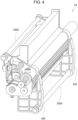
- Fig. 4 illustrates the overall structure of the developing member 33.
- Support rollers 330a and 330b for supporting the developing member 33 are respectively provided on lower and upper portions of the frame 330 that supports the developing member 33.
- the lower support roller 330a and the upper support roller 330b are placed on and supported by the support member 50 (see Fig. 3 ).
- the support member 50 includes rails that support the lower support roller 330a and the upper support roller 330b.
- the support member 50 includes, for example, two rails for each of the lower support roller 330a and the upper support roller 330b, the two rails being disposed at the front and rear of the print unit 1B.
- the lower support roller 330a and the upper support roller 330b are placed on the rails of the support member 50 so that the developing member 33 is movable along the rails of the support member 50.
- the support member 50 is an example of a support unit.
- the lower support roller 330a when the print unit 1B is viewed from the front, the lower support roller 330a is disposed at a lower right location, and the upper support roller 330b is disposed at an upper left location. More specifically, when a side of the developing member 33 at which the developing member 33 faces the photoconductor drum 31 (see Fig. 3 ) is referred to as one side, the lower support roller 330a is closer to the other side than the center of gravity of the developing member 33. The upper support roller 330b is closer to the one side than the center of gravity of the developing member 33. The position of the upper support roller 330b is not limited to the position illustrated in Fig.
- the upper support roller 330b is capable of stably supporting the developing member 33 together with the lower support roller 330a. Since the lower support roller 330a and the upper support roller 330b are provided as described above, the developing member 33 leans toward the one side when the upper support roller 330b is separated from the rails and when the developing member 33 is supported only by the lower support roller 330a closer to the other side than the center of gravity.
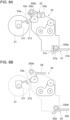
- Figs. 5A to 5D schematically illustrate support structures for the developing member 33, where Fig. 5A illustrates a front support structure for the lower support roller 330a, Fig. 5B illustrates a rear support structure for the lower support roller 330a, Fig. 5C illustrates a front support structure for the upper support roller 330b, and Fig. 5D illustrates a rear support structure for the upper support roller 330b.
- the support member 50 includes one rail at each of the front and rear ends of the lower support roller 330a, and one rail at each of the front and rear ends of the upper support roller 330b.
- first lower support 51 is referred to as a first lower support 51
- the rail at the rear of the lower support roller 330a illustrated in Fig. 5B is a second lower support 52
- the rail at the front of the upper support roller 330b illustrated in Fig. 5C is a first upper support 53
- a rail at the rear of the upper support roller 330b illustrated in Fig. 5D is a second upper support 54.
- the first lower support 51 includes an inclined portion 51a inclined downward toward an end at one end thereof, and a substantially horizontal retracting portion 51b at the other end thereof.
- An abutting portion 51c extending upward is formed at the end of the inclined portion 51a.
- the lower support roller 330a placed on the first lower support 51 is on the inclined portion 51a (as shown by the solid line in Fig. 5A ) during a normal image forming operation, and is retracted to the retracting portion 51b (as shown by the dashed line in Fig. 5A ) when the developing member 33 is pulled out of the print unit 1B, for example, for replacement of the components or the developer.
- the lower support roller 330a When the lower support roller 330a is on the inclined portion 51a, the lower support roller 330a receives a force in a downward direction (toward the end) along the inclined portion 51a due to the weight of the developing member 33.
- the lower support roller 330a is positioned by being abutted against the abutting portion 51c at the end of the inclined portion 51a.
- a pressing member 55 is attached to the first lower support 51 while the lower support roller 330a is abutted against the abutting portion 51c, so that the movement of the lower support roller 330a is restrained by the pressing member 55.
- the second lower support 52 includes an inclined portion 52a inclined downward toward an end at one end thereof, and a substantially horizontal retracting portion 52b at the other end thereof.
- the positions and lengths of the inclined portion 52a and the retracting portion 52b correspond to those of the inclined portion 51a and the retracting portion 5 1b of the first lower support 51 described above with reference to Fig. 5A .
- the lower support roller 330a placed on the second lower support 52 is on the inclined portion 52a (as shown by the solid line in Fig. 5B ) during the normal image forming operation, and is retracted to the retracting portion 52b (as shown by the dashed line in Fig. 5B ) when the developing member 33 is pulled out of the print unit 1B, for example, for replacement of the components or the developer.
- the second lower support 52 includes no structures for restraining the movement of the lower support roller 330a. Therefore, the lower support roller 330a is movable along the inclined portion 52a of the second lower support 52 in a normal operation. Thus, the lower support roller 330a is positioned simply by being placed on the second lower support 52, and is positioned more loosely by the second lower support 52 than by the first lower support 51. The reason for this is to prevent the developing member 33 from receiving an excessive physical load.
- the developing member 33 is positioned at four locations by the contact supports 312 of the drum holders 311, the contact portions 33a of the frame 330 of the developing member 33, the first lower support 51, and the second lower support 52.
- the lower support roller 330a is loosely positioned by the second lower support 52 to reduce the load on the developing member 33.
- the first lower support 51 and the second lower support 52 constitute an example of a lower guide path and an example of a first positioning unit.
- the first upper support 53 includes an inclined portion 53a inclined downward toward an end at one end thereof, and a substantially horizontal retracting portion 53b at the other end thereof.
- a support tab 53c projecting upward is formed at the end of the inclined portion 53a.
- the upper support roller 330b placed on the first upper support 53 is moved to the inclined portion 53a (as shown by the solid line in Fig. 5C ) when the developing member 33 is set at a position for the normal image forming operation.
- the upper support roller 330b is retracted to the retracting portion 53b (as shown by the dashed line in Fig. 5C ) when the developing member 33 is pulled out of the print unit 1B, for example, for replacement of the components or the developer.
- the first upper support 53 is structured such that the inclined portion 53a and the support tab 53c are retractable in a downward direction. More specifically, for example, a rotating shaft (not illustrated) is provided at the bottom of the retracting portion 53b, and the first upper support 53 is rotated around the rotating shaft in the direction of arrow D to be retracted. When the first upper support 53 is retracted downward, the upper support roller 330b is separated from the first upper support 53. As described in detail below, in the normal image forming operation, the first upper support 53 is retracted after the upper support roller 330b is placed on the inclined portion 53a.
- the first upper support 53 is referred to as being in a first state when the upper support roller 330b is in contact with the inclined portion 53a of the first upper support 53, and in a second state when the first upper support 53 is retracted and separated from the upper support roller 330b.
- the second upper support 54 includes a substantially horizontal portion.
- the position and length of the second upper support 54 correspond to those of the retracting portion 53b of the first upper support 53 described above with reference to Fig. 5C . Therefore, when the developing member 33 is pulled out of the print unit 1B, for example, for replacement of the components or the developer, the upper support roller 330b is placed on the second upper support 54 (as shown by the dashed line in Fig. 5D ). When the developing member 33 is set at the position for the normal image forming operation, the upper support roller 330b is separated from the second upper support 54 (as shown by the solid line in Fig. 5D ).
- the first upper support 53 and the second upper support 54 constitute an example of an upper guide path.
- Figs. 6A to 9B illustrate the operation of setting the developing member 33.
- Figs. 6A and 6B illustrate the developing member 33 in a retracted state, where Fig. 6A illustrates the front region and Fig. 6B illustrates the rear region;
- Figs. 7A and 7B illustrate the developing member 33 being moved from a retracted position to a set position, where Fig. 7A illustrates the front region and Fig. 7B illustrates the rear region;
- Figs. 8A and 8B illustrate the developing member 33 that has moved to the set position, where Fig. 8A illustrates the front region and Fig. 8B illustrates the rear region; and
- Figs. 9A and 9B illustrate the developing member 33 in a set state, where Fig.
- FIG. 9A illustrates the front region and Fig. 9B illustrates the rear region.
- Figs. 6B , 7B , 8B , and 9B illustrate the rear region viewed from the front, and therefore the outer shapes of the photoconductor drum 31 and the developing member 33 are shown by imaginary lines (dashed lines).
- the developing member 33 is set to a retracted state when the developing member 33 is pulled out of the print unit 1B, for example, for replacement of the components or the developer.
- the lower support roller 330a is placed on the retracting portion 51b (see Fig. 5A ) of the first lower support 51 and the retracting portion 52b (see Fig. 5B ) of the second lower support 52.
- the upper support roller 330b is placed on the retracting portion 53b (see Fig. 5C ) of the first upper support 53 in the first state and the second upper support 54.
- the developing member 33 moves from the retracted position toward the photoconductor drum 31. More specifically, as illustrated in Figs. 7A and 7B , the lower support roller 330a moves along the retracting portion 51b toward the inclined portion 51a (see Fig. 5A ) of the first lower support 51 and along the retracting portion 52b toward the inclined portion 52a (see Fig. 5B ) of the second lower support 52.
- the upper support roller 330b moves along the retracting portion 53b toward the inclined portion 53a (see Fig. 5C ) of the first upper support 53 in the first state and along the second upper support 54 toward the end adj acent to the photoconductor drum 31.
- the developing member 33 After the movement of the developing member 33 is completed, the developing member 33 is ready to be set.
- the lower support roller 330a is on the inclined portion 51a of the first lower support 51 and the inclined portion 52a of the second lower support 52.
- the upper support roller 330b is on the inclined portion 53a of the first upper support 53 in the first state, and is separated from the second upper support 54.
- the developing member 33 is supported by the first lower support 51 and the second lower support 52, and is supported by the inclined portion 53a and the support tab 53c (see Fig.
- the second upper support 54 is separated from the upper support roller 330b and does not support the developing member 33.
- the developing member 33 is no longer supported by the inclined portion 53a and the support tab 53c of the first upper support 53, and therefore leans toward the photoconductor drum 31. Then, the contact portion 33a provided on the frame 330 (see Fig. 3 ) of the developing member 33 comes into contact with the contact support 312 of the drum holder 311 of the photoconductor drum 31, so that the developing member 33 leaning toward the photoconductor drum 31 is supported. As illustrated in Fig.
- the pressing member 55 is attached to the first lower support 51 at the front, so that the lower support roller 330a is fixed by the inclined portion 51a and the abutting portion 51c of the first lower support 51 and the pressing member 55.
- the developing member 33 is positioned, and the orientation of the developing member 33 is stabilized.
- the developing member 33 includes a motor as a driving source, and transmits a driving force of the motor to the developing roller 332, the pick-up roller 333, the first transport unit 334, the second transport unit 335, and the third transport unit 336 (see Fig. 2 ) to supply the developer contained in the developing member 33 to the developing roller 332.
- the toner contained in the developer held by the developing roller 332 is used to develop an image on the photoconductor drum 31.
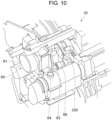
- Fig. 10 illustrates a drive mechanism for the developing member 33.
- the drive mechanism 60 includes a motor 61 provided on an end portion of the developing member 33 at one end (for example, front end) thereof as a driving source.
- the motor 61 is connected to a drive shaft 63 with gears provided therebetween.
- the drive shaft 63 is rotated around an axis by the motor 61, and the rotation of the drive shaft 63 is transmitted to a transmission shaft 339 of the developing member 33.
- the rotation of the transmission shaft 339 around an axis is distributed through gears or the like to drive the developing roller 332, the pick-up roller 333, and the first to third transport units 334 to 336.
- the gears between the motor 61 and the drive shaft 63 are disposed in a casing 64.
- the position of an axis center of the transmission shaft 339 of the developing member 33 may vary due to individual differences and changes over time.
- the lower support roller 330a of the developing member 33 has a portion fixed by the first lower support 51, but is positioned with a certain level of flexibility by the second lower support 52.
- This support structure may lead to a displacement of the position of the axis center of the transmission shaft 339.
- the drive mechanism 60 including the motor 61 is structured such that the position of the axis center of a shaft coupling 66 connecting the drive shaft 63 and the transmission shaft 339 of the developing member 33 can be changed.
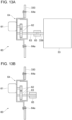
- Figs. 11A to 14B illustrate the procedure for adjusting an axis center of the drive mechanism 60 of the developing member 33.
- Fig. 11A illustrates a first state
- Fig. 11B illustrates a second state.
- Fig. 12A illustrates a third state
- Fig. 12B illustrates a fourth state.
- Fig. 13A illustrates a fifth state
- Fig. 13B illustrates a sixth state.
- Fig. 14A illustrates a seventh state
- Fig. 14B illustrates an eighth state.
- the drive mechanism 60 includes the motor 61, gears 62 that transmit the driving force of the motor 61, and the drive shaft 63.
- the gears 62 and the drive shaft 63 are disposed in a casing 64, and one end of the drive shaft 63 projects from the casing 64.
- the rotation of a shaft of the motor 61 is transmitted to the drive shaft 63 by the gears 62.
- the portion of the drive shaft 63 that projects from the casing 64 rotates to supply the driving force to the outside.
- the casing 64 is attached to the frame 330 of the developing member 33 with screws 64a. Screw holes (not illustrated) in the casing 64 through which the screws 64a are inserted are, for example, long holes, and the position of the casing 64 relative to the frame 330 can be adjusted by changing the positions at which the screws 64a are fastened in the screw holes.
- an adjustment jig 65 is attached to the portion of the drive shaft 63 that projects from the casing 64, as illustrated in Fig. 11B .
- the adjustment jig 65 is a tubular jig made of, for example, a metal.
- the drive shaft 63 of the drive mechanism 60 to which the adjustment jig 65 is attached is aligned with the transmission shaft 339 of the developing member 33. In the state illustrated in Fig. 12A , the drive shaft 63 and the transmission shaft 339 are displaced from each other.
- the screws 64a are removed and the casing 64 is shifted to align the drive shaft 63 with the transmission shaft 339, as illustrated in Fig. 12B .
- the adjustment jig 65 of the drive shaft 63 is slid so that the adjustment jig 65 covers the drive shaft 63 and the transmission shaft 339.
- the casing 64 is fixed to the frame 330 of the developing member 33 with the screws 64a while the drive shaft 63 and the transmission shaft 339 are aligned by the adjustment jig 65.
- the transmission shaft 339 of the developing member 33 is removed from the adjustment jig 65, as illustrated in Fig. 13B .
- the adjustment jig 65 is removed from the drive shaft 63, and the shaft coupling 66 is attached to the drive shaft 63 instead.
- the transmission shaft 339 of the developing member 33 is attached to an end of the shaft coupling 66 opposite to an end to which the drive shaft 63 is attached.
- the axis centers of the drive shaft 63 of the drive mechanism 60 and the transmission shaft 339 of the developing member 33 are adjusted, and the drive shaft 63 and the transmission shaft 339 are connected to each other by the shaft coupling 66.
- the developing device of (((1))) includes a structure for pressing the developing member against the photoconductor drum using the weight of the developing unit, the structure being simpler than a structure including a member for generating a pressing force for pressing the developing member against the photoconductor drum.
- the structure can be simplified compared to a structure including a mechanism for fixing the developing unit because the developing unit is positioned by its own weight.
- the movement of the developing unit can be more reliably restrained compared to when the movement of the developing unit is restrained only by the inclination of the guide path and the abutting portion.
- the structure can be simplified compared to a structure in which the abutting portion is provided on each rail.
- the developing unit can be more easily positioned and the load applied to the developing unit and the first positioning unit can be reduced compared to when the developing unit is fixed on each rail.
- the structure can be simplified compared to a structure including a mechanism for fixing the developing unit because the developing unit is positioned by its own weight.
- the leaning of the developing unit can be controlled.
- the structure can be simplified compared to a structure in which each rail is switchable between the contact state and the retracted state.
- the developing device of (((9)) unlike the structure in which the position of the axis center of the drive mechanism is fixed, displacements in the axis center due to individual differences and changes over time in the developing unit can be compensated for.
- the image forming apparatus of (((10))) includes the developing device including a structure for pressing the developing member against the photoconductor drum using the weight of the developing unit, the structure being simpler than a structure including a member for generating a pressing force for pressing the developing member against the photoconductor drum.
Landscapes
- Physics & Mathematics (AREA)
- General Physics & Mathematics (AREA)
- Engineering & Computer Science (AREA)
- Computer Vision & Pattern Recognition (AREA)
- Dry Development In Electrophotography (AREA)
- Electrophotography Configuration And Component (AREA)
Applications Claiming Priority (1)
| Application Number | Priority Date | Filing Date | Title |
|---|---|---|---|
| JP2023163964A JP2025054808A (ja) | 2023-09-26 | 2023-09-26 | 現像装置および画像形成装置 |
Publications (1)
| Publication Number | Publication Date |
|---|---|
| EP4530754A1 true EP4530754A1 (de) | 2025-04-02 |
Family
ID=89854538
Family Applications (1)
| Application Number | Title | Priority Date | Filing Date |
|---|---|---|---|
| EP24156329.5A Pending EP4530754A1 (de) | 2023-09-26 | 2024-02-07 | Entwicklungsvorrichtung und bilderzeugungsvorrichtung |
Country Status (4)
| Country | Link |
|---|---|
| US (1) | US12313988B2 (de) |
| EP (1) | EP4530754A1 (de) |
| JP (1) | JP2025054808A (de) |
| CN (1) | CN119717463A (de) |
Citations (5)
| Publication number | Priority date | Publication date | Assignee | Title |
|---|---|---|---|---|
| US5089849A (en) * | 1988-09-30 | 1992-02-18 | Kabushiki Kaisha Toshiba | Image forming apparatus, and method of positioning the units incorporated in an image forming apparatus |
| EP1522906A1 (de) * | 2003-10-07 | 2005-04-13 | Brother Kogyo Kabushiki Kaisha | Bildformungsapparat |
| US20050191089A1 (en) * | 2004-02-27 | 2005-09-01 | Brother Kogyo Kabushiki Kaisha | Process cartridge and image forming apparatus |
| JP4655569B2 (ja) | 2004-09-28 | 2011-03-23 | 富士ゼロックス株式会社 | 画像形成装置 |
| US20210271199A1 (en) * | 2020-02-28 | 2021-09-02 | FUJIFILM Business Innivation Corp. | Image forming apparatus having a securing device to secure a photoconductor unit and a developing unit |
Family Cites Families (4)
| Publication number | Priority date | Publication date | Assignee | Title |
|---|---|---|---|---|
| US10067461B2 (en) * | 2016-02-29 | 2018-09-04 | Canon Kabushiki Kaisha | Developing cartridge with a restricted portion that contacts a restricting portion of an image forming apparatus |
| JP2017187738A (ja) * | 2016-03-31 | 2017-10-12 | キヤノン株式会社 | 画像形成装置 |
| US11573523B2 (en) * | 2019-03-31 | 2023-02-07 | Topjet Technology Co., Ltd | Processing cartridge |
| JP7614838B2 (ja) * | 2020-12-25 | 2025-01-16 | キヤノン株式会社 | 画像形成装置 |
-
2023
- 2023-09-26 JP JP2023163964A patent/JP2025054808A/ja active Pending
-
2024
- 2024-02-04 CN CN202410157738.2A patent/CN119717463A/zh active Pending
- 2024-02-05 US US18/432,254 patent/US12313988B2/en active Active
- 2024-02-07 EP EP24156329.5A patent/EP4530754A1/de active Pending
Patent Citations (5)
| Publication number | Priority date | Publication date | Assignee | Title |
|---|---|---|---|---|
| US5089849A (en) * | 1988-09-30 | 1992-02-18 | Kabushiki Kaisha Toshiba | Image forming apparatus, and method of positioning the units incorporated in an image forming apparatus |
| EP1522906A1 (de) * | 2003-10-07 | 2005-04-13 | Brother Kogyo Kabushiki Kaisha | Bildformungsapparat |
| US20050191089A1 (en) * | 2004-02-27 | 2005-09-01 | Brother Kogyo Kabushiki Kaisha | Process cartridge and image forming apparatus |
| JP4655569B2 (ja) | 2004-09-28 | 2011-03-23 | 富士ゼロックス株式会社 | 画像形成装置 |
| US20210271199A1 (en) * | 2020-02-28 | 2021-09-02 | FUJIFILM Business Innivation Corp. | Image forming apparatus having a securing device to secure a photoconductor unit and a developing unit |
Also Published As
| Publication number | Publication date |
|---|---|
| US12313988B2 (en) | 2025-05-27 |
| US20250102959A1 (en) | 2025-03-27 |
| CN119717463A (zh) | 2025-03-28 |
| JP2025054808A (ja) | 2025-04-08 |
Similar Documents
| Publication | Publication Date | Title |
|---|---|---|
| US6795671B2 (en) | Image forming apparatus featuring switchable, contact and spaced, clutch-operated developing units | |
| US7392007B2 (en) | Intermediate transfer system and method for cleaning intermediate transfer belt | |
| US20020181968A1 (en) | Image forming apparatus | |
| US20090047041A1 (en) | Image forming apparatus, developing apparatus and contact-retracting method | |
| US7623809B2 (en) | Image forming apparatus having belt unit | |
| JP2001209294A (ja) | 画像形成装置 | |
| JP2001075374A (ja) | 画像形成装置 | |
| US20030103780A1 (en) | Image forming apparatus | |
| US5063411A (en) | Color image forming apparatus having a unitary guide plate facing a plurality of developing devices | |
| US20070151829A1 (en) | Transfer belt unit and image forming apparatus having the same | |
| JP2005014497A (ja) | 画像形成装置 | |
| JP6055724B2 (ja) | 画像形成ユニットおよび画像形成装置 | |
| US12313988B2 (en) | Developing device and image forming apparatus | |
| JP2004020855A (ja) | 画像形成装置 | |
| JP5063273B2 (ja) | ベルト搬送装置及び画像形成装置 | |
| JP4003079B2 (ja) | 画像形成装置 | |
| JP4628727B2 (ja) | プロセスカートリッジ及び画像形成装置 | |
| JP2006048014A (ja) | プロセスカートリッジ及び画像形成装置 | |
| JP5349262B2 (ja) | 中間転写ベルト搬送装置とこれを用いる画像形成装置及び画像形成方法 | |
| EP1522906B1 (de) | Prozesseinheit mit Photoleitereinheit und getrennt abnehmbarer Entwicklereinheit und Bildformungsapparat | |
| JP4092540B2 (ja) | 現像カートリッジ及び画像形成装置 | |
| JP6942011B2 (ja) | 帯電ローラ軸受保持機構 | |
| US11740570B1 (en) | Image forming apparatus | |
| JP2003162128A (ja) | 画像形成装置 | |
| JP2005352401A (ja) | 画像形成装置 |
Legal Events
| Date | Code | Title | Description |
|---|---|---|---|
| PUAI | Public reference made under article 153(3) epc to a published international application that has entered the european phase |
Free format text: ORIGINAL CODE: 0009012 |
|
| STAA | Information on the status of an ep patent application or granted ep patent |
Free format text: STATUS: THE APPLICATION HAS BEEN PUBLISHED |
|
| AK | Designated contracting states |
Kind code of ref document: A1 Designated state(s): AL AT BE BG CH CY CZ DE DK EE ES FI FR GB GR HR HU IE IS IT LI LT LU LV MC ME MK MT NL NO PL PT RO RS SE SI SK SM TR |
|
| STAA | Information on the status of an ep patent application or granted ep patent |
Free format text: STATUS: REQUEST FOR EXAMINATION WAS MADE |
|
| 17P | Request for examination filed |
Effective date: 20251001 |