EP4530693A1 - Linsenanordnung und elektronische vorrichtung damit - Google Patents
Linsenanordnung und elektronische vorrichtung damit Download PDFInfo
- Publication number
- EP4530693A1 EP4530693A1 EP23811960.6A EP23811960A EP4530693A1 EP 4530693 A1 EP4530693 A1 EP 4530693A1 EP 23811960 A EP23811960 A EP 23811960A EP 4530693 A1 EP4530693 A1 EP 4530693A1
- Authority
- EP
- European Patent Office
- Prior art keywords
- lens
- electronic device
- lens assembly
- image
- conditional equation
- Prior art date
- Legal status (The legal status is an assumption and is not a legal conclusion. Google has not performed a legal analysis and makes no representation as to the accuracy of the status listed.)
- Pending
Links
Images





Classifications
-
- G—PHYSICS
- G02—OPTICS
- G02B—OPTICAL ELEMENTS, SYSTEMS OR APPARATUS
- G02B13/00—Optical objectives specially designed for the purposes specified below
- G02B13/001—Miniaturised objectives for electronic devices, e.g. portable telephones, webcams, PDAs, small digital cameras
- G02B13/0015—Miniaturised objectives for electronic devices, e.g. portable telephones, webcams, PDAs, small digital cameras characterised by the lens design
- G02B13/002—Miniaturised objectives for electronic devices, e.g. portable telephones, webcams, PDAs, small digital cameras characterised by the lens design having at least one aspherical surface
- G02B13/0045—Miniaturised objectives for electronic devices, e.g. portable telephones, webcams, PDAs, small digital cameras characterised by the lens design having at least one aspherical surface having five or more lenses
-
- G—PHYSICS
- G02—OPTICS
- G02B—OPTICAL ELEMENTS, SYSTEMS OR APPARATUS
- G02B13/00—Optical objectives specially designed for the purposes specified below
- G02B13/001—Miniaturised objectives for electronic devices, e.g. portable telephones, webcams, PDAs, small digital cameras
- G02B13/0015—Miniaturised objectives for electronic devices, e.g. portable telephones, webcams, PDAs, small digital cameras characterised by the lens design
- G02B13/002—Miniaturised objectives for electronic devices, e.g. portable telephones, webcams, PDAs, small digital cameras characterised by the lens design having at least one aspherical surface
- G02B13/004—Miniaturised objectives for electronic devices, e.g. portable telephones, webcams, PDAs, small digital cameras characterised by the lens design having at least one aspherical surface having four lenses
-
- G—PHYSICS
- G02—OPTICS
- G02B—OPTICAL ELEMENTS, SYSTEMS OR APPARATUS
- G02B13/00—Optical objectives specially designed for the purposes specified below
-
- G—PHYSICS
- G02—OPTICS
- G02B—OPTICAL ELEMENTS, SYSTEMS OR APPARATUS
- G02B13/00—Optical objectives specially designed for the purposes specified below
- G02B13/001—Miniaturised objectives for electronic devices, e.g. portable telephones, webcams, PDAs, small digital cameras
- G02B13/0055—Miniaturised objectives for electronic devices, e.g. portable telephones, webcams, PDAs, small digital cameras employing a special optical element
- G02B13/0065—Miniaturised objectives for electronic devices, e.g. portable telephones, webcams, PDAs, small digital cameras employing a special optical element having a beam-folding prism or mirror
-
- G—PHYSICS
- G02—OPTICS
- G02B—OPTICAL ELEMENTS, SYSTEMS OR APPARATUS
- G02B13/00—Optical objectives specially designed for the purposes specified below
- G02B13/18—Optical objectives specially designed for the purposes specified below with lenses having one or more non-spherical faces, e.g. for reducing geometrical aberration
-
- G—PHYSICS
- G02—OPTICS
- G02B—OPTICAL ELEMENTS, SYSTEMS OR APPARATUS
- G02B17/00—Systems with reflecting surfaces, with or without refracting elements
- G02B17/02—Catoptric systems, e.g. image erecting and reversing system
- G02B17/04—Catoptric systems, e.g. image erecting and reversing system using prisms only
-
- G—PHYSICS
- G02—OPTICS
- G02B—OPTICAL ELEMENTS, SYSTEMS OR APPARATUS
- G02B17/00—Systems with reflecting surfaces, with or without refracting elements
- G02B17/02—Catoptric systems, e.g. image erecting and reversing system
- G02B17/06—Catoptric systems, e.g. image erecting and reversing system using mirrors only, i.e. having only one curved mirror
-
- G—PHYSICS
- G02—OPTICS
- G02B—OPTICAL ELEMENTS, SYSTEMS OR APPARATUS
- G02B3/00—Simple or compound lenses
- G02B3/02—Simple or compound lenses with non-spherical faces
-
- G—PHYSICS
- G02—OPTICS
- G02B—OPTICAL ELEMENTS, SYSTEMS OR APPARATUS
- G02B7/00—Mountings, adjusting means, or light-tight connections, for optical elements
- G02B7/02—Mountings, adjusting means, or light-tight connections, for optical elements for lenses
-
- G—PHYSICS
- G02—OPTICS
- G02B—OPTICAL ELEMENTS, SYSTEMS OR APPARATUS
- G02B7/00—Mountings, adjusting means, or light-tight connections, for optical elements
- G02B7/18—Mountings, adjusting means, or light-tight connections, for optical elements for prisms; for mirrors
- G02B7/182—Mountings, adjusting means, or light-tight connections, for optical elements for prisms; for mirrors for mirrors
-
- G—PHYSICS
- G02—OPTICS
- G02B—OPTICAL ELEMENTS, SYSTEMS OR APPARATUS
- G02B9/00—Optical objectives characterised both by the number of the components and their arrangements according to their sign, i.e. + or -
- G02B9/04—Optical objectives characterised both by the number of the components and their arrangements according to their sign, i.e. + or - having two components only
- G02B9/10—Optical objectives characterised both by the number of the components and their arrangements according to their sign, i.e. + or - having two components only one + and one - component
-
- G—PHYSICS
- G02—OPTICS
- G02B—OPTICAL ELEMENTS, SYSTEMS OR APPARATUS
- G02B9/00—Optical objectives characterised both by the number of the components and their arrangements according to their sign, i.e. + or -
- G02B9/34—Optical objectives characterised both by the number of the components and their arrangements according to their sign, i.e. + or - having four components only
-
- H—ELECTRICITY
- H04—ELECTRIC COMMUNICATION TECHNIQUE
- H04N—PICTORIAL COMMUNICATION, e.g. TELEVISION
- H04N23/00—Cameras or camera modules comprising electronic image sensors; Control thereof
- H04N23/50—Constructional details
- H04N23/54—Mounting of pick-up tubes, electronic image sensors, deviation or focusing coils
-
- H—ELECTRICITY
- H04—ELECTRIC COMMUNICATION TECHNIQUE
- H04N—PICTORIAL COMMUNICATION, e.g. TELEVISION
- H04N23/00—Cameras or camera modules comprising electronic image sensors; Control thereof
- H04N23/50—Constructional details
- H04N23/55—Optical parts specially adapted for electronic image sensors; Mounting thereof
Definitions
- Various embodiments of the disclosure relate to a lens assembly and, more specifically, to a lens assembly including a curved optical system and an electronic device including the same.
- a limit is posed on the total length (e.g., the overall length and/or height along the optical axis) of compact electronic devices, such as portable terminals, it may be hard to secure a sufficient telephoto ratio for implementing the functionality of a telephoto lens.
- a 'limit is posed on the total length of a lens assemble' may mean that the number of lenses included in the lens assembly is limited.
- the limit in the number of lenses included in the lens assembly may render it difficult to obtain high-quality images and/or videos. With a limited number of lenses alone, it may be hard to manufacture a lens assembly with a low F-number and smaller aberration.
- the lens assembly As a folded optical system, there have been conventionally conceived a method for placing two reflective members before/after and placing a lens assembly between the two reflective members and a method for placing a reflective member between a lens assembly and an image sensor.
- the lens assembly As the lens assembly is disposed between two reflective members, it may be limited to increase the module size, and it may be difficult to align the optical path and to manufacture low F-number optical systems.
- the reflective member since the reflective member is disposed between the lens assembly and the image sensor, the lens assembly may be separated from the reflective member. Accordingly, in the latter case, it may be easier to manufacture low F-number optical systems than in the former case. Further, the latter case may provide more ease of light path alignment than the latter case. Further, the latter case may provide more ease of module size adjustment than the latter case.
- an electronic device including: a lens assembly in which at least four lenses are aligned along an optical axis in a direction from an object side to an image side, an image sensor including an imaging plane on which an image is formed, at least one reflective member disposed between the lens assembly and the image sensor, wherein the reflective member is configured to refract or reflect light at least twice, wherein at least one surface of an object-side surface and an image-side surface of a first lens from an object side among the at least four lenses is formed as an aspherical surface, wherein the object-side surface and the image-side surface are formed to be convex, and wherein the electronic device satisfies conditional equation 1 and conditional equation 2 as set forth below: 0.6 ⁇ BFL / EFL ⁇ 1.1 15 ⁇ FOV ⁇ 35 , and wherein, in conditional equation 1, BFL is a "back focal length,” indicating distance from an image-side surface of a lens closest to the imaging plane to the image sensor, and E
- an electronic device including: a lens assembly in which at least four lenses are aligned along an optical axis in a direction from an object side to an image side, an image sensor including an imaging plane where an image is formed, at least one reflective member disposed between the lens assembly and the image sensor, wherein the at least one reflective member is configured to change a path of light at least twice, wherein a path of a chief ray passing through the at least one reflective member is parallel to a path of a chief ray incident on the lens assembly, wherein the electronic device satisfies conditional equation 1 and conditional equation 2 below: 0.6 ⁇ BFL / EFL ⁇ 1.1 15 ⁇ FOV ⁇ 35 , and wherein, in conditional equation 1, BFL is a "back focal length" indicating a distance from an image-side surface of a lens closest to the imaging plane to the image sensor, and EFL is an "effective focal length,” indicating total focal length of the lens assembly and, in conditional equation 2, FOV is
- the method of placing the reflective member between the lens assembly and the image sensor may have difficulty in aberration control and sensitivity control of the optical system depending on the number of lenses and material of the lens assembly.
- a lens assembly including a small number (e.g., three or fewer) of lenses may have difficulty in aberration control due to failure to secure a number of lenses enough to correct aberration.
- the image size is very small corresponding to the lens assembly including a small number (e.g., three or fewer) of lenses, it may be difficult to obtain high-quality images.
- a spherical glass may typically be used due to an increase in weight and manufacturing costs and difficulty in manufacture in an aspheric shape.
- the lens assembly includes a plurality of lenses arranged along the optical axis
- the remaining lenses should accordingly be formed to have small curvature, and the sensitivity of the optical system may increase.
- various embodiments that provide a shape and material of a lens for implementing a smaller module while having a number and material of lenses effective to aberration control and sensitivity control.
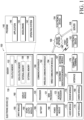
- FIG. 1 is a block diagram illustrating an electronic device 101 in a network environment 100 according to various embodiments.
- the electronic device 101 in the network environment 100 may communicate with an electronic device 102 via a first network 198 (e.g., a short-range wireless communication network), or an electronic device 104 or a server 108 via a second network 199 (e.g., a long-range wireless communication network).
- the electronic device 101 may communicate with the electronic device 104 via the server 108.
- the electronic device 101 may include a processor 120, memory 130, an input module 150, a sound output module 155, a display module 160, an audio module 170, a sensor module 176, an interface 177, a connecting terminal 178, a haptic module 179, a camera module 180, a power management module 188, a battery 189, a communication module 190, a subscriber identification module (SIM) 196, or an antenna module 197.
- at least one (e.g., the connecting terminal 178) of the components may be omitted from the electronic device 101, or one or more other components may be added in the electronic device 101.
- some (e.g., the sensor module 176, the camera module 180, or the antenna module 197) of the components may be integrated into a single component (e.g., the display module 160).
- the processor 120 may execute, for example, software (e.g., a program 140) to control at least one other component (e.g., a hardware or software component) of the electronic device 101 coupled with the processor 120, and may perform various data processing or computation. According to one embodiment, as at least part of the data processing or computation, the processor 120 may store a command or data received from another component (e.g., the sensor module 176 or the communication module 190) in volatile memory 132, process the command or the data stored in the volatile memory 132, and store resulting data in non-volatile memory 134.
- software e.g., a program 140
- the processor 120 may store a command or data received from another component (e.g., the sensor module 176 or the communication module 190) in volatile memory 132, process the command or the data stored in the volatile memory 132, and store resulting data in non-volatile memory 134.
- the processor 120 may include a main processor 121 (e.g., a central processing unit (CPU) or an application processor (AP)), or an auxiliary processor 123 (e.g., a graphics processing unit (GPU), a neural processing unit (NPU), an image signal processor (ISP), a sensor hub processor, or a communication processor (CP)) that is operable independently from, or in conjunction with, the main processor 121.
- a main processor 121 e.g., a central processing unit (CPU) or an application processor (AP)
- auxiliary processor 123 e.g., a graphics processing unit (GPU), a neural processing unit (NPU), an image signal processor (ISP), a sensor hub processor, or a communication processor (CP)
- the main processor 121 may be configured to use lower power than the main processor 121 or to be specified for a designated function.
- the auxiliary processor 123 may be implemented as separate from, or as part of the main processor 121.
- the auxiliary processor 123 may control at least some of functions or states related to at least one component (e.g., the display module 160, the sensor module 176, or the communication module 190) among the components of the electronic device 101, instead of the main processor 121 while the main processor 121 is in an inactive (e.g., sleep) state, or together with the main processor 121 while the main processor 121 is in an active state (e.g., executing an application).
- the auxiliary processor 123 e.g., an image signal processor or a communication processor
- the auxiliary processor 123 may include a hardware structure specified for artificial intelligence model processing.
- the artificial intelligence model may be generated via machine learning. Such learning may be performed, e.g., by the electronic device 101 where the artificial intelligence is performed or via a separate server (e.g., the server 108). Learning algorithms may include, but are not limited to, e.g., supervised learning, unsupervised learning, semi-supervised learning, or reinforcement learning.
- the artificial intelligence model may include a plurality of artificial neural network layers.
- the artificial neural network may be a deep neural network (DNN), a convolutional neural network (CNN), a recurrent neural network (RNN), a restricted Boltzmann machine (RBM), a deep belief network (DBN), a bidirectional recurrent deep neural network (BRDNN), deep Q-network or a combination of two or more thereof but is not limited thereto.
- the artificial intelligence model may, additionally or alternatively, include a software structure other than the hardware structure.
- the memory 130 may store various data used by at least one component (e.g., the processor 120 or the sensor module 176) of the electronic device 101.
- the various data may include, for example, software (e.g., the program 140) and input data or output data for a command related thereto.
- the memory 130 may include the volatile memory 132 or the non-volatile memory 134.
- the program 140 may be stored in the memory 130 as software, and may include, for example, an operating system (OS) 142, middleware 144, or an application 146.
- OS operating system
- middleware middleware
- application application
- the input module 150 may receive a command or data to be used by other component (e.g., the processor 120) of the electronic device 101, from the outside (e.g., a user) of the electronic device 101.
- the input module 150 may include, for example, a microphone, a mouse, a keyboard, keys (e.g., buttons), or a digital pen (e.g., a stylus pen).
- the sound output module 155 may output sound signals to the outside of the electronic device 101.
- the sound output module 155 may include, for example, a speaker or a receiver.
- the speaker may be used for general purposes, such as playing multimedia or playing record.
- the receiver may be used for receiving incoming calls. According to an embodiment, the receiver may be implemented as separate from, or as part of the speaker.
- the display module 160 may visually provide information to the outside (e.g., a user) of the electronic device 101.
- the display 160 may include, for example, a display, a hologram device, or a projector and control circuitry to control a corresponding one of the display, hologram device, and projector.
- the display 160 may include a touch sensor configured to detect a touch, or a pressure sensor configured to measure the intensity of a force generated by the touch.
- the audio module 170 may convert a sound into an electrical signal and vice versa. According to an embodiment, the audio module 170 may obtain the sound via the input module 150, or output the sound via the sound output module 155 or a headphone of an external electronic device (e.g., an electronic device 102) directly (e.g., wiredly) or wirelessly coupled with the electronic device 101.
- an external electronic device e.g., an electronic device 102
- directly e.g., wiredly
- wirelessly e.g., wirelessly
- the sensor module 176 may detect an operational state (e.g., power or temperature) of the electronic device 101 or an environmental state (e.g., a state of a user) external to the electronic device 101, and then generate an electrical signal or data value corresponding to the detected state.
- the sensor module 176 may include, for example, a gesture sensor, a gyro sensor, an atmospheric pressure sensor, a magnetic sensor, an accelerometer, a grip sensor, a proximity sensor, a color sensor, an infrared (IR) sensor, a biometric sensor, a temperature sensor, a humidity sensor, or an illuminance sensor.
- the interface 177 may support one or more specified protocols to be used for the electronic device 101 to be coupled with the external electronic device (e.g., the electronic device 102) directly (e.g., wiredly) or wirelessly.
- the interface 177 may include, for example, a high definition multimedia interface (HDMI), a universal serial bus (USB) interface, a secure digital (SD) card interface, or an audio interface.
- HDMI high definition multimedia interface
- USB universal serial bus
- SD secure digital
- a connecting terminal 178 may include a connector via which the electronic device 101 may be physically connected with the external electronic device (e.g., the electronic device 102).
- the connecting terminal 178 may include, for example, a HDMI connector, a USB connector, a SD card connector, or an audio connector (e.g., a headphone connector).
- the haptic module 179 may convert an electrical signal into a mechanical stimulus (e.g., a vibration or motion) or electrical stimulus which may be recognized by a user via his tactile sensation or kinesthetic sensation.
- the haptic module 179 may include, for example, a motor, a piezoelectric element, or an electric stimulator.
- the camera module 180 may capture a still image or moving images.
- the camera module 180 may include one or more lenses, image sensors, image signal processors, or flashes.
- the power management module 188 may manage power supplied to the electronic device 101.
- the power management module 188 may be implemented as at least part of, for example, a power management integrated circuit (PMIC).
- PMIC power management integrated circuit
- the battery 189 may supply power to at least one component of the electronic device 101.
- the battery 189 may include, for example, a primary cell which is not rechargeable, a secondary cell which is rechargeable, or a fuel cell.
- the communication module 190 may support establishing a direct (e.g., wired) communication channel or a wireless communication channel between the electronic device 101 and the external electronic device (e.g., the electronic device 102, the electronic device 104, or the server 108) and performing communication via the established communication channel.
- the communication module 190 may include one or more communication processors that are operable independently from the processor 120 (e.g., the application processor (AP)) and supports a direct (e.g., wired) communication or a wireless communication.
- AP application processor
- the communication module 190 may include a wireless communication module 192 (e.g., a cellular communication module, a short-range wireless communication module, or a global navigation satellite system (GNSS) communication module) or a wired communication module 194 (e.g., a local area network (LAN) communication module or a power line communication (PLC) module).
- a wireless communication module 192 e.g., a cellular communication module, a short-range wireless communication module, or a global navigation satellite system (GNSS) communication module
- GNSS global navigation satellite system
- wired communication module 194 e.g., a local area network (LAN) communication module or a power line communication (PLC) module.
- LAN local area network
- PLC power line communication
- a corresponding one of these communication modules may communicate with the external electronic device 104 via a first network 198 (e.g., a short-range communication network, such as Bluetooth TM , wireless-fidelity (Wi-Fi) direct, or infrared data association (IrDA)) or a second network 199 (e.g., a long-range communication network, such as a legacy cellular network, a 5G network, a next-generation communication network, the Internet, or a computer network (e.g., local area network (LAN) or wide area network (WAN)).
- a first network 198 e.g., a short-range communication network, such as Bluetooth TM , wireless-fidelity (Wi-Fi) direct, or infrared data association (IrDA)
- a second network 199 e.g., a long-range communication network, such as a legacy cellular network, a 5G network, a next-generation communication network, the Internet, or a computer network (e.g., local area
- the wireless communication module 192 may identify or authenticate the electronic device 101 in a communication network, such as the first network 198 or the second network 199, using subscriber information (e.g., international mobile subscriber identity (IMSI)) stored in the subscriber identification module 196.
- subscriber information e.g., international mobile subscriber identity (IMSI)
- the wireless communication module 192 may support a 5G network, after a 4G network, and next-generation communication technology, e.g., new radio (NR) access technology.
- the NR access technology may support enhanced mobile broadband (eMBB), massive machine type communications (mMTC), or ultra-reliable and low-latency communications (URLLC).
- eMBB enhanced mobile broadband
- mMTC massive machine type communications
- URLLC ultra-reliable and low-latency communications
- the wireless communication module 192 may support a high-frequency band (e.g., the mmWave band) to achieve, e.g., a high data transmission rate.
- the wireless communication module 192 may support various technologies for securing performance on a high-frequency band, such as, e.g., beamforming, massive multiple-input and multiple-output (massive MIMO), full dimensional MIMO (FD-MIMO), array antenna, analog beam-forming, or large scale antenna.
- the wireless communication module 192 may support various requirements specified in the electronic device 101, an external electronic device (e.g., the electronic device 104), or a network system (e.g., the second network 199).
- the wireless communication module 192 may support a peak data rate (e.g., 20Gbps or more) for implementing eMBB, loss coverage (e.g., 164dB or less) for implementing mMTC, or U-plane latency (e.g., 0.5ms or less for each of downlink (DL) and uplink (UL), or a round trip of 1ms or less) for implementing URLLC.
- a peak data rate e.g., 20Gbps or more
- loss coverage e.g., 164dB or less
- U-plane latency e.g., 0.5ms or less for each of downlink (DL) and uplink (UL), or a round trip of 1ms or less
- the antenna module 197 may transmit or receive a signal or power to or from the outside (e.g., the external electronic device).
- the antenna module 197 may include one antenna including a radiator formed of a conductor or conductive pattern formed on a substrate (e.g., a printed circuit board (PCB)).
- the antenna module 197 may include a plurality of antennas (e.g., an antenna array). In this case, at least one antenna appropriate for a communication scheme used in a communication network, such as the first network 198 or the second network 199, may be selected from the plurality of antennas by, e.g., the communication module 190.
- the signal or the power may then be transmitted or received between the communication module 190 and the external electronic device via the selected at least one antenna.
- other parts e.g., radio frequency integrated circuit (RFIC)
- RFIC radio frequency integrated circuit
- the antenna module 197 may form a mmWave antenna module.
- the mmWave antenna module may include a printed circuit board, a RFIC disposed on a first surface (e.g., the bottom surface) of the printed circuit board, or adjacent to the first surface and capable of supporting a designated high-frequency band (e.g., the mmWave band), and a plurality of antennas (e.g., array antennas) disposed on a second surface (e.g., the top or a side surface) of the printed circuit board, or adjacent to the second surface and capable of transmitting or receiving signals of the designated high-frequency band.
- a RFIC disposed on a first surface (e.g., the bottom surface) of the printed circuit board, or adjacent to the first surface and capable of supporting a designated high-frequency band (e.g., the mmWave band)
- a plurality of antennas e.g., array antennas
- At least some of the above-described components may be coupled mutually and communicate signals (e.g., commands or data) therebetween via an inter-peripheral communication scheme (e.g., a bus, general purpose input and output (GPIO), serial peripheral interface (SPI), or mobile industry processor interface (MIPI)).
- an inter-peripheral communication scheme e.g., a bus, general purpose input and output (GPIO), serial peripheral interface (SPI), or mobile industry processor interface (MIPI)
- commands or data may be transmitted or received between the electronic device 101 and the external electronic device 104 via the server 108 coupled with the second network 199.
- the external electronic devices 102 or 104 each may be a device of the same or a different type from the electronic device 101.
- all or some of operations to be executed at the electronic device 101 may be executed at one or more of the external electronic devices 102, 104, or 108. For example, if the electronic device 101 should perform a function or a service automatically, or in response to a request from a user or another device, the electronic device 101, instead of, or in addition to, executing the function or the service, may request the one or more external electronic devices to perform at least part of the function or the service.
- the one or more external electronic devices receiving the request may perform the at least part of the function or the service requested, or an additional function or an additional service related to the request, and transfer an outcome of the performing to the electronic device 101.
- the electronic device 101 may provide the outcome, with or without further processing of the outcome, as at least part of a reply to the request.
- a cloud computing, distributed computing, mobile edge computing (MEC), or client-server computing technology may be used, for example.
- the electronic device 101 may provide ultra low-latency services using, e.g., distributed computing or mobile edge computing.
- the external electronic device 104 may include an Internet-of-things (IoT) device.
- the server 108 may be an intelligent server using machine learning and/or a neural network.
- the external electronic device 104 or the server 108 may be included in the second network 199.
- the electronic device 101 may be applied to intelligent services (e.g., smart home, smart city, smart car, or healthcare) based on 5G communication technology or IoT-related technology.
- FIG. 2 is a block diagram 200 illustrating the camera module 280 according to various embodiments.
- the camera module 280 may include a lens assembly 210, a flash 220, an image sensor 230, an image stabilizer 240, memory 250 (e.g., buffer memory (e.g., the memory 130 of FIG. 1 )), or an image signal processor 260.
- the lens assembly 210 may collect light emitted or reflected from an object whose image is to be taken.
- the lens assembly 210 may include one or more lenses.
- the camera module 280 may include a plurality of lens assemblies 210.
- the camera module 280 may form, for example, a dual camera, a 360-degree camera, or a spherical camera.
- Some of the plurality of lens assemblies 210 may have the same lens attribute (e.g., view angle, focal length, auto-focusing, f number (Fno), or optical zoom), or at least one lens assembly may have one or more lens attributes different from those of another lens assembly.
- the lens assembly 210 may include, for example, a wide-angle lens or a telephoto lens.
- the flash 220 may emit light that is used to reinforce light reflected from an object.
- the flash 220 may include one or more light emitting diodes (LEDs) (e.g., a red-green-blue (RGB) LED, a white LED, an infrared (IR) LED, or an ultraviolet (UV) LED) or a xenon lamp.
- LEDs light emitting diodes
- the image sensor 230 may obtain an image corresponding to an object by converting light emitted or reflected from the object and transmitted via the lens assembly 210 into an electrical signal.
- the image sensor 230 may include one selected from image sensors having different attributes, such as a RGB sensor, a black-and-white (BW) sensor, an IR sensor, or a UV sensor, a plurality of image sensors having the same attribute, or a plurality of image sensors having different attributes.
- Each image sensor included in the image sensor 230 may be implemented using, for example, a charged coupled device (CCD) sensor or a complementary metal oxide semiconductor (CMOS) sensor.
- CCD charged coupled device
- CMOS complementary metal oxide semiconductor
- the image stabilizer 240 may move the image sensor 230 or at least one lens included in the lens assembly 210 in a particular direction, or control an operational attribute (e.g., adjust the read-out timing) of the image sensor 230 in response to the movement of the camera module 280 or the electronic device 101 including the camera module 180. This allows compensating for at least part of a negative effect (e.g., image blurring) by the movement on an image being captured.
- the image stabilizer 240 may sense such a movement by the camera module 280 or the electronic device 101 using a gyro sensor (not shown) or an acceleration sensor (not shown) disposed inside or outside the camera module 280.
- the image stabilizer 240 may be implemented, for example, as an optical image stabilizer.
- the memory 250 may store, at least temporarily, at least part of an image obtained via the image sensor 230 for a subsequent image processing task. For example, if image capturing is delayed due to shutter lag or multiple images are quickly captured, a raw image obtained (e.g., a Bayer-patterned image, a high-resolution image) may be stored in the memory 250, and its corresponding copy image (e.g., a low-resolution image) may be previewed via the display module 160.
- a raw image obtained e.g., a Bayer-patterned image, a high-resolution image
- its corresponding copy image e.g., a low-resolution image
- the memory 250 may be configured as at least part of the memory 250 or as a separate memory that is operated independently from the memory.
- the image signal processor 260 may perform one or more image processing with respect to an image obtained via the image sensor 230 or an image stored in the memory 250.
- the one or more image processing may include, for example, depth map generation, three-dimensional (3D) modeling, panorama generation, feature point extraction, image synthesizing, or image compensation (e.g., noise reduction, resolution adjustment, brightness adjustment, blurring, sharpening, or softening).
- the image signal processor 260 may perform control (e.g., exposure time control or read-out timing control) with respect to at least one (e.g., the image sensor 230) of the components included in the camera module 280.
- An image processed by the image signal processor 260 may be stored back in the memory 250 for further processing, or may be provided to an external component (e.g., the memory 130, the display module 160, the electronic device 102, the electronic device 104, or the server 108) outside the camera module 280.
- the image signal processor 260 may be configured as at least part of the processor 120, or as a separate processor that is operated independently from the processor 120. If the image signal processor 260 is configured as a separate processor from the processor 120, at least one image processed by the image signal processor 260 may be displayed, by the processor 120, via the display module (e.g., 160 of FIG. 1 ) as it is or after being further processed.
- the electronic device 101 may include a plurality of camera modules 280 having different attributes or functions.
- at least one of the plurality of camera modules 280 may form, for example, a wide-angle camera and at least another of the plurality of camera modules180 may form a telephoto camera.
- at least one of the plurality of camera modules 280 may form, for example, a front camera and at least another of the plurality of camera modules180 may form a rear camera.
- representative examples of the electronic device 101 may include optical devices (e.g., camera modules), and the following description may be based on the hypothesis that a lens assembly is equipped in an optical device according to an embodiment.
- optical devices e.g., camera modules
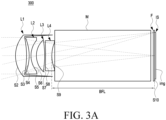
- FIG. 3A is a view illustrating a configuration of a lens assembly according to an embodiment.
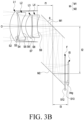
- FIG. 3B is a view illustrating a configuration of an example of FIG. 3A .
- FIG. 3C is a view illustrating a configuration of an example of FIG. 3A . According to an embodiment,
- FIG. 3B and FIG. 3C illustrates a folded optical system including a reflective member M that refracts or reflects the light incident on the lens assembly, at least two times.
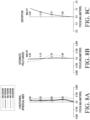
- FIG. 4A is a graph illustrating the spherical aberration of the lens assembly of FIG. 3A .
- FIG. 4B is a graph illustrating astigmatism of the lens assembly of FIG. 3A .
- FIG. 4C is a graph illustrating the distortion of the lens assembly of FIG. 3A .
- a lens assembly may include a plurality of lenses and an image sensor.
- an image sensor IS may be equipped in an electronic device.
- the lens assembly 300 including a plurality of lenses may be mounted in the optical device equipped with the image sensor and/or the electronic device (e.g., the electronic device 101 of FIG. 1 ), configuring an optical system.
- the optical device may be, e.g., a camera. The following description may assume that the lens assembly 300 is mounted in the optical device.
- the optical device may be understood as a concept that further includes a housing that protects the internal components and forms the exterior along with the optical system.
- the image sensor IS may be a sensor that is mounted on a circuit board and is aligned with the optical axis and may respond to light.
- the image sensor IS may include such a sensor as a complementary metal-oxide semiconductor (CMOS) or charge coupled device (CCD) sensor.
- CMOS complementary metal-oxide semiconductor
- CCD charge coupled device
- the image sensor IS is not limited thereto but may rather include various elements that convert light, e.g., an object image, into an electrical image signal.
- the image sensor IS may detect brightness, contrast ratio information, or color information about the object from the light which has been transmitted through the plurality of lenses, thereby obtaining an image for the object.
- At least one of the plurality of lenses included in the lens assembly 300 may include a lens formed of a synthetic resin (e.g., plastic).
- a synthetic resin e.g., plastic
- the size or shape of the lens assembly may have a high degree of freedom in design.
- the plurality of lenses included in the lens assembly are manufactured as lenses formed of a synthetic resin (e.g., plastic) having a predetermined refractive index, it is possible to reduce the weight of the lens assembly and manufacturing costs as compared with, e.g., when the lens assembly is formed including a glass material.
- the first lens from the object side includes a glass material
- the second and following lenses from the object side are limited in shape by the first lens.
- the plurality of lenses included in the lens assembly 300 are formed of a synthetic resin material, so that a high degree of freedom in lens design may be secured. Further, as the plurality of lenses included in the lens assembly 300 are formed of a synthetic resin material, it may be advantageous for weight reduction and miniaturization of an electronic device (e.g., the electronic device 101 of FIG. 1 ) on which the lens assembly 300 is mounted.
- the lens assembly 300 may be disposed on the optical axis O-I passing through the centers of the plurality of lenses from the object (or external object) side to the image side.
- 'object side' may denote the direction in which the object O is present
- 'image side' may denote the direction in which an imaging plane img where an image I forms is present.
- the 'object side-facing surface' of a lens may denote a surface towards the object on the optical axis, which may mean the left (or front) surface of the lens as viewed from above the drawings
- the 'image side-facing surface' of the lens may denote a surface towards the imaging plane img on the optical axis O-I, which may mean the right (or rear) surface of the lens as viewed from above the drawings of the disclosure.
- the imaging plane img may be a portion where, e.g., an image capturing element or image sensor is disposed, and an image forms.
- the portion of each lens, which is close to the optical axis O-I may be referred to as a chief portion, and the portion further from the optical axis (or around the edge of the lens) may be referred to as a marginal portion.
- the chief portion may be a portion that crosses the optical axis in a certain lens (e.g., the first lens) and may have the chief ray among the rays incident on the lens assembly 300 pass therethrough.
- the marginal portion may be, e.g., a portion of the lens (e.g., the first lens) which is spaced apart from the optical axis by a predetermined distance.
- the marginal portion may include an end portion of the lens which is positioned farthest from the optical axis of the lens. Further, according to various embodiments of the disclosure, the light passing through the chief portion or the portion close to the chief portion may be referred to as a short axis light beam, and the light passing through the marginal portion may be referred to as a long axis light beam.
- the radius of curvature, thickness, total length from imaging plane (TTL), and focal length of a lens as described herein may be in millimeters unless stated otherwise.
- the thickness of a lens, the interval between lenses, or TTL may be a distance measured from the center of the optical axis of the lens.
- 'one surface of the lens is convex' may mean that the optical axis portion of the surface is convex
- 'one surface of the lens is concave' may mean that the optical axis portion of the surface is concave.
- edge portions of the lens e.g., portions set a predetermined distance apart from the optical axis portion of the surface
- edge portions of the lens may be concave
- edge portions of the lens e.g., portions a predetermined distance apart from the optical axis portion of the surface
- the term 'inflection point' may mean a point where the radius of curvature changes in a portion which does not cross the optical axis.
- a lens assembly 300 may include at least four or more lenses.
- the lens assembly 300 may include four lenses, as a plurality of lenses sequentially arranged in the optical axis direction (e.g., the direction from the object side to the image side of FIG. 3A ).
- the lens assembly 300 may include a first lens L1, a second lens L2, a third lens L3, and a fourth lens L4 sequentially arranged from the object side O to the image side I.
- the number of the lenses included in the lens assembly is not limited to the embodiment of FIG. 3A . An embodiment in which five lenses are included is disclosed below through an embodiment of FIGS.
- the lens assembly 300 may include a reflective member M that may change the path of the light passing through the lens (e.g., the fourth lens L4 of FIGS. 3A 3B , 3C and 13 , or the fifth lens L5 of FIGS. 5 , 7 , 9 and 11 ) closest to the image, at least two or more times.
- the lens assembly 300 may adopt a prism as the reflective member M.
- the reflective member M is described below in detail with reference to FIG. 3B and 3C .
- the first lens e.g., the first lens L1 disposed from the object side included in the lens assembly may have a positive (+) refractive power. If light parallel with the optical axis is incident onto the lens with a positive refractive power, the light, after passing through the lens, may be focused.
- the lens with a positive refractive power may be a lens based on the principle of a convex lens.
- the parallel light is incident on the lens having a negative (-) refractive power
- the light, after passing through the lens may be dispersed.
- the lens with a negative refractive power may be a lens based on the principle of a concave lens.
- the lens e.g., the second lens L2 disposed from the object side may have a negative refractive power.
- the first lens (e.g., the first lens L1) from the object side among the plurality of lenses may be a 'biconvex lens' in which the object side surface and the image side surface which are both convex.
- the first lens (e.g., the first lens L1) from the object side is implemented as a biconvex lens, it is possible to focus the light incident on the first lens from the object side, and the light passing through the first lens (e.g., the first lens L1) from the object side is dispersed.
- the first lens (e.g., the first lens L1) from the object side among the plurality of lenses may form at least one aspheric surface of the first lens (e.g., the first lens L1).
- any one of the object-side surface L1S2 and the image-side surface L1S3 of the first lens (e.g., the first lens L1) from the object side may be formed as an aspheric surface.
- spherical aberration that may occur while light passes through the lens assembly may be controlled by implementing at least one surface of the first lens (e.g., the first lens L1) from the object side as an aspheric surface.
- At least one surface of other lenses other than the first lens (e.g., the first lens L1) from the object side may be formed as an aspheric surface. Accordingly, it is possible to prevent a coma from being generated in the marginal portion of the image sensor IS, to facilitate astigmatism control, and to reduce the occurrence of field curvature from the chief portion to the marginal portion of the imaging plane img of the image sensor.
- the lens assembly 300 of the present disclosure may apply the first lens (e.g., the first lens L1) from the object side of a plurality of lenses as a lens having a glass material according to various embodiments.
- the lens assembly 300 may include at least one stop "sto.”
- the stop adjusts the size of the aperture formed in the stop, and the amount of light reaching the imaging plane "img" of the image sensor may be adjusted by adjusting the size of the aperture.
- the position of the stop may be disposed on the object-side surface of the first lens (e.g., the first lens L1) from the object side, but is not necessarily limited thereto.
- the lens assembly 300 may further include a filter F between the last lens from the object side and the image sensor IS.
- the filter F may block off light, e.g., infrared (IR) light, detected by the image sensor or a film of the optical device.
- the filter F may include at least one of, e.g., a low pass filter or a cover glass.
- the filter F may allow the color of an image detected and captured by the image sensor IS to be closer to the actual color which a human sees and feels for the object.
- the filter F may transmit visible light, but reflect IR light such that IR light reaches the imaging plane "img" of the image sensor IS.
- the electronic device of the disclosure may further include an optical member that refracts or reflects the light passing through the lens assembly 300 and incident to the image sensor IS.
- the electronic device of the disclosure relates to a folded optical system.
- the optical member that refracts or reflects light may be referred to as a reflective member "M.”
- the reflective member M may be disposed between the lens assembly and the image sensor.
- the path of the chief ray passing through the reflective member M may be parallel to the chief ray incident on the lens assembly.
- the reflective member may include a mirror and/or a prism.
- the mirror may be a mirror that reflects or refracts light.
- one kind of reflective member of a mirror and a prism may be provided as the reflective member M.
- the reflective member M may include at least one of the mirror and the prism.
- the reflective member M may have a configuration including a plurality of mirrors and/or prisms. Accordingly, the reflective member M may change the path along which the light travels at least twice. According to various embodiments, it is possible to increase the focal length in downsized electronic devices by including the reflective member M.
- the electronic device of the disclosure may include a reflective member including at least two reflective surfaces, as the reflective member M.
- the reflective member M may include a first reflective surface M1 and a second reflective surface M2.
- FIG. 3B illustrates that the reflective member M includes two reflective surfaces but, without limitations thereto, the reflective member M may further include additional reflective surfaces not shown.
- at least two reflective surfaces may be reflective surfaces provided in one reflective member M.
- at least two reflective surfaces may correspond to two opposite surfaces in one reflective member M having a parallelogram cross section shown in FIG. 3B .
- the present disclosure is not necessarily limited thereto. At least two reflective surfaces may be separately disposed on two or more reflective members M, rather than one.
- the reflective member M includes four reflective surfaces M1, M2, M3 and M4.
- the reflective member M may include a first reflective surface M1, a second reflective surface M2, a third reflective surface M3, and a fourth reflective surface M4.
- the reflective member M may include a parallelogram structure in which the first reflective surface M1 and the second reflective surface M2 are parallel to each other, and the third reflective surface M3 and the fourth reflective surface M4 are parallel to each other.
- 3B and 3C may be formed of an integral reflective member M, e.g., a prism and/or mirror structure in the form of a single body(or unibody), in which the entire reflective member M is formed with seamless joints.
- the reflective member M may be formed of a combination of a plurality of sub-reflective members.
- a plurality of sub-reflecting members may be continuously connected to each other to form one reflective member M.
- the reflective member M may include a first sub-reflecting member having a first reflective surface M1 and a second sub-reflecting member having a second reflective surface M2.
- the reflective member M may include a first sub-reflecting member having a first reflective surface M1, a second sub-reflecting member having a second reflective surface M2, and a third sub-reflecting member having a third reflective surface M3 and a fourth reflective surface M4.
- an angle between the first reflective surface M1 and the normal line perpendicular to the optical axis O-I may be formed to be approximately 45 degrees, and in the embodiment of FIG. 3C , an angle between the first reflective surface M1 and the normal line perpendicular to the optical axis O-I may be formed to be approximately 30 degrees.
- light is designed to be refracted and/or reflected at least twice while passing through the reflective member M, but in the embodiment of FIG. 3C , light may be designed to be refracted and/or reflected at least four times while passing through the reflective member M. Accordingly, in the embodiment of FIG. 3C , a distance at which light moves may be longer than the embodiment of FIG. 3B . Accordingly, in the embodiment of FIG. 3C , the back focal length (BFL) may be longer than the embodiment of FIG. 3B .
- FIG. 3B and 3C illustrates that the direction of the light incident on the lens assembly 300 may be identical to the direction of the light emitted to the image sensor IS, but alternatively, the scope of the disclosure may also include the case in which the direction of the light incident on the lens assembly 300 is opposite to the direction of the light emitted to the image sensor IS.
- the reflective member M may be formed in an isosceles trapezoid shape rather than a parallelogram, and the direction of light incident to the lens assembly 300 and the direction of light emitted to the image sensor IS may be opposite to each other.
- the captured image quality of the electronic device may be enhanced.
- the image height IMG HT of the image sensor of the disclosure may have a size of 4.0 mm or more.
- the image height of the image sensor may mean half of the diagonal length of the image sensor.
- the lens assembly corresponding thereto may be difficult to equip in a downsized electronic device.
- the thickness of the electronic device may increase due to the length or width of the image sensor.
- the lens assembly includes at least one reflective member, a degree of freedom in design regarding an arrangement direction of the lenses or an arrangement direction of the image sensor may be secured. Thus, even when the image sensor is enlarged, it may be easily mounted in a downsized and/or slimmed-down electronic device.
- the lens assembly may be included in a small electronic device as a bright telephoto lens by satisfying conditional equation 1 and conditional equation 2 as follows. 0.6 ⁇ BFL / EFL ⁇ 1.1 15 ⁇ FOV ⁇ 35
- BFL back focal length
- EFL effective focal length
- FOV field of view of the entire optical system including the lens assembly 300.
- a lens assembly including four lenses (the first lens L1, the second lens L2, the third lens L3, and the fourth lens L4).
- the focal length may be increased by forming a long BFL, and a plurality of reflective members may be included.
- BFL may mean the length on the optical axis O-I.
- BFL may mean the distance from the image-side surface of the lens (e.g., the fourth lens L4) closest to the imaging plane img to the image sensor IS with respect to the light passing through the center of the lens.
- BFL may be the sum of the distance I1 from the image-side surface S9 of the lens (e.g., the fourth lens L4) closest to the imaging plane img to the first reflective surface M1 of the reflective member M, the distance I2 from the first reflective surface M1 to the second reflective surface M2, and the distance I3 from the second reflective surface M2 to the imaging plane img of the image sensor IS.
- conditional equation 1 may represent the field-of-view range of the telephoto lens.
- the angle of view range may be expressed as a conversion focal length corresponding thereto, and the angle of view range of Conditional Equation 2 may correspond to a value of approximately 85 mm to 150 mm of the converted focal length based on 35 mm film.
- the lens assembly may satisfy conditional equation 3 and conditional equation 4. 0.8 ⁇ OTTL / EFL ⁇ 1.4 2.5 ⁇ EFL / EFL 1 ⁇ 3.4
- the OTTL optical total length from image plane
- the OTTL represents an optical overall length, and may be the distance from the apex of the object-side surface of the first lens (e.g., the first lens L1) from the object side to the image sensor IS
- EFL may be the total focal length of the lens assembly
- EFL1 may be the focal length of the first lens (e.g., the first lens L1) from the object side.
- EFL/EFL1 in conditional equation 4 is below the lower limit, the overall size of the lens assembly 300 may be increased to make it difficult to downsize the module and, if above the upper limit, the sensitivity of spherical aberration is increased, rendering it difficult to manufacture the electronic device.
- the lens assembly may satisfy conditional equation 5 and conditional equation 6.
- EFL may indicate the total focal length of the lens assembly 300
- L1LL is the distance from the apex of the object-side surface of the first lens (e.g., the first lens L1) from the object side to the apex of the image-side surface of the lens (e.g., the fourth lens L4 in the embodiment of FIGS. 3A and 3B , and the fifth lens L5 in the embodiment of FIGS.
- L1S3 may indicate the curvature of the image-side surface S3 of the first lens (e.g., the first lens L1) from the object side
- L1S2 may indicate the curvature of the obj ect-side surface S2 of the first lens (e.g., the first lens L1) from the object side.
- L1S3/L1S2 in conditional equation 6 is below the lower limit, to control spherical aberration, the shape sensitivity of the other lenses than the first lens (e.g., the first lens L1) from the object side may be increased to make manufacture difficult and, if above the upper limit, the field curvature aberration may be increased, deteriorating image quality.
- the shape sensitivity of the other lenses than the first lens e.g., the first lens L1 from the object side may be increased to make manufacture difficult and, if above the upper limit, the field curvature aberration may be increased, deteriorating image quality.
- the lens assembly may satisfy conditional equation 7. 2.1 ⁇ BFL / L 1 LL ⁇ 3.8
- BFL back focal length
- L1LL is the distance from the apex of the object-side surface of the first lens (e.g., the first lens L1) from the object side to the apex of the image-side surface of the lens (e.g., the fourth lens L4 in the embodiment of FIGS. 3A and 3B , and the fifth lens L5 in the embodiment of FIGS. 5 , 7 , and 9 ) closest to the image side.
- the angle of view (FOV) increases, which is disadvantageous to construct a telephoto lens and may increase the shape sensitivity of the lens.
- the sensitivity of the curvature of field may be increased, the angle of view (FOV) may be reduced, which is advantageous for a telephoto, but the overall size of the camera module may be increased, which may not be suitable for a small electronic device.
- Table 1 shows various lens data of the lens assembly of FIG. 3A , where 'obj' may indicate the object, radius may mean the radius of curvature of the lens, thickness the thickness of the lens or air gap, EFL the focal length of all the lenses, "nd" the refractive index of the medium (e.g., lens), and "vd” the Abbe's number of the lens.
- the radius of curvature may denote a value or degree of curvature at each point on a curve or curved surface.
- 'S1' may be a position considered in design of the lens assembly, rather than the actual lens surface.
- 'S1' may indicate a point on the lens barrel.
- the lens barrel may contact the lens (e.g., the first lens L1) closest to the object side of the lens assembly.
- the stop “sto” may be disposed between the second lens from the object side and the third lens from the object side of the lens assembly.
- the position of the stop “sto” may be defined as the same as the position of the subject-side surface S6 of the third lens of the lens assembly.
- 'S2 to S13' may refer to the object-side and image-side surfaces of the plurality of lenses and filter F.
- thickness marked on the object-side surface (e.g., S2) of a certain lens may mean the thickness of the lens, and the thickness value marked on the image-side surface of a certain lens may be described as an air gap from the lens to the lens positioned behind the lens along the optical axis direction.
- the thickness value marked on the image-side surface S3 of the first lens L1 may be data for representing the air gap to the object-side surface S4 of the second lens L2.
- 'S12' and 'S13' may mean the object-side (O) surface and image-side (I) surface of the filter (IR cut filter) F.
- the lens assembly 300 included in Table 1 below may relate to a telephoto lens having a field of view (FOV) of 25.9 degrees. Further, when the total focal length (EFL) is 18.183mm, the F number (Fno) is about 2.798, and the optical total length from imaging plane (OTTL) is 24.799mm, the lens assembly 300 included in Table 1 may satisfy the above-described conditions (and/or at least one of the above-described conditions). Further, the lens assembly corresponding to Table 1 below may adopt a prism as the reflective member.
- FOV field of view
- portions marked with the symbol '*' may mean the surfaces of lenses to which an aspheric surface is applied.
- Table 2 below shows the aspheric surface coefficients of the plurality of lenses, and the aspheric surface coefficients may be calculated through conditional equation 8 below.
- z c ′ y 2 1 + 1 ⁇ K + 1 c ′ 2 y 2 + Ay 4 + By 6 + Cy 8 + Dy 10 + Ey 12 + Fy 14 + Gy 16 + Hy 18 + Iy 20 + Jy 22 + Ky 24 + Ly 26 + My 28 + Ny 30
- 'z' may mean the distance sag from the apex of the lens to the optical axis O-I, 'c' the reciprocal of the radius of curvature of the lens at the apex of the lens, 'y' the distance in the direction perpendicular to the optical axis, 'K' the Conic constant, and 'A', 'B', 'C', 'D', 'E', 'F', 'G', 'H', 'I', 'J', 'K', 'L', 'M', and 'N' the aspheric coefficients.
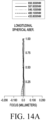
- FIG. 4A is a graph illustrating the spherical aberration of the lens assembly according to one embodiment (e.g., the embodiment of FIG. 3A ) of various embodiments of the disclosure.
- Spherical aberration may refer to the phenomenon in which light beams passing through different portions (e.g., the chief portion and the marginal portion) of the lens are focused onto different positions.
- the horizontal axis refers to the degree of longitudinal spherical aberration
- the vertical axis refers to the result of normalization of the distance from the center of the optical axis.
- FIG. 2 may illustrate variations in longitudinal spherical aberration depending on light wavelengths.
- the longitudinal spherical aberration may be shown for each of light beams whose wavelengths are about 656.3000 nanometers (nm), about 587.6000nm, about 546.1000nm, about 486.1000nm, and about 435.8000nm.
- the longitudinal spherical aberration of the lens assembly in a visible light range, may be limited to be within a range from about +0.100 to -0.100 so that stable optical properties are shown.
- FIG. 4B is a graph illustrating the astigmatism of the lens assembly according to one embodiment (e.g., the embodiment of FIG. 3 ) of various embodiments of the disclosure.
- Astigmatism may refer to a deviation between the focuses of the light beams passing in the vertical and horizontal directions when the tangential plane or meridian plane of the lens has a different radius from the radius of the sagittal plane of the lens.
- the astigmatism of the lens assembly is the result obtained at a wavelength of about 546.1000nm, wherein the dashed line Y may denote the astigmatism in the tangential plane direction (e.g., tangential field curvature), and the solid line X may denote the astigmatism in the sagittal plane direction (e.g., sagittal field curvature). It can be identified from the graph that the astigmatism may be limited to a range from about +0.100 to -0.100 so that stable optical properties may be shown according to various embodiments of the disclosure.
- FIG. 4C is a graph illustrating the distortion of the lens assembly according to one embodiment (e.g., the embodiment of FIG. 3 ) of various embodiments of the disclosure. Distortion occurs because the optical magnification varies depending on the distance from the optical axis. As compared with an image forming on a theoretical imaging plane img, an image forming on the actual imaging plane img may be shown to be larger or smaller by distortion.
- the distortion of the lens assembly is the result obtained in a wavelength of about 546.1000nm.
- the image captured by the lens assembly may cause distortion at a point (e.g., marginal portion) off the optical axis.
- the distortion is a degree that may commonly occur in an optical device using a lens, and the lens assembly according to one of various embodiments of the disclosure (e.g., the embodiment of FIG. 3A ) has a distortion rate of less than about 1.00 % and may provide good optical properties.
- FIG. 5 is a view illustrating a configuration of a lens assembly according to an embodiment.
- FIG. 6A is a graph illustrating the spherical aberration of the lens assembly of FIG. 5 .
- FIG. 6B is a graph illustrating astigmatism of the lens assembly of FIG. 5 .
- FIG. 6C is a graph illustrating the distortion of the lens assembly of FIG. 5 .
- lens assembly 300 may apply to lens assemblies 400, 500, and 600 described below according to other various embodiments.
- Some of the plurality of lens assemblies 300, 400, 500, and 600 may have the same lens attribute (e.g., view angle, focal length, auto-focusing, f number, or optical zoom), or at least one lens assembly may have one or more lens attributes different from those of another lens assembly.
- the lens assembly 400 may include a plurality of lenses, an image sensor, and/or a filter.
- the lens assembly according to the embodiment shown in FIGS. 5 and 6C may include 5 lenses.
- the lens assembly 400 may include a first lens L1, a second lens L2, a third lens L3, a fourth lens L4, and a fifth lens L5.
- the lens assembly 400 adopts a mirror as the reflective member, and in FIG. 5 , the reflective member may not be illustrated.
- Table 3 below may represent various lens data about the lens assembly according to the embodiment of FIGS. 5 to 6C .
- portions marked with the symbol '*' may mean the surfaces of lenses to which an aspheric surface is applied.
- Table 4 below may show data for defining aspheric coefficients of the plurality of lenses, respectively.
- the lens assembly included in Table 3 below may relate to a telephoto lens having a field of view (FOV) of 19.7 degrees. Further, when the total focal length (EFL) is 23.927mm, the F number (Fno) is about 3.305, and the optical total length from imaging plane (OTTL) is 22.554mm, the lens assembly included in Table 3 may satisfy the above-described conditions (and/or at least one of the above-described conditions).
- FIG. 7 is a view illustrating a configuration of a lens assembly according to an embodiment.
- FIG. 8A is a graph illustrating the spherical aberration of the lens assembly of FIG. 7 .
- FIG. 8B is a graph illustrating astigmatism of the lens assembly of FIG. 7 .
- FIG. 8C is a graph illustrating the distortion of the lens assembly of FIG. 7 .
- the lens assembly 500 according to another one different from the embodiment of FIGS. 3A to 4C among various embodiments of the disclosure may include a plurality of lenses, an image sensor, and/or a filter.
- the lens assembly according to the embodiment shown in FIGS. 7 to 8C may include 5 lenses.
- the lens assembly 500 may include a first lens L1, a second lens L2, a third lens L3, a fourth lens L4, and a fifth lens L5.
- the lens assembly 500 may include a reflective member M capable of changing the path of the light passing through the fifth lens L5 at least twice or more.
- the lens assembly 500 may adopt a prism as the reflective member M.
- portions marked with the symbol '*' such as 'S2*, S3*, S5*, S7*, S9*, and S10*', may mean the surfaces of lenses to which an aspheric surface is applied.
- Various lens data about the lens assembly 500 may be shown. Table 6 below may show data for defining aspheric coefficients of the plurality of lenses, respectively.
- the lens assembly 500 included in Table 5 below may relate to a telephoto lens having a field of view (FOV) of 23.7 degrees. Further, when the total focal length (EFL) is 19.784mm, the F number (Fno) is about 3.016, and the optical total length from imaging plane (OTTL) is 25.076mm, the lens assembly included in Table 6 may satisfy the above-described conditions (and/or at least one of the above-described conditions).
- FOV field of view
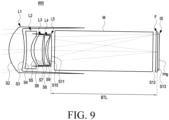
- FIG. 9 is a view illustrating a configuration of a lens assembly according to an embodiment.
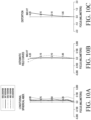
- FIG. 10A is a graph illustrating the spherical aberration of the lens assembly of FIG. 9 .
- FIG. 10B is a graph illustrating astigmatism of the lens assembly of FIG. 9 .
- FIG. 10C is a graph illustrating the distortion of the lens assembly of FIG. 9 .
- the lens assembly 600 according to another one different from the embodiment of FIGS. 3A to 4C among various embodiments of the disclosure may include a plurality of lenses, an image sensor IS, and/or a filter F.
- the lens assembly according to the embodiment shown in FIGS. 9 to 10C may include 5 lenses.
- the lens assembly 600 may include a first lens L1, a second lens L2, a third lens L3, a fourth lens L4, and a fifth lens L5.
- the lens assembly 600 may include a reflective member M capable of changing the path of the light passing through the fifth lens L5 at least twice or more.
- the lens assembly 600 may adopt a prism as the reflective member M.
- Table 7 below may represent various lens data about the lens assembly 600 according to the embodiment of FIGS. 9 to 10C .
- portions marked with the symbol '*' such as 'S2*, S3*, S5*, S7*, S9*, and S10*', may mean the surfaces of lenses to which an aspheric surface is applied.
- Table 8 below may show data for defining aspheric coefficients of the plurality of lenses, respectively.
- the lens assembly 600 included in Table 7 below may relate to a telephoto lens having a field of view (FOV) of 17.1 degrees. Further, when the total focal length (EFL) is 27.812mm, the F number (Fno) is about 2.959, and the optical total length from imaging plane (OTTL) is 35.416mm, the lens assembly 600 included in Table 8 may satisfy the above-described conditions (and/or at least one of the above-described conditions).
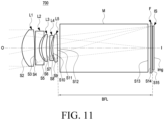
- FIG. 11 is a view illustrating a configuration of a lens assembly according to an embodiment.
- FIG. 12A is a graph illustrating the spherical aberration of the lens assembly of FIG. 11 .
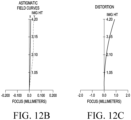
- FIG. 12B is a graph illustrating astigmatism of the lens assembly of FIG. 11 .
- FIG. 12C is a graph illustrating the distortion of the lens assembly of FIG. 11 .
- the lens assembly 700 according to another one different from the embodiment of FIGS. 3A to 4C among various embodiments of the disclosure may include a plurality of lenses, an image sensor IS, and/or a filter F.
- the lens assembly according to the embodiment shown in FIGS. 11 to 12C may include 5 lenses.
- the lens assembly 700 may include a first lens L1, a second lens L2, a third lens L3, a fourth lens L4, and a fifth lens L5.
- the second lens L2 may be different from the above-described embodiments in that the surface facing the object side has a convex shape.
- the lens assembly 700 may include a reflective member M that is capable of changing the path of the light passing through the fifth lens L5 at least twice or more.
- the lens assembly 700 may adopt a prism as the reflective member M. Table 9 below may represent various lens data about the lens assembly 700 according to the embodiment of FIGS. 11 to 12C .
- Table 9 portions marked with the symbol '*', such as 'S2*, S3*, S5*, S7*, S9*, and S10*', which may indicate surfaces of lenses to which an aspheric surface is applied.
- Table 10 may show data for defining aspheric coefficients of the plurality of lenses, respectively.
- the lens assembly 700 included in Table 9 below may relate to a telephoto lens having a field of view (FOV) of 22.4 degrees. Further, when the total focal length (EFL) is 21.000mm, the F number (Fno) is about 3.135, and the optical total length from imaging plane (OTTL) is 25.193mm, the lens assembly 700 included in Table 9 may satisfy the above-described conditions (and/or at least one of the above-described conditions).
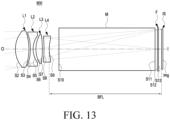
- FIG. 13 is a view illustrating a configuration of a lens assembly according to an embodiment.
- FIG. 14A is a graph illustrating the spherical aberration of the lens assembly of FIG. 13 .
- FIG. 14B is a graph illustrating astigmatism of the lens assembly of FIG. 13 .
- FIG. 14C is a graph illustrating the distortion of the lens assembly of FIG. 13 .
- the lens assembly 800 according to another one different from the embodiment of FIGS. 3A to 4C among various embodiments of the disclosure may include a plurality of lenses, an image sensor IS, and/or a filter F.
- the lens assembly according to the embodiment shown in FIGS. 13 to 14C may include 4 lenses.
- the lens assembly 800 may include a first lens L1, a second lens L2, a third lens L3, and a fourth lens L4.
- the lens assembly 800 may be different from the above-described embodiments in that it includes the first lens L1 having a glass material.
- the lens assembly 800 may include a reflective member M capable of changing the path of the light passing through the fourth lens L4 at least twice or more.
- the lens assembly 700 may adopt a prism as the reflective member M. Table 11 below may represent various lens data about the lens assembly 800 according to the embodiment of FIGS. 13 to 14C .
- portions marked with the symbol '*' may indicate the surfaces of lenses to which an aspheric surface is applied.
- Table 12 below may show data for defining aspheric coefficients of the plurality of lenses, respectively.
- the lens assembly 800 included in Table 11 below may relate to a telephoto lens having a field of view (FOV) of 17.6 degrees. Further, when the total focal length (EFL) is 27.000mm, the F number (Fno) is about 3.649, and the optical total length from imaging plane (OTTL) is 30.564mm, the lens assembly 800 included in Table 11 may satisfy the above-described conditions (and/or at least one of the above-described conditions).
- 'embodiment 1,' 'embodiment 2,' 'embodiment 3,' and 'embodiment 4' may mean the lens assembly 300 of FIG. 3A , the lens assembly 400 of FIG. 5 , the lens assembly 500 of FIG. 7 , the lens assembly 600 of FIG. 9 , the lens assembly 700 of FIG. 11 , and the lens assembly 800 of FIG. 13 , respectively.
- Embodiment 1, embodiment 3, embodiment 4, embodiment 5 and embodiment 6 may use a prism as the reflective member, and embodiment 2 may use a mirror as the reflective member.
- conditional equation 2 is an equation representing the field of view of the lens assembly of the disclosure and is omitted from Table 13.
- the above-described lens assembly may be equipped in an electronic device (e.g., an optical device).
- the electronic device e.g., an optical device
- the electronic device may further include an application processor (AP) and drive an operating system (OS) or application programs through the application processor (AP) to thereby control multiple hardware or software components connected with the AP 21 and to perform processing and computation on various data.
- the application processor (AP) may further include a graphic processing unit (GPU) and/or an image signal processor.
- the application processor (AP) includes an image signal processor, the image (or video) obtained by the image sensor IS may be stored or output by way of the application processor.
- the electronic device may be one of various types of electronic devices.
- the electronic devices may include, for example, a portable communication device (e.g., a smartphone), a computer device, a portable multimedia device, a portable medical device, a camera, a wearable device, or a home appliance.
- a portable communication device e.g., a smartphone
- a computer device e.g., a laptop, a desktop, a tablet, or a portable multimedia device
- a portable medical device e.g., a portable medical device
- camera e.g., a camera
- a wearable device e.g., a portable medical device
- each of such phrases as “A or B,” “at least one of A and B,” “at least one of A or B,” “A, B, or C,” “at least one of A, B, and C,” and “at least one of A, B, or C,” may include all possible combinations of the items enumerated together in a corresponding one of the phrases.
- such terms as “1st” and “2nd,” or “first” and “second” may be used to simply distinguish a corresponding component from another, and does not limit the components in other aspect (e.g., importance or order).
- an element e.g., a first element
- the element may be coupled with the other element directly (e.g., wiredly), wirelessly, or via a third element.
- module may include a unit implemented in hardware, software, or firmware, and may interchangeably be used with other terms, for example, “logic,” “logic block,” “part,” or “circuitry”.
- a module may be a single integral component, or a minimum unit or part thereof, adapted to perform one or more functions.
- the module may be implemented in a form of an application-specific integrated circuit (ASIC).
- ASIC application-specific integrated circuit
- Various embodiments as set forth herein may be implemented as software (e.g., the program 140) including one or more instructions that are stored in a storage medium (e.g., internal memory 136 or external memory 138) that is readable by a machine (e.g., the electronic device 101).
- a processor e.g., the processor 120
- the machine e.g., the electronic device 101
- the one or more instructions may include a code generated by a complier or a code executable by an interpreter.
- the machine-readable storage medium may be provided in the form of a non-transitory storage medium.
- non-transitory simply means that the storage medium is a tangible device, and does not include a signal (e.g., an electromagnetic wave), but this term does not differentiate between where data is semi-permanently stored in the storage medium and where the data is temporarily stored in the storage medium.
- a method may be included and provided in a computer program product.
- the computer program products may be traded as commodities between sellers and buyers.
- the computer program product may be distributed in the form of a machine-readable storage medium (e.g., compact disc read only memory (CD-ROM)), or be distributed (e.g., downloaded or uploaded) online via an application store (e.g., Play StoreTM), or between two user devices (e.g., smartphones) directly. If distributed online, at least part of the computer program product may be temporarily generated or at least temporarily stored in the machine-readable storage medium, such as memory of the manufacturer's server, a server of the application store, or a relay server.
- CD-ROM compact disc read only memory
- an application store e.g., Play StoreTM
- two user devices e.g., smartphones
- each component e.g., a module or a program of the above-described components may include a single entity or multiple entities. Some of the plurality of entities may be separately disposed in different components. According to various embodiments, one or more of the above-described components may be omitted, or one or more other components may be added. Alternatively or additionally, a plurality of components (e.g., modules or programs) may be integrated into a single component. In such a case, according to various embodiments, the integrated component may still perform one or more functions of each of the plurality of components in the same or similar manner as they are performed by a corresponding one of the plurality of components before the integration.
- operations performed by the module, the program, or another component may be carried out sequentially, in parallel, repeatedly, or heuristically, or one or more of the operations may be executed in a different order or omitted, or one or more other operations may be added.
- an electronic device 101 may include a lens assembly 210; 300; 400; 500; 600; 700; 800 in which at least four lenses are aligned along an optical axis O-I direction from an object O side to an image I side; an image sensor IS including an imaging plane "img" on which an image is formed; and at least one reflective member M disposed between the lens assembly and the image sensor.
- At least one surface of an object-side surface S2 and an image-side surface S3 of a first lens L1 from an object side among the at least four lenses may be formed as an aspherical surface.
- the object-side surface and the image-side surface may be formed to be convex.
- the electronic device may satisfy conditional equation 1 and conditional equation 2 below.
- BFL is a distance from an image-side surface of a lens closest to the imaging plane to the image sensor
- EFL is a total focal length of the lens assembly
- FOV is a field of view of an overall optical system including the lens assembly.
- the reflective member may be configured to change a path of light at least twice.
- At least two or more reflective members may be provided between the lens assembly and the image sensor.
- a path of a chief ray passing through the reflective member may be parallel to a chief ray incident on the lens assembly.
- the electronic device may satisfy conditional equation 3 below. 0.8 ⁇ OTTL / EFL ⁇ 1.4 (wherein, in conditional equation 3, OTTL is a distance from an apex of the object-side surface of the first lens from the object side to the image sensor, and EFL is the total focal length of the lens assembly).
- the electronic device may satisfy conditional equation 4 below. 2.5 ⁇ EFL / EFL 1 ⁇ 3.4 (wherein, in conditional equation 4, EFL is the total focal length of the lens assembly, and EFL1 is a focal length of the first lens from the object side).
- the reflective member may be a mirror or a prism.
- the electronic device may satisfy conditional equation 5 below. 2.5 ⁇ EFL / L 1 LL ⁇ 4.2 (wherein, in conditional equation 5, EFL is the total focal length of the lens assembly, and L1LL is a distance from an apex of the object-side surface of the first lens from the object side to an apex of an image-side surface of a lens closest to the image side).
- an image height IMG HT of the image sensor may have a size of 4.0 mm or more. (wherein, the image IMG HT of the image sensor may correspond to half of a diagonal length of the image sensor).
- the first lens from the object side among the plurality of lenses included in the lens assembly may have a positive refractive power
- a second lens from the object side among the plurality of lenses included in the lens assembly may have a negative refractive power
- the electronic device may satisfy conditional equation 6 below. ⁇ 4.5 ⁇ L 1 S 3 / L 1 S 2 ⁇ ⁇ 0.6 (wherein, in conditional equation 6, L1S3 is a curvature of the image-side surface of the first lens from the object side, and L1S2 is a curvature of the object-side surface of the first lens from the object side).
- the stop "sto" may be disposed between the second lens from the object side and the third lens from the object side of the lens assembly.
- an electronic device 101 may include a lens assembly 210; 300; 400; 500; 600; 700; 800 in which at least four lenses are aligned along an optical axis direction from an object side to an image side; an image sensor IS including an imaging plane on which an image is formed; and at least one reflective member M disposed between the lens assembly and the image sensor.
- the at least one reflective member M may include prism or mirror.
- the at least one reflective member may be configured to change a path of light at least twice. A path of a chief ray passing through the at least one reflective member may be parallel to a chief ray incident on the lens assembly.
- the electronic device may satisfy conditional equation 1 and conditional equation 2 below.
- BFL is a distance from an image-side surface of a lens closest to the imaging plane to the image sensor
- EFL is a total focal length of the lens assembly
- FOV is a field of view of an overall optical system including the lens assembly.
- At least two or more reflective members may be provided between the lens assembly and the image sensor.
- the electronic device may satisfy conditional equation 3 below. 0.8 ⁇ OTTL / EFL ⁇ 1.4 (wherein, in conditional equation 3, OTTL is a distance from an apex of the object-side surface of the first lens from the object side to the image sensor, and EFL is the total focal length of the lens assembly).
- the electronic device may satisfy conditional equation 4 below. 2.5 ⁇ EFL / EFL 1 ⁇ 4.3 (wherein, in conditional equation 4, EFL is the total focal length of the lens assembly, and EFL1 is a focal length of the first lens from the object side).
- the electronic device may satisfy conditional equation 5 below. 2.5 ⁇ EFL / L 1 LL ⁇ 4.2 (wherein, in conditional equation 5, EFL is the total focal length of the lens assembly, and L1LL is a distance from an apex of the object-side surface of the first lens from the object side to an apex of an image-side surface of a lens closest to the image side).
- an image height of the image sensor may be 4.0 mm or more.
- the image IMG HT of the image sensor may correspond to half of a diagonal length of the image sensor).
- the electronic device may satisfy conditional equation 6 below. ⁇ 4.5 ⁇ L 1 S 3 / L 1 S 2 ⁇ ⁇ 0.6 (wherein, in conditional equation 6, L1S3 is a curvature of the image-side surface of the first lens from the object side, and L1S2 is a curvature of the object-side surface of the first lens from the object side).
- the measurements of the plurality of lenses may be properly set depending on the structure, specifications, or actual use environment of the lens assembly as actually manufactured or an electronic device equipped with the lens assembly.
Landscapes
- Physics & Mathematics (AREA)
- General Physics & Mathematics (AREA)
- Optics & Photonics (AREA)
- Engineering & Computer Science (AREA)
- Multimedia (AREA)
- Signal Processing (AREA)
- Studio Devices (AREA)
- Lenses (AREA)
Applications Claiming Priority (4)
| Application Number | Priority Date | Filing Date | Title |
|---|---|---|---|
| KR20220065160 | 2022-05-27 | ||
| KR20220125780 | 2022-09-30 | ||
| KR1020230028763A KR102651598B1 (ko) | 2022-05-27 | 2023-03-03 | 렌즈 어셈블리 및 그를 포함하는 전자 장치 |
| PCT/KR2023/003626 WO2023229174A1 (ko) | 2022-05-27 | 2023-03-17 | 렌즈 어셈블리 및 그를 포함하는 전자 장치 |
Publications (2)
| Publication Number | Publication Date |
|---|---|
| EP4530693A1 true EP4530693A1 (de) | 2025-04-02 |
| EP4530693A4 EP4530693A4 (de) | 2025-09-17 |
Family
ID=88919556
Family Applications (1)
| Application Number | Title | Priority Date | Filing Date |
|---|---|---|---|
| EP23811960.6A Pending EP4530693A4 (de) | 2022-05-27 | 2023-03-17 | Linsenanordnung und elektronische vorrichtung damit |
Country Status (5)
| Country | Link |
|---|---|
| US (2) | US11785324B1 (de) |
| EP (1) | EP4530693A4 (de) |
| KR (1) | KR20240044398A (de) |
| CN (1) | CN119301496A (de) |
| WO (1) | WO2023229174A1 (de) |
Families Citing this family (5)
| Publication number | Priority date | Publication date | Assignee | Title |
|---|---|---|---|---|
| KR102897344B1 (ko) * | 2021-06-07 | 2025-12-08 | 삼성전자주식회사 | 카메라 모듈 및 카메라 모듈을 포함하는 전자 장치 |
| TWI847212B (zh) | 2022-08-09 | 2024-07-01 | 大立光電股份有限公司 | 折疊光學系統、取像裝置及電子裝置 |
| TW202429156A (zh) * | 2022-12-11 | 2024-07-16 | 以色列商核心光電有限公司 | 用於緊湊折疊式長焦相機的折射和混合鏡頭 |
| WO2025105866A1 (ko) * | 2023-11-15 | 2025-05-22 | 삼성전자 주식회사 | 렌즈 어셈블리 및 이를 포함한 전자 장치 |
| CN120315149A (zh) | 2024-01-12 | 2025-07-15 | 大立光电股份有限公司 | 成像用光学镜头、取像装置及电子装置 |
Family Cites Families (24)
| Publication number | Priority date | Publication date | Assignee | Title |
|---|---|---|---|---|
| JP4788953B2 (ja) * | 2005-11-16 | 2011-10-05 | ソニー株式会社 | 撮像装置及びズームレンズ |
| KR100906851B1 (ko) | 2007-06-01 | 2009-07-08 | 엘지이노텍 주식회사 | 줌 렌즈 |
| KR101271733B1 (ko) | 2011-02-11 | 2013-06-04 | 삼성테크윈 주식회사 | 줌 렌즈계 |
| US9557627B2 (en) | 2014-03-07 | 2017-01-31 | Apple Inc. | Folded camera lens systems |
| KR101661922B1 (ko) | 2014-12-22 | 2016-10-04 | (주)파트론 | 렌즈 광학계 |
| TWI587067B (zh) | 2015-08-04 | 2017-06-11 | 中強光電股份有限公司 | 投影裝置及投影鏡頭 |
| KR101792344B1 (ko) * | 2015-10-19 | 2017-11-01 | 삼성전기주식회사 | 촬상 광학계 |
| CN108780210A (zh) | 2016-03-28 | 2018-11-09 | 苹果公司 | 具有四个折射透镜的折叠透镜系统 |
| US9967547B2 (en) | 2016-06-08 | 2018-05-08 | Qualcomm Incorporated | Wafer level optics for folded optic passive depth sensing system |
| KR102369443B1 (ko) | 2016-12-29 | 2022-03-03 | 삼성전기주식회사 | 촬상 광학계 및 이를 포함하는 휴대용 전자기기 |
| KR101956705B1 (ko) | 2017-08-21 | 2019-03-11 | 삼성전기주식회사 | 촬상 광학계 |
| US11029496B2 (en) | 2017-12-21 | 2021-06-08 | Apple Inc. | Folded lens system |
| US11061213B2 (en) | 2018-02-07 | 2021-07-13 | Apple Inc. | Folded camera |
| CN108957689B (zh) * | 2018-06-08 | 2020-12-15 | 玉晶光电(厦门)有限公司 | 光学成像镜头 |
| KR102837193B1 (ko) | 2018-11-14 | 2025-07-23 | 삼성전자주식회사 | 렌즈 어셈블리 및 그를 포함하는 전자 장치 |
| JP7306687B2 (ja) * | 2019-08-20 | 2023-07-11 | 株式会社コシナ | 撮像光学系 |
| KR102258604B1 (ko) | 2019-09-10 | 2021-05-31 | 삼성전기주식회사 | 촬상 광학계 |
| KR102437800B1 (ko) * | 2020-05-19 | 2022-08-30 | 삼성전기주식회사 | 카메라 모듈 |
| KR102334584B1 (ko) * | 2020-07-17 | 2021-12-06 | 자화전자(주) | 카메라용 액추에이터 및 이를 포함하는 카메라 모듈 |
| US11762174B2 (en) | 2020-09-24 | 2023-09-19 | Apple Inc. | Optical system including lenses and prism for telephoto cameras |
| KR102867025B1 (ko) * | 2020-10-12 | 2025-10-02 | 삼성전기주식회사 | 카메라 모듈 |
| KR102544194B1 (ko) | 2020-11-02 | 2023-06-15 | 삼성전기주식회사 | 촬상 광학계 |
| CN113253436B (zh) * | 2021-07-14 | 2021-11-23 | 江西晶超光学有限公司 | 光学系统、摄像模组及电子设备 |
| KR20230100342A (ko) | 2021-12-28 | 2023-07-05 | 삼성전기주식회사 | 촬상 광학계 |
-
2023
- 2023-03-17 EP EP23811960.6A patent/EP4530693A4/de active Pending
- 2023-03-17 US US18/122,790 patent/US11785324B1/en active Active
- 2023-03-17 CN CN202380043330.6A patent/CN119301496A/zh active Pending
- 2023-03-17 WO PCT/KR2023/003626 patent/WO2023229174A1/ko not_active Ceased
- 2023-09-14 US US18/368,090 patent/US12160651B2/en active Active
-
2024
- 2024-03-21 KR KR1020240039337A patent/KR20240044398A/ko active Pending
Also Published As
| Publication number | Publication date |
|---|---|
| US11785324B1 (en) | 2023-10-10 |
| US12160651B2 (en) | 2024-12-03 |
| CN119301496A (zh) | 2025-01-10 |
| US20240056667A1 (en) | 2024-02-15 |
| WO2023229174A1 (ko) | 2023-11-30 |
| EP4530693A4 (de) | 2025-09-17 |
| KR20240044398A (ko) | 2024-04-04 |
Similar Documents
| Publication | Publication Date | Title |
|---|---|---|
| US11785324B1 (en) | Lens assembly and electronic device including the same | |
| US12504606B2 (en) | Lens assembly and electronic apparatus including the same | |
| US20220269048A1 (en) | Lens assembly and electronic apparatus including the same | |
| US20240126054A1 (en) | Lens assembly and electronic device including same | |
| EP4318070A1 (de) | Linsenanordnung und elektronische vorrichtung damit | |
| KR20240156915A (ko) | 렌즈 어셈블리 및 그를 포함하는 전자 장치 | |
| US20250334776A1 (en) | Lens assembly and electronic device comprising same | |
| EP4350412A1 (de) | Linsenanordnung und elektronische vorrichtung damit | |
| US20250224602A1 (en) | Lens assembly and electronic device comprising same | |
| EP4390493A1 (de) | Linsenanordnung und elektronische vorrichtung damit | |
| US12560780B2 (en) | Lens assembly and electronic device including the same | |
| EP4481459A1 (de) | Linsenanordnung und elektronische vorrichtung damit | |
| US20230176336A1 (en) | Lens assembly and electronic device including the same | |
| KR20230100539A (ko) | 렌즈 어셈블리 및 그를 포함하는 전자 장치 | |
| EP4738858A1 (de) | Kameramodul und elektronische vorrichtung damit | |
| KR102651598B1 (ko) | 렌즈 어셈블리 및 그를 포함하는 전자 장치 | |
| US20260016664A1 (en) | Lens assembly and electronic device comprising same | |
| EP4439146A1 (de) | Linsenanordnung und elektronische vorrichtung damit | |
| EP4700452A1 (de) | Linsenanordnung und elektronische vorrichtung damit | |
| EP4664174A1 (de) | Linsenanordnung und elektronische vorrichtung damit | |
| EP4589354A1 (de) | Linsenanordnung und elektronische vorrichtung damit | |
| US20260029617A1 (en) | Lens assembly and electronic device comprising same | |
| EP4556980A1 (de) | Linsenanordnung und elektronische vorrichtung damit | |
| EP4571384A1 (de) | Linsenanordnung und elektronische vorrichtung damit | |
| EP4502694A1 (de) | Linsenanordnung und elektronische vorrichtung damit |
Legal Events
| Date | Code | Title | Description |
|---|---|---|---|
| STAA | Information on the status of an ep patent application or granted ep patent |
Free format text: STATUS: THE INTERNATIONAL PUBLICATION HAS BEEN MADE |
|
| PUAI | Public reference made under article 153(3) epc to a published international application that has entered the european phase |
Free format text: ORIGINAL CODE: 0009012 |
|
| STAA | Information on the status of an ep patent application or granted ep patent |
Free format text: STATUS: REQUEST FOR EXAMINATION WAS MADE |
|
| 17P | Request for examination filed |
Effective date: 20241223 |
|
| AK | Designated contracting states |
Kind code of ref document: A1 Designated state(s): AL AT BE BG CH CY CZ DE DK EE ES FI FR GB GR HR HU IE IS IT LI LT LU LV MC ME MK MT NL NO PL PT RO RS SE SI SK SM TR |
|
| DAV | Request for validation of the european patent (deleted) | ||
| DAX | Request for extension of the european patent (deleted) | ||
| A4 | Supplementary search report drawn up and despatched |
Effective date: 20250818 |
|
| RIC1 | Information provided on ipc code assigned before grant |
Ipc: G02B 13/00 20060101AFI20250811BHEP Ipc: G02B 13/18 20060101ALI20250811BHEP Ipc: G02B 3/02 20060101ALI20250811BHEP Ipc: G02B 9/34 20060101ALI20250811BHEP Ipc: G02B 7/02 20210101ALI20250811BHEP Ipc: G02B 7/182 20210101ALI20250811BHEP Ipc: G02B 17/04 20060101ALI20250811BHEP Ipc: G02B 17/06 20060101ALI20250811BHEP Ipc: G02B 9/10 20060101ALI20250811BHEP Ipc: H04N 23/54 20230101ALI20250811BHEP Ipc: H04N 23/55 20230101ALI20250811BHEP |