EP4530594A1 - Verfahren zur bestimmung der dichtheit und cci von behältern mit einem quetschverschluss - Google Patents
Verfahren zur bestimmung der dichtheit und cci von behältern mit einem quetschverschluss Download PDFInfo
- Publication number
- EP4530594A1 EP4530594A1 EP23200185.9A EP23200185A EP4530594A1 EP 4530594 A1 EP4530594 A1 EP 4530594A1 EP 23200185 A EP23200185 A EP 23200185A EP 4530594 A1 EP4530594 A1 EP 4530594A1
- Authority
- EP
- European Patent Office
- Prior art keywords
- container
- crimp
- seal closure
- crimp seal
- determined
- Prior art date
- Legal status (The legal status is an assumption and is not a legal conclusion. Google has not performed a legal analysis and makes no representation as to the accuracy of the status listed.)
- Pending
Links
Images

Classifications
-
- G—PHYSICS
- G01—MEASURING; TESTING
- G01M—TESTING STATIC OR DYNAMIC BALANCE OF MACHINES OR STRUCTURES; TESTING OF STRUCTURES OR APPARATUS, NOT OTHERWISE PROVIDED FOR
- G01M3/00—Investigating fluid-tightness of structures
-
- B—PERFORMING OPERATIONS; TRANSPORTING
- B67—OPENING, CLOSING OR CLEANING BOTTLES, JARS OR SIMILAR CONTAINERS; LIQUID HANDLING
- B67B—APPLYING CLOSURE MEMBERS TO BOTTLES JARS, OR SIMILAR CONTAINERS; OPENING CLOSED CONTAINERS
- B67B3/00—Closing bottles, jars or similar containers by applying caps
- B67B3/26—Applications of control, warning, or safety devices in capping machinery
-
- B—PERFORMING OPERATIONS; TRANSPORTING
- B65—CONVEYING; PACKING; STORING; HANDLING THIN OR FILAMENTARY MATERIAL
- B65B—MACHINES, APPARATUS OR DEVICES FOR, OR METHODS OF, PACKAGING ARTICLES OR MATERIALS; UNPACKING
- B65B7/00—Closing containers or receptacles after filling
- B65B7/16—Closing semi-rigid or rigid containers or receptacles not deformed by, or not taking-up shape of, contents, e.g. boxes or cartons
- B65B7/28—Closing semi-rigid or rigid containers or receptacles not deformed by, or not taking-up shape of, contents, e.g. boxes or cartons by applying separate preformed closures, e.g. lids, covers
- B65B7/2842—Securing closures on containers
- B65B7/285—Securing closures on containers by deformation of the closure
-
- B—PERFORMING OPERATIONS; TRANSPORTING
- B67—OPENING, CLOSING OR CLEANING BOTTLES, JARS OR SIMILAR CONTAINERS; LIQUID HANDLING
- B67C—CLEANING, FILLING WITH LIQUIDS OR SEMILIQUIDS, OR EMPTYING, OF BOTTLES, JARS, CANS, CASKS, BARRELS, OR SIMILAR CONTAINERS, NOT OTHERWISE PROVIDED FOR; FUNNELS
- B67C7/00—Concurrent cleaning, filling, and closing of bottles; Processes or devices for at least two of these operations
Definitions
- Crimp seal closures are known in the art and are used to seal containers, for example like glass containers like vials. Testing the integrity or tightness of the closed container is important to ensure that the closure is fit for purpose. Methods for testing the tightness of a crimp seal closure are known in the art, for example from the European Patent 0892918B1 . These methods work by applying a pressure to the top of the crimp seal closure and measure the movement of the crimp seal closure in reaction to the applied pressure. The disadvantages of these methods are that they are time consuming, not very reliable and destructive.
- One object of the invention is to provide for a method to testing the integrity of a crimp seal closure that is easy, quick and non-destructive to perform while providing reliable results.
- the invention provides for a fast, reliable and non-destructive method for testing the integrity of a crimp seal closure.
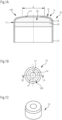
- a crimp seal closure as shown in Fig. 1A-C is typically comprised of a crimp ring 10 ( Fig. 1C ), made up of a cylindrical body 11, with a closed end 14 having a flange 12 provided with a concentrical opening 13.
- the flange 12 has a top surface 100.
- a reference circle d has a diameter that fits concentrically between the opening 13 and the outer wall of the cylindrical body 11. The reference circle d can be used for further measurements described below.
- the material is typically aluminum or another suitable deformable material.
- the crimp seal closure is provided with an elastomer section formed as a closing element 20 that is disk shaped and fits into the cylindrical body 11.
- the closing element 20 is made out of an elastic material, like for example a rubber.
- the closing element can be made up out of a single piece (for example a rubber disk) or made out of multiple pieces, for example two (like the two sections 23 and 24 shown in Fig. 1A ) or more rubber disks.
- the closing element is made up of a flexible material like a rubber, polyisoprene or bromobutyl.
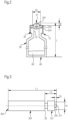
- the container 30 to be closed ( Fig. 2 , in this example provided with a liquid content 60) has a cylindrical opening 31 provided with a circumferential flange 32.
- the closing element 201 is placed with the crimp ring 10 and placed on top of the container 30.
- the lower section 15 of the cylindrical crimp ring 10 extends beyond the flange 32.
- To close the crimp ring 10 is pressed onto the container, thereby compressing the closing element 201 between the crimp ring 10 and the flange 32 of the container 30. Subsequently, the lower section 15 is crimped (ie deformed) on the flange 32.
- the result is a form closed connection of the crimp ring 10 onto the container 30, with the closing element 201 remaining under pressure, thereby closing and sealing the container 30.
- the pressure with which the crimp seal closure is affixed to the container is determined by the pressures used during the crimping procedure.
- the closing element 20 has a central protrusion 21, or bulge 21. Tools to crimp the crimp closure onto the container are widely known in the art. According to the invention, by closing the crimp ring, the central protrusion 21 extends to some extent, outward in axial direction.
- the reliability of the closure is essential.
- Tests for determining the reliability of the closure are known in the art, and essentially determine the pressure the closure can withstand before leakage occurs.
- many leakage tests evaluate the adequacy of container closure systems to maintain a sterile barrier against potential contaminants. In essence, these methods apply a pressure to the container to be tested that is closed with a crimp seal closure to be tested and apply different pressures to the container until the seal is breached.
- One example of such a test is ISO21881:2019, annex F. For a specific use, a minimum pressure that needs to be able to be resisted is required.
- Containers that have a tight closure are also very likely to have container closure integrity (CCI), which the resistance to ingress of fluids into the container.
- CCI container closure integrity
- the closure integrity of the crimp seal closure is determined by the height of the crimp seal closure in relation to the closed container.
- the height of the mounted crimp seal closure is determined by the topmost section of the closing element 21, that is the central protrusion 21.
- the topmost section of central protrusion 21 is the first measuring point.
- the second measuring point is located on a concentrical circle with a reference diameter d0 on the top surface of the crimp ring 10 (surface 100 in Fig. 1A ), that is larger than the opening 13, and smaller than the circumference of the crimp ring. Within this range, any suitable diameter can be chosen.
- the height X of the mounted crimp seal closure can be measured between a point on the circle d and the central protrusion 21, i.e. between the first and second measuring point.
- the second measuring point is a predetermined section of the cylindrical body 11.
- the predetermined section is the bottom 40 of the cylindrical body.
- the second measuring point can be any part of the container, for example a certain position on the shoulder of the container, or a specific point on the container indicated with a mark like a print or etching.
- dimensional variations in the geometry of the container are taken into account to improve the accuracy of the measurement.
- Fig. 2 shows an example of a closed container 30 according to the invention and shows the determined length of the top of the closing element compared to the container, in this embodiment with determined length L measured between the top of the closing element 21 and the bottom of the container 40.
- the determined length as determined by the concentric circle d0 and the top of the closing element 21 is shown as X.
- a closed container 301 is shown with a closure 101 and a protruding closing element 201 with a central protrusion 211 with two examples for measuring the determined length that is L1 measured between the top of the closing element 211 and the bottom 401 of the container 301 and a determined length L2 between the top of the closing element 211 and a shoulder 35 of the container 301. Further, in Fig. 3 the determined length as determined by the concentric circle d1 and the top of the closing element 211 is shown as X1.
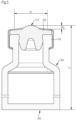
- FIG. 5 another embodiment of the invention is shown, with a closed container 302 with bottom 402.
- the crimp ring 102 is crimped on, with a single part closure element 202 and a topmost section 212.
- the closure element 212 has a central section 212 that protrudes above the crimp ring 102 after being closed.
- the determined length L3 is determined from the topmost section 212 to the bottom 402 of the container 302. Further, in Fig. 5 the determined length as determined by the concentric circle d2 and the top of the closing element 212 is shown as X2.
- the determined length (L, L1, L3, X, X1, X2) is predictive of the tightness performance of the closed container.
- a calibration is needed.
- a set of containers is closed with several values for the crimping force, resulting in a set of containers with variations in the determined length of the closed container.
- This set of containers is tested for tightness where for each of the closed cylinders the maximum pressure where the closing integrity is still guaranteed is determined.
- a graph like shown in Fig. 4 is generated.
- the line LSL determines the required tightness for this specific combination of crimp closure and container, according to ISO21881:2019, Annex F.
- the line M1 shows the line where for the minimal determined length that corresponds to the determined length that is minimally required to ensure the required tightness. Containers which were not tight for the required pressure over 60s as required per ISO21881:2019 are indicated with a point below the line LSL.
- the topmost section of the central protrusion 21, 211, 212 that is the first measuring point can be measured using optical measurement means, for example with a camera-based vision system or a laser based system.
- optical measurement systems are known in the art.
- measurement systems to determine geometrical measurements of pharmaceutical containers are well known in the art.
- Optical systems have the advantage of not needing physical contact with the central protrusion 2, 211, 212 to be measured, improving the accuracy of the measurement.
- Other measurement systems can also be used, for example with a mechanical measurement tool contacting the central protrusion 21, 211, 212.
- the contact force with which the central protrusion is tested should be kept low to avoid impacting the measurement. Contact forces between 0.01 and 0.1 N are advantageous.
- the crimping force can be varied for specific combinations of crimp closure type and container type.
- the crimping force is one factor for determining the closing strength of the closure and plays a large role in determining whether the closed container maintains the required tightness. Due to unavoidable production machine tolerances, the effective crimping force will vary per closed container.
- a set of calibration containers is generated.
- the determined length of each of these containers will be varied due to variation in actual crimping force.
- the containers in the calibration set are measured for length (bulge height) and tested for tightness.
- the tightness test is a go/no-go test, and this will generate a set of passed containers. These have each all a specific length, distributed along some distribution. The highest and lowest lengths will determine a range of lengths for which tightness is guaranteed. This will give a reference range for the determined length that corresponds to a test representative for tightness for the closure and container combination.
- the reference range needs to be determined for each specific type of closure and container combination.
- the reference range for the determined height is determined using the same calibration test run.
- the lower value of the reference range is determined as in the previous example.
- the upper value of the reference range is determined by a geometric limit, for example a maximum height of the closed container. This is shown by line M2 in Fig. 4 . This although tightness and CCI would be guaranteed with a higher height.
- the maximum height can for example be limited by a maximum size for further use of the closed container, for example to ensure compatibility with use in pharma applications or use in devices that have a maximum acceptance size of closed containers.
- each crimped container is measured and compared to the reference range, preferably directly after filling and closing.
- the container can be filled with a liquid, for example a liquid containing a pharmaceutical ingredient.
- Containers within the reference range are certain to meet the required tightness and CCI and processed further. Containers outside the range have uncertain tightness and CCI and are rejected or sorted out. Production lines and method are known in the art, for example in US 9796489 .
- the tightness and CCI of the closed container can be quickly and reliably determined.
- advantageous is to perform the measurement downstream of the closing machine.
- the container can be of any type with an opening suitable for a crimp seal closure, for example a cartridge, vial or ampoule.
- the container can be made of glass, polymer or any other suitable material.
Landscapes
- Engineering & Computer Science (AREA)
- Mechanical Engineering (AREA)
- Physics & Mathematics (AREA)
- General Physics & Mathematics (AREA)
- Closures For Containers (AREA)
- Examining Or Testing Airtightness (AREA)
Priority Applications (3)
| Application Number | Priority Date | Filing Date | Title |
|---|---|---|---|
| EP23200185.9A EP4530594A1 (de) | 2023-09-27 | 2023-09-27 | Verfahren zur bestimmung der dichtheit und cci von behältern mit einem quetschverschluss |
| CN202411137174.2A CN119714742A (zh) | 2023-09-27 | 2024-08-19 | 用于确定具有压接密封封闭件的容器的气密性和cci的方法 |
| US18/882,996 US20250100861A1 (en) | 2023-09-27 | 2024-09-12 | Method for determining tightness and CCI of containers with a crimp seal closure |
Applications Claiming Priority (1)
| Application Number | Priority Date | Filing Date | Title |
|---|---|---|---|
| EP23200185.9A EP4530594A1 (de) | 2023-09-27 | 2023-09-27 | Verfahren zur bestimmung der dichtheit und cci von behältern mit einem quetschverschluss |
Publications (1)
| Publication Number | Publication Date |
|---|---|
| EP4530594A1 true EP4530594A1 (de) | 2025-04-02 |
Family
ID=88207623
Family Applications (1)
| Application Number | Title | Priority Date | Filing Date |
|---|---|---|---|
| EP23200185.9A Pending EP4530594A1 (de) | 2023-09-27 | 2023-09-27 | Verfahren zur bestimmung der dichtheit und cci von behältern mit einem quetschverschluss |
Country Status (3)
| Country | Link |
|---|---|
| US (1) | US20250100861A1 (de) |
| EP (1) | EP4530594A1 (de) |
| CN (1) | CN119714742A (de) |
Citations (3)
| Publication number | Priority date | Publication date | Assignee | Title |
|---|---|---|---|---|
| EP0892918B1 (de) | 1996-04-12 | 2003-05-07 | Robert Bosch Gmbh | Prüfen der Dichtheit des Verschlusses von Kleinbehältern |
| US9796489B2 (en) | 2011-09-15 | 2017-10-24 | Groninger & Co. Gmbh | Method and device for filling and closing pharmaceutical objects |
| US20220187155A1 (en) * | 2019-01-25 | 2022-06-16 | West Pharmaceutical Services, Inc. | Real-time, non-destructive container closure integrity measurement |
-
2023
- 2023-09-27 EP EP23200185.9A patent/EP4530594A1/de active Pending
-
2024
- 2024-08-19 CN CN202411137174.2A patent/CN119714742A/zh active Pending
- 2024-09-12 US US18/882,996 patent/US20250100861A1/en active Pending
Patent Citations (3)
| Publication number | Priority date | Publication date | Assignee | Title |
|---|---|---|---|---|
| EP0892918B1 (de) | 1996-04-12 | 2003-05-07 | Robert Bosch Gmbh | Prüfen der Dichtheit des Verschlusses von Kleinbehältern |
| US9796489B2 (en) | 2011-09-15 | 2017-10-24 | Groninger & Co. Gmbh | Method and device for filling and closing pharmaceutical objects |
| US20220187155A1 (en) * | 2019-01-25 | 2022-06-16 | West Pharmaceutical Services, Inc. | Real-time, non-destructive container closure integrity measurement |
Also Published As
| Publication number | Publication date |
|---|---|
| US20250100861A1 (en) | 2025-03-27 |
| CN119714742A (zh) | 2025-03-28 |
Similar Documents
| Publication | Publication Date | Title |
|---|---|---|
| KR102081526B1 (ko) | 센서를 포함하는 파이프 피팅 | |
| US10337630B2 (en) | Oil-hydraulic valve | |
| EP2151616A2 (de) | Crimpsichere Dichtung | |
| US20230138697A1 (en) | Method and apparatus for checking the tightness of a closure | |
| US20040173976A1 (en) | Resilient seal with axial protrusions | |
| US6438814B1 (en) | Method of forming a connection between a tube and a fitting | |
| EP4530594A1 (de) | Verfahren zur bestimmung der dichtheit und cci von behältern mit einem quetschverschluss | |
| EP3673229B1 (de) | Werkzeug und verfahren zur beurteilung von steckverbinderanordnungen | |
| US20180328858A1 (en) | Automated tablet tooling inspection system and a method thereof | |
| US20100000958A1 (en) | Anesthetic container | |
| CN100408995C (zh) | 确定密封瓶器余留密封力的设备和方法 | |
| US20050081598A1 (en) | Method and apparatus for calibrating seal force testing devices | |
| US5679904A (en) | Method and test plug for field testing pipe joints | |
| US10520118B2 (en) | Tube fitting assembly | |
| EP3502644A1 (de) | Leckagetestmethoden für tanks | |
| US20240110855A1 (en) | Top Loading Testing Method and Device for Blow Molded Containers | |
| JPH0361897B2 (de) | ||
| DE102006047040B3 (de) | Packmitteldichtheit | |
| CN120063627B (zh) | 分层包装瓶的密封性能检测方法及系统 | |
| JP7418648B1 (ja) | プレス式管継手のゲージ装置及びプレス式管継手の施工状態の判定方法 | |
| KR102819382B1 (ko) | 무용접 방식에 의한 파이프나 튜브의 체결장치에 사용되는 지그 | |
| Crocker et al. | Preliminary EDS Liquid Sample Adapter Design Assurance Testing | |
| JPS63308538A (ja) | リ−ク検査方法および良品容器選別方法 | |
| JPS63133034A (ja) | 漏れ試験装置 | |
| Tobita et al. | Containment performance of transportable storage casks at 9m drop test |
Legal Events
| Date | Code | Title | Description |
|---|---|---|---|
| PUAI | Public reference made under article 153(3) epc to a published international application that has entered the european phase |
Free format text: ORIGINAL CODE: 0009012 |
|
| STAA | Information on the status of an ep patent application or granted ep patent |
Free format text: STATUS: THE APPLICATION HAS BEEN PUBLISHED |
|
| AK | Designated contracting states |
Kind code of ref document: A1 Designated state(s): AL AT BE BG CH CY CZ DE DK EE ES FI FR GB GR HR HU IE IS IT LI LT LU LV MC ME MK MT NL NO PL PT RO RS SE SI SK SM TR |
|
| P01 | Opt-out of the competence of the unified patent court (upc) registered |
Free format text: CASE NUMBER: APP_31669/2025 Effective date: 20250701 |
|
| STAA | Information on the status of an ep patent application or granted ep patent |
Free format text: STATUS: REQUEST FOR EXAMINATION WAS MADE |
|
| 17P | Request for examination filed |
Effective date: 20251001 |