EP4525541A1 - Kommunikationsverfahren und -vorrichtung - Google Patents
Kommunikationsverfahren und -vorrichtung Download PDFInfo
- Publication number
- EP4525541A1 EP4525541A1 EP23818998.9A EP23818998A EP4525541A1 EP 4525541 A1 EP4525541 A1 EP 4525541A1 EP 23818998 A EP23818998 A EP 23818998A EP 4525541 A1 EP4525541 A1 EP 4525541A1
- Authority
- EP
- European Patent Office
- Prior art keywords
- random access
- terminal device
- indication information
- occasions
- information indicates
- Prior art date
- Legal status (The legal status is an assumption and is not a legal conclusion. Google has not performed a legal analysis and makes no representation as to the accuracy of the status listed.)
- Pending
Links
Images






Classifications
-
- H—ELECTRICITY
- H04—ELECTRIC COMMUNICATION TECHNIQUE
- H04W—WIRELESS COMMUNICATION NETWORKS
- H04W74/00—Wireless channel access
- H04W74/002—Transmission of channel access control information
- H04W74/006—Transmission of channel access control information in the downlink, i.e. towards the terminal
-
- H—ELECTRICITY
- H04—ELECTRIC COMMUNICATION TECHNIQUE
- H04W—WIRELESS COMMUNICATION NETWORKS
- H04W40/00—Communication routing or communication path finding
- H04W40/02—Communication route or path selection, e.g. power-based or shortest path routing
- H04W40/04—Communication route or path selection, e.g. power-based or shortest path routing based on wireless node resources
- H04W40/10—Communication route or path selection, e.g. power-based or shortest path routing based on wireless node resources based on available power or energy
-
- H—ELECTRICITY
- H02—GENERATION; CONVERSION OR DISTRIBUTION OF ELECTRIC POWER
- H02J—ELECTRIC POWER NETWORKS; CIRCUIT ARRANGEMENTS OR SYSTEMS FOR SUPPLYING OR DISTRIBUTING ELECTRIC POWER; SYSTEMS FOR STORING ELECTRIC ENERGY
- H02J50/00—Circuit arrangements or systems for wireless supply or distribution of electric power
- H02J50/001—Energy harvesting or scavenging
-
- H—ELECTRICITY
- H04—ELECTRIC COMMUNICATION TECHNIQUE
- H04B—TRANSMISSION
- H04B5/00—Near-field transmission systems, e.g. inductive or capacitive transmission systems
- H04B5/70—Near-field transmission systems, e.g. inductive or capacitive transmission systems specially adapted for specific purposes
- H04B5/77—Near-field transmission systems, e.g. inductive or capacitive transmission systems specially adapted for specific purposes for interrogation
-
- H—ELECTRICITY
- H04—ELECTRIC COMMUNICATION TECHNIQUE
- H04W—WIRELESS COMMUNICATION NETWORKS
- H04W74/00—Wireless channel access
- H04W74/08—Non-scheduled access, e.g. ALOHA
- H04W74/0833—Random access procedures, e.g. with 4-step access
Definitions
- a radio frequency identification (radio frequency identification, RFID) technology is a non-contact automatic identification technology.
- An RFID system usually includes a reader (Reader) and a tag (Tag).
- the reader may send a continuous wave (continuous wave, CW) to provide energy or a carrier for the tag, and may further send signaling to page the tag, indicating the tag to initiate an operation such as access.
- CW continuous wave
- the tag is located in a coverage area of the reader.
- a tag closer to the reader has stronger coverage, and can store sufficient energy by using the continuous wave in shorter time.
- a tag farther away from the reader has weaker coverage, and needs longer time to store sufficient energy by using the continuous wave.
- This application provides a communication method and apparatus, to improve random access efficiency of a terminal device and reduce an unnecessary waste of time domain resources.
- a communication method may be performed by a network device, may be performed by a component of the network device, for example, a processor, a chip, or a chip system of the network device, or may be implemented by a logical module or software that can implement all or some functions of the network device.
- the method includes: sending first signaling that indicates a terminal device to initiate random access on a first random access occasion; receiving first indication information from a first terminal device, where the first indication information indicates that the first terminal device cannot complete the random access or data transmission after the random access; and sending second signaling, where the second signaling indicates the terminal device to initiate random access on a second random access occasion, and the second random access occasion is a next random access occasion after the first random access occasion.
- the network device when the network device indicates the terminal device to initiate random access on the first random access occasion, the first indication information from the first terminal device indicates that the first terminal device cannot complete the random access or data transmission after the random access, so that the network device can send the second signaling in time, to indicate the terminal device to initiate random access on the next random access occasion (namely, the second random access occasion) after the first random access occasion, so as to reduce time for another terminal device to wait for the first terminal device to perform access or send data. Therefore, a terminal device that selects the second random access occasion can perform access as early as possible, to reduce waiting time and reduce an unnecessary waste of time domain resources.
- that the first indication information indicates that the first terminal device cannot complete the random access or data transmission after the random access includes at least one of the following:
- the network device may send the second signaling in time based on an indication of the first indication information when the first terminal device has little energy storage, low signal received power, or a large quantity of times of repeated data transmission.
- the communication method before the sending second signaling, the communication method further includes: receiving a random number from the first terminal device, where the random number is used to initiate the random access.
- the random number from the first terminal device and the first indication information from the first terminal device are carried in same signaling.
- the communication method further includes: determining, based on the first indication information, not to send response information to the first terminal device.
- the network device may learn that the first terminal device cannot complete the random access or data transmission after the random access. Consequently, even if the network device sends the response information to the first terminal device, subsequent random access or data transmission cannot be completed, and unnecessary signaling overheads are caused. Therefore, the network device may not send the response information to the first terminal device, to reduce the signaling overheads.
- a communication method may be performed by a terminal device, may be performed by a component of the terminal device, for example, a processor, a chip, or a chip system of the terminal device, or may be implemented by a logical module or software that can implement all or some functions of the terminal device.
- the method includes: receiving first signaling from a network device, where the first signaling indicates the terminal device to initiate random access on a first random access occasion; and sending first indication information to the network device, where the first indication information indicates that a first terminal device cannot complete the random access or data transmission after the random access.
- the first terminal device may indicate, to the network device, that the first terminal device cannot complete the random access or data transmission after the random access, so that the network device can send second signaling in time, to indicate the terminal device to initiate random access on a next random access occasion (namely, a second random access occasion) after the first random access occasion, so as to reduce time for another terminal device to wait for the first terminal device to perform access or send data. Therefore, a terminal device that selects the second random access occasion can perform access as early as possible, to reduce the waiting time and reduce an unnecessary waste of time domain resources.
- that the first indication information indicates that a first terminal device cannot complete the random access or data transmission after the random access includes at least one of the following:
- a communication method may be performed by a network device, may be performed by a component of the network device, for example, a processor, a chip, or a chip system of the network device, or may be implemented by a logical module or software that can implement all or some functions of the network device.
- the method includes: sending second indication information and third indication information.
- the second indication information indicates a maximum quantity N of random access occasions, the maximum quantity of random access occasions indicates N random access occasions, and N is a positive integer.
- the third indication information indicates that last K random access occasions in the N random access occasions are used by a first-type terminal device to initiate random access, and K is a positive integer less than N; the third indication information indicates that the N random access occasions are used by a second-type terminal device to initiate random access; or the third indication information indicates that the N random access occasions are used by a first-type terminal device to initiate random access.
- the network device may configure a later random access occasion for the first-type terminal device, and correspondingly, may configure an earlier random access occasion for the second-type terminal device. Therefore, the second-type terminal device can access a network as early as possible, and time for waiting for the first-type terminal device to perform access or send data is reduced, thereby reducing an unnecessary waste of time domain resources.
- the later random access is configured for the first-type terminal device, so that the network device can provide energy for the first-type terminal device when processing random access of the second-type terminal device on the earlier random access occasion, to increase a possibility that the first-type terminal device successfully performs access on the later random access occasion, and further increase an access success rate of the first-type terminal device.
- the network device may centrally configure the N random access occasions for the second-type terminal device, so that the second-type terminal device initiates random access on the N random access occasions without waiting for random access of the first-type terminal device to time out, to access the network as early as possible and reduce the unnecessary waste of the time domain resources.
- the network device may centrally configure the N random access occasions for the first-type terminal device, so that a terminal device that cannot complete random access before the N random access occasions can initiate random access on the N random access occasions again, to increase an access success rate of the terminal device.
- the first-type terminal device is a terminal device that cannot complete the random access or data transmission after the random access.
- the first-type terminal device when the third indication information indicates that the last K random access occasions in the N random access occasions are used by the first-type terminal device to initiate random access, the first-type terminal device is a terminal device that cannot complete the random access or data transmission after the random access on first M random access occasions in the N random access occasions, where M is a positive integer less than or equal to N-K.
- that the random access or data transmission after the random access cannot be completed includes at least one of the following: Stored energy of the terminal device is insufficient, residual energy of the terminal device is less than or equal to a first threshold, signal received power of the terminal device is less than or equal to a second threshold, or a quantity of times of repeated data transmission of the terminal device is greater than or equal to a third threshold.
- the second-type terminal device includes at least one of the following: a terminal device that can complete the random access or data transmission after the random access, a terminal device with sufficient stored energy, a terminal device whose residual energy is greater than or equal to the first threshold, a terminal device whose signal received power is greater than or equal to the second threshold, or a terminal device whose quantity of times of repeated data transmission is less than or equal to the third threshold.
- the second indication information and the third indication information that are sent by the network device may be carried in same signaling.
- the method further includes: sending third signaling after determining that the second-type terminal device completes random access on the N random access occasions, where the third signaling indicates the first-type terminal device to initiate random access.
- the network device may provide energy for the first-type terminal device in a process of processing random access or data transmission of the second-type terminal device. Therefore, after the N random access occasions, when the network device sends the third signaling to indicate the first-type terminal device to initiate random access, the first-type terminal device may complete the random access or data transmission after the random access.
- a communication method may be performed by a terminal device, may be performed by a component of the terminal device, for example, a processor, a chip, or a chip system of the terminal device, or may be implemented by a logical module or software that can implement all or some functions of the terminal device.
- the method includes: receiving second indication information and third indication information from a network device, and initiating random access based on the second indication information and the third indication information.
- the second indication information indicates a maximum quantity N of random access occasions, the maximum quantity of random access occasions indicates N random access occasions, and N is a positive integer.
- the third indication information indicates that last K random access occasions in the N random access occasions are used by a first-type terminal device to initiate random access, and K is a positive integer less than or equal to N; the third indication information indicates that the N random access occasions are used by a second-type terminal device to initiate random access; or the third indication information indicates that the N random access occasions are used by a first-type terminal device to initiate random access.
- the initiating random access based on the second indication information and the third indication information includes: initiating the random access on a third random access occasion.
- a communication apparatus including a processor and a communication interface.
- the communication interface is configured to communicate with a module outside the communication apparatus.
- the processor is configured to execute a computer program or instructions, so that the communication apparatus performs the method according to any one of the aspects.
- the communication apparatus may be the network device in the first aspect, the third aspect, or the fifth aspect, or an apparatus included in the network device, for example, a chip or a chip system.
- the communication apparatus may be the terminal device in the second aspect or the fourth aspect, or an apparatus included in the terminal device, for example, a chip or a chip system.
- the apparatus may include a chip, or may include a chip and another discrete component.
- a computer program product including instructions is provided.
- the communication apparatus is enabled to perform the method according to any one of the aspects.
- the tag sends a random number (random number, RN) A.
- the random number A may be a 16-bit random number (RN16).
- the tag may toggle the state of the inventoried flag bit Sx. For example, when X is A, the tag updates the state of the inventoried flag bit Sx from A to B.
- the tag sends the electronic product code (electronic product code, EPC).
- EPC electronic product code
- the reader may send the QueryRep command to start to perform inventory and access on a next tag.
- a tag matching the QueryRep command may toggle a state X of an inventoried flag bit Sx indicated by the QueryRep command. For example, when X is A, the tag updates the state of the inventoried flag bit Sx from A to B.
- the tag matching the QueryRep command means that a type of an inventoried flag bit that is of the tag and that participates in inventory and access is the same as a type of the inventoried flag bit indicated by the QueryRep command.
- the foregoing step S201 may be used as a paging process in the cellular network (with a proper variation).
- the foregoing steps S202 to S204 may be used as a random access process in the cellular network (with a proper variation).
- the foregoing step S205 and the access operation may be used as a data transmission process or the like in the cellular network.
- a coverage area of the reader may be large.
- a tag far away from the reader has poor coverage, and needs long time to obtain sufficient energy. Consequently, after the reader charges the tag for a period of time, energy obtained by the tag may be insufficient to support the tag in completing complete procedures such as access and transmission.
- the technical solutions provided in this application may be applied to various communication systems.
- the communication system may be a 3 rd generation partnership project (3 rd generation partnership project, 3GPP) communication system, for example, a 4 th generation (4 th generation, 4G) long term evolution (long term evolution, LTE) system, a 5 th generation (5 th generation, 5G) new radio (new radio, NR) system, a vehicle-to-everything (vehicle-to-everything, V2X) system, an LTE and NR hybrid networking system, a device-to-device (device-to-device, D2D) system, a machine-to-machine (machine-to-machine, M2M) communication system, an internet of things (Internet of Things, IoT) system, a passive IoT (passive IoT, PIoT) system, or another next generation communication system.
- the communication system may be a non-3GPP communication system, for example, a wireless local area network (wire
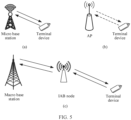
- FIG. 4 shows an example of a communication system according to an embodiment of this application.
- the communication system includes a network device and at least one terminal device.
- the terminal device may be located in a coverage area provided by the network device.
- different terminal devices may be located at different locations in the coverage area provided by the network device.
- the terminal device may be a passive terminal device.
- energy and a carrier that are needed when the terminal device works may be provided by the network device.
- the network device in this application may be used as a reader, or the network device may implement a function of the reader.
- the terminal device may be used as a tag, or the terminal device may be a device including the tag.
- the network device in this application may be an evolved NodeB (evolved NodeB, eNB or eNodeB) in an LTE or LTE-advanced (LTE-Advanced, LTE-A) system, for example, a conventional macro base station eNB or a micro base station eNB in a heterogeneous network scenario; may be a next generation NodeB (next generation NodeB, gNodeB or gNB) in a 5G system; may be a transmission reception point (transmission reception point, TRP); may be an access point (access point, AP) in a Wi-Fi system; may be a wireless relay node or a wireless backhaul node, namely, an IAB node, in integrated access and backhaul (integrated access and backhaul, IAB); or may be a device that implements a base station function in an IoT, V2X, D2D, or M2M.
- LTE-Advanced LTE-Advanced
- base stations in embodiments of this application may include base stations in various forms.
- the base station may be a micro base station (Micro BS), and the micro base station may communicate with the terminal device through a Uu interface.
- the base station may be an AP, and the AP may communicate with the terminal device through a sidelink (sidelink, SL).
- the base station may be an IAB node, and the IAB node may communicate with a macro base station (Macro BS) through a Uu interface, and communicate with the terminal device through the Uu interface.
- the network device in this application may include a macro base station and an IAB node (or a relay node).
- a downlink may be established between the IAB node and the terminal device, and an uplink may be established between the macro base station and the terminal device.
- the IAB node may be used as an excitation source to provide energy or a carrier for the terminal device, to implement a function of the helper shown in FIG. 1
- the macro base station may implement a function of the receiver shown in FIG. 1 .
- an uplink may be established between the IAB node and the terminal device, and a downlink may be established between the macro base station and the terminal device.
- the network device may be a central unit (central unit, CU) or a distributed unit (distributed unit, DU), or the network device may include a CU and a DU.
- the CU and the DU may be divided based on a protocol layer of a wireless network, or may be divided in another manner. This is not specifically limited in this application.
- the CU may include a CU control plane (CU control plane, CU-CP) and a CU user plane (CU user plane, CU-UP).
- CU control plane CU control plane, CU-CP
- CU user plane CU-UP
- the terminal device in this application may also be referred to as user equipment (user equipment, UE), a terminal, an access terminal, a subscriber unit, a subscriber station, a mobile station (mobile station, MS), a remote station, a remote terminal, a mobile terminal (mobile terminal, MT), a user terminal, a wireless communication device, a user agent, a user apparatus, or the like.
- the terminal device may be deployed on land, including an indoor or outdoor terminal device, a handheld or vehicle-mounted terminal device; may be deployed on water (for example, on a ship); or may be deployed in the air (for example, on an airplane, a balloon, or a satellite).
- the terminal device may be, for example, a wireless terminal in IoT, V2X, D2D, M2M, a 5G network, or a future evolved public land mobile network (public land mobile network, PLMN).
- the terminal device may be a drone, an IoT device (for example, a sensor, an electricity meter, or a water meter), a V2X device, a station (station, STA) in a WLAN, a cellular phone, a cordless phone, a session initiation protocol (session initiation protocol, SIP) phone, a wireless local loop (wireless local loop, WLL) station, a personal digital assistant (personal digital assistant, PDA) device, a handheld device having a wireless communication function, a computing device, another processing device connected to a wireless modem, a vehicle-mounted device, a wearable device (which may also be referred to as a wearable intelligent device), a tablet computer, a computer having a wireless transceiver function, a virtual reality (virtual reality, VR) terminal, a wireless terminal in industrial control (industrial control), a wireless terminal in self driving (self driving), a wireless terminal in remote medical (remote medical), a wireless terminal in a smart grid (smart grid),
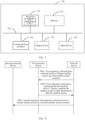
- the terminal device or the network device may use a composition structure shown in FIG. 7 , or include components shown in FIG. 7.
- FIG. 7 is a diagram of composition of a communication apparatus 700 according to this application.
- the communication apparatus 700 may be a terminal device, or a chip or a system on chip in the terminal device; or may be a network device, or a module, a chip, or a system on chip in the network device.
- the communication apparatus 700 includes at least one processor 701 and at least one communication interface ( FIG. 7 is described merely by using an example in which one communication interface 704 and one processor 701 are included).
- the communication apparatus 700 may further include a communication bus 702 and a memory 703.
- the processor 701 may be a general-purpose central processing unit (central processing unit, CPU), a general-purpose processor, a network processor (network processor, NP), a digital signal processor (digital signal processor, DSP), a microprocessor, a microcontroller, a programmable logic device (programmable logic device, PLD), or any combination thereof.
- the processor 701 may be another apparatus having a processing function, for example, a circuit, a component, or a software module. This is not limited.
- the communication bus 702 is configured to connect different components in the communication apparatus 700, so that the different components can communicate with each other.
- the communication bus 702 may be a peripheral component interconnect (peripheral component interconnect, PCI) bus, an extended industry standard architecture (extended industry standard architecture, EISA) bus, or the like.
- PCI peripheral component interconnect
- EISA extended industry standard architecture
- the bus may be classified into an address bus, a data bus, a control bus, or the like. For ease of representation, only one bold line is used to represent the bus in FIG. 7 , but this does not mean that there is only one bus or only one type of bus.
- the communication interface 704 is configured to communicate with another device or a communication network.
- the communication interface 704 may be a module, a circuit, a transceiver, or any apparatus that can implement communication.
- the communication interface 704 may alternatively be an input/output interface located in the processor 701, and is configured to implement signal input and signal output of the processor.
- the memory 703 may be an apparatus having a storage function, and is configured to store instructions and/or data.
- the instructions may be a computer program.
- the memory 703 may be a read-only memory (read-only memory, ROM) or another type of static storage device that can store static information and/or instructions, a random access memory (random access memory, RAM) or another type of dynamic storage device that can store information and/or instructions, an electrically erasable programmable read-only memory (electrically erasable programmable read-only memory, EEPROM), a compact disc read-only memory (compact disc read-only memory, CD-ROM) or another compact disc storage, an optical disc storage (including a compressed optical disc, a laser disc, an optical disc, a digital versatile disc, a Blu-ray disc, or the like), a magnetic disk storage medium, or another magnetic storage device. This is not limited.
- the memory 703 may exist independent of the processor 701, or may be integrated with the processor 701.
- the memory 703 may be located inside the communication apparatus 700, or may be located outside the communication apparatus 700. This is not limited.
- the processor 701 may be configured to execute the instructions stored in the memory 703, to implement a method provided in the following embodiments of this application.
- the communication apparatus 700 may further include an output device 705 and an input device 706.
- the output device 705 communicates with the processor 701, and may display information in a plurality of manners.
- the output device 705 may be a liquid crystal display (liquid crystal display, LCD), a light emitting diode (light emitting diode, LED) display device, a cathode ray tube (cathode ray tube, CRT) display device, or a projector (projector).
- the input device 706 communicates with the processor 701, and may receive user input in a plurality of manners.
- the input device 706 may be a mouse, a keyboard, a touchscreen device, or a sensor device.
- the structure shown in FIG. 7 does not constitute a specific limitation on a terminal device or a network device.
- the terminal device or the network device may include more or fewer components than those shown in the figure, or combine some components, or split some components, or have different component arrangements.
- the components shown in the figure may be implemented by hardware, software, or a combination of software and hardware.
- an execution body may perform some or all steps in embodiments of this application. These steps or operations are merely examples. In embodiments of this application, other operations or variations of various operations may be further performed. In addition, the steps may be performed in a sequence different from a sequence presented in embodiments of this application, and not all the operations in embodiments of this application may be necessarily to be performed.
- names of messages between the devices, names of parameters in the messages, or the like in the following embodiments of this application are merely examples, and there may be other names during specific implementation. This is not specifically limited in embodiments of this application.
- the method provided in the following embodiments of this application may be applied to a scenario in which an RFID technology is applied to a cellular network, may be applied to a scenario in which a coverage area of a reader is large, or may be applied to any scenario in which stored energy of a tag is insufficient.
- an application scenario of this application is merely described herein as an example. The application scenario does not constitute any limitation on this application, and an application scenario of the method provided below is not specifically limited in this application either.
- FIG. 8 shows a communication method according to an embodiment of this application.
- the communication method includes the following steps.
- a network device sends first signaling.
- a terminal device receives the first signaling from the network device.
- the first signaling indicates the terminal device to initiate random access on a first random access occasion.
- the first random access occasion may be one of N random access occasions.
- the N random access occasions may be configured by the network device, and N is a positive integer.
- the network device may send signaling (denoted as signaling A) to page at least one terminal device to access a network, or to select at least one terminal device and change a flag bit state of the selected terminal device.
- the network device may configure a maximum quantity N of random access occasions, and the maximum quantity N of random access occasions indicates the N random access occasions.
- the network device may send the signaling A after receiving a paging instruction or an inventory instruction from a core network.
- an implementation of the signaling A may be the same as or similar to an implementation of the foregoing select command or the foregoing query command.
- the select command or the query command may be the same as or similar to the foregoing select command or the foregoing query command.
- the random access occasion in this application may be duration with a variable length, and the terminal device may initiate random access on the random access occasion. Further, the terminal device and the network device may perform data transmission on the random access occasion.
- the random access occasion may also be referred to as a random access opportunity or a random access slot. Certainly, the random access occasion may further have another name. This is not specifically limited in this application.
- the random access occasion in this application is not a time unit with a fixed length, and duration of different random access occasions may be the same or may be different.
- the maximum quantity N of random access occasions configured by the network device indicates a quantity of random access occasions.
- a start moment of the random access occasion may be determined by specific signaling sent by the network device. To be specific, that the network device sends the specific signaling once or the terminal device receives the specific signaling once may indicate that one random access occasion starts.
- the specific signaling may be, for example, a query command or a QueryRep command.
- the maximum quantity N of random access occasions configured by the network device is equal to 5, the specific signaling is the query command or the QueryRep command, and the random access occasion starts at a moment when the terminal device receives the query command or the QueryRep command.
- a 1 st random access occasion starts at a moment t1; a 2 nd random access occasion starts at a moment t2; ...; and a 5 th random access occasion starts at a moment t5.
- the terminal device may select one of the random access occasions, for example, select an n th random access occasion, to initiate random access, where n may be a positive integer from 1 to N. Then, when the n th random access occasion is triggered, related processing is performed. The related processing is described in subsequent embodiments, and details are not described herein.
- the first signaling indicates the terminal device to initiate random access on a first random access occasion may also be understood as that the first signaling is used to trigger (or activate) the first random access occasion.
- the first signaling may also be referred to as paging signaling, select signaling, query signaling, or QueryRep signaling.
- a name of the first signaling is not specifically limited in this application.
- an implementation of the first signaling may be the same as or similar to an implementation of the select command, the query command, or the QueryRep command.
- the select command the query command
- the QueryRep command the queryRep command. Details are not described herein again.
- a terminal device in a coverage area provided by the network device may receive the first signaling.
- terminal devices in the coverage area include a first terminal device and a second terminal device is used for description.
- the first random access occasion is a random access occasion selected by the first terminal device.
- the first terminal device may determine that the random access occasion selected by the first terminal device arrives, and may determine whether the first terminal device can complete the random access or data transmission after the random access.
- the first terminal device may determine that the random access or data transmission after the random access cannot be completed: Stored energy of the first terminal device is insufficient, residual energy of the first terminal device is less than or equal to a first threshold, received power of a signal received by the first terminal device is less than or equal to a second threshold, a quantity of times of repeated data transmission of the first terminal device is greater than or equal to a third threshold, or a coverage level of the first terminal device is greater than or equal to n, where n is a positive integer.
- energy may be understood as an electricity quantity.
- energy of the terminal device may also be understood as an electricity quantity of the terminal device.
- the energy and the electricity quantity may be replaced with each other.
- the residual energy of the first terminal device may be residual energy when the first terminal device receives the first signaling.
- the signal received by the first terminal device may be the first signaling. In other words, signal received power of the first signaling is less than or equal to the second threshold.
- the signal received by the first terminal device may be signaling before the first signaling.
- the quantity of times of repeated data transmission of the first terminal device may be configured by the network device. When the received power of the signal received by the first terminal device is low, or the quantity of times of repeated data transmission is large, it indicates that the first terminal device has poor coverage, and needs long time to store sufficient energy.
- the coverage level of the first terminal device may be determined by the first terminal device based on measurement.
- the first terminal device may measure received power of a signal from the network device, to determine the coverage level based on a range of the received power.
- the coverage level of the first terminal device may be determined based on successfully decoded information. For example, when successfully decoding the quantity of times of repeated data transmission configured by the network device, the terminal device may determine the coverage level based on the quantity of times of repeated data transmission.
- the network device may indicate a type of a subsequently executed service to the terminal device, and the terminal device may estimate, based on the type of the service, a quantity of pieces of signaling that needs to be exchanged for executing the service, to determine, based on the quantity of pieces of signaling, whether stored energy of the terminal device is sufficient.
- the first threshold, the second threshold, the third threshold, or the coverage level n is determined based on the quantity of pieces of signaling.
- the first terminal device may perform the following step S802.
- the first terminal device sends first indication information to the network device.
- the network device receives the first indication information from the first terminal device.
- the first indication information indicates that the first terminal device cannot complete the random access and/or data transmission after the random access. It may be understood that, because the random access occasion selected by the first terminal device is the first random access occasion, it may also be considered that the first indication information indicates that the first terminal device cannot complete the random access or data transmission after the random access on the first random access occasion.
- the first indication information indicates that the first terminal device cannot complete the random access or data transmission after the random access may include that the first indication information indicates at least one of the following: The stored energy of the first terminal device is insufficient, the residual energy of the first terminal device is less than or equal to the first threshold, the signal received power of the first terminal device is less than or equal to the second threshold, the quantity of times of repeated data transmission of the first terminal device is greater than or equal to the third threshold, or the coverage level of the first terminal device is greater than or equal to n, where n is a positive integer.
- the first indication information indicates that the first terminal device cannot complete the random access or data transmission after the random access may be replaced with at least one of the following:
- the first indication information indicates that the stored energy of the first terminal device is insufficient, the first indication information indicates that the residual energy of the first terminal device is less than or equal to the first threshold, the first indication information indicates that the signal received power of the first terminal device is less than or equal to the second threshold, or the first indication information indicates that the quantity of times of repeated data transmission of the first terminal device is greater than or equal to the third threshold.
- all the plurality of terminal devices may send first indication information to the network device, and the first indication information sent by the plurality of terminal devices may be the same.
- the network device may correctly receive the first indication information, to reduce a decoding failure caused by collision.
- the first terminal device may further send a random number to the network device.
- the network device receives the random number, where the random number is used to initiate the random access.
- the random number may be a 16-bit random number.
- the first indication information and the random number may be carried in same signaling.
- the first indication information and the random number may be carried in a random access message.
- the first indication information and the random number may be carried in different signaling.
- the random number is carried in a random access (request) message, and the first indication information is carried in a message sent after the random access (request) message. This is not specifically limited in this application.
- the network device may determine, based on the first indication information, not to send response information to the first terminal device.
- the response information may be understood as a response to the random number, conflict resolution information, a conflict resolution message, a response to the first indication information and the random number, or a response to the random access (request) message.
- the response information may be understood as response information of the first indication information.
- the network device may learn that the first terminal device cannot complete the random access or data transmission after the random access. Consequently, even if the network device sends the response information to the first terminal device, subsequent random access or data transmission cannot be completed, and unnecessary signaling overheads are caused. Therefore, the network device may not send the response information to the first terminal device, to reduce the signaling overheads.
- S803 The network device sends second signaling.
- the terminal device receives the second signaling from the network device.
- the network device may send the second signaling to the terminal device after determining not to send the response information to the first terminal device.
- the second signaling indicates the terminal device to initiate random access on a second random access occasion.
- the second random access occasion is a next (or a 1 st ) random access occasion after the first random access occasion.
- the second signaling indicates the terminal device to initiate random access on a second random access occasion may also be understood as that the second signaling is used to trigger (or activate) the second random access occasion.
- an implementation of the second signaling may be the same as or similar to the implementation of the QueryRep command.
- the terminal device in the coverage area provided by the network device may receive the second signaling. It is assumed that the second random access occasion is a random access occasion selected by the second terminal device. After receiving the second signaling, the second terminal device may determine that the random access occasion selected by the second terminal device arrives, and may determine whether the second terminal device can complete the random access or data transmission after the random access.
- the communication method may further include the following steps.
- the second terminal device sends a random number to the network device.
- the network device receives the random number from the second terminal device.
- the random number is used by the second terminal device to initiate random access.
- the random number sent by the second terminal device may be the same as or different from the random number sent by the first terminal device. This is not specifically limited in this application.
- the network device sends a response message to the second terminal device.
- the second terminal device receives the response message from the network device.
- the response message may include the random number sent by the second terminal device in step S804 or identification information of the second terminal device.
- the response message may be referred to as a conflict resolution message or an acknowledgment response message.
- a name of the response message is not specifically limited in this application.
- S806 The second terminal device performs data transmission with the network device.
- the second terminal device may send identification information such as an EPC of the second terminal device to the network device.
- the network device may perform operations such as reading and writing on the second terminal device.
- the network device may send specific signaling to trigger (or activate) a next random access occasion after the second random access occasion.
- the second terminal device may send indication information to the network device.
- the indication information may indicate that the second terminal device cannot complete the random access or data transmission after the random access.
- the first terminal device that selects the first random access occasion may indicate, to the network device, that the first terminal device cannot complete the random access or data transmission after the random access, so that the network device can send the second signaling in time, to indicate the terminal device to initiate random access on the next random access occasion (namely, the second random access occasion) after the first random access occasion, so as to reduce time for waiting for the first terminal device to perform access or send data. Therefore, a terminal device that selects the second random access occasion can perform access as early as possible, to reduce the waiting time and reduce an unnecessary waste of time domain resources.
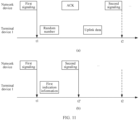
- the first terminal device can complete random access and subsequent data transmission.
- the first terminal device may send the random number to the network device.
- the network device returns an ACK message to the first terminal device.
- the first terminal device sends uplink data to the network device.
- the network device sends the second signaling.
- the terminal device receives the second signaling. It indicates that the second random access occasion starts at the moment t2.
- the first terminal device may send the first indication information to the network device.
- the network device After receiving the first indication information, the network device sends the second signaling in time. At a moment t2', the terminal device receives the second signaling. It indicates that the second random access occasion starts at the moment t2'.
- a start moment of a next random access occasion may be advanced, to reduce waiting time of a terminal device that selects the next random access occasion, and reduce the unnecessary waste of the time domain resources.
- the network device may send an excitation signal, to provide energy and a carrier for the terminal device in the coverage area of the network device. Therefore, after the first random access occasion, the network device may provide energy for the first terminal device in a process of processing random access or data transmission of another terminal device. After random access or data transmission processing of a plurality of terminal devices paged by the network device in a current round is completed, the network device may page the first terminal device again, to provide a random access occasion for the first terminal device. In this case, the first terminal device may have stored sufficient energy. Therefore, the first terminal device may complete random access and data transmission on the random access occasion provided by the network device again.
- this application further provides a communication method.
- a network device may respectively configure random access occasions for a first-type terminal device and a second-type terminal device.
- the first-type terminal device is a terminal device that cannot complete the random access or data transmission after the random access.
- that the terminal device cannot complete the random access or data transmission after the random access may include (or be replaced with) at least one of the following: Stored energy of the terminal device is insufficient, residual energy of the terminal device is less than or equal to a first threshold, signal received power of the terminal device is less than or equal to a second threshold, or a quantity of times of repeated data transmission of the terminal device is greater than or equal to a third threshold.
- the second-type terminal device may include at least one of the following: a terminal device that can complete the random access or data transmission after the random access, a terminal device with sufficient stored energy, a terminal device whose residual energy is greater than or equal to the first threshold, a terminal device whose signal received power is greater than or equal to the second threshold, or a terminal device whose quantity of times of repeated data transmission is less than or equal to the third threshold.
- the communication method includes the following steps.
- S1201 The network device sends second indication information.
- a terminal device receives the second indication information from the network device.
- the second indication information indicates a maximum quantity N of random access occasions, and the maximum quantity of random access occasions indicates N random access occasions.
- the random access occasion refer to related descriptions in the foregoing step S801. Details are not described herein again.
- the second indication information may explicitly indicate the maximum quantity N of random access occasions, for example, indicate a value of N.
- the second indication information may implicitly indicate the maximum quantity N of random access occasions, for example, indicate a parameter for calculating N.
- the network device may send signaling to page at least one terminal device to access a network.
- a receiver of information sent by the network device may be the at least one terminal device paged by the network device.
- S1202 The network device sends third indication information.
- the terminal device receives the third indication information from the network device.
- the third indication information indicates that last K random access occasions in the N random access occasions are used by the first-type terminal device to initiate random access.
- K is a positive integer less than or equal to N.
- the third indication information may indicate that first N-K random access occasions in the N random access occasions are used by the second-type terminal device to initiate random access.
- N is equal to 10 and K is equal to 3.
- first seven random access occasions in the 10 random access occasions may be used by the second-type terminal device, and last three random access occasions may be used by the first-type terminal device.
- the first-type terminal device may be specifically a terminal device that cannot complete the random access or data transmission after the random access on first M random access occasions in the N random access occasions, where M is a positive integer less than or equal to N-K.
- a terminal device cannot complete the random access or data transmission after the random access on the first M random access occasions in the N random access occasions, when the network device processes random access or data transmission of another terminal device on the first M random access occasions, the network device may provide energy for the terminal device. Therefore, after the M random access occasions, the terminal device may complete the random access or data transmission after the random access. Therefore, when the network device provides the last K random access occasions in the N random access occasions for the first-type terminal device, the first-type terminal device may complete random access or data transmission on the last K random access occasions.
- a ratio of K to N may be fixed.
- a value of K when the value of N changes, a value of K also changes accordingly, so that the ratio of K to N is fixed.
- a value of K may be fixed.
- a value of K when the value of N changes, the value of K remains unchanged.
- a value of K may be predefined in a protocol or preconfigured.
- a value of K may be determined based on a quantity of terminal devices located at an edge of a coverage area of the network device. For example, the value of K may be equal to the quantity of terminal devices located at the edge of the coverage area.
- the method shown in FIG. 8 may be performed before the method shown in FIG. 12 is performed.
- the network device may determine a value of K based on a quantity of pieces of received first indication information.
- the value of K may be equal to the quantity of pieces of received first indication information.
- the third indication information may include the value of K.
- the third indication information may include the ratio of K to N.
- the third indication information may be an indication of one bit. When a value of the bit is 1 (or 0), it indicates that the last K random access occasions in the N random access occasions are used by the first-type terminal device to initiate random access.
- the third indication information may indicate an index corresponding to one of the plurality of values or ratios.
- the third indication information indicates that the N random access occasions are used by the second-type terminal device to initiate random access.
- the network device may send third signaling.
- the third signaling may indicate the first-type terminal device to initiate random access, or the third signaling may be used to configure a random access occasion for the first-type terminal device.
- an implementation of the third signaling may be the same as or similar to an implementation of a select command, a query command, or a QueryRep command. For details, refer to related descriptions of the foregoing three commands. Details are not described herein again.
- the network device may provide energy for the first-type terminal device in a process of processing random access or data transmission of the second-type terminal device. Therefore, after the N random access occasions, when the first-type terminal device receives the third signaling, the first-type terminal device may complete the random access or data transmission after the random access.
- the third indication information indicates that the N random access occasions are used by the first-type terminal device to initiate random access.
- the first-type terminal device may be specifically a terminal device that cannot complete the random access or data transmission after the random access before the N random access occasions.
- the network device may determine whether the first-type terminal device exists in a coverage area of the network device. If the first-type terminal device exists, the network device may send the third indication information to indicate a random access occasion to the first-type terminal device.
- the network device may provide energy for the first-type terminal device. Therefore, when the N random access occasions indicated by the second indication information arrive, the first-type terminal device may complete the random access or data transmission after the random access.
- the third indication information may be an indication of one bit.
- a value of the bit is a first value, it indicates that the N random access occasions are used by the second-type terminal device to initiate random access.
- a value of the bit is a second value, it indicates that the N random access occasions are used by the first-type terminal device to initiate random access.
- the first value may be 1, and correspondingly, the second value is 0; or the first value may be 0, and correspondingly, the second value is 1. This is not specifically limited in this application.
- the network device may send the third indication information when the first-type terminal device exists in the coverage area of the network device.
- the network device may send the third indication information when the coverage area of the network device is large.
- the network device may send the third indication information when a terminal device that cannot complete uplink transmission exists in the coverage area of the network device.
- the network device may determine, based on a historical paging record of the terminal device, that the first-type terminal device exists in the coverage area of the network device. For example, before the method shown in FIG. 12 , the network device may perform the method shown in FIG. 8 . If the network device receives the first indication information in an execution process of the method shown in FIG. 8 , the network device may determine that the first-type terminal device exists in the coverage area of the network device. For another example, before the method shown in FIG. 12 , the network device may page a terminal device, to indicate the terminal device to perform random access.
- the network device may determine that the first-type terminal device exists in the coverage area of the network device. For an implementation in which the network device determines that the terminal device that cannot complete uplink transmission exists, refer to related descriptions of determining that the first-type terminal device exists. Details are not described herein again.
- the second indication information and the third indication information may be carried in same signaling, for example, may both be carried in a select command or a query command.
- the second indication information and the third indication information may be carried in different signaling. This is not specifically limited in this application.
- step S1201 may be performed before step S1202.
- step S1202 may be performed before step S1201.
- step S1201 and step S1202 may be simultaneously performed. This is not specifically limited in this application.
- S1203 The terminal device initiates random access based on the second indication information and the third indication information.
- the terminal device may determine a third random access occasion. Then, random access is initiated on the third random access occasion.
- the third indication information indicates that the last K random access occasions in the N random access occasions are used by the first-type terminal device to initiate random access
- the terminal device is the first-type terminal device
- the third random access may be one of the last K random access occasions; or if the terminal device is the second-type terminal device, the third random access occasion may be one of the first M random access occasions in the N random access occasions.
- whether the terminal device is the first-type terminal device or the second-type terminal device may be autonomously determined by the terminal device. For example, when the third indication information is received, if stored energy of the terminal device is insufficient, residual energy is less than or equal to the first threshold, received power of the third indication information is less than or equal to the second threshold, a charging/discharging capability of the terminal device is low, or a charging/discharging speed of the terminal device is low, the terminal device may be the first-type terminal device.
- the terminal device may be the second-type terminal device.
- the third indication information indicates that the N random access occasions are used by the second-type terminal device to initiate random access, and the terminal device is the second-type terminal device, the third random access occasion is one of the N random access occasions.
- the terminal device when the terminal device receives the third indication information, if stored energy of the terminal device is sufficient, residual energy is greater than or equal to the first threshold, or received power of the third indication information is greater than or equal to the second threshold, the terminal device may be the second-type terminal device.
- the third indication information indicates that the N random access occasions are used by the first-type terminal device to initiate random access, and the terminal device is the first-type terminal device, the third random access occasion is one of the N random access occasions.
- the terminal device when receiving the third indication information, may determine whether a power failure, a random access failure, or a failure of data transmission after random access occurs in a paging process and a random access process that are performed before the terminal device receives the third indication information. If the power failure, the random access failure, or the failure of data transmission after random access occurs, it may be determined that the terminal device is the first-type terminal device, so that the third random access occasion can be selected from the N random access occasions to initiate random access.
- the network device may configure a later random access occasion for the first-type terminal device, and correspondingly, may configure an earlier random access occasion for the second-type terminal device. Therefore, the second-type terminal device can access the network as early as possible, and time for waiting for the first-type terminal device to perform access or send data is reduced, thereby reducing an unnecessary waste of time domain resources.
- the later random access is configured for the first-type terminal device, so that the network device can provide energy for the first-type terminal device when processing random access of the second-type terminal device on the earlier random access occasion, to increase a possibility that the first-type terminal device successfully performs access on the later random access occasion, and further increase an access success rate of the first-type terminal device.
- the network device may centrally configure the N random access occasions for the second-type terminal device, so that the second-type terminal device initiates random access on the N random access occasions without waiting for random access of the first-type terminal device to time out, to access the network as early as possible and reduce the unnecessary waste of the time domain resources.
- the network device may centrally configure the N random access occasions for the first-type terminal device, so that a terminal device that cannot complete random access before the N random access occasions can initiate random access on the N random access occasions again, to increase an access success rate of the terminal device.
- this application further provides a communication method.
- a network device mainly performs related processing. As shown in FIG. 14 , the method includes the following steps.
- the network device sends first information and second information.
- a terminal device receives the first information and the second information from the network device.
- the first information is used to page at least one terminal device.
- the second information indicates a maximum quantity N of random access occasions, the maximum quantity of random access occasions indicates N random access occasions, and N is a positive integer.
- N is a positive integer.
- a receiver of the first information may be a terminal device in a coverage area of the network device.
- a receiver of the second information may be the at least one terminal device paged in the coverage area of the network device.
- the first information and the second information may be carried in same signaling, or may be carried in different signaling. This is not specifically limited in this application.
- the terminal device paged by the network device may select a random access occasion from the N random access occasions, and initiate random access on the random access occasion selected by the terminal device.
- the network device may determine whether a first-type terminal device exists in the at least one terminal device paged by the network device.
- the first-type terminal device may be a terminal device that cannot complete the random access or data transmission after the random access on the N random access occasions.
- the terminal device cannot complete the random access or data transmission after the random access may include at least one of the following: Stored energy of the terminal device is insufficient, residual energy of the terminal device is less than or equal to a first threshold, signal received power of the terminal device is less than or equal to a second threshold, or a quantity of times of repeated data transmission of the terminal device is greater than or equal to a third threshold.
- the network device may determine, when a first case occurs, that the first-type terminal device exists.
- the first case may be that uplink data or uplink signaling to be transmitted by the terminal device exists in the at least one terminal device paged by the network device, but the network device receives no uplink data or uplink signaling.
- the network device may determine that the first-type terminal device exists.
- the uplink data or the uplink signaling may be a response to downlink data or downlink signaling sent by the network device. Therefore, after sending the downlink data or the downlink signaling, the network device may learn that the terminal device needs to send the uplink data or the uplink signaling. Therefore, when the network device receives no uplink data or uplink signaling on the random access occasion, the network device may determine that the first-type terminal device exists.
- the network device sends an excitation signal.
- the terminal device receives the excitation signal from the network device.
- the excitation signal is used to provide energy.
- the excitation signal may be a monophonic signal, a continuous wave, or the like.
- the excitation signal may be further used to provide a carrier for the terminal device.
- the network device may attempt to page the terminal device again to access a network.
- the network device may indicate the N random access occasions and page the at least one terminal device.
- the network device may send the excitation signal to provide energy for the terminal device.
- the network device may perform paging again, process random access of the terminal device, and the like. It should be noted that, in the time period T3, the network device may still provide energy for the terminal device. However, in comparison with the time period T2, in the time period T3, less energy is provided, and a charging amount of the terminal device in a unit time is smaller.
- duration in which the network device sends the excitation signal may be greater than or equal to T or greater than or equal to X multiplied by T.
- X is a positive integer greater than 1, for example, 5 or 10.
- T is shortest time or longest time for successfully completing communication (random access and subsequent data transmission) corresponding to one terminal device in current paging or random access triggering (for example, in the time period T1 shown in FIG. 15 ).
- the network device may send fourth signaling.
- the fourth signaling may be sent in the time period T2 shown in FIG. 15 .
- the fourth signaling may be used to query whether an electricity quantity of the terminal device in the coverage area of the network device is sufficient, or used to query whether the first-type terminal device can complete a normal communication procedure (for example, random access, or random access and subsequent data transmission).
- a terminal device that receives the fourth signaling may feed back, to the network device based on a status of the electricity quantity of the terminal device, an indication indicating that the electricity quantity is sufficient (or charging is completed) or the like, or feed back, to the network device, that an energy storage procedure is not completed or charging is not completed, to indicate that the terminal device cannot complete random access or subsequent data transmission.
- the network device may determine, based on the feedback, whether to continue to send the excitation signal.
- the network device may stop sending the excitation signal; or if the terminal device feeds back that the energy storage procedure is not completed or the charging is not completed, the network device may continue to send the excitation signal. After the excitation signal is sent, the network device may attempt to page the terminal device again to access the network.
- the terminal device paged by the network device again may include the first-type terminal device that exists before the excitation signal is sent.
- the first-type terminal device may store energy by receiving the excitation signal.
- the first-type terminal device may store sufficient energy. Therefore, when the network device performs paging again, the first-type terminal device may complete the random access or data transmission after the random access.
- information about a flag bit (for example, a type and a state of an inventoried flag bit) carried in sent signaling used for paging is the same as information about a flag bit carried in signaling that is used for paging and that is sent before the excitation signal.
- a terminal device that has successfully performed access toggles a state of a flag bit of the terminal device, in this scenario, signaling that is used for paging and that is sent by the network device again is not for re-paging the terminal device that has successfully performed access, but is for paging a terminal device (for example, the first-type terminal device) that has not performed access before. In this way, complete paging of the terminal device in the coverage area of the network device is implemented.
- the network device may configure the maximum quantity of random access occasions based on the quantity of times that the first case occurs.
- the network device may perform the foregoing step S 1402 again. For example, if in the time period T3, the network device determines that the first-type terminal device still exists, the network device may continue to send the excitation signal in a time period (denoted as T4) after T3. After T4, the network device may attempt to perform paging again.
- the network device may send the excitation signal, to provide energy for the terminal device.
- the first-type terminal device can store energy by using the excitation signal, to complete subsequent random access or data transmission, so as to increase an access success rate of the first-type terminal device.
- the network device may first send the excitation signal to provide energy for the terminal device, and then perform the foregoing methods.
- the duration in which the network device sends the excitation signal may be in a unit of seconds.
- the duration for sending the excitation signal may be 1 second to 99 seconds.
- the actions of the network device may alternatively be implemented by a device in a form of the terminal device.
- interaction between the network device and the terminal device may alternatively be implemented through interaction between terminal devices.
- a terminal device that implements the actions of the network device may be used as a reader, or may implement a function of the reader.
- the methods and/or the steps implemented by the network device may alternatively be implemented by a component (for example, a processor, a chip, a chip system, a circuit, a logical module, or software such as a chip or a circuit) that can be used in the network device; and the methods and/or the steps implemented by the terminal device may alternatively be implemented by a component (for example, a processor, a chip, a chip system, a circuit, a logical module, or software such as a chip or a circuit) that can be used in the terminal device.
- a component for example, a processor, a chip, a chip system, a circuit, a logical module, or software such as a chip or a circuit
- this application further provides a communication apparatus, and the communication apparatus is configured to implement the foregoing methods.
- the communication apparatus may be the network device in the foregoing method embodiments, or an apparatus including the foregoing network device, or a component that can be used in the network device, for example, a chip or a chip system.
- the communication apparatus may be the terminal device in the foregoing method embodiments, or an apparatus including the foregoing terminal device, or a component that can be used in the terminal device, for example, a chip or a chip system.
- the communication apparatus includes a corresponding hardware structure and/or a corresponding software module for performing each function.
- a person skilled in the art should be easily aware that units and algorithm steps in the examples described with reference to embodiments disclosed in this specification can be implemented in a form of hardware or a combination of hardware and computer software in this application. Whether a function is executed by hardware or hardware driven by computer software depends on particular applications and design constraints of the technical solutions. A person skilled in the art may use different methods to implement the described functions for each particular application, but it should not be considered that the implementation goes beyond the scope of this application.
- the communication apparatus may be divided into functional modules based on the foregoing method embodiments.
- each functional module may be obtained through division based on each corresponding function, or two or more functions may be integrated into one processing module.
- the integrated module may be implemented in a form of hardware, or may be implemented in a form of a software functional module. It should be noted that module division in embodiments of this application is an example, and is merely logical function division. During actual implementation, another division manner may be used.
- FIG. 16 is a diagram of a structure of a network device 160.
- the network device 160 includes a processing module 1601 and a transceiver module 1602.
- the network device 160 may further include a storage module (not shown in FIG. 16 ), configured to store program instructions and data.
- the transceiver module 1602 may also be referred to as a transceiver unit, and is configured to implement a sending function and/or a receiving function.
- the transceiver module 1602 may include a transceiver circuit, a transceiver machine, a transceiver, or a communication interface.
- the transceiver module 1602 may include a receiving module and a sending module that are respectively configured to perform the receiving and sending steps performed by the network device in the foregoing method embodiments, and/or configured to support another process of the technology described in this specification.
- the processing module 1601 may be configured to perform the processing (for example, determining or generation) steps performed by the network device in the foregoing method embodiments, and/or configured to support another process of the technology described in this specification.
- the first indication information indicates that the first terminal device cannot complete the random access or data transmission after the random access includes at least one of the following: The first indication information indicates that stored energy of the first terminal device is insufficient; the first indication information indicates that residual energy of the first terminal device is less than or equal to a first threshold; the first indication information indicates that signal received power of the first terminal device is less than or equal to a second threshold; or the first indication information indicates that a quantity of times of repeated data transmission of the first terminal device is greater than or equal to a third threshold.
- the processing module 1601 is further configured to receive a random number from the first terminal device by using the transceiver module 1602, where the random number is used to initiate the random access.
- the processing module 1601 is further configured to determine, based on the first indication information, not to send response information to the first terminal device.
- the first-type terminal device is a terminal device that cannot complete the random access or data transmission after the random access.
- the first-type terminal device is a terminal device that cannot complete the random access or data transmission after the random access on first M random access occasions in the N random access occasions, where M is a positive integer less than or equal to N-K.
- the random access or data transmission after the random access cannot be completed includes at least one of the following: Stored energy of the terminal device is insufficient, residual energy of the terminal device is less than or equal to a first threshold, signal received power of the terminal device is less than or equal to a second threshold, or a quantity of times of repeated data transmission of the terminal device is greater than or equal to a third threshold.
- the second-type terminal device includes at least one of the following: a terminal device that can complete the random access or data transmission after the random access; a terminal device with sufficient stored energy; a terminal device whose residual energy is greater than or equal to the first threshold; a terminal device whose signal received power is greater than or equal to the second threshold; or a terminal device whose quantity of times of repeated data transmission is less than or equal to the third threshold.
- the second indication information and the third indication information are carried in same signaling.
- the processing module 1601 is further configured to send third signaling by using the transceiver module 1602 after determining that the second-type terminal device completes random access on the N random access occasions, where the third signaling indicates the first-type terminal device to initiate random access.
- the first-type terminal device exists in the at least one terminal device includes: Uplink data or uplink signaling to be transmitted by the terminal device exists in the at least one terminal device, but the network device receives no uplink data or uplink signaling.
- the random access or data transmission after the random access cannot be completed includes at least one of the following: Stored energy of the terminal device is insufficient, residual energy of the terminal device is less than or equal to a first threshold, signal received power of the terminal device is less than or equal to a second threshold, or a quantity of times of repeated data transmission of the terminal device is greater than or equal to a third threshold.
- the processing module receives/sends information by using the transceiver module may also be understood as that the processing module controls the transceiver module to receive/send information.
- the processing module sends information by using the transceiver module may be understood as that the processing module outputs information to the transceiver module, and the transceiver module sends the information; and that the processing module receives information by using the transceiver module may be understood as that the transceiver module receives information and inputs the information to the processing module.
- the network device 160 is presented in a form of functional modules obtained through division in an integrated manner.
- the "module” herein may be an application-specific integrated circuit (application-specific integrated circuit, ASIC), a circuit, a processor and a memory that execute one or more software or firmware programs, an integrated logic circuit, and/or another device that can provide the foregoing functions.
- ASIC application-specific integrated circuit
- the network device 160 may be in a form of the communication apparatus 700 shown in FIG. 7 .
- a function/an implementation process of the processing module 1601 in FIG. 16 may be implemented by using the processor 701 in the communication apparatus 700 shown in FIG. 7 by invoking computer-executable instructions stored in the memory 703.
- a function/an implementation process of the transceiver module 1602 in FIG. 16 may be implemented through the communication interface 704 in the communication apparatus 700 shown in FIG. 7 .
- the function/the implementation process of the transceiver module 1602 may be implemented through an input/output interface (or a communication interface) of the chip or the chip system
- the function/the implementation process of the processing module 1601 may be implemented by using a processor (or a processing circuit) of the chip or the chip system.
- the network device 160 provided in this embodiment may perform the foregoing methods. Therefore, for technical effects that can be achieved by the network device 160, refer to the foregoing method embodiments. Details are not described herein again.
- FIG. 17 is a diagram of a structure of a first terminal device 70.
- the first terminal device 70 includes a processing module 1701 and a transceiver module 1702.
- the first terminal device 70 may further include a storage module (not shown in FIG. 17 ), configured to store program instructions and data.
- the transceiver module 1702 may also be referred to as a transceiver unit, and is configured to implement a sending function and/or a receiving function.
- the transceiver module 1702 may include a transceiver circuit, a transceiver machine, a transceiver, or a communication interface.
- the transceiver module 1702 may include a receiving module and a sending module that are respectively configured to perform the receiving and sending steps performed by the terminal device in the foregoing method embodiments, and/or configured to support another process of the technology described in this specification.
- the processing module 1701 may be configured to perform the processing (for example, determining or generation) steps performed by the terminal device in the foregoing method embodiments, and/or configured to support another process of the technology described in this specification.
- the first indication information indicates that a first terminal device cannot complete the random access or data transmission after the random access includes at least one of the following: The first indication information indicates that stored energy of the first terminal device is insufficient; the first indication information indicates that residual energy of the first terminal device is less than or equal to a first threshold; the first indication information indicates that signal received power of the first terminal device is less than or equal to a second threshold; or the first indication information indicates that a quantity of times of repeated data transmission of the first terminal device is greater than or equal to a third threshold.
- the third indication information indicates that the last K random access occasions in the N random access occasions are used by the first-type terminal device to initiate random access, and a terminal device is the first-type terminal device, the third random access occasion is one of the last K random access occasions.
- the third random access occasion is one of the N random access occasions.
- the first terminal device 70 is presented in a form of functional modules obtained through division in an integrated manner.
- the "module” herein may be an application-specific integrated circuit (application-specific integrated circuit, ASIC), a circuit, a processor and a memory that execute one or more software or firmware programs, an integrated logic circuit, and/or another device that can provide the foregoing functions.
- ASIC application-specific integrated circuit
- the first terminal device 70 may be in a form of the communication apparatus 700 shown in FIG. 7 .
- a function/an implementation process of the processing module 1701 in FIG. 17 may be implemented by using the processor 701 in the communication apparatus 700 shown in FIG. 7 by invoking computer-executable instructions stored in the memory 703.
- a function/an implementation process of the transceiver module 1702 in FIG. 17 may be implemented through the communication interface 704 in the communication apparatus 700 shown in FIG. 7 .
- the function/the implementation process of the transceiver module 1702 may be implemented through an input/output interface (or a communication interface) of the chip or the chip system
- the function/the implementation process of the processing module 1701 may be implemented by using a processor (or a processing circuit) of the chip or the chip system.
- the first terminal device 70 provided in this embodiment may perform the foregoing methods. Therefore, for technical effects that can be achieved by the first terminal device 70, refer to the foregoing method embodiments. Details are not described herein again.
- the access network device or the terminal device in embodiments of this application may be implemented by using one or more field programmable gate arrays (field programmable gate arrays, FPGAs), a programmable logic device (programmable logic device, PLD), a controller, a state machine, gate logic, a discrete hardware component, any other suitable circuit, or any combination of circuits that can perform various functions described in this application.
- field programmable gate arrays field programmable gate arrays, FPGAs
- programmable logic device programmable logic device
- PLD programmable logic device
- controller a state machine, gate logic, a discrete hardware component, any other suitable circuit, or any combination of circuits that can perform various functions described in this application.
- an embodiment of this application further provides a communication apparatus.
- the communication apparatus includes a processor, configured to implement the method in any one of the foregoing method embodiments.
- the communication apparatus further includes a memory.
- the memory is configured to store a necessary computer program and necessary data.
- the computer program may include instructions, and the processor may invoke the instructions in the computer program stored in the memory, to instruct the communication apparatus to perform the method in any one of the foregoing method embodiments.
- the memory may alternatively not be located in the communication apparatus.
- the communication apparatus further includes an interface circuit.
- the interface circuit is a code/data read/write interface circuit, and the interface circuit is configured to: receive computer-executable instructions (where the computer-executable instructions are stored in the memory, may be directly read from the memory, or may pass through another component), and transmit the computer-executable instructions to the processor.
- the communication apparatus further includes a communication interface, and the communication interface is configured to communicate with a module outside the communication apparatus.
- the communication apparatus may be a chip or a chip system.
- the communication apparatus may include a chip, or may include a chip and another discrete component. This is not specifically limited in embodiments of this application.
- This application further provides a computer-readable storage medium.
- the computer-readable storage medium stores a computer program or instructions. When the computer program or the instructions are executed by a computer, a function of any one of the foregoing method embodiments is implemented.
- This application further provides a computer program product.
- the computer program product is executed by a computer, a function of any one of the foregoing method embodiments is implemented.
- the system, apparatus, and method described in this application may alternatively be implemented in another manner.
- the described apparatus embodiments are merely examples.
- division into the units is merely logical function division.
- another division manner may be used.
- a plurality of units or components may be combined or integrated into another system, or some features may be ignored or not performed.
- the displayed or discussed mutual couplings or direct couplings or communication connections may be implemented through some interfaces.
- the indirect couplings or communication connections between the apparatuses or units may be implemented in an electronic form, a mechanical form, or another form.
- the units described as separate parts may be or may not be physically separate, that is, may be located in one location, or may be distributed on a plurality of network units. Parts displayed as units may be or may not be physical units. A part or all of the units may be selected based on actual requirements to achieve objectives of the solutions of embodiments.
- All or some of the foregoing embodiments may be implemented by software, hardware, firmware, or any combination thereof.
- a software program is used for implementation, all or some of the foregoing embodiments may be implemented in a form of a computer program product.
- the computer program product includes one or more computer instructions.
- the computer may be a general-purpose computer, a dedicated computer, a computer network, or another programmable apparatus.
- the computer instructions may be stored in a computer-readable storage medium or may be transmitted from a computer-readable storage medium to another computer-readable storage medium.
- the computer instructions may be transmitted from a website, computer, server, or data center to another website, computer, server, or data center in a wired (for example, a coaxial cable, an optical fiber, or a digital subscriber line (digital subscriber line, DSL)) or wireless (for example, infrared, radio, or microwave) manner.
- the computer-readable storage medium may be any usable medium that can be accessed by the computer, or a data storage device that is integrated by one or more usable media, such as a server or a data center.
- the usable medium may be a magnetic medium (for example, a floppy disk, a hard disk, or a magnetic tape), an optical medium (for example, a DVD), a semiconductor medium (for example, a solid-state drive (solid-state drive, SSD)), or the like.
- the computer may include the foregoing apparatuses.
Landscapes
- Engineering & Computer Science (AREA)
- Computer Networks & Wireless Communication (AREA)
- Signal Processing (AREA)
- Mobile Radio Communication Systems (AREA)
Applications Claiming Priority (2)
| Application Number | Priority Date | Filing Date | Title |
|---|---|---|---|
| CN202210635751.5A CN117241407A (zh) | 2022-06-06 | 2022-06-06 | 一种通信方法及装置 |
| PCT/CN2023/097468 WO2023236833A1 (zh) | 2022-06-06 | 2023-05-31 | 一种通信方法及装置 |
Publications (2)
| Publication Number | Publication Date |
|---|---|
| EP4525541A1 true EP4525541A1 (de) | 2025-03-19 |
| EP4525541A4 EP4525541A4 (de) | 2025-09-03 |
Family
ID=89097229
Family Applications (1)
| Application Number | Title | Priority Date | Filing Date |
|---|---|---|---|
| EP23818998.9A Pending EP4525541A4 (de) | 2022-06-06 | 2023-05-31 | Kommunikationsverfahren und -vorrichtung |
Country Status (4)
| Country | Link |
|---|---|
| US (1) | US20250097992A1 (de) |
| EP (1) | EP4525541A4 (de) |
| CN (1) | CN117241407A (de) |
| WO (1) | WO2023236833A1 (de) |
Cited By (1)
| Publication number | Priority date | Publication date | Assignee | Title |
|---|---|---|---|---|
| EP4518375A4 (de) * | 2022-05-30 | 2025-08-06 | Huawei Tech Co Ltd | Funkrufverfahren und -vorrichtung |
Families Citing this family (9)
| Publication number | Priority date | Publication date | Assignee | Title |
|---|---|---|---|---|
| CN120787474A (zh) * | 2024-02-06 | 2025-10-14 | 北京小米移动软件有限公司 | 信息处理方法及装置、通信设备、通信系统及存储介质 |
| CN120568511A (zh) * | 2024-02-28 | 2025-08-29 | 华为技术有限公司 | 一种通信方法及装置 |
| CN120730534A (zh) * | 2024-03-29 | 2025-09-30 | 华为技术有限公司 | 一种通信方法及装置 |
| CN120786706A (zh) * | 2024-04-03 | 2025-10-14 | 华为技术有限公司 | 一种信息传输方法及通信装置 |
| WO2025227344A1 (zh) * | 2024-04-29 | 2025-11-06 | 北京小米移动软件有限公司 | 接入网络的方法、终端、网络设备及存储介质 |
| CN120881736A (zh) * | 2024-04-29 | 2025-10-31 | 华为技术有限公司 | 一种通信方法及装置 |
| CN120935855A (zh) * | 2024-05-10 | 2025-11-11 | 华为技术有限公司 | 一种通信方法和装置 |
| CN121336490A (zh) * | 2024-05-10 | 2026-01-13 | 北京小米移动软件有限公司 | 通信方法及装置、存储介质 |
| CN121547860A (zh) * | 2024-08-09 | 2026-02-17 | 荣耀终端股份有限公司 | 无源物联网设备通信方法、装置及计算机可读存储介质 |
Family Cites Families (6)
| Publication number | Priority date | Publication date | Assignee | Title |
|---|---|---|---|---|
| CN102548033B (zh) * | 2011-10-17 | 2015-09-02 | 杭州仟桥科技有限公司 | 一种可靠性物联网组网布局方法 |
| CN103369611B (zh) * | 2012-03-30 | 2018-09-11 | 中兴通讯股份有限公司 | 随机接入处理方法、切换处理方法及装置 |
| CN108289339B (zh) * | 2017-01-09 | 2021-12-24 | 北京三星通信技术研究有限公司 | 随机接入响应发送和检测的方法及基站、用户设备 |
| CN110958715A (zh) * | 2018-09-26 | 2020-04-03 | 华为技术有限公司 | 一种发送、接收随机接入前导的方法及通信装置 |
| WO2020191515A1 (zh) * | 2019-03-22 | 2020-10-01 | Oppo广东移动通信有限公司 | 一种随机接入方法及装置、终端、网络设备 |
| EP4527143A4 (de) * | 2022-05-17 | 2026-02-25 | Qualcomm Inc | Vierschritt-rach-verfahren für energiegewinnendes benutzergerät |
-
2022
- 2022-06-06 CN CN202210635751.5A patent/CN117241407A/zh active Pending
-
2023
- 2023-05-31 WO PCT/CN2023/097468 patent/WO2023236833A1/zh not_active Ceased
- 2023-05-31 EP EP23818998.9A patent/EP4525541A4/de active Pending
-
2024
- 2024-12-04 US US18/969,002 patent/US20250097992A1/en active Pending
Cited By (1)
| Publication number | Priority date | Publication date | Assignee | Title |
|---|---|---|---|---|
| EP4518375A4 (de) * | 2022-05-30 | 2025-08-06 | Huawei Tech Co Ltd | Funkrufverfahren und -vorrichtung |
Also Published As
| Publication number | Publication date |
|---|---|
| WO2023236833A1 (zh) | 2023-12-14 |
| US20250097992A1 (en) | 2025-03-20 |
| CN117241407A (zh) | 2023-12-15 |
| EP4525541A4 (de) | 2025-09-03 |
Similar Documents
| Publication | Publication Date | Title |
|---|---|---|
| EP4525541A1 (de) | Kommunikationsverfahren und -vorrichtung | |
| US20250193851A1 (en) | Communication method, apparatus, and system | |
| US20250039841A1 (en) | Paging method and apparatus | |
| US20250240835A1 (en) | Communication method and apparatus | |
| KR102900158B1 (ko) | 랜덤 액세스 방법, 장치 및 시스템 | |
| US20250193863A1 (en) | Communication method and apparatus | |
| US20250106831A1 (en) | Communication method and apparatus | |
| US20240322976A1 (en) | Information receiving method, information sending method, and apparatus | |
| US20240276466A1 (en) | Communication method and system, and related apparatus | |
| CN116897355A (zh) | 传输信息的方法及装置 | |
| US20260082430A1 (en) | Communication method and apparatus | |
| CN113747574A (zh) | 数据传输方法及装置 | |
| CN121310302A (zh) | 用于随机接入的方法和通信装置 | |
| CN120957252A (zh) | 通信方法、通信装置及计算机可读存储介质 | |
| CN117957881A (zh) | 无线设备的超精简随机接入 | |
| US20240187167A1 (en) | Communication processing method and communication processing apparatus | |
| CN119946891A (zh) | 一种接入方法及装置 | |
| CN113852989A (zh) | 确定数据传输方式的方法及装置 | |
| US20260019995A1 (en) | Communication method, apparatus, and system | |
| US20240365351A1 (en) | Resource selection method and apparatus | |
| WO2025118297A1 (en) | Devices, methods, and medium for communication | |
| CN121547860A (zh) | 无源物联网设备通信方法、装置及计算机可读存储介质 | |
| WO2025232533A1 (zh) | 一种通信方法和装置 | |
| CN120730535A (zh) | 通信方法及装置 | |
| WO2026066356A1 (zh) | 一种通信方法及装置 |
Legal Events
| Date | Code | Title | Description |
|---|---|---|---|
| STAA | Information on the status of an ep patent application or granted ep patent |
Free format text: STATUS: THE INTERNATIONAL PUBLICATION HAS BEEN MADE |
|
| PUAI | Public reference made under article 153(3) epc to a published international application that has entered the european phase |
Free format text: ORIGINAL CODE: 0009012 |
|
| STAA | Information on the status of an ep patent application or granted ep patent |
Free format text: STATUS: REQUEST FOR EXAMINATION WAS MADE |
|
| 17P | Request for examination filed |
Effective date: 20241210 |
|
| AK | Designated contracting states |
Kind code of ref document: A1 Designated state(s): AL AT BE BG CH CY CZ DE DK EE ES FI FR GB GR HR HU IE IS IT LI LT LU LV MC ME MK MT NL NO PL PT RO RS SE SI SK SM TR |
|
| A4 | Supplementary search report drawn up and despatched |
Effective date: 20250730 |
|
| RIC1 | Information provided on ipc code assigned before grant |
Ipc: H04W 74/00 20090101AFI20250725BHEP Ipc: H04W 36/08 20090101ALI20250725BHEP Ipc: G06K 7/10 20060101ALI20250725BHEP Ipc: H02J 50/00 20160101ALI20250725BHEP Ipc: H04B 5/77 20240101ALI20250725BHEP Ipc: H04W 4/80 20180101ALI20250725BHEP |
|
| DAV | Request for validation of the european patent (deleted) | ||
| DAX | Request for extension of the european patent (deleted) |