EP4523839A1 - Schweisshilfsvorrichtung, schweisshilfsverfahren und programm - Google Patents
Schweisshilfsvorrichtung, schweisshilfsverfahren und programm Download PDFInfo
- Publication number
- EP4523839A1 EP4523839A1 EP23826706.6A EP23826706A EP4523839A1 EP 4523839 A1 EP4523839 A1 EP 4523839A1 EP 23826706 A EP23826706 A EP 23826706A EP 4523839 A1 EP4523839 A1 EP 4523839A1
- Authority
- EP
- European Patent Office
- Prior art keywords
- welding
- data
- normal
- range
- learning model
- Prior art date
- Legal status (The legal status is an assumption and is not a legal conclusion. Google has not performed a legal analysis and makes no representation as to the accuracy of the status listed.)
- Pending
Links
Images


Classifications
-
- G—PHYSICS
- G05—CONTROLLING; REGULATING
- G05B—CONTROL OR REGULATING SYSTEMS IN GENERAL; FUNCTIONAL ELEMENTS OF SUCH SYSTEMS; MONITORING OR TESTING ARRANGEMENTS FOR SUCH SYSTEMS OR ELEMENTS
- G05B23/00—Testing or monitoring of control systems or parts thereof
- G05B23/02—Electric testing or monitoring
-
- G—PHYSICS
- G09—EDUCATION; CRYPTOGRAPHY; DISPLAY; ADVERTISING; SEALS
- G09B—EDUCATIONAL OR DEMONSTRATION APPLIANCES; APPLIANCES FOR TEACHING, OR COMMUNICATING WITH, THE BLIND, DEAF OR MUTE; MODELS; PLANETARIA; GLOBES; MAPS; DIAGRAMS
- G09B5/00—Electrically-operated educational appliances
- G09B5/02—Electrically-operated educational appliances with visual presentation of the material to be studied, e.g. using film strip
-
- B—PERFORMING OPERATIONS; TRANSPORTING
- B23—MACHINE TOOLS; METAL-WORKING NOT OTHERWISE PROVIDED FOR
- B23K—SOLDERING OR UNSOLDERING; WELDING; CLADDING OR PLATING BY SOLDERING OR WELDING; CUTTING BY APPLYING HEAT LOCALLY, e.g. FLAME CUTTING; WORKING BY LASER BEAM
- B23K31/00—Processes relevant to this subclass, specially adapted for particular articles or purposes, but not covered by any single one of main groups B23K1/00 - B23K28/00
-
- B—PERFORMING OPERATIONS; TRANSPORTING
- B23—MACHINE TOOLS; METAL-WORKING NOT OTHERWISE PROVIDED FOR
- B23K—SOLDERING OR UNSOLDERING; WELDING; CLADDING OR PLATING BY SOLDERING OR WELDING; CUTTING BY APPLYING HEAT LOCALLY, e.g. FLAME CUTTING; WORKING BY LASER BEAM
- B23K31/00—Processes relevant to this subclass, specially adapted for particular articles or purposes, but not covered by any single one of main groups B23K1/00 - B23K28/00
- B23K31/006—Processes relevant to this subclass, specially adapted for particular articles or purposes, but not covered by any single one of main groups B23K1/00 - B23K28/00 relating to using of neural networks
-
- B—PERFORMING OPERATIONS; TRANSPORTING
- B23—MACHINE TOOLS; METAL-WORKING NOT OTHERWISE PROVIDED FOR
- B23K—SOLDERING OR UNSOLDERING; WELDING; CLADDING OR PLATING BY SOLDERING OR WELDING; CUTTING BY APPLYING HEAT LOCALLY, e.g. FLAME CUTTING; WORKING BY LASER BEAM
- B23K31/00—Processes relevant to this subclass, specially adapted for particular articles or purposes, but not covered by any single one of main groups B23K1/00 - B23K28/00
- B23K31/12—Processes relevant to this subclass, specially adapted for particular articles or purposes, but not covered by any single one of main groups B23K1/00 - B23K28/00 relating to investigating the properties, e.g. the weldability, of materials
- B23K31/125—Weld quality monitoring
-
- B—PERFORMING OPERATIONS; TRANSPORTING
- B23—MACHINE TOOLS; METAL-WORKING NOT OTHERWISE PROVIDED FOR
- B23K—SOLDERING OR UNSOLDERING; WELDING; CLADDING OR PLATING BY SOLDERING OR WELDING; CUTTING BY APPLYING HEAT LOCALLY, e.g. FLAME CUTTING; WORKING BY LASER BEAM
- B23K9/00—Arc welding or cutting
- B23K9/095—Monitoring or automatic control of welding parameters
-
- B—PERFORMING OPERATIONS; TRANSPORTING
- B23—MACHINE TOOLS; METAL-WORKING NOT OTHERWISE PROVIDED FOR
- B23K—SOLDERING OR UNSOLDERING; WELDING; CLADDING OR PLATING BY SOLDERING OR WELDING; CUTTING BY APPLYING HEAT LOCALLY, e.g. FLAME CUTTING; WORKING BY LASER BEAM
- B23K9/00—Arc welding or cutting
- B23K9/095—Monitoring or automatic control of welding parameters
- B23K9/0953—Monitoring or automatic control of welding parameters using computing means
Definitions
- the present disclosure relates to a welding assistance device, a welding assistance method, and a program.
- Patent Document 1 discloses a technology of performing automatic welding by machine-learning a physical quantity related to arc welding, such as an appearance of a welding bead, and an arc welding condition, such as a welding speed and a protrusion length, and adjusting the arc welding condition based on a physical quantity obtained from imaging data.
- Patent Document 1 Japanese Patent No. 6126174
- Patent Document 1 targets an automatic welding robot, it is difficult to apply the technology to welding work by a welder. Therefore, a method of stabilizing welding quality and suppressing an occurrence of a welding defect by assisting welding work performed by a welder is desired.
- the present disclosure has been made in view of such problems and provides a welding assistance device, a welding assistance method, and a program capable of stabilizing welding quality and suppressing an occurrence of a welding defect in welding work performed by a welder.
- a welding assistance device includes an acquisition unit configured to acquire welding data including a plurality of parameters indicating a welding state, a determination unit configured to calculate an abnormality degree of the welding data based on a learning model constructed by learning normal data including welding data collected during a period in which the welding state is normal, and the welding data acquired by the acquisition unit, an extraction unit configured to extract, based on the welding data, part of the normal data of the learning model as an optimal condition range, a setting unit configured to set a recommendation range of a value of at least one parameter included in the welding data based on the optimal condition range, and an output unit configured to output assistance information including the recommendation range.
- a welding assistance method includes a step of acquiring welding data including a plurality of parameters indicating a welding state, a step of calculating an abnormality degree of the welding data based on a learning model constructed by learning normal data including welding data collected during a period in which the welding state is normal, and the acquired welding data, a step of extracting, based on the welding data, part of the normal data of the learning model as an optimal condition range, a step of setting a recommendation range of a value of at least one parameter included in the welding data based on the optimal condition range, and a step of outputting assistance information including the recommendation range.
- a program causes a welding assistance device to perform: a step of acquiring welding data including a plurality of parameters indicating a welding state; a step of calculating an abnormality degree of the welding data based on a learning model constructed by learning normal data including welding data collected during a period in which the welding state is normal, and the acquired welding data; a step of extracting, based on the welding data, part of the normal data of the learning model as an optimal condition range; a step of setting a recommendation range of a value of at least one parameter included in the welding data based on the optimal condition range; and a step of outputting assistance information including the recommendation range.
- the welding assistance device With the welding assistance device, the welding assistance method, and the program according to the present disclosure, it is possible to stabilize welding quality and suppress the occurrence of a welding defect in welding work performed by a welder.
- FIGS. 1 to 6 a welding assistance system 1 and a welding assistance device 10 according to an embodiment of the present disclosure will be described with reference to FIGS. 1 to 6 .
- FIG. 1 is a block diagram representing a functional configuration of a welding assistance device according to an embodiment of the present disclosure.
- the welding assistance system 1 includes the welding assistance device 10, a welding device 20, a data logger 30, and a display device 40.
- the welding device 20 includes an operation panel on which devices such as switches and levers for adjusting various parameters having an influence on a welding state, and instruments are provided.
- a welder performs welding work while adjusting each parameter on the operation panel of the welding device. These parameters are, for example, a welding current, a welding voltage, a protrusion length of an electrode, and the like.
- the welding state is, for example, an abnormality degree estimated based on the welding data or the like.
- the data logger 30 acquires welding data including a plurality of parameters measured by sensors (not represented) provided in each location of as the welding device 20 and the vicinity of a welding part.
- the welding assistance device 10 monitors a welding state based on the welding data acquired by the data logger 30 and displays the current welding state and the recommendation range of the value of each parameter on the display device 40 to assist the welding work of the welder.
- the welding assistance device 10 includes a processor 11, a memory 12, a storage 13, and a communication interface 14.
- the processor 11 operates in accordance with a predetermined program to exhibit functions as an acquisition unit 110, a determination unit 111, an extraction unit 112, a setting unit 113, an output unit 114, and a learning unit 115.
- the acquisition unit 110 acquires welding data from the data logger 30.
- the determination unit 111 calculates the abnormality degree of the welding data based on the learning model M constructed by learning normal data including welding data collected in a period in which the welding state is normal, and the welding data acquired by the acquisition unit 110.
- the extraction unit 112 extracts part of the normal data of the learning model M as the optimal condition range, based on the welding data acquired by the acquisition unit 110.
- the setting unit 113 sets a recommendation range of the value of at least one parameter included in the welding data based on the optimal condition range extracted by the extraction unit 112.
- the output unit 114 outputs assistance information including the recommendation range set by the setting unit 113.
- the assistance information is displayed on the display device 40.
- the learning unit 115 learns and updates the learning model M based on the welding data collected from the data logger 30.
- the memory 12 has a memory area necessary for the operation of the processor 11.
- the storage 13 is a so-called auxiliary storage device and is, for example, a hard disk drive (HDD) or a solid-state drive (SSD).
- HDD hard disk drive
- SSD solid-state drive
- the welding data collected from the data logger 30, the learned learning model M, and the like are recoded in the storage 13.
- the acquisition unit 110 acquires welding data X from the data logger 30 (Step S10).
- FIG. 3 is a first diagram for describing the function of the welding assistance device according to the embodiment of the present disclosure.
- the learning model M represented in FIG. 3 is an evaluation model that performs unsupervised learning on the welding data (normal data P) collected in a past period in which the welding state is normal and defines a normal range (normal space) of the welding data.
- the normal data P is indicated as a point in a two-dimensional space as in the example of FIG. 3 .
- the normal data P is data including a larger number of n parameters
- the learning model M is an evaluation model that defines a normal space in an n-dimensional space. It is assumed that the learning model M is constructed by the learning unit 115 before the welding assistance process is performed.
- the determination unit 111 selects normal data Pk1 that is the k1-th (for example, tenth) closest to the current welding data X among pieces of the normal data P included in the learning model M, and calculates a distance D between the k1-th normal data Pk1 and the welding data X.
- the distance D indicates the abnormality degree of the welding data X.
- the distance D may be, for example, a Euclidean distance obtained by summing up differences between the parameters of the welding data X and the normal data Pk1, or may be a Mahalanobis distance, a Manhattan distance, or the like.
- the determination unit 111 determines that the welding state is abnormal (there is a sign of a defect).
- the determination unit 111 determines that the welding state is normal.
- the extraction unit 112 extracts the optimal condition range based on the learning model M and the welding data X (Step S12).
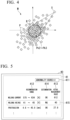
- FIG. 4 is a second diagram for describing the function of the welding assistance device according to the embodiment of the present disclosure.
- the learning model M represented in FIG. 4 is the same as the learning model M of FIG. 3 .
- the optimal condition range R is part of the normal space formed by the normal data P and is a range in which the welding quality is more stable, and defects are less likely to occur.
- the extraction unit 112 extracts, as the optimal condition range R, a range including the k2-th to k3-th (for example, 9000th to 10000th) normal data P from the current welding data X. That is, the extraction unit 112 extracts a different optimal condition range R according to the acquired welding data X each time the welding data X is acquired.
- the extraction unit 112 extracts, as the optimal condition range R, the normal data Pk2 and Pk3 farther from the welding data X than the normal data Pk1 used for calculating the abnormality degree. That is, the values of k2 and k3 are set to values more than k1. As a result, the extraction unit 112 can extract, as the optimal condition range R, a range in which the density of the normal data P is higher (the welding quality is more stable) than the vicinity of the normal data Pk1 used for calculating the abnormality degree in the normal space configured by the normal data P.
- the values of k1, k2, and k3 may be freely changed in consideration of the simulation results, the welding quality when the welding work is performed by using the welding assistance device 10, and the like.
- the setting unit 113 sets a recommendation range of the value of the parameter included in the welding data X based on the optimal condition range R extracted by the extraction unit 112 (Step S13). Specifically, the setting unit 113 sets a range from the minimum value to the maximum value of each parameter included in the normal data Pk2 to Pk3 in the optimal condition range R, as the recommendation range of the value of each parameter.
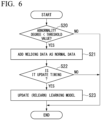
- FIG. 5 is a third diagram for describing the function of the welding assistance device according to the embodiment of the present disclosure.
- the welding data X includes parameters such as a welding current [A], a welding voltage [V], and a protrusion length [mm], as parameters that can be adjusted by the welder through the operation panel of the welding device 20.
- the setting unit 113 sets the recommendation range of the value of the welding current to 575 to 634 [A].
- the setting unit 113 sets the recommendation range for the other parameters in the similar manner.
- the output unit 114 generates assistance information 41 ( FIG. 5 ) including the recommendation range of each parameter set by the setting unit 113 and outputs (displays) the assistance information 41 to the display device 40 (Step S14).
- the assistance information 41 includes a recommendation range 412 of each parameter, an actual measurement value 413, and a determination result 414.
- the output unit 114 sets the determination result 414 to "OK (no problem)".
- the output unit 114 sets the determination result 414 to "NG (with problem)”.
- the output unit 114 may add an improvement suggestion display 415 that emphasizes the parameter with a frame, a background color, a text color, or the like to urge improvement.
- the output unit 114 may include the abnormality degree 411 calculated by the determination unit 111 or the determination result of the welding state in the assistance information 41.
- the welder refers to the assistance information 41 displayed on the display device 40 and operates the welding device 20 to, for example, change or maintain the welding conditions such that the actual measurement value 413 of each parameter falls within the recommendation range 412.
- the welder changes the welding conditions so that the actual measurement value 413 is quickly within the recommendation range 412.
- FIG. 6 is a second flowchart representing an example of a process of the welding assistance device according to the embodiment of the present disclosure.
- the learning unit 115 may update (relearn) the learning model M based on the welding data collected while performing the welding assistance process after the learning model M is constructed.
- a flow of an update process of the learning model M by the welding assistance device 10 will be described with reference to FIG. 6 .
- the learning unit 115 determines whether to use the welding data X for learning based on the welding data X acquired in Step S10 of FIG. 2 and the abnormality degree calculated in Step S11. Specifically, the learning unit 115 determines whether the abnormality degree of the welding data X is less than a predetermined threshold value (Step S20).
- Step S20 In a case where the abnormality degree of the welding data X is equal to or greater than the threshold value (Step S20; NO), the welding state is not normal, and thus it is not possible to use the welding data X for learning. Therefore, the learning unit 115 ends the process.
- the welding state is normal, and thus the learning unit 115 adds the welding data X as new normal data P (Step S21).
- the normal data P is recorded and accumulated in the storage 13.
- the learning unit 115 determines whether it is an update timing of the learning model M (Step S22). For example, in a case where the amount of newly added normal data P is equal to or greater than a predetermined amount or a predetermined time has elapsed from the previous update of the learning model M, the learning unit 115 determines that it is the update timing (Step S22; YES). In this case, the learning unit 115 relearns and updates the learning model M based on both the normal data P accumulated in the past and the newly added normal data P (Step S23). The learning unit 115 records the updated learning model M in the storage 13 and ends the process.
- the learning unit 115 ends the process.
- the learning unit 115 executes the series of processes in FIG. 6 to add new normal data P and update the learning model M.
- the welding assistance device 10 includes the acquisition unit 110 that acquires the welding data X, the extraction unit 112 that extracts the optimal condition range R corresponding to the welding data X from the normal data P included in the learning model M used for calculating the abnormality degree, the setting unit 113 that sets the recommendation range 412 of the value of the parameter included in the welding data based on the optimal condition range R, and the output unit 114 that outputs the assistance information 41 including the recommendation range 412.
- the welding assistance device 10 can suggest an appropriate value for stabilizing the welding quality to the welder for each parameter.
- the welding assistance device 10 can stabilize the welding quality and suppress the occurrence of defects regardless of the degree of proficiency of the welder.
- the welding assistance device 10 can shorten the processing time in the determination unit 111 and the extraction unit 112 and can quickly feed back the recommendation range to the welder, by using the same learning model M for the calculation of the abnormality degree and the extraction of the optimal condition range R.
- the determination unit 111 selects the k1-th normal data Pk1 from the welding data X among pieces of the normal data P included in the learning model M and calculates the distance between the selected normal data Pk1 and the welding data X, as the abnormality degree.
- the extraction unit 112 extracts, as the optimal condition range R, the k2-th to k3-th normal data Pk2 to Pk3 farther from the welding data X than the normal data Pk1.
- the welding assistance device 10 can use the normal data Pk1 that is relatively close to the welding data X to suppress an occurrence of a situation in which the abnormality degree that is determined to be excessively abnormal is calculated.
- the welding assistance device 10 can appropriately extract a range of the normal data P in which the density of the normal data P is high (indicating a more stable welding state). Accordingly, the welding assistance device 10 can appropriately set the recommendation value of each parameter based on the optimal condition range R, and thus can more stabilize the welding quality.
- the setting unit 113 sets a range from the minimum value to the maximum value of each parameter in the optimal condition range R as the recommendation range.
- the welding assistance device 10 can clearly suggest the recommendation range including the minimum value and the maximum value of each parameter, so that the welder can appropriately adjust the parameter regardless of the degree of proficiency. As a result, it is possible to suppress an occurrence of variation in welding quality due to the welder.
- the output unit 114 outputs the assistance information 41 including the improvement suggestion display 415 of this parameter.
- the welding assistance device 10 can cause the welder to easily and quickly recognize whether it is necessary to improve the parameters. As a result, it is possible to suppress an occurrence of defects in advance.
- the learning unit 115 updates the learning model M by adding the welding data X acquired when the abnormality degree is less than the predetermined value (that is, the welding state is normal), to the normal data P.
- the welding assistance device 10 accumulates a large amount of normal data P while performing the welding work and updates the learning model M, and thus, it is possible to learn the influence of the characteristics of the welding device 20, the aging deterioration, and the like. Thus, it is possible to suggest the parameter suitable for the welding device 20.
- the process of various types of processes of the welding assistance device 10 is stored in a computer-readable recording medium in a form of a program, and the various types of processes are executed by reading and executing the program by the computer.
- the computer-readable recording media include magnetic disks, magneto-optical disks, CD-ROMs, DVD-ROMs, semiconductor memories, and the like.
- this computer program may be distributed to a computer via a communication line, and the computer receiving the distribution may execute the program.
- the above program may be for implementing part of the above-described functions. Further, the program may be a so-called difference file (difference program) capable of realizing the functions described above in combination with a program recorded in advance in the computer system.
- difference file difference program
- the welding assistance device, the welding assistance method, and the program described in the above-described embodiment are ascertained as follows, for example.
- the welding assistance device With the welding assistance device, the welding assistance method, and the program according to the present disclosure, it is possible to stabilize welding quality and suppress the occurrence of a welding defect in welding work performed by a welder.
Landscapes
- Engineering & Computer Science (AREA)
- Mechanical Engineering (AREA)
- Physics & Mathematics (AREA)
- General Physics & Mathematics (AREA)
- Quality & Reliability (AREA)
- Theoretical Computer Science (AREA)
- Plasma & Fusion (AREA)
- Automation & Control Theory (AREA)
- Educational Technology (AREA)
- Educational Administration (AREA)
- Business, Economics & Management (AREA)
- Artificial Intelligence (AREA)
- Evolutionary Computation (AREA)
- Numerical Control (AREA)
- Resistance Welding (AREA)
- Testing And Monitoring For Control Systems (AREA)
Applications Claiming Priority (2)
| Application Number | Priority Date | Filing Date | Title |
|---|---|---|---|
| JP2022101615A JP2024002443A (ja) | 2022-06-24 | 2022-06-24 | 溶接支援装置、溶接支援方法、およびプログラム |
| PCT/JP2023/002520 WO2023248513A1 (ja) | 2022-06-24 | 2023-01-26 | 溶接支援装置、溶接支援方法、およびプログラム |
Publications (2)
| Publication Number | Publication Date |
|---|---|
| EP4523839A1 true EP4523839A1 (de) | 2025-03-19 |
| EP4523839A4 EP4523839A4 (de) | 2025-10-01 |
Family
ID=89379391
Family Applications (1)
| Application Number | Title | Priority Date | Filing Date |
|---|---|---|---|
| EP23826706.6A Pending EP4523839A4 (de) | 2022-06-24 | 2023-01-26 | Schweisshilfsvorrichtung, schweisshilfsverfahren und programm |
Country Status (5)
| Country | Link |
|---|---|
| US (1) | US20250378762A1 (de) |
| EP (1) | EP4523839A4 (de) |
| JP (1) | JP2024002443A (de) |
| KR (1) | KR20250009539A (de) |
| WO (1) | WO2023248513A1 (de) |
Family Cites Families (11)
| Publication number | Priority date | Publication date | Assignee | Title |
|---|---|---|---|---|
| JPS6126174U (ja) | 1984-07-24 | 1986-02-17 | 三菱電機株式会社 | 高周波加熱装置の高周波出力検出装置 |
| JP2837002B2 (ja) * | 1991-10-22 | 1998-12-14 | 三菱重工業株式会社 | 溶接状況監視装置 |
| JP6126174B2 (ja) | 2015-07-31 | 2017-05-10 | ファナック株式会社 | 機械学習装置、アーク溶接制御装置、アーク溶接ロボットシステムおよび溶接システム |
| JP7463055B2 (ja) * | 2018-12-27 | 2024-04-08 | 株式会社Ihi | 異常診断装置、異常診断方法、異常診断プログラム、及び記録媒体 |
| JP6932729B2 (ja) * | 2019-01-10 | 2021-09-08 | 大豊精機株式会社 | 溶接システム |
| US11373262B2 (en) * | 2019-03-25 | 2022-06-28 | Illinois Tool Works Inc. | Systems and methods for providing part quality confidence |
| JP7306898B2 (ja) * | 2019-07-09 | 2023-07-11 | 株式会社ダイヘン | 制御装置、プログラム、及びロボット制御システム |
| JP2019195850A (ja) * | 2019-08-22 | 2019-11-14 | 株式会社小松製作所 | 溶接システム、方法、溶接判定装置、及び学習済みモデルの構築方法 |
| JP7245806B2 (ja) | 2020-03-27 | 2023-03-24 | マイクロ モーション インコーポレイテッド | マルチチャネル流管によって流体を測定する方法 |
| JP7360987B2 (ja) * | 2020-04-01 | 2023-10-13 | 株式会社ダイヘン | 溶接条件調整装置 |
| JP7420692B2 (ja) * | 2020-10-16 | 2024-01-23 | 株式会社神戸製鋼所 | 溶接システム、溶接方法、溶接支援装置、プログラム、学習装置、及び学習済みモデルの生成方法 |
-
2022
- 2022-06-24 JP JP2022101615A patent/JP2024002443A/ja active Pending
-
2023
- 2023-01-26 US US18/874,288 patent/US20250378762A1/en active Pending
- 2023-01-26 WO PCT/JP2023/002520 patent/WO2023248513A1/ja not_active Ceased
- 2023-01-26 EP EP23826706.6A patent/EP4523839A4/de active Pending
- 2023-01-26 KR KR1020247041725A patent/KR20250009539A/ko active Pending
Also Published As
| Publication number | Publication date |
|---|---|
| US20250378762A1 (en) | 2025-12-11 |
| JP2024002443A (ja) | 2024-01-11 |
| KR20250009539A (ko) | 2025-01-17 |
| EP4523839A4 (de) | 2025-10-01 |
| WO2023248513A1 (ja) | 2023-12-28 |
Similar Documents
| Publication | Publication Date | Title |
|---|---|---|
| WO2021030103A8 (en) | Vehicle health record | |
| US11455203B2 (en) | Abnormality detection support device, abnormality detection support method, and program | |
| JP7006702B2 (ja) | 画像処理装置、画像処理方法及びプログラム | |
| JP6874864B2 (ja) | 画像処理装置、画像処理方法及びプログラム | |
| US11507788B2 (en) | Non-transitory computer-readable storage medium for storing analysis program, analysis apparatus, and analysis method | |
| US20190335154A1 (en) | Image processing apparatus, image processing method, and storage medium storing program | |
| JP2019204190A (ja) | 学習支援装置および学習支援方法 | |
| US20170032284A1 (en) | Machine learning apparatus for learning filter in accordance with machine command, motor drive apparatus and motor drive system having machine learning apparatus, and machine learning method | |
| JP2021144637A (ja) | 情報処理装置、情報処理方法およびプログラム | |
| EP3605518A1 (de) | Verfahren und vorrichtung zur steuerung eines anzeigebildschirms | |
| US20220067124A1 (en) | Information processing device, information processing method, and computer program product | |
| EP4523839A1 (de) | Schweisshilfsvorrichtung, schweisshilfsverfahren und programm | |
| EP4270270A1 (de) | Informationsverarbeitungsvorrichtung, faktoranalyseverfahren, computerprogramm und computerlesbares aufzeichnungsmedium | |
| CN114902060B (zh) | 机器学习装置及机器学习方法 | |
| CN105427180A (zh) | 质量控制设备及其控制方法 | |
| JP2011075622A (ja) | 音響モデル適応装置、その方法、プログラム、及び記録媒体 | |
| EP3690743A1 (de) | Trainingsvorrichtung, trainingsverfahren und trainingsprogramm | |
| CN114118485B (zh) | 一种尾撑系统健康监测与预防性维护的方法 | |
| CN118939919A (zh) | 应用于焊接设备的功率控制方法、装置和计算机设备 | |
| US20210125088A1 (en) | Product detection device, method, and program | |
| CN116724276B (zh) | 可由计算机系统进行读取的存储介质、运转改善辅助装置及运转改善辅助方法 | |
| CN116777305A (zh) | 电力数据质量提升方法、装置、电子设备及存储介质 | |
| TW201721319A (zh) | 自動化監測方法、系統與電腦程式產品 | |
| US20230298329A1 (en) | Information processing apparatus, information processing method, and storage medium | |
| CN117178238A (zh) | 数据处理系统、数据处理方法以及程序 |
Legal Events
| Date | Code | Title | Description |
|---|---|---|---|
| STAA | Information on the status of an ep patent application or granted ep patent |
Free format text: STATUS: THE INTERNATIONAL PUBLICATION HAS BEEN MADE |
|
| PUAI | Public reference made under article 153(3) epc to a published international application that has entered the european phase |
Free format text: ORIGINAL CODE: 0009012 |
|
| STAA | Information on the status of an ep patent application or granted ep patent |
Free format text: STATUS: REQUEST FOR EXAMINATION WAS MADE |
|
| 17P | Request for examination filed |
Effective date: 20241211 |
|
| AK | Designated contracting states |
Kind code of ref document: A1 Designated state(s): AL AT BE BG CH CY CZ DE DK EE ES FI FR GB GR HR HU IE IS IT LI LT LU LV MC ME MK MT NL NO PL PT RO RS SE SI SK SM TR |
|
| A4 | Supplementary search report drawn up and despatched |
Effective date: 20250902 |
|
| DAV | Request for validation of the european patent (deleted) | ||
| DAX | Request for extension of the european patent (deleted) | ||
| RIC1 | Information provided on ipc code assigned before grant |
Ipc: B23K 31/00 20060101AFI20250827BHEP Ipc: B23K 31/12 20060101ALI20250827BHEP |