EP4523831A1 - In-line-spektroskopie zur unterscheidung von hdpe-qualitäten - Google Patents
In-line-spektroskopie zur unterscheidung von hdpe-qualitäten Download PDFInfo
- Publication number
- EP4523831A1 EP4523831A1 EP23198023.6A EP23198023A EP4523831A1 EP 4523831 A1 EP4523831 A1 EP 4523831A1 EP 23198023 A EP23198023 A EP 23198023A EP 4523831 A1 EP4523831 A1 EP 4523831A1
- Authority
- EP
- European Patent Office
- Prior art keywords
- polyethylene component
- light
- laser
- transmitted light
- detector
- Prior art date
- Legal status (The legal status is an assumption and is not a legal conclusion. Google has not performed a legal analysis and makes no representation as to the accuracy of the status listed.)
- Granted
Links
Images



Classifications
-
- B—PERFORMING OPERATIONS; TRANSPORTING
- B23—MACHINE TOOLS; METAL-WORKING NOT OTHERWISE PROVIDED FOR
- B23K—SOLDERING OR UNSOLDERING; WELDING; CLADDING OR PLATING BY SOLDERING OR WELDING; CUTTING BY APPLYING HEAT LOCALLY, e.g. FLAME CUTTING; WORKING BY LASER BEAM
- B23K26/00—Working by laser beam, e.g. welding, cutting or boring
- B23K26/02—Positioning or observing the workpiece, e.g. with respect to the point of impact; Aligning, aiming or focusing the laser beam
- B23K26/03—Observing, e.g. monitoring, the workpiece
- B23K26/032—Observing, e.g. monitoring, the workpiece using optical means
-
- G—PHYSICS
- G01—MEASURING; TESTING
- G01N—INVESTIGATING OR ANALYSING MATERIALS BY DETERMINING THEIR CHEMICAL OR PHYSICAL PROPERTIES
- G01N21/00—Investigating or analysing materials by the use of optical means, i.e. using sub-millimetre waves, infrared, visible or ultraviolet light
- G01N21/17—Systems in which incident light is modified in accordance with the properties of the material investigated
- G01N21/25—Colour; Spectral properties, i.e. comparison of effect of material on the light at two or more different wavelengths or wavelength bands
- G01N21/31—Investigating relative effect of material at wavelengths characteristic of specific elements or molecules, e.g. atomic absorption spectrometry
-
- G—PHYSICS
- G01—MEASURING; TESTING
- G01N—INVESTIGATING OR ANALYSING MATERIALS BY DETERMINING THEIR CHEMICAL OR PHYSICAL PROPERTIES
- G01N21/00—Investigating or analysing materials by the use of optical means, i.e. using sub-millimetre waves, infrared, visible or ultraviolet light
- G01N21/84—Systems specially adapted for particular applications
- G01N21/88—Investigating the presence of flaws or contamination
- G01N21/90—Investigating the presence of flaws or contamination in a container or its contents
- G01N21/909—Investigating the presence of flaws or contamination in a container or its contents in opaque containers or opaque container parts, e.g. cans, tins, caps, labels
-
- B—PERFORMING OPERATIONS; TRANSPORTING
- B41—PRINTING; LINING MACHINES; TYPEWRITERS; STAMPS
- B41M—PRINTING, DUPLICATING, MARKING, OR COPYING PROCESSES; COLOUR PRINTING
- B41M5/00—Duplicating or marking methods; Sheet materials for use therein
- B41M5/26—Thermography ; Marking by high energetic means, e.g. laser otherwise than by burning, and characterised by the material used
- B41M5/267—Marking of plastic artifacts, e.g. with laser
-
- B—PERFORMING OPERATIONS; TRANSPORTING
- B65—CONVEYING; PACKING; STORING; HANDLING THIN OR FILAMENTARY MATERIAL
- B65B—MACHINES, APPARATUS OR DEVICES FOR, OR METHODS OF, PACKAGING ARTICLES OR MATERIALS; UNPACKING
- B65B61/00—Auxiliary devices, not otherwise provided for, for operating on sheets, blanks, webs, binding material, containers or packages
- B65B61/02—Auxiliary devices, not otherwise provided for, for operating on sheets, blanks, webs, binding material, containers or packages for perforating, scoring, slitting, or applying code or date marks on material prior to packaging
- B65B61/025—Auxiliary devices, not otherwise provided for, for operating on sheets, blanks, webs, binding material, containers or packages for perforating, scoring, slitting, or applying code or date marks on material prior to packaging for applying, e.g. printing, code or date marks on material prior to packaging
-
- G—PHYSICS
- G01—MEASURING; TESTING
- G01N—INVESTIGATING OR ANALYSING MATERIALS BY DETERMINING THEIR CHEMICAL OR PHYSICAL PROPERTIES
- G01N21/00—Investigating or analysing materials by the use of optical means, i.e. using sub-millimetre waves, infrared, visible or ultraviolet light
- G01N21/84—Systems specially adapted for particular applications
- G01N2021/8411—Application to online plant, process monitoring
- G01N2021/8416—Application to online plant, process monitoring and process controlling, not otherwise provided for
-
- G—PHYSICS
- G01—MEASURING; TESTING
- G01N—INVESTIGATING OR ANALYSING MATERIALS BY DETERMINING THEIR CHEMICAL OR PHYSICAL PROPERTIES
- G01N21/00—Investigating or analysing materials by the use of optical means, i.e. using sub-millimetre waves, infrared, visible or ultraviolet light
- G01N21/84—Systems specially adapted for particular applications
- G01N2021/845—Objects on a conveyor
-
- G—PHYSICS
- G01—MEASURING; TESTING
- G01N—INVESTIGATING OR ANALYSING MATERIALS BY DETERMINING THEIR CHEMICAL OR PHYSICAL PROPERTIES
- G01N21/00—Investigating or analysing materials by the use of optical means, i.e. using sub-millimetre waves, infrared, visible or ultraviolet light
- G01N21/17—Systems in which incident light is modified in accordance with the properties of the material investigated
- G01N21/25—Colour; Spectral properties, i.e. comparison of effect of material on the light at two or more different wavelengths or wavelength bands
- G01N21/31—Investigating relative effect of material at wavelengths characteristic of specific elements or molecules, e.g. atomic absorption spectrometry
- G01N21/33—Investigating relative effect of material at wavelengths characteristic of specific elements or molecules, e.g. atomic absorption spectrometry using ultraviolet light
-
- G—PHYSICS
- G01—MEASURING; TESTING
- G01N—INVESTIGATING OR ANALYSING MATERIALS BY DETERMINING THEIR CHEMICAL OR PHYSICAL PROPERTIES
- G01N21/00—Investigating or analysing materials by the use of optical means, i.e. using sub-millimetre waves, infrared, visible or ultraviolet light
- G01N21/84—Systems specially adapted for particular applications
- G01N21/88—Investigating the presence of flaws or contamination
- G01N21/90—Investigating the presence of flaws or contamination in a container or its contents
- G01N21/9081—Inspection especially designed for plastic containers, e.g. preforms
-
- G—PHYSICS
- G01—MEASURING; TESTING
- G01N—INVESTIGATING OR ANALYSING MATERIALS BY DETERMINING THEIR CHEMICAL OR PHYSICAL PROPERTIES
- G01N2201/00—Features of devices classified in G01N21/00
- G01N2201/12—Circuits of general importance; Signal processing
- G01N2201/129—Using chemometrical methods
Definitions
- the present invention relates to a method for laser marking of a polyethylene component using spectroscopic discrimination of at least two different quality grades of the polyethylene component, and a system for laser marking of a polyethylene component using spectroscopic discrimination of at least two different quality grades of the polyethylene component.
- Another possibility of marking medical devices may be engraving the material using lasers, for example.
- CO 2 lasers used commonly for engraving lead to a thermal reaction that may introduce holes in the packaging of the medical device. For these reasons, engraving may be only possible on breaking parts of the medical device, but not directly on a bottle or a cap.
- Another method for marking or labelling bottles or caps used in the pharmaceutical field may be laser making using lasers in the ultra-violet UV range that do not induce a thermal reaction in the material leading to an engraving, but locally change the color of the marked material at the surface due to a photo-chemical reaction.
- different materials may require different parameters of the marking laser like laser energy and exposure time in order to provide best marking results and readability of the label.
- the inventors of the present invention have thus found that it would be advantageous to have an improved method of laser marking and a laser marking system for medical devices like bottles or caps that takes into account different materials to be provided with codes or labels.
- the described embodiments similarly pertain to the method for laser marking of a polyethylene component using spectroscopic discrimination of at least two different quality grades of the polyethylene component, and the system for laser marking of a polyethylene component using spectroscopic discrimination of at least two different quality grades of the polyethylene component.
- the embodiments described further may be combined in any possible way. Synergistic effects may arise from different combinations of the embodiments although they might not be described in detail.
- a method for laser marking of a polyethylene component using spectroscopic discrimination of at least two different quality grades of the polyethylene component comprises the steps of providing a polyethylene component to be laser marked, illuminating the polyethylene component with light from a light source, and guiding at least a portion of the light that is transmitted through the polyethylene component to a detector and detecting the transmitted light with the detector.
- the method comprises further the steps of analyzing the transmitted light that is detected by the detector and determining a quality grade of the polyethylene component based on the transmitted light, selecting a set of laser parameters from a plurality of pre-defined sets of laser parameters based on the determined quality grade of the polyethylene component, and laser marking of the polyethylene component with a laser marking device using the selected set of laser parameters.
- a plurality of polyethylene component may be provided, which may be of different quality grades, or may be manufactured according to different production processes or by different manufactures. Although all of the plurality of polyethylene components may be of a similar or nearly identical material, i.e. polyethylene or high-density polyethylene HDPE, they may have slightly different properties due to their manufacturing process. For example, different reactors and/or different catalyst systems might lead to end products comprising different molecular distributions. Thus, one production process may lead to HDPE components comprising a broad molecular distribution, whereas another production process from a different supplier may lead to HDPE components comprising two narrow molecular distribution, for example.
- the inventors of the present invention propose a method for laser marking of a polyethylene component using spectroscopic discrimination of at least two different quality grades of the polyethylene component.
- a plurality of polyethylene component to be laser marked are provided and serially one other one another illuminated with light from a light source, the light that is transmitted through the polyethylene component is guided to a detector and detecting with the detector. Further, the transmitted light is spectroscopically analyzed and a quality grade of the polyethylene component is determined based on the spectra of the transmitted light.
- different quality grades of the HDPE components show different absorbance and transmission spectra, especially in the UV range of about 350 nm wavelength.
- a set of laser parameters from a plurality of pre-defined sets of laser parameters can be selected based on the determined quality grade of the polyethylene component.
- the set of laser parameters can comprise, for example, exposure time, or intensity or power of a laser used for marking the polyethylene component.
- the polyethylene component can be marked with a laser marking device using the selected and optimized set of laser parameters.
- the laser induces a photochemical reaction in the polyethylene material
- the polyethylene components may have additives that enable the laser marking, which may be difficult in the natural material. In general, it proved to be not straight forward to find out optimized laser parameters that worked for the specific material provided. Therefore, an optical application which allows the discrimination of different qualities of HDPE caps in-line is proposed in order to replace current inkjet printing systems with a reliable laser marking system.
- the polyethylene component is a high-density polyethylene HDPE component. These materials are commonly used to manufacture bottles and caps used in the pharmaceutical field.
- the quality grade of the high-density polyethylene component is selected from at least two predefined quality grades that are representative of a manufacturer and/or a manufacturing process of the high-density polyethylene component.
- the polyethylene component is a cap of a receptacle for medical use.
- the polyethylene component can be the receptacle itself like a bottle or a container.
- the light source is a pulsed xenon lamp.
- any other light source that provides preferably broadband light can be used.
- Using a pulsed lamp may reduce measurement noise, whereas also continuously emitting light sources can be used.
- transmission of different HDPE grade mainly differs in the ultra-violet range of about 350 nm.
- any light source that emits light in this range can advantageously be used.
- the step of detecting the transmitted light with the detector comprises detecting a spectrum of the transmitted light
- the step of analyzing the transmitted light that is detected by the detector comprises analyzing the spectrum of the transmitted light.
- a spectroscopic module with a sensitivity preferably in the range of 340 nm to 800 nm can be used to analyze the light that is transmitted through the polyethylene component.
- the step of analyzing the spectrum of the transmitted light comprises using a classification algorithm to discriminate between at least two predefined quality grades of the polyethylene components.
- a classification algorithm to discriminate between at least two predefined quality grades of the polyethylene components.
- the application of Linear Discriminant Analysis to establish a classification model to grade different HDPE qualities of the polyethylene component can be preferred.
- the spectra obtained can be processed and analyzed by classification algorithms based on Discrimination Analysis techniques to discriminate the two target HDPE quality grades that may be available.
- the method comprises further the step of collimating the light from the light source and focusing the light onto the polyethylene component, and/or collecting the transmitted light and focusing the transmitted light onto the detector.
- collimating the emitted light and collimating the transmitted light may increase the intensity of light reaching the detector and improve the quality of the measurement results.
- the method is performed in-line and/or automatically.
- the method is performed on the fly in real time, it is possible to determine the quality grade of the polyethylene component shortly before laser marking the respective component.
- a plurality of components like caps can be arranged in a row on a conveyor belt, which transports the caps serially through an analyzation stage and a laser marking stage, which uses the measurement results of the analyzation to adjust the laser marking stage to the optimized laser parameters.
- the method comprises further the steps of transmitting a signal representative of the determined quality grade of the polyethylene component to the laser marking device, and buffering the signal representative of the determined quality grade of the polyethylene component before and/or after transmitting the signal to the laser marking device.
- a signal is transmitted to the laser marking device in order to transmit data necessary to select the specific laser parameters for marking the respective component.
- This signal representative of the determined quality grade of the polyethylene component may include at least a part of the measurement data of the transmitted light, and/or may include a digital signal used to distinguish between at least two predefined quality grades.
- a spectroscopic module can preferably send a digital signal to a laser module to use a set of laser parameters from a plurality of pre-defined set of laser parameters based on the determined quality grade of the polyethylene component.
- the pre-defined set of laser parameters can be created and saved in the laser module, not in the spectroscopic module. Therefore, the spectroscopic module may have a plurality of pre-defined quality grades of the polyethylene component that can be linked to a set of laser parameters that are saved in laser module.
- An interface with an external PLC device by means of digital I/O through the implementation of dedicated electronic hardware and software can be provided in order to acquire and process the spectral data and to communicate with external devices.
- a system for laser marking of a polyethylene component using spectroscopic discrimination of at least two different quality grades of the polyethylene component comprises a light source configured for illuminating the polyethylene component with light, a detector configured for detecting light that is transmitted through the polyethylene component, and an analyzing module configured for analyzing the transmitted light that is detected by the detector.
- the system comprises further at least one processing unit configured for determining a quality grade of the polyethylene component based on the transmitted light, and for selecting a set of laser parameters from a plurality of pre-defined sets of laser parameters based on the determined quality grade of the polyethylene component, and a laser marking device configured for laser marking of the polyethylene component using the selected set of laser parameters.
- one processing unit can be provided that is configured for determining a quality grade of the polyethylene component based on the transmitted light and for selecting a set of laser parameters from a plurality of pre-defined sets of laser parameters based on the determined quality grade of the polyethylene component.
- two processing units can be provided, where the first processing unit is configured for determining a quality grade of the polyethylene component based on the transmitted light, and the second processing unit is configured for selecting a set of laser parameters from a plurality of pre-defined sets of laser parameters based on the determined quality grade of the polyethylene component.
- the first processing unit can be part of the analyzing module
- the second processing unit can be part of the laser marking device.
- a digital signal representative of the determined quality grade can be transmitted from the analyzing module to the laser marking device.
- the light source is a pulsed xenon lamp.
- the detector and/or the analyzing module are configured for detecting and/or analyzing the transmitted light spectroscopically.
- the detector and/or the analyzing module can be part of a spectroscopic module for spectroscopically analyzing the transmitted light.
- Linear Discriminant Analysis can be applied to establish a classification model to grade the different HDPE qualities of the polyethylene component.
- the system further comprises a collimator configured for collimating the light from the light source and focusing the light onto the polyethylene component, and/or a collector configured for collecting the transmitted light and focusing the transmitted light onto the detector.
- the system further comprises a buffer configured for buffering a signal representative of the determined quality grade of the polyethylene component.
- This buffer may be necessary to compensate for a time delay between the determination of the quality grade of the polyethylene component and the laser marking of the respective polyethylene component, which may result from the arrangement of a plurality of polyethylene components in-line on a conveyor belt, for example.
- the invention relates to a method for laser marking of a polyethylene component using spectroscopic discrimination of at least two different quality grades of the polyethylene component.
- the method comprises the steps of providing a polyethylene component to be marked with a laser, illuminating the polyethylene component with light, guiding at least a portion of the transmitted light to a detector, analyzing the transmitted light that is detected by the detector and determining a quality grade of the polyethylene component based on the transmitted light, selecting a set of laser parameters from a plurality of pre-defined sets of laser parameters based on the determined quality grade of the polyethylene component, and laser marking of the polyethylene component with a laser marking device using the selected set of laser parameters.
- One of the advantages of embodiments of the present invention of laser marking a polyethylene component using spectroscopic discrimination of at least two different quality grades of the polyethylene component may be that a reliable laser marking system to replace the current inkjet printing systems can be provided. Another advantage may reside in that at least two different quality grades of the polyethylene component can be detected and laser marked with optimized laser parameters. Another advantage may reside in that different qualities of HDPE caps can be discriminated in-line.
- Fig. 1 shows a block diagram of a method for laser marking of a polyethylene component 110 using spectroscopic discrimination of at least two different quality grades of the polyethylene component 110 according to an embodiment of the invention.
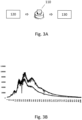
- the method comprises the step S110 of providing a polyethylene component 110 to be laser marked, the step S 120 of illuminating the polyethylene component 110 with light from a light source 120, and the step S130 of guiding at least a portion of the light that is transmitted through the polyethylene component 110 to a detector 130 and detecting the transmitted light with the detector.
- Fig. 3B shows a spectroscopic measurement of light transmitted through a polyethylene component 110. After irradiating the polyethylene component 110 with light from the light source 120, only a part of the light spectrum is transmitted through the polyethylene component 110. This part of the spectrum is detected with the detector 130, resulting in the spectrum shown in Fig. 3B . It is noted that the two spectra shown in this figure are acquired from two different quality grades of the polyethylene component 110, and differ from each other in particular in the ultra-violet region of about 350 nm. Thus, the at least two different quality grades of the polyethylene component can be distinguished by analyzing the transmitted light.
- One processing unit can be part of the analyzing module 131 and configured for determining a quality grade of the polyethylene component 110 based on the transmitted light, and one another processing unit can be part of the laser marking device 140 and configured for selecting a set of laser parameters from a plurality of pre-defined sets of laser parameters based on the determined quality grade of the polyethylene component 110. However, it is possible that both of these steps are performed in one single processing unit.
- a signal 150 representative of the determined quality grade of the polyethylene component 110 is transmitted from the analyzing module 131 to the laser marking device 140, optionally via a buffer 160 for buffering the transmitted signal.
- the laser marking device 140 is configured for laser marking of the polyethylene component 110 using the selected set of laser parameters.
Landscapes
- Physics & Mathematics (AREA)
- Health & Medical Sciences (AREA)
- Life Sciences & Earth Sciences (AREA)
- Chemical & Material Sciences (AREA)
- Analytical Chemistry (AREA)
- Biochemistry (AREA)
- General Health & Medical Sciences (AREA)
- General Physics & Mathematics (AREA)
- Immunology (AREA)
- Pathology (AREA)
- Spectroscopy & Molecular Physics (AREA)
- Optics & Photonics (AREA)
- Engineering & Computer Science (AREA)
- Plasma & Fusion (AREA)
- Mechanical Engineering (AREA)
- Laser Beam Processing (AREA)
Priority Applications (2)
| Application Number | Priority Date | Filing Date | Title |
|---|---|---|---|
| EP23198023.6A EP4523831B1 (de) | 2023-09-18 | 2023-09-18 | In-line-spektroskopie zur unterscheidung von hdpe-qualitäten |
| ES23198023T ES3075386T3 (en) | 2023-09-18 | 2023-09-18 | In-line spectroscopy for discrimination of hdpe grades |
Applications Claiming Priority (1)
| Application Number | Priority Date | Filing Date | Title |
|---|---|---|---|
| EP23198023.6A EP4523831B1 (de) | 2023-09-18 | 2023-09-18 | In-line-spektroskopie zur unterscheidung von hdpe-qualitäten |
Publications (2)
| Publication Number | Publication Date |
|---|---|
| EP4523831A1 true EP4523831A1 (de) | 2025-03-19 |
| EP4523831B1 EP4523831B1 (de) | 2026-06-03 |
Family
ID=88093695
Family Applications (1)
| Application Number | Title | Priority Date | Filing Date |
|---|---|---|---|
| EP23198023.6A Active EP4523831B1 (de) | 2023-09-18 | 2023-09-18 | In-line-spektroskopie zur unterscheidung von hdpe-qualitäten |
Country Status (2)
| Country | Link |
|---|---|
| EP (1) | EP4523831B1 (de) |
| ES (1) | ES3075386T3 (de) |
Citations (4)
| Publication number | Priority date | Publication date | Assignee | Title |
|---|---|---|---|---|
| US20160221356A1 (en) * | 2015-01-24 | 2016-08-04 | Ten Media, Llc Dba Ten Ag Tech Co. | Method and system for optimizing laser marking on a food product |
| CN109320819A (zh) * | 2018-09-10 | 2019-02-12 | 常州大学 | 一种可激光标记的有机-无机聚乙烯复合材料的制备方法与应用 |
| WO2022170262A1 (en) * | 2021-02-08 | 2022-08-11 | Sortera Alloys, Inc. | Sorting of plastics |
| US20220305812A1 (en) * | 2021-03-23 | 2022-09-29 | Kazuki FUNAHASHI | Medium, container, object-holding container, marking device, and method of manufacturing container |
-
2023
- 2023-09-18 ES ES23198023T patent/ES3075386T3/es active Active
- 2023-09-18 EP EP23198023.6A patent/EP4523831B1/de active Active
Patent Citations (4)
| Publication number | Priority date | Publication date | Assignee | Title |
|---|---|---|---|---|
| US20160221356A1 (en) * | 2015-01-24 | 2016-08-04 | Ten Media, Llc Dba Ten Ag Tech Co. | Method and system for optimizing laser marking on a food product |
| CN109320819A (zh) * | 2018-09-10 | 2019-02-12 | 常州大学 | 一种可激光标记的有机-无机聚乙烯复合材料的制备方法与应用 |
| WO2022170262A1 (en) * | 2021-02-08 | 2022-08-11 | Sortera Alloys, Inc. | Sorting of plastics |
| US20220305812A1 (en) * | 2021-03-23 | 2022-09-29 | Kazuki FUNAHASHI | Medium, container, object-holding container, marking device, and method of manufacturing container |
Also Published As
| Publication number | Publication date |
|---|---|
| EP4523831B1 (de) | 2026-06-03 |
| ES3075386T3 (en) | 2026-08-04 |
Similar Documents
| Publication | Publication Date | Title |
|---|---|---|
| US7652268B2 (en) | General purpose, high accuracy dosimeter reader | |
| FI92560C (fi) | Menetelmä kontaminoituneiden ja kontaminoitumattomien säiliöiden erottamiseksi | |
| US6753527B1 (en) | Method and device for imaging liquid-filling container | |
| EP1241467B2 (de) | Untersuchungsgerät und System zur Untersuchung von Fremdkörpern in mit Flüssigkeit gefüllten Behältern | |
| US20020154809A1 (en) | Method and device for imaging liquid-filled container | |
| US7605372B2 (en) | Method for authentication by chemical marking or tracing of an object or a substance | |
| US8707790B2 (en) | Method and device for optical pressure measurement of a gas in a closed container | |
| JPH06323992A (ja) | 透明な容器を光学的に検査するための方法および装置 | |
| MXPA06008254A (es) | Dispositivo y metodo para detectar contaminacion en un envase. | |
| US20200284720A1 (en) | Method for measuring a concentration of a gas | |
| JP2011191129A (ja) | 錠剤検査装置、錠剤包装装置、錠剤検査方法及び錠剤包装方法 | |
| KR20140076648A (ko) | 콘테이너들의 검사 및 재순환 | |
| US20060244954A1 (en) | System and method for inspecting packaging quality of a packaged food product | |
| US5699162A (en) | Process and apparatus for testing a multi-trip bottle for contamination utilizing residual liquid in bottle bottom and sprectral measurement | |
| US20150192521A1 (en) | Method, device and portable meter for detecting degradation products of biological molecules in layers of a layer system | |
| US7294837B2 (en) | Tablets press with integral NIR measuring device | |
| US20040000653A1 (en) | Method and device for spectrophotometric analysis | |
| NO338611B1 (no) | Fremgangsmåte for kvantitativ analyse av løsninger og dispersjoner ved hjelp av nærinfrarød-spektroskopi | |
| US20240280505A1 (en) | Apparatus and method for inspecting filled containers and their filling product | |
| EP1181526A1 (de) | Vorrichtung und verfahren zur inspektion von mehrschichtigen plasitkbehältern | |
| US20130215426A1 (en) | Method and apparatus for analyte detection | |
| JP2002098703A (ja) | 生物学的物質を自動分析するための品質管理方法および装置 | |
| JP5002980B2 (ja) | 米の品質測定方法及び米の品質測定装置 | |
| EP4443103A1 (de) | Optisches verfahren zur zerstörungsfreien messung der dicke eines hohlen behälters | |
| JP3643821B2 (ja) | 炭素バリア膜のバリア性評価装置 |
Legal Events
| Date | Code | Title | Description |
|---|---|---|---|
| PUAI | Public reference made under article 153(3) epc to a published international application that has entered the european phase |
Free format text: ORIGINAL CODE: 0009012 |
|
| STAA | Information on the status of an ep patent application or granted ep patent |
Free format text: STATUS: THE APPLICATION HAS BEEN PUBLISHED |
|
| AK | Designated contracting states |
Kind code of ref document: A1 Designated state(s): AL AT BE BG CH CY CZ DE DK EE ES FI FR GB GR HR HU IE IS IT LI LT LU LV MC ME MK MT NL NO PL PT RO RS SE SI SK SM TR |
|
| STAA | Information on the status of an ep patent application or granted ep patent |
Free format text: STATUS: REQUEST FOR EXAMINATION WAS MADE |
|
| 17P | Request for examination filed |
Effective date: 20250918 |
|
| GRAP | Despatch of communication of intention to grant a patent |
Free format text: ORIGINAL CODE: EPIDOSNIGR1 |
|
| STAA | Information on the status of an ep patent application or granted ep patent |
Free format text: STATUS: GRANT OF PATENT IS INTENDED |
|
| RIC1 | Information provided on ipc code assigned before grant |
Ipc: B23K 26/03 20060101AFI20251128BHEP Ipc: B41M 5/26 20060101ALI20251128BHEP Ipc: G01N 21/63 20060101ALI20251128BHEP Ipc: A61J 1/05 20060101ALI20251128BHEP Ipc: B65B 21/04 20060101ALI20251128BHEP Ipc: G01N 21/31 20060101ALI20251128BHEP Ipc: G01N 21/90 20060101ALI20251128BHEP Ipc: G01N 21/33 20060101ALN20251128BHEP Ipc: G01N 21/84 20060101ALN20251128BHEP |
|
| INTG | Intention to grant announced |
Effective date: 20260107 |
|
| GRAS | Grant fee paid |
Free format text: ORIGINAL CODE: EPIDOSNIGR3 |
|
| GRAA | (expected) grant |
Free format text: ORIGINAL CODE: 0009210 |
|
| STAA | Information on the status of an ep patent application or granted ep patent |
Free format text: STATUS: THE PATENT HAS BEEN GRANTED |
|
| AK | Designated contracting states |
Kind code of ref document: B1 Designated state(s): AL AT BE BG CH CY CZ DE DK EE ES FI FR GB GR HR HU IE IS IT LI LT LU LV MC ME MK MT NL NO PL PT RO RS SE SI SK SM TR |
|
| REG | Reference to a national code |
Ref country code: CH Ref legal event code: F10 Free format text: ST27 STATUS EVENT CODE: U-0-0-F10-F00 (AS PROVIDED BY THE NATIONAL OFFICE) Effective date: 20260603 Ref country code: GB Ref legal event code: FG4D |
|
| REG | Reference to a national code |
Ref country code: IE Ref legal event code: FG4D |
|
| REG | Reference to a national code |
Ref country code: DE Ref legal event code: R096 Ref document number: 602023017983 Country of ref document: DE |
|
| REG | Reference to a national code |
Ref country code: ES Ref legal event code: FG2A Ref document number: 3075386 Country of ref document: ES Kind code of ref document: T3 Effective date: 20260804 |