EP4523550A1 - Method for isolating and purifying neophytadiene from leaf tobacco, neophytadiene composition, non-combustion heating-type flavor inhaler, non-combustion non-heating type flavor inhaler, combustion-type flavor inhaler and methods for producing same - Google Patents
Method for isolating and purifying neophytadiene from leaf tobacco, neophytadiene composition, non-combustion heating-type flavor inhaler, non-combustion non-heating type flavor inhaler, combustion-type flavor inhaler and methods for producing same Download PDFInfo
- Publication number
- EP4523550A1 EP4523550A1 EP23803229.6A EP23803229A EP4523550A1 EP 4523550 A1 EP4523550 A1 EP 4523550A1 EP 23803229 A EP23803229 A EP 23803229A EP 4523550 A1 EP4523550 A1 EP 4523550A1
- Authority
- EP
- European Patent Office
- Prior art keywords
- neophytadiene
- combustion
- obtaining
- solution
- tobacco
- Prior art date
- Legal status (The legal status is an assumption and is not a legal conclusion. Google has not performed a legal analysis and makes no representation as to the accuracy of the status listed.)
- Pending
Links
Images







Classifications
-
- A—HUMAN NECESSITIES
- A24—TOBACCO; CIGARS; CIGARETTES; SIMULATED SMOKING DEVICES; SMOKERS' REQUISITES
- A24B—MANUFACTURE OR PREPARATION OF TOBACCO FOR SMOKING OR CHEWING; TOBACCO; SNUFF
- A24B15/00—Chemical features or treatment of tobacco; Tobacco substitutes, e.g. in liquid form
- A24B15/18—Treatment of tobacco products or tobacco substitutes
- A24B15/28—Treatment of tobacco products or tobacco substitutes by chemical substances
- A24B15/30—Treatment of tobacco products or tobacco substitutes by chemical substances by organic substances
- A24B15/32—Treatment of tobacco products or tobacco substitutes by chemical substances by organic substances by acyclic compounds
-
- A—HUMAN NECESSITIES
- A24—TOBACCO; CIGARS; CIGARETTES; SIMULATED SMOKING DEVICES; SMOKERS' REQUISITES
- A24B—MANUFACTURE OR PREPARATION OF TOBACCO FOR SMOKING OR CHEWING; TOBACCO; SNUFF
- A24B15/00—Chemical features or treatment of tobacco; Tobacco substitutes, e.g. in liquid form
- A24B15/10—Chemical features of tobacco products or tobacco substitutes
-
- A—HUMAN NECESSITIES
- A24—TOBACCO; CIGARS; CIGARETTES; SIMULATED SMOKING DEVICES; SMOKERS' REQUISITES
- A24B—MANUFACTURE OR PREPARATION OF TOBACCO FOR SMOKING OR CHEWING; TOBACCO; SNUFF
- A24B15/00—Chemical features or treatment of tobacco; Tobacco substitutes, e.g. in liquid form
- A24B15/10—Chemical features of tobacco products or tobacco substitutes
- A24B15/16—Chemical features of tobacco products or tobacco substitutes of tobacco substitutes
-
- A—HUMAN NECESSITIES
- A24—TOBACCO; CIGARS; CIGARETTES; SIMULATED SMOKING DEVICES; SMOKERS' REQUISITES
- A24B—MANUFACTURE OR PREPARATION OF TOBACCO FOR SMOKING OR CHEWING; TOBACCO; SNUFF
- A24B15/00—Chemical features or treatment of tobacco; Tobacco substitutes, e.g. in liquid form
- A24B15/10—Chemical features of tobacco products or tobacco substitutes
- A24B15/16—Chemical features of tobacco products or tobacco substitutes of tobacco substitutes
- A24B15/167—Chemical features of tobacco products or tobacco substitutes of tobacco substitutes in liquid or vaporisable form, e.g. liquid compositions for electronic cigarettes
-
- A—HUMAN NECESSITIES
- A24—TOBACCO; CIGARS; CIGARETTES; SIMULATED SMOKING DEVICES; SMOKERS' REQUISITES
- A24B—MANUFACTURE OR PREPARATION OF TOBACCO FOR SMOKING OR CHEWING; TOBACCO; SNUFF
- A24B15/00—Chemical features or treatment of tobacco; Tobacco substitutes, e.g. in liquid form
- A24B15/18—Treatment of tobacco products or tobacco substitutes
- A24B15/24—Treatment of tobacco products or tobacco substitutes by extraction; Tobacco extracts
-
- A—HUMAN NECESSITIES
- A24—TOBACCO; CIGARS; CIGARETTES; SIMULATED SMOKING DEVICES; SMOKERS' REQUISITES
- A24B—MANUFACTURE OR PREPARATION OF TOBACCO FOR SMOKING OR CHEWING; TOBACCO; SNUFF
- A24B15/00—Chemical features or treatment of tobacco; Tobacco substitutes, e.g. in liquid form
- A24B15/18—Treatment of tobacco products or tobacco substitutes
- A24B15/24—Treatment of tobacco products or tobacco substitutes by extraction; Tobacco extracts
- A24B15/241—Extraction of specific substances
-
- A—HUMAN NECESSITIES
- A24—TOBACCO; CIGARS; CIGARETTES; SIMULATED SMOKING DEVICES; SMOKERS' REQUISITES
- A24B—MANUFACTURE OR PREPARATION OF TOBACCO FOR SMOKING OR CHEWING; TOBACCO; SNUFF
- A24B15/00—Chemical features or treatment of tobacco; Tobacco substitutes, e.g. in liquid form
- A24B15/18—Treatment of tobacco products or tobacco substitutes
- A24B15/24—Treatment of tobacco products or tobacco substitutes by extraction; Tobacco extracts
- A24B15/26—Use of organic solvents for extraction
-
- A—HUMAN NECESSITIES
- A24—TOBACCO; CIGARS; CIGARETTES; SIMULATED SMOKING DEVICES; SMOKERS' REQUISITES
- A24D—CIGARS; CIGARETTES; TOBACCO SMOKE FILTERS; MOUTHPIECES OF CIGARS OR CIGARETTES; MANUFACTURE OF TOBACCO SMOKE FILTERS OR MOUTHPIECES
- A24D1/00—Cigars; Cigarettes
- A24D1/20—Cigarettes specially adapted for simulated smoking devices
-
- B—PERFORMING OPERATIONS; TRANSPORTING
- B01—PHYSICAL OR CHEMICAL PROCESSES OR APPARATUS IN GENERAL
- B01D—SEPARATION
- B01D11/00—Solvent extraction
- B01D11/02—Solvent extraction of solids
- B01D11/0215—Solid material in other stationary receptacles
- B01D11/0253—Fluidised bed of solid materials
- B01D11/0257—Fluidised bed of solid materials using mixing mechanisms, e.g. stirrers, jets
-
- B—PERFORMING OPERATIONS; TRANSPORTING
- B01—PHYSICAL OR CHEMICAL PROCESSES OR APPARATUS IN GENERAL
- B01D—SEPARATION
- B01D11/00—Solvent extraction
- B01D11/02—Solvent extraction of solids
- B01D11/028—Flow sheets
- B01D11/0284—Multistage extraction
-
- B—PERFORMING OPERATIONS; TRANSPORTING
- B01—PHYSICAL OR CHEMICAL PROCESSES OR APPARATUS IN GENERAL
- B01D—SEPARATION
- B01D11/00—Solvent extraction
- B01D11/02—Solvent extraction of solids
- B01D11/0288—Applications, solvents
-
- B—PERFORMING OPERATIONS; TRANSPORTING
- B01—PHYSICAL OR CHEMICAL PROCESSES OR APPARATUS IN GENERAL
- B01D—SEPARATION
- B01D11/00—Solvent extraction
- B01D11/04—Solvent extraction of solutions which are liquid
- B01D11/0488—Flow sheets
-
- B—PERFORMING OPERATIONS; TRANSPORTING
- B01—PHYSICAL OR CHEMICAL PROCESSES OR APPARATUS IN GENERAL
- B01D—SEPARATION
- B01D11/00—Solvent extraction
- B01D11/04—Solvent extraction of solutions which are liquid
- B01D11/0492—Applications, solvents used
-
- B—PERFORMING OPERATIONS; TRANSPORTING
- B01—PHYSICAL OR CHEMICAL PROCESSES OR APPARATUS IN GENERAL
- B01D—SEPARATION
- B01D15/00—Separating processes involving the treatment of liquids with solid sorbents; Apparatus therefor
- B01D15/08—Selective adsorption, e.g. chromatography
-
- B—PERFORMING OPERATIONS; TRANSPORTING
- B01—PHYSICAL OR CHEMICAL PROCESSES OR APPARATUS IN GENERAL
- B01D—SEPARATION
- B01D15/00—Separating processes involving the treatment of liquids with solid sorbents; Apparatus therefor
- B01D15/08—Selective adsorption, e.g. chromatography
- B01D15/26—Selective adsorption, e.g. chromatography characterised by the separation mechanism
- B01D15/32—Bonded phase chromatography
- B01D15/322—Normal bonded phase
Definitions
- the present invention relates to a method of performing isolated purification of neophytadiene from leaf tobacco, a neophytadiene composition, a non-combustion-heating-type flavor inhaler, a non-combustion-non-heating-type flavor inhaler, a combustion-type flavor inhaler, and manufacturing methods therefor.
- Neophytadiene is a terpenoid compound contained in leaf tobacco and correlates with a characteristic aroma of a tobacco plant, so it is focused as an important component to develop aroma quality.
- an essential oil containing neophytadiene has an anti-inflammatory action (NPL 1)
- NPL 2 anti-inflammatory action
- Neophytadiene As a substance containing neophytadiene, algae are known among plant bodies (NPL 2). Neophytadiene reportedly derives from phytol obtained by liberating part of chlorophylls a, b contained in a plant through hydrolysis in lumens, and it is also reported that neophytadiene is detected from milk and beef of cows for which grass containing neophytadiene is used as feed (NPL 3).
- a synthetic reaction is mainly used as a method of obtaining a simple substance of neophytadiene.
- initially chlorophyll is subjected to hydrolysis under alkaline condition to produce phytol.
- Concentrated sulfuric acid is added to the produced phytol and heated at 170°C to cause an elimination reaction, with the result that neophytadiene is produced (PTL 1).
- neophytadiene is separated from a mixture, such as a plant body, neophytadiene is purified as essential oil containing another material, and there are a small number of reports on isolated purification of neophytadiene simple substance.
- NPL 4 describes a method in which, as a process of performing isolated purification of neophytadiene from tobacco, extraction is performed with a hexane solvent from tobacco of a flue cured type, then a hexane layer is dissolved by using a silicic acid column chromatography, the solvent is replaced with acetone, saturated hydrocarbons are crystallized and removed, and then elution is performed with an alumina chromatography.
- the present invention includes the following embodiments.
- a method capable of performing isolated purification of neophytadiene from leaf tobacco with high yield and high purity a neophytadiene composition obtained with the method, and a non-combustion-heating-type flavor inhaler, a non-combustion-non-heating-type flavor inhaler, and a combustion-type flavor inhaler that include the neophytadiene composition.
- the method according to the present embodiment includes the steps A1 to H1, so it is possible to perform isolated purification of neophytadiene from leaf tobacco with high yield and high purity. Ordinarily, it is not possible to completely separate neophytadiene and nicotine through normal phase high performance liquid chromatography, so it is difficult to perform isolated purification of neophytadiene with high yield and high purity.
- step B1 by initially performing step B1 on an extract obtained from leaf tobacco in step A1 to add an acidic aqueous solution and then remove an aqueous layer, alkaloids including nicotine as a main component and contained in the extract are separated.
- a dry solid (D1) is obtained by intentionally removing a solvent of an extract (C1) in step D1
- the dry solid (D1) is dissolved again by adding a protic solvent in step E1
- a deposit (high hydrocarbon) produced in a solution (E1) obtained is removed in step F1
- the method according to the present embodiment may include another step other than steps A1 to H1.
- Fig. 1 shows a flowchart of an example of the method according to the present embodiment.
- an extract (A1) is obtained by adding an aprotic solvent to leaf tobacco to perform extraction operation and then removing an extraction residue. With this step, it is possible to extract an effective component including neophytadiene contained in leaf tobacco, into an extract (A1).
- the type of leaf tobacco is not limited.
- Examples of the type of leaf tobacco include a flue cured type, a burley type, an orient type, a local type, other nicotiana-tabacum species, and nicotiana-rustica species.
- One of these types of leaf tobacco may be used or two or more of these types of leaf tobacco may be used in combination.
- leaf tobacco of at least one type selected from the group consisting of a flue cured type and a burley type is preferable, and a flue cured type is more preferable.
- a form of leaf tobacco is not limited. From the viewpoint of improving extracting efficiency, finely powdered leaf tobacco is preferable.
- a solid ejected as waste from a step of expanding leaf tobacco or leaf tobacco fine powder ejected from a leaf tobacco raw material factory may be used as leaf tobacco.
- an aprotic solvent that is an extractant is preferably a solvent of at least one selected from the group consisting of hexane, heptane, and ethyl acetate, and more preferably hexane.
- the aprotic solvent preferably ranges from 500 parts by mass to 2000 parts by mass and more preferably ranges from 750 parts by mass to 1250 parts by mass with respect to 100 parts by mass of leaf tobacco.
- Extraction operation can be performed by, for example, agitating aprotic solvent containing leaf tobacco.
- An extraction temperature preferably ranges from 15°C to 40°C, and an extraction time preferably ranges from one to six hours. Removal of an extraction residue can be performed by, for example, separating extract (A1) and an extraction residue from each other with a stainless steel mesh.
- an extract (B1) is obtained by adding an acidic aqueous solution to the extract (A1) obtained in step A1 to perform liquid-liquid extraction and then removing an aqueous layer.
- alkaloids containing nicotine as a main component migrates into an aqueous layer, and a hydrophobic effective component of leaf tobacco, such as neophytadiene, remains in an organic layer, so it is possible to selectively separate and remove alkaloids containing nicotine as a main component.
- the acidic aqueous solution means an aqueous solution of which the pH is less than seven.
- the acidic aqueous solution may be, for example, an aqueous solution containing a pH adjustor, such as sulfuric acid and hydrochloric acid.
- a pH adjustor such as sulfuric acid and hydrochloric acid.
- the pH of the acidic aqueous solution is preferably less than or equal to three, and more preferably ranges from one to three.
- the pH of an aqueous solution is a value measured with a pH meter (for example, product name: desktop pH meter, made by HORIBA).
- a volume ratio of extract (A1) and acidic aqueous solution preferably ranges from 50:100 to 500:100 and more preferably ranges from 200:100 to 400:100.
- Liquid-liquid extraction operation can be performed by, for example, shaking a mixture.
- the extraction temperature preferably ranges from 15°C to 40°C.
- the extraction time preferably ranges from 0.5 hours to three hours.
- a salt, such as sodium chloride may be added to a mixture when liquid-liquid extraction is performed.
- Dewatering operation in an extract (B1) may be performed by adding a desiccant, such as anhydrous sodium sulfate, to the extract (B1) obtained by separating and removing an aqueous layer.
- an extract (C1) is obtained by adding a protic solvent to the extract (B1) obtained in step B1 to perform liquid-liquid extraction and then removing a layer of a protic solvent.
- a foliar resin component of leaf tobacco containing cembratrienediol (CBT) as a main component migrates into a layer of a protic solvent, and neophytadiene and high hydrocarbon each migrate into a layer of an aprotic solvent, so it is possible to selectively separate and remove the foliar resin component of leaf tobacco containing CBT as a main component.
- the protic solvent is preferably methanol.
- a volume ratio of extract (B1) and protic solvent preferably ranges from 100:15 to 100:100 and more preferably ranges from 100:40 to 100:60.
- Liquid-liquid extraction operation can be performed by, for example, shaking a mixture.
- the extraction temperature preferably ranges from 15°C to 40°C.
- the extraction time preferably ranges from three hours to eight hours. From the viewpoint of further removing the foliar resin component of leaf tobacco containing CBT as a main component, this step may be repeated twice or more.
- a dry solid (D1) is obtained by removing a solvent of the extract (C1) obtained in step C1.
- a method of removing a solvent (aprotic solvent) of the extract (C1) is not limited.
- a solvent may be removed from the extract (C1) under reduced pressure.
- a solution (E1) is obtained by adding a protic solvent to the dry solid (D1) obtained in step D1 to dissolve the dry solid (D1).
- the protic solvent is preferably methanol.
- the protic solvent preferably ranges from 750 parts by mass to 2500 parts by mass and more preferably ranges from 1000 parts by mass to 1500 parts by mass with respect to 100 parts by mass of the dry solid (D1).
- a method of dissolving the dry solid (D1) into the protic solvent is not limited.
- the dry solid (D1) can be dispersed and dissolved by applying ultrasonic waves to the solution. The dry solid (D1) does not need to be completely dissolved into the protic solvent, and at least part of the dry solid (D1) just needs to be dissolved.
- a supernatant (F1) is obtained by removing a deposit produced in the solution (E1) obtained in step E1.
- high hydrocarbon can be selectively separated and removed as a deposit.
- a deposit can be produced by standing the solution (E1). Standing can be performed, for example, at 0°C to 30°C for one to 12 hours.
- a solution (G1) is obtained by replacing a solvent of the supernatant (F1) obtained in step F1 with an aprotic solvent.
- the method is not limited.
- a solution (G1) can be obtained by adding an aprotic solvent to the supernatant (F1) to perform liquid-liquid extraction and then removing a layer of a protic solvent.
- the solution (G1) may be obtained by removing a solvent of the supernatant (F1) and then adding an aprotic solvent.
- HPLC normal phase high performance liquid chromatography
- 1260 Infinity product name, made by Agilent Technologies
- separation operation can be performed under the following conditions.
- neophytadiene After separation under the conditions, a signal detected at 220 nm is cut off to a fraction collector, the cutoff fraction is collected, and the obtained sample is condensed and dried, with the result that isolated purification of neophytadiene can be performed.
- neophytadiene can be obtained with high yield, and a neophytadiene composition obtained through isolated purification contains 95mass% or higher of neophytadiene.
- the method according to the present embodiment includes the steps A2 to G2, so it is possible to perform isolated purification of neophytadiene from leaf tobacco with high purity.
- step B2 by initially performing step B2 on an extract obtained from leaf tobacco in step A2 to add an acidic aqueous solution and remove an aqueous layer, alkaloids including nicotine as a main component and contained in the extract are separated.
- alkaloids including nicotine as a main component and contained in the extract are separated.
- nicotine and the like are initially removed, so it is possible to efficiently improve the yield and purity of neophytadiene subjected to isolated purification.
- a dry solid (C2) is obtained by intentionally removing a solvent of an extract (B2) in step C2
- the dry solid (C2) is dissolved again by adding a protic solvent in step D2, and a deposit (high hydrocarbon) produced in a solution (D2) obtained is removed in step E2, with the result that the high hydrocarbon can be efficiently separated.
- steps A2 to G2 the details of steps A2 to G2 will be described; however, the method according to the present embodiment may include another step other than steps A2 to G2.
- Fig. 2 shows a flowchart of an example of the method according to the present embodiment.
- Steps A2 and B2 can be performed similarly to steps A1 and B1 in the first embodiment.
- a dry solid (C2) is obtained by removing a solvent of the extract (B2) obtained in step B2.
- a method of removing a solvent (aprotic solvent) of the extract (B2) is not limited.
- a solvent may be removed from the extract (B2) under reduced pressure.
- a solution (D2) is obtained by adding a protic solvent to the dry solid (C2) obtained in step C2 to dissolve the dry solid (C2);
- the protic solvent is preferably methanol.
- the protic solvent preferably ranges from 500 parts by mass to 2500 parts by mass and more preferably ranges from 750 parts by mass to 1500 parts by mass with respect to 100 parts by mass of the dry solid (C2).
- a method of dissolving the dry solid (C2) into the protic solvent is not limited.
- the dry solid (C2) can be dispersed and dissolved by applying ultrasonic waves to the solution.
- the dry solid (C2) does not need to be completely dissolved into the protic solvent, and at least part of the dry solid (C2) just needs to be dissolved.
- a supernatant (E2) is obtained by removing a deposit produced in the solution (D2) obtained in step D2.
- high hydrocarbon can be selectively separated and removed as a deposit.
- a deposit can be produced by standing the solution (D2). Standing can be performed, for example, at 15°C to 40°C for three to eight hours.
- a solution (F2) is obtained by adding an aprotic solvent to the supernatant (E2) obtained in step E2 to perform liquid-liquid extraction and then removing a layer of a protic solvent;
- a foliar resin component of leaf tobacco containing cembratrienediol (CBT) as a main component migrates into a layer of a protic solvent, and neophytadiene migrates into a layer of an aprotic solvent, so it is possible to selectively separate and remove the foliar resin component of leaf tobacco containing CBT as a main component.
- an aprotic solvent is preferably a solvent of at least one selected from the group consisting of hexane, heptane, and ethyl acetate, and more preferably hexane.
- a volume ratio of supernatant (E2) and aprotic solvent (supernatant (E2):aprotic solvent) preferably ranges from 15:100 to 100:100 and more preferably ranges from 40:100 to 60: 100.
- Liquid-liquid extraction operation can be performed by, for example, shaking a mixture.
- the extraction temperature preferably ranges from 0°C to 30°C.
- the extraction time preferably ranges from three hours to 12 hours. From the viewpoint of further removing the foliar resin component of leaf tobacco containing CBT as a main component, this step may be repeated twice or more.
- Step G2 can be performed similarly to step H1 in the first embodiment.
- neophytadiene can be obtained with high yield, and a neophytadiene composition obtained through isolated purification contains 95mass% or higher of neophytadiene.
- a neophytadiene composition according to the present embodiment is obtained with the method of performing isolated purification of neophytadiene from leaf tobacco according to the above-described present embodiment and contains 95mass% or higher of neophytadiene.
- the neophytadiene composition preferably contains 97mass% or higher of neophytadiene and more preferably contains 99mass% or higher of neophytadiene.
- the content (purity) of neophytadiene in the neophytadiene composition is a value measured through GC.
- Components other than neophytadiene and contained in the neophytadiene composition obtained with the method according to the present embodiment are various components mainly derived from leaf tobacco, and are contained only in slight amounts, so identification is difficult.
- a manufacturing method for a non-combustion-heating-type flavor inhaler includes a step of obtaining a neophytadiene composition by performing isolated purification of neophytadiene from leaf tobacco with the method according to the present embodiment, a step of adding the neophytadiene composition to a substrate, and a step of manufacturing a non-combustion-heating-type flavor inhaler including the substrate.
- the non-combustion-heating-type flavor inhaler according to the present embodiment includes the neophytadiene composition according to the present embodiment.
- the manufacturing method for a non-combustion-heating-type flavor inhaler according to the present embodiment obtains a neophytadiene composition with the method according to the present embodiment, so it is possible to efficiently perform isolated purification of neophytadiene from leaf tobacco, and it is possible to efficiently manufacture a non-combustion-heating-type flavor inhaler capable of providing a good flavor.
- the non-combustion-heating-type flavor inhaler according to the present embodiment includes the neophytadiene composition obtained with the method according to the present embodiment, so it is possible to provide a good flavor.
- examples of the substrate to which the neophytadiene composition is added include a tobacco material.
- examples of the tobacco material include a tobacco sheet, a shredded tobacco, a wrapping paper, and a polysaccharide sheet.
- a tobacco sheet is a sheet obtained by molding a composition including aged tobacco leaves and the like.
- Aged tobacco leaves used for a tobacco sheet are not limited. Examples of the aged tobacco leaves include the one stripped and separated into laminae and leaf midribs.
- Aged tobacco leaves mean tobacco leaves subjected to treatment, such as curing, and long-term storage in a warehouse or the like.
- sheet means a material having a pair of substantially parallel principal surfaces and a side surface.
- a tobacco sheet may be molded with a known method, such as sheet making, casting, and rolling. Various tobacco sheets molded by such methods are disclosed in details in " Tobacco Dictionary, Tobacco Academic Studies Center, 2009.3.31 ".
- a mode in which the neophytadiene composition according to the present embodiment is added to a tobacco sheet is not limited.
- the neophytadiene composition according to the present embodiment may be dissolved in a solvent to prepare a solution-form flavor agent for tobacco, and the flavor agent may be atomized or impregnated in a completed tobacco sheet, or the neophytadiene composition according to the present embodiment may be added at the time of forming a tobacco sheet.
- sheet making a step in which water-soluble materials are extracted from aged tobacco leaves and separated into a water extract and a residue, a mixture of fiberized residue and pulp is subjected to sheet making, and a condensate of the water extract is added to the made sheet is performed, and the neophytadiene composition according to the present embodiment can be added to the water extract.
- a step in which water, pulp, binder, and a ground product of aged tobacco are mixed as a mixture and the mixture is cast is performed, and the neophytadiene composition according to the present embodiment can be added to the mixture.
- rolling a step in which water, pulp, binder, and a ground product of aged tobacco are mixed as a mixture and the mixture is put into a plurality of rolling rolls to be rolled is performed, and the neophytadiene composition according to the present embodiment can be added to the mixture.
- a ground product of aged tobacco and binder are mixed as a mixture, the mixture is sandwiched by nonwoven fabric, and the laminate is molded into a certain shape by thermal welding, with the result that a nonwoven fabric tobacco sheet can be obtained.
- the neophytadiene composition according to the present embodiment can be added to the mixture.
- a tobacco sheet may contain an aerosol-source material.
- the type of the aerosol-source material is not limited. Extracted substances from various natural products or components of them may be selected according to an application. Specific examples of the aerosol-source material include polyhydric alcohols, such as glycerine, propylene glycol, sorbitol, xylitol, and erythritol, triacetin, 1,3-butanediol, and mixtures of them.
- the content of the aerosol-source material can be adjusted to various amounts according to a mode to be used in a tobacco product.
- the content is commonly higher than or equal to 5mass%, preferably higher than or equal to 10mass%, more preferably higher than or equal to 15mass% and is commonly lower than or equal to 50mass%, preferably lower than or equal to 40mass%, and more preferably lower than or equal to 25mass% with respect to the total mass of the tobacco sheet from the viewpoint of obtaining a good flavor.
- Examples of shredded tobacco include the one obtained by shredding aged tobacco leaves into a predetermined size, the one obtained by shredding the tobacco sheet into a predetermined size, and a mixture of them.
- the size is not limited. In an example, the size may be a width of 0.5 mm to 2.0 mm and a length of 3 mm to 10 mm. Shredded tobacco with such a size is preferable in a mode to fill an object to be filled (described later).
- examples of shredded tobacco include strand-type shreds obtained by shredding processed tobacco leaves so as to have a width of 0.5 mm to 2.0 mm and a length longer than that of the above-described shredded tobacco, preferably, a length equivalent to that of a wrapping paper.
- the neophytadiene composition according to the present embodiment may be added to shredded tobacco or may be added to a raw material before cutting.
- Shredded tobacco may contain an aerosol-source material.
- the content is commonly higher than or equal to 5mass%, preferably higher than or equal to 10mass%, more preferably higher than or equal to 15mass% and is commonly lower than or equal to 50mass%, preferably lower than or equal to 40mass%, and more preferably lower than or equal to 25mass% with respect to the total mass of the tobacco sheet from the viewpoint of producing a sufficient amount of aerosol and obtaining a good flavor.
- the neophytadiene composition according to the present embodiment can be dissolved in a solvent to prepare a solution-form flavor agent for tobacco, and the flavor agent can be, for example, atomized or impregnated in a wrapping paper, with the result that a wrapping paper containing the neophytadiene composition according to the present embodiment can be prepared.
- the wrapping paper include the one containing pulp as a main component. Not only a sheet is made from wood pulp, such as soft wood pulp and hard wood pulp, as pulp but also a sheet may be made by mixing non-wood pulp generally used in a wrapping paper for a tobacco article, such as flax pulp, cannabis pulp, sisal pulp, and esparto, as pulp.
- the wrapping paper may be made up of a single sheet or may be made up of a plurality of sheets or more.
- a wrapping paper may be used in a mode to wrap a tobacco raw material, such as shredded tobacco, or the wrapped member may be used as a material (for example, a tipping paper) for wrapping with another member, such as a cooling member and a filter member.
- Chemical pulp, ground pulp, chemiground pulp, thermomechanical pulp, or the like obtained by kraft cooking, acid, neutral, alkali sulfite cooking, soda salt cooking, or the like may be used as pulp.
- a polysaccharide sheet is a sheet containing polysaccharide as a main component, and the neophytadiene composition according to the present embodiment can be contained in a polysaccharide sheet.
- a non-combustion-heating-type flavor inhaler using a polysaccharide sheet containing the neophytadiene composition according to the present embodiment can release a good flavor.
- polysaccharide examples include carageenan, agar, gellan gum, tamarind gum, thyrium seed gum, konjac glucomannan, carageenan, locust bean gum, guar gum, agar, xanthan gum, gellan gum, tamarind gum, tara gum, konjac glucomannan, starch, cassia gum, and thyrium seed gum
- a polysaccharide sheet containing the neophytadiene composition according to the present embodiment can be used for a non-combustion-heating-type flavor inhaler, a non-combustion-non-heating-type flavor inhaler (described later), and a combustion-type flavor inhaler.
- a combustion-type flavor inhaler the polysaccharide sheet described in, for example, Japanese Patent No. 5481574 can be used.
- the content of the neophytadiene composition according to the present embodiment can range from 0.01mass% to 30mass% with respect to the sheet.
- the polysaccharide sheet can be prepared with a method in which polysaccharide and water are mixed to prepare a polysaccharide aqueous solution and the aqueous solution is added with a flavoring agent and an emulsifier is kneaded and emulsified.
- a known one may be used as the emulsifier.
- the polysaccharide sheet described in PCT/JP2019/20136 can be used.
- agar is particularly preferably used as polysaccharide.
- the content of agar preferably ranges from 10mass% to 50mass% and more preferably ranges from 15mass% to 45mass% with respect to the sheet.
- the neophytadiene composition according to the present embodiment in the polysaccharide sheet can range from 0.01mass% to 30mass% with respect to the sheet.
- a saccharide compound selected from the group consisting of sugar and sugar alcohol is preferably used.
- the "sugar” include glucose, sucrose, fructose, xylose, galactose, mannose, maltose, trehalose, lactose, and raffinose.
- the "sugar alcohol” include sorbitol that is an alcohol obtained by reducing the carbonyl group of sugar to a hydroxyl group.
- the content of the compound is preferably higher than or equal to 10mass%, more preferably ranges from 10mass% to 500mass%, further preferably ranges from 10mass% to 300mass%, and furthermore preferably ranges from 10mass% to 200mass% with respect to agar.
- an emulsifier is preferably used.
- a known one may be used as an emulsifier.
- the content of the emulsifier preferably ranges from 0.5mass% to 10mass% and more preferably ranges from 1.0mass% to 8.0mass% with respect to the mass of agar.
- the polysaccharide sheet in this mode can be manufactured by kneading a raw material including agar, a saccharide compound, a flavoring agent, and an emulsifier in water to prepare raw material slurry, spreading the raw material slurry on a substrate, and drying the raw material.
- a "flavor inhaler” means an article for a user to inhale a flavor.
- Favor inhalers are roughly classified into “combustion-type flavor inhalers” that generate a flavor by combustion and “non-combustion-type flavor inhalers” that generate a flavor without combustion.
- non-combustion-type flavor inhalers are roughly classified into “non-combustion-heating-type flavor inhalers” that generate a flavor by heating and “non-combustion-non-heating-type flavor inhalers” that generate a flavor without heating.
- a combination of a device for generating an aerosol (a heating device, an atomizing device, or the like) with a non-combustion-heating-type flavor inhaler is also particularly referred to as a non-combustion-heating-type flavor inhaling system.
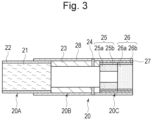
- Fig. 3 shows a mode of the non-combustion-heating-type flavor inhaler according to the present embodiment.
- a non-combustion-heating-type flavor inhaler 20 includes a tobacco rod portion 20A, a cylindrical cooling portion 20B having perforations along a circumference, and a filter part 20C.
- the non-combustion-heating-type flavor inhaler 20 may have a member other than these.
- the axial length of the non-combustion-heating-type flavor inhaler 20 is not limited and preferably ranges from 40 mm to 90 mm, more preferably ranges from 50 mm to 75 mm, and further preferably ranges from 50 mm to 60 mm.
- the circumferential length of the non-combustion-heating-type flavor inhaler 20 preferably ranges from 16 mm to 25 mm, more preferably ranges from 20 mm to 24 mm, and further preferably ranges from 21 mm to 23 mm.
- a mode in which the length of the tobacco rod portion 20A is 20 mm, the length of the cooling portion 20B is 20 mm, and the length of the filter part 20C is 7 mm is applicable.
- the lengths of these individual members may be changed as needed according to manufacturing suitability, quality requirements, and the like.
- Fig. 3 shows a mode in which a first segment 25 is disposed. Alternatively, it is also applicable that the first segment 25 is not disposed and only a second segment 26 is disposed downstream of the cooling portion 20B.
- Shredded tobacco or tobacco sheet containing the neophytadiene composition according to the present embodiment may be used for the tobacco rod portion 20A as a tobacco filler 21.
- a method of filling a wrapping paper 22 with the tobacco filler 21 is not limited.
- the tobacco filler 21 may be wrapped with the wrapping paper 22 or the cylindrical wrapping paper 22 may be filled with the tobacco filler 21.
- tobacco may be filled such that the longitudinal directions each become an indefinite direction in the wrapping paper 22 or may be filled so as to be aligned in an axial direction of the tobacco rod portion 20A or aligned in a direction orthogonal to the axial direction of the tobacco rod portion 20A.
- a wrapping paper containing the neophytadiene composition according to the present embodiment may be used as the wrapping paper 22.
- the cooling portion 20B is preferably made up of a cylindrical member.
- the cylindrical member may be, for example, a paper core 23 formed by working thick paper into a cylindrical shape.
- the cooling portion 20B may be formed of a sheet of a thin material creased, subsequently pleated, gathered, or folded in order to form channels.
- a sheet material selected from the group consisting of polyethylene, polypropylene, polyvinyl chloride, polyethylene terephthalate, polylactate, cellulose acetate, and aluminum foil.
- the total surface area of the cooling portion 20B is prepared as needed in consideration of cooling efficiency and, for example, may range from 300 mm 2 /mm to 1000 mm 2 /mm.
- the cooling portion 20B preferably has perforations 24.
- each perforation 24 is not limited and may, for example, range from 0.5 mm to 1.5 mm.
- the number of the perforations 24 is not limited and may be one or two or more. For example, a plurality of the perforations 24 may be provided along the circumference of the cooling portion 20B.
- the cooling portion 20B may have a rod shape of which the axial length, for example, ranges from 7 mm to 28 mm.
- the axial length of the cooling portion 20B may be 18 mm.
- the cooling portion 20B may substantially have a circular shape as its axial sectional shape and have a diameter that ranges from 5 mm to 10 mm.
- the diameter of the cooling portion may be about 7 mm.
- the configuration of the filter part 20C is not limited and may be made up of one or multiple filling layers.
- the outside of the filling layer may be wrapped with one or multiple pieces of wrapping paper.
- An air-flow resistance of the filter part 20C may be changed as needed by the amount, material, or the like of a filler filling the filter part 20C.
- the filler is cellulose acetate fibers
- the packing density of cellulose acetate fibers may range from 0.13 g/cm 3 to 0.18 g/cm 3 .
- the air-flow resistance is a value measured with an air-flow resistance measuring device (product name: SODIMAX made by SODIM).
- the circumferential length of the filter part 20C is not limited and preferably ranges from 16 mm to 25 mm, more preferably ranges from 20 mm to 24 mm, and further preferably ranges from 21 mm to 23 mm.
- the axial length (horizontal direction in Fig. 3 ) of the filter part 20C can be selected within the range of 4 mm to 10 mm and is selected such that the air-flow resistance ranges from 15 mmH 2 O/seg to 60 mmH 2 O/seg.
- the axial length of the filter part 20C preferably ranges from 5 mm to 9 mm and more preferably ranges from 6 mm to 8 mm.
- the sectional shape of the filter part 20C is not limited and may be, for example, a circular shape, an elliptical shape, a polygonal shape, or the like.
- the filter part 20C may be directly added with a breakable capsule containing a flavoring agent, a flavor bead, or a flavoring agent.
- the filter part 20C may have a center hole part as a first segment 25.
- the center hole part is made up of a first filling layer 25a having one or multiple hollow portions and an inner plug wrapper (inner wrapping paper) 25b covering the filling layer.
- the center hole part has a function to enhance the strength of the mouthpiece portion.
- the center hole part may be held in shape by heat molding without the inner plug wrapper 25b.
- the first filling layer 25a may be, for example, a rod with an inside diameter ranging from ⁇ 5.0 mm to ⁇ 1.0 mm, filled with cellulose acetate fibers with a high density and added with a plasticizer containing triacetin in the range of 6mass% to 20mass% with respect to the mass of cellulose acetate and cured.
- the filter part 20C may have a second segment 26.
- the second segment 26 is made up of a second filling layer 26a and an inner plug wrapper (inner wrapping paper) 26b covering the filling layer.
- the first segment 25 and the second segment 26 are connected by an outer plug wrapper (outer wrapping paper) 27.
- the outer plug wrapper 27 may be, for example, a cylindrical paper.
- the tobacco rod portion 20A, the cooling portion 20B, and the connected first segment 25 and second segment 26 are connected by a mouthpiece lining paper 28. Connection of these can be made by, for example, applying a paste, such as vinyl acetate paste, on the inner surface of the mouthpiece lining paper 28 and wrapping the three members. These members may be connected separately with a plurality of pieces of lining paper multiple times.
- Fig. 4 is an example of the non-combustion-heating-type flavor inhaling system according to the present embodiment.
- the non-combustion-heating-type flavor inhaling system includes the non-combustion-heating-type flavor inhaler 20 and a heating device 10 that heats the tobacco rod portion 20A from outside.
- the heating device 10 includes a body 11, a heater 12, a metal tube 13, a battery unit 14, and a control unit 15.
- the body 11 has a cylindrical recess 16.
- the heater 12 and the metal tube 13 are disposed at a location corresponding to the tobacco rod portion 20A inserted in the recess 16.
- the heater 13 may be an electrical resistance heater. Electric power is supplied from the battery unit 14 in response to instructions from the control unit 15 that executes temperature control, and the heater 12 performs heating. Heat emitted from the heater 12 is transferred to the tobacco rod portion 20A through the metal tube 13 having a high heat conductivity.
- Fig. 4 shows a mode in which the heating device 10 heats the tobacco rod portion 20A from outside. Alternatively, the heating device 10 may heats the tobacco rod portion 20A from inside.
- the heating temperature of the heating device 10 is not limited and is preferably lower than or equal to 400°C, more preferably ranges from 150°C to 400°C, and further preferably ranges from 200°C to 350°C.
- the heating temperature represents the temperature of the heater 12 of the heating device 10.
- a manufacturing method for a non-combustion-non-heating-type flavor inhaler includes a step of obtaining a neophytadiene composition by performing isolated purification of neophytadiene from leaf tobacco with the method according to the present embodiment, a step of adding the neophytadiene composition to a substrate, and a step of manufacturing a non-combustion-non-heating-type flavor inhaler including the substrate.
- the non-combustion-non-heating-type flavor inhaler according to the present embodiment includes the neophytadiene composition according to the present embodiment.
- the manufacturing method for a non-combustion-non-heating-type flavor inhaler according to the present embodiment obtains a neophytadiene composition with the method according to the present embodiment, so it is possible to efficiently perform isolated purification of neophytadiene from leaf tobacco, and it is possible to efficiently manufacture a non-combustion-non-heating-type flavor inhaler capable of providing a good flavor.
- the non-combustion-non-heating-type flavor inhaler according to the present embodiment includes the neophytadiene composition obtained with the method according to the present embodiment, so it is possible to provide a good flavor.
- the method of adding the neophytadiene composition to a substrate in the manufacturing method for a non-combustion-non-heating-type flavor inhaler according to the present embodiment may be similar to the above-described manufacturing method for a non-combustion-heating-type flavor inhaler.
- Fig. 5 shows a mode of the non-combustion-non-heating-type flavor inhaler according to the present embodiment.
- the non-combustion-non-heating-type flavor inhaler 30 includes a power supply unit 30D, a cartridge 30E, and a tobacco capsule 30F.
- the non-combustion-non-heating-type flavor inhaler 30 has such a shape extending from a non-inhalation port end u (upstream) toward an inhalation port end d (downstream).
- the cartridge 30E is detachable from the power supply unit 30D.
- the tobacco capsule 30F is detachable from the cartridge 30E.
- Fig. 6 shows an example of the tobacco capsule 30F.
- the tobacco capsule 30F is a tobacco rod portion and has a flavor source 300 inside.
- the flavor source 300 contains a tobacco material including the neophytadiene composition according to the present embodiment.
- the tobacco capsule 30F is connected to the cartridge 30E. Specifically, part of the tobacco capsule 30F is accommodated in the cartridge 30E.
- the tobacco capsule 30F includes an accommodating body 310 that accommodates the flavor source 300, a mesh body 320, a nonwoven fabric 330, and a cap 340.
- An aerosol atomized by an atomizing portion 220 (described later) is introduced into the accommodating body 310 through the mesh body 320 and contacts with the flavor source 300 to impart a flavor to the aerosol. After that, the aerosol is inhaled by a user through the nonwoven fabric 330. In this way, with the non-combustion-non-heating-type flavor inhaler 30, it is possible to impart a flavor to an aerosol without heating the flavor source 300. No aerosol is substantially generated from the flavor source 300.
- the length of the tobacco capsule 30F (accommodating body 310) is preferably less than or equal to 40 mm and more preferably less than or equal to 25 mm. In the flow direction of aerosol, the length is preferably greater than or equal to 1 mm and more preferably greater than or equal to 5 mm. In a direction orthogonal to the flow direction of aerosol, the maximum length of the accommodating body 310 of the tobacco capsule 30F (accommodating body 310) is preferably less than or equal to 20 mm and more preferably less than or equal to 10 mm. In the direction orthogonal to the flow direction of aerosol, the maximum length of the tobacco capsule 30F (accommodating body 310) is preferably greater than or equal to 1 mm and more preferably greater than or equal to 3 mm.
- the flavor source 300 containing tobacco is made up of raw material pieces that impart a flavor to an aerosol.
- a lower limit of the size of the raw material pieces preferably ranges from 0.2 mm to 1.2 mm and more preferably ranges from 0.2 mm to 0.7 mm.
- the specific surface area increases, so a flavor component is more easily released.
- the raw material pieces that make up the flavor source 300 include shredded tobacco containing the neophytadiene composition according to the present embodiment and molded bodies obtained by molding a tobacco material containing the neophytadiene composition according to the present embodiment into a granular shape.
- the flavor source 300 may contain a plant other than tobacco (for example, mint, herb, or the like) or a flavoring agent, such as menthol. Furthermore, the flavor source 300 containing tobacco may contain a flavor material.
- the flavor material include raw materials that provide sweet taste, sour taste, salty taste, umami, bitter taste, harsh taste, rich taste, pungent taste, acrid taste, astringent taste, and the like.
- the raw materials that provide sweet taste include saccharides, sugar alcohol, and sweeteners. Examples of the saccharides include monosaccharides, disaccharides, oligosaccharides, and polysaccharides. Examples of the sweeteners include natural sweeteners and synthetic sweeteners.
- the raw material pieces are, for example, obtained by screening that conforms with JIS Z 8815 using a stainless screen that conforms with JIS Z 8801. For example, raw material pieces are screened over 20 minutes by a dry and mechanical shaking method with a stainless screen having an aperture of 0.71 mm to obtain raw material pieces passing through the stainless screen having an aperture of 0.71 mm. Subsequently, raw material pieces are screened over 20 minutes by a dry and mechanical shaking method with a stainless screen having an aperture of 0.212 mm to remove raw material pieces passing through the stainless screen having an aperture of 0.212 mm.
- the filling amount of the flavor source 300 accommodated in the accommodating body 310 is preferably greater than or equal to 300 mg and more preferably greater than or equal to 350 mg from the viewpoint of a good flavor.
- Fig. 7 shows an example of the power supply unit 30D.
- the power supply unit 30D has a battery 110.
- the battery 110 may be a disposable battery or may be a rechargeable battery.
- An initial value of the output voltage of the battery 110 preferably falls within the range higher than or equal to 1.2 V and lower than or equal to 4.2 V.
- a battery capacity of the battery 110 preferably falls within the range greater than or equal to 100 mAh and less than or equal to 1000 mAh.
- Figs. 8 and 9 show an example of the cartridge 30E.
- Fig. 8 is a sectional view of an example of the cartridge 30E.
- Fig. 9 is a view that shows the internal structure.
- the cartridge 30E includes a reservoir 210, the atomizing portion 220, a channel forming body 230, an outer frame body 240, and an end cap 250.
- the cartridge 30E has a first channel 200X disposed downstream of the atomizing portion 220 as an aerosol channel.
- the reservoir 210 stores an aerosol source 200.
- the reservoir 210 is located around the channel forming body 230 in a cross section orthogonal to the flow direction of aerosol (a direction from the non-inhalation port end toward the inhalation port end (from upstream toward downstream)).
- the reservoir 210 is located in an air gap between the channel forming body 230 and the outer frame body 240.
- the reservoir 210 is made up of, for example, a porous body, such as resin web and cotton.
- the reservoir 210 may also be made up of a tank that accommodates liquid aerosol source 200. Examples of the aerosol source 200 include glycerine and propylene glycol.
- the channel forming body 230 has a cylindrical shape that forms a first channel 200X extending along the flow direction of aerosol.
- the outer frame body 240 has a cylindrical shape that accommodates the channel forming body 230.
- the outer frame body 240 extends toward a downstream side beyond the end cap 250 and accommodates part of the tobacco capsule 30F.
- the end cap 250 is a cap that closes from a downstream side an air gap between the channel forming body 230 and the outer frame body 240. The end cap 250 suppresses leakage of the aerosol source 200 stored in the reservoir 210 to the tobacco capsule 30F side.
- a manufacturing method for a combustion-type flavor inhaler includes a step of obtaining a neophytadiene composition by performing isolated purification of neophytadiene from leaf tobacco with the method according to the present embodiment, a step of adding the neophytadiene composition to a substrate, and a step of manufacturing a combustion-type flavor inhaler including the substrate.
- the combustion-type flavor inhaler according to the present embodiment includes the neophytadiene composition according to the present embodiment.
- the manufacturing method for a combustion-type flavor inhaler according to the present embodiment obtains a neophytadiene composition with the method according to the present embodiment, so it is possible to efficiently perform isolated purification of neophytadiene from leaf tobacco, and it is possible to efficiently manufacture a combustion-type flavor inhaler capable of providing a good flavor.
- the combustion-type flavor inhaler according to the present embodiment includes the neophytadiene composition obtained with the method according to the present embodiment, so it is possible to provide a good flavor.
- the method of adding the neophytadiene composition to a substrate in the manufacturing method for a combustion-type flavor inhaler according to the present embodiment may be similar to the above-described manufacturing method for a non-combustion-heating-type flavor inhaler.
- Fig. 10 is an example of the combustion-type flavor inhaler according to the present embodiment.
- a combustion-type flavor inhaler 400 includes a tobacco-containing segment 401 and a filter segment 402 provided adjacent to the tobacco-containing segment 401.
- the tobacco-containing segment 401 includes a tobacco filler 403 containing a tobacco material containing the neophytadiene composition according to the present embodiment, and a wrapping paper 404 wrapping around the tobacco filler 403.
- the wrapping paper 404 may contain the neophytadiene composition according to the present embodiment.
- the filter segment 402 is not limited as long as the filter segment 402 has a function as a general filter.
- tow made of synthetic fiber also simply referred to as "tow" and the one obtained by working a material, such as paper, into a cylindrical shape.
- the tobacco-containing segment 401 and the filter segment 402 are coupled by a tipping paper member 405 wound on the tobacco-containing segment 401 and the filter segment 402.
- the tipping paper member 405 may have air holes at part of the outer circumference.
- the number of air holes may be one or multiple. For example, 10 to 40 air holes can be formed. In a case where the number of air holes is multiple, the air holes, for example, can be disposed annularly so as to be arranged in a line at the outer peripheral part of the tipping paper member 405.
- the plurality of air holes may be disposed at substantially constant intervals. With the air holes, air is taken in through the air holes into the filter segment 402 during inhalation. By diluting mainstream smoke with outside air through the air holes, a product design with a desired tar value can be obtained.
- the number of the filter segments 402 is not limited to one.
- a plurality of filter segments respectively having different functions may be coupled and disposed.
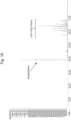
- a signal detected at 220 nm was cut off to a fraction collector.
- the cut-off fraction is a part shown in the dashed line in Fig. 19 .
- the fraction was collected, the obtained sample was condensed and dried, with the result that a colorless and transparent neophytadiene composition was obtained. It was learned from a total ion chromatogram obtained by analysis through GC/MS that the yield of neophytadiene was 65.0% and isolated purification of neophytadiene could be performed from leaf tobacco.
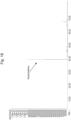
- the obtained neophytadiene composition was dissolved into methanol and subjected to GC/MS analysis under the conditions shown in Reference Example 1. The result is shown in Fig.
- the purity of the neophytadiene composition is 99.83%, so it was learned that isolated purification of the neophytadiene composition could be performed with high purity with the method according to the present embodiment.
- Example 1 1000massppm of the neophytadiene composition (alcohol formulation) obtained in Example 1 was added to tobacco sheet shreds to boost flavor.
- the obtained flavor-boosted sheet shreds were dried, used to fill the tobacco rod portion of an external heating-type non-combustion-heating-type flavor inhaler, and evaluated.
- Non-flavor-boosted sheet shreds were also used to fill the tobacco rod portion of an external heating-type non-combustion-heating-type flavor inhaler, and evaluated.
- a tobacco-intrinsic important aroma was further more developed from the flavor-boosted sheet shreds than from the non-flavor-boosted sheet shreds.
- Example 1 500massppm of the neophytadiene composition (alcohol formulation) obtained in Example 1 was added to shredded tobacco to boost flavor.
- the obtained flavor-boosted shredded tobacco was dried, used to fill the tobacco-containing segment of a combustion-type flavor inhaler, and evaluated.
- Non-flavor-boosted shredded tobacco was also similarly used to fill the tobacco-containing segment of a combustion-type flavor inhaler, and evaluated.
- a tobacco-intrinsic important aroma was further more developed from the flavor-boosted shredded tobacco than from the non-flavor-boosted shredded tobacco.
Landscapes
- Chemical & Material Sciences (AREA)
- Chemical Kinetics & Catalysis (AREA)
- General Chemical & Material Sciences (AREA)
- Health & Medical Sciences (AREA)
- General Health & Medical Sciences (AREA)
- Toxicology (AREA)
- Analytical Chemistry (AREA)
- Manufacture Of Tobacco Products (AREA)
Applications Claiming Priority (2)
| Application Number | Priority Date | Filing Date | Title |
|---|---|---|---|
| JP2022079245 | 2022-05-13 | ||
| PCT/JP2023/009210 WO2023218745A1 (ja) | 2022-05-13 | 2023-03-10 | 葉たばこからネオフィタジエンを単離精製する方法、ネオフィタジエン組成物、非燃焼加熱型香味吸引器、非燃焼非加熱型香味吸引器及び燃焼型香味吸引器、並びにそれらの製造方法 |
Publications (1)
| Publication Number | Publication Date |
|---|---|
| EP4523550A1 true EP4523550A1 (en) | 2025-03-19 |
Family
ID=88729980
Family Applications (1)
| Application Number | Title | Priority Date | Filing Date |
|---|---|---|---|
| EP23803229.6A Pending EP4523550A1 (en) | 2022-05-13 | 2023-03-10 | Method for isolating and purifying neophytadiene from leaf tobacco, neophytadiene composition, non-combustion heating-type flavor inhaler, non-combustion non-heating type flavor inhaler, combustion-type flavor inhaler and methods for producing same |
Country Status (6)
| Country | Link |
|---|---|
| US (1) | US20250064103A1 (https=) |
| EP (1) | EP4523550A1 (https=) |
| JP (1) | JP7724374B2 (https=) |
| KR (1) | KR20250007651A (https=) |
| CN (1) | CN119630294A (https=) |
| WO (1) | WO2023218745A1 (https=) |
Family Cites Families (10)
| Publication number | Priority date | Publication date | Assignee | Title |
|---|---|---|---|---|
| CN1720827A (zh) | 2004-07-12 | 2006-01-18 | 苏少宁 | 非燃烧吸烟烟品及提取方法 |
| JPWO2009142159A1 (ja) | 2008-05-19 | 2011-09-29 | 日本たばこ産業株式会社 | シガレット用香料含有材料、その製造方法およびシガレット |
| CN101926506B (zh) | 2009-06-19 | 2012-11-21 | 李文博 | 一种香烟液 |
| US8893725B2 (en) | 2011-01-28 | 2014-11-25 | R. J. Reynolds Tobacco Company | Polymeric materials derived from tobacco |
| US9254001B2 (en) | 2011-04-27 | 2016-02-09 | R.J. Reynolds Tobacco Company | Tobacco-derived components and materials |
| PL2939553T3 (pl) | 2012-12-28 | 2018-01-31 | Japan Tobacco Inc | Źródło aromatu dla niepalnego, wziewnego produktu tytoniowego i niepalny, wziewny produkt tytoniowy |
| CN110041303B (zh) | 2019-05-30 | 2020-06-16 | 深圳波顿香料有限公司 | 从废烟叶中提取新植二烯、类胡萝卜素和烟碱的工艺方法 |
| CN110584186A (zh) | 2019-10-30 | 2019-12-20 | 云南省烟草公司玉溪市公司 | 一种烟油及其制备方法 |
| CN111233611B (zh) | 2020-02-09 | 2021-04-06 | 昆明理工大学 | 一种初烤烟叶中新植二烯的分离纯化方法 |
| WO2022102542A1 (ja) | 2020-11-13 | 2022-05-19 | 日本たばこ産業株式会社 | たばこテルペン類を含むたばこ抽出物およびその製造方法 |
-
2023
- 2023-03-10 EP EP23803229.6A patent/EP4523550A1/en active Pending
- 2023-03-10 CN CN202380039196.2A patent/CN119630294A/zh active Pending
- 2023-03-10 WO PCT/JP2023/009210 patent/WO2023218745A1/ja not_active Ceased
- 2023-03-10 JP JP2024520271A patent/JP7724374B2/ja active Active
- 2023-03-10 KR KR1020247040792A patent/KR20250007651A/ko active Pending
-
2024
- 2024-11-12 US US18/944,253 patent/US20250064103A1/en active Pending
Also Published As
| Publication number | Publication date |
|---|---|
| WO2023218745A1 (ja) | 2023-11-16 |
| KR20250007651A (ko) | 2025-01-14 |
| JP7724374B2 (ja) | 2025-08-15 |
| CN119630294A (zh) | 2025-03-14 |
| US20250064103A1 (en) | 2025-02-27 |
| JPWO2023218745A1 (https=) | 2023-11-16 |
Similar Documents
| Publication | Publication Date | Title |
|---|---|---|
| JP7396778B2 (ja) | タバコ組成物 | |
| US20230041070A1 (en) | Aerosol generating material and devices including the same | |
| US9282766B2 (en) | Smoking article including flavour granules | |
| JP7738571B2 (ja) | たばこテルペン類を含むたばこ抽出物およびその製造方法 | |
| UA129525C2 (uk) | Генеруючий аерозоль субстрат, який містить види розмарину | |
| CN101708072B (zh) | 一种含有生物组合物的复合滤嘴 | |
| EP4523550A1 (en) | Method for isolating and purifying neophytadiene from leaf tobacco, neophytadiene composition, non-combustion heating-type flavor inhaler, non-combustion non-heating type flavor inhaler, combustion-type flavor inhaler and methods for producing same | |
| EP4245745A1 (en) | Tobacco extract containing cembratriendiol and production method therefor | |
| UA130067C2 (uk) | Аморфна тверда речовина для використання в генеруванні аерозолю, спосіб її утворення, матеріал та композиція, що містять вказану аморфну тверду речовину, суспензія, витратний виріб та система для надання аерозолю | |
| KR20250168567A (ko) | 정제 랍다넘 추출물, 이의 제조 방법, 담배 재료, 담배 로드, 및 향미 흡인기 | |
| EP4643668A1 (en) | Constituent member perfumed by flavor raw material and smoking article | |
| EP4691272A1 (en) | Tobacco extract and method for producing same, tobacco material, tobacco rod, flavor inhaler, and smokeless tobacco | |
| WO2024247077A1 (ja) | たばこ材料及び香味吸引物品 | |
| EP4736674A1 (en) | Flavor inhaler filter, method for producing same, and flavor inhaler | |
| WO2024126655A1 (en) | Method for manufacturing a pouch-shaped heat-not-burn consumable | |
| RU2802648C2 (ru) | Табачная композиция | |
| WO2024127546A1 (ja) | たばこ充填物、香味吸引物品、及びたばこ充填物の製造方法 |
Legal Events
| Date | Code | Title | Description |
|---|---|---|---|
| STAA | Information on the status of an ep patent application or granted ep patent |
Free format text: STATUS: THE INTERNATIONAL PUBLICATION HAS BEEN MADE |
|
| PUAI | Public reference made under article 153(3) epc to a published international application that has entered the european phase |
Free format text: ORIGINAL CODE: 0009012 |
|
| STAA | Information on the status of an ep patent application or granted ep patent |
Free format text: STATUS: REQUEST FOR EXAMINATION WAS MADE |
|
| 17P | Request for examination filed |
Effective date: 20241210 |
|
| AK | Designated contracting states |
Kind code of ref document: A1 Designated state(s): AL AT BE BG CH CY CZ DE DK EE ES FI FR GB GR HR HU IE IS IT LI LT LU LV MC ME MK MT NL NO PL PT RO RS SE SI SK SM TR |
|
| DAV | Request for validation of the european patent (deleted) | ||
| DAX | Request for extension of the european patent (deleted) |