EP4521602A2 - Dispositifs électromécaniques et procédés de formation de couches de revêtement sur des composants de ceux-ci - Google Patents
Dispositifs électromécaniques et procédés de formation de couches de revêtement sur des composants de ceux-ci Download PDFInfo
- Publication number
- EP4521602A2 EP4521602A2 EP24178375.2A EP24178375A EP4521602A2 EP 4521602 A2 EP4521602 A2 EP 4521602A2 EP 24178375 A EP24178375 A EP 24178375A EP 4521602 A2 EP4521602 A2 EP 4521602A2
- Authority
- EP
- European Patent Office
- Prior art keywords
- weight percent
- bao
- sio
- coating
- component
- Prior art date
- Legal status (The legal status is an assumption and is not a legal conclusion. Google has not performed a legal analysis and makes no representation as to the accuracy of the status listed.)
- Pending
Links
Images


Classifications
-
- C—CHEMISTRY; METALLURGY
- C04—CEMENTS; CONCRETE; ARTIFICIAL STONE; CERAMICS; REFRACTORIES
- C04B—LIME, MAGNESIA; SLAG; CEMENTS; COMPOSITIONS THEREOF, e.g. MORTARS, CONCRETE OR LIKE BUILDING MATERIALS; ARTIFICIAL STONE; CERAMICS; REFRACTORIES; TREATMENT OF NATURAL STONE
- C04B35/00—Shaped ceramic products characterised by their composition; Ceramics compositions; Processing powders of inorganic compounds preparatory to the manufacturing of ceramic products
- C04B35/622—Forming processes; Processing powders of inorganic compounds preparatory to the manufacturing of ceramic products
- C04B35/62222—Forming processes; Processing powders of inorganic compounds preparatory to the manufacturing of ceramic products obtaining ceramic coatings
-
- C—CHEMISTRY; METALLURGY
- C23—COATING METALLIC MATERIAL; COATING MATERIAL WITH METALLIC MATERIAL; CHEMICAL SURFACE TREATMENT; DIFFUSION TREATMENT OF METALLIC MATERIAL; COATING BY VACUUM EVAPORATION, BY SPUTTERING, BY ION IMPLANTATION OR BY CHEMICAL VAPOUR DEPOSITION, IN GENERAL; INHIBITING CORROSION OF METALLIC MATERIAL OR INCRUSTATION IN GENERAL
- C23C—COATING METALLIC MATERIAL; COATING MATERIAL WITH METALLIC MATERIAL; SURFACE TREATMENT OF METALLIC MATERIAL BY DIFFUSION INTO THE SURFACE, BY CHEMICAL CONVERSION OR SUBSTITUTION; COATING BY VACUUM EVAPORATION, BY SPUTTERING, BY ION IMPLANTATION OR BY CHEMICAL VAPOUR DEPOSITION, IN GENERAL
- C23C24/00—Coating starting from inorganic powder
- C23C24/08—Coating starting from inorganic powder by application of heat or pressure and heat
- C23C24/082—Coating starting from inorganic powder by application of heat or pressure and heat without intermediate formation of a liquid in the layer
-
- C—CHEMISTRY; METALLURGY
- C03—GLASS; MINERAL OR SLAG WOOL
- C03C—CHEMICAL COMPOSITION OF GLASSES, GLAZES OR VITREOUS ENAMELS; SURFACE TREATMENT OF GLASS; SURFACE TREATMENT OF FIBRES OR FILAMENTS MADE FROM GLASS, MINERALS OR SLAGS; JOINING GLASS TO GLASS OR OTHER MATERIALS
- C03C3/00—Glass compositions
- C03C3/04—Glass compositions containing silica
- C03C3/062—Glass compositions containing silica with less than 40% silica by weight
- C03C3/064—Glass compositions containing silica with less than 40% silica by weight containing boron
-
- C—CHEMISTRY; METALLURGY
- C03—GLASS; MINERAL OR SLAG WOOL
- C03C—CHEMICAL COMPOSITION OF GLASSES, GLAZES OR VITREOUS ENAMELS; SURFACE TREATMENT OF GLASS; SURFACE TREATMENT OF FIBRES OR FILAMENTS MADE FROM GLASS, MINERALS OR SLAGS; JOINING GLASS TO GLASS OR OTHER MATERIALS
- C03C3/00—Glass compositions
- C03C3/04—Glass compositions containing silica
- C03C3/062—Glass compositions containing silica with less than 40% silica by weight
- C03C3/064—Glass compositions containing silica with less than 40% silica by weight containing boron
- C03C3/066—Glass compositions containing silica with less than 40% silica by weight containing boron containing zinc
-
- C—CHEMISTRY; METALLURGY
- C03—GLASS; MINERAL OR SLAG WOOL
- C03C—CHEMICAL COMPOSITION OF GLASSES, GLAZES OR VITREOUS ENAMELS; SURFACE TREATMENT OF GLASS; SURFACE TREATMENT OF FIBRES OR FILAMENTS MADE FROM GLASS, MINERALS OR SLAGS; JOINING GLASS TO GLASS OR OTHER MATERIALS
- C03C8/00—Enamels; Glazes; Fusion seal compositions being frit compositions having non-frit additions
- C03C8/02—Frit compositions, i.e. in a powdered or comminuted form
-
- C—CHEMISTRY; METALLURGY
- C03—GLASS; MINERAL OR SLAG WOOL
- C03C—CHEMICAL COMPOSITION OF GLASSES, GLAZES OR VITREOUS ENAMELS; SURFACE TREATMENT OF GLASS; SURFACE TREATMENT OF FIBRES OR FILAMENTS MADE FROM GLASS, MINERALS OR SLAGS; JOINING GLASS TO GLASS OR OTHER MATERIALS
- C03C8/00—Enamels; Glazes; Fusion seal compositions being frit compositions having non-frit additions
- C03C8/02—Frit compositions, i.e. in a powdered or comminuted form
- C03C8/04—Frit compositions, i.e. in a powdered or comminuted form containing zinc
-
- C—CHEMISTRY; METALLURGY
- C04—CEMENTS; CONCRETE; ARTIFICIAL STONE; CERAMICS; REFRACTORIES
- C04B—LIME, MAGNESIA; SLAG; CEMENTS; COMPOSITIONS THEREOF, e.g. MORTARS, CONCRETE OR LIKE BUILDING MATERIALS; ARTIFICIAL STONE; CERAMICS; REFRACTORIES; TREATMENT OF NATURAL STONE
- C04B35/00—Shaped ceramic products characterised by their composition; Ceramics compositions; Processing powders of inorganic compounds preparatory to the manufacturing of ceramic products
- C04B35/01—Shaped ceramic products characterised by their composition; Ceramics compositions; Processing powders of inorganic compounds preparatory to the manufacturing of ceramic products based on oxide ceramics
-
- C—CHEMISTRY; METALLURGY
- C04—CEMENTS; CONCRETE; ARTIFICIAL STONE; CERAMICS; REFRACTORIES
- C04B—LIME, MAGNESIA; SLAG; CEMENTS; COMPOSITIONS THEREOF, e.g. MORTARS, CONCRETE OR LIKE BUILDING MATERIALS; ARTIFICIAL STONE; CERAMICS; REFRACTORIES; TREATMENT OF NATURAL STONE
- C04B41/00—After-treatment of mortars, concrete, artificial stone or ceramics; Treatment of natural stone
- C04B41/0018—Coating or impregnating "in situ", e.g. impregnating of artificial stone by subsequent melting of a compound added to the artificial stone composition
-
- C—CHEMISTRY; METALLURGY
- C04—CEMENTS; CONCRETE; ARTIFICIAL STONE; CERAMICS; REFRACTORIES
- C04B—LIME, MAGNESIA; SLAG; CEMENTS; COMPOSITIONS THEREOF, e.g. MORTARS, CONCRETE OR LIKE BUILDING MATERIALS; ARTIFICIAL STONE; CERAMICS; REFRACTORIES; TREATMENT OF NATURAL STONE
- C04B41/00—After-treatment of mortars, concrete, artificial stone or ceramics; Treatment of natural stone
- C04B41/0072—Heat treatment
-
- G—PHYSICS
- G01—MEASURING; TESTING
- G01D—MEASURING NOT SPECIALLY ADAPTED FOR A SPECIFIC VARIABLE; ARRANGEMENTS FOR MEASURING TWO OR MORE VARIABLES NOT COVERED IN A SINGLE OTHER SUBCLASS; TARIFF METERING APPARATUS; MEASURING OR TESTING NOT OTHERWISE PROVIDED FOR
- G01D5/00—Mechanical means for transferring the output of a sensing member; Means for converting the output of a sensing member to another variable where the form or nature of the sensing member does not constrain the means for converting; Transducers not specially adapted for a specific variable
- G01D5/12—Mechanical means for transferring the output of a sensing member; Means for converting the output of a sensing member to another variable where the form or nature of the sensing member does not constrain the means for converting; Transducers not specially adapted for a specific variable using electric or magnetic means
- G01D5/14—Mechanical means for transferring the output of a sensing member; Means for converting the output of a sensing member to another variable where the form or nature of the sensing member does not constrain the means for converting; Transducers not specially adapted for a specific variable using electric or magnetic means influencing the magnitude of a current or voltage
- G01D5/20—Mechanical means for transferring the output of a sensing member; Means for converting the output of a sensing member to another variable where the form or nature of the sensing member does not constrain the means for converting; Transducers not specially adapted for a specific variable using electric or magnetic means influencing the magnitude of a current or voltage by varying inductance, e.g. by a movable armature
- G01D5/22—Mechanical means for transferring the output of a sensing member; Means for converting the output of a sensing member to another variable where the form or nature of the sensing member does not constrain the means for converting; Transducers not specially adapted for a specific variable using electric or magnetic means influencing the magnitude of a current or voltage by varying inductance, e.g. by a movable armature differentially influencing two coils
- G01D5/2291—Linear or rotary variable differential transformers (LVDTs/RVDTs) having a single primary coil and two secondary coils
-
- H—ELECTRICITY
- H01—ELECTRIC ELEMENTS
- H01F—MAGNETS; INDUCTANCES; TRANSFORMERS; SELECTION OF MATERIALS FOR THEIR MAGNETIC PROPERTIES
- H01F27/00—Details of transformers or inductances, in general
- H01F27/28—Coils; Windings; Conductive connections
- H01F27/32—Insulating of coils, windings, or parts thereof
- H01F27/324—Insulation between coil and core, between different winding sections, around the coil; Other insulation structures
-
- H—ELECTRICITY
- H01—ELECTRIC ELEMENTS
- H01F—MAGNETS; INDUCTANCES; TRANSFORMERS; SELECTION OF MATERIALS FOR THEIR MAGNETIC PROPERTIES
- H01F41/00—Apparatus or processes specially adapted for manufacturing or assembling magnets, inductances or transformers; Apparatus or processes specially adapted for manufacturing materials characterised by their magnetic properties
- H01F41/02—Apparatus or processes specially adapted for manufacturing or assembling magnets, inductances or transformers; Apparatus or processes specially adapted for manufacturing materials characterised by their magnetic properties for manufacturing cores, coils, or magnets
- H01F41/04—Apparatus or processes specially adapted for manufacturing or assembling magnets, inductances or transformers; Apparatus or processes specially adapted for manufacturing materials characterised by their magnetic properties for manufacturing cores, coils, or magnets for manufacturing coils
- H01F41/12—Insulating of windings
- H01F41/125—Other insulating structures; Insulating between coil and core, between different winding sections, around the coil
-
- H—ELECTRICITY
- H02—GENERATION; CONVERSION OR DISTRIBUTION OF ELECTRIC POWER
- H02K—DYNAMO-ELECTRIC MACHINES
- H02K1/00—Details of the magnetic circuit
- H02K1/04—Details of the magnetic circuit characterised by the material used for insulating the magnetic circuit or parts thereof
-
- H—ELECTRICITY
- H02—GENERATION; CONVERSION OR DISTRIBUTION OF ELECTRIC POWER
- H02K—DYNAMO-ELECTRIC MACHINES
- H02K15/00—Processes or apparatus specially adapted for manufacturing, assembling, maintaining or repairing of dynamo-electric machines
- H02K15/12—Impregnating, moulding insulation, heating or drying of windings, stators, rotors or machines
- H02K15/121—Impregnating, moulding insulation, heating or drying of windings, stators, rotors or machines of cores
-
- C—CHEMISTRY; METALLURGY
- C03—GLASS; MINERAL OR SLAG WOOL
- C03C—CHEMICAL COMPOSITION OF GLASSES, GLAZES OR VITREOUS ENAMELS; SURFACE TREATMENT OF GLASS; SURFACE TREATMENT OF FIBRES OR FILAMENTS MADE FROM GLASS, MINERALS OR SLAGS; JOINING GLASS TO GLASS OR OTHER MATERIALS
- C03C2207/00—Compositions specially applicable for the manufacture of vitreous enamels
- C03C2207/04—Compositions specially applicable for the manufacture of vitreous enamels for steel
-
- C—CHEMISTRY; METALLURGY
- C04—CEMENTS; CONCRETE; ARTIFICIAL STONE; CERAMICS; REFRACTORIES
- C04B—LIME, MAGNESIA; SLAG; CEMENTS; COMPOSITIONS THEREOF, e.g. MORTARS, CONCRETE OR LIKE BUILDING MATERIALS; ARTIFICIAL STONE; CERAMICS; REFRACTORIES; TREATMENT OF NATURAL STONE
- C04B2235/00—Aspects relating to ceramic starting mixtures or sintered ceramic products
- C04B2235/02—Composition of constituents of the starting material or of secondary phases of the final product
- C04B2235/30—Constituents and secondary phases not being of a fibrous nature
- C04B2235/32—Metal oxides, mixed metal oxides, or oxide-forming salts thereof, e.g. carbonates, nitrates, (oxy)hydroxides, chlorides
- C04B2235/3201—Alkali metal oxides or oxide-forming salts thereof
- C04B2235/3203—Lithium oxide or oxide-forming salts thereof
-
- C—CHEMISTRY; METALLURGY
- C04—CEMENTS; CONCRETE; ARTIFICIAL STONE; CERAMICS; REFRACTORIES
- C04B—LIME, MAGNESIA; SLAG; CEMENTS; COMPOSITIONS THEREOF, e.g. MORTARS, CONCRETE OR LIKE BUILDING MATERIALS; ARTIFICIAL STONE; CERAMICS; REFRACTORIES; TREATMENT OF NATURAL STONE
- C04B2235/00—Aspects relating to ceramic starting mixtures or sintered ceramic products
- C04B2235/02—Composition of constituents of the starting material or of secondary phases of the final product
- C04B2235/30—Constituents and secondary phases not being of a fibrous nature
- C04B2235/32—Metal oxides, mixed metal oxides, or oxide-forming salts thereof, e.g. carbonates, nitrates, (oxy)hydroxides, chlorides
- C04B2235/3205—Alkaline earth oxides or oxide forming salts thereof, e.g. beryllium oxide
- C04B2235/3206—Magnesium oxides or oxide-forming salts thereof
-
- C—CHEMISTRY; METALLURGY
- C04—CEMENTS; CONCRETE; ARTIFICIAL STONE; CERAMICS; REFRACTORIES
- C04B—LIME, MAGNESIA; SLAG; CEMENTS; COMPOSITIONS THEREOF, e.g. MORTARS, CONCRETE OR LIKE BUILDING MATERIALS; ARTIFICIAL STONE; CERAMICS; REFRACTORIES; TREATMENT OF NATURAL STONE
- C04B2235/00—Aspects relating to ceramic starting mixtures or sintered ceramic products
- C04B2235/02—Composition of constituents of the starting material or of secondary phases of the final product
- C04B2235/30—Constituents and secondary phases not being of a fibrous nature
- C04B2235/32—Metal oxides, mixed metal oxides, or oxide-forming salts thereof, e.g. carbonates, nitrates, (oxy)hydroxides, chlorides
- C04B2235/3205—Alkaline earth oxides or oxide forming salts thereof, e.g. beryllium oxide
- C04B2235/3215—Barium oxides or oxide-forming salts thereof
-
- C—CHEMISTRY; METALLURGY
- C04—CEMENTS; CONCRETE; ARTIFICIAL STONE; CERAMICS; REFRACTORIES
- C04B—LIME, MAGNESIA; SLAG; CEMENTS; COMPOSITIONS THEREOF, e.g. MORTARS, CONCRETE OR LIKE BUILDING MATERIALS; ARTIFICIAL STONE; CERAMICS; REFRACTORIES; TREATMENT OF NATURAL STONE
- C04B2235/00—Aspects relating to ceramic starting mixtures or sintered ceramic products
- C04B2235/02—Composition of constituents of the starting material or of secondary phases of the final product
- C04B2235/30—Constituents and secondary phases not being of a fibrous nature
- C04B2235/32—Metal oxides, mixed metal oxides, or oxide-forming salts thereof, e.g. carbonates, nitrates, (oxy)hydroxides, chlorides
- C04B2235/3217—Aluminum oxide or oxide forming salts thereof, e.g. bauxite, alpha-alumina
-
- C—CHEMISTRY; METALLURGY
- C04—CEMENTS; CONCRETE; ARTIFICIAL STONE; CERAMICS; REFRACTORIES
- C04B—LIME, MAGNESIA; SLAG; CEMENTS; COMPOSITIONS THEREOF, e.g. MORTARS, CONCRETE OR LIKE BUILDING MATERIALS; ARTIFICIAL STONE; CERAMICS; REFRACTORIES; TREATMENT OF NATURAL STONE
- C04B2235/00—Aspects relating to ceramic starting mixtures or sintered ceramic products
- C04B2235/02—Composition of constituents of the starting material or of secondary phases of the final product
- C04B2235/30—Constituents and secondary phases not being of a fibrous nature
- C04B2235/32—Metal oxides, mixed metal oxides, or oxide-forming salts thereof, e.g. carbonates, nitrates, (oxy)hydroxides, chlorides
- C04B2235/3231—Refractory metal oxides, their mixed metal oxides, or oxide-forming salts thereof
- C04B2235/3232—Titanium oxides or titanates, e.g. rutile or anatase
-
- C—CHEMISTRY; METALLURGY
- C04—CEMENTS; CONCRETE; ARTIFICIAL STONE; CERAMICS; REFRACTORIES
- C04B—LIME, MAGNESIA; SLAG; CEMENTS; COMPOSITIONS THEREOF, e.g. MORTARS, CONCRETE OR LIKE BUILDING MATERIALS; ARTIFICIAL STONE; CERAMICS; REFRACTORIES; TREATMENT OF NATURAL STONE
- C04B2235/00—Aspects relating to ceramic starting mixtures or sintered ceramic products
- C04B2235/02—Composition of constituents of the starting material or of secondary phases of the final product
- C04B2235/30—Constituents and secondary phases not being of a fibrous nature
- C04B2235/32—Metal oxides, mixed metal oxides, or oxide-forming salts thereof, e.g. carbonates, nitrates, (oxy)hydroxides, chlorides
- C04B2235/3231—Refractory metal oxides, their mixed metal oxides, or oxide-forming salts thereof
- C04B2235/3244—Zirconium oxides, zirconates, hafnium oxides, hafnates, or oxide-forming salts thereof
-
- C—CHEMISTRY; METALLURGY
- C04—CEMENTS; CONCRETE; ARTIFICIAL STONE; CERAMICS; REFRACTORIES
- C04B—LIME, MAGNESIA; SLAG; CEMENTS; COMPOSITIONS THEREOF, e.g. MORTARS, CONCRETE OR LIKE BUILDING MATERIALS; ARTIFICIAL STONE; CERAMICS; REFRACTORIES; TREATMENT OF NATURAL STONE
- C04B2235/00—Aspects relating to ceramic starting mixtures or sintered ceramic products
- C04B2235/02—Composition of constituents of the starting material or of secondary phases of the final product
- C04B2235/30—Constituents and secondary phases not being of a fibrous nature
- C04B2235/32—Metal oxides, mixed metal oxides, or oxide-forming salts thereof, e.g. carbonates, nitrates, (oxy)hydroxides, chlorides
- C04B2235/3284—Zinc oxides, zincates, cadmium oxides, cadmiates, mercury oxides, mercurates or oxide forming salts thereof
-
- C—CHEMISTRY; METALLURGY
- C04—CEMENTS; CONCRETE; ARTIFICIAL STONE; CERAMICS; REFRACTORIES
- C04B—LIME, MAGNESIA; SLAG; CEMENTS; COMPOSITIONS THEREOF, e.g. MORTARS, CONCRETE OR LIKE BUILDING MATERIALS; ARTIFICIAL STONE; CERAMICS; REFRACTORIES; TREATMENT OF NATURAL STONE
- C04B2235/00—Aspects relating to ceramic starting mixtures or sintered ceramic products
- C04B2235/02—Composition of constituents of the starting material or of secondary phases of the final product
- C04B2235/30—Constituents and secondary phases not being of a fibrous nature
- C04B2235/32—Metal oxides, mixed metal oxides, or oxide-forming salts thereof, e.g. carbonates, nitrates, (oxy)hydroxides, chlorides
- C04B2235/3298—Bismuth oxides, bismuthates or oxide forming salts thereof, e.g. zinc bismuthate
-
- C—CHEMISTRY; METALLURGY
- C04—CEMENTS; CONCRETE; ARTIFICIAL STONE; CERAMICS; REFRACTORIES
- C04B—LIME, MAGNESIA; SLAG; CEMENTS; COMPOSITIONS THEREOF, e.g. MORTARS, CONCRETE OR LIKE BUILDING MATERIALS; ARTIFICIAL STONE; CERAMICS; REFRACTORIES; TREATMENT OF NATURAL STONE
- C04B2235/00—Aspects relating to ceramic starting mixtures or sintered ceramic products
- C04B2235/02—Composition of constituents of the starting material or of secondary phases of the final product
- C04B2235/30—Constituents and secondary phases not being of a fibrous nature
- C04B2235/34—Non-metal oxides, non-metal mixed oxides, or salts thereof that form the non-metal oxides upon heating, e.g. carbonates, nitrates, (oxy)hydroxides, chlorides
- C04B2235/3409—Boron oxide, borates, boric acids, or oxide forming salts thereof, e.g. borax
-
- C—CHEMISTRY; METALLURGY
- C04—CEMENTS; CONCRETE; ARTIFICIAL STONE; CERAMICS; REFRACTORIES
- C04B—LIME, MAGNESIA; SLAG; CEMENTS; COMPOSITIONS THEREOF, e.g. MORTARS, CONCRETE OR LIKE BUILDING MATERIALS; ARTIFICIAL STONE; CERAMICS; REFRACTORIES; TREATMENT OF NATURAL STONE
- C04B2235/00—Aspects relating to ceramic starting mixtures or sintered ceramic products
- C04B2235/02—Composition of constituents of the starting material or of secondary phases of the final product
- C04B2235/30—Constituents and secondary phases not being of a fibrous nature
- C04B2235/34—Non-metal oxides, non-metal mixed oxides, or salts thereof that form the non-metal oxides upon heating, e.g. carbonates, nitrates, (oxy)hydroxides, chlorides
- C04B2235/3418—Silicon oxide, silicic acids or oxide forming salts thereof, e.g. silica sol, fused silica, silica fume, cristobalite, quartz or flint
-
- C—CHEMISTRY; METALLURGY
- C04—CEMENTS; CONCRETE; ARTIFICIAL STONE; CERAMICS; REFRACTORIES
- C04B—LIME, MAGNESIA; SLAG; CEMENTS; COMPOSITIONS THEREOF, e.g. MORTARS, CONCRETE OR LIKE BUILDING MATERIALS; ARTIFICIAL STONE; CERAMICS; REFRACTORIES; TREATMENT OF NATURAL STONE
- C04B2235/00—Aspects relating to ceramic starting mixtures or sintered ceramic products
- C04B2235/70—Aspects relating to sintered or melt-casted ceramic products
- C04B2235/96—Properties of ceramic products, e.g. mechanical properties such as strength, toughness, wear resistance
Definitions
- the present invention generally relates to electromechanical devices, and more particularly relates to an electromechanical device having components with electrically insulative coating layers thereon that are capable of surviving in environmental conditions with temperatures exceeding 180 °C over a long term.
- Electric motors can generate relatively large amounts of heat during powered operation. More specifically, during motor operation, current flow through electromagnetic coils causes heat to be generated due, in part, to the resistance of the coils (e.g., copper loss). This heat causes the coil and device temperatures to rise. As the coil temperature increases, the generated heat is typically transferred from the coils toward area(s) with lower temperatures.
- the temperature that the coil and motor assembly can handle depends mainly on the temperature limits of the electrical insulation used. The higher the temperature the coils and motor assembly can handle, the higher the power density of the motor.
- electromagnetic coils are coated with an organic-based (e.g., polyamide) wire electrical insulation, and other components of the motor assembly are insulated from the electromagnetic coils with various insulators such as slot liners, insulating paper materials, potting materials, adhesive insulating (e.g., fiberglass, polyimide, etc.) tapes, ceramic inserts, and the like. Due to the material properties of these insulators, the operational temperature of the electromagnetic coils of motor assemblies such as these may be limited to less than 240°C over a short term (e.g., less than 10 hours), and less than 150°C over a long term. This consequently imposes limits on the applied current and/or electrical potential to the electromagnetic coils, as well as the ambient conditions surrounding the motor. This, in turn, limits the achievable power density, cooling system requirements, and potential operating environments, of the motor (or other electromagnetic devices). Additionally, the heat that is generated in, and transferred away from, the electromagnetic coils, can increase the temperatures of various other components to undesirable levels.
- Improving the thermal and environmental capability of electromagnetic devices, such as electric motors, has the potential to dramatically reduce overall size/weight and improve overall efficiency while further improving the power density.
- the efficiency improvements can be realized by reducing the additional power draw and/or system complexity and/or weight typically required for cooling system components to keep an organically insulated electromagnetic coil/device cool.
- the ability to operate the electromagnetic device with increased power input and/or at higher temperature would also increase power density.
- a method includes forming an intermediate coating product from a ceramic powder for application of the coating powder, applying the intermediate product to a surface of a component of an electromechanical device, and thermally processing the intermediate product at a temperature of 800 °C or less to melt the intermediate product and thereby form an electrically insulative coating layer on the surface of the component that is configured to survive in operating environments having temperatures in excess of 180 °C for a long term.
- an electromechanical device includes components each having one or more surfaces formed of one or more metallic materials and susceptible to operating environments having temperatures in excess of 150 °C for a long term, and electrically insulative coating layers formed on the one or more surfaces of the components.
- the coating layer is configured to survive in operating environments having temperatures in excess of 180 °C for a long term.
- components of electromechanical devices having at least one electrically insulative layer or coating layer on surfaces of the components and methods for forming the electrically insulative coating layer on the surfaces of the components are disclosed herein.
- the components may be parts of various systems and configured for use in various environments.
- the components are parts of electromechanical devices such as, but not limited to, linear variable differential transformers (LVDTs), electric motors, generators, transformers, inductors, relays, solenoids, actuators, and sensors.
- LVDTs linear variable differential transformers
- the components may be portions of a stator (e.g., stator interfaces, stator teeth, stator back-iron, etc.), portions of a rotor, stator and rotor stack inter-laminate insulation, cores, frames, motor end bells, magnetic return walls, various surfaces of enclosures or housings, feedthroughs, and conductor joints.
- the components may be parts of electromechanical devices configured for use in automotive, aerospace, medical, industrial, oil and/or gas down-hole drilling, fuel cell, and/or household applications.
- the components may be parts of systems that are typically electrically insulated with a separate insulator such as, but not limited to, slot liners, insulating paper materials, adhesive insulating (e.g., fiberglass, polyimide, polyester, etc.) tapes, ceramic inserts, fiber mats (e.g., Nomex ® by DuPont de Nemours, Inc.), etc.
- a separate insulator such as, but not limited to, slot liners, insulating paper materials, adhesive insulating (e.g., fiberglass, polyimide, polyester, etc.) tapes, ceramic inserts, fiber mats (e.g., Nomex ® by DuPont de Nemours, Inc.), etc.
- the components of the electromechanical devices and the coated surfaces thereof may be formed of or include various materials, including certain metallic, ceramic, and composite materials.
- the coated surfaces of the component are formed of or include a conductive material, such as a metallic material.
- the coated surfaces of the component may be formed of or include a magnetic material, such as but not limited to iron or ferrite.
- the coated surfaces of the component may be formed of or include ASTM A801 Alloy Type 1 (e.g., Hiperco ® 50 and Vacudur ® 49), electrical steel, samarium cobalt, neodymium, or Mu-metal.
- the coated surfaces of the components may be formed of or include a non-magnetic material, such as stainless steel, copper, aluminum, or alloys thereof. In various embodiments, the coated surfaces of the components may be formed of or include Inconel ® alloys.
- the coating layer may include various electrically insulative materials.
- the coating layer may be formed of insulative materials that are capable of surviving in operating environments having temperatures in excess of 180 °C over a long term.
- the phrase "long term" may refer to a minimum operating life, a desired operating life, or an extended operating life of the component and/or a system in which the component is installed.
- the phrase long term refers to a period of time in excess of about 40,000 hours, such as about 70,000 hours, such as about 100,000 hours or more.
- the phrase “short term” refers to about 10 hours or less.
- the coating layer may provide various properties to the underlying surface of the component in addition to electrical insulation.
- the coating layer may be formed of one or more inorganic materials.
- the coating layer includes a mixture of ceramic materials.
- the coating layer includes a mixture of B 2 O 3 , Al 2 O 3 , BaO, SiO 2 , ZnO, Bi 2 O 3 , MgO, ZrO 2 , and TiO 2 .
- the coating layer includes a mixture of B 2 O 3 , Al 2 O 3 , SiO 2 , and BaO.
- the coating layer includes a mixture of B 2 O 3 , SiO 2 , ZnO, BaO, and Bi 2 O 3 .
- the coating layer includes a mixture of B 2 O 3 , Al 2 O 3 , BaO, SiO 2 , MgO, ZrO 2 , and TiO 2 .
- the coating layer may have various microstructures and textures.
- the coating layer may be amorphous.
- the coating layer may be crystalline or semi-crystalline.
- the coating layer includes between 40 and 54 weight percent B 2 O 3 , between 3 and 5 weight percent Al 2 O 3 , between 12 and 17 weight percent SiO 2 , and between 28 and 38 weight percent BaO. In various embodiments, the coating layer includes between 40 and 54 weight percent B 2 O 3 , between 3 and 5 weight percent Al 2 O 3 , between 12 and 17 weight percent SiO2, between 28 and 38 weight percent BaO, greater than 5 weight percent Li 2 O, and a remainder including one or more additional constituents or components each having a weight percent of less than one.
- the coating layer includes a mixture consisting essentially of B 2 O 3 , Al 2 O 3 , SiO 2 , and BaO, wherein any other constituents or components thereof are incidental impurities each having a weight percent of less than one, such as less than 0.5 weight percent.
- the coating layer includes between 47 and 64 weight percent B 2 O 3 , between 5 and 7 weight percent SiO 2 , between 9 and 14 weight percent ZnO, between 6 and 9 weight percent BaO, and between 16 and 22 weight percent Bi 2 O 3 .
- the coating layer includes between 47 and 64 weight percent B 2 O 3 , between 5 and 7 weight percent SiO 2 , between 9 and 14 weight percent ZnO, between 6 and 9 weight percent BaO, between 16 and 22 weight percent Bi 2 O 3 , and a remainder including one or more additional constituents or components each having a weight percent of less than one.
- the coating layer includes a mixture consisting essentially of B 2 O 3 , SiO 2 , ZnO, BaO, and Bi 2 O 3 , wherein any other constituents or components are incidental impurities each having a weight percent of less than one, such as less than 0.5 weight percent.
- the coating layer includes between 27 and 33 weight percent B 2 O 3 , between 24 and 30 weight percent BaO, between 12 and 16 weight percent MgO, between 11 and 13 weight percent SiO 2 , between 5 and 7 weight percent Al 2 O 3 , between 3 and 4 weight percent ZrO 2 , and between 2.5 to 3.5 weight percent TiO 2 .
- the coating layer includes between 27 and 33 weight percent B 2 O 3 , between 24 and 30 weight percent BaO, between 12 and 16 weight percent MgO, between 11 and 13 weight percent SiO 2 , between 5 and 7 weight percent Al 2 O 3 , between 3 and 4 weight percent ZrO 2 , and between 2.5 to 3.5 weight percent TiO 2 , and a remainder including one or more additional constituents or components each having a weight percent of less than one.
- the coating layer includes a mixture consisting essentially of B 2 O 3 , BaO, MgO, SiO 2 , Al 2 O 3 , ZrO 2 , and TiO 2 , wherein any other constituents or components are incidental impurities each having a weight percent of less than one, such as less than 0.5 weight percent.
- the coating layer includes a eutectic system formed from the mixture.
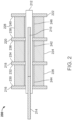
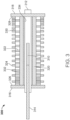
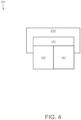
- FIGS. 1-4 illustrate various nonlimiting examples of components having coating layers thereon in accordance with various embodiments. It should be noted that these examples are merely for illustrative purposes and the components and the locations of the coating layers may be different than those shown.
- FIG. 1 represents an exemplary stator 100 that includes a plurality of relatively thin laminates 114 bonded together to form a cylindrical body 110 of the stator 100 (three of the laminates 114 are isolated for clarity).
- Each of the laminates 114 include a ring-shaped member having a plurality of protruding members extending radially inward from the ring-shaped member.
- the protruding members of the laminates 114 define stator teeth 112 of the stator 100.
- Planar surfaces 116 and 117 of the laminates 114 include coating layers 118 and 120 thereon. The coating layers 118 and 120 are configured to provide electrical insulation to surfaces of the stator 100 after bonding of the laminates 114.
- the surfaces 116 and 117 may be formed of various conductive materials such as, for example, steel, and the coating layers 118 and 120 may be formed of the electrically insulative coating materials described above.
- exterior surfaces of the stator teeth and surfaces therebetween may be coated with a coating layer be formed of the electrically insulative coating materials described above after formation of the cylindrical body 110 of the stator.
- FIG. 2 represents an exemplary first LVDT 200 having a core 210 within a tubular member 212 with radial members 216, 218, 220, and 222 extending therefrom.
- the core 210 may be coupled to an arm 214.
- a primary coil 224 of a first conductive wire, a first secondary coil 226 of a second conductive wire, and a second secondary coil 228 of a third conductive wire are wound about the tubular member 212 between separate sections defined by the radial members 216, 218, 220, and 222.
- Surfaces 230, 232, 234, 236, 238, and 240 of the radial members 216, 218, 220, and 222 that are in contact with the primary coil 224, the first secondary coil 226, or the second secondary coil 228 include coating layers thereon formed of the electrically insulative coating materials described above.
- insulation layers 242, 244, and 246 are located between the tubular member 212 and the primary coil 224, the first secondary coil 226, and the second secondary coil 228, respectively.
- the insulation layers 242, 244, and 246 may be formed of the electrically insulative coating materials described above.
- FIG. 3 represents an exemplary second LVDT 300 having a core 310 within a tubular member 312 with radial members 316 and 318 extending therefrom.
- the core 310 may be coupled to an arm 314.
- a primary coil 320 of a first conductive wire is wound about the tubular member 212
- a first secondary coil 322 of a second conductive wire is wound about the primary coil 320
- a second secondary coil 324 of a third conductive wire is wound about the first secondary coil 322 between the radial members 316 and 318.
- Surfaces 326 and 328 of the radial members 316 and 318 that are in contact with the primary coil 320, the first secondary coil 322, and the second secondary coil 324 include coating layers thereon formed of the electrically insulative coating materials described above.
- insulation layers 330, 332, 334 are located between the second secondary coil 228 and the first secondary coil 226, between the first secondary coil 226 and the primary coil 224, and between the primary coil 224 and the tubular member 212, respectively.
- the insulation layers 330, 332, and 334 may be formed of the electrically insulative coating materials described above.
- FIG. 4 represents an electrical joint 400 that includes a pair of conductors (e.g., electrical wires) having electrically conductive surfaces 410 and 411 configured for use in, for example, an electric motor to electrically couple two or more components thereof.
- the pair of conductors surfaces 410 and 411 of the pair of conductors are physically and electrically coupled via an electrically conductive joint (e.g., solder) on the surfaces 410 and 411.
- a coating layer 414 on the surfaces 410 and 411 of the pair of conductors and the electrically conductive joint electrically insulates the electrical joint 400.
- the surfaces 410 and 411 of the conductors may be formed of various conductive materials such as, for example, copper, and the coating layer 414 may be formed of the electrically insulative coating materials described above.
- a flowchart illustrates an exemplary method 500 for forming a coating layer on the surface of a component of an electromechanical device.
- the method 500 may start at 510.
- the method 500 may include providing a ceramic powder that includes a mixture of ceramic materials.
- suitable mixtures include B 2 O 3 , Al 2 O 3 , SiO 2 , and BaO; B 2 O 3 , SiO 2 , ZnO, BaO, and Bi 2 O 3 ; or B 2 O 3 , Al 2 O 3 , BaO, SiO 2 , MgO, ZrO 2 , and TiO 2 .
- the size, shape, and surface characteristics of particles of the ceramic powder particles may vary.
- the ceramic powder may be formed using various processes such as, but not limited to, solid-state reaction, sol-gel, spray drying, ball milling, grinding, and hydrothermal synthesis processes.
- the method 500 may include processing the ceramic powder to form an intermediate coating product for application of the coating powder, and at 516, the method 500 may include applying the intermediate product to a surface of a component of an electromechanical device.
- the method 500 is not limited to any particular type of intermediate coating product or any particular application process.
- the coating layer may be formed by applying the intermediate product to the surface of the component by various processes including, but not limited to, certain dipping, spraying, taping, brushing, and painting processes.
- the intermediate coating product may include a slurry.
- the slurry may include the ceramic powder, a carrier fluid (e.g., water and/or an organic solvent), and, optionally, one or more additional components such as, but not limited to, certain surfactants, chelators, stabilizers, and pH adjusters.
- the carrier fluid may include a polymer with solvents, surfactants, and one or more suitable chemicals.
- a suitable carrier fluid include 2,2,4-trimethyl-1,3-pentanediol monoisobutyrate, poly(iso-butyl methacrylate), ethyl cellulose, dimethyl silicone oil, dibutyl phthalate, or polyethylene glycol.
- the slurry may have a solids loading of about 30 to 40 wt.%. In various embodiments, the slurry may be applied to the surface of the component via a spraying process, and have a solids loading of less than 30 wt.%. In some embodiments, the slurry may be thinned or diluted prior to application thereof on the surface of the component.
- the intermediate coating product may include a paste.
- the paste may include the ceramic powder, a carrier fluid (e.g., water and/or an organic solvent), and, optionally, one or more additional components such as, but not limited to, certain thickeners, dispersants, or thinning agents (e.g., ester alcohol (Texanol TM ) or alpha-terpineol).
- the paste may have a solids loading of about 65 to 85 wt.%.
- the paste may be applied to the surface of the component via a spraying process or a painting process (e.g., brushing, troweling, etc.).
- the paste may be thinned or diluted prior to application thereof on the surface of the component.
- the intermediate coating product may include a non-adhesive precursor tape.
- the precursor tape may include a precursor layer and, optionally, a substrate layer.
- the precursor layer may include the ceramic powder, a matrix material, and, optionally, one or more additional components.
- the substrate layer may provide flexible support structure configured to temporarily support the precursor layer.
- the tape may have a solids loading of about 30 to 60 wt.%.
- the precursor tape may be cut to shape and applied to the surface of the component manually or by an automated process.
- the tape may have a composition similar to the slurry described above.
- the applied intermediate coating product may undergo a drying process in, for example, an oven, box furnace, vacuum furnace, belt furnace, and any of numerous suitable heating techniques.
- the drying process when implemented, may occur at a first predetermined temperature for a first predetermined time period, to remove solvents and produce a dried green coating (i.e., green state) on the surface of the component.
- the first predetermined temperature and the first predetermined time may vary depending, for example, on the composition and type of the intermediate coating product.
- the intermediate coating product may include an alcohol solvent
- the first predetermined temperature may be a temperature that is 150 °C or less
- the first predetermined time period may be between 5 and 30 minutes.
- the intermediate coating product may include water soluble solvents
- the first predetermined temperature may be a temperature that is 100 °C or less
- the first predetermined time period may be between 10 and 60 minutes.
- the dried green coating may then undergo a binder burnout process (if necessary) in, for example, an oven, box furnace, vacuum furnace, belt furnace, or any of numerous suitable heating techniques.
- the binder burnout process when implemented, may occur at a second predetermined temperature for a second predetermined time period to remove organics to produce a burned out, or brown coating on the surface of the component.
- the drying process may be omitted and the binder burnout process may be performed on the applied intermediate coating product.
- the second predetermined temperature and the second predetermined time may vary.
- the second predetermined temperature may be a temperature of about 300 °C or less and the second predetermined time period may be between 5 and 30 minutes.
- the method 500 may include performing a heat treatment in, for example, an oven, box furnace, vacuum furnace, belt furnace, and any of numerous suitable heating techniques, at a third predetermined temperature for a third predetermined time period to thermally process and melt the intermediate coating product, the brown coating, or the green coating, whichever is present.
- the intermediate coating product, the brown coating, or the green coating, whichever is present is entirely melted (inorganics) and/or burned out (organics) during the heat treatment.
- the drying process forms the green coating from the intermediate coating product
- the binder burnout process forms the brown coating from the green coating
- the heat treatment is performed to melt the brown coating.
- the drying process is omitted, the binder burnout process forms the brown coating from the intermediate coating product, and the heat treatment is performed to melt the brown coating. In some embodiments, the drying process and the binder burnout process are omitted, and the heat treatment is performed to melt and burnout the intermediate coating product.
- the third predetermined temperature and third predetermined time period that are used to produce the intermediately processed coil may also vary depending, for example, on the composition of the ceramic powder and/or the intermediate coating product.
- the third predetermined temperature may be based on the properties of the underlying surface of the component.
- the underlying surface of the component includes non-magnetic or soft magnetic materials.
- the third predetermined temperature may be a temperature sufficiently low such that magnetic properties of the component are not negatively affected.
- the surface of the component includes permanent magnetic properties
- the third predetermined temperature may be a temperature below a Curie temperature of the surface of the component.
- the third predetermined temperature may be a temperature of 800 °C or less, such as 400 to 800 °C, such as 750 °C or less, such as 700 °C or less, such as 650 °C or less, such as 600 °C or less, such as 550 °C or less, such as 500 °C or less, or such as 450 °C or less.
- the third predetermined time may be between 10 and 30 minutes, such as between 15 and 30 minutes.
- the resulting melt may then be cooled and solidified to form the coating layer on the surface of the component.
- the coating layer is capable of surviving for a long term use in operating environments having temperatures in excess of 150 °C, such as 180 °C or more, such as 200 °C or more, such as 220 °C or more, such as 240 °C or more, such as 260 °C or more, such as 280 °C or more, such as 300 °C or more, such as 320 °C or more, and/or such as 350 °C or more.
- the method 500 may end at 520.
- the method 500 may include applying the intermediate coating product, prior to thermally processing thereof, to all surfaces of all components of the electromechanical device that are likely to experience or are susceptible to operating environments having temperatures in excess of 150 °C for a long term during operation of the electromechanical device.
- electromechanical devices typically include insulators that includes organic materials (e.g., polyamides) which are limited to long term operating temperatures of 150 °C or less. Operating at higher temperatures may result in the electrical insulation properties of the organic insulators decreasing significantly and thereby increasing a likelihood of arc-flashing, poor breakdown voltage, reduced lifetime, etc.
- Electromechanical devices having components with the coating layers described herein are capable of operating at elevated temperatures, such as above 180 °C over a long term. As such, the electromechanical devices are capable of improved voltage breakdown and thermal conductivity.
- the coating layers described herein may provide additional benefits such as, but not limited to, oxidation protection, chemical/environmental protection, and improved aesthetics.
- the term “substantially” denotes within 5% to account for manufacturing tolerances. Also, as used herein, the term “about” denotes within 5% to account for manufacturing tolerances.
Landscapes
- Engineering & Computer Science (AREA)
- Chemical & Material Sciences (AREA)
- Power Engineering (AREA)
- Ceramic Engineering (AREA)
- Organic Chemistry (AREA)
- Materials Engineering (AREA)
- Manufacturing & Machinery (AREA)
- Structural Engineering (AREA)
- Chemical Kinetics & Catalysis (AREA)
- Geochemistry & Mineralogy (AREA)
- Life Sciences & Earth Sciences (AREA)
- General Chemical & Material Sciences (AREA)
- Physics & Mathematics (AREA)
- Thermal Sciences (AREA)
- Inorganic Chemistry (AREA)
- General Physics & Mathematics (AREA)
- Mechanical Engineering (AREA)
- Metallurgy (AREA)
- Paints Or Removers (AREA)
- General Electrical Machinery Utilizing Piezoelectricity, Electrostriction Or Magnetostriction (AREA)
Applications Claiming Priority (1)
| Application Number | Priority Date | Filing Date | Title |
|---|---|---|---|
| US18/338,542 US20240425420A1 (en) | 2023-06-21 | 2023-06-21 | Electromechanical devices and methods for forming coating layers on components thereof |
Publications (2)
| Publication Number | Publication Date |
|---|---|
| EP4521602A2 true EP4521602A2 (fr) | 2025-03-12 |
| EP4521602A3 EP4521602A3 (fr) | 2025-06-18 |
Family
ID=91302268
Family Applications (1)
| Application Number | Title | Priority Date | Filing Date |
|---|---|---|---|
| EP24178375.2A Pending EP4521602A3 (fr) | 2023-06-21 | 2024-05-28 | Dispositifs électromécaniques et procédés de formation de couches de revêtement sur des composants de ceux-ci |
Country Status (2)
| Country | Link |
|---|---|
| US (1) | US20240425420A1 (fr) |
| EP (1) | EP4521602A3 (fr) |
Family Cites Families (13)
| Publication number | Priority date | Publication date | Assignee | Title |
|---|---|---|---|---|
| JPS61281880A (ja) * | 1985-06-07 | 1986-12-12 | Matsushita Electric Ind Co Ltd | 絶縁耐摩耗被覆層を有する物品 |
| SU1497166A1 (ru) * | 1987-07-01 | 1989-07-30 | Белорусский Политехнический Институт | Стекло |
| US5153070A (en) * | 1990-08-01 | 1992-10-06 | Corning Incorporated | Coated refractory article and method |
| US5998037A (en) * | 1997-12-22 | 1999-12-07 | Ferro Corporation | Porcelain enamel composition for electronic applications |
| US20030129329A1 (en) * | 2001-12-21 | 2003-07-10 | Grossman David G. | Protective coating on metal |
| EP1361199B1 (fr) * | 2002-04-24 | 2008-01-09 | Central Glass Company, Limited | Verre sans plomb à faible point de fusion |
| US20080260952A1 (en) * | 2004-01-22 | 2008-10-23 | The University Of Manchester | Ceramic Coating |
| EP1878710A4 (fr) * | 2005-04-04 | 2011-01-19 | Panasonic Corp | Composition de verre pour le recouvrement d electrode et pate de verre contenant ladite composition |
| JP2007246382A (ja) * | 2006-02-16 | 2007-09-27 | Nippon Electric Glass Co Ltd | プラズマディスプレイパネル用誘電体材料 |
| JP2007314376A (ja) * | 2006-05-26 | 2007-12-06 | Matsushita Electric Ind Co Ltd | 電極被覆用ガラスおよびこれを用いたディスプレイ装置 |
| CN101682069B (zh) * | 2007-04-12 | 2013-11-20 | 康宁股份有限公司 | 密封材料、使用该材料的装置以及装置的制造方法 |
| US10097054B2 (en) * | 2015-01-30 | 2018-10-09 | Honeywell International Inc. | Methods for manufacturing high temperature laminated stator cores |
| US11437188B2 (en) * | 2018-09-25 | 2022-09-06 | Honeywell International Inc. | Low porosity glass coatings formed on coiled wires, high temperature devices containing the same, and methods for the fabrication thereof |
-
2023
- 2023-06-21 US US18/338,542 patent/US20240425420A1/en active Pending
-
2024
- 2024-05-28 EP EP24178375.2A patent/EP4521602A3/fr active Pending
Also Published As
| Publication number | Publication date |
|---|---|
| EP4521602A3 (fr) | 2025-06-18 |
| US20240425420A1 (en) | 2024-12-26 |
Similar Documents
| Publication | Publication Date | Title |
|---|---|---|
| US11894757B2 (en) | Actively cooled coil | |
| EP2192599B1 (fr) | Fils isolés haute température résistants à l'attrition et leurs procédés de fabrication correspondants | |
| US8581452B2 (en) | Motor for high temperature applications | |
| US10848016B2 (en) | Magnetic powder dust core with entirely buried coil or magnet | |
| Wrobel et al. | Characterizing the in situ thermal behavior of selected electrical machine insulation and impregnation materials | |
| TW201618120A (zh) | 高溫絕緣之鋁導體 | |
| EP2573908A2 (fr) | Machine électrique avec conducteur d'enroulement équipé d'un isolant céramique | |
| JP2010239861A (ja) | 電気機器用の単一のアモルファス金属製部品を構築する方法 | |
| JP2001157390A (ja) | 高耐熱回転電機 | |
| JP2014143908A (ja) | 界磁コイル巻線組立体 | |
| KR102290141B1 (ko) | 절연성 및 방열성이 우수한 각형 권선의 제조방법 | |
| Cozonac et al. | Materials characterization and geometry of a high temperature induction machine | |
| EP4521602A2 (fr) | Dispositifs électromécaniques et procédés de formation de couches de revêtement sur des composants de ceux-ci | |
| EP3629344B1 (fr) | Revêtements de verre à faible porosité formés sur des fils enroulés, dispositifs haute température les contenant et procédés de fabrication associés | |
| US7843092B2 (en) | Core and method for producing core | |
| US11611257B2 (en) | Method and stator for optimized slot base insulation | |
| US20150155766A1 (en) | High Slip Variable Frequency Induction Motors | |
| JP2004129480A (ja) | 電磁機器用磁性部材及びその簡易結束方法 | |
| US9543800B2 (en) | External corona shielding for an electrical machine | |
| US20100045121A1 (en) | Motor for high temperature applications | |
| CN113963861A (zh) | 一种pi/peek复合绝缘绕包线及其制备方法 | |
| CN103608412A (zh) | 绝缘漆和绝缘叠制件 | |
| US10763005B2 (en) | Insulation for conductors | |
| JP4482283B2 (ja) | 高温動作電気機器の製造方法 | |
| US20250202307A1 (en) | Line Element Having Efficiently Producible Insulation |
Legal Events
| Date | Code | Title | Description |
|---|---|---|---|
| PUAI | Public reference made under article 153(3) epc to a published international application that has entered the european phase |
Free format text: ORIGINAL CODE: 0009012 |
|
| STAA | Information on the status of an ep patent application or granted ep patent |
Free format text: STATUS: THE APPLICATION HAS BEEN PUBLISHED |
|
| AK | Designated contracting states |
Kind code of ref document: A2 Designated state(s): AL AT BE BG CH CY CZ DE DK EE ES FI FR GB GR HR HU IE IS IT LI LT LU LV MC ME MK MT NL NO PL PT RO RS SE SI SK SM TR |
|
| PUAL | Search report despatched |
Free format text: ORIGINAL CODE: 0009013 |
|
| AK | Designated contracting states |
Kind code of ref document: A3 Designated state(s): AL AT BE BG CH CY CZ DE DK EE ES FI FR GB GR HR HU IE IS IT LI LT LU LV MC ME MK MT NL NO PL PT RO RS SE SI SK SM TR |
|
| RIC1 | Information provided on ipc code assigned before grant |
Ipc: C03C 8/04 20060101ALI20250515BHEP Ipc: C03C 8/02 20060101ALI20250515BHEP Ipc: H02K 1/00 20060101AFI20250515BHEP |
|
| P01 | Opt-out of the competence of the unified patent court (upc) registered |
Free format text: CASE NUMBER: APP_31464/2025 Effective date: 20250630 |
|
| STAA | Information on the status of an ep patent application or granted ep patent |
Free format text: STATUS: REQUEST FOR EXAMINATION WAS MADE |
|
| 17P | Request for examination filed |
Effective date: 20251208 |