EP4521350A1 - Vector quantizer - Google Patents
Vector quantizer Download PDFInfo
- Publication number
- EP4521350A1 EP4521350A1 EP24213706.5A EP24213706A EP4521350A1 EP 4521350 A1 EP4521350 A1 EP 4521350A1 EP 24213706 A EP24213706 A EP 24213706A EP 4521350 A1 EP4521350 A1 EP 4521350A1
- Authority
- EP
- European Patent Office
- Prior art keywords
- flip
- centroid
- codevectors
- class
- codebook
- Prior art date
- Legal status (The legal status is an assumption and is not a legal conclusion. Google has not performed a legal analysis and makes no representation as to the accuracy of the status listed.)
- Pending
Links
Images


Classifications
-
- G—PHYSICS
- G10—MUSICAL INSTRUMENTS; ACOUSTICS
- G10L—SPEECH ANALYSIS TECHNIQUES OR SPEECH SYNTHESIS; SPEECH RECOGNITION; SPEECH OR VOICE PROCESSING TECHNIQUES; SPEECH OR AUDIO CODING OR DECODING
- G10L19/00—Speech or audio signals analysis-synthesis techniques for redundancy reduction, e.g. in vocoders; Coding or decoding of speech or audio signals, using source filter models or psychoacoustic analysis
- G10L19/02—Speech or audio signals analysis-synthesis techniques for redundancy reduction, e.g. in vocoders; Coding or decoding of speech or audio signals, using source filter models or psychoacoustic analysis using spectral analysis, e.g. transform vocoders or subband vocoders
- G10L19/032—Quantisation or dequantisation of spectral components
- G10L19/038—Vector quantisation, e.g. TwinVQ audio
-
- G—PHYSICS
- G10—MUSICAL INSTRUMENTS; ACOUSTICS
- G10L—SPEECH ANALYSIS TECHNIQUES OR SPEECH SYNTHESIS; SPEECH RECOGNITION; SPEECH OR VOICE PROCESSING TECHNIQUES; SPEECH OR AUDIO CODING OR DECODING
- G10L19/00—Speech or audio signals analysis-synthesis techniques for redundancy reduction, e.g. in vocoders; Coding or decoding of speech or audio signals, using source filter models or psychoacoustic analysis
- G10L19/04—Speech or audio signals analysis-synthesis techniques for redundancy reduction, e.g. in vocoders; Coding or decoding of speech or audio signals, using source filter models or psychoacoustic analysis using predictive techniques
- G10L19/16—Vocoder architecture
- G10L19/18—Vocoders using multiple modes
-
- H—ELECTRICITY
- H03—ELECTRONIC CIRCUITRY
- H03M—CODING; DECODING; CODE CONVERSION IN GENERAL
- H03M7/00—Conversion of a code where information is represented by a given sequence or number of digits to a code where the same, similar or subset of information is represented by a different sequence or number of digits
- H03M7/30—Compression; Expansion; Suppression of unnecessary data, e.g. redundancy reduction
- H03M7/3082—Vector coding
-
- H—ELECTRICITY
- H04—ELECTRIC COMMUNICATION TECHNIQUE
- H04N—PICTORIAL COMMUNICATION, e.g. TELEVISION
- H04N19/00—Methods or arrangements for coding, decoding, compressing or decompressing digital video signals
- H04N19/90—Methods or arrangements for coding, decoding, compressing or decompressing digital video signals using coding techniques not provided for in groups H04N19/10-H04N19/85, e.g. fractals
- H04N19/94—Vector quantisation
-
- G—PHYSICS
- G10—MUSICAL INSTRUMENTS; ACOUSTICS
- G10L—SPEECH ANALYSIS TECHNIQUES OR SPEECH SYNTHESIS; SPEECH RECOGNITION; SPEECH OR VOICE PROCESSING TECHNIQUES; SPEECH OR AUDIO CODING OR DECODING
- G10L19/00—Speech or audio signals analysis-synthesis techniques for redundancy reduction, e.g. in vocoders; Coding or decoding of speech or audio signals, using source filter models or psychoacoustic analysis
- G10L2019/0001—Codebooks
- G10L2019/0013—Codebook search algorithms
Definitions
- the suggested technology relates generally to vector quantization (VQ), and especially to the accuracy and computational complexity of the same.
- VQs vector quantizers
- CB codebook
- Such a search returns the index of the codebook vector that provides the best match k opt based on a distortion measure d ( s , c k ) .
- the optimal index k opt is transmitted to the decoder, and the corresponding codevector is extracted from the CB (identical CBs are available both at the encoder and the decoder) and is used to reconstruct the target vector.
- the CB is typically trained offline and captures the statistical properties of the data.
- only squared error, defined in equation (2) will be used in the further description. However, it should be noted that the principles discussed herein are valid also when more sophisticated criteria, such as the one in equation (3), are used.
- the accuracy or quality of the reconstructed target signal is dependent on the size K of the codebook; where a large CB leads to higher accuracy, and thus better quality, than a smaller CB.
- the main computational complexity also is related to the size of the CB, assuming that the vector dimensionality is fixed by the application.
- audio transmission systems are built under the constraints of limited computational complexity. That is, the worst-case complexity should not exceed a certain pre-defined level L MAX .
- the computational complexity of an audio codec is typically measured by means of Weighted Millions of Operations per Second (WMOPS), but as we consider a VQ module, the complexity is directly related to the size of the search space (size of the CB).
- WOPS Weighted Millions of Operations per Second
- a VQ is typically the most complex module in a codec, and further, the CB search (number of comparisons with CB vectors) is what makes the VQ so complex.
- VQ system If a VQ system is to quantize one target vector s at a time, the search space K has to be optimized such that complexity does not exceed L MAX .
- Some off-line optimization techniques, such as split and multi-stage VQ can provide certain reduction of complexity (and storage), given the properties of vector s and the quality requirements for the reconstructed vector.
- the off-line optimization techniques mentioned above are not capable of maintaining complexity and quality constraints.
- the technology described herein is applicable e.g. for audio and video compression/transmission systems that perform lossy compression on the input stream, and could be described in a number of different aspects.
- the herein described technology involves a codebook, which is divided into classes and sorted, and the classification of an input target vector to be quantized into one of said classes.
- the herein described technology enables that the class of codevectors, in the codebook, which comprises the most probable set of candidate codevectors in regard of the input vector is searched first of the classes in the codebook. Thus, the best match codevector for the input vector may be found early in a search, and the computational complexity may be reduced.
- an audio coding method for encoding a variable number of target vectors per time segment.
- a target vector represents a spectral peak region of a segment of an audio signal.
- the method comprises obtaining an input target vector comprising transform coefficients on both sides of a spectral peak, comparing the input target vector with a plurality of centroids, i.e. reference vectors, where each centroid represents a respective class of codevectors in a codebook.
- the method further comprises determining a starting point, in a codebook, where the starting point is determined based on the result of the comparison, and performing a search in the codebook, starting at the determined starting point, to identify a codevector that best matches the input target vector.
- the search space is dynamically adjusted such that the size of the search space depends on the number of input target vectors.
- the codevectors in the codebook are sorted according to a distortion measure reflecting the distance between each codevector and the centroids. The method enables that the class of codevectors, in the codebook, which comprises the most probable set of candidate codevectors in regard of the input vector is searched first of the classes in the codebook.
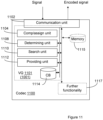
- an audio codec adapted to perform encoding of a variable number of target vectors per time segment, comprising means for executing the method according to the first aspect.
- the audio codec comprises means for obtaining an input target vector comprising transform coefficients on both sides of a spectral peak, and means for comparing the input target vector with a plurality of centroids, each centroid representing a respective class of codevectors in a codebook.
- the audio codec further comprises means for determine a starting point for a search in the codebook, based on the result of the comparison, and for dynamically adjusting a search space such that the size of the search space depends on the number of input target vectors.
- the codevectors in the codebook are sorted according to a distortion measure reflecting the distance between each codevector and the centroids.
- the audio codec enables that the class of codevectors comprising the most probable candidate codevectors in regard of the input vector are searched first of the classes in the codebook.
- a mobile terminal which comprises an audio codec according the second aspect above.
- the size of a search region in the codebook, in which a search is performed may be adapted based on a number of input target vectors and a maximum complexity constraint.
- the number of input target vectors per coding unit may be variable.
- the maximum complexity constraint may be set dynamically.
- a search could be performed in the codebook in the determined search space, starting at the determined starting point, where the search delivers a best match to the input target vector.
- “best match” is here meant the closest match, shortest distance, in regard of a distance measure between the input target vector and a candidate vector in the codebook, i.e. a best match is a codevector which has the shortest distance to the input target vector, according to the distance measure.
- the solution described herein relates to dynamically adapting the search space of a VQ, such that, for any number of target (input) vectors (per block or time interval), a high accuracy, and thus quality, quantization is achieved within a given complexity constraint. That is, the requirements of computational complexity (cf. L MAX ) are not to be violated.
- This is achieved by that the search is performed in a special classified and ordered CB.
- the starting point in the search space for each target vector is based on a classification procedure, and the size of the search space is increased or reduced, based on the number of target vectors.
- the VQ algorithm described herein may be regarded as a "tool" for data compression, independent of what the data is, i.e. the data could be e.g. video and/or audio.
- the VQ is described in the context of an audio codec, but the concept described herein is not limited to audio codecs. For example, it could also be implemented in video codecs.
- the algorithm described herein is based on a specially designed CB. Some variants of such a codebook will be described in more detail below. First a basic case will be described, and further below a more advanced scheme will be discussed.
- the codevectors of the CB may be arranged according to the solution described herein in an offline mode.
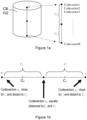
- the codevectors of a CB are split into two classes, here denoted C 0 and C 1 (this notation will be used both for the names of the classes, as well as for the corresponding centroids, cf. figure 1 ).
- C 0 and C 1 this notation will be used both for the names of the classes, as well as for the corresponding centroids, cf. figure 1 ).
- K-means algorithm Generalized Lloyd's algorithm
- centroid vectors when using a K-means algorithm, are vectors of the same dimension as the vectors from the data set, but they do not belong to the data set. That is, the centroid vectors are outside the CB and do not need to coincide with some existing codevectors.
- centroid is herein generally meant a reference vector representing a class of vectors.
- the distortion measure above results in, or assumes, large negative values for codevectors close to C 0 , and large positive values for codevectors close to C 1 .
- the codevectors which are equally distanced from the centroids ( C 0 and C 1 ) of the two classes produce a distortion measure d which is close to zero.
- the codevectors are ordered e.g. by increasing distortion measure, as illustrated in figure 1a and 1b .
- Each input target vector is compared with the two centroids (the respective centroid of the two classes) and is, depending on the result, assigned to, i.e. concluded or determined to belong to, either class C 0 or class C 1 .
- the starting point of the search is either selected to be the most upper point ( figure 1a ) or most left ( figure 1b ) point 0 (when the target vector belongs to class C 0 ) or the lowest point ( figure 1a ) or most right ( figure 1b ) point 1 (when the target vector belongs to class C 1 ).
- the size of the search space should be made dependent on the number of input target vectors N per block or time segment/interval.
- the search space K not to be the size of the entire CB, but to be variable, the concept behind the adaption described herein may be defined in equation (5) N ⁇ K ⁇ const In other words #Quantizers ⁇ #Operations_ per_Quantizer ⁇ const, where "Quantizer” may be regarded as the algorithm that maps an input vector to one of the codevectors.
- an input target vector may reflect a spectral peak (region) of a segment of the audio signal being processed.
- the number of spectral peaks in the signal spectrum of a time segment, e.g. 30 ms, of an audio signal depends on the spectral properties of the audio signal in that time segment. Since the spectral properties of an audio signal may vary over time and is different e.g. for different types of audio, the number of spectral peaks may vary between different time segments and between different audio signals.
- the number of input vectors, per block or time segment, to the VQ will vary.
- the maximum number of input vectors, corresponding to a number of spectral peaks in a time segment of an audio signal is 17.
- this number is only an example, and should not be interpreted as limiting the solution in general.
- the scheme described above keeps the number of operations required for the VQ in a narrow range (or almost constant); that is, when the number of VQs increases, i.e. number of input target vectors increases, the number of operations per-VQ decreases (the size of the search space decreases/only part of the CB is searched), such that the complexity requirements (i.e. constraints) are not violated.
- the search space K With a decrease of N, the search space K may be increased, at most up to the size of the entire CB, which leads to higher accuracy and thus quality of the reconstructed vector.
- the accuracy of a vector quantizer may be measured as a squared error between an original signal and corresponding reconstructed data.
- the codebook of the VQ need not be designed for the worst-case scenario (i.e. maximum number of input target vectors). Instead, it could be designed e.g. for a best-case scenario, thus comprising more codevectors than could possibly be searched for the maximum number of input target vectors within the maximum complexity constraint L MAX .
- the maximum complexity requirement will be fulfilled by that the extent of the search, i.e. the size of search space, in the CB depends on the number of input target vectors. However, if this would be done "blindly", e.g.
- a set of target vectors s represent spectral peak regions in a transform-domain audio coding, e.g., transform coefficients in the neighborhood of MDCT peaks.
- the number of target vectors varies over time, since the number of spectral peaks varies from one time-block to another.
- the target vectors s exhibit certain symmetries that can be used to further optimize the CB.
- the transform coefficients on the both sides of a spectral peak have similar statistics. If we assume that the target vectors s are centered at the peak position, the symmetry described above allows adding further structure in the ordered CB from figure 1a and 1b .
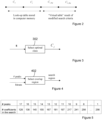
- the structure of such a new, further improved CB is illustrated in figure 2.
- Figure 2 illustrates a CB where the codevectors of the left part are stored in a memory, such as a Read Only Memory. However, there are no codevectors pre-stored for the right side of the CB, i.e. for the classes C 1, flip and C 0,flip .
- the codevectors of these classes are flipped versions of the codevectors of the right side of the CB.
- an input target vector is compared with four centroids and assigned to a class in order to determine a starting point for the search, i.e. the optimal class for the input target vector is determined by comparing the input vector s to each of the centroids ⁇ C 0 C 1 C 1 ,flip C 0 ,flip ⁇ .
- a target vector s is input to a class assigning unit 302, which delivers a class indicator, C j , as output.
- the centroids C 1, flip and C 0, flip are not stored in a table, but "created” by flipping the elements of the centroids C 0 and C 1 .
- a modified search operation may read the elements of C 0 and C 1 in the reverse order when reading C 0, flip and C 1, flip , i.e. both centroids and codebook vectors .
- the CB may be extended to comprising twice the number of codevectors, as compared to what is physically stored in the CB, which means saving of memory resources. This is possible due to that the symmetry of the peak regions is exploited, as described above. More specifically, the solution is based on the observation that the symmetry may be exploited by that a flipped valid codevector also is a valid codevector.
- the search region is adapted to the number of spectral peaks, which corresponds to the number of input target vectors.
- FIG 4 shows a functional unit 402 taking an indicator of a number of peaks/vectors as input, and producing an indicator of a search region as output.
- Figure 4 further illustrates that e.g. the bitrate of a codec applying the VQ could be taken into consideration when determining the search region (search space). For example, there may be different quality requirements for different bitrates, e.g. the higher the bitrate, the higher the expected quality. Further, the allowed maximum complexity may change with the bitrate, e.g.
- bitrate information reflects changes in quality and complexity requirements, which may be taken into consideration in the vector quantization.
- the table in figure 5 illustrates how the search region is adapted to the number of peaks.
- the search region is indicated as the number of coefficients (codevectors) in the search per input vector.
- the numbers in the table in figure 5 are derived under the assumption that the CB from figure 2 comprises four 7-bit segments (four segments with 128 codevectors each) of which two are "normal” or “physical” and two are "flipped" or “virtual”).
- the logic behind the table in figure 5 is that when there is one less peak to code, e.g. 16 instead of 17, the "saved" 128 comparisons may be distributed among the remaining peaks. At some point the search length saturates, because it reaches the physical size of the CB. In the example illustrated in figure 5 , this point is reached when the number of peaks is 8 or less. That is, in the example illustrated in figure 5 , when the number of peaks is 8 or less, a full search could be made for all the input target vectors (i.e. peaks) without reaching the maximum allowed complexity.
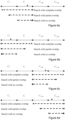
- search procedure examples are illustrated in figure 6a-d . In practice, it is the same type of search as the one described earlier in conjunction with figure 1a-b , but with additional classification into "normal” and “flipped" CB segments/classes.
- the input vector s belongs to class C 1 (position indicated with down arrow).
- the search space is then limited to sizes between the class C 1 only, and the joint space of the classes C 0 and C 1 .
- this is illustrated with three broken arrows indicating search spaces of different sizes.
- Figure 6b illustrates the case where an input vector belongs to class C 0 (position indicated with down arrow), in which case the search has a different starting point.
- the search can be performed in classes C 1, flip and/or C 0, flip if the input vector belongs to one of these classes.
- No searches are performed in the joint space of C 1 and C 1 ,flip .
- the reason for this is that the joint space of a regular and a flipped class does not correspond to a real data set (its statistics do not correspond to real data statistics). Thus, it is not very likely that a good match could be found for an input vector in such a space.
- VQ having a complexity which is dynamically adjusted to the number of target vectors N
- the complexity limit is not pre-determined, but may vary e.g. based on some criterion, and be signaled to the VQ and/or to the entity in which the VQ is applied.
- FIG 7 shows a functional unit 702 taking an indicator or the number of peaks/vectors as input, and further taking a complexity constraint L MAX as input.
- the functional unit 702 delivers an indicator of a search space/a region of the CB, cf. the broken arrows in figure 6a-d .
- VQ algorithm with adjustable complexity gives the optimal balance between accuracy of quantization (i.e. quality) and maintaining computational complexity below a pre-defined threshold.
- the procedure is for creating a CB for use in a VQ providing quantization in a transform audio encoder, such as e.g. an MDCT encoder.
- the procedure described below relates to the parts of a CB creation procedure which deviate from, and/or are additional to, a conventional VQ CB creation or organization.
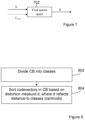
- the CB is divided into classes in an action 802, e.g. by use of a so-called K-means algorithm, as previously described.
- the codevectors of the CB are then sorted in the CB based on a distortion measure, e.g. as the one described in equation (4).
- the distortion measure for each codevector depends on a relation between the codevector and centroids representing each class of the CB, as previously described.
- This organization of the CB enables adaptation of the search space, and thus of the search complexity in VQ, at a highly preserved VQ quality (e.g. quality of the reconstructed target vectors).
- VQ vector quantizer
- a number N of input target vectors are received by the VQ, as previously described. Below, the actions associated with one of the input target vectors will be described, for reasons of simplicity.
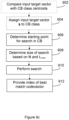
- An input target vector s is compared with a number of codevectors each representing a CB class (cf. classes C 0 and C 1 , etc. described earlier), preferably the centroid of each class.
- the comparison is illustrated as action 902 in figure 9a-c .
- Action 902 could alternatively be regarded as integrated with an action 904, illustrated in figure 9c .
- the input target vector s is assigned one of the classes, or sections, of the CB, in an action 904.
- the input target vector s is assigned, or concluded to belong to, the class to which it has the shortest distance, i.e. to which it is most similar, according to some distance measure (error measure).
- the starting point of the search in the CB is determined in an action 906, based on the class assignment or distance measure.
- a search may be performed in the codebook in an action 910.
- the search is initiated in the selected starting point, and is performed over a search space, which may be of a determined size, comprising one or more classes, or parts thereof. Due to the advantageously designed and organized CB, the probability of that the best match, of all candidate codevectors within the whole CB, for the input target vector s will be found within the search space is very high, even when the search space is limited to e.g. half the CB. In a case where the search space would comprise the entire codebook, the best match codevector would be found early in the search when starting the search at the determined starting point.
- the index of the best match codevector is provided, as a result from the VQ, in an action 912, e.g. for use in an audio decoder.
- the size of the search space may be determined in an action 908 illustrated in figure 9c .
- the search space may be described as the number of codevectors in the CB that should be evaluated in search for the best match for the input target vector s.
- the size of the search space is determined based on the number of input target vectors and a constraint on computational complexity L MAX .
- the size of the search space can be determined e.g. once for every coding block, or some other time interval, depending e.g. on the characteristics of the signal to be quantized and/or the attributes of a codec. If the number of input target vectors and the constraint L MAX are constant or semi-constant over time, the size of the search space may also be kept constant over the corresponding time.
- the transform codec could be e.g. an MDCT codec.
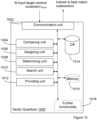
- the VQ is adapted to perform the actions of the procedure described above.
- the VQ 1001 is illustrated as to communicate with other entities (e.g. audio codec) via a communication unit 1002.
- the VQ may further comprise other functional units 1016, such as e.g. functional units providing regular functions, and may further comprise one or more storage units 1014.
- the VQ 1001 could be implemented e.g. by one or more of: a processor or a micro processor and adequate software with suitable storage therefore, a Programmable Logic Device (PLD) or other electronic component(s) and/or circuits.
- PLD Programmable Logic Device
- the communication unit 1002 is assumed to comprise functional units for obtaining the adequate parameters, such as input target vectors and L MAX , provided e.g. from an encoding entity.
- the VQ may comprise a comparison unit 1004, which is adapted to compare an input target vector s with vectors representing each class of the CB, e.g. the centroid vector of each class. Further, the VQ may comprise an assigning unit 1006, which is adapted to assign a class to the input target vector s (or assign the vector s to a class), i.e. conclude to which class the vector belongs, based on the comparison. Further, the VQ may comprise a determining unit 1008, adapted to determine an adequate starting point for a search in the CB, based on the class assigned to the vector s. The determining unit may further be adapted to determine the size of a search space in the CB, based e.g. on a number of received input target vectors and a computational complexity constraint.
- the VQ may comprise a search unit 1010, which is adapted to perform a search in the CB, starting at the determined starting point and searching the determined search space. The search should result in one or more CB indices pointing to the codevector which best matches the input target vector s.
- the VQ may further comprise a providing unit 1012, which is adapted to provide said index or indices to another entity, e.g. to (or for use by) a transform codec.
- FIG 12 schematically shows an embodiment of an arrangement 1200 suitable for use in e.g. a transform audio decoder, which also can be an alternative way of disclosing an embodiment of the VQ illustrated in figure 5 .
- a processing unit 1206 e.g. with a DSP (Digital Signal Processor).
- the processing unit 1206 can be a single unit or a plurality of units to perform different steps of procedures described herein.
- the arrangement 1200 may also comprise the input unit 1202 for receiving signals, such as input target vectors and indicators of e.g. bitrate and/or complexity constraint; and further the output unit 1204 for output signal(s), such as the CB indices for the best match codevectors.
- the input unit 1202 and the output unit 1204 may be arranged as one in the hardware of the arrangement.
- the arrangement 1200 comprises at least one computer program product 1208 in the form of a non-volatile memory, e.g. an EEPROM, a flash memory and a hard drive.
- the computer program product 1208 comprises a computer program 1210, which comprises code means, which when run in the processing unit 1206 in the arrangement 1200 causes the arrangement to perform the actions of a procedure described earlier in conjunction with figures 9a-c .
- the code means in the computer program 1210 of the arrangement 1200 may comprise a comparison module 1210a for comparing an input target vector with class centroids of a CB.
- the computer program may comprise an assigning module 1210b for assigning a class to the input target vector.
- the computer program 1210 may further comprise a determining unit 1210c for determining a starting point for a search in the CB; and further for determining a search space or region based on input parameters.
- the computer program 1210 may further comprise a search unit 1210d for searching the CB according to the above.
- the computer program 1210 may comprise a providing module 1210e, for providing indices, which are output from the search to other entities.
- the computer program 1210 is in the form of computer program code structured in computer program modules.
- the modules 1210a-e may essentially perform the actions of the flow illustrated in any of figures 9a-c to emulate at least part of the VQ 1001 illustrated in figure 10 .
- the different modules 1210a-d are run on the processing unit 1206, they correspond at least to the units 1004-1012 of figure 10 .
- code means in the embodiment disclosed above in conjunction with figure 12 are implemented as computer program modules which when run on the processing unit causes the arrangement and/or transform audio encoder to perform steps described above in the conjunction with figures mentioned above, at least one of the code means may in alternative embodiments be implemented at least partly as hardware circuits.
- VQs are applied, e.g. in codecs in devices such as mobile terminals, tablets, computers, smart phones, etc.
- the functional blocks may include or encompass, without limitation, digital signal processor (DSP) hardware, reduced instruction set processor, hardware (e.g., digital or analog) circuitry including but not limited to application specific integrated circuit(s) (ASIC), and (where appropriate) state machines capable of performing such functions.
- DSP digital signal processor
- ASIC application specific integrated circuit
- Said method may further comprise:
- a number of input target vectors per coding unit may be variable.
- the search may be performed within a search region determined based on a number of received input target vectors and a computational complexity constraint.
- the size of a search region in the codebook may be adapted based on a number of input target vectors and a computational complexity constraint.
- the computational complexity constraint may be set dynamically.
- Said Vector Quantizer may further comprise:
- Said Vector Quantizer may be further adapted to accept a variable number of input target vectors per coding unit.
- the search may be performed within a search region determined based on a number of input target vectors and a computational complexity constraint.
- Said Vector Quantizer may be further adapted to determine a search region in the codebook, based on a number of received input target vectors and a computational complexity constraint.
- the computational complexity constraint may be set dynamically.
- transform audio codec (1100) comprising said Vector Quantizer.
- a mobile terminal comprising said Vector Quantizer.
- codebook for vector quantization arranged such that the codevectors of the codebook are divided into a plurality of classes, each represented by a centroid, and where the codevectors further are sorted according to a distortion measure reflecting their distance to the centroids of the plurality of classes.
- a computer program (1210) comprising computer readable code, which when run in a processing unit, causes a Vector Quantizer to perform the above method.
- a computer program product (1208) comprising a computer readable medium and said computer program (1210) stored on the computer readable medium.
Landscapes
- Engineering & Computer Science (AREA)
- Physics & Mathematics (AREA)
- Multimedia (AREA)
- Signal Processing (AREA)
- Spectroscopy & Molecular Physics (AREA)
- Computational Linguistics (AREA)
- Health & Medical Sciences (AREA)
- Audiology, Speech & Language Pathology (AREA)
- Human Computer Interaction (AREA)
- Acoustics & Sound (AREA)
- Theoretical Computer Science (AREA)
- Compression, Expansion, Code Conversion, And Decoders (AREA)
- Compression Or Coding Systems Of Tv Signals (AREA)
Applications Claiming Priority (5)
| Application Number | Priority Date | Filing Date | Title |
|---|---|---|---|
| US201261617151P | 2012-03-29 | 2012-03-29 | |
| EP12821073.9A EP2831757B1 (en) | 2012-03-29 | 2012-12-12 | Vector quantizer |
| EP19167463.9A EP3547261B1 (en) | 2012-03-29 | 2012-12-12 | Vector quantizer |
| EP23186309.3A EP4274235B1 (en) | 2012-03-29 | 2012-12-12 | Vector quantizer |
| PCT/SE2012/051381 WO2013147667A1 (en) | 2012-03-29 | 2012-12-12 | Vector quantizer |
Related Parent Applications (3)
| Application Number | Title | Priority Date | Filing Date |
|---|---|---|---|
| EP19167463.9A Division EP3547261B1 (en) | 2012-03-29 | 2012-12-12 | Vector quantizer |
| EP12821073.9A Division EP2831757B1 (en) | 2012-03-29 | 2012-12-12 | Vector quantizer |
| EP23186309.3A Division EP4274235B1 (en) | 2012-03-29 | 2012-12-12 | Vector quantizer |
Publications (1)
| Publication Number | Publication Date |
|---|---|
| EP4521350A1 true EP4521350A1 (en) | 2025-03-12 |
Family
ID=47631684
Family Applications (4)
| Application Number | Title | Priority Date | Filing Date |
|---|---|---|---|
| EP24213706.5A Pending EP4521350A1 (en) | 2012-03-29 | 2012-12-12 | Vector quantizer |
| EP19167463.9A Active EP3547261B1 (en) | 2012-03-29 | 2012-12-12 | Vector quantizer |
| EP12821073.9A Active EP2831757B1 (en) | 2012-03-29 | 2012-12-12 | Vector quantizer |
| EP23186309.3A Active EP4274235B1 (en) | 2012-03-29 | 2012-12-12 | Vector quantizer |
Family Applications After (3)
| Application Number | Title | Priority Date | Filing Date |
|---|---|---|---|
| EP19167463.9A Active EP3547261B1 (en) | 2012-03-29 | 2012-12-12 | Vector quantizer |
| EP12821073.9A Active EP2831757B1 (en) | 2012-03-29 | 2012-12-12 | Vector quantizer |
| EP23186309.3A Active EP4274235B1 (en) | 2012-03-29 | 2012-12-12 | Vector quantizer |
Country Status (12)
| Country | Link |
|---|---|
| US (5) | US9401155B2 (https=) |
| EP (4) | EP4521350A1 (https=) |
| CN (2) | CN104221287B (https=) |
| BR (1) | BR112014022848B1 (https=) |
| DK (1) | DK2831757T3 (https=) |
| ES (3) | ES2745143T3 (https=) |
| FI (1) | FI3547261T3 (https=) |
| IN (1) | IN2014DN07726A (https=) |
| PL (1) | PL2831757T3 (https=) |
| RU (3) | RU2726158C2 (https=) |
| TR (1) | TR201911121T4 (https=) |
| WO (1) | WO2013147667A1 (https=) |
Families Citing this family (5)
| Publication number | Priority date | Publication date | Assignee | Title |
|---|---|---|---|---|
| IN2014DN07726A (https=) * | 2012-03-29 | 2015-05-15 | Ericsson Telefon Ab L M | |
| TR201901612T4 (tr) * | 2014-07-28 | 2019-02-21 | Ericsson Telefon Ab L M | Piramit vektör niceleyici şekil araması. |
| US11710492B2 (en) * | 2019-10-02 | 2023-07-25 | Qualcomm Incorporated | Speech encoding using a pre-encoded database |
| CN111798532B (zh) * | 2020-08-03 | 2021-03-16 | 广州市宝绅科技应用有限公司 | 一种基于质心重合的网屏编码方法及系统 |
| US12438554B1 (en) * | 2024-03-31 | 2025-10-07 | AtomBeam Technologies Inc. | System and method for federated two-stage compression within a persistent cognitive machine |
Family Cites Families (39)
| Publication number | Priority date | Publication date | Assignee | Title |
|---|---|---|---|---|
| JPS63217878A (ja) | 1987-03-06 | 1988-09-09 | Nippon Telegr & Teleph Corp <Ntt> | 予測木探索ベクトル量子化方式 |
| US5195168A (en) * | 1991-03-15 | 1993-03-16 | Codex Corporation | Speech coder and method having spectral interpolation and fast codebook search |
| CA2135629C (en) * | 1993-03-26 | 2000-02-08 | Ira A. Gerson | Multi-segment vector quantizer for a speech coder suitable for use in a radiotelephone |
| US5664055A (en) * | 1995-06-07 | 1997-09-02 | Lucent Technologies Inc. | CS-ACELP speech compression system with adaptive pitch prediction filter gain based on a measure of periodicity |
| EP0788091A3 (en) * | 1996-01-31 | 1999-02-24 | Kabushiki Kaisha Toshiba | Speech encoding and decoding method and apparatus therefor |
| JP3335841B2 (ja) * | 1996-05-27 | 2002-10-21 | 日本電気株式会社 | 信号符号化装置 |
| DE69710505T2 (de) * | 1996-11-07 | 2002-06-27 | Matsushita Electric Industrial Co., Ltd. | Verfahren und Vorrichtung zur Erzeugung eines Vektorquantisierungs-Codebuchs |
| WO1999021174A1 (en) * | 1997-10-22 | 1999-04-29 | Matsushita Electric Industrial Co., Ltd. | Sound encoder and sound decoder |
| US6148283A (en) * | 1998-09-23 | 2000-11-14 | Qualcomm Inc. | Method and apparatus using multi-path multi-stage vector quantizer |
| JP2002531979A (ja) * | 1998-12-01 | 2002-09-24 | ザ リージェンツ オブ ザ ユニバーシティ オブ カリフォルニア | 改良波形補間型符号器 |
| US6782360B1 (en) * | 1999-09-22 | 2004-08-24 | Mindspeed Technologies, Inc. | Gain quantization for a CELP speech coder |
| US7167828B2 (en) * | 2000-01-11 | 2007-01-23 | Matsushita Electric Industrial Co., Ltd. | Multimode speech coding apparatus and decoding apparatus |
| US7171355B1 (en) * | 2000-10-25 | 2007-01-30 | Broadcom Corporation | Method and apparatus for one-stage and two-stage noise feedback coding of speech and audio signals |
| WO2002045077A1 (en) * | 2000-11-30 | 2002-06-06 | Matsushita Electric Industrial Co., Ltd. | Vector quantizing device for lpc parameters |
| US7610198B2 (en) * | 2001-08-16 | 2009-10-27 | Broadcom Corporation | Robust quantization with efficient WMSE search of a sign-shape codebook using illegal space |
| CA2388358A1 (en) * | 2002-05-31 | 2003-11-30 | Voiceage Corporation | A method and device for multi-rate lattice vector quantization |
| US7337110B2 (en) * | 2002-08-26 | 2008-02-26 | Motorola, Inc. | Structured VSELP codebook for low complexity search |
| CA2415105A1 (en) * | 2002-12-24 | 2004-06-24 | Voiceage Corporation | A method and device for robust predictive vector quantization of linear prediction parameters in variable bit rate speech coding |
| BRPI0608270A2 (pt) * | 2005-04-01 | 2009-10-06 | Qualcomm Inc | sistemas, métodos e equipamento para filtragem anti-dispersão |
| US7587314B2 (en) * | 2005-08-29 | 2009-09-08 | Nokia Corporation | Single-codebook vector quantization for multiple-rate applications |
| EP1946447B1 (en) * | 2005-09-23 | 2014-06-04 | Telefonaktiebolaget LM Ericsson (publ) | Successively refinable lattice vector quantization |
| US20070129946A1 (en) * | 2005-12-06 | 2007-06-07 | Ma Changxue C | High quality speech reconstruction for a dialog method and system |
| US8285544B2 (en) * | 2006-03-21 | 2012-10-09 | France Telecom | Restrained vector quantisation |
| CN101198041B (zh) * | 2006-12-05 | 2010-12-08 | 华为技术有限公司 | 矢量量化方法及装置 |
| CN101335558B (zh) * | 2007-06-29 | 2012-07-04 | 华为技术有限公司 | 多输入多输出信道的码本生成方法及装置 |
| US8050919B2 (en) * | 2007-06-29 | 2011-11-01 | Microsoft Corporation | Speaker recognition via voice sample based on multiple nearest neighbor classifiers |
| KR101390051B1 (ko) * | 2007-10-12 | 2014-04-29 | 파나소닉 주식회사 | 벡터 양자화 장치, 벡터 역양자화 장치, 및 이러한 방법 |
| ES2821432T3 (es) * | 2008-02-15 | 2021-04-26 | Nokia Technologies Oy | Cuantificación de audio mediante indexación de vectores de complejidad reducida |
| EP2304722B1 (en) * | 2008-07-17 | 2018-03-14 | Nokia Technologies Oy | Method and apparatus for fast nearest-neighbor search for vector quantizers |
| US20100174539A1 (en) * | 2009-01-06 | 2010-07-08 | Qualcomm Incorporated | Method and apparatus for vector quantization codebook search |
| RU2519027C2 (ru) * | 2009-02-13 | 2014-06-10 | Панасоник Корпорэйшн | Устройство векторного квантования, устройство векторного обратного квантования и способы для этого |
| US8581757B2 (en) * | 2009-07-02 | 2013-11-12 | Siemens Enterprise Communications Gmbh & Co. Kg | Method for vector quantization of a feature vector |
| RU2435214C2 (ru) | 2010-02-01 | 2011-11-27 | Государственное образовательное учреждение высшего профессионального образования Академия Федеральной службы охраны Российской Федерации (Академия ФСО России) | Способ быстрого поиска в кодовой книге при векторном квантовании |
| CN102436815B (zh) * | 2011-09-13 | 2012-12-19 | 东南大学 | 一种应用于英语口语网络机考系统的语音识别装置 |
| IN2014DN07726A (https=) * | 2012-03-29 | 2015-05-15 | Ericsson Telefon Ab L M | |
| ES2561603T3 (es) * | 2012-03-29 | 2016-02-29 | Telefonaktiebolaget Lm Ericsson (Publ) | Extensión del ancho de banda de una señal de audio armónica |
| EP2831874B1 (en) * | 2012-03-29 | 2017-05-03 | Telefonaktiebolaget LM Ericsson (publ) | Transform encoding/decoding of harmonic audio signals |
| BR112016007515B1 (pt) * | 2013-10-18 | 2021-11-16 | Telefonaktiebolaget Lm Ericsson (Publ) | Método de codificação de segmento de sinal de áudio, codificador de segmento de sinal de áudio, e, terminal de usuário. |
| CN110649925B (zh) * | 2013-11-12 | 2023-04-07 | 瑞典爱立信有限公司 | 划分的增益形状向量编码 |
-
2012
- 2012-12-12 IN IN7726DEN2014 patent/IN2014DN07726A/en unknown
- 2012-12-12 EP EP24213706.5A patent/EP4521350A1/en active Pending
- 2012-12-12 PL PL12821073T patent/PL2831757T3/pl unknown
- 2012-12-12 US US14/387,716 patent/US9401155B2/en active Active
- 2012-12-12 FI FIEP19167463.9T patent/FI3547261T3/fi active
- 2012-12-12 TR TR2019/11121T patent/TR201911121T4/tr unknown
- 2012-12-12 EP EP19167463.9A patent/EP3547261B1/en active Active
- 2012-12-12 RU RU2017121373A patent/RU2726158C2/ru active
- 2012-12-12 EP EP12821073.9A patent/EP2831757B1/en active Active
- 2012-12-12 EP EP23186309.3A patent/EP4274235B1/en active Active
- 2012-12-12 CN CN201280072059.0A patent/CN104221287B/zh active Active
- 2012-12-12 BR BR112014022848-5A patent/BR112014022848B1/pt active IP Right Grant
- 2012-12-12 ES ES12821073T patent/ES2745143T3/es active Active
- 2012-12-12 ES ES23186309T patent/ES3000058T3/es active Active
- 2012-12-12 WO PCT/SE2012/051381 patent/WO2013147667A1/en not_active Ceased
- 2012-12-12 ES ES19167463T patent/ES2960582T3/es active Active
- 2012-12-12 DK DK12821073.9T patent/DK2831757T3/da active
- 2012-12-12 RU RU2014143442A patent/RU2624586C2/ru active
- 2012-12-12 CN CN201710451005.XA patent/CN107170459B/zh active Active
-
2016
- 2016-06-21 US US15/187,943 patent/US9842601B2/en active Active
-
2017
- 2017-11-07 US US15/805,768 patent/US10468044B2/en active Active
-
2019
- 2019-08-23 US US16/549,270 patent/US11017786B2/en active Active
-
2020
- 2020-05-12 RU RU2020115683A patent/RU2020115683A/ru unknown
-
2021
- 2021-04-21 US US17/236,563 patent/US11741977B2/en active Active
Non-Patent Citations (5)
| Title |
|---|
| CHEN C-Q ET AL: "Fast codebook search algorithm for unconstrained vector quantisation", IEE PROCEEDINGS: VISION, IMAGE AND SIGNAL PROCESSING, INSTITUTION OF ELECTRICAL ENGINEERS, GB, vol. 145, no. 2, 23 April 1998 (1998-04-23), pages 97 - 102, XP006011551, ISSN: 1350-245X, DOI: 10.1049/IP-VIS:19981691 * |
| H.B. KEKRE ET AL: "Fast codebook search algorithm for vector quantization using sorting technique", PROCEEDINGS OF THE INTERNATIONAL CONFERENCE ON ADVANCES IN COMPUTING, COMMUNICATION AND CONTROL, ICAC3 '09, 2009, New York, New York, USA, pages 317 - 325, XP055063241, ISBN: 978-1-60-558351-8, DOI: 10.1145/1523103.1523168 * |
| JIAN FENG ET AL: "DYNAMIC CODEBROOK ADAPTIVE VECTOR QUANTIZATION FOR IMAGE CODING", IEEE TRANSACTIONS ON CONSUMER ELECTRONICS, IEEE SERVICE CENTER, NEW YORK, NY, US, vol. 45, no. 2, May 1999 (1999-05-01), pages 327 - 332, XP011083742, ISSN: 0098-3063, DOI: 10.1109/30.793416 * |
| MOHAMMADI H R S ET AL: "Application of sorted codebook vector quantization to spectral coding of speech", GLOBAL TELECOMMUNICATIONS CONFERENCE, 1995. CONFERENCE RECORD. COMMUNI CATION THEORY MINI-CONFERENCE, GLOBECOM '95., IEEE SINGAPORE 13-17 NOV. 1995, NEW YORK, NY, USA,IEEE, US, vol. 3, 13 November 1995 (1995-11-13), pages 1595 - 1598, XP010164673, ISBN: 978-0-7803-2509-8, DOI: 10.1109/GLOCOM.1995.500294 * |
| TZU-CHUEN LU ET AL: "A Survey of VQ Codebook Generation", JOURNAL OF INFORMATION HIDING AND MULTIMEDIA SIGNAL PROCESSING, vol. 1, July 2010 (2010-07-01), pages 190 - 203, XP055063250, ISSN: 2073-4212 * |
Also Published As
Similar Documents
| Publication | Publication Date | Title |
|---|---|---|
| US11741977B2 (en) | Vector quantizer | |
| AU2017249291B2 (en) | Audio encoder for encoding an audio signal, method for encoding an audio signal and computer program under consideration of a detected peak spectral region in an upper frequency band | |
| WO2010080663A1 (en) | Method and apparatus for vector quantization codebook search | |
| US8510105B2 (en) | Compression and decompression of data vectors | |
| EP3193332B1 (en) | Vector quantization | |
| CN101821800A (zh) | 矢量量化装置、矢量反量化装置和其方法 | |
| US12106767B2 (en) | Pitch emphasis apparatus, method and program for the same | |
| AU2014286765B2 (en) | Signal encoding and decoding methods and devices | |
| US20120078618A1 (en) | Method and apparatus for generating lattice vector quantizer codebook | |
| Svedberg et al. | MDCT audio coding with pulse vector quantizers | |
| US20180374489A1 (en) | Bit error detector for an audio signal decoder | |
| EP2490217A1 (en) | Encoding device, decoding device and methods therefor |
Legal Events
| Date | Code | Title | Description |
|---|---|---|---|
| PUAI | Public reference made under article 153(3) epc to a published international application that has entered the european phase |
Free format text: ORIGINAL CODE: 0009012 |
|
| STAA | Information on the status of an ep patent application or granted ep patent |
Free format text: STATUS: THE APPLICATION HAS BEEN PUBLISHED |
|
| AC | Divisional application: reference to earlier application |
Ref document number: 2831757 Country of ref document: EP Kind code of ref document: P Ref document number: 3547261 Country of ref document: EP Kind code of ref document: P Ref document number: 4274235 Country of ref document: EP Kind code of ref document: P |
|
| AK | Designated contracting states |
Kind code of ref document: A1 Designated state(s): AL AT BE BG CH CY CZ DE DK EE ES FI FR GB GR HR HU IE IS IT LI LT LU LV MC MK MT NL NO PL PT RO RS SE SI SK SM TR |
|
| STAA | Information on the status of an ep patent application or granted ep patent |
Free format text: STATUS: REQUEST FOR EXAMINATION WAS MADE |
|
| 17P | Request for examination filed |
Effective date: 20250917 |
|
| D17P | Request for examination filed (deleted) | ||
| GRAP | Despatch of communication of intention to grant a patent |
Free format text: ORIGINAL CODE: EPIDOSNIGR1 |
|
| STAA | Information on the status of an ep patent application or granted ep patent |
Free format text: STATUS: GRANT OF PATENT IS INTENDED |
|
| R17P | Request for examination filed (corrected) |
Effective date: 20251001 |
|
| INTG | Intention to grant announced |
Effective date: 20251029 |
|
| GRAJ | Information related to disapproval of communication of intention to grant by the applicant or resumption of examination proceedings by the epo deleted |
Free format text: ORIGINAL CODE: EPIDOSDIGR1 |
|
| STAA | Information on the status of an ep patent application or granted ep patent |
Free format text: STATUS: REQUEST FOR EXAMINATION WAS MADE |
|
| GRAP | Despatch of communication of intention to grant a patent |
Free format text: ORIGINAL CODE: EPIDOSNIGR1 |
|
| STAA | Information on the status of an ep patent application or granted ep patent |
Free format text: STATUS: GRANT OF PATENT IS INTENDED |
|
| INTC | Intention to grant announced (deleted) | ||
| INTG | Intention to grant announced |
Effective date: 20260302 |