EP4517792A2 - Mehrschichtiger keramischer kondensator mit externer isolierschicht auf basis von aluminiumoxid und bornitrid - Google Patents
Mehrschichtiger keramischer kondensator mit externer isolierschicht auf basis von aluminiumoxid und bornitrid Download PDFInfo
- Publication number
- EP4517792A2 EP4517792A2 EP24184325.9A EP24184325A EP4517792A2 EP 4517792 A2 EP4517792 A2 EP 4517792A2 EP 24184325 A EP24184325 A EP 24184325A EP 4517792 A2 EP4517792 A2 EP 4517792A2
- Authority
- EP
- European Patent Office
- Prior art keywords
- electronic component
- multilayer electronic
- insulating layer
- disposed
- layer
- Prior art date
- Legal status (The legal status is an assumption and is not a legal conclusion. Google has not performed a legal analysis and makes no representation as to the accuracy of the status listed.)
- Pending
Links
Images




Classifications
-
- H—ELECTRICITY
- H01—ELECTRIC ELEMENTS
- H01G—CAPACITORS; CAPACITORS, RECTIFIERS, DETECTORS, SWITCHING DEVICES, LIGHT-SENSITIVE OR TEMPERATURE-SENSITIVE DEVICES OF THE ELECTROLYTIC TYPE
- H01G4/00—Fixed capacitors; Processes of their manufacture
- H01G4/30—Stacked capacitors
-
- H—ELECTRICITY
- H01—ELECTRIC ELEMENTS
- H01G—CAPACITORS; CAPACITORS, RECTIFIERS, DETECTORS, SWITCHING DEVICES, LIGHT-SENSITIVE OR TEMPERATURE-SENSITIVE DEVICES OF THE ELECTROLYTIC TYPE
- H01G4/00—Fixed capacitors; Processes of their manufacture
- H01G4/002—Details
-
- H—ELECTRICITY
- H01—ELECTRIC ELEMENTS
- H01G—CAPACITORS; CAPACITORS, RECTIFIERS, DETECTORS, SWITCHING DEVICES, LIGHT-SENSITIVE OR TEMPERATURE-SENSITIVE DEVICES OF THE ELECTROLYTIC TYPE
- H01G4/00—Fixed capacitors; Processes of their manufacture
- H01G4/002—Details
- H01G4/005—Electrodes
- H01G4/008—Selection of materials
-
- H—ELECTRICITY
- H01—ELECTRIC ELEMENTS
- H01G—CAPACITORS; CAPACITORS, RECTIFIERS, DETECTORS, SWITCHING DEVICES, LIGHT-SENSITIVE OR TEMPERATURE-SENSITIVE DEVICES OF THE ELECTROLYTIC TYPE
- H01G4/00—Fixed capacitors; Processes of their manufacture
- H01G4/002—Details
- H01G4/005—Electrodes
- H01G4/012—Form of non-self-supporting electrodes
-
- H—ELECTRICITY
- H01—ELECTRIC ELEMENTS
- H01G—CAPACITORS; CAPACITORS, RECTIFIERS, DETECTORS, SWITCHING DEVICES, LIGHT-SENSITIVE OR TEMPERATURE-SENSITIVE DEVICES OF THE ELECTROLYTIC TYPE
- H01G4/00—Fixed capacitors; Processes of their manufacture
- H01G4/002—Details
- H01G4/018—Dielectrics
- H01G4/06—Solid dielectrics
- H01G4/08—Inorganic dielectrics
- H01G4/12—Ceramic dielectrics
- H01G4/1209—Ceramic dielectrics characterised by the ceramic dielectric material
- H01G4/1218—Ceramic dielectrics characterised by the ceramic dielectric material based on titanium oxides or titanates
- H01G4/1227—Ceramic dielectrics characterised by the ceramic dielectric material based on titanium oxides or titanates based on alkaline earth titanates
-
- H—ELECTRICITY
- H01—ELECTRIC ELEMENTS
- H01G—CAPACITORS; CAPACITORS, RECTIFIERS, DETECTORS, SWITCHING DEVICES, LIGHT-SENSITIVE OR TEMPERATURE-SENSITIVE DEVICES OF THE ELECTROLYTIC TYPE
- H01G4/00—Fixed capacitors; Processes of their manufacture
- H01G4/002—Details
- H01G4/224—Housing; Encapsulation
-
- H—ELECTRICITY
- H01—ELECTRIC ELEMENTS
- H01G—CAPACITORS; CAPACITORS, RECTIFIERS, DETECTORS, SWITCHING DEVICES, LIGHT-SENSITIVE OR TEMPERATURE-SENSITIVE DEVICES OF THE ELECTROLYTIC TYPE
- H01G4/00—Fixed capacitors; Processes of their manufacture
- H01G4/002—Details
- H01G4/228—Terminals
- H01G4/232—Terminals electrically connecting two or more layers of a stacked or rolled capacitor
-
- H—ELECTRICITY
- H01—ELECTRIC ELEMENTS
- H01G—CAPACITORS; CAPACITORS, RECTIFIERS, DETECTORS, SWITCHING DEVICES, LIGHT-SENSITIVE OR TEMPERATURE-SENSITIVE DEVICES OF THE ELECTROLYTIC TYPE
- H01G4/00—Fixed capacitors; Processes of their manufacture
- H01G4/002—Details
- H01G4/228—Terminals
- H01G4/252—Terminals the terminals being coated on the capacitive element
-
- H—ELECTRICITY
- H01—ELECTRIC ELEMENTS
- H01G—CAPACITORS; CAPACITORS, RECTIFIERS, DETECTORS, SWITCHING DEVICES, LIGHT-SENSITIVE OR TEMPERATURE-SENSITIVE DEVICES OF THE ELECTROLYTIC TYPE
- H01G4/00—Fixed capacitors; Processes of their manufacture
- H01G4/002—Details
- H01G4/018—Dielectrics
- H01G4/06—Solid dielectrics
- H01G4/08—Inorganic dielectrics
- H01G4/12—Ceramic dielectrics
-
- H—ELECTRICITY
- H01—ELECTRIC ELEMENTS
- H01G—CAPACITORS; CAPACITORS, RECTIFIERS, DETECTORS, SWITCHING DEVICES, LIGHT-SENSITIVE OR TEMPERATURE-SENSITIVE DEVICES OF THE ELECTROLYTIC TYPE
- H01G4/00—Fixed capacitors; Processes of their manufacture
- H01G4/002—Details
- H01G4/228—Terminals
- H01G4/232—Terminals electrically connecting two or more layers of a stacked or rolled capacitor
- H01G4/2325—Terminals electrically connecting two or more layers of a stacked or rolled capacitor characterised by the material of the terminals
Definitions
- the present disclosure relates to a multilayer electronic component.
- a multilayer electronic component may be a chip condenser mounted on the printed circuit boards of various electronic products including image display devices such as a liquid crystal display (LCD) and a plasma display panel (PDP), a computer, a smartphone, a mobile phone, or the like, charging or discharging electricity therein or therefrom.
- image display devices such as a liquid crystal display (LCD) and a plasma display panel (PDP), a computer, a smartphone, a mobile phone, or the like, charging or discharging electricity therein or therefrom.
- LCD liquid crystal display
- PDP plasma display panel
- Such a multilayer ceramic capacitor may be used as a component of various electronic devices, as a multilayer ceramic capacitor may have a small size and high capacitance and may be easily mounted. Also, recently, application thereof has been increased, including servers and automobile electronic components. Accordingly, there has been demand for development of an MLCC having higher specifications and reliability than before.
- An embodiment of the present disclosure is to provide a multilayer electronic component having improved reliability.
- An embodiment of the present disclosure is to provide a multilayer electronic component in which cracks are prevented.
- a multilayer electronic component includes a body including a dielectric layer and an internal electrode alternately disposed in a first direction, and including first and second surfaces opposing each other in the first direction, third and fourth surfaces opposing each other in a second direction and connected to the first and second surfaces, and fifth and sixth surfaces opposing each other in a third direction and connected to the first to fourth surfaces; an insulating layer disposed on the first, second, fifth and sixth surfaces and including at least one of Al 2 O 3 and BN; an external electrode disposed on the body, wherein each of the first and second surfaces is concave into the body.
- a multilayer electronic component includes a body including a dielectric layer and an internal electrode alternately disposed in a first direction, and including first and second surfaces opposing each other in the first direction, third and fourth surfaces opposing each other in a second direction and connected to the first and second surfaces, and fifth and sixth surfaces opposing each other in a third direction and connected to the first to fourth surfaces; an insulating layer disposed on the first, second, fifth and sixth surfaces and including BN; and an external electrode disposed on the body.
- the first direction may be defined as a thickness (T) direction
- the second direction may be defined as a length (L) direction
- the third direction may be defined as a width (W) direction.
- a multilayer ceramic capacitor will be described as an example of a multilayer electronic component, but an embodiment thereof is not limited thereto, and the multilayer ceramic capacitor may be applied to various multilayer electronic components, such as an inductor, a piezoelectric element, a varistor, or a thermistor.
- the multilayer electronic component 100 may include a body 110 including a dielectric layer 111 and internal electrodes 121 and 122 alternately disposed in a first direction, and including first and second surfaces 1 and 2 opposing each other in a first direction, third and fourth surfaces 3 and 4 connected to the first and second surfaces 1 and 2 and opposing each other in a second direction, and fifth and sixth surfaces 5 and 6 connected to the first to fourth surfaces and opposing each other in a third direction, an insulating layer 140 disposed on the first, second, fifth and sixth surfaces; and external electrodes 131 and 132 disposed on the body.
- the insulating layer 140 may be BN.
- the insulating layer 140 may include one or more of Al 2 O 3 and BN, and the first and second surfaces may have a concave shape, concave into the body.
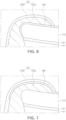
- a thickness of the body may increase due to reduction of the internal electrode pattern in a sintering process, and a cover portion may have a convex shape, which may cause a cover-convex phenomenon, and the margin portion may have a concave shape.
- the cover portion has a convex shape as in the general body 10
- the chip may expand in the T direction (thickness direction) due to a reverse piezoelectric phenomenon, which may cause cracks.
- the cover-convex phenomenon of the body 110 may be prevented during the sintering process such that cracks may be suppressed.
- the dielectric layers 111 and the internal electrodes 121 and 122 may be alternately laminated.
- the body 110 may have the first and second surfaces 1 and 2 opposing each other in the first direction, the third and fourth surfaces 3 and 4 connected to the first and second surfaces 1 and 2 and opposing in the second direction, and the fifth and sixth surfaces 5 and 6 connected to the first and second surfaces 1 and 2 and the third and fourth surfaces 3 and 4 and opposing each other in the third direction.
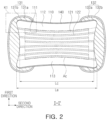
- first and second surfaces 1 and 2 of the body 110 may have a concave shape, concave into the body. As the first and second surfaces 1 and 2 of the body 110 are concave into the body, crack due to expansion in the T direction (thickness direction) due to the reverse piezoelectric phenomenon may be prevented.
- Tc/Te in a cross-section cut in the first and third directions a center of the multilayer electronic component 100 in the second direction, when a minimum size in the first direction in a central portion of the multilayer electronic component 100 in the third direction is defined as Tc, and a maximum size in the first direction on an end portion in the third direction is defined as Te, Tc/Te may be less than 1.000 and more than 0.950.
- the multilayer electronic component 100 may be divided into five regions in the third direction, a size in the first direction may be measured at five points at an equal distance in the first or fifth region (e.g., the end portion), and the maximum size may be defined as Te.
- the size in the first direction may be measured at five points at an equal distance in the third region (e.g., the central portion) and the minimum size may be defined as Tc.
- Other methods and/or tools appreciated by one of ordinary skill in the art, even if not described in the present disclosure, may also be used.
- Wc/We may be less than 1.000 and greater than 0.950.
- the multilayer electronic component 100 may be divided into five regions in the first direction, the size in the third direction may be measured at five points at an equal distance in the first or fifth region (e.g., the end portion), and the maximum size may be defined as We.
- the size in the third direction may be measured at five points at an equal distance in the third region (e.g., the central portion), and the minimum size may be defined as Wc.
- Other methods and/or tools appreciated by one of ordinary skill in the art, even if not described in the present disclosure, may also be used.
- the third and fourth surfaces 3 and 4 of the body 110 may have a concave shape, concave into the body.
- Wc/We a minimum size in the second direction in a central portion of the multilayer electronic component taken in the first direction
- We a maximum size in the second direction on an end portion in the first direction
- the multilayer electronic component 100 may be divided into five regions in the first direction, the size in the second direction may be measured at five points at an equal distance in the first or fifth region (e.g., the end portion), and the maximum size may be defined as Le.
- the size in the second direction may be measured at five points at an equal distance in the third region (e.g., the central portion), and the minimum size may be defined as Lc.
- Other methods and/or tools appreciated by one of ordinary skill in the art, even if not described in the present disclosure, may also be used.
- the plurality of dielectric layers 111 forming the body 110 may be in a fired state, and boundaries between adjacent dielectric layers 111 may be integrated with each other such that the boundaries therebetween may not be distinct without using a scanning electron microscope (SEM).
- SEM scanning electron microscope
- the number of laminated dielectric layers is not limited any particular example, and may be determined considering a size of the multilayer electronic component. For example, a body may be formed by laminating more than 400 dielectric layers.
- the dielectric layer 111 may be formed by preparing a ceramic slurry including ceramic powder, an organic solvent, an additive, and a binder, preparing a ceramic green sheet by coating the slurry on a carrier film and drying the slurry, and firing the ceramic green sheet.
- the ceramic powder is not limited to any particular example as long as sufficient electrostatic capacitance may be obtained therewith.
- An example of the ceramic powder may include BaTiO 3 , (Ba 1-x Ca x )TiO 3 (0 ⁇ x ⁇ 1), Ba(Ti 1-y Ca y )O 3 (0 ⁇ y ⁇ 1), (Ba 1-xC a x )(Ti 1-y Zr y )O 3 (0 ⁇ x ⁇ 1, 0 ⁇ y ⁇ 1) and Ba(Ti 1-y Zr y )O 3 (0 ⁇ y ⁇ 1).
- the dielectric layer 111 includes one or more of BaTiO 3 , (Ba 1-xC a x )TiO 3 (0 ⁇ x ⁇ 1), Ba (Ti 1-y Ca y )O 3 (0 ⁇ y ⁇ 1), (Ba 1-x Ca x )(Ti 1-y Zr y )O 3 (0 ⁇ x ⁇ 1, 0 ⁇ y ⁇ 1) and Ba(Ti 1-y Zr y )O 3 (0 ⁇ y ⁇ 1). Accordingly, a difference in reduction rates with the insulating layer 140 may be easily controlled during firing, such that the shape of the body may be easily controlled.
- the dielectric layer 111 may include, as a main component, a material having a lower reduction rate than the insulating layer 140 during firing.
- the cover convex phenomenon may occur excessively during the sintering process, such that the first and second surfaces may easily have a convex shape.
- the cover convex phenomenon may be suppressed in the sintering process, and further, the first and second surfaces may easily have a concave shape.
- the reduction rate may be determined by measuring and comparing the dimensions (e.g., length, width, and thickness) of a layer of the material before and after firing. Other methods and/or tools appreciated by one of ordinary skill in the art, even if not described in the present disclosure, may also be used.
- the average thickness of the dielectric layer 111 may not need to be limited to any particular example, an average thickness of at least one of the dielectric layers 111 may be 0.1 um or more and 10 um or less. Also, the average thickness of the dielectric layer 111 may be arbitrarily determined depending on desired characteristics or use. For example, in the case of a high voltage electronic component for a vehicle, the average thickness of at least one of the dielectric layers 111 may be 0.5 um or more, and the average thickness of at least one of the dielectric layers 111 may be less than 2.8 um to implement the capacitance of the multilayer electronic component.
- the body 110 may include a capacitance forming portion Ac forming capacitance including the first internal electrode 121 and the second internal electrode 122 disposed in the body 110 and opposing each other with the dielectric layer 111 therebetween, and cover portions 112 and 113 formed in upper and lower portions of the capacitance forming portion Ac in the first direction.
- the capacitance forming portion Ac may contribute to forming the capacitance of the capacitor, and may be formed by repeatedly laminating the plurality of first and second internal electrodes 121 and 122 with the dielectric layer 111 interposed therebetween.
- the cover portions 112 and 113 may include an upper cover portion 112 disposed on the capacitance forming portion Ac in the first direction and a lower cover portion 113 disposed below the capacitance forming portion Ac in the first direction.
- the upper cover portion 112 and lower cover portion 113 may be formed by laminating a single dielectric layer or two or more dielectric layers on the upper and lower surfaces of the capacitance forming portion Ac in the thickness direction, respectively, and may basically prevent damages to the internal electrode due to physical or chemical stress.
- the upper cover portion 112 and the lower cover portion 113 may not include an internal electrode and may include the same material as that of the dielectric layer 111.
- the upper cover portion 112 and the lower cover portion 113 may include a ceramic material, for example, barium titanate (BaTiO 3 ) ceramic material.
- Thicknesses of the cover portions 112 and 113 may not be limited to any particular example.
- the average thickness of the cover portions 112 and 113 may be 300 um or less, or 1-20% of the size of the body in the first direction.
- the average thickness of the cover portions 112 and 113 may indicate the average thickness of the upper cover portion 112 and the lower cover portion 113, respectively.
- the average thickness of the cover portions 112 and 113 may refer to the average size of the cover portions 112 and 113 in the first direction, and may be an average value of the first direction size measured at five points at an equal distance in the cross-section of the body 110 in the first and second directions.
- margin portions 114 and 115 may be disposed on a side surface of the capacitance forming portion Ac.
- the margin portions 114 and 115 may include a first margin portion 114 disposed on the fifth surface 5 of the body 110 and a second margin portion 115 disposed on the sixth surface 6. That is, the margin portions 114 and 115 may be disposed on end surfaces of the ceramic body 110 in the width direction.
- the margin portions 114 and 115 may refer to a region between both ends of the first and second internal electrodes 121 and 122 and a boundary surface of the body 110 in a cross-section of the body 110 in the width-thickness (W-T) direction.
- the margin portions 114 and 115 may basically prevent damages to the internal electrode due to physical or chemical stress.
- the margin portions 114 and 115 may be formed by forming an internal electrode by applying a conductive paste on the ceramic green sheet other than the region in which the margin portion is to be formed.
- the internal electrode may be cut to be exposed to the fifth and sixth surfaces 5 and 6 of the body, and a single dielectric layer or two or more dielectric layers may be laminated on both side surfaces of the capacitance forming portion Ac in the third direction (width direction), thereby forming the margin portion 114 and 115.
- Widths of the margin portions 114 and 115 may not need to be limited to any particular example.
- the average width of margin portions 114 and 115 may be less than 400 um or 1-15% of the size of the body in the third direction.
- the internal electrodes 121 and 122 may include first and second internal electrodes 121 and 122.
- the first and second internal electrodes 121 and 122 may be disposed alternately to oppose each other with the dielectric layer 111 included in the body 110 therebetween, and may be exposed to the third and fourth surfaces 3 and 4 of the body 110, respectively.
- the first internal electrode 121 may be spaced apart from the fourth surface 4 and may be exposed through the third surface 3, and the second internal electrode 122 may be spaced apart from the third surface 3 and may be exposed through the fourth surface 4.
- the first external electrode 131 may be disposed on the third surface 3 of the body and may be connected to the first internal electrode 121, and the second external electrode 132 may be disposed on the fourth surface 4 of the body and may be connected to the second internal electrode 122.
- the first internal electrode 121 may not be connected to the second external electrode 132 and may be connected to the first external electrode 131, and the second internal electrode 122 may not be connected to the first external electrode 131 and may be connected to the second external electrode 132. Accordingly, the first internal electrode 121 may be spaced apart from the fourth surface 4 at a predetermined distance, and the second internal electrode 122 may be spaced apart from the third surface 3 by a predetermined distance. Also, the first and second internal electrodes 121 and 122 may be spaced apart from the fifth and sixth surfaces of the body 110.
- a conductive metal included in the internal electrodes 121 and 122 may be one or more of Ni, Cu, Pd, Ag, Au, Pt, In, Sn, Al, Ti and alloys thereof, but an embodiment thereof is not limited thereto.
- a method of forming the internal electrodes 121 and 122 is not limited to any particular example.
- the internal electrodes 121 and 122 may be formed by applying a conductive paste for internal electrodes including a conductive metal on a ceramic green sheet and firing the sheet.
- a conductive paste for internal electrodes including a conductive metal on a ceramic green sheet and firing the sheet.
- a screen-printing method or a gravure printing method may be used, but an embodiment thereof is not limited thereto.
- the internal electrodes 121 and 122 may be formed using a sputtering method, a vacuum deposition method, and/or a chemical vapor deposition method.
- the average thickness of the internal electrodes 121 and 122 may not need to be limited to any particular example, and may be, for example, 3.0 um or less. Also, an average thickness of internal electrodes 121 and 122 may be arbitrarily determined depending on desired characteristics or use. For example, in the case of a high voltage electronic component for a vehicle, the average thickness of at least one of the internal electrodes 121 and 122 may be 0.1 um or more, and to implement the capacitance of the multilayer electronic component, the average thickness of at least one of the internal electrodes 121 and 122 may be less than 1.0 ⁇ m.
- the average thickness of the dielectric layer 111 and the average thickness of the internal electrodes 121 and 122 may indicate the sizes of the dielectric layer 111 and the internal electrodes 121 and 122 in the first direction, respectively.
- the average thickness of the dielectric layer 111 and the average thickness of the internal electrodes 121 and 122 may be measured by scanning the cross-sections of the body 110 in the first and second directions using a scanning electron microscope (SEM) at 10,000 magnification. More specifically, the average thickness of the dielectric layer 111 may be measured by measuring the thickness at multiple points of the dielectric layer 111, for example, 30 points at equal distances in the second direction.
- the average thickness of the internal electrodes 121 and 122 may be measured by measuring the thickness at multiple points of one of the internal electrode 121 and 122, for example, 30 points at an equal distance in the second direction. The 30 points at equal distance may be designated in the capacitance forming portion. Meanwhile, the measuring the average value may be performed on 10 dielectric layers 111 and internal electrodes 121 and 122, and the average thickness of the dielectric layer 111 and the average thickness of the internal electrodes 121 and 122 may be further generalized.
- the insulating layer 140 may be disposed on the first, second, fifth and sixth surfaces of the body. Accordingly, moisture resistance reliability may be improved by covering fine pores and cracks of the body 110, and the shape of the body 110 may be easily controlled by effectively controlling stress generated by heat.
- the insulating layer 140 may include a material having a reduction rate higher than that of the dielectric layer 111 during firing. Accordingly, by suppressing the cover convex phenomenon of the body 110 during a sintering process, cracks may be suppressed.
- the insulating layer 140 may include one or more of Al 2 O 3 (alumina) and BN (boron nitride) . Accordingly, the insulating layer 140 may have excellent adhesion with the body 110 and may suppress the cover convex phenomenon of the body 110 during a sintering process. Further, the first and second surfaces of the body 110 may easily have a concave shape, concave into the body.
- the insulating layer 140 may include BN.
- BN has a reduction rate higher than that of Al 2 O 3 during a sintering process, the cover convex phenomenon may be easily suppressed.
- the method of forming the insulating layer 140 is not limited to any particular example.
- a coating solution may be prepared by mixing powder with a particle size of 3um with an aqueous binder, a plasticization process may be performed, the coating solution may be applied on the body 110 using a brush before a sintering process, and the insulating layer 140 may be formed through the sintering process.
- the coating solution may be applied using a physical vapor deposition method such as electron beam evaporation or sputtering on the body.
- the coating solution may be applied after applying the paste to form an external electrode or before forming the plating layer, or may be applied before forming the conductive resin layer.
- the BN powder content in the coating solution may be 9 wt% or less, and the content of Al 2 O 3 powder may be 18 wt% or less.
- the insulating layer 140 may not be disposed on the third and fourth surfaces of the body.
- the insulating layer 140' may extend to at least a portion of the third and fourth surfaces.
- the insulating layer 140' may be disposed to not cover the internal electrodes 121 and 122 on the third surface and fourth surface. Accordingly, moisture resistance reliability may be improved and the shape of the body 110 may be easily controlled without deteriorating electrical connection between the internal electrodes 121 and 122 and the external electrodes 131 and 132.
- the body 110 may include a material included in the insulating layer 140 in a region adjacent to the insulating layer 140. This is because the material contained in the insulating layer 140 may diffuse into the body 110 during the sintering process.
- the average thickness of the insulating layer 140 is not limited to any particular example and may be adjusted appropriately to obtain the desired shape of the body.
- the average thickness of the insulating layer 140 may be 10-300 um.
- the average thickness of the insulating layer 140 may be measured by scanning the cross-sections in first and third directions in a center of the body 110 in the second direction using a scanning electron microscope (SEM) at 10,000 magnification, and the insulating layer 140 be distinct by having a difference in contract from the body 110.
- the average value of the insulating layer 140 may be measured by measuring the thickness at 30 points at an equal distance in a central portion of the second surface in the third direction.
- the multilayer electronic component 100 may include two external electrodes 131 and 132, but the number of the external electrodes 131 and 132 and the shape thereof may be varied by the shape of the internal electrodes 121 and 122 and other use.
- the external electrode may include a first external electrode disposed on the third surface, a second external electrode disposed on the fourth surface, and a third external electrode disposed on at least one of the first, second, fifth and sixth surfaces.
- the external electrodes 131 and 132 may include first and second external electrodes 131 and 132 disposed on the third and fourth surfaces 3 and 4 of body 110, respectively, and connected to the first and second internal electrodes 121 and 122, respectively. Also, the first and second external electrodes may be disposed by extending to a portion of the first and second surfaces.
- the external electrodes 131 and 132 may be disposed to cover the end surfaces of the side margin portions (first and second margin portions 114 and 115) in the second direction.
- the external electrodes 131 and 132 may be disposed on the third and fourth surfaces and may be disposed on at least a portion of the insulating layer 140.
- the external electrodes 131 and 132 may be formed using a material having electrical conductivity, such as metal, and the specific material may be determined considering electrical characteristics, and structural stability, and may have multilayer structure.
- the external electrodes 131 and 132 may include electrode layers 131a and 132a disposed on the body 110 and plating layers 131b and 132b formed on the electrode layers 131a and 132a.
- the plating layers 131b and 132b may improve mounting characteristics.
- the types of the plating layers 131b and 132b are not limited to any particular example, and the plating layers 131b and 132b may contain one or more of Ni, Sn, Pd and alloys thereof, and may include a plurality of layers.
- the plating layers 131b and 132b may be a Ni plating layer or a Sn plating layer, and the Ni plating layer and the Sn plating layer may be formed in order on the electrode layers 131a and 132a, or the Sn plating layer, the Ni plating layer and the Sn plating layer may be formed in order.
- the plating layers 131b and 132b may include a plurality of Ni plating layers and/or a plurality of Sn plating layers.
- the first external electrode 131 may include an electrode layer 131a connected to the internal electrode 121 and a plating layer 131b disposed on the electrode layer, and the Insulating layer 140" may extend to a region between the electrode layer 131a and the plating layer 131b.
- the second external electrode 132 may also have a corresponding component.
- the electrode layers 131a and 132a may be firing electrodes including conductive metal and glass, or may be resin-based electrodes including conductive metal and resin.
- the electrode layer 131a may be a multilayer structure including a base electrode layer in contact with the internal electrode and including glass, and a conductive resin layer disposed on the base electrode layer and including resin.
- the electrode layers 131a and 132a may be formed by transferring a sheet including conductive metal to the body, or may be formed by transferring a sheet including conductive metal to the firing electrode.
- the conductive metal included in electrode layers 131a and 132a a material having excellent electrical conductivity may be used and are not limited to any particular example.
- the conductive metal may be one or more of nickel (Ni), copper (Cu) and alloys thereof.
- the first external electrode 131 may include a base electrode layer 131a1 in contact with the first internal electrode 121 and including glass and a conductive resin layer 131a2 disposed on the base electrode layer and including resin, and the insulating layer 140'" may extend to a region between the base electrode layer 131a1 and the conductive resin layer 131a2.
- the second external electrode 132 may also have a component corresponding to the first external electrode 131.
- a ceramic green sheet having the internal electrode pattern printed thereon was laminated and compressed, and was cut into unit chip sizes. Thereafter, a plasticization process may be performed, and in the comparative example, an insulating layer was not disposed on the body surface and a sintering process was performed, thereby manufacturing a sample chip.
- a coating solution containing 9 wt% of BN was applied to the body surface and a sintering process was performed, thereby manufacturing a sample chip
- a coating solution containing 18wt% of Al 2 O 3 was applied to the body surface and a sintering process was performed, thereby manufacturing a sample chip.
- Tc the minimum size in the second direction in the central portion of the sample chip in the first direction
- Te the maximum size in the second direction on the end taken in the first direction
- Tc/Te of five sample chips was 0.972-0.989, indicating that the first and second surfaces of the body were concave.
- test No. 1 In example 2 in which an insulating layer including Al 2 O 3 was disposed, among the five sample chips, four sample chips were in the range of 0.995-0.998, such that the first and second surfaces of the body were concave. Also, in test number 5 of example 2, the convex shape of the first and second surfaces was suppressed as compared to test number 2 of the comparative example. [Table 2] Test No.
- Example 2 Wc (mm) We (mm) Wc/We Wc (mm) We (mm) Wc/We Wc (mm) We (mm) Wc/We 1 2.563 2.564 1.000 2.440 2.451 0.996 2.552 2.545 1.003 2 2.578 2.576 1.001 2.428 2.465 0.985 2.557 2.563 0.998 3 2.582 2.595 0.995 2.410 2.462 0.979 2.558 2.567 0.996 4 2.586 2.572 1.005 2.446 2.492 0.982 2.562 2.562 1.000 5 2.578 2.586 0.997 2.426 2.506 0.968 2.572 2.582 0.996 Referring to Table 2, in comparative example, two sample chips had Wc/We of less than 1.000, in example 1, five sample chips had Wc/We of less than 1.000, and in example 2, three sample chips had Wc/We of less than 1.000.
- Example 2 Lc (mm) Le (mm) Lc/Le Lc (mm) Le (mm) Lc/Le Lc (mm) Le (mm) Lc/Le 1 3.281 3.287 0.998 3.272 3.351 0.976 3.281 3.324 0.987 2 3.287 3.296 0.997 3.263 3.348 0.975 3.277 3.292 0.995 3 3.286 3.293 0.998 3.263 3.395 0.961 3.282 3.297 0.995 4 3.276 3.282 0.998 3.262 3.361 0.971 3.281 3.291 0.997 5 3.276 3.282 0.998 3.265 3.391 0.963 3.289 3.298 0.997
- the comparative example, the example 1 and the example 2 had Lc/Le of less than 1.000, and had a concave shape. However, as compared to the comparative example, examples 1 and 2 had lower Lc/Le values, such that, when disposing an insulating layer including at least one of Al 2 O 3 and BN, the shape of the body in the length direction may also be controlled.
- the term "embodiment” may not refer to one same embodiment, and may be provided to describe and emphasize different unique features of each embodiment.
- the above suggested embodiments may be implemented do not exclude the possibilities of combination with features of other embodiments. For example, even though the features described in an embodiment are not described in the other embodiment, the description may be understood as relevant to the other embodiment unless otherwise indicated.
Landscapes
- Engineering & Computer Science (AREA)
- Power Engineering (AREA)
- Manufacturing & Machinery (AREA)
- Microelectronics & Electronic Packaging (AREA)
- Chemical & Material Sciences (AREA)
- Ceramic Engineering (AREA)
- Inorganic Chemistry (AREA)
- Materials Engineering (AREA)
- Fixed Capacitors And Capacitor Manufacturing Machines (AREA)
- Ceramic Capacitors (AREA)
- Coils Or Transformers For Communication (AREA)
Applications Claiming Priority (1)
| Application Number | Priority Date | Filing Date | Title |
|---|---|---|---|
| KR1020230114470A KR102906499B1 (ko) | 2023-08-30 | 2023-08-30 | 적층형 전자 부품 |
Publications (2)
| Publication Number | Publication Date |
|---|---|
| EP4517792A2 true EP4517792A2 (de) | 2025-03-05 |
| EP4517792A3 EP4517792A3 (de) | 2025-04-30 |
Family
ID=91670622
Family Applications (1)
| Application Number | Title | Priority Date | Filing Date |
|---|---|---|---|
| EP24184325.9A Pending EP4517792A3 (de) | 2023-08-30 | 2024-06-25 | Mehrschichtiger keramischer kondensator mit externer isolierschicht auf basis von aluminiumoxid und bornitrid |
Country Status (5)
| Country | Link |
|---|---|
| US (1) | US20250079085A1 (de) |
| EP (1) | EP4517792A3 (de) |
| JP (1) | JP2025036116A (de) |
| KR (1) | KR102906499B1 (de) |
| CN (1) | CN119542030A (de) |
Family Cites Families (9)
| Publication number | Priority date | Publication date | Assignee | Title |
|---|---|---|---|---|
| KR100200902B1 (ko) * | 1990-09-19 | 1999-06-15 | 가나이 쓰도무 | 다층세라믹 소결체 및 그 제조방법 |
| WO2001033588A1 (fr) * | 1999-11-02 | 2001-05-10 | Tdk Corporation | Condensateur multicouche |
| US7075775B2 (en) * | 2004-05-27 | 2006-07-11 | Kyocera Corporation | Chip-type electronic component |
| CN102203327B (zh) * | 2008-10-22 | 2014-03-19 | 罗姆股份有限公司 | 含硼薄膜形成方法和叠层结构体 |
| JP6711192B2 (ja) * | 2015-09-15 | 2020-06-17 | Tdk株式会社 | 積層電子部品 |
| KR102070234B1 (ko) * | 2018-08-23 | 2020-01-28 | 삼성전기주식회사 | 커패시터 부품 |
| KR102068805B1 (ko) * | 2018-09-06 | 2020-01-22 | 삼성전기주식회사 | 세라믹 전자 부품 |
| JP2021114570A (ja) * | 2020-01-21 | 2021-08-05 | 株式会社村田製作所 | 積層セラミック電子部品 |
| KR102880983B1 (ko) * | 2021-11-29 | 2025-11-04 | 삼성전기주식회사 | 세라믹 전자부품 |
-
2023
- 2023-08-30 KR KR1020230114470A patent/KR102906499B1/ko active Active
-
2024
- 2024-06-25 EP EP24184325.9A patent/EP4517792A3/de active Pending
- 2024-06-28 JP JP2024105579A patent/JP2025036116A/ja active Pending
- 2024-07-02 US US18/761,850 patent/US20250079085A1/en active Pending
- 2024-08-28 CN CN202411187393.1A patent/CN119542030A/zh active Pending
Also Published As
| Publication number | Publication date |
|---|---|
| KR102906499B1 (ko) | 2026-01-02 |
| JP2025036116A (ja) | 2025-03-14 |
| KR20250032109A (ko) | 2025-03-07 |
| US20250079085A1 (en) | 2025-03-06 |
| EP4517792A3 (de) | 2025-04-30 |
| CN119542030A (zh) | 2025-02-28 |
Similar Documents
| Publication | Publication Date | Title |
|---|---|---|
| US12249466B2 (en) | Multilayer electronic component | |
| US11664164B2 (en) | Multilayer electronic component | |
| US20250140478A1 (en) | Multilayer electronic component | |
| EP4542598A1 (de) | Mehrschichtiges elektronisches bauteil | |
| EP4517792A2 (de) | Mehrschichtiger keramischer kondensator mit externer isolierschicht auf basis von aluminiumoxid und bornitrid | |
| US12176153B2 (en) | Multilayer electronic component | |
| US20230215627A1 (en) | Multilayer electronic component | |
| US20150103468A1 (en) | Multilayer ceramic electronic component and method of manufacturing the same | |
| EP4579700A1 (de) | Mehrschichtiges elektronisches bauteil | |
| US12255020B2 (en) | Ceramic electronic component | |
| US20250218683A1 (en) | Multilayer electronic component | |
| EP4418288A2 (de) | Biegen des endes der innenelektroden im bereich der schnittstelle zu den aussenelektroden eines mehrschichtigen keramischen elektronikbauteils | |
| EP4521432A1 (de) | Elektronisches multilayerbauelement | |
| US20230230772A1 (en) | Ceramic electronic component | |
| EP4557338A1 (de) | Mehrschichtiges elektronisches bauteil | |
| EP4542597A1 (de) | Mehrschichtiger keramischer kondensator | |
| EP4557334A2 (de) | Mehrschichtiges elektronisches bauteil | |
| US12255022B2 (en) | Multilayer electronic component having insulating layer which includes fluorine-based organic material | |
| EP4386793A2 (de) | Mehrschichtiges elektronisches bauteil | |
| US20250218670A1 (en) | Multilayer electronic component | |
| EP4560660A1 (de) | Mehrschichtiges elektronisches bauteil | |
| EP4539068A2 (de) | Keramischer vielschichtkondensator mit mehrschichtigen aussenelektroden auf der basis von silber, kupfer als hauptbestandteil und verschiedenen gläsern | |
| US20250210260A1 (en) | Multilayer electronic component | |
| EP4576136A1 (de) | Mehrschichtiges elektronisches bauteil | |
| EP4425513A1 (de) | Molarverhältnis von ba ti und si in den dielektrischen schichten für mehrschichtige keramische komponenten |
Legal Events
| Date | Code | Title | Description |
|---|---|---|---|
| PUAI | Public reference made under article 153(3) epc to a published international application that has entered the european phase |
Free format text: ORIGINAL CODE: 0009012 |
|
| STAA | Information on the status of an ep patent application or granted ep patent |
Free format text: STATUS: THE APPLICATION HAS BEEN PUBLISHED |
|
| AK | Designated contracting states |
Kind code of ref document: A2 Designated state(s): AL AT BE BG CH CY CZ DE DK EE ES FI FR GB GR HR HU IE IS IT LI LT LU LV MC ME MK MT NL NO PL PT RO RS SE SI SK SM TR |
|
| PUAL | Search report despatched |
Free format text: ORIGINAL CODE: 0009013 |
|
| AK | Designated contracting states |
Kind code of ref document: A3 Designated state(s): AL AT BE BG CH CY CZ DE DK EE ES FI FR GB GR HR HU IE IS IT LI LT LU LV MC ME MK MT NL NO PL PT RO RS SE SI SK SM TR |
|
| RIC1 | Information provided on ipc code assigned before grant |
Ipc: H01G 4/252 20060101ALI20250325BHEP Ipc: H01G 4/008 20060101ALI20250325BHEP Ipc: H01G 4/30 20060101ALI20250325BHEP Ipc: H01G 4/232 20060101ALI20250325BHEP Ipc: H01G 4/224 20060101ALI20250325BHEP Ipc: H01G 4/12 20060101ALI20250325BHEP Ipc: H01G 4/012 20060101AFI20250325BHEP |
|
| STAA | Information on the status of an ep patent application or granted ep patent |
Free format text: STATUS: REQUEST FOR EXAMINATION WAS MADE |
|
| 17P | Request for examination filed |
Effective date: 20250701 |