EP4418288A2 - Biegen des endes der innenelektroden im bereich der schnittstelle zu den aussenelektroden eines mehrschichtigen keramischen elektronikbauteils - Google Patents
Biegen des endes der innenelektroden im bereich der schnittstelle zu den aussenelektroden eines mehrschichtigen keramischen elektronikbauteils Download PDFInfo
- Publication number
- EP4418288A2 EP4418288A2 EP24152114.5A EP24152114A EP4418288A2 EP 4418288 A2 EP4418288 A2 EP 4418288A2 EP 24152114 A EP24152114 A EP 24152114A EP 4418288 A2 EP4418288 A2 EP 4418288A2
- Authority
- EP
- European Patent Office
- Prior art keywords
- internal electrode
- electronic component
- multilayer electronic
- bent
- referred
- Prior art date
- Legal status (The legal status is an assumption and is not a legal conclusion. Google has not performed a legal analysis and makes no representation as to the accuracy of the status listed.)
- Pending
Links
Images


Classifications
-
- H—ELECTRICITY
- H01—ELECTRIC ELEMENTS
- H01G—CAPACITORS; CAPACITORS, RECTIFIERS, DETECTORS, SWITCHING DEVICES, LIGHT-SENSITIVE OR TEMPERATURE-SENSITIVE DEVICES OF THE ELECTROLYTIC TYPE
- H01G4/00—Fixed capacitors; Processes of their manufacture
- H01G4/30—Stacked capacitors
-
- H—ELECTRICITY
- H01—ELECTRIC ELEMENTS
- H01G—CAPACITORS; CAPACITORS, RECTIFIERS, DETECTORS, SWITCHING DEVICES, LIGHT-SENSITIVE OR TEMPERATURE-SENSITIVE DEVICES OF THE ELECTROLYTIC TYPE
- H01G4/00—Fixed capacitors; Processes of their manufacture
- H01G4/002—Details
- H01G4/005—Electrodes
- H01G4/008—Selection of materials
- H01G4/0085—Fried electrodes
-
- H—ELECTRICITY
- H01—ELECTRIC ELEMENTS
- H01G—CAPACITORS; CAPACITORS, RECTIFIERS, DETECTORS, SWITCHING DEVICES, LIGHT-SENSITIVE OR TEMPERATURE-SENSITIVE DEVICES OF THE ELECTROLYTIC TYPE
- H01G4/00—Fixed capacitors; Processes of their manufacture
- H01G4/002—Details
- H01G4/005—Electrodes
- H01G4/012—Form of non-self-supporting electrodes
-
- H—ELECTRICITY
- H01—ELECTRIC ELEMENTS
- H01G—CAPACITORS; CAPACITORS, RECTIFIERS, DETECTORS, SWITCHING DEVICES, LIGHT-SENSITIVE OR TEMPERATURE-SENSITIVE DEVICES OF THE ELECTROLYTIC TYPE
- H01G4/00—Fixed capacitors; Processes of their manufacture
- H01G4/002—Details
- H01G4/018—Dielectrics
- H01G4/06—Solid dielectrics
- H01G4/08—Inorganic dielectrics
- H01G4/12—Ceramic dielectrics
-
- H—ELECTRICITY
- H01—ELECTRIC ELEMENTS
- H01G—CAPACITORS; CAPACITORS, RECTIFIERS, DETECTORS, SWITCHING DEVICES, LIGHT-SENSITIVE OR TEMPERATURE-SENSITIVE DEVICES OF THE ELECTROLYTIC TYPE
- H01G4/00—Fixed capacitors; Processes of their manufacture
- H01G4/002—Details
- H01G4/018—Dielectrics
- H01G4/06—Solid dielectrics
- H01G4/08—Inorganic dielectrics
- H01G4/12—Ceramic dielectrics
- H01G4/1209—Ceramic dielectrics characterised by the ceramic dielectric material
- H01G4/1218—Ceramic dielectrics characterised by the ceramic dielectric material based on titanium oxides or titanates
- H01G4/1227—Ceramic dielectrics characterised by the ceramic dielectric material based on titanium oxides or titanates based on alkaline earth titanates
-
- H—ELECTRICITY
- H01—ELECTRIC ELEMENTS
- H01G—CAPACITORS; CAPACITORS, RECTIFIERS, DETECTORS, SWITCHING DEVICES, LIGHT-SENSITIVE OR TEMPERATURE-SENSITIVE DEVICES OF THE ELECTROLYTIC TYPE
- H01G4/00—Fixed capacitors; Processes of their manufacture
- H01G4/002—Details
- H01G4/228—Terminals
- H01G4/232—Terminals electrically connecting two or more layers of a stacked or rolled capacitor
-
- H—ELECTRICITY
- H01—ELECTRIC ELEMENTS
- H01G—CAPACITORS; CAPACITORS, RECTIFIERS, DETECTORS, SWITCHING DEVICES, LIGHT-SENSITIVE OR TEMPERATURE-SENSITIVE DEVICES OF THE ELECTROLYTIC TYPE
- H01G4/00—Fixed capacitors; Processes of their manufacture
- H01G4/002—Details
- H01G4/228—Terminals
- H01G4/232—Terminals electrically connecting two or more layers of a stacked or rolled capacitor
- H01G4/2325—Terminals electrically connecting two or more layers of a stacked or rolled capacitor characterised by the material of the terminals
Definitions
- the present disclosure relates to a multilayer electronic component.
- a multilayer ceramic capacitor (MLCC), a multilayer electronic component, is a chip-type condenser mounted on the printed circuit boards of various electronic products such as image display devices including a liquid crystal display (LCD) and a plasma display panel (PDP), computers, smartphones, and mobile phones, and serves to charge or discharge electricity therein or therefrom.
- image display devices including a liquid crystal display (LCD) and a plasma display panel (PDP)
- LCD liquid crystal display
- PDP plasma display panel
- ceramic capacitors are also required to have high capacity, high reliability, and high strength characteristics for use in automobiles or infotainment systems.
- ADAS technology of automobiles becomes more advanced, demand for electric and electronic MLCC having high-capacity, high-reliability is increasing, and thus, new technological development is required.
- margins with different degrees of stacking of internal electrodes may be formed in a body of the multilayer electronic component, and a bent portion may be formed in the internal electrode included in the margin portion by undergoing processes such as lamination and press cutting. Since the bent portion of the internal electrode is a portion in which an external electrode is formed at an end thereof, it may be vulnerable to external moisture penetration. Accordingly, as the bent portion is formed in the internal electrode, it may be required to solve a problem that the moisture resistance reliability of the multilayer electronic component becomes weak.
- the present disclosure attempts to solve a problem in which moisture resistance reliability of a multilayer electronic component becomes weak as a bent portion is formed in an internal electrode.
- the present disclosure according to one aspect also attempts to alleviate a phenomenon in which delamination occurs due to a decrease of adhesive force between an internal electrode and a dielectric layer due to a difference in degrees of stacking of the internal electrodes of a capacitance formation portion and a margin portion.
- a multilayer electronic component includes: a body including a dielectric layer and first and second internal electrodes alternately disposed in a first direction with the dielectric layer interposed therebetween, and including a first surface and a second surface opposing each other in the first direction, a third surface and a fourth surface connected to the first surface and the second surface and opposing each other in a second direction, and a fifth surface and a sixth surface connected to the first surface to the fourth surface and opposing each other in a third direction; a first external electrode disposed on the third surface and connected to the first internal electrode; and a second external electrode disposed on the fourth surface and connected to the second internal electrode, wherein the first internal electrode is connected to the third surface and is spaced apart from the fourth surface, and the second internal electrode is connected to the fourth surface and is spaced apart from the third surface, the first internal electrode includes a first bent portion bent in a region adjacent to the third surface, and the second internal electrode includes a second bent portion bent in a region adjacent to the fourth surface
- One of various effects of the present disclosure is to improve moisture resistance reliability of a multilayer electronic component by adjusting an angle of a bent portion of an internal electrode.
- One of various effects of the present disclosure is to alleviate a phenomenon in which delamination occurs in a multilayer electronic component by adjusting an angle of a bent portion of an internal electrode.
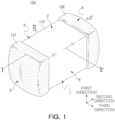
- a first direction may be defined as a direction in which first and second internal electrodes are alternately disposed with the dielectric layer interposed therebetween, or a thickness T direction, and among second and third directions perpendicular to the first direction, a second direction may be defined as a length L direction, and a third direction may be defined as a width W direction.
- FIG. 1 is a perspective view schematically illustrating a multilayer electronic component according to an exemplary embodiment of the present disclosure.
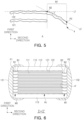
- FIG. 2 is a cross-sectional view taken along line I-I' of FIG 1 .
- FIG. 3 is a cross-sectional view taken along line II-II' of FIG. 1 .
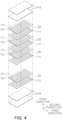
- FIG. 4 is an exploded perspective view illustrating a body according to an exemplary embodiment of the present disclosure.
- FIG. 5 is an enlarged schematic view of region A of FIG. 2 .
- FIG. 6 is a cross-sectional view taken along line I-I' of FIG. 1 corresponding to an exemplary embodiment.
- FIG. 7 is an enlarged schematic view of r'gion A' of FIG. 6 .
- FIG. 8 is a schematic view illustrating a method of determining a straight line L1 according to an exemplary embodiment.
- FIGS. 1 to 5 and 8 a multilayer electronic component 100 according to an exemplary embodiment of the present disclosure will be described in detail with reference to FIGS. 1 to 5 and 8 .
- a multilayer electronic component 100 includes a dielectric layer 111 and first and second internal electrodes 121 and 122 alternately disposed in the first direction with the dielectric layer 111 interposed therebetween, and including a first surface 1 and a second surface 2 opposing each other in the first direction, a third surface 3 and a fourth surface 4 connected to the first surface 1 and the second surface 2 and opposing each other in the second direction, and a fifth surface 5 and a sixth surface 6 connected to the first to fourth surfaces 1 to 4 and opposing each other in the third direction; a first external electrode 131 disposed on the third surface 3 and connected to the first internal electrode 121; and a second external electrode 132 disposed on the fourth surface 4 and connected to the second internal electrode 122, and the first internal electrode 121 is connected to the third surface 3 and is spaced apart from the fourth surface 4, the second internal electrode 122 is connected to the fourth surface 4 and is spaced apart from the third surface 3, the first internal electrode 121 includes a first bent portion B1 bent in
- the body 110 includes the dielectric layer 111 and the internal electrodes 121 and 122 alternately disposed with the dielectric layer 111.
- the body 110 may have a hexahedral shape or a shape similar thereto. Due to the shrinkage of ceramic powder particles included in the body 110 during a sintering process, the body 110 is not a hexahedral shape with a complete straight line, but may have a substantially hexahedral shape.
- the body 110 may have a first surface 1 and a second surface 2 opposing each other in the first direction, a third surface 3 and a fourth surface 4 connected to the first surface 1 and the second surface 2 and opposing each other in the second direction, a fifth surface 5 and a sixth surface 6 connected to the first surface 1 and the second surface 2, connected to the third surface 3 and the fourth surface 4, and opposing each other in the third direction.
- a boundary between adjacent dielectric layers 111 may be integrated to the extent that the boundary may be difficult to confirm without using a scanning electron microscope (SEM).
- materials for forming the dielectric layer 111 is not particularly limited as long as they can obtain sufficient capacitance.
- a barium titanate-based material, a lead composite perovskite-based material, or a strontium titanate-based material may be used as the materials therefor.
- the barium titanate-based material may include BaTiO 3 -based ceramic powder particles, and examples of the ceramic powder particles may include BaTiO 3 , (Ba 1-x Ca x )TiO 3 (0 ⁇ x ⁇ 1), Ba(Ti 1-y Ca y )O 3 (0 ⁇ y ⁇ 1), (Ba 1-x Ca x )(Ti 1-y Zr y )O 3 (0 ⁇ x ⁇ 1, 0 ⁇ y ⁇ 1) or Ba(Ti 1-y Zr y )O 3 (0 ⁇ y ⁇ 1) which is formed by partially employing calcium (Ca) and zirconium (Zr) in BaTiO 3 , or the like.
- the ceramic powder particles may include BaTiO 3 , (Ba 1-x Ca x )TiO 3 (0 ⁇ x ⁇ 1), Ba(Ti 1-y Ca y )O 3 (0 ⁇ y ⁇ 1), (Ba 1-x Ca x )(Ti 1-y Zr y )O 3 (0 ⁇ x ⁇ 1, 0 ⁇ y ⁇ 1) or Ba
- various ceramic additives, organic solvents, binders, dispersants, and the like may be added to powder particles such as barium titanate (BaTiO 3 ) depending on the purpose of the present disclosure.
- the body 110 may include a capacitance formation portion Ac which is disposed in the body 110 and is a region in which the first and second internal electrodes 121 and 122 overlap each other in the first direction.
- the capacitance formation portion Ac is a portion that contributes to a capacitance formation of a capacitor, and may be formed by repeatedly stacking a plurality of first and second internal electrodes 121 and 122 with the dielectric layer 111 interposed therebetween.
- an upper cover portion 112 may be disposed on one surface of the capacitance formation portion Ac in the first direction, and a lower cover portion 113 may be disposed on the other surface of the capacitance formation portion Ac in the first direction.
- the upper cover portion 112 and the lower cover portion 113 may be formed by stacking a single dielectric layer or two or more dielectric layers on the upper and lower surfaces of the capacitance formation portion Ac in a thickness direction, and may basically serve to prevent damage to the internal electrodes due to physical or chemical stress.
- the upper cover portion 112 and the lower cover portion 113 do not include the internal electrodes, and may include the same material as the dielectric layer 111.
- the upper cover portion 112 and the lower cover part 113 portion may include a ceramic material, and may include, for example, a barium titanate (BaTiO 3 )-based ceramic material.
- an average thickness of the cover portions 112 and 113 needs not be particularly limited. However, in order to more easily achieve high capacitance of the multilayer electronic component, the average thickness tc of the cover portion 112 and 113 may be 70 um or more and 180 um or less. Here, the average thickness of the cover portions 112 and 113 may denote an average thickness of each of the first cover portion 112 and the second cover portion 113.
- the average thickness of the cover portions 112 and 113 may denote a size in the first direction, and may be a value obtained by averaging first directional sizes of the cover portions 112 and 113 measured at five points spaced apart from each other at equal intervals in an upper portion or a lower portion of the capacitance formation portion Ac.
- a second margin portion M2 may be disposed on one surface and the other surface of the capacitance formation portion Ac in the third direction.
- the second margin portion M2 may be disposed on a surface facing the body 110 in the third direction (width direction).
- the second margin portion M2 may denote a third directional region between both ends of the first and second internal electrodes 121 and 122 and a boundary surface of the body 110.
- the second margin portion M2 may basically serve to prevent damage to the internal electrode due to physical or chemical stress.
- the second margin portion M2 may be formed by applying a conductive paste except for a region in which the margin portion will be formed on a ceramic green sheet, and forming the internal electrode.
- the internal electrodes 121 and 122 may be stacked and then cut to be exposed to the fifth surface 5 and the sixth surface 6 of the body 110, and then, the second margin portion M2 may be formed by stacking a single dielectric layer or two or more dielectric layers on both side surfaces of the capacitance formation portion Ac in the third direction (width direction).
- an average width of the second margin portion M2 is not particularly limited. However, in order to increase the capacitance of the multilayer electronic component, the average width of the second margin portion M2 may be, preferably, 70 um or more and 170 um or less.
- the average width of the second margin portion M2 may denote an average size of the second machining part M2 in the third direction, and may be a value obtained by averaging third directional sizes of the second margin portion M2 measured at five points spaced apart from each other at equal intervals on a side surface of the capacitance formation portion Ac.
- the internal electrodes 121 and 122 are alternately disposed with the dielectric layer 111 in the first direction.
- the internal electrodes 121 and 122 may include first and second internal electrodes 121 and 122.
- the first and second internal electrodes 121 and 122 may be alternately disposed to oppose each other with the dielectric layer 111 forming the body 110 interposed therebetween, and may be connected to the third surface 3 and the fourth surface 4 of the body 110, respectively.
- one end of the first internal electrode 121 may connected to the third surface 3, and one end of the second internal electrode 122 may be connected to the fourth surface 4. That is, in an exemplary embodiment, the internal electrodes 121 and 122 may be in contact with the third surface 3 or the fourth surface 4.
- the first internal electrode 121 may be spaced apart from the fourth surface 4 and may be exposed through the third surface 3, and the second internal electrode 122 may be spaced apart from the third surface 3 and may be exposed through the fourth surface 4.
- the first external electrode 131 may be disposed on the third surface 3 of the body 110 and connected to the first internal electrode 121, and the second external electrode 132 may be disposed on the fourth surface 4 of the body 110 and connected to the second internal electrode 122.
- the first internal electrode 121 is not connected to the second external electrode 132 and is connected to the first external electrode 131
- the second internal electrode 122 is not connected to the first external electrode 131 and is connected to the second external electrode 132.
- the first internal electrode 121 may be formed to be spaced apart from the fourth surface 4 by a predetermined distance
- the second internal electrode 122 may be formed to be spaced apart from the third surface 3 by a predetermined distance.
- the first and second internal electrodes 121 and 122 may be electrically separated from each other by the dielectric layer 111 disposed in the middle.
- a space from an end of the first internal electrode 121 in the second direction to the fourth surface 4, and a space from an end of the second internal electrode 122 in the second direction to the third surface 3 may be referred to as a first margin portion M1.
- the body 110 may be formed by alternately stacking a ceramic green sheet on which the first internal electrode 121 is printed and a ceramic green sheet on which the second internal electrode 122 is printed, and then sintering the ceramic green sheets.
- a material for forming the internal electrodes 121 and 122 is not particularly limited, and a material having excellent electrical conductivity may be used.
- the internal electrodes 121 and 122 may include at least one of nickel (Ni), copper (Cu), palladium (Pd), silver (Ag), gold (Au), platinum (Pt), tin (Sn), tungsten (W), titanium (Ti), and alloys thereof.
- the internal electrodes 121 and 122 may be formed by printing a conductive paste for internal electrodes including at least one of nickel (Ni), copper (Cu), palladium (Pd), silver (Ag), gold (Au), platinum (Pt), tin (Sn), tungsten (W), titanium (Ti) and alloys thereof, on the ceramic green sheet.
- a method of printing the conductive paste for the internal electrodes may be a screen printing method, a gravure printing method, but the present disclosure is not limited thereto.
- the external electrodes 131 and 132 may be disposed on the third surface or the fourth surface of the body 110. Specifically, the first external electrode 131 is disposed on the third surface 3 and connected to the first internal electrode 121, and the second external electrode 132 is disposed on the fourth surface 4 and connected to the second internal electrode 122.
- this exemplary embodiment describes a structure in which the multilayer electronic component 100 has two external electrodes 131 and 132, but the number or shape of the external electrodes 131 and 132 may vary, according to the shape of the internal electrodes 121 and 122 or other purpose.
- the external electrodes 131 and 132 may be formed using any material as long as the material has electrical conductivity such as metal, and a specific material may be determined in consideration of electrical characteristics, structural stability, and the like, and also, the external electrodes 131 and 132 may have a multilayer structure.
- the external electrodes 131 and 132 may include an electrode layer disposed on the body 110 and a plating layer formed on the electrode layer.
- the electrode layer may be a sintered electrode including conductive metal and glass, or a resin-based electrode including conductive metal and resin.
- the electrode layer may have a shape in which the sintered electrode and the resin-based electrode are sequentially formed on the body. Furthermore, the electrode layer may be formed by transferring a sheet including the conductive metal on the body, or by transferring a sheet including the conductive metal on the sintered electrode.
- a material having excellent electrical conductivity may be used as the conductive metal included in the electrode layer, and is not particularly limited.
- the conductive metal may be one or more of nickel (Ni), copper (Cu), and alloys thereof.
- the plating layer serves to improve mounting properties.
- the type of the plating layer is not particularly limited, and may be a plating layer including at least one of Ni, Sn, Pd and alloys thereof, and the plating layer may be formed of a plurality of layers.
- the plating layer may be a Ni plating layer or a Sn plating layer, may be a form in which the Ni plating layer and the Sn plating layer are sequentially formed on the electrode layer, and may be a form in which the Sn plating layer, the Ni plating layer, and the Sn plating layer are sequentially formed thereon.
- the plating layer may include a plurality of Ni plating layers and/or a plurality of Sn plating layers.
- the first internal electrode 121 includes a first bent portion B1 bent in a region adjacent to the third surface 3, and the second internal electrode 2 includes a second bent portion B2 bent in a region adjacent to the fourth surface 4.
- margin portions having different stacking degrees of the internal electrodes may be formed in the body of the multilayer electronic component, and a bent portion may be formed in the internal electrode included in the margin portion by passing through processes such as a stacking process and a compression cutting process. Since the bent portion of the internal electrode is a portion in which the external electrode is formed at an end, it may be vulnerable to external moisture penetration. Accordingly, as the bent portion is formed in the internal electrode, moisture resistance reliability of the multilayer electronic component may be weak.
- an angle of the bent portion is intended to be controlled so as not to decrease the moisture resistance reliability of the multilayer electronic component 100.
- FIG. 5 is an enlarged schematic view of region A of FIG. 2
- FIG. 8 is a schematic view illustrating a method of determining a straight line L1 according to an exemplary embodiment.
- FIG. 5 illustrates that the second internal electrode 122 includes a second bent portion B2 in a region adjacent to the fourth surface 4, but the following description may be similarly understood in a region in which the first internal electrode 121 includes the first bent portion B1 in a region adjacent to the third surface 3.
- a straight line in parallel to the second direction and in contact with the second internal electrodes 121 and 122 may be defined as L1
- a straight line connecting a point P2 at which the second internal electrode 122 is in contact with the fourth surface 4 and the second bent portion B2 may be defined as L2.
- the L1 may be set by adjusting a straight line in parallel with the second direction so that first directional straight lines (D1, D2, D3, ... Dn) obtained by dividing the first or second internal electrodes 121 or 122 into n equal portions in the second direction in the capacitance formation portion Ac as illustrated in FIG. 8 and points (G1, G2, G3, ... Dn) in which a straight line in parallel with the second direction simultaneously meets the first or second internal electrode 121 or 122 are 0.8*n or more.
- L2 may be a straight line connecting the highest point of the second bent portion B2 in the first direction and the highest point at the first direction among the points in which the second internal electrode 122 is in contact with the fourth surface 4.
- tan( T ) when an acute angle formed by L1 and L2 is referred to as T, and an average value of the T is referred to as T , tan( T ) satisfies 0.1 or more and 0.5 or less. Accordingly, moisture resistance reliability of the multilayer electronic component 100 may be improved. When tan( T ) is less than 0.1, since a path of external moisture penetration is not sufficiently blocked, an effect of improving moisture resistance reliability of the multilayer electronic component may be somewhat insufficient.
- delamination may occur along a cut surface during a cutting process of forming the body 110, and a step portion between the capacitance formation portion Ac and the first margin portion M1 may be excessively increased to cause the delamination between the internal electrodes 121 and 122 included in the first margin portion M1 and the dielectric layer 111. Such delamination may reduce the moisture resistance reliability of the multilayer electronic component 100.
- a method of measuring an average value T of the T is not particularly limited.
- the value T is an arithmetic average value of a T value obtained by polishing the multilayer electronic component 100 to a center thereof in the third direction to expose and polish cross sections thereof in the first and second directions, and then dividing a space between an internal electrode disposed at an uppermost end in the first direction and an internal electrode disposed at a lowermost end in the first direction among the first and second internal electrodes 121 and 122 into five equal portions in the first direction, and measuring the second bending portion B2 of any five or more second internal electrodes 122 disposed between 1/5 and 4/5 points with a scanning electron microscope (SEM).
- SEM scanning electron microscope
- the measurement and obtaining an average value of the value T may be further generalized by measuring the first bent portion B1 of the first internal electrode 121 in the same manner.
- the method of adjusting the value T is not particularly limited.
- a method of controlling pressure, time, a stacking degree, composition of a binder, temperature, and the like, may be used.
- a direction in which the first and second bent portions B1 and B2 are bent is not particularly limited.
- the first and second bent portions B1 and B2 may be bent in the first direction through stacking, cutting, and pressing processes in the first direction.
- a stacking degree (i.e., the number of layers) of the first and second internal electrodes 121 and 122 stacked in the body 110 may be 800 layers or more.
- a method of improving the stacking degree of the first and second internal electrodes 121 and 122 may be further increased.
- tan( T ) is adjusted to satisfy 0.1 or more and 0.5 or less, even when the step portion between the capacitance formation portion AC and the first margin portion M1 is increased as the stacking degree of the internal electrode is 800 layers or more, it may be possible to improve the moisture resistance reliability of the multilayer electronic component 100. That is, according to an exemplary embodiment, when the stacking degree of the first and second internal electrodes 121 and 122 is 800 layers or more, the effect of improving moisture resistance reliability according to the present disclosure may be more remarkable.
- FIG. 6 is a cross-sectional view taken along line I-I' of FIG. 1 corresponding to an exemplary embodiment
- FIG. 7 is an enlarged schematic view of region A' of FIG. 6
- two or more first bent portions B1 may be disposed between an end of a second internal electrode 122 in the second direction and the third surface 3 and two or more second bent portions B2 may be disposed between an end of a first internal electrode 121 in the second direction and the fourth surface 4. Accordingly, adhesive force between the dielectric layer 111 and the first and the second internal electrodes 121 and 122 may be improved in a region between the end of the internal electrode in the second direction and the third or fourth surface, thereby further improving the moisture resistance reliability of the multilayer electronic component 100.
- an angle of the bent portion closest to the third surface 3 or the fourth surface 4 among the bent portions may have the greatest influence on moisture resistance reliability. Accordingly, adjusting the angle of the bent portion closest to the third surface 3 or the fourth surface 4 may be effective in improving moisture resistance reliability of the multilayer electronic component 100.
- L2 when two or more first and second bent portions B1 and B2 are formed, L2 may be more specifically defined. Referring to FIG. 7 , L2 may be a straight line connecting a point P2 at which the second internal electrode 122 is in contact with the fourth surface 4 and a second bent portion closest to the fourth surface 4 among two or more second bent portions B2.
- L2 may be a straight line connecting a point P1 at which the first internal electrode 121 is in contact with the third surface 3 and a first bent portion closest to the third surface 3 among two or more first bent portions B1, or a straight line connecting a point P2 at which the second internal electrode 122 is in contact with the fourth surface 4 and a second bent portion closest to the fourth surface 4 among two or more second bent portions B2.
- the point P2 at which the second internal electrode is in contact with the fourth surface 4 may be disposed parallel to the second direction and may be spaced apart from L1, which is a straight line in contact with the second internal electrodes 121 and 122.
- This structure may also be applied between the first internal electrode 121 and the third surface 3. That is, a point at which the first internal electrode 121 is in contact with the third surface 3 may be spaced apart from L1.
- the two or more first and second bent portions B1 and B2 may be disposed at one side in the first direction based on L1.
- L2 may be a straight line connecting the lowest point of the second bent portion B2 in the first direction closest to the fourth surface 4 and the lowest point at the first direction among points in which the second internal electrode 122 is in contact with the fourth surface 4.
- FIGS. 2 , 5 , 6 and 7 of the present disclosure express that the first and second bent portions B1 and B2 are bent in the first direction in specific cross-sections in the first and second directions, this does not denote that the bent portions B1 and B2 are formed only in any one cross-section. That is, the first and second bent portions B1 and B2 may be disposed to extend in the third direction, and more specifically, in order to improve a contact area between the dielectric layer 111 and the internal electrodes 121 and 122, the first and second bent portions B1 and B2 may be disposed to continuously extend in the third direction.
- An average thickness of the first and second internal electrodes 121 and 122 and an average thickness of the dielectric layer 111 may have various values. Specifically, for an IT multilayer electronic component, the average thickness of the first and second internal electrodes 121 and 122 and the average thickness of the dielectric layer 111 may be 0.35 um or less, respectively, and a high voltage electric and electronic multilayer electronic component may have an average thickness of the first and second internal electrodes 121 and 122 and an average thickness of the dielectric layer 111 larger than those of the IT multilayer electronic component.
- a major issue for the high voltage electric and electronic multilayer electronic component is a decrease in reliability due to a decrease in insulation breakdown voltage under a high-voltage environment.
- te an average thickness of the first and second internal electrodes 121 and 122
- td an average thickness of the dielectric layer 111
- td > 2 ⁇ te may be satisfied to increase a thickness td of the dielectric layer 111 as a distance between the internal electrodes 121 and 122, thereby improving insulation breakdown voltage characteristics.
- an absolute value of the average thickness of the first and second internal electrodes 121 and 122 and the average thickness of the dielectric layer 111 is not particularly limited.
- te when the average thickness of the first and second internal electrodes 121 and 122 is referred to as te and the average thickness of the dielectric layer 111 is referred as td, te may be less than 1 ⁇ m, and td may be 2.8 ⁇ m.
- the average thickness td of the dielectric layer 111 may denote a first directional average size of the dielectric layer 111 disposed between the first and second internal electrodes 121 and 122. Meanwhile, when the body 110 includes a plurality of dielectric layers 111, the average thickness td of the dielectric layer 111 may denote an average thickness of at least one of a plurality of dielectric layers 111.
- the average thickness td of the dielectric layer 111 may be measured by scanning an image of a cross-section of the body 110 in a length and thickness (L-T) direction with a scanning electron microscope (SEM) of 10,000 ⁇ magnification. More specifically, an average value may be measured by measuring the thickness at 30 points of one dielectric layer in the scanned image, which are spaced apart from each other at equal intervals in a length direction. The 30 points spaced apart from each other at equal intervals may be designated in the capacitance formation portion Ac.
- the average thickness of the dielectric layer may be further generalized. For the average thickness td of the dielectric layer 111, other measurement methods and/or tools appreciated by one of ordinary skill in the art, even if not described in the present disclosure, may also be used.
- An average thickness te of the internal electrodes 121 and 122 may denote an average size of the internal electrodes 121 and 122 in the first direction. Meanwhile, when the body 110 includes a plurality of internal electrodes 121 and 122, an average thickness td of the internal electrodes 121 and 122 may denote an average thickness of at least one of the plurality of internal electrodes 121 and 122.
- the average thickness of the internal electrodes 121 and 122 may be measured by scanning an image of a cross-section of the body 110 in a length and thickness (L-T) direction with a scanning electron microscope (SEM) of 10,000X magnification. More specifically, an average value may be measured by measuring the thickness at 30 points of one internal electrode in the scanned image, which are spaced apart from each other at equal intervals in a length direction. The 30 points spaced apart from each other at equal intervals may be designated in the capacitance formation portion Ac.
- the average thickness of the dielectric layer may be further generalized.
- other measurement methods and/or tools appreciated by one of ordinary skill in the art, even if not described in the present disclosure may also be used.
- an average width of the first margin portion may be 70 um to 170 um. Accordingly, moisture resistance reliability of the multilayer electronic component 100 may be improved simultaneously with securing sufficient capacitance.
- barium titanate powder particles, ethanol as an organic solvent, and polyvinyl butyral as a binder were mixed, and ball-milled to produce a ceramic slurry, and a ceramic green sheet was produced using the ceramic slurry.
- a conductive paste for an internal electrode including nickel was printed on a ceramic green sheet to form an internal electrode, and a green laminate in which the internal electrode was stacked was subjected to isostatic compression molding by changing pressure and temperature conditions for each test number.
- the compressed green laminate was cut to make a green chip, and after a debinding process in which the cut green chip was maintained at 340°C for 60 hours or more under atmospheric conditions, the green chip was sintered at 1100°C or higher to produce a sintered chip. Sintering was performed in a reducing atmosphere to prevent oxidation of the internal electrode.
- An electrode layer was formed on the outside of the sintered chip using an external electrode paste including copper powder particles and glass powder particles, and a nickel plating layer and a tin plating layer were formed on the electrode layer through electroplating.
- the characteristics of the multilayer electronic component manufactured according to the method were evaluated as follows.
- a tan ( T ) value was adjusted by controlling the pressure and temperature during the isostatic compression molding process, and a reliability evaluation of moisture resistance was conducted according to the tan ( T ) value and is shown in Table 1.
- the reliability evaluation of moisture resistance was conducted for 15 hours for 750 samples of a multilayer electronic component per test number under an environment having a temperature of 85°C, relative humidity of 85%, and 1.5Vr, and a sample in which a value of insulation resistance was reduced 10 ⁇ 7 times from an initial value was determined as a defective product.
- Tan( T ) was confirmed by selecting 30 samples from 750 samples for each test number, measuring T and obtaining average values thereof. Specifically, after polishing a sample to a center thereof in the third direction to expose surfaces in the first and second directions, in a region in which a space between an internal electrode disposed at an uppermost end and an internal electrode disposed at a lowermost end in the first direction was divided into five equal portions in the first direction among the first and second internal electrodes 121 and 122, the arithmetic mean value was calculated by measuring T, respectively, using a scanning electron microscope (SEM). The value T measured in one sample was conducted in the same manner in 30 samples, and an average value was obtained again and a tan value was obtained.
- SEM scanning electron microscope
- T was measured for the bent portion closest to the third or fourth surface of the body.
- Table 1 Test Number tan ( T )
- Moisture resistance reliability (number of defective products/total number of samples) 1 0.1 0/750 2 0.2 0/750 3 0.3 0/750 4 0.4 0/750 5 0.5 0/750 6 0.6 1/750 7 0.7 2/750 8 0.8 1/750 9 0.9 8/750 10 1 11/750
- the tan( T ) value exceeds 0.5, an effect of improving the moisture resistance reliability is reduced, and with an increase in the tan( T ) value, the moisture resistance reliability decreases. This is expected to be a result of delamination due to cutting or a step portion as the tan( T ) value exceeds 0.5.
- the tan ( T ) value may be adjusted to 0.1 or more and 0.5 or less as in an exemplary embodiment of the present disclosure, thereby improving the moisture resistance reliability of the multilayer electronic component 100.
- the expression 'an exemplary embodiment' used in the present disclosure does not denote the same exemplary embodiment, and is provided to emphasize and explain different unique characteristics.
- the exemplary embodiments presented above do not preclude being implemented in combination with the features of another embodiment.
- the items described in a specific embodiment are not described in another embodiment, the items may be understood as a description related to another embodiment unless a description opposite or contradictory to the items is in another embodiment.
Landscapes
- Engineering & Computer Science (AREA)
- Power Engineering (AREA)
- Manufacturing & Machinery (AREA)
- Microelectronics & Electronic Packaging (AREA)
- Chemical & Material Sciences (AREA)
- Ceramic Engineering (AREA)
- Inorganic Chemistry (AREA)
- Materials Engineering (AREA)
- Ceramic Capacitors (AREA)
- Fixed Capacitors And Capacitor Manufacturing Machines (AREA)
Applications Claiming Priority (1)
| Application Number | Priority Date | Filing Date | Title |
|---|---|---|---|
| KR1020230019938A KR20240127042A (ko) | 2023-02-15 | 2023-02-15 | 적층형 전자 부품 |
Publications (2)
| Publication Number | Publication Date |
|---|---|
| EP4418288A2 true EP4418288A2 (de) | 2024-08-21 |
| EP4418288A3 EP4418288A3 (de) | 2025-01-22 |
Family
ID=89619908
Family Applications (1)
| Application Number | Title | Priority Date | Filing Date |
|---|---|---|---|
| EP24152114.5A Pending EP4418288A3 (de) | 2023-02-15 | 2024-01-16 | Biegen des endes der innenelektroden im bereich der schnittstelle zu den aussenelektroden eines mehrschichtigen keramischen elektronikbauteils |
Country Status (5)
| Country | Link |
|---|---|
| US (1) | US20240274355A1 (de) |
| EP (1) | EP4418288A3 (de) |
| JP (1) | JP2024116074A (de) |
| KR (1) | KR20240127042A (de) |
| CN (1) | CN118507257A (de) |
Family Cites Families (6)
| Publication number | Priority date | Publication date | Assignee | Title |
|---|---|---|---|---|
| US4618911A (en) * | 1984-11-19 | 1986-10-21 | Sfe Technologies | End termination for chip capacitor |
| JP3544569B2 (ja) * | 1994-11-24 | 2004-07-21 | 京セラ株式会社 | 積層セラミックコンデンサ |
| JPH09260193A (ja) * | 1996-03-26 | 1997-10-03 | Taiyo Yuden Co Ltd | 積層コンデンサ |
| JP2003045740A (ja) * | 2001-07-30 | 2003-02-14 | Kyocera Corp | 積層型電子部品 |
| KR102064009B1 (ko) * | 2013-01-21 | 2020-01-08 | 삼성전기주식회사 | 적층 세라믹 커패시터 및 적층 세라믹 커패시터의 실장 기판 |
| JP2015111650A (ja) * | 2013-10-30 | 2015-06-18 | 株式会社村田製作所 | 積層セラミック電子部品及びマザーのセラミック積層体 |
-
2023
- 2023-02-15 KR KR1020230019938A patent/KR20240127042A/ko active Pending
-
2024
- 2024-01-12 JP JP2024003511A patent/JP2024116074A/ja active Pending
- 2024-01-16 EP EP24152114.5A patent/EP4418288A3/de active Pending
- 2024-01-19 US US18/417,590 patent/US20240274355A1/en active Pending
- 2024-02-08 CN CN202410176612.XA patent/CN118507257A/zh active Pending
Also Published As
| Publication number | Publication date |
|---|---|
| US20240274355A1 (en) | 2024-08-15 |
| CN118507257A (zh) | 2024-08-16 |
| JP2024116074A (ja) | 2024-08-27 |
| KR20240127042A (ko) | 2024-08-22 |
| EP4418288A3 (de) | 2025-01-22 |
Similar Documents
| Publication | Publication Date | Title |
|---|---|---|
| US11476047B2 (en) | Multilayer electronic component | |
| US11664164B2 (en) | Multilayer electronic component | |
| EP4394822B1 (de) | Mehrschichtiges keramisches elektronisches komponent, dessen innere elektrodenschichten nickel (ni) und zinn (sn) enthalten und in der nähe des deckels eine grössere konzentration von zinn (sn) aufweisen als in der mitte des körpers | |
| KR20240091624A (ko) | 적층형 전자 부품 | |
| US20220230809A1 (en) | Multilayer electronic component | |
| US20250132093A1 (en) | Multilayer electronic component | |
| US12148570B2 (en) | Multilayer electronic component | |
| US12278057B2 (en) | Ceramic electronic component including barium calcium titanate | |
| EP4418288A2 (de) | Biegen des endes der innenelektroden im bereich der schnittstelle zu den aussenelektroden eines mehrschichtigen keramischen elektronikbauteils | |
| US20250118490A1 (en) | Multilayer electronic component | |
| US20240290542A1 (en) | Multilayer electronic component | |
| EP4404223A2 (de) | Mehrschichtiges elektronisches bauteil | |
| US20250218681A1 (en) | Multilayer electronic component | |
| US20250218670A1 (en) | Multilayer electronic component | |
| KR102473419B1 (ko) | 적층 세라믹 전자부품 | |
| EP4579700A1 (de) | Mehrschichtiges elektronisches bauteil | |
| US20250201480A1 (en) | Multilayer electronic component | |
| EP4415012A1 (de) | Mehrschichtiges elektronisches bauteil | |
| KR102921396B1 (ko) | 적층형 전자 부품 | |
| US20250166911A1 (en) | Multilayer electronic component | |
| KR20240137967A (ko) | 적층형 전자 부품 | |
| KR20230124372A (ko) | 적층 세라믹 커패시터 | |
| KR20240092272A (ko) | 적층형 전자 부품 | |
| KR20250056702A (ko) | 적층형 전자 부품 | |
| KR20250083918A (ko) | 적층형 전자 부품 |
Legal Events
| Date | Code | Title | Description |
|---|---|---|---|
| PUAI | Public reference made under article 153(3) epc to a published international application that has entered the european phase |
Free format text: ORIGINAL CODE: 0009012 |
|
| STAA | Information on the status of an ep patent application or granted ep patent |
Free format text: STATUS: THE APPLICATION HAS BEEN PUBLISHED |
|
| AK | Designated contracting states |
Kind code of ref document: A2 Designated state(s): AL AT BE BG CH CY CZ DE DK EE ES FI FR GB GR HR HU IE IS IT LI LT LU LV MC ME MK MT NL NO PL PT RO RS SE SI SK SM TR |
|
| PUAL | Search report despatched |
Free format text: ORIGINAL CODE: 0009013 |
|
| AK | Designated contracting states |
Kind code of ref document: A3 Designated state(s): AL AT BE BG CH CY CZ DE DK EE ES FI FR GB GR HR HU IE IS IT LI LT LU LV MC ME MK MT NL NO PL PT RO RS SE SI SK SM TR |
|
| RIC1 | Information provided on ipc code assigned before grant |
Ipc: H01G 4/12 20060101ALI20241218BHEP Ipc: H01G 4/30 20060101ALI20241218BHEP Ipc: H01G 4/232 20060101ALI20241218BHEP Ipc: H01G 4/012 20060101ALI20241218BHEP Ipc: H01G 4/008 20060101AFI20241218BHEP |
|
| STAA | Information on the status of an ep patent application or granted ep patent |
Free format text: STATUS: REQUEST FOR EXAMINATION WAS MADE |
|
| 17P | Request for examination filed |
Effective date: 20250722 |