EP4516933A1 - Control method and control device for blast furnace - Google Patents
Control method and control device for blast furnace Download PDFInfo
- Publication number
- EP4516933A1 EP4516933A1 EP23839303.7A EP23839303A EP4516933A1 EP 4516933 A1 EP4516933 A1 EP 4516933A1 EP 23839303 A EP23839303 A EP 23839303A EP 4516933 A1 EP4516933 A1 EP 4516933A1
- Authority
- EP
- European Patent Office
- Prior art keywords
- blast furnace
- solidified layer
- residual solidified
- temperature distribution
- estimated
- Prior art date
- Legal status (The legal status is an assumption and is not a legal conclusion. Google has not performed a legal analysis and makes no representation as to the accuracy of the status listed.)
- Pending
Links
Images
Classifications
-
- C—CHEMISTRY; METALLURGY
- C21—METALLURGY OF IRON
- C21B—MANUFACTURE OF IRON OR STEEL
- C21B7/00—Blast furnaces
- C21B7/24—Test rods or other checking devices
-
- C—CHEMISTRY; METALLURGY
- C21—METALLURGY OF IRON
- C21B—MANUFACTURE OF IRON OR STEEL
- C21B5/00—Making pig-iron in the blast furnace
- C21B5/006—Automatically controlling the process
-
- C—CHEMISTRY; METALLURGY
- C21—METALLURGY OF IRON
- C21B—MANUFACTURE OF IRON OR STEEL
- C21B5/00—Making pig-iron in the blast furnace
- C21B5/008—Composition or distribution of the charge
-
- C—CHEMISTRY; METALLURGY
- C21—METALLURGY OF IRON
- C21B—MANUFACTURE OF IRON OR STEEL
- C21B2300/00—Process aspects
- C21B2300/04—Modeling of the process, e.g. for control purposes; CII
-
- Y—GENERAL TAGGING OF NEW TECHNOLOGICAL DEVELOPMENTS; GENERAL TAGGING OF CROSS-SECTIONAL TECHNOLOGIES SPANNING OVER SEVERAL SECTIONS OF THE IPC; TECHNICAL SUBJECTS COVERED BY FORMER USPC CROSS-REFERENCE ART COLLECTIONS [XRACs] AND DIGESTS
- Y02—TECHNOLOGIES OR APPLICATIONS FOR MITIGATION OR ADAPTATION AGAINST CLIMATE CHANGE
- Y02P—CLIMATE CHANGE MITIGATION TECHNOLOGIES IN THE PRODUCTION OR PROCESSING OF GOODS
- Y02P10/00—Technologies related to metal processing
- Y02P10/20—Recycling
Definitions
- Patent Literature 1 for a shutdown of a blast furnace for a long period of time, a method is proposed to inhibit expansion of the furnace body steel shell caused by solidified pig iron expanded upon restarting due to insertion of shrinkable mortar into a gap formed by cooling and shrinking of the pig iron causing entrance of coke or the like into the gap.
- Patent Literature 2 for a shutdown of a blast furnace for a long period of time, a method is proposed to carry equipment into the blast furnace to mechanically scrape out residues in the blast furnace.
- the present invention has been made to solve the above problems, and an object of the present invention is to provide a control method and a control device for a blast furnace that are configured to suppress application of a stress equal to or larger than an allowable value to a furnace body steel shell of the blast furnace upon restarting the blast furnace, without charging a measure into the blast furnace.
- a control method for a blast furnace includes the steps of: estimating a temperature distribution in a residual solidified layer in restarting a blast furnace by using a temperature distribution estimation model for the residual solidified layer; estimating an expansion behavior of the residual solidified layer by using an expansion estimation model for the residual solidified layer according to an estimated temperature distribution, and estimating a stress applied to a furnace body steel shell of the blast furnace according to the estimated expansion behavior of the residual solidified layer; and controlling, when the estimated stress is equal to or larger than an allowable value, an increase rate in the number of blast tuyeres to be opened to a predetermined value or less and controlling a position of a taphole from which molten metal is discharged.
- a step of correcting the temperature distribution estimation model and the expansion estimation model depending on a difference between a measured value and an estimated value of the stress applied to the furnace body steel shell of the blast furnace may be included.
- a control device for a blast furnace includes: means for estimating a temperature distribution in a residual solidified layer in restarting a blast furnace by using a temperature distribution estimation model for the residual solidified layer; means for estimating an expansion behavior of the residual solidified layer by using an expansion estimation model for the residual solidified layer according to an estimated temperature distribution, and estimating a stress applied to a furnace body steel shell of the blast furnace according to the estimated expansion behavior of the residual solidified layer; and means for controlling, when the estimated stress is equal to or larger than an allowable value, an increase rate in the number of blast tuyeres to be opened to a predetermined value or less and controlling a position of a taphole from which molten metal is discharged.
- control method and the control device for the blast furnace of the present invention it is possible to suppress application of the stress equal to or larger than the allowable value to the furnace body steel shell of the blast furnace upon restarting the blast furnace without charging the measure into the blast furnace.
- a blast furnace control device according to an embodiment of the present invention will be described below with reference to the drawings.
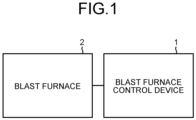
- FIG. 1 is a block diagram illustrating the configuration of the blast furnace control device according to an embodiment of the present invention.
- the blast furnace control device 1 includes an information processing device such as a computer.
- an arithmetic processing device such as a CPU in the information processing device executes a computer program to control an operation state of a blast furnace 2.
- the blast furnace control device 1 having such a configuration performs a blast furnace control process described below to suppress application of a stress equal to or larger than an allowable value to a furnace body steel shell of the blast furnace 2 upon restarting the blast furnace 2, without charging a measure into the blast furnace 2.
- a blast furnace control process described below to suppress application of a stress equal to or larger than an allowable value to a furnace body steel shell of the blast furnace 2 upon restarting the blast furnace 2, without charging a measure into the blast furnace 2.
- FIG. 2 the operation of the blast furnace control device 1 upon performing the blast furnace control process will be described with reference to FIG. 2 .
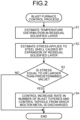
- FIG. 2 is a flowchart illustrating a procedure of the blast furnace control process according to an embodiment of the present invention.
- the flowchart illustrated in FIG. 2 starts at the timing when an instruction on restarting is given after shutdown of the blast furnace 2, and the blast furnace control process proceeds to the processing of Step S1.
- the blast furnace control device 1 estimates a temperature distribution in a residual solidified layer due to heating of the residual solidified layer in a region ranging from immediately below an opening tuyere of the blast furnace 2 to an operating taphole, on the assumption that molten metal flows from immediately below the opening tuyere of the blast furnace 2 to the operating taphole. Specifically, the blast furnace control device 1 estimates the temperature distribution in the residual solidified layer by using equations of transient heat conduction illustrated in the following Formulas (1) and (2) as basic equations.
- T is a temperature (K)
- t is a time (s)
- x, y, and z are coordinates (m)
- ⁇ is a heat conductivity (W/(m ⁇ K)) of the region
- C p is a specific heat (J/(kg ⁇ K)) of the region
- ⁇ is a density (kg/m 3 ) of the region.
- peripheral boundary conditions are determined in consideration of heat transfer from a hearth cooling pipe for a furnace bottom, heat transfer from side wall cooling for an outer peripheral portion, and heat transfer of molten metal from a portion corresponding to a lower portion from the opening tuyere for a contact surface between the molten metal and the solidified layer, by changing heat transfer coefficients thereof depending on an operation state. Therefore, the processing of Step S1 is completed, and the blast furnace control process proceeds to the processing of Step S2.
- the blast furnace control device 1 estimates an expansion behavior of the residual solidified layer by using an expansion estimation model, according to the temperature distribution in the residual solidified layer estimated in the processing of Step S1. Specifically, the blast furnace control device 1 gives a temperature change ⁇ T to the structure on the basis of the temperature distribution in the residual solidified layer estimated in the processing of Step S1, and estimates thermal strain (thermal stress) at each portion of the structure by using a Hooke's law indicated in the following Formula (3).
- ⁇ i is a strain (-) in an i-direction of the structure
- E is a Young's modulus (kPa)
- ⁇ i is a stress (kPa) in the i-direction of the structure
- ⁇ T is a temperature change (K)
- ⁇ is a thermal expansion coefficient (1/K)
- v is a Poisson's ratio (-)
- ⁇ j is a stress (kPa) in a j-direction
- ⁇ k is a stress (kPa) in a k-direction.
- Step S2 1 E ⁇ i ⁇ v ⁇ j + ⁇ k + ⁇ T ⁇
- the blast furnace control device 1 determines whether the stress applied to the furnace body steel shell estimated in the processing of Step S2 is equal to or larger than a predetermined value (allowable value). As a result of the determination, when the stress applied to the furnace body steel shell is equal to or larger than the predetermined value (Step S3: Yes), the blast furnace control device 1 proceeds to the processing of Step S4 of the blast furnace control process. Meanwhile, when the stress applied to the furnace body steel shell is less than the predetermined value (Step S3: No), the blast furnace control device 1 finishes a series of the steps of the blast furnace control process.
- a predetermined value allowable value
- the blast furnace control device 1 controls an increase rate in the number of blast tuyeres to be opened to a predetermined value or less and controls the position of a taphole from which molten metal is discharged. Controlling the increase rate in the number of blast tuyeres to be opened to the predetermined value or less makes it possible to suppress heating of a wide range of the residual solidified layer. In addition, controlling the position of the taphole from which molten metal is discharged makes it possible to intensively heat the residual solidified layer to promote melting of the residual solidified layer.
- the taphole through which molten metal is discharged is preferably positioned near a blast tuyere opened. This processing makes it possible to relax the stress applied to the furnace body steel shell.
- Step S4 the processing of Step S4 is completed, and the series of the steps of the blast furnace control processes is finished.
- the blast furnace control device 1 estimates the temperature distribution in the residual solidified layer in restarting the blast furnace 2 by using a temperature distribution estimation model for the residual solidified layer, estimates the expansion behavior of the residual solidified layer by using the expansion estimation model for the residual solidified layer according to the estimated temperature distribution, and estimates the stress applied to the furnace body steel shell of the blast furnace 2 according to the estimated expansion behavior of the residual solidified layer, and when the estimated stress is equal to or larger than the predetermined value, the blast furnace control device 1 controls the increase rate in the number of blast tuyeres to be opened to the predetermined value or less and controls the position of the taphole from which the molten metal is discharged, therefore, suppressing application of the stress equal to or larger than the allowable value to the furnace body steel shell of the blast furnace upon restarting the blast furnace 2, without charging the measure into the blast furnace 2.
- a stress sensor may be installed in the furnace body to measure the stress applied to the furnace body steel shell so as to correct the temperature distribution estimation model or the expansion estimation model when there is a difference equal to or larger than the allowable value between a measured value and an estimated value of the stress.
- the temperature distribution in the residual solidified layer estimated by the temperature distribution estimation model is preferably compared with data of several thermometers installed at the furnace bottom to correct a cooling condition (heat transfer coefficient) of the temperature distribution estimation model so that the temperature distribution in the residual solidified layer approaches the data of the thermometer.
- a cooling condition heat transfer coefficient
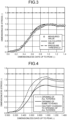
- a stress (actual value) applied to the furnace body steel shell measured by a stress sensor was compared with the stress (calculated value) applied to the furnace body steel shell estimated in the blast furnace control process. Results of the comparison are illustrated in FIG. 3 .
- the number of days nondimensionalized is displayed with the day on which the blast furnace is restarted as 0.0 and the day on which the stress applied to the furnace body steel shell reaches a peak as 1.0. Furthermore, for restarting the blast furnace, the number of blast tuyeres was gradually increased so that all the blast tuyeres were opened in approximately 0.7 dimensionless days.
- FIG. 4 also illustrates an example in which the opening of some tuyeres was performed for 0.6 dimensionless days, and the opening was changed to the opening of all tuyeres upon confirmation of the suppression of the increase in stress, thus reducing a start-up period.
- operation can be performed with a stress less than a prescribed stress, and it was confirmed that this method contributes to shortening the start-up period while protecting the steel shells. From the above descriptions, it was confirmed that the number of openings of the blast tuyeres is effectively controlled while referring to the calculated values of the stress, for the start-up operation from the long-term blowing-down while protecting the furnace body steel shell.
- control method and the control device for the blast furnace that are configured to suppress application of the stress equal to or larger than the allowable value to the furnace body steel shell of the blast furnace upon restarting the blast furnace, without charging the measure into the blast furnace.
Landscapes
- Engineering & Computer Science (AREA)
- Chemical & Material Sciences (AREA)
- Manufacturing & Machinery (AREA)
- Materials Engineering (AREA)
- Metallurgy (AREA)
- Organic Chemistry (AREA)
- Manufacture Of Iron (AREA)
- Blast Furnaces (AREA)
Abstract
Description
- The present invention relates to a control method and a control device for a blast furnace.
- Shutdown of a blast furnace for a long period of time for production amount adjustment in or large-scale repair of the blast furnace solidifies pig iron remaining in a region below a taphole. Therefore, upon restarting the blast furnace, the solidified pig iron is expanded by heating, a furnace body steel shell is expanded by expansion of the pig iron until the pig iron melts, and stress is applied to the furnace body steel shell. When the stress equal to or larger than an allowable value is applied to the furnace body steel, the furnace body steel shell may be damaged. Therefore, in
Patent Literature 1, for a shutdown of a blast furnace for a long period of time, a method is proposed to inhibit expansion of the furnace body steel shell caused by solidified pig iron expanded upon restarting due to insertion of shrinkable mortar into a gap formed by cooling and shrinking of the pig iron causing entrance of coke or the like into the gap. In addition, inPatent Literature 2, for a shutdown of a blast furnace for a long period of time, a method is proposed to carry equipment into the blast furnace to mechanically scrape out residues in the blast furnace. -
- Patent Literature 1:
JP H1-159308 A - Patent Literature 2:
JP H9-287010 A - However, when a measure, such as the shrinkable mortar or the equipment, is charged into the furnace as in the methods described in
Patent Literature 1 andPatent Literature 2, it is necessary to lower furnace temperature to a temperature suitable for the measure. Therefore, when a shutdown period of the blast furnace is fluid, it may be difficult to restart the blast furnace according to the situation of the blast furnace. Furthermore, when a hole is provided for carrying the equipment in the blast furnace, the hole needs to be processed by welding or the like to be closed before restarting, but a defect may occur from the processed portion and air leakage may occur. - The present invention has been made to solve the above problems, and an object of the present invention is to provide a control method and a control device for a blast furnace that are configured to suppress application of a stress equal to or larger than an allowable value to a furnace body steel shell of the blast furnace upon restarting the blast furnace, without charging a measure into the blast furnace.
- A control method for a blast furnace according to the present invention includes the steps of: estimating a temperature distribution in a residual solidified layer in restarting a blast furnace by using a temperature distribution estimation model for the residual solidified layer; estimating an expansion behavior of the residual solidified layer by using an expansion estimation model for the residual solidified layer according to an estimated temperature distribution, and estimating a stress applied to a furnace body steel shell of the blast furnace according to the estimated expansion behavior of the residual solidified layer; and controlling, when the estimated stress is equal to or larger than an allowable value, an increase rate in the number of blast tuyeres to be opened to a predetermined value or less and controlling a position of a taphole from which molten metal is discharged.
- A step of correcting the temperature distribution estimation model and the expansion estimation model depending on a difference between a measured value and an estimated value of the stress applied to the furnace body steel shell of the blast furnace may be included.
- A control device for a blast furnace, the control device according to the present invention includes: means for estimating a temperature distribution in a residual solidified layer in restarting a blast furnace by using a temperature distribution estimation model for the residual solidified layer; means for estimating an expansion behavior of the residual solidified layer by using an expansion estimation model for the residual solidified layer according to an estimated temperature distribution, and estimating a stress applied to a furnace body steel shell of the blast furnace according to the estimated expansion behavior of the residual solidified layer; and means for controlling, when the estimated stress is equal to or larger than an allowable value, an increase rate in the number of blast tuyeres to be opened to a predetermined value or less and controlling a position of a taphole from which molten metal is discharged.
- According to the control method and the control device for the blast furnace of the present invention, it is possible to suppress application of the stress equal to or larger than the allowable value to the furnace body steel shell of the blast furnace upon restarting the blast furnace without charging the measure into the blast furnace.
-
-
FIG. 1 is a block diagram illustrating a configuration of a blast furnace control device according to an embodiment of the present invention. -
FIG. 2 is a flowchart illustrating a procedure of a blast furnace control process according to an embodiment of the present invention. -
FIG. 3 is a graph illustrating a relationship between measured values and calculated values of stress applied to a furnace body steel shell. -
FIG. 4 is a graph illustrating calculated values of stress applied to a furnace body steel shell with all tuyeres opened, with some tuyeres opened, and with opening of some tuyeres changed to opening of all tuyeres. Description of Embodiments - A blast furnace control device according to an embodiment of the present invention will be described below with reference to the drawings.
- First, a configuration of the blast furnace control device according to an embodiment of the present invention will be described with reference to
FIG. 1 . -
FIG. 1 is a block diagram illustrating the configuration of the blast furnace control device according to an embodiment of the present invention. As illustrated inFIG. 1 , the blastfurnace control device 1 according to the embodiment of the present invention includes an information processing device such as a computer. In the blastfurnace control device 1, an arithmetic processing device such as a CPU in the information processing device executes a computer program to control an operation state of ablast furnace 2. - The blast
furnace control device 1 having such a configuration performs a blast furnace control process described below to suppress application of a stress equal to or larger than an allowable value to a furnace body steel shell of theblast furnace 2 upon restarting theblast furnace 2, without charging a measure into theblast furnace 2. Hereinafter, the operation of the blastfurnace control device 1 upon performing the blast furnace control process will be described with reference toFIG. 2 . -
FIG. 2 is a flowchart illustrating a procedure of the blast furnace control process according to an embodiment of the present invention. The flowchart illustrated inFIG. 2 starts at the timing when an instruction on restarting is given after shutdown of theblast furnace 2, and the blast furnace control process proceeds to the processing of Step S1. - In the processing of Step S1, the blast
furnace control device 1 estimates a temperature distribution in a residual solidified layer due to heating of the residual solidified layer in a region ranging from immediately below an opening tuyere of theblast furnace 2 to an operating taphole, on the assumption that molten metal flows from immediately below the opening tuyere of theblast furnace 2 to the operating taphole. Specifically, the blastfurnace control device 1 estimates the temperature distribution in the residual solidified layer by using equations of transient heat conduction illustrated in the following Formulas (1) and (2) as basic equations. In Formulas (1) and (2), T is a temperature (K), t is a time (s), x, y, and z are coordinates (m), λ is a heat conductivity (W/(m·K)) of the region, Cp is a specific heat (J/(kg·K)) of the region, and ρ is a density (kg/m3) of the region. In addition, peripheral boundary conditions are determined in consideration of heat transfer from a hearth cooling pipe for a furnace bottom, heat transfer from side wall cooling for an outer peripheral portion, and heat transfer of molten metal from a portion corresponding to a lower portion from the opening tuyere for a contact surface between the molten metal and the solidified layer, by changing heat transfer coefficients thereof depending on an operation state. Therefore, the processing of Step S1 is completed, and the blast furnace control process proceeds to the processing of Step S2.

- In the processing of Step S2, the blast
furnace control device 1 estimates an expansion behavior of the residual solidified layer by using an expansion estimation model, according to the temperature distribution in the residual solidified layer estimated in the processing of Step S1. Specifically, the blastfurnace control device 1 gives a temperature change ΔT to the structure on the basis of the temperature distribution in the residual solidified layer estimated in the processing of Step S1, and estimates thermal strain (thermal stress) at each portion of the structure by using a Hooke's law indicated in the following Formula (3). In Formula (3), εi is a strain (-) in an i-direction of the structure, E is a Young's modulus (kPa), σi is a stress (kPa) in the i-direction of the structure, ΔT is a temperature change (K), α is a thermal expansion coefficient (1/K), v is a Poisson's ratio (-), σj is a stress (kPa) in a j-direction, and σk is a stress (kPa) in a k-direction. At this time, in the blastfurnace control device 1, it is assumed that a region of the residual solidified layer having a temperature equal to or higher than a melting point is melted and the region is excluded from the estimation of the expansion behavior. Then, the blastfurnace control device 1 estimates a stress applied to the furnace body steel shell according to the estimated expansion behavior of the residual solidified layer. Therefore, the processing of Step S2 is completed, and the blast furnace control process proceeds to the processing of Step S3.
- In the processing of Step S3, the blast
furnace control device 1 determines whether the stress applied to the furnace body steel shell estimated in the processing of Step S2 is equal to or larger than a predetermined value (allowable value). As a result of the determination, when the stress applied to the furnace body steel shell is equal to or larger than the predetermined value (Step S3: Yes), the blastfurnace control device 1 proceeds to the processing of Step S4 of the blast furnace control process. Meanwhile, when the stress applied to the furnace body steel shell is less than the predetermined value (Step S3: No), the blastfurnace control device 1 finishes a series of the steps of the blast furnace control process. - In the processing of Step S4, the blast
furnace control device 1 controls an increase rate in the number of blast tuyeres to be opened to a predetermined value or less and controls the position of a taphole from which molten metal is discharged. Controlling the increase rate in the number of blast tuyeres to be opened to the predetermined value or less makes it possible to suppress heating of a wide range of the residual solidified layer. In addition, controlling the position of the taphole from which molten metal is discharged makes it possible to intensively heat the residual solidified layer to promote melting of the residual solidified layer. The taphole through which molten metal is discharged is preferably positioned near a blast tuyere opened. This processing makes it possible to relax the stress applied to the furnace body steel shell. During repetition of such operation, the number of openings of the blast tuyeres is increased, and when all the tuyeres are opened or a target number of tuyeres initially set is obtained, the processing of Step S4 is completed, and the series of the steps of the blast furnace control processes is finished. - As is clear from the above description, in the blast furnace control process according to an embodiment of the present invention, the blast
furnace control device 1 estimates the temperature distribution in the residual solidified layer in restarting theblast furnace 2 by using a temperature distribution estimation model for the residual solidified layer, estimates the expansion behavior of the residual solidified layer by using the expansion estimation model for the residual solidified layer according to the estimated temperature distribution, and estimates the stress applied to the furnace body steel shell of theblast furnace 2 according to the estimated expansion behavior of the residual solidified layer, and when the estimated stress is equal to or larger than the predetermined value, the blastfurnace control device 1 controls the increase rate in the number of blast tuyeres to be opened to the predetermined value or less and controls the position of the taphole from which the molten metal is discharged, therefore, suppressing application of the stress equal to or larger than the allowable value to the furnace body steel shell of the blast furnace upon restarting theblast furnace 2, without charging the measure into theblast furnace 2. - A stress sensor may be installed in the furnace body to measure the stress applied to the furnace body steel shell so as to correct the temperature distribution estimation model or the expansion estimation model when there is a difference equal to or larger than the allowable value between a measured value and an estimated value of the stress. Specifically, the temperature distribution in the residual solidified layer estimated by the temperature distribution estimation model is preferably compared with data of several thermometers installed at the furnace bottom to correct a cooling condition (heat transfer coefficient) of the temperature distribution estimation model so that the temperature distribution in the residual solidified layer approaches the data of the thermometer. In addition, when there is a difference equal to or larger than the allowable value between the measured value and the estimated value of the stress even if the temperature distribution estimation model is corrected, it is preferable to correct the expansion coefficient of the residual solidified layer in the expansion estimation model.
- In the present example, a stress (actual value) applied to the furnace body steel shell measured by a stress sensor was compared with the stress (calculated value) applied to the furnace body steel shell estimated in the blast furnace control process. Results of the comparison are illustrated in
FIG. 3 . InFIG. 3 , the number of days nondimensionalized is displayed with the day on which the blast furnace is restarted as 0.0 and the day on which the stress applied to the furnace body steel shell reaches a peak as 1.0. Furthermore, for restarting the blast furnace, the number of blast tuyeres was gradually increased so that all the blast tuyeres were opened in approximately 0.7 dimensionless days. In addition, for 0.5 dimensionless days, molten metal was discharged only from a specific taphole closer to a blast tuyere opened to limit a heated region of the residual solidified layer, thus, alleviating an increase in stress caused by expansion of the residual solidified layer. As illustrated inFIG. 3 , the actual values match the calculated values well. From this result, it was confirmed that, according to the present invention, the stress applied to the furnace body steel shell can be accurately estimated to suppress application of the stress equal to or larger than the allowable value to the furnace body steel shell of theblast furnace 2 upon restarting theblast furnace 2. Next, as illustrated inFIG. 4 , calculated values of the stress applied to the furnace body steel shell were compared between when all the blast tuyeres were opened from restarting (opening of all tuyeres) and when the number of the blast tuyeres to be opened was gradually increased (opening of some tuyeres). As illustrated inFIG. 4 , in the opening of all tuyeres, the entire residual solidified layer was heated from an early stage, and therefore, the stress increased and closely approached a pressure threshold. In contrast, in the opening of some tuyeres, the increase in stress was suppressed. Based on these results,FIG. 4 also illustrates an example in which the opening of some tuyeres was performed for 0.6 dimensionless days, and the opening was changed to the opening of all tuyeres upon confirmation of the suppression of the increase in stress, thus reducing a start-up period. In this example as well, operation can be performed with a stress less than a prescribed stress, and it was confirmed that this method contributes to shortening the start-up period while protecting the steel shells. From the above descriptions, it was confirmed that the number of openings of the blast tuyeres is effectively controlled while referring to the calculated values of the stress, for the start-up operation from the long-term blowing-down while protecting the furnace body steel shell. - Although the embodiments to which the invention made by the present inventors is applied have been described above, the present invention is not limited to the descriptions and drawings constituting part of the disclosure of the present invention according to the present embodiments. In other words, other embodiments, examples, operation techniques, and the like made by those skilled in the art and the like on the basis of the present embodiment are all included in the scope of the present invention.
- According to the present invention, it is possible to provide the control method and the control device for the blast furnace that are configured to suppress application of the stress equal to or larger than the allowable value to the furnace body steel shell of the blast furnace upon restarting the blast furnace, without charging the measure into the blast furnace.
-
- 1 BLAST FURNACE CONTROL DEVICE
- 2 BLAST FURNACE
Claims (3)
- A control method for a blast furnace comprising the steps of:estimating a temperature distribution in a residual solidified layer in restarting a blast furnace by using a temperature distribution estimation model for the residual solidified layer;estimating an expansion behavior of the residual solidified layer by using an expansion estimation model for the residual solidified layer according to an estimated temperature distribution, and estimating a stress applied to a furnace body steel shell of the blast furnace according to the estimated expansion behavior of the residual solidified layer; andcontrolling, when the estimated stress is equal to or larger than an allowable value, an increase rate in the number of blast tuyeres to be opened to a predetermined value or less and controlling a position of a taphole from which molten metal is discharged.
- The control method for a blast furnace according to claim 1, further comprising a step of correcting the temperature distribution estimation model and the expansion estimation model depending on a difference between a measured value and an estimated value of the stress applied to the furnace body steel shell of the blast furnace.
- A control device for a blast furnace, the control device comprising:means for estimating a temperature distribution in a residual solidified layer in restarting a blast furnace by using a temperature distribution estimation model for the residual solidified layer;means for estimating an expansion behavior of the residual solidified layer by using an expansion estimation model for the residual solidified layer according to an estimated temperature distribution, and estimating a stress applied to a furnace body steel shell of the blast furnace according to the estimated expansion behavior of the residual solidified layer; andmeans for controlling, when the estimated stress is equal to or larger than an allowable value, an increase rate in the number of blast tuyeres to be opened to a predetermined value or less and controlling a position of a taphole from which molten metal is discharged.
Applications Claiming Priority (2)
| Application Number | Priority Date | Filing Date | Title |
|---|---|---|---|
| JP2022111106 | 2022-07-11 | ||
| PCT/JP2023/018727 WO2024014126A1 (en) | 2022-07-11 | 2023-05-19 | Control method and control device for blast furnace |
Publications (2)
| Publication Number | Publication Date |
|---|---|
| EP4516933A1 true EP4516933A1 (en) | 2025-03-05 |
| EP4516933A4 EP4516933A4 (en) | 2025-08-27 |
Family
ID=89536510
Family Applications (1)
| Application Number | Title | Priority Date | Filing Date |
|---|---|---|---|
| EP23839303.7A Pending EP4516933A4 (en) | 2022-07-11 | 2023-05-19 | Control method and control device for blast furnace |
Country Status (3)
| Country | Link |
|---|---|
| EP (1) | EP4516933A4 (en) |
| JP (1) | JP7448101B1 (en) |
| WO (1) | WO2024014126A1 (en) |
Family Cites Families (6)
| Publication number | Priority date | Publication date | Assignee | Title |
|---|---|---|---|---|
| JPS6040481B2 (en) * | 1981-04-14 | 1985-09-11 | 川崎製鉄株式会社 | How to fire up a blast furnace after intermediate renovation |
| JPH01159308A (en) | 1987-12-16 | 1989-06-22 | Sumitomo Metal Ind Ltd | Method for protecting hearth at banking time in blast furnace |
| JPH09287010A (en) | 1996-04-19 | 1997-11-04 | Kobe Steel Ltd | Method for scraping out contents in blast furnace |
| JP5904344B2 (en) * | 2014-07-25 | 2016-04-13 | Jfeスチール株式会社 | Blast furnace blast start method and hearth temperature raising burner |
| KR20220154826A (en) * | 2020-04-30 | 2022-11-22 | 제이에프이 스틸 가부시키가이샤 | A method for detecting fluctuations in the solidified layer and a method for operating a blast furnace |
| JP7243677B2 (en) * | 2020-05-15 | 2023-03-22 | Jfeスチール株式会社 | Furnace bottom temperature raising method and blast furnace start-up method |
-
2023
- 2023-05-19 EP EP23839303.7A patent/EP4516933A4/en active Pending
- 2023-05-19 JP JP2023554838A patent/JP7448101B1/en active Active
- 2023-05-19 WO PCT/JP2023/018727 patent/WO2024014126A1/en not_active Ceased
Also Published As
| Publication number | Publication date |
|---|---|
| WO2024014126A1 (en) | 2024-01-18 |
| JP7448101B1 (en) | 2024-03-12 |
| JPWO2024014126A1 (en) | 2024-01-18 |
| EP4516933A4 (en) | 2025-08-27 |
Similar Documents
| Publication | Publication Date | Title |
|---|---|---|
| CN114896546B (en) | A high-precision calculation method for the residual thickness of carbon bricks in blast furnace hearth | |
| JP5482615B2 (en) | Blowing control method in converter | |
| JP4119620B2 (en) | In-furnace situation estimation method for blast furnace | |
| JP7448101B1 (en) | Blast furnace control method and control device | |
| CN114807590B (en) | Billet heating secondary control method and system based on heating furnace | |
| JP7243677B2 (en) | Furnace bottom temperature raising method and blast furnace start-up method | |
| JP7786618B2 (en) | Blast furnace control method and control device | |
| Pal et al. | Mathematical model of COREX melter gasifier: Part II. Dynamic model | |
| JP4752021B2 (en) | Reduced blast operation method of blast furnace | |
| JP7722610B1 (en) | Blast furnace control method and control device | |
| JP4081248B2 (en) | Control method of the lower part of the blast furnace | |
| JP4276563B2 (en) | Blast furnace bottom condition diagnosis method | |
| JP7661949B2 (en) | Blast furnace operation method | |
| JP3664071B2 (en) | Hot metal temperature estimation method in torpedo car | |
| JP7482658B2 (en) | Method for supporting electric furnace operation and method for steelmaking using electric furnace | |
| JPS6137327B2 (en) | ||
| CN116793284A (en) | Online monitoring method for residual thickness of castable of main channel of blast furnace | |
| JPH09272905A (en) | Method for repairing sidewall bricks at the bottom of a blast furnace | |
| JPH07207310A (en) | Blast furnace bottom side wall protection operation method | |
| JPH03104808A (en) | Method for operating blast furnace | |
| KR20030032615A (en) | Method for Cooling Blast Furance | |
| JPH10298621A (en) | Blast furnace operation method | |
| JPH0586411A (en) | Method for assuming eroded line in furnace bottom of blast furnace | |
| Weiss et al. | Upgrade of Thermal Stress Supervision and Lifetime Assessment | |
| JP2011137212A (en) | Method for cooling inner part in blast furnace |
Legal Events
| Date | Code | Title | Description |
|---|---|---|---|
| STAA | Information on the status of an ep patent application or granted ep patent |
Free format text: STATUS: THE INTERNATIONAL PUBLICATION HAS BEEN MADE |
|
| PUAI | Public reference made under article 153(3) epc to a published international application that has entered the european phase |
Free format text: ORIGINAL CODE: 0009012 |
|
| STAA | Information on the status of an ep patent application or granted ep patent |
Free format text: STATUS: REQUEST FOR EXAMINATION WAS MADE |
|
| 17P | Request for examination filed |
Effective date: 20241125 |
|
| AK | Designated contracting states |
Kind code of ref document: A1 Designated state(s): AL AT BE BG CH CY CZ DE DK EE ES FI FR GB GR HR HU IE IS IT LI LT LU LV MC ME MK MT NL NO PL PT RO RS SE SI SK SM TR |
|
| A4 | Supplementary search report drawn up and despatched |
Effective date: 20250725 |
|
| RIC1 | Information provided on ipc code assigned before grant |
Ipc: C21B 5/00 20060101AFI20250721BHEP Ipc: C21B 7/24 20060101ALI20250721BHEP |
|
| DAV | Request for validation of the european patent (deleted) | ||
| DAX | Request for extension of the european patent (deleted) |