EP4516658A1 - Schiffsantriebssystem, steuerungsverfahren dafür und wasserfahrzeug - Google Patents
Schiffsantriebssystem, steuerungsverfahren dafür und wasserfahrzeug Download PDFInfo
- Publication number
- EP4516658A1 EP4516658A1 EP24192318.4A EP24192318A EP4516658A1 EP 4516658 A1 EP4516658 A1 EP 4516658A1 EP 24192318 A EP24192318 A EP 24192318A EP 4516658 A1 EP4516658 A1 EP 4516658A1
- Authority
- EP
- European Patent Office
- Prior art keywords
- propulsion
- propulsion device
- force
- propulsion force
- range
- Prior art date
- Legal status (The legal status is an assumption and is not a legal conclusion. Google has not performed a legal analysis and makes no representation as to the accuracy of the status listed.)
- Pending
Links
Images




Classifications
-
- B—PERFORMING OPERATIONS; TRANSPORTING
- B63—SHIPS OR OTHER WATERBORNE VESSELS; RELATED EQUIPMENT
- B63H—MARINE PROPULSION OR STEERING
- B63H20/00—Outboard propulsion units, e.g. outboard motors or Z-drives; Arrangements thereof on vessels
-
- B—PERFORMING OPERATIONS; TRANSPORTING
- B63—SHIPS OR OTHER WATERBORNE VESSELS; RELATED EQUIPMENT
- B63B—SHIPS OR OTHER WATERBORNE VESSELS; EQUIPMENT FOR SHIPPING
- B63B79/00—Monitoring properties or operating parameters of vessels in operation
- B63B79/10—Monitoring properties or operating parameters of vessels in operation using sensors, e.g. pressure sensors, strain gauges or accelerometers
-
- B—PERFORMING OPERATIONS; TRANSPORTING
- B63—SHIPS OR OTHER WATERBORNE VESSELS; RELATED EQUIPMENT
- B63B—SHIPS OR OTHER WATERBORNE VESSELS; EQUIPMENT FOR SHIPPING
- B63B79/00—Monitoring properties or operating parameters of vessels in operation
- B63B79/40—Monitoring properties or operating parameters of vessels in operation for controlling the operation of vessels, e.g. monitoring their speed, routing or maintenance schedules
-
- B—PERFORMING OPERATIONS; TRANSPORTING
- B63—SHIPS OR OTHER WATERBORNE VESSELS; RELATED EQUIPMENT
- B63H—MARINE PROPULSION OR STEERING
- B63H20/00—Outboard propulsion units, e.g. outboard motors or Z-drives; Arrangements thereof on vessels
- B63H20/08—Means enabling movement of the position of the propulsion element, e.g. for trim, tilt or steering; Control of trim or tilt
-
- B—PERFORMING OPERATIONS; TRANSPORTING
- B63—SHIPS OR OTHER WATERBORNE VESSELS; RELATED EQUIPMENT
- B63H—MARINE PROPULSION OR STEERING
- B63H20/00—Outboard propulsion units, e.g. outboard motors or Z-drives; Arrangements thereof on vessels
- B63H20/08—Means enabling movement of the position of the propulsion element, e.g. for trim, tilt or steering; Control of trim or tilt
- B63H20/12—Means enabling steering
-
- B—PERFORMING OPERATIONS; TRANSPORTING
- B63—SHIPS OR OTHER WATERBORNE VESSELS; RELATED EQUIPMENT
- B63H—MARINE PROPULSION OR STEERING
- B63H21/00—Use of propulsion power plant or units on vessels
- B63H21/21—Control means for engine or transmission, specially adapted for use on marine vessels
-
- B—PERFORMING OPERATIONS; TRANSPORTING
- B63—SHIPS OR OTHER WATERBORNE VESSELS; RELATED EQUIPMENT
- B63H—MARINE PROPULSION OR STEERING
- B63H25/00—Steering; Slowing-down otherwise than by use of propulsive elements; Dynamic anchoring, i.e. positioning vessels by means of main or auxiliary propulsive elements
- B63H25/02—Initiating means for steering, for slowing down, otherwise than by use of propulsive elements, or for dynamic anchoring
-
- B—PERFORMING OPERATIONS; TRANSPORTING
- B63—SHIPS OR OTHER WATERBORNE VESSELS; RELATED EQUIPMENT
- B63H—MARINE PROPULSION OR STEERING
- B63H25/00—Steering; Slowing-down otherwise than by use of propulsive elements; Dynamic anchoring, i.e. positioning vessels by means of main or auxiliary propulsive elements
- B63H25/42—Steering or dynamic anchoring by propulsive elements; Steering or dynamic anchoring by propellers used therefor only; Steering or dynamic anchoring by rudders carrying propellers
-
- B—PERFORMING OPERATIONS; TRANSPORTING
- B63—SHIPS OR OTHER WATERBORNE VESSELS; RELATED EQUIPMENT
- B63H—MARINE PROPULSION OR STEERING
- B63H20/00—Outboard propulsion units, e.g. outboard motors or Z-drives; Arrangements thereof on vessels
- B63H2020/003—Arrangements of two, or more outboard propulsion units
-
- B—PERFORMING OPERATIONS; TRANSPORTING
- B63—SHIPS OR OTHER WATERBORNE VESSELS; RELATED EQUIPMENT
- B63H—MARINE PROPULSION OR STEERING
- B63H21/00—Use of propulsion power plant or units on vessels
- B63H21/21—Control means for engine or transmission, specially adapted for use on marine vessels
- B63H2021/216—Control means for engine or transmission, specially adapted for use on marine vessels using electric control means
-
- B—PERFORMING OPERATIONS; TRANSPORTING
- B63—SHIPS OR OTHER WATERBORNE VESSELS; RELATED EQUIPMENT
- B63H—MARINE PROPULSION OR STEERING
- B63H25/00—Steering; Slowing-down otherwise than by use of propulsive elements; Dynamic anchoring, i.e. positioning vessels by means of main or auxiliary propulsive elements
- B63H25/02—Initiating means for steering, for slowing down, otherwise than by use of propulsive elements, or for dynamic anchoring
- B63H2025/026—Initiating means for steering, for slowing down, otherwise than by use of propulsive elements, or for dynamic anchoring using multi-axis control levers, or the like, e.g. joysticks, wherein at least one degree of freedom is employed for steering, slowing down, or dynamic anchoring
Definitions
- the present invention relates to a marine propulsion system, a control method therefor, and a marine vessel.
- a marine propulsion system including a propulsion device like a trolling motor (hereinafter referred to as a front propulsion device) disposed at a position in front of a stern in addition to a propulsion device like an outboard motor (hereinafter referred to as a rear propulsion device) disposed at the stern.
- a propulsion device like a trolling motor (hereinafter referred to as a front propulsion device) disposed at a position in front of a stern in addition to a propulsion device like an outboard motor (hereinafter referred to as a rear propulsion device) disposed at the stern.
- a marine vessel disclosed in US 9988134 B1 achieves a lateral motion by using an outboard motor at a stern and a trolling motor at a bow.
- a propulsion device capable of normal rotation and reverse rotation like an outboard motor and a propulsion device having a steerable angle of 360 degrees or more like a trolling motor can generate a propulsion force in both a forward direction and a backward direction.
- the lateral motion is achieved by using either of propulsion force including a component in a forward direction (hereinafter referred to as forward propulsion force) and propulsion force including a component in a backward direction (hereinafter referred to as backward propulsion force) generated by each of the front propulsion device and the rear propulsion device and by combining a steering angle of the front propulsion device and a steering angle of the rear propulsion device.
- forward propulsion force a component in a forward direction
- backward propulsion force propulsion force including a component in a backward direction
- a first combination for right lateral motion is achieved when the rear propulsion device generates the propulsion force obliquely in the right backward direction and the front propulsion device generates the propulsion force obliquely in the right forward direction.
- a second combination is achieved when the rear propulsion device generates a propulsion force obliquely to the right forward direction and the front propulsion device generates a propulsion force obliquely to the right backward direction.
- a control unit determines at any time whether to cause the rear propulsion device to generate the forward propulsion force or the backward propulsion force during the lateral motion and switches the direction of the propulsion force of the rear propulsion device according to the determination result, switching of a shift position (forward or backward) of the rear propulsion device may frequently occur. Further, if a difference between the propulsion force of the front propulsion device and the propulsion force of the rear propulsion device is too large, ON/OFF of the output of the propulsion device having the larger propulsion force may be frequently repeated in order to cancel the propulsion force in the front-back direction. This may disturb the smooth lateral motion of the marine vessel.
- the object is solved by a marine propulsion system having the features of independent claim 1.
- Preferred embodiments are laid down in the dependent claims 2 to 13.
- the smooth lateral motion is achieved.
- FIG. 1 is a schematic top view of a marine vessel to which a marine propulsion system according to an embodiment of the present teaching is provided.
- the marine vessel 1 includes a hull 2.
- a forward direction (bow direction) of the marine vessel 1 is indicated by an arrow FWD, and a backward direction (stem direction) is indicated by an arrow BWD.
- a starboard direction of the marine vessel 1 is indicated by an arrow R, and a port direction thereof is indicated by an arrow L.
- a center line C of the hull 2 passes through a center of a stern 2A and a tip of a bow 2B.
- the center line C passes through a center of gravity G (turning center) of the marine vessel 1.
- a front-back direction is a direction parallel to the center line C.
- a front is in a direction upward along the center line C shown in FIG. 1 (a direction toward the bow 2B viewed from the stern 2A).
- a back is in a direction downward along the center line C shown in FIG. 1 .
- the left-right direction is based on a case where the hull 2 is viewed from the back.
- An up-down direction is perpendicular to the front-back direction and the left-right direction.
- the marine vessel 1 includes a steerable outboard motor 4 (first propulsion device) and a steerable trolling motor 5 (second propulsion device) as propulsion devices that propel the hull 2.
- the outboard motor 4 is steerably disposed at the stern 2A, and the trolling motor 5 is steerably disposed in the bow 2B.
- the trolling motor 5 is disposed at a predetermined position in front of the stern 2A of the hull 2, and the position of the trolling motor 5 is not limited to the bow 2B of the hull 2.
- the outboard motor 4 and the trolling motor 5 may be a main propulsion device and an auxiliary propulsion device, respectively, of the marine vessel 1.
- the single outboard motor 4 is provided at a central portion in the lateral direction of the stern 2A.
- the marine vessel 1 is provided with a steering (e.g., steering wheel) 11 operated mainly for steering, a throttle operator 12 operated mainly for output adjustment of the outboard motor 4, and a joystick 13 operated mainly for steering and output adjustment of the outboard motor 4.
- a steering e.g., steering wheel
- a throttle operator 12 operated mainly for output adjustment of the outboard motor 4
- a joystick 13 operated mainly for steering and output adjustment of the outboard motor 4.
- the layout of these components is not limited to the illustrated one.
- FIG. 2 is a schematic side view showing the bow portion and the stern portion of the marine vessel 1.
- the outboard motor 4 includes an outboard motor body 20.
- a propeller 21 and a skeg (rudder) 23 are disposed in a lower portion of the outboard motor body 20.
- the outboard motor body 20 is mounted to the stern 2A with a mounting mechanism 22.
- the mounting mechanism 22 includes a clamp bracket detachably fixed to the stern 2A and a swivel bracket coupled to the clamp bracket so as to be rotatable about a tilt shaft.
- the outboard motor body 20 is mounted to the swivel bracket so as to be rotatable about a steering axis center K ( FIG. 1 ).
- the steering angle of the outboard motor 4 is changed by rotating the outboard motor body 20 about the turning axis center K.
- the trolling motor 5 is an after-part that can be externally attached to the completed marine vessel 1 later, unlike a bow thruster (not shown).
- the trolling motor 5 is designed to apply propulsion force to the hull 2 in any direction around a rotation axis J ( FIG. 1 ), which is the center line of a rotation shaft 52.
- the trolling motor 5 is electrically driven.
- the trolling motor 5 includes an electric motor 50 and a propeller 51 that is rotationally driven by the electric motor 50 to generate a propulsion force.
- the trolling motor 5 further includes the rotation shaft 52 extending upward from the electric motor 50 through the rotation axis J, and a bracket 53 fixed to the bow 2B and supporting the rotation shaft 52 rotatably around the rotation axis J.
- the electric motor 50 rotates around the rotation axis J integrally with the rotation shaft 52.
- An upper portion of the rotation shaft 52 protrudes upward from the bracket 53.
- An operation panel 54 including an indicator (not shown) indicating the direction of the propeller 51 in the water is provided at the upper end of the rotation shaft 52.
- the bracket 53 is provided with an operation unit (not shown), such as a foot pedal, for a user to directly operate the trolling motor 5.
- a wireless remote controller (not shown) for the user to operate the trolling motor 5 may be provided.
- the operation panel 54 is not shown in FIG. 1 .
- the trolling motor 5 includes, for example, an electric steering unit 56 that is built in the bracket 53 and rotates the rotation shaft 52 and the electric motor 50 around the rotation axis J, and an ECU (not shown) that is built in the operation panel 54 and controls the electric motor 50 and the steering unit 56.
- an electric steering unit 56 that is built in the bracket 53 and rotates the rotation shaft 52 and the electric motor 50 around the rotation axis J
- an ECU (not shown) that is built in the operation panel 54 and controls the electric motor 50 and the steering unit 56.
- the steering unit 56 includes, for example, a servo motor.
- the trolling motor 5 is able to change its direction by a steering operation by the steering unit 56.
- the steering unit 56 changes the direction of the propulsion force generated by the rotating propeller 51 by rotating the electric motor 50 about the rotation axis J to change the direction of the electric motor 50 within a range of 360 degrees or more. This changes the steering angle of the trolling motor 5, and the direction of the propulsion force applied to the hull 2 by the trolling motor 5 changes.
- the bracket 53 is vertically pivotable with respect to the hull 2 around a pivot shaft 59.
- the bracket 53 is rotated about the pivot shaft 59, so that the trolling motor 5 can be moved between a use position and a storage position.
- FIGS. 1 and 2 show a state in which the trolling motor 5 is in the use position. When the trolling motor 5 is in the use position, the electric motor 50 and the propeller 51 are located below a waterline (not shown).
- the plurality of maneuvering modes are roughly classified into an outboard motor mode in which the trolling motor 5 is not used and cooperation modes in which the trolling motor 5 and the outboard motor 4 are used in combination.
- the outboard motor mode is a maneuvering mode in which the outboard motor 4 is controlled mainly according to the rotation operation of the steering 11 and the operation of the throttle operator 12.
- the cooperation modes include automatic maneuvering modes, a joystick mode, and a drive mode (steering wheel maneuvering mode).
- the joystick mode is a maneuvering mode in which the outboard motor 4 and the trolling motor 5 are controlled according to the operation of the joystick 13.
- the drive mode is a maneuvering mode in which the outboard motor 4 and the trolling motor 5 are controlled based on operations of various switches and paddles (described below) in the steering 11 and a rotation operation of the steering 11.
- the automatic maneuvering modes are modes in which the outboard motor 4 and the trolling motor 5 are controlled to automatically hold a route, a heading, or a position of the hull 2, when a target position of the hull 2 or a target heading of the hull 2 is designated.
- Typical examples of the automatic maneuvering modes include a Stay Point (trademark), a Fish Point (trademark), and a Drift Point (trademark).
- FIG. 3 is a perspective view showing the joystick 13.
- the joystick 13 includes a main body 13a and a columnar stick 13b extending upward from the main body 13a.
- a stay point button 13c, a fish point button 13d, a drift button 13e, and a joystick button 13f are arranged on the main body 13a.
- the stay point button 13c receives an operation of switching ON and OFF of the Stay Point (trademark).
- the fish point button 13d receives an operation of switching ON and OFF of the Fish Point (trademark).
- the drift button 13e receives an operation of switching ON and OFF of the Drift Point (trademark).
- the joystick button 13f receives an operation of switching ON and OFF of the joystick mode.
- the Stay Point (trademark) is one of the automatic maneuvering modes in which the heading of the bow 2B of the hull 2 is maintained at a set target heading and the position of the hull 2 is maintained at a set target point.
- the Fish Point (trademark) is one of the automatic maneuvering modes in which the hull 2 is directed to a set target point by turning the hull 2 and the moving direction of the hull 2 is maintained toward the target point.
- the Drift Point (trademark) is one of the automatic maneuvering modes in which the hull 2 is moved by receiving an external force including wind and current while maintaining the heading at the bow 2B of the hull 2 in the target heading by turning the hull 2. It is not essential that all of the above-mentioned buttons are mounted on the main body 13a.
- FIG. 4 is a view showing the steering 11 viewed approximately from the front.
- the steering 11 includes a central portion 44, an annular wheel 43, and three spokes (a first spoke 45, a second spoke 46, and a third spoke 47).
- the steering 11 is supported by the hull 2 so as to be rotatable about a rotation fulcrum C0.
- the steering 11 includes a plurality of switches.
- a changeover switch 69, a left switch 63, and a right switch 64 are disposed on the surface of the steering 11.
- the steering 11 includes a left paddle 67 and a right paddle 68.
- the left paddle 67 and the right paddle 68 are pivotable in the front-back direction.
- the left paddle 67 and the right paddle 68 are operators to control providing the propulsion force to the hull 2 in the backward direction and the forward direction, respectively.
- a controller 70 changes the magnitude of the propulsion force in the backward direction according to a throttle opening angle of the left paddle 67 when the left paddle 68 is operated.
- the controller 70 changes the magnitude of the propulsion force in the forward direction according to a throttle opening angle of the right paddle 68 when the right paddle 68 is operated.
- the controller 70 controls the trolling motor 5 and the outboard motor 4 according to the operation signals of the switches 63 and 64 and the paddles 67 and 68.
- the joystick mode and the drive mode enable on-the-spot turning in addition to parallel motions including a lateral motion.
- the parallel motion means that the hull 2 moves in the horizontal direction without turning in a yaw direction about the center of gravity G ( FIG. 1 ).
- the lateral motion moves the hull 2 to the left or right without turning.
- Addition of the propulsion force in the front-back direction during the lateral motion enables the parallel motion of the hull 2 in an oblique direction (obliquely left, right, front, and back).
- the on-the-spot turning rotates the hull 2 in the yaw direction around the center of gravity G.
- the parallel motion and the turning may be applied in combination.
- the hull 2 moves in parallel to a direction in which the stick 13b is turned.
- the operations of the left switch 63 and the right switch 64 achieve leftward lateral motion and rightward lateral motion of the hull 2, respectively.
- the paddles 67 and 68 are operated, the hull 2 moves backward and forward, respectively.
- one of the paddles 67 and 68 is operated in parallel with the operation of the left switch 63 or the right switch 64, the hull 2 moves in parallel to an oblique direction because the forward or backward motion is added to the lateral motion.
- the stick 13b can be operated to twist (or rotate) around the axial center of the stick 13b.
- an instruction to turn (or veer) can be given by twisting the stick 13b.
- an instruction to turn (or veer) can be given by a rotation operation of the wheel 43.
- Energizing elements are provided about the tilting direction and the twisting direction of the stick 13b of the joystick 13, and the stick 13b is always biased to a neutral position. Therefore, when the user releases the stick 13b, the stick 13b automatically returns to the neutral position.
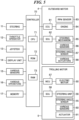
- FIG. 5 is a block diagram showing the marine propulsion system.
- the marine propulsion system includes a display unit 14, various sensors 15, the various operators 16, and a memory 17 in addition to the controller 70, the outboard motor 4, the trolling motor 5, the steering 11, the throttle operator 12, and the joystick 13.
- the controller 70 includes a CPU 71, a ROM 72, a RAM 73, and a timer (not shown).
- the ROM 72 stores control programs.
- the CPU 71 achieves various control processes by developing the control programs stored in the ROM 72 onto the RAM 73 and executing the control programs.
- the RAM 73 provides a work area in executing the control programs by the CPU 71.
- the various sensors 15 include a hull speed sensor, a hull acceleration sensor, a heading sensor, a distance sensor, a posture sensor, a position sensor, and a GNSS (Global Navigation Satellite System) sensor. Further, the various sensors 15 include a sensor to detect an operation of the throttle operator 12, a sensor to detect a rotational angular position of the steering 11, a sensor to detect an operation of each switch or paddle in the steering 11, and a sensor to detect an operation of the joystick 13.
- the hull speed sensor detects a speed (vessel speed) of the navigation of the marine vessel 1 (hull 2). The vessel speed may be obtained from a GNSS signal received by the GNSS sensor.
- the detection signals by the various sensors 15 are supplied to the controller 70.
- the various operators 16 include setting operators to perform various settings and input operators to input various instructions in addition to operators to perform operations related to the maneuvering. Some of the various operators 16 may be arranged in the steering 11. The various operators 16 are operated by the user, and the operation signals are supplied to the controller 70.
- the memory 17 is preferably a readable and writable nonvolatile storage medium.
- the controller 70 may exchange information with the various sensors 15 and the various operators 16 by establishing predetermined communications.
- the display unit 14 displays various kinds of information.
- the outboard motor 4 includes an ECU (Engine Control Unit) 81, an SCU (Steering Control Unit) 82, an rpm sensor 83, an engine 84, a steering mechanism 85, various sensors 86, a steering angle sensor 87, and various actuators 88.
- Each of the ECU 81 and the SCU 82 includes a CPU (not shown).
- the ECU 81 controls the driving of the engine 84 according to an instruction from the controller 70.
- the SCU 82 controls the driving of the steering mechanism 85 according to an instruction from the controller 70.
- the steering mechanism 85 changes the direction of the outboard motor body 20 in the left-right direction by rotating the outboard motor body 20 about the steering axis center K ( FIG. 1 ). This changes the direction of the propulsion force acting on the stern 2A, which is the attachment position of the outboard motor body 20.
- the steering mechanism 85 may use an electric type or a hydraulic type.
- the various actuators 88 may include a power trim and tilt mechanism (PTT mechanism) that rotates the outboard motor 4 about a tilt axis.
- the rpm sensor 83 detects the number of rotations per unit time period of the engine 84 (an engine rotation speed).
- the various sensors 86 include a throttle opening sensor.
- the steering angle sensor 87 detects an actual steering angle of the outboard motor 4.
- the controller 70 may obtain the actual steering angle from a steering instruction value output to the steering mechanism 85.
- the trolling motor 5 includes an MCU (Motor Control Unit) 57, an SCU (Steering Control Unit) 58, a steering angle sensor 55, various sensors 60, and an actuator 61 in addition to the electric motor 50 and the steering unit 56.
- MCU Motor Control Unit
- SCU Steering Control Unit
- the MCU 57 and the SCU 58 include CPUs (not shown), respectively.
- the MCU 57 controls the driving of the electric motor 50 according to an instruction from the controller 70.
- the maximum output of the electric motor 50 may be less than the maximum output of the engine 84 of the outboard motor 4.
- the SCU 58 controls the driving of the steering unit 56 according to an instruction from the controller 70 to change the direction of the propulsion force acting on the bow 2B, which is the attachment position of the trolling motor 5.
- the actuator 61 moves the trolling motor 5 between the use position and the storage position. It is not essential to provide a function of moving the trolling motor 5 between the use position and the storage position by power.
- the steering angle sensor 55 detects the steering angle of the trolling motor 5 changed by the steering unit 56.
- the detection signals by the steering angle sensor 55 and the various sensors 60 are supplied to the controller 70. It is not essential that the outboard motor 4 and the trolling motor 5 include all of the above-described sensors and actuators.
- each propulsion motor acts on the point at which each propulsion motor is attached to the hull 2.
- the propulsion force of the trolling motor 5 acts on the bow 2B and the propulsion force of the outboard motor 4 acts on the position of the attachment mechanism 22 on the stern 2A for convenience of description.
- FIGS. 6A and 6B are schematic views for describing the direction of the propulsion force of the outboard motor 4 and the direction of the propulsion force of the trolling motor 5 during the rightward lateral motion.
- the directions of propulsion force of the outboard motor 4 are divided into a first range ⁇ 1 (that is, an angular range of 180° in the forward direction) including a component in the forward direction and a second range ⁇ 2 (that is, an angular range of 180° in the backward direction) including a component in the backward direction.
- the directions of propulsion force of the trolling motor 5 are divided into the first range ⁇ 1 and the second range ⁇ 2.
- the direction of the propulsion force is equivalent to the direction of the outboard motor 4 or the trolling motor 5.
- the direction of propulsion force of the outboard motor 4 is included in the second range ⁇ 2, and the direction of propulsion force of the trolling motor 5 is included in the first range ⁇ 1.
- the direction of propulsion force of outboard motor 4 is included in the first range ⁇ 1
- the direction of propulsion force of the trolling motor 5 is included in the second range ⁇ 2.
- the rotation of the propeller 21 of the outboard motor 4 can be reversed by switching the shift position, and therefore, the direction of the propulsion force generated by the outboard motor 4 is actually determined according to the steering angle of the outboard motor 4 and the rotation direction of the propeller 21. Since the trolling motor 5 can be steered by 360 degrees, the direction of the propulsion force to be generated is determined by the steering angle of the trolling motor 5.
- the controller 70 determines whether to cause the outboard motor 4 during the lateral motion of the hull 2 to generate the propulsion force in the direction in the first range ⁇ 1 or to generate the propulsion force in the direction in the second range ⁇ 2, and stores information about the determination in the memory 17.
- a determination process shall be executed as part of a calibration before the first use of the marine vessel 1 after the outboard motor 4 and the trolling motor 5 are mounted on the marine vessel 1.
- the determination process may be executed at the time of replacement or maintenance of the outboard motor 4 or the trolling motor 5, or may be executed at a desired timing in response to an instruction from the user.
- FIG. 7 is a flowchart showing the determination process. This process is implemented by the CPU 71 developing a program stored in the ROM 72 onto the RAM 73 and executing the program. This process is started, for example, when the user or a maintenance person instructs the start of the determination process.
- the controller 70 configured or programmed to define and function as an obtaining unit obtains propulsion force information about the outboard motor 4 and the trolling motor 5. Alternatively, the controller 70 obtains the respective propulsion force information by communication or from information input by the user.
- the propulsion force information about the outboard motor 4 includes information about the propulsion force in the forward direction and information about the propulsion force in the backward direction. At least the minimum value of propulsion force in the forward direction (hereinafter referred to as forward minimum propulsion force F min ) and the minimum value of propulsion force in the backward direction (hereinafter referred to as backward minimum propulsion force R min ) are obtained. Further, the maximum steering angle information about the outboard motor 4 and the information about a distance from the center of gravity G to the outboard motor 4, and the like are obtained.
- the controller 70 may calculate the forward minimum propulsion force F min and the backward minimum propulsion force R min from the forward/backward minimum propulsion force at the maximum steering angle. Further, the forward minimum propulsion force Fmin and the backward minimum propulsion force R min may be calculated based on the rotation speed of the engine 84 (a drive source) in a fully closed position of the throttle. At least one of the value at the maximum steering angle and the value in a fully closed position of the throttle may be considered.
- the propulsion force information about the trolling motor 5 includes information about the maximum value of the propulsion force (hereinafter referred to as the motor maximum propulsion force Mmax) and the distance from the center of gravity G to the trolling motor 5.
- Mmax the maximum value of the propulsion force
- the controller 70 may obtain each piece of information described above by obtaining format information about each of the outboard motor 4 and the trolling motor 5 and referring to a map stored in the ROM 72 in advance.
- the controller 70 may consider the distance from the center of gravity G to each of the outboard motor 4 and the trolling motor 5.
- the controller 70 configured or programmed to define and function as a determination unit determines the range of the direction of the propulsion force of the outboard motor 4 used during the lateral motion of the hull 2, that is, determines whether to cause the outboard motor 4 to generate the propulsion force in the direction in the first range ⁇ 1 or to generate the propulsion force in the direction in the second range ⁇ 2.
- the controller 70 obtains a first absolute value of a difference (first difference) between the forward minimum propulsion force F min and the motor maximum propulsion force Mmax.
- the first absolute value is represented by
- the controller 70 obtains a second absolute value of a difference (second difference) between the backward minimum propulsion force R min and the motor maximum propulsion force M max .
- the second absolute value is represented by IRmin-Mmaxl.
- the controller 70 compares the first absolute value with the second absolute value. When the first absolute value is less than the second absolute value, the range of the direction of the outboard motor 4 used is determined as the first range ⁇ 1. When the first absolute value is more than the second absolute value, the range of the direction of the outboard motor 4 used is determined as the second range ⁇ 2.
- the range corresponding to the forward minimum propulsion force Fmin or the backward minimum propulsion force R min of which difference from the motor maximum propulsion force M max is smaller is determined as the range of the direction of the outboard motor 4 used.
- the forward minimum propulsion force F min or the backward minimum propulsion force R min is more than the motor maximum propulsion force M max , it may be necessary to repeat turning ON and OFF (shift-in and shift-out) the output of the outboard motor 4 in order to cancel the propulsion force component in the front-back direction during the lateral motion.
- the forward minimum propulsion force Fmin or the backward minimum propulsion force R min of which difference from the motor maximum propulsion force Mmax is smaller is used as described above, the frequency of repeating ON and OFF of the output of the outboard motor 4 is reduced or prevented. This enables the smooth lateral motion.
- the range of the direction of the outboard motor 4 used may be determined to be a predetermined range (for example, the first range ⁇ 1). Moreover, when the difference between the first absolute value and the second absolute value falls within a predetermined range, the range of the direction of the outboard motor 4 used may be determined to be the predetermined range.
- the range of the orientation of the trolling motor 5 used is determined to be opposite to the range of the direction of the outboard motor 4. For example, when the range of the direction of the outboard motor 4 is determined as the first range ⁇ 1, the range of the direction of the trolling motor 5 is determined as the second range ⁇ 2.
- the determined contents constitute the determination information. It is not essential to include the range of the direction of the trolling motor 5 in the determination information.
- the controller 70 configured or programmed to define and function as a storage processing unit stores the determination information determined in the step S102 in the memory 17 in a step S103, and ends the determination process ( FIG. 7 ).
- FIG. 8 is a flowchart showing a steering/propulsion control process. This process is achieved by the CPU 71 developing a program stored in the ROM 72 onto the RAM 73 and executing the program. This process is based on the premise that the determination process ( FIG. 7 ) has already been executed and the determination information has been stored in the memory 17.
- This process is started, for example, in response to input of an instruction to start a maneuvering mode (for example, the cooperation mode) that may require the lateral motion or in response to an instruction to start a lateral motion mode. Therefore, the time point at which a situation that may need the lateral motion occurs becomes the start timing of the direction change, and the process of keeping the outboard motor 4 directed in the direction based on the determination information is started by the process from a step S201, which leads to the shortening of the period of time until the actual start of the lateral motion.
- a maneuvering mode for example, the cooperation mode
- the controller 70 reads the determination information from the memory 17.
- the controller 70 controls the steering mechanism 85 to change the steering angle so that the direction of the propulsion force of the outboard motor 4 is directed in a direction included in the range based on the determination information.
- the controller 70 controls the steering unit 56 to change the steering angle so that the direction of the trolling motor 5 is directed in a direction included in the range based on the determination information.
- each steering angle is controlled so that each propulsion force is directed in a direction parallel to the center line C ( FIG. 1 ) of the hull 2 within a range based on the determination information. At this time, it is not essential to reverse the range of the direction of trolling motor 5 to the range of the direction of the outboard motor 4.
- a step S203 the controller 70 executes another process.
- the controller 70 executes a process corresponding to the maneuvering instruction. Further, if there is an instruction to end the steering/propulsion control process ( FIG. 8 ), the controller 70 ends this process.
- a step S204 the controller 70 determines whether a lateral motion maneuvering instruction is received.
- the lateral motion maneuvering instruction referred to here also includes an instruction for a parallel translation (oblique motion) including a lateral direction component.
- the maneuvering instruction, the target direction, and the required propulsion force of the lateral motion are input by the tilting operation of the stick 13b.
- an instruction for turning (or veering) or the like is input by a twisting operation of the stick 13b.
- the maneuvering instruction is input from one operation or a combination of two or more operations of the wheel 43, first operation instruction members, and second operation instruction members.
- the switches 63 and 64 correspond to the first operation instruction members for instructing to generate an instruction to provide a propulsion force in the lateral direction to the hull 2.
- the paddles 67 and 68 correspond to the second operation instruction members for instructing to provide a propulsion force in the front-back direction to the hull 2.
- a lateral motion maneuvering instruction and a target direction are input by a combination of operations of the switches 63 and 64 and the paddles 67 and 68, and a required propulsion force is input by a combination of the operation amounts thereof.
- an instruction for turning (or veering) or the like is input by the rotational operation of the wheel 43.
- the controller 70 returns the process to the step S202 when no lateral motion maneuvering instruction is received, or proceeds with the process to a step S205 when the lateral motion maneuvering instruction is received.
- the controller 70 achieves the instructed lateral motion by controlling the steering angles and the propulsion forces of the outboard motor 4 and the trolling motor 5 according to the target direction and the required propulsion force indicated by the maneuvering instruction. Normally, the directions of the outboard motor 4 and the trolling motor 5 during the lateral motion are within the ranges corresponding to the determination information, and thus the lateral motion is smooth.
- the controller 70 returns the process to the step S202.
- the marine vessel 1 includes functional blocks to implement the determination process ( FIG. 7 ) and the steering/propulsion control process ( FIG. 8 ).
- Functional units included in the functional block include the obtaining unit, the determination unit, the storage processing unit, and the controller. The functions of these functional units are implemented mainly by cooperation of the CPU 71, ROM 72, RAM 73, sensors 15, 55, 60, 83, 86, and 87, etc.
- the information about the propulsion force in the forward direction of the outboard motor 4, the information about the propulsion force in the backward direction of the outboard motor 4, and the propulsion force information about the trolling motor 5 are obtained. And based on these, the controller 70 determines whether to cause the outboard motor 4 to generate the propulsion force in the direction in the first range ⁇ 1 or to generate the propulsion force in the direction in the second range ⁇ 2. The determined contents are stored in the memory 17 as the determination information.
- the range of the direction of the outboard motor 4 is fixed in one of the first range ⁇ 1 and the second range ⁇ 2 during the lateral motion, and therefore, the shift position is not frequently switched. This enables the smooth lateral motion.
- the range of the direction of the outboard motor 4 used is determined as the first range ⁇ 1 when the first absolute value is less than the second absolute value, and is determined as the second range ⁇ 2 when the first absolute value is more than the second absolute value. This reduces the frequent repetition of turning ON and OFF of the output of the outboard motor 4, which enables the smooth lateral motion.
- the accuracy of determining the range of the direction of the outboard motor 4 is further improved.
- the controller 70 When controlling the steering angles and the propulsion forces of the outboard motor 4 and the trolling motor 5 in the step S205, the controller 70 maintains the steering angle of the trolling motor 5 in the range determined based on the determination information.
- the steering angle range does not exceed 180°, and therefore excessive rotation is prevented in a configuration that limits the steering angle, and entwining of a harness is also prevented.
- the propulsion device disposed at a predetermined position in front of the stern 2A is an electric propulsion device like the trolling motor 5.
- the propulsion device disposed at a predetermined position in front of the stern 2A is an engine propulsion device including an outboard motor.
- the propulsion device disposed at the stern 2A is the outboard motor 4.
- the propulsion device disposed at the stern 2A is any one of an inboard motor, an inboard/outboard motor, and a jet boat motor.
- the propulsion device is an engine propulsion device.
- the propulsion device is an electric propulsion device.
- Example embodiments of the present teaching can also be achieved by a process in which a program to achieve one or more functions of the above-described example embodiments is supplied to a system or an apparatus via a network or a non-transitory storage medium, and one or more processors of a computer of the system or the apparatus read and execute the program.
- the program and the storage medium storing the program may correspond to an example embodiment of the present teaching.
- the present teaching can also be implemented by a circuit (for example, an ASIC) that implements one or more functions.
Landscapes
- Chemical & Material Sciences (AREA)
- Engineering & Computer Science (AREA)
- Combustion & Propulsion (AREA)
- Mechanical Engineering (AREA)
- Ocean & Marine Engineering (AREA)
- Control Of Position, Course, Altitude, Or Attitude Of Moving Bodies (AREA)
- Mechanical Control Devices (AREA)
- Steering Control In Accordance With Driving Conditions (AREA)
Applications Claiming Priority (1)
| Application Number | Priority Date | Filing Date | Title |
|---|---|---|---|
| JP2023130809A JP2025025729A (ja) | 2023-08-10 | 2023-08-10 | 船舶推進システムの制御装置および方法、船舶 |
Publications (1)
| Publication Number | Publication Date |
|---|---|
| EP4516658A1 true EP4516658A1 (de) | 2025-03-05 |
Family
ID=92209085
Family Applications (1)
| Application Number | Title | Priority Date | Filing Date |
|---|---|---|---|
| EP24192318.4A Pending EP4516658A1 (de) | 2023-08-10 | 2024-08-01 | Schiffsantriebssystem, steuerungsverfahren dafür und wasserfahrzeug |
Country Status (3)
| Country | Link |
|---|---|
| US (1) | US20250050999A1 (de) |
| EP (1) | EP4516658A1 (de) |
| JP (1) | JP2025025729A (de) |
Families Citing this family (1)
| Publication number | Priority date | Publication date | Assignee | Title |
|---|---|---|---|---|
| US20250353586A1 (en) * | 2024-05-14 | 2025-11-20 | Brunswick Corporation | Marine propulsion system and method with single rear drive and lateral marine drive |
Citations (4)
| Publication number | Priority date | Publication date | Assignee | Title |
|---|---|---|---|---|
| JP2008110749A (ja) * | 2006-10-06 | 2008-05-15 | Yamaha Motor Co Ltd | 船舶用推進装置の制御装置、ならびにそれを用いた航走支援システムおよび船舶 |
| US8190316B2 (en) * | 2006-10-06 | 2012-05-29 | Yamaha Hatsudoki Kabushiki Kaisha | Control apparatus for marine vessel propulsion system, and marine vessel running supporting system and marine vessel using the same |
| US9988134B1 (en) | 2016-12-12 | 2018-06-05 | Brunswick Corporation | Systems and methods for controlling movement of a marine vessel using first and second propulsion devices |
| US20220126963A1 (en) * | 2020-10-22 | 2022-04-28 | Yamaha Hatsudoki Kabushiki Kaisha | Vessel operation system and vessel |
Family Cites Families (4)
| Publication number | Priority date | Publication date | Assignee | Title |
|---|---|---|---|---|
| EP4208388A1 (de) * | 2020-09-02 | 2023-07-12 | Svitzer A/S | Antriebssystem für schiff und schiff mit dem antriebssystem |
| JP7664060B2 (ja) * | 2021-03-12 | 2025-04-17 | ヤンマーホールディングス株式会社 | 操船装置、及び船舶 |
| US12263915B1 (en) * | 2022-03-28 | 2025-04-01 | Brunswick Corporation | Anchoring system for a marine vessel |
| US12258115B2 (en) * | 2022-07-20 | 2025-03-25 | Brunswick Corporation | Marine propulsion system and joystick control method |
-
2023
- 2023-08-10 JP JP2023130809A patent/JP2025025729A/ja active Pending
-
2024
- 2024-08-01 EP EP24192318.4A patent/EP4516658A1/de active Pending
- 2024-08-07 US US18/796,769 patent/US20250050999A1/en active Pending
Patent Citations (4)
| Publication number | Priority date | Publication date | Assignee | Title |
|---|---|---|---|---|
| JP2008110749A (ja) * | 2006-10-06 | 2008-05-15 | Yamaha Motor Co Ltd | 船舶用推進装置の制御装置、ならびにそれを用いた航走支援システムおよび船舶 |
| US8190316B2 (en) * | 2006-10-06 | 2012-05-29 | Yamaha Hatsudoki Kabushiki Kaisha | Control apparatus for marine vessel propulsion system, and marine vessel running supporting system and marine vessel using the same |
| US9988134B1 (en) | 2016-12-12 | 2018-06-05 | Brunswick Corporation | Systems and methods for controlling movement of a marine vessel using first and second propulsion devices |
| US20220126963A1 (en) * | 2020-10-22 | 2022-04-28 | Yamaha Hatsudoki Kabushiki Kaisha | Vessel operation system and vessel |
Also Published As
| Publication number | Publication date |
|---|---|
| JP2025025729A (ja) | 2025-02-21 |
| US20250050999A1 (en) | 2025-02-13 |
Similar Documents
| Publication | Publication Date | Title |
|---|---|---|
| JP6521527B2 (ja) | 船舶用操船装置及びそれを備えた船舶 | |
| JP2006001432A (ja) | 小型船舶用ステアリング装置 | |
| JP2010126085A (ja) | 操船支援装置およびそれを備えた船舶 | |
| JP2014076755A (ja) | 船舶の制御システム、船舶の制御方法、プログラム | |
| EP4368492B1 (de) | Wasserfahrzeugantriebssystem und wasserfahrzeug mit dem wasserfahrzeugantriebssystem | |
| EP4516658A1 (de) | Schiffsantriebssystem, steuerungsverfahren dafür und wasserfahrzeug | |
| EP4177155A1 (de) | Schiffsantriebssystem | |
| EP4177154A1 (de) | Schiffsantriebssystem | |
| EP4089004A2 (de) | System zum manövrieren von schiffen | |
| JP2002234495A (ja) | 操船装置 | |
| JP2022099788A (ja) | 船舶を制御するためのシステム及び方法 | |
| EP4206071B1 (de) | Schiffsantriebssystem | |
| US20250050996A1 (en) | Marine propulsion system, control method therefor, and marine vessel | |
| EP4177152A1 (de) | Schiffsantriebssystem | |
| JP7684833B2 (ja) | 船舶の航行システム | |
| EP4520648A1 (de) | Schiffsantriebssystem, steuerungsverfahren dafür und wasserfahrzeug | |
| US20250050990A1 (en) | Marine propulsion system, control method therefor, and marine vessel | |
| JP2023068839A (ja) | 船舶推進システムおよび船舶 | |
| US20250236380A1 (en) | Boat control system and boat | |
| US20250236374A1 (en) | Boat control system and boat | |
| EP4524023B1 (de) | Schiffsantriebssystem zur bewegung eines wasserfahrzeugs in seitlicher richtung und steuerungsverfahren dafür | |
| US20250388296A1 (en) | Marine vessel and control device therefor | |
| US20240150000A1 (en) | Watercraft propulsion system, and watercraft including the watercraft propulsion system | |
| EP4177150A1 (de) | Schiffsantriebssystem und wasserfahrzeug | |
| JP2025025665A (ja) | 船舶推進システムおよび船舶 |
Legal Events
| Date | Code | Title | Description |
|---|---|---|---|
| PUAI | Public reference made under article 153(3) epc to a published international application that has entered the european phase |
Free format text: ORIGINAL CODE: 0009012 |
|
| STAA | Information on the status of an ep patent application or granted ep patent |
Free format text: STATUS: THE APPLICATION HAS BEEN PUBLISHED |
|
| AK | Designated contracting states |
Kind code of ref document: A1 Designated state(s): AL AT BE BG CH CY CZ DE DK EE ES FI FR GB GR HR HU IE IS IT LI LT LU LV MC ME MK MT NL NO PL PT RO RS SE SI SK SM TR |
|
| STAA | Information on the status of an ep patent application or granted ep patent |
Free format text: STATUS: REQUEST FOR EXAMINATION WAS MADE |
|
| P01 | Opt-out of the competence of the unified patent court (upc) registered |
Free format text: CASE NUMBER: UPC_APP_1590_4516658/2025 Effective date: 20250731 |
|
| 17P | Request for examination filed |
Effective date: 20250822 |