EP4512946A1 - Faserstruktur und faserverstärkter verbundstoff - Google Patents
Faserstruktur und faserverstärkter verbundstoff Download PDFInfo
- Publication number
- EP4512946A1 EP4512946A1 EP23791707.5A EP23791707A EP4512946A1 EP 4512946 A1 EP4512946 A1 EP 4512946A1 EP 23791707 A EP23791707 A EP 23791707A EP 4512946 A1 EP4512946 A1 EP 4512946A1
- Authority
- EP
- European Patent Office
- Prior art keywords
- yarns
- yarn
- interlayer binding
- fiber structure
- interlayer
- Prior art date
- Legal status (The legal status is an assumption and is not a legal conclusion. Google has not performed a legal analysis and makes no representation as to the accuracy of the status listed.)
- Pending
Links
Images


Classifications
-
- D—TEXTILES; PAPER
- D03—WEAVING
- D03D—WOVEN FABRICS; METHODS OF WEAVING; LOOMS
- D03D11/00—Double or multi-ply fabrics not otherwise provided for
-
- B—PERFORMING OPERATIONS; TRANSPORTING
- B29—WORKING OF PLASTICS; WORKING OF SUBSTANCES IN A PLASTIC STATE IN GENERAL
- B29B—PREPARATION OR PRETREATMENT OF THE MATERIAL TO BE SHAPED; MAKING GRANULES OR PREFORMS; RECOVERY OF PLASTICS OR OTHER CONSTITUENTS OF WASTE MATERIAL CONTAINING PLASTICS
- B29B11/00—Making preforms
- B29B11/14—Making preforms characterised by structure or composition
- B29B11/16—Making preforms characterised by structure or composition comprising fillers or reinforcement
-
- B—PERFORMING OPERATIONS; TRANSPORTING
- B29—WORKING OF PLASTICS; WORKING OF SUBSTANCES IN A PLASTIC STATE IN GENERAL
- B29C—SHAPING OR JOINING OF PLASTICS; SHAPING OF MATERIAL IN A PLASTIC STATE, NOT OTHERWISE PROVIDED FOR; AFTER-TREATMENT OF THE SHAPED PRODUCTS, e.g. REPAIRING
- B29C70/00—Shaping composites, i.e. plastics material comprising reinforcements, fillers or preformed parts, e.g. inserts
- B29C70/04—Shaping composites, i.e. plastics material comprising reinforcements, fillers or preformed parts, e.g. inserts comprising reinforcements only, e.g. self-reinforcing plastics
- B29C70/06—Fibrous reinforcements only
- B29C70/10—Fibrous reinforcements only characterised by the structure of fibrous reinforcements, e.g. hollow fibres
- B29C70/16—Fibrous reinforcements only characterised by the structure of fibrous reinforcements, e.g. hollow fibres using fibres of substantial or continuous length
-
- B—PERFORMING OPERATIONS; TRANSPORTING
- B29—WORKING OF PLASTICS; WORKING OF SUBSTANCES IN A PLASTIC STATE IN GENERAL
- B29C—SHAPING OR JOINING OF PLASTICS; SHAPING OF MATERIAL IN A PLASTIC STATE, NOT OTHERWISE PROVIDED FOR; AFTER-TREATMENT OF THE SHAPED PRODUCTS, e.g. REPAIRING
- B29C70/00—Shaping composites, i.e. plastics material comprising reinforcements, fillers or preformed parts, e.g. inserts
- B29C70/04—Shaping composites, i.e. plastics material comprising reinforcements, fillers or preformed parts, e.g. inserts comprising reinforcements only, e.g. self-reinforcing plastics
- B29C70/06—Fibrous reinforcements only
- B29C70/10—Fibrous reinforcements only characterised by the structure of fibrous reinforcements, e.g. hollow fibres
- B29C70/16—Fibrous reinforcements only characterised by the structure of fibrous reinforcements, e.g. hollow fibres using fibres of substantial or continuous length
- B29C70/22—Fibrous reinforcements only characterised by the structure of fibrous reinforcements, e.g. hollow fibres using fibres of substantial or continuous length oriented in at least two directions forming a two-dimensional [2D] structure
- B29C70/226—Fibrous reinforcements only characterised by the structure of fibrous reinforcements, e.g. hollow fibres using fibres of substantial or continuous length oriented in at least two directions forming a two-dimensional [2D] structure the structure comprising mainly parallel filaments interconnected by a small number of cross threads
-
- B—PERFORMING OPERATIONS; TRANSPORTING
- B29—WORKING OF PLASTICS; WORKING OF SUBSTANCES IN A PLASTIC STATE IN GENERAL
- B29C—SHAPING OR JOINING OF PLASTICS; SHAPING OF MATERIAL IN A PLASTIC STATE, NOT OTHERWISE PROVIDED FOR; AFTER-TREATMENT OF THE SHAPED PRODUCTS, e.g. REPAIRING
- B29C70/00—Shaping composites, i.e. plastics material comprising reinforcements, fillers or preformed parts, e.g. inserts
- B29C70/04—Shaping composites, i.e. plastics material comprising reinforcements, fillers or preformed parts, e.g. inserts comprising reinforcements only, e.g. self-reinforcing plastics
- B29C70/28—Shaping operations therefor
- B29C70/40—Shaping or impregnating by compression not applied
- B29C70/42—Shaping or impregnating by compression not applied for producing articles of definite length, i.e. discrete articles
- B29C70/46—Shaping or impregnating by compression not applied for producing articles of definite length, i.e. discrete articles using matched moulds, e.g. for deforming sheet moulding compounds [SMC] or prepregs
- B29C70/48—Shaping or impregnating by compression not applied for producing articles of definite length, i.e. discrete articles using matched moulds, e.g. for deforming sheet moulding compounds [SMC] or prepregs and impregnating the reinforcements in the closed mould, e.g. resin transfer moulding [RTM], e.g. by vacuum
-
- D—TEXTILES; PAPER
- D03—WEAVING
- D03D—WOVEN FABRICS; METHODS OF WEAVING; LOOMS
- D03D13/00—Woven fabrics characterised by the special disposition of the warp or weft threads, e.g. with curved weft threads, with discontinuous warp threads, with diagonal warp or weft
- D03D13/004—Woven fabrics characterised by the special disposition of the warp or weft threads, e.g. with curved weft threads, with discontinuous warp threads, with diagonal warp or weft with weave pattern being non-standard or providing special effects
-
- D—TEXTILES; PAPER
- D03—WEAVING
- D03D—WOVEN FABRICS; METHODS OF WEAVING; LOOMS
- D03D15/00—Woven fabrics characterised by the material, structure or properties of the fibres, filaments, yarns, threads or other warp or weft elements used
- D03D15/50—Woven fabrics characterised by the material, structure or properties of the fibres, filaments, yarns, threads or other warp or weft elements used characterised by the properties of the yarns or threads
- D03D15/587—Woven fabrics characterised by the material, structure or properties of the fibres, filaments, yarns, threads or other warp or weft elements used characterised by the properties of the yarns or threads adhesive; fusible
-
- D—TEXTILES; PAPER
- D10—INDEXING SCHEME ASSOCIATED WITH SUBLASSES OF SECTION D, RELATING TO TEXTILES
- D10B—INDEXING SCHEME ASSOCIATED WITH SUBLASSES OF SECTION D, RELATING TO TEXTILES
- D10B2505/00—Industrial
- D10B2505/02—Reinforcing materials; Prepregs
Definitions
- the present disclosure relates to a fiber structure and a fiber-reinforced composite material.
- a fiber structure described in Patent Literature 1 includes multiple first yarns each having a yarn main axis extending in a first direction, and multiple second yarns each having a yarn main axis extending in a second direction orthogonal to the first direction.
- the first yarns are arranged in the second direction.
- the second yarns are arranged in the first direction.
- the fiber structure described in Patent Literature 1 includes thermofusible yarns that contain thermofusible fibers. By fusing the thermofusible yarns at intersections of the first and second yarns, the first and second yarns are prevented from being displaced in the fiber structure.
- Patent Literature 1 Japanese Laid-Open Patent Publication No. 2011-58119
- thermofusible yarns described in Patent Literature 1 at the ends of the fiber structure in the first direction and fusing these thermofusible yarns to the first and second yarns.
- this approach requires an additional step of fusing the thermofusible yarns to the first and second yarns, in addition to the weaving process used to produce the fiber structure. This results in an increase in the number of steps involved in manufacturing the fiber structure. Therefore, it is desirable to suppress fraying from the ends of the fiber structure while minimizing the increase in the number of steps required for the manufacture of the fiber structure.
- a fiber structure includes multiple fiber layers stacked in a stacking direction, and multiple interlayer binding yarns binding the multiple fiber layers in the stacking direction.
- the fiber layers include multiple first yarn layers and one or more second yarn layers located between the first yarn layers in the stacking direction.
- Each of the first yarn layers includes multiple first yarns each having a yarn main axis extending in a first direction.
- the first yarns are arranged in a second direction orthogonal to the first direction.
- One of the first yarn layers is located at each of opposite ends of the fiber structure in the stacking direction.
- Each of the second yarn layers includes multiple second yarns each having a yarn main axis extending in the second direction. The second yarns are arranged in the first direction without interlacing with the first yarns.
- Each of the interlayer binding yarns is adjacent to one of the second yarns in the first direction, has a yarn main axis extending in the second direction, and is engaged with the first yarns of the first yarn layers located at the opposite ends of the fiber structure in the stacking direction.
- the fiber structure further includes a central region including a center of the fiber structure in the first direction, and two end regions respectively including opposite ends of the fiber structure in the first direction. Each of the end regions is adjacent to the central region in the first direction.
- the second yarns include multiple end second yarns located at an end of the central region in the first direction.
- Each of the second yarn layers includes the end second yarns.
- Each of the central region and the two end regions includes the interlayer binding yarns.
- the interlayer binding yarns located in each of the end regions include the interlayer binding yarn located at an endmost position in the first direction among the interlayer binding yarns included in the fiber structure, and two of the interlayer binding yarns that pass through mutually different paths in a cross section of the fiber structure orthogonal to the first direction, so as to interlace with the first yarns.
- a pitch in the first direction between the interlayer binding yarns in the end regions is smaller than a pitch in the first direction between the interlayer binding yarns in the central region.
- a fiber-reinforced composite material includes the above-described fiber structure and a matrix material impregnated into the fiber structure.
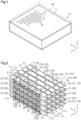
- a fiber-reinforced composite material 10 includes a fiber structure 11 and a matrix resin Ma as a matrix material impregnated into the fiber structure 11.
- the fiber structure 11 serves as a reinforcing substrate of the fiber-reinforced composite material 10.
- the matrix resin Ma is, for example, a thermosetting resin.
- the thermosetting resin include an epoxy resin, a vinyl ester resin, an unsaturated polyester resin, and a phenol resin.
- the fiber-reinforced composite material 10 is formed by impregnating the fiber structure 11 with a thermosetting resin using a resin transfer molding (RTM) method.
- RTM resin transfer molding
- the fiber structure 11 includes multiple fiber layers 20.
- the fiber layers 20 are stacked in a stacking direction Z.
- the fiber structure 11 does not change in configuration before and after thermal curing of the matrix material.
- the fiber structure 11 is described as being placed horizontally.
- directions along a horizontal plane are indicated by an X-axis and a Y-axis, and a direction orthogonal to the horizontal plane is indicated by a Z-axis.
- the X-axis, the Y-axis, and the Z-axis are orthogonal to each other.
- a direction parallel to the X-axis is also referred to as a first direction X.
- a direction parallel to the Y-axis is also referred to as a second direction Y.
- the second direction Y is a direction orthogonal to the first direction X.
- the stacking direction Z is a direction parallel to the Z-axis.
- the fiber layers 20 include multiple first yarn layers 21 and one or more (multiple in this example) second yarn layers 22.
- the first yarn layers 21 and the second yarn layers 22 are stacked in the stacking direction Z.
- Each first yarn layer 21 includes multiple first yarns 31, and the first yarns 31 are arranged in the second direction Y.
- the first yarns 31 each have a yarn main axis extending in the first direction X.
- Each second yarn layer 22 includes multiple second yarns 32, and the second yarns 32 are arranged in the first direction X.
- the second yarns 32 each have a yarn main axis extending in the second direction Y.
- the first yarns 31 and the second yarns 32 is, for example, a fiber bundle in which multiple reinforcing continuous fibers are bundled.
- the reinforcing fibers may be organic fibers or inorganic fibers. Instead, the reinforcing fibers may be mixed fibers in which different types of organic fibers, different types of inorganic fibers, or organic fibers and inorganic fibers are mixed. Examples of the organic fibers include acrylic fibers, nylon fibers, polyester fibers, aramid fibers, poly-p-phenylenebenzobisoxazole fibers, and ultra-high-molecular weight polyethylene fibers. Examples of the inorganic fibers include carbon fibers, glass fibers, and ceramic fibers.
- the first yarns 31 and the second yarns 32 of the present embodiment are made of carbon fibers.
- One of the first yarn layers 21 is located at each of the opposite ends of the fiber structure 11 in the stacking direction Z. Specifically, one of the multiple first yarn layers 21 is located at an end 11a, which is one end (lower end in Fig. 2 ) of the fiber structure 11 in the stacking direction Z. Another of the first yarn layers 21 is located at an end 11b, which is the other end (upper end in Fig. 2 ) of the fiber structure 11 in the stacking direction Z.
- the first yarn layer 21 located at the end 11a of the fiber structure 11 is also referred to as a first end layer 21a.
- the first yarn layer 21 located at the end 11b of the fiber structure 11 is also referred to as a second end layer 21b.
- Each second yarn layer 22 is located between the corresponding first yarn layers 21 in the stacking direction Z.
- Each of the first end layer 21a and the second end layer 21b is adjacent to one of the second yarn layers 22 in the stacking direction Z.
- Two of the first yarn layers 21 are located between the corresponding second yarn layers 22 in the stacking direction Z.
- One second yarn layer 22 and two first yarn layers 21 are alternately stacked in that order in the stacking direction Z between the first end layer 21a and the second end layer 21b. In this manner, the multiple first yarn layers 21 and the multiple second yarn layers 22 are stacked in the stacking direction Z, so that the multiple fiber layers 20 are stacked in the stacking direction Z.
- the first yarns 31 extend linearly in the first direction X.
- the first yarn layers 21 are stacked such that the first yarns 31 are arranged in the stacking direction Z.
- the first yarns 31 arranged in the stacking direction Z are collectively referred to as a first yarn group 31a.
- Multiple first yarn groups 31a are arranged in the second direction Y.
- each second yarn 32 in the second yarn layer 22 extends linearly in the second direction Y across the first yarns 31 in the first yarn layer 21.
- the fiber structure 11 includes a central region Ra and two end regions Rb.
- the central region Ra includes a center of the fiber structure 11 in the first direction X.
- Each of the end regions Rb is adjacent to the central region Ra in the first direction X.
- the two end regions Rb include ends 11c and 11d of the fiber structure 11 in the first direction X, respectively.
- Each second yarn layer 22 includes multiple end second yarns 32a.
- the end second yarns 32a are the second yarns 32 located at ends Rc of the central region Ra in the first direction X.
- the second yarn 32 located at one end in the first direction X and the second yarn 32 located at the other end correspond to the end second yarns 32a.
- the end second yarns 32a are located at the opposite ends of the central region Ra in the first direction X.
- the central region Ra includes the end second yarns 32a located at the opposite ends in the first direction X, and multiple second yarns 32 located between the end second yarns 32a at one end in the first direction X and the end second yarns 32a at the other end.
- the end regions Rb are regions of the fiber structure 11 located outside the end second yarns 32a in the first direction X.
- the opposite ends of the first yarns 31 protrude beyond the end second yarns 32a toward the outside of the fiber structure 11.
- Each end region Rb thus includes the ends of the first yarns 31 protruding beyond the end second yarns 32a.
- the parts of the first yarns 31 other than the parts located in the end regions Rb are located in the central region Ra.
- the fiber structure 11 includes multiple interlayer binding yarns 35 that bind the multiple fiber layers 20 in the stacking direction Z.
- Each of the interlayer binding yarns 35 is, for example, a fiber bundle in which multiple reinforcing continuous fibers are bundled.
- the interlayer binding yarns 35 are included in the fiber structure 11 by binding the multiple fiber layers 20 with the interlayer binding yarns 35 in the weaving process used to produce the fiber structure 11.
- the interlayer binding yarns 35 are adjacent to the second yarns 32 in the first direction X.
- the interlayer binding yarns 35 each have a yarn main axis extending in the second direction Y.
- the interlayer binding yarns 35 engage with the first yarns 31 in the first end layer 21a and the first yarns 31 in the second end layer 21b. In other words, the interlayer binding yarns 35 engage with the first yarns 31 of the first yarn layers 21 located at the opposite ends in the stacking direction Z of the multiple fiber layers 20.
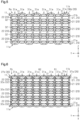
- the interlayer binding yarns 35 located in the central region Ra include multiple first interlayer binding yarns 36a and multiple second interlayer binding yarns 36b.
- the first interlayer binding yarns 36a and the second interlayer binding yarns 36b are disposed alternately in the first direction X.
- each of the first interlayer binding yarns 36a and the second interlayer binding yarns 36b alternately engages with the first yarns 31 located in the first end layer 21a and the first yarns 31 located in the second end layer 21b, from one end to the other end in the second direction Y of the fiber structure 11.
- the first yarns 31 with which the first interlayer binding yarns 36a are engaged in the first end layer 21a and the first yarns 31 with which the first interlayer binding yarns 36a are engaged in the second end layer 21b are located in the first yarn groups 31a adjacent to each other in the second direction Y.
- first yarns 31 with which the second interlayer binding yarns 36b are engaged in the first end layer 21a and the first yarns 31 with which the second interlayer binding yarns 36b are engaged in the second end layer 21b are located in the first yarn groups 31a adjacent to each other in the second direction Y.
- Each of the first interlayer binding yarns 36a and the second interlayer binding yarns 36b extends in the second direction Y, alternating the engaged first yarn 31 between the first yarn 31 in the first end layer 21a and the first yarn 31 in the second end layer 21b for each first yarn group 31a.
- Each of the first interlayer binding yarns 36a and the second interlayer binding yarns 36b extends in the stacking direction Z between any two of the first yarn groups 31a adjacent to each other in the second direction Y.
- the first interlayer binding yarns 36a and the second interlayer binding yarns 36b pass through mutually different paths in a cross section of the fiber structure 11 orthogonal to the first direction X, so as to interlace with the first yarns 31.
- Each first interlayer binding yarn 36a alternately engages with the first yarn 31 located in the first end layer 21a and the first yarn 31 located in the second end layer 21b, from one end to the other end of the fiber structure 11 in the second direction Y.
- Each second interlayer binding yarn 36b alternately engages with the first yarn 31 located in the second end layer 21b and the first yarn 31 located in the first end layer 21a, from one end to the other end of the fiber structure 11 in the second direction Y.
- the second interlayer binding yarn 36b engages with the first yarn 31 located in the second end layer 21b.
- the second interlayer binding yarn 36b engages with the first yarn 31 located in the first end layer 21a.
- the interlayer binding yarns 35 located in each end region Rb include a first end interlayer binding yarn 37a and a second end interlayer binding yarn 37b.
- the first end interlayer binding yarn 37a and the second end interlayer binding yarn 37b are adjacent to each other in the first direction X.
- One first end interlayer binding yarn 37a is located in the end region Rb at each of the ends 11c and 11d of the fiber structure 11.
- One second end interlayer binding yarn 37b is located in the end region Rb at each of the ends 11c and 11d of the fiber structure 11.
- the first end interlayer binding yarns 37a and the second end interlayer binding yarns 37b are thinner than the second yarns 32.
- the multiple interlayer binding yarns 35 located in each end region Rb are thinner than the second yarns 32.
- All the interlayer binding yarns 35 provided in the fiber structure 11 may have the same thickness.
- the first interlayer binding yarns 36a and the second interlayer binding yarns 36b, which are the interlayer binding yarns 35 located in the central region Ra are also thinner than the second yarns 32.
- the second end interlayer binding yarns 37b are the interlayer binding yarns 35 located at the endmost positions in the first direction X among the interlayer binding yarns 35 provided in the fiber structure 11.
- the interlayer binding yarns 35 located in the end regions Rb include the interlayer binding yarns 35 located at the endmost positions in the first direction X among the interlayer binding yarns 35 provided in the fiber structure 11.
- each of the first end interlayer binding yarn 37a and the second end interlayer binding yarn 37b alternately engages with the first yarn 31 located in the first end layer 21a and the first yarn 31 located in the second end layer 21b from one end to the other end of the fiber structure 11 in the second direction Y.
- the first yarns 31 with which the first end interlayer binding yarn 37a is engaged in the first end layer 21a and the first yarns 31 with which the first end interlayer binding yarn 37a is engaged in the second end layer 21b are located in the first yarn groups 31a adjacent to each other in the second direction Y.
- first yarns 31 with which the second end interlayer binding yarn 37b is engaged in the first end layer 21a and the first yarns 31 with which the second end interlayer binding yarn 37b is engaged in the second end layer 21b are located in the first yarn groups 31a adjacent to each other in the second direction Y.
- Each of the first end interlayer binding yarn 37a and the second end interlayer binding yarn 37b extends in the second direction Y, alternating the engaged first yarn 31 between the first yarn 31 in the first end layer 21a and the first yarn 31 in the second end layer 21b for each first yarn group 31a.
- Each of the first end interlayer binding yarn 37a and the second end interlayer binding yarn 37b extends in the stacking direction Z between any two of the first yarn groups 31a adjacent to each other in the second direction Y.
- the first end interlayer binding yarn 37a and the second end interlayer binding yarn 37b pass through mutually different paths in a cross section of the fiber structure 11 orthogonal to the first direction X, so as to interlace with the first yarns 31.
- the first end interlayer binding yarn 37a alternately engages with the first yarn 31 located in the first end layer 21a and the first yarn 31 located in the second end layer 21b, from one end to the other end of the fiber structure 11 in the second direction Y.
- the second end interlayer binding yarn 37b alternately engages with the first yarn 31 located in the second end layer 21b and the first yarn 31 located in the first end layer 21a, from one end to the other end of the fiber structure 11 in the second direction Y.
- the second end interlayer binding yarn 37b engages with the first yarn 31 located in the second end layer 21b.
- the second end interlayer binding yarn 37b engages with the first yarn 31 located in the first end layer 21a.
- a path through which each first interlayer binding yarn 36a passes is schematically shown as a first path R1 indicated by a long-dash double-short-dash line
- a path through which each second interlayer binding yarn 36b passes is schematically shown as a second path R2 indicated by a long-dash short-dash line.
- the first end interlayer binding yarn 37a which is the interlayer binding yarn 35 located in each end region Rb, passes through the same first path R1 as the first interlayer binding yarn 36a in the cross section of the fiber structure 11 orthogonal to the first direction X, so as to interlace with the first yarns 31.
- the second end interlayer binding yarn 37b which is the other interlayer binding yarn 35, passes through the same second path R2 as the second interlayer binding yarn 36b in the cross section of the fiber structure 11 orthogonal to the first direction X, so as to interlace with the first yarns 31.
- a pitch between the first interlayer binding yarn 36a and the second interlayer binding yarn 36b, which are adjacent to each other in the first direction X, is referred to as a first pitch L1.
- the interlayer binding yarns 35 are separated from each other in the first direction X.
- a pitch between the first end interlayer binding yarn 37a and the second end interlayer binding yarn 37b, which are adjacent to each other in the first direction X, is referred to as a second pitch L2.
- the first end interlayer binding yarn 37a and the second end interlayer binding yarn 37b, which are adjacent to each other in the first direction X, are in contact with each other in the first direction X. Therefore, the second pitch L2, which is the pitch in the first direction X between the interlayer binding yarns 35 in each end region Rb, is smaller than the first pitch L1, which is the pitch in the first direction X between the interlayer binding yarns 35 in the central region Ra.
- the first interlayer binding yarns 36a and the second interlayer binding yarns 36b which are located in the central region Ra, pass through mutually different paths in a cross section of the fiber structure 11 orthogonal to the first direction X, so as to interlace with the first yarns 31.
- the parts of the first yarns 31 located in the central region Ra are engaged with the first interlayer binding yarns 36a and the second interlayer binding yarns 36b from the opposite sides in the stacking direction Z.
- the engagement of the interlayer binding yarns 35 in the central region Ra allows the second yarns 32 located in the central region Ra in the first direction X to be supported by being sandwiched from the opposite sides in the stacking direction Z by the first yarns 31 adjacent to the second yarns 32 in the stacking direction Z.
- the parts of the fiber layers 20 located in the central region Ra are bound together by the first interlayer binding yarns 36a and the second interlayer binding yarns 36b.
- the first end interlayer binding yarn 37a and the second end interlayer binding yarn 37b located in each end region Rb interlace with the first yarns 31 through mutually different paths in a cross section of the fiber structure 11 orthogonal to the first direction X.
- parts of the first yarns 31 located in each end region Rb are engaged with the first end interlayer binding yarn 37a and the second end interlayer binding yarn 37b from the opposite sides in the stacking direction Z.
- the engagement of the interlayer binding yarns 35 in each end region Rb allows the end second yarns 32a adjacent to the end region Rb in the first direction X to be supported to be sandwiched from the opposite sides in the stacking direction Z by the first yarns 31 adjacent to the end second yarns 32a in the stacking direction Z.
- the parts of the fiber layers 20 located in each end region Rb are bound together by the first end interlayer binding yarn 37a and the second end interlayer binding yarns 37b.
- the second pitch L2 which is the pitch between the first end interlayer binding yarn 37a and the second end interlayer binding yarn 37b in each end region Rb, is smaller than the first pitch L1, which is the pitch between the first interlayer binding yarn 36a and the second interlayer binding yarn 36b in the central region Ra. Therefore, the fiber layers 20 are more firmly bound together by the interlayer binding yarns 35 in each end region Rb than in the central region Ra. Such engagement of the interlayer binding yarns 35 in each end region Rb allows the end second yarns 32a to be more strongly sandwiched from the opposite sides in the stacking direction Z by the first yarns 31 adjacent in the stacking direction Z than the other second yarns 32 located in the central region Ra.
- the interlayer binding yarns 35 located in each end region Rb may be melted by impregnating the fiber structure 11 with the matrix resin Ma as a thermosetting resin by using the RTM method.
- a resin having a property of melting at the curing temperature of the matrix resin Ma can be used as the material of the interlayer binding yarns 35 located in the end regions Rb.
- an epoxy resin is used as the matrix resin Ma, for example, a phenoxy resin, a methyl methacrylate resin, or the like can be used as the material of the interlayer binding yarns 35 located in the end regions Rb.
- the first modification has the following advantages.
- fiber structures 11 may be manufactured by cutting a fiber body 11f, which is a precursor of the fiber structures 11.
- the fiber body 11f in this case has the first yarns 31, the second yarns 32, and the interlayer binding yarns 35 similar to those of the fiber structure 11.
- central regions Ra and end regions Rb are arranged in the first direction X.
- Two end regions Rb are adjacent to each other in the first direction X between the central regions Ra in the first direction X.
- the first yarns 31 of the end regions Rb adjacent to each other in the first direction X are continuous.
- the first yarns 31 extend in the first direction X between the opposite ends of the fiber body 11f in the first direction X.
- the fiber body 11f is cut along a cutting position C indicated by the long-dash short-dash line in Fig. 8 . Accordingly, since the fiber body 11f is cut between the end regions Rb adjacent to each other in the first direction X, the fiber structures 11 are manufactured from the fiber body 11f.
- the number of the first yarn layers 21 located between the second yarn layers 22 in the stacking direction Z may be one or three or more.
- the second yarns 32 may be located in each end region Rb. In this case as well, fraying of the end second yarns 32a from the ends 11c, 11d of the fiber structure 11 in the first direction X is suppressed by the interlayer binding yarns 35 in the end portion regions Rb.
- the first interlayer binding yarns 36a may pass through a path different from the first path R1.
- the second interlayer binding yarns 36b may pass through a path different from the second path R2.
- the paths of the first interlayer binding yarns 36a and the second interlayer binding yarns 36b may be changed as long as they pass through mutually different paths in a cross section of the fiber structure 11 orthogonal to the first direction X and interlace with the first yarns 31.
- the first end interlayer binding yarns 37a may pass through a path different from the first path R1.
- the second end interlayer binding yarns 37b may pass through a path different from the second path R2.
- the interlayer binding yarns 35 located in the end regions Rb may pass through a path different from that of the interlayer binding yarns 35 located in the central region Ra in a cross section of the fiber structure 11 orthogonal to the first direction X.
- the number of the interlayer binding yarns 35 located in each end region Rb may be three or more.
- two or more first end interlayer binding yarns 37a may be located in each end region Rb.
- Two or more second end interlayer binding yarns 37b may be located in each end region Rb.
- the fiber structure 11 may be provided with interlayer binding yarns 35 having different thicknesses.
- the thickness of the interlayer binding yarns 35 located in the central region Ra may be different from the thickness of the interlayer binding yarns 35 located in the end regions Rb.
- the thickness of the interlayer binding yarns 35 located in the central region Ra may be greater than or equal to the thickness of the second yarns 32.
- the thickness of the interlayer binding yarns 35 located in the end regions Rb may be greater than or equal to the thickness of the second yarns 32.
- the interlayer binding yarns 35 may be separated from each other in the first direction X.
- the second pitch L2 which is the pitch in the first direction X between the interlayer binding yarns 35 in each end region Rb, is smaller than the first pitch L1, which is the pitch in the first direction X between the interlayer binding yarns 35 in the central region Ra.
- the fiber structure 11 may be manufactured using first yarns 31 and second yarns 32 impregnated with the matrix resin Ma.
- At least one of the first yarns 31, the second yarns 32, and the interlayer binding yarns 35 may be fiber bundles formed by bundling multiple non-reinforcing fibers.
- the phrase “at least one of” as used in this description means “one or more” of desired options.
- the expression “at least one” as used in this description means “only one option” or “both two options” if the number of options is two.
- the phrase “at least one of” as used in this description means “only one single option” or “any combination of two or more options” if the number of options is three or more.
Landscapes
- Engineering & Computer Science (AREA)
- Textile Engineering (AREA)
- Mechanical Engineering (AREA)
- Chemical & Material Sciences (AREA)
- Composite Materials (AREA)
- Woven Fabrics (AREA)
- Reinforced Plastic Materials (AREA)
- Moulding By Coating Moulds (AREA)
- Yarns And Mechanical Finishing Of Yarns Or Ropes (AREA)
- Nonwoven Fabrics (AREA)
Applications Claiming Priority (2)
| Application Number | Priority Date | Filing Date | Title |
|---|---|---|---|
| JP2022071036A JP7715075B2 (ja) | 2022-04-22 | 2022-04-22 | 繊維構造体及び繊維強化複合材 |
| PCT/JP2023/014409 WO2023204058A1 (ja) | 2022-04-22 | 2023-04-07 | 繊維構造体及び繊維強化複合材 |
Publications (2)
| Publication Number | Publication Date |
|---|---|
| EP4512946A1 true EP4512946A1 (de) | 2025-02-26 |
| EP4512946A4 EP4512946A4 (de) | 2025-08-13 |
Family
ID=88420039
Family Applications (1)
| Application Number | Title | Priority Date | Filing Date |
|---|---|---|---|
| EP23791707.5A Pending EP4512946A4 (de) | 2022-04-22 | 2023-04-07 | Faserstruktur und faserverstärkter verbundstoff |
Country Status (5)
| Country | Link |
|---|---|
| US (1) | US20250257502A1 (de) |
| EP (1) | EP4512946A4 (de) |
| JP (1) | JP7715075B2 (de) |
| CA (1) | CA3249262A1 (de) |
| WO (1) | WO2023204058A1 (de) |
Families Citing this family (1)
| Publication number | Priority date | Publication date | Assignee | Title |
|---|---|---|---|---|
| WO2022002337A1 (en) * | 2020-07-03 | 2022-01-06 | Vestas Wind Systems A/S | Wind turbine blade |
Family Cites Families (6)
| Publication number | Priority date | Publication date | Assignee | Title |
|---|---|---|---|---|
| JP5461930B2 (ja) | 2009-09-10 | 2014-04-02 | 三菱レイヨン株式会社 | 強化繊維織物及びその製造方法 |
| JP2017106128A (ja) * | 2015-12-08 | 2017-06-15 | 株式会社Ihi | 3次元強化繊維織物 |
| JP2018066086A (ja) * | 2016-10-20 | 2018-04-26 | 株式会社豊田自動織機 | Rtm成形用繊維プリフォーム及び繊維強化複合材 |
| JP6620771B2 (ja) * | 2017-02-08 | 2019-12-18 | 株式会社豊田自動織機 | 繊維構造体及び繊維強化複合材 |
| EP3653769A4 (de) * | 2017-07-13 | 2020-05-27 | Kabushiki Kaisha Toyota Jidoshokki | Faserstruktur und faserverstärkter verbundstoff |
| JP2019094578A (ja) * | 2017-11-17 | 2019-06-20 | 株式会社豊田自動織機 | 繊維構造体及び繊維強化複合材 |
-
2022
- 2022-04-22 JP JP2022071036A patent/JP7715075B2/ja active Active
-
2023
- 2023-04-07 CA CA3249262A patent/CA3249262A1/en active Pending
- 2023-04-07 EP EP23791707.5A patent/EP4512946A4/de active Pending
- 2023-04-07 WO PCT/JP2023/014409 patent/WO2023204058A1/ja not_active Ceased
- 2023-04-07 US US18/857,345 patent/US20250257502A1/en active Pending
Also Published As
| Publication number | Publication date |
|---|---|
| JP7715075B2 (ja) | 2025-07-30 |
| WO2023204058A1 (ja) | 2023-10-26 |
| US20250257502A1 (en) | 2025-08-14 |
| CA3249262A1 (en) | 2025-06-17 |
| JP2023160586A (ja) | 2023-11-02 |
| EP4512946A4 (de) | 2025-08-13 |
Similar Documents
| Publication | Publication Date | Title |
|---|---|---|
| US20160101591A1 (en) | Composite article | |
| EP2889324A1 (de) | Dreidimensionaler faserverstärkter verbundstoff und verfahren zur herstellung eines dreidimensionalen faserverstärkten verbundstoffes | |
| EP4512946A1 (de) | Faserstruktur und faserverstärkter verbundstoff | |
| JP2022182789A (ja) | 繊維構造体、及び繊維強化複合材 | |
| JP2011074207A (ja) | 繊維強化複合材料のプリフォーム及びその製造方法 | |
| EP3712309A1 (de) | Faserkonstrukt, faserverstärktes verbundmaterial und verfahren zu seiner herstellung | |
| EP3190307B1 (de) | Energieabsorbierendes element | |
| EP2615248A2 (de) | Faserverbundanordnung und Prozess zur Herstellung einer Faserverbundanordnung | |
| KR20120009128A (ko) | 복합재료용 직물 보강재 및 이를 갖는 섬유강화 복합재료 프리프레그 | |
| EP3225725A1 (de) | Faserstruktur und faserverstärktes verbundmaterial | |
| EP4549640A1 (de) | Faserstruktur für faserverstärkten verbundstoff | |
| JP7609009B2 (ja) | 繊維構造体および繊維強化複合材 | |
| EP3581690A1 (de) | Faserstruktur und faserverstärkter verbundstoff | |
| JP2025173417A (ja) | 繊維構造体および繊維強化複合材 | |
| JP2026000064A (ja) | 繊維構造体および繊維強化複合材 | |
| JP7287162B2 (ja) | 繊維構造体及び繊維強化複合材 | |
| EP4435162B1 (de) | Faserstruktur und faserverstärkter verbundstoff | |
| JP7256001B2 (ja) | セラミック管状体の製造方法 | |
| JP4069202B2 (ja) | 3次元繊維強化複合材ラグの製造方法 | |
| JP2022119368A (ja) | 繊維構造体及び繊維強化複合材 | |
| WO2013191232A1 (ja) | 強化繊維複合材料及び強化繊維複合材料の製造方法 | |
| JP2022122656A (ja) | 繊維構造体、繊維強化複合材、及び繊維構造体の製造方法 | |
| JP2015098156A (ja) | 三次元繊維強化複合材 | |
| JPH0198800A (ja) | 極低温機器用支持材 |
Legal Events
| Date | Code | Title | Description |
|---|---|---|---|
| STAA | Information on the status of an ep patent application or granted ep patent |
Free format text: STATUS: THE INTERNATIONAL PUBLICATION HAS BEEN MADE |
|
| PUAI | Public reference made under article 153(3) epc to a published international application that has entered the european phase |
Free format text: ORIGINAL CODE: 0009012 |
|
| STAA | Information on the status of an ep patent application or granted ep patent |
Free format text: STATUS: REQUEST FOR EXAMINATION WAS MADE |
|
| 17P | Request for examination filed |
Effective date: 20241029 |
|
| AK | Designated contracting states |
Kind code of ref document: A1 Designated state(s): AL AT BE BG CH CY CZ DE DK EE ES FI FR GB GR HR HU IE IS IT LI LT LU LV MC ME MK MT NL NO PL PT RO RS SE SI SK SM TR |
|
| DAV | Request for validation of the european patent (deleted) | ||
| DAX | Request for extension of the european patent (deleted) | ||
| A4 | Supplementary search report drawn up and despatched |
Effective date: 20250710 |
|
| RIC1 | Information provided on ipc code assigned before grant |
Ipc: D03D 11/00 20060101AFI20250704BHEP Ipc: B29B 15/12 20060101ALI20250704BHEP Ipc: B29C 70/16 20060101ALI20250704BHEP Ipc: B29C 70/48 20060101ALI20250704BHEP Ipc: D03D 1/00 20060101ALI20250704BHEP Ipc: D03D 15/587 20210101ALI20250704BHEP Ipc: B29K 105/08 20060101ALI20250704BHEP Ipc: D03D 13/00 20060101ALI20250704BHEP Ipc: B29C 70/22 20060101ALI20250704BHEP Ipc: B29B 11/16 20060101ALI20250704BHEP |
|
| GRAP | Despatch of communication of intention to grant a patent |
Free format text: ORIGINAL CODE: EPIDOSNIGR1 |
|
| STAA | Information on the status of an ep patent application or granted ep patent |
Free format text: STATUS: GRANT OF PATENT IS INTENDED |
|
| RIC1 | Information provided on ipc code assigned before grant |
Ipc: D03D 11/00 20060101AFI20251209BHEP Ipc: B29B 15/12 20060101ALI20251209BHEP Ipc: B29C 70/16 20060101ALI20251209BHEP Ipc: B29C 70/48 20060101ALI20251209BHEP Ipc: D03D 1/00 20060101ALI20251209BHEP Ipc: D03D 15/587 20210101ALI20251209BHEP Ipc: B29K 105/08 20060101ALI20251209BHEP Ipc: D03D 13/00 20060101ALI20251209BHEP Ipc: B29C 70/22 20060101ALI20251209BHEP Ipc: B29B 11/16 20060101ALI20251209BHEP |
|
| INTG | Intention to grant announced |
Effective date: 20260113 |
|
| GRAS | Grant fee paid |
Free format text: ORIGINAL CODE: EPIDOSNIGR3 |
|
| GRAA | (expected) grant |
Free format text: ORIGINAL CODE: 0009210 |
|
| STAA | Information on the status of an ep patent application or granted ep patent |
Free format text: STATUS: THE PATENT HAS BEEN GRANTED |