EP4549640A1 - Faserstruktur für faserverstärkten verbundstoff - Google Patents
Faserstruktur für faserverstärkten verbundstoff Download PDFInfo
- Publication number
- EP4549640A1 EP4549640A1 EP23830983.5A EP23830983A EP4549640A1 EP 4549640 A1 EP4549640 A1 EP 4549640A1 EP 23830983 A EP23830983 A EP 23830983A EP 4549640 A1 EP4549640 A1 EP 4549640A1
- Authority
- EP
- European Patent Office
- Prior art keywords
- yarn
- yarns
- weft
- warp
- selvage
- Prior art date
- Legal status (The legal status is an assumption and is not a legal conclusion. Google has not performed a legal analysis and makes no representation as to the accuracy of the status listed.)
- Pending
Links
Images

Classifications
-
- D—TEXTILES; PAPER
- D03—WEAVING
- D03D—WOVEN FABRICS; METHODS OF WEAVING; LOOMS
- D03D13/00—Woven fabrics characterised by the special disposition of the warp or weft threads, e.g. with curved weft threads, with discontinuous warp threads, with diagonal warp or weft
-
- D—TEXTILES; PAPER
- D03—WEAVING
- D03D—WOVEN FABRICS; METHODS OF WEAVING; LOOMS
- D03D1/00—Woven fabrics designed to make specified articles
-
- D—TEXTILES; PAPER
- D03—WEAVING
- D03D—WOVEN FABRICS; METHODS OF WEAVING; LOOMS
- D03D11/00—Double or multi-ply fabrics not otherwise provided for
-
- D—TEXTILES; PAPER
- D03—WEAVING
- D03D—WOVEN FABRICS; METHODS OF WEAVING; LOOMS
- D03D5/00—Selvedges
-
- D—TEXTILES; PAPER
- D10—INDEXING SCHEME ASSOCIATED WITH SUBLASSES OF SECTION D, RELATING TO TEXTILES
- D10B—INDEXING SCHEME ASSOCIATED WITH SUBLASSES OF SECTION D, RELATING TO TEXTILES
- D10B2505/00—Industrial
- D10B2505/02—Reinforcing materials; Prepregs
Definitions
- the present disclosure relates to a fiber structure for a fiber-reinforced composite material.
- Patent Literature 1 discloses a fiber structure used in fiber-reinforced composite materials.
- the fiber structure includes a warp yarn layer and a weft yarn layer.
- the warp yarn layer includes warp yarns that extend in a first direction.
- the warp yarns are arranged in a second direction that is orthogonal to the first direction.
- the weft yarn layer includes weft yarns that are reinforcing fiber yarns extending in the second direction.
- the weft yarns are arranged in the first direction.
- Patent Literature 1 includes a laminate in which the warp yarn layer and the weft yarn layer are laminated in a laminating direction that is orthogonal to the first and second directions.
- the laminate includes opposite end sections in the second direction and a general section.
- the opposite end sections are formed by multiple weft yarn layers arranged in the laminating direction.
- the general section is located between the opposite end sections in the second direction.
- the general section includes binding yarns that bind the warp yarn layers to the weft yarn layers by engaging with the weft yarns.
- Patent Literature 1 it is known to provide selvage yarns that engage with the weft yarns at the opposite end sections in the second direction to prevent fraying of the weft yarns at the opposite end sections in the second direction.
- Patent Literature 1 Japanese Laid-Open Patent Publication No. 2018-178299
- the surfaces of the weft yarns are smooth.
- the selvage yarns are prone to slipping against the weft yarns. If the selvage yarns shift toward the opposite sides of the fiber structure in the second direction, fraying occurs at the opposite end sections of the fiber structure in the second direction.
- the fiber structure includes a laminate and a selvage yarn.
- the laminate includes at least one warp yarn layer and at least two weft yarn layers.
- the warp yarn layer includes warp yarns extending in a first direction.
- the warp yarns are arranged in a second direction that is orthogonal to the first direction.
- Each of the weft yarn layers includes weft yarns that are reinforcing fiber yarns extending in the second direction.
- the weft yarns are arranged in the first direction.
- the warp yarn layers and the weft yarn layers are laminated in a laminating direction that is orthogonal to the first direction and the second direction.
- the laminate includes end sections that are respectively located at opposite ends in the second direction and formed by the weft yarn layers and a general section located between the end sections in the second direction.
- the selvage yarn engages with the weft yarns of the weft yarn layer located at at least one of opposite ends in the laminating direction. At least some of the warp yarns are binding yarns that bind the warp yarn layer to the weft yarn layer by engaging with the weft yarns in the general section.
- the selvage yarn is a continuous yarn.
- the weft yarns of the weft yarn layers located at the opposite ends in the laminating direction are spun yarns.
- the fiber structure for the fiber-reinforced composite material is a fiber structure used in a fiber-reinforced composite material.
- the fiber-reinforced composite material is formed by combining the fiber structure with a matrix (not shown).
- the fiber structure is a reinforcing base for the fiber-reinforced composite material.
- the matrix is, for example, a thermosetting epoxy resin.
- the fiber structure for the fiber-reinforced composite material will be simply referred to as the fiber structure.
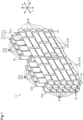
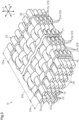
- the fiber structure 10 includes a laminate 20 and selvage yarns 40.
- the laminate 20 includes warp yarn layers 21 and weft yarn layers 22.
- the fiber structure 10 of the present embodiment includes three warp yarn layers 21 and three weft yarn layers 22.
- the laminate 20 is formed by laminating the warp yarn layers 21 and the weft yarn layers 22.
- the direction in which the warp yarn layers 21 and the weft yarn layers 22 are laminated is referred to as the laminating direction Z.
- the laminating direction Z is orthogonal to a first direction X and a second direction Y, both of which will be described later.
- Each warp yarn layer 21 includes warp yarns 23.
- the warp yarns 23 extend in the first direction X.
- the warp yarns 23 are arranged in the second direction Y, which is orthogonal to the first direction X. That is, each warp yarn layer 21 is formed by arranging, in the second direction Y, the warp yarns 23 extending in the first direction X.
- first warp yarn layers 21 are first warp yarn layers 21a, and one warp yarn layer 21 is a second warp yarn layer 21b.
- Each first warp yarn layer 21a is formed by arranging first warp yarns 23a, which are the warp yarns 23 extending in the first direction X, in the second direction Y.
- the second warp yarn layer 21b is formed by arranging second warp yarns 23b, which are the warp yarns 23 extending in the first direction X, in the second direction Y.
- the first warp yarns 23a and the second warp yarns 23b are alternately arranged in the second direction Y.
- the warp yarns 23 located at the opposite ends in the second direction Y are the first warp yarns 23a.
- Each first warp yarn 23a is a reinforcing fiber yarn.
- the reinforcing fiber in the present embodiment is carbon fiber.
- Each second warp yarn 23b is made of phenoxy resin.
- the first warp yarn 23a and the second warp yarn 23b are continuous yarns formed by bundling continuous fibers.
- the second warp yarn 23b is thinner than the first warp yarn 23a.
- the first warp yarn 23a extends straight in the first direction X.
- the second warp yarn 23b extends in the first direction X while meandering in the laminating direction Z. The structure of the second warp yarn 23b will be described in detail later.
- Each weft yarn layer 22 includes weft yarns 24.
- the weft yarns 24 extend straight in the second direction Y.
- the weft yarns 24 are arranged in the first direction X. That is, each weft yarn layer 22 is formed by arranging, in the first direction X, the weft yarns 24 extending in the second direction Y.
- the opposite end sections of the weft yarn layer 22 in the second direction Y protrude outward from the warp yarns 23 located at the opposite ends in the second direction Y, respectively.
- Each weft yarn 24 is a reinforcing fiber yarn.
- the reinforcing fiber in the present embodiment is carbon fiber.
- the laminate 20 includes two end sections 20a and a general section 20b.
- the end sections 20a are located at the opposite ends of the laminate 20 in the second direction Y, respectively. Specifically, the two end sections 20a are located outward from the warp yarns 23 located at the opposite ends in the second direction Y, respectively.
- Each end section 20a includes multiple weft yarn layers 22 arranged in the laminating direction Z. Specifically, the two end sections 20a are formed by laminating, in the laminating direction Z, the opposite end sections of the weft yarn layers 22 in the second direction Y.
- the weft yarns 24 of the weft yarn layers 22 located at the opposite ends in the laminating direction Z are spun yarns formed by bundling discontinuous fibers.
- the weft yarns 24 of the weft yarn layer 22, other than those located at the opposite ends in the laminating direction Z, are continuous yarns.
- the weft yarn layer 22, other than those located at the opposite ends in the laminating direction Z refer to one weft yarn layer 22 positioned between the weft yarn layers 22 located at the opposite ends in the laminating direction Z.
- the general section 20b is located between the two end sections 20a in the second direction Y.
- the general section 20b includes multiple warp yarn layers 21 and multiple weft yarn layers 22, which are arranged in the laminating direction Z.
- the first warp yarn layers 21a and the weft yarn layers 22 are alternately laminated in the laminating direction Z.
- Each first warp yarn layer 21a is located between the weft yarn layers 22 in the laminating direction Z.
- the second warp yarn layers 21b are laminated on the weft yarn layers 22 at the opposite ends in the laminating direction Z.
- each second warp yarn 23b includes first warp yarn engagement portions 31, second warp yarn engagement portions 32, and warp yarn connection portions 33.
- Each second warp yarn engagement portion 32 engages with the weft yarns 24 of the weft yarn layer 22 located at a second end, which is opposite to the first end, in the laminating direction Z. However, the second warp yarn engagement portion 32 engages with weft yarns 24 that are adjacent, in the first direction X, to the weft yarns 24 with which the first warp yarn engagement portion 31 are engaged.
- the second warp yarn engagement portion 32 is formed by folding back the second warp yarns 23b such that it passes outside the weft yarns 24 of the weft yarn layer 22 located at the second end in the laminating direction Z.
- the second warp yarn engagement portion 32 is laminated on the weft yarns 24 of the weft yarn layer 22 located at the second end in the laminating direction Z.
- the second warp yarn engagement portion 32 is engaged with two weft yarns 24 of the weft yarn layer 22 located at the second end in the laminating direction Z.
- Each warp yarn connection portion 33 connects the first warp yarn engagement portion 31 to the second warp yarn engagement portion 32.
- the warp yarn connection portion 33 extends in the laminating direction Z between the weft yarns 24 with which the first warp yarn engagement portion 31 is engaged and the weft yarns 24 with which the second warp yarn engagement portion 32 is engaged.
- the first warp yarn engagement portion 31 and the second warp yarn engagement portion 32 are alternately and repeatedly provided via the warp yarn connection portion 33.
- the second warp yarn 23b is alternately engaged with the weft yarn 24 of the weft yarn layer 22 located at the first end in the laminating direction Z and the weft yarn 24 of the weft yarn layer 22 located at the second end in the laminating direction Z.
- the second warp yarn 23b is alternately engaged with two weft yarns 24 of the weft yarn layer 22 located at the first end in the laminating direction Z and two weft yarns 24 of the weft yarn layer 22 located at the second end in the laminating direction Z.
- Two second warp yarns 23b adjacent to each other, with one first warp yarn 23a in between, in the second direction Y are each passed through a different route and engaged with the weft yarns 24 of the weft yarn layers 22 located at the opposite ends in the laminating direction Z.
- the first warp yarn engagement portion 31 of one of the second warp yarns 23b and the second warp yarn engagement portion 32 of the other second warp yarn 23b are arranged side by side in the second direction Y.
- the second warp yarn engagement portion 32 of one of the second warp yarns 23b and the first warp yarn engagement portion 31 of the other second warp yarn 23b are arranged side by side in the second direction Y.
- the first warp yarn engagement portion 31 of one second warp yarn 23b and the first warp yarn engagement portion 31 of the other second warp yarn 23b are shifted from each other in the first direction X.
- the second warp yarn engagement portion 32 of one second warp yarn 23b and the second warp yarn engagement portion 32 of the other second warp yarn 23b are shifted from each other in the first direction X.
- the second binding warp yarns 23d are binding yarns that bind the warp yarn layer 21 to the weft yarn layer 22 by engaging with the weft yarns 24 in the general section 20b.
- all the warp yarns 23 are binding yarns that bind the warp yarn layer 21 to the weft yarn layer 22.
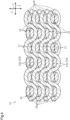
- each weft yarn layer 22 is formed by arranging, in the first direction X, multiple weft yarns 24 extending the second direction Y.
- the number of weft yarns 24 in the weft yarn layer 22 at the opposite ends in the laminating direction Z is smaller than that of weft yarns 24 in the four weft yarn layers 22 located between the weft yarn layers 22 at the opposite ends in the laminating direction Z.
- the weft yarns 24 of the weft yarn layers 22 at the opposite ends in the laminating direction Z are arranged such that, in the first direction X, each of them overlaps in the laminating direction Z with every other weft yarn 24 of the weft yarn layer 22 located between the weft yarn layers 22 located at the opposite ends in the laminating direction Z.
- the second embodiment achieves the same advantages as the advantages (1) to (4) of the first embodiment.
- Reinforcing fibers are not limited to carbon fibers.
- Examples of the reinforcing fibers may include glass fibers, silicon carbide-based ceramic fibers, aramid fibers, and ultra-high molecular weight polyethylene fibers.
- the number of the weft yarn layers 22 is not limited to three.
- the number of weft yarn layers 22 may be changed as long as there are two or more layers.
- the number of the first warp yarn layers 21a is not limited to two.
- the number of first warp yarn layers 21a may be changed.
- the first warp yarn layer 21a needs to be located between the weft yarn layers 22 in the laminating direction Z.
- Two or more first warp yarn layers 21a may be arranged between adjacent ones of the weft yarn layers 22 in the laminating direction Z.
- the first warp yarn 23a is not limited to a reinforcing fiber yarn.
- the first warp yarn 23a may be, for example, a yarn made of phenoxy resin or nylon.
- the second warp yarn 23b does not have to be made of phenoxy.
- the second warp yarn 23b may be, for example, a yarn made of nylon or a reinforcing fiber yarn.
- the fiber structure 10 is a unidirectional fiber structure for a fiber-reinforced composite material that is reinforced only in the second direction Y by the weft yarns 24, which are reinforcing fibers.
- the first warp yarn 23a may be a spun yarn.
- the second warp yarn 23b may be a spun yarn.
- the second warp yarn 23b may be alternately engaged with each weft yarn 24 of the weft yarn layer 22 located at the first end in the laminating direction Z and each weft yarn 24 of the weft yarn layer 22 located at the second end in the laminating direction Z.
- the second warp yarn 23b may be alternately engaged with three weft yarns 24 of the weft yarn layer 22 located at the first end in the laminating direction Z and three weft yarns 24 of the weft yarn layer 22 located at the second end in the laminating direction Z.
- two second warp yarns 23b that engage with the weft yarns 24 by each passing through a different route may be arranged between adjacent ones of the first warp yarns 23a in the second direction Y.
- the number of weft yarn layers 22 is not limited to six.
- the number of weft yarn layers 22 may be changed as long as there are two or more layers.
- the number of warp yarn layers 21 is not limited to four.
- the number of warp yarn layers 21 may be changed within the range where the warp yarns 23 can bind the warp yarn layers 21 to the weft yarn layers 22.
- the warp yarn 23 is not limited to a reinforcing fiber yarn.
- the warp yarn 23 may be, for example, a yarn made of phenoxy resin or nylon.
- the fiber structure 10 is a unidirectional fiber structure for a fiber-reinforced composite material that is reinforced only in the second direction Y by the weft yarns 24, which are reinforcing fiber yarns.
- the warp yarn 23 may be a spun yarn.
- the warp yarns 23 at the opposite ends in the second direction Y may be the second binding warp yarns 23d.
- the warp yarns 23 at one end in the second direction Y may be the first binding warp yarns 23c, and the warp yarns 23 at the other end in the second direction Y may be the second binding warp yarns 23d.
- weft yarns 24 of the weft yarn layers 22, except for the weft yarn layers 22 at the opposite ends in the laminating direction Z, may also be spun yarns.
- the selvage yarn 40 may be made of material other than phenoxy.
- the selvage yarn 40 may be, for example, a nylon yarn or a reinforcing fiber yarn.
- the selvage yarn 40 may be engaged only with the weft yarns 24 of the weft yarn layer 22 at the first end in the laminating direction Z. In this case, the selvage yarn 40 is not engaged with the weft yarns 24 of the weft yarn layer 22 at the second end in the laminating direction Z, as it is folded back at an intermediate point in the laminating direction Z. As another example, the selvage yarn 40 may be engaged only with the weft yarns 24 of the weft yarn layer 22 at the second end in the laminating direction Z.
- the selvage yarn 40 is not engaged with the weft yarns 24 of the weft yarn layer 22 at the first end in the laminating direction Z, as it is folded back at an intermediate point in the laminating direction Z. In other words, it is sufficient for the selvage yarn 40 to be engaged with the weft yarn 24 of the weft yarn layer 22 located at at least one end in the laminating direction Z.
- the phrase "at least one end in the laminating direction" refers to either only one end, only the other end, or the opposite ends in the laminating direction.
- the selvage yarn 40 does not have to be alternately engaged with each weft yarn 24 of the weft yarn layer 22 located at the first end in the laminating direction Z and each weft yarn 24 of the weft yarn layer 22 located at the second end in the laminating direction Z.
- the selvage yarn 40 may be alternately engaged with multiple weft yarns 24 of the weft yarn layer 22 located at the first end in the laminating direction Z and multiple weft yarns 24 of the weft yarn layer 22 located at the second end in the laminating direction Z.
- the matrix is not limited to epoxy resin.
- the matrix may be another thermosetting resin such as vinyl ester resin, unsaturated polyester resin, or phenolic resin.
- the matrix may be a thermoplastic resin such as polyamide, polybutylene terephthalate, polycarbonate, polyethylene, polypropylene, polyimide resin, or ABS resin.
Landscapes
- Engineering & Computer Science (AREA)
- Textile Engineering (AREA)
- Woven Fabrics (AREA)
- Moulding By Coating Moulds (AREA)
- Reinforced Plastic Materials (AREA)
Applications Claiming Priority (2)
| Application Number | Priority Date | Filing Date | Title |
|---|---|---|---|
| JP2022104829A JP7718336B2 (ja) | 2022-06-29 | 2022-06-29 | 繊維強化複合材用繊維構造体 |
| PCT/JP2023/020778 WO2024004533A1 (ja) | 2022-06-29 | 2023-06-05 | 繊維強化複合材用繊維構造体 |
Publications (2)
| Publication Number | Publication Date |
|---|---|
| EP4549640A1 true EP4549640A1 (de) | 2025-05-07 |
| EP4549640A4 EP4549640A4 (de) | 2025-10-01 |
Family
ID=89382733
Family Applications (1)
| Application Number | Title | Priority Date | Filing Date |
|---|---|---|---|
| EP23830983.5A Pending EP4549640A4 (de) | 2022-06-29 | 2023-06-05 | Faserstruktur für faserverstärkten verbundstoff |
Country Status (5)
| Country | Link |
|---|---|
| US (1) | US20250179696A1 (de) |
| EP (1) | EP4549640A4 (de) |
| JP (1) | JP7718336B2 (de) |
| CA (1) | CA3258729A1 (de) |
| WO (1) | WO2024004533A1 (de) |
Family Cites Families (7)
| Publication number | Priority date | Publication date | Assignee | Title |
|---|---|---|---|---|
| JP3226330B2 (ja) * | 1992-06-18 | 2001-11-05 | 株式会社アイ・エイチ・アイ・エアロスペース | テープラップ成形用織布およびプリプレグ |
| JP2006144847A (ja) | 2004-11-17 | 2006-06-08 | Bando Chem Ind Ltd | 樹脂ベルト |
| JP6790967B2 (ja) * | 2017-03-31 | 2020-11-25 | 株式会社豊田自動織機 | 繊維構造体及び繊維強化複合材 |
| JP6855889B2 (ja) * | 2017-04-11 | 2021-04-07 | 株式会社豊田自動織機 | 繊維構造体、及び繊維強化複合材の製造方法 |
| JP2019094578A (ja) * | 2017-11-17 | 2019-06-20 | 株式会社豊田自動織機 | 繊維構造体及び繊維強化複合材 |
| JP2020179705A (ja) | 2019-04-23 | 2020-11-05 | 株式会社豊田自動織機 | 構造材 |
| JP7287162B2 (ja) * | 2019-07-19 | 2023-06-06 | 株式会社豊田自動織機 | 繊維構造体及び繊維強化複合材 |
-
2022
- 2022-06-29 JP JP2022104829A patent/JP7718336B2/ja active Active
-
2023
- 2023-06-05 EP EP23830983.5A patent/EP4549640A4/de active Pending
- 2023-06-05 CA CA3258729A patent/CA3258729A1/en active Pending
- 2023-06-05 WO PCT/JP2023/020778 patent/WO2024004533A1/ja not_active Ceased
- 2023-06-05 US US18/875,997 patent/US20250179696A1/en active Pending
Also Published As
| Publication number | Publication date |
|---|---|
| WO2024004533A1 (ja) | 2024-01-04 |
| JP7718336B2 (ja) | 2025-08-05 |
| EP4549640A4 (de) | 2025-10-01 |
| CA3258729A1 (en) | 2025-04-07 |
| JP2024004923A (ja) | 2024-01-17 |
| US20250179696A1 (en) | 2025-06-05 |
Similar Documents
| Publication | Publication Date | Title |
|---|---|---|
| JP2022182789A (ja) | 繊維構造体、及び繊維強化複合材 | |
| JP2011074207A (ja) | 繊維強化複合材料のプリフォーム及びその製造方法 | |
| EP4549640A1 (de) | Faserstruktur für faserverstärkten verbundstoff | |
| EP3604649A1 (de) | Faserstruktur und faserverstärktes verbundmaterial | |
| EP3712309A1 (de) | Faserkonstrukt, faserverstärktes verbundmaterial und verfahren zu seiner herstellung | |
| CN108431314B (zh) | 用于纤维强化复合材料的织物和纤维强化复合材料 | |
| WO2016035694A1 (ja) | エネルギー吸収部材 | |
| EP4512946A1 (de) | Faserstruktur und faserverstärkter verbundstoff | |
| JP5644755B2 (ja) | 織物基材及び繊維強化複合材料 | |
| JP7666397B2 (ja) | 繊維強化複合材用繊維構造体及び繊維強化複合材 | |
| EP3581690A1 (de) | Faserstruktur und faserverstärkter verbundstoff | |
| JP7609009B2 (ja) | 繊維構造体および繊維強化複合材 | |
| JP7287162B2 (ja) | 繊維構造体及び繊維強化複合材 | |
| EP3375920B1 (de) | Faserstruktur | |
| JP2022119368A (ja) | 繊維構造体及び繊維強化複合材 | |
| WO2018179877A1 (ja) | 繊維構造体及び繊維強化複合材 | |
| WO2013035518A1 (ja) | 織物基材及び繊維強化複合材料 | |
| JP2026000064A (ja) | 繊維構造体および繊維強化複合材 | |
| JP2025173417A (ja) | 繊維構造体および繊維強化複合材 | |
| JP5550827B2 (ja) | Frp製引抜き構造部材およびその製造方法 | |
| JP2022098319A (ja) | 繊維構造体、及び繊維強化複合材 | |
| JP2014004735A (ja) | 強化繊維複合材料及び強化繊維複合材料の製造方法 | |
| JP4069202B2 (ja) | 3次元繊維強化複合材ラグの製造方法 | |
| JP2022122656A (ja) | 繊維構造体、繊維強化複合材、及び繊維構造体の製造方法 | |
| JP2015098156A (ja) | 三次元繊維強化複合材 |
Legal Events
| Date | Code | Title | Description |
|---|---|---|---|
| STAA | Information on the status of an ep patent application or granted ep patent |
Free format text: STATUS: THE INTERNATIONAL PUBLICATION HAS BEEN MADE |
|
| PUAI | Public reference made under article 153(3) epc to a published international application that has entered the european phase |
Free format text: ORIGINAL CODE: 0009012 |
|
| STAA | Information on the status of an ep patent application or granted ep patent |
Free format text: STATUS: REQUEST FOR EXAMINATION WAS MADE |
|
| 17P | Request for examination filed |
Effective date: 20241203 |
|
| AK | Designated contracting states |
Kind code of ref document: A1 Designated state(s): AL AT BE BG CH CY CZ DE DK EE ES FI FR GB GR HR HU IE IS IT LI LT LU LV MC ME MK MT NL NO PL PT RO RS SE SI SK SM TR |
|
| A4 | Supplementary search report drawn up and despatched |
Effective date: 20250901 |
|
| RIC1 | Information provided on ipc code assigned before grant |
Ipc: D03D 1/00 20060101AFI20250826BHEP Ipc: D03D 5/00 20060101ALI20250826BHEP Ipc: D03D 11/00 20060101ALI20250826BHEP |
|
| DAV | Request for validation of the european patent (deleted) | ||
| DAX | Request for extension of the european patent (deleted) |