EP4512518A2 - Isolierungszusammensetzung für eine batterievorrichtung, verfahren zur herstellung davon, damit hergestellte folie und batteriemodul damit - Google Patents
Isolierungszusammensetzung für eine batterievorrichtung, verfahren zur herstellung davon, damit hergestellte folie und batteriemodul damit Download PDFInfo
- Publication number
- EP4512518A2 EP4512518A2 EP24180819.5A EP24180819A EP4512518A2 EP 4512518 A2 EP4512518 A2 EP 4512518A2 EP 24180819 A EP24180819 A EP 24180819A EP 4512518 A2 EP4512518 A2 EP 4512518A2
- Authority
- EP
- European Patent Office
- Prior art keywords
- aerogel
- fibrous
- fibrous support
- composition
- aerogel composition
- Prior art date
- Legal status (The legal status is an assumption and is not a legal conclusion. Google has not performed a legal analysis and makes no representation as to the accuracy of the status listed.)
- Pending
Links
Images


Classifications
-
- C—CHEMISTRY; METALLURGY
- C08—ORGANIC MACROMOLECULAR COMPOUNDS; THEIR PREPARATION OR CHEMICAL WORKING-UP; COMPOSITIONS BASED THEREON
- C08K—Use of inorganic or non-macromolecular organic substances as compounding ingredients
- C08K7/00—Use of ingredients characterised by shape
- C08K7/02—Fibres or whiskers
-
- B—PERFORMING OPERATIONS; TRANSPORTING
- B01—PHYSICAL OR CHEMICAL PROCESSES OR APPARATUS IN GENERAL
- B01J—CHEMICAL OR PHYSICAL PROCESSES, e.g. CATALYSIS OR COLLOID CHEMISTRY; THEIR RELEVANT APPARATUS
- B01J13/00—Colloid chemistry, e.g. the production of colloidal materials or their solutions, not otherwise provided for; Making microcapsules or microballoons
- B01J13/0091—Preparation of aerogels, e.g. xerogels
-
- C—CHEMISTRY; METALLURGY
- C04—CEMENTS; CONCRETE; ARTIFICIAL STONE; CERAMICS; REFRACTORIES
- C04B—LIME, MAGNESIA; SLAG; CEMENTS; COMPOSITIONS THEREOF, e.g. MORTARS, CONCRETE OR LIKE BUILDING MATERIALS; ARTIFICIAL STONE; CERAMICS; REFRACTORIES; TREATMENT OF NATURAL STONE
- C04B26/00—Compositions of mortars, concrete or artificial stone, containing only organic binders, e.g. polymer or resin concrete
- C04B26/02—Macromolecular compounds
-
- B—PERFORMING OPERATIONS; TRANSPORTING
- B32—LAYERED PRODUCTS
- B32B—LAYERED PRODUCTS, i.e. PRODUCTS BUILT-UP OF STRATA OF FLAT OR NON-FLAT, e.g. CELLULAR OR HONEYCOMB, FORM
- B32B19/00—Layered products comprising a layer of natural mineral fibres or particles, e.g. asbestos, mica
- B32B19/04—Layered products comprising a layer of natural mineral fibres or particles, e.g. asbestos, mica next to another layer of the same or of a different material
- B32B19/045—Layered products comprising a layer of natural mineral fibres or particles, e.g. asbestos, mica next to another layer of the same or of a different material of synthetic resin
-
- B—PERFORMING OPERATIONS; TRANSPORTING
- B32—LAYERED PRODUCTS
- B32B—LAYERED PRODUCTS, i.e. PRODUCTS BUILT-UP OF STRATA OF FLAT OR NON-FLAT, e.g. CELLULAR OR HONEYCOMB, FORM
- B32B19/00—Layered products comprising a layer of natural mineral fibres or particles, e.g. asbestos, mica
- B32B19/04—Layered products comprising a layer of natural mineral fibres or particles, e.g. asbestos, mica next to another layer of the same or of a different material
- B32B19/047—Layered products comprising a layer of natural mineral fibres or particles, e.g. asbestos, mica next to another layer of the same or of a different material of foam
-
- B—PERFORMING OPERATIONS; TRANSPORTING
- B32—LAYERED PRODUCTS
- B32B—LAYERED PRODUCTS, i.e. PRODUCTS BUILT-UP OF STRATA OF FLAT OR NON-FLAT, e.g. CELLULAR OR HONEYCOMB, FORM
- B32B27/00—Layered products comprising a layer of synthetic resin
- B32B27/30—Layered products comprising a layer of synthetic resin comprising vinyl (co)polymers; comprising acrylic (co)polymers
- B32B27/306—Layered products comprising a layer of synthetic resin comprising vinyl (co)polymers; comprising acrylic (co)polymers comprising vinyl acetate or vinyl alcohol (co)polymers
-
- B—PERFORMING OPERATIONS; TRANSPORTING
- B32—LAYERED PRODUCTS
- B32B—LAYERED PRODUCTS, i.e. PRODUCTS BUILT-UP OF STRATA OF FLAT OR NON-FLAT, e.g. CELLULAR OR HONEYCOMB, FORM
- B32B33/00—Layered products characterised by particular properties or particular surface features, e.g. particular surface coatings; Layered products designed for particular purposes not covered by another single class
-
- B—PERFORMING OPERATIONS; TRANSPORTING
- B32—LAYERED PRODUCTS
- B32B—LAYERED PRODUCTS, i.e. PRODUCTS BUILT-UP OF STRATA OF FLAT OR NON-FLAT, e.g. CELLULAR OR HONEYCOMB, FORM
- B32B5/00—Layered products characterised by the non- homogeneity or physical structure, i.e. comprising a fibrous, filamentary, particulate or foam layer; Layered products characterised by having a layer differing constitutionally or physically in different parts
- B32B5/18—Layered products characterised by the non- homogeneity or physical structure, i.e. comprising a fibrous, filamentary, particulate or foam layer; Layered products characterised by having a layer differing constitutionally or physically in different parts characterised by features of a layer of foamed material
-
- C—CHEMISTRY; METALLURGY
- C04—CEMENTS; CONCRETE; ARTIFICIAL STONE; CERAMICS; REFRACTORIES
- C04B—LIME, MAGNESIA; SLAG; CEMENTS; COMPOSITIONS THEREOF, e.g. MORTARS, CONCRETE OR LIKE BUILDING MATERIALS; ARTIFICIAL STONE; CERAMICS; REFRACTORIES; TREATMENT OF NATURAL STONE
- C04B26/00—Compositions of mortars, concrete or artificial stone, containing only organic binders, e.g. polymer or resin concrete
- C04B26/02—Macromolecular compounds
- C04B26/04—Macromolecular compounds obtained by reactions only involving carbon-to-carbon unsaturated bonds
-
- C—CHEMISTRY; METALLURGY
- C08—ORGANIC MACROMOLECULAR COMPOUNDS; THEIR PREPARATION OR CHEMICAL WORKING-UP; COMPOSITIONS BASED THEREON
- C08J—WORKING-UP; GENERAL PROCESSES OF COMPOUNDING; AFTER-TREATMENT NOT COVERED BY SUBCLASSES C08B, C08C, C08F, C08G or C08H
- C08J5/00—Manufacture of articles or shaped materials containing macromolecular substances
- C08J5/04—Reinforcing macromolecular compounds with loose or coherent fibrous material
- C08J5/10—Reinforcing macromolecular compounds with loose or coherent fibrous material characterised by the additives used in the polymer mixture
-
- C—CHEMISTRY; METALLURGY
- C08—ORGANIC MACROMOLECULAR COMPOUNDS; THEIR PREPARATION OR CHEMICAL WORKING-UP; COMPOSITIONS BASED THEREON
- C08J—WORKING-UP; GENERAL PROCESSES OF COMPOUNDING; AFTER-TREATMENT NOT COVERED BY SUBCLASSES C08B, C08C, C08F, C08G or C08H
- C08J9/00—Working-up of macromolecular substances to porous or cellular articles or materials; After-treatment thereof
- C08J9/0085—Use of fibrous compounding ingredients
-
- C—CHEMISTRY; METALLURGY
- C08—ORGANIC MACROMOLECULAR COMPOUNDS; THEIR PREPARATION OR CHEMICAL WORKING-UP; COMPOSITIONS BASED THEREON
- C08J—WORKING-UP; GENERAL PROCESSES OF COMPOUNDING; AFTER-TREATMENT NOT COVERED BY SUBCLASSES C08B, C08C, C08F, C08G or C08H
- C08J9/00—Working-up of macromolecular substances to porous or cellular articles or materials; After-treatment thereof
- C08J9/32—Working-up of macromolecular substances to porous or cellular articles or materials; After-treatment thereof from compositions containing microballoons, e.g. syntactic foams
-
- C—CHEMISTRY; METALLURGY
- C08—ORGANIC MACROMOLECULAR COMPOUNDS; THEIR PREPARATION OR CHEMICAL WORKING-UP; COMPOSITIONS BASED THEREON
- C08K—Use of inorganic or non-macromolecular organic substances as compounding ingredients
- C08K7/00—Use of ingredients characterised by shape
- C08K7/22—Expanded, porous or hollow particles
-
- C—CHEMISTRY; METALLURGY
- C08—ORGANIC MACROMOLECULAR COMPOUNDS; THEIR PREPARATION OR CHEMICAL WORKING-UP; COMPOSITIONS BASED THEREON
- C08L—COMPOSITIONS OF MACROMOLECULAR COMPOUNDS
- C08L101/00—Compositions of unspecified macromolecular compounds
-
- H—ELECTRICITY
- H01—ELECTRIC ELEMENTS
- H01B—CABLES; CONDUCTORS; INSULATORS; SELECTION OF MATERIALS FOR THEIR CONDUCTIVE, INSULATING OR DIELECTRIC PROPERTIES
- H01B17/00—Insulators or insulating bodies characterised by their form
- H01B17/56—Insulating bodies
- H01B17/60—Composite insulating bodies
-
- H—ELECTRICITY
- H01—ELECTRIC ELEMENTS
- H01B—CABLES; CONDUCTORS; INSULATORS; SELECTION OF MATERIALS FOR THEIR CONDUCTIVE, INSULATING OR DIELECTRIC PROPERTIES
- H01B19/00—Apparatus or processes specially adapted for manufacturing insulators or insulating bodies
-
- H—ELECTRICITY
- H01—ELECTRIC ELEMENTS
- H01M—PROCESSES OR MEANS, e.g. BATTERIES, FOR THE DIRECT CONVERSION OF CHEMICAL ENERGY INTO ELECTRICAL ENERGY
- H01M10/00—Secondary cells; Manufacture thereof
- H01M10/60—Heating or cooling; Temperature control
- H01M10/61—Types of temperature control
- H01M10/613—Cooling or keeping cold
-
- H—ELECTRICITY
- H01—ELECTRIC ELEMENTS
- H01M—PROCESSES OR MEANS, e.g. BATTERIES, FOR THE DIRECT CONVERSION OF CHEMICAL ENERGY INTO ELECTRICAL ENERGY
- H01M10/00—Secondary cells; Manufacture thereof
- H01M10/60—Heating or cooling; Temperature control
- H01M10/65—Means for temperature control structurally associated with the cells
- H01M10/658—Means for temperature control structurally associated with the cells by thermal insulation or shielding
-
- H—ELECTRICITY
- H01—ELECTRIC ELEMENTS
- H01M—PROCESSES OR MEANS, e.g. BATTERIES, FOR THE DIRECT CONVERSION OF CHEMICAL ENERGY INTO ELECTRICAL ENERGY
- H01M50/00—Constructional details or processes of manufacture of the non-active parts of electrochemical cells other than fuel cells, e.g. hybrid cells
- H01M50/20—Mountings; Secondary casings or frames; Racks, modules or packs; Suspension devices; Shock absorbers; Transport or carrying devices; Holders
- H01M50/289—Mountings; Secondary casings or frames; Racks, modules or packs; Suspension devices; Shock absorbers; Transport or carrying devices; Holders characterised by spacing elements or positioning means within frames, racks or packs
- H01M50/293—Mountings; Secondary casings or frames; Racks, modules or packs; Suspension devices; Shock absorbers; Transport or carrying devices; Holders characterised by spacing elements or positioning means within frames, racks or packs characterised by the material
-
- H—ELECTRICITY
- H01—ELECTRIC ELEMENTS
- H01M—PROCESSES OR MEANS, e.g. BATTERIES, FOR THE DIRECT CONVERSION OF CHEMICAL ENERGY INTO ELECTRICAL ENERGY
- H01M50/00—Constructional details or processes of manufacture of the non-active parts of electrochemical cells other than fuel cells, e.g. hybrid cells
- H01M50/50—Current conducting connections for cells or batteries
- H01M50/572—Means for preventing undesired use or discharge
- H01M50/584—Means for preventing undesired use or discharge for preventing incorrect connections inside or outside the batteries
- H01M50/59—Means for preventing undesired use or discharge for preventing incorrect connections inside or outside the batteries characterised by the protection means
- H01M50/593—Spacers; Insulating plates
-
- B—PERFORMING OPERATIONS; TRANSPORTING
- B32—LAYERED PRODUCTS
- B32B—LAYERED PRODUCTS, i.e. PRODUCTS BUILT-UP OF STRATA OF FLAT OR NON-FLAT, e.g. CELLULAR OR HONEYCOMB, FORM
- B32B2266/00—Composition of foam
- B32B2266/12—Gel
- B32B2266/126—Aerogel, i.e. a supercritically dried gel
-
- B—PERFORMING OPERATIONS; TRANSPORTING
- B32—LAYERED PRODUCTS
- B32B—LAYERED PRODUCTS, i.e. PRODUCTS BUILT-UP OF STRATA OF FLAT OR NON-FLAT, e.g. CELLULAR OR HONEYCOMB, FORM
- B32B2307/00—Properties of the layers or laminate
- B32B2307/20—Properties of the layers or laminate having particular electrical or magnetic properties, e.g. piezoelectric
- B32B2307/206—Insulating
-
- B—PERFORMING OPERATIONS; TRANSPORTING
- B32—LAYERED PRODUCTS
- B32B—LAYERED PRODUCTS, i.e. PRODUCTS BUILT-UP OF STRATA OF FLAT OR NON-FLAT, e.g. CELLULAR OR HONEYCOMB, FORM
- B32B2457/00—Electrical equipment
- B32B2457/10—Batteries
-
- C—CHEMISTRY; METALLURGY
- C04—CEMENTS; CONCRETE; ARTIFICIAL STONE; CERAMICS; REFRACTORIES
- C04B—LIME, MAGNESIA; SLAG; CEMENTS; COMPOSITIONS THEREOF, e.g. MORTARS, CONCRETE OR LIKE BUILDING MATERIALS; ARTIFICIAL STONE; CERAMICS; REFRACTORIES; TREATMENT OF NATURAL STONE
- C04B2111/00—Mortars, concrete or artificial stone or mixtures to prepare them, characterised by specific function, property or use
- C04B2111/00474—Uses not provided for elsewhere in C04B2111/00
- C04B2111/00612—Uses not provided for elsewhere in C04B2111/00 as one or more layers of a layered structure
-
- C—CHEMISTRY; METALLURGY
- C08—ORGANIC MACROMOLECULAR COMPOUNDS; THEIR PREPARATION OR CHEMICAL WORKING-UP; COMPOSITIONS BASED THEREON
- C08J—WORKING-UP; GENERAL PROCESSES OF COMPOUNDING; AFTER-TREATMENT NOT COVERED BY SUBCLASSES C08B, C08C, C08F, C08G or C08H
- C08J2205/00—Foams characterised by their properties
- C08J2205/02—Foams characterised by their properties the finished foam itself being a gel or a gel being temporarily formed when processing the foamable composition
- C08J2205/026—Aerogel, i.e. a supercritically dried gel
-
- C—CHEMISTRY; METALLURGY
- C08—ORGANIC MACROMOLECULAR COMPOUNDS; THEIR PREPARATION OR CHEMICAL WORKING-UP; COMPOSITIONS BASED THEREON
- C08J—WORKING-UP; GENERAL PROCESSES OF COMPOUNDING; AFTER-TREATMENT NOT COVERED BY SUBCLASSES C08B, C08C, C08F, C08G or C08H
- C08J2329/00—Characterised by the use of homopolymers or copolymers of compounds having one or more unsaturated aliphatic radicals, each having only one carbon-to-carbon double bond, and at least one being terminated by an alcohol, ether, aldehydo, ketonic, acetal, or ketal radical; Hydrolysed polymers of esters of unsaturated alcohols with saturated carboxylic acids; Derivatives of such polymer
- C08J2329/02—Homopolymers or copolymers of unsaturated alcohols
- C08J2329/04—Polyvinyl alcohol; Partially hydrolysed homopolymers or copolymers of esters of unsaturated alcohols with saturated carboxylic acids
-
- C—CHEMISTRY; METALLURGY
- C08—ORGANIC MACROMOLECULAR COMPOUNDS; THEIR PREPARATION OR CHEMICAL WORKING-UP; COMPOSITIONS BASED THEREON
- C08K—Use of inorganic or non-macromolecular organic substances as compounding ingredients
- C08K2201/00—Specific properties of additives
- C08K2201/002—Physical properties
- C08K2201/005—Additives being defined by their particle size in general
-
- C—CHEMISTRY; METALLURGY
- C08—ORGANIC MACROMOLECULAR COMPOUNDS; THEIR PREPARATION OR CHEMICAL WORKING-UP; COMPOSITIONS BASED THEREON
- C08K—Use of inorganic or non-macromolecular organic substances as compounding ingredients
- C08K2201/00—Specific properties of additives
- C08K2201/002—Physical properties
- C08K2201/006—Additives being defined by their surface area
-
- Y—GENERAL TAGGING OF NEW TECHNOLOGICAL DEVELOPMENTS; GENERAL TAGGING OF CROSS-SECTIONAL TECHNOLOGIES SPANNING OVER SEVERAL SECTIONS OF THE IPC; TECHNICAL SUBJECTS COVERED BY FORMER USPC CROSS-REFERENCE ART COLLECTIONS [XRACs] AND DIGESTS
- Y02—TECHNOLOGIES OR APPLICATIONS FOR MITIGATION OR ADAPTATION AGAINST CLIMATE CHANGE
- Y02E—REDUCTION OF GREENHOUSE GAS [GHG] EMISSIONS, RELATED TO ENERGY GENERATION, TRANSMISSION OR DISTRIBUTION
- Y02E60/00—Enabling technologies; Technologies with a potential or indirect contribution to GHG emissions mitigation
- Y02E60/10—Energy storage using batteries
Definitions
- One or more aspects of embodiments of the present disclosure are directed toward an aerogel composition for battery insulation sheets, a method of manufacturing the aerogel composition, a battery insulation sheet formed using the aerogel composition, and a method of manufacturing the battery insulation sheet.
- a secondary battery is a power storage system that converts electrical energy into chemical energy, stores the chemical energy, and provides suitably high energy density.
- a secondary battery is rechargeable and is widely used in information technology (IT) (e.g., electronic) devices such as smartphones, cellular phones, laptop computers, and/or tablet computers.
- IT information technology
- the secondary battery requires (or should possess) characteristics such as suitably high density, suitably high output, and/or stability.
- one cell may overheat and may go into thermal runaway for one or more reasons, which may adversely affect other cells adjacent thereto, and therefore it is desirable to thermally isolate neighboring cells from each other.
- a plate and/or an insulating resin sheet may be arranged between cells to isolate and insulate neighboring cells from each other.
- L indicates an average length of each fibrous support of the two or more fibrous supports and D indicates an average diameter of each fibrous support of the two or more fibrous supports.
- the aspect ratio difference between the two or more fibrous supports may be 1 to 5,000.
- the reinforcement material may include two or more selected from the group consisting of a first fibrous support, a second fibrous support, and a third fibrous support.
- the aspect ratio of the first fibrous support may be 1 to 500, the average diameter of the first fibrous support may be 8 ⁇ m to 12 ⁇ m, and the average length of the first fibrous support may be 100 ⁇ m to 3,000 ⁇ m.
- the aspect ratio of the second fibrous support may be 2.5 to 2,500, the average diameter of the second fibrous support may be 8 ⁇ m to 20 ⁇ m, and the average length of the second fibrous support may be 50 ⁇ m to 20,000 ⁇ m.
- the aspect ratio of the third fibrous support may be 300 to 5,000, the average diameter of the third fibrous support may be 8 ⁇ m to 12 ⁇ m, and the average length of the third fibrous support may be 3,000 ⁇ m to 50,000 ⁇ m.
- the aerogel may have a BET (Brunauer, Emmett and Teller) specific surface area of 500 m 2 /g to 1,000 m 2 /g.
- BET Brunauer, Emmett and Teller
- the aerogel may have an average particle size (D50) of 5 ⁇ m to 200 ⁇ m.
- the ratio of the average particle size of the aerogel to the average length of the fibrous support may be 1:1 to 1:10,000.
- the binder may include an aqueous polymer binder, and the aqueous polymer binder may be at least one selected from the group consisting of a water-based polymer, an anionic water-soluble polymer, a cationic water-soluble polymer, and a water-dispersible polymer.
- the dispersant may be at least one selected from the group consisting of a surfactant and a phosphate-based salt.
- the dispersant may be included in an amount of 0.1 wt% to 6 wt% based on the total amount of solids in the aerogel composition.
- the solvent may be at least one selected from the group consisting of a polar solvent and a non-polar solvent.
- the reinforcement material may be included in an amount of 5 wt% to 70 wt%
- the aerogel may be included in an amount of 10 wt% to 90 wt%
- the functional material may be included in an amount of 0.5 wt% to 20 wt%, based on the total amount of solids in the aerogel composition.
- L indicates an average length of each fibrous support of the two or more fibrous supports and D indicates an average diameter of each fibrous support of the two or more fibrous supports.
- One or more embodiments provide a battery insulation sheet including a first substrate, a second substrate, and an aerogel layer formed between the first substrate and the second substrate, wherein the aerogel layer is formed using the aerogel composition.
- One or more embodiments provide a method of manufacturing a battery insulation sheet, the method including applying the aerogel composition to a first substrate and laminating a second substrate on the applied aerogel composition to form a laminate.
- the method may further include pressing and drying the laminate.
- “at least one selected from among a, b and c”, “at least one of a, b or c”, and “at least one of a, b and/or c” may indicate only a, only b, only c, both (e.g., simultaneously) a and b, both (e.g., simultaneously) a and c, both (e.g., simultaneously) b and c, all of a, b, and c, or variations thereof.
- spatially relative terms such as “beneath,” “below,” “lower,” “above,” “upper,” “bottom,” “top” and the like, may be used herein for ease of description to describe one element or feature's relationship to another element(s) or feature(s) as illustrated in the figures. It will be understood that the spatially relative terms are intended to encompass different orientations of the device in use or operation in addition to the orientation depicted in the figures. For example, if the device in the figures is turned over, elements described as “below” or “beneath” other elements or features would then be oriented “above” or “over” the other elements or features. Thus, the term “below” may encompass both an orientation of above and below. The device may be otherwise oriented (rotated 90 degrees or at other orientations), and the spatially relative descriptors used herein should be interpreted accordingly.
- any numerical range recited herein is intended to include all sub-ranges of the same numerical precision subsumed within the recited range.
- a range of "1.0 to 10.0" is intended to include all subranges between (and including) the recited minimum value of 1.0 and the recited maximum value of 10.0, that is, having a minimum value equal to or greater than 1.0 and a maximum value equal to or less than 10.0, such as, for example, 2.4 to 7.6.
- Any maximum numerical limitation recited herein is intended to include all lower numerical limitations subsumed therein and any minimum numerical limitation recited in this specification is intended to include all higher numerical limitations subsumed therein. Accordingly, Applicant reserves the right to amend this specification, including the claims, to expressly recite any sub-range subsumed within the ranges expressly recited herein.
- An insulating material e.g., thermal or heat insulator
- thermal or heat insulator which is a material that prevents or reduces the flow of heat (e.g., energy) from higher to lower temperatures
- heat e.g., energy
- the insulating material needs to have (e.g., it is desirable that the insulating material has) excellent or suitable thermal insulation performance through suitable thermal conductivity (e.g., relatively low thermal conductivity) and mechanical strength to maintain (or substantially maintain) thermal insulation performance over time.
- suitable thermal conductivity e.g., relatively low thermal conductivity
- An aerogel which is a transparent and/or translucent advanced material having a nanoporous structure, may exhibit very (or substantially) low density and suitably low thermal conductivity, and therefore the aerogel may have a suitably high potential as an insulating material and is considered to be a highly efficient super insulating material that can be used in a variety of industrial applications.
- the aerogel has lower thermal conductivity than comparable organic insulating materials such as Styrofoam TM and that the aerogel is capable (e.g., potentially capable) of solving some of the critical weaknesses of organic insulating materials, such as fire vulnerability and/or generation of harmful gases in the event of fire.
- the aerogel has been found to be highly brittle, easily breaking upon slight impact, and rather difficult to process into very small thicknesses and shapes, making it very difficult to manufacture an insulation material using the aerogel alone despite its excellent or suitable thermal insulation.
- L indicates the average length of the fibrous support and D indicates the average diameter of the fibrous support.
- a battery insulation sheet manufactured using the aerogel composition including the above components may have excellent or suitable thermal insulation, fire resistance, and/or mechanical properties, suitably low manufacturing process cost, and at the same time (e.g., simultaneously or concurrently) may prevent or reduce generation of dust from the aerogel during a manufacturing process and during actual use, thereby improving the safety of a battery.
- the reinforcement material may include two or more fibrous supports having different aspect ratios, whereby the mechanical properties of a battery insulation sheet formed using the same may be improved.
- the aspect ratio difference between the two or more fibrous supports may be 1 to 5,000, 200 to 4,900, or 200 to 1,000.
- the aspect ratio difference may be applied to the two or more fibrous supports.
- the aspect ratio difference may refer to the aspect ratio difference between the first fibrous support and the second fibrous support.
- the aspect ratio difference may refer to the aspect ratio difference between the first fibrous support and the second fibrous support, the aspect ratio difference between the second fibrous support and the third fibrous support, and the aspect ratio difference between the first fibrous support and the third fibrous support.
- the reinforcement material may include two or more selected from among (e.g., selected from the group consisting of) a first fibrous support, a second fibrous support, and a third fibrous support.
- the aspect ratio of the first fibrous support may be 1 to 500, 10 to 500, or 200 to 400.
- the average diameter of the first fibrous support may be 8 ⁇ m to 12 ⁇ m.
- the average length of the first fibrous support may be 100 ⁇ m to 3,000 ⁇ m.
- the aspect ratio of the second fibrous support may be 2 to 2,500, 50 to 300, or 70 to 150.
- the average diameter of the second fibrous support may be 8 ⁇ m to 20 ⁇ m.
- the average length of the second fibrous support may be 50 ⁇ m to 20,000 ⁇ m.
- the aspect ratio of the third fibrous support may be 3 to 5,000, 1,000 to 5,000, or 800 to 1,200.
- the average diameter of the third fibrous support may be 8 ⁇ m to 12 ⁇ m.
- the average length of the third fibrous support may be 3,000 ⁇ m to 50,000 ⁇ m.
- the term "diameter” refers to an average circle diameter when the material's cross-section is circular, and refers to an average major axis length when the material's cross-section is non-circular.
- the reinforcement material may include a first fibrous support and a second fibrous support.
- the first fibrous support may be included so as to account for 1 to 90 parts by weight, 20 to 80 parts by weight, or 40 to 60 parts by weight
- the second fibrous support may be included so as to account for 1 to 90 parts by weight, 20 to 80 parts by weight, or 40 to 60 parts by weight, based on 100 parts by weight of the reinforcement material.
- compressibility of the battery insulation sheet may be improved by including the first fibrous support and the second fibrous support in a content ratio within any of the above ranges.
- the reinforcement material may include a first fibrous support and a third fibrous support.
- the first fibrous support may be included so as to account for 1 to 90 parts by weight, 20 to 80 parts by weight, or 40 to 60 parts by weight
- the third fibrous support may be included so as to account for 1 to 90 parts by weight, 20 to 80 parts by weight, or 40 to 60 parts by weight, based on 100 parts by weight of the reinforcement material.
- compressibility of the battery insulation sheet may be improved by including the first fibrous support and the third fibrous support in a content ratio within any of the above ranges.
- the reinforcement material may include a second fibrous support and a third fibrous support.
- the second fibrous support may be included so as to account for 1 to 90 parts by weight, 20 to 80 parts by weight, or 40 to 60 parts by weight
- the third fibrous support may be included so as to account for 1 to 90 parts by weight, 20 to 80 parts by weight, or 40 to 60 parts by weight, based on 100 parts by weight of the reinforcement material.
- compressibility of the battery insulation sheet may be improved by including the second fibrous support and the third fibrous support in a content ratio within any of the above ranges.
- the mineral fiber may be at least one selected from the group consisting of, for example, basalt, diatomite, alumina, boron, quartz, silica, slag, and rock.
- the polymer fiber may be at least one selected from the group consisting of, for example, nylon, polyimide, polyamide, polybenzimidazole, polybenzoxazole, polyamideimide, polyethylene terephthalate, polybutylene terephthalate, polyester, polyethylene (PE), and polypropylene (PP).
- the polymer fiber may include at least one selected from the group consisting of, without being limited to, polyimide, polyamide, and polybenzimidazole.
- the fibrous support may be in the form of at least one selected from the group consisting of, for example, without being limited to, powder, wool, chop, felt, batting, and lofty batting.
- the content of the reinforcement may be 5 wt% to 70 wt%, 25 wt% to 60 wt%, or 30 wt% to 50 wt%, based on the total amount (100 wt%) of solids in the aerogel composition. If a battery insulation sheet is manufactured using the aerogel composition of the present embodiments including the fibrous support within any of the above ranges, the mechanical properties of the battery insulation sheet may be improved.
- the aerogel may have a BET specific surface area of 500 m 2 /g to 1,000 m 2 /g.
- the aerogel may have a BET specific surface area of 500 m 2 /g to 950 m 2 /g, 550 m 2 /g to 950 m 2 /g, or 600 m 2 /g to 900 m 2 /g. Because the aerogel having the BET specific surface area value within any of the above ranges is included, it may be possible to provide an insulation sheet capable of effectively or suitably preventing or reducing heat transfer and/or heat propagation between a plurality of cells.
- the BET may be determined according to DIN ISO 9277.
- the average particle size D50 of the aerogel may be 5 ⁇ m to 200 ⁇ m, 10 ⁇ m to 100 ⁇ m, or 20 ⁇ m to 50 ⁇ m. Because the aerogel having the particle size within the above range is included, thermal insulation may be improved, whereby heat transfer between the plurality of cells may be delayed.
- the average particle size D50 of particles may be defined as the particle size at 50% of the particle size distribution (the particle size corresponding to cumulative 50% of the volume of the particle size distribution).
- the average particle size D50 may be measured, for example, using any suitable method such as a laser diffraction method and/or scanning electron microscopy (SEM). Another method may be performed by using a measuring device with dynamic light scattering, analyzing data to count a number of particles relative to each particle size, and then calculating to obtain an average particle diameter D50.
- SEM scanning electron microscopy
- the ratio of the average particle size of the aerogel to the average length of the fibrous support may be 1:1 to 1:10,000, 1:70 to 1:10,000, 1:6 to 1:17, or 1:1.5 to 1:2.5.
- thermal insulation, heat resistance, compressibility, and/or dustiness may be improved.
- the content of the aerogel may be 10 wt% to 90 wt%, 30 wt% to 70 wt%, or 40 wt% to 60 wt%, based on the total amount (100 wt%) of solids in the aerogel composition. If a battery insulation sheet is manufactured using the aerogel composition including the aerogel in the amount within any of the above ranges, thermal insulation of the battery insulation sheet may be improved.
- the binder may include an aqueous polymer binder.
- the aqueous polymer binder may be at least one selected from the group consisting of a water-based polymer, an anionic water-soluble polymer, a cationic water-soluble polymer, and a water-dispersible polymer.
- the water-based polymer may be at least one selected from the group consisting of, for example, without being limited to, polyvinyl alcohol, polyethylene oxide, polyacrylamide, and polyvinylpyrrolidone.
- the anionic water-soluble polymer may include at least one selected from the group consisting of carboxylic acid, sulfonic acid, sulfuric acid ester, phosphoric acid ester, and a polymer having functional groups of salts thereof.
- the anionic water-soluble polymer may be a polymer having a carboxylic acid group, and may include, without being limited to, polymaleic acid as a specific example.
- the cationic water-soluble polymer may include at least one selected from the group consisting of amine, ammonium, phosphonium, sulfonium, and a polymer having functional groups of salts thereof.
- the cationic water-soluble polymer may be a polymer having an amine group, and may be at least one selected from the group consisting of, without being limited to, polyethylene amine and polyamine.
- the water-dispersible polymer may be, without being limited to, at least one selected from the group consisting of water-dispersible polyurethane and water-dispersible polyester.
- the binder may include a water-based polymer and a water-dispersible polymer.
- the binder may include a water-based polymer having binder properties and dispersing properties and water-dispersible polyurethane having fire-resistant properties.
- the binder may include polyvinyl alcohol and water-dispersible polyurethane.
- the weight ratio of the water-based polymer to the water-dispersible polymer may be 1:1 to 1:5, 1:1 to 1:4, or 1:2 to 1:3. If the weight ratio of the water-based polymer to the water-dispersible polymer is within any of the above ranges, fire resistance and mechanical properties of the insulation sheet may be further improved in addition to the thermal insulation, dustiness, and compressibility of the insulation sheet.
- the content of the binder may be 0.5 wt% to 20 wt%, 2 wt% to 15 wt%, or 8 wt% to 15 wt%, based on the total amount (100 wt%) of solids in the aerogel composition. If a battery insulation sheet is manufactured using the aerogel composition including the binder in the amount within any of the above ranges, dustiness of the battery insulation sheet may be improved.
- the dispersant may be at least one selected from the group consisting of a surfactant and a phosphate-based salt.
- the dispersant may include at least one selected from among, without being limited to, a non-ionic surfactant, an anionic surfactant, an amphoteric surfactant, a natural surfactant such as lecithin, and phosphate.
- dispersant may further improve the dispersion of the aerogel in the composition, whereby the fibrous support and the aerogel may be uniformly (e.g., substantially uniformly) dispersed.
- the content of the dispersant may be 0.1 wt% to 6 wt%, 0.1 wt% to 5 wt%, or 0.1 wt% to 3 wt%, based on the total amount (100 wt%) of solids in the aerogel composition. If the dispersant is included within any of the above ranges, it may be possible to manufacture the aerogel composition at a suitably low cost and to manufacture a battery insulation sheet having excellent or suitable thermal insulation, fire resistance, mechanical properties, and dustiness using the aerogel composition.
- the binder and the dispersant may be included in a weight ratio of 1:0.001 to 1:0.67, 1:0.001 to 1:0.5, or 1:0.001 to 1:0.3. Mixing the binder and the dispersant in a weight ratio within any of the above ranges may result in more uniform dispersion of the aerogel in an aerogel layer.
- the reinforcement material may be included so as to account for 25 wt% to 60 wt%
- the aerogel may be included so as to account for 30 wt% to 70 wt%
- the binder may be included so as to account for 2 wt% to 15 wt%, based on the total amount (100 wt%) of solids in the aerogel composition.
- the reinforcement material may be included so as to account for 30 wt% to 50 wt%
- the aerogel may be included so as to account for 40 wt% to 60 wt%
- the binder may be included so as to account for 8 wt% to 15 wt%, based on the total amount (100 wt%) of solids in the aerogel composition. If the aerogel composition is formed within any of the above ranges, it may be possible to realize excellent or suitable thermal insulation and fire resistance while improving mechanical properties, and to improve the binding between the reinforcement material and the aerogel, thereby preventing or reducing dust generation.
- the solvent may be at least one selected from the group consisting of a polar solvent and a non-polar solvent.
- the polar solvent may include water, an alcohol-based solvent, or a combination thereof.
- the solvent may include water.
- the use of water as a solvent may effectively or suitably reduce raw material costs and post-processing costs. If water is used as a solvent, however, water may not be mixed well or suitably with aerogel, which is hydrophobic.
- the aerogel may be dispersed evenly (or substantially evenly) by controlling the design of a mixing step (e.g., act or task), the mixing conditions, the addition of the binder and the dispersant, and/or the amount of the binder and the dispersant.
- This even (or substantially even) dispersion of the aerogel in the composition may enable the formation of a battery insulation sheet having excellent or suitable thermal insulation, fire resistance, mechanical properties, and dustiness at a suitably thin thickness without the use of a large (e.g., unsuitably large) amount of binder.
- the solvent may be included such that the weight ratio of the solvent to the total amount of solids in the aerogel composition is 1:1 to 1:90.
- the weight ratio of the solvent to the total amount of solids in the aerogel composition may be 1:50 to 1:70, 1:20 to 1:30, or 1:2 to 1:10.
- the viscosity may be controlled or selected to suitably coat the aerogel layer.
- the aerogel composition may further include a silane-based compound.
- the silane-based compound may be at least one selected from the group consisting of, for example, 3-(trimethoxysilyl)propylmethacrylate, methyltriethoxysilane, methyltrimethoxysilane, ethyltrimethoxysilane, octadecyltrimethoxysilane, ethyltriethoxysilane, and 3-glycidoxypropyltrimethoxysilane. Further inclusion of the silane-based compound may further improve dispersibility.
- a method of manufacturing an aerogel composition may include a step (e.g., act or task) of mixing a solvent with a functional material including a binder, a dispersant, or a combination thereof to manufacture a solvent mixture, a step (e.g., act or task) of mixing the solvent mixture with an aerogel to manufacture an aerogel mixture, and a step (e.g., act or task) of mixing the aerogel mixture with a reinforcement material to manufacture an aerogel composition, wherein the reinforcing material may include two or more fibrous supports, and the two or more fibrous supports may have different aspect ratios AR as represented by Formula 1.
- the solvent may be mixed with the binder or may be mixed with the binder and the dispersant.
- the solvent, the binder, and the dispersant may be the same as described above.
- the aerogel may be added in powder form, and a more detailed description of the aerogel may be the same as described above.
- the step (e.g., act or task) of mixing the solvent with the functional material including the binder, the dispersant, or the combination thereof to manufacture the solvent mixture may be performed using a mixer.
- the mixer may include, without being limited to, a planetary mixer and a Thinky mixer (e.g., THINKYMIXER).
- the planetary mixer may be used to mix the solvent mixture with the aerogel.
- the use of the planetary mixer to mix the solvent mixture with the aerogel may allow the aerogel to be uniformly (e.g., substantially uniformly) dispersed in the solvent.
- the planetary mixer may be a device that may be used to mix and/or stir different substances in order to produce a homogeneous (or substantially homogenous) mixture.
- the planetary mixer may include a blade capable of performing planetary motion.
- the planetary mixer may include at least one selected from among one or more planetary blades and one or more high-speed dispersing blades.
- the planetary mixer may include at least one planetary blade and at least one high-speed dispersing blade.
- Each of the planetary blade and the high-speed dispersing blade may continuously rotate about an axis thereof.
- the rotation speed may be expressed in rotations per minute (rpm).
- the planetary mixer may include a first blade and a second blade having different axes of rotation.
- the first blade may be a low speed blade
- the second blade may be a high speed blade.
- the low speed and the high speed refer to relative rotational speeds between the first blade and the second blade.
- the first blade may be an open blade
- the second blade may be a Despa blade.
- the rotational speed of the first blade may be, for example, 10 rpm to 100 rpm, 10 rpm to 60 rpm, or 30 rpm to 70 rpm.
- the rotational speed of the second blade may be, for example, 100 rpm to 2000 rpm, 100 rpm to 1000 rpm, 300 rpm to 1700 rpm, or 500 rpm to 1700 rpm.
- the rotational speed of the first blade of the mixer may be 10 rpm to 60 rpm, 20 rpm to 50 rpm, or 30 rpm to 40 rpm, and the rotational speed of the second blade may be 300 rpm to 1700 rpm, 600 rpm to 1000 rpm, or 700 rpm to 800 rpm.
- the solvent and the functional material are mixed with each other, as described above, the solvent mixture in which the binder, the dispersant, or the combination thereof is uniformly (e.g., substantially uniformly) dispersed may be manufactured to facilitate mixing of the aerogel in a subsequent step (e.g., act or task).
- the rotational speed of the first blade of the mixer may be 30 rpm to 70 rpm, 40 rpm to 70 rpm, or 60 rpm to 70 rpm, and the rotational speed of the second blade may be 500 rpm to 1700 rpm, 600 rpm to 1600 rpm, or 800 rpm to 1500 rpm. If the aerogel is added to and mixed with the solvent mixture, as described above, the clumping together of the aerogel may be prevented or reduced, to induce (or achieve) a substantially uniform dispersion.
- the rotational speed of the first blade of the mixer may be 10 rpm to 60 rpm, 20 rpm to 50 rpm, or 30 rpm to 40 rpm, and the rotational speed of the second blade may be 300 rpm to 1700 rpm, 400 rpm to 1500 rpm, or 800 rpm to 1200 rpm.
- Mixing the aerogel mixture with the fibrous support as described above may remove air bubbles in the composition, control viscosity, and/or facilitate dispersion of the fibrous support in the evenly (or suitably) dispersed aerogel, such that the aerogel may surround the periphery of the fibrous support in the composition.
- a binder may be present between the aerogel and the fibrous support to improve the binding of the aerogel and the fibrous support.
- a battery insulation sheet may include a first substrate, a second substrate, and an aerogel layer formed between the first substrate and the second substrate, wherein the aerogel layer may be formed using the aerogel composition according to the present embodiments.
- FIG. 1 is a schematic view showing the structure of a battery insulation sheet according to one or more embodiments.
- An embodiment including three fibrous supports is shown as a representative example, but other embodiments, such as those including two fibrous supports or four or more fibrous supports are not excluded.
- the battery insulation sheet 100 may have a structure including a first substrate 110, an aerogel layer 120 formed on the first substrate 110, and a second substrate 130 formed on the aerogel layer 120.
- a first fibrous support, a second fibrous support, and a third fibrous support having different aspect ratios in the aerogel layer 120 are shown as lines having different average lengths and shapes, the fibrous supports do not necessarily have the structure shown and may vary in thickness.
- the aerogel layer 120 may include one or more suitable components, in addition to the fibrous supports.
- the first substrate 110 and the second substrate 130 may be made of the same material or different materials.
- an aerogel layer including an aerogel composition is formed between the first substrate and the second substrate, thermal insulation, fire resistance, and mechanical properties of the battery insulation sheet may be improved, thus preventing or reducing the risk of the aerogel falling off and creating dust if the battery insulation sheet is manufactured and/or installed in an apparatus.
- FIG. 2 is a schematic view showing the battery insulation sheet according to the one or more embodiments formed between a plurality of cells.
- the battery insulation sheet 100 may be formed between a plurality of cells 200 included in a battery module.
- the upper surface and the lower surface of the battery insulation sheet i.e., the first substrate and the second substrate of the battery insulation sheet, may be arranged to each face corresponding cells adjacent thereto, respectively.
- the battery insulation sheet 100 according to the embodiments is formed between the plurality of cells 200, it is possible to provide a battery module capable of blocking or reducing flames (e.g., fire or ignition) in one cell in advance, thereby maximally or suitably inhibiting or reducing the propagation of the flames to the other cell, thereby obtaining a battery module with a higher or improved level of safety, and a battery pack including the same.
- a battery module capable of blocking or reducing flames (e.g., fire or ignition) in one cell in advance, thereby maximally or suitably inhibiting or reducing the propagation of the flames to the other cell, thereby obtaining a battery module with a higher or improved level of safety, and a battery
- One or more suitable substrates such as, without being limited to, a resin, a metal, an inorganic material other than the metal, and/or a composite thereof, may be used as each of the first substrate and the second substrate.
- the form of the substrate may be, without being limited to, a film, a membrane, a sheet, and/or the like.
- the resin may be at least one selected from the group consisting of, for example, polyethylene, polypropylene, polystyrene, polyethylene terephthalate, and polyamide.
- the metal may be at least one selected from the group consisting of, for example, copper, nickel, cobalt, iron, chromium, vanadium, palladium, ruthenium, rhodium, molybdenum, tungsten, iridium, silver, gold, and platinum. If a substrate made of any of the above metals is used, the substrate may be subjected to anticorrosion treatment and/or insulating treatment as needed.
- the inorganic material may be at least one selected from the group consisting of calcium carbonate (CaCOs), talc, and mica.
- each of the first substrate and the second substrate may include an inorganic material, and in some embodiments, each of the first substrate and the second substrate may include mica. In this case, thermal insulation, durability, and/or the like of the insulation sheet may be improved.
- each of the two or more fibrous supports in the aerogel layer may have a vertical orientation, a horizontal orientation, or a combination thereof.
- each of the two or more fibrous supports in the aerogel layer may have a substantially uniform vertical orientation and a substantially uniform horizontal orientation.
- compressibility of the aerogel layer may be further improved to absorb pressure applied from one cell to cells adjacent thereto during degradation and expansion of the cell, thereby improving the safety of the battery.
- the aerogel layer may be formed so as to have a monolayer structure or a multilayer structure. If the aerogel layer is formed so as to have a multilayer structure, the aerogel layer may be formed so as to have 2 to 10 layers, 2 to 7 layers, or 2 to 5 layers.
- a method of manufacturing a battery insulation sheet according to one or more embodiments may include a step (e.g., act or task) of applying an aerogel composition according to the present embodiments to a first substrate and a step (e.g., act or task) of laminating a second substrate on the applied aerogel composition to form a laminate.
- the substrate and the aerogel composition may be the same as described above.
- the step (e.g., act or task) of applying the aerogel composition to the first substrate and the step (e.g., act or task) of laminating the second substrate on the applied aerogel composition may be performed using any suitable method.
- the step (e.g., act or task) of applying the aerogel composition to the first substrate may be performed once or repeatedly performed twice or more.
- the method may further include a step (e.g., act or task) of pressing and drying the laminate after manufacturing the laminate.
- a step e.g., act or task
- the drying step may be performed at a temperature of, for example, 25 °C to 100 °C, 45 °C to 90 °C, or 60 °C to 85 °C. If drying is performed under the above temperature conditions, a solid aerogel layer may be formed on the substrate without a separate adhesive member and/or adhesive, while preventing or reducing the risk of detachment between the substrate and the aerogel layer, and a coating layer of the aerogel may be formed around the periphery of two or more dispersed fibrous supports.
- a battery insulation sheet without the use of a separate adhesive or the formation of an adhesive layer using the method of applying the aerogel composition according to one or more embodiments to a first substrate, laminating a second substrate on the aerogel composition to manufacture a laminate, and pressing and drying the laminate, whereby excellent or suitable thermal insulation, fire resistance, mechanical properties, and/or dustiness may be realized even with a relatively small thickness due to the substantially uniform dispersion of an aerogel.
- a solvent mixture was manufactured by adding polyvinyl alcohol (Sigma Aldrich), as a binder, to deionized water, as a solvent, and mixing the same at 30 rpm using an open blade and at 700 rpm using a Despa blade (e.g., Planetary Despa Mixer). Subsequently, an aerogel having a BET specific surface area value of 800 m 2 /g and an average particle size D50 of 60 micrometers ( ⁇ m) was added to the solvent mixture and mixed at 70 rpm using the open blade and at 1500 rpm using the Despa blade to manufacture an aerogel mixture.
- polyvinyl alcohol Sigma Aldrich
- Deionized water as a solvent
- a Despa blade e.g., Planetary Despa Mixer
- An aerogel composition was manufactured by adding a first fibrous support having an aspect ratio of 1, a second fibrous support having an aspect ratio of 2, and a third fibrous support having an aspect ratio of 3, as a reinforcement material, to the aerogel mixture in a weight ratio of 1:3:6, and mixing the same at 30 rpm using the open blade and at 1200 rpm using the Despa blade.
- a planetary mixer (DNTEK, PT-005) was used for mixing.
- the solids content of the manufactured aerogel composition was found to be 50 wt% of the aerogel, 40 wt% of the reinforcement material, and 10 wt% of polyvinyl alcohol.
- a slurry of the manufactured aerogel composition was applied to a 0.1 mm thick mica sheet (Pamica, Muscovite), another 0.1 mm thick mica sheet was laminated thereon in a sandwich manner, and coating was performed using a roll-rolling method. Subsequently, an aerogel layer was formed by drying the obtained sheet at 60 °C for 24 hours to manufacture a battery insulation sheet. The total thickness of the manufactured battery insulation sheet was found to be 1.38 millimeters (mm).
- a battery insulation sheet was manufactured using substantially the same method as in Example 1 except that a first fibrous support, a second fibrous support, and a third fibrous support were added in a weight ratio of 3:4:3 as a reinforcement material.
- a battery insulation sheet was manufactured using substantially the same method as in Example 1 except that a first fibrous support, a second fibrous support, and a third fibrous support were added in a weight ratio of 6:3:1 as a reinforcement material.
- a battery insulation sheet was manufactured using substantially the same method as in Example 1 except that a first fibrous support, a second fibrous support, and a third fibrous support were added in a weight ratio of 2:6:2 as a reinforcement material.
- a battery insulation sheet was manufactured using substantially the same method as in Example 1 except that a first fibrous support having an aspect ratio of 300, a second fibrous support having an aspect ratio of 100, and a third fibrous support having an aspect ratio of 1,000 were used as a reinforcement material.
- a battery insulation sheet was manufactured using substantially the same method as in Example 1 except that a first fibrous support having an aspect ratio of 500, a second fibrous support having an aspect ratio of 50, and a third fibrous support having an aspect ratio of 1,000 were used as a reinforcement material.
- a solvent mixture was manufactured by adding polyvinyl alcohol (Sigma Aldrich), as a binder, and a surfactant (Triton-X100, Sigma Aldrich), as a dispersant, to deionized water, as a solvent, and mixing the same at 30 rpm using an open blade and at 700 rpm using a Despa blade. Subsequently, an aerogel having a BET specific surface area value of 800 m 2 /g and an average particle size D50 of 60 ⁇ m was added to the solvent mixture and mixed at 70 rpm using the open blade and at 1500 rpm using the Despa blade to manufacture an aerogel mixture.
- An aerogel composition was manufactured by adding a first fibrous support having an aspect ratio of 1, a second fibrous support having an aspect ratio of 2, and a third fibrous support having an aspect ratio of 3, as a reinforcement material, to the aerogel mixture in a weight ratio of 6:3:1, and mixing the same at 30 rpm using the open blade and at 1200 rpm using the Despa blade.
- a planetary mixer (DNTEK, PT-005) was used for mixing.
- the solids content of the manufactured aerogel composition was found to be 50 wt% of the aerogel, 40 wt% of the reinforcement material, 9.9 wt% of polyvinyl alcohol, and 0.1 wt% of the dispersant.
- a slurry of the manufactured aerogel composition was applied to a 0.1 mm thick mica sheet (Pamica, Muscovite), another 0.1 mm thick mica sheet was laminated thereon in a sandwich manner, and coating was performed using a roll-rolling method. Subsequently, an aerogel layer was formed by drying the obtained sheet at 60 °C for 24 hours to manufacture a battery insulation sheet. The total thickness of the manufactured battery insulation sheet was found to be 1.38 mm.
- An aerogel composition was manufactured by adding polyvinyl alcohol (Sigma Aldrich), as a binder, and an aerogel having a BET specific surface area value of 800 m 2 /g to deionized water, as a solvent, and mixing the same.
- a planetary mixer (DNTEK, PT-005) was used for mixing.
- the solids content of the manufactured aerogel composition was found to be 50 wt% of the aerogel and 50 wt% of polyvinyl alcohol.
- a slurry of the manufactured aerogel composition was applied to a 0.1 mm thick mica sheet (Pamica, Muscovite), another 0.1 mm thick mica sheet was laminated thereon in a sandwich manner, and coating was performed using a roll-rolling method. Subsequently, an aerogel layer was formed by drying the obtained sheet at 60 °C for 24 hours to manufacture a battery insulation sheet. The total thickness of the manufactured battery insulation sheet was found to be 1.38 mm.
- a battery insulation sheet was manufactured using substantially the same method as in Example 1 except that a first fibrous support having an aspect ratio of 1 was used alone as a reinforcement material (e.g., no second or third fibrous support was used).
- a battery insulation sheet was manufactured using substantially the same method as in Example 1 except that a second fibrous support having an aspect ratio of 2 was used alone as a reinforcement material (e.g., no first or third fibrous support was used).
- a battery insulation sheet was manufactured using substantially the same method as in Example 1 except that a third fibrous support having an aspect ratio of 3 was used alone as a reinforcement material (e.g., no first or second fibrous support was used).
- FIG. 3 is an SEM image of the aerogel layer of the battery insulation sheet according to Example 1
- FIG. 4 is an SEM image of the aerogel layer of the battery insulation sheet according to Comparative Example 1
- FIG. 5 is an SEM image of the aerogel layer of the battery insulation sheet according to Comparative Example 2
- FIG. 6 is an SEM image of the aerogel layer of the battery insulation sheet according to Comparative Example 3
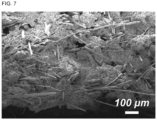
- FIG. 7 is an SEM image of the aerogel layer of the battery insulation sheet according to Comparative Example 4.
- Comparative Example 1 ( FIG. 4 ) that no reinforcement material is present, and it can be seen from Comparative Example 2 ( FIG. 5 ), in which a first fibrous support having an aspect ratio of 1 is used alone, that the first fibrous support includes fibers having a relatively small (e.g., unsuitable) average diameter.
- Comparative Example 3 ( FIG. 6 ), in which a second fibrous support having an aspect ratio of 2 is used alone, that the second fibrous support includes fibers having a longer aspect ratio than in Comparative Example 2.
- Comparative Example 4 ( FIG. 7 ), in which a third fibrous support having an aspect ratio of 3 is used alone, that the third fibrous support includes fibers having a longer aspect ratio than in Comparative Example 3.
- Example 1 ( FIG. 3 ), in which a first fibrous support, a second fibrous support, and a third fibrous support are used, that the fibrous supports have different average diameters and average lengths.
- each insulation sheet was inserted between aluminum plates each having a thickness of 1 mm and compressed at a compression speed of 0.02 mm/second from 0 kN to 80 kN to measure a change in thickness of the insulation sheet using a UTM (universal testing machine).
- UTM universal testing machine
- Each insulation sheet was placed between a pair of opposing 1 mm thick aluminum plates and was placed on a heat press.
- An upper plate of the heat press was heated to 350 °C, and a lower plate of the heat press was not heated and was maintained at a starting temperature of 40 °C.
- a pressure of 20 kN was applied to the lower plate of the heat press, and the temperature of the lower plate of the heat press in 11 minutes was measured. The results are shown in Table 1.
- Example 1 Compression rate (%) Lower plate temperature (°C) Example 1 51.5 80.1 Example 2 56.1 79.5 Example 3 58.6 75.5 Example 4 60.1 76.4 Example 5 55.4 79.5 Example 6 58.5 78.9 Example 7 53.4 78.5 Example 8 57.8 75.6 Comparative Example 1 51.2 73.2 Comparative Example 2 48.8 79.5 Comparative Example 3 43.8 78.4 Comparative Example 4 44.2 80.1
- the results of the evaluation of the compression properties depending on the content ratio of the first fibrous support, the second fibrous support, and the third fibrous support are shown, and it can be seen therefrom that excellent or suitable physical properties are achieved if the first fibrous support is included so as to account for 10 to 60 parts by weight, the second fibrous support is included so as to account for 30 to 60 parts by weight, and the third fibrous support is included so as to account for 10 to 60 parts by weight as the reinforcement material and that better physical properties are achieved if the first fibrous support is included so as to account for 20 to 60 parts by weight, the second fibrous support is included so as to account for 40 to 60 parts by weight, and the third fibrous support is included so as to account for 10 to 30 parts by weight as the reinforcement material.
- Example 8 It can be seen from Example 8 that the compression properties are further improved if the binder and the dispersant are mixed to manufacture the aerogel composition.
- Comparative Example 1 It can be seen from Comparative Example 1 that the compression properties are very (e.g., unsuitably) low because no reinforcement material is included, and it can be seen from Comparative Examples 2 to 4 that the compressive properties are lower than in Examples if a reinforcement material including only one fibrous support is used.
- a battery insulation sheet according to one or more embodiments has structurally enhanced mechanical properties while maintaining thermal insulation.
- a battery insulation sheet manufactured using an aerogel composition may have excellent or suitable thermal insulation, fire resistance, and mechanical properties while having excellent or suitable mechanical properties, such as durability and/or compressibility, suitably low manufacturing process cost, and at the same time may prevent or reduce generation of dust from the aerogel during a manufacturing process and in actual use.
Landscapes
- Chemical & Material Sciences (AREA)
- Chemical Kinetics & Catalysis (AREA)
- Organic Chemistry (AREA)
- Engineering & Computer Science (AREA)
- Polymers & Plastics (AREA)
- Health & Medical Sciences (AREA)
- Medicinal Chemistry (AREA)
- Materials Engineering (AREA)
- General Chemical & Material Sciences (AREA)
- Electrochemistry (AREA)
- Manufacturing & Machinery (AREA)
- Ceramic Engineering (AREA)
- Structural Engineering (AREA)
- Dispersion Chemistry (AREA)
- Cell Separators (AREA)
- Compositions Of Macromolecular Compounds (AREA)
- Reinforced Plastic Materials (AREA)
- Thermal Insulation (AREA)
- Fireproofing Substances (AREA)
Applications Claiming Priority (1)
| Application Number | Priority Date | Filing Date | Title |
|---|---|---|---|
| KR1020230098058A KR20250017389A (ko) | 2023-07-27 | 2023-07-27 | 배터리 장치용 단열 조성물, 이의 제조 방법, 이를 이용하여 제조한 시트 및 이를 포함하는 배터리 모듈 |
Publications (2)
| Publication Number | Publication Date |
|---|---|
| EP4512518A2 true EP4512518A2 (de) | 2025-02-26 |
| EP4512518A3 EP4512518A3 (de) | 2025-04-23 |
Family
ID=91465244
Family Applications (1)
| Application Number | Title | Priority Date | Filing Date |
|---|---|---|---|
| EP24180819.5A Pending EP4512518A3 (de) | 2023-07-27 | 2024-06-07 | Isolierungszusammensetzung für eine batterievorrichtung, verfahren zur herstellung davon, damit hergestellte folie und batteriemodul damit |
Country Status (5)
| Country | Link |
|---|---|
| US (1) | US20250038307A1 (de) |
| EP (1) | EP4512518A3 (de) |
| JP (1) | JP2025018922A (de) |
| KR (1) | KR20250017389A (de) |
| CN (1) | CN119371137A (de) |
Family Cites Families (12)
| Publication number | Priority date | Publication date | Assignee | Title |
|---|---|---|---|---|
| BR0115523A (pt) * | 2000-12-22 | 2003-09-16 | Aspen Aerogels Inc | Compósito |
| US7560062B2 (en) * | 2004-07-12 | 2009-07-14 | Aspen Aerogels, Inc. | High strength, nanoporous bodies reinforced with fibrous materials |
| US20090029147A1 (en) * | 2006-06-12 | 2009-01-29 | Aspen Aerogels, Inc. | Aerogel-foam composites |
| EP2429948A4 (de) * | 2009-04-27 | 2017-09-06 | Cabot Corporation | Aerogelzusammensetzungen sowie verfahren zu ihrer herstellung und verwendung |
| JP2018204708A (ja) * | 2017-06-06 | 2018-12-27 | パナソニックIpマネジメント株式会社 | 断熱材とそれを用いた発熱ユニット、および、電池ユニット |
| WO2021095279A1 (ja) * | 2019-11-15 | 2021-05-20 | 井前工業株式会社 | 複合型断熱材及びその製造方法 |
| JP6997263B1 (ja) * | 2020-07-10 | 2022-01-17 | イビデン株式会社 | 熱伝達抑制シート及び組電池 |
| WO2022084394A1 (en) * | 2020-10-22 | 2022-04-28 | Basf Se | Composite article |
| JP2022125585A (ja) * | 2021-02-17 | 2022-08-29 | 住友理工株式会社 | 断熱材 |
| EP4414596A1 (de) * | 2021-10-08 | 2024-08-14 | Nitto Denko Corporation | Wärmedämmstoff und verfahren zur herstellung des wärmedämmstoffes |
| JP7052139B1 (ja) * | 2021-12-28 | 2022-04-11 | イビデン株式会社 | 熱伝達抑制シート及び組電池 |
| WO2024059682A1 (en) * | 2022-09-16 | 2024-03-21 | Cabot Corporation | Aerogel composition for thermal insulation |
-
2023
- 2023-07-27 KR KR1020230098058A patent/KR20250017389A/ko active Pending
-
2024
- 2024-05-17 JP JP2024080557A patent/JP2025018922A/ja active Pending
- 2024-05-21 US US18/670,274 patent/US20250038307A1/en active Pending
- 2024-06-07 EP EP24180819.5A patent/EP4512518A3/de active Pending
- 2024-06-17 CN CN202410774802.1A patent/CN119371137A/zh active Pending
Also Published As
| Publication number | Publication date |
|---|---|
| CN119371137A (zh) | 2025-01-28 |
| KR20250017389A (ko) | 2025-02-04 |
| JP2025018922A (ja) | 2025-02-06 |
| EP4512518A3 (de) | 2025-04-23 |
| US20250038307A1 (en) | 2025-01-30 |
Similar Documents
| Publication | Publication Date | Title |
|---|---|---|
| JP2021143733A (ja) | 断熱材およびその製造方法 | |
| JP7763215B2 (ja) | バッテリー断熱シート用エアロゲル組成物、その製造方法、これを用いて形成したバッテリー断熱シートおよびその製造方法 | |
| EP4512519A2 (de) | Isolierungszusammensetzung für batterievorrichtung, verfahren zur herstellung der isolierungszusammensetzung, mit der isolierungszusammensetzung geformtes blech und batteriemodul mit dem blech | |
| Zhou et al. | Enhanced thermal properties for nanoencapsulated phase change materials with functionalized graphene oxide (FGO) modified PMMA | |
| EP4509311A1 (de) | Batterieisolierfolie, herstellungsverfahren dafür und batteriemodul mit der batterieisolierfolie | |
| JP7809675B2 (ja) | バッテリー断熱シートおよびその製造方法 | |
| EP4512518A2 (de) | Isolierungszusammensetzung für eine batterievorrichtung, verfahren zur herstellung davon, damit hergestellte folie und batteriemodul damit | |
| US20250038308A1 (en) | Insulation composition for battery device, method for preparing the same, sheet formed using the insulation composition, and battery module comprising the sheet | |
| EP4517940A1 (de) | Isolierfolie für batterie, herstellungsverfahren dafür und batteriemodul damit | |
| EP4461776A1 (de) | Aerogelzusammensetzung für batterieisolierfolie, herstellungsverfahren dafür, damit hergestellte batterieisolierfolie und batteriemodul damit | |
| EP4461777A1 (de) | Aerogelzusammensetzung für batterieisolierfolie, herstellungsverfahren dafür, damit hergestellte batterieisolierfolie und batteriemodul damit | |
| KR20240156263A (ko) | 배터리 단열시트, 이의 제조방법 및 이를 포함하는 배터리 모듈 | |
| EP4446000A1 (de) | Aerogelzusammensetzung für batterieisolierfolie, herstellungsverfahren dafür und herstellungsverfahren für eine batterieisolierfolie | |
| JP7713553B2 (ja) | バッテリー断熱シート、その製造方法、及びそれを含むバッテリーモジュール | |
| US20240429542A1 (en) | Battery module, manufacturing method thereof, and battery pack comprising the battery module | |
| KR20250171909A (ko) | 리튬 이차 전지용 단열 시트 및 이를 포함하는 리튬 이차 전지 모듈 |
Legal Events
| Date | Code | Title | Description |
|---|---|---|---|
| PUAI | Public reference made under article 153(3) epc to a published international application that has entered the european phase |
Free format text: ORIGINAL CODE: 0009012 |
|
| STAA | Information on the status of an ep patent application or granted ep patent |
Free format text: STATUS: REQUEST FOR EXAMINATION WAS MADE |
|
| 17P | Request for examination filed |
Effective date: 20240607 |
|
| AK | Designated contracting states |
Kind code of ref document: A2 Designated state(s): AL AT BE BG CH CY CZ DE DK EE ES FI FR GB GR HR HU IE IS IT LI LT LU LV MC ME MK MT NL NO PL PT RO RS SE SI SK SM TR |
|
| PUAL | Search report despatched |
Free format text: ORIGINAL CODE: 0009013 |
|
| AK | Designated contracting states |
Kind code of ref document: A3 Designated state(s): AL AT BE BG CH CY CZ DE DK EE ES FI FR GB GR HR HU IE IS IT LI LT LU LV MC ME MK MT NL NO PL PT RO RS SE SI SK SM TR |
|
| RIC1 | Information provided on ipc code assigned before grant |
Ipc: B01J 13/00 20060101AFI20250318BHEP |