EP4510262A1 - Übertragungsschale für elektrodenanordnung - Google Patents
Übertragungsschale für elektrodenanordnung Download PDFInfo
- Publication number
- EP4510262A1 EP4510262A1 EP23816415.6A EP23816415A EP4510262A1 EP 4510262 A1 EP4510262 A1 EP 4510262A1 EP 23816415 A EP23816415 A EP 23816415A EP 4510262 A1 EP4510262 A1 EP 4510262A1
- Authority
- EP
- European Patent Office
- Prior art keywords
- electrode assembly
- transfer tray
- support
- support portion
- electrode
- Prior art date
- Legal status (The legal status is an assumption and is not a legal conclusion. Google has not performed a legal analysis and makes no representation as to the accuracy of the status listed.)
- Pending
Links
Images


Classifications
-
- H—ELECTRICITY
- H01—ELECTRIC ELEMENTS
- H01M—PROCESSES OR MEANS, e.g. BATTERIES, FOR THE DIRECT CONVERSION OF CHEMICAL ENERGY INTO ELECTRICAL ENERGY
- H01M10/00—Secondary cells; Manufacture thereof
- H01M10/04—Construction or manufacture in general
-
- H—ELECTRICITY
- H01—ELECTRIC ELEMENTS
- H01M—PROCESSES OR MEANS, e.g. BATTERIES, FOR THE DIRECT CONVERSION OF CHEMICAL ENERGY INTO ELECTRICAL ENERGY
- H01M10/00—Secondary cells; Manufacture thereof
- H01M10/04—Construction or manufacture in general
- H01M10/0404—Machines for assembling batteries
- H01M10/0409—Machines for assembling batteries for cells with wound electrodes
-
- B—PERFORMING OPERATIONS; TRANSPORTING
- B65—CONVEYING; PACKING; STORING; HANDLING THIN OR FILAMENTARY MATERIAL
- B65D—CONTAINERS FOR STORAGE OR TRANSPORT OF ARTICLES OR MATERIALS, e.g. BAGS, BARRELS, BOTTLES, BOXES, CANS, CARTONS, CRATES, DRUMS, JARS, TANKS, HOPPERS, FORWARDING CONTAINERS; ACCESSORIES, CLOSURES, OR FITTINGS THEREFOR; PACKAGING ELEMENTS; PACKAGES
- B65D25/00—Details of other kinds or types of rigid or semi-rigid containers
- B65D25/02—Internal fittings
- B65D25/10—Devices to locate articles in containers
- B65D25/107—Grooves, ribs, or the like, situated on opposed walls and between which the articles are located
-
- H—ELECTRICITY
- H01—ELECTRIC ELEMENTS
- H01M—PROCESSES OR MEANS, e.g. BATTERIES, FOR THE DIRECT CONVERSION OF CHEMICAL ENERGY INTO ELECTRICAL ENERGY
- H01M10/00—Secondary cells; Manufacture thereof
- H01M10/04—Construction or manufacture in general
- H01M10/0404—Machines for assembling batteries
-
- H—ELECTRICITY
- H01—ELECTRIC ELEMENTS
- H01M—PROCESSES OR MEANS, e.g. BATTERIES, FOR THE DIRECT CONVERSION OF CHEMICAL ENERGY INTO ELECTRICAL ENERGY
- H01M10/00—Secondary cells; Manufacture thereof
- H01M10/04—Construction or manufacture in general
- H01M10/0431—Cells with wound or folded electrodes
-
- H—ELECTRICITY
- H01—ELECTRIC ELEMENTS
- H01M—PROCESSES OR MEANS, e.g. BATTERIES, FOR THE DIRECT CONVERSION OF CHEMICAL ENERGY INTO ELECTRICAL ENERGY
- H01M10/00—Secondary cells; Manufacture thereof
- H01M10/05—Accumulators with non-aqueous electrolyte
- H01M10/058—Construction or manufacture
- H01M10/0587—Construction or manufacture of accumulators having only wound construction elements, i.e. wound positive electrodes, wound negative electrodes and wound separators
-
- H—ELECTRICITY
- H01—ELECTRIC ELEMENTS
- H01M—PROCESSES OR MEANS, e.g. BATTERIES, FOR THE DIRECT CONVERSION OF CHEMICAL ENERGY INTO ELECTRICAL ENERGY
- H01M50/00—Constructional details or processes of manufacture of the non-active parts of electrochemical cells other than fuel cells, e.g. hybrid cells
- H01M50/20—Mountings; Secondary casings or frames; Racks, modules or packs; Suspension devices; Shock absorbers; Transport or carrying devices; Holders
-
- H—ELECTRICITY
- H01—ELECTRIC ELEMENTS
- H01M—PROCESSES OR MEANS, e.g. BATTERIES, FOR THE DIRECT CONVERSION OF CHEMICAL ENERGY INTO ELECTRICAL ENERGY
- H01M50/00—Constructional details or processes of manufacture of the non-active parts of electrochemical cells other than fuel cells, e.g. hybrid cells
- H01M50/20—Mountings; Secondary casings or frames; Racks, modules or packs; Suspension devices; Shock absorbers; Transport or carrying devices; Holders
- H01M50/256—Carrying devices, e.g. belts
-
- Y—GENERAL TAGGING OF NEW TECHNOLOGICAL DEVELOPMENTS; GENERAL TAGGING OF CROSS-SECTIONAL TECHNOLOGIES SPANNING OVER SEVERAL SECTIONS OF THE IPC; TECHNICAL SUBJECTS COVERED BY FORMER USPC CROSS-REFERENCE ART COLLECTIONS [XRACs] AND DIGESTS
- Y02—TECHNOLOGIES OR APPLICATIONS FOR MITIGATION OR ADAPTATION AGAINST CLIMATE CHANGE
- Y02E—REDUCTION OF GREENHOUSE GAS [GHG] EMISSIONS, RELATED TO ENERGY GENERATION, TRANSMISSION OR DISTRIBUTION
- Y02E60/00—Enabling technologies; Technologies with a potential or indirect contribution to GHG emissions mitigation
- Y02E60/10—Energy storage using batteries
-
- Y—GENERAL TAGGING OF NEW TECHNOLOGICAL DEVELOPMENTS; GENERAL TAGGING OF CROSS-SECTIONAL TECHNOLOGIES SPANNING OVER SEVERAL SECTIONS OF THE IPC; TECHNICAL SUBJECTS COVERED BY FORMER USPC CROSS-REFERENCE ART COLLECTIONS [XRACs] AND DIGESTS
- Y02—TECHNOLOGIES OR APPLICATIONS FOR MITIGATION OR ADAPTATION AGAINST CLIMATE CHANGE
- Y02P—CLIMATE CHANGE MITIGATION TECHNOLOGIES IN THE PRODUCTION OR PROCESSING OF GOODS
- Y02P70/00—Climate change mitigation technologies in the production process for final industrial or consumer products
- Y02P70/50—Manufacturing or production processes characterised by the final manufactured product
Definitions
- the present disclosure relates to an electrode assembly transfer tray for a cylindrical battery.
- Secondary batteries have high applicability according to product groups and electrical characteristics such as high energy density, and thus are commonly applied not only to portable devices but also to electric vehicles (EVs) or hybrid electric vehicles (HEVs) driven by electric power sources.
- EVs electric vehicles
- HEVs hybrid electric vehicles
- Such secondary batteries are attracting attention as a new energy source to improve eco-friendliness and energy efficiency in that they have not only a primary advantage of dramatically reducing the use of fossil fuels, but also no by-products generated from the use of energy.
- Secondary batteries widely used at present include lithium-ion batteries, lithium polymer batteries, nickel cadmium batteries, nickel hydrogen batteries, nickel zinc batteries and the like.
- An operating voltage of the unit secondary battery cell namely a unit battery cell, is about 2.5V to 4.5V. Therefore, if a higher output voltage is required, a plurality of battery cells may be connected in series to configure a battery pack. In addition, depending on the charge/discharge capacity required for the battery pack, a plurality of battery cells may be connected in parallel to configure a battery pack. Thus, the number of battery cells included in the battery pack may be set variously according to the required output voltage or the demanded charge/discharge capacity.
- a separator which is an insulator, is interposed between the positive electrode and the negative electrode and then wound to form the electrode assembly in the shape of a jelly roll, which is inserted together with an electrolyte into the battery can to configure a battery.
- a strip-shaped electrode tab may be connected to each uncoated portion of the positive electrode and the negative electrode, and the electrode tab electrically connects the electrode assembly and the electrode terminal exposed to the outside.
- the positive electrode terminal is a cap plate of a sealing body sealing the opening of the battery can
- the negative electrode terminal is the battery can.
- the present disclosure is designed to solve the problems of the related art, and therefore the present disclosure is directed to providing an electrode assembly transfer tray configured to minimize damage to the electrode assembly when transferring the electrode assembly wound in the electrode assembly winding device to the assembly facility.
- An electrode assembly transfer tray may be configured to accommodate an electrode assembly which includes a first electrode including a first uncoated portion, a second electrode including a second uncoated portion, and a separator interposed therebetween, and in which a laminate including the first electrode, the second electrode, and the separator is wound around a winding axis, and may include a bottom plate configured to support the electrode assembly, wherein the bottom plate may include a seating portion, wherein the seating portion may include a first accommodating portion positioned at one end in the extension direction of the winding axis and configured to accommodate a first tab portion formed by winding the first uncoated portion; a second accommodating portion positioned at the other end in the extension direction of the winding axis and configured to accommodate a second tab portion formed by winding the second uncoated portion; and a support portion configured to support a body portion positioned between the first tab portion and the second tab portion.
- the bottom plate may include a plurality of seating portions provided along at least one of a first direction parallel to the winding axis and a second direction perpendicular to the first direction.
- the seating portion may have a groove shape configured to accommodate the electrode assembly.
- the seating portion may have a length longer than the length of the electrode assembly along the winding axis.
- the seating portion may be configured such that the first tab portion accommodated in the first accommodating portion and the second tab portion accommodated in the second accommodating portion are not in contact with the bottom plate.
- the support portion may be configured such that a bottom surface formed therein is not in contact with the body portion of the electrode assembly.
- the support portion may support the electrode assembly at a position lower than the winding axis of the electrode assembly.
- the support portion may include a first support portion configured to support a first side of the body portion; and a second support portion configured to support a second side of the body portion.
- the first support portion and the second support portion may be configured to be in contact with the outer circumferential surface of the body portion.
- the first support portion and the second support portion may be configured such that at least a portion thereof has the same radius of curvature as the radius of curvature of the outer circumferential surface of the body portion.
- the first support portion and the second support portion may be inclined to have a predetermined angle with respect to the bottom surface, and may be inclined in opposite directions to each other.
- the bottom plate may include a plurality of seating portions provided along at least one of a first direction parallel to the winding axis and a second direction perpendicular to the first direction, wherein the plurality of seating portions may be arranged such that a pair of seating portions adjacent to each other along the second direction are spaced apart by a predetermined distance.
- the first support portion and the second support portion may be formed discontinuously along the first direction.
- the first support portion and the second support portion may have a discontinuous shape at a position corresponding to the core of the body portion along the first direction so as to grip an outer circumferential surface of the electrode assembly for lifting of the electrode assembly.
- the electrode assembly transfer tray may include a guide portion configured to prevent separation of the electrode assembly during transfer along the edge of the bottom plate.
- the electrode assembly when transporting an electrode assembly with increased size and weight, the electrode assembly may be transferred in a horizontally seated state, thereby reducing the possibility of damage to the electrode assembly during the transfer.
- the first tab portion and the second tab portion which are relatively more likely to be damaged when interfering with the transfer tray during the transfer process, are not supported by the support portion, and thus the possibility of damage to the first tab portion and the second tab portion during the transfer of the electrode assembly may also be reduced.
- the seating portion is formed longer than the length of the electrode assembly, so that the outer circumferential surfaces and/or ends of the first tab portion and the second tab portion are not in contact with the bottom plate, thereby reducing the possibility of damage to the first tab portion and the second tab portion more effectively.
- the transfer path of the electrode assembly using the electrode assembly transfer tray may be set to move only in a first direction parallel to and a second direction perpendicular to the winding axis of the electrode assembly.
- the lowest portion of the electrode assembly is not in contact with the bottom surface, and thus damage caused by a load of the electrode assembly may be prevented.
- the support portion may stably support the body portion of the electrode assembly from both sides.
- the electrode assembly tray even if the electrode assembly is separated from the seating portion, it is possible to prevent the electrode assembly from being separated from the entire electrode assembly transfer tray by the guide portion.
- the transfer process of the electrode assembly tray may be facilitated by the handle portion.
- FIG. 1 is a view showing a first electrode and a second electrode of an electrode assembly transferred by an electrode assembly transfer tray according to an embodiment of the present disclosure.
- FIG. 2 is a view showing a state before an electrode assembly transferred by an electrode assembly transfer tray according to an embodiment of the present disclosure is wound, and shows a laminate including a first electrode, a second electrode, and a separator.
- FIG. 3 is a cross-sectional view showing an electrode assembly moved by an electrode assembly transfer tray according to an embodiment of the present disclosure.
- an electrode assembly 100 transported by an electrode assembly transfer tray 1 may include a first electrode 10, a second electrode 20, and a separator 30.
- the first electrode 10 may include a first uncoated portion 11.
- the first electrode 10 may have a first electrode active material applied to at least a portion of one or both surfaces thereof, and may include the first uncoated portion 11 in which the first electrode active material is not applied to one end thereof.
- the first uncoated portion 11 may be provided at one end of the first electrode 10 along the winding direction (X-axis extension direction).
- the first electrode 10 may be a negative electrode or a positive electrode.
- the second electrode 20 may include a second uncoated portion 21.
- the second electrode 20 may have a second electrode active material applied to at least a portion of one or both surfaces thereof, and may include the second uncoated portion 21 in which the second electrode active material is not applied to one end thereof.
- the second uncoated portion 21 may be provided at one end of the second electrode 20 along the winding direction (X-axis extension direction).
- the second electrode 20 may be a positive electrode or a negative electrode, with a polarity opposite to that of the first electrode 10.
- the separator 30 may be interposed between the first electrode 10 and the second electrode 20.
- the separator 30 may use a porous polymer film including at least one polymer selected from polyolefin-based polymers such as ethylene homopolymer, propylene homopolymer, ethylene/butene copolymer, ethylene/hexene copolymer, ethylene/methacrylate copolymer, and the like, alone or by laminating a plurality of polymer films.
- the separator 30 may use a conventional porous nonwoven fabric, for example, a nonwoven fabric made of high melting point glass fiber, polyethylene terephthalate fiber, or the like.
- the electrode assembly 100 may be manufactured by winding a laminate 100' including the first electrode 10, the second electrode 20, and the separator 30 around a winding axis (a direction parallel to the Z-axis).
- the laminate 100' may be formed by stacking the first electrode 10 and the second electrode 20 at least once with the separator 30 interposed therebetween.
- the electrode assembly 100 may have a central hole C formed by winding the laminate 100' around a winding axis (a direction parallel to the Z-axis).
- FIG. 4 is a perspective view showing an electrode assembly moved by an electrode assembly transfer tray according to an embodiment of the present disclosure.
- the electrode assembly 100 may form a first tab portion 110, a second tab portion 120, and a body portion 130 by winding the laminate 100'.
- the first tab portion 110 may be formed by winding the first uncoated portion 11.
- the first tab portion 110 may be located at one end (an end located in the positive direction of the Z-axis) in the extension direction of the winding axis (a direction parallel to the Z-axis). This is to use at least a portion of the first uncoated portion 11 exposed to the outside of the separator 30 as an electrode tab by itself.
- At least a portion of the first uncoated portion 11 may include a plurality of segments divided along the winding direction (X-axis extension direction) of the electrode assembly 100. The plurality of segments may be bent along the radial direction of the electrode assembly 100. The plurality of bent segments may be overlapped in several layers.
- the first tab portion 110 may form a surface by overlapping several layers of a plurality of segments.
- the first tab portion 110 may be not only in the case where the plurality of segments are completely bent along the radial direction of the electrode assembly 100, but also in the form of being bent only at a certain angle.
- the second tab portion 120 may be formed by winding the second uncoated portion 21.
- the second tab portion 120 may be located at the other end (an end located in the negative direction of the Z-axis) in the extension direction of the winding axis (a direction parallel to the Z-axis). This is to use at least a portion of the second uncoated portion 21 exposed to the outside of the separator 30 as an electrode tab by itself.
- At least a portion of the second uncoated portion 21 may include a plurality of segments divided along the winding direction of the electrode assembly 100. The plurality of segments may be bent along the radial direction of the electrode assembly 100. The plurality of bent segments may be overlapped in several layers.
- the second tab portion 120 may form a surface by overlapping several layers of a plurality of segments.
- the second tab portion 120 may be not only in the case where the plurality of segments are completely bent along the radial direction of the electrode assembly 100, but also in the form of being bent only at a certain angle.
- the body portion 130 may be positioned between the first tab portion 110 and the second tab portion 120.
- the body portion 130 may be formed by winding a portion corresponding to the portion to which the first electrode 10 active material of the first electrode 10 is applied and/or the portion to which the second electrode 20 active material of the second electrode 20 is applied.
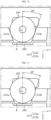
- FIG. 5 is a perspective view showing an electrode assembly transfer tray according to an embodiment of the present disclosure.
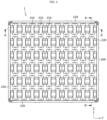
- FIG. 6 is a plan view showing an electrode assembly transfer tray according to an embodiment of the present disclosure.
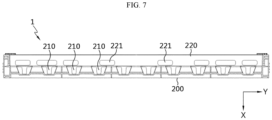
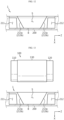
- FIG. 7 is a view showing a cross section taken along line A-A' of FIG. 6 .
- the electrode assembly transfer tray 1 may include a bottom plate 200.
- the bottom plate 200 may be configured to support the electrode assembly 100.
- the bottom plate 200 may include a seating portion 210.
- the seating portion 210 may be configured to accommodate the electrode assembly 100.
- the seating portion 210 may have a groove shape configured to accommodate the electrode assembly 100.
- the seating portion 210 may be configured such that the electrode assembly 100 is seated in a horizontal direction.
- the seating portion 210 may be provided in plurality.
- the seating portion 210 may be provided in plurality along at least one direction of a first direction (a direction parallel to the Z-axis) parallel to the winding axis (a direction parallel to the Z-axis) of the electrode assembly and a second direction (a direction parallel to the Y-axis) perpendicular to the first direction.
- the seating portion 210 may be arranged in 10 columns along the first direction (a direction parallel to the Z-axis) and in 6 rows along the second direction (a direction parallel to the Y-axis).
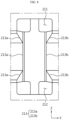
- FIG. 8 is an enlarged view of a partial area of FIG. 6 .
- FIG. 9 is a view showing a state in which an electrode assembly is accommodated in a seating portion of an electrode assembly transfer tray according to an embodiment of the present disclosure.
- the seating portion 210 may include a first accommodating portion 211, a second accommodating portion 212, and a support portion 213.
- the first accommodating portion 211 and the second accommodating portion 212 may be formed on both sides of the support portion 213 in the longitudinal direction (extension direction of the Z-axis), respectively.
- the first accommodating portion 211 may be formed at a position corresponding to the first tab portion 110.
- the first accommodating portion 211 may be configured to accommodate the first tab portion 110.
- the first accommodating portion 211 may have a groove shape configured to accommodate the first tab portion 110.
- the first accommodating portion 211 may be configured to accommodate the first tab portion 110 of the electrode assembly 100 in a horizontal state.
- the first accommodating portion 211 may be configured not to support the first tab portion 110 accommodated in the first accommodating portion 211.
- the second accommodating portion 212 may be formed at a position corresponding to the second tab portion 120.
- the second accommodating portion 212 may be configured to accommodate the second tab portion 120.
- the second accommodating portion 212 may have a groove shape configured to accommodate the second tab portion 120.
- the second accommodating portion 212 may be configured to accommodate the second tab portion 120 of the electrode assembly 100 in a horizontal state.
- the second accommodating portion 212 may be configured not to support the second tab portion 120 accommodated in the second accommodating portion 212.
- the support portion 213 may be configured to support the body portion 130.
- the support portion 213 may be configured to support the body portion 130 of the electrode assembly 100 in a horizontal state.
- the electrode assembly 100 when transporting the electrode assembly 100 with increased size and weight, the electrode assembly 100 may be transferred in a horizontally seated state, thereby reducing the possibility of damage to the electrode assembly 100 during the transfer.
- the first tab portion 110 and the second tab portion 120 which are relatively more likely to be damaged when interfering with the transfer tray during the transfer process, are not supported by the support portion 213, and thus the possibility of damage to the first tab portion 110 and the second tab portion 120 during the transfer of the electrode assembly 100 may also be reduced.
- the length L1 of the seating portion 210 may be longer than the length L2 of the electrode assembly 100 along the winding axis (a direction parallel to the Z-axis).
- the support portion 213 of the seating portion 210 may have approximately the same length as the body portion 130 of the electrode assembly 100, the first accommodating portion 211 of the seating portion 210 may have an approximately longer length than the first tab portion 110 of the electrode assembly 100, and the second accommodating portion 212 of the seat portion 210 may have an approximately longer length than the second tab portion 120 of the electrode assembly 100.
- the seating portion 210 may be configured such that the first tab portion 110 accommodated in the first accommodating portion 211 is not in contact with the bottom plate 200.
- the seating portion 210 may be configured such that the second tab portion 120 accommodated in the second accommodating portion 212 is not in contact with the bottom plate 200.
- the seating portion 210 may be configured such that the outer circumferential surface and end of the first tab portion 110 and the second tab portion 120 are not in contact with the bottom plate 200. Meanwhile, when the first tab portion 110 and/or the second tab portion 120 of the electrode assembly 100 has a bent structure along the radial direction of the electrode assembly 100, the seating portion 210 may be configured such that the surface formed by bending the first tab portion 110 and the second tab portion 120 is not in contact with the bottom plate 200.
- the seating portion 210 may be formed to be longer than the length of the electrode assembly 100, so that the outer circumferential surfaces and/or ends of the first tab portion 110 and the second tab portion 120 are not in contact with the bottom plate 200, thereby reducing the possibility of damage to the first tab portion 110 and the second tab portion 120 more effectively.
- the transfer path of the electrode assembly 100 using the electrode assembly transfer tray 1 may be set to move only in a first direction (a direction parallel to the Z-axis) parallel to and a second direction (a direction parallel to the Y-axis) perpendicular to the winding axis (a direction parallel to the Z-axis) of the electrode assembly 100.
- FIG. 10 is a view showing a state in which an electrode assembly is accommodated in the transfer tray according to an embodiment of the present disclosure shown in FIG. 7 .
- FIG. 11 is a view showing a state in which an electrode assembly is accommodated in an electrode assembly transfer tray according to another embodiment of the present disclosure.
- the support portion 213 may be configured such that the bottom surface B formed therein is not contact with the body portion 130 of the electrode assembly 100.
- the support portion 213 may support the electrode assembly 100 at a position lower than the winding axis (a direction parallel to the Z-axis) of the electrode assembly 100.
- the support portion 213 may support the body portion 130 of the electrode assembly 100 so that the electrode assembly 100 is in a state of being approximately floating from the bottom surface B.
- the lowest portion of the electrode assembly 100 is not in contact with the bottom surface B, and thus damage caused by a load of the electrode assembly 100 may be prevented.
- the support portion 213 may include a first support portion 213a and a second support portion 213b.
- the support portion 213 may support the body portion 130 with the first support portion 213a and the second support portion 213b at both sides along a first direction (a direction parallel to the Z-axis) parallel to and a second direction (a direction parallel to the Y-axis) perpendicular to the winding axis (a direction parallel to the Z-axis) of the electrode assembly 100, respectively.
- the first support portion 213a may be configured to support the first side (a negative direction of the Y-axis) of the body portion 130.
- the first support portion 213a may be configured to be in contact with the outer circumferential surface of the body portion 130.
- the first support portion 213a may be inclined to have a predetermined angle with respect to the bottom surface B, as shown in FIG. 10 .
- At least a portion of the first support portion 213a may have the same radius of curvature as the radius of curvature of the outer circumferential surface of the body portion 130, as shown in FIG. 11 .
- the first support portion 213a may be inclined in an opposite direction to the second support portion 213b.
- the first support portion 213a may be inclined by approximately 50° to 80° with respect to the bottom surface B.
- the second support portion 213b may be configured to support the second side (a positive direction of the Y-axis) of the body portion 130.
- the second support portion 213b may be configured to be in contact with the outer circumferential surface of the body portion 130.
- the second support portion 213b may be inclined to have a predetermined angle with respect to the bottom surface B, as shown in FIG. 10 .
- At least a portion of the second support portion 213b may have the same radius of curvature as the radius of curvature of the outer circumferential surface of the body portion 130, as shown in FIG. 11 .
- the second support portion 213b may be inclined in an opposite direction to the first support portion 213a.
- the second support portion 213b may be inclined by approximately 50° to 80° with respect to the bottom surface B.
- the second support portion 213b may be inclined by approximately 60° to 80° with respect to the bottom surface B.
- the second support portion 213b may be inclined by approximately 65° to 75° with respect to the bottom surface B.
- the second support portion 213b may be inclined by approximately 68° to 72° with respect to the bottom surface B.
- the second support portion 213b may be inclined by approximately 70° with respect to the bottom surface B.
- the support portion 213 may stably support the body portion 130 of the electrode assembly 100 from both sides.
- the inclined angles of the first support portion 213a and the second support portion 213b are formed as described above, the movement of the electrode assembly 100 may be minimized by the optimal formation angle.
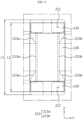
- FIG. 12 is a view showing a portion of a cross section taken along line B-B' of FIG. 6 .
- FIG. 13 is a view showing a state in which an electrode assembly is being accommodated in an electrode assembly transfer tray shown in FIG. 12 .
- first support portion 213a and the second support portion 213b The detailed structure of the first support portion 213a and the second support portion 213b and the arrangement relationship between the pair of seating portions 210 adjacent to each other along the second direction will be described in detail with reference to FIGS. 5 and 6 together with FIGS. 12 and 13 .
- the first support portion 213a and the second support portion 213b may be formed discontinuously along the first direction (a direction parallel to the X-axis).
- the first support portion 213a and the second support portion 213b may have a tapered shape that becomes narrower toward the bottom surface B.
- the first support portion 213a and the second support portion 213b may have a discontinuous area S formed at a position corresponding to the core of the body portion 130 in the first direction (a direction parallel to the Z-axis).
- the discontinuous area S of the first support portion 213a and the discontinuous area S of the second support portion 213b may be symmetrical along the second direction (a direction parallel to the Y-axis).
- the outer circumferential surface of the electrode assembly 100 may be exposed through a substantially trapezoidal opening formed by the discontinuous area S.
- the outer circumferential surface thereof exposed through the trapezoidal opening may be gripped and lifted by an operator or a lifting jig.
- the plurality of seating portions 210 may be arranged such that a pair of seating portions 210 adjacent to each other along the second direction (a direction parallel to the Y-axis) are spaced apart by a predetermined distance.
- the predetermined distance may be set to secure a space into which a lifting jig configured to grip and lift the operator's hand or the outer circumferential surface of the electrode assembly 100 may be inserted.
- the electrode assembly transfer tray 1 may include a guide portion 220.
- the guide portion 220 may be configured such that the electrode assembly 100 is not separated during transfer along the edge of the bottom plate 200.
- the guide portion 220 may be in a form protruding in the negative direction of the X-axis along the edge of the bottom plate 200.
- the guide portion 220 may be four plates coupled along the edge of the bottom plate 200.
- the guide portion 220 may include a handle portion 221 configured to be lifted during transfer.
- the handle portion 221 has an opening shape formed in the guide portion 220, and a hook connected to an operator's hand or a lifting jig may be caught.
- the handle portion 221 may be provided in plurality.
- the electrode assembly 100 tray may be facilitated by the handle portion 221.
Landscapes
- Chemical & Material Sciences (AREA)
- Chemical Kinetics & Catalysis (AREA)
- Electrochemistry (AREA)
- General Chemical & Material Sciences (AREA)
- Engineering & Computer Science (AREA)
- Manufacturing & Machinery (AREA)
- Mechanical Engineering (AREA)
- Secondary Cells (AREA)
- Packaging Of Annular Or Rod-Shaped Articles, Wearing Apparel, Cassettes, Or The Like (AREA)
- Details Of Rigid Or Semi-Rigid Containers (AREA)
- Battery Mounting, Suspending (AREA)
Applications Claiming Priority (2)
| Application Number | Priority Date | Filing Date | Title |
|---|---|---|---|
| KR20220068447 | 2022-06-03 | ||
| PCT/KR2023/007658 WO2023234756A1 (ko) | 2022-06-03 | 2023-06-02 | 전극 조립체 이송 트레이 |
Publications (2)
| Publication Number | Publication Date |
|---|---|
| EP4510262A1 true EP4510262A1 (de) | 2025-02-19 |
| EP4510262A4 EP4510262A4 (de) | 2025-10-29 |
Family
ID=89025224
Family Applications (1)
| Application Number | Title | Priority Date | Filing Date |
|---|---|---|---|
| EP23816415.6A Pending EP4510262A4 (de) | 2022-06-03 | 2023-06-02 | Übertragungsschale für elektrodenanordnung |
Country Status (8)
| Country | Link |
|---|---|
| US (1) | US20250323306A1 (de) |
| EP (1) | EP4510262A4 (de) |
| JP (1) | JP7806308B2 (de) |
| KR (1) | KR102948281B1 (de) |
| CN (1) | CN119318044A (de) |
| CA (1) | CA3253392A1 (de) |
| MX (1) | MX2024014966A (de) |
| WO (1) | WO2023234756A1 (de) |
Family Cites Families (12)
| Publication number | Priority date | Publication date | Assignee | Title |
|---|---|---|---|---|
| JPH10250783A (ja) * | 1997-03-11 | 1998-09-22 | Fuji Photo Film Co Ltd | 電池用巻回体の搬送コンテナ |
| JP2000173568A (ja) * | 1998-12-03 | 2000-06-23 | Fuji Elelctrochem Co Ltd | 複数個の円筒型電池をまとめてシュリンク包装するために各電池の商品図案の向きを揃える方法 |
| JP2003142057A (ja) | 2001-11-07 | 2003-05-16 | Sony Corp | 電池収納容器およびそれに用いられるカセット容器 |
| JP2009193691A (ja) | 2008-02-12 | 2009-08-27 | Panasonic Corp | 電池収納トレイとそれを用いた集合電池収納トレイ |
| CN201985218U (zh) * | 2010-12-17 | 2011-09-21 | 天津力神电池股份有限公司 | 一种聚合物锂离子电池多用托盘 |
| KR101813739B1 (ko) * | 2013-11-29 | 2017-12-29 | 주식회사 엘지화학 | 젤리롤 외경 자동 측정 장치 및 젤리롤 외경 자동 측정 방법 |
| KR102224024B1 (ko) * | 2014-07-24 | 2021-03-08 | 삼성에스디아이 주식회사 | 이차 전지용 포장 트레이 |
| KR102113300B1 (ko) * | 2016-02-29 | 2020-05-20 | 주식회사 엘지화학 | 전지셀의 이송장치 |
| JP6988538B2 (ja) | 2018-02-13 | 2022-01-05 | トヨタ自動車株式会社 | 密閉型電池の製造装置 |
| KR102404261B1 (ko) * | 2019-01-11 | 2022-05-30 | 삼성에스디아이 주식회사 | 전지 이송용 트레이 |
| CN210110901U (zh) * | 2019-09-11 | 2020-02-21 | 东莞市鑫睿电子有限公司 | 一种应用于装电池的托盘 |
| KR102461967B1 (ko) | 2020-11-19 | 2022-10-31 | 박성호 | 노약자를 위한 계단 리프트 장치 |
-
2023
- 2023-06-02 US US18/867,306 patent/US20250323306A1/en active Pending
- 2023-06-02 EP EP23816415.6A patent/EP4510262A4/de active Pending
- 2023-06-02 CN CN202380044699.9A patent/CN119318044A/zh active Pending
- 2023-06-02 WO PCT/KR2023/007658 patent/WO2023234756A1/ko not_active Ceased
- 2023-06-02 KR KR1020230071927A patent/KR102948281B1/ko active Active
- 2023-06-02 JP JP2024571221A patent/JP7806308B2/ja active Active
- 2023-06-02 CA CA3253392A patent/CA3253392A1/en active Pending
-
2024
- 2024-12-02 MX MX2024014966A patent/MX2024014966A/es unknown
Also Published As
| Publication number | Publication date |
|---|---|
| US20250323306A1 (en) | 2025-10-16 |
| CA3253392A1 (en) | 2025-06-17 |
| CN119318044A (zh) | 2025-01-14 |
| KR102948281B1 (ko) | 2026-04-03 |
| JP2025518325A (ja) | 2025-06-12 |
| JP7806308B2 (ja) | 2026-01-26 |
| WO2023234756A1 (ko) | 2023-12-07 |
| MX2024014966A (es) | 2025-01-09 |
| KR20230168163A (ko) | 2023-12-12 |
| EP4510262A4 (de) | 2025-10-29 |
Similar Documents
| Publication | Publication Date | Title |
|---|---|---|
| US9437898B2 (en) | Secondary battery including plurality of electrode assemblies | |
| KR20250096525A (ko) | 배터리 셀 및 전극 조립체 | |
| KR102901452B1 (ko) | 단락 방지용 코팅부가 구비된 전극조립체 | |
| KR102162723B1 (ko) | 절곡된 한 개의 분리막으로 이루어진 단위셀을 포함하고 있는 전극조립체 | |
| US20230198106A1 (en) | Battery Cell Including Electrode Tab Having Stress Relief Portion | |
| EP4510262A1 (de) | Übertragungsschale für elektrodenanordnung | |
| KR101668356B1 (ko) | 스택-폴딩형 전극 조립체 및 그 제조 방법 | |
| US20250246785A1 (en) | Electrode Assembly, Electrode Assembly Manufacturing Method, Secondary Battery, Battery Pack, And Vehicle | |
| KR102876316B1 (ko) | 전극 조립체 및 이를 포함하는 전지셀 | |
| KR101760393B1 (ko) | 코팅부와 비코팅부를 가진 분리막을 포함하는 전극조립체 및 이를 구비한 전지셀 | |
| KR101709527B1 (ko) | 안전성이 향상된 전지셀 | |
| US20260051528A1 (en) | Winding rod for electrode assembly, cylindrical battery cell produced using same, and battery pack and vehicle including cylindrical battery cell | |
| EP4362206B1 (de) | Batteriemodul und batteriepack und fahrzeug mit diesem | |
| EP4629372A1 (de) | Wiederaufladbare batterie | |
| US20250167275A1 (en) | Taping device for secondary battery and secondary battery manufactured using the same | |
| KR20200102167A (ko) | 전극조립체 | |
| EP4572078A1 (de) | Batteriezellenlade- und -entladevorrichtung und damit hergestellte batteriezelle sowie batteriepack und fahrzeug mit batteriezellen | |
| US20250105473A1 (en) | Battery cell, battery module including battery cell, and battery pack including battery module | |
| KR20250174854A (ko) | 배터리 팩 및 이를 포함하는 자동차 | |
| KR20250052746A (ko) | 전극 조립체 이송 장치 및 이를 사용하여 생산된 전극 조립체를 포함하는 배터리 셀 및, 배터리 셀을 포함하는 배터리 팩 및 자동차 | |
| KR20260031811A (ko) | 전극 조립체 권취용 권심장치, 이를 이용한 전극 조립체의 제조방법, 전지셀 및 배터리 팩 | |
| KR20260038365A (ko) | 전극 슬러리 코팅방법, 이에 의해 제조되는 전극, 전지셀 및 배터리 팩 | |
| KR102259379B1 (ko) | 배터리 셀의 전극 이송 장치 | |
| KR20250122771A (ko) | 전극 조립체 및 이를 포함하는 배터리 셀 | |
| KR20260005050A (ko) | 배터리 셀 및 이를 포함하는 배터리 팩 및 자동차 |
Legal Events
| Date | Code | Title | Description |
|---|---|---|---|
| STAA | Information on the status of an ep patent application or granted ep patent |
Free format text: STATUS: THE INTERNATIONAL PUBLICATION HAS BEEN MADE |
|
| PUAI | Public reference made under article 153(3) epc to a published international application that has entered the european phase |
Free format text: ORIGINAL CODE: 0009012 |
|
| STAA | Information on the status of an ep patent application or granted ep patent |
Free format text: STATUS: REQUEST FOR EXAMINATION WAS MADE |
|
| 17P | Request for examination filed |
Effective date: 20241115 |
|
| AK | Designated contracting states |
Kind code of ref document: A1 Designated state(s): AL AT BE BG CH CY CZ DE DK EE ES FI FR GB GR HR HU IE IS IT LI LT LU LV MC ME MK MT NL NO PL PT RO RS SE SI SK SM TR |
|
| DAV | Request for validation of the european patent (deleted) | ||
| DAX | Request for extension of the european patent (deleted) | ||
| A4 | Supplementary search report drawn up and despatched |
Effective date: 20250925 |
|
| RIC1 | Information provided on ipc code assigned before grant |
Ipc: H01M 10/04 20060101AFI20250919BHEP Ipc: H01M 50/20 20210101ALI20250919BHEP Ipc: H01M 10/0587 20100101ALI20250919BHEP Ipc: H01M 50/256 20210101ALI20250919BHEP |