EP4503733A1 - Netzwerkregistrierungsverfahren für verkehrsübertragung und vorrichtung zur unterstützung davon - Google Patents
Netzwerkregistrierungsverfahren für verkehrsübertragung und vorrichtung zur unterstützung davon Download PDFInfo
- Publication number
- EP4503733A1 EP4503733A1 EP23775225.8A EP23775225A EP4503733A1 EP 4503733 A1 EP4503733 A1 EP 4503733A1 EP 23775225 A EP23775225 A EP 23775225A EP 4503733 A1 EP4503733 A1 EP 4503733A1
- Authority
- EP
- European Patent Office
- Prior art keywords
- access
- 3gpp access
- 3gpp
- registration
- pdu session
- Prior art date
- Legal status (The legal status is an assumption and is not a legal conclusion. Google has not performed a legal analysis and makes no representation as to the accuracy of the status listed.)
- Pending
Links
Images





Classifications
-
- H—ELECTRICITY
- H04—ELECTRIC COMMUNICATION TECHNIQUE
- H04W—WIRELESS COMMUNICATION NETWORKS
- H04W76/00—Connection management
- H04W76/10—Connection setup
- H04W76/12—Setup of transport tunnels
-
- H—ELECTRICITY
- H04—ELECTRIC COMMUNICATION TECHNIQUE
- H04W—WIRELESS COMMUNICATION NETWORKS
- H04W60/00—Affiliation to network, e.g. registration; Terminating affiliation with the network, e.g. de-registration
- H04W60/005—Multiple registrations, e.g. multihoming
-
- H—ELECTRICITY
- H04—ELECTRIC COMMUNICATION TECHNIQUE
- H04W—WIRELESS COMMUNICATION NETWORKS
- H04W4/00—Services specially adapted for wireless communication networks; Facilities therefor
- H04W4/30—Services specially adapted for particular environments, situations or purposes
- H04W4/40—Services specially adapted for particular environments, situations or purposes for vehicles, e.g. vehicle-to-pedestrians [V2P]
-
- H—ELECTRICITY
- H04—ELECTRIC COMMUNICATION TECHNIQUE
- H04W—WIRELESS COMMUNICATION NETWORKS
- H04W60/00—Affiliation to network, e.g. registration; Terminating affiliation with the network, e.g. de-registration
- H04W60/06—De-registration or detaching
-
- H—ELECTRICITY
- H04—ELECTRIC COMMUNICATION TECHNIQUE
- H04W—WIRELESS COMMUNICATION NETWORKS
- H04W76/00—Connection management
- H04W76/10—Connection setup
-
- H—ELECTRICITY
- H04—ELECTRIC COMMUNICATION TECHNIQUE
- H04W—WIRELESS COMMUNICATION NETWORKS
- H04W76/00—Connection management
- H04W76/10—Connection setup
- H04W76/15—Setup of multiple wireless link connections
- H04W76/16—Involving different core network technologies, e.g. a packet-switched [PS] bearer in combination with a circuit-switched [CS] bearer
-
- H—ELECTRICITY
- H04—ELECTRIC COMMUNICATION TECHNIQUE
- H04W—WIRELESS COMMUNICATION NETWORKS
- H04W84/00—Network topologies
- H04W84/02—Hierarchically pre-organised networks, e.g. paging networks, cellular networks, WLAN [Wireless Local Area Network] or WLL [Wireless Local Loop]
- H04W84/04—Large scale networks; Deep hierarchical networks
- H04W84/042—Public Land Mobile systems, e.g. cellular systems
-
- H—ELECTRICITY
- H04—ELECTRIC COMMUNICATION TECHNIQUE
- H04W—WIRELESS COMMUNICATION NETWORKS
- H04W88/00—Devices specially adapted for wireless communication networks, e.g. terminals, base stations or access point devices
- H04W88/14—Backbone network devices
Definitions
- the present disclosure relates to a method of network registration for transmitting traffic and a device that supports the same.
- 3rd generation partnership project (3GPP) long-term evolution (LTE) is a technology for enabling high-speed packet communications.
- 3GPP 3rd generation partnership project
- LTE long-term evolution
- Many schemes have been proposed for the LTE objective including those that aim to reduce user and provider costs, improve service quality, and expand and improve coverage and system capacity.
- the 3GPP LTE requires reduced cost per bit, increased service availability, flexible use of a frequency band, a simple structure, an open interface, and adequate power consumption of a terminal as an upper-level requirement.
- ITU international telecommunication union
- NR new radio
- 3GPP has to identify and develop the technology components needed for successfully standardizing the new RAT timely satisfying both the urgent market needs, and the more long-term requirements set forth by the ITU radio communication sector (ITU-R) international mobile telecommunications (IMT)-2020 process.
- ITU-R ITU radio communication sector
- IMT international mobile telecommunications
- the NR should be able to use any spectrum band ranging at least up to 100 GHz that may be made available for wireless communications even in a more distant future.
- the NR targets a single technical framework addressing all usage scenarios, requirements and deployment scenarios including enhanced mobile broadband (eMBB), massive machine-type-communications (mMTC), ultra-reliable and low latency communications (URLLC), etc.
- eMBB enhanced mobile broadband
- mMTC massive machine-type-communications
- URLLC ultra-reliable and low latency communications
- the NR shall be inherently forward compatible.
- the Access Traffic Steering, Switching & Splitting (ATSSS) feature enables User Equipment (UE) and User Plane Function (UPF) to communicate simultaneously over multiple paths (typically one 3GPP access path and one non-3GPP access path).
- UE User Equipment
- UPF User Plane Function
- 5G systems will be able to provide services with an enhanced user experience, distribute traffic across multiple accesses in a policy-based fashion, offer new high-data-rate services, and more.
- the 5G Core network supports a variety of non-3GPP accesses.
- the 5GC may support untrusted non-3GPP access, trusted non-3GPP access, wireline access, etc.
- a User Equipment While a User Equipment (UE) is receiving services by performing registration over an untrusted non-3GPP access and establishing a Multi-Access Protocol Data Unit (MA PDU) session for ATSSS functions, if it discovers a trusted non-3GPP access, it may attempt to use the discovered trusted non-3GPP access according to the UE's settings. In this case, a method may be required to ensure that traffic is seamlessly switched between the non-3GPP accesses.
- UE User Equipment
- MA PDU Multi-Access Protocol Data Unit
- a method performed by a User Equipment (UE) adapted to operate in a wireless communication system comprises, performing a first registration procedure over a first non-3rd Generation Partnership Project (3GPP) access, and transmitting a registration request message of a second registration procedure to an Access and mobility Management Function (AMF) over a second non-3GPP access.
- the registration request message includes, i) information about an access switching from the first non-3GPP access to the second non-3GPP access, and ii) information about a Multi-Access (MA) Protocol Data Unit (PDU) session related to the access switching.
- 3GPP 3rd Generation Partnership Project
- AMF Access and mobility Management Function
- a method performed by an AMF adapted to operate in a wireless communication system comprises, performing a first registration procedure for a UE over a first non-3GPP access, and receiving a registration request message of a second registration procedure from the UE over a second non-3GPP access.
- the registration request message includes, i) information about an access switching from the first non-3GPP access to the second non-3GPP access, and ii) information about a Multi-Access (MA) Protocol Data Unit (PDU) session related to the access switching.
- the method further comprises transmitting the information about the access switching from the first non-3GPP access to the second non-3GPP access to a Session Management Function (SMF).
- SMF Session Management Function
- CDMA code division multiple access
- FDMA frequency division multiple access
- TDMA time division multiple access
- OFDMA orthogonal frequency division multiple access
- SC-FDMA single carrier frequency division multiple access
- MC-FDMA multicarrier frequency division multiple access
- CDMA may be embodied through radio technology such as universal terrestrial radio access (UTRA) or CDMA2000.
- TDMA may be embodied through radio technology such as global system for mobile communications (GSM), general packet radio service (GPRS), or enhanced data rates for GSM evolution (EDGE).
- GSM global system for mobile communications
- GPRS general packet radio service
- EDGE enhanced data rates for GSM evolution
- OFDMA may be embodied through radio technology such as institute of electrical and electronics engineers (IEEE) 802.11 (Wi-Fi), IEEE 802.16 (WiMAX), IEEE 802.20, or evolved UTRA (E-UTRA).
- IEEE institute of electrical and electronics engineers
- Wi-Fi Wi-Fi
- WiMAX IEEE 802.16
- E-UTRA evolved UTRA
- UTRA is a part of a universal mobile telecommunications system (UMTS).
- 3rd generation partnership project (3GPP) long term evolution (LTE) is a part of evolved UMTS (E-UMTS) using E-UTRA.
- 3GPP LTE employs OFDMA in DL and SC-FDMA in UL.
- Evolution of 3GPP LTE includes LTE-A (advanced), LTE-A Pro, and/or 5G new radio (NR).
- implementations of the present disclosure are mainly described in regards to a 3GPP based wireless communication system.
- the technical features of the present disclosure are not limited thereto.
- the following detailed description is given based on a mobile communication system corresponding to a 3GPP based wireless communication system, aspects of the present disclosure that are not limited to 3GPP based wireless communication system are applicable to other mobile communication systems.
- a or B may mean “only A”, “only B”, or “both A and B”.
- a or B in the present disclosure may be interpreted as “A and/or B”.
- A, B or C in the present disclosure may mean “only A”, “only B”, “only C”, or "any combination of A, B and C”.
- slash (/) or comma (,) may mean “and/or”.
- A/B may mean “A and/or B”.
- A/B may mean "only A”, “only B”, or “both A and B”.
- A, B, C may mean "A, B or C”.
- At least one of A and B may mean “only A”, “only B” or “both A and B”.
- the expression “at least one of A or B” or “at least one of A and/or B” in the present disclosure may be interpreted as same as “at least one of A and B”.
- At least one of A, B and C may mean “only A”, “only B”, “only C”, or “any combination of A, B and C”.
- at least one of A, B or C or “at least one of A, B and/or C” may mean “at least one of A, B and C”.
- parentheses used in the present disclosure may mean “for example”.
- control information PDCCH
- PDCCH control information
- PDCCH control information
- PDCCH control information
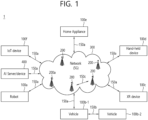
- FIG. 1 shows an example of a communication system to which implementations of the present disclosure are applied.
- the 5G usage scenarios shown in FIG. 1 are only exemplary, and the technical features of the present disclosure can be applied to other 5G usage scenarios which are not shown in FIG. 1 .
- Three main requirement categories for 5G include (1) a category of enhanced mobile broadband (eMBB), (2) a category of massive machine type communication (mMTC), and (3) a category of ultra-reliable and low latency communications (URLLC).
- eMBB enhanced mobile broadband
- mMTC massive machine type communication
- URLLC ultra-reliable and low latency communications
- the communication system 1 includes wireless devices 100a to 100f, base stations (BSs) 200, and a network 300.
- FIG. 1 illustrates a 5G network as an example of the network of the communication system 1, the implementations of the present disclosure are not limited to the 5G system, and can be applied to the future communication system beyond the 5G system.
- the BSs 200 and the network 300 may be implemented as wireless devices and a specific wireless device may operate as a BS/network node with respect to other wireless devices.
- the wireless devices 100a to 100f represent devices performing communication using radio access technology (RAT) (e.g., 5G new RAT (NR)) or LTE) and may be referred to as communication/radio/5G devices.
- RAT radio access technology
- the wireless devices 100a to 100f may include, without being limited to, a robot 100a, vehicles 100b-1 and 100b-2, an extended reality (XR) device 100c, a hand-held device 100d, a home appliance 100e, an IoT device 100f, and an artificial intelligence (AI) device/server 400.
- the vehicles may include a vehicle having a wireless communication function, an autonomous driving vehicle, and a vehicle capable of performing communication between vehicles.
- the vehicles may include an unmanned aerial vehicle (UAV) (e.g., a drone).
- UAV unmanned aerial vehicle
- the XR device may include an AR/VR/Mixed Reality (MR) device and may be implemented in the form of a head-mounted device (HMD), a head-up display (HUD) mounted in a vehicle, a television, a smartphone, a computer, a wearable device, a home appliance device, a digital signage, a vehicle, a robot, etc.
- the hand-held device may include a smartphone, a smartpad, a wearable device (e.g., a smartwatch or a smartglasses), and a computer (e.g., a notebook).
- the home appliance may include a TV, a refrigerator, and a washing machine.
- the IoT device may include a sensor and a smartmeter.
- the wireless devices 100a to 100f may be called user equipments (UEs).
- a UE may include, for example, a cellular phone, a smartphone, a laptop computer, a digital broadcast terminal, a personal digital assistant (PDA), a portable multimedia player (PMP), a navigation system, a slate personal computer (PC), a tablet PC, an ultrabook, a vehicle, a vehicle having an autonomous traveling function, a connected car, an UAV, an AI module, a robot, an AR device, a VR device, an MR device, a hologram device, a public safety device, an MTC device, an IoT device, a medical device, a FinTech device (or a financial device), a security device, a weather/environment device, a device related to a 5G service, or a device related to a fourth industrial revolution field.
- PDA personal digital assistant
- PMP portable multimedia player
- PC slate personal computer
- tablet PC a tablet PC
- ultrabook a vehicle, a vehicle having an autonomous
- the wireless devices 100a to 100f may be connected to the network 300 via the BSs 200.
- An AI technology may be applied to the wireless devices 100a to 100f and the wireless devices 100a to 100f may be connected to the AI server 400 via the network 300.
- the network 300 may be configured using a 3G network, a 4G (e.g., LTE) network, a 5G (e.g., NR) network, and a beyond-5G network.
- the wireless devices 100a to 100f may communicate with each other through the BSs 200/network 300, the wireless devices 100a to 100f may perform direct communication (e.g., sidelink communication) with each other without passing through the BSs 200/network 300.
- the vehicles 100b-1 and 100b-2 may perform direct communication (e.g., vehicle-to-vehicle (V2V)/vehicle-to-everything (V2X) communication).
- the IoT device e.g., a sensor
- the IoT device may perform direct communication with other IoT devices (e.g., sensors) or other wireless devices 100a to 100f.
- Wireless communication/connections 150a, 150b and 150c may be established between the wireless devices 100a to 100f and/or between wireless device 100a to 100f and BS 200 and/or between BSs 200.
- the wireless communication/connections may be established through various RATs (e.g., 5G NR) such as uplink/downlink communication 150a, sidelink communication (or deviceto-device (D2D) communication) 150b, inter-base station communication 150c (e.g., relay, integrated access and backhaul (IAB)), etc.
- the wireless devices 100a to 100f and the BSs 200/the wireless devices 100a to 100f may transmit/receive radio signals to/from each other through the wireless communication/connections 150a, 150b and 150c.
- the wireless communication/connections 150a, 150b and 150c may transmit/receive signals through various physical channels.
- various configuration information configuring processes e.g., channel encoding/decoding, modulation/demodulation, and resource mapping/de-mapping
- resource allocating processes for transmitting/receiving radio signals, may be performed based on the various proposals of the present disclosure.
- NR supports multiples numerologies (and/or multiple subcarrier spacings (SCS)) to support various 5G services. For example, if SCS is 15 kHz, wide area can be supported in traditional cellular bands, and if SCS is 30 kHz/60 kHz, dense-urban, lower latency, and wider carrier bandwidth can be supported. If SCS is 60 kHz or higher, bandwidths greater than 24.25 GHz can be supported to overcome phase noise.
- numerologies and/or multiple subcarrier spacings (SCS)
- the NR frequency band may be defined as two types of frequency range, i.e., FR1 and FR2.
- the numerical value of the frequency range may be changed.
- the frequency ranges of the two types may be as shown in Table 1 below.
- FR1 may mean "sub 6 GHz range”
- FR2 may mean "above 6 GHz range”
- mmW millimeter wave
- FR1 may include a frequency band of 410MHz to 7125MHz as shown in Table 2 below. That is, FR1 may include a frequency band of 6GHz (or 5850, 5900, 5925 MHz, etc.) or more. For example, a frequency band of 6 GHz (or 5850, 5900, 5925 MHz, etc.) or more included in FR1 may include an unlicensed band. Unlicensed bands may be used for a variety of purposes, for example for communication for vehicles (e.g., autonomous driving). [Table 2] Frequency Range designation Corresponding frequency range Subcarrier Spacing FR1 410MHz - 7125MHz 15, 30, 60kHz FR2 24250MHz - 52600MHz 60, 120, 240kHz
- the radio communication technologies implemented in the wireless devices in the present disclosure may include narrowband internet-of-things (NB-IoT) technology for low-power communication as well as LTE, NR and 6G.
- NB-IoT technology may be an example of low power wide area network (LPWAN) technology, may be implemented in specifications such as LTE Cat NB1 and/or LTE Cat NB2, and may not be limited to the above-mentioned names.
- LPWAN low power wide area network
- the radio communication technologies implemented in the wireless devices in the present disclosure may communicate based on LTE-M technology.
- LTE-M technology may be an example of LPWAN technology and be called by various names such as enhanced machine type communication (eMTC).
- eMTC enhanced machine type communication
- LTE-M technology may be implemented in at least one of the various specifications, such as 1) LTE Cat 0, 2) LTE Cat M1, 3) LTE Cat M2, 4) LTE nonbandwidth limited (non-BL), 5) LTE-MTC, 6) LTE Machine Type Communication, and/or 7) LTE M, and may not be limited to the above-mentioned names.
- the radio communication technologies implemented in the wireless devices in the present disclosure may include at least one of ZigBee, Bluetooth, and/or LPWAN which take into account low-power communication, and may not be limited to the above-mentioned names.
- ZigBee technology may generate personal area networks (PANs) associated with small/low-power digital communication based on various specifications such as IEEE 802.15.4 and may be called various names.
- PANs personal area networks
- FIG. 2 shows an example of wireless devices to which implementations of the present disclosure are applied.
- the first wireless device 100 and/or the second wireless device 200 may be implemented in various forms according to use cases/services.
- ⁇ the first wireless device 100 and the second wireless device 200 ⁇ may correspond to at least one of ⁇ the wireless device 100a to 100f and the BS 200 ⁇ , ⁇ the wireless device 100a to 100f and the wireless device 100a to 100f ⁇ and/or ⁇ the BS 200 and the BS 200 ⁇ of FIG. 1 .
- the first wireless device 100 and/or the second wireless device 200 may be configured by various elements, devices/parts, and/or modules.
- the first wireless device 100 may include at least one transceiver, such as a transceiver 106, at least one processing chip, such as a processing chip 101, and/or one or more antennas 108.
- a transceiver such as a transceiver 106
- a processing chip such as a processing chip 101
- antennas 108 one or more antennas 108.
- the processing chip 101 may include at least one processor, such a processor 102, and at least one memory, such as a memory 104. Additional and/or alternatively, the memory 104 may be placed outside of the processing chip 101.
- the processor 102 may control the memory 104 and/or the transceiver 106 and may be adapted to implement the descriptions, functions, procedures, suggestions, methods and/or operational flowcharts described in the present disclosure. For example, the processor 102 may process information within the memory 104 to generate first information/signals and then transmit radio signals including the first information/signals through the transceiver 106. The processor 102 may receive radio signals including second information/signals through the transceiver 106 and then store information obtained by processing the second information/signals in the memory 104.
- the memory 104 may be operably connectable to the processor 102.
- the memory 104 may store various types of information and/or instructions.
- the memory 104 may store a firmware and/or a software code 105 which implements codes, commands, and/or a set of commands that, when executed by the processor 102, perform the descriptions, functions, procedures, suggestions, methods and/or operational flowcharts disclosed in the present disclosure.
- the firmware and/or the software code 105 may implement instructions that, when executed by the processor 102, perform the descriptions, functions, procedures, suggestions, methods and/or operational flowcharts disclosed in the present disclosure.
- the firmware and/or the software code 105 may control the processor 102 to perform one or more protocols.
- the firmware and/or the software code 105 may control the processor 102 to perform one or more layers of the radio interface protocol.
- the processor 102 and the memory 104 may be a part of a communication modem/circuit/chip designed to implement RAT (e.g., LTE or NR).
- the transceiver 106 may be connected to the processor 102 and transmit and/or receive radio signals through one or more antennas 108.
- Each of the transceiver 106 may include a transmitter and/or a receiver.
- the transceiver 106 may be interchangeably used with Radio Frequency (RF) unit(s).
- the first wireless device 100 may represent a communication modem/circuit/chip.
- the second wireless device 200 may include at least one transceiver, such as a transceiver 206, at least one processing chip, such as a processing chip 201, and/or one or more antennas 208.
- the processing chip 201 may include at least one processor, such a processor 202, and at least one memory, such as a memory 204. Additional and/or alternatively, the memory 204 may be placed outside of the processing chip 201.
- the processor 202 may control the memory 204 and/or the transceiver 206 and may be adapted to implement the descriptions, functions, procedures, suggestions, methods and/or operational flowcharts described in the present disclosure. For example, the processor 202 may process information within the memory 204 to generate third information/signals and then transmit radio signals including the third information/signals through the transceiver 206. The processor 202 may receive radio signals including fourth information/signals through the transceiver 106 and then store information obtained by processing the fourth information/signals in the memory 204.
- the memory 204 may be operably connectable to the processor 202.
- the memory 204 may store various types of information and/or instructions.
- the memory 204 may store a firmware and/or a software code 205 which implements codes, commands, and/or a set of commands that, when executed by the processor 202, perform the descriptions, functions, procedures, suggestions, methods and/or operational flowcharts disclosed in the present disclosure.
- the firmware and/or the software code 205 may implement instructions that, when executed by the processor 202, perform the descriptions, functions, procedures, suggestions, methods and/or operational flowcharts disclosed in the present disclosure.
- the firmware and/or the software code 205 may control the processor 202 to perform one or more protocols.
- the firmware and/or the software code 205 may control the processor 202 to perform one or more layers of the radio interface protocol.
- the processor 202 and the memory 204 may be a part of a communication modem/circuit/chip designed to implement RAT (e.g., LTE or NR).
- the transceiver 206 may be connected to the processor 202 and transmit and/or receive radio signals through one or more antennas 208.
- Each of the transceiver 206 may include a transmitter and/or a receiver.
- the transceiver 206 may be interchangeably used with RF unit.
- the second wireless device 200 may represent a communication modem/circuit/chip.
- One or more protocol layers may be implemented by, without being limited to, one or more processors 102 and 202.
- the one or more processors 102 and 202 may implement one or more layers (e.g., functional layers such as Physical (PHY) layer, Media Access Control (MAC) layer, Radio Link Control (RLC) layer, Packet Data Convergence Protocol (PDCP) layer, Radio Resource Control (RRC) layer, and Service Data Adaptation Protocol (SDAP) layer).
- layers e.g., functional layers such as Physical (PHY) layer, Media Access Control (MAC) layer, Radio Link Control (RLC) layer, Packet Data Convergence Protocol (PDCP) layer, Radio Resource Control (RRC) layer, and Service Data Adaptation Protocol (SDAP) layer).
- PHY Physical
- MAC Media Access Control
- RLC Radio Link Control
- PDCP Packet Data Convergence Protocol
- RRC Radio Resource Control
- SDAP Service Data Adaptation Protocol
- the one or more processors 102 and 202 may generate one or more Protocol Data Units (PDUs), one or more Service Data Unit (SDUs), messages, control information, data, or information according to the descriptions, functions, procedures, suggestions, methods and/or operational flowcharts disclosed in the present disclosure.
- the one or more processors 102 and 202 may generate signals (e.g., baseband signals) including PDUs, SDUs, messages, control information, data, or information according to the descriptions, functions, procedures, suggestions, methods and/or operational flowcharts disclosed in the present disclosure and provide the generated signals to the one or more transceivers 106 and 206.
- signals e.g., baseband signals
- the one or more processors 102 and 202 may receive the signals (e.g., baseband signals) from the one or more transceivers 106 and 206 and acquire the PDUs, SDUs, messages, control information, data, or information according to the descriptions, functions, procedures, suggestions, methods and/or operational flowcharts disclosed in the present disclosure.
- signals e.g., baseband signals
- the one or more processors 102 and 202 may be referred to as controllers, microcontrollers, microprocessors, or microcomputers.
- the one or more processors 102 and 202 may be implemented by hardware, firmware, software, or a combination thereof.
- ASICs Application Specific Integrated Circuits
- DSPs Digital Signal Processors
- DSPDs Digital Signal Processing Devices
- PLDs Programmable Logic Devices
- FPGAs Field Programmable Gate Arrays
- the one or more processors 102 and 202 may be configured by a set of a communication control processor, an Application Processor (AP), an Electronic Control Unit (ECU), a Central Processing Unit (CPU), a Graphic Processing Unit (GPU), and a memory control processor.
- the one or more memories 104 and 204 may be connected to the one or more processors 102 and 202 and store various types of data, signals, messages, information, programs, code, instructions, and/or commands.
- the one or more memories 104 and 204 may be configured by Random Access Memory (RAM), Dynamic RAM (DRAM), Read-Only Memory (ROM), electrically Erasable Programmable Read-Only Memory (EPROM), flash memory, volatile memory, non-volatile memory, hard drive, register, cash memory, computer-readable storage medium, and/or combinations thereof.
- RAM Random Access Memory
- DRAM Dynamic RAM
- ROM Read-Only Memory
- EPROM electrically Erasable Programmable Read-Only Memory
- flash memory volatile memory, non-volatile memory, hard drive, register, cash memory, computer-readable storage medium, and/or combinations thereof.
- the one or more memories 104 and 204 may be located at the interior and/or exterior of the one or more processors 102 and 202.
- the one or more memories 104 and 204 may be connected to the one or more processors 102 and 202 through various technologies such as wired or wireless connection.
- the one or more transceivers 106 and 206 may transmit user data, control information, and/or radio signals/channels, mentioned in the descriptions, functions, procedures, suggestions, methods and/or operational flowcharts disclosed in the present disclosure, to one or more other devices.
- the one or more transceivers 106 and 206 may receive user data, control information, and/or radio signals/channels, mentioned in the descriptions, functions, procedures, suggestions, methods and/or operational flowcharts disclosed in the present disclosure, from one or more other devices.
- the one or more transceivers 106 and 206 may be connected to the one or more processors 102 and 202 and transmit and receive radio signals.
- the one or more processors 102 and 202 may perform control so that the one or more transceivers 106 and 206 may transmit user data, control information, or radio signals to one or more other devices.
- the one or more processors 102 and 202 may perform control so that the one or more transceivers 106 and 206 may receive user data, control information, or radio signals from one or more other devices.
- the one or more transceivers 106 and 206 may be connected to the one or more antennas 108 and 208. Additionally and/or alternatively, the one or more transceivers 106 and 206 may include one or more antennas 108 and 208. The one or more transceivers 106 and 206 may be adapted to transmit and receive user data, control information, and/or radio signals/channels, mentioned in the descriptions, functions, procedures, suggestions, methods and/or operational flowcharts disclosed in the present disclosure, through the one or more antennas 108 and 208. In the present disclosure, the one or more antennas 108 and 208 may be a plurality of physical antennas or a plurality of logical antennas (e.g., antenna ports).
- the one or more transceivers 106 and 206 may convert received user data, control information, radio signals/channels, etc., from RF band signals into baseband signals in order to process received user data, control information, radio signals/channels, etc., using the one or more processors 102 and 202.
- the one or more transceivers 106 and 206 may convert the user data, control information, radio signals/channels, etc., processed using the one or more processors 102 and 202 from the base band signals into the RF band signals.
- the one or more transceivers 106 and 206 may include (analog) oscillators and/or filters.
- the one or more transceivers 106 and 206 can up-convert OFDM baseband signals to OFDM signals by their (analog) oscillators and/or filters under the control of the one or more processors 102 and 202 and transmit the up-converted OFDM signals at the carrier frequency.
- the one or more transceivers 106 and 206 may receive OFDM signals at a carrier frequency and down-convert the OFDM signals into OFDM baseband signals by their (analog) oscillators and/or filters under the control of the one or more processors 102 and 202.
- the wireless devices 100 and 200 may further include additional components.
- the additional components 140 may be variously configured according to types of the wireless devices 100 and 200.
- the additional components 140 may include at least one of a power unit/battery, an Input/Output (I/O) device (e.g., audio I/O port, video I/O port), a driving device, and a computing device.
- the additional components 140 may be coupled to the one or more processors 102 and 202 via various technologies, such as a wired or wireless connection.
- a UE may operate as a transmitting device in UL and as a receiving device in DL.
- a BS may operate as a receiving device in UL and as a transmitting device in DL.
- the first wireless device 100 acts as the UE
- the second wireless device 200 acts as the BS.
- the processor(s) 102 connected to, mounted on or launched in the first wireless device 100 may be adapted to perform the UE behavior according to an implementation of the present disclosure or control the transceiver(s) 106 to perform the UE behavior according to an implementation of the present disclosure.
- the processor(s) 202 connected to, mounted on or launched in the second wireless device 200 may be adapted to perform the BS behavior according to an implementation of the present disclosure or control the transceiver(s) 206 to perform the BS behavior according to an implementation of the present disclosure.
- a BS is also referred to as a node B (NB), an eNode B (eNB), or a gNB.
- NB node B
- eNB eNode B
- gNB gNode B
- FIG. 3 shows an example of UE to which implementations of the present disclosure are applied.
- a UE 100 may correspond to the first wireless device 100 of FIG. 2 .
- a UE 100 includes a processor 102, a memory 104, a transceiver 106, one or more antennas 108, a power management module 141, a battery 142, a display 143, a keypad 144, a Subscriber Identification Module (SIM) card 145, a speaker 146, and a microphone 147.
- SIM Subscriber Identification Module
- the processor 102 may be adapted to implement the descriptions, functions, procedures, suggestions, methods and/or operational flowcharts disclosed in the present disclosure.
- the processor 102 may be adapted to control one or more other components of the UE 100 to implement the descriptions, functions, procedures, suggestions, methods and/or operational flowcharts disclosed in the present disclosure.
- Layers of the radio interface protocol may be implemented in the processor 102.
- the processor 102 may include ASIC, other chipset, logic circuit and/or data processing device.
- the processor 102 may be an application processor.
- the processor 102 may include at least one of DSP, CPU, GPU, a modem (modulator and demodulator).
- processor 102 may be found in SNAPDRAGON TM series of processors made by Qualcomm ® , EXYNOS TM series of processors made by Samsung ® , A series of processors made by Apple ® , HELIO TM series of processors made by MediaTek ® , ATOM TM series of processors made by Intel ® or a corresponding next generation processor.
- the memory 104 is operatively coupled with the processor 102 and stores a variety of information to operate the processor 102.
- the memory 104 may include ROM, RAM, flash memory, memory card, storage medium and/or other storage device.
- modules e.g., procedures, functions, etc.
- the modules can be stored in the memory 104 and executed by the processor 102.
- the memory 104 can be implemented within the processor 102 or external to the processor 102 in which case those can be communicatively coupled to the processor 102 via various means as is known in the art.
- the transceiver 106 is operatively coupled with the processor 102, and transmits and/or receives a radio signal.
- the transceiver 106 includes a transmitter and a receiver.
- the transceiver 106 may include baseband circuitry to process radio frequency signals.
- the transceiver 106 controls the one or more antennas 108 to transmit and/or receive a radio signal.
- the power management module 141 manages power for the processor 102 and/or the transceiver 106.
- the battery 142 supplies power to the power management module 141.
- the display 143 outputs results processed by the processor 102.
- the keypad 144 receives inputs to be used by the processor 102.
- the keypad 144 may be shown on the display 143.
- the SIM card 145 is an integrated circuit that is intended to securely store the International Mobile Subscriber Identity (IMSI) number and its related key, which are used to identify and authenticate subscribers on mobile telephony devices (such as mobile phones and computers). It is also possible to store contact information on many SIM cards.
- IMSI International Mobile Subscriber Identity
- the speaker 146 outputs sound-related results processed by the processor 102.
- the microphone 147 receives sound-related inputs to be used by the processor 102.
- FIG. 4 shows an example of 5G system architecture to which implementations of the present disclosure are applied.
- the 5G system (5GS) architecture consists of the following network functions (NF).
- FIG. 4 depicts the 5G system architecture in the non-roaming case, using the reference point representation showing how various network functions interact with each other.
- the UDSF, NEF and NRF have not been depicted. However, all depicted Network Functions can interact with the UDSF, UDR, NEF and NRF as necessary.
- the UDR and its connections with other NFs are not depicted in FIG. 4 .
- the NWDAF and its connections with other NFs are not depicted in FIG. 4 .
- the 5G system architecture contains the following reference points:
- a couple of NFs may need to be associated with each other to serve a UE.
- FIGS. 5 and 6 show an example of a registration procedure to which implementations of the present disclosure are applied.
- a UE needs to register with the network to get authorized to receive services, to enable mobility tracking and to enable reachability.
- the UE initiates the registration procedure using one of the following registration types:
- the general registration procedure in FIGS. 5 and 6 applies on all these registration procedures, but the periodic registration update need not include all parameters that are used in other registration cases.
- the general registration procedure in FIGS. 5 and 6 is also used for the case of registration in 3GPP access when the UE is already registered in a non-3GPP access, and vice versa. Registration in 3GPP access when the UE is already registered in a non-3GPP access scenario may require an AMF change.
- the Registration Request message may include AN parameters.
- the AN parameters include, e.g., 5G SAE temporary mobile subscriber identity (5G-S-TMSI) or globally unique AMF ID (GUAMI), the selected public land mobile network (PLMN) ID (or PLMN ID and network identifier (NID)) and Requested network slice selection assistance information (NSSAI).
- the AN parameters also include establishment cause. The establishment cause provides the reason for requesting the establishment of an RRC connection. Whether and how the UE includes the Requested NSSAI as part of the AN parameters is dependent on the value of the access stratum connection establishment NSSAI inclusion mode parameter.
- the Registration Request message may include a registration type.
- the registration type indicates if the UE wants to perform an initial registration (i.e., the UE is in RM-DEREGISTERED state), a mobility registration update (i.e., the UE is in RM-REGISTERED state and initiates a registration procedure due to mobility or due to the UE needs to update its capabilities or protocol parameters, or to request a change of the set of network slices it is allowed to use), a periodic registration update (i.e., the UE is in RM-REGISTERED state and initiates a registration procedure due to the periodic registration update timer expiry) or an emergency registration (i.e., the UE is in limited service state).
- an initial registration i.e., the UE is in RM-DEREGISTERED state
- a mobility registration update i.e., the UE is in RM-REGISTERED state and initiates a registration procedure due to mobility or due to the UE needs to update its capabilities or protocol parameters, or
- the UE When the UE is performing an initial registration, the UE shall indicate its UE identity in the Registration Request message as follows, listed in decreasing order of preference:
- the UE When the UE performing an initial registration has both a valid EPS GUTI and a native 5G-GUTI, the UE shall also indicate the native 5G-GUTI as additional GUTI. If more than one native 5G-GUTIs are available, the UE shall select the 5G-GUTI in decreasing order of preference among items (ii)-(iv) in the list above.
- the UE When the UE is performing an initial registration with a native 5G-GUTI, then the UE shall indicate the related GUAMI information in the AN parameters. When the UE is performing an initial registration with its SUCI, the UE shall not indicate any GUAMI information in the AN parameters.
- the SUCI shall be included if the UE does not have a valid 5G-GUTI available; the permanent equipment identifier (PEI) shall be included when the UE has no subscriber permanent identifier (SUPI) and no valid 5G-GUTI. In other cases, the 5G-GUTI is included and it indicates the last serving AMF.
- PKI permanent equipment identifier
- SUPI subscriber permanent identifier
- the Registration Request message may also include security parameters, PDU Session Status, etc.
- the security parameters are used for authentication and integrity protection.
- the PDU Session Status indicates the previously established PDU sessions in the UE. When the UE is connected to the two AMFs belonging to different PLMN via 3GPP access and non-3GPP access then the PDU Session status indicates the established PDU Session of the current PLMN in the UE.
- Step 2 The (R)AN selects an AMF.
- the (R)AN based on (R)AT and requested NSSAI, if available, selects an AMF.
- the (R)AN can forward the Registration Request message to the AMF based on the N2 connection of the UE.
- the (R)AN If the (R)AN cannot select an appropriate AMF, it forwards the Registration Request message to an AMF which has been configured, in the (R)AN, to perform AMF selection.
- Step 3 The (R)AN transmits a Registration Request message to the new AMF.
- the Registration Request message corresponds to N2 message.
- the Registration Request message may include whole information and/or a part of information included in the Registration Request message received from the UE which is described in step 1.
- the Registration Request message may include N2 parameters.
- the N2 parameters include the selected PLMN ID (or PLMN ID and NID), location information and cell identity related to the cell in which the UE is camping, UE context request which indicates that a UE context including security information needs to be setup at the NG-RAN.
- the N2 parameters shall also include the establishment cause.
- steps 4 to 19 may be omitted.
- the new AMF sends a Registration Accept message to the UE indicating that the Registration Request has been accepted.
- 5G-GUTI is included if the new AMF allocates a new 5G-GUTI. If the UE is already in RM-REGISTERED state via another access in the same PLMN, the UE shall use the 5G-GUTI received in the Registration Accept message for both registrations. If no 5G-GUTI is included in the Registration Accept message, then the UE uses the 5G-GUTI assigned for the existing registration also for the new registration. If the new AMF allocates a new registration area, it shall send the registration area to the UE via Registration Accept message. If there is no registration area included in the Registration Accept message, the UE shall consider the old registration area as valid.
- Mobility Restrictions is included in case mobility restrictions applies for the UE and registration type is not emergency registration.
- the new AMF indicates the established PDU sessions to the UE in the PDU Session status.
- the UE removes locally any internal resources related to PDU sessions that are not marked as established in the received PDU Session status.
- the UE is connected to the two AMFs belonging to different PLMN via 3GPP access and non-3GPP access then the UE removes locally any internal resources related to the PDU session of the current PLMN that are not marked as established in received PDU Session status. If the PDU Session status information was in the Registration Request message, the new AMF shall indicate the PDU Session status to the UE.
- the Allowed NSSAI provided in the Registration Accept message is valid in the registration area and it applies for all the PLMNs which have their tracking areas included in the registration area.
- the Mapping Of Allowed NSSAI is the mapping of each S-NSSAI of the Allowed NSSAI to the HPLMN S-NSSAIs.
- the Mapping Of Configured NSSAI is the mapping of each S-NSSAI of the Configured NSSAI for the serving PLMN to the HPLMN S-NSSAIs.
- the new AMF performs a UE Policy Association Establishment.
- Step 22 The UE may send a Registration Complete message to the new AMF when it has successfully updated itself.
- the UE may send a Registration Complete message to the new AMF to acknowledge if a new 5G-GUTI was assigned.
- Step 23 For registration over 3GPP Access, if the new AMF does not release the signaling connection, the new AMF may send the RRC Inactive Assistance Information to the NG-RAN. For registration over non-3GPP Access, if the UE is also in CM-CONNECTED state on 3GPP access, the new AMF may send the RRC Inactive Assistance Information to the NG-RAN.
- Step 24 The new AMF may perform information update towards the UDM.
- Step 25 The UE may execute Network Slice-Specific Authentication and Authorization procedure.
- a PDU session establishment procedure is described.
- FIGS. 7 and 8 show an example of a PDU session establishment procedure to which implementations of the present disclosure are applied.
- a PDU session establishment may correspond to:
- a PDU session may be associated either (a) with a single access type at a given time, i.e., either 3GPP access or non-3GPP access, or (b) simultaneously with multiple access types, i.e., one 3GPP access and one non-3GPP access.
- a PDU session associated with multiple access types is referred to as multi access PDU (MA PDU) session and it may be requested by access traffic steering, switching, splitting (ATSSS)-capable UEs.
- MA PDU multi access PDU
- FIGS. 7 and 8 specify the procedures for establishing PDU sessions associated with a single access type at a given time.
- the UE initiates the UE requested PDU session establishment procedure by the transmission of a NAS message containing a PDU Session Establishment Request message within the N1 SM container.
- the PDU Session Establishment Request message includes a PDU session ID, Requested PDU Session Type, a Requested session and service continuity (SSC) mode, 5GSM Capability, protocol configuration options (PCO), SM PDU DN Request Container, UE Integrity Protection Maximum Data Rate, etc.
- the Request Type indicates "Initial request” if the PDU session establishment is a request to establish a new PDU session and indicates “Existing PDU Session” if the request refers to an existing PDU session switching between 3GPP access and non-3GPP access or to a PDU session handover from an existing packet data network (PDN) connection in EPC.
- the Request Type indicates "Emergency Request” if the PDU session establishment is a request to establish a PDU session for emergency services.
- the Request Type indicates "Existing Emergency PDU Session” if the request refers to an existing PDU session for emergency services switching between 3GPP access and non-3GPP access or to a PDU session handover from an existing PDN connection for emergency services in EPC.
- the UE includes the S-NSSAI from the Allowed NSSAI of the current access type. If the Mapping of Allowed NSSAI was provided to the UE, the UE shall provide both the S-NSSAI of the visited PLMN (VPLMN) from the Allowed NSSAI and the corresponding S-NSSAI of the HPLMN from the Mapping Of Allowed NSSAI.
- VPN visited PLMN
- Step 2 The AMF selects an SMF. If the Request Type indicates "Initial request” or the request is due to handover from EPS or from non-3GPP access serving by a different AMF, the AMF stores an association of the S-NSSAI(s), the data network name (DNN), the PDU session ID, the SMF ID as well as the Access Type of the PDU session.
- the AMF stores an association of the S-NSSAI(s), the data network name (DNN), the PDU session ID, the SMF ID as well as the Access Type of the PDU session.
- the AMF selects an SMF and stores an association of the new PDU Session ID, the S-NSSAI(s), the selected SMF ID as well as Access Type of the PDU Session.
- the AMF selects the SMF based on SMF-ID received from UDM.
- the AMF updates the Access Type stored for the PDU session.
- the PDU session establishment procedure can be performed in the following cases:
- the AMF shall reject the PDU session establishment request with an appropriate reject cause.
- the AMF shall reject a request coming from an emergency registered UE and the Request Type indicates neither "Emergency Request” nor "Existing Emergency PDU Session".
- Step 3 If the AMF does not have an association with an SMF for the PDU session ID provided by the UE (e.g., when Request Type indicates "initial request"), the AMF invokes Create SM Context Request procedure (e.g., Nsmf_PDUSession_CreateSMContext Request). If the AMF already has an association with an SMF for the PDU session ID provided by the UE (e.g., when Request Type indicates "existing PDU Session"), the AMF invokes Update SM Context Request procedure (e.g., Nsmf_PDUSession_UpdateSMContext Request).
- Create SM Context Request procedure e.g., Nsmf_PDUSession_CreateSMContext Request.
- the AMF sends the S-NSSAI of the serving PLMN from the Allowed NSSAI to the SMF.
- the AMF also sends the corresponding S-NSSAI of the HPLMN from the Mapping Of Allowed NSSAI to the SMF.
- the AMF ID is the UE's GUAMI which uniquely identifies the AMF serving the UE.
- the AMF forwards the PDU session ID together with the N1 SM container containing the PDU Session Establishment Request message received from the UE.
- the generic public subscription identifier (GPSI) shall be included if available at AMF.
- the AMF provides the PEI instead of the SUPI when the UE in limited service state has registered for emergency services without providing a SUPI.
- the AMF indicates that the SUPI has not been authenticated.
- the SMF determines that the UE has not been authenticated when it does not receive a SUPI for the UE or when the AMF indicates that the SUPI has not been authenticated.
- the AMF may include a PCF ID in the Nsmf_PDUSession_CreateSMContext Request. This PCF ID identifies the home PCF (H-PCF) in the non-roaming case and the visited PCF (V-PCF) in the LBO roaming case.
- H-PCF home PCF
- V-PCF visited PCF
- the SMF If the SMF received Nsmf_PDUSession_CreateSMContext Request in step 3 and the SMF is able to process the PDU session establishment request, the SMF creates an SM context and responds to the AMF by providing an SM Context ID.
- the SMF When the SMF decides to not accept to establish a PDU session, the SMF rejects the UE request via NAS SM signaling including a relevant SM rejection cause by responding to the AMF with Nsmf_PDUSession_CreateSMContext Response.
- the SMF also indicates to the AMF that the PDU session ID is to be considered as released, the SMF proceeds to step 20 below and the PDU session establishment procedure is stopped.
- the SMF may send an N4 Session Establishment/Modification Request to the UPF and provides packet detection, enforcement and reporting rules to be installed on the UPF for this PDU session.
- the UPF may acknowledge by sending an N4 Session Establishment/Modification Response.
- Step 11 The SMF transmits a N1N2Message Transfer message (e.g., Namf_Communication _N1N2MessageTransfer) to the AMF.
- N1N2Message Transfer message e.g., Namf_Communication _N1N2MessageTransfer
- the N1N2Message Transfer message may include N2 SM information.
- the N2 SM information carries information that the AMF shall forward to the (R)AN which may include:
- the N1N2Message Transfer message may include N1 SM container.
- the N1 SM container contains the PDU Session Establishment Accept message that the AMF shall provide to the UE.
- the PDU Session Establishment Accept message includes S-NSSAI from the Allowed NSSAI.
- the PDU Session Establishment Accept message includes the S-NSSAI from the Allowed NSSAI for the VPLMN and also it includes the corresponding S-NSSAI of the HPLMN from the Mapping Of Allowed NSSAI that SMF received in step 3.
- QoS Rules QoS flow level, QoS parameters if needed for the QoS Flow(s) associated with those QoS rule(s) and QoS Profiles may be included in the PDU Session Establishment Accept message within the N1 SM container and in the N2 SM information.
- the N1N2Message Transfer message shall include the N1 SM container with a PDU Session Establishment Reject message and shall not include any N2 SM information.
- the (R)AN sends the NAS message containing the PDU Session Establishment Reject message to the UE. In this case, steps 12-17 are skipped.
- Step 12 The AMF sends the NAS message containing PDU Session ID and PDU Session Establishment Accept message targeted to the UE and the N2 SM information received from the SMF within the N2 PDU Session Request message to the (R)AN.
- Step 13 The (R)AN may issue AN specific signaling exchange with the UE that is related with the information received from SMF. For example, in case of a NG-RAN, an RRC connection reconfiguration may take place with the UE establishing the necessary NG-RAN resources related to the QoS rules for the PDU session request received in step 12.
- the (R)AN forwards the NAS message (PDU Session ID, N1 SM container (PDU Session Establishment Accept message)) provided in step 12 to the UE.
- the (R)AN shall only provide the NAS message to the UE if the AN specific signaling exchange with the UE includes the (R)AN resource additions associated to the received N2 command.
- step 11 If the N2 SM information is not included in the step 11, then the following steps 14 to 16b and step 17 are omitted.
- the UPF may deliver any DL packets to the UE that may have been buffered for this PDU session.
- the AMF forwards relevant events subscribed by the SMF.
- Non-3GPP access is described.
- the 5G Core Network supports connectivity of UEs via non-3GPP access networks, e.g. Wireless Local Area Network (WLAN) access networks.
- WLAN Wireless Local Area Network
- the 5GC supports both untrusted non-3GPP access networks and Trusted Non-3GPP Access Networks (TNANs).
- TNANs Trusted Non-3GPP Access Networks
- N3IWF An untrusted non-3GPP access network is connected to the 5GC via a N3IWF, whereas a trusted non-3GPP access network is connected to the 5GC via a Trusted Non-3GPP Gateway Function (TNGF).
- TNGF Trusted Non-3GPP Gateway Function
- a non-3GPP access network may advertise the PLMNs for which it supports trusted connectivity and the type of supported trusted connectivity (e.g. "5G connectivity"). Therefore, the UEs may discover the non-3GPP access networks that can provide trusted connectivity to one or more PLMNs.
- 5G connectivity the type of supported trusted connectivity
- the UE may decide to use trusted or untrusted non-3GPP access for connecting to a 5G PLMN.
- N1 instances exist for the UE, i.e., there are one N1 instance over NG-RAN and one N1 instance over non-3GPP access.
- a UE simultaneously connected to the same 5GC of a PLMN over a 3GPP access and a non-3GPP access is served by a single AMF in this 5GC.
- a UE When a UE is connected to a 3GPP access of a PLMN, if the UE selects a N3IWF and the N3IWF is located in a PLMN different from the PLMN of the 3GPP access, e.g., in a different VPLMN or in the HPLMN, the UE is served separately by the two PLMNs. The UE is registered with two separate AMFs. PDU sessions over the 3GPP access are served by Visited SMFs (V-SMFs) different from the V-SMF serving the PDU Sessions over the non-3GPP access.
- V-SMFs Visited SMFs
- the UE uses trusted non-3GPP access, i.e., the UE may select one PLMN for 3GPP access and a different PLMN for trusted non-3GPP access.
- the PLMN selection for the 3GPP access does not depend on the PLMN that is used for non-3GPP access. In other words, if a UE is registered with a PLMN over a non-3GPP access, the UE performs PLMN selection for the 3GPP access independently of this PLMN.
- a UE establishes an IPsec tunnel with the N3IWF or with the TNGF in order to register with the 5GC over non-3GPP access.
- N1 NAS signaling over non-3GPP accesses is protected with the same security mechanism applied for N1 over a 3GPP access.
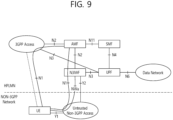
- FIG. 9 shows an example of an architecture for a 5GC with an untrusted non-3GPP access to which implementations of the present disclosure are applied.
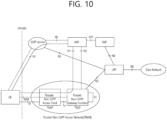
- FIG. 10 shows an example of an architecture for a 5GC with a trusted non-3GPP access to which implementations of the present disclosure are applied.
- ATSSS Access Traffic Steering, Switching & Splitting
- the ATSSS feature is an optional feature that may be supported by the UE and the 5GC.
- the ATSSS feature enables a multi-access PDU connectivity Service, which can exchange PDUs between the UE and a data network by simultaneously using one 3GPP access network and one non-3GPP access network and two independent N3/N9 tunnels between the PDU Session Anchor (PSA) and RAN/AN.
- the multi-access PDU connectivity service is realized by establishing a Multi-Access PDU (MAPDU) Session, i.e., a PDU session that may have user-plane resources on two access networks. This assumes both 3GPP access and non-3GPP access are allowed for the S-NSSAI of the PDU session.
- MAPDU Multi-Access PDU
- the UE may request a MA PDU session when the UE is registered via both 3GPP and non-3GPP accesses, or when the UE is registered via one access only.
- the UE After the establishment of a MA PDU session, and when there are user-plane resources on both access networks, the UE applies network-provided policy (i.e., ATSSS rules) and considers local conditions (such as network interface availability, signal loss conditions, user preferences, etc.) for deciding how to distribute the uplink traffic across the two access networks.
- the UPF anchor of the MA PDU session applies network-provided policy (i.e., N4 rules) and feedback information received from the UE via the user-plane (such as access network Unavailability or Availability) for deciding how to distribute the downlink traffic across the two N3/N9 tunnels and two access networks.
- the UE applies the ATSSS rules and considers local conditions for triggering the establishment or activation of the user plane resources over another access.
- the type of a MA PDU Session may be one of IPv4, IPv6, IPv4v6, and Ethernet.
- the ATSSS feature may be supported over any type of access network, including untrusted and trusted non-3GPP access networks, wireline 5G access networks, etc., as long as a MA PDU session can be established over this type of access network.
- the UE due to mobility, moves from being served by a source AMF supporting ATSSS to a target AMF not supporting ATSSS, the MA PDU session is released.
- MA PDU session is managed by using the session management functionality, with the following additions and modifications.
- a MA PDU session may be established either:
- the AMF indicates as part of the registration procedure whether ATSSS is supported or not.
- ATSSS is not supported, the UE does not:
- An ATSSS-capable UE may decide to request a MA PDU session based on the provisioned URSP rules.
- the UE requests a MA PDU session when the UE applies a URSP rule, which triggers the UE to establish a new PDU session and the Access Type Preference component of the URSP rule indicates "Multi-Access".
- 3GPP NR Rel-18 how the MA PDU session can support more types of access paths will be discussed. More specifically, how the traffic of an MA PDU session can be switched between two non-3GPP access paths (e.g., untrusted non-3GPP access and trusted non-3GPP access) in the same PLMN may be discussed.
- two non-3GPP access paths e.g., untrusted non-3GPP access and trusted non-3GPP access
- a case in which traffic is switched between one non-3GPP access path from the UE to a N3IWF in PLMN-1 and another non-3GPP access path from the UE to a TNGF in PLMN-1 may be considered.
- the UE registrations via two non-3GPP access paths in PLMN-1 may be maintained only for the duration needed to switch the traffic from a source non-3GPP access path to a target non-3GPP access path. After switching the traffic, only one UE registration via non-3GPP access may exist.
- the UE may also be able to access PLMN-1 directly using 3GPP radio technology.
- the MA PDU session may have three access paths for the duration needed to switch the traffic from a source non-3GPP access path to a target non-3GPP access path.
- the existing steering modes and the existing steering functionalities is reused and, if needed, potential enhancements may be considered to support the above case.
- FIG. 11 shows an example in which traffic of a MA PDU session is switched between an untrusted non-3GPP access and a trusted non-3GPP access to which implementations of the present disclosure are applied.
- the UE may receive service over a trusted non-3GPP access using Wi-Fi.
- traffic of the MA PDU session may be switched from an untrusted non-3GPP access to a trusted non-3GPP access.
- the UE and the network independently perform registration in the 3GPP access and the non-3GPP access. However, if registration is performed through a different RAT and/or access type in the same 3GPP access or non-3GPP access, the previous registration may be deregistered by the network. For example, if the UE is registered over an untrusted non-3GPP access, when the UE performs registration over a trusted non-3GPP access, since the UE, AMF and UDM manage only one registration on a non-3GPP access, registration over an untrusted non-3GPP access may be deregistered.
- the present disclosure provides various implementations to solve the above-described problems.
- the various implementations of the present disclosure to be described below may be performed or applied in combination and/or complement.
- the various implementations of the present disclosure to be described below are described assuming access switching over non-3GPP accesses, but this is only an example, and various implementations of the present disclosure may be similarly applied to access switching over 3GPP accesses.
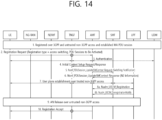
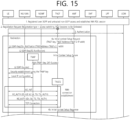
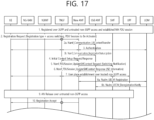
- the first implementation of the present disclosure describes the case where access switching is performed in the middle of the registration procedure. More specifically, according to the first implementation of the present disclosure, the UE may transmit information for non-3GPP access switching and information about the MA PDU session requiring access switching in a registration request message.
- the AMF may notify the SMF managing the MA PDU session requested by the UE that an access switching is required and may perform the registration with UDM after receiving a response from the SMF.
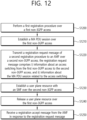
- FIG. 12 shows am example of a method performed by a UE to which the first implementation of the present disclosure is applied.
- step S1200 the method comprises performing a first registration procedure over a first non-3GPP access.
- step S1210 the method comprises establishing a MA PDU session over the first non-3GPP access.
- establishing the MA PDU session may comprise, transmitting a PDU session establishment request message comprising information indicating whether the UE supports access switching in non-3GPP accesses.
- establishing the MA PDU session may comprise, receiving a PDU session establishment accept message comprising information indicating whether the SMF supports the access switching in non-3GPP accesses, in response to the PDU session establishment request message.
- the method comprises transmitting a registration request message of a second registration procedure to an AMF over a second non-3GPP access.
- the registration request message comprises i) information about access switching from the first non-3GPP access to the second non-3GPP access, and ii) information about the MA PDU session related to the access switching.
- the information about the access switching may be a registration type in the registration request message set to "non-3GPP access switching" and/or an indicator in the registration request message indicating non-3GPP path switching.
- the information about the MA PDU session may be included within a List Of PDU Sessions To Be Activated in the registration request message.
- the information about the MA PDU session may be included within the List Of PDU Sessions To Be Activated in the registration request message, based on an indication that the access switching in non-3GPP accesses is supported for the MA PDU session.
- the information about the MA PDU session may be included within a separate Information Element (IE) in the registration request message.
- IE Information Element
- step S1230 the method comprises establishing a user plane resource with an SMF over the second non-3GPP access.
- step S1240 the method comprises releasing a user plane resource over the first non-3GPP access.
- step S1250 the method comprises receiving a registration accept message from the AMF in response to the registration request message.
- the method further may comprise considering that the UE is de-registered from the first non-3GPP access and is registered with the second non-3GPP access, based on receiving the registration accept message.
- the first non-3GPP access or the second non-3GPP access may be any one of an untrusted non-3GPP access, a trusted non-3GPP access, or a wireline access.
- the method may further comprise performing a registration procedure over a 3GPP access before performing the access switching.
- the first non-3GPP access and the 3GPP access may belong to a same PLMN.
- the first registration procedure may be performed with a non-geographically selected AMF over the first non-3GPP access, and the non-geographically selected AMF may be different from the AMF.
- the method may further comprise performing an access addition procedure and/or service request procedure over the second non-3GPP access for MA PDU sessions for which the access switching from the first non-3GPP access to the second non-3GPP access has not been performed.
- the UE may be in communication with at least one of a mobile device, a network, and/or autonomous vehicles other than the UE.
- the method in perspective of the UE described above in FIG. 12 may be performed by the first wireless device 100 shown in FIG. 2 , and/or the UE 100 shown in FIG. 3 .
- the UE comprises at least one transceiver, at least one processor, and at least one memory operably connectable to the at least one processor and storing instructions. Based on being executed by the at least one processor, the instructions perform the following operations.
- the UE performs a first registration procedure over a first non-3GPP access.
- the UE establishes a MA PDU session over the first non-3GPP access.
- establishing the MA PDU session may comprise, transmitting a PDU session establishment request message comprising information indicating whether the UE supports access switching in non-3GPP accesses.
- establishing the MA PDU session may comprise, receiving a PDU session establishment accept message comprising information indicating whether the SMF supports the access switching in non-3GPP accesses, in response to the PDU session establishment request message.
- the UE transmits, via the at least one transceiver, a registration request message of a second registration procedure to an AMF over a second non-3GPP access.
- the registration request message comprises i) information about access switching from the first non-3GPP access to the second non-3GPP access, and ii) information about the MA PDU session related to the access switching.
- the information about the access switching may be a registration type in the registration request message set to "non-3GPP access switching" and/or an indicator in the registration request message indicating non-3GPP path switching.
- the information about the MA PDU session may be included within a List Of PDU Sessions To Be Activated in the registration request message.
- the information about the MA PDU session may be included within the List Of PDU Sessions To Be Activated in the registration request message, based on an indication that the access switching in non-3GPP accesses is supported for the MA PDU session.
- the information about the MA PDU session may be included within a separate Information Element (IE) in the registration request message.
- IE Information Element
- the UE establishes a user plane resource with an SMF over the second non-3GPP access.
- the UE releases a user plane resource over the first non-3GPP access.
- the UE receives, via the at least one transceiver, a registration accept message from the AMF in response to the registration request message.
- the UE may further consider that the UE is de-registered from the first non-3GPP access and is registered with the second non-3GPP access, based on receiving the registration accept message.
- the first non-3GPP access or the second non-3GPP access may be any one of an untrusted non-3GPP access, a trusted non-3GPP access, or a wireline access.
- the UE may further perform a registration procedure over a 3GPP access before performing the access switching.
- the first non-3GPP access and the 3GPP access may belong to a same PLMN.
- the first registration procedure may be performed with a non-geographically selected AMF over the first non-3GPP access, and the non-geographically selected AMF may be different from the AMF.
- the UE may further perform an access addition procedure and/or service request procedure over the second non-3GPP access for MA PDU sessions for which the access switching from the first non-3GPP access to the second non-3GPP access has not been performed.
- the method in perspective of the UE described above in FIG. 12 may be performed by control of the processor 102 included in the first wireless device 100 shown in FIG. 2 , and/or by control of the processor 102 included in the UE 100 shown in FIG. 3 .
- a processing apparatus adapted to control a UE in a wireless communication system comprises at least one processor, and at least one memory operably connectable to the at least one processor and storing instructions.
- the at least one processor is adapted to perform following operations comprising: performing a first registration procedure over a first non-3GPP access, establishing a MA PDU session over the first non-3GPP access, generating a registration request message of a second registration procedure over a second non-3GPP access, wherein the registration request message comprises i) information about an access switching from the first non-3GPP access to the second non-3GPP access, and ii) information about the MA PDU session related to the access switching, establishing a user plane resource with an SMF over the second non-3GPP access, releasing a user plane resource over the first non-3GPP access, and obtaining a registration accept message in response to the registration request message.
- the method in perspective of the UE described above in FIG. 12 may be performed by a software code 105 stored in the memory 104 included in the first wireless device 100 shown in FIG. 2 .
- a method performed by a wireless device in a wireless communication may be implemented in hardware, software, firmware, or any combination thereof.
- a software may reside in RAM, flash memory, ROM, EPROM, EEPROM, registers, hard disk, a removable disk, a CD-ROM, or any other storage medium.
- storage medium may be coupled to the processor such that the processor can read information from the storage medium.
- the storage medium may be integral to the processor.
- the processor and the storage medium may reside in an ASIC.
- the processor and the storage medium may reside as discrete components.
- the computer-readable medium may include a tangible and non-transitory computer-readable storage medium.
- non-transitory computer-readable media may include RAM such as synchronous dynamic random access memory (SDRAM), ROM, non-volatile random access memory (NVRAM), EEPROM, flash memory, magnetic or optical data storage media, or any other medium that can be used to store instructions or data structures.
- RAM such as synchronous dynamic random access memory (SDRAM), ROM, non-volatile random access memory (NVRAM), EEPROM, flash memory, magnetic or optical data storage media, or any other medium that can be used to store instructions or data structures.
- RAM such as synchronous dynamic random access memory (SDRAM), ROM, non-volatile random access memory (NVRAM), EEPROM, flash memory, magnetic or optical data storage media, or any other medium that can be used to store instructions or data structures.
- NVRAM non-volatile random access memory
- EEPROM electrically erasable programmable read-only memory
- the method described herein may be realized at least in part by a computer-readable communication medium that carries or communicates code in the form of instructions or data structures and that can be accessed, read, and/or executed by a computer.
- a non-transitory computer-readable medium has stored thereon a plurality of instructions.
- CRM stores instructions to cause at least one processor to perform following operations comprising: performing a first registration procedure over a first non-3GPP access, establishing a MA PDU session over the first non-3GPP access, generating a registration request message of a second registration procedure over a second non-3GPP access, wherein the registration request message comprises i) information about an access switching from the first non-3GPP access to the second non-3GPP access, and ii) information about the MA PDU session related to the access switching, establishing a user plane resource with an SMF over the second non-3GPP access, releasing a user plane resource over the first non-3GPP access, and obtaining a registration accept message in response to the registration request message.
- FIG. 13 shows am example of a method performed by an AMF to which the first implementation of the present disclosure is applied.
- step S1300 the method comprises performing a first registration procedure for a UE over a first non-3GPP access.
- the method comprises receiving a registration request message of a second registration procedure from the UE over a second non-3GPP access.
- the registration request message comprises i) information about an access switching from the first non-3GPP access to the second non-3GPP access, and ii) information about a MA PDU session related to the access switching.
- the information about the access switching may be a registration type in the registration request message set to "non-3GPP access switching" and/or an indicator in the registration request message indicating non-3GPP path switching.
- the information about the MA PDU session may be included within a List Of PDU Sessions To Be Activated in the registration request message.
- the information about the MA PDU session may be included within the List Of PDU Sessions To Be Activated in the registration request message, based on an indication that the access switching in non-3GPP accesses is supported for the MA PDU session.
- the information about the MA PDU session may be included within a separate IE in the registration request message.
- step S1320 the method comprises transmitting the information about the access switching from the first non-3GPP access to the second non-3GPP access to an SMF.
- the information about the MA PDU session may comprise information about a plurality of MA PDU sessions, and the information about the access switching may be transmitted to all SMFs managing each of the plurality of MA PDU sessions.
- the method may further comprise receiving a response message from the SMF in response to transmission of the information about the access switching.
- the method may further comprises performing a UDM registration after receiving the response message.
- the method may further comprise waiting to perform the UDM registration until the response message is received from all SMFs managing each of the plurality of MA PDU sessions.
- step S1330 the method comprises performing an AN release procedure over the first non-3GPP access.
- step S1340 the method comprises transmitting a registration accept message to the UE in response to the registration request message.
- the first non-3GPP access or the second non-3GPP access may be any one of an untrusted non-3GPP access, a trusted non-3GPP access, or a wireline access.
- the method may further comprises performing a registration procedure over a 3GPP access before performing the access switching.
- the first non-3GPP access and the 3GPP access may belong to a same PLMN.
- the method may further comprise informing the SMF of whether the AMF supports the access switching in non-3GPP accesses.
- the method may further comprise informing the SMF that an AN release procedure is to be performed over the first non-3GPP access, based on not receiving a response message from the SMF in response to transmission of the information about the access switching for a period of time.
- the method in perspective of the AMF described above in FIG. 13 may be performed by the second wireless device 200 shown in FIG. 2 .
- the AMF comprises at least one transceiver, at least one processor, and at least one memory operably connectable to the at least one processor and storing instructions. Based on being executed by the at least one processor, the instructions perform the following operations.
- the AMF performs a first registration procedure for a UE over a first non-3GPP access.
- the AMF receives, via the at least one transceiver, a registration request message of a second registration procedure from the UE over a second non-3GPP access.
- the registration request message comprises i) information about an access switching from the first non-3GPP access to the second non-3GPP access, and ii) information about a MA PDU session related to the access switching.
- the information about the access switching may be a registration type in the registration request message set to "non-3GPP access switching" and/or an indicator in the registration request message indicating non-3GPP path switching.
- the information about the MA PDU session may be included within a List Of PDU Sessions To Be Activated in the registration request message.
- the information about the MA PDU session may be included within the List Of PDU Sessions To Be Activated in the registration request message, based on an indication that the access switching in non-3GPP accesses is supported for the MA PDU session.
- the information about the MA PDU session may be included within a separate IE in the registration request message.
- the AMF transmits, via the at least one transceiver, the information about the access switching from the first non-3GPP access to the second non-3GPP access to an SMF.
- the information about the MA PDU session may comprise information about a plurality of MA PDU sessions, and the information about the access switching may be transmitted to all SMFs managing each of the plurality of MA PDU sessions.
- the AMF may further receive a response message from the SMF in response to transmission of the information about the access switching.
- the AMF may further perform a UDM registration after receiving the response message.
- the AMF may further wait to perform the UDM registration until the response message is received from all SMFs managing each of the plurality of MA PDU sessions.
- the AMF performs an AN release procedure over the first non-3GPP access.
- the AMF transmits, via the at least one transceiver, a registration accept message to the UE in response to the registration request message.
- the first non-3GPP access or the second non-3GPP access may be any one of an untrusted non-3GPP access, a trusted non-3GPP access, or a wireline access.
- the AMF may further perform a registration procedure over a 3GPP access before performing the access switching.
- the first non-3GPP access and the 3GPP access may belong to a same PLMN.
- the AMF may further inform the SMF of whether the AMF supports the access switching in non-3GPP accesses.
- the AMF may further inform the SMF that an AN release procedure is to be performed over the first non-3GPP access, based on not receiving a response message from the SMF in response to transmission of the information about the access switching for a period of time.
- FIG. 14 shows an example of a non-3GPP access switching procedure to which the first implementation of the present disclosure is applied.
- Step 1 The UE is registered over 3GPP access and untrusted non-3GPP access and established MA PDU session.
- the UE may indicate whether it supports non-3GPP access switching in the PDU session establishment request message.
- the AMF may also indicate whether it supports non-3GPP access switching to the SMF.
- the SMF may indicate whether non-3GPP access switching is supported to the UE in the PDU session establishment accept message.
- Step 2 The UE registers over a trusted non-3GPP access with a new registration type "non-3GPP access switching".
- the UE may include the MA PDU sessions that user plane resources are established over untrusted non-3GPP access in the List Of PDU Sessions To Be Activated.
- the UE may only include in the List Of PDU Sessions To Be Activated those MA PDU sessions that have been instructed to support non-3GPP access switching in the MA PDU session establishment procedure.
- an MA PDU session established as Home Routed (HR) may not support non-3GPP access switching
- an MA PDU session established as Local Breakout (LBO) may support non-3GPP access switching.
- the UE may include only LBO MA PDU sessions that support non-3GPP access switching in the List Of PDU Sessions To Be Activated.
- the UE may inform the MA PDU session via a separate IE in the registration request message.
- the UE may only perform non-3GPP access switching if the 3GPP access and the non-3GPP access are in the same PLMN.
- an AMF change may occur during the registration process via a trusted non-3GPP access.
- the registration procedure described in FIGS. 5 and 6 may be followed to obtain the UE context from the previous AMF.
- AMF refers to the new AMF unless otherwise noted.
- Step 3 The AMF may perform authentication procedure based on existing procedure.
- Step 4 The AMF sends Initial UE Context Setup Request message to the TNGF.
- Step 5 After the Initial UE Context Setup procedure is completed, the AMF notifies to the SMF that the UE requested non-3GPP access switching.
- This operation may be done for MA PDU sessions that the UE has indicated in the List Of PDU Sessions To Be Activated in step 2. If the MA PDU session is indicated via a separate IE instead of the List Of PDU Sessions To Be Activated in step 2, the AMF may decide which SMF to notify via that IE that the UE has requested a non-3GPP access switching. If the UE notified information about multiple MA PDU sessions, the AMF may notify all SMFs that manage multiple MA PDU sessions that the UE has requested to non-3GPP access switching.
- Steps 6-7 The SMF establishes user plane resources over the trusted non-3GPP access.
- there may be three user plane tunnels i.e., 3GPP access, untrusted non-3GPP access, trusted non-3GPP access
- the SMF may indicate the target access type to "trusted non-3GPP access" so that the N2 information is delivered to the trusted non-3GPP access.
- Step 8 The AMF performs UDM registration by triggering
- the AMF may wait for a response to the signaling transmitted to the SMF in step 5 before performing step 8. If the AMF has transmitted such signaling to all SMFs managing multiple PDU sessions and/or multiple signaling to one SMF managing multiple PDU sessions, the AMF may wait until it receives a response to all signaling. If the AMF does not receive a response from the SMF for a period of time, an AN release procedure may be performed in step 9, described below, for that MA PDU session, and during the AN release procedure, the AMF may notify the SMF that an AN release procedure has been performed, indicating that the user plane resources for the non-3GPP access have been released.
- step 8b is performed by the old AMF.
- Step 9 The AMF performs AN release procedure over the untrusted non-3GPP access. As a result of this procedure, user plane resources over untrusted non-3GPP access of MA PDU is completely released. Also, user plane resources of single access PDU session is deactivated. When the UE and UPF recognize that user plane resources over untrusted non-3GPP access are released, the UE and UPF starts to transmit traffic over trusted non-3GPP access.
- Step 10 The AMF transmits a registration accept message to the UE.
- the UE receives the registration accept message, the UE considers that the UE is deregistered from untrusted non-3GPP access and registered over trusted non-3GPP access.
- the UE may perform the access addition and/or service request process by transmitting a PDU session establishment request with a new access.
- Network redirection may be required for non-3GPP access switching. There are two options for network redirection, 1) redirect the UE during the registration, or 2) redirect the UE after the registration.
- FIG. 15 shows an example of a non-3GPP access switching where redirection is performed during a registration procedure to which the first implementation of the present disclosure is applied.
- FIG. 15 corresponds to steps 1-4 of the non-3GPP access switching procedure described in FIG. 14 , in particular detailing the EAP-5G signaling for the redirection. After step 4 of FIG. 15 , steps 5-10 of FIG. 14 may be performed as it is.
- redirection uses EAP-5G signaling to transmit redirection information and redirection procedure is performed before the TNGF/N3IWF transmits initial context setup response to the AMF.
- redirection may be applied between step 3 and step 4 in FIG. 14 .
- FIG. 16 shows an example of a non-3GPP access switching where redirection is performed after a registration procedure to which the first implementation of the present disclosure is applied.
- FIG. 16 corresponds to steps 1-2 of the non-3GPP access switching procedure described in FIG. 14 , in particular where the redirection is performed before the non-3GPP access switching. After step 2 of FIG. 16 , steps 3-10 of FIG. 14 may be performed as it is.
- the non-3GPP access switching may be performed either before the redirection or after the redirection as redirection may be performed independent with the non-3GPP access switching.
- the non-3GPP access switching is performed before the redirection, the user plane path needs to be updated again when the connected to the new TNGF/N3IWF and it causes more signaling. Therefore, it may be preferable to perform non-3GPP access switching after the redirection is completed.
- FIG. 17 shows another example of a non-3GPP access switching procedure to which the first implementation of the present disclosure is applied.
- FIG. 17 shows a procedure for performing redirection before non-3GPP access switching and performing non-3GPP access switching afterward, in the event of an AMF change during the registration procedure.
- Step 1 The UE is registered over 3GPP access and untrusted non-3GPP access and established MA PDU session.
- the UE may indicate whether it supports non-3GPP access switching in the PDU session establishment request message.
- the AMF may also indicate whether it supports non3GPP access switching to the SMF.
- the SMF may indicate whether non-3GPP access switching is supported to the UE in the PDU session establishment accept message.
- Step 2 The UE registers over trusted non-3GPP access with new Registration type "non-3GPP access switching".
- the UE includes the MA PDU sessions that user plane resources are established over untrusted non-3GPP access in the List Of PDU Sessions To Be Activated.
- Step 2a If the UE is registered over untrusted non-3GPP access only in step 1, the serving AMF may be selected based on non-geographical criteria. For example, if only non-geographically selectable N3IWF are deployed, the serving AMF may be selected based on non-geographical criteria. In this case, a new AMF may be selected during the registration procedure. Then the new AMF retrieves UE context from the old AMF.
- the selected TNGF supports the S-NSSAI of the established MA PDU session. This may be ensured by the UE or done by the network.
- the AMF does not trigger non-3GPP access switching and wait until redirection procedure is finished (e.g., may be done between step 3 and step 4 or UE may need to trigger registration with new TNGF and then performs non-3GPP access switching).
- Step 3 The AMF may perform authentication procedure based on existing procedure.
- Step 3b If the (new) AMF retrieved UE context from the old AMF as described in step 2a, the AMF informs the old AMF that the registration of the UE in the new AMF is completed by invoking the Namf_Communication_RegistrationStatusUpdate service operation. In this case, the old AMF may also run the timer according to the conventional procedure.
- Step 4 The AMF sends Initial UE Context Setup Request message to the TNGF.
- Step 5 After the Initial UE Context Setup procedure is completed, the AMF notifies to the SMF that the UE requested non-3GPP access switching.
- This operation may be performed for the MA PDU session indicated by the UE in the List Of PDU Sessions To Be Activated in step 2. If there are other PDU sessions (e.g., normal PDU sessions that are not MA PDU sessions), they may be notified in step 3b to the previous AMF that they are released. Alternatively, if the UE also wishes to perform access switching for a normal PDU session that is not an MA PDU session, the AMF may notify the SMF of non-3GPP access switching for that PDU session. Alternatively, the AMF may deactivate the PDU session to eliminate the impact on the SMF that manages the normal PDU session. This may be done by transmitting Nsmf_PDUSession_Update_SMContext request with the operation type set to "UP deactivate".
- Step 6-7 The SMF establishes user plane resources over the trusted non-3GPP access.
- there may be three user plane tunnels i.e., 3GPP access, untrusted non-3GPP access, trusted non-3GPP access
- the SMF may set the target access type to "trusted non-3GPP access" so that the AMF delivers the N2 information to the trusted non-3GPP access.
- Step 8a The AMF performs UDM registration by triggering Nud_UECM_Registration service operation.
- Step 8b The UDM triggers Nudm_UECM_DeregistrationNotify service according to the existing procedure. After this point, all signaling and reachability procedures are performed over the trusted non-3GPP access. If the AMF has changed, the UDM sends the notification to the old AMF.
- Step 9 After receiving Numd_UECM_DeregistrationNotify, the (old) AMF performs AN release procedure over the untrusted non-3GPP access. As a result of this procedure, user plane resources over untrusted non-3GPP access of MA PDU is completely released. When the UE and UPF recognize that user plane resources over untrusted non-3GPP access are released, the UE and UPF starts to transmit traffic over trusted non-3GPP access.
- the old AMF may perform the AN release procedure if the timer that started the operation in step 3b has expired.
- Step 10 The AMF sends registration accept message to the UE.
- the UE receives the registration accept message, the UE considers that the UE is deregistered from untrusted non-3GPP access and registered over trusted non-3GPP access.
- a UE that is registered over non-3GPP access may trigger a mobility registration update procedure via a new non-3GPP AN node (i.e., N3IWF or TNGF) to switch traffic from an old non-3GPP access to a new non-3GPP access.
- a new non-3GPP AN node i.e., N3IWF or TNGF
- the UE When the UE wants to request a new MA PDU session, the UE indicates during MA PDU session establishment to the AMF whether it supports non-3GPP access path switching, i.e., whether the UE can transfer the non-3GPP access path of the MA PDU session from a source non-3GPP access (N3IWF/TNGF) to a target non-3GPP access (a different N3IWF/TNGF). If the UE has indicated support for non-3GPP access path switching and the AMF supports non-3GPP access path switching, the AMF selects the SMF that supports non-3GPP access path switching and indicates whether the UE supports non-3GPP access path switching to the SMF. If the AMF has indicated that the UE supports non-3GPP access path switching and the SMF supports non-3GPP access path switching, the SMF indicates support for non-3GPP access path switching to the UE in the PDU session establishment accept message.
- non-3GPP access path switching i.e., whether the UE can transfer the non-3GP
- the UE After the MA PDU session establishment, if the UE wants to move the non-3GPP user-plane resources of the MA PDU session from a source non-3GPP access (e.g., source N3IWF or TNGF) to a target non-3GPP access (e.g., target N3IWF or TNGF), the UE initiates a mobility registration update via the target non-3GPP access according to a registration procedure for non-3GPP access path switching to be described below. This procedure may also be used to move the non-3GPP user-plane resources of single access PDU session(s).
- a source non-3GPP access e.g., source N3IWF or TNGF
- target non-3GPP access e.g., target N3IWF or TNGF
- the UE may request activation of single access PDU session(s) over the target non-3GPP access while performing mobility registration update procedure according to the existing procedure.
- the AMF indicates as part of the registration procedure whether it supports non-3GPP access path switching.
- the UE does not perform the mobility registration update procedure for non-3GPP access path switching, i.e., to switch traffic from a source non-3GPP access to a target non-3GPP access.
- Capability of the SMF (V-SMF and H-SMF) to support non-3GPP access path switching may be considered during the SMF selection.
- the UE may trigger a mobility registration update via a new non-3GPP access to switch traffic from an old non-3GPP access (i.e., TNGF or N3IWF) to the new non-3GPP access (i.e., TNGF or N3IWF).
- an old non-3GPP access i.e., TNGF or N3IWF
- the new non-3GPP access i.e., TNGF or N3IWF
- the UE may also provide an "Non-3GPP path switching while using old AN resources" indication in the registration request to indicate that the UP connection(s) via the old non-3GPP access can still be used for the MA PDU session(s) during the registration procedure. If the UP connection(s) via the old non-3GPP access cannot be used by the UE during the registration procedure, the UE does not provide an "Non-3GPP path switching while using old AN resources" indication.
- the UE does not perform non-3GPP access path switching if the PLMN of the selected new non-3GPP access is different from the PLMN of the old non-3GPP access.
- the AMF delays the release of the old N2 connection until the UP connection via the new non-3GPP access is established. Otherwise, the AMF may trigger AN release towards the old non-3GPP access before proceeding with the registration procedure in the new non-3GPP access. In this case, during the AN release procedure, the AMF notifies the SMF to release the UP resources for the activated PDU sessions before sending the N2 UE Context Release Command to the old non-3GPP access.
- the AMF if it supports maintaining two N2 connections for non-3GPP access, forwards this indication to the SMF in case the PDU session is a MA PDU session. If the SMF receives this indication, the SMF does not trigger release of the UP connection in the old non-3GPP access (if any).
- the UE and UPF After the UP connection via the new non-3GPP access is established, the UE and UPF start to send traffic via the new non-3GPP access.
- the AMF After the UP connection has been established in new non-3GPP access, the AMF also triggers AN release towards the old non-3GPP access (i.e., old N3IWF or TNGF), unless done previously.
- old non-3GPP access i.e., old N3IWF or TNGF
- the AMF in VPLMN may be configured to not indicate support for non-3GPP path switch for inbound roaming UEs during MA PDU session establishment towards a SMF in VPLMN, unless it has been agreed in roaming agreements that non-3GPP path switch can be supported for such UEs.
- the second implementation of the present disclosure describes a method of supporting non-3GPP access switching between N3IWFs or between TNGFs.
- the first implementation of the present disclosure described above describes a method for non-3GPP access switching between N3IWF and TNGF (i.e., N3IWF -> TNGF or TNGF -> N3IWF).
- non-3GPP access switching may be performed between N3IWFs or between TNGFs.
- the SMF only indicates the target access type when transmitting N2 information over the new non-3GPP access (e.g., step 6 in FIG. 17 )
- the AMF does not know which access it should transmit the received N2 information over.
- the SMF may transmit with the target access type set to "trusted non-3GPP access". In this case, since both the old non-3GPP access and the new non-3GPP access are trusted non-3GPP accesses, the AMF does not know which access it should transmit the received N2 information over.
- the present disclosure may have various advantageous effects.
- it can support service continuity by enabling UEs to add access for MA PDU sessions between different types of non-3GPP access.
- a UE when a UE finds a new non-3GPP access, it can support access switching between non-3GPP accesses to ensure that traffic using MA PDU sessions can be transferred seamlessly.
Landscapes
- Engineering & Computer Science (AREA)
- Computer Networks & Wireless Communication (AREA)
- Signal Processing (AREA)
- Mobile Radio Communication Systems (AREA)
Applications Claiming Priority (4)
| Application Number | Priority Date | Filing Date | Title |
|---|---|---|---|
| US202263323508P | 2022-03-25 | 2022-03-25 | |
| US202263337176P | 2022-05-02 | 2022-05-02 | |
| US202263340476P | 2022-05-11 | 2022-05-11 | |
| PCT/KR2023/003499 WO2023182728A1 (ko) | 2022-03-25 | 2023-03-16 | 트래픽 전송을 위한 네트워크 등록 방법 및 이를 지원하는 장치 |
Publications (2)
| Publication Number | Publication Date |
|---|---|
| EP4503733A1 true EP4503733A1 (de) | 2025-02-05 |
| EP4503733A4 EP4503733A4 (de) | 2026-03-25 |
Family
ID=88101814
Family Applications (1)
| Application Number | Title | Priority Date | Filing Date |
|---|---|---|---|
| EP23775225.8A Pending EP4503733A4 (de) | 2022-03-25 | 2023-03-16 | Netzwerkregistrierungsverfahren für verkehrsübertragung und vorrichtung zur unterstützung davon |
Country Status (4)
| Country | Link |
|---|---|
| US (1) | US20250168801A1 (de) |
| EP (1) | EP4503733A4 (de) |
| KR (1) | KR20240162485A (de) |
| WO (1) | WO2023182728A1 (de) |
Families Citing this family (2)
| Publication number | Priority date | Publication date | Assignee | Title |
|---|---|---|---|---|
| US12549948B2 (en) * | 2022-08-29 | 2026-02-10 | Velocloud Networks, Llc | Multipath link optimization for private mobile network |
| KR20250126482A (ko) * | 2024-02-16 | 2025-08-25 | 삼성전자주식회사 | 무선 통신 시스템에서 세션을 관리하기 위한 방법 및 장치 |
Family Cites Families (4)
| Publication number | Priority date | Publication date | Assignee | Title |
|---|---|---|---|---|
| WO2018088836A1 (ko) * | 2016-11-10 | 2018-05-17 | 엘지전자 주식회사 | 무선 통신 시스템에서 동일 plmn에 속하는 네트워크 액세스를 통한 등록 방법 및 이를 위한 장치 |
| WO2018161796A1 (zh) * | 2017-03-08 | 2018-09-13 | 华为技术有限公司 | 多接入场景中的连接处理方法和装置 |
| EP3753294B1 (de) * | 2018-02-16 | 2023-11-29 | InterDigital Patent Holdings, Inc. | Mobilitätshandhabung für mehrfachzugriffsprotokolldateneinheiten (pdu) in einem 5g-netzwerk |
| US11178725B2 (en) * | 2018-06-21 | 2021-11-16 | Ofinno, Llc | Multi access packet/protocol data unit session |
-
2023
- 2023-03-16 US US18/841,307 patent/US20250168801A1/en active Pending
- 2023-03-16 EP EP23775225.8A patent/EP4503733A4/de active Pending
- 2023-03-16 WO PCT/KR2023/003499 patent/WO2023182728A1/ko not_active Ceased
- 2023-03-16 KR KR1020247028076A patent/KR20240162485A/ko active Pending
Also Published As
| Publication number | Publication date |
|---|---|
| WO2023182728A1 (ko) | 2023-09-28 |
| KR20240162485A (ko) | 2024-11-15 |
| US20250168801A1 (en) | 2025-05-22 |
| EP4503733A4 (de) | 2026-03-25 |
Similar Documents
| Publication | Publication Date | Title |
|---|---|---|
| US11490351B2 (en) | Efficient PLMN selection upon authentication failure for each network slice in roaming network | |
| EP4216622A2 (de) | Netzwerkregistrierungsverfahren für verkehrssteuerung und vorrichtung zur unterstützung davon | |
| US12250593B2 (en) | Method for measuring performance for QOS | |
| KR20230066112A (ko) | Pdu 세션 관리 방법 | |
| EP4329367B1 (de) | Verfahren zum verschieben einer pdu-sitzung von einem nicht-3gpp- zu einem 3gpp-zugang | |
| US12470987B2 (en) | N14 interface support indicator for service continuity | |
| EP4224930B1 (de) | Unterstützung der dienstkontinuität für eine heimgeroutete pdu-sitzung ohne n14-schnittstelle zwischen quellnetzwerk und zielnetzwerk | |
| EP4503733A1 (de) | Netzwerkregistrierungsverfahren für verkehrsübertragung und vorrichtung zur unterstützung davon | |
| US20250212150A1 (en) | Communication related to communication state | |
| US20250126033A1 (en) | Method for measuring traffic usage | |
| EP4648390A1 (de) | Edge-computing-basierte kommunikation | |
| EP4648487A1 (de) | Nicht-3gpp-knotenauswahlverfahren | |
| CN118844091A (zh) | 用于业务传输的网络注册方法和支持该方法的设备 | |
| EP4661590A1 (de) | Pfadumschaltung | |
| EP4568306A1 (de) | Lbo-modus-pdu-sitzung | |
| EP4564987A1 (de) | Kommunikation in zusammenhang mit einer redundanten pdu-sitzung | |
| EP4679899A1 (de) | Netzwerk-slice | |
| EP4607846A1 (de) | Direkte c2-autorisierung | |
| EP4664951A1 (de) | Föderiertes lernen | |
| EP4694070A1 (de) | Verfahren zur latenzmessung | |
| EP4503723A1 (de) | Verfahren zur verwaltung lokaler dienste | |
| EP4598074A1 (de) | Verfahren zur bestimmung einer ursp-regel | |
| EP4697797A1 (de) | Satellitenkommunikation | |
| EP4564988A1 (de) | Kommunikation in zusammenhang mit einer redundanten pdu-sitzung | |
| CN119073004A (zh) | 无线通信系统中操作终端的方法和设备 |
Legal Events
| Date | Code | Title | Description |
|---|---|---|---|
| STAA | Information on the status of an ep patent application or granted ep patent |
Free format text: STATUS: THE INTERNATIONAL PUBLICATION HAS BEEN MADE |
|
| PUAI | Public reference made under article 153(3) epc to a published international application that has entered the european phase |
Free format text: ORIGINAL CODE: 0009012 |
|
| STAA | Information on the status of an ep patent application or granted ep patent |
Free format text: STATUS: REQUEST FOR EXAMINATION WAS MADE |
|
| 17P | Request for examination filed |
Effective date: 20240916 |
|
| AK | Designated contracting states |
Kind code of ref document: A1 Designated state(s): AL AT BE BG CH CY CZ DE DK EE ES FI FR GB GR HR HU IE IS IT LI LT LU LV MC ME MK MT NL NO PL PT RO RS SE SI SK SM TR |
|
| DAV | Request for validation of the european patent (deleted) | ||
| DAX | Request for extension of the european patent (deleted) | ||
| A4 | Supplementary search report drawn up and despatched |
Effective date: 20260224 |
|
| RIC1 | Information provided on ipc code assigned before grant |
Ipc: H04W 36/00 20090101AFI20260218BHEP Ipc: H04W 40/36 20090101ALI20260218BHEP Ipc: H04W 60/00 20090101ALI20260218BHEP Ipc: H04W 76/10 20180101ALI20260218BHEP |