EP4502208A1 - Legierungsmaterial - Google Patents
Legierungsmaterial Download PDFInfo
- Publication number
- EP4502208A1 EP4502208A1 EP23780945.4A EP23780945A EP4502208A1 EP 4502208 A1 EP4502208 A1 EP 4502208A1 EP 23780945 A EP23780945 A EP 23780945A EP 4502208 A1 EP4502208 A1 EP 4502208A1
- Authority
- EP
- European Patent Office
- Prior art keywords
- alloy material
- content
- less
- corrosion resistance
- intergranular corrosion
- Prior art date
- Legal status (The legal status is an assumption and is not a legal conclusion. Google has not performed a legal analysis and makes no representation as to the accuracy of the status listed.)
- Pending
Links
Images

Classifications
-
- C—CHEMISTRY; METALLURGY
- C22—METALLURGY; FERROUS OR NON-FERROUS ALLOYS; TREATMENT OF ALLOYS OR NON-FERROUS METALS
- C22F—CHANGING THE PHYSICAL STRUCTURE OF NON-FERROUS METALS AND NON-FERROUS ALLOYS
- C22F1/00—Changing the physical structure of non-ferrous metals or alloys by heat treatment or by hot or cold working
-
- C—CHEMISTRY; METALLURGY
- C22—METALLURGY; FERROUS OR NON-FERROUS ALLOYS; TREATMENT OF ALLOYS OR NON-FERROUS METALS
- C22C—ALLOYS
- C22C30/00—Alloys containing less than 50% by weight of each constituent
- C22C30/02—Alloys containing less than 50% by weight of each constituent containing copper
-
- C—CHEMISTRY; METALLURGY
- C22—METALLURGY; FERROUS OR NON-FERROUS ALLOYS; TREATMENT OF ALLOYS OR NON-FERROUS METALS
- C22C—ALLOYS
- C22C19/00—Alloys based on nickel or cobalt
- C22C19/03—Alloys based on nickel or cobalt based on nickel
- C22C19/05—Alloys based on nickel or cobalt based on nickel with chromium
-
- C—CHEMISTRY; METALLURGY
- C22—METALLURGY; FERROUS OR NON-FERROUS ALLOYS; TREATMENT OF ALLOYS OR NON-FERROUS METALS
- C22C—ALLOYS
- C22C19/00—Alloys based on nickel or cobalt
- C22C19/03—Alloys based on nickel or cobalt based on nickel
- C22C19/05—Alloys based on nickel or cobalt based on nickel with chromium
- C22C19/051—Alloys based on nickel or cobalt based on nickel with chromium and Mo or W
- C22C19/055—Alloys based on nickel or cobalt based on nickel with chromium and Mo or W with the maximum Cr content being at least 20% but less than 30%
-
- C—CHEMISTRY; METALLURGY
- C22—METALLURGY; FERROUS OR NON-FERROUS ALLOYS; TREATMENT OF ALLOYS OR NON-FERROUS METALS
- C22C—ALLOYS
- C22C30/00—Alloys containing less than 50% by weight of each constituent
-
- C—CHEMISTRY; METALLURGY
- C22—METALLURGY; FERROUS OR NON-FERROUS ALLOYS; TREATMENT OF ALLOYS OR NON-FERROUS METALS
- C22C—ALLOYS
- C22C30/00—Alloys containing less than 50% by weight of each constituent
- C22C30/04—Alloys containing less than 50% by weight of each constituent containing tin or lead
-
- C—CHEMISTRY; METALLURGY
- C22—METALLURGY; FERROUS OR NON-FERROUS ALLOYS; TREATMENT OF ALLOYS OR NON-FERROUS METALS
- C22F—CHANGING THE PHYSICAL STRUCTURE OF NON-FERROUS METALS AND NON-FERROUS ALLOYS
- C22F1/00—Changing the physical structure of non-ferrous metals or alloys by heat treatment or by hot or cold working
- C22F1/16—Changing the physical structure of non-ferrous metals or alloys by heat treatment or by hot or cold working of other metals or alloys based thereon
-
- C—CHEMISTRY; METALLURGY
- C22—METALLURGY; FERROUS OR NON-FERROUS ALLOYS; TREATMENT OF ALLOYS OR NON-FERROUS METALS
- C22F—CHANGING THE PHYSICAL STRUCTURE OF NON-FERROUS METALS AND NON-FERROUS ALLOYS
- C22F1/00—Changing the physical structure of non-ferrous metals or alloys by heat treatment or by hot or cold working
- C22F1/10—Changing the physical structure of non-ferrous metals or alloys by heat treatment or by hot or cold working of nickel or cobalt or alloys based thereon
Definitions
- the present disclosure relates to an alloy material.
- Alloy materials are used in chemical plant equipment at oil refinery plants, petrochemical plants and the like.
- Examples of the respective apparatuses included in such chemical plant equipment include a vacuum distillation unit, a direct desulfurization unit, a catalytic reforming unit and the like.
- These apparatuses include a heating furnace pipe, a reactor, a tank, a heat exchanger, piping and the like.
- These apparatuses are welded structures that are formed by welding together materials.
- alloy materials that are used in chemical plant equipment are welded to form a part of a welded structure.
- a heat affected zone HZ
- intergranular corrosion is likely to occur due to sensitization. Therefore, alloy materials that are used in chemical plant equipment are required to have excellent intergranular corrosion resistance.
- Patent Literature 1 An alloy material that has excellent intergranular corrosion resistance is proposed in International Application Publication No. WO2017/168904 (Patent Literature 1).
- the alloy material disclosed in Patent Literature 1 has a chemical composition consisting of, in mass%, C: 0.005 to 0.015%, Si: 0.05 to 0.50%, Mn: 0.05 to 1.5%, P: 0.030% or less, S: 0.020% or less, Cu: 1.0 to 5.0%, Ni: 30.0 to 45.0%, Cr: 18.0 to 30.0%, Mo: 2.0 to 4.5%, Ti: 0.5 to 2.0%, N: 0.001 to 0.015%, and Al: 0 to 0.50%, with the balance being Fe and impurities.
- An average grain size d ( ⁇ m) satisfies Formula (1): d ⁇ 4.386 / C rel + 0.15
- Patent Literature 1 International Application Publication No. WO2017/168904
- the intergranular corrosion resistance in a heat affected zone can be increased.
- the intergranular corrosion resistance in a heat affected zone may also be increased by means that is different from the means proposed in Patent Literature 1.
- An objective of the present disclosure is to provide an alloy material in which, even when the alloy material is subjected to welding, excellent intergranular corrosion resistance is obtained in a heat affected zone.
- An alloy material according to the present disclosure is as follows.
- the present inventors conducted studies regarding an alloy material with which excellent intergranular corrosion resistance is obtained in a heat affected zone even when welding is performed. As a result, the present inventors obtained the following findings.
- the present inventors conducted studies from the viewpoint of the chemical composition with regard to an alloy material which has excellent intergranular corrosion resistance even in a heat affected zone. As a result, the present inventors considered that if an alloy material has a chemical composition consisting of, in mass%, C: 0.005 to 0.020%, Si: 0.05 to 0.50%, Mn: 0.05 to 1.00%, P: 0.030% or less, S: 0.0100% or less, Cu: 1.5 to 3.0%, Ni: 35.0 to 50.0%, Cr: 20.0 to 30.0%, Mo: 2.5 to 4.0%, Co: 0.01 to 0.80%, W: 0.01 to 0.30%, Ca: 0.0050% or less, N: 0.001 to 0.015%, Al: 0.20% or less, B: 0.0030% or less, Sn: 0.050% or less, Ti: 0.40 to 0.90%, Nb: 0 to 0.150%, V: 0 to 0.150%, Zr: 0 to 0.150%, Hf: 0 to 0.150%, and
- the present inventors prepared test specimens simulating a heat affected zone from alloy materials having the chemical composition described above. Specifically, the present inventors extracted test specimens from alloy materials having the chemical composition described above. The test specimens were subjected to a heat treatment that simulated welding. By the above method, test specimens which simulated a heat affected zone were prepared. Next, the intergranular corrosion resistance of the test specimens was investigated. As a result, it has been found that in some cases excellent intergranular corrosion resistance was not obtained in an alloy material satisfying the chemical composition described above.
- the present inventors conducted further studies. As a result, the present inventors obtained the following finding.
- Ti, Nb, V, Zr, Hf, and Ta have high affinity with dissolved C. Therefore, these elements form carbides.
- the dissolved C in the alloy material is reduced by formation of the carbides. Consequently, it becomes difficult for Cr to form Cr carbides, and the formation of Cr-depleted zones at grain boundaries is suppressed.
- the present inventors considered that the intergranular corrosion resistance can be increased by adjusting the total content of Ti, Nb, V, Zr, Hf, and Ta.
- the present inventors therefore conducted further studies to investigate the relation between a total content Tx (%) of Ti, Nb, V, Zr, Hf, and Ta and the intergranular corrosion resistance.
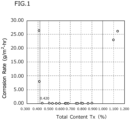
- FIG. 1 is a view that illustrates, with respect to an alloy material having the chemical composition described above, the relation between the total content Tx (%) of Ti, Nb, V, Zr, Hf, and Ta, and a corrosion rate (g/m 2 ⁇ hr) that is an index of intergranular corrosion resistance obtained by carrying out an intergranular corrosion test in accordance with ASTM A262 Practice C.
- FIG. 1 was created based on data obtained by tests described in Examples to be described later.
- the corrosion rate is 0.20 g/m 2 ⁇ hr or less, and very excellent intergranular corrosion resistance is obtained.
- the present inventors discovered that if the total content Tx of Ti, Nb, V, Zr, Hf, and Ta is 0.420 to 1.000%, the intergranular corrosion resistance will increase.
- N is contained to increase the strength.
- the elements Ti, Nb, V, Zr, Hf, and Ta which have high affinity with C
- the elements Ti and Nb in particular, also have high affinity with N. Therefore, Ti and Nb form nano-level-size nitrides or carbo-nitrides at grain boundaries.
- nitrides and carbo-nitrides are also referred to as "nitrogen-containing precipitates”.
- Such kind of fine nitrogen-containing precipitates dissolve in a strongly oxidizing corrosive environment. Therefore, even in a case where there are no Cr-depleted zones present at grain boundaries, if a large number of fine nitrogen-containing precipitates are present at the grain boundaries, intergranular corrosion will occur due to dissolution of the nitrogen-containing precipitates, and the intergranular corrosion resistance will decrease.
- the present inventors considered that in an alloy material which has the chemical composition described above and in which the total content Tx of Ti, Nb, V, Zr, Hf, and Ta is within the range of 0.420 to 1.000%, if, furthermore, the number density of fine nitrogen-containing precipitates at the grain boundaries can be reduced, excellent intergranular corrosion resistance will be obtained even in a heat affected zone.
- the present inventors conducted further studies regarding the relation between the number density of fine nitrogen-containing precipitates at grain boundaries and the intergranular corrosion resistance.
- FIG. 2 is a view that illustrates, with respect to alloy materials which have the chemical composition described above and in which the total content of Ti, Nb, V, Zr, Hf, and Ta is 0.420 to 1.000%, the relation between the number density (/ ⁇ m) of fine nitrogen-containing precipitates at grain boundaries, and a corrosion rate (g/m 2 ⁇ hr) that is an index of intergranular corrosion resistance obtained by carrying out an intergranular corrosion test in accordance with ASTM A262 Practice C.
- FIG. 2 was created based on data obtained by tests described in Examples to be described later.
- the present inventors discovered that in an alloy material having the chemical composition described above and in which the total content Tx of Ti, Nb, V, Zr, Hf, and Ta is 0.420 to 1.000%, if the number density of fine nitrogen-containing precipitates at the grain boundaries is made 20/ ⁇ m or less, excellent intergranular corrosion resistance is obtained even in a heat affected zone in a case where welding is performed.
- the alloy material according to the present embodiment which has been completed based on the above findings, is as follows.
- the alloy material of the present embodiment satisfies the following Feature 1 to Feature 3.
- the chemical composition consists of, in mass%, C: 0.005 to 0.020%, Si: 0.05 to 0.50%, Mn: 0.05 to 1.00%, P: 0.030% or less, S: 0.0100% or less, Cu: 1.5 to 3.0%, Ni: 35.0 to 50.0%, Cr: 20.0 to 30.0%, Mo: 2.5 to 4.0%, Co: 0.01 to 0.80%, W: 0.01 to 0.30%, Ca: 0.0050% or less, N: 0.001 to 0.015%, Al: 0.20% or less, B: 0.0030% or less, Sn: 0.050% or less, Ti: 0.40 to 0.90%, Nb: 0 to 0.150%, V: 0 to 0.150%, Zr: 0 to 0.150%, Hf: 0 to 0.150%, and Ta: 0 to 0.150%, with the balance being Fe and impurities.
- the total content of Ti, Nb, V, Zr, Hf, and Ta is 0.420 to 1.000%.
- the number density of nitrogen-containing precipitates having a major axis of 10 to 100 nm at grain boundaries of the alloy material is 20/ ⁇ m or less.
- the chemical composition of the alloy material of the present embodiment contains the following elements.
- Carbon (C) increases the strength of the alloy material. If the content of C is less than 0.005%, the aforementioned advantageous effect will not be sufficiently obtained even if the contents of other elements are within the range of the present embodiment.
- C if the content of C is more than 0.020%, C will form M 23 C 6 -type Cr carbides at grain boundaries. In such case, Cr-depleted zones will form at the grain boundaries. Consequently, the intergranular corrosion resistance of the alloy material will decrease even if the contents of other elements are within the range of the present embodiment.
- the content of C is to be 0.005 to 0.020%.
- a preferable lower limit of the content of C is 0.006%, more preferably is 0.007%, and further preferably is 0.008%.
- a preferable upper limit of the content of C is 0.019%, more preferably is 0.017%, further preferably is 0.015%, and further preferably is 0.013%.
- Si deoxidizes the alloy in the steel production process. If the content of Si is less than 0.05%, the aforementioned advantageous effect will not be sufficiently obtained.
- the content of Si is to be 0.05 to 0.50%.
- a preferable lower limit of the content of Si is 0.08%, more preferably is 0.12%, and further preferably is 0.15%.
- a preferable upper limit of the content of Si is 0.45%, more preferably is 0.40%, further preferably is 0.38%, and further preferably is 0.35%.
- Mn Manganese deoxidizes the alloy.
- Mn is an austenite forming element, and stabilizes austenite in the alloy material. If the content of Mn is too low, the aforementioned advantageous effects will not be sufficiently obtained even if the contents of other elements are within the range of the present embodiment.
- the content of Mn is to be 0.05 to 1.00%.
- a preferable lower limit of the content of Mn is 0.10%, more preferably is 0.20%, further preferably is 0.30%, and further preferably is 0.40%.
- a preferable upper limit of the content of Mn is 0.90%, more preferably is 0.85%, further preferably is 0.80%, and further preferably is 0.70%.
- Phosphorus (P) is an impurity which is unavoidably contained. That is, the content of P is more than 0%. P segregates to grain boundaries. Therefore, if the content of P is too high, the intergranular corrosion resistance of the alloy material will decrease even if the contents of other elements are within the range of the present embodiment.
- the content of P is to be 0.030% or less.
- the content of P is preferably as low as possible. However, excessively reducing the content of P will significantly increase the production cost. Therefore, when industrial manufacturing is taken into consideration, a preferable lower limit of the content of P is 0.001%, more preferably is 0.002%, and further preferably is 0.003%.
- a preferable upper limit of the content of P is 0.028%, more preferably is 0.025%, further preferably is 0.023%, and further preferably is 0.020%.
- S Sulfur
- S is an impurity which is unavoidably contained. That is, the content of S is more than 0%. S segregates to grain boundaries. Therefore, if the content of S is too high, the intergranular corrosion resistance of the alloy material will decrease even if the contents of other elements are within the range of the present embodiment.
- the content of S is to be 0.0100% or less.
- the content of S is preferably as low as possible. However, excessively reducing the content of S will significantly increase the production cost. Therefore, when industrial manufacturing is taken into consideration, a preferable lower limit of the content of S is 0.0001%, and more preferably is 0.0002%.
- a preferable upper limit of the content of S is 0.0050%, more preferably is 0.0040%, further preferably is 0.0030%, further preferably is 0.0020%, and further preferably is 0.0010%.
- Copper (Cu) increases the corrosion resistance of the alloy material in environments containing non-oxidizing acids and chlorides. If the content of Cu is less than 1.5%, the aforementioned advantageous effect will not be sufficiently obtained.
- the hot workability of the alloy material will decrease even if the contents of other elements are within the range of the present embodiment.
- the content of Cu is to be 1.5 to 3.0%.
- a preferable lower limit of the content of Cu is 1.6%, and more preferably is 1.7%.
- a preferable upper limit of the content of Cu is 2.5%, more preferably is 2.3%, further preferably is 2.1%, and further preferably is 2.0%.
- Nickel (Ni) is an austenite forming element, and stabilizes the austenite in the alloy material. In addition, Ni increases the intergranular corrosion resistance of the alloy material. If the content of Ni is less than 35.0%, the aforementioned advantageous effects will not be sufficiently obtained even if the contents of other elements are within the range of the present embodiment.
- the content of Ni is more than 50.0%, the intergranular corrosion resistance of the alloy material will decrease even if the contents of other elements are within the range of the present embodiment. Furthermore, if the content of Ni is more than 50.0%, the production cost will significantly increase.
- the content of Ni is to be 35.0 to 50.0%.
- a preferable lower limit of the content of Ni is 36.0%, more preferably is 37.0%, and further preferably is 38.0%.
- a preferable upper limit of the content of Ni is 48.0%, more preferably is 46.0%, and further preferably is 44.0%.
- Chromium (Cr) increases the intergranular corrosion resistance of the alloy material. If the content of Cr is less than 20.0%, the aforementioned advantageous effect will not be sufficiently obtained even if the contents of other elements are within the range of the present embodiment.
- the content of Cr is to be 20.0 to 30.0%.
- a preferable lower limit of the content of Cr is 20.3%, more preferably is 20.5%, further preferably is 20.8%, and further preferably is 21.0%.
- a preferable upper limit of the content of Cr is 29.0%, more preferably is 28.5%, further preferably is 28.0%, and further preferably is 27.5%.
- Molybdenum (Mo) increases the corrosion resistance of the alloy material.
- the content of Mo is to be 2.5 to 4.0%.
- a preferable lower limit of the content of Mo is 2.6%, more preferably is 2.7%, and further preferably is 2.8%.
- a preferable upper limit of the content of Mo is 3.9%, more preferably is 3.8%, and further preferably is 3.7%.
- Co Co
- the content of Co is less than 0.01%, the aforementioned advantageous effect will not be sufficiently obtained even if the contents of other elements are within the range of the present embodiment.
- the content of Co is to be 0.01 to 0.80%.
- a preferable lower limit of the content of Co is 0.03%, more preferably is 0.05%, further preferably is 0.10%, and further preferably is 0.20%.
- a preferable upper limit of the content of Co is 0.75%, more preferably is 0.70%, and further preferably is 0.65%.
- Tungsten (W) increases the corrosion resistance of the alloy material. If the content of W is less than 0.01%, the aforementioned advantageous effect will not be sufficiently obtained even if the contents of other elements are within the range of the present embodiment.
- the hot workability of the alloy material will decrease even if the contents of other elements are within the range of the present embodiment.
- the content of W is to be 0.01 to 0.30%.
- a preferable lower limit of the content of W is 0.02%, and more preferably is 0.03%.
- a preferable upper limit of the content of W is 0.25%, more preferably is 0.20%, further preferably is 0.15%, and further preferably is 0.12%.
- Ca Calcium
- the content of Ca is more than 0%.
- Ca immobilizes S in the alloy material as a sulfide to thereby make the S harmless.
- Ca increases the hot workability and the weldability of the alloy material. If even a small amount of Ca is contained, the aforementioned advantageous effect will be obtained to a certain extent.
- the content of Ca is more than 0.0050%, even if the contents of other elements are within the range of the present embodiment, coarse oxides will form in the alloy material. In such case, the hot workability of the alloy material will decrease.
- the content of Ca is to be 0.0050% or less.
- a preferable lower limit of the content of Ca is 0.0001%, more preferably is 0.0005%, further preferably is 0.0010%, and further preferably is 0.0015%.
- a preferable upper limit of the content of Ca is 0.0045%, more preferably is 0.0040%, further preferably is 0.0035%, and further preferably is 0.0030%.
- N Nitrogen (N) dissolves in the alloy material and thereby increases the strength of the alloy material. If the content of N is less than 0.001%, the aforementioned advantageous effect will not be sufficiently obtained even if the contents of other elements are within the range of the present embodiment.
- the content of N is to be 0.001 to 0.015%.
- a preferable lower limit of the content of N is 0.002%, and more preferably is 0.003%.
- a preferable upper limit of the content of N is 0.012%, more preferably is 0.010%, and further preferably is 0.009%.
- Aluminum (Al) is unavoidably contained. In other words, the content of Al is more than 0%. Al deoxidizes the alloy. If even a small amount of Al is contained, the aforementioned advantageous effect will be obtained to a certain extent.
- the content of Al is more than 0.20%, oxide-based inclusions will excessively form even if the contents of other elements are within the range of the present embodiment. In such case, the corrosion resistance of the alloy material will decrease.
- the content of Al is to be 0.20% or less.
- a preferable lower limit of the content of Al is 0.01%, more preferably is 0.02%, and further preferably is 0.03%.
- a preferable upper limit of the content of Al is 0.18%, more preferably is 0.16%, further preferably is 0.14%, and further preferably is 0.12%.
- B Boron
- the content of B is to be 0.0030% or less.
- a preferable lower limit of the content of B is 0.0001%, and more preferably is 0.0002%.
- a preferable upper limit of the content of B is 0.0025%, more preferably is 0.0020%, further preferably is 0.0018%, and further preferably is 0.0016%.
- the content of tin (Sn) is more than 0%. Sn increases the corrosion resistance of the alloy material. If even a small amount of Sn is contained, the aforementioned advantageous effect will be obtained to a certain extent.
- the hot workability of the alloy material will decrease even if the contents of other elements are within the range of the present embodiment.
- the content of Sn is to be 0.050% or less.
- a preferable lower limit of the content of Sn is 0.001%, and more preferably is 0.002%.
- a preferable upper limit of the content of Sn is 0.040%, more preferably is 0.030%, further preferably is 0.020%, and further preferably is 0.015%.
- Titanium (Ti) combines with C to form Ti carbides, and thereby immobilizes C. In this way, Ti suppresses formation of Cr carbides that are formed by dissolved C combining with Cr. Consequently, it is difficult for Cr-depleted zones to form at grain boundaries. As a result, the intergranular corrosion resistance of the alloy material increases. In addition, Ti combines with C and/or N to form Ti carbides, Ti nitrides, or Ti carbo-nitrides, which increases the strength of the alloy material.
- Ti nitrides and/or Ti carbo-nitrides will excessively form at grain boundaries. In such case, the intergranular corrosion resistance of the alloy material will decrease.
- the content of Ti is to be 0.40 to 0.90%.
- a preferable lower limit of the content of Ti is 0.41%, more preferably is 0.43%, and further preferably is 0.45%.
- a preferable upper limit of the content of Ti is 0.85%, more preferably is 0.80%, further preferably is 0.75%, and further preferably is 0.70%.
- the balance of the chemical composition of the alloy material according to the present embodiment is Fe and impurities.
- impurities means substances which are mixed in from ore and scrap used as the raw material or from the production environment or the like when industrially producing the alloy material, and which are not intentionally contained but are permitted within a range that does not have a marked adverse effect on the operational advantages of the alloy material according to the present embodiment.
- Each of these elements is an optional element.
- Each of these elements combines with dissolved C to form carbides, and thereby increases the intergranular corrosion resistance of the alloy material.
- Niobium (Nb) is an optional element, and does not have to be contained. In other words, the content of Nb may be 0%. When contained, Nb combines with C to form Nb carbides, and thereby immobilizes C. In this way, Nb can suppress the formation of Cr-depleted zones at grain boundaries, and thus the intergranular corrosion resistance of the alloy material increases. In addition, Nb combines with C and/or N to form Nb carbides, Nb nitrides, or Nb carbo-nitrides, and thereby increases the strength of the alloy material. If even a small amount of Nb is contained, the aforementioned advantageous effects will be obtained to a certain extent.
- Nb nitrides and/or Nb carbo-nitrides will excessively form at grain boundaries even if the contents of other elements are within the range of the present embodiment. In such case, the intergranular corrosion resistance of the alloy material will decrease.
- the content of Nb is to be 0 to 0.150%.
- a preferable lower limit of the content of Nb is 0.001%, more preferably is 0.002%, and further preferably is 0.005%.
- a preferable upper limit of the content of Nb is 0.140%, more preferably is 0.130%, further preferably is 0.100%, further preferably is 0.070%, further preferably is 0.050%, and further preferably is 0.040%.
- Vanadium (V) is an optional element, and does not have to be contained. In other words, the content of V may be 0%. When contained, V combines with C to form V carbides, and thereby immobilizes C. In this way, V can suppress the formation of Cr-depleted zones at grain boundaries, and thus the intergranular corrosion resistance of the alloy material increases. In addition, V combines with C and/or N to form V carbides, V nitrides, or V carbo-nitrides, and thereby increases the strength of the alloy material. If even a small amount of V is contained, the aforementioned advantageous effects will be obtained to a certain extent.
- the content of V is more than 0.150%, the strength of the alloy material will become excessively high even if the contents of other elements are within the range of the present embodiment. In such case, the hot workability of the alloy material will decrease.
- V carbides and/or V carbo-nitrides will excessively form at grain boundaries. In such case, the intergranular corrosion resistance of the alloy material will decrease.
- the content of V is to be 0 to 0.150%.
- a preferable lower limit of the content of V is 0.001%, more preferably is 0.002%, and further preferably is 0.005%.
- a preferable upper limit of the content of V is 0.140%, more preferably is 0.130%, further preferably is 0.100%, further preferably is 0.070%, further preferably is 0.050%, and further preferably is 0.040%.
- Zirconium (Zr) is an optional element, and does not have to be contained. In other words, the content of Zr may be 0%. When contained, Zr combines with C to form Zr carbides, and thereby immobilizes C. In this way, Zr can suppress the formation of Cr-depleted zones at grain boundaries, and thus the intergranular corrosion resistance of the alloy material increases. In addition, Zr combines with C and/or N to form Zr carbides, Zr nitrides, or Zr carbo-nitrides, and thereby increases the strength of the alloy material. If even a small amount of Zr is contained, the aforementioned advantageous effects will be obtained to a certain extent.
- the strength of the alloy material will become excessively high even if the contents of other elements are within the range of the present embodiment. In such case, the hot workability of the alloy material will decrease.
- the content of Zr is to be 0 to 0.150%.
- a preferable lower limit of the content of Zr is 0.001%, more preferably is 0.002%, further preferably is 0.005%, and further preferably is 0.010%.
- a preferable upper limit of the content of Zr is 0.140%, more preferably is 0.130%, and further preferably is 0.120%.
- Hafnium (Hf) is an optional element, and does not have to be contained. In other words, the content of Hf may be 0%. When contained, Hf combines with C to form Hf carbides, and thereby immobilizes C. In this way, Hf can suppress the formation of Cr-depleted zones at grain boundaries, and thus the intergranular corrosion resistance of the alloy material increases. In addition, Hf combines with C and/or N to form Hf carbides, Hf nitrides, or Hf carbo-nitrides, and thereby increases the strength of the alloy material. If even a small amount of Hf is contained, the aforementioned advantageous effects will be obtained to a certain extent.
- the strength of the alloy material will become excessively high even if the contents of other elements are within the range of the present embodiment. In such case, the hot workability of the alloy material will decrease.
- the content of Hf is to be 0 to 0.150%.
- a preferable lower limit of the content of Hf is 0.001%, more preferably is 0.002%, further preferably is 0.005%, and further preferably is 0.010%.
- a preferable upper limit of the content of Hf is 0.140%, more preferably is 0.130%, and further preferably is 0.120%.
- Tantalum (Ta) is an optional element, and does not have to be contained. In other words, the content of Ta may be 0%. When contained, Ta combines with C to form Ta carbides, and thereby immobilizes C. In this way, Ta can suppress the formation of Cr-depleted zones at grain boundaries, and thus the intergranular corrosion resistance of the alloy material increases. In addition, Ta combines with C and/or N to form Ta carbides, Ta nitrides, or Ta carbo-nitrides, and thereby increases the strength of the alloy material. If even a small amount of Ta is contained, the aforementioned advantageous effects will be obtained to a certain extent.
- the content of Ta is more than 0.150%, the strength of the alloy material will become excessively high even if the contents of other elements are within the range of the present embodiment. In such case, the hot workability of the alloy material will decrease.
- the content of Ta is to be 0 to 0.150%.
- a preferable lower limit of the content of Ta is 0.001%, more preferably is 0.002%, further preferably is 0.005%, and further preferably is 0.010%.
- a preferable upper limit of the content of Ta is 0.140%, more preferably is 0.130%, and further preferably is 0.120%.
- the total content Tx of Ti, Nb, V, Zr, Hf, and Ta is 0.420 to 1.000%.
- each of Ti, Nb, V, Zr, Hf, and Ta combines with C to form carbides, and thereby immobilizes C.
- these elements suppress the formation of Cr carbides which are formed by dissolved C combining with Cr. Therefore, it is difficult for Cr-depleted zones to form at the grain boundaries. As a result, the intergranular corrosion resistance of the alloy material increases.
- a preferable lower limit of the total content Tx is 0.425%, more preferably is 0.440%, further preferably is 0.460%, further preferably is 0.480%, and further preferably is 0.500%.
- a preferable upper limit of the total content Tx is 0.950%, more preferably is 0.920%, further preferably is 0.900%, further preferably is 0.880%, further preferably is 0.850%, further preferably is 0.830%, and further preferably is 0.800%.
- the number density of nitrogen-containing precipitates having a major axis of 10 to 100 nm at the grain boundaries is 20/ ⁇ m or less.
- nitrogen-containing precipitates means precipitates that contain N. That is, the nitrogen-containing precipitates are nitrides and/or carbo-nitrides. Further, nitrogen-containing precipitates having a major axis of 10 to 100 nm are referred to as "fine nitrogen-containing precipitates”.
- fine nitrogen-containing precipitates that are present at grain boundaries dissolve. If the fine nitrogen-containing precipitates dissolve, the intergranular corrosion resistance of the alloy material will decrease. Therefore, it is preferable for the number density of fine nitrogen-containing precipitates at grain boundaries to be low.
- the number of fine nitrogen-containing precipitates per 1 ⁇ m of grain boundary is defined as the number density of fine nitrogen-containing precipitates (/ ⁇ m). If the number density of fine nitrogen-containing precipitates is more than 20/ ⁇ m, even if the alloy material satisfies Feature 1 and Feature 2, sufficient intergranular corrosion resistance will not be obtained. If the number density of fine nitrogen-containing precipitates is 20/ ⁇ m or less, as illustrated in FIG. 2 , excellent intergranular corrosion resistance will be obtained.
- the number density of fine nitrogen-containing precipitates at grain boundaries can be determined by the following method.
- a microstructure observation specimen is taken from a t/4 portion that is the observation target region.
- the term “t/4 portion” refers to, when the plate thickness is taken as “t (mm)", a portion that is at a depth of t/4 from the surface of the alloy plate.
- a microstructure observation specimen is taken from a central portion of the wall thickness that is the observation target region.
- a microstructure observation specimen is taken from an R/2 portion that is the observation target region.
- R/2 portion refers to the central portion of a radius R in a cross section perpendicular to the rolling direction of the alloy bar.
- the size of the microstructure observation specimen is not particularly limited.
- the surface of the microstructure observation specimen is mirror-polished, and thereafter the microstructure observation specimen is immersed for 10 minutes in a 3% nital etching reagent to etch the surface.
- the etched surface is then covered with a carbon deposited film.
- the microstructure observation specimen whose surface is covered with the deposited film is immersed for 20 minutes in a 5% nital etching reagent.
- the deposited film is thereby peeled off from the immersed microstructure observation specimen.
- the deposited film that peeled off from the microstructure observation specimen is cleaned with ethanol, and thereafter is scooped up with a sheet mesh and dried.
- the deposited film (replica film) is observed using a transmission electron microscope (TEM). Specifically, an arbitrary position is specified on the deposited film, and the specified position is observed at an observation magnification of 50,000 ⁇ with an acceleration voltage of 200 kV. Note that, although not particularly limited, the size of the observation visual field is, for example, 2.0 ⁇ m ⁇ 2.0 ⁇ m.
- grain boundaries of the alloy material can be easily identified based on the contrast.
- Precipitates which are present on grain boundaries can also be easily identified based on the contrast. Therefore, precipitates that are present on the grain boundaries are identified.
- the major axis of each identified precipitate is measured.
- the term "major axis" means the maximum length (nm) of a line segment connecting two points at the interface between the precipitate and the parent phase.
- those precipitates which have a major axis of 10 to 100 nm are identified.
- a precipitate which has a major axis of 10 to 100 nm is referred to as a "fine precipitate”.
- the major axis of a precipitate can be determined by performing image analysis of an observation image in TEM observation.
- FIG. 3 is a view showing a TEM image of an alloy material satisfying Feature 1 and Feature 2, and a diffraction pattern obtained by performing selected area electron diffraction on a fine precipitate indicated by an arrow in the TEM image.
- selected area electron diffraction is performed on fine precipitates identified in an alloy material satisfying Feature 1 and Feature 2
- almost all of the diffraction patterns are identified as the MX type (nitride or carbo-nitride) as illustrated in FIG. 3 . That is, almost no precipitates other than fine nitrogen-containing precipitates are included among the identified fine precipitates. Therefore, the identified fine precipitates are regarded as fine nitrogen-containing precipitates.
- the number of fine nitrogen-containing precipitates which are present on the grain boundaries within the observation visual field is counted.
- the total length ( ⁇ m) of the grain boundaries within the observation visual field is measured.
- the number density (/ ⁇ m) of fine nitrogen-containing precipitates at the grain boundaries is then determined based on the obtained number of fine nitrogen-containing precipitates and the total length of the grain boundaries. In the present embodiment, a value obtained by rounding off the tenths place of the obtained numerical value is adopted as the number density of fine nitrogen-containing precipitates.
- the alloy material of the present embodiment satisfies Feature 1 to Feature 3. Therefore, the alloy material of the present embodiment has excellent intergranular corrosion resistance in a strongly oxidizing corrosive environment.
- intergranular corrosion resistance is evaluated by the following method.
- a test specimen having a thickness of 5 mm, a width of 10 mm, and a length of 50 mm is taken from the alloy material.
- the longitudinal direction of the test specimen is to be made parallel to the rolling direction of the alloy material.
- the test specimen is subjected to a sensitization treatment. Specifically, the test specimen is held at 700°C for 60 minutes. After the holding time elapses, the test specimen is allowed to cool. By performing the above sensitization treatment, a test specimen that simulates a heat affected zone is prepared.
- the surface of the prepared test specimen is finished by polishing with wet 600 grit emery paper, degreased with acetone, and dried.
- the test specimen is subjected to an intergranular corrosion test in accordance with ASTM A262 Practice C. Specifically, a test bath that is boiled 65% nitric acid is prepared. The test specimen is immersed in the test bath for 48 hours. After the 48 hours pass, the test specimen is taken out from the test bath.
- the corrosion rate (g/m 2 ⁇ hr) is determined based on the change in the mass of the test specimen between before and after the test, and the surface area of the test specimen before the test. This operation is repeated five times, and the corrosion rate (g/m 2 ⁇ hr) for each of the five times is determined. If the arithmetic average value of the obtained five corrosion rates is 0.20 g/m 2 ⁇ hr or less, it is determined that the alloy material is excellent in intergranular corrosion resistance.
- the microstructure of the alloy material of the present embodiment is composed of austenite. However, this excludes precipitates and inclusions.
- the shape of the alloy material according to the present embodiment is not particularly limited.
- the alloy material may be an alloy plate, may be an alloy pipe, or may be an alloy bar.
- the alloy material is an alloy pipe, preferably the alloy material is a seamless alloy pipe.
- the uses of the alloy material of the present embodiment are not particularly limited.
- the alloy material of the present embodiment is particularly suitable for use in a corrosive environment.
- the alloy material of the present embodiment can be used, for example, in equipment relating to the petroleum industry, the gas industry, the petrochemical industry, and the chemical industry.
- the alloy material according to the present embodiment is suitable for use in primary processing equipment for petroleum and gas, and equipment of chemical plants and the like.
- the production method described hereunder is one example of a method for producing the alloy material of the present embodiment. Therefore, an alloy material that satisfies Feature 1 to Feature 3 may also be produced by a production method other than the production method described hereunder. However, the production method described hereunder is a preferable example of a method for producing the alloy material of the present embodiment.
- a method for producing the alloy material of the present embodiment includes the following processes.
- the cold working process in Process 3 is an optional process. In other words, the cold working process in Process 3 does not have to be performed.
- a starting material having a chemical composition according to Feature 1 that is described above is prepared.
- the starting material may be supplied by a third party or may be produced.
- the starting material may be an ingot, or may be a slab, a bloom, or a billet.
- the starting material is produced by the following method.
- An alloy in a liquid state (molten metal) that has the chemical composition described above is produced.
- the produced molten metal is used to produce an ingot by an ingot-making process.
- the produced molten metal may also be used to produce a slab, a bloom, or a billet by a continuous casting process.
- Hot working may be performed on the produced ingot, slab, or bloom to produce a billet.
- hot forging or blooming may be performed on the ingot or bloom to produce a cylindrical billet, and the billet may be used as the starting material.
- the temperature of the starting material immediately before the start of the hot forging is, for example, 1000 to 1300°C.
- the method for cooling the starting material after hot forging is not particularly limited.
- the intermediate alloy material for example, may be an alloy pipe, may be an alloy plate, or may be an alloy bar.
- the intermediate alloy material being an alloy pipe
- the following working is performed in the hot working process.
- a cylindrical starting material is prepared.
- a through-hole is formed along the central axis in the cylindrical starting material by machining.
- the cylindrical starting material in which the through-hole has been formed is heated.
- the heated cylindrical starting material is then subjected to a hot-extrusion process, which is typified by the Ugine-Sejournet process, to produce an intermediate alloy material (alloy pipe).
- a hot hollow forging process may be performed instead of the hot extrusion process.
- an alloy pipe may be produced by performing piercing-rolling according to the Mannesmann process.
- the cylindrical starting material is heated.
- the heated cylindrical starting material is then pierced and rolled using a piercing machine.
- the piercing ratio is, for example, 1.0 to 4.0.
- the cylindrical starting material subjected to piercing and rolling is further subjected to hot rolling with a mandrel mill, a stretch reducing mill, a sizing mill or the like to produce a hollow blank (alloy pipe).
- the heating temperature of the starting material in the hot working process is, for example, 1000 to 1300°C.
- the cumulative reduction of area in the hot working process is, for example, 20 to 80%.
- the temperature (finishing temperature) of the hollow blank immediately after completing the hot working is 800°C or more.
- the intermediate alloy material being an alloy plate
- one or a plurality of rolling mills equipped with a pair of work rolls is used in the hot working process, for example.
- the starting material such as a slab is heated.
- the heated starting material is subjected to hot working to produce an alloy plate.
- the hot working is, for example, hot forging or hot rolling.
- the heating temperature of the starting material before hot working is, for example, 1000 to 1300°C.
- the intermediate alloy material being an alloy bar
- a continuous mill equipped with a plurality of roll stands arranged in a row is used in the hot working process.
- Each roll stand has a pair of rolls in which grooves are formed.
- the heated cylindrical starting material is subjected to hot rolling using the continuous mill to produce an alloy bar.
- the heating temperature of the cylindrical starting material before hot rolling is, for example, 1000 to 1300°C.
- a cold working process is performed as necessary. In other words, a cold working process does not have to be performed.
- cold working is performed on the intermediate alloy material after the intermediate alloy material has been subjected to a pickling treatment.
- the cold working is, for example, cold drawing.
- the cold working is, for example, cold rolling. Performing the cold working process allows the development of recrystallization and the formation of uniform grains to occur.
- the reduction of area in the cold working process is, for example, 10 to 90%.
- the intermediate alloy material after the hot working process or after the cold working process is subjected to a heat treatment.
- a heat treatment temperature T (°C) is 900 to 1150°C.
- a holding time t (mins) at the heat treatment temperature T is 3 to 30 minutes. After the holding time t elapses, the intermediate alloy material is rapidly cooled.
- Formula (1) is a condition for reducing the number density of fine nitrogen-containing precipitates at the grain boundaries of the alloy material after production.
- ⁇ A defined by Formula (2) is an index of the amount of fine nitrogen-containing precipitates that precipitate within the range of the aforementioned heat treatment temperature T and holding time t.
- Z defined by Formula (3) is an index relating to the formation of fine nitrogen-containing precipitates with respect to the chemical composition.
- the heat treatment temperature T (°C) is within the range of 900 to 1150°C and the holding time t (mins) is within the range of 3 to 30 minutes
- the chemical composition (contents of C, Ti, Nb, and N) of the intermediate alloy material that is the object of the heat treatment, the heat treatment temperature T, and the holding time t each satisfy Formula (1)
- the number density of fine nitrogen-containing precipitates at the grain boundaries in the alloy material after the heat treatment process will decrease to 20/ ⁇ m or less. Therefore, in the heat treatment process, the heat treatment temperature T (°C) and the holding time t (mins) are adjusted to satisfy Formula (1).
- the alloy material of the present embodiment can be produced by the processes described above.
- the production method described above is one example of a method for producing the alloy material of the present embodiment. Therefore, a method for producing the alloy material of the present embodiment is not limited to the above production method. As long as Feature 1 to Feature 3 are satisfied, a method for producing the alloy material is not limited to the production method described above.
- the advantageous effect of the alloy material of the present embodiment is described more specifically hereunder by way of examples.
- the conditions adopted in the following examples are one example of conditions adopted for confirming the feasibility and advantageous effect of the alloy material of the present embodiment. Accordingly, the alloy material of the present embodiment is not limited to this one example of conditions.
- Ingots having the chemical compositions shown in Table 1-1 and Table 1-2 were produced. Each ingot was formed in a cylindrical shape with an outer diameter of 120 mm, and the mass of each ingot was 30 kg.
- a blank space in Table 1-2 means that the content of the corresponding element was 0% in the significant figures (numerical value to the least significant digit) defined in the embodiment.
- a blank space means that the content of the corresponding element was 0% when a fraction in the significant figures (numerical value to the least significant digit) defined in the above embodiment was rounded off.
- the content of Zr that is defined in the present embodiment is defined as a numerical value to the thousandths place. Therefore, in Test No. 1 in Table 1-2, the blank space with respect to the content of Zr means that the measured content of Zr was 0% when the ten thousandths place was rounded off.
- rounding off means that if a digit (fraction) below the defined least significant digit is less than 5, it is rounded down, and if the digit (fraction) is 5 or more, it is rounded up.
- Each of the produced ingots was subjected to hot forging to produce a starting material (alloy plate) having a thickness of 30 mm.
- the heating temperature of the ingot in the hot forging was 1000 to 1300°C.
- the produced starting material was subjected to hot rolling to produce an intermediate alloy material (alloy plate) having a thickness of 10 mm.
- the intermediate alloy material was subjected to a heat treatment process.
- the heat treatment temperature T (°C)
- the holding time t (mins) at the heat treatment temperature T
- ⁇ A defined by Formula (2), and Z defined by Formula (3) were as shown in Table 2.
- the intermediate alloy material was water-cooled to normal temperature.
- An alloy material (alloy plate) of each test number was produced by the above process.
- the number density (/ ⁇ m) of fine nitrogen-containing precipitates at the grain boundaries of the alloy material of each test number was determined by the method described in the above [Method for determining number density of fine nitrogen-containing precipitates].
- the determined number density (/ ⁇ m) of fine nitrogen-containing precipitates is shown in the column "Number Density (/ ⁇ m)" in Table 2.
- the corrosion rate (g/m 2 ⁇ hr) of the alloy material of each test number was determined by the method described in the above [Method for evaluating intergranular corrosion resistance]. The determined corrosion rate is shown in the column "Corrosion Rate (g/m 2 ⁇ hr)" in Table 2. If the determined corrosion rate was 0.20 g/m 2 ⁇ hr or less, it was determined that excellent intergranular corrosion resistance was obtained.
- the alloy materials of Test Nos. 1 to 14 satisfied Feature 1 to Feature 3. Therefore, the corrosion rate was 0.20 g/m 2 ⁇ hr or less, and excellent intergranular corrosion resistance was obtained in a strongly oxidizing corrosive environment.
Landscapes
- Chemical & Material Sciences (AREA)
- Engineering & Computer Science (AREA)
- Materials Engineering (AREA)
- Mechanical Engineering (AREA)
- Metallurgy (AREA)
- Organic Chemistry (AREA)
- Physics & Mathematics (AREA)
- Thermal Sciences (AREA)
- Crystallography & Structural Chemistry (AREA)
- Turbine Rotor Nozzle Sealing (AREA)
- Powder Metallurgy (AREA)
Applications Claiming Priority (2)
| Application Number | Priority Date | Filing Date | Title |
|---|---|---|---|
| JP2022059816 | 2022-03-31 | ||
| PCT/JP2023/013313 WO2023190937A1 (ja) | 2022-03-31 | 2023-03-30 | 合金材 |
Publications (2)
| Publication Number | Publication Date |
|---|---|
| EP4502208A1 true EP4502208A1 (de) | 2025-02-05 |
| EP4502208A4 EP4502208A4 (de) | 2026-03-18 |
Family
ID=88202272
Family Applications (1)
| Application Number | Title | Priority Date | Filing Date |
|---|---|---|---|
| EP23780945.4A Pending EP4502208A4 (de) | 2022-03-31 | 2023-03-30 | Legierungsmaterial |
Country Status (6)
| Country | Link |
|---|---|
| US (1) | US20250215536A1 (de) |
| EP (1) | EP4502208A4 (de) |
| JP (1) | JP7787459B2 (de) |
| KR (1) | KR20240168410A (de) |
| CN (1) | CN118946680A (de) |
| WO (1) | WO2023190937A1 (de) |
Family Cites Families (3)
| Publication number | Priority date | Publication date | Assignee | Title |
|---|---|---|---|---|
| JP6579263B2 (ja) * | 2016-03-31 | 2019-09-25 | 日本製鉄株式会社 | Ni−Fe−Cr合金 |
| JP7408347B2 (ja) * | 2019-10-30 | 2024-01-05 | 日鉄ステンレス株式会社 | 高Ni合金及び高Ni合金の製造方法 |
| JP7644345B2 (ja) * | 2020-05-22 | 2025-03-12 | 日本製鉄株式会社 | Ni基合金管および溶接継手 |
-
2023
- 2023-03-30 CN CN202380030192.8A patent/CN118946680A/zh active Pending
- 2023-03-30 JP JP2024512829A patent/JP7787459B2/ja active Active
- 2023-03-30 WO PCT/JP2023/013313 patent/WO2023190937A1/ja not_active Ceased
- 2023-03-30 EP EP23780945.4A patent/EP4502208A4/de active Pending
- 2023-03-30 US US18/848,754 patent/US20250215536A1/en active Pending
- 2023-03-30 KR KR1020247035837A patent/KR20240168410A/ko active Pending
Also Published As
| Publication number | Publication date |
|---|---|
| WO2023190937A1 (ja) | 2023-10-05 |
| US20250215536A1 (en) | 2025-07-03 |
| KR20240168410A (ko) | 2024-11-29 |
| CN118946680A (zh) | 2024-11-12 |
| EP4502208A4 (de) | 2026-03-18 |
| JP7787459B2 (ja) | 2025-12-17 |
| JPWO2023190937A1 (de) | 2023-10-05 |
Similar Documents
| Publication | Publication Date | Title |
|---|---|---|
| EP3418410B1 (de) | Nahtloses stahlrohr und herstellungsverfahren dafür | |
| EP4286542B1 (de) | Martensitisches edelstahlmaterial | |
| EP4461837A1 (de) | Fe-cr-ni legierungsmaterial | |
| JP7425299B2 (ja) | オーステナイト系ステンレス鋼材 | |
| EP4089195A1 (de) | Austenitisches edelstahlmaterial | |
| EP4509619A1 (de) | Legierungsmaterial | |
| EP4148158A1 (de) | Nahtloses duplexedelstahlrohr | |
| EP4589039A1 (de) | Austenitisches legierungsmaterial | |
| JP7284433B2 (ja) | 合金 | |
| EP3480330A1 (de) | Austenitischer edelstahl | |
| EP3018229B1 (de) | Nahtloses stahlrohr für ein leitungsrohr in saurer umgebung und verfahren zu seiner herstellung. | |
| EP4512921A1 (de) | Stahlmaterial | |
| EP4137598A1 (de) | Stahlmaterial | |
| JP7339526B2 (ja) | オーステナイト系ステンレス鋼材 | |
| KR20180125566A (ko) | Ni-Fe-Cr 합금 | |
| EP4411002A1 (de) | Duplex-edelstahlrohr | |
| EP4678777A1 (de) | Zweiphasiges edelstahlmaterial und schweissverbindung aus zweiphasigem edelstahl | |
| EP4491754A1 (de) | Austenitisches edelstahlmaterial | |
| US20250215536A1 (en) | Alloy material | |
| EP4484598A1 (de) | Duplexedelstahlmaterial | |
| EP4506481A1 (de) | Martensitisches edelstahlmaterial | |
| EP4502207A1 (de) | Material aus einer nicrfe-legierung | |
| EP4606918A1 (de) | Duplexedelstahlmaterial | |
| JP7572623B2 (ja) | 二相ステンレス鋼管 | |
| JP2024137052A (ja) | 鋼材 |
Legal Events
| Date | Code | Title | Description |
|---|---|---|---|
| STAA | Information on the status of an ep patent application or granted ep patent |
Free format text: STATUS: THE INTERNATIONAL PUBLICATION HAS BEEN MADE |
|
| PUAI | Public reference made under article 153(3) epc to a published international application that has entered the european phase |
Free format text: ORIGINAL CODE: 0009012 |
|
| STAA | Information on the status of an ep patent application or granted ep patent |
Free format text: STATUS: REQUEST FOR EXAMINATION WAS MADE |
|
| 17P | Request for examination filed |
Effective date: 20241028 |
|
| AK | Designated contracting states |
Kind code of ref document: A1 Designated state(s): AL AT BE BG CH CY CZ DE DK EE ES FI FR GB GR HR HU IE IS IT LI LT LU LV MC ME MK MT NL NO PL PT RO RS SE SI SK SM TR |
|
| DAV | Request for validation of the european patent (deleted) | ||
| DAX | Request for extension of the european patent (deleted) | ||
| A4 | Supplementary search report drawn up and despatched |
Effective date: 20260217 |
|
| RIC1 | Information provided on ipc code assigned before grant |
Ipc: C22C 30/04 20060101AFI20260211BHEP Ipc: C22C 19/05 20060101ALI20260211BHEP Ipc: C22F 1/00 20060101ALI20260211BHEP Ipc: C22F 1/10 20060101ALI20260211BHEP Ipc: C22F 1/16 20060101ALI20260211BHEP Ipc: C22C 30/00 20060101ALI20260211BHEP Ipc: C22C 30/02 20060101ALI20260211BHEP |