EP4498442A2 - Elektrode und wiederaufladbare batterie damit - Google Patents
Elektrode und wiederaufladbare batterie damit Download PDFInfo
- Publication number
- EP4498442A2 EP4498442A2 EP24186420.6A EP24186420A EP4498442A2 EP 4498442 A2 EP4498442 A2 EP 4498442A2 EP 24186420 A EP24186420 A EP 24186420A EP 4498442 A2 EP4498442 A2 EP 4498442A2
- Authority
- EP
- European Patent Office
- Prior art keywords
- active material
- electrode
- volume
- positive
- material layer
- Prior art date
- Legal status (The legal status is an assumption and is not a legal conclusion. Google has not performed a legal analysis and makes no representation as to the accuracy of the status listed.)
- Pending
Links
Images


Classifications
-
- H—ELECTRICITY
- H01—ELECTRIC ELEMENTS
- H01M—PROCESSES OR MEANS, e.g. BATTERIES, FOR THE DIRECT CONVERSION OF CHEMICAL ENERGY INTO ELECTRICAL ENERGY
- H01M4/00—Electrodes
- H01M4/02—Electrodes composed of, or comprising, active material
- H01M4/36—Selection of substances as active materials, active masses, active liquids
- H01M4/48—Selection of substances as active materials, active masses, active liquids of inorganic oxides or hydroxides
- H01M4/485—Selection of substances as active materials, active masses, active liquids of inorganic oxides or hydroxides of mixed oxides or hydroxides for inserting or intercalating light metals, e.g. LiTi2O4 or LiTi2OxFy
-
- H—ELECTRICITY
- H01—ELECTRIC ELEMENTS
- H01M—PROCESSES OR MEANS, e.g. BATTERIES, FOR THE DIRECT CONVERSION OF CHEMICAL ENERGY INTO ELECTRICAL ENERGY
- H01M4/00—Electrodes
- H01M4/02—Electrodes composed of, or comprising, active material
-
- H—ELECTRICITY
- H01—ELECTRIC ELEMENTS
- H01M—PROCESSES OR MEANS, e.g. BATTERIES, FOR THE DIRECT CONVERSION OF CHEMICAL ENERGY INTO ELECTRICAL ENERGY
- H01M10/00—Secondary cells; Manufacture thereof
- H01M10/04—Construction or manufacture in general
-
- H—ELECTRICITY
- H01—ELECTRIC ELEMENTS
- H01M—PROCESSES OR MEANS, e.g. BATTERIES, FOR THE DIRECT CONVERSION OF CHEMICAL ENERGY INTO ELECTRICAL ENERGY
- H01M10/00—Secondary cells; Manufacture thereof
- H01M10/05—Accumulators with non-aqueous electrolyte
- H01M10/052—Li-accumulators
-
- H—ELECTRICITY
- H01—ELECTRIC ELEMENTS
- H01M—PROCESSES OR MEANS, e.g. BATTERIES, FOR THE DIRECT CONVERSION OF CHEMICAL ENERGY INTO ELECTRICAL ENERGY
- H01M4/00—Electrodes
- H01M4/02—Electrodes composed of, or comprising, active material
- H01M4/13—Electrodes for accumulators with non-aqueous electrolyte, e.g. for lithium-accumulators; Processes of manufacture thereof
-
- H—ELECTRICITY
- H01—ELECTRIC ELEMENTS
- H01M—PROCESSES OR MEANS, e.g. BATTERIES, FOR THE DIRECT CONVERSION OF CHEMICAL ENERGY INTO ELECTRICAL ENERGY
- H01M4/00—Electrodes
- H01M4/02—Electrodes composed of, or comprising, active material
- H01M4/13—Electrodes for accumulators with non-aqueous electrolyte, e.g. for lithium-accumulators; Processes of manufacture thereof
- H01M4/131—Electrodes based on mixed oxides or hydroxides, or on mixtures of oxides or hydroxides, e.g. LiCoOx
-
- H—ELECTRICITY
- H01—ELECTRIC ELEMENTS
- H01M—PROCESSES OR MEANS, e.g. BATTERIES, FOR THE DIRECT CONVERSION OF CHEMICAL ENERGY INTO ELECTRICAL ENERGY
- H01M4/00—Electrodes
- H01M4/02—Electrodes composed of, or comprising, active material
- H01M4/36—Selection of substances as active materials, active masses, active liquids
-
- H—ELECTRICITY
- H01—ELECTRIC ELEMENTS
- H01M—PROCESSES OR MEANS, e.g. BATTERIES, FOR THE DIRECT CONVERSION OF CHEMICAL ENERGY INTO ELECTRICAL ENERGY
- H01M4/00—Electrodes
- H01M4/02—Electrodes composed of, or comprising, active material
- H01M4/36—Selection of substances as active materials, active masses, active liquids
- H01M4/48—Selection of substances as active materials, active masses, active liquids of inorganic oxides or hydroxides
- H01M4/50—Selection of substances as active materials, active masses, active liquids of inorganic oxides or hydroxides of manganese
- H01M4/505—Selection of substances as active materials, active masses, active liquids of inorganic oxides or hydroxides of manganese of mixed oxides or hydroxides containing manganese for inserting or intercalating light metals, e.g. LiMn2O4 or LiMn2OxFy
-
- H—ELECTRICITY
- H01—ELECTRIC ELEMENTS
- H01M—PROCESSES OR MEANS, e.g. BATTERIES, FOR THE DIRECT CONVERSION OF CHEMICAL ENERGY INTO ELECTRICAL ENERGY
- H01M4/00—Electrodes
- H01M4/02—Electrodes composed of, or comprising, active material
- H01M4/36—Selection of substances as active materials, active masses, active liquids
- H01M4/48—Selection of substances as active materials, active masses, active liquids of inorganic oxides or hydroxides
- H01M4/52—Selection of substances as active materials, active masses, active liquids of inorganic oxides or hydroxides of nickel, cobalt or iron
- H01M4/525—Selection of substances as active materials, active masses, active liquids of inorganic oxides or hydroxides of nickel, cobalt or iron of mixed oxides or hydroxides containing iron, cobalt or nickel for inserting or intercalating light metals, e.g. LiNiO2, LiCoO2 or LiCoOxFy
-
- H—ELECTRICITY
- H01—ELECTRIC ELEMENTS
- H01M—PROCESSES OR MEANS, e.g. BATTERIES, FOR THE DIRECT CONVERSION OF CHEMICAL ENERGY INTO ELECTRICAL ENERGY
- H01M4/00—Electrodes
- H01M4/02—Electrodes composed of, or comprising, active material
- H01M4/64—Carriers or collectors
- H01M4/66—Selection of materials
- H01M4/661—Metal or alloys, e.g. alloy coatings
-
- H—ELECTRICITY
- H01—ELECTRIC ELEMENTS
- H01M—PROCESSES OR MEANS, e.g. BATTERIES, FOR THE DIRECT CONVERSION OF CHEMICAL ENERGY INTO ELECTRICAL ENERGY
- H01M50/00—Constructional details or processes of manufacture of the non-active parts of electrochemical cells other than fuel cells, e.g. hybrid cells
- H01M50/10—Primary casings; Jackets or wrappings
- H01M50/102—Primary casings; Jackets or wrappings characterised by their shape or physical structure
- H01M50/105—Pouches or flexible bags
-
- H—ELECTRICITY
- H01—ELECTRIC ELEMENTS
- H01M—PROCESSES OR MEANS, e.g. BATTERIES, FOR THE DIRECT CONVERSION OF CHEMICAL ENERGY INTO ELECTRICAL ENERGY
- H01M4/00—Electrodes
- H01M4/02—Electrodes composed of, or comprising, active material
- H01M2004/021—Physical characteristics, e.g. porosity, surface area
-
- H—ELECTRICITY
- H01—ELECTRIC ELEMENTS
- H01M—PROCESSES OR MEANS, e.g. BATTERIES, FOR THE DIRECT CONVERSION OF CHEMICAL ENERGY INTO ELECTRICAL ENERGY
- H01M4/00—Electrodes
- H01M4/02—Electrodes composed of, or comprising, active material
- H01M2004/026—Electrodes composed of, or comprising, active material characterised by the polarity
- H01M2004/028—Positive electrodes
-
- Y—GENERAL TAGGING OF NEW TECHNOLOGICAL DEVELOPMENTS; GENERAL TAGGING OF CROSS-SECTIONAL TECHNOLOGIES SPANNING OVER SEVERAL SECTIONS OF THE IPC; TECHNICAL SUBJECTS COVERED BY FORMER USPC CROSS-REFERENCE ART COLLECTIONS [XRACs] AND DIGESTS
- Y02—TECHNOLOGIES OR APPLICATIONS FOR MITIGATION OR ADAPTATION AGAINST CLIMATE CHANGE
- Y02E—REDUCTION OF GREENHOUSE GAS [GHG] EMISSIONS, RELATED TO ENERGY GENERATION, TRANSMISSION OR DISTRIBUTION
- Y02E60/00—Enabling technologies; Technologies with a potential or indirect contribution to GHG emissions mitigation
- Y02E60/10—Energy storage using batteries
Definitions
- Embodiments of the present disclosure relate to an electrode and a rechargeable battery including the same.
- Rechargeable batteries may be formed by immersing an electrode assembly formed by placing electrodes on both sides of a separator and wound into a jelly roll shape, or an electrode assembly formed by stacking sheet-shaped electrodes and separators, in a case together with an electrolyte solution, and then closing and sealing the case with a cap assembly.
- a material with relatively high specific capacity is applied or an amount of an active material applied on the substrate is increased by relatively high loading to form (or provide) a thick film, but as the film thickness increases, it becomes difficult to secure electrode adhesion or conductivity, ultimately leading to problems with deterioration of battery performance and deterioration of rapid charging characteristics.
- aspects of one or more embodiments of the present disclosure relate to an electrode that can secure high energy density and concurrently (e.g ., simultaneously) secure rapid charging characteristics, and a rechargeable battery including the same.
- the positive active material layer may include a first pore and a second pore of different sizes, and a diameter of the first pore is 0.2 ⁇ m to 0.5 ⁇ m.
- the first pore may be 55 volume% to 65 volume% of the entire pore volume included in the positive active material layer.
- a compression ratio of the positive active material layer may be 69 volume% to 73 volume% (e.g., 69:100 to 73:100).
- the substrate may include aluminum.
- spatially relative terms such as “below,” “lower,” “upper,” and the like, may be used herein for ease of explanation to describe one element or feature's relationship to another element(s) or feature(s) as illustrated in the figures. It will be understood that the spatially relative terms are intended to encompass different orientations of the device in use or in operation, in addition to the orientation depicted in the figures. For example, if the device in the figures is turned over, elements described as “below” or “under” other elements or features would then be oriented “above” the other elements or features. Thus, the example terms “below” and “under” can encompass both an orientation of above and below. The device may be otherwise oriented (e.g., rotated 90 degrees or at other orientations) and the spatially relative descriptors used herein should be interpreted accordingly.
- diameter indicates a particle diameter or an average particle diameter
- the average particle diameter indicates a major axis length or an average major axis length.
- the diameter (or size) of the particles may be measured utilizing a scanning electron microscope or a particle size analyzer.
- the particle size analyzer for example, HORIBA, LA-950 laser particle size analyzer, may be utilized.
- the average particle diameter is referred to as D50.
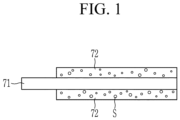
- FIG. 1 is a schematic cross-sectional view of a positive electrode for a rechargeable battery according to one or more embodiments of the present disclosure.
- the positive active material layer 72 is compressed after coating a positive active material and may include pores S.
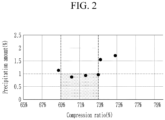
- the positive active material may be coated at a loading level (L/L) of 40 mg/cm 2 to 60 mg/cm 2 and then compressed by a compression ratio of 69 volume% to 73 volume%.
- the compression ratio is a ratio of the thickness of the active material layer after being rolled to the thickness of the active material layer before being rolled ( e.g ., rolled electrode plate thickness/coating thickness).
- the compression ratio of the positive active material layer e.g. , the ratio or rate of the pre-rolled to post rolled volume of the positive active material layer
- compression ratio of the positive active material layer is 69 volume% to 73 volume%, wherein the compression ratio is a ratio of the thickness of the active material layer after being rolled to the thickness of the active material layer before being rolled ( e.g ., rolled electrode plate thickness/coating thickness).
- the amount of precipitation is at or less than 1 weight percent (wt%), and if ( e.g ., when) the compression ratio is less than 69% or more than 73%, the amount of precipitation substantially exceeds 1 wt%.
- An average diameter may be an average particle diameter D50, and unless otherwise defined in this specification, the average particle diameter D50 refers to a diameter of particles with a cumulative volume of 50 volume% in a particle size distribution.
- the average particle size D50 may be measured by a method generally available and/or suitable to persons of ordinary skill in the art. For example, it may be measured with a particle size analyzer, a transmission electron microscope image, or a scanning electron microscope image. As another method, it may be measured with a device utilizing dynamic light-scattering, or data analysis may be performed to count the number of particles for each particle size range to obtain the average particle diameter D50 value.
- the separator 13 may be a polymer film that allows lithium ions to pass through, and may be made of polyethylene, polypropylene, polyvinylidene fluoride, or a multilayer of two or more layers thereof, as well as mixed multilayers such as a polyethylene/polypropylene two-layer separator, polyethylene/polypropylene/polyethylene three-layer separator, and polypropylene/polyethylene/polypropylene three-layer separator and/or the like.
- the substrate of the positive electrode 11 may be aluminum, and as the positive electrode active material, a compound (lithiated intercalation compound) capable of reversibly intercalating and deintercalating lithium ions may be utilized.
- a compound (lithiated intercalation compound) capable of reversibly intercalating and deintercalating lithium ions may be utilized.
- one or more types (kinds) of composite oxides of metals of ( e.g ., selected from among) cobalt, manganese, nickel, and/or combinations thereof with lithium may be utilized.
- the content (e.g ., amount) of the positive active material may be 90 weight percent (wt%) to 98 wt% with respect to the entire weight of the positive active material layer.
- the positive active material may further include a binder and a conductive material.
- the content (e.g ., amount) of the binder and the conductive material may be 1 wt% to 5 wt%, respectively, relative to the total weight of the positive active material layer.
- the binder serves to adhere the positive active material particles to each other and also to adhere the positive active material to the positive electrode substrate.
- Representative examples of the binder may include polyvinyl alcohol, carboxymethylcellulose, hydroxypropyl cellulose, diacetyl cellulose, polyvinyl chloride, carboxylated polyvinyl chloride, polyvinyl fluoride, and/or polymers including ethylene oxide, polyvinylpyrrolidone, polyurethane, polytetrafluoroethylene, polyvinylidene fluoride, polyethylene, polypropylene, styrene-butadiene rubber, acryl federated styrene-butadiene rubber, epoxy resin, and nylon, but the present disclosure is not limited thereto.
- the conductive material is utilized to provide conductivity to the electrodes, and in the configured battery, any material may be utilized as an electron conductive material as long as it does not cause a chemical change.
- the negative electrode 12 includes an electrode active region DB1 and an electrode passive region DB2, and the electrode active region DB1 includes a substrate formed of a metal foil of a thin plate and a negative active material layer made of a negative active material on the substrate (or on an intermediate layer).
- the electrode passive region is a region where the substrate is exposed because the negative active material layer is not formed, and may be a portion extended from the substrate of the electrode active region.
- the electrode passive regions of the positive electrode and the negative electrode may protrude at a regular interval along the wound direction from the substrate, or may be positioned at the tip or end of the wound electrode assembly.
- the negative active material included in the negative active material layer may be a carbon-based active material.
- the carbon-based negative active material may be artificial graphite or a mixture of an artificial graphite and a natural graphite. If ( e.g ., when) the negative active material is a crystalline carbon-based material obtained by mixing natural graphite with artificial graphite, the crystalline carbon-based material may have more developed crystalline characteristics than an amorphous carbon-based active material and thus may further improve orientation characteristics of the carbon material in an electrode plate having an external magnetic field.
- the artificial graphite or natural graphite may be amorphous, sheet-shaped, flake-shaped, spherically shaped, fiber-shaped, and/or any suitable combination thereof without a particular limit.
- a mixing ratio in wt% of artificial graphite : natural graphite may be 70:30 (wt%) to 95:5 (wt%).
- the Si-based negative active material may be Si, an Si-C composite, SiO x (0 ⁇ x ⁇ 2), or an Si-Q alloy (Q is an element of ( e.g ., selected from among) the group including ( e.g ., consisting of) an alkali metal, an alkaline earth metal, a Group 13 element, a Group 14 element, a Group 15 element, a Group 16 element, a transition metal, a rare earth element, and/or any suitable combination thereof), and the Sn-based negative active material may include Sn, SnO 2 , and/or an Sn-R alloy (R is an element of ( e.g ., selected from among) the group including ( e.g ., consisting of) an alkali metal, an alkaline earth metal, a Group 13 element, a Group 14 element, a Group 15 element, a Group 16 element, a transition metal, and/or a rare earth element, and does not include Sn), and at least one of them may be mixed
- the element Q and the element R may be at least one element of ( e.g ., at least one element selected from among) the group including ( e.g ., consisting of) Mg, Ca, Sr, Ba, Ra, Sc, Y, Ti, Zr, Hf, Rf, V, Nb, Ta, Db, Cr, Mo, W, Sg, Pb, Pt, Cu, Ag, Au, Zn, Cd, B, Al, Ga, Sn, In, Tl, Ge, P, As, Sb, Bi, S, Se, Te, Po, and/or any suitable combination thereof.
- the group including ( e.g ., consisting of) Mg, Ca, Sr, Ba, Ra, Sc, Y, Ti, Zr, Hf, Rf, V, Nb, Ta, Db, Cr, Mo, W, Sg, Pb, Pt, Cu, Ag, Au, Zn, Cd, B, Al, Ga, Sn, In, Tl, Ge, P, As, S
- a content (e.g., amount) of the negative active material in the negative active material layer may be 95 wt% to 99 wt% based on a total weight of the negative active material layer.
- the negative active material includes a binder, and may optionally further include a conductive material.
- the content (e.g ., amount) of the binder in the negative active material may be 1 wt% to 5 wt% based on the total weight of the negative active material.
- the negative active material may be utilized in an amount of 90 wt% to 98 wt%
- the binder may be utilized in an amount of 1 wt% to 5 wt%
- the conductive material may be utilized in an amount of 1 wt% to 5 wt%.
- the binder serves to adhere the negative active material particles to each other and also to adhere the negative active material to the negative base substrate.
- a non-aqueous binder, an aqueous binder, and/or any suitable combination thereof may be utilized.
- non-aqueous binders may include polyvinyl chloride, carboxylated polyvinyl chloride, polyvinyl fluoride, a polymer including ethylene oxide, polyvinyl pyrrolidone, polyurethane, polytetrafluoroethylene, polyvinylidene fluoride, polyethylene, polypropylene, polyamide-imide, polyimide, and/or any suitable combination thereof.
- aqueous binders may include styrene-butadiene rubber, acrylated styrene-butadiene rubber (SBR), acrylonitrile-butadiene rubber, acryl rubber, butyl rubber, an ethylene-propylene copolymer, polyepichlorohydrin, polyphosphazene, polyvinyl pyridine, chlorosulfonated polyethylene, latex, a polyester resin, an acryl resin, a phenol resin, an epoxy resin, a polyvinyl alcohol, an acrylate resin, and/or any suitable combination thereof.
- SBR acrylated styrene-butadiene rubber
- SBR acrylated styrene-butadiene rubber
- acrylonitrile-butadiene rubber acryl rubber
- butyl rubber an ethylene-propylene copolymer
- polyepichlorohydrin polyphosphazene
- polyvinyl pyridine chlorosulf
- a cellulose-based compound capable of imparting viscosity may be further included as a thickener.
- a cellulose-based compound capable of imparting viscosity may be further included as a thickener.
- carboxymethyl cellulose, hydroxypropyl methyl cellulose, methyl cellulose, an alkali metal salt thereof, and/or the like may be utilized in combination.
- alkali metal Na, K, or Li may be utilized.
- a content ( e.g ., amount) of the thickener may be 0.1 to 3 parts by weight based on 100 parts by weight of the negative active material.
- the conductive material is utilized to impart conductivity to the electrode, and any electronic conductive material that does not cause a chemical change in the battery may be utilized.
- the conductive material may include a carbon-based material such as natural graphite, artificial graphite, carbon black, acetylene black, ketjen black, and carbon fiber; a metal powder such as copper, nickel, aluminum, and silver; a metal-based material such as metal fiber; a conductive polymer such as polyphenylene derivative; and a conductive material containing (including) any suitable mixture thereof.
- a BET-specific surface area of the negative electrode active material layer may be less than 3.0 m 2 /g and may range from 0.6 m 2 /g to 1. 2m 2 /g. If ( e.g ., when) the BET-specific surface area of the negative electrode active material layer is less than 3.0m 2 /g, electrochemical lifespan characteristics of a cell may be improved.
- the BET measurement is made by charging/discharging the lithium rechargeable battery including the negative electrode, cutting the negative electrode obtained by breaking the battery in a completely discharged state into a set or predetermined size, and subsequently putting the cut negative electrode into a BET sample holder, and measuring it by a nitrogen gas absorption method.
- the negative electrode may have a sectional loading level (L/L) of 6 mg/cm 2 to 65 mg/cm 2 .
- the electrode assembly 10 may be accommodated in the case 27 together with an electrolyte, and the electrolyte may include a non-aqueous organic solvent and a lithium salt.
- the non-aqueous organic solvent serves as a medium through which ions involved in the electrochemical reaction of the battery can move.
- the lithium salt is dissolved in an organic solvent and acts as a supply source of lithium ions in the battery, enabling basic lithium secondary battery operation, and is a material that promotes the movement of lithium ions between the positive and negative electrodes.
- Representative examples of such lithium salts include one or two or more of ( e.g ., selected from among) the group including ( e.g ., consisting of) LiPF 6 , LiBF 4 , LiSbF 6 , LiAsF 6 , LiN (SO 2 C 2 F 5 ) 2 , Li (CF 3 SO 2 ) 2 N, LiN (SO 3 C 2 F 5 ) 2 , LiC 4 F 9 SO 3 , LiClO 4 , LiAlO 2 , LiAlCl 4 , LiN (C x F 2x+1 SO 2 ), (C y F 2y+1 SO 2 ), (where x and y are natural numbers, such as an integer of 1 to 20), LiCl, LiI and/or LiB C 2 O 42 (
- lithium salt concentration within the range of 0.1M to 2.0M. If ( e.g. , when) the concentration of lithium salt is in that range, the electrolyte has appropriate or suitable conductivity and viscosity, so it can exhibit excellent or suitable electrolyte performance, and lithium ions can move effectively.
- the case 27 may be made of a metal such as aluminum, and may be roughly cuboidal in shape. One side of the case 27 may be opened, and a cap plate may be installed on the opened side of the case 27.
- the cap assembly 30 includes a cap plate 31 coupled to the case 27 and blocking the opening of the case 27, a positive terminal 21 protruded to the outside of the cap plate 31 and electrically connected to the positive electrode 11, and a negative terminal 22 electrically connected to the negative electrode 12.
- the cap plate 31 is in the form of an elongated plate connected in one direction and is connected to the opening of case 27.
- the cap plate 31 has an injection port 32 that penetrates to the inside of the case 27.
- the injection port 32 is for injecting an electrolyte solution, and a sealing stopper 38 may be installed.
- a vent plate 39 on which a notch 39a is formed is installed in a vent hole 34 so that the cap plate 31 may be opened at a set or predetermined pressure.
- the positive terminal 21 and the negative terminal 22 are installed to protrude to (be protruded onto) the top of the cap plate 31.
- the positive terminal 21 is electrically connected to the positive electrode 11 through a current collecting tab 41
- the negative terminal 22 is electrically connected to the negative electrode 12 through a current collecting tab 42.
- a terminal connection member 25 to electrically connect the positive terminal 21 and the current collecting tab 41 is installed between the positive terminal 21 and the current collecting tab 41.
- the terminal connection member 25 is inserted into the hole formed in the positive terminal 21, and the upper end is welded to the positive terminal 21, and the lower end is welded to the current collecting tab 41.
- a gasket 59 for sealing is installed between the terminal connection member 25 and the cap plate 31 by being inserted into a hole through which the terminal connection member 25 passes, and a lower insulating member 43 into which the lower part of the terminal connection member 25 is inserted is installed below the cap plate 31.
- a connection plate 58 is installed between the positive terminal 21 and the cap plate 31 to electrically connect them. The terminal connection member 25 is inserted and installed into the connection plate 58. Accordingly, the cap plate 31 and the case 27 are charged with the positive electrode 11.
- a terminal connection member 26 that electrically connects the negative terminal 22 and the current collecting tab 42 is installed between the negative terminal 22 and the current collecting tab 42.
- the terminal connection member 26 is inserted into the hole formed in the negative terminal 22, and the upper end is welded to the negative terminal 22, and the lower end is welded to the current collecting tab 42.
- a gasket 59 for sealing is installed between the negative terminal 22 and the cap plate 31 by being inserted into the hole through which the terminal connection member 26 passes, and an upper insulating member 54 is installed to insulate between the negative terminal 22 and the cap plate 31.
- the terminal connection member 26 may be installed by being inserted into a hole of the upper insulating member 54, and the upper insulating member 54 may be formed to surround the end of the negative terminal 22.
- a lower insulation member 45 is installed below the cap plate 31 to insulate the negative terminal 22 and the current collecting tab 42 from the cap plate 31.
- a shorting hole 37 is formed in the cap plate 31, and a shorting member 56 is installed in the shorting hole 37.
- the shorting member 56 includes a curved portion convexly curved downward in an arc shape and an edge portion formed on the outside of the curved portion and fixed to the cap plate 31.
- the upper insulation member 54 may have an incision that overlaps the shorting hole 37, and the shorting member 56 overlaps the negative terminal 22 exposed through the incision.
- the shorting member 56 is electrically connected to the cap plate 31, and is deformed if ( e.g ., when) an internal pressure of the rechargeable battery 1000 rises, thereby causing a short circuit between the positive electrode and the negative electrode. For example, if ( e.g ., when) gas is generated inside the rechargeable battery because of an abnormal reaction, internal pressure of the rechargeable battery increases. If ( e.g ., when) the internal pressure of the rechargeable battery exceeds a set or predetermined pressure, the curved portion is transformed to be convex in an upward direction, and the negative terminal 22 touches the shorting member 56 to cause a short circuit.
- the negative terminal 22 may further include at least one or more protrusions protruded toward the shorting member 56, and the protrusion may be separated from the shorting member 56.
- FIG. 6 is a schematic exploded perspective view of a rechargeable battery according to one or more embodiments of the present disclosure.
- a rechargeable battery 1001 includes an electrode assembly 101 and a pouch.
- the electrode assembly 101 may include a positive electrode and a negative electrode, and a separator positioned between the positive electrode and the negative electrode.
- the electrode assembly 101 may be in the form of a jelly roll wound around a winding axis (X).
- the positive electrode may be the positive electrode shown in FIG. 1 , and may include a substrate and a positive active material layer formed on the substrate and having a pore ratio of 11 volume% to 16 volume% and an average diameter D50 of particles in the positive active material layer of 8um to 20um.
- a first electrode tab 14 and a second electrode tab 23 may be connected to the electrode passive regions of the positive electrode and the negative electrode, respectively.
- the electrode assembly 101 may be contained in a pouch-type or kind case together with the electrolyte.
- the pouch-type or kind case may be formed of a laminate exterior, and the exterior may include a lower exterior and an upper exterior, and the electrode assembly 101 is placed between them and then sealed by thermal melting.
- the laminate exterior may be formed as a multi-layer structure with, for example, a first insulation layer 2, a metal layer 3 and a second insulation layer 4.
- a first insulation layer 2 a metal layer 3 and a second insulation layer 4.
- one or more suitable other adhesive layers or functional layers may be added.
- the first insulating layer 2 is formed of a material that is insulating and thermally bondable to the inner surface of the laminate exterior, and may be sealed by thermally melting the edge in a state in which the electrode assembly 101 is received in the pouch. Additionally, the first insulation layer 2 is formed on one surface of the metal layer 3 and forms the inner surface of the laminate exterior facing the electrode assembly 101.
- the first insulating layer 2 may be formed of cast polypropylene (CPP) that does not react with the electrolyte solution and or its equivalent.
- the term “substantially,” “about,” and similar terms are used as terms of approximation and not as terms of degree, and are intended to account for the inherent deviations in measured or calculated values that would be recognized by those of ordinary skill in the art. "Substantially” as used herein, is inclusive of the stated value and means within an acceptable range of deviation for the particular value as determined by one of ordinary skill in the art, considering the measurement in question and the error associated with measurement of the particular quantity (i.e., the limitations of the measurement system). For example, “substantially” may mean within one or more standard deviations, or within ⁇ 30%, 20%, 10%, 5% of the stated value.
- any numerical range recited herein is intended to include all subranges of the same numerical precision subsumed within the recited range.
- a range of "1.0 to 10.0" is intended to include all subranges between (and including) the recited minimum value of 1.0 and the recited maximum value of 10.0, that is, having a minimum value equal to or greater than 1.0 and a maximum value equal to or less than 10.0, such as, for example, 2.4 to 7.6.
- Any maximum numerical limitation recited herein is intended to include all lower numerical limitations subsumed therein and any minimum numerical limitation recited in this specification is intended to include all higher numerical limitations subsumed therein. Accordingly, Applicant reserves the right to amend this specification, including the claims, to expressly recite any sub-range subsumed within the ranges expressly recited herein.
- the portable device, vehicle, and/or the battery e.g ., a battery controller, and/or any other relevant devices or components according to embodiments of the present disclosure described herein may be implemented utilizing any suitable hardware, firmware (e.g ., an application-specific integrated circuit), software, or a combination of software, firmware, and hardware.
- the various components of the device may be formed on one integrated circuit (IC) chip or on separate IC chips.
- the various components of the device may be implemented on a flexible printed circuit film, a tape carrier package (TCP), a printed circuit board (PCB), or formed on one substrate.
- the various components of the device may be a process or thread, running on one or more processors, in one or more computing devices, executing computer program instructions and interacting with other system components for performing the various functionalities described herein.
- the computer program instructions are stored in a memory which may be implemented in a computing device using a standard memory device, such as, for example, a random access memory (RAM).
- the computer program instructions may also be stored in other non-transitory computer readable media such as, for example, a CD-ROM, flash drive, or the like.
Landscapes
- Chemical & Material Sciences (AREA)
- Chemical Kinetics & Catalysis (AREA)
- Electrochemistry (AREA)
- General Chemical & Material Sciences (AREA)
- Engineering & Computer Science (AREA)
- Materials Engineering (AREA)
- Manufacturing & Machinery (AREA)
- Inorganic Chemistry (AREA)
- Battery Electrode And Active Subsutance (AREA)
Applications Claiming Priority (1)
| Application Number | Priority Date | Filing Date | Title |
|---|---|---|---|
| KR1020230098389A KR20250017527A (ko) | 2023-07-27 | 2023-07-27 | 전극 및 이를 포함하는 이차 전지 |
Publications (2)
| Publication Number | Publication Date |
|---|---|
| EP4498442A2 true EP4498442A2 (de) | 2025-01-29 |
| EP4498442A3 EP4498442A3 (de) | 2025-02-12 |
Family
ID=91829256
Family Applications (1)
| Application Number | Title | Priority Date | Filing Date |
|---|---|---|---|
| EP24186420.6A Pending EP4498442A3 (de) | 2023-07-27 | 2024-07-04 | Elektrode und wiederaufladbare batterie damit |
Country Status (4)
| Country | Link |
|---|---|
| US (1) | US20250038191A1 (de) |
| EP (1) | EP4498442A3 (de) |
| KR (1) | KR20250017527A (de) |
| CN (1) | CN119381392A (de) |
Family Cites Families (4)
| Publication number | Priority date | Publication date | Assignee | Title |
|---|---|---|---|---|
| JP2016504727A (ja) * | 2012-12-14 | 2016-02-12 | ユミコア | 充電式電池用の低空隙率電極 |
| KR102195730B1 (ko) * | 2014-05-20 | 2020-12-28 | 삼성에스디아이 주식회사 | 전극 구조체 및 이를 채용한 리튬 전지 |
| KR102462060B1 (ko) * | 2016-11-08 | 2022-11-01 | 혼다 기켄 고교 가부시키가이샤 | 비수계 전해질 2차 전지용 전극 및 이것을 구비하는 비수계 전해질 2차 전지 |
| US11108035B2 (en) * | 2019-01-08 | 2021-08-31 | Samsung Electronics Co., Ltd. | Solid-state positive electrode, method of manufacture thereof, and battery including the electrode |
-
2023
- 2023-07-27 KR KR1020230098389A patent/KR20250017527A/ko active Pending
-
2024
- 2024-05-01 US US18/652,599 patent/US20250038191A1/en active Pending
- 2024-07-04 EP EP24186420.6A patent/EP4498442A3/de active Pending
- 2024-07-09 CN CN202410913326.7A patent/CN119381392A/zh active Pending
Also Published As
| Publication number | Publication date |
|---|---|
| EP4498442A3 (de) | 2025-02-12 |
| US20250038191A1 (en) | 2025-01-30 |
| KR20250017527A (ko) | 2025-02-04 |
| CN119381392A (zh) | 2025-01-28 |
Similar Documents
| Publication | Publication Date | Title |
|---|---|---|
| KR101686600B1 (ko) | 전해액 함침용 홀을 포함하고 있는 전지셀 | |
| US20230006189A1 (en) | Electrode assembly and rechargeable battery including the same | |
| KR20160036577A (ko) | 리튬 2 차 전지 및 리튬 2 차 전지용 전해액 | |
| US20230122856A1 (en) | Electrode assembly and rechargeable lithium battery including the same | |
| EP4498442A2 (de) | Elektrode und wiederaufladbare batterie damit | |
| US20250167202A1 (en) | Electrode for secondary battery and method of manufacturing the same | |
| EP4553923A1 (de) | Negative elektrode für eine wiederaufladbare batterie und wiederaufladbare batterie damit | |
| EP4468423A1 (de) | Elektrode für eine wiederaufladbare batterie, elektrodenanordnung und wiederaufladbare batterie damit | |
| US20260011719A1 (en) | Negative electrode for rechargeable battery and manufacturing method thereof | |
| EP4636885A1 (de) | Separator für wiederaufladbare batterie und elektrodenanordnung damit | |
| EP4475268B1 (de) | Wiederaufladbare lithiumbatterie | |
| EP4550516A2 (de) | Elektrode für eine wiederaufladbare batterie, elektrodenanordnung und wiederaufladbare batterie damit | |
| EP4593099A1 (de) | Elektrode für wiederaufladbare batterie | |
| US20240186519A1 (en) | Current collector for rechargeable lithium battery, and electrode and rechargeable lithium battery including the same | |
| EP4611086A1 (de) | Elektrode für eine wiederaufladbare batterie und elektrodenanordnung | |
| KR102881373B1 (ko) | 리튬 이차 전지 | |
| US20250316796A1 (en) | Rechargeable battery and manufacturing method thereof | |
| US20250392023A1 (en) | Electrode, electrode assembly, and rechargeable lithium battery including the same | |
| US20250030139A1 (en) | Electrode assembly and rechargeable battery including the same | |
| US20250140783A1 (en) | Electrode assembly and rechargeable battery including the same | |
| EP4648119A1 (de) | Elektrode für eine wiederaufladbare batterie und elektrodenanordnung damit | |
| US20260106147A1 (en) | Positive electrode active materials, positive electrodes, and rechargeable lithium batteries | |
| US20260100371A1 (en) | Electrodes and rechargeable lithium batteries including the same | |
| US20250349836A1 (en) | Positive electrodes and rechargeable lithium batteries | |
| EP4730421A1 (de) | Negative elektroden und wiederaufladbare lithiumbatterien damit |
Legal Events
| Date | Code | Title | Description |
|---|---|---|---|
| PUAI | Public reference made under article 153(3) epc to a published international application that has entered the european phase |
Free format text: ORIGINAL CODE: 0009012 |
|
| STAA | Information on the status of an ep patent application or granted ep patent |
Free format text: STATUS: REQUEST FOR EXAMINATION WAS MADE |
|
| PUAL | Search report despatched |
Free format text: ORIGINAL CODE: 0009013 |
|
| 17P | Request for examination filed |
Effective date: 20240704 |
|
| AK | Designated contracting states |
Kind code of ref document: A2 Designated state(s): AL AT BE BG CH CY CZ DE DK EE ES FI FR GB GR HR HU IE IS IT LI LT LU LV MC ME MK MT NL NO PL PT RO RS SE SI SK SM TR |
|
| AK | Designated contracting states |
Kind code of ref document: A3 Designated state(s): AL AT BE BG CH CY CZ DE DK EE ES FI FR GB GR HR HU IE IS IT LI LT LU LV MC ME MK MT NL NO PL PT RO RS SE SI SK SM TR |
|
| RIC1 | Information provided on ipc code assigned before grant |
Ipc: H01M 4/525 20100101ALI20250103BHEP Ipc: H01M 4/505 20100101ALI20250103BHEP Ipc: H01M 4/13 20100101AFI20250103BHEP |