EP4496247A2 - Verfahren und benutzervorrichtung zur übertragung von rückkopplungsinformationen - Google Patents
Verfahren und benutzervorrichtung zur übertragung von rückkopplungsinformationen Download PDFInfo
- Publication number
- EP4496247A2 EP4496247A2 EP24218164.2A EP24218164A EP4496247A2 EP 4496247 A2 EP4496247 A2 EP 4496247A2 EP 24218164 A EP24218164 A EP 24218164A EP 4496247 A2 EP4496247 A2 EP 4496247A2
- Authority
- EP
- European Patent Office
- Prior art keywords
- feedback information
- groups
- bits
- group
- data
- Prior art date
- Legal status (The legal status is an assumption and is not a legal conclusion. Google has not performed a legal analysis and makes no representation as to the accuracy of the status listed.)
- Pending
Links
- 238000000034 method Methods 0.000 title claims abstract description 76
- 238000013507 mapping Methods 0.000 claims abstract description 19
- 230000005540 biological transmission Effects 0.000 claims description 22
- 238000004590 computer program Methods 0.000 claims 2
- 125000004122 cyclic group Chemical group 0.000 description 31
- 230000008569 process Effects 0.000 description 12
- 101000741965 Homo sapiens Inactive tyrosine-protein kinase PRAG1 Proteins 0.000 description 9
- 102100038659 Inactive tyrosine-protein kinase PRAG1 Human genes 0.000 description 9
- 230000002776 aggregation Effects 0.000 description 9
- 238000004220 aggregation Methods 0.000 description 9
- 238000010586 diagram Methods 0.000 description 9
- 239000013256 coordination polymer Substances 0.000 description 5
- 230000011664 signaling Effects 0.000 description 4
- 239000000969 carrier Substances 0.000 description 3
- 238000005516 engineering process Methods 0.000 description 3
- 238000001228 spectrum Methods 0.000 description 3
- 230000007423 decrease Effects 0.000 description 2
- 230000007774 longterm Effects 0.000 description 2
- 238000004891 communication Methods 0.000 description 1
- 230000007547 defect Effects 0.000 description 1
- 230000001419 dependent effect Effects 0.000 description 1
- 230000006870 function Effects 0.000 description 1
- 230000003287 optical effect Effects 0.000 description 1
- 230000010363 phase shift Effects 0.000 description 1
Images




Classifications
-
- H—ELECTRICITY
- H04—ELECTRIC COMMUNICATION TECHNIQUE
- H04W—WIRELESS COMMUNICATION NETWORKS
- H04W72/00—Local resource management
- H04W72/20—Control channels or signalling for resource management
- H04W72/21—Control channels or signalling for resource management in the uplink direction of a wireless link, i.e. towards the network
-
- H—ELECTRICITY
- H04—ELECTRIC COMMUNICATION TECHNIQUE
- H04L—TRANSMISSION OF DIGITAL INFORMATION, e.g. TELEGRAPHIC COMMUNICATION
- H04L1/00—Arrangements for detecting or preventing errors in the information received
- H04L1/0001—Systems modifying transmission characteristics according to link quality, e.g. power backoff
- H04L1/0023—Systems modifying transmission characteristics according to link quality, e.g. power backoff characterised by the signalling
- H04L1/0026—Transmission of channel quality indication
-
- H—ELECTRICITY
- H04—ELECTRIC COMMUNICATION TECHNIQUE
- H04L—TRANSMISSION OF DIGITAL INFORMATION, e.g. TELEGRAPHIC COMMUNICATION
- H04L1/00—Arrangements for detecting or preventing errors in the information received
- H04L1/0001—Systems modifying transmission characteristics according to link quality, e.g. power backoff
- H04L1/0023—Systems modifying transmission characteristics according to link quality, e.g. power backoff characterised by the signalling
- H04L1/0028—Formatting
-
- H—ELECTRICITY
- H04—ELECTRIC COMMUNICATION TECHNIQUE
- H04L—TRANSMISSION OF DIGITAL INFORMATION, e.g. TELEGRAPHIC COMMUNICATION
- H04L1/00—Arrangements for detecting or preventing errors in the information received
- H04L1/12—Arrangements for detecting or preventing errors in the information received by using return channel
- H04L1/16—Arrangements for detecting or preventing errors in the information received by using return channel in which the return channel carries supervisory signals, e.g. repetition request signals
- H04L1/1607—Details of the supervisory signal
- H04L1/1671—Details of the supervisory signal the supervisory signal being transmitted together with control information
-
- H—ELECTRICITY
- H04—ELECTRIC COMMUNICATION TECHNIQUE
- H04L—TRANSMISSION OF DIGITAL INFORMATION, e.g. TELEGRAPHIC COMMUNICATION
- H04L1/00—Arrangements for detecting or preventing errors in the information received
- H04L1/12—Arrangements for detecting or preventing errors in the information received by using return channel
- H04L1/16—Arrangements for detecting or preventing errors in the information received by using return channel in which the return channel carries supervisory signals, e.g. repetition request signals
- H04L1/18—Automatic repetition systems, e.g. Van Duuren systems
- H04L1/1829—Arrangements specially adapted for the receiver end
- H04L1/1861—Physical mapping arrangements
-
- H—ELECTRICITY
- H04—ELECTRIC COMMUNICATION TECHNIQUE
- H04L—TRANSMISSION OF DIGITAL INFORMATION, e.g. TELEGRAPHIC COMMUNICATION
- H04L5/00—Arrangements affording multiple use of the transmission path
- H04L5/0001—Arrangements for dividing the transmission path
- H04L5/0003—Two-dimensional division
- H04L5/0005—Time-frequency
- H04L5/0007—Time-frequency the frequencies being orthogonal, e.g. OFDM(A) or DMT
- H04L5/001—Time-frequency the frequencies being orthogonal, e.g. OFDM(A) or DMT the frequencies being arranged in component carriers
-
- H—ELECTRICITY
- H04—ELECTRIC COMMUNICATION TECHNIQUE
- H04L—TRANSMISSION OF DIGITAL INFORMATION, e.g. TELEGRAPHIC COMMUNICATION
- H04L5/00—Arrangements affording multiple use of the transmission path
- H04L5/003—Arrangements for allocating sub-channels of the transmission path
- H04L5/0044—Allocation of payload; Allocation of data channels, e.g. PDSCH or PUSCH
-
- H—ELECTRICITY
- H04—ELECTRIC COMMUNICATION TECHNIQUE
- H04L—TRANSMISSION OF DIGITAL INFORMATION, e.g. TELEGRAPHIC COMMUNICATION
- H04L5/00—Arrangements affording multiple use of the transmission path
- H04L5/003—Arrangements for allocating sub-channels of the transmission path
- H04L5/0048—Allocation of pilot signals, i.e. of signals known to the receiver
-
- H—ELECTRICITY
- H04—ELECTRIC COMMUNICATION TECHNIQUE
- H04L—TRANSMISSION OF DIGITAL INFORMATION, e.g. TELEGRAPHIC COMMUNICATION
- H04L5/00—Arrangements affording multiple use of the transmission path
- H04L5/003—Arrangements for allocating sub-channels of the transmission path
- H04L5/0053—Allocation of signalling, i.e. of overhead other than pilot signals
-
- H—ELECTRICITY
- H04—ELECTRIC COMMUNICATION TECHNIQUE
- H04L—TRANSMISSION OF DIGITAL INFORMATION, e.g. TELEGRAPHIC COMMUNICATION
- H04L5/00—Arrangements affording multiple use of the transmission path
- H04L5/0001—Arrangements for dividing the transmission path
- H04L5/0014—Three-dimensional division
- H04L5/0016—Time-frequency-code
Definitions
- the present invention relates to the field of mobile radio communication, and particularly, to a method for transmitting feedback information and a user equipment.
- Radio frames in a Long Term Evolution (LTE) system include a frame structure of Frequency Division Duplex (FDD) mode and a frame structure of Time Division Duplex (TDD) mode.
- FDD Frequency Division Duplex
- TDD Time Division Duplex
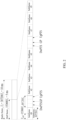
- FIG. 1 in the frame structure of the FDD mode, one 10ms radio frame consists of 20 slots numbered as 0 ⁇ 19 and with length of 0.5ms, slots 2i and 2i+1 constitute a subframe i with length of 1ms (wherein, 0 ⁇ i ⁇ 9).
- FDD Frequency Division Duplex
- TDD Time Division Duplex
- one 10ms radio frame in the frame structure of the TDD mode, consists of 2 half frames with length of 5ms, 5 subframes with length of 1ms are included in one half frame, and the subframe i is defined as a combination of two slots 2i and 2i+1 with length of 0.5ms (wherein, 0 ⁇ i ⁇ 9).
- Uplink-downlink configurations supported by each subframe are as shown in Table 1.
- D represents a subframe exclusively used for the downlink transmission
- U represents a subframe exclusively used for the uplink transmission
- S represents a special subframe used for 3 domains: Downlink Pilot Time Slot (DwPTS), Guard Period (GP) and Uplink Pilot Time Slot (UpPTS).
- DwPTS Downlink Pilot Time Slot
- GP Guard Period
- UpPTS Uplink Pilot Time Slot
- Table 1 A schematic table of uplink-downlink configurations supported by each subframe Uplink-downlink configurations Downlink-uplink switchover point period Subframe number # 0 1 2 3 4 5 6 7 8 9 0 5 ms D S U U U D S U U U 1 5 ms D S U U D D S U U D 2 5 ms D S U D D D S U D D 3 10 ms D S U U U D D D D D D 4 10 ms D S U U D D D D D D D 5 10 ms D S U D D D D D D D D 6 5 ms D S U U U U D S U U U D S U U D
- the LTE TDD supports a 5ms uplink-downlink handover period and a 10ms uplink-downlink handover period. If a downlink-uplink switchover point period is 5ms, the special subframe will exist in two half frames; if the downlink-uplink switchover point period is 10ms, the special subframe only exists in the first half frame; the subframe#0 and subframe #5 and the DwPTS are always used for the downlink transmission; and the UpPTS and subframes following the special subframe closely are exclusively used for the uplink transmission.
- the LTE uses a Single Carrier-Frequency Division Multiple Access (SC-FDMA) way in uplink, and an uplink time domain symbol is an uplink SC-FDMA symbol.
- SC-FDMA Single Carrier-Frequency Division Multiple Access
- Formats of a Physical Uplink Control Channel (PUCCH) are divided into 6 formats: Format 1, Format 1a, Format 1b, Format 2, Format 2a and Format 2b, and 15 bits of original information can be transmitted at most.
- Each PUCCH occupies resources of 2 physical resource blocks in one subframe and occupies resources of 1 physical resource block in one slot.
- LTE-A Long Term Evolution Advanced
- CA Carrier Aggregation
- LTE system bandwidths of the carrier aggregation can be regarded as a Component Carriers (CC), and each component carrier also can be called as one Cell, and it can be formed from the aggregation of n component carriers (Cells).
- Resources of an R10 User Equipment (UE) are composed of n cells (component carriers) of the frequency domain, wherein, one cell is called as a Primary cell, and each of the rest cells is called as a Secondary cell.
- DFT-S-OFDM Discrete Fourier Transform Spread-Orthogonal Frequency Division Multiplexing
- LTE-A system which is used to support that a UE with more than 4 bits performs feedback of ACKnowledgement/Non-ACKnowledgement (ACK/NACK) messages
- this new format based on the DFT- S-OFDM is called as a control channel format 3
- the PUCCH Format 3 uses an encoding way of Reed Muller (32, O) in the related art (i.e. an RM (32, O) encoding way), and 11 bits of information can be transmitted at most.
- one uplink subframe will correspond to multiple downlink subframes, and each downlink subframe has n cells, as shown in FIG. 3 .
- each cell can have one transmission block for transmission and also can have two transmission blocks for transmission.
- the UE Due to the carrier aggregation, when one subframe corresponds to multiple cells in the frequency domain, the UE is required to perform feedback of downlink channel information of the multiple cells.
- the bit capacity of the PUCCH feedback information is limited, it fails to perform simultaneous feedback of information of multiple cells of a corresponding downlink channel in one PUCCH, thus it needs to be allocated to different subframes for performing transmission, and this will cause longer feedback delay of the information, which goes against downlink dynamic scheduling of the base station and influences the system performance.
- the main object of the present invention is to provide a method for transmitting feedback information and a User Equipment (UE) according to appended independent claims, to overcome the defect that the UE cannot perform simultaneous feedback of information of multiple cells of a corresponding downlink channel in one Physical Uplink Control Channel (PUCCH) in the related art. Further improvements and embodiments are provided in the dependent claims.
- UE User Equipment
- the present invention provides a method for transmitting feedback information, which comprises:
- the step of performing time domain extension on feedback information comprises: performing encoding, scrambling and/or interleaving, and modulation on the feedback information, and then performing Discrete Fourier Transform (DFT) on data after going through the encoding, scrambling and/or interleaving and modulation, wherein, a processing order of the scrambling, interleaving and modulation is arbitrary.
- DFT Discrete Fourier Transform
- the step of performing time domain extension on feedback information within one subframe comprises: the UE concatenating all groups of encoded feedback information in order, or interleaving all groups of encoded feedback information, or interleaving all groups of encoded feedback information by block; or after respectively performing scrambling and modulation operation on each group of encoded feedback information, the UE concatenating all groups of symbols obtained after the modulation, wherein, a concatenating way is orderly concatenating or interleaving.
- the step of dividing O bits of feedback information into Y groups comprises: starting from a first bit in a sequence composed of the feedback information, performing division into Y groups in order, except the last group, there are O Y bits contained in each group, and the number of bits contained in the last group is equal to or greater than O Y bits; or performing modulo operation between the location in which each bit is located in the sequence composed of the feedback information and the Y, and classifying bits with identical modulo values under a group; or, when the feedback information is channel state information, classifying the bits representing feedback information corresponding to each cell under a group correspondingly; or, starting from the first bit in the sequence composed of the feedback information, performing division into Y groups in order, wherein the number of bits contained in each group of O mod Y groups is O Y + 1 , and the number of bits contained in each group of remaining Y -( O modY) groups is O Y .
- an interleaving way is to perform interleaving on data to be interleaved according to a fixed sequence, or to perform interleaving on the data to be interleaved according to a row-wise write and column-wise read way, or to perform interleaving according to a block interleaving method.
- the step of performing DFT on data after going through the encoding, scrambling and/or interleaving and modulation comprises: performing DFT processing on all data in the time domain, or performing DFT processing on data borne by each physical resource block in the time domain respectively.
- a sequence of the demodulation reference signals is composed of a sequence with the length of n ⁇ L ; or a sequence of the demodulation reference signals is composed of n sequences with lengths of L, wherein L is the number of subcarriers contained in one physical resource block.
- the sequence is a Zadoff-Chu (ZC) sequence or a Computer Generation ZC sequence.
- the feedback information comprises any one or any combination of ACKnowledgement or Non-ACKnowledgement (ACK/NACK) information, channel state information, rank indication information and scheduling request information.
- ACK/NACK ACKnowledgement or Non-ACKnowledgement
- the present invention further provides a method for transmitting feedback information, and the method comprises: after a user equipment dividing feedback information into n groups, transmitting each group of data correspondingly through one Physical Uplink Control Channel (PUCCH) of which a format is PUCCH Format 2 or PUCCH Format 3; wherein, n is 2, and PUCCHs bearing the data occupy a same physical resource block or adjacent physical resource blocks in the frequency domain.
- PUCCH Physical Uplink Control Channel
- the step of a user equipment dividing feedback information into n groups comprises: starting from a first bit in a sequence composed of O bits of the feedback information, performing division into n groups in order, except the last group, there are O n bits contained in each group, and the number of bits contained in the last group is equal to or greater than O n bits; or performing modulo operation between the location in which each bit is located in the sequence composed of the feedback information and the n, and classifying bits with identical modulo values under a group; or, when the feedback information is channel state information, classifying the bits representing feedback information corresponding to each cell under a group correspondingly; or, starting from the first bit in the sequence composed of the feedback information, performing division into Y groups in order, wherein the number of bits contained in each group of O mod 72 groups is O n + 1 , and the number of bits contained in each group of remaining n - ( O mod n ) groups is O n .
- the feedback information comprises any one or any combination of ACKnowledgement or Non-ACKnowledgement (ACK/NACK) information, channel state information, rank indication information and scheduling request information.
- ACK/NACK ACKnowledgement or Non-ACKnowledgement
- the present invention further provides a user equipment, and the user equipment comprises: a time domain extension module and a data transmission module;
- the time domain extension module is configured to perform time domain extension on the feedback information within one subframe in the following way: performing encoding, scrambling and/or interleaving and modulation on the feedback information, and performing Discrete Fourier Transform (DFT) on data which go through the above processing, wherein, a processing order of the scrambling, interleaving and modulation is arbitrary.
- DFT Discrete Fourier Transform
- the present invention further provides a user equipment, and the user equipment comprises: a group division module and a transmission module;
- the group division module is configured to divide the feedback information into n groups in the following way:
- the number of bits of feedback information of UE is increased, which enhances the uplink feedback capacity, guarantees the maximum throughput of the system, and decreases the feedback delay of downlink channel information.
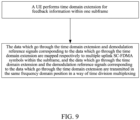
- a method for transmitting feedback information according to the example of the present invention is as shown in FIG. 9 , and the method includes: a UE performing time domain extension on feedback information within one subframe; wherein, the feedback information can be any one or any combination of ACKnowledgement or Non-ACKnowledgement (ACK/NACK) information, channel state information, rank indication information and scheduling request information; and the number of bits contained in the feedback information can be determined according to uplink-downlink timeslot configurations, cells configured for the UE and corresponding transmission modes; mapping data which go through the time domain extension and demodulation reference signals corresponding to the data which go through the time domain extension respectively to multiple uplink SC-FDMA symbols within the subframe, and transmitting the data which go through the time domain extension and the demodulation reference signals corresponding to the data which go through the time domain extension in a same frequency domain position in a way of time division multiplexing; wherein, each uplink SC-FDMA symbol occupies n successive physical resource blocks in the frequency domain, and n is a positive integer; a
- a physical resource block index occupied by an uplink SC-FDMA symbol within a first timeslot in the subframe is m
- a physical resource block index occupied by an uplink SC-FDMA symbol within a second timeslot in the subframe can be either N-1-m or m.
- the channel resource information can be configured to the above UE through upper layer signalings.
- mapping the data which go through the time domain extension and the demodulation reference signals corresponding to the data which go through the time domain extension to multiple uplink SC-FDMA symbols within the subframe means: mapping respectively the data which go through the time domain extension to fuplink SC-FDMA symbols within each timeslot in the subframe, and mapping respectively the demodulation reference signals corresponding to the data which go through the time domain extension to another g uplink SC-FDMA symbols within each timeslot in the subframe, that is, the data transmitted on two timeslots within the same subframe are identical after completing the mapping; or, mapping a part of the data which go through the time domain extension to f uplink SC-FDMA symbols within the first timeslot in the subframe, mapping another part of the data to f uplink SC-FDMA symbols within the second timeslot in the subframe, and mapping demodulation reference signals corresponding to all parts of the mapped data correspondingly to another g uplink SC-FDMA symbols within corresponding timeslots in
- performing time domain extension on the feedback information means: extending an encoded sequence to a corresponding uplink SC-FDMA symbol by using an orthogonal sequence, and the orthogonal sequence can be a Discrete Fourier Transform (DFT) sequence. Specifically, it includes: performing encoding, scrambling and/or interleaving and modulation on the data, and then performing DFT on data which go through the above processing. Wherein, the order of the scrambling, interleaving and modulation can be changed arbitrarily.
- DFT Discrete Fourier Transform
- the interleaving method is to perform interleaving on feedback information to be interleaved according to a sequence ⁇ x 0 , x 1 ..., x B -1 ⁇ , x 0 , x 1 ..., x B -1 is a positive integer sequence from 1 to B, wherein, B is an interleaved sequence length; or the interleaving method is a interleaving method according to row-wise write and column-wise read; an encoding method can be RM (32, O) encoding or convolutional encoding. When a convolutional encoding way is used, it is also required to perform encoding on Cyclic Redundancy Check (CRC) codes and the above feedback information together.
- CRC Cyclic Redundancy Check
- O bits of the feedback information turn into n ⁇ L ⁇ Q ⁇ 2 bits (applied to a situation that data transmitted on two timeslots within the same subframe are different) or L ⁇ Q ⁇ n bits (applied to a situation that data transmitted on two timeslots within the same subframe are identical), wherein, Q represents the number of bits corresponding to one modulation symbol, L is the number of subcarriers contained in one physical resource block, each uplink SC-FDMA symbol occupies n successive physical resource blocks in the frequency domain, and O represents the amount of feedback information required to be encoded, which is equivalent to the number of original bits, namely the number of bits before the encoding; Y represents the number of groups when the feedback information is encoded in group, and it is a positive integer.
- all groups of encoded data can be concatenated in order, such as b 0 0 , ... , b B ⁇ 1 0 , b 0 j , ... , b B ⁇ 1 j ; or all groups of encoded data can be interleaved, such as b 0 0 , ... , b 0 j , ... , b B ⁇ 1 0 , ... , b B ⁇ 1 j ; ; or all groups of encoded data can be interleaved by block, for example, the data in each group are respectively divided into two blocks in order, and blocks in each group are interleaved, for example, in two groups of data, if 24 bits are contained in each group, a result after the concatenating is b 0 0 , ... , b 0 j , ... , b B ⁇ 1 0 ... , b B ⁇ 1 j
- the group division method can be any one of the following three ways:
- performing DFT on the data which go through the above processing can be: performing DFT processing on all data in a time domain, or performing DFT processing on data of each physical resource block in the time domain respectively.
- the total bandwidth is N
- physical resource block indexes are numbered from 0
- a physical resource block index occupied by a channel which transmits the above feedback information with the above method on the first timeslot in one subframe is m
- a physical resource block index on the second timeslot in the subframe is N-1-m
- original O bits of the feedback information are encoded as n ⁇ L ⁇ Q ⁇ 2 bits
- QPSK Quadrature Phase Shift Keying
- the time domain length of the channel structure is one subframe, when a cyclic prefix is a normal cyclic prefix, the number of uplink SC-FDMA symbols corresponding to the data which go through the time domain extension is 5, the number of uplink SC-FDMA symbols corresponding to the demodulation reference signals is 2 and they are located on the 2nd uplink SC-FDMA symbol and the 6th uplink SC-FDMA symbol of each timeslot; and when the cyclic prefix is an extended cyclic prefix, the number of uplink SC-FDMA symbols corresponding to the data which go through the time domain extension is 5, the number of uplink SC-FDMA symbols corresponding to the demodulation reference signals is 1 and it is located on the 3rd uplink SC-FDMA symbol or the 4th uplink SC-FDMA symbol of each timeslot, and a time domain extended code is a 5-order DFT sequence, and at this point, the channel structure is a PUCCH Format 3.
- the total bandwidth is N
- physical resource block indexes are numbered from 0, a physical resource block index occupied by a channel which transmits the above feedback information with the above method on the first timeslot in one subframe is m , and a physical resource block index occupied on the second timeslot in the subframe is N-1-m, and the time domain length of the channel structure is one subframe, when a cyclic prefix is a normal cyclic prefix, the number of uplink SC-FDMA symbols corresponding to the data which go through the time domain extension is 5, the number of uplink SC-FDMA symbols corresponding to the demodulation reference signals is 2 and they are located on the 2nd uplink SC-FDMA symbol and the 6th uplink SC-FDMA symbol of each timeslot; and when the cyclic prefix is an extended cyclic prefix, the number of uplink SC-FDMA symbols corresponding to the data is 5, the number of uplink SC-FDMA symbols corresponding to the demodulation reference signals is 1 and it is located on the 3rd up
- the total bandwidth is N
- physical resource block indexes are numbered from 0, a physical resource block index occupied by a channel which transmits the above feedback information with the above method on the first timeslot in one subframe is m , and a physical resource block index occupied on the second timeslot in the subframe is N-1-m, and the time domain length of the channel structure is one subframe, and when a cyclic prefix is a normal cyclic prefix, the number of uplink SC-FDMA symbols corresponding to the data which go through the time domain extension is 5, the number of uplink SC-FDMA symbols corresponding to the demodulation reference signals is 2 and they are located on the 2nd uplink SC-FDMA symbol and the 6th uplink SC-FDMA symbol of each timeslot; and when the cyclic prefix is an extended cyclic prefix, the number of uplink SC-FDMA symbols corresponding to the data which go through the time domain extension is 5, the number of uplink SC-FDMA symbols corresponding to the demodulation reference signals is 1 and it
- the interleaving method is to perform interleaving according to a fixed sequence, or to perform interleaving according to row-wise write and column-wise reades, or to perform interleaving according to a block interleaving method.
- a user equipment of the example of the present invention includes a time domain extension module and a data transmission module; the time domain extension module is configured to: perform time domain extension on feedback information within one subframe; and the data transmission module is configured to: map extended data obtained by the time domain extension module and demodulation reference signals corresponding to the extended data respectively to multiple uplink SC-FDMA symbols within the subframe, and transmit the extended data and the demodulation reference signals corresponding to the extended data in a same frequency domain position in a way of time division multiplexing; wherein, each uplink SC-FDMA symbol occupies n successive physical resource blocks in the frequency domain, and n is a positive integer.
- the time domain extension module is configured to perform time domain extension on the feedback information within one subframe in the following way: performing encoding, scrambling and/or interleaving and modulation on the above feedback information, and then performing Discrete Fourier Transform (DFT) on data which go through the above processing, wherein, the processing sequence of the scrambling, interleaving and modulation is arbitrary.
- DFT Discrete Fourier Transform
- the present invention also provides a user equipment, the user equipment includes a group division module and a transmission module; the group division module is configured to: divide feedback information into n groups; and the transmission module is configured to: transmit each group of data correspondingly through one PUCCH of which a format is PUCCH Format 2 or PUCCH Format 3; wherein, n is 2, and PUCCHs bearing the data occupy a same physical resource block or adjacent physical resource blocks in the frequency domain.
- the group division module is configured to divide the feedback information into n groups in the following way:
- a PUCCH Format X is used to transmit feedback information
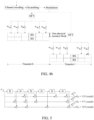
- channel structures of the PUCCH Format X are as shown in FIG. 4a and FIG. 4b , wherein RS represents demodulation reference signals, and it is described specifically as follows.
- n successive physical resource blocks are occupied in a frequency domain, and time domain extension is performed for data on one uplink SC-FDMA symbol, and the data after the time domain extension are mapped to an uplink SC-FDMA symbol in a corresponding time domain, and the demodulation reference signals and data are transmitted in a same frequency domain position in a way of time division multiplexing; the total bandwidth is N, and physical resource block indexes are numbered from 0, if a physical resource block index of the channel in the first timeslot is m, a physical resource block index in the second timeslot is N-1-m.
- a time domain length of the channel structure is one subframe, when a cyclic prefix is a normal cyclic prefix, as shown in FIG. 4a , the number of uplink SC-FDMA symbols corresponding to the data is 5, the number of uplink SC-FDMA symbols corresponding to the demodulation reference signals is 2 and they are respectively located on the 2nd uplink SC-FDMA symbol and the 6th uplink SC-FDMA symbol of each timeslot; and when the cyclic prefix is an extended cyclic prefix, as shown in FIG.
- a time domain extended code is a 5-order DFT sequence.
- a group division way of the first O 2 bits belonging to a group and the remaining bits belonging to a group can be used; or, a group division way of data in an even bit belonging to a group and data in an odd bit belonging to a group can be used.
- N represents the fundamental sequence length
- M i,h represents the value of serial number i in a fundamental sequence h
- O M j ⁇ 1 j represents a bit sequence of feedback information included in the j th group of data
- M j represents the number of bits contained in the j th group of data
- fundamental sequences are as shown in Table 5, and the fundamental sequences also can be in the form where the line replacement has been performed on the fundamental sequences of Table 5.
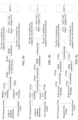
- the channel structures are as shown in FIG. 6a and FIG. 6b ;
- the group division is performed in a way of the first O 3 bits belonging to a group, the O 3 + 1 st bit to O 3 ⁇ 2 nd bit belonging to a group and the remainder bits belonging to a group;
- the channel in the example can be applied when the number of bits of ACK/NACK feedback information in TDD is greater than 11 in the carrier aggregation or when a UE needs to perform feedback of channel state information of r downlink cells simultaneously.
- Feedback information are transmitted on adjacent physical resource blocks or the same physical resource block by using n PUCCH Formats 3, wherein n is 2;
- Feedback information are transmitted on adjacent physical resource blocks or the same physical resource block by using n PUCCH Formats 2, wherein n is 2; the feedback information can be divided into n groups, each group of feedback information corresponds to one PUCCH Format 2, and each PUCCH Format 2 transmits the feedback information in a corresponding group.
- a group division method is classifying the first O 2 bits under a group and classifying the remainder bits under a group; or bits in the even bit are in a group and bits in the odd bit are in a group; or when the feedback information is channel state information, the feedback information corresponding to each cell is in a group.
- a PUCCH Format X is used to transmit feedback information
- the channel in the example can be applied when the amount of ACK/NACK feedback information in TDD is greater than 11 in the carrier aggregation or when a UE performs feedback of channel state information of r downlink cells.
- the number of bits of feedback information of UE is increased, which enhances the uplink feedback capacity, guarantees the maximum throughput of the system, and decreases the feedback delay of downlink channel information.
Landscapes
- Engineering & Computer Science (AREA)
- Signal Processing (AREA)
- Computer Networks & Wireless Communication (AREA)
- Quality & Reliability (AREA)
- Mobile Radio Communication Systems (AREA)
- Detection And Prevention Of Errors In Transmission (AREA)
Applications Claiming Priority (3)
| Application Number | Priority Date | Filing Date | Title |
|---|---|---|---|
| CN201010503424.1A CN101958774B (zh) | 2010-09-30 | 2010-09-30 | 一种反馈信息发送方法和用户设备 |
| PCT/CN2011/076678 WO2012041098A1 (zh) | 2010-09-30 | 2011-06-30 | 反馈信息发送方法和用户设备 |
| EP11827994.2A EP2608439A4 (de) | 2010-09-30 | 2011-06-30 | Verfahren und benutzervorrichtung zur übertragung von rückkopplungsinformationen |
Related Parent Applications (1)
| Application Number | Title | Priority Date | Filing Date |
|---|---|---|---|
| EP11827994.2A Division EP2608439A4 (de) | 2010-09-30 | 2011-06-30 | Verfahren und benutzervorrichtung zur übertragung von rückkopplungsinformationen |
Publications (2)
| Publication Number | Publication Date |
|---|---|
| EP4496247A2 true EP4496247A2 (de) | 2025-01-22 |
| EP4496247A3 EP4496247A3 (de) | 2025-04-30 |
Family
ID=43485899
Family Applications (2)
| Application Number | Title | Priority Date | Filing Date |
|---|---|---|---|
| EP11827994.2A Ceased EP2608439A4 (de) | 2010-09-30 | 2011-06-30 | Verfahren und benutzervorrichtung zur übertragung von rückkopplungsinformationen |
| EP24218164.2A Pending EP4496247A3 (de) | 2010-09-30 | 2011-06-30 | Verfahren und benutzervorrichtung zur übertragung von rückkopplungsinformationen |
Family Applications Before (1)
| Application Number | Title | Priority Date | Filing Date |
|---|---|---|---|
| EP11827994.2A Ceased EP2608439A4 (de) | 2010-09-30 | 2011-06-30 | Verfahren und benutzervorrichtung zur übertragung von rückkopplungsinformationen |
Country Status (8)
| Country | Link |
|---|---|
| US (1) | US9282549B2 (de) |
| EP (2) | EP2608439A4 (de) |
| JP (1) | JP5567219B2 (de) |
| KR (1) | KR101551829B1 (de) |
| CN (1) | CN101958774B (de) |
| BR (1) | BR112013007644A2 (de) |
| RU (1) | RU2540834C2 (de) |
| WO (1) | WO2012041098A1 (de) |
Families Citing this family (34)
| Publication number | Priority date | Publication date | Assignee | Title |
|---|---|---|---|---|
| WO2011034392A2 (ko) | 2009-09-18 | 2011-03-24 | 한국전자통신연구원 | 클러스터드 디에프티 스프레드 오에프디엠 전송에 있어서 상향링크 복조용 레퍼런스 시그널의 생성 및 전송 방법 |
| US8750269B2 (en) | 2009-10-23 | 2014-06-10 | Electronics And Telecommunications Research Institute | Method and apparatus for controlling transmission power in WLAN system |
| JP5073779B2 (ja) * | 2010-04-30 | 2012-11-14 | 株式会社エヌ・ティ・ティ・ドコモ | 基地局装置及びユーザ端末 |
| EP2421188A3 (de) | 2010-08-20 | 2014-11-26 | LG Electronics Inc. | Verfahren zur Übertragung von Steuerinformationen in einem drahtlosen Kommunikationssystem und Vorrichtung dafür |
| CN101958774B (zh) * | 2010-09-30 | 2015-10-21 | 中兴通讯股份有限公司 | 一种反馈信息发送方法和用户设备 |
| US9673945B2 (en) | 2011-02-18 | 2017-06-06 | Qualcomm Incorporated | Implicitly linking aperiodic channel state information (A-CSI) reports to CSI-reference signal (CSI-RS) resources |
| CN102739374B (zh) * | 2011-04-12 | 2017-02-01 | 中兴通讯股份有限公司 | 一种载波聚合下确认信息的反馈方法、用户设备和系统 |
| CN103037514B (zh) * | 2011-09-30 | 2017-02-22 | 上海贝尔股份有限公司 | 一种通信网络中用于传输解调参考信号的方法和装置 |
| CN102377535A (zh) * | 2011-09-30 | 2012-03-14 | 中兴通讯股份有限公司 | 上行控制信息的发送方法及装置、终端 |
| CN103166880A (zh) * | 2011-12-15 | 2013-06-19 | 中国移动通信集团公司 | 上行解调导频的发送方法、接收方法、基站及移动中继 |
| JP5873708B2 (ja) * | 2011-12-19 | 2016-03-01 | シャープ株式会社 | 移動局装置、方法および集積回路 |
| CN103209060B (zh) * | 2012-01-16 | 2016-09-21 | 普天信息技术研究院有限公司 | 一种物理上行链路控制信道的资源分配方法和装置 |
| CN103384188B (zh) * | 2012-05-04 | 2017-03-01 | 电信科学技术研究院 | 载波聚合反馈方法、装置及系统 |
| CN105075359A (zh) * | 2013-03-29 | 2015-11-18 | 日电(中国)有限公司 | 用于无线通信系统中的数据传输的方法和装置 |
| WO2016019553A1 (zh) * | 2014-08-07 | 2016-02-11 | 华为技术有限公司 | 物理下行数据信道传输方法、基站及用户设备 |
| US10171202B2 (en) * | 2014-11-11 | 2019-01-01 | Qualcomm Incorporated | Diversity repetition in mixed-rate wireless communication networks |
| EP3232672A4 (de) * | 2014-12-08 | 2018-08-01 | LG Electronics Inc. | Rundfunksignalsendevorrichtung, rundfunksignalempfangsvorrichtung, rundfunksignalsendeverfahren und rundfunksignalempfangsverfahren |
| WO2016106683A1 (zh) * | 2014-12-31 | 2016-07-07 | 华为技术有限公司 | 一种下行控制信道传输方法及设备 |
| CN104883238B (zh) * | 2015-03-31 | 2018-05-01 | 重庆邮电大学 | 一种多载波时分复用调制/解调方法及系统 |
| CN106559202B (zh) * | 2015-09-29 | 2019-09-10 | 上海朗帛通信技术有限公司 | 一种支持低空口延迟的方法、用户设备和基站设备 |
| US10701721B2 (en) * | 2016-03-25 | 2020-06-30 | Guangdong Oppo Mobile Telecommunications Corp., Ltd. | Method and apparatus for transmitting feedback information |
| CN107231690B (zh) * | 2016-03-25 | 2023-07-04 | 中兴通讯股份有限公司 | 信息发送方法及装置 |
| EP3442283B1 (de) | 2016-05-12 | 2023-10-04 | Huawei Technologies Co., Ltd. | Informationsübertragungsverfahren und benutzergerät |
| WO2018004251A1 (ko) * | 2016-06-28 | 2018-01-04 | 엘지전자 주식회사 | 하향링크 신호 수신 방법 및 사용자기기와, 하향링크 신호 전송 방법 및 기지국 |
| CN109155699B (zh) * | 2016-12-19 | 2021-02-09 | 华为技术有限公司 | 一种上行信息传输方法及设备 |
| CN108365922B (zh) * | 2017-01-26 | 2021-03-30 | 华为技术有限公司 | 用于反馈的方法、设备和系统 |
| CN108633053B (zh) * | 2017-03-24 | 2023-04-28 | 中兴通讯股份有限公司 | 一种信息传输方法及装置 |
| CN108631902B (zh) * | 2017-03-24 | 2024-06-11 | 中兴通讯股份有限公司 | 一种配置方法及装置 |
| US11219025B2 (en) * | 2017-04-24 | 2022-01-04 | Lg Electronics Inc. | Method by which D2D terminal transmits RS for PDoA in wireless communication system and device therefor |
| CN112511285B (zh) | 2017-09-08 | 2021-11-19 | 华为技术有限公司 | 基于序列的信号处理方法及装置 |
| CN109245871B (zh) * | 2017-09-08 | 2020-02-14 | 华为技术有限公司 | 基于序列的信号处理方法及装置 |
| CN109962763B (zh) * | 2017-12-26 | 2021-09-14 | 中国移动通信有限公司研究院 | 一种多用户数据的传输方法及装置、设备 |
| CN112003677B (zh) * | 2020-08-25 | 2022-03-25 | 深圳职业技术学院 | 物联网中的数据传输方法及系统 |
| CN115250539B (zh) * | 2021-04-28 | 2025-07-01 | 大唐移动通信设备有限公司 | 接入方法及装置 |
Family Cites Families (11)
| Publication number | Priority date | Publication date | Assignee | Title |
|---|---|---|---|---|
| RU2392752C2 (ru) * | 2006-01-05 | 2010-06-20 | ЭлДжи ЭЛЕКТРОНИКС ИНК. | Способ передачи данных и способ повторной передачи данных |
| US8369860B2 (en) * | 2006-08-18 | 2013-02-05 | Interdigital Technology Corporation | Sending and reducing uplink feedback signaling for transmission of MBMS data |
| US8503375B2 (en) * | 2007-08-13 | 2013-08-06 | Qualcomm Incorporated | Coding and multiplexing of control information in a wireless communication system |
| US8630184B2 (en) | 2007-08-15 | 2014-01-14 | Qualcomm Incorporated | Uplink control channel format |
| WO2009107985A1 (en) * | 2008-02-28 | 2009-09-03 | Lg Electronics Inc. | Method for multiplexing data and control information |
| KR101597573B1 (ko) * | 2008-08-11 | 2016-02-25 | 엘지전자 주식회사 | 제어정보의 상향링크 전송 방법 |
| KR101328790B1 (ko) * | 2008-10-20 | 2013-11-13 | 인터디지탈 패튼 홀딩스, 인크 | 반송파 집적 방법 |
| CN101771502A (zh) | 2009-01-07 | 2010-07-07 | 中兴通讯股份有限公司 | 一种信息复用的方法、系统和用户终端 |
| CN101783718A (zh) | 2010-02-10 | 2010-07-21 | 中兴通讯股份有限公司 | 调度请求消息和正确错误应答消息的复用方法 |
| US8509155B2 (en) * | 2010-07-16 | 2013-08-13 | Samsung Electronics Co., Ltd. | Method and system for multiplexing acknowledgement signals and sounding reference signals |
| CN101958774B (zh) * | 2010-09-30 | 2015-10-21 | 中兴通讯股份有限公司 | 一种反馈信息发送方法和用户设备 |
-
2010
- 2010-09-30 CN CN201010503424.1A patent/CN101958774B/zh active Active
-
2011
- 2011-06-30 BR BR112013007644A patent/BR112013007644A2/pt not_active Application Discontinuation
- 2011-06-30 EP EP11827994.2A patent/EP2608439A4/de not_active Ceased
- 2011-06-30 WO PCT/CN2011/076678 patent/WO2012041098A1/zh not_active Ceased
- 2011-06-30 JP JP2013530544A patent/JP5567219B2/ja active Active
- 2011-06-30 US US13/824,085 patent/US9282549B2/en active Active
- 2011-06-30 KR KR1020137008154A patent/KR101551829B1/ko active Active
- 2011-06-30 EP EP24218164.2A patent/EP4496247A3/de active Pending
- 2011-06-30 RU RU2013112503/08A patent/RU2540834C2/ru active
Also Published As
| Publication number | Publication date |
|---|---|
| JP5567219B2 (ja) | 2014-08-06 |
| BR112013007644A2 (pt) | 2017-09-26 |
| EP4496247A3 (de) | 2025-04-30 |
| CN101958774B (zh) | 2015-10-21 |
| EP2608439A4 (de) | 2018-02-14 |
| JP2013543685A (ja) | 2013-12-05 |
| RU2540834C2 (ru) | 2015-02-10 |
| KR101551829B1 (ko) | 2015-09-09 |
| EP2608439A1 (de) | 2013-06-26 |
| RU2013112503A (ru) | 2014-11-10 |
| US20130182692A1 (en) | 2013-07-18 |
| WO2012041098A1 (zh) | 2012-04-05 |
| KR20130064795A (ko) | 2013-06-18 |
| US9282549B2 (en) | 2016-03-08 |
| CN101958774A (zh) | 2011-01-26 |
Similar Documents
| Publication | Publication Date | Title |
|---|---|---|
| EP4496247A2 (de) | Verfahren und benutzervorrichtung zur übertragung von rückkopplungsinformationen | |
| EP3952178B1 (de) | Ressourcenbestimmungs- und -empfangsverfahren, elektronische vorrichtung und speichermedium | |
| KR101486679B1 (ko) | 무선 통신 시스템에서 수신 확인 전송 방법 및 장치 | |
| US9179458B2 (en) | Method for allocating resources for HARQ ACK/NACK signal transmission, and method and apparatus for HARQ ACK/NACK signal transmission using same | |
| US8942080B2 (en) | Transmission of bundled ACK/NAK bits | |
| US9065619B2 (en) | Method and apparatus for transmitting control information in a wireless communication system | |
| EP3010170B1 (de) | Verfahren und benutzergerät zur abbildung von ack/nack-antwortmeldungen | |
| EP4236610B1 (de) | Endgerät und pufferpartitionierungsverfahren | |
| CN107070584B (zh) | 用于发送控制信息的方法及其设备 | |
| US20180287735A1 (en) | Method and device for transmitting uplink control signal in wireless communication system | |
| US20160353388A1 (en) | Method and apparatus for transmitting control information in a wireless communication system | |
| WO2014142577A2 (ko) | 제어 정보를 전송하는 방법 및 이를 위한 장치 | |
| US20240187141A1 (en) | Joint coding and multiplexing of deferred sps harq-ack | |
| US9414367B2 (en) | Method and apparatus for transmitting uplink control information | |
| US10506567B2 (en) | Method and apparatus for transmitting and receiving uplink signal in wireless communication system | |
| CN106160956A (zh) | 上行控制信息发送方法、装置及用户设备 | |
| US20230043797A1 (en) | Apparatus and method for transmitting and receiving data and control signal in communication system | |
| US12563590B2 (en) | Apparatus and method for transmission or reception of data and control signal in communication system | |
| KR20120091960A (ko) | Ack/nack 자원 할당 방법 및 장치와 이를 이용한 ack/nack 신호 송신 방법 |
Legal Events
| Date | Code | Title | Description |
|---|---|---|---|
| PUAI | Public reference made under article 153(3) epc to a published international application that has entered the european phase |
Free format text: ORIGINAL CODE: 0009012 |
|
| STAA | Information on the status of an ep patent application or granted ep patent |
Free format text: STATUS: REQUEST FOR EXAMINATION WAS MADE |
|
| 17P | Request for examination filed |
Effective date: 20241206 |
|
| AC | Divisional application: reference to earlier application |
Ref document number: 2608439 Country of ref document: EP Kind code of ref document: P |
|
| AK | Designated contracting states |
Kind code of ref document: A2 Designated state(s): AL AT BE BG CH CY CZ DE DK EE ES FI FR GB GR HR HU IE IS IT LI LT LU LV MC MK MT NL NO PL PT RO RS SE SI SK SM TR |
|
| REG | Reference to a national code |
Ref country code: DE Ref legal event code: R079 Free format text: PREVIOUS MAIN CLASS: H04L0001180000 Ipc: H04L0005000000 |
|
| RIC1 | Information provided on ipc code assigned before grant |
Ipc: H04L 1/00 20060101ALI20250122BHEP Ipc: H04L 1/1829 20230101ALI20250122BHEP Ipc: H04L 1/1607 20230101ALI20250122BHEP Ipc: H04L 5/00 20060101AFI20250122BHEP |
|
| PUAL | Search report despatched |
Free format text: ORIGINAL CODE: 0009013 |
|
| AK | Designated contracting states |
Kind code of ref document: A3 Designated state(s): AL AT BE BG CH CY CZ DE DK EE ES FI FR GB GR HR HU IE IS IT LI LT LU LV MC MK MT NL NO PL PT RO RS SE SI SK SM TR |
|
| RIC1 | Information provided on ipc code assigned before grant |
Ipc: H04L 1/00 20060101ALI20250325BHEP Ipc: H04L 1/1829 20230101ALI20250325BHEP Ipc: H04L 1/1607 20230101ALI20250325BHEP Ipc: H04L 5/00 20060101AFI20250325BHEP |