EP4495898A2 - Computerimplementiertes verfahren zur analyse von daten aus von messwerten von eigenschaften von objekten in proben - Google Patents
Computerimplementiertes verfahren zur analyse von daten aus von messwerten von eigenschaften von objekten in proben Download PDFInfo
- Publication number
- EP4495898A2 EP4495898A2 EP24218729.2A EP24218729A EP4495898A2 EP 4495898 A2 EP4495898 A2 EP 4495898A2 EP 24218729 A EP24218729 A EP 24218729A EP 4495898 A2 EP4495898 A2 EP 4495898A2
- Authority
- EP
- European Patent Office
- Prior art keywords
- control
- data
- test
- perturbation
- loadings
- Prior art date
- Legal status (The legal status is an assumption and is not a legal conclusion. Google has not performed a legal analysis and makes no representation as to the accuracy of the status listed.)
- Pending
Links
Images
Classifications
-
- G—PHYSICS
- G16—INFORMATION AND COMMUNICATION TECHNOLOGY [ICT] SPECIALLY ADAPTED FOR SPECIFIC APPLICATION FIELDS
- G16B—BIOINFORMATICS, i.e. INFORMATION AND COMMUNICATION TECHNOLOGY [ICT] SPECIALLY ADAPTED FOR GENETIC OR PROTEIN-RELATED DATA PROCESSING IN COMPUTATIONAL MOLECULAR BIOLOGY
- G16B15/00—ICT specially adapted for analysing two-dimensional [2D] or three-dimensional [3D] molecular structures, e.g. structural or functional relations or structure alignment
-
- G—PHYSICS
- G01—MEASURING; TESTING
- G01N—INVESTIGATING OR ANALYSING MATERIALS BY DETERMINING THEIR CHEMICAL OR PHYSICAL PROPERTIES
- G01N15/00—Investigating characteristics of particles; Investigating permeability, pore-volume or surface-area of porous materials
- G01N15/10—Investigating individual particles
-
- G—PHYSICS
- G01—MEASURING; TESTING
- G01N—INVESTIGATING OR ANALYSING MATERIALS BY DETERMINING THEIR CHEMICAL OR PHYSICAL PROPERTIES
- G01N15/00—Investigating characteristics of particles; Investigating permeability, pore-volume or surface-area of porous materials
- G01N15/10—Investigating individual particles
- G01N15/14—Optical investigation techniques, e.g. flow cytometry
- G01N15/1429—Signal processing
-
- G—PHYSICS
- G06—COMPUTING OR CALCULATING; COUNTING
- G06F—ELECTRIC DIGITAL DATA PROCESSING
- G06F18/00—Pattern recognition
- G06F18/20—Analysing
- G06F18/21—Design or setup of recognition systems or techniques; Extraction of features in feature space; Blind source separation
- G06F18/213—Feature extraction, e.g. by transforming the feature space; Summarisation; Mappings, e.g. subspace methods
- G06F18/2135—Feature extraction, e.g. by transforming the feature space; Summarisation; Mappings, e.g. subspace methods based on approximation criteria, e.g. principal component analysis
-
- G—PHYSICS
- G06—COMPUTING OR CALCULATING; COUNTING
- G06V—IMAGE OR VIDEO RECOGNITION OR UNDERSTANDING
- G06V20/00—Scenes; Scene-specific elements
- G06V20/60—Type of objects
- G06V20/69—Microscopic objects, e.g. biological cells or cellular parts
- G06V20/695—Preprocessing, e.g. image segmentation
-
- G—PHYSICS
- G01—MEASURING; TESTING
- G01N—INVESTIGATING OR ANALYSING MATERIALS BY DETERMINING THEIR CHEMICAL OR PHYSICAL PROPERTIES
- G01N15/00—Investigating characteristics of particles; Investigating permeability, pore-volume or surface-area of porous materials
- G01N15/10—Investigating individual particles
- G01N2015/1006—Investigating individual particles for cytology
-
- G—PHYSICS
- G01—MEASURING; TESTING
- G01N—INVESTIGATING OR ANALYSING MATERIALS BY DETERMINING THEIR CHEMICAL OR PHYSICAL PROPERTIES
- G01N15/00—Investigating characteristics of particles; Investigating permeability, pore-volume or surface-area of porous materials
- G01N15/10—Investigating individual particles
- G01N15/14—Optical investigation techniques, e.g. flow cytometry
- G01N2015/1402—Data analysis by thresholding or gating operations performed on the acquired signals or stored data
-
- G—PHYSICS
- G16—INFORMATION AND COMMUNICATION TECHNOLOGY [ICT] SPECIALLY ADAPTED FOR SPECIFIC APPLICATION FIELDS
- G16H—HEALTHCARE INFORMATICS, i.e. INFORMATION AND COMMUNICATION TECHNOLOGY [ICT] SPECIALLY ADAPTED FOR THE HANDLING OR PROCESSING OF MEDICAL OR HEALTHCARE DATA
- G16H50/00—ICT specially adapted for medical diagnosis, medical simulation or medical data mining; ICT specially adapted for detecting, monitoring or modelling epidemics or pandemics
- G16H50/20—ICT specially adapted for medical diagnosis, medical simulation or medical data mining; ICT specially adapted for detecting, monitoring or modelling epidemics or pandemics for computer-aided diagnosis, e.g. based on medical expert systems
Definitions
- the invention relates to a method of analysing data, a computer program, a computer readable medium and a data analysis system.
- the data comprises data from healthy individuals and challenged individuals.
- the data from healthy individuals and challenged individuals is individually represented in matrix form.
- the number of healthy individuals and the perturbed individuals is represented as I, the index for an individual is i.
- the data comprises measured values for J characteristics of cells.
- For individual i there are measured values for N i cells, the data for each cell of an individual having an index n i .
- PCA principal component analysis
- the data of all individuals is projected onto the model loadings and represented in a scatterplot wherein the two orthogonal axes correspond to the two model loadings.
- Two scores per cell are determined during projection of data of all individuals. Each cell is indicated as a dot in the scatterplot. The coordinates of the dots correspond to the scores.
- the dots are identified in the scatterplot and one or more gates are determined in the scatterplot.
- a gate here is an area in the scatterplot.
- data from a cytometer usually corresponds to 1000 objects per sample.
- An objective technical problem therefore is to provide a method with increased sensitivity for determining presence of an illness using a computer. It is an object of the invention to provide a method that at least partially solves these problems.
- data comprising measured values of characteristics of objects in samples may relate to data from a cytometer (the computer implemented method then being a cytometric method) and may relate to the measured quantities of radiation (such as light) whereby for a single sample several objects (such as cells or particles) are fed along a measurement station that emits measurement radiation.
- the measured quantity of radiation for instance corresponds to the presence of a substance in the objects. This correspondence may be established by the presence of markers that bind to the substance in the objects and that are sensitive to the measurement radiation in that they scatter or diffract the measurement radiation or absorb it.
- the absorption may lead to a fluorescent or phosphorescent decay, which may be measured or the absorption may be measured.
- the cytometer may be a flow cytometer.
- the cytometer may be a mass cytometer.
- the cytometer may be arranged to measure objects marked with mass labels, for instance isotopically.
- the characteristics of the objects may change for instance as a perturbation to a challenge, such as an LPS challenge to cells of individuals, as perturbation to a disease, ageing periodically (for instance in a night-day rhythm).
- a perturbation to a challenge such as an LPS challenge to cells of individuals, as perturbation to a disease, ageing periodically (for instance in a night-day rhythm).
- the characteristics may also change under the influence of pollution.
- the test set of data does not overlap with the first set of data.
- the reference samples are obtained from individuals that are not subjected to a challenge or diseased. Because the control model is fitted to only the data of the reference samples, the control loadings do not represent correlations (relations) between characteristics present only in perturbed samples, i.e. samples for which it is established that they do not correspond to a reference situation. In other words, perturbed samples are samples the method is arranged to discriminate from the reference samples.
- individual objects in the test data set for which the test control scores are outside the one or more confidence intervals are separated from the other objects in the test sample. This separation may be conducted by a sorter such as a sorter in a cytometer, such as a flow cytometer.
- a principal component analysis is an efficient way to determine the control loadings.
- the number of dimensions i.e the number of principal components, is determined using a scree plot or cross-validation.
- the inventors realised that centering to the average value of the measurements of each sample, i.e. of each individual may be applied after evaluating the absence of systematic difference between profiles of the measured characteristics of objects in reference and perturbed samples.
- the first set of control scores describes the variation of the characteristics per sample. This means that the mutual variation within the first set of control scores may be compared between samples.
- the one or more confidence interval can therefore be determined for samples and for groups of samples so that it is possible to determine for samples if they are reference or perturbed, when compared to the confidence interval of all reference samples.
- a two-dimensional graphical representation such as a biplot can be used to analyse the results for all independent correlations for a combination of two of the principal control loadings of the at least two principal control loadings.
- the test control scores along the vector are within the one or more confidence intervals, it is established if the characteristic is present in equal variability as normal within reference samples or more or less variably present than normal within reference samples. Combined with separately gathered information linking variability in a characteristic to a perturbation, this provides a way to determine if a sample is exposed to a specific perturbation, such as a disease.
- the two-dimensional biplot can be used to represent combinations of two out of the total number of selected principal components.
- This embodiment increases the selectivity of the method with regard to information related to the perturbation. This is accomplished by additional modelling for relations between characteristics that are not exhibited by reference samples but that are exhibited by perturbed samples.
- the modelling for the relations between characteristics that are exhibited by reference samples (and that also may be exhibited by perturbed samples) is not affected, as the control model is based on data from the first set of data only and not also on data from the second set of data, i.e. the control loadings are determined based on data from the first set of data, the reference samples, only.
- the perturbation loadings correspond to components determined in the further principal component analysis.
- the first set of control residuals is determined while projecting the first data onto the control loadings in the step for determining a first set of control scores.
- test set of control residuals is determined while projecting the test set of data onto the control loadings for determining test control scores.
- the test sets of control residuals obtained from several perturbed samples are then described by a further principal component analysis.
- individual objects in the test data set for which the test control scores are outside the one or more further confidence intervals are separated from the other objects in the test sample. This separation may be conducted by a sorter such as a sorter in a cytometer, such as a flow cytometer.
- a principal component analysis is an efficient way to determine the perturbed loadings.
- the number of dimensions i.e. the number of principal components, is determined using a scree plot or cross-validation.
- test set of data is the second set of data
- the method is advantageous for research purposes.
- the method according to this embodiment may for instance be used to investigate if certain perturbations (such diseases) can be detected according the method or if other characteristics need to be measured.
- the second set of data is the test set of data
- data corresponding to test scores falling within the one or more confidence intervals corresponds to data in the second set of data. Removing this data from the second set of data contributes to fitting the perturbation model to relevant data only and increases the sensitivity to finding correlations between characteristics that are not present within the reference set of data.
- a confidence interval for those correlations can be used advantageously to identify if objects in test samples comply with the perturbations captured in the second set of data or relate to another perturbation.
- the further principal component analysis is the principal component analysis used to determine the perturbation loadings and as such can be used to select two principal perturbation loadings.
- the method of the eleventh embodiment provides a way to graphically interpret the data in a highly sensitive manner with respect to a perturbation.
- the invention further provides for a method for analysing data according to claim 12.
- a cytometer can be used to measure various characteristics of cells of particles.
- the objects are cells or particles.
- the invention further provides for a computer program according to claim 13.
- the invention further provides for a computer readable medium according to claim 14.
- the computer readable medium may for instance be a floppy, a hard disk, a USB-stick, a SSD-drive.
- the invention further provides for a data analysis system according to claim 15.
- the data analysis system may be a computer receiving the data from a cytometer, such as a flow cytometer.
- the data analysis system may also be part of a cytometer, such as a multicolour flow cytometer.
- the data analysis system provides the advantages of the computer implemented method of any of the claims 1 to 11.
- the data analysis system may comprise
- the invention further provides for a cytometer according to claim 16.
- Cytometric measurements typically relate to order of magnitude 1000 objects per sample.
- the invention further provides for a cytometer according to claim 17.
- the separation can be done fast and possibly even real time: i.e. whenever the characteristics of an object are measured, the object can be diverted into separate directions based on the check of the corresponding test control scores.
- loadings correspond to components determined in a principal component analysis.
- Scores refer to the expression on the components (loadings) and may be seen as coefficients in the linear model wherein the components are variables. This applies to the control model and control loadings as well as to the perturbation model and perturbation loadings.
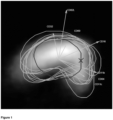
- Figure 1 Biplot of a typical LPS perturbed sample with respect to the control loadings, together with a confidence interval that indicates the variability between objects observed in reference samples, as expressed on the control loadings.
- the samples are either reference samples (such reference samples are indicated as 1 reference ... i reference ... I reference ) or perturbed samples.
- the samples relate to cytometric measurements on cells from individuals stored in a memory of the cytometer. Each sample is taken from a unique individual.
- the reference samples are from healthy individuals.
- the perturbed samples are from individuals which are challenged with lipopolysaccharide (LPS). Such perturbed samples are indicated as 1 perturbed ... i perturbed ... I perturbed ).
- the data set comprises data obtained by a multicolour flow cytometer.
- the data is stored in a memory of the cytometer.
- the matrix T contro, i reference of dimensions contains control scores of sample i reference .
- the matrices T control, i reference for all reference samples together form a first set of control scores.
- P control I a matrix ( J ⁇ R control ) representing the control loadings.
- Y i reference Represents the residuals of this control model for each sample; for all samples combined they are referred to as a first set of control residuals.
- 1 control ... r control ... R control Indicate the components of the control model.
- control scores, the control loadings and the residuals are computed using computation means of a computer which reads the first set of data from a computer readable medium.
- the variability in the surface marker-profile X i reference of each reference sample is expressed by the first control scores (T control, i reference ).
- the first control scores (T control, i reference ) for all the reference samples together form a first set of control scores.
- control loadings P control are different from the PCA scores and loadings of the prior art, because the control model is fitted on the reference samples alone. The method strives to discriminate with respect to the reference samples. This difference with the prior art is also reflected in the control loadings P control determined according to the example according to the invention.
- the control loadings P control exclusively describe relationships (correlations) between surface markers exhibited by reference samples. However the control loadings P control do not explicitly exclude relations (correlations) in perturbed samples if they are also exhibited by reference samples i reference .
- control model is fitted such, that each sample i reference may contribute an equal amount of information to the control model.
- the method thereby averages between all samples i reference rather than between all objects. This is done by weighing the model with the sample object count N i reference as indicated in step 2a of the algorithm below.
- the control model employs sample-based centering, which centers the surface marker profiles in the first set of data (X i reference ) on the average surface marker expression of each reference sample.
- This modelling choice results in (T control, i reference ) describing the surface marker variability per sample, which means that instead of directly comparing the absolute score values between samples, their mutual variability may be compared.
- This choice results from consistent 'offset' differences between surface marker intensities that are empirically observed, that are not related to the perturbation and therefore distract from the variability between objects within the same sample that is of primary interest.
- the surface marker profiles are scaled here with the standard deviation (S control ) among all objects of reference samples. The control model therefore fits the information in reference samples exclusively.
- the sample-based centering is used throughout the method as can be seen in the algorithm below.
- the scores T TC, i perturbed that result from this projection describe the variability among sample objects in perturbed samples expressed on the relations between surface markers exhibited by reference samples.
- the surface marker intensities have been scaled with the same parameters in S control , such that the variability between sample objects in the control model can be compared between reference samples i reference and perturbed samples.
- the scores of perturbed samples may be compared to those from reference samples i reference obtained from equation (1), which may reveal how the perturbation, in this example the challenge with LPS, alters the variability among objects within the same sample through the specific combinations between surface markers exhibited by reference samples. Disruptions in these relationships may be identified on the basis of the scores per sample.
- test samples for whom it is unknown if the sample is perturbed or reference and if perturbed by what perturbation.
- a test set of data is obtained by cytometric measurements.
- the test set of data is projected onto the control loadings, thereby determining test control scores (after scaling and sample centering analogue to what was described for the first set of data).
- the scores of a test sample may be presented graphically.
- a biplot is produced using an output means, such as a printer or a display, of the computer, such as in figure 1 .
- an output means such as a printer or a display, of the computer, such as in figure 1 .
- a typical LPS-perturbed sample is shown based on a projection on the control loadings.
- White areas indicate high object densities.
- the arrows represent vectors.
- the length of the vectors represents the amount of surface marker variability into a certain direction.
- the direction relates to a specific surface marker.
- For each vector the specific surface marker is indicated in the biplot.
- the closed loop line marked by an "x" represents a confidence interval based on the complete first data set.
- the second set of data is used as well and the other closed loop lines indicate perturbed confidence intervals for LPS perturbed samples, which means here that for each of these closed loop lines a percentage of the objects has control scores within the perturbed confidence interval.
- the confidence intervals i.e. the confidence intervals based on the complete first data set as well as the perturbed confidence intervals
- Objects (here cells) having scores outside the confidence interval may be identified using a comparator of the computer and separated from the other objects in a sample by a sorter. Sorters are well known for flow cytometers.
- Such objects may also be used to compose a new second set of data from the test set of data wherein the second set of data does not comprise any objects that comply with the reference samples.
- the perturbation scores, the perturbation loadings and the perturbation residuals are computed using computation means.
- the scores T perturbation, i perturbed contain the object variability in surface markers after the LPS perturbation, obtained without prior biological assumptions and the corresponding loadings P perturbation contain the relations among surface markers that occur in perturbed, but not in reference samples and are therefore perturbation-specific.
- the scores of the second set of data in the control model and of their residuals in the perturbation model form an individualised perturbation surface marker-profile that can be compared between perturbed samples: also the perturbation scores and perturbation loadings from equation (3) can be represented in a bi-plot (a single two-dimensional figure) if R perturbation is two, i.e. if the further principal component analysis results in two principal perturbation components. If more than two principal components are selected for the further principal component analysis, the bi-plot can be used to describe combinations of two out of the selected principal components.
- the calculation of the first set of perturbation scores T CT, i reference , the residuals E i reference and the perturbation loadings is carried out by calculation means.
- the first set of perturbation scores T CT, i reference will not individually be of biomedical interest.
- the first set of perturbation scores T CT, i reference is not supposed to individually contain relevant information because the relevant information is modelled in the control model. However, the perturbation scores in the first set of perturbation scores T CT, i reference have a more validatory function.
- the first set of perturbation scores T CT, i reference for all reference samples may be used to determine a confidence interval.
- the objects of a perturbed sample that fall inside this interval do not vary more from the average m i perturbed T than could be expected from the variability between objects in reference samples. The objects that exceed this interval are therefore of primary interest to the LPS perturbation as they exceed this expected variability.
- Such objects are found by using a comparator of the computer to compare the scores of the objects in the perturbed sample that fall outside the confidence interval.
- the validity of the sample centering (this is done if there is no systematic difference between the surface marker profiles of reference and perturbed samples) can optionally be evaluated by comparing the average surface marker profiles with an object weighted PCA model, in which the averages per sample are weighted according to the number of objects they represent.
- the scores of this object weighted PCA model indicated that there is no such systematic offset, such that sample centering does not remove information of biomedical relevance, i.e. differences in the average expression of surface markers between reference and perturbed samples, that may separately serve as information by which the perturbation can be identified in test samples.
- the table below comprises some steps of the method according to an example of the invention in more detail.
- data with a star relates to centered data (for instance X i reference * , X i perturbed * and X i test * ) and the process of centering is referred to as preprocessing.
- Step # Explanation Calculation 1
- the confidence level of the confidence intervals is determined automatically.
- a perturbed sample of objects in the second set of data may comprise objects that could have been found in a reference sample and objects that could not be found in a reference sample as they correspond specifically to the perturbation.
- the measured values of such samples may differ within the second set of data.
- the confidence level of the confidence interval that is determined using the perturbation scores T perturbation , i perturbed ⁇ of each perturbed sample is incrementally varied between for instance 50% and 100% in steps of 1 percent in an incremental cycle and at the same time the confidence level of the confidence interval that is determined using the scores T CT, ⁇ reference of all reference samples is incrementally varied with the same value.
- the average percentage of objects of each perturbed individual that score outside the confidence interval divided by the average number of scores T CT, i reference that score outside this same confidence interval is a measure of the diagnostic ability of the method.
- the confidence level of the confidence interval may be established at the level where the value of this diagnostic ability is highest. While incrementing the confidence level, the diagnostic ability is determined with a computer. The corresponding confidence level is selected and the corresponding confidence interval is used when feeding the test data into the method to diagnose samples with improved reliability and in a more quantifiable way.
- the same sensitivity analysis may be used for the determination of diagnostic ability of the reference model, by varying the confidence level of the confidence interval on perturbation scores T TC, i perturbed with the same confidence level on T control , i reference ⁇ . This also allows the calculation of a diagnostic ability, for which the highest level may be selected at the confidence level of the confidence interval.
- the diagnostic ability may also be calculated based on Analysis of Variance or another statistical test to compare values from two or more groups of samples.
- This selected confidence level is used to process the test set of data according to the method as described earlier.
- the method of this example provides a more reliable and quantifiable diagnosis.
- the computer implemented method for the first example is implemented on the cytometer which is provided with a sorter.
- the sorter selects objects from the perturbed samples.
- the selection N i perturbed # comprises both:
- the data of the selected objects is used to fit a further perturbation model, i.e. is forms a further second set of data that is processed instead of the second set of data.
- This kind of selection is advantageous in early stages of scientific research to determine important aspects to be studied and to improve the method as it delivers a set of objects that differs in a well-defined way from the objects in the reference samples.
Landscapes
- Engineering & Computer Science (AREA)
- Physics & Mathematics (AREA)
- Life Sciences & Earth Sciences (AREA)
- Chemical & Material Sciences (AREA)
- Theoretical Computer Science (AREA)
- Health & Medical Sciences (AREA)
- General Health & Medical Sciences (AREA)
- General Physics & Mathematics (AREA)
- Spectroscopy & Molecular Physics (AREA)
- Bioinformatics & Computational Biology (AREA)
- Bioinformatics & Cheminformatics (AREA)
- Evolutionary Biology (AREA)
- Data Mining & Analysis (AREA)
- Computer Vision & Pattern Recognition (AREA)
- Analytical Chemistry (AREA)
- Pathology (AREA)
- Immunology (AREA)
- Dispersion Chemistry (AREA)
- Biochemistry (AREA)
- Signal Processing (AREA)
- Biotechnology (AREA)
- Medical Informatics (AREA)
- Crystallography & Structural Chemistry (AREA)
- Biophysics (AREA)
- Artificial Intelligence (AREA)
- General Engineering & Computer Science (AREA)
- Biomedical Technology (AREA)
- Molecular Biology (AREA)
- Multimedia (AREA)
- Evolutionary Computation (AREA)
- Investigating Or Analysing Biological Materials (AREA)
- Testing Of Engines (AREA)
- Management, Administration, Business Operations System, And Electronic Commerce (AREA)
- Feedback Control In General (AREA)
Applications Claiming Priority (4)
| Application Number | Priority Date | Filing Date | Title |
|---|---|---|---|
| NL1040550 | 2013-12-18 | ||
| NL1040872A NL1040872C2 (en) | 2013-12-18 | 2014-06-29 | Method of analysing data from, computer program, computer readable medium and data analysis system. |
| EP14833550.8A EP3084390B1 (de) | 2013-12-18 | 2014-12-18 | Computerimplementiertes verfahren zur analyse von daten aus von messwerten von eigenschaften von objekten in proben |
| PCT/NL2014/050885 WO2015093958A1 (en) | 2013-12-18 | 2014-12-18 | Computer-implemented method of analysing data from measured values of characteristics of objects in samples |
Related Parent Applications (1)
| Application Number | Title | Priority Date | Filing Date |
|---|---|---|---|
| EP14833550.8A Division EP3084390B1 (de) | 2013-12-18 | 2014-12-18 | Computerimplementiertes verfahren zur analyse von daten aus von messwerten von eigenschaften von objekten in proben |
Publications (2)
| Publication Number | Publication Date |
|---|---|
| EP4495898A2 true EP4495898A2 (de) | 2025-01-22 |
| EP4495898A3 EP4495898A3 (de) | 2025-04-23 |
Family
ID=52446416
Family Applications (2)
| Application Number | Title | Priority Date | Filing Date |
|---|---|---|---|
| EP24218729.2A Pending EP4495898A3 (de) | 2013-12-18 | 2014-12-18 | Computerimplementiertes verfahren zur analyse von daten aus von messwerten von eigenschaften von objekten in proben |
| EP14833550.8A Active EP3084390B1 (de) | 2013-12-18 | 2014-12-18 | Computerimplementiertes verfahren zur analyse von daten aus von messwerten von eigenschaften von objekten in proben |
Family Applications After (1)
| Application Number | Title | Priority Date | Filing Date |
|---|---|---|---|
| EP14833550.8A Active EP3084390B1 (de) | 2013-12-18 | 2014-12-18 | Computerimplementiertes verfahren zur analyse von daten aus von messwerten von eigenschaften von objekten in proben |
Country Status (5)
| Country | Link |
|---|---|
| US (1) | US11105725B2 (de) |
| EP (2) | EP4495898A3 (de) |
| ES (1) | ES3009589T3 (de) |
| NL (1) | NL1040872C2 (de) |
| WO (1) | WO2015093958A1 (de) |
Families Citing this family (1)
| Publication number | Priority date | Publication date | Assignee | Title |
|---|---|---|---|---|
| US10692605B2 (en) | 2018-01-08 | 2020-06-23 | International Business Machines Corporation | Library screening for cancer probability |
Citations (1)
| Publication number | Priority date | Publication date | Assignee | Title |
|---|---|---|---|---|
| WO2012048906A1 (en) | 2010-10-12 | 2012-04-19 | Deutsches Rheuma-Forschungszentrum Berlin | Principle component analysis (pca) - based analysis of discontinuous emission spectra in multichromatic flow cytometry |
Family Cites Families (1)
| Publication number | Priority date | Publication date | Assignee | Title |
|---|---|---|---|---|
| US20120214190A1 (en) * | 2012-02-20 | 2012-08-23 | Wanqiu Hou | System and method based on blood components for estimating human physiological parameters |
-
2014
- 2014-06-29 NL NL1040872A patent/NL1040872C2/en active
- 2014-12-18 WO PCT/NL2014/050885 patent/WO2015093958A1/en not_active Ceased
- 2014-12-18 EP EP24218729.2A patent/EP4495898A3/de active Pending
- 2014-12-18 US US15/106,064 patent/US11105725B2/en active Active
- 2014-12-18 EP EP14833550.8A patent/EP3084390B1/de active Active
- 2014-12-18 ES ES14833550T patent/ES3009589T3/es active Active
Patent Citations (1)
| Publication number | Priority date | Publication date | Assignee | Title |
|---|---|---|---|---|
| WO2012048906A1 (en) | 2010-10-12 | 2012-04-19 | Deutsches Rheuma-Forschungszentrum Berlin | Principle component analysis (pca) - based analysis of discontinuous emission spectra in multichromatic flow cytometry |
Also Published As
| Publication number | Publication date |
|---|---|
| US11105725B2 (en) | 2021-08-31 |
| EP3084390A1 (de) | 2016-10-26 |
| ES3009589T3 (en) | 2025-03-27 |
| EP3084390B1 (de) | 2024-12-11 |
| NL1040872C2 (en) | 2015-06-22 |
| WO2015093958A1 (en) | 2015-06-25 |
| EP4495898A3 (de) | 2025-04-23 |
| EP3084390C0 (de) | 2024-12-11 |
| US20170003212A1 (en) | 2017-01-05 |
Similar Documents
| Publication | Publication Date | Title |
|---|---|---|
| EP3500964B1 (de) | System und verfahren zur klassifizierung von biologischen partikeln | |
| KR101106201B1 (ko) | 임상검사분석장치, 임상검사분석방법 및 그 방법을 컴퓨터에 실행시키는 프로그램을 저장하는 컴퓨터 판독 가능한 기록매체 | |
| JP5425814B2 (ja) | サポートベクタマシンを用いてフローサイトメトリーデータを分析するための方法及びシステム | |
| US6804563B1 (en) | Multidimensional method and system for statistical process control | |
| US20190034518A1 (en) | Target class feature model | |
| CN113227755A (zh) | 测定准确度改善 | |
| US20110204259A1 (en) | Method and system for detecting fluorochromes in a flow cytometer | |
| CA3120025A1 (en) | Method and system for determining concentration of an analyte in a sample of a bodily fluid, and method and system for generating a software-implemented module | |
| EP2596456B1 (de) | Verfahren und system zur analyse der ergebnisse einer optischen kohärenztomographie mittels einer analyse mit diskretisierung durch farbreflexion | |
| US10451536B2 (en) | Method and apparatus for multi-parameter data analysis | |
| KR102033484B1 (ko) | 적대적 인공지능 생성망 (gan)을 활용한 반려동물 검사의 정상범위 기준치 설정 방법 및 장치 | |
| EP2332073B1 (de) | Formparameter für hämatologische instrumente | |
| Colihan et al. | Constructing job families: An analysis of quantitative techniques used for grouping jobs | |
| US11105725B2 (en) | Computer-implemented method of analyzing data from measured values of characteristics of objects in samples | |
| Tvedten et al. | Canine differential leukocyte counting with the CellaVision DM96Vision, Sysmex XT‐2000iV, and Advia 2120 hematology analyzers and a manual method | |
| EP2920573B1 (de) | Verfahren zur bewertung von partikel-datensegmentierungsergebnissen und durchflusszytometer | |
| CN118014443A (zh) | 一种药品的监测方法及装置 | |
| US20180293427A1 (en) | Automatic Calculation for Ploidy Classification | |
| JP2025536473A (ja) | 標本画像の異常の検出 | |
| US12259308B2 (en) | Medical analysis device with impedance signal processing | |
| Cabanas et al. | TrustSkin: A fairness pipeline for trustworthy facial affect analysis across skin tone | |
| LeBlond et al. | A Non-Normal Bayesian Model for the Estimation and Comparison of Immunogenicity Screening Assay Cut-Points | |
| Cudney et al. | Forecasting consumer satisfaction for vehicle ride using a multivariate measurement system | |
| Mazhurin et al. | An image segmentation assessment tool ISAT 1.0 | |
| KR20260033182A (ko) | 신경망 기반의 세포 특성 분석 및 치료 성공 예측 방법 및 장치 |
Legal Events
| Date | Code | Title | Description |
|---|---|---|---|
| PUAI | Public reference made under article 153(3) epc to a published international application that has entered the european phase |
Free format text: ORIGINAL CODE: 0009012 |
|
| STAA | Information on the status of an ep patent application or granted ep patent |
Free format text: STATUS: THE APPLICATION HAS BEEN PUBLISHED |
|
| AC | Divisional application: reference to earlier application |
Ref document number: 3084390 Country of ref document: EP Kind code of ref document: P |
|
| AK | Designated contracting states |
Kind code of ref document: A2 Designated state(s): AL AT BE BG CH CY CZ DE DK EE ES FI FR GB GR HR HU IE IS IT LI LT LU LV MC MK MT NL NO PL PT RO RS SE SI SK SM TR |
|
| REG | Reference to a national code |
Ref country code: DE Ref legal event code: R079 Free format text: PREVIOUS MAIN CLASS: G06V0020690000 Ipc: G01N0015140000 |
|
| PUAL | Search report despatched |
Free format text: ORIGINAL CODE: 0009013 |
|
| AK | Designated contracting states |
Kind code of ref document: A3 Designated state(s): AL AT BE BG CH CY CZ DE DK EE ES FI FR GB GR HR HU IE IS IT LI LT LU LV MC MK MT NL NO PL PT RO RS SE SI SK SM TR |
|
| RIC1 | Information provided on ipc code assigned before grant |
Ipc: G01N 15/14 20240101AFI20250314BHEP |
|
| STAA | Information on the status of an ep patent application or granted ep patent |
Free format text: STATUS: REQUEST FOR EXAMINATION WAS MADE |
|
| 17P | Request for examination filed |
Effective date: 20251007 |