EP4495124A2 - Derivatisierung von beta-lactam-antibiotika als kalibratoren/ist in massenprobenmessungen - Google Patents
Derivatisierung von beta-lactam-antibiotika als kalibratoren/ist in massenprobenmessungen Download PDFInfo
- Publication number
- EP4495124A2 EP4495124A2 EP24211316.5A EP24211316A EP4495124A2 EP 4495124 A2 EP4495124 A2 EP 4495124A2 EP 24211316 A EP24211316 A EP 24211316A EP 4495124 A2 EP4495124 A2 EP 4495124A2
- Authority
- EP
- European Patent Office
- Prior art keywords
- antibiotic
- derivatization reagent
- particular embodiments
- complex
- nucleophilic
- Prior art date
- Legal status (The legal status is an assumption and is not a legal conclusion. Google has not performed a legal analysis and makes no representation as to the accuracy of the status listed.)
- Pending
Links
Images





Classifications
-
- C—CHEMISTRY; METALLURGY
- C07—ORGANIC CHEMISTRY
- C07D—HETEROCYCLIC COMPOUNDS
- C07D499/00—Heterocyclic compounds containing 4-thia-1-azabicyclo [3.2.0] heptane ring systems, i.e. compounds containing a ring system of the formula:, e.g. penicillins, penems; Such ring systems being further condensed, e.g. 2,3-condensed with an oxygen-, nitrogen- or sulfur-containing hetero ring
- C07D499/897—Compounds with substituents other than a carbon atom having three bonds to hetero atoms with at the most one bond to halogen, directly attached in position 2
-
- G—PHYSICS
- G01—MEASURING; TESTING
- G01N—INVESTIGATING OR ANALYSING MATERIALS BY DETERMINING THEIR CHEMICAL OR PHYSICAL PROPERTIES
- G01N30/00—Investigating or analysing materials by separation into components using adsorption, absorption or similar phenomena or using ion-exchange, e.g. chromatography or field flow fractionation
- G01N30/02—Column chromatography
- G01N30/62—Detectors specially adapted therefor
- G01N30/72—Mass spectrometers
- G01N30/7233—Mass spectrometers interfaced to liquid or supercritical fluid chromatograph
-
- G—PHYSICS
- G01—MEASURING; TESTING
- G01N—INVESTIGATING OR ANALYSING MATERIALS BY DETERMINING THEIR CHEMICAL OR PHYSICAL PROPERTIES
- G01N33/00—Investigating or analysing materials by specific methods not covered by groups G01N1/00 - G01N31/00
- G01N33/48—Biological material, e.g. blood, urine; Haemocytometers
- G01N33/50—Chemical analysis of biological material, e.g. blood, urine; Testing involving biospecific ligand binding methods; Immunological testing
- G01N33/53—Immunoassay; Biospecific binding assay; Materials therefor
- G01N33/531—Production of immunochemical test materials
- G01N33/532—Production of labelled immunochemicals
- G01N33/534—Production of labelled immunochemicals with radioactive label
-
- A—HUMAN NECESSITIES
- A61—MEDICAL OR VETERINARY SCIENCE; HYGIENE
- A61K—PREPARATIONS FOR MEDICAL, DENTAL OR TOILETRY PURPOSES
- A61K31/00—Medicinal preparations containing organic active ingredients
- A61K31/33—Heterocyclic compounds
- A61K31/395—Heterocyclic compounds having nitrogen as a ring hetero atom, e.g. guanethidine or rifamycins
- A61K31/54—Heterocyclic compounds having nitrogen as a ring hetero atom, e.g. guanethidine or rifamycins having six-membered rings with at least one nitrogen and one sulfur as the ring hetero atoms, e.g. sulthiame
- A61K31/542—Heterocyclic compounds having nitrogen as a ring hetero atom, e.g. guanethidine or rifamycins having six-membered rings with at least one nitrogen and one sulfur as the ring hetero atoms, e.g. sulthiame ortho- or peri-condensed with heterocyclic ring systems
- A61K31/545—Compounds containing 5-thia-1-azabicyclo [4.2.0] octane ring systems, i.e. compounds containing a ring system of the formula:, e.g. cephalosporins, cefaclor, or cephalexine
-
- A—HUMAN NECESSITIES
- A61—MEDICAL OR VETERINARY SCIENCE; HYGIENE
- A61K—PREPARATIONS FOR MEDICAL, DENTAL OR TOILETRY PURPOSES
- A61K31/00—Medicinal preparations containing organic active ingredients
- A61K31/70—Carbohydrates; Sugars; Derivatives thereof
- A61K31/7028—Compounds having saccharide radicals attached to non-saccharide compounds by glycosidic linkages
- A61K31/7034—Compounds having saccharide radicals attached to non-saccharide compounds by glycosidic linkages attached to a carbocyclic compound, e.g. phloridzin
- A61K31/7036—Compounds having saccharide radicals attached to non-saccharide compounds by glycosidic linkages attached to a carbocyclic compound, e.g. phloridzin having at least one amino group directly attached to the carbocyclic ring, e.g. streptomycin, gentamycin, amikacin, validamycin, fortimicins
-
- A—HUMAN NECESSITIES
- A61—MEDICAL OR VETERINARY SCIENCE; HYGIENE
- A61K—PREPARATIONS FOR MEDICAL, DENTAL OR TOILETRY PURPOSES
- A61K31/00—Medicinal preparations containing organic active ingredients
- A61K31/70—Carbohydrates; Sugars; Derivatives thereof
- A61K31/7042—Compounds having saccharide radicals and heterocyclic rings
- A61K31/7048—Compounds having saccharide radicals and heterocyclic rings having oxygen as a ring hetero atom, e.g. leucoglucosan, hesperidin, erythromycin, nystatin, digitoxin or digoxin
-
- G—PHYSICS
- G01—MEASURING; TESTING
- G01N—INVESTIGATING OR ANALYSING MATERIALS BY DETERMINING THEIR CHEMICAL OR PHYSICAL PROPERTIES
- G01N33/00—Investigating or analysing materials by specific methods not covered by groups G01N1/00 - G01N31/00
- G01N33/48—Biological material, e.g. blood, urine; Haemocytometers
- G01N33/50—Chemical analysis of biological material, e.g. blood, urine; Testing involving biospecific ligand binding methods; Immunological testing
- G01N33/94—Chemical analysis of biological material, e.g. blood, urine; Testing involving biospecific ligand binding methods; Immunological testing involving narcotics or drugs or pharmaceuticals, neurotransmitters or associated receptors
- G01N33/9446—Antibacterials
-
- H—ELECTRICITY
- H01—ELECTRIC ELEMENTS
- H01J—ELECTRIC DISCHARGE TUBES OR DISCHARGE LAMPS
- H01J49/00—Particle spectrometers or separator tubes
- H01J49/0009—Calibration of the apparatus
-
- G—PHYSICS
- G01—MEASURING; TESTING
- G01N—INVESTIGATING OR ANALYSING MATERIALS BY DETERMINING THEIR CHEMICAL OR PHYSICAL PROPERTIES
- G01N30/00—Investigating or analysing materials by separation into components using adsorption, absorption or similar phenomena or using ion-exchange, e.g. chromatography or field flow fractionation
- G01N30/02—Column chromatography
- G01N30/88—Integrated analysis systems specially adapted therefor, not covered by a single one of the groups G01N30/04 - G01N30/86
- G01N2030/8809—Integrated analysis systems specially adapted therefor, not covered by a single one of the groups G01N30/04 - G01N30/86 analysis specially adapted for the sample
- G01N2030/884—Integrated analysis systems specially adapted therefor, not covered by a single one of the groups G01N30/04 - G01N30/86 analysis specially adapted for the sample organic compounds
Definitions
- the invention relates to a complex formed of an antibiotic substance and a nucleophilic derivatization reagent, compositions comprising the complex, kits comprising complex or composition, as well as uses of the complex or composition.
- ⁇ -Lactam antibiotics are a class of antibiotics that are prescribed most commonly as either specific or broad-spectrum antibiotics for patients infected with bacteria. This class of antibiotics works by interfering with the crosslinking of the peptidoglycan layer that is most dominant in Gram-positive bacteria. They exhibit a bacteriocidal effect which is concentration dependent. Therefore, it is critical to keep the antibiotic concentration above the MIC. However, higher concentrations lead to adverse effects. Moreover, it has been reported that the pharmacokinetics of these compounds is highly variable and therefore unpredictable ( Ronilda D'Cunha et al.; 2018; Antimicrobial Agents and Chemotherapy 62 (9 )).
- the mechanism of action of these antibiotics is by reacting the four-membered ⁇ -lactam ring with the D-alanyl-D-alanyl-transpeptidase, thereby inhibiting the formation of crosslinks between the peptidoglycan polymers of the outer cell-wall.
- Therapeutic Drug Monitoring is a field of medicine that aims to quantify drugs from human sample material with the aim to monitor drug concentrations in the body. As hydrolyzation continues after patient sampling (e.g. blood collection), it is impossible to obtain accurate concentrations of the native ⁇ -Lactam antibiotics. Considerable efforts have been made to study and address ⁇ -Lactam instability in the field of Therapeutic Drug Monitoring (TDM), mostly focusing storage conditions that aim to retain the compounds in their native (i.e. unhydrolyzed) form ( Zander et al.; 2016; Clinical Chemistry And Laboratory Medicine; 54(2 )).
- the present invention relates to a complex formed of an antibiotic substance and a nucleophilic derivatization reagent.
- the present invention relates to a composition comprising the complex of the first aspect.
- the present invention relates to a kit comprising a) the compex of the first aspect or the composition of the second aspect, and b) a package insert.
- the present invention relates to the use of a complex of the first aspect or the composition of the second aspect for Mass Spec measurements.
- the present invention relates to the use of a nucleophilic derivatization reagent to stabilize an antibiotic substance, in particular to be suitable as ISTD and/ or calibrator in MassSpec Measurements.
- the present invention relates to a derivatized antibiotic substance suitable as ISTD and/ or alibrator in MassSpec Measurements.
- the present invention relates to the use of derivatized antibiotic as ISTD and/or calibrator in Mass Spec Measurements.
- the present invention relates to a method of producing a stabilized antibiotic substance, comprising derivatizing an antibiotic substance with a nucleophilic derivatization reagent.
- Percentages, concentrations, amounts, and other numerical data may be expressed or presented herein in a "range" format. It is to be understood that such a range format is used merely for convenience and brevity and thus should be interpreted flexibly to include not only the numerical values explicitly recited as the limits of the range, but also to include all the individual numerical values or sub-ranges encompassed within that range as if each numerical value and sub-range is explicitly recited. As an illustration, a numerical range of "4% to 20 %" should be interpreted to include not only the explicitly recited values of 4 % to 20 %, but to also include individual values and sub-ranges within the indicated range. Thus, included in this numerical range are individual values such as 4, 5, 6, 7, 8, 9, 10, ...
- measurement preferably comprises a qualitative, a semi-quanitative or a quantitative measurement.
- automated refers to methods or processes which are operated largely by automatic equipment, i.e. which are operate by machines or computers, in order to reduce the amount of work done by humans and the time taken to do the work.
- tasks that were previously performed by humans are now performed by machines or computers.
- the users typically need to configure the tool and define the process.
- the skilled person is well aware that at some minor points manual intervention may still be required, however the large extend of the method is performed automatically.
- MS Mass Spectrometry
- MS is a methods of filtering, detecting, and measuring ions based on their mass-to-charge ratio, or "m/z”.
- MS technology generally includes (1) ionizing the compounds to form charged compounds; and (2) detecting the molecular weight of the charged compounds and calculating a mass-to-charge ratio.
- the compounds may be ionized and detected by any suitable means.
- a “mass spectrometer” generally includes an ionizer and an ion detector.
- one or more molecules of interest are ionized, and the ions are subsequently introduced into a mass spectrographic instrument where, due to a combination of magnetic and electric fields, the ions follow a path in space that is dependent upon mass ("m") and charge ("z").
- the term “ionization” or “ionizing” refers to the process of generating an analyte ion having a net electrical charge equal to one or more electron units. Negative ions are those having a net negative charge of one or more electron units, while positive ions are those having a net positive charge of one or more electron units.
- the MS method may be performed either in "negative ion mode", wherein negative ions are generated and detected, or in "positive ion mode” wherein positive ions are generated and detected.
- tandem mass spectrometry involves multiple steps of mass spectrometry selection, wherein fragmentation of the analyte occurrs in between the stages.
- ions are formed in the ion source and separated by mass-to-charge ratio in the first stage of mass spectrometry (MS1). Ions of a particular mass-to-charge ratio (precursor ions or parent ion) are selected and fragment ions (or daughter ions) are created by collision-induced dissociation, ion-molecule reaction, or photodissociation. The resulting ions are then separated and detected in a second stage of mass spectrometry (MS2).
- MS2 mass-to-charge ratio
- sample workflows in MS further include sample preparation and/or enrichment steps, wherein e.g. the analyte(s) of interest are separated from the matrix using e.g. gas or liquid chromatography.
- sample preparation and/or enrichment steps wherein e.g. the analyte(s) of interest are separated from the matrix using e.g. gas or liquid chromatography.
- mass spectrometry measurement typically, for the mass spectrometry measurement, the following three steps are performed:
- electrospray ionization refers to methods in which a solution is passed along a short length of capillary tube, to the end of which is applied a high positive or negative electric potential. Solution reaching the end of the tube is vaporized (nebulized) into a jet or spray of very small droplets of solution in solvent vapor. This mist of droplets flows through an evaporation chamber, which is heated slightly to prevent condensation and to evaporate solvent. As the droplets get smaller the electrical surface charge density increases until such time that the natural repulsion between like charges causes ions as well as neutral molecules to be released.
- APCI atmospheric pressure chemical ionization
- mass spectrometry methods that are similar to ESI; however, APCI produces ions by ion-molecule reactions that occur within a plasma at atmospheric pressure.
- the plasma is maintained by an electric discharge between the spray capillary and a counter electrode.
- ions are typically extracted into the mass analyzer by use of a set of differentially pumped skimmer stages.
- a counterflow of dry and preheated Ni gas may be used to improve removal of solvent.
- the gas-phase ionization in APCI can be more effective than ESI for analyzing less-polar entity.
- Multiple reaction mode is a detection mode for a MS instrument in which a precursor ion and one or more fragment ions arc selectively detected.
- tandem mass spectrometry involves multiple steps of mass spectrometry selection, wherein fragmentation of the analyte occurrs in between the stages.
- ions are formed in the ion source and separated by mass-to-charge ratio in the first stage of mass spectrometry (MS1). Ions of a particular mass-to-charge ratio (precursor ions or parent ion) are selected and fragment ions (or daughter ions) are created by collision-induced dissociation, ion-molecule reaction, or photodissociation. The resulting ions are then separated and detected in a second stage of mass spectrometry (MS2).
- MS2 mass-to-charge ratio
- Mass spectrometry is thus, an important method for the accurate mass determination and characterization of analytes, including but not limited to low-molecular weight analytes, peptides, polypeptides or proteins. Its applications include the identification of proteins and their post-translational modifications, the elucidation of protein complexes, their subunits and functional interactions, as well as the global measurement of proteins in proteomics. De novo sequencing of peptides or proteins by mass spectrometry can typically be performed without prior knowledge of the amineo acid sequence.
- Mass spectrometric determination may be combined with additional analytical methods including chromatographic methods such as gas chromatography (GC), liquid chromatography (LC), particularly HPLC, and/or ion mobility-based separation techniques.
- chromatographic methods such as gas chromatography (GC), liquid chromatography (LC), particularly HPLC, and/or ion mobility-based separation techniques.
- analyte can be any kind of molecule present in a living organism, include but are not limited to nucleic acid, amineo acids, peptides, proteins, fatty acids, lipids, carbohydrates, steroids, ketosteroids, secosteroids molecules.
- Analytes may also be any substance that has been internalized by the organism, such as but not limited to therapeutic drugs, drugs of abuse, toxin, or a metabolite of such a substance.
- Therapeutic drugs include antibiotics, i.e.
- Antibiotic analytes are substance active against bacteria. Antibiotics are commonly classified based on their mechanism of action, chemical structure, or spectrum of activity.
- One class of antibiotics are ⁇ -lactam antibiotics.
- ⁇ -lactam antibiotics (beta-lactam antibiotics) are all antibiotic agents that contain a beta-lactam ring in their molecular structures. These include but are not limited to penicillin derivatives (penams), cephalosporins (cephems), monobactams, carbapenems and carbacephems.
- penicillin derivatives penams
- cephalosporins cephems
- monobactams carbapenems
- carbacephems Most ⁇ -lactam antibiotics work by inhibiting cell wall biosynthesis in the bacterial organism and are the most widely used group of antibiotics. The effectiveness of these antibiotics relies on their ability to reach the PBP intact and their ability to bind to the penicillin binding proteins (PBP).
- PBP penicillin binding proteins
- Analytes may be present in a sample of interest, e.g. a biological or clinical sample.
- sample or “sample of interest” are used interchangeably herein, referring to a part or piece of a tissue, organ or individual, typically being smaller than such tissue, organ or individual, intended to represent the whole of the tissue, organ or individual.
- samples include but are not limited to fluid samples such as blood, serum, plasma, synovial fluid, spinal fluid, urine, saliva, and lymphatic fluid, or solid samples such as dried blood spots and tissue extracts. Further examples of samples are cell cultures or tissue cultures.
- the sample may be derived from an "individual" or "subject".
- the subject is a mammal.
- Mammals include, but are not limited to, domesticated animals (e.g., cows, sheep, cats, dogs, and horses), primates (e.g., humans and non-human primates such as monkeys), rabbits, and rodents (e.g., mice and rats).
- a sample Before being analysed via Mass Spectrometry, a sample may be pre-treated in a sample- and/or analyte specific manner.
- pre-treatment refers to any measures required to allow for the subsequent analysis of a desired analyte via Mass Spectrometry.
- Pre-treatment measures typically include but are not limited to the elution of solid samples (e.g. elution of dried blood spots), addition of hemolizing reagent (HR) to whole blood samples, and the addition of enzymatic reagents to urine samples. Also the addition of internal standards (ISTD) is considered as pre-treatment of the sample.
- HR hemolizing reagent
- ISD internal standards
- an internal standard is a known amount of a substance which exhibits similar properties as the analyte of interest when subjected to the mass spectrometric detection worklflow (i.e. including any pre-treatment, enrichment and actual detection step). Although the ISTD exhibits similar properties as the analyte of interest, it is still clearly distinguishable from the analyte of interest. Exemplified, during chromatographic separation, such as gas or liquid chromatography, the ISTD has about the same retention time as the analyte of interest from the sample. Thus, both the analyte and the ISTD enter the mass spectrometer at the same time.
- the ISTD however, exhibits a different molecular mass than the analyte of interest from the sample. This allows a mass spectrometric distinction between ions from the ISTD and ions from the analyte by means of their different mass/charge (m/z) ratios. Both are subject to fragmentation and provide daughter ions. These daughter ions can be distinguished by means of their m/z ratios from each other and from the respective parent ions. Consequently, a separate determination and quantification of the signals from the ISTD and the analyte can be performed. Since the ISTD has been added in known amounts, the signal intensity of the analyte from the sample can be attributed to a specific quantitative amount of the analyte.
- an ISTD allows for a relative comparison of the amount of analyte detected, and enables unambiguous identification and quantification of the analyte(s) of interest present in the sample when the analyte(s) reach the mass spectrometer.
- the ISTD is an isotopically labeled variant (comprising e.g. 2 H, 13 C, or 15 N etc. label) of the analyte of interest.
- calibrator refers to a complex or composition used as a standard or control, typically to construct a calibration curve allowing to determine the unknown concentration or amount of an analyte of interest in a given sample.
- the calibrators are run in a series over a predefined linear dynamic range of concentrations.
- the response from the testing of the calibrators is plotted on a signal versus concentration y-x axis graph.
- the chemical structur of a calibrators is identical or very similar (exhibiting very similar properties) to the chemical structure of the analyte of interest.
- chromatography refers to a process in which a chemical mixture carried by a liquid or gas is separated into components as a result of differential distribution of the chemical entities as they flow around or over a stationary liquid or solid phase.
- liquid chromatographie refers to a process of selective retardation of one or more components of a fluid solution as the fluid uniformly percolates through a column of a finely divided substance, or through capillary passageways.
- the retardation results from the distribution of the components of the mixture between one or more stationary phases and the bulk fluid, (i.e., mobile phase), as this fluid moves relative to the stationary phase(s).
- NPLC normal phase liquid chromatography
- RPLC reversed phase liquid chromatography
- High performance liquid chromatography or “HPLC” refers to a method of liquid chromatography in which the degree of separation is increased by forcing the mobile phase under pressure through a stationary phase, typically a densely packed column. Typically, the column is packed with a stationary phase composed of irregularly or spherically shaped particles, a porous monolithic layer, or a porous membrane. HPLC is historically divided into two different sub-classes based on the polarity of the mobile and stationary phases.
- NPLC normal phase liquid chromatography
- RPLC reversed phase liquid chromatography
- Micro LC refers to a HPLC method using a column having a norrow inner column diameter, typically below 1 mm, e.g. about 0.5 mm.
- Ultra high performance liquid chromatography or “UHPLC” refers to a HPLC method using a pressure of 120 MPa (17,405 Ibf/in2), or about 1200 atmospheres.
- Rapid LC refers to an LC method using a column having an inner diameter as mentioned above, with a short length ⁇ 2 cm, e.g. 1 cm, applying a flow rate as mentioned above and with a pressure as mentioned above (Micro LC, UHPLC).
- the short Rapid LC protocol includes a trapping / wash / elution step using a single analytical column and realizes LC in a very short time ⁇ 1 min.
- LC modi include Hydrophilic interaction chromatography (HILIC), size-exclusion LC, ion exchange LC, and affinity LC.
- HILIC Hydrophilic interaction chromatography
- size-exclusion LC size-exclusion LC
- ion exchange LC ion exchange LC
- affinity LC affinity LC
- LC separation may be single-channel LC or multi-channel LC comprising a plurality of LC channels arranged in parallel.
- LC analytes may be separated according to their polarity or log P value, size or affinity, as generally known to the skilled person.
- complex refers to a chemical substance having a specific chemical structure.
- Said complex may comprise one or more functional units. Each unit may fulfil a different functionality, or two or more functional units may fulfil the same funtion.
- nucleophile refers to a chemical species that donates an electron pair to form a chemical bond. Nucleophiles that exists in a water medium include but are not limited to -NH 2 , -OH, -SH, -Se, (R',R",R′′′)P, N 3 - , RCOOH, F - , Cl - , Br - , I - .
- nucleophilic derivatization reagent or “nucleophilic derivatization reagent refers to reagents comprising such nucleophile.
- a nucleophilic derivatization reagent is able to react with a substance of interest, such as an analyte of interest, thereby forming a new complex comprising a nucleophilic unit and an analyte unit.
- a substance of interest such as an analyte of interest
- kits are any manufacture (e.g. a package or container) comprising at least one reagent, e.g., a medicament for treatment of a disorder, or a probe for specifically detecting a biomarker gene or protein of the invention.
- the kit is preferably promoted, distributed, or sold as a unit for performing the methods of the present invention.
- a kit may further comprise carrier means being compartmentalized to receive in close confinement one or more container means such as vials, tubes, and the like.
- each of the container means or comprises one of the separate elements to be used in the method of the first aspect.
- Kits may further comprise one or more other containers comprising further materials including but not limited to buffers, diluents, filters, needles, syringes, and package inserts with instructions for use.
- a label may be present on the container to indicate that the composition is used for a specific application, and may also indicate directions for either in vivo or in vitro use.
- the computer program code may be provided on a data storage medium or device such as a optical storage medium (e.g., a Compact Disc) or directly on a computer or data processing device.
- the kit may, comprise standard amounts for the biomarkers as described elsewhere herein for calibration purposes.
- a "package insert” is used to refer to instructions customarily included in commercial packages of therapeutic products or medicaments, that contain information about the indications, usage, dosage, administration, contra indications, other therapeutic products to be combined with the packaged product, and/or warnings concerning the use of such therapeutic products or medicaments, etc.
- the present invention does not defuse but employs the reactivity of the antibiotics by reacting them with a suitable nucleophile and thereby providing stable ISTDs and calibrators ensuring accurate measurements of antibiotics in patient samples.
- the present invention relates to a complex formed of an antibiotic substance and a nucleophilic derivatization reagent.
- the complex is obtained by reacting the antibiotic substance with the derivatization reagent resulting in the formation of an amide.
- the antibiotic is a ⁇ -lactam containing antibiotic
- the beta-lactam moiety is disrupted when the amide is formed.
- the resulting complex comprises an antibiotic unit and an nucleophile derivatization unit.
- the nucleophilic derivatization reagent is a reagent comprising an amine group, in particular a primary or secondary amine.
- the nucleophilic derivatization reagent is a primary amine group.
- a primary amine group has the advantage that the incubation time can be reduced in comparision to a secondary amine.
- the nucleophilic derivatization reagent comprises more than 3 C-atoms, in particular 3 to 20 C-atoms. In particular embodiments, the nucleophilic derivatization reagent comprises 3 to 10 C-atoms, in particular 3-5 C-atoms. In particular embodiments, the nucleophilic derivatization reagent comprises 4 C-atoms.
- the nucleophilic derivatization reagent is linear or branched, in particular a linear amine, in particular a linear primary amine.
- the nucleophilic derivatization reagent is a linear primary amine comprising 3 to 5 C-atoms.
- the nucleophilic derivatization reagent is selected from the group consisting of propylamine, butylamine, and pentylamine. In particular embodiments, the nucleophilic derivatization reagent is a primary linear butylamine.
- the antibiotic substance is an antibiotic substance comprising a ⁇ -lactam moiety, i.e. in embodiments the antibiotic substance is a ⁇ -lactam antibiotic.
- the antibiotic substance is selected from the group consisting of Amoxicillin, Ampicillin, Bacampicillin, Carbenicillin, Cloxacillin, Dicloxacillin, Flucloxacillin, Mezlocillin, Nafcillin, Oxacillin, Temocillin, Pheneticillin, Penicillin G, Penicillin V, Piperacillin, Azlocillin, Pivampicillin, Pivmecillinam, Ticarcillin, Cefacetrile (cephacetrile), Cefadroxil (cefadroxyl), Cefalexin (cephalexin), Cefalexin (cephalexin), Cefaloglycin (cephaloglycin), Cefalonium (cephalonium), Cefaloridine (cephaloradine), Cefalotin (cephalothin), Cefalotin (cephalothin), Cefalotin (cephalothin), Cefalotin (cephalothin), Cefapirin (cephapirin
- the antibiotic substance is Meropenem or Piperacillin.
- the complex comprises one or more isotopic label.
- the one or more isotopic label may be comprised in the nucleophile derivatization unit and/or the antibiotic unit of the complex.
- the one or more isotopic label is comprised in the antibiotic unit of the complex.
- the one or more isotopic labels is deuterium, 13 C, 15 N, and/or 18 O.
- all isotopic labels are identical label.
- the isotopic label may be different, i.e. may comprise two, three or four different isotopic labels.
- the antibiotic unit of the complex comprises 1 to 10 isotopic labels, in particular which are all identical. In particular embodiments, the antibiotic unit of the complex comprises 1 to 8 isotopic labels, in particular 1 to 5 isotopic labels. In particular embodiments the antibiotic unit of the complex comprises 1, 2, 3, 4, or 5 isotopic labels. In particular embodiments, the antibiotic unit of the complex comprises 5 deuterium labels.
- the present invention relates to a composition
- a composition comprising the complex formed of an antibiotic substance and a nucleophilic derivatization reagent.
- the composition further comprises a solvent, in particular a solvent selected from the group consisting of water, CH 3 CN, THF, Dioxanes, DMF, DMSO, acetone, t-butyl alcohol, diglyme, DME, MeOH, EtOH, 1-PrOH, 2-PrOH, ethylene glycol, Hexamethylphosphoramiede (HMPA), Hexamethylphosphorous triamide (HMPT), and glycerin.
- the solvent selected from the group consisting of water, CH 3 CN, THF, Dioxanes, DMF, DMSO, acetone, t-butyl alcohol, diglyme, and DME.
- the composition further comprises a non-nucleophilic base that is stable and miscibile with water.
- the non-nucleophilic base is selected from the group consisting of DBU, Na 3 PO 4 , Na 2 CO 3 , and Cs 2 CO 3 .
- the complex is obtained by reacting the antibiotic substance with the derivatization reagent resulting in the formation of an amide.
- the antibiotic is a ⁇ -lactam containing antibiotic
- the ⁇ -lactam moiety is disrupted when the amide is formed.
- the resulting complex comprises an antibiotic unit and a nucleophile derivatization unit.
- the nucleophilic derivatization reagent is a reagent comprising an amine group, in particular a primary or secondary amine.
- the nucleophilic derivatization reagent is a primary amine group.
- the nucleophilic derivatization reagent comprises more than 3 C-atoms, in particular 3 to 20 C-atoms. In particular embodiments, the nucleophilic derivatization reagent comprises 3 to 10 C-atoms, in particular 3-5 C-atoms. In particular embodiments, the nucleophilic derivatization reagent comprises 4 C-atoms.
- the nucleophilic derivatization reagent is linear or branched, in particular a linear amine, in particular a linear primary amine.
- the nucleophilic derivatization reagent is a linear primary amine comprising 3 to 5 C-atoms.
- the nucleophilic derivatization reagent is selected from the group consisting of propylamine, butylamine, and pentylamine. In particular embodiments, the nucleophilic derivatization reagent is a primary linear butylamine.
- the antibiotic substance is an antibiotic substance comprising a ⁇ -lactam moiety, i.e. in embodiments the antibiotic substance is a ⁇ -lactam antibiotic.
- the antibiotic substance is selected from the group consisting of Amoxicillin, Ampicillin, Bacampicillin, Carbenicillin, Cloxacillin, Dicloxacillin, Flucloxacillin, Mezlocillin, Nafcillin, Oxacillin, Temocillin, Pheneticillin, Penicillin G, Penicillin V, Piperacillin, Azlocillin, Pivampicillin, Pivmecillinam, Ticarcillin, Cefacetrile (cephacetrile), Cefadroxil (cefadroxyl), Cefalexin (cephalexin), Cefalexin (cephalexin), Cefaloglycin (cephaloglycin), Cefalonium (cephalonium), Cefaloridine (cephaloradine), Cefalotin (cephalothin), Cefalotin (cephalothin), Cefalotin (cephalothin), Cefalotin (cephalothin), Cefapirin (cephapirin
- the antibiotic substance is Meropenem or Piperacillin.
- the complex comprises one or more isotopic labels.
- the one or more isotopic labels may be comprised in the nucleophile derivatization unit and/or the antibiotic unit of the complex.
- the one or more isotopic label is comprised in the antibiotic unit of the complex.
- the one or more isotopic label is deuterium, 13 C, 15 N, and/or 18 O.
- all isotopic labels are identical labels.
- the isotopic label may be different, i.e. may comprise two, three or four different isotopic labels.
- the antibiotic unit of the complex comprises 1 to 10 isotopic labels, in particular which are all identical.
- the antibiotic unit of the complex comprises 1 to 8 isotopic label, in particular 1 to 5 isotopic label.
- the antibiotic unit of the complex comprises 1, 2, 3, 4, or 5 isotopic labels.
- the antibiotic unit of the complex comprises 5 deuterium labels.
- the present invention relates to a kit comprising a) the compex of the first aspect, or the composition of the second aspect, and b) a package insert.
- the present invention relates to the use of a complex of the first aspect, or the composition of the second aspect, or the kit of the third aspect, for Mass Spec measurements.
- the complex or the composition or the kit is used to determine the amount or concentration of an antibiotic analyte in a patients sample via Mass Spec.
- the complex or the composition is used to serve as internal standard (ISTD) in the measurement of the amount or concentration of an antibiotic analyte in a patients sample via Mass Spec.
- the complex of the first aspect or the composition of the second aspect is used as ISTD by adding a pre-defined amount or concentration to a sample of interest.
- the complex of the first aspect or the composition of the second aspect adding to a sample prior to the measurement of the sample.
- the complex or the composition is used to serve as calibrator for the measurement of the amount or concentration of an antibiotic analyte in a patient sample via Mass Spec.
- the complex of the first aspect or the composition of the second aspect is used.
- the present invention relates to the use of a nucleophilic derivatization reagent to stabilize an antibiotic substance.
- the nucleophilic derivatization reagent is used to derivatize and thereby stabilize an antibiotic substance to be suitable as ISTD and/or calibrator in Mass Spec Measurements.
- the nucleophilic derivatization reagent prevents the hydrolyzation of the antibiotic substance.
- the nucleophilic derivatization reagent prevents the hydrolyzation by reacting with the antibiotic substance to form a complex.
- the antibiotic is a ⁇ -lactam containing antibiotic
- the ⁇ -lactam moiety is disrupted when the complex is formed.
- the resulting complex comprises an antibiotic unit and a nucleiophile derivatization unit.
- the nucleophilic derivatization reagent stabilized the antibiotic substance for more than for more than 12 hours, for more than 24 hours, for more than 48 hours, for more than 7 days, for more than 2 weeks, for more than 4 weeks, for more than 2 months, for more than 3 months, for more than 4 months, for more than 5 months, or for more than 6 months.
- the nucleophilic derivatization reagent stabilized the antibiotic substance for more than 12 hours.
- the nucleophilic derivatization reagent stabilized the antibiotic substance for more than 24 hours, in particular for more than 48 hours.
- the nucleophilic derivatization reagent stabilized the antibiotic substance for more than 2 weeks.
- the nucleophilic derivatization reagent stabilized the antibiotic substance for more than 2 months. In particular embodiments, the nucleophilic derivatization reagent stabilized the antibiotic substance for at least 16 hours. In particular embodiments, the nucleophilic derivatization reagent stabilized the antibiotic substance for 16 hours.
- the nucleophilic derivatization reagents is used to stabilize the antibiotic substance which allows for the use of the derivatized antibiotic substance as internal standard (ISTD) Mass Spec measurements.
- the nucleophilic derivatization reagent is a reagent comprising an amine group, in particular a primary or secondary amine.
- the nucleophilic derivatization reagent is a primary amine group.
- the nucleophilic derivatization reagent comprises more than 3 C-atoms, in particular 3 to 20 C-atoms. In particular embodiments, the nucleophilic derivatization reagent comprises 3 to 10 C-atoms, in particular 3-5 C-atoms. In particular embodiments, the nucleophilic derivatization reagent comprises 4 C-atoms.
- the nucleophilic derivatization reagent is linear or branched, in particular a linear amine, in particular a linear primary amine.
- the nucleophilic derivatization reagent is a linear primary amine comprising 3 to 5 C-atoms.
- the nucleophilic derivatization reagent is selected from the group consisting of propylamine, butylamine, and pentylamine. In particular embodiments, the nucleophilic derivatization reagent is a primary linear butylamine.
- the antibiotic substance is a antibiotic substance comprising a ⁇ -lactam moiety, i.e. the antibiotic substance is a ⁇ -lactam antibiotic.
- the antibiotic substance is selected from the group consisting of Amoxicillin, Ampicillin, Bacampicillin, Carbenicillin, Cloxacillin, Dicloxacillin, Flucloxacillin, Mezlocillin, Nafcillin, Oxacillin, Temocillin, Pheneticillin, Penicillin G, Penicillin V, Piperacillin, Azlocillin, Pivampicillin, Pivmecillinam, Ticarcillin, Cefacetrile (cephacetrile), Cefadroxil (cefadroxyl), Cefalexin (cephalexin), Cefalexin (cephalexin), Cefaloglycin (cephaloglycin), Cefalonium (cephalonium), Cefaloridine (cephaloradine), Cefalotin (cephalothin), Cefalotin (cephalothin), Cefalotin (cephalothin), Cefalotin (cephalothin), Cefapirin (cephapirin
- the antibiotic substance is Meropenem or Piperacillin.
- the antibiotic substance and/or the nucleophilic derivatization reagent comprises one or more isotopic labels.
- the one or more isotopic labels may be comprised in the nucleophile derivatization unit and/or the antibiotic unit of the complex.
- the one or more isotopic label is comprises in the antibiotic unit of the complex.
- the one or more isotopic label is deuterium, 13 C, 15 N, and/or 18 O.
- all isotopic labels are identical labels.
- the isotopic label may be different, i.e. may comprise two, three or four different isotopic labels.
- the antibiotic unit of the complex comprises 1 to 10 isotopic label. In particular embodiments, the antibiotic unit of the complex comprises 1 to 8 isotopic labels, in particular 1 to 5 isotopic labels. In particular embodiments the antibiotic unit of the complex comprises 1, 2, 3, 4, or 5 isotopic label.
- the antibiotic unit of the complex comprises 5 deuterium label.
- the present invention relates to a derivatized antibiotic substance, in particular a derivatized antibiotic substance which is suitable to be used as ISTD and/or calibrator in Mass Spec measurements.
- the antibiotic substance is derivatized by a nucleophilic derivatization reagent.
- the nucleophilic derivatization reagent prevents the hydrolyzation by reacting with the antibiotic substance to form a complex.
- the antibiotic is a ⁇ -lactam containing antibiotic
- the ⁇ -lactam moiety is disrupted when the complex is formed.
- the resulting complex comprises an antibiotic unit and an nucleophile derivatization unit.
- the nucleophilic derivatization reagent stabilized the antibiotic substance for more than for more than 12 hours, for more than 24 hours, for more than 48 hours, for more than 7 days, for more than 2 weeks, for more than 4 weeks, for more than 2 months, for more than 3 months, for more than 4 months, for more than 5 months, or for more than 6 months.
- the nucleophilic derivatization reagent stabilized the antibiotic substance for more than 12 hours.
- the nucleophilic derivatization reagent stabilized the antibiotic substance for more than 24 hours, in particular for more than 48 hours.
- the nucleophilic derivatization reagent stabilized the antibiotic substance for more than 2 weeks.
- the nucleophilic derivatization reagent stabilized the antibiotic substance for more than 2 months. In particular embodiments, the nucleophilic derivatization reagent stabilized the antibiotic substance for at least 16 hours. In particular embodiments, the nucleophilic derivatization reagent stabilized the antibiotic substance for 16 hours.
- the nucleophilic derivatization reagent is a reagent comprising an amine group, in particular a primary or secondary amine.
- the nucleophilic derivatization reagent is a primary amine group.
- the nucleophilic derivatization reagent comprises more than 3 C-atoms, in particular 3 to 20 C-atoms. In particular embodiments, the nucleophilic derivatization reagent comprises 3 to 10 C-atoms, in particular 3-5 C-atoms. In particular embodiments, the nucleophilic derivatization reagent comprises 4 C-atoms.
- the nucleophilic derivatization reagent is linear or branched, in particular a linear amine, in particular a linear primary amine.
- the nucleophilic derivatization reagent is a linear primary amine comprising 3 to 5 C-atoms.
- the nucleophilic derivatization reagent is selected from the group consisting of propylamine, butylamine, and pentylamine. In particular embodiments, the nucleophilic derivatization reagent is a primary linear butylamine.
- the antibiotic substance is a antibiotic substance comprising a ⁇ -lactam moiety, i.e. the antibiotic substance is a ⁇ -lactam antibiotic.
- the antibiotic substance is selected from the group consisting of Amoxicillin, Ampicillin, Bacampicillin, Carbenicillin, Cloxacillin, Dicloxacillin, Flucloxacillin, Mezlocillin, Nafcillin, Oxacillin, Temocillin, Pheneticillin, Penicillin G, Penicillin V, Piperacillin, Azlocillin, Pivampicillin, Pivmecillinam, Ticarcillin, Cefacetrile (cephacetrile), Cefadroxil (cefadroxyl), Cefalexin (cephalexin), Cefalexin (cephalexin), Cefaloglycin (cephaloglycin), Cefalonium (cephalonium), Cefaloridine (cephaloradine), Cefalotin (cephalothin), Cefalotin (cephalothin), Cefalotin (cephalothin), Cefalotin (cephalothin), Cefapirin (cephapirin
- the antibiotic substance is Meropenem or Piperacillin.
- the antibiotic substance and/or the nucleophilic derivatization reagent comprises one or more isotopic label.
- the one or more isotopic label may be comprised in the nucleophile derivatization unit and/or the antibiotic unit of the derivatized antibiotic substance.
- the one or more isotopic label is comprises in the antibiotic unit of the derivatized antibiotic substance.
- the one or more isotopic label is deuterium, 13 C, 15 N, and/or 18 O.
- all isotopic label are identical labels.
- the isotopic label may be different, i.e. may comprise two, three or four different isotopic labels.
- the antibiotic unit of the derivatized antibiotic substance comprises 1 to 10 isotopic labels. In particular embodiments, the antibiotic unit of the derivatized antibiotic substance comprises 1 to 8 isotopic labels, in particular 1 to 5 isotopic labels. In particular embodiments the antibiotic unit of the derivatized antibiotic substance comprises 1, 2, 3, 4, or 5 isotopic labels.
- the antibiotic unit of the derivatized antibiotic substance comprises 5 deuterium labels.
- the derivatized antibiotic substance does not comprise an isotopic label.
- the derivatized antibiotic substance comprises at least one isotopic label.
- the present invention relates to the use of a derivatized antibiotic as ISTD and/or calibrator in Mass Spec Measurements.
- the antibiotic substance is derivatized by a nucleophilic derivatization reagent.
- the nucleophilic derivatization reagents stabilizes the antibiotic substance.
- the nucleophilic derivatization reagent prevents the hydrolyzation by reacting with the antibiotic substance to form a complex.
- the antibiotic is a ⁇ -lactam containing antibiotic
- the ⁇ -lactam moiety is disrupted when the complex is formed.
- the resulting complex comprises an antibiotic unit and a nucleophile derivatization unit.
- the nucleophilic derivatization reagent stabilized the antibiotic substance for more than for more than 12 hours, for more than 24 hours, for more than 48 hours, for more than 7 days, for more than 2 weeks, for more than 4 weeks, for more than 2 months, for more than 3 months, for more than 4 months, for more than 5 months, or for more than 6 months.
- the nucleophilic derivatization reagent stabilized the antibiotic substance for more than 12 hours.
- the nucleophilic derivatization reagent stabilized the antibiotic substance for more than 24 hours, in particular for more than 48 hours.
- the nucleophilic derivatization reagent stabilized the antibiotic substance for more than 2 weeks.
- the nucleophilic derivatization reagent stabilized the antibiotic substance for more than 2 months. In particular embodiments, the nucleophilic derivatization reagent stabilized the antibiotic substance for at least 16 hours. In particular embodiments, the nucleophilic derivatization reagent stabilized the antibiotic substance for 16 hours.
- the nucleophilic derivatization reagent is an reagent comprising an amine group, in particular a primary or secondary amine. In particular embodiments, the nucleophilic derivatization reagent is a primary amine group.
- the nucleophilic derivatization reagent comprises more than 3 C-atoms, in particular 3 to 20 C-atoms. In particular embodiments, the nucleophilic derivatization reagent comprises 3 to 10 C-atoms, in particular 3-5 C-atoms. In particular embodiments, the nucleophilic derivatization reagent comprises 4 C-atoms.
- the nucleophilic derivatization reagent is linear or branched, in particular a linear amine, in particular a linear primary amine.
- the nucleophilic derivatization reagent is a linear primary amine comprising 3 to 5 C-atoms.
- the nucleophilic derivatization reagent is selected from the group consisting of propylamine, butylamine, and pentylamine. In particular embodiments, the nucleophilic derivatization reagent is a primary linear butylamine.
- the antibiotic substance is a antibiotic substance comprising a ⁇ -lactam moiety, i.e. the antibiotic substance is a ⁇ -lactam antibiotic.
- the antibiotic substance is selected from the group consisting of Amoxicillin, Ampicillin, Bacampicillin, Carbenicillin, Cloxacillin, Dicloxacillin, Flucloxacillin, Mezlocillin, Nafcillin, Oxacillin, Temocillin, Pheneticillin, Penicillin G, Penicillin V, Piperacillin, Azlocillin, Pivampicillin, Pivmecillinam, Ticarcillin, Cefacetrile (cephacetrile), Cefadroxil (cefadroxyl), Cefalexin (cephalexin), Cefalexin (cephalexin), Cefaloglycin (cephaloglycin), Cefalonium (cephalonium), Cefaloridine (cephaloradine), Cefalotin (cephalothin), Cefalotin (cephalothin), Cefalotin (cephalothin), Cefalotin (cephalothin), Cefapirin (cephapirin
- the antibiotic substance is Meropenem or Piperacillin.
- the antibiotic substance and/or the nucleophilic derivatization reagent comprises one or more isotopic label.
- the one or more isotopic label may be comprised in the nucleophile derivatization unit and/or the antibiotic unit of the complex.
- the one or more isotopic label is comprises in the antibiotic unit of the complex.
- the one or more isotopic label is deuterium, 13 C, 15 N, and/or 18 O.
- all isotopic label are identical label.
- the isotopic label may be different, i.e. may comprise two, three or four different isotopic labels.
- the antibiotic unit of the complex comprises 1 to 10 isotopic labels. In particular embodiments, the antibiotic unit of the complex comprises 1 to 8 isotopic labels, in particular 1 to 5 isotopic labels. In particular embodiments the antibiotic unit of the complex comprises 1, 2, 3, 4, or 5 isotopic labels.
- the antibiotic unit of the complex comprises 5 deuterium labels.
- the derivatized antibiotic substance is used as calibrator and does not comprise an isotopic label.
- the derivatized antibiotic substance is used as ISTD and comprises at least one isotopic label.
- the present invention relates to method of producing a stabilized antibiotic substance, comprising derivatizing an antibiotic substance with a nucleophile derivatization reagent.
- the nucleophilic derivatization reagent is provided in an excess of at least 2.5E8, in particular in an excess of between 1E5 and 1E10 compared to the amount of antibiotic substance present.
- the nucleophilic derivatization reagent is a reagent comprising an amine group, in particular a primary or secondary amine.
- the nucleophilic derivatization reagent is a primary amine group.
- the nucleophilic derivatization reagent comprises more than 3 C-atoms, in particular 3 to 20 C-atoms. In particular embodiments, the nucleophilic derivatization reagent comprises 3 to 10 C-atoms, in particular 3-5 C-atoms. In particular embodiments, the nucleophilic derivatization reagent comprises 4 C-atoms.
- the nucleophilic derivatization reagent is linear or branched, in particular a linear amine, in particular a linear primary amine.
- the nucleophilic derivatization reagent is a linear primary amine comprising 3 to 5 C-atoms.
- the nucleophilic derivatization reagent is selected from the group consisting of propylamine, butylamine, and pentylamine. In particular embodiments, the nucleophilic derivatization reagent is a primary linear butylamine.
- the antibiotic substance is a antibiotic substance comprising a ⁇ -lactam moiety, i.e. the antibiotic substance is a ⁇ -lactam antibiotic.
- the antibiotic substance is selected from the group consisting of Amoxicillin, Ampicillin, Bacampicillin, Carbenicillin, Cloxacillin, Dicloxacillin, Flucloxacillin, Mezlocillin, Nafcillin, Oxacillin, Temocillin, Pheneticillin, Penicillin G, Penicillin V, Piperacillin, Azlocillin, Pivampicillin, Pivmecillinam, Ticarcillin, Cefacetrile (cephacetrile), Cefadroxil (cefadroxyl), Cefalexin (cephalexin), Cefalexin (cephalexin), Cefaloglycin (cephaloglycin), Cefalonium (cephalonium), Cefaloridine (cephaloradine), Cefalotin (cephalothin), Cefalotin (cephalothin), Cefalotin (cephalothin), Cefalotin (cephalothin), Cefapirin (cephapirin
- the antibiotic substance is Meropenem or Piperacillin.
- the antibiotic substance and/or the nucleophilic derivatization reagent comprises one or more isotopic label.
- the one or more isotopic label may be comprised in the nucleiophile derivatization unit and/or the antibiotic unit of the complex.
- the one or more isotopic label is comprises in the antibiotic unit of the complex.
- the one or more isotopic label is deuterium, 13 C, 15 N, and/or 18 O.
- all isotopic labels are identical labels.
- the isotopic label may be different, i.e. may comprise two, three or four different isotopic labels.
- the antibiotic unit of the complex comprises 1 to 10 isotopic labels. In particular embodiments, the antibiotic unit of the complex comprises 1 to 8 isotopic labels, in particular 1 to 5 isotopic labels. In particular embodiments the antibiotic unit of the complex comprises 1, 2, 3, 4, or 5 isotopic labels.
- the antibiotic unit of the complex comprises 5 deuterium labels.
- the present invention further relates to the following items:
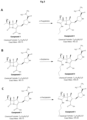
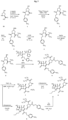
- Solvents and Reagents Dry solvents, such as dichloromethane (CH 2 Cl 2 ), tetrahydrofuran (THF), pyridine, N,N -dimethylformamide (DMF), and acetonitrile (MeCN) were purchased from commercial suppliers and used as received. Solvents for extraction and flash column chromatography were purchased in HPLC grade. D -(-)- ⁇ -Phenylglycine-D 5 ( 1, Figure 6 ) was purchased from Toronto Research Chemicals. Compound S2 ( Figure 7 ) was purchased from Ambeed Inc.. Compound 2 ( Figure 6 ) was synthesized from (+)-6-amineopenicillanic acid (S1, Figure 6 ) according to De Rosa, et al.
- CH 2 Cl 2 dichloromethane
- THF tetrahydrofuran
- DMF N,N -dimethylformamide
- MeCN acetonitrile
- NMR Spectroscopy NMR spectra were measured on an Agilent 400-MR DD2 400 MHz spectrometer equipped with a OneNMR Probe operating at 400 MHz for proton nuclei (100 MHz for carbon nuclei).
- DMSO-d 6 and CDCl 3 were purchased from Sigma-Aldrich. The 1 H NMR shifts are reported in ppm related to the residual shift of TMS. 1 H NMR shifts were calibrated to residual solvent resonances: DMSO-d 6 (2.50 ppm) and CDCl 3 (7.26 ppm).
- Mass Spectrometry Low resolution mass spectra (LRMS) were recorded on a HPLC-MS system from the Waters GmbH (2695 Separations Module, 996 Photodiode Array Detector, MicromassZQ, Grace Vydac 218TP C18 5u) that was computer-controlled through Waters MassLynx V4.1. Only characteristic molecule fragments or molecule ion peaks are indicated for each analyte.
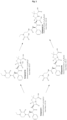
- Example 1 Stability of native Piperacillin (compound 5, see Figure 1)
- Figure 2A and 2B show the obtained areas for one MRM transition for native Piperacillin (compound 5) and its hydrolyzed forms (compounds 9a/9b), respectively. It is clear that the obtained peak-areas vary significantly over time (F-test, yielding a P value of ⁇ 0.0001) with the peak-areas of the native form decreasing and the peak-areas of the hydrolyzed forms (compounds 9a/9b) significantly increasing (F-test, yielding a P value of ⁇ 0.0001). The reason for this is the hydrolyzation or hydrolysis reaction (as is schematically depicted in Figure 1 ).
- Solvents and Reagents Dry solvents, such as dichloromethane (CH 2 Cl 2 ), tetrahydrofuran (THF) and acetonitrile (MeCN) were purchased from commercial suppliers and used as received. Solvents for extraction and flash column chromatography were purchased in HPLC grade. D -(-)- ⁇ -Phenylglycine-D 5 ( 1 ) was purchased from Toronto Research Chemicals. Compound 2 was synthesized from (+)-6-amineopenicillanic acid ( S1 ) according to De Rosa, et al. 2015 (Molecules 2015, 20, 22044-22057 ). All other reagents and solvents were purchased from chemical suppliers ( Sigma-Aldrich, Acros Organics, Alfa Aesar, TCI Europe, abcr ) and were used as received.
- CH 2 Cl 2 dichloromethane
- THF tetrahydrofuran
- MeCN acetonitrile
- the beforehand prepared solution of intermediate 4 was added at -40 °C and the reaction was stirred for 30 min., warmed to 0 °C and stirred for another hour.
- the reaction was quenched via the addition of dest. water (ca. 10 mL).
- the resulting aqueous suspension was mixed with ethyl acetate (ca. 50 mL).
- the pH of the aqueous phase was adjusted to 8.0 via the addition of solid NaHCO 3 and the layers were then separated.
- the aqueous layer was washed with ethyl acetate (20 mL, 3 times).
- Ester (6) Acid 5 (932 mg, 2.87 mmol, 1.00 eq.) and HATU (1.26 g, 3.30 mmol, 1.15 eq.) were suspended in dry tetrahydrofuran (9.4 mL) under argon atmosphere at room temperature. After cooling to 0 °C, a solution of dry DIPEA (538 ⁇ L, 3.09 mmol, 1.08 eq.) in dry tetrahydrofuran (3.0 mL) was added and the resulting mixture was stirred for 5 min.
- DIPEA 538 ⁇ L, 3.09 mmol, 1.08 eq.
- Solvents and Reagents Dry solvents, such as dichloromethane (CH 2 Cl 2 ), tetrahydrofuran (THF) and acetonitrile (MeCN) were purchased from commercial suppliers and used as received. Solvents for extraction and flash column chromatography were purchased in HPLC grade. All other reagents and solvents were purchased from chemical suppliers ( Sigma-Aldrich, Acros Organics, Alfa Aesar, TCI Europe, abcr ) and were used as received.
- CH 2 Cl 2 dichloromethane
- THF tetrahydrofuran
- MeCN acetonitrile
- trans -4-Hydroxy-L-proline S1 , 1.0 g, 7.6 mmol, 1.0 eq.
- aqueous NaOH 0.5 M , 34 mL
- 4-nitrobenzoylchloroformate 1.9 g, 8.6 mmol, 1.1 eq.
- toluene 25 mL
- the bi-phasic mixture was stirred for two hours, after which the toluene (30 mL) was added and the phases separated.
- the aqueous phase was extracted with toluene and the combined organic phases extracted with aqueous NaOH (0.5 M ).
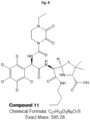
- Butylamide Ester 6 (100 mg, 0.29 mmol, 1.00 eq.) was dissolved in dry CH 3 CN (4.0 mL) at room temperature under argon atmosphere. Thereto, a solution of n -butylamine (282 ⁇ L, 2.85 mmol, 10.0 eq.) in dry CH 3 CN (2.5 mL) was added and the resulting mixture stirred for two hours until control via LCMS indicated the complete consumption of substance 6.
- Figure 5 shows the obtained areas for two MRM transitions for compound 7. It is observed that the obtained peak-areas do not vary significantly over time, i.e. the derivatized Piperacilin does not hydrolyse . This is further corroborated by an F-test, yielding P values of 0.08 and 0.14.
- Example 5 Stabilization of Meropenem (compound 1) and Piperacillin (compound 5) in patient samples
- Derivatization reagents propylamine, butylamine, or pentylamine
- dissolved in water were added to 100 ⁇ L of sample (serum spiked with 1 ⁇ g/mL of both Piperacillin (compound 5) and Meropenem (compound 1)).
Landscapes
- Health & Medical Sciences (AREA)
- Life Sciences & Earth Sciences (AREA)
- Chemical & Material Sciences (AREA)
- Engineering & Computer Science (AREA)
- Immunology (AREA)
- Molecular Biology (AREA)
- General Health & Medical Sciences (AREA)
- Biomedical Technology (AREA)
- Hematology (AREA)
- Urology & Nephrology (AREA)
- Medicinal Chemistry (AREA)
- Analytical Chemistry (AREA)
- Pharmacology & Pharmacy (AREA)
- Pathology (AREA)
- General Physics & Mathematics (AREA)
- Physics & Mathematics (AREA)
- Biochemistry (AREA)
- Microbiology (AREA)
- Biotechnology (AREA)
- Cell Biology (AREA)
- Food Science & Technology (AREA)
- Animal Behavior & Ethology (AREA)
- Organic Chemistry (AREA)
- Epidemiology (AREA)
- Public Health (AREA)
- Veterinary Medicine (AREA)
- Bioinformatics & Cheminformatics (AREA)
- Other Investigation Or Analysis Of Materials By Electrical Means (AREA)
- Investigating Or Analysing Biological Materials (AREA)
- Nitrogen Condensed Heterocyclic Rings (AREA)
- Plural Heterocyclic Compounds (AREA)
- Pharmaceuticals Containing Other Organic And Inorganic Compounds (AREA)
- Measuring Or Testing Involving Enzymes Or Micro-Organisms (AREA)
Applications Claiming Priority (3)
| Application Number | Priority Date | Filing Date | Title |
|---|---|---|---|
| EP19209520 | 2019-11-15 | ||
| EP20829798.6A EP4058460B1 (de) | 2019-11-15 | 2020-11-12 | Derivatisierung von beta-lactam-antibiotika als kalibratoren in massenspektrometriemessungen |
| PCT/EP2020/081819 WO2021094410A1 (en) | 2019-11-15 | 2020-11-12 | Derivatization of beta-lactam antibiotics as calibrators/istd in massspec measurements |
Related Parent Applications (3)
| Application Number | Title | Priority Date | Filing Date |
|---|---|---|---|
| EP20829798.6A Division-Into EP4058460B1 (de) | 2019-11-15 | 2020-11-12 | Derivatisierung von beta-lactam-antibiotika als kalibratoren in massenspektrometriemessungen |
| EP20829798.6A Division EP4058460B1 (de) | 2019-11-15 | 2020-11-12 | Derivatisierung von beta-lactam-antibiotika als kalibratoren in massenspektrometriemessungen |
| PCT/EP2020/081819 Previously-Filed-Application WO2021094410A1 (en) | 2019-11-15 | 2020-11-12 | Derivatization of beta-lactam antibiotics as calibrators/istd in massspec measurements |
Publications (2)
| Publication Number | Publication Date |
|---|---|
| EP4495124A2 true EP4495124A2 (de) | 2025-01-22 |
| EP4495124A3 EP4495124A3 (de) | 2025-03-19 |
Family
ID=68617994
Family Applications (2)
| Application Number | Title | Priority Date | Filing Date |
|---|---|---|---|
| EP24211316.5A Pending EP4495124A3 (de) | 2019-11-15 | 2020-11-12 | Derivatisierung von beta-lactam-antibiotika als kalibratoren/ist in massenprobenmessungen |
| EP20829798.6A Active EP4058460B1 (de) | 2019-11-15 | 2020-11-12 | Derivatisierung von beta-lactam-antibiotika als kalibratoren in massenspektrometriemessungen |
Family Applications After (1)
| Application Number | Title | Priority Date | Filing Date |
|---|---|---|---|
| EP20829798.6A Active EP4058460B1 (de) | 2019-11-15 | 2020-11-12 | Derivatisierung von beta-lactam-antibiotika als kalibratoren in massenspektrometriemessungen |
Country Status (7)
| Country | Link |
|---|---|
| US (1) | US20220365077A1 (de) |
| EP (2) | EP4495124A3 (de) |
| JP (1) | JP7730319B2 (de) |
| KR (1) | KR20220103114A (de) |
| CN (1) | CN114728983A (de) |
| BR (1) | BR112022009244A2 (de) |
| WO (1) | WO2021094410A1 (de) |
Families Citing this family (2)
| Publication number | Priority date | Publication date | Assignee | Title |
|---|---|---|---|---|
| CN113788842A (zh) * | 2021-10-26 | 2021-12-14 | 山东安舜制药有限公司 | 一种哌拉西林酸的制备方法 |
| US20250290940A1 (en) | 2022-05-02 | 2025-09-18 | Roche Diagnostics Operations, Inc. | Method for determining a dilution factor of a sample |
Family Cites Families (4)
| Publication number | Priority date | Publication date | Assignee | Title |
|---|---|---|---|---|
| US4316882A (en) * | 1978-04-20 | 1982-02-23 | Levine Bernard B | Compositions for testing to predict and/or diagnose allergy to penicillins |
| ZA838864B (en) * | 1982-12-17 | 1984-11-28 | Ici Pharma | Process for the manufacture of cephalosporin derivatives |
| ES2197811B2 (es) * | 2002-04-05 | 2005-05-01 | Universidad Complutense De Madrid | Sintesis de derivados fluorescentes de antiobioticos beta-lactamicos. |
| DE102010023452B4 (de) | 2010-06-11 | 2012-11-08 | Bruker Daltonik Gmbh | Massenspektrometrische Messung von β-Lactamase-Resistenzen |
-
2020
- 2020-11-12 KR KR1020227016809A patent/KR20220103114A/ko active Pending
- 2020-11-12 WO PCT/EP2020/081819 patent/WO2021094410A1/en not_active Ceased
- 2020-11-12 EP EP24211316.5A patent/EP4495124A3/de active Pending
- 2020-11-12 BR BR112022009244A patent/BR112022009244A2/pt unknown
- 2020-11-12 CN CN202080078585.2A patent/CN114728983A/zh active Pending
- 2020-11-12 EP EP20829798.6A patent/EP4058460B1/de active Active
- 2020-11-12 JP JP2022527697A patent/JP7730319B2/ja active Active
-
2022
- 2022-05-16 US US17/745,367 patent/US20220365077A1/en active Pending
Non-Patent Citations (4)
| Title |
|---|
| DE ROSA ET AL., MOLECULES, vol. 20, 2015, pages 22044 - 22057 |
| RONILDA D'CUNHA ET AL., ANTIMICROBIAL AGENTS AND CHEMOTHERAPY, vol. 62, 2018, pages 9 |
| WIEDEMANN ET AL., CHEMPLUSCHEM, 2015, pages 80 |
| ZANDER ET AL., CLINICAL CHEMISTRY AND LABORATORY MEDICINE, vol. 54, no. 2, 2016 |
Also Published As
| Publication number | Publication date |
|---|---|
| JP2023502026A (ja) | 2023-01-20 |
| US20220365077A1 (en) | 2022-11-17 |
| JP7730319B2 (ja) | 2025-08-27 |
| EP4058460B1 (de) | 2025-01-01 |
| BR112022009244A2 (pt) | 2022-08-02 |
| WO2021094410A1 (en) | 2021-05-20 |
| CN114728983A (zh) | 2022-07-08 |
| KR20220103114A (ko) | 2022-07-21 |
| EP4058460A1 (de) | 2022-09-21 |
| EP4495124A3 (de) | 2025-03-19 |
Similar Documents
| Publication | Publication Date | Title |
|---|---|---|
| CA2787900C (en) | Quantitative analysis of vitamin d3, vitamin d2, and metabolites thereof | |
| Lehr et al. | Quantification of the enantiomers of ofloxacin in biological fluids by high-performance liquid chromatography | |
| Palmgrén et al. | Drug adsorption to plastic containers and retention of drugs in cultured cells under in vitro conditions | |
| Duan et al. | Progress in pretreatment and analysis of cephalosporins: an update since 2005 | |
| US20220365077A1 (en) | Derivatization of beta-lactam antibiotics as calibrators/istd in massspec measurements | |
| Stefansson et al. | Regulation of multimer formation in electrospray mass spectrometry | |
| EP2802670B1 (de) | Lysosomale enzymtestverfahren und zusammensetzungen | |
| US20120245128A1 (en) | Rapid detection and quantification of modification of medicinal compounds and drug resistance activity | |
| US20220365099A1 (en) | Derivatization of beta-lactam antibiotics for massspec measurements in patient samples | |
| JP6760753B2 (ja) | ピロロキノリンキノンの分析方法 | |
| CN111257478A (zh) | 一种磷霉素氨丁三醇基因毒性杂质的分析方法 | |
| Shah et al. | Development and validation of a spectrofluorimetric method for the quantification of ceftriaxone in pharmaceutical formulations and plasma | |
| Barbosa et al. | Direct cefepime determination in human milk using solid mercury amalgam electrode manufactured with silver nanoparticles | |
| WO2009026252A1 (en) | Methods for assaying alpha-l-iduronidase enzymatic activity | |
| Tureček et al. | Tandem mass spectrometry in the detection of inborn errors of metabolism for newborn screening | |
| CN112213407B (zh) | 一种左奥硝唑有关物质的检测方法 | |
| Delatour et al. | Preparation of stable isotope-labeled 2-nitrobenzaldehyde derivatives of four metabolites of nitrofuran antibiotics and their comprehensive characterization by UV, MS, and NMR techniques | |
| CA3003551C (en) | Isotopic methods for measurement of tryptophan and metabolites thereof | |
| Suma | Stability indicating UPLC-MS/MS method for quantification and identification of cefepime and its degradants in API | |
| Li et al. | Automated magnetic bead‑based LC-Triple Quadrupole MS approach for sensitive colistin therapeutic drug monitoring in human plasma | |
| Sung | COMBINING CHIRAL CHROMATOGRAPHIC STATIONARY PHASES AND N-DERIVATIZATION STRATEGIES FOR THE QUALITATIVE AND QUANTITATIVE ANALYSIS OF D-AMINO ACIDS, D-AMINO ACID CONTAINING PEPTIDES AND D-AMINO ACID RELATED SECONDARY METABOLITES USING LIQUID CHROMATOGRAPHY | |
| Chuchracka et al. | HPLC/ESI-MS identification of diastereomers of Impurity E–Degradation products of cefaclor | |
| WO2023131590A1 (en) | A composition for determining at least one analyte of interest via mass spectrometry measurements | |
| Shi et al. | High-resolution mass spectrometry assay for quantifying ceramides and dihydroceramides in the cerebrospinal fluid from patients who experienced intracranial infection after craniotomy | |
| Rechelo et al. | Comparative of Three Titrimetric Determinations of Cefazolin Sodium |
Legal Events
| Date | Code | Title | Description |
|---|---|---|---|
| PUAI | Public reference made under article 153(3) epc to a published international application that has entered the european phase |
Free format text: ORIGINAL CODE: 0009012 |
|
| STAA | Information on the status of an ep patent application or granted ep patent |
Free format text: STATUS: THE APPLICATION HAS BEEN PUBLISHED |
|
| AC | Divisional application: reference to earlier application |
Ref document number: 4058460 Country of ref document: EP Kind code of ref document: P |
|
| AK | Designated contracting states |
Kind code of ref document: A2 Designated state(s): AL AT BE BG CH CY CZ DE DK EE ES FI FR GB GR HR HU IE IS IT LI LT LU LV MC MK MT NL NO PL PT RO RS SE SI SK SM TR |
|
| REG | Reference to a national code |
Ref country code: DE Ref legal event code: R079 Free format text: PREVIOUS MAIN CLASS: C07D0499897000 Ipc: C07D0499000000 |
|
| PUAL | Search report despatched |
Free format text: ORIGINAL CODE: 0009013 |
|
| AK | Designated contracting states |
Kind code of ref document: A3 Designated state(s): AL AT BE BG CH CY CZ DE DK EE ES FI FR GB GR HR HU IE IS IT LI LT LU LV MC MK MT NL NO PL PT RO RS SE SI SK SM TR |
|
| RIC1 | Information provided on ipc code assigned before grant |
Ipc: G01N 33/94 20060101ALI20250213BHEP Ipc: G01N 33/50 20060101ALI20250213BHEP Ipc: C07K 16/44 20060101ALI20250213BHEP Ipc: C07D 499/00 20060101AFI20250213BHEP |
|
| STAA | Information on the status of an ep patent application or granted ep patent |
Free format text: STATUS: REQUEST FOR EXAMINATION WAS MADE |
|
| 17P | Request for examination filed |
Effective date: 20250718 |
|
| REG | Reference to a national code |
Ref country code: DE Ref legal event code: R079 Free format text: PREVIOUS MAIN CLASS: C07D0499000000 Ipc: C07D0499897000 |
|
| RIC1 | Information provided on ipc code assigned before grant |
Ipc: C07D 499/897 20060101AFI20260304BHEP Ipc: C07D 499/00 20060101ALI20260304BHEP Ipc: C07K 16/44 20060101ALI20260304BHEP Ipc: G01N 33/50 20060101ALI20260304BHEP Ipc: G01N 33/94 20060101ALI20260304BHEP |
|
| GRAP | Despatch of communication of intention to grant a patent |
Free format text: ORIGINAL CODE: EPIDOSNIGR1 |
|
| STAA | Information on the status of an ep patent application or granted ep patent |
Free format text: STATUS: GRANT OF PATENT IS INTENDED |