EP4495079A1 - Zementmaterial, verfahren zur erzeugung davon und verwendung davon - Google Patents
Zementmaterial, verfahren zur erzeugung davon und verwendung davon Download PDFInfo
- Publication number
- EP4495079A1 EP4495079A1 EP23185882.0A EP23185882A EP4495079A1 EP 4495079 A1 EP4495079 A1 EP 4495079A1 EP 23185882 A EP23185882 A EP 23185882A EP 4495079 A1 EP4495079 A1 EP 4495079A1
- Authority
- EP
- European Patent Office
- Prior art keywords
- autoclave
- powder
- cured
- cementitious
- cement
- Prior art date
- Legal status (The legal status is an assumption and is not a legal conclusion. Google has not performed a legal analysis and makes no representation as to the accuracy of the status listed.)
- Pending
Links
Images

Classifications
-
- C—CHEMISTRY; METALLURGY
- C04—CEMENTS; CONCRETE; ARTIFICIAL STONE; CERAMICS; REFRACTORIES
- C04B—LIME, MAGNESIA; SLAG; CEMENTS; COMPOSITIONS THEREOF, e.g. MORTARS, CONCRETE OR LIKE BUILDING MATERIALS; ARTIFICIAL STONE; CERAMICS; REFRACTORIES; TREATMENT OF NATURAL STONE
- C04B20/00—Use of materials as fillers for mortars, concrete or artificial stone according to more than one of groups C04B14/00 - C04B18/00 and characterised by shape or grain distribution; Treatment of materials according to more than one of the groups C04B14/00 - C04B18/00 specially adapted to enhance their filling properties in mortars, concrete or artificial stone; Expanding or defibrillating materials
- C04B20/02—Treatment
- C04B20/023—Chemical treatment
-
- C—CHEMISTRY; METALLURGY
- C04—CEMENTS; CONCRETE; ARTIFICIAL STONE; CERAMICS; REFRACTORIES
- C04B—LIME, MAGNESIA; SLAG; CEMENTS; COMPOSITIONS THEREOF, e.g. MORTARS, CONCRETE OR LIKE BUILDING MATERIALS; ARTIFICIAL STONE; CERAMICS; REFRACTORIES; TREATMENT OF NATURAL STONE
- C04B20/00—Use of materials as fillers for mortars, concrete or artificial stone according to more than one of groups C04B14/00 - C04B18/00 and characterised by shape or grain distribution; Treatment of materials according to more than one of the groups C04B14/00 - C04B18/00 specially adapted to enhance their filling properties in mortars, concrete or artificial stone; Expanding or defibrillating materials
- C04B20/10—Coating or impregnating
- C04B20/1055—Coating or impregnating with inorganic materials
- C04B20/107—Acids or salts thereof
-
- C—CHEMISTRY; METALLURGY
- C04—CEMENTS; CONCRETE; ARTIFICIAL STONE; CERAMICS; REFRACTORIES
- C04B—LIME, MAGNESIA; SLAG; CEMENTS; COMPOSITIONS THEREOF, e.g. MORTARS, CONCRETE OR LIKE BUILDING MATERIALS; ARTIFICIAL STONE; CERAMICS; REFRACTORIES; TREATMENT OF NATURAL STONE
- C04B28/00—Compositions of mortars, concrete or artificial stone, containing inorganic binders or the reaction product of an inorganic and an organic binder, e.g. polycarboxylate cements
- C04B28/02—Compositions of mortars, concrete or artificial stone, containing inorganic binders or the reaction product of an inorganic and an organic binder, e.g. polycarboxylate cements containing hydraulic cements other than calcium sulfates
- C04B28/04—Portland cements
-
- C—CHEMISTRY; METALLURGY
- C04—CEMENTS; CONCRETE; ARTIFICIAL STONE; CERAMICS; REFRACTORIES
- C04B—LIME, MAGNESIA; SLAG; CEMENTS; COMPOSITIONS THEREOF, e.g. MORTARS, CONCRETE OR LIKE BUILDING MATERIALS; ARTIFICIAL STONE; CERAMICS; REFRACTORIES; TREATMENT OF NATURAL STONE
- C04B2103/00—Function or property of ingredients for mortars, concrete or artificial stone
- C04B2103/0068—Ingredients with a function or property not provided for elsewhere in C04B2103/00
- C04B2103/0088—Compounds chosen for their latent hydraulic characteristics, e.g. pozzuolanes
-
- Y—GENERAL TAGGING OF NEW TECHNOLOGICAL DEVELOPMENTS; GENERAL TAGGING OF CROSS-SECTIONAL TECHNOLOGIES SPANNING OVER SEVERAL SECTIONS OF THE IPC; TECHNICAL SUBJECTS COVERED BY FORMER USPC CROSS-REFERENCE ART COLLECTIONS [XRACs] AND DIGESTS
- Y02—TECHNOLOGIES OR APPLICATIONS FOR MITIGATION OR ADAPTATION AGAINST CLIMATE CHANGE
- Y02W—CLIMATE CHANGE MITIGATION TECHNOLOGIES RELATED TO WASTEWATER TREATMENT OR WASTE MANAGEMENT
- Y02W30/00—Technologies for solid waste management
- Y02W30/50—Reuse, recycling or recovery technologies
- Y02W30/91—Use of waste materials as fillers for mortars or concrete
Definitions
- the invention relates to a method of generating a cementitious powder, wherein a waste powder, such as recycled concrete paste, is carbonated.
- the invention also relates to a cementitious powder thus obtained.
- the invention further relates to the use of such a cementitious powder as a supplementary cementitious material, and/or in a cementitious material such as concrete.
- recycled concrete paste essentially consists of hydrated cement fines and/or paste from recycled concrete. CO 2 originally released by limestone calcination during cement clinker production, could be sequestered through carbonation of recycled concrete paste. The authors add thereto as a requirement, that the recycled concrete paste should be present in the fine fraction from concrete recycling. This fine fraction may be separated from sand and aggregates, which are present in a fine fraction from concrete recycling. The authors admit in this respect, that such separation is challenging and requires advanced recycling technologies that are still under development. If the recycled concrete paste could be separated and carbonated, it might be used to replace clinker to a level of 20-40%.
- alumina-silica gel is amorphous and includes that aluminum in tetrahedral coordination, in the form of Al(O-Si) 4 sites, rather than a octahedral coordination in the uncarbonated sample.
- Zajac et al. study the carbonation reaction and its potential application by carbonating hydrated Portland cement paste (CEM-I) for 360 minutes. In addition, they study a carbonated cement paste based on a slag containing composite cement. Such cement is a CEM-III type cement. The slag was GGBFS and was mixed with the cement as a 1:1 blend. Composite cements were then prepared using 60% of cement clinker and 40% of the thus obtained carbonated cement pastes. The compressive strength of the resulting composite cements was tested, at 1 day, 2 days, 7 days, 28 days and 90 days. It was found that the resulting composite cements had slightly lower strength relative to pure Portland cement.
- a method of generating a cementitious powder comprises the steps of: providing a waste powder obtained from comminuting autoclave-cured waste material that comprises a calcium silicate matrix provided with organic fibers, and carbonating said waste powder.
- a cementitious powder is provided as obtainable in accordance with the method of the invention.
- a cementitious powder is provided that is obtained from autoclave-cured waste material comprising a calcium silicate matrix that comprises at least 30wt% calcium carbonate, preferably in calcite form, and at least 40wt% of an amorphous silica-alumina phase, and preferably at least 50wt% of an amorphous silica-alumina phase, and wherein the silica-alumina phase comprises at least 75wt% of SiO2.
- the cementitious powder is more particularly obtainable from the method of the invention.
- cementitious powder of the invention as a supplementary cementitious material (SCM) is provided.
- SCM supplementary cementitious material
- a cementitious material comprising Portland cement and the cementitious powder of the invention is provided.
- the invention is based on the understanding that waste material from autoclave-cured products comprising a calcium silicate matrix is highly suitable and advantageous as a raw material for generating a cementitious powder by means of carbonation.
- This raw material does not need to be isolated from other portions of recycled concrete, but can be used on the basis of ground recycled material.
- autoclave-cured products are typically in use as panels, planks and construction boards, recycling of such products will lead to raw material of high quality and a comparatively uniform composition.
- the resulting cementitious powder turns out to have stronger pozzolanic properties and an improved microstructure than known cementitious powders obtained from carbonation of recycled concrete paste.
- the improvement particularly resides in a comparatively high content of the alumina-silica phase and therein a comparatively high concentration of silica.
- autoclave-curing is a method of steam curing of a material comprising both a source calcium oxide and a source of silicon oxide, wherein the product is put to steam at a temperature above 100°C and at a pressure well above atmospheric pressure, such as at least 5 bar, for a predetermined period of time.
- the temperature is above 150 °C and the pressure is at least 6 bars or even at least 7 bars.
- calcium oxide and silica provided as raw materials will react to form calcium silicates, that might be present either in amorphous form, typically referred to as a calcium silicate hydrate (CSH) gel, or in the form of crystalline calcium silicate.
- CSH calcium silicate hydrate
- An important crystalline phase is tobermorite, which is understood to contribute to the strength of the resulting material.
- Alternative crystalline phases of calcium silicate include xonotlite and wollastonite.
- the autoclave-cured waste material that comprises a calcium silicate matrix is waste material from a fibre cement product.
- the calcium source is cement, and further comprises organic fibers.
- Autoclave-cured fibre cement products have properties such as flexural strength and structural integrity under freeze-thaw behaviour that renders them suitable for use in exterior applications.
- these products are often produced and marketed to be decorative, due to the effective distribution of the fibers through the material and optionally any coating thereon.
- the organic fibers are typically cellulose fibers which serve as processing fibers and/or reinforcing fibers in the autoclave-cured material.
- the cellulose fiber preferably has a fineness as defined by Schopper-Riegler (SR) value of 10 to 40, preferably 15 to 30.
- autoclave-cured products for use in the method of the invention have a density of at least 1.2 kg/dm3, more preferably at least 1.4 kg/dm3, or even 1.5 kg/dm3.
- Such products are known in the art as medium-density and high-density fiber cement products. Beyond being well-characterized, these products typically do not include major additives, such as low-density additives to obtain a low-density product.
- the effectively available raw material for generating the desired carbonated autoclave-cured cementitious powder is a medium-density or high-density fiber cement product.
- the autoclave-cured waste material that comprises a calcium silicate matrix comprises agglomerates of crystalline wollastonite, xonotlite and/or tobermorite. These materials also comprise organic fibers, such as cellulose fibers. Materials comprising such agglomerates are developed and sold as fire-resistant panels.
- the agglomerates are preferably formed in a reaction comprising autoclave-curing, prior to the formation of a board. They are therefore referred to in the art as synthetic aggregates or synthetic wollastonite, synthetic xonotlite and the like.
- Such agglomerates may have a core-shell structure, wherein the shell comprises the crystalline material in a higher density than the core.
- the autoclave-cured waste material is waste from autoclaved aerated concrete (AAC).
- AAC autoclaved aerated concrete
- Ingredients of AAC material are cement, quicklime, sand and/or fly-ash, foaming additives and water. Fibers and fillers are optional.
- AAC is aggregate-free.
- Autoclaved aerated concrete can be ground to obtain a powder material.
- the air-classification herein occurs in a closed circuit, such that classified material either goes back to communication or proceeds to the sieving step.
- the grinding step is for instance embodied by making use of a ball mill or a roller mill or a pendulum mill. Very good results have been achieved by using a vertical roller mill, in which the air-classifier is incorporated.
- the ground particles will herein be moved upwards to the air-classifier. It is deemed that this moving upwards within a single reactor is beneficial to enable removal of the fibers from the cement. It is especially preferred to ensure that the reactor is heated, for instance to a temperature of at least 40°C, or even at least 60°C.
- the cementitious powder comprises a mixture of carbonated waste fibre cement powder from autoclave-cured material and of carbonated waste fibre cement powder from air-cured material.
- a benefit of such mixing is that it allows a broader supply of waste material. Furthermore, it becomes feasible to tune the composition of the alumina-silica phase, and more particularly the SiO2-content therein. This may be useful to ensure that the composition of the alumina-silica phase will remain stable, notwithstanding variations in the supply of waste material.
- the mixing may be performed before or after carbonation. It appears preferable to perform mixing prior to carbonation.
- the waste powder may be mixed with a further material prior to carbonation or after carbonation, and preferably prior to carbonation.
- further materials include a recycled cement paste (i.e. without fibres), and/or a slag material, such as GGBFS as known per se to the skilled person.
- the further material is preferably a carbonatable material.
- the autoclave-cured waste material is mixed with another material, so as to arrive at a predefined density.
- autoclave-cured waste material comprising calcium silicate aggrgates is mixed with autoclave-cured fiber cement waste material, preferably fiber cement waste material from so-called medium-density or high-density products.
- any of the implementation, embodiments and options as specified hereinabove, or hereinafter in the description of examples or in the dependent claims are applicable to all the aspects of the invention.
- any percentage referred to in the context of a composition is to be understood as a weight percentage based on the dry weight of the composition, unless otherwise indicated.
- Test samples 1 and 2 were prepared with compositions as shown in Table 1.
- a fiber cement sheet was prepared therewith using the Hatschek process.
- Composition 1 was cured by subjecting the fiber cement sheet to precuring at atmospheric conditions, followed by autoclave curing at 7 bar for 12 hours.
- Composition 2 was pre-cured during 1 night in a climatized room at around 50°C and thereafter cured in ambient conditions during 3 weeks.
- the samples had a density of around 1.4 g/cm 3 . They represented recycled waste.
- composition of samples all values as weight% relative to dry weight of composition
- Composition 1 Portland cement type CEM I 42.5 R 41 72 Kaolin 4 - Quartz 47 - Cellulose fibers 8 3 Polyvinyl alcohol fiber - 2 Limestone - 17 Amorphous silica - 6
- the cured sheets were cut in smaller pieces, after which the pieces were milled with a cutting mill (Retsch SM300 with a 500 ⁇ m sieve) to obtain a powdered material.
- This powdered material was dried in a laboratory oven at 105°C for 24 hours, and subsequently milled with a disk mill of type Retsch RS200 during 2 minutes. Finally, the powdered material was sieved over a 100 ⁇ m sieve. The residual waste from this process was 25% by weight.
- X-ray fluorescence was applied to identify the elemental composition of the samples. More generally, the amount of CaO in autoclave-cured samples is in the range of 20-30 wt%, and the amount of SiO2 is in the range of 45-65 wt%, such as 50-60wt%.
- Other metal oxides Na, K, Fe, Mg, Mn, ..
- Part of the waste fibre cement powder (at least 500 gram per test sample) produced in Example 1 was put aside to be tested as non-carbonated material. Another part of the waste fibre cement powder (at least 500 gram per test sample) from Example 1 was carbonated. Thereto, the dried and milled powders were spread out in aluminium dishes (about 250 grams per dish). The weight of the dishes and the dry powders were measured, after which the dry powders were moistened with water under a mass ratio of water over dry powder of 0.35 was achieved. The moisture was applied by spraying. Thereafter, the weight of the powders was measured again. The powders were then subjected to pre-hydration by placing them in a chamber at a temperature of 60°C and a relative humidity RH of 90% during 72 hours.
- the powders agglomerated during this pre-hydration process. Hence, they were disturbed and de-agglomerated with a spatula, after which the powders were wetted again to a mass ratio of water over dry powder of 0.35. Weight was measured before and after wetting.
- the powders thereafter were subjected to carbonation in five consecutive cycles. Each carbonation cycle had a duration of 24 hours and was performed in a carbonation chamber at a temperature of 60°C, a relative humidity RH of 90% and a constant CO 2 inflow of 1.5 l/min to achieve a CO 2 concentration of 18% by volume or higher.
- the agglomerated powders were disturbed and de-agglomerated with a spatula, and subsequently wetted until a mass ratio of water over dry powder of approximately 0.35.
- the samples were weighted before and after wetting.
- the powders were dried at 105°C for 24 hours after the last carbonation cycle, and the weight of the powders was measured before and after drying.
- the CO 2 -content in a sample can be derived from the total inorganic content (TIC), by multiplying the TIC with the ratio of molar mass of CO 2 to C (i.e. 3.667).
- the TIC can be found by measuring the total carbon content (TC) and the total organic carbon content (TOC) in a sample.
- the TIC is the difference of TC and TOC.
- TOC and TC can be determined by oxidizing a sample at a temperature of 1300°C.
- the matter contributing to TIC needs to be removed first. This is done by treatment of a dried sample with strong acid, such as phosphoric acid (for instance in a 1:1 ratio).
- Table 3 shows that the TIC and CO2-degree in composition 2 was much higher before carbonation than in composition 1. This is due to the presence of limestone in the product composition, see Table 1.
- the increase in CO2 content is higher for composition 2 than for composition 1.
- the degree of carbonation is about 80% indicating that the laboratory method of carbonation in a plurality of cycles preceded by wetting is sufficiently good, though not perfect.
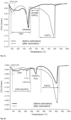
- DTG Difference Thermogravimetry
- a second peak is somewhat diminished and furthermore sharper.
- This peak originates from the cellulose in composition 1 and can be attributed to pyrolysis of fibers.
- a peak attributed to a complex of polyvinyl alcohol (PVA) fiber and Ca(OH) 2 disappeared during carbonation and was replaced by a minor peak for PVA only. All this indicates that the sharpening of the cellulose peak in Fig. 1a (as a consequence of carbonation) may be due thereto, that the fibers in the carbonated sample are less or no longer adhesively bound to the inorganic matrix.
- PVA polyvinyl alcohol
- the graph of the carbonated sample in Fig. 1a includes a broad peak in the range of up to 200°C, which is absent in the uncarbonated sample and which is less pronounced in the carbonated sample of Fig. 1b .
- This broad peak is attributed to the presence of silica gel.
- Fig. 2(a) show results for uncarbonated and carbonated samples of composition 1.
- Fig. 2(b) shows results for uncarbonated and carbonated samples of composition 2.
- results for the uncarbonated samples are shown in a solid line, and the results for the carbonated samples are shown in a line with crosses and stars.
- the graphs for the uncarbonated samples are quite different, but both include a peak around 960 cm -1 that can be attributed to the CSH gel. This peak has shifted and is increased in size in the carbonated samples. It furthermore is broader. This indicates a change in silicon-oxide bonding type.
- the peak at 960 cm -1 is representative for Q1-configuration, wherein merely one oxygen atom bonded to a silicon atom is also bonded to a further silicon atom.
- the peak around 1045 cm -1 is representative of a Q2-configuration, wherein two Si-O-Si bonds are present for a single Si-O-unit rather than one.
- the peak has a shoulder around 1160 cm -1 , that seems representative for Q3, i.e.
- Fig 2(a) shows a peak representative for SiO2 in the carbonated and non-carbonated sample. That implies that non all quartz has been converted into the aluminate-silicate gel.
- both graphs include peaks at 718 cm -1 and 1414 cm -1 that can be attributed to calcium carbonate in crystalline form.
- the carbonated material would contain calcite (47%), alumina-silica phase (50%) and a minor quantity of other (3%).
- the carbonated autoclave-cured material contains 8% of cellulose fibers, and some residual quartz that is not converted. The overall amounts thereto are roughly 7% fiber, 13% residual quartz, 42% amorphous alumina-silica phase and 38% calcite.
- the mutual ratio of the alumina-silica phase and the calcite phase is about 1.10 in the present case and 1.06 according to Zajac et al.
- the present material originates from autoclave-cured material, which comprises relatively more SiO2 than the Portland cement used in Zajac et al.
- the phase comprises 67% SiO2, 19% Al2O3 and 14% other components, including 6% alkali metal oxides (Na2O, K2O), 3% earth alkali metals (MgO, CaO), 2% Fe2O3 and 3% SO3.
- the amount of SiO2 is estimated 85%
- the Al2O3 is about 7%
- the others are about 8%, including 3% Fe.
- the amount of SiO2 is at least 75% by weight, or even at least 80% by weight, and the amount of alumina is less, up to 12%. Furthermore, the amount of alkali metal oxides is less. This leads to an alumina-silica phase, that is richer in silica, and hence would be characterized by a stronger pozzolanic behaviour.
- BET specific surface areas were determined by nitrogen gas adsorption (porosimetry) based on the BET isotherm. Use was made of a Quantachrome Apparatus (Autosorb iQ Station 1) for automated gas sorption. Table 4 - specific surface area of samples according to BET isotherm Composition Before/after carbonation Specific surface area (m 2 /g) 1 Before 33 1 After 54 2 Before 14 2 After 43
- Example 7 mortar sample preparation
- binders for mortars were prepared by mixing the uncarbonated and carbonated samples with Portland cement CEM I, 42.5 R, in accordance with Table 5.
- 450 gram binder 1350 gram standard sand and 225 gram tap water are used.
- the binder includes herein both the Portland cement CEM I and the carbonated material, in the ratio set out in Table 5.
- the effective amount 360 gram CEM-I 90 gram carbonated material, 1350 gram sand and 225 gram water.
Landscapes
- Chemical & Material Sciences (AREA)
- Engineering & Computer Science (AREA)
- Ceramic Engineering (AREA)
- Materials Engineering (AREA)
- Structural Engineering (AREA)
- Organic Chemistry (AREA)
- Chemical Kinetics & Catalysis (AREA)
- Inorganic Chemistry (AREA)
- General Chemical & Material Sciences (AREA)
- Processing Of Solid Wastes (AREA)
Priority Applications (1)
| Application Number | Priority Date | Filing Date | Title |
|---|---|---|---|
| EP23185882.0A EP4495079A1 (de) | 2023-07-17 | 2023-07-17 | Zementmaterial, verfahren zur erzeugung davon und verwendung davon |
Applications Claiming Priority (1)
| Application Number | Priority Date | Filing Date | Title |
|---|---|---|---|
| EP23185882.0A EP4495079A1 (de) | 2023-07-17 | 2023-07-17 | Zementmaterial, verfahren zur erzeugung davon und verwendung davon |
Publications (1)
| Publication Number | Publication Date |
|---|---|
| EP4495079A1 true EP4495079A1 (de) | 2025-01-22 |
Family
ID=87377793
Family Applications (1)
| Application Number | Title | Priority Date | Filing Date |
|---|---|---|---|
| EP23185882.0A Pending EP4495079A1 (de) | 2023-07-17 | 2023-07-17 | Zementmaterial, verfahren zur erzeugung davon und verwendung davon |
Country Status (1)
| Country | Link |
|---|---|
| EP (1) | EP4495079A1 (de) |
Citations (10)
| Publication number | Priority date | Publication date | Assignee | Title |
|---|---|---|---|---|
| US3501324A (en) | 1966-07-15 | 1970-03-17 | Osaka Packing | Manufacturing aqueous slurry of hydrous calcium silicate and products thereof |
| US3679446A (en) | 1968-06-04 | 1972-07-25 | Osaka Packing | Molding materials of calcium silicate hydrate and shaped products thereof |
| EP0009836A1 (de) | 1978-09-21 | 1980-04-16 | Warrior Insulation Company B.V. | Verfahren und Vorrichtung zur chargenweisen Herstellung eines Reaktionsproduktes wie Calcium-Silikat |
| US4849195A (en) | 1985-11-29 | 1989-07-18 | Redco N.V. | Synthetic crystal aggregates of xonotlite and process for preparing same |
| GB2262543A (en) | 1991-12-18 | 1993-06-23 | Nichias Corp | Calcium silicate board formed by paper-making technique |
| JP2000247721A (ja) * | 1999-03-02 | 2000-09-12 | Nichias Corp | 繊維補強セメント板の製造法 |
| JP2004217482A (ja) * | 2003-01-16 | 2004-08-05 | Kubota Matsushitadenko Exterior Works Ltd | 繊維補強セメント板とその製造方法 |
| WO2022194559A1 (en) * | 2021-03-18 | 2022-09-22 | Heidelbergcement Ag | Method and device for carbonation |
| EP4095110A1 (de) * | 2021-05-26 | 2022-11-30 | HeidelbergCement AG | Verfahren zur herstellung von ergänzendem zementmaterial |
| EP4155278A1 (de) * | 2021-09-22 | 2023-03-29 | HeidelbergCement AG | Verbesserung der reaktivität von kohlensäurehaltigen recycelten betonfeinmaterial |
-
2023
- 2023-07-17 EP EP23185882.0A patent/EP4495079A1/de active Pending
Patent Citations (10)
| Publication number | Priority date | Publication date | Assignee | Title |
|---|---|---|---|---|
| US3501324A (en) | 1966-07-15 | 1970-03-17 | Osaka Packing | Manufacturing aqueous slurry of hydrous calcium silicate and products thereof |
| US3679446A (en) | 1968-06-04 | 1972-07-25 | Osaka Packing | Molding materials of calcium silicate hydrate and shaped products thereof |
| EP0009836A1 (de) | 1978-09-21 | 1980-04-16 | Warrior Insulation Company B.V. | Verfahren und Vorrichtung zur chargenweisen Herstellung eines Reaktionsproduktes wie Calcium-Silikat |
| US4849195A (en) | 1985-11-29 | 1989-07-18 | Redco N.V. | Synthetic crystal aggregates of xonotlite and process for preparing same |
| GB2262543A (en) | 1991-12-18 | 1993-06-23 | Nichias Corp | Calcium silicate board formed by paper-making technique |
| JP2000247721A (ja) * | 1999-03-02 | 2000-09-12 | Nichias Corp | 繊維補強セメント板の製造法 |
| JP2004217482A (ja) * | 2003-01-16 | 2004-08-05 | Kubota Matsushitadenko Exterior Works Ltd | 繊維補強セメント板とその製造方法 |
| WO2022194559A1 (en) * | 2021-03-18 | 2022-09-22 | Heidelbergcement Ag | Method and device for carbonation |
| EP4095110A1 (de) * | 2021-05-26 | 2022-11-30 | HeidelbergCement AG | Verfahren zur herstellung von ergänzendem zementmaterial |
| EP4155278A1 (de) * | 2021-09-22 | 2023-03-29 | HeidelbergCement AG | Verbesserung der reaktivität von kohlensäurehaltigen recycelten betonfeinmaterial |
Non-Patent Citations (3)
| Title |
|---|
| M. ZAJAC ET AL., RILEM TECHNICAL LETTERS, vol. 6, 2021, pages 53 - 60 |
| ZAJAC ET AL., CEMENT AND CONCRETE RESEARCH, vol. 134, 2020, pages 106090 |
| ZAJAC ET AL., PROVIDE ONE IMPLEMENTATION IN CEMENT AND CONCRETE RESEARCH, vol. 130, 2020, pages 105990 |
Similar Documents
| Publication | Publication Date | Title |
|---|---|---|
| CA2821512C (en) | Geopolymer composite for ultra high performance concrete | |
| EP3778525A1 (de) | Verbessertes verfahren zur herstellung von zementzusatzmaterial | |
| EP1458489B1 (de) | Bindemittelmischung, kaolinprodukt und deren herstellung | |
| US8147610B2 (en) | Cementitious formulations and products | |
| Cardoza et al. | Alkali-activated cement manufactured by the alkaline activation of demolition and construction waste using brick and concrete wastes | |
| Tavakoli et al. | Properties of Concrete made with Waste Clay Brick as Sand Incorporating Nano SiO^ sub 2^ | |
| EP1966105A2 (de) | Multifunktionale zusammensetzung für abbindefähige verbundmaterialien und verfahren zur herstellung der zusammensetzung | |
| US20240425411A1 (en) | Improving reactivity of carbonated recycled concrete fines | |
| Matalkah et al. | CO2 treatment of ground granulated blast furnace slag for enhancing geopolymer properties | |
| CN111747672A (zh) | 超细改性磷渣粉及混凝土用超细复合掺合料 | |
| EP3305738A1 (de) | Verfahren zur zerkleinerung von ausgehärtetem faserzementmaterial und verfahren zur herstellung von faserzementmaterial enthaltenden dieses zerkleinerte faserzementmaterial | |
| Sanou et al. | Study of the mechanical behaviour of mortars modified with rice husk ash | |
| WO1999042418A1 (fr) | Objet en silicate de calcium durci ayant une grande resistance | |
| JP2023182466A (ja) | 水硬性組成物用混和材及び水硬性組成物 | |
| JPWO1999042418A1 (ja) | 高強度珪酸カルシウム硬化体 | |
| EP4495079A1 (de) | Zementmaterial, verfahren zur erzeugung davon und verwendung davon | |
| Edwards et al. | Pozzolanic properties of glass fines in lime mortars | |
| KR102146455B1 (ko) | 고로슬래그 기반 조성물 및 이의 경화체 | |
| WO2025133379A1 (en) | Method of manufacturing a fiber cement product | |
| JP4176395B2 (ja) | 低比重珪酸カルシウム硬化体の製造方法 | |
| JP2002114562A (ja) | 水熱硬化体およびその製造方法 | |
| AU2010328360B2 (en) | Chloride ingress-resistant concrete and articles formed therewith | |
| JP3432438B2 (ja) | 軽量珪酸カルシウム板の製造方法 | |
| JP7811980B1 (ja) | CaO含有組成物、カルシウム系炭酸化合物の製造方法、カルシウム系炭酸化合物、無機質成形体、及び、無機質成形体のCO2固定化率を上昇させる方法 | |
| JP7811981B1 (ja) | カルシウム系炭酸化合物製造用のCaO含有組成物、カルシウム系炭酸化合物の製造方法、カルシウム系炭酸化合物、無機質成形体、及び、無機質成形体のCO2固定化率を上昇させる方法 |
Legal Events
| Date | Code | Title | Description |
|---|---|---|---|
| PUAI | Public reference made under article 153(3) epc to a published international application that has entered the european phase |
Free format text: ORIGINAL CODE: 0009012 |
|
| STAA | Information on the status of an ep patent application or granted ep patent |
Free format text: STATUS: THE APPLICATION HAS BEEN PUBLISHED |
|
| AK | Designated contracting states |
Kind code of ref document: A1 Designated state(s): AL AT BE BG CH CY CZ DE DK EE ES FI FR GB GR HR HU IE IS IT LI LT LU LV MC ME MK MT NL NO PL PT RO RS SE SI SK SM TR |
|
| STAA | Information on the status of an ep patent application or granted ep patent |
Free format text: STATUS: REQUEST FOR EXAMINATION WAS MADE |
|
| 17P | Request for examination filed |
Effective date: 20250722 |
|
| TPAC | Observations filed by third parties |
Free format text: ORIGINAL CODE: EPIDOSNTIPA |