EP4492811A1 - Photoelektrische wandlerschaltung und photoelektrische wandlervorrichtung - Google Patents
Photoelektrische wandlerschaltung und photoelektrische wandlervorrichtung Download PDFInfo
- Publication number
- EP4492811A1 EP4492811A1 EP23766524.5A EP23766524A EP4492811A1 EP 4492811 A1 EP4492811 A1 EP 4492811A1 EP 23766524 A EP23766524 A EP 23766524A EP 4492811 A1 EP4492811 A1 EP 4492811A1
- Authority
- EP
- European Patent Office
- Prior art keywords
- exposure
- unit
- transistor
- charges
- photoelectric conversion
- Prior art date
- Legal status (The legal status is an assumption and is not a legal conclusion. Google has not performed a legal analysis and makes no representation as to the accuracy of the status listed.)
- Pending
Links
Images



Classifications
-
- H—ELECTRICITY
- H04—ELECTRIC COMMUNICATION TECHNIQUE
- H04N—PICTORIAL COMMUNICATION, e.g. TELEVISION
- H04N25/00—Circuitry of solid-state image sensors [SSIS]; Control thereof
- H04N25/70—SSIS architectures; Circuits associated therewith
- H04N25/703—SSIS architectures incorporating pixels for producing signals other than image signals
- H04N25/705—Pixels for depth measurement, e.g. RGBZ
-
- G—PHYSICS
- G01—MEASURING; TESTING
- G01S—RADIO DIRECTION-FINDING; RADIO NAVIGATION; DETERMINING DISTANCE OR VELOCITY BY USE OF RADIO WAVES; LOCATING OR PRESENCE-DETECTING BY USE OF THE REFLECTION OR RERADIATION OF RADIO WAVES; ANALOGOUS ARRANGEMENTS USING OTHER WAVES
- G01S17/00—Systems using the reflection or reradiation of electromagnetic waves other than radio waves, e.g. lidar systems
- G01S17/02—Systems using the reflection of electromagnetic waves other than radio waves
- G01S17/06—Systems determining position data of a target
- G01S17/08—Systems determining position data of a target for measuring distance only
- G01S17/10—Systems determining position data of a target for measuring distance only using transmission of interrupted, pulse-modulated waves
- G01S17/18—Systems determining position data of a target for measuring distance only using transmission of interrupted, pulse-modulated waves wherein range gates are used
-
- G—PHYSICS
- G01—MEASURING; TESTING
- G01S—RADIO DIRECTION-FINDING; RADIO NAVIGATION; DETERMINING DISTANCE OR VELOCITY BY USE OF RADIO WAVES; LOCATING OR PRESENCE-DETECTING BY USE OF THE REFLECTION OR RERADIATION OF RADIO WAVES; ANALOGOUS ARRANGEMENTS USING OTHER WAVES
- G01S17/00—Systems using the reflection or reradiation of electromagnetic waves other than radio waves, e.g. lidar systems
- G01S17/88—Lidar systems specially adapted for specific applications
- G01S17/89—Lidar systems specially adapted for specific applications for mapping or imaging
- G01S17/894—3D imaging with simultaneous measurement of time-of-flight at a 2D array of receiver pixels, e.g. time-of-flight cameras or flash lidar
-
- G—PHYSICS
- G01—MEASURING; TESTING
- G01S—RADIO DIRECTION-FINDING; RADIO NAVIGATION; DETERMINING DISTANCE OR VELOCITY BY USE OF RADIO WAVES; LOCATING OR PRESENCE-DETECTING BY USE OF THE REFLECTION OR RERADIATION OF RADIO WAVES; ANALOGOUS ARRANGEMENTS USING OTHER WAVES
- G01S7/00—Details of systems according to groups G01S13/00, G01S15/00, G01S17/00
- G01S7/48—Details of systems according to groups G01S13/00, G01S15/00, G01S17/00 of systems according to group G01S17/00
- G01S7/483—Details of pulse systems
- G01S7/486—Receivers
- G01S7/4861—Circuits for detection, sampling, integration or read-out
- G01S7/4863—Detector arrays, e.g. charge-transfer gates
-
- G—PHYSICS
- G01—MEASURING; TESTING
- G01S—RADIO DIRECTION-FINDING; RADIO NAVIGATION; DETERMINING DISTANCE OR VELOCITY BY USE OF RADIO WAVES; LOCATING OR PRESENCE-DETECTING BY USE OF THE REFLECTION OR RERADIATION OF RADIO WAVES; ANALOGOUS ARRANGEMENTS USING OTHER WAVES
- G01S7/00—Details of systems according to groups G01S13/00, G01S15/00, G01S17/00
- G01S7/48—Details of systems according to groups G01S13/00, G01S15/00, G01S17/00 of systems according to group G01S17/00
- G01S7/497—Means for monitoring or calibrating
-
- H—ELECTRICITY
- H04—ELECTRIC COMMUNICATION TECHNIQUE
- H04N—PICTORIAL COMMUNICATION, e.g. TELEVISION
- H04N25/00—Circuitry of solid-state image sensors [SSIS]; Control thereof
- H04N25/70—SSIS architectures; Circuits associated therewith
- H04N25/76—Addressed sensors, e.g. MOS or CMOS sensors
- H04N25/77—Pixel circuitry, e.g. memories, A/D converters, pixel amplifiers, shared circuits or shared components
Definitions
- the present disclosure relates to a photoelectric conversion circuit and a photoelectric conversion device.
- one aspect of the disclosure is a photoelectric conversion circuit including a light receiving element that outputs charges corresponding to an amount of exposure to a predetermined wiring line, an output circuit that, when an instruction signal is input, outputs charges corresponding to a period during which the instruction signal is input to the predetermined wiring line, a plurality of charge storage units, and a transfer circuit that transfers the charges output to the predetermined wiring line to each of the plurality of charge storage units.
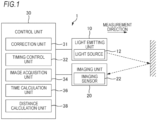
- FIG. 1 is a diagram showing a configuration of a measuring device 1.
- the timing control unit 32 controls the light emission timing of the light emitting unit 10 and the exposure timing of the imaging unit 20. The light emission timing and the exposure timing will be described later.
- the image acquisition unit 34 acquires image data from the imaging sensor 22 of the imaging unit 20.
- the image acquisition unit 34 also includes a memory (not shown) that stores the acquired image data.
- the time calculation unit 36 calculates an arrival time from when the light source 12 of the light emitting unit 10 emits light to when reflected light reaches the imaging sensor 22 of the imaging unit 20, that is, a flight time of light: ToF.
- FIG. 2 is a diagram showing a configuration of the imaging sensor 22 in the present embodiment.
- the imaging sensor 22 captures an image of an imaging target in response to an instruction from the control unit 30, and outputs image data obtained by capturing the image to the image acquisition unit 34 of the control unit 30.
- the value of each pixel (pixel data) that constitutes the image data indicates a signal value corresponding to the amount of exposure.
- the imaging sensor 22 has a plurality of pixels 221 disposed two-dimensionally (for example, 640 ⁇ 480).
- Each of the pixels 221 includes a light receiving element D1, a transistor SPD, a transistor PDR, an output circuit 50, a transfer circuit 60, signal readout units RU1 to RU4, and signal conversion units SO1 to SO4.
- the imaging sensor 22 (pixel 221) corresponds to a "photoelectric conversion circuit”.
- each transistor used in the imaging sensor 22 is, for example, an N-type MOSFET, and the turn-on/turn-off of each transistor is controlled by the control unit 30.
- the light receiving element D1 is an element (such as a photodiode) that generates charges corresponding to the amount of exposure.
- the light receiving element D1 outputs the generated charges to a wiring line L1 via the transistor SPD.
- the wiring line L1 corresponds to a "prescribed wiring line”.
- the transistor PDR is an element that discharges charges of the light receiving element D1, and is connected in parallel to the light receiving element D1.
- the transistor PDR corresponds to a "third switch”.
- the signal conversion unit SO1 outputs a signal value corresponding to the charges stored in the charge storage unit CS1 by selecting the select transistor SL1 of the signal readout unit RU1.
- the signal conversion unit SO1 includes an amplifier circuit ZF1 that amplifies the output of the signal readout unit RU1, and an A/D conversion circuit HK1 that converts an analog signal output from the amplifier circuit ZF1 into a digital signal.
- the signal conversion unit SO1 then converts the charges stored in the charge storage unit CS1 (the amount of exposure during the exposure period) into a signal value (digital signal) corresponding to the charges and outputs the signal value to the image acquisition unit 34 of the control unit 30.
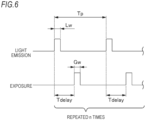
- FIG. 6 is a diagram showing a light emission timing and an exposure timing.
- FIG. 7 is a diagram showing creation of a distance image by indirect ToF. As described above, during measurement, control is performed such that the transistor SPD is turned on and transistors SCS and PDR and reset transistors RT1 to RT4 are turned off.
- Light emission and exposure are repeated a plurality of times at a cycle Tp shown in FIG. 6 . This is for storage of charges in the imaging sensor 22.
- the farther a region to be measured the larger the number of repetitions n is set. This is because reflected light becomes weaker the farther the region.
- a multi-tap (specifically, 4-tap) CMOS image sensor is used as the imaging sensor 22.
- four exposure periods can be set for one light emission, and four regions can be measured. That is, four range images are obtained through one imaging.
- the number of range images (four in this case) obtained through one imaging may be referred to as "subframes”.
- a plurality of regions (four regions in this case) measured through one imaging may be referred to as a "zone".
- the imaging sensor 22 is not limited to a 4-tap CMOS image sensor.
- control unit 30 causes the light emitting unit 10 to emit light at a cycle Tp (see FIG. 6 ) and controls the exposure timing of the imaging unit 20 in accordance with the light emission timing.
- image acquisition unit 34 acquires an image (image data) captured by the imaging unit 20 at each exposure timing.
- the control unit 30 acquires an image of a zone 1 (regions 1 to 4). That is, the timing control unit 32 causes the imaging sensor 22 of the imaging unit 20 to perform exposure for each pixel of the image during exposure periods 1 to 4 (see FIG. 8 ) delayed from the light emission timing.
- the timing control unit 32 repeatedly performs exposure at each cycle Tp, and stores charges in the charge storage units CS1 to CS4.
- the control unit 30 acquires an image of a zone 2 (regions 5 to 8).
- the control unit 30 then writes the image data of the range images (subframes) of the regions 5 to 8 to the image memory of the image acquisition unit 34.
- a delay time Tdelay for the light emission timing in the zone 2 (regions 5 to 8) is set to be longer than that of the zone 1 (regions 1 to 4).
- the number of repetitions is set to be larger as a region to be measured becomes farther.
- light emitting pulses are separate in the regions 4 and 5
- the exposure periods of the regions 4 and 5 are continuous when the light emitting pulse is used as a reference. In this manner, continuous exposure periods are not limited to those constituted by only exposure periods with the same light emission timing, but may also include exposure periods with different light emission timings.
- images up to the region N are acquired.
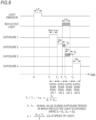
- FIG. 8 is a diagram showing a relationship between light emission and exposure in the case of four taps.
- the pulse width of the light emitting pulse is Lw.
- the pulse width of reflected light is also Lw.
- exposures 1 to 4 are set.
- the width of each of the exposure periods (exposure widths) of the exposures 1 to 4 is the same as the pulse width Lw of the light emitting pulse.
- the exposure period is a period during which the level of exposure in FIG. 8 is a high level (H level).
- the H/L levels of the exposures 1 to 4 indicate turn-on/turn-off of the transfer transistors G1 to G4 in FIG. 2 .
- the reflected light may arrive in a period different from the exposure period 2 and the exposure period 3, and for example, the reflected light may be exposed in the exposure period 1 and the exposure period 2.
- the exposure period 3 corresponding to a region (region 3) next to the region 2 is set for the exposure 3.
- the pixel 221 of the imaging sensor 22 acquires a signal value S 3 corresponding to the amount of exposure of the reflected light in the exposure period 3.
- the exposure period 4 corresponding to a region (region 4) next to the region 3 is set for the exposure 4.
- reflected light is not exposed in the exposure period 4, and thus no charges are stored in the charge storage unit CS4 of the pixel 221 of the imaging sensor 22. That is, a signal value S 4 acquired in the exposure period 4 is zero.
- signal values S i (here, S 1 to S 4 ) become signal values corresponding to charges (corresponding to the amount of exposure) stored by repeating the exposure by the number of repetitions n.
- the signal conversion units SO1 to SO4 of the pixels 221 of the imaging sensor 22 output the signal values S 1 to S 4 corresponding to the charges stored in the charge storage units CS1 to CS4.
- the signal values S 1 to S 4 correspond to the values of pixels (pixel data) that constitute the image data of the images (range images) of the regions 1 to 4, respectively.
- the image acquisition unit 34 of the control unit 30 acquires the signal values S 1 to S 4 (signal values corresponding to the charges in the charge storage units CS1 to CS4) of the pixels 221 from the imaging sensor 22. Thereby, the image acquisition unit 34 acquires the image data of the regions 1 to 4. Similarly, the image acquisition unit 34 acquires images up to the region N (images of all regions).
- the time calculation unit 36 of the control unit 30 calculates an arrival time Tx of reflected light. Specifically, first, the time calculation unit 36 specifies a signal value S of exposure of the reflected light from among the signal values S 1 to S 4 (signal values S 1 to S N ). For example, the time calculation unit 36 specifies a signal value with the largest amount of exposure which is a signal corresponding to two consecutive exposure periods. For example, when a signal value corresponding to an exposure period i in which the exposure of the reflected light is started is set to be S i , two signal values S i and S i + 1 are specified.
- signal values S 2 and S 3 correspond to the signal values S i and S i + 1 of the exposure of the reflected light.
- the time calculation unit 36 calculates a flight time of light (hereinafter also referred to as an arrival time) Tx according to the following Formula (1) by using the signal values S i and S i+1 .
- Tx T i + 1 ⁇ Lw ⁇ S i / S i + S i + 1
- the distance calculation unit 38 calculates the distance L to the object by Formula (2).
- the imaging sensor 22 and the measuring device 1 according to the present embodiment have been described above.
- the imaging sensor 22 includes the light receiving element D1, the output circuit 50, four charge storage units CS1 to CS4, and the transfer circuit 60.
- the light receiving element D1 outputs charges corresponding to the amount of exposure to the wiring line L1.
- the output circuit 50 receives an input of a signal (H-level signal Sa) for instructing calibration from the control unit 30, the output circuit 50 outputs charges corresponding to a period during which the signal is input to the wiring line L1.
- the transfer circuit 60 transfers the charges output to the wiring line L1 to each of the four charge storage units CS1 to CS4. Thereby, it is possible to output charges (current) for calibration from the output circuit 50, and thus variations can be corrected without using dedicated equipment.
- the output circuit 50 also includes the current source 52 and the transistor SCS.
- the transistor SCS is provided between the current source 52 and the wiring line L1, and is turned on based on a command signal from the control unit 30 and turned off based on a stop signal. Thereby, it is possible to control the supply of charges (current) from the current source 52 to the wiring line L1.
- the current source 52A of the output circuit 50A includes the resistor R1 having one end to which a voltage VS is applied, and the capacitor CA connected to the other end of the resistor R1.
- the transistor SCS is connected to a node N1 to which the resistor R1 and the capacitor CA are connected.
- the imaging sensor 22 includes the transistor SPD provided between the light receiving element D1 and the wiring line L1. Thereby, it is possible to perform calibration at a desired timing.
Landscapes
- Engineering & Computer Science (AREA)
- Physics & Mathematics (AREA)
- Computer Networks & Wireless Communication (AREA)
- General Physics & Mathematics (AREA)
- Radar, Positioning & Navigation (AREA)
- Remote Sensing (AREA)
- Electromagnetism (AREA)
- Multimedia (AREA)
- Signal Processing (AREA)
- Optical Radar Systems And Details Thereof (AREA)
Applications Claiming Priority (2)
| Application Number | Priority Date | Filing Date | Title |
|---|---|---|---|
| JP2022038375 | 2022-03-11 | ||
| PCT/JP2023/006026 WO2023171345A1 (ja) | 2022-03-11 | 2023-02-20 | 光電変換回路、及び光電変換装置 |
Publications (2)
| Publication Number | Publication Date |
|---|---|
| EP4492811A1 true EP4492811A1 (de) | 2025-01-15 |
| EP4492811A4 EP4492811A4 (de) | 2025-06-25 |
Family
ID=87936882
Family Applications (1)
| Application Number | Title | Priority Date | Filing Date |
|---|---|---|---|
| EP23766524.5A Pending EP4492811A4 (de) | 2022-03-11 | 2023-02-20 | Photoelektrische wandlerschaltung und photoelektrische wandlervorrichtung |
Country Status (4)
| Country | Link |
|---|---|
| EP (1) | EP4492811A4 (de) |
| JP (1) | JPWO2023171345A1 (de) |
| CN (1) | CN118891894A (de) |
| WO (1) | WO2023171345A1 (de) |
Family Cites Families (6)
| Publication number | Priority date | Publication date | Assignee | Title |
|---|---|---|---|---|
| US20170024868A1 (en) * | 2015-07-22 | 2017-01-26 | Semiconductor Components Industries, Llc | High dynamic range imaging pixels with logarithmic response |
| WO2020014902A1 (zh) * | 2018-07-18 | 2020-01-23 | 深圳市汇顶科技股份有限公司 | 飞时测距系统及校正方法 |
| JP2020118569A (ja) * | 2019-01-24 | 2020-08-06 | ソニーセミコンダクタソリューションズ株式会社 | 受光装置および測距装置 |
| FR3094839B1 (fr) * | 2019-04-02 | 2021-04-09 | Commissariat A Lenergie Atomique Et Aux Energies | Capteur pour l'acquisition d'un signal lumineux modulé à une fréquence acoustique |
| JP7463671B2 (ja) | 2019-08-01 | 2024-04-09 | Toppanホールディングス株式会社 | 距離画像撮像装置、及び距離画像撮像方法 |
| JP7547119B2 (ja) | 2020-08-26 | 2024-09-09 | キヤノン株式会社 | 印刷システム、管理サーバシステム、及び制御方法 |
-
2023
- 2023-02-20 JP JP2024506025A patent/JPWO2023171345A1/ja active Pending
- 2023-02-20 EP EP23766524.5A patent/EP4492811A4/de active Pending
- 2023-02-20 CN CN202380026803.1A patent/CN118891894A/zh active Pending
- 2023-02-20 WO PCT/JP2023/006026 patent/WO2023171345A1/ja not_active Ceased
Also Published As
| Publication number | Publication date |
|---|---|
| CN118891894A (zh) | 2024-11-01 |
| EP4492811A4 (de) | 2025-06-25 |
| JPWO2023171345A1 (de) | 2023-09-14 |
| WO2023171345A1 (ja) | 2023-09-14 |
Similar Documents
| Publication | Publication Date | Title |
|---|---|---|
| CN114175618B (zh) | 距离图像摄像装置以及距离图像摄像方法 | |
| US10690755B2 (en) | Solid-state imaging device having increased distance measurement accuracy and increased distance measurement range | |
| US9787912B2 (en) | Image capture device | |
| US20240393174A1 (en) | Photoelectric conversion apparatus, imaging system, and moving object | |
| US10823827B2 (en) | Imaging system, distance measuring device, and method for operating the imaging system and the distance measuring device | |
| KR102481693B1 (ko) | 거리 측정 장치 | |
| RU2730175C1 (ru) | Устройство фотоэлектрического преобразования, способ возбуждения устройства фотоэлектрического преобразования, система формирования изображения и подвижный объект | |
| US20190007592A1 (en) | Imaging device and solid-state imaging element used in same | |
| US20200137330A1 (en) | A pixel structure | |
| US9154718B2 (en) | Solid state imaging device | |
| CN110024375B (zh) | 固态摄像装置和测距摄像装置 | |
| US11336854B2 (en) | Distance image capturing apparatus and distance image capturing method using distance image capturing apparatus | |
| US7956915B2 (en) | Solid-state imaging apparatus | |
| WO2020054617A1 (ja) | 測距撮像装置、及び固体撮像素子 | |
| US10841519B2 (en) | Photoelectric conversion apparatus, equipment, and driving method of photoelectric conversion apparatus | |
| US11184567B2 (en) | Imaging device and solid-state imaging element and imaging method used therein | |
| US11800255B2 (en) | Solid-state imaging device including driver circuits comprising multi-stage buffer elements | |
| JP6190690B2 (ja) | 距離測定システム及び補正用データの取得方法 | |
| EP4492811A1 (de) | Photoelektrische wandlerschaltung und photoelektrische wandlervorrichtung | |
| JP2000023047A (ja) | 3次元画像入力装置 | |
| US20220350024A1 (en) | Distance image capturing device and distance image capturing method | |
| US20250147157A1 (en) | Measurement apparatus | |
| US20250123374A1 (en) | Measurement device | |
| US20230119511A1 (en) | Apparatus, system, moving body, and equipment | |
| JP2001148868A (ja) | 3次元画像検出装置 |
Legal Events
| Date | Code | Title | Description |
|---|---|---|---|
| STAA | Information on the status of an ep patent application or granted ep patent |
Free format text: STATUS: THE INTERNATIONAL PUBLICATION HAS BEEN MADE |
|
| PUAI | Public reference made under article 153(3) epc to a published international application that has entered the european phase |
Free format text: ORIGINAL CODE: 0009012 |
|
| STAA | Information on the status of an ep patent application or granted ep patent |
Free format text: STATUS: REQUEST FOR EXAMINATION WAS MADE |
|
| 17P | Request for examination filed |
Effective date: 20240916 |
|
| AK | Designated contracting states |
Kind code of ref document: A1 Designated state(s): AL AT BE BG CH CY CZ DE DK EE ES FI FR GB GR HR HU IE IS IT LI LT LU LV MC ME MK MT NL NO PL PT RO RS SE SI SK SM TR |
|
| REG | Reference to a national code |
Ref country code: DE Ref legal event code: R079 Free format text: PREVIOUS MAIN CLASS: H04N0025770000 Ipc: G01S0007497000 |
|
| DAV | Request for validation of the european patent (deleted) | ||
| DAX | Request for extension of the european patent (deleted) | ||
| A4 | Supplementary search report drawn up and despatched |
Effective date: 20250526 |
|
| RIC1 | Information provided on ipc code assigned before grant |
Ipc: H04N 25/705 20230101ALI20250520BHEP Ipc: G01S 17/18 20200101ALI20250520BHEP Ipc: G01S 17/894 20200101ALI20250520BHEP Ipc: G01S 7/4863 20200101ALI20250520BHEP Ipc: H04N 25/77 20230101ALI20250520BHEP Ipc: G01S 7/497 20060101AFI20250520BHEP |