EP4489014A1 - Verfahren zur berechnung der kohlenstoffkonzentrationsverteilung während der impulsaufkohlung - Google Patents
Verfahren zur berechnung der kohlenstoffkonzentrationsverteilung während der impulsaufkohlung Download PDFInfo
- Publication number
- EP4489014A1 EP4489014A1 EP23918049.0A EP23918049A EP4489014A1 EP 4489014 A1 EP4489014 A1 EP 4489014A1 EP 23918049 A EP23918049 A EP 23918049A EP 4489014 A1 EP4489014 A1 EP 4489014A1
- Authority
- EP
- European Patent Office
- Prior art keywords
- carbon concentration
- carburizing
- concentration distribution
- carburizing process
- value
- Prior art date
- Legal status (The legal status is an assumption and is not a legal conclusion. Google has not performed a legal analysis and makes no representation as to the accuracy of the status listed.)
- Granted
Links
Images

Classifications
-
- C—CHEMISTRY; METALLURGY
- C23—COATING METALLIC MATERIAL; COATING MATERIAL WITH METALLIC MATERIAL; CHEMICAL SURFACE TREATMENT; DIFFUSION TREATMENT OF METALLIC MATERIAL; COATING BY VACUUM EVAPORATION, BY SPUTTERING, BY ION IMPLANTATION OR BY CHEMICAL VAPOUR DEPOSITION, IN GENERAL; INHIBITING CORROSION OF METALLIC MATERIAL OR INCRUSTATION IN GENERAL
- C23C—COATING METALLIC MATERIAL; COATING MATERIAL WITH METALLIC MATERIAL; SURFACE TREATMENT OF METALLIC MATERIAL BY DIFFUSION INTO THE SURFACE, BY CHEMICAL CONVERSION OR SUBSTITUTION; COATING BY VACUUM EVAPORATION, BY SPUTTERING, BY ION IMPLANTATION OR BY CHEMICAL VAPOUR DEPOSITION, IN GENERAL
- C23C8/00—Solid state diffusion of only non-metal elements into metallic material surfaces; Chemical surface treatment of metallic material by reaction of the surface with a reactive gas, leaving reaction products of surface material in the coating, e.g. conversion coatings, passivation of metals
- C23C8/06—Solid state diffusion of only non-metal elements into metallic material surfaces; Chemical surface treatment of metallic material by reaction of the surface with a reactive gas, leaving reaction products of surface material in the coating, e.g. conversion coatings, passivation of metals using gases
- C23C8/08—Solid state diffusion of only non-metal elements into metallic material surfaces; Chemical surface treatment of metallic material by reaction of the surface with a reactive gas, leaving reaction products of surface material in the coating, e.g. conversion coatings, passivation of metals using gases only one element being applied
- C23C8/20—Carburising
-
- C—CHEMISTRY; METALLURGY
- C23—COATING METALLIC MATERIAL; COATING MATERIAL WITH METALLIC MATERIAL; CHEMICAL SURFACE TREATMENT; DIFFUSION TREATMENT OF METALLIC MATERIAL; COATING BY VACUUM EVAPORATION, BY SPUTTERING, BY ION IMPLANTATION OR BY CHEMICAL VAPOUR DEPOSITION, IN GENERAL; INHIBITING CORROSION OF METALLIC MATERIAL OR INCRUSTATION IN GENERAL
- C23C—COATING METALLIC MATERIAL; COATING MATERIAL WITH METALLIC MATERIAL; SURFACE TREATMENT OF METALLIC MATERIAL BY DIFFUSION INTO THE SURFACE, BY CHEMICAL CONVERSION OR SUBSTITUTION; COATING BY VACUUM EVAPORATION, BY SPUTTERING, BY ION IMPLANTATION OR BY CHEMICAL VAPOUR DEPOSITION, IN GENERAL
- C23C8/00—Solid state diffusion of only non-metal elements into metallic material surfaces; Chemical surface treatment of metallic material by reaction of the surface with a reactive gas, leaving reaction products of surface material in the coating, e.g. conversion coatings, passivation of metals
- C23C8/06—Solid state diffusion of only non-metal elements into metallic material surfaces; Chemical surface treatment of metallic material by reaction of the surface with a reactive gas, leaving reaction products of surface material in the coating, e.g. conversion coatings, passivation of metals using gases
- C23C8/08—Solid state diffusion of only non-metal elements into metallic material surfaces; Chemical surface treatment of metallic material by reaction of the surface with a reactive gas, leaving reaction products of surface material in the coating, e.g. conversion coatings, passivation of metals using gases only one element being applied
- C23C8/20—Carburising
- C23C8/22—Carburising of ferrous surfaces
-
- G—PHYSICS
- G06—COMPUTING OR CALCULATING; COUNTING
- G06F—ELECTRIC DIGITAL DATA PROCESSING
- G06F17/00—Digital computing or data processing equipment or methods, specially adapted for specific functions
- G06F17/10—Complex mathematical operations
- G06F17/11—Complex mathematical operations for solving equations, e.g. nonlinear equations, general mathematical optimization problems
-
- G—PHYSICS
- G06—COMPUTING OR CALCULATING; COUNTING
- G06F—ELECTRIC DIGITAL DATA PROCESSING
- G06F17/00—Digital computing or data processing equipment or methods, specially adapted for specific functions
- G06F17/10—Complex mathematical operations
- G06F17/14—Fourier, Walsh or analogous domain transformations, e.g. Laplace, Hilbert, Karhunen-Loeve, transforms
-
- G—PHYSICS
- G16—INFORMATION AND COMMUNICATION TECHNOLOGY [ICT] SPECIALLY ADAPTED FOR SPECIFIC APPLICATION FIELDS
- G16C—COMPUTATIONAL CHEMISTRY; CHEMOINFORMATICS; COMPUTATIONAL MATERIALS SCIENCE
- G16C20/00—Chemoinformatics, i.e. ICT specially adapted for the handling of physicochemical or structural data of chemical particles, elements, compounds or mixtures
- G16C20/20—Identification of molecular entities, parts thereof or of chemical compositions
-
- G—PHYSICS
- G16—INFORMATION AND COMMUNICATION TECHNOLOGY [ICT] SPECIALLY ADAPTED FOR SPECIFIC APPLICATION FIELDS
- G16C—COMPUTATIONAL CHEMISTRY; CHEMOINFORMATICS; COMPUTATIONAL MATERIALS SCIENCE
- G16C60/00—Computational materials science, i.e. ICT specially adapted for investigating the physical or chemical properties of materials or phenomena associated with their design, synthesis, processing, characterisation or utilisation
Definitions
- the present disclosure relates to the field of vacuum low-pressure carburizing, and in particular, to a method for calculating a carbon concentration distribution in a pulse carburizing process.
- Vacuum low-pressure carburizing originated from vacuum solid carburizing in the 1960s. In the 1970s, the vacuum solid carburizing had been gradually evolved into carburizing using a low-pressure gas and pulses, and dedicated vacuum carburizing equipment had emerged. In the 1990s, the concept of low-pressure carburizing had been clearly put forward, and it was experimentally demonstrated the advantages of acetylene as a carburizing medium in reducing carbon black production. After 2000, with the progress of research, a vacuum low-pressure carburizing process with acetylene as the carburizing medium and pulses as a working manner had been created. Along with worldwide problems such as environmental degradation and energy crisis, vacuum low-pressure carburizing, as a clean, efficient, and green thermal treatment technique, had received widespread attention.
- Obtaining a carbon concentration distribution at a certain time in a carburizing process lays a foundation for describing and controlling a vacuum carburizing process.
- an oxygen probe cannot be used in the vacuum carburizing process and a carbon potential cannot be measured. It is thus impossible to obtain a real-time data feedback and realize real-time control. Therefore, the vacuum carburizing process relies more on the calculation of the carbon concentration distribution.
- a boost-diffusion cyclic pulse process is employed for vacuum carburizing.
- a carbon concentration distribution cannot be calculated directly and rapidly to obtain information such as a surface carbon concentration and a carburized layer depth for guiding vacuum carburizing process control.
- a method employed currently is a numerical calculation method.
- An equation e.g., Fick law
- Fick law may be discretized in space and time by using a finite element method or a finite difference method, and then is solved to obtain a carbon concentration distribution at a certain time in a carburizing process.
- the numerical calculation method may take a long time for calculation and require a lot of calculation resources, and cannot give a result in real time. Meanwhile, due to mathematical simplification of the numerical method, a systemic error may be produced, resulting in low calculation accuracy.
- an objective of the present disclosure is to provide a method for calculating a carbon concentration distribution in a pulse carburizing process.
- the method may obtain a carbon concentration distribution of each process during a pulse carburizing process and accurately describe a vacuum low-pressure carburizing process.
- the method is high in calculation accuracy and short in calculation time.
- a method for calculating a carbon concentration distribution in a pulse carburizing process includes:
- the present disclosure further provides a computer-readable storage medium, storing a computer program which, when executed by a processor, is caused to implement the method for calculating a carbon concentration distribution in a pulse carburizing process as described in the above technical solution.
- the method for calculating a carbon concentration distribution in a pulse carburizing process described in the present disclosure has the following beneficial effects.
- a method for calculating a carbon concentration distribution in a pulse carburizing process includes setting a carburized layer depth, constructing an auxiliary function, performing Fourier expansion, and performing integral calculation of a carbon concentration distribution.
- the setting the carburized layer depth refers to setting a carburized layer depth F, and a value of a carbon concentration distribution at a position F is a matrix carbon concentration.
- the constructing the auxiliary function refers to selecting a positive number L to construct an auxiliary function within an interval [-L, 0], where a value of the auxiliary function at a position -L is the matrix carbon concentration, a derivative value at the position -L is 0, a value at a position 0 is equal to a value of a carbon concentration distribution at the position 0, and a derivative value at the position 0 is equal to a derivative value of the carbon concentration distribution at the position 0.
- the Fourier expansion refers to expanding a piecewise function composed of the auxiliary function and a carbon concentration distribution into a Fourier series within an interval [-L, F].
- the integral calculation of the carbon concentration distribution refers to substituting the resulting piecewise function composed of the Fourier series and the matrix carbon concentration into an integral equation of Green's function method to ascertain a carbon concentration distribution of next carburizing stage.
- a surface transfer coefficient of a workpiece is 4.2 ⁇ 10 -8 m/s; a diffusion coefficient is 1.2 ⁇ 10 -11 m 2 /s; a surface area of the workpiece is 1 m 2 ; and a density of the workpiece is 7.8 ⁇ 10 3 kg/m 3 .
- a time and a type of each process during a carburizing process are as shown in Table 1.
- a matrix carbon concentration is 0.2 wt.%, and a carburizing gas is acetylene.
- a method for calculating a carbon concentration distribution in a pulse carburizing process is carried out according to the following steps.
- step (2) to step (5) For each carburizing process, the calculation processes of step (2) to step (5) are repeated to obtain carbon concentration distributions of all carburizing processes.
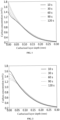
- FIG. 1 shows carbon concentration distributions at different times in a third kind boundary condition (the boost process) obtained by the calculation method in the present disclosure.
- the boost process the carbon concentration within the carburized layer increases constantly with increasing carburizing time. The carbon concentration increases faster when getting closer to the surface.
- FIG. 2 shows carbon concentration distributions at different times in a fourth kind boundary condition (the diffusion process) obtained by the calculation method in the present disclosure.
- the diffusion process the carbon concentration at a position closer to the surface decreases constantly with increasing carburizing time, while the carbon concentration at a position closer to the core part increases constantly.
- FIG. 1 and FIG. 2 indicate that the calculation method in the present disclosure can effectively calculate the carbon concentration distribution during the carburizing process.
- FIG. 3 shows a relationship of a surface carbon concentration and a time in a carburizing process.
- the surface carbon concentration increases in the boost process and decreases in the diffusion process.
- FIG. 4 shows relationship of a carburized layer depth and a time in a carburizing process.
- the carburized layer depth increases constantly with creasing time.
- FIG. 3 and FIG. 4 indicate that the calculation method in the present disclosure can give information such as a surface carbon concentration variation and a carburized layer depth variation in the carburizing process.
- FIG. 5 shows a mass flow rate of a gas corresponding to a mass of carbon entering a workpiece per second in a carburizing process.
- a gas mass flow rate that should be used in the carburizing process is in directly proportional to the mass of carbon entering the workpiece per second.
- FIG. 5 indicates that the calculation method in the present disclosure can give the gas mass flow rate required to realize carbon deposit reduction.
- a surface transfer coefficient of a workpiece is 3.9 ⁇ 10 -8 m/s; a diffusion coefficient is 1.4 ⁇ 10 -11 m 2 /s; a surface area of the workpiece is 1 m 2 ; and a density of the workpiece is 7.8 ⁇ 10 3 kg/m 3 .
- a time and a type of each process during a carburizing process are as shown in Table 2.
- a matrix carbon concentration is 0.2 wt.%, and a carburizing gas is acetylene.
- a method for calculating a carbon concentration distribution in a pulse carburizing process is carried out according to the following steps.
- step (2) to step (5) For each carburizing process, the calculation processes of step (2) to step (5) are repeated to obtain carbon concentration distributions of all carburizing processes.
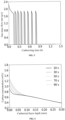
- FIG. 6 shows carbon concentration distributions at different times in a third carburizing process (the boost process) obtained by the calculation method in the present disclosure.
- the boost process the carbon concentration within the carburized layer increases constantly with increasing carburizing time.
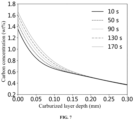
- FIG. 7 shows carbon concentration distributions at different times in a fourth carburizing process (the boost process) obtained by the calculation method in the present disclosure.
- FIG. 6 and FIG. 7 indicate that the calculation method of the present disclosure is not limited to boost-diffusion pulse cyclic process and is applicable to any combination of a finite number of boost and diffusion processes, and can be promoted widespread.
- Example 2 shows different values of F, L, and N from Example 1 and other construction method of the auxiliary function different from Example 1.
Landscapes
- Engineering & Computer Science (AREA)
- Chemical & Material Sciences (AREA)
- Physics & Mathematics (AREA)
- Theoretical Computer Science (AREA)
- Mathematical Physics (AREA)
- General Physics & Mathematics (AREA)
- Computing Systems (AREA)
- Data Mining & Analysis (AREA)
- Pure & Applied Mathematics (AREA)
- Mathematical Optimization (AREA)
- Mathematical Analysis (AREA)
- Computational Mathematics (AREA)
- Chemical Kinetics & Catalysis (AREA)
- Life Sciences & Earth Sciences (AREA)
- Metallurgy (AREA)
- Mechanical Engineering (AREA)
- Materials Engineering (AREA)
- Bioinformatics & Computational Biology (AREA)
- Bioinformatics & Cheminformatics (AREA)
- Organic Chemistry (AREA)
- Algebra (AREA)
- Databases & Information Systems (AREA)
- Software Systems (AREA)
- General Engineering & Computer Science (AREA)
- Operations Research (AREA)
- Spectroscopy & Molecular Physics (AREA)
- Crystallography & Structural Chemistry (AREA)
- Solid-Phase Diffusion Into Metallic Material Surfaces (AREA)
Applications Claiming Priority (2)
| Application Number | Priority Date | Filing Date | Title |
|---|---|---|---|
| CN202310591341.XA CN116564452B (zh) | 2023-05-24 | 2023-05-24 | 一种计算脉冲渗碳过程碳浓度分布的方法 |
| PCT/CN2023/140459 WO2024239634A1 (zh) | 2023-05-24 | 2023-12-21 | 一种计算脉冲渗碳过程碳浓度分布的方法 |
Publications (4)
| Publication Number | Publication Date |
|---|---|
| EP4489014A1 true EP4489014A1 (de) | 2025-01-08 |
| EP4489014A4 EP4489014A4 (de) | 2025-06-18 |
| EP4489014C0 EP4489014C0 (de) | 2026-02-25 |
| EP4489014B1 EP4489014B1 (de) | 2026-02-25 |
Family
ID=87486001
Family Applications (1)
| Application Number | Title | Priority Date | Filing Date |
|---|---|---|---|
| EP23918049.0A Active EP4489014B1 (de) | 2023-05-24 | 2023-12-21 | Verfahren zur berechnung der kohlenstoffkonzentrationsverteilung während der impulsaufkohlung |
Country Status (3)
| Country | Link |
|---|---|
| EP (1) | EP4489014B1 (de) |
| CN (1) | CN116564452B (de) |
| WO (1) | WO2024239634A1 (de) |
Families Citing this family (2)
| Publication number | Priority date | Publication date | Assignee | Title |
|---|---|---|---|---|
| CN116564452B (zh) * | 2023-05-24 | 2023-10-03 | 中国机械总院集团北京机电研究所有限公司 | 一种计算脉冲渗碳过程碳浓度分布的方法 |
| CN118395044B (zh) * | 2024-05-14 | 2025-05-30 | 中国机械总院集团北京机电研究所有限公司 | 一种真空渗碳脉冲时间的计算方法、储存介质 |
Family Cites Families (5)
| Publication number | Priority date | Publication date | Assignee | Title |
|---|---|---|---|---|
| JP2008045975A (ja) * | 2006-08-14 | 2008-02-28 | Daido Steel Co Ltd | 炭素濃度分布測定方法およびこれを用いた浸炭部材の製造方法 |
| CN102063110B (zh) * | 2010-12-03 | 2012-07-18 | 上海交通大学 | 低压渗碳渗层碳浓度分布控制系统及其控制方法 |
| CN103177193A (zh) * | 2013-04-18 | 2013-06-26 | 南京理工大学 | 薄介质涂敷的金属旋转对称目标电磁散射快速计算方法 |
| CN110457834B (zh) * | 2019-08-15 | 2023-02-03 | 东北大学 | 一种表征渗碳钢渗层碳浓度的方法 |
| CN116564452B (zh) * | 2023-05-24 | 2023-10-03 | 中国机械总院集团北京机电研究所有限公司 | 一种计算脉冲渗碳过程碳浓度分布的方法 |
-
2023
- 2023-05-24 CN CN202310591341.XA patent/CN116564452B/zh active Active
- 2023-12-21 WO PCT/CN2023/140459 patent/WO2024239634A1/zh not_active Ceased
- 2023-12-21 EP EP23918049.0A patent/EP4489014B1/de active Active
Also Published As
| Publication number | Publication date |
|---|---|
| EP4489014C0 (de) | 2026-02-25 |
| WO2024239634A1 (zh) | 2024-11-28 |
| CN116564452B (zh) | 2023-10-03 |
| CN116564452A (zh) | 2023-08-08 |
| EP4489014B1 (de) | 2026-02-25 |
| EP4489014A4 (de) | 2025-06-18 |
Similar Documents
| Publication | Publication Date | Title |
|---|---|---|
| EP4489014A1 (de) | Verfahren zur berechnung der kohlenstoffkonzentrationsverteilung während der impulsaufkohlung | |
| EP4492277A1 (de) | Verfahren zur schnellen berechnung der kohlenstoffkonzentrationsverteilung während der impulsaufkohlung | |
| US20190360066A1 (en) | Control method for roller quenching process of heavy-piece weight and large-section ultra-heavy plate | |
| CN107450325B (zh) | 一种燃烧后co2捕集系统的多模型预测控制方法 | |
| CN101927267A (zh) | 一种精轧带钢辊缝的控制方法及装置 | |
| CN111182564A (zh) | 一种基于lstm神经网络的无线链路质量预测方法 | |
| US20250369085A1 (en) | Method for calculating vacuum carburizing pulse time and non-transitory storage medium | |
| CN109698366B (zh) | 一种燃料电池阳极流道氮浓度估计方法及装置 | |
| CN110427706A (zh) | 一种动态提升拟合阶数的搜索堆芯临界棒位计算方法 | |
| CN103530531A (zh) | 一种基于极大似然估计的风电功率持续特性描述方法 | |
| CN115236542A (zh) | 锂离子电池析锂评估方法及装置 | |
| CN113820541B (zh) | 一种基于改进变系数回归的系统谐波阻抗估计方法 | |
| CN118262839A (zh) | 无缝钢管穿孔顶头表面氧化膜生长的预测方法及系统 | |
| CN112067999B (zh) | 一种锂离子电池正极开路电势曲线非破坏获取系统及方法 | |
| CN116562187B (zh) | 一种计算脉冲渗碳过程气体流量的方法 | |
| CN110212592A (zh) | 基于分段线性表达的火电机组负荷调节最大速率估计方法及系统 | |
| CN105334824A (zh) | 基于nsga-ⅱ算法的铝电解生产优化方法 | |
| Wu et al. | Large-time behavior of solutions to bipolar Euler-Poisson equations with time-dependent damping in the half space | |
| CN111157568A (zh) | 一种简单快速测量连续冷却两相转变体积比例的方法 | |
| CN111313413A (zh) | 一种基于图形处理器并行加速的电力系统状态估计方法 | |
| CN203021506U (zh) | 一种焦炉集气管压力数据测量装置 | |
| CN115864530B (zh) | 基于随机森林法的电力系统静态电压稳定临界点预测方法 | |
| CN121919488A (zh) | 基于多应力耦合的储能系统容量衰减建模方法 | |
| CN118468110A (zh) | 一种csp均热炉提质降耗工艺参数优化方法 | |
| CN116591844A (zh) | 一种识别喷气持续期的发动机闭环控制方法、系统及介质 |
Legal Events
| Date | Code | Title | Description |
|---|---|---|---|
| STAA | Information on the status of an ep patent application or granted ep patent |
Free format text: STATUS: UNKNOWN |
|
| STAA | Information on the status of an ep patent application or granted ep patent |
Free format text: STATUS: THE INTERNATIONAL PUBLICATION HAS BEEN MADE |
|
| PUAI | Public reference made under article 153(3) epc to a published international application that has entered the european phase |
Free format text: ORIGINAL CODE: 0009012 |
|
| STAA | Information on the status of an ep patent application or granted ep patent |
Free format text: STATUS: REQUEST FOR EXAMINATION WAS MADE |
|
| 17P | Request for examination filed |
Effective date: 20240802 |
|
| AK | Designated contracting states |
Kind code of ref document: A1 Designated state(s): AL AT BE BG CH CY CZ DE DK EE ES FI FR GB GR HR HU IE IS IT LI LT LU LV MC ME MK MT NL NO PL PT RO RS SE SI SK SM TR |
|
| RIN1 | Information on inventor provided before grant (corrected) |
Inventor name: YANG, GUANGWEN Inventor name: CHEN, XUYANG Inventor name: YAO, JIAWEI Inventor name: DU, CHUNHUI Inventor name: LU, WENLIN Inventor name: MA, JINGBO Inventor name: JIANG, CHAO Inventor name: CONG, PEIWU |
|
| A4 | Supplementary search report drawn up and despatched |
Effective date: 20250520 |
|
| RIC1 | Information provided on ipc code assigned before grant |
Ipc: C23C 8/22 20060101ALI20250514BHEP Ipc: C23C 8/20 20060101ALI20250514BHEP Ipc: G16C 60/00 20190101AFI20250514BHEP |
|
| GRAP | Despatch of communication of intention to grant a patent |
Free format text: ORIGINAL CODE: EPIDOSNIGR1 |
|
| STAA | Information on the status of an ep patent application or granted ep patent |
Free format text: STATUS: GRANT OF PATENT IS INTENDED |
|
| DAV | Request for validation of the european patent (deleted) | ||
| DAX | Request for extension of the european patent (deleted) | ||
| INTG | Intention to grant announced |
Effective date: 20251127 |
|
| GRAS | Grant fee paid |
Free format text: ORIGINAL CODE: EPIDOSNIGR3 |
|
| GRAA | (expected) grant |
Free format text: ORIGINAL CODE: 0009210 |
|
| STAA | Information on the status of an ep patent application or granted ep patent |
Free format text: STATUS: THE PATENT HAS BEEN GRANTED |
|
| AK | Designated contracting states |
Kind code of ref document: B1 Designated state(s): AL AT BE BG CH CY CZ DE DK EE ES FI FR GB GR HR HU IE IS IT LI LT LU LV MC ME MK MT NL NO PL PT RO RS SE SI SK SM TR |
|
| REG | Reference to a national code |
Ref country code: CH Ref legal event code: F10 Free format text: ST27 STATUS EVENT CODE: U-0-0-F10-F00 (AS PROVIDED BY THE NATIONAL OFFICE) Effective date: 20260225 Ref country code: GB Ref legal event code: FG4D |
|
| REG | Reference to a national code |
Ref country code: DE Ref legal event code: R096 Ref document number: 602023012784 Country of ref document: DE |
|
| REG | Reference to a national code |
Ref country code: IE Ref legal event code: FG4D |
|
| U01 | Request for unitary effect filed |
Effective date: 20260226 |
|
| U07 | Unitary effect registered |
Designated state(s): AT BE BG DE DK EE FI FR IT LT LU LV MT NL PT RO SE SI Effective date: 20260305 |