EP4488394A1 - Method for annealing hot-rolled steel strip - Google Patents
Method for annealing hot-rolled steel strip Download PDFInfo
- Publication number
- EP4488394A1 EP4488394A1 EP23780654.2A EP23780654A EP4488394A1 EP 4488394 A1 EP4488394 A1 EP 4488394A1 EP 23780654 A EP23780654 A EP 23780654A EP 4488394 A1 EP4488394 A1 EP 4488394A1
- Authority
- EP
- European Patent Office
- Prior art keywords
- steel strip
- temperature
- annealing
- heating
- hot
- Prior art date
- Legal status (The legal status is an assumption and is not a legal conclusion. Google has not performed a legal analysis and makes no representation as to the accuracy of the status listed.)
- Pending
Links
Images

Classifications
-
- C—CHEMISTRY; METALLURGY
- C21—METALLURGY OF IRON
- C21D—MODIFYING THE PHYSICAL STRUCTURE OF FERROUS METALS; GENERAL DEVICES FOR HEAT TREATMENT OF FERROUS OR NON-FERROUS METALS OR ALLOYS; MAKING METAL MALLEABLE, e.g. BY DECARBURISATION OR TEMPERING
- C21D9/00—Heat treatment, e.g. annealing, hardening, quenching or tempering, adapted for particular articles; Furnaces therefor
- C21D9/52—Heat treatment, e.g. annealing, hardening, quenching or tempering, adapted for particular articles; Furnaces therefor for wires; for strips ; for rods of unlimited length
- C21D9/54—Furnaces for treating strips or wire
- C21D9/56—Continuous furnaces for strip or wire
- C21D9/60—Continuous furnaces for strip or wire with induction heating
-
- C—CHEMISTRY; METALLURGY
- C21—METALLURGY OF IRON
- C21D—MODIFYING THE PHYSICAL STRUCTURE OF FERROUS METALS; GENERAL DEVICES FOR HEAT TREATMENT OF FERROUS OR NON-FERROUS METALS OR ALLOYS; MAKING METAL MALLEABLE, e.g. BY DECARBURISATION OR TEMPERING
- C21D1/00—General methods or devices for heat treatment, e.g. annealing, hardening, quenching or tempering
- C21D1/34—Methods of heating
- C21D1/42—Induction heating
-
- C—CHEMISTRY; METALLURGY
- C21—METALLURGY OF IRON
- C21D—MODIFYING THE PHYSICAL STRUCTURE OF FERROUS METALS; GENERAL DEVICES FOR HEAT TREATMENT OF FERROUS OR NON-FERROUS METALS OR ALLOYS; MAKING METAL MALLEABLE, e.g. BY DECARBURISATION OR TEMPERING
- C21D11/00—Process control or regulation for heat treatments
-
- C—CHEMISTRY; METALLURGY
- C21—METALLURGY OF IRON
- C21D—MODIFYING THE PHYSICAL STRUCTURE OF FERROUS METALS; GENERAL DEVICES FOR HEAT TREATMENT OF FERROUS OR NON-FERROUS METALS OR ALLOYS; MAKING METAL MALLEABLE, e.g. BY DECARBURISATION OR TEMPERING
- C21D6/00—Heat treatment of ferrous alloys
- C21D6/008—Heat treatment of ferrous alloys containing Si
-
- C—CHEMISTRY; METALLURGY
- C21—METALLURGY OF IRON
- C21D—MODIFYING THE PHYSICAL STRUCTURE OF FERROUS METALS; GENERAL DEVICES FOR HEAT TREATMENT OF FERROUS OR NON-FERROUS METALS OR ALLOYS; MAKING METAL MALLEABLE, e.g. BY DECARBURISATION OR TEMPERING
- C21D8/00—Modifying the physical properties of ferrous metals or ferrous alloys by deformation combined with, or followed by, heat treatment
- C21D8/12—Modifying the physical properties of ferrous metals or ferrous alloys by deformation combined with, or followed by, heat treatment during manufacturing of articles with special electromagnetic properties
- C21D8/1216—Modifying the physical properties of ferrous metals or ferrous alloys by deformation combined with, or followed by, heat treatment during manufacturing of articles with special electromagnetic properties characterised by the working steps
- C21D8/1222—Hot rolling
-
- C—CHEMISTRY; METALLURGY
- C21—METALLURGY OF IRON
- C21D—MODIFYING THE PHYSICAL STRUCTURE OF FERROUS METALS; GENERAL DEVICES FOR HEAT TREATMENT OF FERROUS OR NON-FERROUS METALS OR ALLOYS; MAKING METAL MALLEABLE, e.g. BY DECARBURISATION OR TEMPERING
- C21D8/00—Modifying the physical properties of ferrous metals or ferrous alloys by deformation combined with, or followed by, heat treatment
- C21D8/12—Modifying the physical properties of ferrous metals or ferrous alloys by deformation combined with, or followed by, heat treatment during manufacturing of articles with special electromagnetic properties
- C21D8/1244—Modifying the physical properties of ferrous metals or ferrous alloys by deformation combined with, or followed by, heat treatment during manufacturing of articles with special electromagnetic properties characterised by the heat treatment
- C21D8/1261—Modifying the physical properties of ferrous metals or ferrous alloys by deformation combined with, or followed by, heat treatment during manufacturing of articles with special electromagnetic properties characterised by the heat treatment following hot rolling
-
- C—CHEMISTRY; METALLURGY
- C21—METALLURGY OF IRON
- C21D—MODIFYING THE PHYSICAL STRUCTURE OF FERROUS METALS; GENERAL DEVICES FOR HEAT TREATMENT OF FERROUS OR NON-FERROUS METALS OR ALLOYS; MAKING METAL MALLEABLE, e.g. BY DECARBURISATION OR TEMPERING
- C21D9/00—Heat treatment, e.g. annealing, hardening, quenching or tempering, adapted for particular articles; Furnaces therefor
- C21D9/46—Heat treatment, e.g. annealing, hardening, quenching or tempering, adapted for particular articles; Furnaces therefor for sheet metals
-
- C—CHEMISTRY; METALLURGY
- C21—METALLURGY OF IRON
- C21D—MODIFYING THE PHYSICAL STRUCTURE OF FERROUS METALS; GENERAL DEVICES FOR HEAT TREATMENT OF FERROUS OR NON-FERROUS METALS OR ALLOYS; MAKING METAL MALLEABLE, e.g. BY DECARBURISATION OR TEMPERING
- C21D9/00—Heat treatment, e.g. annealing, hardening, quenching or tempering, adapted for particular articles; Furnaces therefor
- C21D9/52—Heat treatment, e.g. annealing, hardening, quenching or tempering, adapted for particular articles; Furnaces therefor for wires; for strips ; for rods of unlimited length
- C21D9/54—Furnaces for treating strips or wire
- C21D9/56—Continuous furnaces for strip or wire
- C21D9/573—Continuous furnaces for strip or wire with cooling
-
- C—CHEMISTRY; METALLURGY
- C22—METALLURGY; FERROUS OR NON-FERROUS ALLOYS; TREATMENT OF ALLOYS OR NON-FERROUS METALS
- C22C—ALLOYS
- C22C38/00—Ferrous alloys, e.g. steel alloys
- C22C38/02—Ferrous alloys, e.g. steel alloys containing silicon
-
- C—CHEMISTRY; METALLURGY
- C21—METALLURGY OF IRON
- C21D—MODIFYING THE PHYSICAL STRUCTURE OF FERROUS METALS; GENERAL DEVICES FOR HEAT TREATMENT OF FERROUS OR NON-FERROUS METALS OR ALLOYS; MAKING METAL MALLEABLE, e.g. BY DECARBURISATION OR TEMPERING
- C21D1/00—General methods or devices for heat treatment, e.g. annealing, hardening, quenching or tempering
- C21D1/34—Methods of heating
-
- C—CHEMISTRY; METALLURGY
- C21—METALLURGY OF IRON
- C21D—MODIFYING THE PHYSICAL STRUCTURE OF FERROUS METALS; GENERAL DEVICES FOR HEAT TREATMENT OF FERROUS OR NON-FERROUS METALS OR ALLOYS; MAKING METAL MALLEABLE, e.g. BY DECARBURISATION OR TEMPERING
- C21D1/00—General methods or devices for heat treatment, e.g. annealing, hardening, quenching or tempering
- C21D1/34—Methods of heating
- C21D1/40—Direct resistance heating
-
- C—CHEMISTRY; METALLURGY
- C21—METALLURGY OF IRON
- C21D—MODIFYING THE PHYSICAL STRUCTURE OF FERROUS METALS; GENERAL DEVICES FOR HEAT TREATMENT OF FERROUS OR NON-FERROUS METALS OR ALLOYS; MAKING METAL MALLEABLE, e.g. BY DECARBURISATION OR TEMPERING
- C21D9/00—Heat treatment, e.g. annealing, hardening, quenching or tempering, adapted for particular articles; Furnaces therefor
- C21D9/52—Heat treatment, e.g. annealing, hardening, quenching or tempering, adapted for particular articles; Furnaces therefor for wires; for strips ; for rods of unlimited length
- C21D9/54—Furnaces for treating strips or wire
- C21D9/56—Continuous furnaces for strip or wire
- C21D9/62—Continuous furnaces for strip or wire with direct resistance heating
Definitions
- the present invention relates to a method for annealing a steel strip (a hot-rolled steel strip) after hot rolling which is used in the production of an electrical steel sheet.
- hot-band annealing it is known that by subjecting a hot-rolled steel strip containing 1.6 to 5.0 mass% Si for an electrical steel sheet to annealing (hot-band annealing) before cold rolling, the magnetic properties of a product sheet can be improved, i.e., the Goss orientation can be highly developed.
- Such hot-band annealing is typically performed using a continuous annealing line including a heating zone, a soaking zone, and a cooling zone.
- the annealing temperature of the hot-band annealing is known to largely affect the magnetic properties of a product sheet. Therefore, it is necessary to control the temperature of the steel sheet so that it is constant and uniform across the entire length and width of the hot-rolled steel strip.
- the furnace temperature in the soaking zone is controlled to be constant so that the heating temperature of the hot-rolled steel strip to be annealed can be controlled within a suitable range.
- a hot-rolled steel strip is not subjected to cold rolling yet, and therefore has a large thickness and a high heat capacity (amount of heat necessary to increase the temperature of an object by 1°C), requiring a larger amount of heat for heating than a cold-rolled steel strip.
- such a thick hot-rolled steel strip has a large variation in thickness with respect to the rolled thickness, particularly at the front and rear ends of the steel strip, and thus the heat capacity is largely varied within the same steel strip. Therefore, the hot-rolled steel strip has a significant effect on the temperature of an annealing furnace compared to a cold-rolled steel strip, and it is difficult to heat the hot-rolled steel strip to a target soaking temperature by maintaining the predetermined furnace temperature in each of the heating zone and the soaking zone.
- Patent Literature 1 discloses that in a furnace for heating a slab, there is a significant difference in temperature between a portion of the slab (skid portion) that is in contact with a rod-like skid for holding the slab and a portion of the slab (non-skid portion) that is not in contact with the rod-like skid. This indicates that the states of precipitates as well as the dissolved states of inhibitors will vary, and thus that the optimum heating conditions of annealing, which is performed after hot rolling, for obtaining excellent magnetic properties will vary.
- Patent Literature 2 discloses a technology for reducing the aging index of a steel sheet before being subjected to the final cold rolling in the production of a grain-oriented electrical steel sheet, by controlling the cooling rate of hot-band annealing.
- Patent Literature 3 discloses a technology for performing hot-band annealing on a Si-containing steel sheet in which a steel strip is rapidly heated during the hot-band annealing.
- Patent Literature 1 only discloses a technology related to a method for heating a slab to eliminate the variation in the magnetic properties of a product steel strip, and fails to disclose a method for controlling the temperature of a steel sheet during hot-band annealing with high accuracy.
- Patent Literature 2 discloses a technology for improving the texture of a hot-rolled sheet for a grain-oriented electrical steel sheet by performing hot-band annealing on the sheet, it does not mention the necessity of controlling the heating temperature of hot-band annealing with high accuracy or means therefor.
- the rapid heating performed during hot-band annealing is intended to improve the descaling property after annealing, and Patent Literature 3 does not mention controlling the heating temperature after the rapid heating with high accuracy.
- the hot-rolled steel strip not only has a large thickness but also has a low thickness accuracy and a large thickness variation, so that the temperature of the annealing furnace varies correspondingly.
- the present invention aims to propose a method for annealing a hot-rolled steel strip that can control the annealing temperature for a steel strip with high accuracy to an annealing temperature that is preferable for the magnetic properties to be obtained, and thus obtain excellent magnetic properties across the entire length of the steel strip.
- the inventors have conducted intensive studies to solve the above problems, and as a result, have arrived at the present invention by finding the following. That is, in order to apply annealing that is preferable to the magnetic properties to a hot-rolled steel strip used for an electrical steel sheet by using a continuous annealing line having an annealing furnace that includes a heating zone, a soaking zone, and a cooling zone, it is necessary to determine a target annealing temperature (target soaking temperature) in the longitudinal direction of the steel strip in the annealing line by taking into account information on the temperature distribution in the longitudinal direction of a slab during slab heating, or information on the temperature distribution in the longitudinal direction of the steel strip during hot rolling.
- target annealing temperature target soaking temperature
- the inventors have found that in order to heat the steel strip to the target annealing temperature, it is important to arrange a rapid heating device on the upstream side of the soaking zone, to arrange a thickness meter on the upstream side of the rapid heating device, and to set the heating temperature for the steel strip by the rapid heating device by taking into account the value of LSD defined by the thickness of the steel strip measured by the thickness meter and the threading speed of the steel strip during annealing.
- a method for annealing a hot-rolled steel strip for an electrical steel sheet of the present invention is configured as follows.
- the temperature of a steel strip at the exit side of a heating zone consequently the temperature of the steel strip at the exit side of a soaking zone can be controlled to the target annealing temperature that is preferable for the magnetic properties to be obtained with high accuracy. This greatly contributes to improving the magnetic properties of a product sheet and reducing the generation of defects.
- the heating conditions of an annealing line are set to achieve the target annealing temperature (target soaking temperature) in the longitudinal direction of the steel strip, which was determined by taking into account the temperature distribution in the longitudinal direction of a slab during slab heating before hot rolling, or the temperature distribution in the longitudinal direction during hot rolling.
- target annealing temperature target soaking temperature
- a rapid heating device is arranged on the upstream side of the soaking zone, and a thickness meter is arranged on the upstream side of the rapid heating device.
- the heating temperature for the steel strip by the rapid heating device is set to achieve the target annealing temperature, taking into account the value of LSD which is defined by the thickness of the steel strip measured by the thickness meter and the threading speed of the steel strip during annealing.
- the heating conditions of the annealing line are set to achieve the target annealing temperature in the longitudinal direction of the steel strip that is preferable for magnetic properties and that has been determined from the temperature distribution in the longitudinal direction of a slab during slab heating or from the temperature distribution in the longitudinal direction of the steel strip during hot rolling.
- a rapid heating device is arranged on the upstream side of the soaking zone of the annealing line, and a thickness meter is arranged on the upstream side of the rapid heating device so that the heating temperature for the steel strip by the rapid heating device is set to achieve the target annealing temperature by taking into account the value of LSD which is defined by the thickness of the steel strip measured by the thickness meter and the threading speed of the steel strip during annealing.
- Fig. 1 is a schematic view showing the first half portion of a continuous annealing line that is used to perform annealing (hot-band annealing) on a hot-rolled steel strip for an electrical steel sheet of the present invention.
- the continuous annealing line includes a heating zone, a soaking zone, and a cooling zone arranged in this order from the upstream side.
- the hot-band annealing is usually performed by heating a steel strip S in a heating zone 3 to allow the temperature of the steel strip at the exit side of the heating zone to reach a target soaking temperature, and holding the steel strip S at the soaking temperature for a predetermined time in a soaking zone 4, and then cooling the steel strip S in a cooling zone (not shown).
- the furnace temperature in each of the heating zone 3 and the soaking zone 4 and the threading speed of the steel strip S are kept constant to keep the steel strip at a predetermined soaking temperature for a predetermined time unless there is variation in the thickness or the threading speed of the steel strip.
- the dissolution of precipitates is controlled so that the orientations of crystal grains can be highly integrated into the Goss orientation during secondary recrystallization.
- a portion of the slab that is in contact with a rod-like base, called a skid which is placed in the slab heating furnace to hold a cooled slab, is cooled when the slab is removed from the heating furnace. Therefore, the temperature distribution in the longitudinal direction of the slab significantly varies depending on the relationship between the position of the skid and the in-furnace time of the slab, when it is removed from the heating furnace.
- the temperature history of the slab differs between the portion of the slab that is in contact with the skid (skid portion) and the remaining portion of the slab that is not in contact with the skid (non-skid portion). Therefore, in processes following hot rolling, the states of the precipitates in the steel strip vary in the longitudinal direction, which greatly affects the recrystallization temperature and so on. As a result, steel sheets produced under the same conditions will have different magnetic properties when formed into final products.
- the present invention is intended to reduce the influence of the temperature variation in the longitudinal direction of the slab on the states of the precipitates in the hot-rolled steel strip and on the recrystallization temperature, and consequently, on the magnetic properties of the final product.
- a target annealing temperature in the longitudinal direction of the steel strip during annealing (hot-band annealing) performed on the hot-rolled steel strip is changed in accordance with the temperature distribution in the longitudinal direction of the slab in slab heating.
- the states of the precipitates and the recrystallization temperature can be controlled to be uniform in the longitudinal direction of the steel strip.
- the target annealing temperature in the longitudinal direction of the steel strip in the annealing line which is determined based on the temperature distribution in the longitudinal direction of the slab, has a different degree of influence depending on the type of steel used and the type and amount of inhibitors.
- the setting of the target annealing temperature by verification is preferably performed using a method of processing a large amount of data, such as statistical processing, machine learning, or AI.
- the target annealing temperature during annealing after the hot rolling is set based on the following manner.
- the dissolution of inhibitors is likely to be insufficient.
- crystal grains with orientations unfavorable for magnetic properties may grow during annealing after the hot rolling.
- crystal grains are coarsened in the portion of the slab heated to a high temperature. This means that high energy is required to grow crystal grains that are preferable for the magnetic properties.
- the target annealing temperature is set high.
- the information on the temperature distribution during slab heating may be determined by numerical analysis using information such as the position of the skid, the in-furnace time of the slab, and the furnace temperature, when it is difficult to actually measure. This is because when there is a change in the in-furnace time of the slab and the position of the skid, the temperature distribution of the slab during the heating of the slab greatly varies both in the thickness direction and in the longitudinal direction.
- induction heating When induction heating is used for slab heating, it is preferable to analyze a numerical value by also taking into account information about the arrangement of an induction coil and a power supply output.
- the temperature distribution in the longitudinal direction of the slab it is also possible to use the temperature distribution in the longitudinal direction of the steel strip in rough rolling during hot rolling immediately afterwards. This is because the surface temperature distribution in the longitudinal direction of the steel strip has the same tendency as the temperature distribution in the longitudinal direction of the slab during slab heating. It should be noted that the steel strip subjected to rough rolling is thinner than the slab. Thus, the surface temperature of the steel strip subjected to rough rolling can be directly measured using a surface thermometer, such as a radiation thermometer.
- the surface temperature of the steel strip is preferably measured immediately after descaling to be performed to remove an oxide film formed on the surface of the steel strip, so that the measurement accuracy is improved.
- the heating conditions for the steel strip by the annealing line such as the heating temperature in each of the heating zone and the soaking zone, are set.
- Fig. 1 is a view showing the first half of a continuous annealing line provided with an annealing furnace 1, which includes the heating zone 3, the soaking zone 4, and the cooling zone arranged in this order from the upstream side, and is used for annealing a hot-rolled steel strip.
- Fig. 1 shows an example in which a rapid heating device 2 is arranged on the upstream side of the heating zone 3 as an embodiment of the present invention.
- the rapid heating device 2 has a function of heating a steel strip to reach the target annealing temperature determined from the temperature distribution in the longitudinal direction of a slab during slab heating or from the temperature distribution in the longitudinal direction of the steel strip during hot rolling.
- a steel strip has more or less thickness variation in the longitudinal direction, and, in particular, has large thickness variation at the front and rear end portions of the steel strip.
- the threading speed of the steel strip is suddenly changed while the steel strip is being annealed.
- the preset temperature of the furnace should be changed.
- suddenly changing the preset temperature of the furnace would cause overshoot or hunting not only of the furnace temperature but also of the steel strip temperature.
- a hot-rolled steel strip is thicker and has a higher heat capacity than a cold-rolled steel strip, as described above. Therefore, it is difficult to heat the steel strip to the target temperature, not only because it is difficult to follow the changes of the furnace temperature in the heating zone but also because it affects the furnace temperature in the heating zone 3. Therefore, it is desired to heat the steel strip in the heating zone 3 so that the steel strip always has the predetermined target temperature at the exit side of the heating zone, regardless of the variation in the thickness or the threading speed of the steel strip.
- the final purpose of hot-band annealing lies in performing heat treatment involving holding the steel strip S at a target annealing temperature (soaking temperature) in the soaking zone 4 for a predetermined time.
- a target annealing temperature soaking temperature
- the amount of heat of the steel strip also greatly varies, causing the amount of heat transferred to the soaking zone 4 to vary, and, consequently, the furnace temperature to also vary.
- a thickness meter 5 is arranged on the upstream side of the heating zone 3, and LSD, which is defined by the following expression (1) using the thickness of the steel strip measured by the thickness meter 5 and the threading speed of the steel strip during annealing, is used. That is, the steel strip temperature at the exit side of the heating zone is increased to the predetermined target temperature by changing the heating temperature for the steel strip S by the rapid heating device 2 in accordance with the value of LSD.
- the heating temperature for the steel strip S by the rapid heating device 2 is set higher, while as the value of LSD of the hot-rolled steel strip is smaller, the heating temperature by the rapid heating device 2 is set lower. More specifically, as the thickness of the steel strip including a minute variation in the thickness of the steel strip is larger, the steel strip temperature at the exit side of the rapid heating device, that is, the heating temperature by the rapid heating device 2 is set higher than the conventional heating temperature for which LSD is not taken into account.
- heating is performed such that the steel strip temperature at the exit side of the rapid heating device, that is, the heating temperature by the rapid heating device 2 is set lower than the conventional heating temperature for which LSD is not taken into account.
- heating is performed such that when the threading speed has become faster, the steel strip temperature at the exit side of the rapid heating device, that is, the heating temperature by the rapid heating device 2 is set higher than the conventional heating temperature for which LSD is not taken into account.
- the steel strip temperature at the exit side of the rapid heating device 2 that is, the heating temperature by the rapid heating device 2 is set lower than the conventional heating temperature for which LSD is not taken into account, and heating is performed.
- the rapid heating device 2 By changing the heating temperature for the steel strip S by the rapid heating device 2 by taking into account the value of LSD as described above, it is possible, even when there is a sudden change in the thickness t or the threading speed LS of the hot-rolled steel strip, to reduce the variation in the steel strip temperature at the exit side of the heating zone as well as the variation in the furnace temperature in the soaking zone 4 without changing the preset furnace temperature in the heating zone 3. Consequently, the temperature of the hot-rolled steel strip can be controlled to a target soaking temperature with high accuracy.
- the rapid heating device 2 may be any type capable of changing the steel strip temperature with high responsiveness.
- any method having a good track record such as induction heating (solenoid method or transverse method), electric heating, or near-infrared heating, may be suitably used.
- the rapid heating device 2 is placed on the upstream side of the soaking zone 4 in order to control the steel strip temperature at the exit side of the heating zone, and consequently, the steel strip temperature at the exit side of the soaking zone, with high accuracy.
- the rapid heating device 2 may be placed on the upstream side of the heating zone, or alternatively, as shown in Fig. 2 , within the heating zone 3 (including between divided sections of the heating zone 3).
- an induction heating device in particular, a solenoid-actuated device is used as the rapid heating device 2
- the rapid heating device 2 is preferably placed not on the rear stage, but on the front stage or the middle stage.
- the heating capacity of the rapid heating device 2 is preferably larger to accommodate large variation in the thickness or the threading speed of the hot-rolled steel strip.
- the rapid heating device is required to have a heating capacity (the amount of temperature increase) of about 50 to 100°C to sufficiently accommodate the variation in the thickness or the threading speed of the steel strip, though it differs depending on the temperature range (position) in which the rapid heating device is placed and the relationship between the temperature and specific heat of the steel strip.
- the heat capacity of a steel strip varies in proportion to the width of the steel strip, the amount of heat needed to heat the steel strip and the amount of heat removed from the furnace body also vary correspondingly, and consequently, the width of the steel strip also affects the steel strip temperature at the exit side of the heating zone and on the furnace temperature in each of the heating zone and the soaking zone.
- the rapid heating device 2 it is preferable to adjust the heating temperature by the rapid heating device 2 by taking into account information on the furnace temperature in the heating zone 3 on the stage following the rapid heating device. For example, if the heating capacity of the rapid heating device 2 is low, the rapid heating device 2 alone may be insufficient to respond to a large change in the heat capacity of the hot-rolled steel strip due to variation in the thickness or the threading speed of the steel strip or due to variation in the value of LSD, and thus the preset furnace temperature in the heating zone 3 may be intentionally changed. In such a case, the steel strip temperature at the exit side of the heating zone 3 can be controlled with even higher accuracy, by feeding back the constantly-changing furnace temperature information caused after the rapid heating device 2 and reflecting it in the preset heating temperature by the rapid heating device 2.
- the steel sheet temperature T s on the entry side that is, the heating temperature for the steel sheet by the rapid heating device is adjusted by taking into account the variation in the furnace temperature Tf, so that it is possible to adjust the amount of temperature increase ⁇ T, and thus control the steel strip temperature on the entry side of the soaking zone.
- the overall heat absorption rate ⁇ CG is the index representing the efficiency related to the flow of heat throughout the entire furnace and determined by the pas records of the furnace temperature and the sheet temperature.
- the heating temperature for the steel strip by the rapid heating device 2 it is preferable to determine the heating temperature for the steel strip by the rapid heating device 2 by using information on the steel strip temperature at the exit side of the heating zone, the furnace temperature in the soaking zone, and the steel strip temperature at the exit side of the soaking zone, in addition to the value of LSD, the width of the steel strip, and the furnace temperature in the heating zone after the rapid heating device described above.
- a hot-rolled steel strip for an electrical steel sheet targeted by the present invention preferably contains 1.6 to 5.0 mass% Si.
- Si is an element effective in increasing the specific resistance of steel to reduce the iron loss and is therefore preferably contained by 1.6 mass% or more.
- the Si content exceeds 5.0 mass%, the magnetic flux density will be reduced to cause the steel to become brittle, resulting in a significant deterioration in manufacturability such that cracks occur during cold rolling.
- the Si content is in the range of 2.0 to 3.8 mass%.
- the hot-rolled steel strip may also contain, in addition to Si, a known inhibitor-forming ingredient to allow secondary recrystallization to occur, or a known additional element to improve magnetic or mechanical properties.
- the hot-band annealing of the present invention it is possible to perform heat treatment on a hot-rolled steel strip in the longitudinal direction (rolling direction) across the entire length thereof at an appropriate temperature corresponding to a temperature distribution in the longitudinal direction of a slab during slab heating, in addition to the variation in the thickness or in the threading speed in the longitudinal direction of the steel strip. Accordingly, it is possible to obtain a final product with excellent magnetic properties and without poor secondary recrystallization and defective crystal orientations across the entire length of the steel strip.
- a steel slab (with a slab weight of 20 tons) for an electrical steel sheet containing 3.5 mass% Si was produced by a continuous casting process.
- the steel slab was then heated to a temperature of 1200°C or higher and hot-rolled into a hot-rolled steel strip with a thickness of 2 mm.
- the hot-rolled steel strip was subjected to hot-band annealing at a target annealing temperature (soaking temperature) of 1050°C for a soaking time of 30 seconds using the continuous annealing line shown in Fig. 1 in which the thickness meter 5 and the rapid heating device 2 are arranged on the upstream side of the heating zone, and was pickled for descaling.
- the target annealing temperature (target soaking temperature) in the longitudinal direction of the steel strip was changed by taking into account the temperature distribution in the longitudinal direction of the slab during slab heating, the temperature distribution in the longitudinal direction of the steel strip during rough rolling of the hot rolling, or the positional information of a skid during the heating of the slab.
- the rapid heating device for the annealing line an induction heating device was used.
- the heating temperature of the device was sequentially changed in the longitudinal direction of the steel strip by taking into account the value of LSD (thickness ⁇ threading speed) to obtain the target annealing temperature.
- the preset furnace temperature in each of the heating zone and the soaking zone was held constant, and the surface temperature of the steel strip at the exit side of the soaking zone was measured with a radiation thermometer. Then, the difference ⁇ T between the surface temperature of the steel strip and the target annealing temperature, which had been determined by taking into account the temperature distribution of the steel strip in the longitudinal direction, was sequentially determined. Table 1 shows the maximum value ⁇ Tmax thereof.
- the target annealing temperature was set by using Expression (2) as the temperature for the best improvement of the magnetic properties from among the past records of the hot-band annealing temperature and the magnetic properties.
- the steel strip subjected to pickling was cold rolled to an intermediate thickness of 1.5 mm.
- the steel strip was then divided into two pieces in the longitudinal direction, and one of the two resulting steel strips was subjected to intermediate annealing at 1 100°C for 20 seconds, while the other was subjected to a second cold rolling step without the intermediate annealing performed so that a cold-rolled steel strip with a final thickness of 0.23 mm was obtained.
- the steel strip was subjected to decarburization annealing, which also serves as primary recrystallization annealing, at a temperature of 840°C for 100 seconds, and an annealing separating agent composed mainly of MgO was applied to each surface of the steel strip and dried.
- the steel strip was then subjected to finishing annealing including secondary recrystallization annealing and purification treatment at a temperature of 1200°C for 10 hours.
- the atmospheric gas in the finishing annealing was set to H 2 when the steel strip was held at 1200°C during the purification treatment and was set to N 2 during the rest of the time when the temperature was increased (including secondary recrystallization annealing) and when the temperature was decreased.
- the steel strip resulting from the above finishing annealing was divided into 10 sections in the longitudinal direction, and then, test pieces for measuring magnetic properties were taken from each section. Then, the magnetic flux density B 8 was measured in accordance with the Japanese Industrial Standards JIS C2553, and the difference ⁇ B 8 between the maximum value and the minimum value of the magnetic flux density B 8 was determined as the variation in magnetic properties. The results are shown in Table 1.
- the target annealing temperature of the hot-band annealing was set without taking into account a temperature distribution of the slab in the longitudinal direction during slab heating, the temperature distribution of the steel strip in the longitudinal direction after the rough rolling during the hot rolling, or the positional information on the skid during the heating of the slab, it is found to be impossible to address the influence of temperature variation during the heating of the slab. Therefore, although the variation in the steel strip temperature with respect to the target annealing temperature was reduced, the variation in the magnetic properties increased.
- the technology of the present invention is applicable to not only a hot-rolled steel strip for an electrical steel sheet, but also all metal strips that should be annealed by taking into account variation in the heating temperature for a slab in the longitudinal direction.
Landscapes
- Chemical & Material Sciences (AREA)
- Engineering & Computer Science (AREA)
- Materials Engineering (AREA)
- Mechanical Engineering (AREA)
- Metallurgy (AREA)
- Organic Chemistry (AREA)
- Physics & Mathematics (AREA)
- Thermal Sciences (AREA)
- Crystallography & Structural Chemistry (AREA)
- Electromagnetism (AREA)
- Manufacturing & Machinery (AREA)
- Heat Treatment Of Strip Materials And Filament Materials (AREA)
- Manufacturing Of Steel Electrode Plates (AREA)
Abstract
Description
- The present invention relates to a method for annealing a steel strip (a hot-rolled steel strip) after hot rolling which is used in the production of an electrical steel sheet.
- It is known that by subjecting a hot-rolled steel strip containing 1.6 to 5.0 mass% Si for an electrical steel sheet to annealing (hot-band annealing) before cold rolling, the magnetic properties of a product sheet can be improved, i.e., the Goss orientation can be highly developed. Such hot-band annealing is typically performed using a continuous annealing line including a heating zone, a soaking zone, and a cooling zone.
- The annealing temperature of the hot-band annealing is known to largely affect the magnetic properties of a product sheet. Therefore, it is necessary to control the temperature of the steel sheet so that it is constant and uniform across the entire length and width of the hot-rolled steel strip. For this purpose, in the continuous annealing line, the furnace temperature in the soaking zone is controlled to be constant so that the heating temperature of the hot-rolled steel strip to be annealed can be controlled within a suitable range.
- However, with the conventional annealing method in which only the furnace temperature in the soaking zone is controlled, it was difficult to control the heating temperature within a suitable range by reducing the variation in the heating temperature for the steel strip due to the variation in the thickness in the longitudinal direction of the steel strip or the variation in the threading speed of the steel strip. Specifically, a hot-rolled steel strip is not subjected to cold rolling yet, and therefore has a large thickness and a high heat capacity (amount of heat necessary to increase the temperature of an object by 1°C), requiring a larger amount of heat for heating than a cold-rolled steel strip. Further, such a thick hot-rolled steel strip has a large variation in thickness with respect to the rolled thickness, particularly at the front and rear ends of the steel strip, and thus the heat capacity is largely varied within the same steel strip. Therefore, the hot-rolled steel strip has a significant effect on the temperature of an annealing furnace compared to a cold-rolled steel strip, and it is difficult to heat the hot-rolled steel strip to a target soaking temperature by maintaining the predetermined furnace temperature in each of the heating zone and the soaking zone.
- However, no practical technologies for controlling the heating temperature of hot-band annealing with high accuracy have been disclosed. For example,
Patent Literature 1 discloses that in a furnace for heating a slab, there is a significant difference in temperature between a portion of the slab (skid portion) that is in contact with a rod-like skid for holding the slab and a portion of the slab (non-skid portion) that is not in contact with the rod-like skid. This indicates that the states of precipitates as well as the dissolved states of inhibitors will vary, and thus that the optimum heating conditions of annealing, which is performed after hot rolling, for obtaining excellent magnetic properties will vary. In addition,Patent Literature 2 discloses a technology for reducing the aging index of a steel sheet before being subjected to the final cold rolling in the production of a grain-oriented electrical steel sheet, by controlling the cooling rate of hot-band annealing. Further,Patent Literature 3 discloses a technology for performing hot-band annealing on a Si-containing steel sheet in which a steel strip is rapidly heated during the hot-band annealing. -
- Patent Literature 1:
JP-2006-206997A - Patent Literature 2:
JP-2016-000856A - Patent Literature 3:
JP-2018-066040A -
Patent Literature 1 only discloses a technology related to a method for heating a slab to eliminate the variation in the magnetic properties of a product steel strip, and fails to disclose a method for controlling the temperature of a steel sheet during hot-band annealing with high accuracy. AlthoughPatent Literature 2 discloses a technology for improving the texture of a hot-rolled sheet for a grain-oriented electrical steel sheet by performing hot-band annealing on the sheet, it does not mention the necessity of controlling the heating temperature of hot-band annealing with high accuracy or means therefor. In addition, in the technology disclosed inPatent Literature 3, the rapid heating performed during hot-band annealing is intended to improve the descaling property after annealing, andPatent Literature 3 does not mention controlling the heating temperature after the rapid heating with high accuracy. - As described above, in the production of an electrical steel sheet, it is extremely important to control the heating temperature in hot-band annealing with high accuracy from the viewpoint of improving magnetic properties. In addition, since the temperature history of a slab during slab heating has a significant influence on the dissolved states of precipitates and inhibitors in steel, it is also necessary to perform annealing at an optimum temperature in accordance with the temperature history of the slab when annealing a hot-rolled steel strip after hot rolling.
- However, the hot-rolled steel strip not only has a large thickness but also has a low thickness accuracy and a large thickness variation, so that the temperature of the annealing furnace varies correspondingly. Thus, there has been a limitation in controlling the heating temperature of a steel strip with high accuracy.
- To solve the above problems of the conventional technologies, the present invention aims to propose a method for annealing a hot-rolled steel strip that can control the annealing temperature for a steel strip with high accuracy to an annealing temperature that is preferable for the magnetic properties to be obtained, and thus obtain excellent magnetic properties across the entire length of the steel strip.
- The inventors have conducted intensive studies to solve the above problems, and as a result, have arrived at the present invention by finding the following. That is, in order to apply annealing that is preferable to the magnetic properties to a hot-rolled steel strip used for an electrical steel sheet by using a continuous annealing line having an annealing furnace that includes a heating zone, a soaking zone, and a cooling zone, it is necessary to determine a target annealing temperature (target soaking temperature) in the longitudinal direction of the steel strip in the annealing line by taking into account information on the temperature distribution in the longitudinal direction of a slab during slab heating, or information on the temperature distribution in the longitudinal direction of the steel strip during hot rolling. Further, the inventors have found that in order to heat the steel strip to the target annealing temperature, it is important to arrange a rapid heating device on the upstream side of the soaking zone, to arrange a thickness meter on the upstream side of the rapid heating device, and to set the heating temperature for the steel strip by the rapid heating device by taking into account the value of LSD defined by the thickness of the steel strip measured by the thickness meter and the threading speed of the steel strip during annealing.
- That is, a method for annealing a hot-rolled steel strip for an electrical steel sheet of the present invention is configured as follows.
- [1] A method for annealing a hot-rolled steel strip for an electrical steel sheet obtained by heating a slab containing 1.6 to 5.0 mass% Si and hot-rolling the slab, using a continuous annealing line including a heating zone, a soaking zone, and a cooling zone arranged in this order from an upstream side, the method including determining a target annealing temperature for the steel strip in a longitudinal direction in the annealing line from information on a temperature distribution in a longitudinal direction of the slab during the slab heating or information on a temperature distribution in the longitudinal direction of the steel strip during the hot rolling; and setting a heating condition for the steel strip in the annealing line.
- [2] The method for annealing a hot-rolled steel strip according to [1] above, in which the heating condition for the steel strip in the annealing line is determined by arranging a rapid heating device on an upstream side of the soaking zone, arranging a thickness meter on an upstream side of the rapid heating device, and setting a heating temperature for the steel strip by the rapid heating device so as to achieve the target annealing temperature based on a value of LSD defined by a thickness of the steel strip measured by the thickness meter and a threading speed of the steel strip during annealing and represented by the following Expression (1):

- [3] The method for annealing a hot-rolled steel strip according to [1] or [2] above, in which the target annealing temperature in the longitudinal direction of the steel strip in the annealing line is determined using positional information on a skid during the slab heating.
- [4] The method for annealing a hot-rolled steel strip according to [3] above, in which the target annealing temperature in the longitudinal direction of the steel strip during the annealing is set using an in-furnace time during the slab heating, in addition to the positional information on the skid when the slab is heated.
- [5] The method for annealing a hot-rolled steel strip according to any one of [2] to [4] above, in which the heating temperature for the steel strip by the rapid heating device is set by feeding back information on a furnace temperature on a downstream side of the rapid heating device.
- According to the present invention, the temperature of a steel strip at the exit side of a heating zone, consequently the temperature of the steel strip at the exit side of a soaking zone can be controlled to the target annealing temperature that is preferable for the magnetic properties to be obtained with high accuracy. This greatly contributes to improving the magnetic properties of a product sheet and reducing the generation of defects.
- According to the present invention, the heating conditions of an annealing line are set to achieve the target annealing temperature (target soaking temperature) in the longitudinal direction of the steel strip, which was determined by taking into account the temperature distribution in the longitudinal direction of a slab during slab heating before hot rolling, or the temperature distribution in the longitudinal direction during hot rolling. Specifically, a rapid heating device is arranged on the upstream side of the soaking zone, and a thickness meter is arranged on the upstream side of the rapid heating device. Then, the heating temperature for the steel strip by the rapid heating device is set to achieve the target annealing temperature, taking into account the value of LSD which is defined by the thickness of the steel strip measured by the thickness meter and the threading speed of the steel strip during annealing.
-
- [
Fig. 1 ] is a schematic view showing an example of a continuous annealing line used for annealing a hot-rolled steel strip of the present invention. - [
Fig. 2 ] is a schematic view showing another example of a continuous annealing line used for annealing a hot-rolled steel strip of the present invention. - [
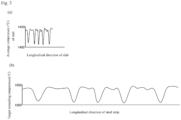
Fig. 3 ] is a graph showing the relationship between a temperature distribution of a slab being heated and a target annealing temperature for a hot-rolled steel strip in which (a) shows the temperature distribution in the longitudinal direction of the slab during slab heating, and (b) shows the target annealing temperature in the longitudinal direction of the hot-rolled steel strip determined by taking into account the temperature distribution in (a). - According to an embodiment of the present invention, when a hot-rolled steel strip for an electrical steel sheet is subjected to annealing (hot-band annealing) by using an annealing line that includes a heating zone, a soaking zone, and a cooling zone arranged in this order, the heating conditions of the annealing line are set to achieve the target annealing temperature in the longitudinal direction of the steel strip that is preferable for magnetic properties and that has been determined from the temperature distribution in the longitudinal direction of a slab during slab heating or from the temperature distribution in the longitudinal direction of the steel strip during hot rolling. As another embodiment, a rapid heating device is arranged on the upstream side of the soaking zone of the annealing line, and a thickness meter is arranged on the upstream side of the rapid heating device so that the heating temperature for the steel strip by the rapid heating device is set to achieve the target annealing temperature by taking into account the value of LSD which is defined by the thickness of the steel strip measured by the thickness meter and the threading speed of the steel strip during annealing.
- Hereinafter, an embodiment of the present invention will be described with reference to the drawings.
-
Fig. 1 is a schematic view showing the first half portion of a continuous annealing line that is used to perform annealing (hot-band annealing) on a hot-rolled steel strip for an electrical steel sheet of the present invention. The continuous annealing line includes a heating zone, a soaking zone, and a cooling zone arranged in this order from the upstream side. The hot-band annealing is usually performed by heating a steel strip S in aheating zone 3 to allow the temperature of the steel strip at the exit side of the heating zone to reach a target soaking temperature, and holding the steel strip S at the soaking temperature for a predetermined time in asoaking zone 4, and then cooling the steel strip S in a cooling zone (not shown). At this time, the furnace temperature in each of theheating zone 3 and thesoaking zone 4 and the threading speed of the steel strip S are kept constant to keep the steel strip at a predetermined soaking temperature for a predetermined time unless there is variation in the thickness or the threading speed of the steel strip. - In slab heating during hot rolling, the dissolution of precipitates, called inhibitors, is controlled so that the orientations of crystal grains can be highly integrated into the Goss orientation during secondary recrystallization. However, even if a slab has been uniformly heated in a heating furnace, a portion of the slab that is in contact with a rod-like base, called a skid, which is placed in the slab heating furnace to hold a cooled slab, is cooled when the slab is removed from the heating furnace. Therefore, the temperature distribution in the longitudinal direction of the slab significantly varies depending on the relationship between the position of the skid and the in-furnace time of the slab, when it is removed from the heating furnace. In addition, the temperature history of the slab differs between the portion of the slab that is in contact with the skid (skid portion) and the remaining portion of the slab that is not in contact with the skid (non-skid portion). Therefore, in processes following hot rolling, the states of the precipitates in the steel strip vary in the longitudinal direction, which greatly affects the recrystallization temperature and so on. As a result, steel sheets produced under the same conditions will have different magnetic properties when formed into final products.
- Thus, the present invention is intended to reduce the influence of the temperature variation in the longitudinal direction of the slab on the states of the precipitates in the hot-rolled steel strip and on the recrystallization temperature, and consequently, on the magnetic properties of the final product. For this purpose, as shown in
Fig. 3 , a target annealing temperature in the longitudinal direction of the steel strip during annealing (hot-band annealing) performed on the hot-rolled steel strip is changed in accordance with the temperature distribution in the longitudinal direction of the slab in slab heating. As a result, the states of the precipitates and the recrystallization temperature can be controlled to be uniform in the longitudinal direction of the steel strip. - It should be noted that the target annealing temperature in the longitudinal direction of the steel strip in the annealing line, which is determined based on the temperature distribution in the longitudinal direction of the slab, has a different degree of influence depending on the type of steel used and the type and amount of inhibitors. Thus, it is desirable to set the target annealing temperature after verifying its influence on the magnetic properties of the final product. Herein, the setting of the target annealing temperature by verification is preferably performed using a method of processing a large amount of data, such as statistical processing, machine learning, or AI.
- The target annealing temperature during annealing after the hot rolling is set based on the following manner. In the portion of the slab portion heated to a low temperature, the dissolution of inhibitors is likely to be insufficient. As a result, crystal grains with orientations unfavorable for magnetic properties may grow during annealing after the hot rolling. Meanwhile, crystal grains are coarsened in the portion of the slab heated to a high temperature. This means that high energy is required to grow crystal grains that are preferable for the magnetic properties. Thus, the target annealing temperature is set high.
- When intermediate annealing is performed in the cold rolling step, the influence of the slab heating temperature on the magnetic properties is reduced to a certain extent. Meanwhile, when intermediate annealing is not performed, it is more preferable to set the annealing temperature after the hot rolling to reflect the temperature distribution in the longitudinal direction of the slab.
- The information on the temperature distribution during slab heating may be determined by numerical analysis using information such as the position of the skid, the in-furnace time of the slab, and the furnace temperature, when it is difficult to actually measure. This is because when there is a change in the in-furnace time of the slab and the position of the skid, the temperature distribution of the slab during the heating of the slab greatly varies both in the thickness direction and in the longitudinal direction.
- When induction heating is used for slab heating, it is preferable to analyze a numerical value by also taking into account information about the arrangement of an induction coil and a power supply output.
- Instead of the temperature distribution in the longitudinal direction of the slab, it is also possible to use the temperature distribution in the longitudinal direction of the steel strip in rough rolling during hot rolling immediately afterwards. This is because the surface temperature distribution in the longitudinal direction of the steel strip has the same tendency as the temperature distribution in the longitudinal direction of the slab during slab heating. It should be noted that the steel strip subjected to rough rolling is thinner than the slab. Thus, the surface temperature of the steel strip subjected to rough rolling can be directly measured using a surface thermometer, such as a radiation thermometer. Herein, the surface temperature of the steel strip is preferably measured immediately after descaling to be performed to remove an oxide film formed on the surface of the steel strip, so that the measurement accuracy is improved.
- After the target annealing temperature in the longitudinal direction of the steel strip in the annealing line is determined as described above, the heating conditions for the steel strip by the annealing line, such as the heating temperature in each of the heating zone and the soaking zone, are set.
-
Fig. 1 is a view showing the first half of a continuous annealing line provided with anannealing furnace 1, which includes theheating zone 3, the soakingzone 4, and the cooling zone arranged in this order from the upstream side, and is used for annealing a hot-rolled steel strip. Specifically,Fig. 1 shows an example in which arapid heating device 2 is arranged on the upstream side of theheating zone 3 as an embodiment of the present invention. Therapid heating device 2 has a function of heating a steel strip to reach the target annealing temperature determined from the temperature distribution in the longitudinal direction of a slab during slab heating or from the temperature distribution in the longitudinal direction of the steel strip during hot rolling. - A steel strip has more or less thickness variation in the longitudinal direction, and, in particular, has large thickness variation at the front and rear end portions of the steel strip. There may also be cases where the threading speed of the steel strip is suddenly changed while the steel strip is being annealed. When there is such a large thickness variation or when the threading speed is suddenly changed, for example, it is impossible to heat the steel strip to the target temperature only by controlling the furnace temperature in each of the heating zone and the soaking zone to be constant. Thus, the preset temperature of the furnace should be changed. However, suddenly changing the preset temperature of the furnace would cause overshoot or hunting not only of the furnace temperature but also of the steel strip temperature. Further, since it takes time to change the furnace temperature, it is difficult to change the furnace temperature immediately. Therefore, it is preferable to set the temperature of the
annealing furnace 1 to be as constant as possible, or gradually change the temperature. - A hot-rolled steel strip is thicker and has a higher heat capacity than a cold-rolled steel strip, as described above. Therefore, it is difficult to heat the steel strip to the target temperature, not only because it is difficult to follow the changes of the furnace temperature in the heating zone but also because it affects the furnace temperature in the
heating zone 3. Therefore, it is desired to heat the steel strip in theheating zone 3 so that the steel strip always has the predetermined target temperature at the exit side of the heating zone, regardless of the variation in the thickness or the threading speed of the steel strip. - The final purpose of hot-band annealing lies in performing heat treatment involving holding the steel strip S at a target annealing temperature (soaking temperature) in the soaking
zone 4 for a predetermined time. However, when the temperature of a hot-rolled steel strip, which is thicker than a cold-rolled steel strip, varies at the exit side of the heating zone, the amount of heat of the steel strip also greatly varies, causing the amount of heat transferred to the soakingzone 4 to vary, and, consequently, the furnace temperature to also vary. As a result, it becomes difficult to heat the hot-rolled steel strip to the target soaking temperature. Also in this sense, it is preferable to set the heating temperature by therapid heating device 2 so that the steel strip temperature at the exit side of theheating zone 3 is constant. - Thus, when a hot-rolled steel strip for an electrical steel sheet is subjected to hot-band annealing using the continuous annealing line shown in
Fig. 1 , athickness meter 5 is arranged on the upstream side of theheating zone 3, and LSD, which is defined by the following expression (1) using the thickness of the steel strip measured by thethickness meter 5 and the threading speed of the steel strip during annealing, is used. That is, the steel strip temperature at the exit side of the heating zone is increased to the predetermined target temperature by changing the heating temperature for the steel strip S by therapid heating device 2 in accordance with the value of LSD. Note that LSD is an index proportional to the heat capacity of the steel strip.
- Specifically, in the present embodiment, as the value of LSD of the hot-rolled steel strip is larger, the heating temperature for the steel strip S by the
rapid heating device 2 is set higher, while as the value of LSD of the hot-rolled steel strip is smaller, the heating temperature by therapid heating device 2 is set lower. More specifically, as the thickness of the steel strip including a minute variation in the thickness of the steel strip is larger, the steel strip temperature at the exit side of the rapid heating device, that is, the heating temperature by therapid heating device 2 is set higher than the conventional heating temperature for which LSD is not taken into account. Conversely, as the thickness of the steel strip is smaller, heating is performed such that the steel strip temperature at the exit side of the rapid heating device, that is, the heating temperature by therapid heating device 2 is set lower than the conventional heating temperature for which LSD is not taken into account. Similarly, heating is performed such that when the threading speed has become faster, the steel strip temperature at the exit side of the rapid heating device, that is, the heating temperature by therapid heating device 2 is set higher than the conventional heating temperature for which LSD is not taken into account. Conversely, when the threading speed has become slower, the steel strip temperature at the exit side of therapid heating device 2, that is, the heating temperature by therapid heating device 2 is set lower than the conventional heating temperature for which LSD is not taken into account, and heating is performed. - By changing the heating temperature for the steel strip S by the
rapid heating device 2 by taking into account the value of LSD as described above, it is possible, even when there is a sudden change in the thickness t or the threading speed LS of the hot-rolled steel strip, to reduce the variation in the steel strip temperature at the exit side of the heating zone as well as the variation in the furnace temperature in the soakingzone 4 without changing the preset furnace temperature in theheating zone 3. Consequently, the temperature of the hot-rolled steel strip can be controlled to a target soaking temperature with high accuracy. - The
rapid heating device 2 may be any type capable of changing the steel strip temperature with high responsiveness. In addition, as the method for heating the steel strip S, any method having a good track record, such as induction heating (solenoid method or transverse method), electric heating, or near-infrared heating, may be suitably used. - The
rapid heating device 2 is placed on the upstream side of the soakingzone 4 in order to control the steel strip temperature at the exit side of the heating zone, and consequently, the steel strip temperature at the exit side of the soaking zone, with high accuracy. As shown inFig. 1 , therapid heating device 2 may be placed on the upstream side of the heating zone, or alternatively, as shown inFig. 2 , within the heating zone 3 (including between divided sections of the heating zone 3). However, when an induction heating device, in particular, a solenoid-actuated device is used as therapid heating device 2, it is difficult to heat the steel strip to a temperature higher than the Curie point. Therefore, in such a case, provided that theheating zone 3 is divided into three sections including the front stage, the middle stage, and the rear stage in this order from the upstream side, therapid heating device 2 is preferably placed not on the rear stage, but on the front stage or the middle stage. - The heating capacity of the
rapid heating device 2 is preferably larger to accommodate large variation in the thickness or the threading speed of the hot-rolled steel strip. As one measure, to change the heating temperature for a steel strip having a thickness of about 2 mm at the exit side of the heating zone by about ±20°C, the rapid heating device is required to have a heating capacity (the amount of temperature increase) of about 50 to 100°C to sufficiently accommodate the variation in the thickness or the threading speed of the steel strip, though it differs depending on the temperature range (position) in which the rapid heating device is placed and the relationship between the temperature and specific heat of the steel strip. - As described above, it is possible to sufficiently contribute to controlling the heating temperature for the steel strip S in the longitudinal direction with high accuracy by changing the preset heating temperature for the steel strip S by the
rapid heating device 2 to achieve the preset target annealing temperature (soaking temperature) in accordance with the value of LSD, that is, variation in (the thickness × the threading speed). However, to control the steel strip temperature at the exit side of theheating zone 3 with even higher accuracy, it is preferable to also take into account the width of the hot-rolled steel strip S in addition to the value of LSD. This is because since the heat capacity of a steel strip varies in proportion to the width of the steel strip, the amount of heat needed to heat the steel strip and the amount of heat removed from the furnace body also vary correspondingly, and consequently, the width of the steel strip also affects the steel strip temperature at the exit side of the heating zone and on the furnace temperature in each of the heating zone and the soaking zone. In particular, when an annealing line having a furnace body with a low heat capacity and including heating and soaking zones where the furnace temperature is likely to change, is used, it is desirable to set the heating temperature by the rapid heating device by taking into account the width of the steel strip. - Further, to control the steel strip temperature at the exit side of the heating zone with even higher accuracy, it is preferable to adjust the heating temperature by the
rapid heating device 2 by taking into account information on the furnace temperature in theheating zone 3 on the stage following the rapid heating device. For example, if the heating capacity of therapid heating device 2 is low, therapid heating device 2 alone may be insufficient to respond to a large change in the heat capacity of the hot-rolled steel strip due to variation in the thickness or the threading speed of the steel strip or due to variation in the value of LSD, and thus the preset furnace temperature in theheating zone 3 may be intentionally changed. In such a case, the steel strip temperature at the exit side of theheating zone 3 can be controlled with even higher accuracy, by feeding back the constantly-changing furnace temperature information caused after therapid heating device 2 and reflecting it in the preset heating temperature by therapid heating device 2. - Note that when the furnace temperature information is fed back, the increase amount of the steel strip temperature at the exit side of the heating zone can be calculated using the following Expression (2).
[Math. 1]
- , where ΔT is a temperature increase amount [°C],
- σ is the Stefan-Boltzmann constant (4.88 × 10⁻⁸ [kcal/m2·h·K4],
- ϕCG is an overall heat absorption rate,
- L is a heated length [m],
- Cp is a specific heat [kcal/kg°C],
- ρ is a density 7850 [kg/m3],
- V is a threading speed [m/min],
- t is a thickness [mm] of the sheet,
- Tf is a furnace temperature [°C], and
- Ts is a steel sheet temperature [°C] on the entry side.
- Using the above Expression (2) above, the steel sheet temperature Ts on the entry side, that is, the heating temperature for the steel sheet by the rapid heating device is adjusted by taking into account the variation in the furnace temperature Tf, so that it is possible to adjust the amount of temperature increase ΔT, and thus control the steel strip temperature on the entry side of the soaking zone. Herein, the overall heat absorption rate φCG is the index representing the efficiency related to the flow of heat throughout the entire furnace and determined by the pas records of the furnace temperature and the sheet temperature.
- To control the steel strip temperature at the exit side of the heating zone with even higher accuracy, it is preferable to determine the heating temperature for the steel strip by the
rapid heating device 2 by using information on the steel strip temperature at the exit side of the heating zone, the furnace temperature in the soaking zone, and the steel strip temperature at the exit side of the soaking zone, in addition to the value of LSD, the width of the steel strip, and the furnace temperature in the heating zone after the rapid heating device described above. - Herein, a hot-rolled steel strip for an electrical steel sheet targeted by the present invention preferably contains 1.6 to 5.0 mass% Si. Si is an element effective in increasing the specific resistance of steel to reduce the iron loss and is therefore preferably contained by 1.6 mass% or more. However, if the Si content exceeds 5.0 mass%, the magnetic flux density will be reduced to cause the steel to become brittle, resulting in a significant deterioration in manufacturability such that cracks occur during cold rolling. Preferably, the Si content is in the range of 2.0 to 3.8 mass%.
- The hot-rolled steel strip may also contain, in addition to Si, a known inhibitor-forming ingredient to allow secondary recrystallization to occur, or a known additional element to improve magnetic or mechanical properties.
- According to the hot-band annealing of the present invention described above, it is possible to perform heat treatment on a hot-rolled steel strip in the longitudinal direction (rolling direction) across the entire length thereof at an appropriate temperature corresponding to a temperature distribution in the longitudinal direction of a slab during slab heating, in addition to the variation in the thickness or in the threading speed in the longitudinal direction of the steel strip. Accordingly, it is possible to obtain a final product with excellent magnetic properties and without poor secondary recrystallization and defective crystal orientations across the entire length of the steel strip.
- A steel slab (with a slab weight of 20 tons) for an electrical steel sheet containing 3.5 mass% Si was produced by a continuous casting process. The steel slab was then heated to a temperature of 1200°C or higher and hot-rolled into a hot-rolled steel strip with a thickness of 2 mm. The hot-rolled steel strip was subjected to hot-band annealing at a target annealing temperature (soaking temperature) of 1050°C for a soaking time of 30 seconds using the continuous annealing line shown in
Fig. 1 in which thethickness meter 5 and therapid heating device 2 are arranged on the upstream side of the heating zone, and was pickled for descaling. - Note that, as shown in Table 1, in the hot-band annealing for some of the steel strips, the target annealing temperature (target soaking temperature) in the longitudinal direction of the steel strip was changed by taking into account the temperature distribution in the longitudinal direction of the slab during slab heating, the temperature distribution in the longitudinal direction of the steel strip during rough rolling of the hot rolling, or the positional information of a skid during the heating of the slab. As the rapid heating device for the annealing line, an induction heating device was used. As shown in Table 1, regarding some of the steel strips, the heating temperature of the device was sequentially changed in the longitudinal direction of the steel strip by taking into account the value of LSD (thickness × threading speed) to obtain the target annealing temperature.
- At this time, the preset furnace temperature in each of the heating zone and the soaking zone was held constant, and the surface temperature of the steel strip at the exit side of the soaking zone was measured with a radiation thermometer. Then, the difference ΔT between the surface temperature of the steel strip and the target annealing temperature, which had been determined by taking into account the temperature distribution of the steel strip in the longitudinal direction, was sequentially determined. Table 1 shows the maximum value ΔTmax thereof. The target annealing temperature was set by using Expression (2) as the temperature for the best improvement of the magnetic properties from among the past records of the hot-band annealing temperature and the magnetic properties.
- Next, the steel strip subjected to pickling was cold rolled to an intermediate thickness of 1.5 mm. The steel strip was then divided into two pieces in the longitudinal direction, and one of the two resulting steel strips was subjected to intermediate annealing at 1 100°C for 20 seconds, while the other was subjected to a second cold rolling step without the intermediate annealing performed so that a cold-rolled steel strip with a final thickness of 0.23 mm was obtained.
- After the two cold rolling steps, the steel strip was subjected to decarburization annealing, which also serves as primary recrystallization annealing, at a temperature of 840°C for 100 seconds, and an annealing separating agent composed mainly of MgO was applied to each surface of the steel strip and dried. The steel strip was then subjected to finishing annealing including secondary recrystallization annealing and purification treatment at a temperature of 1200°C for 10 hours. The atmospheric gas in the finishing annealing was set to H2 when the steel strip was held at 1200°C during the purification treatment and was set to N2 during the rest of the time when the temperature was increased (including secondary recrystallization annealing) and when the temperature was decreased.
- The steel strip resulting from the above finishing annealing was divided into 10 sections in the longitudinal direction, and then, test pieces for measuring magnetic properties were taken from each section. Then, the magnetic flux density B8 was measured in accordance with the Japanese Industrial Standards JIS C2553, and the difference ΔB8 between the maximum value and the minimum value of the magnetic flux density B8 was determined as the variation in magnetic properties. The results are shown in Table 1.
- The results show that in all the steel strips of Nos. 1 to 6 and 9 to 12 (Invention Example) subjected to hot-band annealing under the conditions in accordance with the present invention, the difference of the steel strip temperature at the exit side of the soaking zone from the target annealing temperature determined by taking into account the influence of the heating temperature for the slab on the magnetic properties, was controlled to be small. Thus, it was possible to obtain a grain-oriented electrical steel sheet with small variation in the magnetic properties within the same steel strip.
- In contrast, for the steel strips Nos. 13 and 14 (Comparative Examples) for which the target annealing temperature of hot-band annealing was determined by taking into account the positional information on the skid during the heating of the slab, but the heating temperature by the rapid heating device was set without taking the value of LSD into account, it is found that the difference ΔT of the steel strip temperature at the exit side of the soaking zone from the target annealing temperature of the annealing line is large. Thus, the variation ΔB8 in the magnetic properties in the longitudinal direction of the steel strip is large.
- Meanwhile, for the steel strips No. 15 and 16 (Comparative Examples) for which the heating temperature by the rapid heating device was set by taking the value of LSD into account, but the target annealing temperature of the hot-band annealing was set without taking into account a temperature distribution of the slab in the longitudinal direction during slab heating, the temperature distribution of the steel strip in the longitudinal direction after the rough rolling during the hot rolling, or the positional information on the skid during the heating of the slab, it is found to be impossible to address the influence of temperature variation during the heating of the slab. Therefore, although the variation in the steel strip temperature with respect to the target annealing temperature was reduced, the variation in the magnetic properties increased.
- For the steel strips No. 7 and 8 (Conventional Example) for which the target annealing temperature of the hot-band annealing was set without taking into account the temperature distribution of the slab in the longitudinal direction during slab heating, the temperature distribution of the steel strip in the longitudinal direction after the rough rolling during the hot rolling, or the positional information on the skid during the heating of the slab, and for which the heating temperature by the rapid heating device was set without taking the value of LSD into account, it is found that the difference ΔT of the steel strip temperature at the exit side of the soaking zone from the target annealing temperature is large, and it is also found to be impossible to address the influence of temperature variation during the heating of the slab on the magnetic properties. Therefore, the variation ΔB8 in the magnetic properties in the longitudinal direction within the steel strip is the largest.
- In all of the conditions of the above examples, it was found that applying intermediate annealing between cold rolling steps can mitigate the influence of the temperature distribution of the slab during slab heating to reduce the variation in the magnetic properties in the longitudinal direction of the steel strip.
Table 1 Test No. Use of Rapid Heating Device (with LSD Taken into Account) Factors Used to Determine Target Annealing Temperature of Hot-Band Annealing Intermediate Annealing Between Cold Rolling Step Maximum Difference ΔB8 (T) in Magnetic Flux Density Within Same Steel Strip Maximum Difference ΔTmax (°C) Between Temperature on Exit Side of Annealing Zone and Target Heating Temperature Remarks 1 Used Temperature Distribution of Slab During Slab Heating Not Performed 0.009 8 Invention Example 2 Used Temperature Distribution of Slab During Slab Heating Performed 0.006 7 Invention Example 3 Used Temperature Distribution of Steel Strip During Rough Rolling of Hot Rolling Not Performed 0.005 5 Invention Example 4 Used Temperature Distribution of Steel Strip During Rough Rolling of Hot Rolling Performed 0.004 7 Invention Example 5 Used Position of Skid During Slab Heating Not Performed 0.010 6 Invention Example 6 Used Position of Skid During Slab Heating Performed 0.008 8 Invention Example 7 Not Used None Not Performed 0.053 29 Conventional Example 8 Not Used None Performed 0.042 32 Conventional Example 9 Not Used Temperature Distribution of Slab During Slab Heating Not Performed 0.029 28 Invention Example 10 Not Used Temperature Distribution of Slab During Slab Heating Performed 0.015 31 Invention Example 11 Not Used Temperature Distribution of Steel Strip During Rough Rolling of Hot Rolling Not Performed 0.028 30 Invention Example 12 Not Used Temperature Distribution of Steel Strip During Rough Rolling of Hot Rolling Performed 0.017 27 Invention Example 13 Not Used Position of Skid During Slab Heating Not Performed 0.040 29 Comparative Example 14 Not Used Position of Skid During Slab Heating Performed 0.035 33 Comparative Example 15 Used None Not Performed 0.034 6 Comparative Example 16 Used None Performed 0.030 7 Comparative Example - The technology of the present invention is applicable to not only a hot-rolled steel strip for an electrical steel sheet, but also all metal strips that should be annealed by taking into account variation in the heating temperature for a slab in the longitudinal direction.
-
- S
- steel strip
- 1
- annealing furnace
- 2
- rapid heating device
- 3
- heating zone
- 4
- soaking zone
- 5
- thickness meter
Claims (5)
- A method for annealing a hot-rolled steel strip for an electrical steel sheet obtained by heating a slab containing 1.6 to 5.0 mass% Si and hot-rolling the slab, using a continuous annealing line including a heating zone, a soaking zone, and a cooling zone arranged in this order from an upstream side, comprisingdetermining a target annealing temperature for the steel strip in a longitudinal direction in the annealing line from information on a temperature distribution in a longitudinal direction of the slab during the slab heating or information on a temperature distribution in the longitudinal direction of the steel strip during the hot rolling; andsetting a heating condition for the steel strip in the annealing line.
- The method for annealing a hot-rolled steel strip according to claim 1, whereinthe heating condition for the steel strip in the annealing line is determined by arranging a rapid heating device on an upstream side of the soaking zone, arranging a thickness meter on an upstream side of the rapid heating device, and setting a heating temperature for the steel strip by the rapid heating device so as to achieve the target annealing temperature based on a value of LSD defined by a thickness of the steel strip measured by the thickness meter and a threading speed of the steel strip during annealing and represented by the following Expression (1):
 where t represents the thickness (mm) of the steel strip, and LS represents the threading speed (m/min) of the steel strip.
 - The method for annealing a hot-rolled steel strip according to claim 1 or 2, wherein
the target annealing temperature in the longitudinal direction of the steel strip in the annealing line is determined using positional information on a skid during the slab heating. - The method for annealing a hot-rolled steel strip according to claim 3, wherein
the target annealing temperature in the longitudinal direction of the steel strip during the annealing is set using an in-furnace time during the slab heating, in addition to the positional information on the skid when the slab is heated. - The method for annealing a hot-rolled steel strip according to any one of claims 2 to 4, wherein
the heating temperature for the steel strip by the rapid heating device is set by feeding back information on a furnace temperature on a downstream side of the rapid heating device.
Applications Claiming Priority (2)
| Application Number | Priority Date | Filing Date | Title |
|---|---|---|---|
| JP2022059371 | 2022-03-31 | ||
| PCT/JP2023/012737 WO2023190645A1 (en) | 2022-03-31 | 2023-03-29 | Method for annealing hot-rolled steel strip |
Publications (2)
| Publication Number | Publication Date |
|---|---|
| EP4488394A1 true EP4488394A1 (en) | 2025-01-08 |
| EP4488394A4 EP4488394A4 (en) | 2025-06-25 |
Family
ID=88201997
Family Applications (1)
| Application Number | Title | Priority Date | Filing Date |
|---|---|---|---|
| EP23780654.2A Pending EP4488394A4 (en) | 2022-03-31 | 2023-03-29 | Method for annealing hot-rolled steel strip |
Country Status (4)
| Country | Link |
|---|---|
| US (1) | US20250230519A1 (en) |
| EP (1) | EP4488394A4 (en) |
| JP (1) | JP7673823B2 (en) |
| WO (1) | WO2023190645A1 (en) |
Family Cites Families (11)
| Publication number | Priority date | Publication date | Assignee | Title |
|---|---|---|---|---|
| JP3260605B2 (en) * | 1995-10-27 | 2002-02-25 | 新日本製鐵株式会社 | Method of manufacturing cold rolled steel sheet with good uniformity of coil material |
| JP4187960B2 (en) | 2001-11-05 | 2008-11-26 | Jfeスチール株式会社 | Material stabilization system |
| JP4894146B2 (en) | 2005-01-31 | 2012-03-14 | Jfeスチール株式会社 | Heating method for grain-oriented electrical steel slab |
| RU2414513C1 (en) * | 2007-04-05 | 2011-03-20 | Ниппон Стил Корпорейшн | Procedure for continuous annealing strip steel with curie peak and installation for continuous annealing such steel |
| JP2011179035A (en) * | 2010-02-26 | 2011-09-15 | Jfe Steel Corp | Method for controlling sheet temperature in continuous annealing furnace, and continuous annealing furnace |
| EP2557183A1 (en) * | 2011-08-12 | 2013-02-13 | Siemens Aktiengesellschaft | Method for operating a continuous annealing line for processing a milled item |
| JP6160649B2 (en) | 2014-05-19 | 2017-07-12 | Jfeスチール株式会社 | Method for producing grain-oriented electrical steel sheet |
| JP6572864B2 (en) | 2016-10-18 | 2019-09-11 | Jfeスチール株式会社 | Hot-rolled steel sheet for manufacturing electrical steel sheet and method for manufacturing the same |
| JP6748375B2 (en) | 2016-10-19 | 2020-09-02 | Jfeスチール株式会社 | Descaling method for Si-containing hot rolled steel sheet |
| JP6784182B2 (en) * | 2017-01-31 | 2020-11-11 | Jfeスチール株式会社 | Steel plate temperature control method and steel sheet temperature control device |
| JP7557123B2 (en) * | 2020-02-06 | 2024-09-27 | 日本製鉄株式会社 | Non-oriented electrical steel sheet and its manufacturing method |
-
2023
- 2023-03-29 WO PCT/JP2023/012737 patent/WO2023190645A1/en not_active Ceased
- 2023-03-29 EP EP23780654.2A patent/EP4488394A4/en active Pending
- 2023-03-29 US US18/848,992 patent/US20250230519A1/en active Pending
- 2023-03-29 JP JP2023558798A patent/JP7673823B2/en active Active
Also Published As
| Publication number | Publication date |
|---|---|
| WO2023190645A1 (en) | 2023-10-05 |
| US20250230519A1 (en) | 2025-07-17 |
| JP7673823B2 (en) | 2025-05-09 |
| JPWO2023190645A1 (en) | 2023-10-05 |
| EP4488394A4 (en) | 2025-06-25 |
Similar Documents
| Publication | Publication Date | Title |
|---|---|---|
| KR100432682B1 (en) | Metal plate flatness controlling method and device | |
| KR20090115195A (en) | Continuous Annealing Method and Continuous Annealing Facility for Steel Strip with Curie Point | |
| US12486554B2 (en) | Method of determining final annealing conditions for grain-oriented electrical steel sheet and method of producing grain-oriented electrical steel sheet using method of determining thereof | |
| CN112752623B (en) | Method for producing grain-oriented electrical steel sheet and cold rolling facility | |
| JP5293022B2 (en) | Temperature control method in continuous annealing furnace and continuous annealing furnace | |
| EP4527952A1 (en) | Hot-rolled steel strip annealing method, and electromagnetic steel sheet production method using said annealing method | |
| EP0378131B1 (en) | A method of manufacturing a grain-oriented electrical steel strip | |
| JPH0578744A (en) | Manufacture of grain-oriented electrical steel sheet excellent in magnetic property | |
| JP6137490B2 (en) | Method for predicting primary recrystallization texture and method for producing grain-oriented electrical steel sheet | |
| US20250230519A1 (en) | Method for annealing hot-rolled steel strip | |
| KR102835138B1 (en) | Method of manufacturing grain-oriented electrical steel sheet and manufacturing line | |
| JPH11153581A (en) | Online measuring method and measuring apparatus for recovery / recrystallization progress of steel sheet during annealing and continuous annealing method for steel sheet | |
| EP4575009A1 (en) | Method for producing grain-oriented electromagnetic steel sheet, and induction heater | |
| EP4394056A1 (en) | Hot-rolled steel strip annealing method | |
| JP2022095311A (en) | Manufacturing method of cold rolled steel sheet | |
| EP4729639A1 (en) | Method for manufacturing oriented electromagnetic steel sheet, and induction heating device | |
| EP4553177A1 (en) | Annealing facility, and method for manufacturing grain-oriented electromagnetic steel sheet | |
| EP4729640A1 (en) | Method for producing grain-oriented electrical steel sheet, and induction heating device | |
| EP4575010A1 (en) | Method for producing grain-oriented electromagnetic steel sheet, and induction heater | |
| EP4353850A1 (en) | Method for manufacturing oriented electromagnetic steel sheet and rolling equipment for manufacturing oriented electromagnetic steel sheet | |
| EP4512915A1 (en) | Grain-oriented electromagnetic steel sheet and method for manufacturing grain-oriented electromagnetic steel sheet | |
| JP3885264B2 (en) | Method for producing grain-oriented electrical steel sheet | |
| WO2025154575A1 (en) | Method for cold rolling grain-oriented electromagnetic steel sheet, method for manufacturing same, and cold rolling equipment train | |
| WO2025154576A1 (en) | Cold rolling method and production method for grain-oriented electromagnetic steel sheet, and cold rolling equipment line | |
| CN120457231A (en) | Grain-oriented electrical steel sheet |
Legal Events
| Date | Code | Title | Description |
|---|---|---|---|
| STAA | Information on the status of an ep patent application or granted ep patent |
Free format text: STATUS: THE INTERNATIONAL PUBLICATION HAS BEEN MADE |
|
| PUAI | Public reference made under article 153(3) epc to a published international application that has entered the european phase |
Free format text: ORIGINAL CODE: 0009012 |
|
| STAA | Information on the status of an ep patent application or granted ep patent |
Free format text: STATUS: REQUEST FOR EXAMINATION WAS MADE |
|
| 17P | Request for examination filed |
Effective date: 20241001 |
|
| AK | Designated contracting states |
Kind code of ref document: A1 Designated state(s): AL AT BE BG CH CY CZ DE DK EE ES FI FR GB GR HR HU IE IS IT LI LT LU LV MC ME MK MT NL NO PL PT RO RS SE SI SK SM TR |
|
| A4 | Supplementary search report drawn up and despatched |
Effective date: 20250523 |
|
| RIC1 | Information provided on ipc code assigned before grant |
Ipc: C21D 9/62 20060101ALN20250519BHEP Ipc: C21D 1/40 20060101ALN20250519BHEP Ipc: C21D 1/34 20060101ALN20250519BHEP Ipc: C22C 38/02 20060101ALI20250519BHEP Ipc: C21D 1/42 20060101ALI20250519BHEP Ipc: C21D 9/60 20060101ALI20250519BHEP Ipc: C21D 9/46 20060101ALI20250519BHEP Ipc: C21D 6/00 20060101ALI20250519BHEP Ipc: C21D 9/573 20060101ALI20250519BHEP Ipc: C21D 11/00 20060101ALI20250519BHEP Ipc: C21D 8/12 20060101AFI20250519BHEP |
|
| DAV | Request for validation of the european patent (deleted) | ||
| DAX | Request for extension of the european patent (deleted) |