EP4487970A2 - Verfahren zur reinigung eines turbinenelements - Google Patents
Verfahren zur reinigung eines turbinenelements Download PDFInfo
- Publication number
- EP4487970A2 EP4487970A2 EP24215549.7A EP24215549A EP4487970A2 EP 4487970 A2 EP4487970 A2 EP 4487970A2 EP 24215549 A EP24215549 A EP 24215549A EP 4487970 A2 EP4487970 A2 EP 4487970A2
- Authority
- EP
- European Patent Office
- Prior art keywords
- face
- airfoil
- exemplary
- blade
- along
- Prior art date
- Legal status (The legal status is an assumption and is not a legal conclusion. Google has not performed a legal analysis and makes no representation as to the accuracy of the status listed.)
- Pending
Links
Images



Classifications
-
- F—MECHANICAL ENGINEERING; LIGHTING; HEATING; WEAPONS; BLASTING
- F01—MACHINES OR ENGINES IN GENERAL; ENGINE PLANTS IN GENERAL; STEAM ENGINES
- F01D—NON-POSITIVE DISPLACEMENT MACHINES OR ENGINES, e.g. STEAM TURBINES
- F01D25/00—Component parts, details, or accessories, not provided for in, or of interest apart from, other groups
- F01D25/002—Cleaning of turbomachines
-
- B—PERFORMING OPERATIONS; TRANSPORTING
- B08—CLEANING
- B08B—CLEANING IN GENERAL; PREVENTION OF FOULING IN GENERAL
- B08B7/00—Cleaning by methods not provided for in a single other subclass or a single group in this subclass
- B08B7/02—Cleaning by methods not provided for in a single other subclass or a single group in this subclass by distortion, beating, or vibration of the surface to be cleaned
-
- B—PERFORMING OPERATIONS; TRANSPORTING
- B08—CLEANING
- B08B—CLEANING IN GENERAL; PREVENTION OF FOULING IN GENERAL
- B08B9/00—Cleaning hollow articles by methods or apparatus specially adapted thereto
- B08B9/02—Cleaning pipes or tubes or systems of pipes or tubes
- B08B9/027—Cleaning the internal surfaces; Removal of blockages
- B08B9/032—Cleaning the internal surfaces; Removal of blockages by the mechanical action of a moving fluid, e.g. by flushing
- B08B9/0321—Cleaning the internal surfaces; Removal of blockages by the mechanical action of a moving fluid, e.g. by flushing using pressurised, pulsating or purging fluid
-
- F—MECHANICAL ENGINEERING; LIGHTING; HEATING; WEAPONS; BLASTING
- F01—MACHINES OR ENGINES IN GENERAL; ENGINE PLANTS IN GENERAL; STEAM ENGINES
- F01D—NON-POSITIVE DISPLACEMENT MACHINES OR ENGINES, e.g. STEAM TURBINES
- F01D25/00—Component parts, details, or accessories, not provided for in, or of interest apart from, other groups
- F01D25/28—Supporting or mounting arrangements, e.g. for turbine casing
- F01D25/285—Temporary support structures, e.g. for testing, assembling, installing, repairing; Assembly methods using such structures
-
- F—MECHANICAL ENGINEERING; LIGHTING; HEATING; WEAPONS; BLASTING
- F01—MACHINES OR ENGINES IN GENERAL; ENGINE PLANTS IN GENERAL; STEAM ENGINES
- F01D—NON-POSITIVE DISPLACEMENT MACHINES OR ENGINES, e.g. STEAM TURBINES
- F01D5/00—Blades; Blade-carrying members; Heating, heat-insulating, cooling or antivibration means on the blades or the members
- F01D5/005—Repairing methods or devices
-
- F—MECHANICAL ENGINEERING; LIGHTING; HEATING; WEAPONS; BLASTING
- F01—MACHINES OR ENGINES IN GENERAL; ENGINE PLANTS IN GENERAL; STEAM ENGINES
- F01D—NON-POSITIVE DISPLACEMENT MACHINES OR ENGINES, e.g. STEAM TURBINES
- F01D5/00—Blades; Blade-carrying members; Heating, heat-insulating, cooling or antivibration means on the blades or the members
- F01D5/12—Blades
- F01D5/14—Form or construction
- F01D5/18—Hollow blades, i.e. blades with cooling or heating channels or cavities; Heating, heat-insulating or cooling means on blades
-
- F—MECHANICAL ENGINEERING; LIGHTING; HEATING; WEAPONS; BLASTING
- F05—INDEXING SCHEMES RELATING TO ENGINES OR PUMPS IN VARIOUS SUBCLASSES OF CLASSES F01-F04
- F05D—INDEXING SCHEME FOR ASPECTS RELATING TO NON-POSITIVE-DISPLACEMENT MACHINES OR ENGINES, GAS-TURBINES OR JET-PROPULSION PLANTS
- F05D2230/00—Manufacture
- F05D2230/72—Maintenance
-
- F—MECHANICAL ENGINEERING; LIGHTING; HEATING; WEAPONS; BLASTING
- F05—INDEXING SCHEMES RELATING TO ENGINES OR PUMPS IN VARIOUS SUBCLASSES OF CLASSES F01-F04
- F05D—INDEXING SCHEME FOR ASPECTS RELATING TO NON-POSITIVE-DISPLACEMENT MACHINES OR ENGINES, GAS-TURBINES OR JET-PROPULSION PLANTS
- F05D2230/00—Manufacture
- F05D2230/80—Repairing, retrofitting or upgrading methods
-
- F—MECHANICAL ENGINEERING; LIGHTING; HEATING; WEAPONS; BLASTING
- F05—INDEXING SCHEMES RELATING TO ENGINES OR PUMPS IN VARIOUS SUBCLASSES OF CLASSES F01-F04
- F05D—INDEXING SCHEME FOR ASPECTS RELATING TO NON-POSITIVE-DISPLACEMENT MACHINES OR ENGINES, GAS-TURBINES OR JET-PROPULSION PLANTS
- F05D2240/00—Components
- F05D2240/20—Rotors
- F05D2240/30—Characteristics of rotor blades, i.e. of any element transforming dynamic fluid energy to or from rotational energy and being attached to a rotor
-
- F—MECHANICAL ENGINEERING; LIGHTING; HEATING; WEAPONS; BLASTING
- F05—INDEXING SCHEMES RELATING TO ENGINES OR PUMPS IN VARIOUS SUBCLASSES OF CLASSES F01-F04
- F05D—INDEXING SCHEME FOR ASPECTS RELATING TO NON-POSITIVE-DISPLACEMENT MACHINES OR ENGINES, GAS-TURBINES OR JET-PROPULSION PLANTS
- F05D2260/00—Function
- F05D2260/20—Heat transfer, e.g. cooling
-
- F—MECHANICAL ENGINEERING; LIGHTING; HEATING; WEAPONS; BLASTING
- F05—INDEXING SCHEMES RELATING TO ENGINES OR PUMPS IN VARIOUS SUBCLASSES OF CLASSES F01-F04
- F05D—INDEXING SCHEME FOR ASPECTS RELATING TO NON-POSITIVE-DISPLACEMENT MACHINES OR ENGINES, GAS-TURBINES OR JET-PROPULSION PLANTS
- F05D2260/00—Function
- F05D2260/60—Fluid transfer
- F05D2260/607—Preventing clogging or obstruction of flow paths by dirt, dust, or foreign particles
Definitions
- the disclosure relates to gas turbine engine repair and servicing. More particularly, the disclosure relates to the repair and restoration of airfoil elements from gas turbine engines.
- Gas turbine engines are subject to periodic or other servicing requiring the removal, cleaning, inspection, and repair or restoration of individual components.
- airfoil elements blades and vanes
- Turbine blades and vanes are typically formed of high temperature alloys, generally nickel-based superalloys.
- the elements have internal cooling passage systems (e.g., with inlets typically along the roots of blades and along either an inner diameter platform or outer diameter shroud of vanes).
- thermal barrier coating systems comprise one or more bondcoat layers (often metallic) and one or more barrier layers (typically ceramic). Additionally, abradable and/or abrasive coatings may be located such as at the blade tip for engaging the inner diameter surface of a blade outer airseal (BOAS).
- BOAS blade outer airseal
- So-called cantilevered vanes only have outer diameter shrouds and may have inner diameter ends similar to outer diameter ends of blades. Typical blade outer diameter ends are formed by a tip of the blade airfoil bearing an abrasive coating. Other blades include shrouds at the outer diameter end of the airfoil. Such shrouds may bear sealing teeth or the like.
- the cooling passageway systems include outlets.
- the outlets include outlets along the airfoil itself such as outlets adjacent the leading edge, outlets adjacent the trailing edge (e.g., a discharge slot), outlets along the respective suction side and/or pressure side, and outlets at blade tips. Additional outlets may be along gaspath-facing surfaces of platforms or shrouds. For vanes, in particular, there may be one or more large outlets along the non-gaspath-facing surface of whichever of the platform and shroud does not bear the inlet(s).
- an exemplary servicing process for blades involves cleaning, optional coating removal, inspection, machining at wear or damage locations, subsequent repair/restoration (e.g., build-up weld repairs, tip cap replacement, and the like), and recoating).
- subsequent repair/restoration e.g., build-up weld repairs, tip cap replacement, and the like
- the airfoil elements are typically processed in their respective stages of the engine. For example, all the blades of a given stage may be removed from the associated disk and processed as a batch. Many alternatives exist including aggregating like blades from multiple engines. These blades are sent to repair shops to restore to the original condition. The blades are initially sent for grit blasting to remove the top ceramic coat. Once blasted, the parts are checked if they are salvageable (e.g., based on visual inspection). If the parts are salvageable, they are sent for internal cavity cleaning.
- salvageable e.g., based on visual inspection
- a typical internal cleaning process is an iterative process including radiographic imaging inspection.
- An exemplary baseline initial cleaning process 201 ( FIG. 6 ) comprises an autoclave chemical cleaning or leaching 210. This may be performed on individual blades or groups as discussed above.
- the leaching is performed using an alkaline solution (e.g., KOH).
- the exemplary autoclaving involves an autoclave operating temperature of 400°F to 450°F (204°C to 232°C), an operating pressure of about 200 psi (1.4MPa), and a hold time at operating temperature and pressure of 2.5 hours to 8.0 hours.
- a flushing 212 may be performed.
- An exemplary flushing is a high pressure water jet cleaning.
- An exemplary flushing comprises inserting one or more nozzles into the blade platform inlet(s) and blasting with deionized water at high pressure (e.g., 5000 psi to 8000 psi) (3.4MPa to 5.5MPa). This flushing tends to remove material left by the autoclaving. For example, the autoclaving may tend to loosen internal layers of sand and dust, leaving these relatively fragile.
- an oven dry 218 to remove residual water.
- Exemplary operating temperatures are 225°F to 250°F (107°C to 121°C) in a drying oven or atmospheric furnace.
- Radiographic inspection 220 may involve installing one or more blades in a fixture.
- Exemplary fixtures are serialized to provide visible indication of the particular blade being tested in the radiographic image.
- Exemplary radiographic imaging is a digital x-ray.
- FIG. 7 shows an exemplary radiographic image with areas of residual fouling 380 (dark spots) highlighted in light boxes.
- the process repeats.
- the process may repeat for many cycles.
- it may take many days to process a given stage of elements.
- the costs of this are substantial. It is not merely the time required for processing but labor and downtime. Also, there is a cost to unpredictability. A great variation in the amount of time needed for blade stages also imposes a predictability cost. Going in, one does not know whether a given stage of blades may require many days of cycles or only one or two days.
- One aspect of the disclosure involves a method for processing a turbomachine airfoil element, the airfoil element comprising a metallic substrate having: an airfoil extending from a first end to a second end; and a cooling passageway system extending through the airfoil.
- the method comprises: applying an external vibration to an area of the airfoil element targeting internal fouling of the cooling passageway system; flushing the cooling passageway system; and imaging the cooling passageway system.
- a further embodiment of any of the foregoing embodiments may additionally and/or alternatively include an autoclave leaching between the applying and the flushing.
- a further embodiment of any of the foregoing embodiments may additionally and/or alternatively include locating the internal fouling, if any remaining, via the imaging.
- the method may further include repeating: the applying, the applying targeting the located internal fouling; the flushing; the imaging; and the locating.
- a further embodiment of any of the foregoing embodiments may additionally and/or alternatively include autoclave leaching after the vibrating and before the flushing.
- a further embodiment of any of the foregoing embodiments may additionally and/or alternatively include conductivity testing and drying after the flushing and before the imaging.
- a further embodiment of any of the foregoing embodiments may additionally and/or alternatively include the turbine element being a blade.
- a further embodiment of any of the foregoing embodiments may additionally and/or alternatively include the internal fouling being along a turn in the passageway system.
- a further embodiment of any of the foregoing embodiments may additionally and/or alternatively include the imaging being an x-ray imaging.
- a further embodiment of any of the foregoing embodiments may additionally and/or alternatively include the applying being via a pneumatic vibrator.
- a further embodiment of any of the foregoing embodiments may additionally and/or alternatively include the applying comprising placing a buffer between the substrate and the pneumatic vibrator.
- a further embodiment of any of the foregoing embodiments may additionally and/or alternatively include the buffer comprising: a metallic strip having a first face and a second face opposite the first face; a cushion along the first face; and means along the second face for registering the pneumatic vibrator.
- a further embodiment of any of the foregoing embodiments may additionally and/or alternatively include wherein the means comprising an elevated area surrounding a recess.
- a buffer element for accommodating a vibrating tip to vibrate a workpiece, the buffer element comprising: a metallic strip having a first face and a second face opposite the first face; a cushion along the first face; and means along the second face for registering the vibrating tip.
- a further embodiment of any of the foregoing embodiments may additionally and/or alternatively include the cushion comprising a glass fiber tape.
- a further embodiment of any of the foregoing embodiments may additionally and/or alternatively include the means comprising an elevated area surrounding a recess.
- FIG. 1 shows a turbine blade 20.
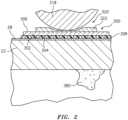
- the blade comprises a metallic substrate 22 ( FIG. 2 ).
- the blade may further comprise one or more coatings.
- the exemplary coatings may include a thermal barrier coating (TBC) system and/or an abrasive coating system (not shown).
- TBC thermal barrier coating
- abrasive coating system may, in turn, include one or more layers.
- the exemplary thermal barrier coating system includes a metallic bondcoat atop the substrate and a ceramic thermal barrier coating (TBC) layer atop the bondcoat.
- the abrasive coating system may include a metallic underlayer (base layer) and an abrasive layer.
- the abrasive layer comprises a matrix and abrasive particles at least partially embedded in the matrix.
- the ceramic layer(s) have been removed but at least a portion of the bondcoat 28 may remain.
- An exemplary substrate comprises a unitary metallic casting (e.g., of a nickel-based superalloy) and defines the overall gross features of the blade.
- the substrate and blade thus include an airfoil 40 and an attachment feature 42 (e.g., a firtree root).
- the blade and substrate may further include a platform 44 between the airfoil and the firtree root.
- the firtree root 42 extends from an inboard end 50 forming an inboard end of the blade to an outboard end at an underside of the platform.
- the airfoil 40 extends from an inboard end at an outer surface (gaspath-facing surface) of the platform to a tip 60.
- the airfoil extends from a leading edge 62 to a trailing edge 64 and has a pressure side surface 66 and a suction side surface 68.
- FIG. 3 shows the cooling passageway system 100 as including multiple trunks 102A, 102B, 102C extending from respective outlets 104A, 104B, 104C along the inner diameter face of the root.
- the trunks may branch in multiple spanwise cavities optionally with turns such that a cavity with tipward flow is termed an up-pass and a cavity leg with rootward flow is termed a down-pass.
- there may be one or more impingement cavities such as a leading edge impingement cavity 120 fed by impingement holes from one of the up-pass or down-pass cavities and discharging via associated outlets to the airfoil exterior surface.
- Various of the cavity legs may discharge to the tip/tip pocket.
- the exemplary trailing edge slot 140 is fed by the most rearward trunk.
- the vibrating 230 is performed only after the first iteration of the baseline process 201 and repeats through further iterations.
- an initial vibrating step 230 is performed at one or more locations which, via experience, are believed to be adjacent likely locations of fouling.
- the targeting may be responsive to the inspection 220.
- An exemplary vibrator is a pneumatic pen-type vibrator/air hammer such as used for engraving. CP 9361 air hammer, Chicago Pneumatic Tool Company LLC, Rock Hill, South Carolina.
- a buffer element or member 300 ( FIG. 4 ) may be introduced between the vibrator and the turbine element.
- An exemplary buffer may serve one or more of at least two purposes. First, it may distribute force to avoid damaging the surface of the turbine element. Second, it may provide means for positioning the vibrator and retaining it in position. The positioning may comprise registering in a predetermined position.
- an exemplary buffer may be sheet-like (e.g., comprising a metallic strip 302).
- An exemplary strip is SAE 1070 high-carbon steel strip. The strip has a first face 304 ( FIG.
- An exemplary strip thickness is 0.2 inch (5.1mm), more broadly 2mm to 8mm.
- a non-metallic layer 308 intervening between the strip and the element to serve as a cushion to prevent metal-to-metal contact to protect the part surface.
- a tape layer may be applied to the first face.
- Exemplary tape is a high temperature glass fiber masking tape (e.g., Scotch ® Performance Green Masking Tape 233+ glass-reinforced adhesive paper masking tape of 3M, St. Paul, Minnesota).
- Exemplary tape thickness is 0.02 inch (0.5mm), more broadly 0.1mm to 1.0mm.
- Exemplary tape width is about 2 cm and length is about 5 cm.
- the positioning features may comprise recesses 320 along the second face for capturing the tip 318 of the vibrator.
- Exemplary recesses may be in elevated areas 322 so as to not actually be below the remainder of the second face 306.
- one or more circular pieces may be tack welded to the first face 304 of a rectangular plate/strip 302 of steel.
- the circular pieces may be of a similar steel to the strip 302.
- An exemplary piece thickness is 0.2 inch (5.1mm), more broadly 2mm to 8mm. The tack welding creates a recess in the exposed face of the circular pieces, leaving a perimeter as the associated elevated area 322.
- Exemplary recess depth is 0.5mm to 10.0 mm (thus potentially below the ambient surface level of the strip), but leaving a thickness of at least 2.0 mm of strip thickness.
- Exemplary circular piece diameter is about 0.4 inch (10 mm) and exemplary recess diameter is about 0.2 inch (5.1mm).
- the piece(s) may have a washer-like circular (annular) shape and be secured to the strip such as by welding so that their hole(s) define the recess(es).
- the technician manually aligns one of the positioning features with the observed fouling location and then vibrates.
- More complex implementations may make use of the multiple positioning features.
- the strip may be dimensioned to fit along one side (pressure side or suction side) of the airfoil. Particular locations may be known as likely candidates for fouling. Each of these locations may have an associated positioning feature (e.g., typically likely only two or three such features being appropriate). Based upon the radiographic inspection, a technician may place the buffer on the element and then sequentially engage the vibrator to one or more of the features to vibrate the airfoil at the associated target location.
- the multiple positioning features may provide redundancy.
- the symmetric illustrated buffer element allows a technician to use either feature to address a given location on the blade (such as by a 180° rotation). This may approximately double the life of the buffer element as the positioning features wear or break off (e.g., due to vibration fatiguing the tack weld.)
- the number of cycles may be greatly reduced. This can, for example, reduce the required number of cycles from something in the vicinity of ten to four or less. This may reduce overall time required for the multiple cycles.
- first, second, and the like in the following claims is for differentiation within the claim only and does not necessarily indicate relative or absolute importance or temporal order. Similarly, the identification in a claim of one element as “first” (or the like) does not preclude such "first” element from identifying an element that is referred to as “second” (or the like) in another claim or in the description.
Landscapes
- Engineering & Computer Science (AREA)
- Mechanical Engineering (AREA)
- General Engineering & Computer Science (AREA)
- Turbine Rotor Nozzle Sealing (AREA)
- Cleaning In General (AREA)
- Analysing Materials By The Use Of Radiation (AREA)
Applications Claiming Priority (2)
| Application Number | Priority Date | Filing Date | Title |
|---|---|---|---|
| SG10201707848UA SG10201707848UA (en) | 2017-09-22 | 2017-09-22 | Turbine element cleaning process |
| EP18196055.0A EP3482841B1 (de) | 2017-09-22 | 2018-09-21 | Turbinenelement-reinigungsverfahren |
Related Parent Applications (1)
| Application Number | Title | Priority Date | Filing Date |
|---|---|---|---|
| EP18196055.0A Division EP3482841B1 (de) | 2017-09-22 | 2018-09-21 | Turbinenelement-reinigungsverfahren |
Publications (2)
| Publication Number | Publication Date |
|---|---|
| EP4487970A2 true EP4487970A2 (de) | 2025-01-08 |
| EP4487970A3 EP4487970A3 (de) | 2025-06-04 |
Family
ID=65808236
Family Applications (2)
| Application Number | Title | Priority Date | Filing Date |
|---|---|---|---|
| EP18196055.0A Active EP3482841B1 (de) | 2017-09-22 | 2018-09-21 | Turbinenelement-reinigungsverfahren |
| EP24215549.7A Pending EP4487970A3 (de) | 2017-09-22 | 2018-09-21 | Verfahren zur reinigung eines turbinenelements |
Family Applications Before (1)
| Application Number | Title | Priority Date | Filing Date |
|---|---|---|---|
| EP18196055.0A Active EP3482841B1 (de) | 2017-09-22 | 2018-09-21 | Turbinenelement-reinigungsverfahren |
Country Status (3)
| Country | Link |
|---|---|
| US (1) | US11105220B2 (de) |
| EP (2) | EP3482841B1 (de) |
| SG (1) | SG10201707848UA (de) |
Family Cites Families (12)
| Publication number | Priority date | Publication date | Assignee | Title |
|---|---|---|---|---|
| US4271925A (en) * | 1979-05-29 | 1981-06-09 | Burg Kenneth E | Fluid actuated acoustic pulse generator |
| US4439241A (en) | 1982-03-01 | 1984-03-27 | United Technologies Corporation | Cleaning process for internal passages of superalloy airfoils |
| DE3322567C2 (de) | 1983-06-23 | 1985-05-23 | Georg Fischer GmbH, 4020 Mettmann | Einrichtung zum Entgraten von als Gießerei-Kerne oder dergleichen ausgebildeten Werkstücken |
| US4735089A (en) * | 1985-12-27 | 1988-04-05 | Hughes Aircraft Company | Shaker table |
| US5464479A (en) | 1994-08-31 | 1995-11-07 | Kenton; Donald J. | Method for removing undesired material from internal spaces of parts |
| WO1996015863A1 (en) | 1994-11-22 | 1996-05-30 | United Technologies Corporation | Cleaning method for turbine airfoils by ultrasonics |
| US6500269B2 (en) | 2001-01-29 | 2002-12-31 | General Electric Company | Method of cleaning turbine component using laser shock peening |
| US7406971B2 (en) | 2003-12-29 | 2008-08-05 | United Technologies Corporation | Method of simultaneously flushing internal cavities of multiple parts |
| US9289790B2 (en) * | 2014-01-13 | 2016-03-22 | Alstom Technology Ltd | Spray dryer absorber vibrator device and method |
| US10018113B2 (en) * | 2015-11-11 | 2018-07-10 | General Electric Company | Ultrasonic cleaning system and method |
| JP6685722B2 (ja) | 2015-12-28 | 2020-04-22 | 三菱日立パワーシステムズ株式会社 | タービン翼の補修方法 |
| US10005111B2 (en) | 2016-01-25 | 2018-06-26 | General Electric Company | Turbine engine cleaning systems and methods |
-
2017
- 2017-09-22 SG SG10201707848UA patent/SG10201707848UA/en unknown
-
2018
- 2018-09-11 US US16/127,438 patent/US11105220B2/en active Active
- 2018-09-21 EP EP18196055.0A patent/EP3482841B1/de active Active
- 2018-09-21 EP EP24215549.7A patent/EP4487970A3/de active Pending
Also Published As
| Publication number | Publication date |
|---|---|
| EP3482841A3 (de) | 2019-10-09 |
| US20190093506A1 (en) | 2019-03-28 |
| EP3482841A2 (de) | 2019-05-15 |
| SG10201707848UA (en) | 2019-04-29 |
| EP3482841B1 (de) | 2024-11-27 |
| EP4487970A3 (de) | 2025-06-04 |
| US11105220B2 (en) | 2021-08-31 |
Similar Documents
| Publication | Publication Date | Title |
|---|---|---|
| EP1944120A2 (de) | Schweißreparatur metallischer Komponenten | |
| US5972424A (en) | Repair of gas turbine engine component coated with a thermal barrier coating | |
| US5794338A (en) | Method for repairing a turbine engine member damaged tip | |
| JP5264165B2 (ja) | 翼形部の疲労切欠き性能を高めるための方法及び装置 | |
| EP2540961B1 (de) | Schleifschaufelspitze | |
| JP5226184B2 (ja) | 超合金部品の補修及び再分類 | |
| US7216428B2 (en) | Method for turbine element repairing | |
| US5464479A (en) | Method for removing undesired material from internal spaces of parts | |
| EP1880793A2 (de) | Reparatur einer Hochdruck-Einzelturbinenschaufelspitze mittels Laserplattierung | |
| US20030082297A1 (en) | Combustion turbine blade tip restoration by metal build-up using thermal spray techniques | |
| US20050091848A1 (en) | Turbine blade and a method of manufacturing and repairing a turbine blade | |
| EP2848356B2 (de) | Reparaturverfahren für ein Turbinenbauteil wobei beschädigtes Material entfernt wird und ein Einsatz mit verbesserten Materialeigenschaften angebracht wird und zugehöriges repariertes Turbinenbauteil | |
| JP2008111425A (ja) | ガスタービンエンジン圧縮機用摩擦皮膜 | |
| EP2159371B1 (de) | Gasturbinenschaufelanordnungen und Reparaturverfahren | |
| CN102811835A (zh) | 用于再加工具有至少一个平台的涡轮叶片的方法 | |
| EP2274131A1 (de) | Diffusionsverbinden | |
| US6352406B1 (en) | Method for assessing quality of a coating process and assembly therefor | |
| US20140193664A1 (en) | Recoating process and recoated turbine blade | |
| EP3482841B1 (de) | Turbinenelement-reinigungsverfahren | |
| EP3837088B1 (de) | Verfahren zur reinigung eines bauteils mit einer wärmedämmschicht | |
| EP1978346B1 (de) | Verfahren zur Prüfung des Oberflächenzustands nach einem Reinigungsverfahren | |
| JP6609017B2 (ja) | タービン動翼の補修方法 | |
| JP2018173023A (ja) | タービン部品の補修方法 |
Legal Events
| Date | Code | Title | Description |
|---|---|---|---|
| PUAI | Public reference made under article 153(3) epc to a published international application that has entered the european phase |
Free format text: ORIGINAL CODE: 0009012 |
|
| STAA | Information on the status of an ep patent application or granted ep patent |
Free format text: STATUS: THE APPLICATION HAS BEEN PUBLISHED |
|
| AC | Divisional application: reference to earlier application |
Ref document number: 3482841 Country of ref document: EP Kind code of ref document: P |
|
| AK | Designated contracting states |
Kind code of ref document: A2 Designated state(s): AL AT BE BG CH CY CZ DE DK EE ES FI FR GB GR HR HU IE IS IT LI LT LU LV MC MK MT NL NO PL PT RO RS SE SI SK SM TR |
|
| PUAL | Search report despatched |
Free format text: ORIGINAL CODE: 0009013 |
|
| AK | Designated contracting states |
Kind code of ref document: A3 Designated state(s): AL AT BE BG CH CY CZ DE DK EE ES FI FR GB GR HR HU IE IS IT LI LT LU LV MC MK MT NL NO PL PT RO RS SE SI SK SM TR |
|
| RIC1 | Information provided on ipc code assigned before grant |
Ipc: F01D 25/00 20060101ALN20250429BHEP Ipc: B06B 3/00 20060101ALI20250429BHEP Ipc: B08B 7/02 20060101AFI20250429BHEP |
|
| STAA | Information on the status of an ep patent application or granted ep patent |
Free format text: STATUS: REQUEST FOR EXAMINATION WAS MADE |
|
| 17P | Request for examination filed |
Effective date: 20251127 |