EP4487802A1 - Vorrichtung zur steuerung eines medizinischen verfahrenswerkzeugs - Google Patents
Vorrichtung zur steuerung eines medizinischen verfahrenswerkzeugs Download PDFInfo
- Publication number
- EP4487802A1 EP4487802A1 EP23763738.4A EP23763738A EP4487802A1 EP 4487802 A1 EP4487802 A1 EP 4487802A1 EP 23763738 A EP23763738 A EP 23763738A EP 4487802 A1 EP4487802 A1 EP 4487802A1
- Authority
- EP
- European Patent Office
- Prior art keywords
- roller
- surgical tool
- roller module
- module
- vertical movement
- Prior art date
- Legal status (The legal status is an assumption and is not a legal conclusion. Google has not performed a legal analysis and makes no representation as to the accuracy of the status listed.)
- Pending
Links
Images









Classifications
-
- A—HUMAN NECESSITIES
- A61—MEDICAL OR VETERINARY SCIENCE; HYGIENE
- A61B—DIAGNOSIS; SURGERY; IDENTIFICATION
- A61B17/00—Surgical instruments, devices or methods
- A61B17/00234—Surgical instruments, devices or methods for minimally invasive surgery
-
- A—HUMAN NECESSITIES
- A61—MEDICAL OR VETERINARY SCIENCE; HYGIENE
- A61B—DIAGNOSIS; SURGERY; IDENTIFICATION
- A61B34/00—Computer-aided surgery; Manipulators or robots specially adapted for use in surgery
- A61B34/30—Surgical robots
-
- A—HUMAN NECESSITIES
- A61—MEDICAL OR VETERINARY SCIENCE; HYGIENE
- A61B—DIAGNOSIS; SURGERY; IDENTIFICATION
- A61B34/00—Computer-aided surgery; Manipulators or robots specially adapted for use in surgery
- A61B34/30—Surgical robots
- A61B34/37—Leader-follower robots
-
- A—HUMAN NECESSITIES
- A61—MEDICAL OR VETERINARY SCIENCE; HYGIENE
- A61B—DIAGNOSIS; SURGERY; IDENTIFICATION
- A61B17/00—Surgical instruments, devices or methods
- A61B17/22—Implements for squeezing-off ulcers or the like on inner organs of the body; Implements for scraping-out cavities of body organs, e.g. bones; for invasive removal or destruction of calculus using mechanical vibrations; for removing obstructions in blood vessels, not otherwise provided for
-
- A—HUMAN NECESSITIES
- A61—MEDICAL OR VETERINARY SCIENCE; HYGIENE
- A61B—DIAGNOSIS; SURGERY; IDENTIFICATION
- A61B34/00—Computer-aided surgery; Manipulators or robots specially adapted for use in surgery
- A61B34/70—Manipulators specially adapted for use in surgery
-
- A—HUMAN NECESSITIES
- A61—MEDICAL OR VETERINARY SCIENCE; HYGIENE
- A61B—DIAGNOSIS; SURGERY; IDENTIFICATION
- A61B17/00—Surgical instruments, devices or methods
- A61B2017/00017—Electrical control of surgical instruments
- A61B2017/00225—Systems for controlling multiple different instruments, e.g. microsurgical systems
-
- A—HUMAN NECESSITIES
- A61—MEDICAL OR VETERINARY SCIENCE; HYGIENE
- A61B—DIAGNOSIS; SURGERY; IDENTIFICATION
- A61B17/00—Surgical instruments, devices or methods
- A61B2017/00367—Details of actuation of instruments, e.g. relations between pushing buttons, or the like, and activation of the tool, working tip, or the like
-
- A—HUMAN NECESSITIES
- A61—MEDICAL OR VETERINARY SCIENCE; HYGIENE
- A61B—DIAGNOSIS; SURGERY; IDENTIFICATION
- A61B17/00—Surgical instruments, devices or methods
- A61B2017/00367—Details of actuation of instruments, e.g. relations between pushing buttons, or the like, and activation of the tool, working tip, or the like
- A61B2017/00398—Details of actuation of instruments, e.g. relations between pushing buttons, or the like, and activation of the tool, working tip, or the like using powered actuators, e.g. stepper motors, solenoids
-
- A—HUMAN NECESSITIES
- A61—MEDICAL OR VETERINARY SCIENCE; HYGIENE
- A61B—DIAGNOSIS; SURGERY; IDENTIFICATION
- A61B17/00—Surgical instruments, devices or methods
- A61B2017/00743—Type of operation; Specification of treatment sites
- A61B2017/00778—Operations on blood vessels
-
- A—HUMAN NECESSITIES
- A61—MEDICAL OR VETERINARY SCIENCE; HYGIENE
- A61B—DIAGNOSIS; SURGERY; IDENTIFICATION
- A61B17/00—Surgical instruments, devices or methods
- A61B17/22—Implements for squeezing-off ulcers or the like on inner organs of the body; Implements for scraping-out cavities of body organs, e.g. bones; for invasive removal or destruction of calculus using mechanical vibrations; for removing obstructions in blood vessels, not otherwise provided for
- A61B2017/22038—Implements for squeezing-off ulcers or the like on inner organs of the body; Implements for scraping-out cavities of body organs, e.g. bones; for invasive removal or destruction of calculus using mechanical vibrations; for removing obstructions in blood vessels, not otherwise provided for with a guide wire
-
- A—HUMAN NECESSITIES
- A61—MEDICAL OR VETERINARY SCIENCE; HYGIENE
- A61B—DIAGNOSIS; SURGERY; IDENTIFICATION
- A61B17/00—Surgical instruments, devices or methods
- A61B17/22—Implements for squeezing-off ulcers or the like on inner organs of the body; Implements for scraping-out cavities of body organs, e.g. bones; for invasive removal or destruction of calculus using mechanical vibrations; for removing obstructions in blood vessels, not otherwise provided for
- A61B2017/22094—Implements for squeezing-off ulcers or the like on inner organs of the body; Implements for scraping-out cavities of body organs, e.g. bones; for invasive removal or destruction of calculus using mechanical vibrations; for removing obstructions in blood vessels, not otherwise provided for for crossing total occlusions, i.e. piercing
-
- A—HUMAN NECESSITIES
- A61—MEDICAL OR VETERINARY SCIENCE; HYGIENE
- A61B—DIAGNOSIS; SURGERY; IDENTIFICATION
- A61B34/00—Computer-aided surgery; Manipulators or robots specially adapted for use in surgery
- A61B34/30—Surgical robots
- A61B2034/301—Surgical robots for introducing or steering flexible instruments inserted into the body, e.g. catheters or endoscopes
-
- A—HUMAN NECESSITIES
- A61—MEDICAL OR VETERINARY SCIENCE; HYGIENE
- A61B—DIAGNOSIS; SURGERY; IDENTIFICATION
- A61B34/00—Computer-aided surgery; Manipulators or robots specially adapted for use in surgery
- A61B34/30—Surgical robots
- A61B2034/303—Surgical robots specifically adapted for manipulations within body lumens, e.g. within lumen of gut, spine, or blood vessels
Definitions
- the following embodiments relate to a surgical tool control apparatus.
- PCI percutaneous coronary intervention
- Interventional assistant robots have been introduced to compensate for the above disadvantages, but most of the assistant robots are configured to control only one set of surgical tools.
- the interventional assistant robots of the related art are applicable only to procedures for lesions of low difficulty and are difficult to be applied when multiple surgical tools are required, such as chronic total occlusion (CTO) lesions.
- CTO chronic total occlusion
- An object of an embodiment is to provide a surgical tool control apparatus capable of being applied to complicated percutaneous coronary intervention.
- Another object of an embodiment is to provide a surgical tool control apparatus capable of independently controlling a plurality of surgical tools and a guide catheter.
- a surgical tool control apparatus including: a main housing; a surgical tool control assembly installed in the main housing and configured to control at least one surgical tool; and a guide catheter control assembly positioned on a front end side of the main housing, and configured to control a guide catheter that guides a path of the at least one surgical tool.
- the guide catheter control assembly may include a frame positioned on a front end of the main housing; and a first roller module and a second roller module installed in the frame, and the second roller module may be horizontally movable toward the first roller module so that the guide catheter is gripped between the first roller module and the second roller module.
- the first roller module and the second roller module may each include: a roller plate connected to the frame; and a roller member rotatably provided on the roller plate.
- the gripped guide catheter may be moved in a longitudinal direction by rotating the roller members of the first roller module and the second roller module.
- the gripped guide catheter may be rotated by vertically moving the roller member of at least one of the first roller module or the second roller module.
- the roller plate may include an upper roller plate which is connected to the frame, and a lower roller plate which is positioned on a lower side of the upper roller plate and to which the roller member is rotatably connected, and the first roller module or the second roller module may further include a vertical movement portion configured to vertically move the lower roller plate with respect to the upper roller plate.
- the vertical movement portion may include: a vertical movement driving motor; a vertical movement pulley configured to receive rotational power from the vertical movement driving motor; a vertical movement lead screw nut integrally rotating with the vertical movement pulley; and a vertical movement lead screw that is engaged with the vertical movement lead screw nut and has one side connected to the lower roller plate to vertically move the lower roller plate in accordance with rotation of the vertical movement lead screw nut.
- the first roller module or the second roller module may further include a rotation driving portion configured to rotate the roller member with respect to the roller plate.
- the rotation driving portion may include: a rotation driving motor; a rotation drive pulley configured to receive rotational power from the rotation driving motor; a spline nut integrally rotating with the rotation drive pulley; and a spline shaft that is engaged with the spline nut and has one side connected to the roller member to rotate the roller member in accordance with rotation of the spline nut.
- the rotation driving portion may further include a shaft support configured to be positioned between the rotation drive pulley and the spline shaft to prevent wobble of the spline shaft.
- the guide catheter control assembly may further include a horizontal movement portion configured to horizontally move the second roller module.
- the horizontal movement portion may include: a horizontal movement driving motor; a horizontal movement lead screw configured to be connected to the frame in a horizontal direction and receive rotational power from the horizontal movement driving motor; and a horizontal movement lead screw nut that is engaged with the horizontal movement lead screw and has one side connected to the roller plate to horizontally move the roller plate in accordance with rotation of the horizontal movement lead screw.
- the surgical tool control apparatus may further include a connecting arm configured to connect the guide catheter control assembly to the main housing, and the guide catheter control assembly may be able to be tilted or translate with respect to the main housing through the connecting arm.
- the surgical tool control apparatus may independently control a plurality of surgical tools and a guide catheter.
- the surgical tool control apparatus may be applied to complicated PCI.
- first, second, A, B, (a), (b), and the like may be used to describe components of the embodiments. These terms are used only for the purpose of discriminating one component from another component, and the nature, the sequences, or the orders of the components are not limited by the terms.
- one constituent element is described as being “connected”, “coupled”, or “attached” to another constituent element, it should be understood that one constituent element may be connected or attached directly to another constituent element, and an intervening constituent element may also be “connected”, “coupled”, or “attached” to the constituent elements.
- FIG. 1 is a perspective view illustrating a surgical tool control apparatus according to an embodiment.
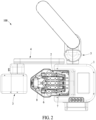
- FIG. 2 is a plan view illustrating a surgical tool control apparatus according to an embodiment.
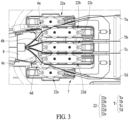
- FIG. 3 is a perspective view illustrating a surgical tool control apparatus according to an embodiment.
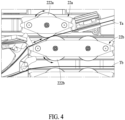
- FIG. 4 illustrates a process in which a roller module of a surgical tool control assembly moves a surgical tool forward and backward according to an embodiment.
- FIG. 5 illustrates a process in which a roller module of a surgical tool control assembly rotates a surgical tool according to an embodiment.
- a surgical tool control apparatus 100 may independently control a plurality of surgical tools T.
- the surgical tool T may refer to a surgical tool having a longitudinal direction.
- the surgical tool T may include various surgical tools, such as a guide wire and/or a balloon catheter having a longitudinal direction.
- the surgical tool control apparatus 100 may move the surgical tool T forward and backward and rotate the surgical tool T through the rotation and vertical movement of a roller module 22 which will be described below. Specifically, as shown in FIG.
- each of roller members 222a and 222b may rotate in one direction or the other direction, thereby moving the first surgical tool Ta gripped therebetween forward or backward along the longitudinal direction.
- at least one roller module 22 may move in a vertical direction, thereby rotating the surgical tool gripped therebetween.
- the surgical tool control apparatus 100 may independently control four surgical tools Ta, Tb, Tc, and Td through five roller modules 22a, 22b, 22c, 22d, and 22e.
- the surgical tool control apparatus 100 may grip or release the surgical tool T between the roller modules 22 through the horizontal movement of the roller modules 22.
- FIG. 3 shows a state in which the first surgical tool Ta is gripped by the first roller module 22a and the second roller module 22b and a third surgical tool Tc is gripped by the third roller module 22c and the fourth roller module 22d. A method of gripping the surgical tool will be described below in more detail.
- the surgical tool control apparatus 100 may include a main housing 1, a surgical tool control assembly 2, a guide catheter control assembly 3, a connecting arm 4, a housing tilting portion 5, a clamping portion 6, a surgical tool supporter 7, and a Y connector holder 8.
- the main housing 1 may form an appearance of the surgical tool control apparatus 100.
- the main housing 1 may be connected to a robot arm of a slave base. That is, the surgical tool control apparatus 100 may function as an end effector connected to the robot arm of the slave base.
- the main housing 1 may be provided with a switch or a knob for position adjustment and/or tilting of the main housing 1.
- the main housing 1 may include a display panel to show a user how to use the apparatus and to notify information on a state of the apparatus or the like.
- FIG. 6 is a perspective view illustrating a surgical tool control assembly according to an embodiment.
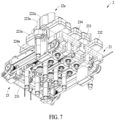
- FIG. 7 is a perspective view illustrating a bottom portion of a surgical tool control assembly according to an embodiment.
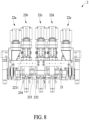
- FIG. 8 is a front view illustrating a surgical tool control assembly according to an embodiment.
- FIG. 9 is a bottom view illustrating a surgical tool control assembly according to an embodiment.
- the surgical control assembly 2 may control the surgical tool T.
- the surgical tool control assembly 2 may grip or release the surgical tool T.
- the surgical tool control assembly 2 may move the gripped surgical tool T in the longitudinal direction or rotate the gripped surgical tool T.
- the surgical tool control assembly 2 may include a frame 21, the roller module 22, and a horizontal movement portion 23.
- the frame 21 may form a base frame on which the roller module 22 and the horizontal movement portion 23, which will be described below, are installed. That is, the frame 21 may be connected to the main housing 1, and the frame 21 may be connected to the roller module 22 and the horizontal movement portion 23.
- a plurality of roller modules 22 may be provided and connected to the frame 21.
- the roller module 22 may include the first roller module 22a, the second roller module 22b, the third roller module 22c, the fourth roller module 22d, and the fifth roller module 22e.
- the first roller module 22a, the second roller module 22b, the third roller module 22c, the fourth roller module 22d, and the fifth roller module 22e may be arranged side by side with each other. Meanwhile, this is merely an example, and the number of roller modules 22 is not limited thereto.
- the surgical tool T may be gripped between two adjacent roller modules 22.
- at least one roller module 22 may be horizontally movable with respect to another roller module 22.
- the second roller module 22b may be horizontally movable with respect to the first roller module 22a so that the first surgical tool Ta is gripped between the first roller module 22a and the second roller module 22b.
- the second surgical tool Tb positioned between the second roller module 22b and the third roller module 22c may be released.
- the second roller module 22b may be horizontally movable with respect to the third roller module 22c so that the second surgical tool Tb is gripped between the second roller module 22b and the third roller module 22c.
- the first surgical tool Ta positioned between the first roller module 22a and the second roller module 22b may be released.
- the fourth roller module 22d may be horizontally movable with respect to the third roller module 22c so that the third surgical tool Tc is gripped between the third roller module 22c and the fourth roller module 22d.
- the fourth surgical tool Td positioned between the fourth roller module 22a and the fifth roller module 22e may be released.
- the fourth roller module 22d may be horizontally movable with respect to the fifth roller module 22e so that the fourth surgical tool Td is gripped between the fourth roller module 22d and the fifth roller module 22e.
- the third surgical tool Tc positioned between the third roller module 22c and the fourth roller module 22d may be released.
- each surgical tool T may be selectively gripped according to the structure in which the movable roller module 22 is horizontally movable between the roller modules 22 positioned on both sides with respect to the roller modules 22 on both sides.
- the roller modules 22 may spread to have a sufficient distance therebetween to load the surgical tool T, and thus, a thickness of the surgical tool T, that may be gripped, may not be limited. That is, the versatility of the surgical tool control apparatus 100 may be improved in that the thickness of the surgical tool T is not limited and the surgical tool T having any thickness may be applied and gripped.
- the first surgical tool Ta and the third surgical tool Tc may be independently controlled (moved forward and backward and rotated), respectively.
- the first surgical tool Ta may move forward or backward in the longitudinal direction by the rotation of the respective roller members 222a and 222b of the first roller module 22a and the second roller module 22b (see FIG. 4 ).
- the first surgical tool Ta may rotate by the vertical movement of one of the respective roller members 222a and 222b of the first roller module 22a and the second roller module 22b (see FIG. 5 ).
- the third surgical tool Tc may move forward or backward in the longitudinal direction by the rotation of the respective roller members 222c and 222d of the third roller module 22c and the fourth roller module 22d.
- the third surgical tool Tc may rotate by the vertical movement of one of the respective roller members 222c and 222d of the third roller module 22c and the fourth roller module 22d.
- the first surgical tool Ta may be controlled by the first roller module 22a and the second roller module 22b
- the third surgical tool Tc may be controlled by the third roller module 22c and the fourth roller module 22d.
- the first surgical tool Ta and the third surgical tool Tc, as a set may be controlled independently of each other at the same time.
- one of the first surgical tool Ta and the third surgical tool Tc may be a balloon catheter and the other one thereof may be a guide wire.
- the second surgical tool Tb and the fourth surgical tool Td may be independently controlled (moved forward and backward and rotated), respectively.
- the above description is used for the details of the control of the second surgical tool Tb and the fourth surgical tool Td.
- the second surgical tool Tb may be controlled by the second roller module 22b and the third roller module 22c
- the fourth surgical tool Td may be controlled by the fourth roller module 22d and the fifth roller module 22e.
- the second surgical tool Tb and the fourth surgical tool Td may be controlled independently of each other at the same time.
- one of the second surgical tool Tb and the fourth surgical tool Td may be a balloon catheter and the other one thereof may be a guide wire.
- the surgical tool control apparatus 100 may set the first surgical tool Ta and the third surgical tool Tc as one set and the second surgical tool Tb and the fourth surgical tool Td as another set, and independently control the two sets, respectively. Accordingly, the surgical tool control apparatus 100 may be easily applied to complicated interventional procedures requiring a plurality of surgical tools.
- the surgical tools described above is merely an example, and the surgical tools may be arranged as sets in various ways by changing horizontal positions of the roller modules 22, if necessary.
- the second roller module 22b and the fourth roller module 22d move horizontally between the roller modules 22a, 22c, and 22e positioned on both sides, this is merely an example, and the first roller module 22a, the third roller module 22c, and the fifth roller module 22e may also be configured to be movable horizontally.
- FIG. 10 is a perspective view illustrating a roller module of a surgical tool control assembly according to an embodiment.
- FIG. 11 is a cross-sectional view illustrating a roller module of a surgical tool control assembly according to an embodiment.
- the roller module 22 shown in FIGS. 10 and 11 may be a roller module in which the roller member 222 is formed to be movable in the vertical direction.
- the second roller module 22b, the third roller module 22c, and the fourth roller module 22d may be formed as the roller module 22 shown in FIGS. 10 and 11 .
- the roller module 22 shown in FIGS. 10 and 11 may include a roller plate 221, the roller member 222, a roller housing 223, a rotation driving portion 224, a vertical movement portion 225, and a link structure support 226.
- the roller plate 221 may be connected to the frame 21. That is, the roller plate 221 may perform a function of connecting the roller module 22 to the frame 21.
- the roller member 222 may be rotatably connected to the roller plate 221.
- the roller plate 221 may include a lower roller plate 2211 and an upper roller plate 2212.
- the lower roller plate 2211 may be a portion connected to the frame 21.
- the lower roller plate 2211 may be provided with the rotation driving portion 224 and the vertical movement portion 225 which will be described below.
- the upper roller plate 2212 may be positioned above the lower roller plate 2211 and may be a portion to which the roller member 222 is rotatably connected.
- the upper roller plate 2212 may be moved vertically with respect to the lower roller plate 2211 by the vertical movement portion 225 which will be described below.
- the roller member 222 may be rotatably connected to the upper roller plate 2212.
- a rotation axis of the roller member 222 may be perpendicular to the upper roller plate 2212.
- a pair of roller members 222 may be provided, and may be spaced apart from each other along the longitudinal direction of the upper roller plate 2212.
- the roller housing 223 may be connected to an upper side of the upper roller plate 2212 and provide a space in which the roller members 222 rotate.
- the roller housing 223 may be engaged with the upper roller plate 2212 using a latch.
- the rotation driving portion 224 may rotate the roller members 222 with respect to the roller plate 221.
- the rotation driving portion 224 may rotate the roller members 222 in one direction or the other direction.
- the rotation driving portion 224 may be installed on the lower roller plate 2211.
- the rotation driving portion 224 may include a rotation driving motor 2241, a rotation drive pulley 2242, a spline nut 2243, a spline shaft 2244, and a shaft support 2245.
- the rotation driving motor 2241 may generate rotational power for rotating the roller members 222.
- the rotation driving motor 2241 may be a motor that implements the rotation in one direction and the other direction.
- the rotation drive pulley 2242 may receive the rotational power from the rotation driving motor 2241.
- the rotation drive pulley 2242 may receive the rotational power through a timing belt or the like.
- the number of rotation drive pulleys 2242 may correspond to the number of roller members 222.
- a pair of rotation drive pulleys 2242 may be provided.
- a pair of rotation drive pulleys 2242 may be connected with a timing belt or the like to transmit the rotational power to each other.
- the spline nut 2243 may rotate integrally with the rotation drive pulley 2242.
- the spline nut 2243 may be positioned inside the rotation drive pulley 2242.
- the spline shaft 2244 may be engaged with the spline nut 2243.
- the spline shaft 2244 may be rotated integrally with the spline nut 2243.
- the roller member 222 may be connected to one side of the spline shaft 2244. According to such a structure, the roller member 222 connected to one side of the spline shaft 2244 may be rotated in accordance with the rotation of the spline nut 2243.
- the rotation driving motor 2241 may rotate the rotation drive pulley 2242 through a timing belt or the like, the spline nut 2243 and the spline shaft 2244 may integrally rotate as the rotation drive pulley 2242 rotates, and accordingly, the roller member 222 connected to the spline shaft 2244 may rotate.
- the shaft support 2245 may be positioned between the rotation drive pulley 2242 and the spline shaft 2244.
- the shaft support 2245 may be connected to fit to fill an empty space between the rotation drive pulley 2242 and the spline shaft 2244.
- the shaft support 2245 may fill empty spaces formed on upper and lower sides of the spline nut 2243 in the inner space of the rotation drive pulley 2242.
- the shaft support 2245 is positioned between the rotation drive pulley 2242 and the spline shaft 2244, it is possible to prevent the spline shaft 2244 from shaking.
- the shaft support 2245 may be desirably formed to have an inner diameter tolerance of +0.0005 millimeters (mm) to +0.01 mm after assembly.
- the shaft support 2245 may include a Teflon or acetal material.
- the vertical movement portion 225 may vertically move the upper roller plate 2212 with respect to the lower roller plate 2211. That is, the vertical movement portion 225 may vertically move the upper roller plate 2212 to vertically move the roller member 222.
- the vertical movement portion 225 may be installed on the lower roller plate 2211.
- the vertical movement portion 225 may include a vertical movement driving motor 2251, a vertical movement pulley 2252, a vertical movement lead screw nut 2253, and a vertical movement lead screw 2255.
- the vertical movement driving motor 2251 may generate rotational power for vertically moving the roller member 222.
- the vertical movement driving motor 2251 may be a motor that implements the rotation in one direction and the other direction.
- the vertical movement pulley 2252 may receive the rotational power from the vertical movement driving motor 2251.
- the vertical movement pulley 2252 may receive the rotational power through a timing belt or the like.
- a pair of vertical movement pulleys 2252 may be provided.
- a pair of vertical movement pulleys 2252 may be disposed to be spaced apart from each other on one side and the other side of the lower roller plate 2211, respectively.
- the pair of vertical movement pulleys 2252 may be connected with a timing belt or the like to transmit the rotational power to each other.
- the vertical movement screw nut 2253 may rotate integrally with the vertical movement pulley 2252.
- the vertical movement screw nut 2253 may be disposed inside the vertical movement pulley 2252.
- the vertical movement lead screw 2254 may be engaged with the vertical movement screw nut 2253.
- the vertical movement screw 2254 may be moved in the longitudinal direction in accordance with the rotation of the vertical movement screw nut 2253.
- the upper roller plate 2212 may be connected to one side of the vertical movement screw 2254. According to such a structure, the vertical movement screw 2254 may vertically move the upper roller plate 2212 in accordance with the rotation of the vertical movement screw nut 2253.
- the vertical movement driving motor 2251 may rotate the vertical movement pulley 2252 and the vertical movement lead screw nut 2253 integrally through a timing belt or the like, and the vertical movement lead screw 2254 may vertically move the roller member 222 connected to the upper roller plate 2212, as the vertical movement lead screw 2254 moves in the longitudinal direction in accordance with the rotation of the vertical movement lead screw nut 2253.
- the spacing between the lower roller plate 2211 and the upper roller plate 2212 may increase due to the vertical movement portion 225, and therefore, it may be important to prevent a problem regarding tilting of the upper roller plate 2212 with respect to the lower roller plate 2211, that is, a problem of wobble of the axis of the spline shaft 2244.
- the link structure support 226 may support the upper roller plate 2212 with respect to the lower roller plate 2211. Since a spacing distance of the upper roller plate 2212 from the lower roller plate 2211 may be changed, the link structure support 226 may have a link structure with a length which is changeable in the vertical direction in response to the spacing distance between the lower roller plate 2211 and the upper roller plate 2212.
- the link structure support 226 may have a structure such as a pantograph.
- the link structure support 226 may include a link frame 2261 and a link 2262.
- the link frame 2261 may be positioned between the lower roller plate 2211 and the upper roller plate 2212.
- the link 2262 may connect both sides of the link frame 2261 to the lower roller plate 2211 and the upper roller plate 2212, respectively.
- the link 2262 may be rotatably connected to both sides of the link frame 2261, the lower roller plate 2211, and the upper roller plate 2212, respectively, so that a length of the link structure support 226 in the vertical direction is changed.
- the link structure support 226 is positioned between the lower roller plate 2211 and the upper roller plate 2212 and has a length changeable in the vertical direction in response to a change of the spacing distance therebetween, while supporting both sides of the upper roller plate 2212 with respect to the lower roller plate 2211. Accordingly, it is possible to prevent a problem regarding tilting of the upper roller plate 2212 with respect to the lower roller plate 2211, that is, a problem of wobble of the axis of the spline shaft 2244.
- the first roller module 22a and the fifth roller module 22e may include roller plates 221a and 221e, roller members 222a and 222e, roller housings 223a and 223e, and rotation driving portions 224a and 224e, respectively.
- the first roller module 22a and the fifth roller module 22e may be formed as roller modules that do not move in the vertical direction.
- the roller plates 221a and 221e of the first roller module 22a and the fifth roller module 22e may be formed as single plates to be directly connected to the frame 21, and may not include a separate vertical movement portion and link structure support.
- the first roller module 22a and the fifth roller module 22e may include one of the roller members 222a and 222e, respectively.
- the horizontal movement portion 23 may move the roller module 22 in a horizontal direction.
- the horizontal movement portion 23 may move the second roller module 22b and the fourth roller module 22d in the horizontal direction.
- the first roller module 22a, the third roller module 22c, and the fifth roller module 22e may also be formed to be movable in the horizontal direction.
- the number of horizontal movement portions 23 may correspond to the number of roller modules 22 desired to be moved.
- the horizontal movement portion 23 may be installed on the frame 21.
- the horizontal movement portion 23 may include a horizontal movement driving motor 231, a horizontal movement lead screw 232, a horizontal movement lead screw nut 233, and a connecting member 234.
- the horizontal movement driving motor 231 may generate rotational power for horizontally moving the roller module 22.
- the horizontal movement driving motor 231 may be a motor that implements the rotation in one direction and the other direction.
- the horizontal movement lead screw 232 may be connected to the frame 21 in the horizontal direction.
- the horizontal movement lead screw 232 may receive the rotational power from the horizontal movement driving motor 231 through a timing belt, a pulley, or the like.
- a pair of horizontal movement lead screws 232 may be provided.
- a pair of horizontal movement lead screws 232 may be disposed on one side and the other side of the frame 21, respectively.
- the pair of horizontal movement lead screws 232 may be connected with a timing belt, a pulley, or the like to transmit the rotational power to each other.
- the horizontal movement lead screw nut 233 may be engaged with the horizontal movement lead screw 232.
- One side of the horizontal movement lead screw nut 233 may be connected to the roller plate 221.
- the horizontal movement lead screw nut 233 may be connected to the lower roller plate 2211 through the connecting member 234.
- a pair of horizontal movement lead screw nuts 233 may be connected to one side and the other side of the lower roller plate 2211, respectively. According to such a structure, since the horizontal movement lead screw nut 233 moves in the longitudinal direction of the horizontal movement lead screw 232 in accordance with the rotation of the horizontal movement lead screw 232, the roller plate 221 connected to the horizontal movement lead screw nut 233 may move in the horizontal direction.
- the horizontal movement driving motor 231 may rotate the horizontal movement lead screw 232 through a timing belt, a pulley, or the like, and the horizontal movement lead screw nut 233 and the lower roller plate 2211 connected thereto may horizontally move along the longitudinal direction of the horizontal movement lead screw 232 in accordance with the rotation of the horizontal movement lead screw 232, that is, the roller module 22 may move in the horizontal direction.
- FIG. 12 is a perspective view of a housing tilting portion according to an embodiment.
- the housing tilting portion 5 may tilt the main housing 1 with respect to a position where the surgical tool control apparatus 100 is installed (e.g., a robot arm). As shown in FIG. 12 , the housing tilting portion 5 may tilt the main housing 1 with respect to a position where the surgical tool control apparatus 100 is installed (e.g., a robot arm) through the configuration of a motor, worm gear, worm wheel, and the like.
- a position where the surgical tool control apparatus 100 e.g., a robot arm
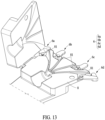
- FIG. 13 is a perspective view illustrating a clamping portion and a Y connector holder according to an embodiment.
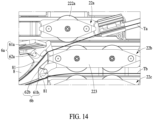
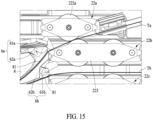
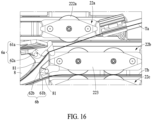
- FIGS. 14 to 16 are plan views illustrating a method of operating a clamping portion according to an embodiment.
- the clamping portion 6 may clamp the surgical tool T, that is not gripped by the roller module 22, to fix the position thereof. According to such a configuration, it is possible to prevent the surgical tool T from moving in an unintended direction in a state in which the surgical tool T is not gripped by the roller module 22. In addition, the clamping portion 6 may release the clamping for the surgical tool T gripped by the roller module 22 so that the surgical tool T may be controlled.
- the number of clamping portions 6 may correspond to the number of surgical tools T.
- the clamping portion 6 may include a first clamping portion 6a, a second clamping portion 6b, a third clamping portion 6c, and a fourth clamping portion 6d.
- the clamping portions 6a, 6b, 6c, and 6d may be applied to the surgical tools Ta, Tb, Tc, and Td, respectively.
- the clamping portion 6 may have a structure capable of automatically clamping or unclamping the surgical tool T in accordance with the horizontal movement of the roller module 22.
- the clamping portion 6 may include a clamp 61 and an elastic body 62.
- the clamp 61 may be a member for clamping the surgical tool T.
- the clamp 61 may be installed on the Y connector holder 8 (see FIG. 13 ).
- a step 81 may be formed in the Y connector holder 8, and the surgical tool T may be clamped between the clamp 61 and the step 81 of the Y connector holder 8.
- the member on a side opposite to the clamp 61 is not limited to the step 81 of the Y connector holder 8. That is, the surgical tool T may be clamped between the clamp 61 and any member positioned opposite to the clamp 61.
- the elastic body 62 may press the clamp 61 in one direction so that the clamp 61 may clamp the surgical tool T.
- the elastic body 62 may press the clamp 61 against the step 81 of the Y connector holder 8.
- FIG. 14 shows a state in which the roller module 22 is at a neutral position, that is, a state in which an adjacent roller module 22 is not gripping the surgical tool T.
- the clamp 61 may be pressed in one direction by the elasticity of the elastic body 62 so that the surgical tool T is clamped between the clamp 61 and the step 81 of the Y connector holder 8.
- FIG. 15 shows a state in which the second roller module 22b has horizontally moved toward the first roller module 22a to grip the first surgical tool Ta between the first roller module 22a and the second roller module 22b.
- the second roller 22b may release the clamping of the first surgical tool Ta by pushing the clamp 61a of the first clamping portion 6a in the other direction. Therefore, the first surgical tool Ta may be gripped between the first roller module 22a and the second roller module 22b, and at the same time, the clamping of the first clamping portion 6a may be released, thereby freely controlling the first surgical tool Ta.
- the second surgical tool Tb not gripped by the second roller module 22b and the third roller module 22c may be clamped by the second clamping portion 6b so that the movement thereof is limited.
- FIG. 16 shows a state in which the second roller module 22b has horizontally moved toward the third roller module 22c to grip the second surgical tool Tb between the second roller module 22b and the third roller module 22c.
- the second roller 22b may release the clamping of the second surgical tool Tb by pushing the clamp 61b of the second clamping portion 6b in the other direction.
- the second surgical tool Tb may be gripped between the second roller module 22b and the third roller module 22c, and at the same time, the clamping of the second clamping portion 6b may be released, thereby freely controlling the second surgical tool Tb (moving the second surgical tool Tb forward and backward and rotating the second surgical tool Tb). Also, at the same time, in the process in which the second roller module 22b horizontally moves toward the third roller module 22c, the clamp 61a of the first clamping portion 6a may be pressed in one direction again by the elasticity of the elastic body 62a to clamp the first surgical tool Ta. Accordingly, even if the first surgical tool Ta is placed in an un-gripped state, it is possible to prevent the first surgical tool Ta from moving in an unintended direction by the clamping of the first clamping portion 6a.
- the clamp 61 may be rotatably installed around one axis.
- the elastic body 62 may generate the elasticity that rotates the clamp 61 in a direction (one direction) toward the step 81 of the Y connector holder 8.
- the clamp 61 may come into contact with the roller housing 223 and may be rotated around one axis in the other direction.
- An end portion of the roller housing 223 may be formed as an inclined surface to smoothly rotate the clamp 61. Meanwhile, this is merely an example, and the clamp 61 may be formed to be translated in one direction and the other direction.
- the third clamping portion 6c and the fourth clamping portion 6d may also clamp the third surgical tool Tc and the fourth surgical tool Td, respectively, by the same method as described above. In order to avoid repetitive description, the specific description of the third clamping portion 6c and the fourth clamping portion 6d will be omitted.
- the surgical tool supporter 7 may be provided in the main housing 1 and may be positioned at the rear side of the roller module 22.
- the surgical tool supporter 7 may support the rear side of the surgical tool T at the rear side of the roller module 22.
- the surgical tool supporter 7 may include a groove in which the surgical tool T is to be placed, and a cover that covers the groove when the surgical tool T is placed in the groove. Accordingly, the user may open the cover to place the surgical tool T in the groove, and close the cover so that the surgical tool T is supported by the surgical tool support 7.
- the number of surgical tool supporters 7 may correspond to the number of surgical tools T.
- a plurality of surgical tool supporters 7 may be connected and fixed to one frame.
- FIG. 17 is a side view illustrating a surgical tool control apparatus according to an embodiment.
- FIG. 18 is a perspective view illustrating a guide catheter control assembly according to an embodiment.
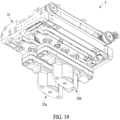
- FIG. 19 is a perspective view illustrating a bottom portion of a guide catheter control assembly according to an embodiment.
- FIG. 20 is a plan view illustrating a guide catheter control assembly according to an embodiment.
- the guide catheter control assembly 3 may control a guide catheter.
- the guide catheter may be disposed on a front end of the surgical tool control apparatus 100 to guide a path of at least one surgical tool T.
- the guide catheter control assembly 3 may grip or release the guide catheter.
- the guide catheter control assembly 3 may move the gripped guide catheter in the longitudinal direction or rotate the gripped guide catheter.
- the guide catheter control assembly 3 may positioned on a front end side (that is, a proximal end portion side) of the surgical tool control apparatus 100.
- the guide catheter control assembly 3 may be connected to the main housing 1 through the connecting arm 4.
- one side of the connecting arm 4 may be connected to one side surface of the main housing 1, and the other side of the connecting arm 4 may be connected to a cover 30 on which the guide catheter control assembly 3 is mounted.
- the connecting arm 4 may be rotatably connected to the main housing 1.
- the cover 30 may be connected to the connecting arm 4 to be rotatable and/or to be able to translate.
- the guide catheter control assembly 3 may be able to tilt and/or translate with respect to the main housing 1 through the connecting arm 4. That is, the guide catheter control assembly 3 may adjust a position by the connecting arm 4.
- the guide catheter control assembly 3 may control the guide catheter by substantially the same method as a surgical tool control assembly (e.g., the surgical tool control assembly 2 of FIG. 6 ).
- the guide catheter control assembly 3 may include a frame 31, a roller module 32, and a horizontal movement portion 33.
- the frame 31 may form a base frame on which the roller module 32 and the horizontal movement portion 33, which will be described below, are installed.
- the frame 31 may be positioned on the front end (that is, a proximal end portion) of the main housing 1.
- the frame 31 may be fixedly positioned inside the cover 30, which is connected to an end portion of the connecting arm 4.
- the roller module 32 and the horizontal movement portion 33 may be connected to the frame 31.
- a plurality of roller modules 32 may be provided and connected to the frame 31.
- the roller module 32 may include a first roller module 32a and a second roller module 32b.
- the first roller module 32a and the second roller module 32b may be arranged side by side with each other. Meanwhile, this is merely an example, and the number of roller modules 32 is not limited thereto.
- the guide catheter may be gripped between two adjacent roller modules 32.
- at least one roller module 32 may be horizontally movable with respect to another roller module 32.
- the second roller module 32b may be horizontally movable with respect to the first roller module 32a so that the guide catheter is gripped between the first roller module 32a and the second roller module 32b.
- the first roller module 32a may be movable toward the second roller module 32b.
- the roller modules 32 may spread to have a sufficient distance therebetween to grip the guide catheter, and thus, a thickness of the guide catheter, that may be gripped, may not be limited. That is, the versatility of the surgical tool control apparatus 100 may be improved in that the thickness of the guide catheter is not limited and the guide catheter having any thickness may be gripped.
- the guide catheter may be controlled (moved forward and backward and rotated). Specifically, the guide catheter may move forward or backward in the longitudinal direction by the rotation of the respective roller members 322a and 322b of the first roller module 32a and the second roller module 32b. In addition, the guide catheter may rotate by the vertical movement of one of the respective roller members 322a and 322b of the first roller module 32a and the second roller module 32b.
- FIG. 21 is a perspective view illustrating a roller module of a guide catheter control assembly according to an embodiment.
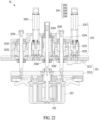
- FIG. 22 is a cross-sectional view of a roller module of a guide catheter control assembly according to an embodiment.
- the roller module 32 shown in FIGS. 21 and 22 may include a roller plate 321, a roller member 322, a roller housing 323, a rotation driving portion 324, and a vertical movement portion 325.
- the roller plate 321 may be connected to the frame 31. That is, the roller plate 321 may perform a function of connecting the roller module 32 to the frame 31.
- the roller member 322 may be rotatably connected to the roller plate 321.
- the roller plate 321 may include an upper roller plate 3211 and a lower roller plate 3212.
- the upper roller plate 3211 may be a portion connected to the frame 31.
- the upper roller plate 3211 may be provided with the rotation driving portion 324 and the vertical movement portion 325 which will be described below.
- the lower roller plate 3212 may be positioned on a lower side of the upper roller plate 3211 and may be a portion to which the roller member 322 is rotatably connected.
- the lower roller plate 3212 may be moved vertically with respect to the upper roller plate 3211 by the vertical movement portion 325 which will be described below.
- the roller member 322 may be rotatably connected to the lower roller plate 3212.
- a rotation axis of the roller member 322 may be perpendicular to the lower roller plate 3212.
- a pair of roller members 322 may be provided, and may be spaced apart from each other along the longitudinal direction of the lower roller plate 3212.
- the roller housing 323 may be connected to a lower side of the lower roller plate 3212 and provide a space in which the roller members 322 rotate.
- the roller housing 323 may be engaged with the lower roller plate 3212 using a latch.
- the rotation driving portion 324 may rotate the roller members 322 with respect to the roller plate 321.
- the rotation driving portion 324 may rotate the roller members 322 in one direction or the other direction.
- the rotation driving portion 324 may be installed on the upper roller plate 3211.
- the rotation driving portion 324 may include a rotation driving motor 3241, a rotation drive pulley 3242, a spline nut 3243, a spline shaft 3244, and a shaft support 3245.
- the rotation driving motor 3241 may generate rotational power for rotating the roller members 322.
- the rotation driving motor 3241 may be a motor that implements the rotation in one direction and the other direction.
- the rotation drive pulley 3242 may receive the rotational power from the rotation driving motor 3241.
- the rotation drive pulley 3242 may receive the rotational power through a timing belt or the like.
- the number of rotation drive pulleys 3242 may correspond to the number of roller members 322.
- the spline nut 3243 may rotate integrally with the rotation drive pulley 3242.
- the spline nut 3243 may be positioned inside the rotation drive pulley 3242.
- the spline shaft 3244 may be engaged with the spline nut 3243.
- the spline shaft 3244 may be rotated integrally with the spline nut 3243.
- the roller member 322 may be connected to one side of the spline shaft 3244. According to such a structure, the roller member 322 connected to one side of the spline shaft 3244 may be rotated in accordance with the rotation of the spline nut 3243.
- the rotation driving motor 3241 may rotate the rotation drive pulley 3242 through a timing belt or the like, the spline nut 3243 and the spline shaft 3244 may integrally rotate as the rotation drive pulley 3242 rotates, and accordingly, the roller member 322 connected to the spline shaft 3244 may rotate.
- the shaft support 3245 may be positioned between the rotation drive pulley 3242 and the spline shaft 3244.
- the shaft support 3245 may be connected to fit to fill an empty space between the rotation drive pulley 3242 and the spline shaft 3244. In this way, as the shaft support 3245 is positioned between the rotation drive pulley 3242 and the spline shaft 3244, it is possible to prevent the spline shaft 3244 from shaking.
- the shaft support 3245 has a flange shape, a supporting force may be improved.
- the shaft support 3245 may be desirably formed to have an inner diameter tolerance of +0.0005 mm to +0.01 mm after assembly.
- the shaft support 3245 may include a Teflon or acetal material.
- the vertical movement portion 325 may vertically move the lower roller plate 3212 with respect to the upper roller plate 3211. That is, the vertical movement portion 325 may vertically move the lower roller plate 3212 to vertically move the roller member 322.
- the vertical movement portion 325 may be installed on the upper roller plate 3211.
- the vertical movement portion 325 may include a vertical movement driving motor 3251, a vertical movement pulley 3252, a vertical movement lead screw nut 3253, and a vertical movement lead screw 3255.
- the vertical movement driving motor 3251 may generate rotational power for vertically moving the roller member 322.
- the vertical movement driving motor 3251 may be a motor that implements the rotation in one direction and the other direction.
- the vertical movement pulley 3252 may receive the rotational power from the vertical movement driving motor 3251.
- the vertical movement pulley 3252 may receive the rotational power through a timing belt or the like.
- a pair of vertical movement pulleys 3252 may be provided.
- a pair of vertical movement pulleys 3252 may be disposed to be spaced apart from each other on one side and the other side of the upper roller plate 3211, respectively.
- the pair of vertical movement pulleys 3252 may be connected with a timing belt or the like to transmit the rotational power to each other.
- the vertical movement screw nut 3253 may rotate integrally with the vertical movement pulley 3252.
- the vertical movement screw nut 3253 may be disposed inside the vertical movement pulley 3252.
- the vertical movement lead screw 3254 may be engaged with the vertical movement screw nut 3253.
- the vertical movement screw 3254 may be moved in the longitudinal direction in accordance with the rotation of the vertical movement screw nut 3253.
- the lower roller plate 3212 may be connected to one side of the vertical movement screw 3254. According to such a structure, the vertical movement screw 3254 may vertically move the lower roller plate 3212 in accordance with the rotation of the vertical movement screw nut 3253.
- the vertical movement driving motor 3251 may rotate the vertical movement pulley 3252 and the vertical movement lead screw nut 3253 integrally through a timing belt or the like, and the vertical movement lead screw 3254 may vertically move the roller member 322 connected to the lower roller plate 3212, as the vertical movement lead screw 3254 moves in the longitudinal direction in accordance with the rotation of the vertical movement lead screw nut 3253.
- the horizontal movement portion 33 may horizontally move the roller module 32.
- the horizontal movement portion 33 may horizontally move the second roller module 32b.
- the first roller module 32a may be formed to be horizontally movable.
- the horizontal movement portion 33 may be installed on the frame 31.
- the horizontal movement portion 33 may include a horizontal movement driving motor 331, a horizontal movement lead screw 332, and a horizontal movement lead screw nut 333.
- the horizontal movement driving motor 331 may generate rotational power for horizontally moving the roller module 32.
- the horizontal movement driving motor 331 may be a motor that implements the rotation in one direction and the other direction.
- the horizontal movement lead screw 332 may be connected to the frame 31 in the horizontal direction.
- the horizontal movement lead screw 332 may receive the rotational power from the horizontal movement driving motor 331 through a timing belt, a pulley, or the like.
- a pair of horizontal movement lead screws 332 may be provided.
- a pair of horizontal movement lead screws 332 may be disposed on one side and the other side of the frame 31, respectively.
- the pair of horizontal movement lead screws 332 may be connected with a timing belt, a pulley, or the like to transmit the rotational power to each other.
- the horizontal movement lead screw nut 333 may be engaged with the horizontal movement lead screw 332.
- One side of the horizontal movement lead screw nut 333 may be connected to the roller plate 321.
- the horizontal movement lead screw nut 333 may be connected to the upper roller plate 3211 through a connecting member.
- a pair of horizontal movement lead screw nuts 333 may be connected to one side and the other side of the upper roller plate 3211, respectively. According to such a structure, since the horizontal movement lead screw nut 333 moves in the longitudinal direction of the horizontal movement lead screw 332 in accordance with the rotation of the horizontal movement lead screw 332, the roller plate 321 connected to the horizontal movement lead screw nut 333 may move in the horizontal direction.
- the horizontal movement driving motor 331 may rotate the horizontal movement lead screw 332 through a timing belt, a pulley, or the like, and the horizontal movement lead screw nut 333 and the upper roller plate 3211 connected thereto may horizontally move along the longitudinal direction of the horizontal movement lead screw 332 in accordance with the rotation of the horizontal movement lead screw 332, that is, the roller module 32 may move in the horizontal direction.
- the roller module 32 shown in FIGS. 21 and 22 may further include a link structure support 226 in the same manner as in the roller module 22 shown in FIGS. 10 and 11 .
- the guide catheter assembly 3 when describing the guide catheter control assembly 3, it is described and illustrated that the guide catheter assembly 3 is installed in a direction in which the roller member 322 faces the lower side, however, this is merely an example, and the guide catheter control assembly 3 in an embodiment may be installed in a direction in which the roller member 322 faces the upper side.
Landscapes
- Health & Medical Sciences (AREA)
- Engineering & Computer Science (AREA)
- Life Sciences & Earth Sciences (AREA)
- Surgery (AREA)
- Robotics (AREA)
- Medical Informatics (AREA)
- Public Health (AREA)
- Heart & Thoracic Surgery (AREA)
- Nuclear Medicine, Radiotherapy & Molecular Imaging (AREA)
- Molecular Biology (AREA)
- Animal Behavior & Ethology (AREA)
- General Health & Medical Sciences (AREA)
- Biomedical Technology (AREA)
- Veterinary Medicine (AREA)
- Orthopedic Medicine & Surgery (AREA)
- Vascular Medicine (AREA)
- Manipulator (AREA)
- Media Introduction/Drainage Providing Device (AREA)
- Surgical Instruments (AREA)
Applications Claiming Priority (2)
| Application Number | Priority Date | Filing Date | Title |
|---|---|---|---|
| KR1020220028183A KR102697428B1 (ko) | 2022-03-04 | 2022-03-04 | 시술 도구 제어 장치 |
| PCT/KR2023/002936 WO2023167540A1 (ko) | 2022-03-04 | 2023-03-03 | 시술 도구 제어 장치 |
Publications (2)
| Publication Number | Publication Date |
|---|---|
| EP4487802A1 true EP4487802A1 (de) | 2025-01-08 |
| EP4487802A4 EP4487802A4 (de) | 2026-02-25 |
Family
ID=87884049
Family Applications (1)
| Application Number | Title | Priority Date | Filing Date |
|---|---|---|---|
| EP23763738.4A Pending EP4487802A4 (de) | 2022-03-04 | 2023-03-03 | Vorrichtung zur steuerung eines medizinischen verfahrenswerkzeugs |
Country Status (7)
| Country | Link |
|---|---|
| US (1) | US20250057616A1 (de) |
| EP (1) | EP4487802A4 (de) |
| JP (1) | JP2025508003A (de) |
| KR (1) | KR102697428B1 (de) |
| CN (1) | CN116725587A (de) |
| AU (1) | AU2023227737B2 (de) |
| WO (1) | WO2023167540A1 (de) |
Families Citing this family (1)
| Publication number | Priority date | Publication date | Assignee | Title |
|---|---|---|---|---|
| WO2025263910A1 (ko) * | 2024-06-20 | 2025-12-26 | (주)엘엔로보틱스 | 롤러 어셈블리 및 이를 포함하는 시술 도구 제어 장치 |
Family Cites Families (13)
| Publication number | Priority date | Publication date | Assignee | Title |
|---|---|---|---|---|
| EP2821094B1 (de) * | 2008-05-06 | 2018-07-04 | Corindus Inc. | Kathetersystem |
| US20120071752A1 (en) * | 2010-09-17 | 2012-03-22 | Sewell Christopher M | User interface and method for operating a robotic medical system |
| CN103157170B (zh) * | 2013-02-25 | 2014-12-03 | 中国科学院自动化研究所 | 一种基于两点夹持的血管介入手术导管或导丝操纵装置 |
| EP3057642B1 (de) | 2013-10-15 | 2020-03-04 | Corindus, Inc. | Flexible spur für führungskathetersteuerung |
| CN104644270B (zh) * | 2015-02-05 | 2016-09-07 | 北京航空航天大学 | 一种基于反向丝杠的导管操纵装置 |
| FR3046543B1 (fr) * | 2016-01-07 | 2018-02-02 | Robocath | Module robotisable d'entrainement d'un organe medical souple allonge, robot medical et systeme comprenant un tel module |
| CN110799146B (zh) * | 2017-12-29 | 2023-04-07 | 凯奇股份有限公司 | 可操纵外科手术机器人系统 |
| KR102184889B1 (ko) * | 2018-04-19 | 2020-12-01 | (주)엘엔로보틱스 | 의료 로봇용 롤러 모듈, 의료 로봇용 구동 기기 및 의료 로봇 |
| CN119700313A (zh) * | 2019-07-15 | 2025-03-28 | 科林达斯公司 | 细长医疗装置的操纵 |
| US11246672B2 (en) * | 2019-08-15 | 2022-02-15 | Auris Health, Inc. | Axial motion drive devices, systems, and methods for a robotic medical system |
| KR102402850B1 (ko) * | 2020-03-06 | 2022-05-27 | 울산대학교 산학협력단 | 시술도구 제어 장치 및 방법 |
| CN111529065B (zh) * | 2020-05-09 | 2021-08-31 | 中国科学院自动化研究所 | 血管介入器械操控装置 |
| EP4249031A4 (de) * | 2020-11-18 | 2024-10-02 | LN Robotics Inc. | Steuervorrichtung für chirurgisches werkzeug |
-
2022
- 2022-03-04 KR KR1020220028183A patent/KR102697428B1/ko active Active
- 2022-03-24 CN CN202210295478.6A patent/CN116725587A/zh active Pending
-
2023
- 2023-03-03 AU AU2023227737A patent/AU2023227737B2/en active Active
- 2023-03-03 US US18/723,273 patent/US20250057616A1/en active Pending
- 2023-03-03 WO PCT/KR2023/002936 patent/WO2023167540A1/ko not_active Ceased
- 2023-03-03 JP JP2024552729A patent/JP2025508003A/ja active Pending
- 2023-03-03 EP EP23763738.4A patent/EP4487802A4/de active Pending
Also Published As
| Publication number | Publication date |
|---|---|
| KR102697428B1 (ko) | 2024-08-22 |
| EP4487802A4 (de) | 2026-02-25 |
| KR20230130946A (ko) | 2023-09-12 |
| AU2023227737B2 (en) | 2025-12-04 |
| US20250057616A1 (en) | 2025-02-20 |
| AU2023227737A1 (en) | 2024-10-10 |
| CN116725587A (zh) | 2023-09-12 |
| WO2023167540A1 (ko) | 2023-09-07 |
| JP2025508003A (ja) | 2025-03-21 |
Similar Documents
| Publication | Publication Date | Title |
|---|---|---|
| KR102511036B1 (ko) | 시술 도구 제어 장치 | |
| AU2024227571A1 (en) | Surgical tool control apparatus | |
| US6966657B2 (en) | Projection lens fixation and adjustment mechanism | |
| EP4487802A1 (de) | Vorrichtung zur steuerung eines medizinischen verfahrenswerkzeugs | |
| JP4960386B2 (ja) | 顕微鏡用の制御装置 | |
| KR102386014B1 (ko) | 텐셔너 모듈 및 이를 포함하는 스텐트 구동 장치 | |
| EP1495336A2 (de) | Positionierer für einen testkopf | |
| CN115517773B (zh) | 一种导管无菌盒、导管机械臂和神经介入手术机器人 | |
| JP3790079B2 (ja) | プロジェクタ装置 | |
| CN104241068A (zh) | 扫描头及运用此扫描头的扫描臂 | |
| EP0375033B1 (de) | Objekthalterung zum Positionieren eines Objekts in einem Strahlenbündel | |
| CN212460292U (zh) | 投影仪镜头位移调整机构及投影仪 | |
| KR102855698B1 (ko) | 시술 도구 제어 장치에 연결되는 시술 도구 홀더 | |
| US5010564A (en) | Dual axis translation mechanism | |
| CN116275798A (zh) | 一种机器人焊接用工件定位夹紧装置 | |
| CN210058312U (zh) | 一种中学生用物理实验仪器架 | |
| JPS5994708A (ja) | ズ−ムレンズ移動装置 | |
| CN119857992B (zh) | 一种导轨焊接用翻转装置 | |
| KR102561899B1 (ko) | 시술도구 제어 장치 | |
| CN111528938A (zh) | 一种导管机器人系统 | |
| KR20190079223A (ko) | 강성조절이 가능한 수술용 가이드 어셈블리 및 이를 이용한 수술용 가이드 시스템 | |
| JP2004357987A (ja) | X線診断装置 | |
| JP3256895B2 (ja) | 直動機構を持つ処理容器を備えた処理装置 | |
| CN121290328A (zh) | 用于薄板型光机模块的自适应装校装置及装校调控方法 | |
| CN121698103A (zh) | 规正装置及基板存储装置 |
Legal Events
| Date | Code | Title | Description |
|---|---|---|---|
| STAA | Information on the status of an ep patent application or granted ep patent |
Free format text: STATUS: THE INTERNATIONAL PUBLICATION HAS BEEN MADE |
|
| PUAI | Public reference made under article 153(3) epc to a published international application that has entered the european phase |
Free format text: ORIGINAL CODE: 0009012 |
|
| STAA | Information on the status of an ep patent application or granted ep patent |
Free format text: STATUS: REQUEST FOR EXAMINATION WAS MADE |
|
| 17P | Request for examination filed |
Effective date: 20240924 |
|
| AK | Designated contracting states |
Kind code of ref document: A1 Designated state(s): AL AT BE BG CH CY CZ DE DK EE ES FI FR GB GR HR HU IE IS IT LI LT LU LV MC ME MK MT NL NO PL PT RO RS SE SI SK SM TR |
|
| DAV | Request for validation of the european patent (deleted) | ||
| DAX | Request for extension of the european patent (deleted) | ||
| A4 | Supplementary search report drawn up and despatched |
Effective date: 20260128 |
|
| RIC1 | Information provided on ipc code assigned before grant |
Ipc: A61B 34/00 20160101AFI20260122BHEP Ipc: A61B 34/37 20160101ALI20260122BHEP Ipc: A61B 34/30 20160101ALI20260122BHEP Ipc: A61B 17/00 20060101ALI20260122BHEP Ipc: A61B 17/22 20060101ALI20260122BHEP |