EP4484166A2 - Roboter zur generativen fertigung von farbigen architektonischen strukturen - Google Patents
Roboter zur generativen fertigung von farbigen architektonischen strukturen Download PDFInfo
- Publication number
- EP4484166A2 EP4484166A2 EP24213248.8A EP24213248A EP4484166A2 EP 4484166 A2 EP4484166 A2 EP 4484166A2 EP 24213248 A EP24213248 A EP 24213248A EP 4484166 A2 EP4484166 A2 EP 4484166A2
- Authority
- EP
- European Patent Office
- Prior art keywords
- cementitious material
- pigments
- extrusion head
- coloring
- extrusion
- Prior art date
- Legal status (The legal status is an assumption and is not a legal conclusion. Google has not performed a legal analysis and makes no representation as to the accuracy of the status listed.)
- Pending
Links
Images

Classifications
-
- B—PERFORMING OPERATIONS; TRANSPORTING
- B28—WORKING CEMENT, CLAY, OR STONE
- B28B—SHAPING CLAY OR OTHER CERAMIC COMPOSITIONS; SHAPING SLAG; SHAPING MIXTURES CONTAINING CEMENTITIOUS MATERIAL, e.g. PLASTER
- B28B1/00—Producing shaped prefabricated articles from the material
- B28B1/001—Rapid manufacturing of 3D objects by additive depositing, agglomerating or laminating of material
-
- B—PERFORMING OPERATIONS; TRANSPORTING
- B01—PHYSICAL OR CHEMICAL PROCESSES OR APPARATUS IN GENERAL
- B01F—MIXING, e.g. DISSOLVING, EMULSIFYING OR DISPERSING
- B01F25/00—Flow mixers; Mixers for falling materials, e.g. solid particles
- B01F25/30—Injector mixers
- B01F25/31—Injector mixers in conduits or tubes through which the main component flows
- B01F25/314—Injector mixers in conduits or tubes through which the main component flows wherein additional components are introduced at the circumference of the conduit
- B01F25/3141—Injector mixers in conduits or tubes through which the main component flows wherein additional components are introduced at the circumference of the conduit with additional mixing means other than injector mixers
-
- B—PERFORMING OPERATIONS; TRANSPORTING
- B01—PHYSICAL OR CHEMICAL PROCESSES OR APPARATUS IN GENERAL
- B01F—MIXING, e.g. DISSOLVING, EMULSIFYING OR DISPERSING
- B01F25/00—Flow mixers; Mixers for falling materials, e.g. solid particles
- B01F25/30—Injector mixers
- B01F25/31—Injector mixers in conduits or tubes through which the main component flows
- B01F25/314—Injector mixers in conduits or tubes through which the main component flows wherein additional components are introduced at the circumference of the conduit
- B01F25/3142—Injector mixers in conduits or tubes through which the main component flows wherein additional components are introduced at the circumference of the conduit the conduit having a plurality of openings in the axial direction or in the circumferential direction
- B01F25/31423—Injector mixers in conduits or tubes through which the main component flows wherein additional components are introduced at the circumference of the conduit the conduit having a plurality of openings in the axial direction or in the circumferential direction with a plurality of perforations in the circumferential direction only and covering the whole circumference
-
- B—PERFORMING OPERATIONS; TRANSPORTING
- B01—PHYSICAL OR CHEMICAL PROCESSES OR APPARATUS IN GENERAL
- B01F—MIXING, e.g. DISSOLVING, EMULSIFYING OR DISPERSING
- B01F27/00—Mixers with rotary stirring devices in fixed receptacles; Kneaders
- B01F27/50—Pipe mixers, i.e. mixers wherein the materials to be mixed flow continuously through pipes, e.g. column mixers
-
- B—PERFORMING OPERATIONS; TRANSPORTING
- B28—WORKING CEMENT, CLAY, OR STONE
- B28B—SHAPING CLAY OR OTHER CERAMIC COMPOSITIONS; SHAPING SLAG; SHAPING MIXTURES CONTAINING CEMENTITIOUS MATERIAL, e.g. PLASTER
- B28B3/00—Producing shaped articles from the material by using presses; Presses specially adapted therefor
- B28B3/20—Producing shaped articles from the material by using presses; Presses specially adapted therefor wherein the material is extruded
-
- B—PERFORMING OPERATIONS; TRANSPORTING
- B28—WORKING CEMENT, CLAY, OR STONE
- B28C—PREPARING CLAY; PRODUCING MIXTURES CONTAINING CLAY OR CEMENTITIOUS MATERIAL, e.g. PLASTER
- B28C5/00—Apparatus or methods for producing mixtures of cement with other substances, e.g. slurries, mortars, porous or fibrous compositions
- B28C5/08—Apparatus or methods for producing mixtures of cement with other substances, e.g. slurries, mortars, porous or fibrous compositions using driven mechanical means affecting the mixing
- B28C5/10—Mixing in containers not actuated to effect the mixing
- B28C5/12—Mixing in containers not actuated to effect the mixing with stirrers sweeping through the materials, e.g. with incorporated feeding or discharging means or with oscillating stirrers
- B28C5/1238—Mixing in containers not actuated to effect the mixing with stirrers sweeping through the materials, e.g. with incorporated feeding or discharging means or with oscillating stirrers for materials flowing continuously through the mixing device and with incorporated feeding or discharging devices
- B28C5/1253—Mixing in containers not actuated to effect the mixing with stirrers sweeping through the materials, e.g. with incorporated feeding or discharging means or with oscillating stirrers for materials flowing continuously through the mixing device and with incorporated feeding or discharging devices with discharging devices
-
- B—PERFORMING OPERATIONS; TRANSPORTING
- B28—WORKING CEMENT, CLAY, OR STONE
- B28C—PREPARING CLAY; PRODUCING MIXTURES CONTAINING CLAY OR CEMENTITIOUS MATERIAL, e.g. PLASTER
- B28C7/00—Controlling the operation of apparatus for producing mixtures of clay or cement with other substances; Supplying or proportioning the ingredients for mixing clay or cement with other substances; Discharging the mixture
- B28C7/16—Discharge means, e.g. with intermediate storage of fresh concrete
- B28C7/162—Discharge means, e.g. with intermediate storage of fresh concrete by means of conveyors, other than those comprising skips or containers, e.g. endless belts, screws, air under pressure
- B28C7/163—Discharge means, e.g. with intermediate storage of fresh concrete by means of conveyors, other than those comprising skips or containers, e.g. endless belts, screws, air under pressure using a pump
-
- B—PERFORMING OPERATIONS; TRANSPORTING
- B33—ADDITIVE MANUFACTURING TECHNOLOGY
- B33Y—ADDITIVE MANUFACTURING, i.e. MANUFACTURING OF THREE-DIMENSIONAL [3-D] OBJECTS BY ADDITIVE DEPOSITION, ADDITIVE AGGLOMERATION OR ADDITIVE LAYERING, e.g. BY 3-D PRINTING, STEREOLITHOGRAPHY OR SELECTIVE LASER SINTERING
- B33Y30/00—Apparatus for additive manufacturing; Details thereof or accessories therefor
-
- B—PERFORMING OPERATIONS; TRANSPORTING
- B33—ADDITIVE MANUFACTURING TECHNOLOGY
- B33Y—ADDITIVE MANUFACTURING, i.e. MANUFACTURING OF THREE-DIMENSIONAL [3-D] OBJECTS BY ADDITIVE DEPOSITION, ADDITIVE AGGLOMERATION OR ADDITIVE LAYERING, e.g. BY 3-D PRINTING, STEREOLITHOGRAPHY OR SELECTIVE LASER SINTERING
- B33Y70/00—Materials specially adapted for additive manufacturing
- B33Y70/10—Composites of different types of material, e.g. mixtures of ceramics and polymers or mixtures of metals and biomaterials
-
- E—FIXED CONSTRUCTIONS
- E04—BUILDING
- E04B—GENERAL BUILDING CONSTRUCTIONS; WALLS, e.g. PARTITIONS; ROOFS; FLOORS; CEILINGS; INSULATION OR OTHER PROTECTION OF BUILDINGS
- E04B1/00—Constructions in general; Structures which are not restricted either to walls, e.g. partitions, or floors or ceilings or roofs
- E04B1/35—Extraordinary methods of construction, e.g. lift-slab, jack-block
-
- E—FIXED CONSTRUCTIONS
- E04—BUILDING
- E04G—SCAFFOLDING; FORMS; SHUTTERING; BUILDING IMPLEMENTS OR AIDS, OR THEIR USE; HANDLING BUILDING MATERIALS ON THE SITE; REPAIRING, BREAKING-UP OR OTHER WORK ON EXISTING BUILDINGS
- E04G21/00—Preparing, conveying, or working-up building materials or building elements in situ; Other devices or measures for constructional work
- E04G21/02—Conveying or working-up concrete or similar masses able to be heaped or cast
- E04G21/04—Devices for both conveying and distributing
Definitions
- the invention relates to the additive manufacturing of cementitious materials.
- the invention relates more particularly to a system for extruding beads of cementitious material for a robot for the additive manufacturing of colored architectural structures.
- the invention also relates to a robot equipped with such a system for the additive manufacturing of architectural structures.
- 3D printing of cementitious materials is a branch of additive manufacturing of cementitious materials, whose applications appear numerous and promising in the field of architecture and construction.
- architectural structures or “architectural pieces” refer to both individual construction elements (bridge, pillar, wall, street furniture, etc.), complete structures (building, house, apartment building, etc.) and various architectural pieces (artistic works, sculptures, etc.).
- the extrusion of cementitious material intended for the manufacture of an architectural structure uses a cementitious printing head comprising a cementitious material inlet and a cementitious material outlet nozzle, and a circuit for supplying the cementitious material to the print head comprising a cementitious material storage tank, a pipe connecting the storage tank and the print head inlet, and a pump for feeding the pipe with the cementitious material from the storage tank.
- the first solution consists of first manufacturing an architectural part using an additive manufacturing robot, and then painting this manufactured architectural part.
- the painting operation only occurs after the part has been manufactured, which slows down the part production operation and adds an additional step.
- only the parts that can be reached on the surface of the architectural structure can be colored.
- the second solution is to use a cementitious material that is colored in the mass before use.
- the storage tank of the extrusion system is supplied with a colored cementitious material.
- a color change is then only possible by changing the contents of the tank. In practice, this can be done with each batch of cementitious material poured into the storage tank. It is therefore not possible with such a solution to produce parts that have several rapid color variations, unless the manufacturing operations are complicated by regularly replacing the contents of the storage tank for each desired color change.
- the inventors therefore sought to propose a system for extruding cementitious material which makes it possible to resolve at least some of the drawbacks of previous solutions.
- the invention aims to provide an extrusion system which allows to manufacture colorful architectural structures without lengthening manufacturing operations.
- the invention also aims to provide, in at least one embodiment, an extrusion system which makes it possible to manufacture an architectural structure which has a continuous variation in color.
- the invention also aims to provide, in at least one embodiment, an extrusion system which makes it possible to manufacture an architectural structure which is colored not only on the surface, but also in depth.
- the invention also aims to provide a robot equipped with a cement extrusion system according to the invention.
- the invention relates to a robot for additive manufacturing of architectural structures
- a positioning system such as an articulated arm, controlled by a control unit
- an extrusion system comprising an extrusion head for cementitious material cords comprising a cementitious material inlet mouth, an outlet nozzle configured to form cementitious material cords, an intermediate enclosure, called a mixing enclosure, arranged between said inlet mouth and said outlet nozzle, said extrusion head being mounted on said positioning system such that the movement of the positioning system carrying said extrusion head along a predetermined trajectory allows the manufacture of an architectural structure by stacking layers of cementitious material cords extruded by said extrusion head.
- a robot according to the invention thus makes it possible to color the cementitious material directly in the extrusion head before its extrusion.
- the storage tank of the supply circuit is supplied with a cementitious material of all types, in particular an uncolored cementitious material. In general, cementitious materials are white or gray depending on their compositions.
- This cementitious material is conveyed to the extrusion head via the supply pipe of the supply circuit.
- the coloring of the cementitious material occurs just before extrusion by injecting colored pigments into the mixing chamber which is arranged between the inlet mouth and the outlet nozzle.
- the quantity of pigments injected into the mixing chamber is controlled by adjustment means arranged on the coloring pipes, which makes it possible to adapt the quantity of pigments to the target color of the bead and to the color of the cementitious material poured into the storage tank of the supply circuit.
- the invention therefore makes it possible to provide colored architectural structures, in particular color gradients, by suitable control of the adjustment means.
- a robot according to the invention makes it possible to color architectural structures, not only for aesthetic reasons, but also to define areas of the structure that require specific subsequent treatment. For example, if the structure must have subsequent cutting areas or anchoring areas for specific equipment, it is possible and easy with the invention to color these cutting areas or anchoring areas during the manufacture of the part. These colored areas are then easily identifiable by an operator to carry out the corresponding operations.
- the color of an extruded cord depends on the control of the adjustment means and the color pigments in the pigment tanks.
- the coloring device comprises at least three colored pigment reservoirs, each reservoir being supplied with pigments of a distinct primary color, such that coordinated control of the means for adjusting the quantity of pigments injected into said mixing enclosure by each coloring pipe of each pigment reservoir makes it possible to obtain a bead of cementitious material extruded by said outlet nozzle which has any color resulting from any combination of the three primary colors.
- said color pigments are color pigments in aqueous solution and said means for adjusting the quantity of pigments injected into said mixing enclosure comprise a metering pump configured to define the flow rate of pigments injected into said mixing enclosure.
- Pigments in aqueous solution facilitate the mixing of pigments with the cementitious material.
- this allows the use of dosing pumps to regulate the quantity of pigments injected into the mixing chamber and to convey the pigments into the mixing chamber.
- the system comprises a control unit for said dosing pumps.
- control unit makes it possible to control the dosing pumps and therefore the color of the extruded beads.
- This control unit is preferably associated with a control unit for the movements of the extrusion head to form the architectural structure.
- each coloring line comprises a booster pump for the metering pump of this line.
- Each metering pump is for example formed of a volumetric metering device.
- the feed pump is used to supply the dosing pump with pigments from the pigment tank.
- This feed pump is, for example, a peristaltic pump, which improves the pumping of the pigments, especially in the case of a significant distance, for example greater than 5 meters, between the pigment tank and the dosing pump.
- this distance from which a volumetric doser is preferable depends on the type of volumetric doser, the coloring line and the height difference between the pigment tank and the dosing pump.
- said mixing enclosure extends in a direction, called the longitudinal direction, and each coloring pipe opens into said mixing enclosure via a needle which extends in a direction forming with said longitudinal direction an angle of between 0 and 90°.
- the colour pigments are injected into the cementitious material of the mixing enclosure in a direction which forms a predetermined angle with the longitudinal direction, which is the main direction of the mixing enclosure.
- This main direction of the mixing enclosure is also the direction of the flow of cementitious material in the mixing enclosure towards the outlet nozzle.
- the injection of colour pigments in a predetermined direction makes it possible to obtain a homogeneous mixture of the cementitious material and the pigments.
- An injection of the pigments in a direction at 90° to the main direction of the mixing enclosure i.e. a radial injection of the pigments into the flow of cementitious material promotes the mixing of the pigments with the cementitious material circulating in the vicinity of the central axis of the mixing enclosure.
- An injection at an angle close to 0° promotes the mixing of the pigments with the material circulating in the vicinity of the walls of the mixing enclosure.
- An admixture at 45° is a good compromise between the two angles previously described for a homogeneous mixture.
- the invention allows different angles to be used for different pigments, for example to favor one color at the periphery of the cords and another at the center of the cords.
- the needles are arranged in the vicinity of the upstream part of the mixing chamber, i.e. opposite the outlet nozzle.
- Each needle is further connected to the pigment reservoir via a volumetric doser, which makes it possible to control the flow rate of pigments injected into the mixing chamber.
- the cementitious material is led into the mixing chamber with a constant flow rate, controlled by the feed pump, which is for example pressure/flow controlled, and the pigments are led to the mixing chamber with a constant flow rate controlled by the volumetric dosers.
- each volumetric doser is connected to the needle via a Luer-type locking connector, better known by the English name "luer-lock".
- the extrusion head comprises a dynamic mixer configured to be able to mix said cementitious material and said pigments supplied by said coloring device in said mixing enclosure.
- the print head further comprises, associated with the mixing chamber, a dynamic mixer for mixing the cementitious material and the pigments homogeneously upstream of the outlet nozzle.
- a dynamic mixer for mixing the cementitious material and the pigments homogeneously upstream of the outlet nozzle.
- the cementitious material is conveyed to the mixing chamber, from the inlet mouth, for example by means of an eccentric screw metering pump, which makes it possible to convey the material to the chamber at a constant flow rate, without generating pulsations.
- this pump makes it possible to reduce any pulsations created by the feed pump.
- the dynamic mixer comprises at least one shaft extending in the mixing enclosure in one direction, called the longitudinal direction, and carrying radial fingers distributed along the shaft, and a motor configured to be able to drive this shaft in rotation so as to be able to provide a homogeneous mixture of the cementitious material and the pigments provided by said coloring device.
- a robot according to this advantageous variant makes it possible to obtain a homogeneous mixture of the cementitious material and the colour pigments.
- the presence of radial fingers distributed along the mixer shaft makes it possible to distribute the material particles evenly in the mixing chamber.
- the mixer comprises two parallel arms, each arm comprising radial fingers, so as to form an “egg beater” type member.
- the mixer motor can be controlled so as to reverse its direction of rotation of the axis(es) during printing.
- the robot system comprises a pressure sensor for said cementitious material upstream of the mixing chamber, called a safety sensor, configured to measure the pressure upstream of said mixing chamber so as to be able to prevent risks of clogging of the mixing chamber or the outlet nozzle.
- the robot according to the invention comprises an extrusion system whose print head is carried by a positioning system, such as an articulated arm, itself controlled by a computer.
- a robot according to the invention therefore makes it possible to manufacture colored architectural structures.
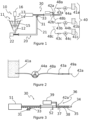
- An extrusion system of a robot comprises a storage tank 10 for cementitious material, an extrusion head 30, a circuit 20 for supplying cementitious material to the print head arranged between the storage tank 10 and the print head 30, and a coloring device 40 connected to the extrusion head 30.
- the storage tank 10 is preferably a hopper comprising an upper opening 11 adapted to receive batches of cementitious materials and a lower outlet 12 connected to the supply circuit 20.
- the cementitious material intended to supply the storage tank is preferably a white material that can be colored by a coloring device described later.
- the hopper further comprises an agitator 13 comprising a shaft 14 carrying a plurality of side blades 15 via axes perpendicular to the shaft 14, and a motor 16 for rotating the shaft 14.
- the motor 14 is for example an electric motor configured to be able to drive at low speed, for example at a speed of 6 revolutions/minute, the shaft 14 of the agitator 13.
- the use of a heat engine is of course possible without modifying the performance of the extrusion system according to the invention.
- the role of the agitator is to be able to maintain the cementitious material in the hopper at a quasi-constant rheological state before being led to the print head by the supply circuit 20.
- the cementitious material used is, for example, a white premix based on cement with fine particles, hydrated and fluidified.
- the supply circuit 20 connects the storage tank 10 to the extrusion head 30.
- This circuit comprises a pipe 21 connecting the outlet 12 of the storage tank 10 to an inlet 31 of the extrusion head 30.
- the supply circuit 20 further comprises a booster pump 22.
- This booster pump 22 is for example controlled in pressure/flow rate by a pressure sensor 33 arranged in the vicinity of the inlet 31 of the extrusion head 30.
- This booster pump 22 is for example an eccentric screw pump so as to be able to convey the cementitious material to the extrusion head 30 while minimizing the pulsations.
- This booster pump 22 is for example a pump marketed under the references Putzmeister ® FP-V Mono. Of course, other pumps can be used without modifying the performance of the invention.
- the extrusion head 30 comprises, as shown in the figure 3 , an inlet mouth 31 connected to the supply circuit 20 and an outlet nozzle 34 configured to form beads of cementitious material.
- the extrusion head 30 also comprises an eccentric screw metering pump 51 configured to be able to convey the cementitious material from the inlet mouth 31 to the mixing enclosure 35.
- a metering pump is for example a pump marketed under the references Viscotec ® 3VMP36.
- Viscotec ® 3VMP36 a pump marketed under the references Viscotec ® 3VMP36.
- other pumps can be used without modifying the performances of the invention.
- the dosing pump 51 is replaced by a volumetric doser configured to be able to ensure a constant flow rate over a predetermined operating range.
- the outlet nozzle 34 of the extrusion head is preferably removable so as to be able to adapt the shape of the outlet nozzle 34 to the part to be manufactured.
- the section of the outlet nozzle 34 can be adapted to each type of part manufactured, or even changed during printing to modify the section of the beads of certain areas of the part manufactured.
- the outlet nozzle comprises for example a threaded external wall which cooperates with a threaded internal portion of the wall of the extrusion head delimiting the mixing enclosure 35.
- the outlet nozzle comprises a threaded internal wall which cooperates with a threaded external portion of the wall of the extrusion head.
- the coloring device 40 comprises as shown in the figure 1 , reservoirs 41a, 41b, 41c of color pigments. These reservoirs 41a, 41b, 41c preferably each contain pigments of one of the three primary colors so that the device can provide a combination of pigments making it possible to give the extruded cords any color by combining the three primary colors.
- the pigments are preferably pigments in aqueous solution.
- the reservoir 41a is connected to the mixing enclosure 35 of the extrusion head by a coloring pipe 48a.
- This pipe 48a opens into the mixing enclosure 35 via a needle 42a.
- the pipe 48a further comprises a volumetric doser 43a and a peristaltic pump 44a.
- the volumetric doser is for example a doser marketed under the reference Viscotec ® eco-PEN600. Of course, another doser can be used without modifying the performance of the invention.
- the needle 42a opens into the mixing enclosure 35, opposite the outlet nozzle 34, in a direction which forms for example an angle of 45° with the main direction of the mixing enclosure, as shown schematically in the Figure 4b .
- the injection of color pigments into the mixing chamber 35 is therefore carried out by means of a volumetric doser 43a which makes it possible to adjust the quantity of pigments injected into the mixing chamber.
- the pigments are pumped in liquid form into the reservoir 41a and conducted at a constant pressure into the mixing chamber 35.
- the volumetric doser 43a is connected to a needle 42a by means of a luer-lock type device 49a.
- the volumetric doser 43a forms means for adjusting the quantity of pigments injected into the mixing chamber 35.
- the coordinated control of the volumetric dosers 43a, 43b, 43d of the three pigment reservoirs makes it possible to define, at each moment, the color of the bead of cementitious material extruded by the outlet nozzle 34.
- volumetric dosers 43a, 43b, 43c are preferably controlled by a control unit not shown in the figures.
- a control unit makes it possible to control the flow of pigments from each tank to the mixing enclosure in order to be able to obtain a bead of the targeted color at all times.
- the coloring device 40 therefore makes it possible to inject color pigments directly into the mixing chamber, just before the extrusion of the bead. of cementitious material through the outlet nozzle. This injection of pigments into the mixing chamber therefore makes it possible to give the extruded beads a colored tint before extrusion.
- the invention has been described with pigments in aqueous form.
- the pigments are supplied in powder form and are conveyed to the mixing enclosure by endless screws of the Archimedes screw type, which then replace the volumetric dosers.
- the robot may be a six-axis robot, mounted on rails or not, on a gantry or not.
- the robot may also be a cable robot or any type of robot whose positioning system, such as an articulated arm, can be controlled by computer.
- a robot according to the invention can be used to manufacture all types of architectural parts.
- Such an architectural part can be a reinforcement part, a building, and generally, any part made of cementitious material.
- the architectural parts manufactured by using an extrusion system according to the invention can be of various scales. It can be a portion of a post, an entire post, a wall, a slab element, a building, street furniture, a sculpture, etc.
Landscapes
- Engineering & Computer Science (AREA)
- Chemical & Material Sciences (AREA)
- Mechanical Engineering (AREA)
- Manufacturing & Machinery (AREA)
- Ceramic Engineering (AREA)
- Structural Engineering (AREA)
- Civil Engineering (AREA)
- Architecture (AREA)
- Materials Engineering (AREA)
- Chemical Kinetics & Catalysis (AREA)
- Composite Materials (AREA)
- Dispersion Chemistry (AREA)
- Physics & Mathematics (AREA)
- Electromagnetism (AREA)
- Devices For Post-Treatments, Processing, Supply, Discharge, And Other Processes (AREA)
- Coating Apparatus (AREA)
Applications Claiming Priority (3)
| Application Number | Priority Date | Filing Date | Title |
|---|---|---|---|
| FR1758302A FR3070896B1 (fr) | 2017-09-08 | 2017-09-08 | Systeme d'extrusion de cordons de materiau cimentaire pour robots de fabrication additive de structures architecturales colorees |
| PCT/FR2018/052099 WO2019048752A1 (fr) | 2017-09-08 | 2018-08-23 | Système d'extrusion de cordons de matériau cimentaire pour robot de fabrication additive de structures architecturales colorées |
| EP18788809.4A EP3638477B1 (de) | 2017-09-08 | 2018-08-23 | System zum extrudieren von zementmaterial für einen roboter zur generativen fertigung von farbigen architekturstrukturen |
Related Parent Applications (1)
| Application Number | Title | Priority Date | Filing Date |
|---|---|---|---|
| EP18788809.4A Division EP3638477B1 (de) | 2017-09-08 | 2018-08-23 | System zum extrudieren von zementmaterial für einen roboter zur generativen fertigung von farbigen architekturstrukturen |
Publications (2)
| Publication Number | Publication Date |
|---|---|
| EP4484166A2 true EP4484166A2 (de) | 2025-01-01 |
| EP4484166A3 EP4484166A3 (de) | 2025-03-12 |
Family
ID=60515554
Family Applications (2)
| Application Number | Title | Priority Date | Filing Date |
|---|---|---|---|
| EP18788809.4A Active EP3638477B1 (de) | 2017-09-08 | 2018-08-23 | System zum extrudieren von zementmaterial für einen roboter zur generativen fertigung von farbigen architekturstrukturen |
| EP24213248.8A Pending EP4484166A3 (de) | 2017-09-08 | 2018-08-23 | Roboter zur generativen fertigung von farbigen architektonischen strukturen |
Family Applications Before (1)
| Application Number | Title | Priority Date | Filing Date |
|---|---|---|---|
| EP18788809.4A Active EP3638477B1 (de) | 2017-09-08 | 2018-08-23 | System zum extrudieren von zementmaterial für einen roboter zur generativen fertigung von farbigen architekturstrukturen |
Country Status (3)
| Country | Link |
|---|---|
| EP (2) | EP3638477B1 (de) |
| FR (1) | FR3070896B1 (de) |
| WO (1) | WO2019048752A1 (de) |
Families Citing this family (6)
| Publication number | Priority date | Publication date | Assignee | Title |
|---|---|---|---|---|
| DE102019204230A1 (de) | 2019-03-27 | 2020-10-01 | Putzmeister Engineering Gmbh | Verfahren zur Herstellung von einem Bauwerksteil, System zur Herstellung von einem Bauwerksteil und Bauwerksteil |
| DE102021121046A1 (de) * | 2021-08-12 | 2023-02-16 | Wilhelm Tölke GmbH & Co KG | Vorrichtung und Verfahren zur Herstellung von Bauwerken oder Objekten aus eingefärbtem Beton |
| FR3126913B1 (fr) | 2021-09-13 | 2024-03-08 | Xtreee | Système d’extrusion de materiau de construction enrichi de granulats et/ou de fibres aciers pour fabrication additive de structures architecturales |
| JP2025506099A (ja) | 2022-02-22 | 2025-03-07 | シーカ テクノロジー アクチェンゲゼルシャフト | 積層造形プロセスにおける硬化性バインダー組成物の着色方法及び着色懸濁液 |
| FR3140571B1 (fr) | 2022-10-10 | 2024-10-25 | Xtreee | Système d’extrusion de materiau de construction equipé d’un dispositif de mesure de la largeur des cordons extrudés |
| FR3148931B1 (fr) | 2023-05-25 | 2025-08-15 | Xtreee | Système d’extrusion de materiau de construction equipé d’un dispositif d’injection d’un retardateur de prise en tete d’impression |
Family Cites Families (7)
| Publication number | Priority date | Publication date | Assignee | Title |
|---|---|---|---|---|
| JP2566179B2 (ja) * | 1991-02-25 | 1996-12-25 | 株式会社フジタ | コンクリート急硬剤の混合攪拌装置における急硬剤吐出口の閉塞防止装置 |
| US6280785B1 (en) * | 2000-03-28 | 2001-08-28 | Nanotek Instruments, Inc. | Rapid prototyping and fabrication method for 3-D food objects |
| DE102011102337A1 (de) * | 2011-05-25 | 2012-11-29 | Werner Sobek | Vorrichtung und Verfahren zum Herstellen von Bauteilen mit zumindest einer kontinuierlichen Eigenschaftsänderung |
| CN204354263U (zh) * | 2014-12-29 | 2015-05-27 | 中国建筑股份有限公司 | 一种适用于不同粘度的宾汉姆多组分流体混合挤出装置 |
| CN105216333B (zh) * | 2015-11-16 | 2020-03-24 | 陈志敏 | 一种三维打印机流体挤出系统及其实现方法 |
| CN106088610B (zh) * | 2016-06-15 | 2019-02-05 | 博湃建筑科技(上海)有限公司 | 3d打印建筑墙体的方法和3d打印建筑的设备 |
| CN106988535A (zh) * | 2017-05-17 | 2017-07-28 | 都书鹏 | 具有自动注入外加剂功能的建筑3d打印头 |
-
2017
- 2017-09-08 FR FR1758302A patent/FR3070896B1/fr active Active
-
2018
- 2018-08-23 EP EP18788809.4A patent/EP3638477B1/de active Active
- 2018-08-23 EP EP24213248.8A patent/EP4484166A3/de active Pending
- 2018-08-23 WO PCT/FR2018/052099 patent/WO2019048752A1/fr not_active Ceased
Also Published As
| Publication number | Publication date |
|---|---|
| WO2019048752A1 (fr) | 2019-03-14 |
| FR3070896A1 (fr) | 2019-03-15 |
| EP3638477A1 (de) | 2020-04-22 |
| EP3638477B1 (de) | 2024-11-20 |
| EP4484166A3 (de) | 2025-03-12 |
| EP3638477C0 (de) | 2024-11-20 |
| FR3070896B1 (fr) | 2019-08-30 |
Similar Documents
| Publication | Publication Date | Title |
|---|---|---|
| EP3638477B1 (de) | System zum extrudieren von zementmaterial für einen roboter zur generativen fertigung von farbigen architekturstrukturen | |
| EP3638475B1 (de) | System zum extrudieren zementartiger materialschichten für einen roboter zur generativen fertigung von architekturstrukturen | |
| EP3638476B1 (de) | System zum extrudieren zementartiger materialperlen für einen roboter zur generativen fertigung von architekturstrukturen | |
| EP3638473B1 (de) | System zum extrudieren von baumaterial für einen roboter zur generativen fertigung von architekturstrukturen mit einer vorrichtung zum einbringen von verstärkungsfasern | |
| US5205722A (en) | Metering pump | |
| EP3674045B1 (de) | System zur extrusion von baumaterialsträngen für roboter zur additiven fertigung von architektonischen strukturen, das eine verflüssigungsvorrichtung des extrudierten zementmaterials umfasst | |
| EP2265362B1 (de) | Mischvorrichtung und verfahren zur herstellung eines präparats mit dieser mischvorrichtung | |
| CN105339664A (zh) | 聚合物材料 | |
| EP3616865B1 (de) | Vorrichtung und verfahren zum dreidimensionalen drucken in gel | |
| EP0165098B1 (de) | Anordnung für die Verteilung flüssiger oder pastenartiger Ingredienzien | |
| WO2024078919A1 (fr) | Système d'extrusion de materiau de construction equipé d'un dispositif de mesure de la largeur des cordons extrudés | |
| FR3126913A1 (fr) | Système d’extrusion de materiau de construction enrichi de granulats et/ou de fibres aciers pour fabrication additive de structures architecturales | |
| CN111037920A (zh) | 一种光固化梯度材料成型装置及方法 | |
| EP1286784B1 (de) | Verfahren zur herstellung und anwendung einer mehrkomponentenfarbe mittels zerstäubung | |
| US20170312710A1 (en) | Apparatus and method for mixing components | |
| FR3068911A1 (fr) | Tete d'extrusion de cordons de materiaux de construction d'un robot de fabrication additive equipee d'un dispositif de lissage | |
| WO2024240375A1 (fr) | Système et procédé d'extrusion de cordons de matériau de construction pour robot de fabrication additive de structures architecturales | |
| FR3126333A1 (fr) | contrôle d’impression 3D | |
| FR3079230A1 (fr) | Procede de fabrication additive de ceramique par voie liquide et dispositif pour la mise en œuvre dudit procede | |
| WO2021214398A1 (fr) | Dispositif de machine de projection | |
| FR2997604A3 (fr) | Dispositif a injection directe pour engin notamment agricole et engin equipe d'un tel dispositif |
Legal Events
| Date | Code | Title | Description |
|---|---|---|---|
| PUAI | Public reference made under article 153(3) epc to a published international application that has entered the european phase |
Free format text: ORIGINAL CODE: 0009012 |
|
| STAA | Information on the status of an ep patent application or granted ep patent |
Free format text: STATUS: THE APPLICATION HAS BEEN PUBLISHED |
|
| AC | Divisional application: reference to earlier application |
Ref document number: 3638477 Country of ref document: EP Kind code of ref document: P |
|
| AK | Designated contracting states |
Kind code of ref document: A2 Designated state(s): AL AT BE BG CH CY CZ DE DK EE ES FI FR GB GR HR HU IE IS IT LI LT LU LV MC MK MT NL NO PL PT RO RS SE SI SK SM TR |
|
| REG | Reference to a national code |
Ref country code: DE Ref legal event code: R079 Free format text: PREVIOUS MAIN CLASS: B33Y0070100000 Ipc: B28C0007160000 |
|
| PUAL | Search report despatched |
Free format text: ORIGINAL CODE: 0009013 |
|
| AK | Designated contracting states |
Kind code of ref document: A3 Designated state(s): AL AT BE BG CH CY CZ DE DK EE ES FI FR GB GR HR HU IE IS IT LI LT LU LV MC MK MT NL NO PL PT RO RS SE SI SK SM TR |
|
| RIC1 | Information provided on ipc code assigned before grant |
Ipc: B01F 27/50 20220101ALI20250204BHEP Ipc: B33Y 30/00 20150101ALI20250204BHEP Ipc: B33Y 70/10 20200101ALI20250204BHEP Ipc: E04G 21/04 20060101ALI20250204BHEP Ipc: E04B 1/35 20060101ALI20250204BHEP Ipc: E04B 1/16 20060101ALI20250204BHEP Ipc: B28C 5/12 20060101ALI20250204BHEP Ipc: B28B 3/20 20060101ALI20250204BHEP Ipc: B28B 1/00 20060101ALI20250204BHEP Ipc: B01F 25/314 20220101ALI20250204BHEP Ipc: B28C 7/16 20060101AFI20250204BHEP |
|
| STAA | Information on the status of an ep patent application or granted ep patent |
Free format text: STATUS: REQUEST FOR EXAMINATION WAS MADE |
|
| 17P | Request for examination filed |
Effective date: 20250912 |