EP4481237A1 - Ensemble de transmission pour un aéronef - Google Patents
Ensemble de transmission pour un aéronef Download PDFInfo
- Publication number
- EP4481237A1 EP4481237A1 EP23180561.5A EP23180561A EP4481237A1 EP 4481237 A1 EP4481237 A1 EP 4481237A1 EP 23180561 A EP23180561 A EP 23180561A EP 4481237 A1 EP4481237 A1 EP 4481237A1
- Authority
- EP
- European Patent Office
- Prior art keywords
- opening
- tank
- transmission assembly
- axis
- threshold value
- Prior art date
- Legal status (The legal status is an assumption and is not a legal conclusion. Google has not performed a legal analysis and makes no representation as to the accuracy of the status listed.)
- Granted
Links
Images




Classifications
-
- F—MECHANICAL ENGINEERING; LIGHTING; HEATING; WEAPONS; BLASTING
- F16—ENGINEERING ELEMENTS AND UNITS; GENERAL MEASURES FOR PRODUCING AND MAINTAINING EFFECTIVE FUNCTIONING OF MACHINES OR INSTALLATIONS; THERMAL INSULATION IN GENERAL
- F16H—GEARING
- F16H57/00—General details of gearing
- F16H57/04—Features relating to lubrication or cooling or heating
- F16H57/0434—Features relating to lubrication or cooling or heating relating to lubrication supply, e.g. pumps; Pressure control
- F16H57/0442—Features relating to lubrication or cooling or heating relating to lubrication supply, e.g. pumps; Pressure control for supply in case of failure, i.e. auxiliary supply
-
- B—PERFORMING OPERATIONS; TRANSPORTING
- B64—AIRCRAFT; AVIATION; COSMONAUTICS
- B64C—AEROPLANES; HELICOPTERS
- B64C27/00—Rotorcraft; Rotors peculiar thereto
- B64C27/04—Helicopters
- B64C27/12—Rotor drives
-
- F—MECHANICAL ENGINEERING; LIGHTING; HEATING; WEAPONS; BLASTING
- F02—COMBUSTION ENGINES; HOT-GAS OR COMBUSTION-PRODUCT ENGINE PLANTS
- F02C—GAS-TURBINE PLANTS; AIR INTAKES FOR JET-PROPULSION PLANTS; CONTROLLING FUEL SUPPLY IN AIR-BREATHING JET-PROPULSION PLANTS
- F02C7/00—Features, components parts, details or accessories, not provided for in, or of interest apart form groups F02C1/00 - F02C6/00; Air intakes for jet-propulsion plants
- F02C7/36—Power transmission arrangements between the different shafts of the gas turbine plant, or between the gas-turbine plant and the power user
-
- F—MECHANICAL ENGINEERING; LIGHTING; HEATING; WEAPONS; BLASTING
- F16—ENGINEERING ELEMENTS AND UNITS; GENERAL MEASURES FOR PRODUCING AND MAINTAINING EFFECTIVE FUNCTIONING OF MACHINES OR INSTALLATIONS; THERMAL INSULATION IN GENERAL
- F16C—SHAFTS; FLEXIBLE SHAFTS; ELEMENTS OR CRANKSHAFT MECHANISMS; ROTARY BODIES OTHER THAN GEARING ELEMENTS; BEARINGS
- F16C33/00—Parts of bearings; Special methods for making bearings or parts thereof
- F16C33/30—Parts of ball or roller bearings
- F16C33/66—Special parts or details in view of lubrication
- F16C33/6637—Special parts or details in view of lubrication with liquid lubricant
- F16C33/6659—Details of supply of the liquid to the bearing, e.g. passages or nozzles
- F16C33/667—Details of supply of the liquid to the bearing, e.g. passages or nozzles related to conditioning, e.g. cooling, filtering
-
- F—MECHANICAL ENGINEERING; LIGHTING; HEATING; WEAPONS; BLASTING
- F16—ENGINEERING ELEMENTS AND UNITS; GENERAL MEASURES FOR PRODUCING AND MAINTAINING EFFECTIVE FUNCTIONING OF MACHINES OR INSTALLATIONS; THERMAL INSULATION IN GENERAL
- F16H—GEARING
- F16H57/00—General details of gearing
- F16H57/04—Features relating to lubrication or cooling or heating
- F16H57/041—Coatings or solid lubricants, e.g. anti-seize layers or pastes
-
- F—MECHANICAL ENGINEERING; LIGHTING; HEATING; WEAPONS; BLASTING
- F16—ENGINEERING ELEMENTS AND UNITS; GENERAL MEASURES FOR PRODUCING AND MAINTAINING EFFECTIVE FUNCTIONING OF MACHINES OR INSTALLATIONS; THERMAL INSULATION IN GENERAL
- F16H—GEARING
- F16H57/00—General details of gearing
- F16H57/04—Features relating to lubrication or cooling or heating
- F16H57/0412—Cooling or heating; Control of temperature
-
- F—MECHANICAL ENGINEERING; LIGHTING; HEATING; WEAPONS; BLASTING
- F16—ENGINEERING ELEMENTS AND UNITS; GENERAL MEASURES FOR PRODUCING AND MAINTAINING EFFECTIVE FUNCTIONING OF MACHINES OR INSTALLATIONS; THERMAL INSULATION IN GENERAL
- F16H—GEARING
- F16H57/00—General details of gearing
- F16H57/04—Features relating to lubrication or cooling or heating
- F16H57/0412—Cooling or heating; Control of temperature
- F16H57/0413—Controlled cooling or heating of lubricant; Temperature control therefor
-
- F—MECHANICAL ENGINEERING; LIGHTING; HEATING; WEAPONS; BLASTING
- F16—ENGINEERING ELEMENTS AND UNITS; GENERAL MEASURES FOR PRODUCING AND MAINTAINING EFFECTIVE FUNCTIONING OF MACHINES OR INSTALLATIONS; THERMAL INSULATION IN GENERAL
- F16H—GEARING
- F16H57/00—General details of gearing
- F16H57/04—Features relating to lubrication or cooling or heating
- F16H57/045—Lubricant storage reservoirs, e.g. reservoirs in addition to a gear sump for collecting lubricant in the upper part of a gear case
-
- F—MECHANICAL ENGINEERING; LIGHTING; HEATING; WEAPONS; BLASTING
- F16—ENGINEERING ELEMENTS AND UNITS; GENERAL MEASURES FOR PRODUCING AND MAINTAINING EFFECTIVE FUNCTIONING OF MACHINES OR INSTALLATIONS; THERMAL INSULATION IN GENERAL
- F16H—GEARING
- F16H57/00—General details of gearing
- F16H57/04—Features relating to lubrication or cooling or heating
- F16H57/0467—Elements of gearings to be lubricated, cooled or heated
- F16H57/0479—Gears or bearings on planet carriers
-
- F—MECHANICAL ENGINEERING; LIGHTING; HEATING; WEAPONS; BLASTING
- F16—ENGINEERING ELEMENTS AND UNITS; GENERAL MEASURES FOR PRODUCING AND MAINTAINING EFFECTIVE FUNCTIONING OF MACHINES OR INSTALLATIONS; THERMAL INSULATION IN GENERAL
- F16H—GEARING
- F16H57/00—General details of gearing
- F16H57/04—Features relating to lubrication or cooling or heating
- F16H57/048—Type of gearings to be lubricated, cooled or heated
-
- F—MECHANICAL ENGINEERING; LIGHTING; HEATING; WEAPONS; BLASTING
- F16—ENGINEERING ELEMENTS AND UNITS; GENERAL MEASURES FOR PRODUCING AND MAINTAINING EFFECTIVE FUNCTIONING OF MACHINES OR INSTALLATIONS; THERMAL INSULATION IN GENERAL
- F16H—GEARING
- F16H57/00—General details of gearing
- F16H57/04—Features relating to lubrication or cooling or heating
- F16H57/048—Type of gearings to be lubricated, cooled or heated
- F16H57/0482—Gearings with gears having orbital motion
-
- F—MECHANICAL ENGINEERING; LIGHTING; HEATING; WEAPONS; BLASTING
- F16—ENGINEERING ELEMENTS AND UNITS; GENERAL MEASURES FOR PRODUCING AND MAINTAINING EFFECTIVE FUNCTIONING OF MACHINES OR INSTALLATIONS; THERMAL INSULATION IN GENERAL
- F16H—GEARING
- F16H57/00—General details of gearing
- F16H57/04—Features relating to lubrication or cooling or heating
- F16H57/048—Type of gearings to be lubricated, cooled or heated
- F16H57/0482—Gearings with gears having orbital motion
- F16H57/0486—Gearings with gears having orbital motion with fixed gear ratio
-
- F—MECHANICAL ENGINEERING; LIGHTING; HEATING; WEAPONS; BLASTING
- F16—ENGINEERING ELEMENTS AND UNITS; GENERAL MEASURES FOR PRODUCING AND MAINTAINING EFFECTIVE FUNCTIONING OF MACHINES OR INSTALLATIONS; THERMAL INSULATION IN GENERAL
- F16C—SHAFTS; FLEXIBLE SHAFTS; ELEMENTS OR CRANKSHAFT MECHANISMS; ROTARY BODIES OTHER THAN GEARING ELEMENTS; BEARINGS
- F16C2361/00—Apparatus or articles in engineering in general
- F16C2361/61—Toothed gear systems, e.g. support of pinion shafts
Definitions
- the present invention concerns a transmission assembly for an aircraft.
- the present invention concerns in particular a transmission assembly for an aircraft capable of hovering, for example a helicopter or a convertiplane.
- Helicopters are known essentially comprising a fuselage, a main rotor located at the top of the fuselage and revolving about its own axis, and an auxiliary rotor arranged at a tail end of the fuselage.
- Said aircraft further comprise, in a known manner, one or more motor members, for example turbines, and a transmission assembly interposed between the turbines and the main rotor and adapted to transmit the motion from the turbines to the main rotor.
- the aircraft can also comprise further transmission assemblies, which are adapted to transmit the motion from the turbines to a plurality of accessory devices adapted, for example, to supply the energy required for operation of the on-board equipment.
- the aircraft During operation of the aircraft, it is fundamental to ensure correct lubrication of the transmission assembly, since inadequate lubrication conditions could pose a risk for the entire aircraft.
- the aircraft comprise a circuit for overall lubrication of the transmission assembly.
- the object of the present invention is to provide a transmission assembly for an aircraft, which meets the above-mentioned need in a simple and inexpensive manner.
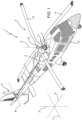
- the number 1 indicates an aircraft capable of hovering.
- the aircraft is a helicopter.
- the aircraft 1 comprises:
- the rotor 4 essentially comprises:
- the helicopter 1 further comprises a transmission assembly 3, which transmits the motion from the turbines 2 to the main rotor 4.
- the transmission assembly 3 comprises a terminal stage 20 formed essentially of a planetary gear train 21, which transmits the power to the drive shaft 11 with the correct torque and angular velocity values ( Figure 2 ).
- the planetary gear train 21 is a reduction gear.
- the planetary gear train 21 comprises essentially:
- the planetary gear train 21 further comprises a planet carrier 30 rotatable about the axis A, connected directly to the drive shaft 11 and connected to the planets 18.
- the crown gear 17 has a larger diameter than the sun gear 15 and surrounds the planet carrier 30.
- the crown gear 17 is furthermore carried by a fixed structure only partially illustrated in the attached figures.
- each planet 18 revolves about its own axis I relative to the planet carrier 30 and describes a revolution motion around the axis A integrally with the planet carrier 30.
- the mechanical power enters the planetary gear train 21 at the sun gear 15 and exits, in the direction of the drive shaft 11, at the planet carrier 30, with the correct torque value and number of revolutions.
- the planet carrier 30 comprises, in turn ( Figures 2 and 3 ):
- the main body 31 is opposite the inlet shaft 22 relative to the arms 33.
- all the arms 33 are identical to one another.
- Each bearing 40 is adapted to support a respective planet 18 in a revolving manner about the respective axis I on the respective pin 32.
- the bearing 40 comprises, in turn ( Figure 3 ):
- the ring 41 comprises ( Figures 4 and 5 ):
- the two annular elements 41c, 41d are spaced from each other parallel to the axis I and define respective shoulders for the bodies 45 parallel to the axis I. More specifically, the annular element 41c is arranged on the side of the arms 33 and the annular element 41d is opposite the annular element 41c relative to the bodies 45 parallel to the axis I.
- the pin 32 comprises a cylindrical body 34 extending from the respective arm 33 parallel to the axis I.
- the cylindrical body 34 comprises, in turn, relative to the axis I:
- the compartment 37 comprises a section 37a arranged on the side of the arm 33 and a compartment 37b opposite the arm 33 relative to the section 37a.
- the extension of the section 37a orthogonally to the axis I is smaller than the extension of the section 37b orthogonally to the axis I.
- the sections 37a and 37b are cylindrical and coaxial to the axis I.
- the transmission assembly 3 further comprises a main lubrication circuit 47 - only partially illustrated - inside which a lubricating fluid flows for lubrication of the planetary gear train 21 and, in particular, the planets 18 and bearings 40 ( Figure 3 ).
- the pin 32 comprises two holes 48, 49 passing radially to the axis I from the radially inner surface 35 to the radially outer surface 36.
- the holes 48, 49 are spaced from each other parallel to the axis I and arranged at the section 37b.
- the holes 48 and 49 form part of the main lubrication circuit 47 and are adapted to allow the passage of the lubricating fluid that flows inside it.
- the transmission assembly 3 further comprises ( Figure 3 ):
- the transmission assembly 3 comprises:
- the threshold value could be a range of values.
- the lubricating fluid flowing out of the tank 50 is adapted to lubricate the bearing 40 and/or the planet 18.
- the temperature of a component means a local temperature at any point of the component (for example, a point of the component near the retaining means 60), or a mean temperature of the component, or a temperature around the component (for example, the temperature of the air surrounding the component).
- the lubricating fluid that flows in the main lubrication circuit 47 is the same lubricating fluid contained in the tank 50.
- the tank 50 is preferably filled with the lubricating fluid before installation.
- the tank 50 is a cartridge of lubricating fluid.
- the fact that the retaining means 60 are passive means that the passage from the configuration in which they prevent outflow of the lubricating fluid to the configuration in which they allow outflow of the lubricating fluid takes place without the supply of electrical, pneumatic or hydraulic energy from the outside.
- the retaining means 60 comprise a shutter 60, which can be arranged in:
- the shutter 60 is adapted to move automatically from the closed configuration to the open configuration when the temperature of the bearing 40 and/or of the relative planet 18 exceeds the threshold value.
- the shutter 60 is adapted to move from the closed configuration to the open configuration in an irreversible manner. In other words, once arranged in the open configuration, the shutter 60 cannot automatically return to the closed configuration.
- the tank 50 is rotatable about the axis A integrally with the planet carrier 30.
- the tank 50 is radially internal to the planet carrier 30 relative to the axis A.
- the tank 50 is arranged coaxially to the axis A.
- the tank 50 comprises, in turn, a main body 51 and a plurality of appendages 52 extending radially cantilevered from the main body 51. More specifically, the appendages 52 extend radially towards the crown gear 17.
- the main body 51 comprises a compartment 510 adapted to contain at least part of the lubricating fluid of the tank 50.
- the main body 51 further comprises a base surface 51a, which faces the sun gear 15 and a top surface 51b opposite the base surface 51a parallel to the axis A.
- the tank 50 comprises an appendage 52 at each arm 33.
- each appendage 52 is aligned with a respective arm 33 in a circumferential direction relative to the axis A. Furthermore, each appendage 52 is interposed between the respective arm 33 and the respective bearing 40 parallel to the respective axis I. In other words, each appendage 52 extends directly below the respective arm 33 parallel to the respective axis I.
- each arm 33 in a circumferential direction relative to the axis A is greater than or equal to the extension of the relative appendage 52 in the same circumferential direction.
- the appendages 52 extend from the main body 51 in respective directions J transverse to the axis A.
- Said directions J are the generatrices of a virtual conical surface having vertical axis coinciding with the axis A and vertex belonging to the axis A and arranged on the side opposite the inlet shaft 22 relative to the sun gear 15.
- the appendages 52 extend from the base surface 51a ( Figures 3 , 4 and 5 ).
- the appendage 52 comprises a cavity 53 adapted to house at least partly the shutter 60 and to guide the lubricating fluid ( Figures 4 and 5 ).
- the cavity 53 comprises, in turn, an opening 54, which fluidically connects the compartment 510 to the cavity 53 and an opening 55 adapted to allow outflow of the lubricating fluid from the cavity 53 and therefore from the tank 50.
- the opening 55 directly faces the bearing 40.
- the opening 55 directly faces the annular element 41c ( Figures 4 and 5 ).
- the radially external surface 56 abuts against the protuberance 46.
- the protuberance 46 extends throughout the circumferential extension of the ring 41 relative to the axis I.
- the cavity 53 comprises ( Figures 4 and 5 ):
- the radial extension of the section 53b in a plane perpendicular to the direction J is greater than the radial extension of the section 53a in a plane perpendicular to the same direction J.
- the opening 55 is furthermore arranged at the section 53b ( Figures 4 and 5 ).
- the shuttle 61 slides between a first position, in which it determines obstruction of the opening 55, and a second position in which it determines unblocking of the opening 55.
- the shuttle 61 is in the first position when the shutter 60 is in the closed configuration ( Figure 4 ) and in the second position when the shutter 60 is in the open configuration ( Figure 5 ).
- the shutter 60 further comprises a striker element 62 integral with the appendage 52.
- the meltable element 63 is adapted to keep the shuttle 61 and the striker element 62 at a distance from each other ( Figure 4 ); when the shutter 60 is in the open configuration, the shuttle 61 abuts against the striker element 62 ( Figure 5 ).
- the striker element 62 is furthermore arranged at the section 53b and is positioned in abutment against the protuberance 46.
- the shutter 60 also comprises elastic means 64 adapted to preload the shuttle 61 towards the second position.
- the elastic means 64 comprise a helical spring cooperating in contact with the shuttle 61 on the side opposite the striker element 62.
- the shutter 60 further comprises a seal element 65 slidable relative to the cavity 53 integrally with the shuttle 61.
- the seal element 65 is fitted around the shuttle 61.
- the seal element 65 is interposed between the shuttle 61 and the inner walls of the cavity 53.
- the shuttle 61 comprises a cylindrical portion 61a arranged on the side of the striker element 62 and a portion 61b also cylindrical and opposite the portion 61a parallel to the direction J.
- the radial extension of the portion 61a is greater than the radial extension of the portion 61b.
- the shuttle 61 further comprises a seat 61c interposed between the portion 61a and the portion 61b parallel to the direction J and adapted to house the seal element 65.
- the shuttle 61 also comprises:
- the shuttle 61 further comprises a flat surface 61f directed perpendicular to the direction J and arranged at one end of the shuttle 61 opposite the portion 61b.
- the compartment 61d has a cylindrical shape and extends from the surface 61f towards the portion 61b for part of the extension of the portion 61a along direction J.
- the opening 61e is spaced from the surface 61f parallel to the direction J.
- the shuttle 61 comprises a plurality of seats 61g adapted to house respective elastic bands. Said seats 61g are arranged at the portion 61a.
- the meltable element 63 in the solid state is a cylindrical body comprising:
- meltable element 6 in the solid state is partially housed in the compartment 61d on the side of the end 63a ( Figure 4 ).
- the meltable element 63 is made of a material adapted to melt at (namely at values equal to or higher than) or near the temperature threshold value.
- the meltable element 63 is made of tin or lead, or an alloy thereof.
- the striker element 62 is a cylindrical or substantially cylindrical body comprising:
- the striker element 62 further comprises a through opening 62d passing parallel to the direction J and adapted to allow passage of the material of the meltable element 63 in the melted state towards the opening 57.
- the shuttle 61 slides between the section 53a and the section 53b.
- the radial extension of the portion 61a is greater than the radial extension of the section 53a and the portion 61a is completely housed at the section 53b.
- the elastic means 64 are completely housed at the section 53a.
- the operation of the transmission assembly 3 is described below with reference to a single planet 18 and the relative shutter 60, said operation being equal for all the planets 18 and the relative shutters 60.
- the operation is described starting from a condition in which the shutter 60 is in the closed configuration and the temperature of the bearing 40 and/or the planet 18 is below the threshold value.
- the planetary gear train 21 transmits the power from the inlet shaft 22 to the drive shaft 11 with the correct torque and angular velocity values.
- the components of the transmission assembly 3 are regularly lubricated by the main lubrication circuit 47.
- the tank 50 rotates integrally with the planet carrier 30 and the outflow of the lubricating fluid from the tank 50 is prevented.
- the meltable element 63 keeps the shuttle 61 at a distance from the striker element 62 and constrains the shuttle 61 in the first position. Consequently, the seal element 65 obstructs the opening 55.
- the meltable element 63 melts.
- the melted material of the meltable element 63 flows through the openings 62d and 57 and accumulates in the space between the protuberance 46, the appendage 52 and the annular element 41c.
- the elastic means 64 push the shuttle 61 towards the second position, until the surface 61f abuts against the abutment surface 62a.
- the lubricating fluid that has flowed out of the opening 55 runs between the interstices between the rings 41, 43 and the bodies 45 and/or on the surfaces of the planet 18 and/or between the surfaces interposed between the planet 18 and the bearing 40, providing an emergency lubrication of the bearing 40 and/or of the satellite 18.
- the number 3' indicates a transmission assembly according to a second embodiment of the present invention.
- the transmission assembly 3' is similar to the transmission assembly 3 and will be described below only insofar as it differs from the latter; equal or equivalent parts of the transmission assemblies 3, 3' will be identified, where possible, by the same reference numbers.
- the transmission assembly 3' differs from the transmission assembly 3 due to the fact that it comprises shutters 60' instead of the shutters 60. Below, reference will be made to one single shutter 60', since all the shutters 60' are identical to one another.
- the shutters 60' are adapted to control the flow of lubricating fluid coming from the tank 50 for lubrication of the planet 18 and/or the bearing 40.
- the shutter 60' comprises ( Figures 8 and 9 ):
- the cavity 61d' comprises an opening 610', which is fluidically connected to the tank 50 and an opening 611', which is adapted to allow outflow of the lubricating fluid from the cavity 61d'.
- the cavity 61d' comprises:
- the section 612' has a conical shape and the section 613' has a parallelepipedal shape.
- the cavity 61d' could be directly fluidically connected to the compartment 510, or be connected to a cavity 53 of an appendage 52 of the transmission assembly 3'.
- the meltable element 63' in the solid state comprises a conical section 63a', which is housed at the section 612', and a section 63b' having parallelepipedal shape, which is housed at the section 613' ( Figure 8 ).
- the shutter 60' further comprises elastic means 64'.
- Said elastic means 64' comprise an elastic bar 64a' fixed to the planet carrier 30.
- the elastic bar 64a' comprises, in turn:
- the elastic bar 64a' is fixed to the main body 31 at the section 64b' and is operatively connected to the meltable element 63' in the solid state at the section 64c'.
- the section 64b' is curved and has the shape of an arc of a circle centred or substantially centred in a point belonging to the axis A, when the elastic bar 64a' is in the position it assumes when the meltable element 63' is in the solid state.
- the section 64c' is adapted to guide the lubricating fluid coming out of the opening 611' towards the surfaces to be lubricated, when the shutter 60' is in the open configuration. More specifically, the section 64c' comprises a surface facing the main body 31, which is directed parallel or substantially parallel to the axis A and which is adapted to guide the lubricating fluid.
- the section 64b' comprises a first end 640' and a second end 641' opposite each other in the circumferential direction relative to the axis A.
- the section 64b' is fixed to the main body 31 at the first end 640' and the section 64c' extends from the section 64b' at the second end 641'.
- the section 64c' has an S shape in a plane perpendicular to the axis A.
- the operation of the transmission assembly 3' is similar to that of the transmission assembly 3 and will be described below only insofar as it differs from the latter.
- the operation is described below with reference to a single planet 18 and to the relative shutter 60', said operation being equal for all the planets 18 and the relative shutters 60'.
- the operation is described starting from a condition in which the shutter 60' is in the closed configuration and the temperature of the bearing 40 and/or of the planet 18 is below the threshold value.
- the meltable element 63' occupies the compartment 61d', preventing the passage of the lubricating fluid from the opening 610' to the opening 611'.
- the meltable element 63' melts due to its proximity to the bearing 40 and/or the planet 18, unblocking the openings 610' and 611' and leaving the elastic means 64' free to come into contact against the pin 32.
- the lubricating fluid that has come out of the opening 611' is then guided by the section 64c' and flows into the interstices between the rings 41, 43 and the bodies 45 and/or on the surfaces of the planet 18 and/or between the surfaces interposed between the planet 18 and the bearing 40, providing emergency lubrication of the bearing 40 and/or of the planet 18.
- the number 3" indicates a transmission assembly according to a third embodiment of the present invention.
- the transmission assembly 3'' is similar to the transmission assembly 3, and will be described below only insofar as it differs from the latter; identical or equivalent parts of the transmission assemblies 3; 3'' will be indicated, where possible, by the same reference numbers.
- the transmission assembly 3" differs from the transmission assembly 3 due to the fact that it comprises:
- the retaining means 501'' comprise a casing 501", which defines the tank 500" and is adapted to be in the solid state below the temperature threshold value and is adapted to melt at the threshold value.
- the tank 500" is fixed to the ring 41 and is therefore rotatable integrally with the planet carrier 30 about the axis A.
- the tank 500" ' is preferably filled with the lubricating fluid before installation.
- the tank 500" is a cartridge of lubricating fluid.
- the tank 500" has a rectangular section in a plane passing through the axis I.
- the tank 500" is arranged in abutment against the annular element 41c parallel to the axis I and is opposite the bodies 45 relative to the annular element 41c parallel to the axis I.
- the tank 500" is also in abutment against the protuberance 46 radially relative to the axis I.
- the tank 500" is a toroidal-shaped body arranged coaxially to the axis I.
- the operation of the transmission assembly 3" is described below starting from a condition in which the temperature of the bearing 40 and/or of the planet 18 is below the threshold value. In said condition, the casing 501" is completely solid and the outflow of the lubricating fluid from the tank 500" is prevented.
- the casing 501" melts, developing the openings 502" and allowing outflow of the lubricating fluid contained in the tank 500".
- a transmission assembly 3''' according to a fourth embodiment of the present invention is indicated.
- the transmission assembly 3′′′ is similar to the transmission assembly 3" and will be described below only insofar as it differs from the latter; equal or equivalent parts of the transmission assemblies 3" and 3′′′ will be indicated, where possible, by the same reference numbers.
- the transmission assembly 3′′′ differs from the transmission assembly 3" due to the fact that the tank 500′′′ comprises a casing 501′′′ comprising, in turn, an opening 502′′′ and passive retaining means 503′′′, 504'''.
- the retaining means 503′′′, 504′′′ comprise:
- the meltable element 504′′′ is adapted to maintain the elastic element 503′′′ in the flat configuration, when it is in the solid state, and is adapted to determine displacement of the elastic element 503′′′ to the bent configuration when it melts.
- the elastic element 503′′′ in the flat configuration obstructs, together with the meltable element 504''', the opening 502′′′ ( Figure 12 ).
- the elastic element 503′′′ in the flat configuration is directed perpendicular or substantially perpendicular to the axis I ( Figure 12 ).
- the elastic element 503′′′ in the bent configuration frees at least partly the opening 502''', allowing outflow of the lubricating fluid from the tank 500′′′.
- the elastic element 503′′′ in the bent configuration has its concavity facing the bodies 45 ( Figure 13 ).
- the casing 501′′′ is made of metal.
- the casing 501′′′ comprises:
- the radially external surface 501a′′′ comprises a tooth 505′′′ at an end thereof opposite the top surface 501c′′′ parallel to the axis I.
- the tooth 505′′′ extends radially towards the radially internal surface 501b′′′ ( Figures 12 and 13 ).
- the base surface 501d′′′ extends from the radially internal surface 501b′′′ towards the radially external surface 501a′′′ only for part of the radial extension of the tank 500′′′.
- the opening 502′′′ is defined by the radial and axial space between the radially external surface 501a′′′ and the base surface 501d′′′.
- the opening 502''' furthermore, faces the bodies 45.
- the opening 502′′′ faces the annular element 41c.
- the elastic element 503′′′ extends from the radially internal surface 501b"' towards the radially external surface 501a'' radially to the axis I.
- the elastic element 503′′′ is spaced from the radially external surface 501a'' both radially to the axis I and parallel to the axis I.
- the meltable element 504′′′ in the solid state is interposed between the radially external surface 501a"' and the elastic element 503′′′ radially to the axis I and parallel to the axis I.
- the meltable element 504′′′ in the solid state comprises:
- the second section and the third section are arranged at respective opposite ends of the first section parallel to the axis I.
- the meltable element 504′′′ in the solid state has an S shape in a plane passing through the axis I.
- meltable element 504′′′ in the solid state is in contact with the tooth 505′′′ at the second section and with the elastic element 503′′′ at the third section.
- the second section is opposite the third section relative to the tooth 505" and the third section is opposite the second section relative to the elastic element 503′′′.
- the operation of the transmission assembly 3′′′ is similar to that of the transmission assembly 3" and will therefore be described insofar as it differs from the latter starting from a condition in which the temperature of the bearing 40 and/or of the planet 18 is below the threshold value and outflow of the lubricating fluid from the tank 500′′′ is therefore prevented.
- the meltable element 504′′′ melts, allowing the elastic element 503′′′ to be arranged in the bent configuration.
- the elastic element 503′′′ partially uncovers the opening 502''', allowing outflow of the lubricating fluid from the tank 500'''.
- the lubricating fluid that has come out of the tank 500′′′ lubricates the surfaces in contact between the bodies 45 and the rings 41, 43 and/or the planet 18.
- the number 3 ⁇ indicates a transmission assembly according to a fifth embodiment of the present invention.
- the transmission assembly 3 ⁇ is similar to the transmission assembly 3" and will be described below only insofar as it differs from the latter; identical or equivalent parts of the transmission assemblies 3''; 3 ⁇ will be indicated, where possible, by the same reference numbers.
- the transmission assembly 3 ⁇ differs from the transmission assembly 3" due to the fact that the tank 500 ⁇ comprises a casing 501 ⁇ comprising, in turn, an opening 502 ⁇ and passive retaining means 503 ⁇ .
- the retaining means 503 ⁇ comprise an element 503 ⁇ made of a shape-memory material arranged in a flat configuration below the temperature threshold value and adapted to reacquire a bent configuration at the threshold value.
- the element 503 ⁇ in the flat configuration obstructs the opening 502 ⁇ .
- the element 503"" in the flat configuration is directed perpendicular or substantially perpendicular to the axis I ( Figure 14 ).
- the opening 502 ⁇ is defined by the radial and/or axial space between the radially external surface 501a ⁇ and the base surface 501d ⁇ .
- the element 503"" in the bent configuration frees at least partly the opening 502"", allowing outflow of the lubricating fluid.
- the element 503 ⁇ in the bent configuration has its concavity facing the bodies 45 ( Figure 15 ) .
- the element 503 ⁇ in the flat configuration extends from the radially internal surface 501b ⁇ towards the radially external surface 501a ⁇ radially relative to the axis I and is in contact with the radially external surface 501a ⁇ .
- the casing 501 ⁇ is made of metal.
- the operation of the transmission assembly 3 ⁇ is similar to that of the transmission assembly 3" and will therefore be described insofar as it differs from the latter and starting from a condition in which the temperature of the bearing 40 and/or of the planet 18 is below the threshold value and outflow of the lubricating fluid from the tank 500 ⁇ is prevented.
- the element 503 ⁇ When the temperature of the bearing 40 and/or of the planet 18 is equal to or exceeds the threshold value, the element 503 ⁇ returns to the bent configuration, partly uncovering the opening 502 ⁇ and allowing outflow of the lubricating fluid from the tank 500 ⁇ .
- the lubricating fluid that has flowed out of the tank 500 ⁇ lubricates the surfaces in contact between the bodies 45 and the rings 41, 43 and/or the planet 18.
- the number 3′′′ ⁇ indicates a transmission assembly according to a sixth embodiment of the present invention.
- the transmission assembly 3′′′ ⁇ is similar to the transmission assembly 3" and will be described below only insofar as it differs from the latter; identical or equivalent parts of the transmission assemblies 3''; 3′′′ ⁇ will be indicated, where possible, by the same reference numbers.
- the transmission assembly 3′′′ ⁇ differs from the transmission assembly 3" due to the fact that the tank 500′′′ ⁇ comprises a casing 501′′′ ⁇ comprising, in turn, an opening 502′′′ ⁇ and passive retaining means 503′′′ ⁇ , 506′′′ ⁇ .
- the retaining means 503′′′ ⁇ , 506′′′ ⁇ comprise:
- the elastic element 503′′′ ⁇ in the flat configuration obstructs the opening 502′′′ ⁇ .
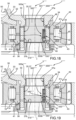
- the element 503′′′ ⁇ in the flat configuration is directed perpendicular or substantially perpendicular to the axis I ( Figure 16 ).
- the element 503′′′ ⁇ in the bent configuration frees at least partly the opening 502′′′ ⁇ , allowing outflow of the lubricating fluid.
- the element 503′′′ ⁇ in the bent configuration has its concavity facing the bodies 45 ( Figure 17 ) .
- the opening 502′′′ ⁇ is defined by the radial and/or axial space between the radially external surface 501a′′′ ⁇ and the base surface 501d′′′ ⁇ .
- the element 506′′′ ⁇ in the compressed configuration is adapted to maintain the elastic element 503′′′ ⁇ in the flat configuration.
- the element 506′′′ ⁇ in the extended configuration is adapted to move away and/or detach the elastic element 503′′′ ⁇ from the casing 501′′′ ⁇ - in particular, from the radially external surface 501a′′′ ⁇ - allowing the elastic element 503′′′ ⁇ to be arranged in the bent configuration.
- the element 506′′′ ⁇ extends into the inner volume of the tank 500′′′ ⁇ and comprises a first end and a second end opposite each other parallel to the axis I.
- the first end is fixed to the top surface 501c′′′ ⁇ and the second end is fixed to the elastic element 503′′′ ⁇ .
- the element 506′′′ ⁇ in the extended configuration is parallel or substantially parallel to the axis I.
- the casing 501′′′ ⁇ is made of metal.
- the element 506′′′ ⁇ returns to the extended configuration, detaching the elastic element 503′′′ ⁇ from the radially external surface 501a′′′ ⁇ .
- the elastic element 503′′′ ⁇ is therefore arranged in the bent configuration, partly uncovering the opening 502′′′ ⁇ and allowing outflow of the lubricating fluid from the tank 500′′′ ⁇ .
- the lubricating fluid that has flowed out of the tank 500′′′ ⁇ lubricates the surfaces in contact between the bodies 45 and the rings 41, 43 and/or the planet 18.
- the number 3′′′′′′ indicates a transmission assembly according to a seventh embodiment of the present invention.
- the transmission assembly 3′′′′′′ is similar to the transmission assembly 3 and will be described below only insofar as it differs from the latter; identical or equivalent parts of the transmission assemblies 3; 3′′′′′′ will be indicated, where possible, by the same reference numbers.
- the transmission assembly 3′′′′′′ differs from the transmission assembly 3 due to the fact that it comprises:
- the retaining means 501′′′′′′ comprise a shutter 600′′′′′′, which can be arranged in:
- the tank 500′′′′′′ ' is rotatable about the axis A integrally with the planet carrier 30.
- the tank 500′′′′′′ is housed in the compartment 37 and is fixed to the pin 32 of the relative planet 18.
- the tank 500′′′′′′ comprises a section 500a′′′′′′ arranged on the side of the arm 33 and a compartment 500b′′′′′′ opposite the arm 33 relative to the section 500a′′′′′′.
- the extension of the section 500a′′′′′′ orthogonally to the axis I is less than the extension of the section 500b′′′′′′ orthogonally to the axis I.
- the section 500a′′′′′′ ' and the section 500b′′′′′′ ' are cylindrical and coaxial to the axis I.
- the section 500a′′′′′′ ' is housed at the section 37a and the section 500b′′′′′′ ' is housed at the section 37b.
- the section 500a′′′′′′ is in contact with the radially internal surface 35 at the section 37a.
- the tank 500′′′′′′ comprises a compartment 510′′′′′′ adapted to contain at least part of the lubricating fluid of the tank 500′′′′′′ and a cavity 530′′′′′′ fluidically connected to the compartment 510′′′′′′ adapted to house the shutter 600′′′′′′.
- the cavity 530′′′′′′ comprises:
- the cavity 530′′′′′′ has a cylindrical shape having axis parallel to the axis I.
- the opening 550′′′′′′ is fluidically connected to the compartment 37.
- the opening 550′′′′′′ communicates with the compartment 37 both when the shutter 600′′′′′′ is in the closed configuration ( Figures 18 and 20 ) and when the shutter 600′′′′′′ is in the open configuration ( Figures 19 and 21 ).
- the shuttle 610′′′′′′ is slidable between a first position and a second position parallel to the axis I.
- the shuttle 610′′′′′′ is in the first position when the shutter 600′′′′′′ is in the closed configuration ( Figures 18 , 20 ) and in the second position when the shuttle 600''''' ' is in the open configuration ( Figures 19 , 21 ).
- the shuttle 610′′′′′′ in the first position determines obstruction of the opening 540′′′′′′; the shuttle 610′′′′′′ in the second position determines unblocking of the opening 540′′′′′′.
- the shuttle 610′′′′′′ abuts against the meltable element 630′′′′′′ in the solid state.
- the meltable element 630′′′′′′ is adapted to maintain the shuttle 610′′′′′′ in the first position when it is in the solid state and is adapted to determine sliding of the shuttle 610′′′′′′ towards the second position when it is at least partly melted.
- the cavity 530′′′′′′ also comprises an opening 560′′′′′′ for outflow of the melted material of the meltable element 630′′′′′′ from the cavity 530′′′′′′.
- the main lubrication circuit 47 also comprises:
- the duct 70 is defined by the interstice between the radially internal surface 41a and the radially external surface 36.
- the duct 71 extends from the radially internal surface 41a to the radially external surface 41b, preferably orthogonally to the axis I.
- the openings 48, 49 and/or the ducts 70, 71 are adapted to be crossed both by the lubricating fluid of the main lubrication circuit 47 and by the lubricating fluid that flows out of the tank 500′′′′′′.
- the meltable element 630′′′′′′ melts and flows through the opening 560′′′′′′.
- the elastic means 640′′′′′′ push the shuttle 610′′′′′′ towards the second position, until it unblocks the opening 540′′′′′′ thus allowing passage of the lubricating fluid from the opening 540′′′′′′ to the opening 550′′′′′′.
- the lubricating fluid that has flowed out of the opening 550′′′′′′ flows in sequence through the compartment 37, the openings 48, 49, and the ducts 70 and 71, lubricating the bearing 40 and/or the planet 18.
- the number 3′′′′′′′ indicates a transmission assembly according to an eighth embodiment of the present invention.
- the transmission assembly 3′′′′′′′ comprises:
- the transmission assembly 3′′′′′′′ further comprises:
- the bearing 1400 comprises, in turn:
- the bearing 1401 comprises:
- the ring 1431 is in contact with the support 230 and the bodies 1451 are spaced from the bodies 1450 parallel to the axis M.
- the ring 1430 is in contact with the ring 1431 on the side of the ring 1431 opposite the support 230.
- the rings 1430 and 1431 are rotationally fixed.
- the cog wheels 1800 and 1801 are bevel gears and the rotation axis M is perpendicular to the rotation axis of the cog wheel 1801.
- the transmission assembly 3′′′′′′′ forms part of a collector stage of the aircraft 1′′′′′′′ without this being understood as limiting in any way.
- the transmission assembly 3′′′′′′′ comprises:
- the tank 1500 is rotationally fixed relative to the axis M.
- the tank 1500 is partly integrated in the support 230 and partly in the ring 1431. According to a variation not illustrated, the tank 1500 is completely integrated in the support 230.
- the tank 1500 comprises a compartment 1510 adapted to contain at least a part of the lubricating fluid of the tank 1500 and a cavity 1530 fluidically connected to the compartment 1510 and adapted to house the shutter 1600.
- the tank 1500 is preferably filled with the lubricating fluid before installation.
- the tank 1500 is a cartridge of lubricating fluid.
- the cavity 1530 comprises:
- the cavity 1530 has a cylindrical shape having an axis W, which is perpendicular to the axis M.
- the cavity 1530 comprises two sections 1530a, 1530b at the support 23 and a section 1530c at the ring 1431.
- the section 1530a extends from the opening 1540 and sections 1530a, 1530b and 1530c are contiguous to one another and extend in sequence parallel to the axis W.
- the extension of the cross section of the section 1530b perpendicular to the axis W is greater than the extension of the cross section of the section 1530a perpendicular to the axis W.
- the extension of the cross section of the section 1530c is equal to that of the section 1530a.
- the shutter 1600 can be arranged in:
- the shutter 1600 is adapted to move automatically from the closed configuration to the open configuration, when the temperature of the bearing 1400 and/or of the bearing 1401 and/or of the cog wheel 1800 and/or of the shaft 1802 exceeds the threshold value.
- the shutter 1600 is adapted to move from the closed configuration to the open configuration in an irreversible manner.
- the shuttle 1610 slides between a first position and a second position parallel to the axis W.
- the distance between the shuttle 1610 and the ring 1430 is greater in the first position than in the second position.
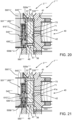
- the shuttle 1610 is in the first position when the shutter 1600 is in the closed configuration ( Figure 22 ) and in the second position when the shutter 1600 is in the open configuration ( Figure 23 ).
- the shuttle 1610 in the first position determines obstruction of the opening 1550; the shuttle 1610 in the second position determines unblocking of the opening 1550 ( Figure 23 ). In detail, the shuttle 1610 contributes only indirectly to obstruction and unblocking of the opening 1550.
- the shuttle 1610 abuts against the meltable element 1630 in the solid state.
- the meltable element 1630 is adapted to maintain the shuttle 1610 in the first position when in the solid state and is adapted to determine sliding of the shuttle 1610 towards the second position when it is at least partly melted.
- the shutter 1600 also comprises elastic means 1640 adapted to preload the shuttle 1610 towards the second position.
- the elastic means 1640 comprise a helical spring arranged in contact with the shuttle 1610 on the side opposite the meltable element 1630.
- the shutter 1600 further comprises a seal element 1650 fixed to the shuttle 1610 on the side opposite the meltable element 1630.
- the seal element 1650 slides relative to the cavity 1530 integrally with the shuttle 1610.
- the seal element 1650 prevents fluidic communication between the opening 1540 and the opening 1550 ( Figure 22 ).
- the seal element 1650 allows fluidic communication between the opening 1540 and the opening 1550.
- the meltable element 1630 in the solid state is a cylindrical body and is adapted to cooperate with the ring 1430.
- the meltable element 1630 in the solid state is arranged directly in abutment against the ring 1430.
- one or more elements are interposed between the meltable element 1630 in the solid state and the ring 1430.
- the meltable element 1630 is made of a material adapted to melt at or near the threshold temperature.
- the meltable element 1630 is made of tin or lead, or an alloy thereof.
- the cavity 1530 also comprises an opening 1560 for outflow of the melted material of the meltable element 1630 from the cavity 1530.
- the opening 1560 is arranged at the section 1530c.
- the bearing 1400 further comprises one or more ducts 1700 passing through the ring 1410 and the ring 1430 parallel to the axis W or transversely to the axis W.
- the ducts 1700 are adapted to be crossed by the lubricating fluid.
- the support 230 comprises ducts 1701, which extend from the opening 1550 and are adapted to be crossed by the lubricating fluid.
- the bearing 1401 comprises ducts 1702, which fluidically connect the ducts 1701 with at least some of the ducts 1700.
- the ducts 1702 are arranged at the ring 1431.
- the ducts 1700 are directly fluidically connected to the ducts 1701.
- the meltable element 1630 melts and flows through the opening 1560.
- the elastic means 1640 push the shuttle 1610 towards the second position, until it unblocks the opening 1550 thus allowing passage of the lubricating fluid from the opening 1540 to the opening 1550.
- the lubricating fluid that has come out of the opening 1550 flows in sequence through the ducts 1701, 1702 and 1700, lubricating the bearing 1400 and/or the bearing 1401 and/or the cog wheel 1800 and/or the shaft 1802.
- the number 3′′′′′′ ⁇ indicates a transmission assembly according to a ninth embodiment of the present invention.
- the transmission assembly 3′′′′′′ ⁇ is similar to the transmission assembly 3′′′′′′ ⁇ and will be described below only insofar as it differs from the latter; identical or equivalent parts of the transmission assemblies 3′′′′′′′; 3′′′′′′ ⁇ will be indicated, where possible, by the same reference numbers.
- the transmission assembly 3 ⁇ ′′′′′′ comprises the cog wheels 1800, 1801, the bearings 1400, 1401 and the support 230.
- the transmission assembly 3′′′′′′ ⁇ comprises:
- the bearing 1402 comprises:
- the cog wheel 1801 comprises a main body 1804 and an inner toothing 1805 extending from the main body 1804.
- the transmission assembly 3′′′′′′ ⁇ differs from the transmission assembly 3′′′′′′ ⁇ due to the fact that it comprises:
- the tank 2500 comprises a compartment 2510 adapted to contain at least part of the lubricating fluid of the tank 2500 and a cavity 2530 fluidically connected to the compartment 2510 and adapted to house the shutter 2600.
- the tank 2500 is preferably filled with the lubricating fluid before installation.
- the tank 2500 is a cartridge of lubricating fluid.
- the cavity 2530 comprises:
- the cavity 2530 has a cylindrical shape with axis Q, which is perpendicular to the axis N.
- the extension of the cross section of the section 2530b perpendicular to the axis Q is greater than the extension of the cross section of the section 2530a perpendicular to the axis Q.
- the extension of the cross section of the section 2530c perpendicular to the axis Q is equal to that of the section 2530a.
- the shutter 2600 can be arranged in:
- the shutter 2600 is adapted to move automatically from the closed configuration to the open configuration, when the temperature of the bearing 1402 and/or of the cog wheel 1801 and/or of the shaft 1803 exceeds the threshold value.
- the shutter 2600 is adapted to move from the closed configuration to the open configuration in an irreversible manner.
- the shutter 2600 comprises:
- the shuttle 2610 slides between a first position and a second position parallel to the axis Q.
- the shuttle 2610 is in the first position when the shutter 2600 is in the closed configuration ( Figure 24 ) and in the second position when the shutter 2600 is in the open configuration ( Figure 25 ).
- the distance between the shuttle 2610 and the toothing 1805 parallel to the axis Q is greater in the first position than in the second position.
- the meltable element 2630 is adapted to maintain the shuttle 2610 in the first position when it is in the solid state and is adapted to determine sliding of the shuttle 2610 towards the second position when it is at least partly melted.
- the shuttle 2610 abuts against the meltable element 2630 in the solid state.
- the meltable element 2630 in the solid state furthermore abuts directly against the main body 1804 ( Figure 24 ).
- the shutter 2600 further comprises a seal element 2650 fixed to the shuttle 2610 on the side opposite the meltable element 2630.
- the seal element 2650 slides relative to the cavity 2530 integrally with the shuttle 2610.
- the seal element 2650 When the shuttle 2610 is in the first position, the seal element 2650 obstructs the opening 2550 and prevents fluidic communication between the opening 2540 and the opening 2550 ( Figure 24 ). Vice versa, when the shuttle 2610 is in the second position, the seal element 2650 unblocks the opening 2550 and allows fluidic communication between the opening 2540 and the opening 2550 ( Figure 25 ). Therefore, the shuttle 2610 contributes only indirectly to the obstruction and unblocking of the opening 2550.
- the meltable element 2630 in the solid state is a cylindrical body arranged directly in abutment against the main body 1804.
- the meltable element 2630 is made of a material adapted to melt at or near the threshold temperature.
- the meltable element 2630 is made of tin or lead, or an alloy thereof.
- the cavity 2530 also comprises an opening 2560 for outflow of the melted material of the meltable element 2630 from the cavity 2530.
- the cog wheel 1801 further comprises an opening 2570 and a duct 2800, which extends inside the main body 1804 and which fluidically connects the opening 2550 to the opening 2570.
- the meltable element 2630 melts at least partly, the elastic means 2640 push the shuttle 2610 towards the second position and the opening 2550 is unblocked. Consequently, the passage of the lubricating fluid from the opening 2540 to the opening 2550 is allowed.
- the lubricating fluid that has come out of the opening 2550 flows in sequence through the ducts 2800 to the opening 2570 and lubricates the cog wheels 1800 and/or 1801 and/or the shaft 1803.
- the retaining means 60; 60'; 501''; 503''', 504′′′; 503 ⁇ ; 503′′′′′′, 506′′′ ⁇ ; 1600; 2600 do not require the supply of electrical, pneumatic or hydraulic energy to operate and are calibrated as a function of the threshold temperature of the part to be lubricated.
- the passive retaining means 60; 60'; 501"; 503′′′, 504′′′; 600′′′′′′; 1600; 2600 comprise meltable portions that melt at the threshold temperature or the passive retaining means 503 ⁇ ; 503′′′ ⁇ , 506′′′ ⁇ comprise shape-memory portions adapted to return to an initial configuration at the threshold temperature, the outflow of the lubricating fluid from the tank 50; 500"; 500′′′; 500 ⁇ ; 500′′′ ⁇ ; 500′′′′′′; 1500; 2500 is effectively obtained when the part to be lubricated reaches said threshold temperature.
- tank 50; 500 ⁇ ; 500′′′; 500 ⁇ ; 500′′′ ⁇ ; 500′′′′′′; 2500 is carried by a rotating component, outflow of the lubricating fluid in emergency conditions is facilitated by the centrifugal force to which it is subject during the rotation.
- the shutter 60; 600′′′′′′; 1600; 2600 comprises the elastic means 64; 640′′′′′′; 1640; 2640, the movement of the shuttle 61; 610′′′′′′; 1610; 2610 towards the second position, in which it allows outflow of the lubricating fluid, is facilitated in emergency conditions.
- the transmission assembly 3; 3' could comprise, in addition to the tank 50:
- the transmission assembly 3′′′′′′ could comprise passive retaining means analogous to the retaining means 60' or 501"; or 503''', 504''' or 503 ⁇ or 503′′′ ⁇ , 506′′′ ⁇ .
- the tank 500′′′′′′ could be revolving relative to the respective axis I integrally with the respective planet 18.
- the aircraft 1; 1'; 1 ⁇ ; 1′′′; 1 ⁇ ; 1′′′ ⁇ ; 1′′′′′′; 1′′′ ⁇ ; 1′′′′′′ ⁇ could be a convertiplane or an airplane.
- the shutter 60; 600′′′′′′; 1600; 2600 could be housed outside the cavity 53; 530′′′′′′; 1530; 2530.
- meltable element 63; 63'; 504′′′; 630′′′′′′; 1630; 2630 could be adapted to be in a non-deformed state below the threshold temperature and adapted to deform and/or lose its mechanical characteristics when the temperature is equal to or exceeds the threshold value.
Landscapes
- Engineering & Computer Science (AREA)
- General Engineering & Computer Science (AREA)
- Mechanical Engineering (AREA)
- Chemical & Material Sciences (AREA)
- Combustion & Propulsion (AREA)
- Aviation & Aerospace Engineering (AREA)
- General Details Of Gearings (AREA)
- Lubricants (AREA)
Priority Applications (7)
| Application Number | Priority Date | Filing Date | Title |
|---|---|---|---|
| EP23180561.5A EP4481237B1 (fr) | 2023-06-21 | 2023-06-21 | Ensemble de transmission pour un avion |
| EP24183061.1A EP4484802A1 (fr) | 2023-06-21 | 2023-06-21 | Ensemble de transmission pour un aéronef |
| EP25212326.0A EP4663966A3 (fr) | 2023-06-21 | 2023-06-21 | Ensemble de transmission pour un aéronef |
| CN202480043264.7A CN121420146A (zh) | 2023-06-21 | 2024-06-20 | 用于飞行器的传动组件 |
| KR1020257043815A KR20260039941A (ko) | 2023-06-21 | 2024-06-20 | 항공기용 트랜스미션 어셈블리 |
| EP24738392.0A EP4731918A1 (fr) | 2023-06-21 | 2024-06-20 | Ensemble de transmission pour un aéronef |
| PCT/IB2024/056024 WO2024261682A1 (fr) | 2023-06-21 | 2024-06-20 | Ensemble de transmission pour un aéronef |
Applications Claiming Priority (1)
| Application Number | Priority Date | Filing Date | Title |
|---|---|---|---|
| EP23180561.5A EP4481237B1 (fr) | 2023-06-21 | 2023-06-21 | Ensemble de transmission pour un avion |
Related Child Applications (3)
| Application Number | Title | Priority Date | Filing Date |
|---|---|---|---|
| EP24183061.1A Division EP4484802A1 (fr) | 2023-06-21 | 2023-06-21 | Ensemble de transmission pour un aéronef |
| EP24183061.1A Division-Into EP4484802A1 (fr) | 2023-06-21 | 2023-06-21 | Ensemble de transmission pour un aéronef |
| EP25212326.0A Division EP4663966A3 (fr) | 2023-06-21 | 2023-06-21 | Ensemble de transmission pour un aéronef |
Publications (2)
| Publication Number | Publication Date |
|---|---|
| EP4481237A1 true EP4481237A1 (fr) | 2024-12-25 |
| EP4481237B1 EP4481237B1 (fr) | 2025-11-26 |
Family
ID=87580223
Family Applications (4)
| Application Number | Title | Priority Date | Filing Date |
|---|---|---|---|
| EP24183061.1A Pending EP4484802A1 (fr) | 2023-06-21 | 2023-06-21 | Ensemble de transmission pour un aéronef |
| EP25212326.0A Pending EP4663966A3 (fr) | 2023-06-21 | 2023-06-21 | Ensemble de transmission pour un aéronef |
| EP23180561.5A Active EP4481237B1 (fr) | 2023-06-21 | 2023-06-21 | Ensemble de transmission pour un avion |
| EP24738392.0A Pending EP4731918A1 (fr) | 2023-06-21 | 2024-06-20 | Ensemble de transmission pour un aéronef |
Family Applications Before (2)
| Application Number | Title | Priority Date | Filing Date |
|---|---|---|---|
| EP24183061.1A Pending EP4484802A1 (fr) | 2023-06-21 | 2023-06-21 | Ensemble de transmission pour un aéronef |
| EP25212326.0A Pending EP4663966A3 (fr) | 2023-06-21 | 2023-06-21 | Ensemble de transmission pour un aéronef |
Family Applications After (1)
| Application Number | Title | Priority Date | Filing Date |
|---|---|---|---|
| EP24738392.0A Pending EP4731918A1 (fr) | 2023-06-21 | 2024-06-20 | Ensemble de transmission pour un aéronef |
Country Status (3)
| Country | Link |
|---|---|
| EP (4) | EP4484802A1 (fr) |
| KR (1) | KR20260039941A (fr) |
| CN (1) | CN121420146A (fr) |
Citations (2)
| Publication number | Priority date | Publication date | Assignee | Title |
|---|---|---|---|---|
| US20210116016A1 (en) * | 2019-10-18 | 2021-04-22 | Bell Textron Inc. | Thermostatically controlled emergency lubrication system |
| US11415174B2 (en) * | 2019-04-11 | 2022-08-16 | Textron Innovations Inc. | Lubrication system |
Family Cites Families (2)
| Publication number | Priority date | Publication date | Assignee | Title |
|---|---|---|---|---|
| US2742332A (en) * | 1952-03-28 | 1956-04-17 | Gen Motors Corp | Bearings and lubrication therefor |
| WO2023043466A1 (fr) * | 2021-09-20 | 2023-03-23 | Daniella Sladen | Système centralisé de distribution d'huile |
-
2023
- 2023-06-21 EP EP24183061.1A patent/EP4484802A1/fr active Pending
- 2023-06-21 EP EP25212326.0A patent/EP4663966A3/fr active Pending
- 2023-06-21 EP EP23180561.5A patent/EP4481237B1/fr active Active
-
2024
- 2024-06-20 KR KR1020257043815A patent/KR20260039941A/ko active Pending
- 2024-06-20 CN CN202480043264.7A patent/CN121420146A/zh active Pending
- 2024-06-20 EP EP24738392.0A patent/EP4731918A1/fr active Pending
Patent Citations (2)
| Publication number | Priority date | Publication date | Assignee | Title |
|---|---|---|---|---|
| US11415174B2 (en) * | 2019-04-11 | 2022-08-16 | Textron Innovations Inc. | Lubrication system |
| US20210116016A1 (en) * | 2019-10-18 | 2021-04-22 | Bell Textron Inc. | Thermostatically controlled emergency lubrication system |
Also Published As
| Publication number | Publication date |
|---|---|
| EP4663966A3 (fr) | 2026-03-11 |
| EP4484802A1 (fr) | 2025-01-01 |
| CN121420146A (zh) | 2026-01-27 |
| EP4663966A2 (fr) | 2025-12-17 |
| EP4731918A1 (fr) | 2026-04-29 |
| KR20260039941A (ko) | 2026-03-23 |
| EP4481237B1 (fr) | 2025-11-26 |
Similar Documents
| Publication | Publication Date | Title |
|---|---|---|
| EP2711292B1 (fr) | Lubrification de boîte de vitesses | |
| CA2312323C (fr) | Boite planetaire | |
| US9057431B2 (en) | Differential apparatus | |
| EP3330574B1 (fr) | Ensemble d'essieux | |
| CN111094791B (zh) | 滑动轴承的枢轴 | |
| US11703088B2 (en) | Lubrication system | |
| US11384695B2 (en) | Assembly for aircraft turbine engine comprising an improved system for lubricating a fan drive reduction gear in case of autorotation of the fan | |
| ITMI972028A1 (it) | Snodo girevole omocinetico con serbatoio del lubrificante | |
| EP4484802A1 (fr) | Ensemble de transmission pour un aéronef | |
| US10760613B2 (en) | Rotary device | |
| WO2024261682A1 (fr) | Ensemble de transmission pour un aéronef | |
| US10760676B2 (en) | Differential apparatus | |
| JP6549425B2 (ja) | ブリーザ構造 | |
| US12188552B2 (en) | Beam axle drain back valve | |
| CN121002308A (zh) | 用于飞行器的机械减速齿轮的移动环形齿轮 | |
| US11885407B1 (en) | Fluid scavenge system | |
| CN210195834U (zh) | 凸轮轴及发动机 | |
| EP4063694B1 (fr) | Engrenage planétaire pour une transmission d'un aéronef capable de vol stationnaire | |
| ES2878673T3 (es) | Motor de arranque de turbina de aire | |
| JP3133219B2 (ja) | 動力伝達装置の潤滑構造 | |
| US12410731B2 (en) | Lubrication and cooling of equipment of an aircraft turbomachine | |
| JP6013262B2 (ja) | ケーシングの構造 | |
| JP7815824B2 (ja) | 回転体装置 | |
| EP4556255A1 (fr) | Roue configurable pour véhicule | |
| US20260126110A1 (en) | Systems and methods for heating a gearbox prior to fan rotation |
Legal Events
| Date | Code | Title | Description |
|---|---|---|---|
| PUAI | Public reference made under article 153(3) epc to a published international application that has entered the european phase |
Free format text: ORIGINAL CODE: 0009012 |
|
| STAA | Information on the status of an ep patent application or granted ep patent |
Free format text: STATUS: EXAMINATION IS IN PROGRESS |
|
| 17P | Request for examination filed |
Effective date: 20240618 |
|
| AK | Designated contracting states |
Kind code of ref document: A1 Designated state(s): AL AT BE BG CH CY CZ DE DK EE ES FI FR GB GR HR HU IE IS IT LI LT LU LV MC ME MK MT NL NO PL PT RO RS SE SI SK SM TR |
|
| GRAP | Despatch of communication of intention to grant a patent |
Free format text: ORIGINAL CODE: EPIDOSNIGR1 |
|
| STAA | Information on the status of an ep patent application or granted ep patent |
Free format text: STATUS: GRANT OF PATENT IS INTENDED |
|
| INTG | Intention to grant announced |
Effective date: 20250618 |
|
| GRAS | Grant fee paid |
Free format text: ORIGINAL CODE: EPIDOSNIGR3 |
|
| GRAA | (expected) grant |
Free format text: ORIGINAL CODE: 0009210 |
|
| STAA | Information on the status of an ep patent application or granted ep patent |
Free format text: STATUS: THE PATENT HAS BEEN GRANTED |
|
| AK | Designated contracting states |
Kind code of ref document: B1 Designated state(s): AL AT BE BG CH CY CZ DE DK EE ES FI FR GB GR HR HU IE IS IT LI LT LU LV MC ME MK MT NL NO PL PT RO RS SE SI SK SM TR |
|
| REG | Reference to a national code |
Ref country code: CH Ref legal event code: F10 Free format text: ST27 STATUS EVENT CODE: U-0-0-F10-F00 (AS PROVIDED BY THE NATIONAL OFFICE) Effective date: 20251126 Ref country code: GB Ref legal event code: FG4D |
|
| P01 | Opt-out of the competence of the unified patent court (upc) registered |
Free format text: CASE NUMBER: UPC_APP_0011384_4481237/2025 Effective date: 20251028 |
|
| REG | Reference to a national code |
Ref country code: IE Ref legal event code: FG4D |
|
| REG | Reference to a national code |
Ref country code: DE Ref legal event code: R096 Ref document number: 602023008919 Country of ref document: DE |
|
| REG | Reference to a national code |
Ref country code: CH Ref legal event code: R17 Free format text: ST27 STATUS EVENT CODE: U-0-0-R10-R17 (AS PROVIDED BY THE NATIONAL OFFICE) Effective date: 20260106 |
|
| REG | Reference to a national code |
Ref country code: NL Ref legal event code: MP Effective date: 20251126 |
|
| PG25 | Lapsed in a contracting state [announced via postgrant information from national office to epo] |
Ref country code: ES Free format text: LAPSE BECAUSE OF FAILURE TO SUBMIT A TRANSLATION OF THE DESCRIPTION OR TO PAY THE FEE WITHIN THE PRESCRIBED TIME-LIMIT Effective date: 20251126 |
|
| REG | Reference to a national code |
Ref country code: LT Ref legal event code: MG9D |
|
| PG25 | Lapsed in a contracting state [announced via postgrant information from national office to epo] |
Ref country code: NO Free format text: LAPSE BECAUSE OF FAILURE TO SUBMIT A TRANSLATION OF THE DESCRIPTION OR TO PAY THE FEE WITHIN THE PRESCRIBED TIME-LIMIT Effective date: 20260226 |
|
| PG25 | Lapsed in a contracting state [announced via postgrant information from national office to epo] |
Ref country code: FI Free format text: LAPSE BECAUSE OF FAILURE TO SUBMIT A TRANSLATION OF THE DESCRIPTION OR TO PAY THE FEE WITHIN THE PRESCRIBED TIME-LIMIT Effective date: 20251126 Ref country code: HR Free format text: LAPSE BECAUSE OF FAILURE TO SUBMIT A TRANSLATION OF THE DESCRIPTION OR TO PAY THE FEE WITHIN THE PRESCRIBED TIME-LIMIT Effective date: 20251126 Ref country code: AT Free format text: LAPSE BECAUSE OF FAILURE TO SUBMIT A TRANSLATION OF THE DESCRIPTION OR TO PAY THE FEE WITHIN THE PRESCRIBED TIME-LIMIT Effective date: 20251126 |
|
| REG | Reference to a national code |
Ref country code: AT Ref legal event code: MK05 Ref document number: 1861334 Country of ref document: AT Kind code of ref document: T Effective date: 20251126 |
|
| PG25 | Lapsed in a contracting state [announced via postgrant information from national office to epo] |
Ref country code: NL Free format text: LAPSE BECAUSE OF FAILURE TO SUBMIT A TRANSLATION OF THE DESCRIPTION OR TO PAY THE FEE WITHIN THE PRESCRIBED TIME-LIMIT Effective date: 20251126 |
|
| PG25 | Lapsed in a contracting state [announced via postgrant information from national office to epo] |
Ref country code: RS Free format text: LAPSE BECAUSE OF FAILURE TO SUBMIT A TRANSLATION OF THE DESCRIPTION OR TO PAY THE FEE WITHIN THE PRESCRIBED TIME-LIMIT Effective date: 20260226 |
|
| PG25 | Lapsed in a contracting state [announced via postgrant information from national office to epo] |
Ref country code: IS Free format text: LAPSE BECAUSE OF FAILURE TO SUBMIT A TRANSLATION OF THE DESCRIPTION OR TO PAY THE FEE WITHIN THE PRESCRIBED TIME-LIMIT Effective date: 20260326 |
|
| PG25 | Lapsed in a contracting state [announced via postgrant information from national office to epo] |
Ref country code: PT Free format text: LAPSE BECAUSE OF FAILURE TO SUBMIT A TRANSLATION OF THE DESCRIPTION OR TO PAY THE FEE WITHIN THE PRESCRIBED TIME-LIMIT Effective date: 20260326 |
|
| PG25 | Lapsed in a contracting state [announced via postgrant information from national office to epo] |
Ref country code: PL Free format text: LAPSE BECAUSE OF FAILURE TO SUBMIT A TRANSLATION OF THE DESCRIPTION OR TO PAY THE FEE WITHIN THE PRESCRIBED TIME-LIMIT Effective date: 20251126 |
|
| PG25 | Lapsed in a contracting state [announced via postgrant information from national office to epo] |
Ref country code: LV Free format text: LAPSE BECAUSE OF FAILURE TO SUBMIT A TRANSLATION OF THE DESCRIPTION OR TO PAY THE FEE WITHIN THE PRESCRIBED TIME-LIMIT Effective date: 20251126 |
|
| PG25 | Lapsed in a contracting state [announced via postgrant information from national office to epo] |
Ref country code: BG Free format text: LAPSE BECAUSE OF FAILURE TO SUBMIT A TRANSLATION OF THE DESCRIPTION OR TO PAY THE FEE WITHIN THE PRESCRIBED TIME-LIMIT Effective date: 20251126 |