EP4481017A2 - Reaktor für muiltiphasische reaktionen - Google Patents
Reaktor für muiltiphasische reaktionen Download PDFInfo
- Publication number
- EP4481017A2 EP4481017A2 EP24205347.8A EP24205347A EP4481017A2 EP 4481017 A2 EP4481017 A2 EP 4481017A2 EP 24205347 A EP24205347 A EP 24205347A EP 4481017 A2 EP4481017 A2 EP 4481017A2
- Authority
- EP
- European Patent Office
- Prior art keywords
- reactor
- tubes
- reaction
- reactant
- outlet
- Prior art date
- Legal status (The legal status is an assumption and is not a legal conclusion. Google has not performed a legal analysis and makes no representation as to the accuracy of the status listed.)
- Withdrawn
Links
- 238000006243 chemical reaction Methods 0.000 title claims abstract description 67
- 239000003054 catalyst Substances 0.000 claims abstract description 25
- 239000000376 reactant Substances 0.000 claims abstract description 23
- 239000012530 fluid Substances 0.000 claims description 18
- 239000002245 particle Substances 0.000 claims description 13
- 239000007795 chemical reaction product Substances 0.000 claims description 10
- 239000000047 product Substances 0.000 claims description 10
- 238000002844 melting Methods 0.000 claims description 9
- 230000008018 melting Effects 0.000 claims description 9
- 238000004519 manufacturing process Methods 0.000 abstract description 19
- 238000000034 method Methods 0.000 abstract description 16
- 239000000843 powder Substances 0.000 description 10
- CURLTUGMZLYLDI-UHFFFAOYSA-N Carbon dioxide Chemical compound O=C=O CURLTUGMZLYLDI-UHFFFAOYSA-N 0.000 description 8
- 239000000654 additive Substances 0.000 description 8
- 230000000996 additive effect Effects 0.000 description 8
- 239000007789 gas Substances 0.000 description 8
- 229910052751 metal Inorganic materials 0.000 description 8
- 239000002184 metal Substances 0.000 description 8
- VNWKTOKETHGBQD-UHFFFAOYSA-N methane Chemical compound C VNWKTOKETHGBQD-UHFFFAOYSA-N 0.000 description 8
- 239000007787 solid Substances 0.000 description 5
- 229910002092 carbon dioxide Inorganic materials 0.000 description 4
- 238000009826 distribution Methods 0.000 description 4
- 229930195733 hydrocarbon Natural products 0.000 description 4
- 150000002430 hydrocarbons Chemical class 0.000 description 4
- 239000000758 substrate Substances 0.000 description 4
- UFHFLCQGNIYNRP-UHFFFAOYSA-N Hydrogen Chemical compound [H][H] UFHFLCQGNIYNRP-UHFFFAOYSA-N 0.000 description 3
- 239000001569 carbon dioxide Substances 0.000 description 3
- 238000006555 catalytic reaction Methods 0.000 description 3
- 229910052739 hydrogen Inorganic materials 0.000 description 3
- 239000001257 hydrogen Substances 0.000 description 3
- 230000001965 increasing effect Effects 0.000 description 3
- 239000000463 material Substances 0.000 description 3
- UGFAIRIUMAVXCW-UHFFFAOYSA-N Carbon monoxide Chemical compound [O+]#[C-] UGFAIRIUMAVXCW-UHFFFAOYSA-N 0.000 description 2
- 150000001336 alkenes Chemical class 0.000 description 2
- 229910002091 carbon monoxide Inorganic materials 0.000 description 2
- 239000010935 stainless steel Substances 0.000 description 2
- 229910001220 stainless steel Inorganic materials 0.000 description 2
- OKTJSMMVPCPJKN-UHFFFAOYSA-N Carbon Chemical compound [C] OKTJSMMVPCPJKN-UHFFFAOYSA-N 0.000 description 1
- 229910000604 Ferrochrome Inorganic materials 0.000 description 1
- 239000002253 acid Substances 0.000 description 1
- 150000007513 acids Chemical class 0.000 description 1
- 239000000853 adhesive Substances 0.000 description 1
- 230000001070 adhesive effect Effects 0.000 description 1
- 150000001298 alcohols Chemical class 0.000 description 1
- 150000001299 aldehydes Chemical class 0.000 description 1
- 229910045601 alloy Inorganic materials 0.000 description 1
- 239000000956 alloy Substances 0.000 description 1
- 238000004873 anchoring Methods 0.000 description 1
- 230000015572 biosynthetic process Effects 0.000 description 1
- 229910052799 carbon Inorganic materials 0.000 description 1
- 230000003197 catalytic effect Effects 0.000 description 1
- 238000001816 cooling Methods 0.000 description 1
- 230000009849 deactivation Effects 0.000 description 1
- 230000001419 dependent effect Effects 0.000 description 1
- 238000010586 diagram Methods 0.000 description 1
- 230000002708 enhancing effect Effects 0.000 description 1
- 230000017525 heat dissipation Effects 0.000 description 1
- 238000005984 hydrogenation reaction Methods 0.000 description 1
- 229910052742 iron Inorganic materials 0.000 description 1
- 238000005304 joining Methods 0.000 description 1
- 150000002576 ketones Chemical class 0.000 description 1
- 239000000203 mixture Substances 0.000 description 1
- 238000012986 modification Methods 0.000 description 1
- 230000004048 modification Effects 0.000 description 1
- 229910052759 nickel Inorganic materials 0.000 description 1
- 239000012188 paraffin wax Substances 0.000 description 1
- -1 pressure Substances 0.000 description 1
- 229910052707 ruthenium Inorganic materials 0.000 description 1
- 239000011949 solid catalyst Substances 0.000 description 1
- 239000011343 solid material Substances 0.000 description 1
- 238000003892 spreading Methods 0.000 description 1
- 239000000126 substance Substances 0.000 description 1
- 238000010792 warming Methods 0.000 description 1
- XLYOFNOQVPJJNP-UHFFFAOYSA-N water Substances O XLYOFNOQVPJJNP-UHFFFAOYSA-N 0.000 description 1
- 238000003466 welding Methods 0.000 description 1
Images


Classifications
-
- C—CHEMISTRY; METALLURGY
- C10—PETROLEUM, GAS OR COKE INDUSTRIES; TECHNICAL GASES CONTAINING CARBON MONOXIDE; FUELS; LUBRICANTS; PEAT
- C10G—CRACKING HYDROCARBON OILS; PRODUCTION OF LIQUID HYDROCARBON MIXTURES, e.g. BY DESTRUCTIVE HYDROGENATION, OLIGOMERISATION, POLYMERISATION; RECOVERY OF HYDROCARBON OILS FROM OIL-SHALE, OIL-SAND, OR GASES; REFINING MIXTURES MAINLY CONSISTING OF HYDROCARBONS; REFORMING OF NAPHTHA; MINERAL WAXES
- C10G2/00—Production of liquid hydrocarbon mixtures of undefined composition from oxides of carbon
- C10G2/30—Production of liquid hydrocarbon mixtures of undefined composition from oxides of carbon from carbon monoxide with hydrogen
- C10G2/32—Production of liquid hydrocarbon mixtures of undefined composition from oxides of carbon from carbon monoxide with hydrogen with the use of catalysts
- C10G2/34—Apparatus, reactors
- C10G2/341—Apparatus, reactors with stationary catalyst bed
-
- B—PERFORMING OPERATIONS; TRANSPORTING
- B01—PHYSICAL OR CHEMICAL PROCESSES OR APPARATUS IN GENERAL
- B01J—CHEMICAL OR PHYSICAL PROCESSES, e.g. CATALYSIS OR COLLOID CHEMISTRY; THEIR RELEVANT APPARATUS
- B01J19/00—Chemical, physical or physico-chemical processes in general; Their relevant apparatus
- B01J19/0093—Microreactors, e.g. miniaturised or microfabricated reactors
-
- B—PERFORMING OPERATIONS; TRANSPORTING
- B01—PHYSICAL OR CHEMICAL PROCESSES OR APPARATUS IN GENERAL
- B01J—CHEMICAL OR PHYSICAL PROCESSES, e.g. CATALYSIS OR COLLOID CHEMISTRY; THEIR RELEVANT APPARATUS
- B01J8/00—Chemical or physical processes in general, conducted in the presence of fluids and solid particles; Apparatus for such processes
- B01J8/02—Chemical or physical processes in general, conducted in the presence of fluids and solid particles; Apparatus for such processes with stationary particles, e.g. in fixed beds
- B01J8/06—Chemical or physical processes in general, conducted in the presence of fluids and solid particles; Apparatus for such processes with stationary particles, e.g. in fixed beds in tube reactors; the solid particles being arranged in tubes
-
- B—PERFORMING OPERATIONS; TRANSPORTING
- B01—PHYSICAL OR CHEMICAL PROCESSES OR APPARATUS IN GENERAL
- B01J—CHEMICAL OR PHYSICAL PROCESSES, e.g. CATALYSIS OR COLLOID CHEMISTRY; THEIR RELEVANT APPARATUS
- B01J8/00—Chemical or physical processes in general, conducted in the presence of fluids and solid particles; Apparatus for such processes
- B01J8/02—Chemical or physical processes in general, conducted in the presence of fluids and solid particles; Apparatus for such processes with stationary particles, e.g. in fixed beds
- B01J8/06—Chemical or physical processes in general, conducted in the presence of fluids and solid particles; Apparatus for such processes with stationary particles, e.g. in fixed beds in tube reactors; the solid particles being arranged in tubes
- B01J8/067—Heating or cooling the reactor
-
- C—CHEMISTRY; METALLURGY
- C10—PETROLEUM, GAS OR COKE INDUSTRIES; TECHNICAL GASES CONTAINING CARBON MONOXIDE; FUELS; LUBRICANTS; PEAT
- C10G—CRACKING HYDROCARBON OILS; PRODUCTION OF LIQUID HYDROCARBON MIXTURES, e.g. BY DESTRUCTIVE HYDROGENATION, OLIGOMERISATION, POLYMERISATION; RECOVERY OF HYDROCARBON OILS FROM OIL-SHALE, OIL-SAND, OR GASES; REFINING MIXTURES MAINLY CONSISTING OF HYDROCARBONS; REFORMING OF NAPHTHA; MINERAL WAXES
- C10G2/00—Production of liquid hydrocarbon mixtures of undefined composition from oxides of carbon
- C10G2/50—Production of liquid hydrocarbon mixtures of undefined composition from oxides of carbon from carbon dioxide with hydrogen
-
- B—PERFORMING OPERATIONS; TRANSPORTING
- B01—PHYSICAL OR CHEMICAL PROCESSES OR APPARATUS IN GENERAL
- B01J—CHEMICAL OR PHYSICAL PROCESSES, e.g. CATALYSIS OR COLLOID CHEMISTRY; THEIR RELEVANT APPARATUS
- B01J2208/00—Processes carried out in the presence of solid particles; Reactors therefor
- B01J2208/00008—Controlling the process
- B01J2208/00017—Controlling the temperature
-
- B—PERFORMING OPERATIONS; TRANSPORTING
- B01—PHYSICAL OR CHEMICAL PROCESSES OR APPARATUS IN GENERAL
- B01J—CHEMICAL OR PHYSICAL PROCESSES, e.g. CATALYSIS OR COLLOID CHEMISTRY; THEIR RELEVANT APPARATUS
- B01J2208/00—Processes carried out in the presence of solid particles; Reactors therefor
- B01J2208/00008—Controlling the process
- B01J2208/00017—Controlling the temperature
- B01J2208/00026—Controlling or regulating the heat exchange system
- B01J2208/00035—Controlling or regulating the heat exchange system involving measured parameters
- B01J2208/00044—Temperature measurement
-
- B—PERFORMING OPERATIONS; TRANSPORTING
- B01—PHYSICAL OR CHEMICAL PROCESSES OR APPARATUS IN GENERAL
- B01J—CHEMICAL OR PHYSICAL PROCESSES, e.g. CATALYSIS OR COLLOID CHEMISTRY; THEIR RELEVANT APPARATUS
- B01J2208/00—Processes carried out in the presence of solid particles; Reactors therefor
- B01J2208/00008—Controlling the process
- B01J2208/00017—Controlling the temperature
- B01J2208/00106—Controlling the temperature by indirect heat exchange
- B01J2208/00168—Controlling the temperature by indirect heat exchange with heat exchange elements outside the bed of solid particles
- B01J2208/00212—Plates; Jackets; Cylinders
-
- B—PERFORMING OPERATIONS; TRANSPORTING
- B01—PHYSICAL OR CHEMICAL PROCESSES OR APPARATUS IN GENERAL
- B01J—CHEMICAL OR PHYSICAL PROCESSES, e.g. CATALYSIS OR COLLOID CHEMISTRY; THEIR RELEVANT APPARATUS
- B01J2208/00—Processes carried out in the presence of solid particles; Reactors therefor
- B01J2208/00008—Controlling the process
- B01J2208/00017—Controlling the temperature
- B01J2208/0053—Controlling multiple zones along the direction of flow, e.g. pre-heating and after-cooling
-
- B—PERFORMING OPERATIONS; TRANSPORTING
- B01—PHYSICAL OR CHEMICAL PROCESSES OR APPARATUS IN GENERAL
- B01J—CHEMICAL OR PHYSICAL PROCESSES, e.g. CATALYSIS OR COLLOID CHEMISTRY; THEIR RELEVANT APPARATUS
- B01J2208/00—Processes carried out in the presence of solid particles; Reactors therefor
- B01J2208/06—Details of tube reactors containing solid particles
- B01J2208/065—Heating or cooling the reactor
-
- C—CHEMISTRY; METALLURGY
- C10—PETROLEUM, GAS OR COKE INDUSTRIES; TECHNICAL GASES CONTAINING CARBON MONOXIDE; FUELS; LUBRICANTS; PEAT
- C10G—CRACKING HYDROCARBON OILS; PRODUCTION OF LIQUID HYDROCARBON MIXTURES, e.g. BY DESTRUCTIVE HYDROGENATION, OLIGOMERISATION, POLYMERISATION; RECOVERY OF HYDROCARBON OILS FROM OIL-SHALE, OIL-SAND, OR GASES; REFINING MIXTURES MAINLY CONSISTING OF HYDROCARBONS; REFORMING OF NAPHTHA; MINERAL WAXES
- C10G2300/00—Aspects relating to hydrocarbon processing covered by groups C10G1/00 - C10G99/00
- C10G2300/40—Characteristics of the process deviating from typical ways of processing
- C10G2300/4006—Temperature
Definitions
- the present disclosure relates to reactors for exothermic or endothermic reactions, e.g., exothermic catalytic reactions, for obtaining hydrocarbons when multiphasic reactants are involved.
- Hydrocarbons may be indirectly obtained by specific chemical reactions, e.g., Fischer-Tropsch (FTS) reaction or Sabatier reaction.
- FTS is a reaction that transforms hydrogen and carbon monoxide gases into hydrocarbons.
- methane is obtained from hydrogen and carbon monoxide and/or carbon dioxide gases by a Sabatier Reaction, also known as hydrogenation of carbon dioxide or methanation. Both reactions usually take place between 250 - 450°C.
- FTS normally occurs between 10 - 20 bar
- Sabatier reaction may happen between 10 - 25 bar.
- FTS and Sabatier reactions are highly exothermic, i.e., a large amount of heat is released as a consequence of the process. Exothermic reactions take place in adapted reactors that are continuously cooled in order to dissipate the heat released by the reaction. Heat transfer is a key point to get the reaction under controlled conditions and achieve high efficiencies in the reaction.
- the FTS can produce a wide range of olefins, paraffin and oxygenated products (alcohols, aldehydes, acids and ketones).
- This range of different products is influenced by combinations of variables, e.g., temperature, feeding gas composition, pressure, catalyst type and promoters.
- variables e.g., temperature, feeding gas composition, pressure, catalyst type and promoters.
- hydrocarbons ranging from methane to higher molecular paraffins and olefins can be obtained.
- the product distribution is primarily driven by the operating temperature: higher temperatures than 300°C shift selectivity towards lower carbon number products and more hydrogenated products.
- reactors for catalytic reactions when reactors for catalytic reactions are designed, a wide contact surface is sought in order to increase both gas-solid contact and heat transfer.
- reactor configurations are designed in order to improve the multiphasic reactants, i.e., more than one state of matter, and some of the most promising are the microreactors.
- the microreactors or microchannel reactors allow a high contact surface between gas and solid material and dissipate the heat properly.
- microchannel reactors i.e., stacking different featured layers and then joining them together
- the conventional manufacturing technique used to make microchannel reactors implies several phases to construct and to assemble one reactor. Numerous pieces have to be stacked together and could lead assembling problems.
- the bigger stacks reactors the more serious problems and more materials required and more overall costs and required time to assemble it appear.
- reaction unit according to the independent claim.
- Other aspects of the invention are set forth in the dependent claims.
- a body manufactured in a single part provides a compact, secure, flexible and homogeneous reactor.
- the term body manufactured in a single part must be understood as a body comprising only one, individual, integral piece.
- the reactor could integrate fins attached on the outer surface of the tubes. These fins may connect each tube to other adjacent tubes. The use of fins enhances the energy transfer from or to the reaction.
- the body of the reactor is built by an additive manufacturing technique.
- This manufacturing process allows a more flexible design of the reactor than when using other techniques, which leads to save materials and time.
- the additive manufacturing technique is Selective Laser Melting. By using this technique, a reliable reaction unit having the required accurate dimensions and characteristics is obtained.
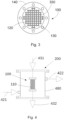
- Figure 1 shows an example of a reactor or reactor module 100 with a body 101 manufactured in a single part.
- the body 101 may comprise an array of parallel tubes 110 which may be linked to adjacent tubes 110 by fins 120. These fins 120 may be attached on the outer surfaces of the tubes 110 and may extend between each tube and another adjacent tube.
- the tubes 110 may also be attached together at their opposite ends to connectors 140, 150.
- the connectors 140, 150 may comprise holes 130 which may receive screws to fix the reactor 100 to an external element and also holes (not shown) in correspondence with the tubes which may be used as inlet/outlet for reactants and/or reaction products.
- the connectors 140, 150 may be also fixed by an adhesive or they may be welded to the external element. Any other suitable manner may be used to fix the reactor 100 to an external element.
- connector 140 may be used as inlet connector to feed the tubes 110 with reactants, e.g. carbon dioxide and hydrogen in Sabatier reaction, while connector 150 may be used as outlet connector to collect reaction products, e.g., methane and water in a Sabatier reaction.
- reactants e.g. carbon dioxide and hydrogen in Sabatier reaction
- connector 150 may be used as outlet connector to collect reaction products, e.g., methane and water in a Sabatier reaction.
- Such reactants may be previously heated in a preheater, e.g., a coil.
- Figure 2 shows in cross-section an array of parallel tubes 110 according to an example.
- fins attached on the outer surfaces of the tubes 110 and tubes internal diameters ⁇ are depicted.
- the distance between adjacent tubes may be of about 1.25 mm.
- the internal diameter ⁇ of the tubes 110 may be less than 4 mm, preferably between 1 - 3 mm and more preferably between 1 - 2.2 mm.
- This range has been found suitable for containing e.g. catalyst particles, but also for achieving a high gas-solid contact between the reactants and catalyst increasing the efficiency of the reactor 100.
- the parallel tubes 110 may contain a catalyst e.g. catalyst particles, to increase the reaction rate.
- a catalyst e.g. catalyst particles
- different catalysts may be used, e.g., in case of a Fischer-Tropsch reaction such catalyst particles may be based on Fe or Co, and in case of a Sabatier reaction those particles may be based on Ni or Ru.
- Catalyst particles may have a particle size between 0.25 - 0.30 mm and/or a density about 0.55 - 0.65 g/cm 3 .
- the reactor 100 may comprise a metallic filter (not shown) at the outlet of the tubes 110 to avoid catalyst loss.
- Figure 3 shows a top view of a reactor 100 comprising a connector 140 with holes 130 which may receive screws to fix the reactor 100 to an external element.
- the reactor 100 shown in Figure 3 may also comprise holes 330, in correspondence with the parallel tubes, which may be used as inlet for reactants in inlet connector 140.
- connector 150 placed at the opposite end of the parallel tubes may be used as outlet for reaction products.
- the reactor module 100 may further be part of an exemplary reaction unit 200 shown in Figure 4 .
- the reactor unit 200 may comprise a housing 480 for receiving at least a reactor module 100 and a plurality of anchoring elements (not shown) to receive, e.g., screws, for securing the reaction unit 200.
- the number of modules 100 may be modified depending on the targeted capacity production rate.
- the housing 480 should be provided an inlet 431 (indicated by an arrow) for feeding reaction products into the tubes 110 and an outlet 432 (also indicated by an arrow) for collecting reaction products.
- the reaction products may be firstly collected in individual reaction product collectors that may converge in a collective reaction product collector which may be connected to the reaction product outlet 432.
- the housing 480 may further comprise a thermal fluid inside the housing (not shown) in which the reactor modules 100, or at least the reactor tubes 110, may be immersed.
- a thermal fluid may be any fluid, e.g., thermal oil, which enables heat transfer and capable of being warmed or cooled depending on the requirements of each case. Therefore, a thermal fluid may be cooled to remove the heat released by the reaction or it may be heated to provide the required temperature for the reaction to happen.
- the thermal fluid may flow between parallel tubes 110 and all along their length, thus properly dissipating the heat caused by exothermic reactions, e.g., FTS reaction or Sabatier reaction, or to provide the required heat for, e.g., endothermic reactions
- exothermic reactions e.g., FTS reaction or Sabatier reaction
- the thermal fluid may be brought to a predetermined temperature, e.g., reaction temperature, before being circulated into the housing 480 to flow around the reactor and between the tubes 110.
- the fluid may exit the housing 480 and, before being re-circulated, the temperature of the fluid may be readjusted to previously predetermined temperature by, e.g., passing it through a thermal fluid preheater.
- This thermal fluid preheater may be e.g. a coil, and it may be located inside or outside the housing 480.
- the reactor unit 200 may comprise an inlet 421 and an outlet 422 (both indicated by an arrow) for the thermal fluid flow.
- the fluid may flow continuously and, consequently, an isothermal medium, e.g., at reaction temperature, which contributes to improve the reaction may be created.
- a pump (not shown) may be used to maintain the fluid flow at a desired rate, e.g., a rate that minimizes the gradient between the thermic fluid and the reactor output gases.
- Reaction unit 200 may additionally comprise a distribution chamber (not shown) for feeding the tubes 110 with e.g. gaseous reactants, in a homogeneous manner.
- reaction unit 200 may further comprise thermocouple nozzles (not shown) to connect thermocouples and measure temperature inside the housing 480. Additionally, the reaction unit 200 may further comprise a coil immersed in the thermic fluid so as to put the reactants into the reaction temperature by, e.g., warming it.
- the reaction unit 200 shown in Figure 4 may comprise 4 reaction modules, each of them having 388 parallel tubes. However, both the number of reactors and/or the number of parallel tubes may be determined, e.g., for a target production. In another example, the reaction unit may comprise 4 reactors, each them comprising 97 parallel tubes.
- the number of parallel tubes 110 may depend not only on the reaction and/or its variables but on the gas flow and the catalyst performance. For example, in a reactor where the tubes have an internal diameter of 1.75 mm and a length of 100 mm, and the catalyst density is 0.55 g/cm 3 , the number of tubes for different reactions and parameters is summarized below: Reaction T (°C) P (bar) Q (L/h) M (g) N FTS 220-280 10-20 24 2 16 FTS 220-280 10-20 90-100 8 64 Sabatier 280-450 5-25 200-250 6-6.2 68 Sabatier 280-450 5-25 3100-2900 80 388
- T is the reaction temperature range measured in degrees Celsius
- P is the gas line pressure measured in bars
- Q is the gas flow measured in liters per hour
- M is the total catalyst mass used in the reactor measured in grams
- N is the number of tubes in the reactor of each example.
- the reactor may be designed to have an elevated length to diameter ratio and thus a higher amount of tube surface in contact with a thermal fluid.
- the length of each tube may be 100 - 75 mm and the internal diameter may be 1.75 - 2.20 mm.
- the wall thickness of the parallel tubes 110 may be, e.g., about 0.4 - 0.5 mm, to further improve heat dissipation while maintaining mechanical strength to support the pressures.
- the reactor design parameters such as material selections, parallel tubes internal diameter, wall thickness, geometry; the number and distribution of tubes and fins, etc., may be selected according to requirements of each case taking into consideration the reactant media, catalyst particle size, the pressure, temperature, etc.
- the total length of the reactor may be of about 85 mm or about 91 mm, the total diameter of the reactor may be 35 mm and the distance between parallel tubes external parts may be of about 1.25 mm.
- a reactor according to any of the disclosed examples may be manufactured by an additive manufacturing technique.
- a reactor is manufactured by Selective Laser Melting (SLM).
- SLM Selective Laser Melting
- a 3D reactor design may be implemented in a computer with a commercially available 3D CAD tool.
- the 3D design may be sliced into several 2D layers which are stored in a file.
- the file may be loaded into preparation software which assigns parameters to be interpreted by additive manufacturing machines in order to manufacture the designed reactor.
- a metal powder layer may be spread 510 onto a substrate plate.
- Such metal powder may be e.g. stainless steel or FeCr alloy, and the thickness of each layer may be between 20 - 100 pm.
- the additive manufacturing machine and according to the loaded 2D file, may selectively melt 520 the layer of metal powder.
- the substrate plate may be lowered 530.
- Such manufacturing method allows obtaining a reactor with the required dimensions, suitable for enhancing both gas-solid contact and energy transfer while at the same time improves the output of the reactor and the required thermal stability to provide an effective reaction i.e. as an isothermal environment is achieved.
- the manufactured reactor is compact, stable and homogeneous and it has reliable mechanical properties. Moreover, as the reactor is free from joints, the risk of leaks is avoided.
Landscapes
- Chemical & Material Sciences (AREA)
- Organic Chemistry (AREA)
- Chemical Kinetics & Catalysis (AREA)
- Oil, Petroleum & Natural Gas (AREA)
- Engineering & Computer Science (AREA)
- General Chemical & Material Sciences (AREA)
- Devices And Processes Conducted In The Presence Of Fluids And Solid Particles (AREA)
Applications Claiming Priority (3)
| Application Number | Priority Date | Filing Date | Title |
|---|---|---|---|
| EP16382388 | 2016-08-04 | ||
| PCT/EP2017/069508 WO2018024764A1 (en) | 2016-08-04 | 2017-08-02 | Reactor for multiphasic reactions |
| EP17745190.3A EP3493898B1 (de) | 2016-08-04 | 2017-08-02 | Reaktionsanlage mit mikroreaktor |
Related Parent Applications (1)
| Application Number | Title | Priority Date | Filing Date |
|---|---|---|---|
| EP17745190.3A Division EP3493898B1 (de) | 2016-08-04 | 2017-08-02 | Reaktionsanlage mit mikroreaktor |
Publications (1)
| Publication Number | Publication Date |
|---|---|
| EP4481017A2 true EP4481017A2 (de) | 2024-12-25 |
Family
ID=56682074
Family Applications (2)
| Application Number | Title | Priority Date | Filing Date |
|---|---|---|---|
| EP17745190.3A Active EP3493898B1 (de) | 2016-08-04 | 2017-08-02 | Reaktionsanlage mit mikroreaktor |
| EP24205347.8A Withdrawn EP4481017A2 (de) | 2016-08-04 | 2017-08-02 | Reaktor für muiltiphasische reaktionen |
Family Applications Before (1)
| Application Number | Title | Priority Date | Filing Date |
|---|---|---|---|
| EP17745190.3A Active EP3493898B1 (de) | 2016-08-04 | 2017-08-02 | Reaktionsanlage mit mikroreaktor |
Country Status (3)
| Country | Link |
|---|---|
| EP (2) | EP3493898B1 (de) |
| ES (1) | ES3000885T3 (de) |
| WO (1) | WO2018024764A1 (de) |
Families Citing this family (2)
| Publication number | Priority date | Publication date | Assignee | Title |
|---|---|---|---|---|
| US12491484B2 (en) | 2021-01-15 | 2025-12-09 | CRI, hf | Reactor for synthesis of methanol or other products |
| WO2022153214A1 (en) * | 2021-01-15 | 2022-07-21 | Cri, Ehf | Methanol synthesis reactor |
Family Cites Families (4)
| Publication number | Priority date | Publication date | Assignee | Title |
|---|---|---|---|---|
| US7018589B1 (en) * | 2000-07-19 | 2006-03-28 | Symyx Technologies, Inc. | High pressure parallel reactor |
| NL1022756C2 (nl) * | 2003-02-21 | 2004-08-24 | Stichting Tech Wetenschapp | Microreactor voor snel parallel testen van katalysatoren. |
| US8614158B2 (en) * | 2008-02-29 | 2013-12-24 | Schlumberger Technology Corporation | Fischer-trospch and oxygenate synthesis catalyst activation/regeneration in a micro scale process |
| CA2888452A1 (en) * | 2012-10-16 | 2014-04-24 | The Regents Of The University Of Colorado, A Body Corporate | Catalyst support structure, catalyst including the structure, reactor including a catalyst, and methods of forming same |
-
2017
- 2017-08-02 EP EP17745190.3A patent/EP3493898B1/de active Active
- 2017-08-02 EP EP24205347.8A patent/EP4481017A2/de not_active Withdrawn
- 2017-08-02 ES ES17745190T patent/ES3000885T3/es active Active
- 2017-08-02 WO PCT/EP2017/069508 patent/WO2018024764A1/en not_active Ceased
Non-Patent Citations (1)
| Title |
|---|
| R K SHAH ET AL.: "The Manufacture of Micro Cross-Flow Heat Exchangers by Selective Laser Melting", PROCEEDINGS OF FIFTH INTERNATIONAL CONFERENCE ON ENHANCED, COMPACT AND ULTRA-COMPACT HEAT EXCHANGERS, September 2015 (2015-09-01) |
Also Published As
| Publication number | Publication date |
|---|---|
| EP3493898A1 (de) | 2019-06-12 |
| WO2018024764A1 (en) | 2018-02-08 |
| EP3493898B1 (de) | 2024-10-09 |
| ES3000885T3 (en) | 2025-03-03 |
Similar Documents
| Publication | Publication Date | Title |
|---|---|---|
| JP5086516B2 (ja) | 温度制御付きのマイクロチャンネル反応器 | |
| JP6120015B2 (ja) | マイクロチャネルリアクタ及び製作工程 | |
| EP1511561B1 (de) | Reaktor mit variierenden querschnitten und verfahren zur durchführung von reaktionen mit variierender lokaler kontaktzeit | |
| JP6283027B2 (ja) | 水蒸気改質器、モジュール、及び使用方法 | |
| US20130186607A1 (en) | Multi-Stream Microchannel Device | |
| CN112218717A (zh) | 用于通过电阻加热进行甲烷蒸汽重整的催化剂和系统、以及所述催化剂的制备 | |
| JP7644104B2 (ja) | メタノールからオンデマンド合成ガス | |
| JP2006514878A (ja) | 単段階プロセスチャネル内における平衡制限的化学反応を行うプロセス | |
| WO2007008581A2 (en) | Thermally coupled monolith reactor | |
| CN114466694A (zh) | 按需生产合成气 | |
| EP3493898B1 (de) | Reaktionsanlage mit mikroreaktor | |
| CN115532201A (zh) | 增强型微通道或中通道装置及其增材制造方法 | |
| US11465115B2 (en) | Reactor for carrying out a chemical balanced reaction | |
| US20100310436A1 (en) | Reactor and method for the production thereof | |
| JP2025061076A (ja) | ガス状生成物を得るための装置およびガス状生成物を得るための方法 | |
| WO2013108011A1 (en) | A compact catalytic reactor | |
| CN116056785A (zh) | 结构化催化剂 | |
| CN107999016A (zh) | 一种具有三维通道结构的反应器及其应用 | |
| JP2024545836A (ja) | 低減した熱応力によるプロセスインテンシブリアクタ | |
| JP7467192B2 (ja) | ガス状生成物を得るための装置およびガス状生成物を得るための方法 | |
| JP3251744U (ja) | ガス状生成物を得るための装置 | |
| KR102865264B1 (ko) | 마이크로 채널 반응기 | |
| JP7389686B2 (ja) | 流体間の熱交換ができる装置およびその製法 | |
| JP3251766U (ja) | ガス状生成物を得るための装置 | |
| JP2025533751A (ja) | チャネルアセンブリ |
Legal Events
| Date | Code | Title | Description |
|---|---|---|---|
| PUAI | Public reference made under article 153(3) epc to a published international application that has entered the european phase |
Free format text: ORIGINAL CODE: 0009012 |
|
| STAA | Information on the status of an ep patent application or granted ep patent |
Free format text: STATUS: THE APPLICATION HAS BEEN PUBLISHED |
|
| AC | Divisional application: reference to earlier application |
Ref document number: 3493898 Country of ref document: EP Kind code of ref document: P |
|
| AK | Designated contracting states |
Kind code of ref document: A2 Designated state(s): AL AT BE BG CH CY CZ DE DK EE ES FI FR GB GR HR HU IE IS IT LI LT LU LV MC MK MT NL NO PL PT RO RS SE SI SK SM TR |
|
| STAA | Information on the status of an ep patent application or granted ep patent |
Free format text: STATUS: THE APPLICATION HAS BEEN WITHDRAWN |
|
| 18W | Application withdrawn |
Effective date: 20250116 |