EP4480952A1 - Kristalline form einer stickstoffhaltigen heterocyclischen verbindung, herstellungsverfahren dafür und verwendung davon - Google Patents
Kristalline form einer stickstoffhaltigen heterocyclischen verbindung, herstellungsverfahren dafür und verwendung davon Download PDFInfo
- Publication number
- EP4480952A1 EP4480952A1 EP23755900.0A EP23755900A EP4480952A1 EP 4480952 A1 EP4480952 A1 EP 4480952A1 EP 23755900 A EP23755900 A EP 23755900A EP 4480952 A1 EP4480952 A1 EP 4480952A1
- Authority
- EP
- European Patent Office
- Prior art keywords
- crystal form
- follows
- compound
- ray powder
- crystal
- Prior art date
- Legal status (The legal status is an assumption and is not a legal conclusion. Google has not performed a legal analysis and makes no representation as to the accuracy of the status listed.)
- Pending
Links
Images







Classifications
-
- C—CHEMISTRY; METALLURGY
- C07—ORGANIC CHEMISTRY
- C07D—HETEROCYCLIC COMPOUNDS
- C07D471/00—Heterocyclic compounds containing nitrogen atoms as the only ring hetero atoms in the condensed system, at least one ring being a six-membered ring with one nitrogen atom, not provided for by groups C07D451/00 - C07D463/00
- C07D471/02—Heterocyclic compounds containing nitrogen atoms as the only ring hetero atoms in the condensed system, at least one ring being a six-membered ring with one nitrogen atom, not provided for by groups C07D451/00 - C07D463/00 in which the condensed system contains two hetero rings
- C07D471/04—Ortho-condensed systems
-
- A—HUMAN NECESSITIES
- A61—MEDICAL OR VETERINARY SCIENCE; HYGIENE
- A61K—PREPARATIONS FOR MEDICAL, DENTAL OR TOILETRY PURPOSES
- A61K31/00—Medicinal preparations containing organic active ingredients
- A61K31/33—Heterocyclic compounds
- A61K31/395—Heterocyclic compounds having nitrogen as a ring hetero atom, e.g. guanethidine or rifamycins
- A61K31/495—Heterocyclic compounds having nitrogen as a ring hetero atom, e.g. guanethidine or rifamycins having six-membered rings with two or more nitrogen atoms as the only ring heteroatoms, e.g. piperazine or tetrazines
- A61K31/505—Pyrimidines; Hydrogenated pyrimidines, e.g. trimethoprim
- A61K31/517—Pyrimidines; Hydrogenated pyrimidines, e.g. trimethoprim ortho- or peri-condensed with carbocyclic ring systems, e.g. quinazoline, perimidine
-
- A—HUMAN NECESSITIES
- A61—MEDICAL OR VETERINARY SCIENCE; HYGIENE
- A61P—SPECIFIC THERAPEUTIC ACTIVITY OF CHEMICAL COMPOUNDS OR MEDICINAL PREPARATIONS
- A61P35/00—Antineoplastic agents
-
- C—CHEMISTRY; METALLURGY
- C07—ORGANIC CHEMISTRY
- C07D—HETEROCYCLIC COMPOUNDS
- C07D487/00—Heterocyclic compounds containing nitrogen atoms as the only ring hetero atoms in the condensed system, not provided for by groups C07D451/00 - C07D477/00
- C07D487/02—Heterocyclic compounds containing nitrogen atoms as the only ring hetero atoms in the condensed system, not provided for by groups C07D451/00 - C07D477/00 in which the condensed system contains two hetero rings
- C07D487/04—Ortho-condensed systems
-
- C—CHEMISTRY; METALLURGY
- C07—ORGANIC CHEMISTRY
- C07B—GENERAL METHODS OF ORGANIC CHEMISTRY; APPARATUS THEREFOR
- C07B2200/00—Indexing scheme relating to specific properties of organic compounds
- C07B2200/13—Crystalline forms, e.g. polymorphs
-
- Y—GENERAL TAGGING OF NEW TECHNOLOGICAL DEVELOPMENTS; GENERAL TAGGING OF CROSS-SECTIONAL TECHNOLOGIES SPANNING OVER SEVERAL SECTIONS OF THE IPC; TECHNICAL SUBJECTS COVERED BY FORMER USPC CROSS-REFERENCE ART COLLECTIONS [XRACs] AND DIGESTS
- Y02—TECHNOLOGIES OR APPLICATIONS FOR MITIGATION OR ADAPTATION AGAINST CLIMATE CHANGE
- Y02P—CLIMATE CHANGE MITIGATION TECHNOLOGIES IN THE PRODUCTION OR PROCESSING OF GOODS
- Y02P20/00—Technologies relating to chemical industry
- Y02P20/50—Improvements relating to the production of bulk chemicals
- Y02P20/55—Design of synthesis routes, e.g. reducing the use of auxiliary or protecting groups
Definitions
- the present disclosure relates to a nitrogen-containing heterocyclic compound, a preparation method therefor, and a use thereof.
- a nitrogen-containing heterocyclic compound designated as compound 1, having the chemical name ( R , Z )- N -(4-((4-([1,2,4]triazolo[1,5- a ]pyridin-7-yloxy)-3-methylphenyl)amino)-7-ethoxyquinazolin-6-yl)-2-fluoro-3-(1-methylpyrrolidin-2-yl)acrylamide, with a molecular formula of C 31 H 31 FN 8 O 3 , and having the structural formula shown below:
- CN109422755 and WO2019042409 disclose this nitrogen-containing heterocyclic compound and its preparation method.
- the compound 1 obtained by the method disclosed in the patent is a yellow, foamy solid with undesirable solid-state properties. It also shows that compound 1 is a small molecule inhibitor that either weakens the EGFR kinase inhibitory activity or is selective for the ErbB2 target.
- the technical problem to be solved by the present disclosure is to overcome the defects in the prior art of the undesirable solid-state properties of ( R,Z )- N -(4-((4-([1,2,4]triazolo[1,5- a ]pyridin-7-yloxy)-3-methylphenyl)amino)-7-ethoxyquinazolin-6-yl)-2-fluoro-3-(1-methylpyrrolidin-2-yl)acrylamide, and to provide a crystal form of this compound, a preparation method therefor, and a use thereof, wherein the crystal form exhibits high stability and good bioavailability.
- the present disclosure provides a crystal form C of compound 1; the crystal form C has an X-ray powder diffraction pattern expressed in 2 ⁇ angles comprising diffraction peaks at positions as follows: 5.32 ⁇ 0.2°, 8.42 ⁇ 0.2°, 10.62 ⁇ 0.2°, 11.48 ⁇ 0.2°, 13.46 ⁇ 0.2°, 16.14 ⁇ 0.2°, 16.57 ⁇ 0.2°, 16.96 ⁇ 0.2°, 17.26 ⁇ 0.2°, and 18.11 ⁇ 0.2° using Cu-K ⁇ radiation.
- the X-ray powder diffraction pattern of the crystal form C expressed in 2 ⁇ angles further comprises diffraction peaks at one or more positions as follows: 19.42 ⁇ 0.2°, 21.26 ⁇ 0.2°, 22.11 ⁇ 0.2°, 22.73 ⁇ 0.2°, 23.05 ⁇ 0.2°, 23.45 ⁇ 0.2°, 25.98 ⁇ 0.2°, 26.71 ⁇ 0.2°, and 26.89 ⁇ 0.2°;
- the X-ray powder diffraction pattern of the crystal form C expressed in 2 ⁇ angles preferably further comprises diffraction peaks at one or more positions as follows: 12.23 ⁇ 0.2°, 13.00 ⁇ 0.2°, 14.76 ⁇ 0.2°, 20.33 ⁇ 0.2°, 24.89 ⁇ 0.2°, 28.50 ⁇ 0.2°, 31.74 ⁇ 0.2°, 34.46 ⁇ 0.2°, 35.94 ⁇ 0.2°, and 37.67 ⁇ 0.2°.
- the X-ray powder diffraction pattern of the crystal form C expressed in 2 ⁇ angles comprises diffraction peaks as shown in the table below: Diffraction angle (°2 ⁇ ) d-Spacing ( ⁇ ) Relative intensity (%) 5.32 16.62 74.21 8.42 10.51 16.85 10.62 8.33 33.15 11.48 7.71 76.93 12.23 7.24 7.17 13.00 6.81 8.22 13.46 6.58 26.98 14.76 6.00 8.36 16.14 5.49 28.59 16.57 5.35 78.16 16.96 5.23 58.96 17.26 5.14 55.51 18.11 4.90 100.00 19.42 4.57 24.10 20.33 4.37 10.44 21.26 4.18 65.07 22.11 4.02 44.06 22.73 3.91 22.24 23.05 3.86 68.68 23.45 3.79 26.23 24.89 3.58 10.74 25.98 3.43 23.94 26.71 3.34 38.70 26.89 3.32 55.25 28.50 3.13 18.99 31.74 2.82 7.39
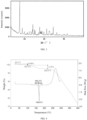
- the X-ray powder diffraction pattern of the crystal form C expressed in 2 ⁇ angles is basically as shown in FIG. 5 .
- the crystal form C has a differential scanning calorimetry pattern comprising an endothermic peak at 213.3°C (onset temperature).
- the differential scanning calorimetry pattern of the crystal form C comprises an endothermic peak at 213.3°C (onset temperature), with a heat of fusion of 95.16 J/g.
- the differential scanning calorimetry pattern of the crystal form C is basically as shown in FIG. 6 .
- the crystal form C has a thermogravimetric analysis pattern showing a weight loss of 2.1% when heated to 200°C and an additional weight loss of 1.5% when further heated to 230°C.
- thermogravimetric analysis pattern of the crystal form C is basically as shown in FIG. 6 .
- the present disclosure further provides a preparation method for the crystal form C, which follows scheme 1 or scheme 2;
- the scheme 1 comprises the following step: obtaining the crystal form C of the compound 1 by performing a crystal transformation on a suspension of compound 1 in a solvent;
- the volume ratio of acetone to water is between 986:14 and 950:50.
- the crystal transformation is performed at a temperature of 20°C to 30°C (room temperature).
- the crystal transformation is performed at a temperature of 20°C to 50°C, such as 20°C to 30°C (room temperature).
- the mass-to-volume ratio of the compound 1 to the solvent is 100 mg:2 mL.
- the crystallization is performed at a temperature of 50°C to 60°C, preferably 55°C.
- the present disclosure further provides a pharmaceutical composition comprising the aforementioned crystal form C and a pharmaceutical excipient.
- the present disclosure further provides a use of the aforementioned crystal form C in the preparation of a medicament, and the medicament may be used for treating cancer and/or diseases treated by inhibiting EGFR and/or ErbB2 receptor tyrosine kinases, such as diseases treated by selectively inhibiting the ErbB2 receptor tyrosine kinase;
- the cancer and diseases may be breast cancer, gastric cancer, ovarian cancer, lung cancer, etc.;
- the crystal form C may be used in a therapeutically effective amount.
- the present disclosure further provides a use of the aforementioned crystal form C in the preparation of an EGFR and/or ErbB2 receptor tyrosine kinase inhibitor.
- the EGFR and/or ErbB2 receptor tyrosine kinase inhibitor may be a selective ErbB2 receptor tyrosine kinase inhibitor.
- room temperature refers to 20°C to 30°C.
- the reagents and raw materials used in the present disclosure are commercially available.
- the positive and progressive effect of the present disclosure lies in overcoming the shortcomings of the undesirable solid-state properties of ( R , Z )- N (4-((4-([1,2,4]triazolo[1,5- a ]pyridin-7-yloxy)-3-methylphenyl)amino)-7-ethoxyquinazolin-6-yl)-2-fluoro-3-(1-methylpyrrolidin-2-yl)acrylamide in the prior art, by providing a crystal form of the compound with high stability and good bioavailability.
- the testing conditions are as follows:
- the X-ray powder diffraction patterns described in the present disclosure were collected using the PANalytical Empyrean X-ray powder diffractometer and the PANalytical X'Pert 3 X-ray powder diffractometer.
- the differential scanning calorimetry (DSC) data described in the present disclosure were obtained using the TA Instruments Q200 and TA Instruments Q2000 DSC instruments.
- the instrument control software used was Q Series, and the analysis software was Universal Analysis.
- 1 to 10 milligrams of the sample was placed in a lidded aluminum crucible (unless otherwise specified).
- the sample was heated from room temperature to 300°C at a rate of 10°C/min under a dry nitrogen atmosphere with a flow rate of 50 mL/min.
- the TA software recorded the heat changes of the sample during the heating process. In the present disclosure, the melting point was reported based on the onset temperature.
- thermogravimetric analysis (TGA) data described in the present disclosure were obtained using the TA Instruments Q500 and TA Instruments Q5000 TGA instruments.
- the instrument control software used was Q Series, and the analysis software was Universal Analysis.
- 2 to 15 mg of the sample was placed in a platinum crucible.
- the sample was heated from room temperature to 400°C at a rate of 10°C/min under a dry nitrogen atmosphere with a flow rate of 50 mL/min.
- the TA software recorded the weight changes of the sample during the heating process.
- Table 1 XRPD data of crystal form A Diffraction angle (°2 ⁇ ) d-Spacing ( ⁇ ) Relative intensity (%) 5.97 14.80 100.00 9.62 9.19 1.59 11.62 7.62 3.74 11.92 7.42 1.65 12.27 7.22 4.98 13.07 6.78 2.48 13.30 6.66 5.55 13.71 6.46 3.11 14.31 6.19 9.01 14.88 5.95 1.18 15.39 5.76 0.72 16.08 5.51 4.19 16.60 5.34 4.21 17.93 4.95 3.09 18.37 4.83 0.75 19.22 4.62 0.71 19.66 4.52 0.61 20.24 4.39 4.13 21.28 4.17 1.40 21.77 4.08 1.81 22.89 3.89 1.33 23.47 3.79 1.38 24.50 3.63 1.21 25.25 3.53 2.72 25.79 3.45 1.26 26.46 3.37 1.16 28.25 3.16 0.61 31.75 2.82 0.71
- Table 2 XRPD data of crystal form B Diffraction angle (°2 ⁇ ) d-Spacing ( ⁇ ) Relative intensity (%) 7.53 11.75 100.00 8.83 10.02 18.57 9.86 8.97 8.55 11.14 7.94 2.90 11.63 7.61 7.78 12.72 6.96 10.12 13.69 6.47 7.91 13.98 6.33 15.12 14.20 6.24 30.79 15.05 5.89 15.58 15.44 5.74 12.55 17.13 5.18 7.48 17.68 5.02 23.85 17.91 4.95 8.24 18.13 4.89 10.52 18.38 4.83 10.03 18.60 4.77 7.47 18.86 4.70 12.63 19.80 4.48 9.58 21.24 4.18 19.45 22.44 3.96 12.75 22.78 3.90 9.63 23.52 3.78 4.15 24.07 3.70 6.64 24.54 3.63 25.40 26.35 3.38 9.61 27.44 3.25 2.89 29.97 2.98 2.87 31.76 2.82 5.20
- Table 3 XRPD data of crystal form C Diffraction angle (°2 ⁇ ) d-Spacing ( ⁇ ) Relative intensity (%) 5.32 16.62 74.21 8.42 10.51 16.85 10.62 8.33 33.15 11.48 7.71 76.93 12.23 7.24 7.17 13.00 6.81 8.22 13.46 6.58 26.98 14.76 6.00 8.36 16.14 5.49 28.59 16.57 5.35 78.16 16.96 5.23 58.96 17.26 5.14 55.51 18.11 4.90 100.00 19.42 4.57 24.10 20.33 4.37 10.44 21.26 4.18 65.07 22.11 4.02 44.06 22.73 3.91 22.24 23.05 3.86 68.68 23.45 3.79 26.23 24.89 3.58 10.74 25.98 3.43 23.94 26.71 3.34 38.70 26.89 3.32 55.25 28.50 3.13 18.99 31.74 2.82 7.39 34.46 2.60 1.90 35.94 2.50 1.47 37.67 2.39 3.97
- Table 5 XRPD data of crystal form E Diffraction angle (°2 ⁇ ) d-Spacing ( ⁇ ) Relative intensity (%) 6.07 14.57 91.77 8.97 9.85 100.00 9.32 9.49 76.64 9.87 8.96 18.12 13.05 6.78 44.04 13.27 6.67 31.10 14.09 6.28 29.37 15.78 5.62 38.84 16.98 5.22 72.71 18.27 4.86 27.83 18.47 4.80 33.43 21.26 4.18 19.00 22.41 3.97 18.53 23.60 3.77 11.44 24.45 3.64 11.92 25.20 3.53 11.11 26.22 3.40 10.95 28.10 3.18 10.27 30.28 2.95 3.01 31.70 2.82 4.98
- Table 8 XRPD data of crystal form H Diffraction angle (°2 ⁇ ) d-Spacing ( ⁇ ) Relative intensity (%) 5.41 16.35 100.00 6.13 14.42 35.95 7.92 11.16 35.68 11.19 7.90 13.58 12.26 7.22 22.74 21.91 4.06 12.38
- Table 10 XRPD data of crystal form J Diffraction angle (°2 ⁇ ) d-Spacing ( ⁇ ) Relative intensity (%) 5.34 16.54 100.00 6.15 14.38 28.86 8.1 10.91 2.02 10.68 8.29 5.66 11.1 7.97 6.01 12.29 7.20 3.00 14.53 6.10 1.00 15.13 5.85 0.66 16.02 5.53 3.11 17.16 5.17 10.50 18.31 4.85 1.88 19.07 4.65 0.42 20.16 4.40 0.97 21.63 4.11 5.22 22.32 3.98 2.70 23.32 3.81 6.62 26.85 3.32 2.86 27.55 3.24 1.10 32.46 2.76 0.93
- Table 11 XRPD data of crystal form K Diffraction angle (°2 ⁇ ) d-Spacing ( ⁇ ) Relative intensity (%) 6.63 13.33 47.55 7.49 11.81 28.07 9.26 9.55 100.00 12.54 7.06 29.34 13.28 6.67 51.57 13.61 6.51 0.36 13.92 6.36 54.12 14.97 5.92 28.88 17.29 5.13 61.37 19.41 4.57 11.55 21.93 4.05 20.82 23.25 3.83 8.93 25.69 3.47 31.10 26.56 3.36 24.04 28.14 3.17 13.70
- Example 5 The crystal form E obtained in Example 5 was purged with nitrogen gas for ten minutes.
- the X-ray powder diffraction data of the resulting solid are shown in Table 12, and the XRPD pattern thereof is shown in FIG. 20 .
- the results confirm that the resulting solid product is crystal form L as described in the present disclosure.
- Table 12 XRPD data of crystal form L Diffraction angle (°2 ⁇ ) d-Spacing ( ⁇ ) Relative intensity (%) 6.02 14.69 61.59 6.25 14.15 42.99 8.39 10.54 9.07 8.99 9.84 100.00 9.38 9.43 30.03 9.72 9.10 22.68 13.29 6.66 73.09 13.62 6.50 67.03 14.34 6.18 17.74 14.98 5.91 24.10 15.29 5.79 27.64 15.7 5.65 32.71 16.27 5.45 17.59 17.36 5.11 45.43 17.67 5.02 58.37 18.21 4.87 37.98 18.95 4.68 29.36 20.33 4.37 17.38 21.34 4.16 27.50 21.78 4.08 27.23 22.75 3.91 20.74 24.38 3.65 35.96 25.45 3.50 44.63 26.44 3.37 23.19 27.14 3.29 31.70 27.82 3.21 31.52
- Table 13 XRPD data of crystal form M Diffraction angle (°2 ⁇ ) d-Spacing ( ⁇ ) Relative intensity (%) 5.52 16.00 100.00 6.62 13.36 7.21 7.96 11.10 13.70 9.41 9.40 87.09 13.36 6.63 24.72 14.68 6.04 29.13 15.39 5.76 8.21 17.93 4.95 14.08 18.70 4.75 16.58 20.51 4.33 2.57 24.17 3.68 9.22 25.75 3.46 20.55 26.11 3.41 11.39 26.50 3.36 13.80 28.31 3.15 7.97 29.67 3.01 2.84
- Example 2 Suspension competition test among crystal forms C/A/G/H/I/M/E
- crystal form C To assess the physicochemical stability of crystal form C, approximately 20 mg of the crystal form C of compound 1 was weighed and placed in a sealed setting at 60°C for one day, and in an open setting (sealed with a sealing film, with several small holes punctured in the sealing film) at 25°C/60% RH or 40°C/75% RH for one week, respectively.
- the solid samples after being placed under different conditions were respectively tested for purity by UPLC to evaluate chemical stability, and the crystal form was tested by XRPD to evaluate physical stability.
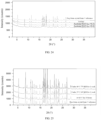
- the evaluation results, summarized in Table 15, indicate that crystal form C did not undergo any crystal transformation under all three test conditions, as confirmed by the XRPD data shown in FIG. 25 .
- Table 16 Summary of impurities in samples of crystal form C for stability testing Sample RRT 0.63 0.67 0.95 1.00 1.03 1.08 Initial sample 0.18% 0.18% 0.08% 99.31% 0.10% 0.15% 60°C 0.18% 0.18% 0.08% 99.29% 0.12% 0.15% 25°C/60%RH 0.18% 0.18% 0.08% 99.29% 0.12% 0.15% 40°C/75%RH 0.18% 0.18% 0.08% 99.29% 0.12% 0.15%
- SD rats were intragastrically administered samples of different crystal forms.
- Blood samples (0.4 mL) were respectively collected from the venous plexus of the rat's fundus oculi at various time points: before administration and at 5, 15, 30, 60, 90, 120, 240, 360, 480, 600, and 1440 minutes after administration.
- the blood samples were centrifuged at 8000 rpm for 5 minutes to separate the upper plasma.
- 50 ⁇ L of plasma sample was added with 300 ⁇ L of acetonitrile containing an internal standard (Propranolol, 25 ng/mL) to precipitate proteins.
- the mixture was vortexed for 10 minutes, and centrifuged at 6000 g and 4°C for 20 minutes.
- the supernatant (20 ⁇ L) was taken and diluted with 80 ⁇ L of ultrapure water. After centrifugation, 80 ⁇ L of the supernatant was taken for injection into a 96-well plate.
- the plasma drug concentration was determined using LC/MS/MS, and the corresponding pharmacokinetic parameters were calculated, as shown in Table 17.
- Table 17 Pharmacokinetic parameters after intragastric administration of different crystal forms Parameter Amorphous form Crystal form A Crystal form B Crystal form C Crystal form M Dosage mg/kg 8.00 8.00 8.00 8.00 Cmax ng/mL 800 753 599 1165 489 Tmax h 6.00 2.00 6.00 2.00 2.00 AUClast (h)*(ng/mL) 6536 4789 5904 6863 2870 AUCextra (h)*(ng/mL) 0.758 0.288 1.01 0.451 0.169 AUCtot (h)*(ng/mL) 6586 4802 5965 6894 2875 t 1/2 h 3.03 2.74 3.34 3.04 2.55 MRT h 6.52 4.74 6.07 4.63 4.59
- a 10 mM stock solution of the test compound (crystal form C prepared in Example 3) was serially diluted in DMSO in a 96-well compound plate to obtain a compound solution with an initial concentration of 100 ⁇ . This initial concentration was then used as the first concentration, and further diluted with DMSO in a 3-fold serial dilution to dilute a total of 10 concentrations. Subsequently, 1 ⁇ L of the serially diluted solution was added to 19 ⁇ L of 1 ⁇ reaction buffer to prepare the 5 ⁇ compound solution for later use. Then, 2 ⁇ L of the 5 ⁇ compound solution was transferred from the 96-well plate into a 384-well plate.
- the final concentration of EGFR kinase (Carna 08-016) was 0.06 units/ ⁇ L, with an ATP final concentration of 1.65 ⁇ M.
- 4 ⁇ L of the 2.5 ⁇ enzyme/substrate mixture was added to the 384-well plate, followed by incubation at room temperature for 5 minutes. Then, 4 ⁇ L of the 2.5 ⁇ ATP solution was added to each well, and the reaction was carried out at room temperature for 30 minutes.
- the reaction termination stage a 2 ⁇ mixture of TK Antibody-Eu(K) and Sa-XL665 was prepared using HTRF Detection Buffer, with 5 ⁇ L of TK Antibody-Eu(K) added per well.
Landscapes
- Chemical & Material Sciences (AREA)
- Organic Chemistry (AREA)
- Health & Medical Sciences (AREA)
- Animal Behavior & Ethology (AREA)
- Life Sciences & Earth Sciences (AREA)
- Pharmacology & Pharmacy (AREA)
- General Health & Medical Sciences (AREA)
- Public Health (AREA)
- Veterinary Medicine (AREA)
- Medicinal Chemistry (AREA)
- Chemical Kinetics & Catalysis (AREA)
- General Chemical & Material Sciences (AREA)
- Nuclear Medicine, Radiotherapy & Molecular Imaging (AREA)
- Epidemiology (AREA)
- Pharmaceuticals Containing Other Organic And Inorganic Compounds (AREA)
Applications Claiming Priority (2)
| Application Number | Priority Date | Filing Date | Title |
|---|---|---|---|
| CN202210147592 | 2022-02-17 | ||
| PCT/CN2023/076920 WO2023155899A1 (zh) | 2022-02-17 | 2023-02-17 | 一种含氮杂环化合物的晶型、制备方法及应用 |
Publications (2)
| Publication Number | Publication Date |
|---|---|
| EP4480952A1 true EP4480952A1 (de) | 2024-12-25 |
| EP4480952A4 EP4480952A4 (de) | 2026-03-25 |
Family
ID=87577636
Family Applications (1)
| Application Number | Title | Priority Date | Filing Date |
|---|---|---|---|
| EP23755900.0A Pending EP4480952A4 (de) | 2022-02-17 | 2023-02-17 | Kristalline form einer stickstoffhaltigen heterocyclischen verbindung, herstellungsverfahren dafür und verwendung davon |
Country Status (5)
| Country | Link |
|---|---|
| US (1) | US20250163053A1 (de) |
| EP (1) | EP4480952A4 (de) |
| JP (1) | JP2025505801A (de) |
| CN (1) | CN116606289B (de) |
| WO (1) | WO2023155899A1 (de) |
Family Cites Families (2)
| Publication number | Priority date | Publication date | Assignee | Title |
|---|---|---|---|---|
| CN109422755B (zh) | 2017-09-01 | 2023-07-04 | 上海医药集团股份有限公司 | 一种含氮杂环化合物、制备方法、中间体、组合物和应用 |
| WO2022206929A1 (zh) * | 2021-04-01 | 2022-10-06 | 上海医药集团股份有限公司 | 一种化合物在制备靶向ErbB2突变体的抑制药物中的应用 |
-
2023
- 2023-02-17 WO PCT/CN2023/076920 patent/WO2023155899A1/zh not_active Ceased
- 2023-02-17 US US18/839,040 patent/US20250163053A1/en active Pending
- 2023-02-17 JP JP2024548614A patent/JP2025505801A/ja active Pending
- 2023-02-17 EP EP23755900.0A patent/EP4480952A4/de active Pending
- 2023-02-17 CN CN202310131494.6A patent/CN116606289B/zh active Active
Also Published As
| Publication number | Publication date |
|---|---|
| CN116606289B (zh) | 2026-02-24 |
| EP4480952A4 (de) | 2026-03-25 |
| CN116606289A (zh) | 2023-08-18 |
| JP2025505801A (ja) | 2025-02-28 |
| WO2023155899A1 (zh) | 2023-08-24 |
| US20250163053A1 (en) | 2025-05-22 |
Similar Documents
| Publication | Publication Date | Title |
|---|---|---|
| AU2020220512B2 (en) | FGFR inhibitor compound in solid form and preparation method therefor | |
| US9193730B2 (en) | Short-acting benzodiazepine salts and their polymorphic forms | |
| WO2017219948A1 (en) | Crystalline forms of triazolopyrimidine compound | |
| WO2019191620A1 (en) | Crystalline forms of modulators of cftr | |
| EP3592745B1 (de) | Als wee-1-kinase-inhibitoren nützliche pyrimidopyrimidinone | |
| US20250263420A1 (en) | Method for synthesizing furoimidazopyridine compound, polymorphic substance and polymorphic substance of salt | |
| EP3317270B1 (de) | (4-((3r,4r) -3-methoxytetrahydro-pyran-4-ylamino ) piperidin-1-yl)-(5-methyl-6-(( (2r,6s) -6-(p-tolyl) tetrahydro-2 h-pyran-2-yl) methylamino) pyrimidin-4 yl) methanon-citrat | |
| US20240199585A1 (en) | Solid forms of (3r)-n-[2-cyano-4-fluoro-3-(3-methyl-4-oxo-quinazolin-6-yl)oxy-phenyl]-3-fluoro-pyrrolidine-1-sulfonamide | |
| EP3805229B1 (de) | Salz einer kondensierten ringpyrimidinverbindung, ihre kristallform und verfahren zu ihrer herstellung und ihre verwendung | |
| EP4624474A1 (de) | Pharmazeutisch akzeptables salz einer stickstoffhaltigen heterocyclischen verbindung, kristalline form davon und herstellungsverfahren dafür | |
| CA2393720C (en) | Crystalline 2,5-dione-3-(1-methyl-1h-indol-3-yl)-4-[1-(pyridin-2-ylmethyl)piperidin-4-yl]-1h-indol-3-yl]-1h-pyrrole mono-hydrochloride | |
| US20250026773A1 (en) | Mono-p-toluenesulfonate of axl kinase inhibitor and crystal form thereof | |
| US20250163053A1 (en) | Crystalline form of nitrogen-containing heterocyclic compound, preparation method therefor and use thereof | |
| EP3461823B1 (de) | Pexidartinib-hydrochloridkristallformen, herstellungsverfahren und verwendung davon | |
| WO2011027324A1 (en) | Polymorphic forms of atazanavir sulfate | |
| CN110291071B (zh) | Sb-939的盐的晶型及其制备方法和用途 | |
| CN115894440B (zh) | 奥布替尼化合物的晶型及其制备方法 | |
| EP4700027A1 (de) | Kristalline form einer stickstoffhaltigen tetracyclischen verbindung und herstellungsverfahren dafür | |
| HK40112199A (en) | Method for synthesizing furoimidazopyridine compound, polymorphic substance and polymorphic substance of salt | |
| EP1841429B1 (de) | Solide formen eines chemokin-rezeptorantagonisten und anwendungsverfahren dafür | |
| HK40112200A (en) | Method for synthesizing furoimidazopyridine compound, polymorphic substance and polymorphic substance of salt | |
| CN119384423A (zh) | 4-[(5-氯吡啶-2-基)甲氧基]-1-[3-(丙烷-2-基)-1H,2H,3H,4H,5H-[1,4]二氮杂环庚三烯并[1,7-a]吲哚-9-基]-1,2-二氢吡啶-2-酮及其盐的晶型、制备方法及其用途 | |
| CN114591260A (zh) | 一种莫沙必利有机酸盐 | |
| CN120607535A (zh) | 一种kif18a抑制剂的可药用盐、晶型及其制备方法和应用 | |
| HK40040064A (en) | Salt of fused ring pyrimidine compound, crystal form thereof and preparation method therefor and use thereof |
Legal Events
| Date | Code | Title | Description |
|---|---|---|---|
| STAA | Information on the status of an ep patent application or granted ep patent |
Free format text: STATUS: THE INTERNATIONAL PUBLICATION HAS BEEN MADE |
|
| PUAI | Public reference made under article 153(3) epc to a published international application that has entered the european phase |
Free format text: ORIGINAL CODE: 0009012 |
|
| STAA | Information on the status of an ep patent application or granted ep patent |
Free format text: STATUS: REQUEST FOR EXAMINATION WAS MADE |
|
| 17P | Request for examination filed |
Effective date: 20240916 |
|
| AK | Designated contracting states |
Kind code of ref document: A1 Designated state(s): AL AT BE BG CH CY CZ DE DK EE ES FI FR GB GR HR HU IE IS IT LI LT LU LV MC ME MK MT NL NO PL PT RO RS SE SI SK SM TR |
|
| DAV | Request for validation of the european patent (deleted) | ||
| DAX | Request for extension of the european patent (deleted) | ||
| A4 | Supplementary search report drawn up and despatched |
Effective date: 20260225 |
|
| RIC1 | Information provided on ipc code assigned before grant |
Ipc: C07D 471/04 20060101AFI20260219BHEP Ipc: C07D 487/04 20060101ALI20260219BHEP Ipc: A61K 31/519 20060101ALI20260219BHEP Ipc: A61P 35/00 20060101ALI20260219BHEP |