EP4478445A1 - Elektrode für eine wiederaufladbare batterie und elektrodenanordnung und wiederaufladbare lithiumbatterie damit - Google Patents
Elektrode für eine wiederaufladbare batterie und elektrodenanordnung und wiederaufladbare lithiumbatterie damit Download PDFInfo
- Publication number
- EP4478445A1 EP4478445A1 EP24181388.0A EP24181388A EP4478445A1 EP 4478445 A1 EP4478445 A1 EP 4478445A1 EP 24181388 A EP24181388 A EP 24181388A EP 4478445 A1 EP4478445 A1 EP 4478445A1
- Authority
- EP
- European Patent Office
- Prior art keywords
- electrode
- chemical formula
- active material
- functional layer
- substrate
- Prior art date
- Legal status (The legal status is an assumption and is not a legal conclusion. Google has not performed a legal analysis and makes no representation as to the accuracy of the status listed.)
- Pending
Links
Images


Classifications
-
- H—ELECTRICITY
- H01—ELECTRIC ELEMENTS
- H01M—PROCESSES OR MEANS, e.g. BATTERIES, FOR THE DIRECT CONVERSION OF CHEMICAL ENERGY INTO ELECTRICAL ENERGY
- H01M4/00—Electrodes
- H01M4/02—Electrodes composed of, or comprising, active material
- H01M4/62—Selection of inactive substances as ingredients for active masses, e.g. binders, fillers
- H01M4/628—Inhibitors, e.g. gassing inhibitors, corrosion inhibitors
-
- H—ELECTRICITY
- H01—ELECTRIC ELEMENTS
- H01M—PROCESSES OR MEANS, e.g. BATTERIES, FOR THE DIRECT CONVERSION OF CHEMICAL ENERGY INTO ELECTRICAL ENERGY
- H01M4/00—Electrodes
- H01M4/02—Electrodes composed of, or comprising, active material
- H01M4/13—Electrodes for accumulators with non-aqueous electrolyte, e.g. for lithium-accumulators; Processes of manufacture thereof
-
- H—ELECTRICITY
- H01—ELECTRIC ELEMENTS
- H01M—PROCESSES OR MEANS, e.g. BATTERIES, FOR THE DIRECT CONVERSION OF CHEMICAL ENERGY INTO ELECTRICAL ENERGY
- H01M10/00—Secondary cells; Manufacture thereof
- H01M10/05—Accumulators with non-aqueous electrolyte
- H01M10/052—Li-accumulators
-
- H—ELECTRICITY
- H01—ELECTRIC ELEMENTS
- H01M—PROCESSES OR MEANS, e.g. BATTERIES, FOR THE DIRECT CONVERSION OF CHEMICAL ENERGY INTO ELECTRICAL ENERGY
- H01M4/00—Electrodes
- H01M4/02—Electrodes composed of, or comprising, active material
- H01M4/13—Electrodes for accumulators with non-aqueous electrolyte, e.g. for lithium-accumulators; Processes of manufacture thereof
- H01M4/131—Electrodes based on mixed oxides or hydroxides, or on mixtures of oxides or hydroxides, e.g. LiCoOx
-
- H—ELECTRICITY
- H01—ELECTRIC ELEMENTS
- H01M—PROCESSES OR MEANS, e.g. BATTERIES, FOR THE DIRECT CONVERSION OF CHEMICAL ENERGY INTO ELECTRICAL ENERGY
- H01M4/00—Electrodes
- H01M4/02—Electrodes composed of, or comprising, active material
- H01M4/36—Selection of substances as active materials, active masses, active liquids
- H01M4/362—Composites
- H01M4/366—Composites as layered products
-
- H—ELECTRICITY
- H01—ELECTRIC ELEMENTS
- H01M—PROCESSES OR MEANS, e.g. BATTERIES, FOR THE DIRECT CONVERSION OF CHEMICAL ENERGY INTO ELECTRICAL ENERGY
- H01M4/00—Electrodes
- H01M4/02—Electrodes composed of, or comprising, active material
- H01M4/36—Selection of substances as active materials, active masses, active liquids
- H01M4/48—Selection of substances as active materials, active masses, active liquids of inorganic oxides or hydroxides
- H01M4/50—Selection of substances as active materials, active masses, active liquids of inorganic oxides or hydroxides of manganese
- H01M4/505—Selection of substances as active materials, active masses, active liquids of inorganic oxides or hydroxides of manganese of mixed oxides or hydroxides containing manganese for inserting or intercalating light metals, e.g. LiMn2O4 or LiMn2OxFy
-
- H—ELECTRICITY
- H01—ELECTRIC ELEMENTS
- H01M—PROCESSES OR MEANS, e.g. BATTERIES, FOR THE DIRECT CONVERSION OF CHEMICAL ENERGY INTO ELECTRICAL ENERGY
- H01M4/00—Electrodes
- H01M4/02—Electrodes composed of, or comprising, active material
- H01M4/36—Selection of substances as active materials, active masses, active liquids
- H01M4/48—Selection of substances as active materials, active masses, active liquids of inorganic oxides or hydroxides
- H01M4/52—Selection of substances as active materials, active masses, active liquids of inorganic oxides or hydroxides of nickel, cobalt or iron
- H01M4/525—Selection of substances as active materials, active masses, active liquids of inorganic oxides or hydroxides of nickel, cobalt or iron of mixed oxides or hydroxides containing iron, cobalt or nickel for inserting or intercalating light metals, e.g. LiNiO2, LiCoO2 or LiCoOxFy
-
- H—ELECTRICITY
- H01—ELECTRIC ELEMENTS
- H01M—PROCESSES OR MEANS, e.g. BATTERIES, FOR THE DIRECT CONVERSION OF CHEMICAL ENERGY INTO ELECTRICAL ENERGY
- H01M4/00—Electrodes
- H01M4/02—Electrodes composed of, or comprising, active material
- H01M4/64—Carriers or collectors
- H01M4/66—Selection of materials
- H01M4/665—Composites
- H01M4/667—Composites in the form of layers, e.g. coatings
-
- H—ELECTRICITY
- H01—ELECTRIC ELEMENTS
- H01M—PROCESSES OR MEANS, e.g. BATTERIES, FOR THE DIRECT CONVERSION OF CHEMICAL ENERGY INTO ELECTRICAL ENERGY
- H01M50/00—Constructional details or processes of manufacture of the non-active parts of electrochemical cells other than fuel cells, e.g. hybrid cells
- H01M50/40—Separators; Membranes; Diaphragms; Spacing elements inside cells
- H01M50/46—Separators, membranes or diaphragms characterised by their combination with electrodes
-
- H—ELECTRICITY
- H01—ELECTRIC ELEMENTS
- H01M—PROCESSES OR MEANS, e.g. BATTERIES, FOR THE DIRECT CONVERSION OF CHEMICAL ENERGY INTO ELECTRICAL ENERGY
- H01M4/00—Electrodes
- H01M4/02—Electrodes composed of, or comprising, active material
- H01M2004/021—Physical characteristics, e.g. porosity, surface area
-
- Y—GENERAL TAGGING OF NEW TECHNOLOGICAL DEVELOPMENTS; GENERAL TAGGING OF CROSS-SECTIONAL TECHNOLOGIES SPANNING OVER SEVERAL SECTIONS OF THE IPC; TECHNICAL SUBJECTS COVERED BY FORMER USPC CROSS-REFERENCE ART COLLECTIONS [XRACs] AND DIGESTS
- Y02—TECHNOLOGIES OR APPLICATIONS FOR MITIGATION OR ADAPTATION AGAINST CLIMATE CHANGE
- Y02E—REDUCTION OF GREENHOUSE GAS [GHG] EMISSIONS, RELATED TO ENERGY GENERATION, TRANSMISSION OR DISTRIBUTION
- Y02E60/00—Enabling technologies; Technologies with a potential or indirect contribution to GHG emissions mitigation
- Y02E60/10—Energy storage using batteries
-
- Y—GENERAL TAGGING OF NEW TECHNOLOGICAL DEVELOPMENTS; GENERAL TAGGING OF CROSS-SECTIONAL TECHNOLOGIES SPANNING OVER SEVERAL SECTIONS OF THE IPC; TECHNICAL SUBJECTS COVERED BY FORMER USPC CROSS-REFERENCE ART COLLECTIONS [XRACs] AND DIGESTS
- Y02—TECHNOLOGIES OR APPLICATIONS FOR MITIGATION OR ADAPTATION AGAINST CLIMATE CHANGE
- Y02P—CLIMATE CHANGE MITIGATION TECHNOLOGIES IN THE PRODUCTION OR PROCESSING OF GOODS
- Y02P70/00—Climate change mitigation technologies in the production process for final industrial or consumer products
- Y02P70/50—Manufacturing or production processes characterised by the final manufactured product
Definitions
- Embodiments of the present disclosure relate to an electrode, and for example, to an electrode for a rechargeable battery, and an electrode assembly and a rechargeable battery (e.g ., a rechargeable lithium battery) including the same.
- a rechargeable battery e.g ., a rechargeable lithium battery
- Rechargeable batteries that have relatively high energy densities and are (easily) portable are utilized as driving power sources for mobile information terminals, such as portable phones, notebooks (or laptop computers), smartphones, and/or the like.
- the rechargeable battery may include an electrode assembly in which a negative electrode, a separator, and a positive electrode are sequentially stacked, and the positive electrode and the negative electrode may be formed in or have different areas.
- an exposed substrate e.g ., current collector
- the active material layers of different polarities may contact each other, resulting in a short circuit. If the short circuit occurs, a large electric current may flow to/from any one electrode within a short time causing the rechargeable battery to ignite or explode.
- one or more suitable insulating layers may be formed, and materials with relatively low thermal conductivity may be utilized as the insulating layer.
- the material with relatively low thermal conductivity is utilized as the insulating layer and the rechargeable battery is quickly charged or an output of the rechargeable battery is increased, a section where an electric current is concentrated may occur. In such situations, a temperature of the rechargeable battery may increase, increasing the possibility of undesired ignition.
- an electrode may prevent or reduce a risk of a short circuit and prevent or reduce (e.g ., protect from) a sudden increase in heat at a portion where an electric current is concentrated, and to an electrode assembly and a rechargeable battery (e.g.e.g ., a lithium rechargeable battery) including the same.
- a rechargeable battery e.g.e.g ., a lithium rechargeable battery
- An electrode for a rechargeable battery includes: a substrate including an electrode uncoated portion and an electrode active portion; a functional layer on the substrate; and an active material layer on the functional layer of the electrode active portion.
- the functional layer includes a first portion overlapping the electrode active portion and a second portion extending from the first portion to the electrode uncoated portion.
- a resistance (e.g ., a resistance value) of the functional layer may be greater than a resistance (e.g ., a resistance value) of the substrate and may be less than a resistance ( e.g ., a resistance value) of the active material layer.
- the resistance (e.g ., a resistance value) of the functional layer may be 5 to 25 times greater than the resistance ( e.g ., a resistance value) of the substrate.
- an area of the second portion may be 60% or less than an area of the electrode uncoated portion.
- a length of the second portion may be greater than 0 mm and 5 mm or less.
- a length of the electrode uncoated portion may be 2 mm or more and 10 mm or less.
- a boundary line of the functional layer may be within a boundary line of the substrate.
- the electrode uncoated portion may protrude from one side of the electrode active portion.
- the active material layer may include a positive electrode active material (e.g ., a positive electrode active material for a rechargeable battery).
- a positive electrode active material e.g ., a positive electrode active material for a rechargeable battery
- the active material layer may include an active material represented by Chemical Formula A1.
- Chemical Formula A1 Li a11 Ni x11 M 11 y11 M 12 1-x11-y11 O 2
- each of M 11 and M 12 may independently be (e.g., be selected from among) Al, B, Ce, Co, Cr, F, Mg, Mn, Mo, Nb, P, S, Si, Sr, Ti, V, W, Zr, and/or a ( e.g ., any suitable) combination thereof.
- the functional layer may include a compound represented by Chemical Formula 1, a compound represented by Chemical Formula 2, and/or a ( e.g ., any suitable) combination thereof.
- Chemical Formula 1 Li a1 M 1 x1 Fe (1-x1) PO 4
- Chemical Formula 1 0.90 ⁇ a1 ⁇ 1.5, and 0 ⁇ x1 ⁇ 0.4, and M 1 may be Mg, Co, Ni, and/or a ( e.g ., any suitable) combination thereof.
- Chemical Formula 2 Li a2 Mn x2 Fe (1-x2) PO 4
- An electrode assembly includes: a first electrode including the above-described electrode; a second electrode having an opposite polarity to the first electrode; and a separator between the first electrode and the second electrode.
- a distance between a boundary line of the first electrode and a boundary line of the second electrode may be greater than 0 and 5 mm or less.
- the first electrode, the separator, and the second electrode may have a sheet shape and may be alternately and repeatedly stacked.
- a rechargeable battery according to one or more embodiments of the present disclosure includes the electrode assembly and an electrolyte.
- the electrode according to one or more embodiments of the present disclosure it is possible to provide a safe electrode that does not cause a risk or reduces a risk of a short circuit and a sudden increase in heat at a portion ( e.g.e.g ., a tab) where an electric current is concentrated, and an electrode assembly and a rechargeable battery including the same.
- first,” “second,” “third,” etc. may be used herein to describe various elements, components, regions, layers and/or sections, these elements, components, regions, layers and/or sections should not be limited by these terms. These terms are used to distinguish one element, component, region, layer or section from another element, component, region, layer or section. Thus, a first element, component, region, layer or section described below could be termed a second element, component, region, layer or section, without departing from the spirit and scope of the present disclosure.
- the expressions "at least one of a, b, or c,” “at least one of a, b, and/or c,” “one selected from the group consisting of a, b, and c,” “at least one selected from a, b, and c,” “at least one from among a, b, and c,” “one from among a, b, and c", "at least one of a to c" indicates only a, only b, only c, both a and b, both a and c, both b and c, all of a, b, and c, or variations thereof.
- FIG. 1 is a schematic plan view of an electrode according to one or more embodiments of the present disclosure
- FIG. 2 is a schematic cross-sectional view taken along a line II-II' of FIG. 1 , according to one or more embodiments of the present disclosure.
- the electrode according to one or more embodiments of the present disclosure may include a substrate 70, a functional layer 71 formed on the substrate 70, and an active material layer 72 formed on the functional layer 71.
- the substrate 70 may be aluminum (Al).
- the functional layer 71 may include a material including a compound represented by Chemical Formula 1, a compound represented by Chemical Formula 2, and/or a ( e.g ., any suitable) combination thereof: Chemical Formula 1 Li a1 M 1 x1 Fe (1-x1) PO 4
- Chemical Formula 1 0.90 ⁇ a1 ⁇ 1.5, 0 ⁇ x1 ⁇ 0.4, and M 1 may be Mg, Co, Ni, and/or a ( e.g ., any suitable) combination thereof.
- Chemical Formula 2 Li a2 Mn x2 Fe (1-x2) PO 4
- the compound represented by Chemical Formula 1 may be a lithium iron phosphate compound.
- a mole fraction of lithium may be appropriately or suitably adjusted between approximately (about) 0.9 and (about) 1.5, and for example, 0.90 ⁇ a1 ⁇ 1.2, or 0.95 ⁇ a1 ⁇ 1.1.
- Mn may exist instead of Fe, and a mole fraction thereof may be 0 ⁇ x1 ⁇ 0.7, 0 ⁇ x1 ⁇ 0.5, 0 ⁇ x1 ⁇ 0.3, 0 ⁇ x1 ⁇ 0.1, or 0 ⁇ x1 ⁇ 0.05.
- the compound represented by Chemical Formula 2 may be a lithium manganese iron phosphate compound (lithium manganese iron phosphate).
- a mole fraction of lithium may be 0.90 ⁇ a2 ⁇ 1.2 or 0.95 ⁇ a2 ⁇ 1.1, like Chemical Formula 1.
- a mole fraction of manganese may be 0.2 ⁇ x2 ⁇ 0.9, 0.3 ⁇ x2 ⁇ 0.9, or 0.4 ⁇ x2 ⁇ 0.8, and particularly if 0.5 ⁇ x2 ⁇ 0.9, lithium ion conduction capacity is relatively high.
- the functional layer 71 may be lithium transition metal phosphate, and may include LiFePO 4 , LiMn 0.5 Fe 0.5 PO 4 , LiMnPO 4 , and/or the like.
- the functional layer 71 may include the above material, and may further include a binder and/or a conductive material.
- a content (e.g ., amount) of the material may be 80 wt% to 95 wt% with respect to an entire weight of the functional layer 71.
- a content (e.g ., amount) of the binder may be 1 wt% to 10 wt% with respect to the entire weight of the functional layer 71
- the conductive material may be 0.1 wt% to 10 wt% with respect to the entire weight of the functional layer 71.
- the binder may attach material particles within the functional layer 71 to each other, and may attach the material particles to the substrate 70 as well.
- the binder may include a non-water-soluble binder, a water-soluble binder, and/or a ( e.g ., any suitable) combination thereof.
- the non-water-soluble binder may include polyvinyl chloride, carboxylated polyvinyl chloride, polyvinyl fluoride, a polymer including ethylene oxide, a polyethylene propylene copolymer, polystyrene, polyvinylpyrrolidone, polyurethane, polytetrafluoroethylene, polyvinylidene fluoride, polyethylene, polypropylene, polyamideimide, polyimide, and/or a ( e.g ., any suitable) combination thereof.
- the water-soluble binder may include a rubber-based binder or a polymer resin binder.
- the rubber-based binder may be ( e.g ., may be selected from among) a styrene-butadiene rubber (SBR), an acrylated styrene-butadiene rubber, acrylonitrile-butadiene rubber (ABR), acryl rubber, butylrubber, fluorine rubber, and/or a ( e.g ., any suitable) combination thereof.
- SBR styrene-butadiene rubber
- ABR acrylonitrile-butadiene rubber
- fluorine rubber e.g ., any suitable
- the polymer resin binder may be ( e.g ., may be selected from among) polyethylene oxide, polyvinylpyrrolidone, polyepichlorohydrin, polyphosphazene, polyacrylonitrile, an ethylene-propylene-diene copolymer, polyvinylpyridine, chlorosulfonated polyethylene, latex, a polyester resin, an acrylic resin, a phenol resin, an epoxy resin, polyvinyl alcohol, and/or a ( e.g ., any suitable) combination thereof.
- the water-soluble binder may further include a cellulose-based compound capable of imparting viscosity.
- This cellulose-based compound may be utilized by mixing one or more types (kinds) of carboxyl methyl cellulose, hydroxypropyl methyl cellulose, methyl cellulose, and/or the like, and an alkali metal salt. Na, K, or Li may be utilized as the alkali metal.
- the conductive material (e.g ., a conductor or electron conductor) may be utilized to provide conductivity to the electrode, and the conductive material may include a carbon-based material, a metal-based material, a conductive polymer, and/or a ( e.g ., any suitable) mixture thereof.
- a (e.g ., any suitable) conductive material may be included/utilized in the functional layer 71 as long as it does not cause chemical change and is an electronic conductive material.
- the conductive material may be a conductive material including a carbon-based material such as natural graphite, artificial graphite, carbon black, acetylene black, ketjen black, a carbon fiber, and/or the like; a metal-based material such as a metal powder or a metal fiber containing copper, nickel, aluminum, silver, and/or the like; a conductive polymer such as a polyphenylene derivative and/or the like; and/or a ( e.g ., any suitable) mixture thereof.
- the active material layer 72 may include a positive electrode active material, and the positive electrode active material may be a compound (a lithiated intercalation compound) capable of reversible intercalation and deintercalation of lithium.
- An example of the positive electrode active material may be a compound expressed by any one or more of ( e.g ., selected from among) the following formulas: Li a A 1-b X b D 2 (0.90 ⁇ a ⁇ 1.8, 0 ⁇ b ⁇ 0.5); Li a A 1-b X b O 2-c D c (0.90 ⁇ a ⁇ 1.8, 0 ⁇ b ⁇ 0.5, 0 ⁇ c ⁇ 0.05); Li a E 1-b X b O 2-c D c (0.90 ⁇ a ⁇ 1.8, 0 ⁇ b ⁇ 0.5, 0 ⁇ c ⁇ 0.05); Li a E 2-b X b O 4-c D c (0.90 ⁇ a ⁇ 1.8
- A may be ( e.g ., may be selected from among) the group including ( e.g ., consisting of) Ni, Co, Mn, and/or a ( e.g ., any suitable) combination thereof;
- X may be ( e.g ., may be selected from among) the group including ( e.g ., consisting of) Al, Ni, Co, Mn, Cr, Fe, Mg, Sr, V, a rare earth element, and/or a ( e.g ., any suitable) combination thereof;
- D may be ( e.g ., may be selected from among) the group including ( e.g ., consisting of) O, F, S, P, and/or a ( e.g ., any suitable) combination thereof;
- E may be ( e.g ., may be selected from among) the group including ( e.g.
- a compound of the positive electrode active material having a coating layer on a surface of the compound may be utilized, and/or a ( e.g ., any suitable) mixture of the compound and the compound that has the coating layer may be utilized.
- the coating layer may include at least one coating element compound of ( e.g ., selected from among) the group including ( e.g ., consisting of) an oxide of a coating element, a hydroxide of the coating element, an oxyhydroxide of the coating element, an oxycarbonate of the coating element, and/or a hydroxycarbonate of the coating element.
- a compound constituting the coating layer may be amorphous or crystalline.
- the coating element included in the coating layer may include Mg, Al, Co, K, Na, Ca, Si, Ti, V, Sn, Ge, Ga, B, As, Zr, and/or a ( e.g ., any suitable) combination thereof.
- a process of forming the coating layer may utilize a method (a spray coating method, a dipping method, and/or the like) that does not adversely affect an active material property of the active material layer.
- positive electrode active material may include a positive electrode active material represented by Chemical Formula A1: Chemical Formula A1 Li a11 Ni x11 M 11 y11 M 12 1-x11-y11 O 2
- each of M 11 and M 12 may independently be ( e.g ., selected from among) Al, B, Ce, Co, Cr, F, Mg, Mn, Mo, Nb, P, S, Si, Sr, Ti, V, W, Zr, and/or a ( e.g ., any suitable) combination thereof.
- Chemical Formula A1 for example, 0.4 ⁇ x11 ⁇ 1 and 0 ⁇ y11 ⁇ 0.6, 0.5 ⁇ x11 ⁇ 1 and 0 ⁇ y11 ⁇ 0.5, 0.6 ⁇ x11 ⁇ 1 and 0 ⁇ y11 ⁇ 0.4, 0.7 ⁇ x11 ⁇ 1 and 0 ⁇ y11 ⁇ 0.3, 0.8 ⁇ x11 ⁇ 1 and 0 ⁇ y11 ⁇ 0.2, or 0.9 ⁇ x11 ⁇ 1 and 0 ⁇ y11 ⁇ 0.1.
- a specific example of the positive electrode active material may include lithium nickel cobalt composite oxide represented by Chemical Formula A2.
- Chemical Formula A2 Li a12 Ni x12 Co y12 M 13 1-x12-y12 O 2
- M 13 may be ( e.g ., may be selected from among) Al, B, Ce, Cr, F, Mg, Mn, Mo, Nb, P, S, Si, Sr, Ti, V, W, Zr, and/or a ( e.g. , any suitable) combination thereof.
- Chemical Formula A2 for example, 0.3 ⁇ x12 ⁇ 0.99 and 0.01 ⁇ y12 ⁇ 0.7, 0.4 ⁇ x12 ⁇ 0.99 and 0.01 ⁇ y12 ⁇ 0.6, 0.5 ⁇ x12 ⁇ 0.99 and 0.01 ⁇ y12 ⁇ 0.5, 0.6 ⁇ x12 ⁇ 0.99 and 0.01 ⁇ y12 ⁇ 0.4, 0.7 ⁇ x12 ⁇ 0.99 and 0.01 ⁇ y12 ⁇ 0.3, 0.8 ⁇ x12 ⁇ 0.99 and 0.01 ⁇ y12 ⁇ 0.2, or 0.9 ⁇ x12 ⁇ 0.99 and 0.01 ⁇ y12 ⁇ 0.1.
- a specific example of the positive electrode active material may include lithium nickel cobalt composite oxide represented by Chemical Formula A3.
- Chemical Formula A3 Li a13 Ni x13 Co y13 M 14 z13 M 15 1-x13-y13-z13 O 2
- M 14 may be ( e.g ., may be selected from among) Al, Mn, and/or a ( e.g ., any suitable) combination thereof
- M 15 may be of ( e.g ., may be selected from among) B, Ce, Cr, F, Mg, Mo, Nb, P, S, Si, Sr, Ti, V, W, Zr, and/or a ( e.g ., any suitable) combination thereof.
- a negative electrode active material layer that will be described in more detail later includes silicon to implement relatively high-capacity, an irreversible phenomenon of the silicon-based negative electrode active material may occur, and to solve or reduce the irreversible phenomenon, the positive electrode active material may further include a sacrificial positive electrode material.
- a lithium rechargeable battery may be intended to improve lifespan by compensating for the irreversibility of the negative electrode by including the sacrificial positive electrode material, but for example, irreversibility of the positive electrode may also increase so that capacity of the positive electrode decreases.
- the decreased capacity of the positive electrode may not decrease ( e.g ., may not effectively or substantially decrease) the ( e.g ., overall) capacity of the lithium rechargeable battery if ( e.g ., when) the positive electrode includes the sacrificial positive electrode material.
- the silicon-based negative electrode active material may cause the problem of volume expansion and contraction during charging and discharging of the battery.
- the lithium rechargeable battery may improve a lifespan characteristic without ( e.g ., effectively or substantially) reducing the capacity of the lithium rechargeable battery by sacrificing some of the capacity of the positive electrode that is not utilized or needed.
- a content ( e.g ., amount) of the sacrificial positive electrode material may be greater than 0 wt% to about 20 wt% or less based on a total of 100 wt% of the positive electrode active material, and for example, the content ( e.g ., amount) of the sacrificial positive electrode material may be about 5 wt% to about 15 wt% or about 5 wt% to about 10 wt%.
- the capacity and the lifespan characteristic of the lithium rechargeable battery may be concurrently ( e.g ., simultaneously) improved by utilizing the sacrificial positive electrode material with the above contents ( e.g ., amounts).
- the positive electrode active material layer 72 may include the positive electrode active material, and may further include a binder and/or a conductive material.
- a content (e.g ., amount) of the positive electrode active material may be 90 wt% to 98 wt% or 90 wt% to 95 wt% based on an entire weight of the positive electrode active material layer.
- a content (e.g ., amount) of each of the binder and the conductive material may be 1 wt% to 5 wt% based on the entire weight of the positive electrode active material layer.
- the electrode uncoated portion DB may be a portion in which the active material layer is not formed, and may be formed at an edge around ( e.g ., surrounding) the active material layer.
- the electrode uncoated portion DB may be a portion for drawing an electric current to the outside, and may protrude from the electrode active portion DA except for the substrate portion exposed at the edge around ( e.g ., surrounding) the active material layer.
- the functional layer 71 may include a first portion 7 that is formed in the electrode active portion DA to overlap the active material layer 72, and a second portion 8 that extends to the electrode uncoated portion DB.
- the functional layer 71 may have a resistance (e.g ., a resistance value) greater than that of the substrate 70 and lower than that of the active material layer 72 to serve as a resistance layer.
- a resistance of the functional layer 71 may be 5 to 25 times or 10 to 20 times greater than a resistance of the substrate 70.
- the second portion 8 may be formed at a portion of the electrode uncoated portion DB so that an electric current is drawn out to the outside and a welded portion is exposed, and an area of the second portion 8 may be formed to be 60% or less of an area of the electrode uncoated portion DB.
- a length L2 of the electrode uncoated portion DB may be 2 mm or more and 10 mm or less, or 2 mm or more and 7 mm or less, and a length L1 of the second portion 8 may be greater than 0 and 5 mm or less, or 0.1 mm or more and 3 mm or less.
- the functional layer 71 may be formed to have a larger area than that of the active material layer 72 and protrude around the active material layer 72, but may be ( e.g ., may be formed to be) smaller than the substrate 70 so that a boundary line of the functional layer 71 is arranged within a boundary line of the substrate 70.
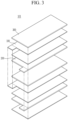
- the above electrode may be utilized in a stacked electrode assembly, and hereinafter, an electrode assembly according to one or more embodiments of the present disclosure will be described with reference to FIG. 3 .
- the electrode assembly 101 may be the stacked electrode assembly 101 in which the negative electrode 100 and the positive electrode 200 are repeatedly stacked with a separator 300 interposed therebetween.
- the separator 300 may be a polymer film that passes a lithium ion (allows lithium ions to pass through).
- the separator may be made of ( e.g ., may include) polyethylene, polypropylene, polyvinylidene fluoride, or a multifilm of two or more films thereof, and may be made of ( e.g ., may include) a mixed multifilm such as a polyethylene/polypropylene two-layer separator, a polyethylene/polypropylene/polyethylene three-layer separator, a polypropylene/polyethylene/ polypropylene three-layer separator, and/or the like.
- the negative electrode 100 may include an electrode portion where an active material layer is formed at (on) a metal substrate (e.g ., a current collector) made of copper (Cu), and an uncoated portion where the metal substrate is exposed by not applying an active material.
- a metal substrate e.g ., a current collector
- Cu copper
- the positive electrode 200 may include an electrode portion where an active material is applied to a metal substrate (e.g ., a current collector) made of aluminum (Al) and an electrode uncoated portion where the metal substrate is exposed by not applying an active material.
- a metal substrate e.g ., a current collector
- Al aluminum
- the positive electrode 200 may be the electrode shown in FIG. 1 and FIG. 2 .
- the negative electrode may be formed larger than the positive electrode, and for example, a distance between a boundary line of the negative electrode and a boundary line of the positive electrode may be greater than 0 and 5 mm or less, or 0.5 mm or more and 3 mm or less.
- the separator arranged between the negative electrode and the positive electrode may shrink so that the active material layers and the electrode uncoated portions of different polarities of the negative electrode and the positive electrode contact each other. As a result, a short circuit may occur. As the short circuit current increases, Joule heat may increase.
- the functional layer with a greater resistance than that of the substrate may be formed, so that the negative electrode is in contact with the functional layer rather than directly with the substrate of the positive electrode. Thus, for example, the short circuit current may be relatively reduced so that Joule heat is reduced.
- a plurality of electrode uncoated portions of the positive electrode 200 may be electrically connected to an external terminal and a plurality of electrode uncoated portions of the negative electrode 100 may be electrically connected to an external terminal (e.g ., uncoated portions of the same polarity may be electrically connected to the same external terminal).
- the electrode uncoated portion of each positive electrode 200 and the electrode uncoated portion of each negative electrode 100 may protrude in substantially the same direction, but the present disclosure is not limited thereto, and the electrode uncoated portions of the positive electrode 200 and the electrode uncoated portions of the negative electrode 100 may protrude in opposite directions, and may be spaced and/or apart ( e.g ., spaced apart or separated) from each other.
- the electrode assembly 101 may be accommodated together with an electrolyte in a pouch-shaped or can-shaped prismatic case to be utilized in the rechargeable battery.
- the electrolyte may include a non-aqueous organic solvent and a lithium salt.
- the non-aqueous organic solvent may serve as a medium through which ions involved in the electrochemical reaction of the battery move.
- the lithium salt may be a material that is dissolved in an organic solvent so that it acts as a supply source of a lithium ion within the battery to enable a basic operation of the lithium rechargeable battery and it serves to promote a movement of the lithium ion between the positive and negative electrodes.
- a representative example of the lithium salt may include one or more e.g.selected from the group e.g.consisting of LiPF 6 , LiBF 4 , LiSbF 6 , LiAsF 6 , LiN(SO 2 C 2 F 5 ) 2 , Li(CF 3 SO 2 ) 2 N, LiN(SO 3 C 2 F 5 ) 2 , LiC 4 F 9 SO 3 , LiClO 4 , LiAlO 2 , LiAlCl 4 , LiN(C x F 2x+1 SO 2 )C y F 2y+1 SO 2 (wherein x and y are natural numbers, and for example, are an integer of 1 to 20), LiCl, Lil, LiB(C 2 O 4 ) 2 (lithium bis(oxalato) borate (LiBOB)), and combinations thereof.
- LiPF 6 LiBF 4 , LiSbF 6 , LiAsF 6 , LiN(SO 2 C 2 F 5 ) 2 , Li(CF
- a concentration of the lithium salt may be utilized within a range of 0.1 M to 2.0 M. If the concentration of the lithium salt is included within this range, the electrolyte may have appropriate or suitable conductivity and viscosity so that the electrolyte shows excellent or suitable electrolyte performance and the lithium ion effectively moves.
- the term “substantially,” “about,” and similar terms are used as terms of approximation and not as terms of degree, and are intended to account for the inherent deviations in measured or calculated values that would be recognized by those of ordinary skill in the art. "Substantially” as used herein, is inclusive of the stated value and means within an acceptable range of deviation for the particular value as determined by one of ordinary skill in the art, considering the measurement in question and the error associated with measurement of the particular quantity (i.e., the limitations of the measurement system). For example, “substantially” may mean within one or more standard deviations, or within ⁇ 30%, 20%, 10%, 5% of the stated value.
- any numerical range recited herein is intended to include all subranges of the same numerical precision subsumed within the recited range.
- a range of "1.0 to 10.0" is intended to include all subranges between (and including) the recited minimum value of 1.0 and the recited maximum value of 10.0, that is, having a minimum value equal to or greater than 1.0 and a maximum value equal to or less than 10.0, such as, for example, 2.4 to 7.6.
- Any maximum numerical limitation recited herein is intended to include all lower numerical limitations subsumed therein and any minimum numerical limitation recited in this specification is intended to include all higher numerical limitations subsumed therein. Accordingly, Applicant reserves the right to amend this specification, including the claims, to expressly recite any sub-range subsumed within the ranges expressly recited herein.
- the portable device, vehicle, and/or the battery e.g ., a battery controller, and/or any other relevant devices or components according to embodiments of the present disclosure described herein may be implemented utilizing a (e.g ., any suitable) hardware, firmware (e.g ., an application-specific integrated circuit), software, or a combination of software, firmware, and hardware.
- a (e.g ., any suitable) hardware, firmware (e.g ., an application-specific integrated circuit), software, or a combination of software, firmware, and hardware may be formed on one integrated circuit (IC) chip or on separate IC chips.
- the various components of the device may be implemented on a flexible printed circuit film, a tape carrier package (TCP), a printed circuit board (PCB), or formed on one substrate.
- the various components of the device may be a process or thread, running on one or more processors, in one or more computing devices, executing computer program instructions and interacting with other system components for performing the various functionalities described herein.
- the computer program instructions are stored in a memory which may be implemented in a computing device using a standard memory device, such as, for example, a random access memory (RAM).
- the computer program instructions may also be stored in other non-transitory computer readable media such as, for example, a CD-ROM, flash drive, or the like.
Landscapes
- Chemical & Material Sciences (AREA)
- Chemical Kinetics & Catalysis (AREA)
- Electrochemistry (AREA)
- General Chemical & Material Sciences (AREA)
- Engineering & Computer Science (AREA)
- Materials Engineering (AREA)
- Inorganic Chemistry (AREA)
- Composite Materials (AREA)
- Manufacturing & Machinery (AREA)
- Battery Electrode And Active Subsutance (AREA)
Applications Claiming Priority (1)
| Application Number | Priority Date | Filing Date | Title |
|---|---|---|---|
| KR1020230075707A KR20240175588A (ko) | 2023-06-13 | 2023-06-13 | 이차 전지용 전극, 이를 포함하는 전극 조립체 및 이차 전지 |
Publications (1)
| Publication Number | Publication Date |
|---|---|
| EP4478445A1 true EP4478445A1 (de) | 2024-12-18 |
Family
ID=91481826
Family Applications (1)
| Application Number | Title | Priority Date | Filing Date |
|---|---|---|---|
| EP24181388.0A Pending EP4478445A1 (de) | 2023-06-13 | 2024-06-11 | Elektrode für eine wiederaufladbare batterie und elektrodenanordnung und wiederaufladbare lithiumbatterie damit |
Country Status (4)
| Country | Link |
|---|---|
| US (1) | US20240421319A1 (de) |
| EP (1) | EP4478445A1 (de) |
| KR (1) | KR20240175588A (de) |
| CN (1) | CN119133358A (de) |
Citations (4)
| Publication number | Priority date | Publication date | Assignee | Title |
|---|---|---|---|---|
| CN103378352A (zh) * | 2012-04-25 | 2013-10-30 | 协鑫动力新材料(盐城)有限公司 | 锂离子电池正极极片及其制备方法 |
| US20190393484A1 (en) * | 2018-06-26 | 2019-12-26 | Nichia Corporation | Positive electrode active material for non-aqueous electrolyte secondary battery |
| US20200185713A1 (en) * | 2018-12-10 | 2020-06-11 | Lg Chem, Ltd. | High-Nickel Positive Electrode Active Material, Producing Method Thereof, Positive Electrode and Lithium Secondary Battery Comprising the Same |
| CN218896657U (zh) * | 2022-07-29 | 2023-04-21 | 郑州比克电子有限责任公司 | 一种耐针刺的锂离子电池极片结构 |
-
2023
- 2023-06-13 KR KR1020230075707A patent/KR20240175588A/ko active Pending
-
2024
- 2024-04-24 US US18/644,982 patent/US20240421319A1/en active Pending
- 2024-06-11 EP EP24181388.0A patent/EP4478445A1/de active Pending
- 2024-06-12 CN CN202410754339.4A patent/CN119133358A/zh active Pending
Patent Citations (4)
| Publication number | Priority date | Publication date | Assignee | Title |
|---|---|---|---|---|
| CN103378352A (zh) * | 2012-04-25 | 2013-10-30 | 协鑫动力新材料(盐城)有限公司 | 锂离子电池正极极片及其制备方法 |
| US20190393484A1 (en) * | 2018-06-26 | 2019-12-26 | Nichia Corporation | Positive electrode active material for non-aqueous electrolyte secondary battery |
| US20200185713A1 (en) * | 2018-12-10 | 2020-06-11 | Lg Chem, Ltd. | High-Nickel Positive Electrode Active Material, Producing Method Thereof, Positive Electrode and Lithium Secondary Battery Comprising the Same |
| CN218896657U (zh) * | 2022-07-29 | 2023-04-21 | 郑州比克电子有限责任公司 | 一种耐针刺的锂离子电池极片结构 |
Also Published As
| Publication number | Publication date |
|---|---|
| CN119133358A (zh) | 2024-12-13 |
| KR20240175588A (ko) | 2024-12-20 |
| US20240421319A1 (en) | 2024-12-19 |
Similar Documents
| Publication | Publication Date | Title |
|---|---|---|
| US11799081B2 (en) | Positive electrode material for lithium secondary battery, positive electrode including same, and lithium secondary battery | |
| CN113270631B (zh) | 用于高能量密度的含石墨电池组的电解质 | |
| US10707530B2 (en) | Carbonate-based electrolyte system improving or supporting efficiency of electrochemical cells having lithium-containing anodes | |
| KR101451044B1 (ko) | 쌍극형 전지 | |
| US20060078797A1 (en) | Lithium ion battery and methods of manufacture | |
| US20060197496A1 (en) | Combination of lithium ion batteries | |
| CN110556521B (zh) | 硅阳极材料 | |
| CN112670601A (zh) | 具有均匀热分布的超高功率混合型电池设计 | |
| KR20070100957A (ko) | 리튬 이온 2차 배터리 | |
| CN108140867A (zh) | 具有其中形成有多个电极接片的单元电极的袋型电池单元 | |
| KR20210154133A (ko) | 리튬 이차 전지 | |
| US11855260B2 (en) | Nonincendive electrolyte for lithium secondary battery, and lithium secondary battery including same | |
| KR20160057813A (ko) | 음극 활물질 및 이를 포함하는 리튬 전지 | |
| US20150340700A1 (en) | Battery cell of irregular structure | |
| CN110419137A (zh) | 电极组件和包括其的锂电池 | |
| JP2013145712A (ja) | 非水電解液二次電池 | |
| KR102019061B1 (ko) | 전극 연장부를 가진 전극조립체 및 전해액 저장 부재를 포함하는 이차전지 | |
| US20230231135A1 (en) | Protective coatings for lithium metal electrodes and methods of forming the same | |
| EP4478445A1 (de) | Elektrode für eine wiederaufladbare batterie und elektrodenanordnung und wiederaufladbare lithiumbatterie damit | |
| KR20240100285A (ko) | 원통형 리튬 이차전지 | |
| KR20110082289A (ko) | 고에너지 밀도 리튬 이차전지 및 그 제조방법 | |
| CN110676517B (zh) | 电芯以及电池 | |
| CN114792838A (zh) | 用于含磷橄榄石正电极的三元盐电解质 | |
| US20250149583A1 (en) | Electrode for rechargeable battery, electrode assembly and rechargeable battery including the same | |
| EP4685975A1 (de) | Elektrodenanordnung und sekundärbatterie |
Legal Events
| Date | Code | Title | Description |
|---|---|---|---|
| PUAI | Public reference made under article 153(3) epc to a published international application that has entered the european phase |
Free format text: ORIGINAL CODE: 0009012 |
|
| STAA | Information on the status of an ep patent application or granted ep patent |
Free format text: STATUS: REQUEST FOR EXAMINATION WAS MADE |
|
| 17P | Request for examination filed |
Effective date: 20240611 |
|
| AK | Designated contracting states |
Kind code of ref document: A1 Designated state(s): AL AT BE BG CH CY CZ DE DK EE ES FI FR GB GR HR HU IE IS IT LI LT LU LV MC ME MK MT NL NO PL PT RO RS SE SI SK SM TR |