EP4477152A1 - Ultraschalldiagnosevorrichtung - Google Patents
Ultraschalldiagnosevorrichtung Download PDFInfo
- Publication number
- EP4477152A1 EP4477152A1 EP22926047.6A EP22926047A EP4477152A1 EP 4477152 A1 EP4477152 A1 EP 4477152A1 EP 22926047 A EP22926047 A EP 22926047A EP 4477152 A1 EP4477152 A1 EP 4477152A1
- Authority
- EP
- European Patent Office
- Prior art keywords
- probe
- inclination angle
- image
- diagnostic
- living body
- Prior art date
- Legal status (The legal status is an assumption and is not a legal conclusion. Google has not performed a legal analysis and makes no representation as to the accuracy of the status listed.)
- Pending
Links
Images





Classifications
-
- A—HUMAN NECESSITIES
- A61—MEDICAL OR VETERINARY SCIENCE; HYGIENE
- A61B—DIAGNOSIS; SURGERY; IDENTIFICATION
- A61B8/00—Diagnosis using ultrasonic, sonic or infrasonic waves
- A61B8/46—Ultrasonic, sonic or infrasonic diagnostic devices with special arrangements for interfacing with the operator or the patient
- A61B8/461—Displaying means of special interest
-
- A—HUMAN NECESSITIES
- A61—MEDICAL OR VETERINARY SCIENCE; HYGIENE
- A61B—DIAGNOSIS; SURGERY; IDENTIFICATION
- A61B8/00—Diagnosis using ultrasonic, sonic or infrasonic waves
-
- A—HUMAN NECESSITIES
- A61—MEDICAL OR VETERINARY SCIENCE; HYGIENE
- A61B—DIAGNOSIS; SURGERY; IDENTIFICATION
- A61B8/00—Diagnosis using ultrasonic, sonic or infrasonic waves
- A61B8/13—Tomography
- A61B8/14—Echo-tomography
-
- A—HUMAN NECESSITIES
- A61—MEDICAL OR VETERINARY SCIENCE; HYGIENE
- A61B—DIAGNOSIS; SURGERY; IDENTIFICATION
- A61B8/00—Diagnosis using ultrasonic, sonic or infrasonic waves
- A61B8/42—Details of probe positioning or probe attachment to the patient
-
- A—HUMAN NECESSITIES
- A61—MEDICAL OR VETERINARY SCIENCE; HYGIENE
- A61B—DIAGNOSIS; SURGERY; IDENTIFICATION
- A61B8/00—Diagnosis using ultrasonic, sonic or infrasonic waves
- A61B8/42—Details of probe positioning or probe attachment to the patient
- A61B8/4245—Details of probe positioning or probe attachment to the patient involving determining the position of the probe, e.g. with respect to an external reference frame or to the patient
- A61B8/4254—Details of probe positioning or probe attachment to the patient involving determining the position of the probe, e.g. with respect to an external reference frame or to the patient using sensors mounted on the probe
-
- A—HUMAN NECESSITIES
- A61—MEDICAL OR VETERINARY SCIENCE; HYGIENE
- A61B—DIAGNOSIS; SURGERY; IDENTIFICATION
- A61B8/00—Diagnosis using ultrasonic, sonic or infrasonic waves
- A61B8/44—Constructional features of the ultrasonic, sonic or infrasonic diagnostic device
- A61B8/4444—Constructional features of the ultrasonic, sonic or infrasonic diagnostic device related to the probe
-
- A—HUMAN NECESSITIES
- A61—MEDICAL OR VETERINARY SCIENCE; HYGIENE
- A61B—DIAGNOSIS; SURGERY; IDENTIFICATION
- A61B8/00—Diagnosis using ultrasonic, sonic or infrasonic waves
- A61B8/46—Ultrasonic, sonic or infrasonic diagnostic devices with special arrangements for interfacing with the operator or the patient
- A61B8/461—Displaying means of special interest
- A61B8/463—Displaying means of special interest characterised by displaying multiple images or images and diagnostic data on one display
-
- G—PHYSICS
- G01—MEASURING; TESTING
- G01C—MEASURING DISTANCES, LEVELS OR BEARINGS; SURVEYING; NAVIGATION; GYROSCOPIC INSTRUMENTS; PHOTOGRAMMETRY OR VIDEOGRAMMETRY
- G01C9/00—Measuring inclination, e.g. by clinometers, by levels
- G01C9/02—Details
-
- G—PHYSICS
- G01—MEASURING; TESTING
- G01S—RADIO DIRECTION-FINDING; RADIO NAVIGATION; DETERMINING DISTANCE OR VELOCITY BY USE OF RADIO WAVES; LOCATING OR PRESENCE-DETECTING BY USE OF THE REFLECTION OR RERADIATION OF RADIO WAVES; ANALOGOUS ARRANGEMENTS USING OTHER WAVES
- G01S15/00—Systems using the reflection or reradiation of acoustic waves, e.g. sonar systems
- G01S15/88—Sonar systems specially adapted for specific applications
- G01S15/89—Sonar systems specially adapted for specific applications for mapping or imaging
- G01S15/8906—Short-range imaging systems; Acoustic microscope systems using pulse-echo techniques
- G01S15/8934—Short-range imaging systems; Acoustic microscope systems using pulse-echo techniques using a dynamic transducer configuration
- G01S15/8936—Short-range imaging systems; Acoustic microscope systems using pulse-echo techniques using a dynamic transducer configuration using transducers mounted for mechanical movement in three dimensions
-
- G—PHYSICS
- G01—MEASURING; TESTING
- G01S—RADIO DIRECTION-FINDING; RADIO NAVIGATION; DETERMINING DISTANCE OR VELOCITY BY USE OF RADIO WAVES; LOCATING OR PRESENCE-DETECTING BY USE OF THE REFLECTION OR RERADIATION OF RADIO WAVES; ANALOGOUS ARRANGEMENTS USING OTHER WAVES
- G01S15/00—Systems using the reflection or reradiation of acoustic waves, e.g. sonar systems
- G01S15/88—Sonar systems specially adapted for specific applications
- G01S15/89—Sonar systems specially adapted for specific applications for mapping or imaging
- G01S15/8906—Short-range imaging systems; Acoustic microscope systems using pulse-echo techniques
- G01S15/899—Combination of imaging systems with ancillary equipment
-
- G—PHYSICS
- G01—MEASURING; TESTING
- G01S—RADIO DIRECTION-FINDING; RADIO NAVIGATION; DETERMINING DISTANCE OR VELOCITY BY USE OF RADIO WAVES; LOCATING OR PRESENCE-DETECTING BY USE OF THE REFLECTION OR RERADIATION OF RADIO WAVES; ANALOGOUS ARRANGEMENTS USING OTHER WAVES
- G01S7/00—Details of systems according to groups G01S13/00, G01S15/00, G01S17/00
- G01S7/52—Details of systems according to groups G01S13/00, G01S15/00, G01S17/00 of systems according to group G01S15/00
- G01S7/52017—Details of systems according to groups G01S13/00, G01S15/00, G01S17/00 of systems according to group G01S15/00 particularly adapted to short-range imaging
- G01S7/52053—Display arrangements
- G01S7/52057—Cathode ray tube displays
-
- G—PHYSICS
- G01—MEASURING; TESTING
- G01S—RADIO DIRECTION-FINDING; RADIO NAVIGATION; DETERMINING DISTANCE OR VELOCITY BY USE OF RADIO WAVES; LOCATING OR PRESENCE-DETECTING BY USE OF THE REFLECTION OR RERADIATION OF RADIO WAVES; ANALOGOUS ARRANGEMENTS USING OTHER WAVES
- G01S7/00—Details of systems according to groups G01S13/00, G01S15/00, G01S17/00
- G01S7/52—Details of systems according to groups G01S13/00, G01S15/00, G01S17/00 of systems according to group G01S15/00
- G01S7/52017—Details of systems according to groups G01S13/00, G01S15/00, G01S17/00 of systems according to group G01S15/00 particularly adapted to short-range imaging
- G01S7/52053—Display arrangements
- G01S7/52057—Cathode ray tube displays
- G01S7/52073—Production of cursor lines, markers or indicia by electronic means
-
- G—PHYSICS
- G01—MEASURING; TESTING
- G01S—RADIO DIRECTION-FINDING; RADIO NAVIGATION; DETERMINING DISTANCE OR VELOCITY BY USE OF RADIO WAVES; LOCATING OR PRESENCE-DETECTING BY USE OF THE REFLECTION OR RERADIATION OF RADIO WAVES; ANALOGOUS ARRANGEMENTS USING OTHER WAVES
- G01S7/00—Details of systems according to groups G01S13/00, G01S15/00, G01S17/00
- G01S7/52—Details of systems according to groups G01S13/00, G01S15/00, G01S17/00 of systems according to group G01S15/00
- G01S7/52017—Details of systems according to groups G01S13/00, G01S15/00, G01S17/00 of systems according to group G01S15/00 particularly adapted to short-range imaging
- G01S7/52053—Display arrangements
- G01S7/52057—Cathode ray tube displays
- G01S7/52074—Composite displays, e.g. split-screen displays; Combination of multiple images or of images and alphanumeric tabular information
-
- G—PHYSICS
- G01—MEASURING; TESTING
- G01S—RADIO DIRECTION-FINDING; RADIO NAVIGATION; DETERMINING DISTANCE OR VELOCITY BY USE OF RADIO WAVES; LOCATING OR PRESENCE-DETECTING BY USE OF THE REFLECTION OR RERADIATION OF RADIO WAVES; ANALOGOUS ARRANGEMENTS USING OTHER WAVES
- G01S7/00—Details of systems according to groups G01S13/00, G01S15/00, G01S17/00
- G01S7/52—Details of systems according to groups G01S13/00, G01S15/00, G01S17/00 of systems according to group G01S15/00
- G01S7/52017—Details of systems according to groups G01S13/00, G01S15/00, G01S17/00 of systems according to group G01S15/00 particularly adapted to short-range imaging
- G01S7/52079—Constructional features
-
- G—PHYSICS
- G01—MEASURING; TESTING
- G01S—RADIO DIRECTION-FINDING; RADIO NAVIGATION; DETERMINING DISTANCE OR VELOCITY BY USE OF RADIO WAVES; LOCATING OR PRESENCE-DETECTING BY USE OF THE REFLECTION OR RERADIATION OF RADIO WAVES; ANALOGOUS ARRANGEMENTS USING OTHER WAVES
- G01S7/00—Details of systems according to groups G01S13/00, G01S15/00, G01S17/00
- G01S7/52—Details of systems according to groups G01S13/00, G01S15/00, G01S17/00 of systems according to group G01S15/00
- G01S7/52017—Details of systems according to groups G01S13/00, G01S15/00, G01S17/00 of systems according to group G01S15/00 particularly adapted to short-range imaging
- G01S7/52085—Details related to the ultrasound signal acquisition, e.g. scan sequences
-
- A—HUMAN NECESSITIES
- A61—MEDICAL OR VETERINARY SCIENCE; HYGIENE
- A61B—DIAGNOSIS; SURGERY; IDENTIFICATION
- A61B8/00—Diagnosis using ultrasonic, sonic or infrasonic waves
- A61B8/42—Details of probe positioning or probe attachment to the patient
- A61B8/4245—Details of probe positioning or probe attachment to the patient involving determining the position of the probe, e.g. with respect to an external reference frame or to the patient
- A61B8/4263—Details of probe positioning or probe attachment to the patient involving determining the position of the probe, e.g. with respect to an external reference frame or to the patient using sensors not mounted on the probe, e.g. mounted on an external reference frame
-
- A—HUMAN NECESSITIES
- A61—MEDICAL OR VETERINARY SCIENCE; HYGIENE
- A61B—DIAGNOSIS; SURGERY; IDENTIFICATION
- A61B8/00—Diagnosis using ultrasonic, sonic or infrasonic waves
- A61B8/42—Details of probe positioning or probe attachment to the patient
- A61B8/4272—Details of probe positioning or probe attachment to the patient involving the acoustic interface between the transducer and the tissue
-
- A—HUMAN NECESSITIES
- A61—MEDICAL OR VETERINARY SCIENCE; HYGIENE
- A61B—DIAGNOSIS; SURGERY; IDENTIFICATION
- A61B8/00—Diagnosis using ultrasonic, sonic or infrasonic waves
- A61B8/44—Constructional features of the ultrasonic, sonic or infrasonic diagnostic device
- A61B8/4444—Constructional features of the ultrasonic, sonic or infrasonic diagnostic device related to the probe
- A61B8/4455—Features of the external shape of the probe, e.g. ergonomic aspects
-
- A—HUMAN NECESSITIES
- A61—MEDICAL OR VETERINARY SCIENCE; HYGIENE
- A61B—DIAGNOSIS; SURGERY; IDENTIFICATION
- A61B8/00—Diagnosis using ultrasonic, sonic or infrasonic waves
- A61B8/46—Ultrasonic, sonic or infrasonic diagnostic devices with special arrangements for interfacing with the operator or the patient
-
- A—HUMAN NECESSITIES
- A61—MEDICAL OR VETERINARY SCIENCE; HYGIENE
- A61B—DIAGNOSIS; SURGERY; IDENTIFICATION
- A61B8/00—Diagnosis using ultrasonic, sonic or infrasonic waves
- A61B8/54—Control of the diagnostic device
-
- G—PHYSICS
- G01—MEASURING; TESTING
- G01B—MEASURING LENGTH, THICKNESS OR SIMILAR LINEAR DIMENSIONS; MEASURING ANGLES; MEASURING AREAS; MEASURING IRREGULARITIES OF SURFACES OR CONTOURS
- G01B11/00—Measuring arrangements characterised by the use of optical techniques
- G01B11/002—Measuring arrangements characterised by the use of optical techniques for measuring two or more coordinates
Definitions
- the present disclosure relates to an ultrasound diagnostic device.
- This application claims the benefit of priority of Japanese Patent Application No. 2022-19567 filed on February 10, 2022 , and contents thereof are incorporated herein.
- Patent Literature 1 in order to appropriately perform the ultrasonic wave flaw detection for the pipe, an ultrasonic wave is radiated onto the surface of the pipe in a direction perpendicular to the surface of the pipe. That is, the ultrasonic transducer that emits the ultrasonic wave is arranged perpendicularly to the surface of the pipe.
- an object to be subjected to the ultrasonic wave flaw detection is a pipe.
- the pipe is a rigid body, and hence does not deform at the time of the ultrasonic wave flaw detection.
- the ultrasonic wave flaw detection for the pipe is performed while maintaining a state in which the ultrasonic transducer is arranged perpendicularly to the surface of the pipe.
- the ultrasound diagnostic device may further include a storage unit configured to store in advance diagnostic reference information in which an allowable range of the position of the probe for diagnosing a specific organ in the living body and an allowable range of the inclination angle of the probe for diagnosing the specific organ are associated with each other.
- the probe specifying unit may be configured to output a predetermined alarm in at least one of a case in which a current position of the probe is out of the allowable range of the position of the probe indicated by the diagnostic reference information and a case in which a current inclination angle of the probe is out of the allowable range of the inclination angle of the probe indicated by the diagnostic reference information, at the time of diagnosing the specific organ.
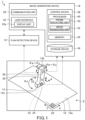
- FIG. 1 is a schematic view for illustrating a configuration of an ultrasound diagnostic device 1 according to a first embodiment.
- the ultrasound diagnostic device 1 of the first embodiment diagnoses, for example, a living body 2 such as a human body as a diagnosis object, and performs ultrasound diagnostic on the diagnosis object.
- the diagnosis object is not limited to the living body 2, and may be any object.
- the ultrasound diagnostic device 1 includes a sheet material 10, a probe 12, a flaw detection device 14, and an image generating device 16.
- the sheet material 10 is made of a material that transmits an ultrasonic wave, and is formed into a flexible sheet shape.
- a shape of a surface 10a of the sheet material 10 is a quadrangular shape, but is not limited to the quadrangular shape, and may be any shape.
- the sheet material 10 is capable of being attached to the surface of the living body 2. For example, a contact medium for transmitting an ultrasonic wave is applied to a surface of an abdomen of the living body 2, and the sheet material 10 is attached onto the contact medium.
- coordinate data indicating the position within the surface 10a of the sheet material 10 is encrypted.
- a two-dimensional code 20 arranged at a predetermined one corner (for example, a right lower corner in the sheet material 10 of FIG. 1 ) of the sheet material 10 is set as a two-dimensional code 20 at a reference position.
- Coordinate data of "m, n" is encrypted on a two-dimensional code 20 located at an m-th position in the X direction and at an n-th position in the Y direction from the two-dimensional code 20 at the reference position.
- the position within the surface 10a of the sheet material 10 can be specified based on the coordinate data and the predetermined interval of the two-dimensional codes 20.
- the ultrasonic transducer 22 is built in the distal end portion 12a of the probe 12.
- the ultrasonic transducer 22 includes one or a plurality of oscillators.
- the oscillator is formed of, for example, a piezoelectric element. When voltage is applied to the oscillator, the oscillator causes oscillation.
- the ultrasonic transducer 22 generates an ultrasonic wave through the oscillation by the oscillator, and emits the generated ultrasonic wave from the distal end portion 12a of the probe 12.
- the ultrasonic transducer 22 can radiate the ultrasonic wave onto the living body 2 through the sheet material 10.
- the ultrasonic wave radiated to the inside of the living body 2 propagates inside the living body 2, and is, for example, reflected by an organ or the like located inside the living body 2. A part of the reflected ultrasonic wave propagates inside the living body 2 and returns to the ultrasonic transducer 22.
- the ultrasonic wave that is reflected and then reaches the ultrasonic transducer 22 may be referred to as an ultrasonic wave echo.
- the ultrasonic transducer 22 can receive the ultrasonic wave echo reflected inside the living body 2.
- the oscillator of the ultrasonic transducer 22 causes oscillation when receiving the ultrasonic wave echo, and converts the oscillation into voltage. The converted voltage is transmitted to the flaw detection device 14.
- the flaw detection device 14 illustrated in FIG. 1 is electrically connected to the ultrasonic transducer 22.
- the flaw detection device 14 performs control related to radiation of the ultrasonic wave by the ultrasonic transducer 22. For example, the flaw detection device 14 scans an irradiation direction of the ultrasonic wave in a direction in which a side surface in the distal end portion 12a of the probe 12 protrudes. Further, the flaw detection device 14 can acquire the voltage indicating the ultrasonic wave echo received by the ultrasonic transducer 22.
- the flaw detection device 14 performs predetermined signal processing such as A/D conversion on the acquired voltage, and transmits the signal having been subjected to the signal processing to the image generating device 16. Although having been subjected to the predetermined signal processing, the signal transmitted by the image generating device 16 is data indicating the ultrasonic wave echo.
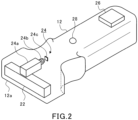
- the imaging device 24 includes a light guiding portion 24a, a lens 24b, and a light receiving element 24c.
- the light guiding portion 24a is provided at the distal end portion 12a of the probe 12 and arranged adjacent to the ultrasonic transducer 22. A distal end portion of the light guiding portion 24a is directed forward from the distal end portion 12a of the probe 12.
- the lens 24b is arranged at a rear end portion of the light guiding portion 24a.
- the light receiving element 24c is arranged on a side opposite to the light guiding portion 24a in the lens 24b.
- the light guiding portion 24a is formed into a box shape from a material that guides light.
- the imaging device 24 is installed so as to be capable of imaging a forward side from the distal end portion 12a of the probe 12 at the distal end portion 12a of the probe 12.
- the imaging device 24 is installed so as to be capable of generally imaging the irradiation direction of the ultrasonic transducer 22 in the vicinity of the ultrasonic transducer 22.
- the imaging device 24 can image the two-dimensional code 20 on the surface 10a of the sheet material 10 within a field of view of the imaging device 24.
- Image data including the two-dimensional code 20 imaged by the imaging device 24 is transmitted to the image generating device 16.
- the image generating device 16 can specify the position of the probe 12 on the surface 10a of the sheet material 10 based on the two-dimensional code 20 imaged by the imaging device 24.
- the inclination angle sensor 26 is installed at a rear end portion 12b of the probe 12.
- the inclination angle sensor 26 is not limited to the mode of being installed at the rear end portion 12b, and may be installed at any position on the probe 12.
- the inclination angle sensor 26 is formed of, for example, micro electro mechanical systems (MEMS).
- MEMS micro electro mechanical systems
- the inclination angle sensor 26 can detect an inclination angle of the probe 12 with respect to a vertical direction.
- a direction along a direction in which the side surface at the distal end portion 12a of the probe 12 protrudes is defined as an A direction
- a direction along a direction in which the side surface at the distal end portion 12a of the probe 12 does not protrude is defined as a B direction.
- an angle about an axis of the A direction is defined as an inclination angle ⁇ a
- an angle about an axis of the B direction is defined as an inclination angle ⁇ b.
- an angle about an axis of the X direction of the sheet material 10 is defined as an inclination angle ⁇ x
- an angle about an axis of the Y direction of the sheet material 10 is defined as an inclination angle ⁇ y.
- the inclination angle sensor 26 can detect each of an absolute inclination angle ⁇ a and an absolute inclination angle ⁇ b of the probe 12 with respect to the vertical direction.
- the inclination angle ⁇ a and the inclination angle ⁇ b are inclination angles of the probe 12 in a coordinate system.
- the detection result given by the inclination angle sensor 26 is transmitted to the image generating device 16.
- the image generating device 16 can specify the inclination angle ⁇ x and the inclination angle ⁇ y, which are inclination angles of the probe 12 with respect to the vertical direction and are inclination angles of the sheet material 10 in a coordinate system based on the inclination angle ⁇ a and the inclination angle ⁇ b detected by the inclination angle sensor 26 and the angle ⁇ z of the probe 12.
- the operation switch 28 is provided on a side surface side on which the side surface does not protrude in the distal end portion 12a.
- the operation switch 28 is provided closer to the distal end portion 12a than the center in the axial direction of the probe 12 extending from the rear end portion 12b to the distal end portion 12a.
- the operation switch 28 is not limited to the mode of being provided at the exemplified position, and may be provided at any position on the probe 12.
- the operation switch 28 receives an input operation by a user, and information indicating the input operation is transmitted to the image generating device 16. For example, when the operation switch 28 is pressed, the image generating device 16 may store, for example, an image indicating a result of ultrasound diagnostic in a storage device 34 described later.
- the communication unit 30 can communicate with the flaw detection device 14 in a wired or wireless manner. Further, the communication unit 30 can communicate also with the imaging device 24 and the inclination angle sensor 26 in a wired or wireless manner. The communication unit 30 may communicate directly with the imaging device 24 and the inclination angle sensor 26 without interposing the flaw detection device 14, or may communicate indirectly with the imaging device 24 and the inclination angle sensor 26 via the flaw detection device 14.
- the user interface 32 includes a display unit 32a that displays various images or pieces of information.
- Examples of the display unit 32a include various display devices such as a liquid crystal display and an organic EL display.
- the user interface 32 may include, besides the display unit 32a, an output device that presents various pieces of information to a user, such as a speaker. Further, the user interface 32 includes an input device such as a keyboard or a mouse that receives an input operation of a user.
- the storage device 34 is formed of a non-volatile storage element, and functions as a storage unit.
- the data indicating the ultrasonic wave echo detected by the ultrasonic transducer 22 may be stored.
- the diagnostic image generated by the image generating device 16 may be stored. In this case, the diagnostic image and the position of the probe 12 and the inclination angle of the probe 12 corresponding to the diagnostic image may be stored in the storage device 34 in association with each other.
- the control device 36 includes one or a plurality of processors 40 and one or a plurality of memories 42 connected to the processors 40.
- the memory 42 includes a ROM in which a program or the like is stored and a RAM as a work area.
- the processor 40 controls the entire image generating device 16 in cooperation with a program included in the memory 42.
- the control device 36 of the image generating device 16 executes the program to also function as a probe specifying unit 50 and an image generating unit 52.
- the probe specifying unit 50 specifies the position of the probe 12 on the surface 10a of the sheet material 10 based on the two-dimensional code 20 imaged by the imaging device 24.
- the probe 12 is placed on the surface 10a of the sheet material 10 in a state in which the sheet material 10 is attached to the surface of the living body 2.
- the position of the probe 12 on the surface 10a of the sheet material 10 is specified, the position of the probe 12 on the surface of the living body 2 is specified as a consequence.
- the image generating unit 52 generates a diagnostic image indicating the result of ultrasound diagnostic of the living body 2 based on the ultrasonic wave echo acquired through the ultrasonic transducer 22 and the flaw detection device 14.
- the image generating unit 52 may generate, in addition to the diagnostic image, various images relating to ultrasound diagnostic as described later. Further, the image generating unit 52 also functions as a display control unit that controls the display unit 32a.
- the image generating unit 52 causes the display unit 32a to display various generated images such as a diagnostic image, a captured image captured by the imaging device, or other various pieces of information.
- FIG. 3 is an explanatory view for illustrating a method of specifying the position of the probe 12 according to the first embodiment.
- some of the plurality of two-dimensional codes 20 on the sheet material 10 are illustrated.
- a frame 60 of FIG. 3 is an example of a captured image captured by the imaging device 24.
- identification points 62 are set at three corners of the square two-dimensional surface.
- the probe specifying unit 50 acquires the captured image from the imaging device 24 through the communication unit 30.
- the probe specifying unit 50 searches for the identification point 62 closest to a center T of the captured image based on the acquired captured image.
- the probe specifying unit 50 also specifies the other two identification points 62 in relation to the found identification point 62, and specifies the two-dimensional code 20 closest to the center T.
- a two-dimensional code 20a is the two-dimensional code 20 closest to the center T.
- the probe specifying unit 50 derives the position of the center T of the captured image on the surface 10a of the sheet material 10 based on the position of the specified two-dimensional code 20a, the derived angle ⁇ z, and the position of the two-dimensional code 20a1 that is not rotated within the captured image.
- the distance between the imaging device 24 and the ultrasonic transducer 22, that is, the offset amount of the center T of the captured image with respect to the ultrasonic transducer 22 is stored in advance .
- the probe specifying unit 50 specifies the position of the probe 12 on the surface 10a of the sheet material 10 based on the derived position of the center T of the captured image and the offset amount stored in the storage device 34.
- the specified position of the probe 12 corresponds to the position of the probe 12 on the surface of the living body 2.
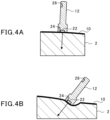
- ultrasound diagnostic of the living body 2 When ultrasound diagnostic of the living body 2 is to be performed, as illustrated in FIG. 4A , basically, the user performs ultrasound diagnostic while erecting the probe 12 perpendicularly to the surface 10a of the sheet material 10 so as to radiate the ultrasonic wave to the inside of the living body 2 approximately perpendicularly from the surface of the living body 2.
- the ultrasonic wave when the ultrasonic wave is radiated perpendicularly as in FIG. 4A , for example, the ultrasonic wave may be blocked by bones or other organs, with the result that the ultrasonic wave is difficult to reach a target organ.
- diagnosis may be desired to be performed by radiating the ultrasonic wave onto the target organ from a plurality of directions.
- a diagnosis person may perform ultrasound diagnostic of the target organ while pushing the probe 12 in a direction toward the inside of the living body 2 and inclining the probe 12 with respect to the surface of the living body 2.
- the abdomen or the like of the living body 2 is a soft body with its surface being flexibly deformable.
- the probe specifying unit 50 associates the specified position of the probe 12 and the specified inclination angle of the probe 12 with each other. Further, it is preferred that the probe specifying unit 50 associate the specified position of the probe 12, the specified inclination angle of the probe 12, and an ultrasonic wave echo given when the position of the probe 12 and the inclination angle of the probe 12 are specified.
- the probe specifying unit 50 may store the associated data in the storage device 34.
- FIG. 6 is a view for illustrating an example of a display screen of the display unit 32a according to the first embodiment.
- the image generating unit 52 generates a waveform image 70 indicating a time transition of an amplitude of an ultrasonic wave echo based on the data indicating the ultrasonic wave echo. As illustrated in FIG. 6 , the image generating unit 52 displays the waveform image 70 in a lower left region among the four divided regions of the display screen.
- a time scale 72a indicating a time is associated with one side extending in the left-and-right direction at the lower portion of the waveform image 70.
- An amplitude scale 72b indicating an amplitude of the ultrasonic wave echo is associated with other one side extending in the up-and-down direction at a left portion of the waveform image 70.
- a plane length scale 76b indicating a length in a plane direction substantially parallel to the surface of the living body 2 is associated with other one side extending in the left-and-right direction at a lower portion of each of the first diagnostic image 74a and the second diagnostic image 74b.
- a user sequentially performs ultrasound diagnostic of a plurality of organs inside the living body 2 one by one. For example, at the time of switching an organ to be diagnosed to a next organ, a user moves the probe 12 on the sheet material 10 along the surface 10a of the sheet material 10 from a position corresponding to the organ before switching to a position corresponding to the organ after switching. Such movement of the probe 12 on the sheet material 10 is one mode of scanning by the probe 12.
- the image generating unit 52 is not limited to the mode of displaying the generated various images in the arrangement exemplified in FIG. 6 , and the image generating unit 52 may display the generated various images in any arrangement.
- the image generating unit 52 generates a position image 82 indicating a current position of the probe 12 based on the position of the probe 12 specified by the probe specifying unit 50. As illustrated in FIG. 6 , the image generating unit 52 superimposes the position image 82 on the diagnostic image 74 and displays the superimposed position image 82 on the display unit 32a.
- the position image 82 is a cursor including a horizontal line 82a and a vertical line 82b.
- the horizontal line 82a indicates a position of the sheet material 10 in the X direction in the position of the probe 12 on the sheet material 10.
- the vertical line 82b indicates a position of the sheet material 10 in the Y direction in the position of the probe 12 on the sheet material 10.
- a portion of the surface of the living body 2, with which the probe 12 is in contact, with the sheet material 10 interposed therebetween is defined as a reference portion.
- the image generating unit 52 derives a relationship between an irradiation distance of the ultrasonic wave from the reference portion in the irradiation direction of the ultrasonic wave and a depth of the living body 2 in a direction toward the inside from the reference portion based on the irradiation distance and the inclination angle of the probe 12.
- the image generating unit 52 sets the value of the depth scale 76a in the diagnostic image 74 based on the relationship between the derived irradiation distance and the depth.
- the image generating unit 52 performs image processing such that the first diagnostic image 74a is line-symmetric in the left-and-right direction with the center of the first diagnostic image 74a in the left-and-right direction as a symmetric axis, and then displays the first diagnostic image 74a after the image processing on the display unit 32a.
- the image generating unit 52 may set the value of the plane length scale 76b of the diagnostic image 74 based on the position of the probe 12. Further, the image generating unit 52 may generate the diagnostic image 74 based on the ultrasonic wave echo, the position of the probe 12, and the inclination angle of the probe 12.
- FIG. 7 is an explanatory flowchart for illustrating a flow of operations of the control device 36 according to the first embodiment.
- the control device 36 executes a series of processing illustrated in FIG. 7 each time a predetermined interrupt timing that arrives in a predetermined cycle comes.
- the probe specifying unit 50 of the control device 36 executes probe specifying processing (S11) of specifying the position of the probe 12 and the inclination angle of the probe 12.
- the probe specifying processing (S11) is to be described in detail later.
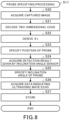
- FIG. 8 is an explanatory flowchart for illustrating a flow of the probe specifying processing (S11) according to the first embodiment.
- the probe specifying unit 50 acquires the captured image which is captured by the imaging device 24 from the imaging device 24 through the communication unit 30 (S20).
- the probe specifying unit 50 decodes the two-dimensional code 20 in the acquired captured image and acquires coordinate data in the two-dimensional code 20 (S21) .
- the probe specifying unit 50 derives the angle ⁇ z of the probe 12 about the axis of the Z direction with respect to the sheet material 10 based on the orientation of the captured image of the decoded two-dimensional code 20 (S22).
- the probe specifying unit 50 specifies the position of the probe 12 with respect to the sheet material 10 based on the coordinate data of the decoded two-dimensional code 20, the angle ⁇ z, and the offset amount of the imaging device 24 stored in the storage device 34 (S23).
- the probe specifying unit 50 acquires the detection result given by the inclination angle sensor 26 through the communication unit 30 (S24). For example, the probe specifying unit 50 acquires the inclination angle ⁇ a and the inclination angle ⁇ b which are the detection results detected by the inclination angle sensor 26.
- the probe specifying unit 50 acquires the data indicating the ultrasonic wave echo through the ultrasonic transducer 22 and the flaw detection device 14 (S26).
- the probe specifying unit 50 associates the data indicating the ultrasonic wave echo acquired in Step S26, the angle ⁇ z specified in Step S22, the position of the probe 12 specified in Step S23, and the inclination angle of the probe 12 specified in Step S25 with one another, stores them in the storage device 34 (S27), and ends the probe specifying processing.
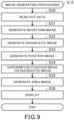
- FIG. 9 is an explanatory flowchart for illustrating a flow of the image generating processing (S12) according to the first embodiment.
- the image generating unit 52 reads out data necessary for generating various images from the storage device 34 (S30).
- the various pieces of data acquired and derived in the probe specifying processing may be used in processing subsequent to Step S31 of the image generating processing without performing the storing processing of Step S27 and the reading processing of Step S30.
- the image generating unit 52 generates the waveform image 70 indicating the time transition of the amplitude of the ultrasonic wave echo based on the data indicating the ultrasonic wave echo (S31).
- the image generating unit 52 generates the position image 82 representing the position of the probe 12 on the image based on the specified position of the probe 12 (S33) .
- the image generating unit 52 superimposes the position image 82 generated in Step S33 on the diagnostic image 74 generated in Step S32 (S34).
- the image generating unit 52 generates the area image 78 corresponding to a range in which the sheet material 10 is attached in the living body 2 (S35). In this case, when scanning by the probe 12 is not performed in the entire range of the area image 78, the image generating unit 52 generates an area image in which a display mode of the entire range of the area image 78 is set to an initial display mode. Further, when there is a portion in which a predetermined condition indicating that scanning by the probe 12 has been performed is satisfied in the area image 78, the image generating unit 52 generates an area image 78 in which the display mode of the portion is changed from the initial display mode of the portion before scanning by the probe 12 is performed.
- the order of the generation of the waveform image 70, the generation of the diagnostic image 74, the generation of the position image 82, and the generation of the area image 78 shows an example, and is not limited to the exemplified order and may be any order. Further, the processing of superimposing the position image 82 on the diagnostic image 74 may be performed in any order after both the diagnostic image 74 and the position image 82 are generated.
- the image generating unit 52 may perform the processing of superimposing the position image 82 on the waveform image 70, or may perform the processing of superimposing the position image 82 on the area image 78.
- the image generating unit 52 arranges the generated images at respective prescribed positions on the display screen, displays the generated images on the display unit 32a of the user interface 32 (S36), and ends the image generating processing.
- the image generating unit 52 arranges the diagnostic image 74 on which the position image 82 is superimposed in the lower right region and the upper right region among the four divided regions of the display screen, arranges the waveform image 70 in the lower left region, and arranges the area image 78 in the upper left region, thereby displaying the respective images.
- the imaging device 24 and the inclination angle sensor 26 are provided to the probe 12.
- the probe specifying unit 50 specifies the position of the probe 12 on the surface of the living body 2 based on the two-dimensional code 20 on the surface 10a of the sheet material 10 which is imaged by the imaging device 24, and specifies the inclination angle of the probe 12 with respect to the vertical direction based on the detection result given by the inclination angle sensor 26.
- the relationship between the position of the probe 12 with respect to the surface of the living body 2 and the posture of the probe 12 can be appropriately grasped.
- the ultrasound diagnostic device 1 of the first embodiment with reference to the specified inclination angle of the probe 12, it is possible to appropriately distinguish whether the specified position of the probe 12 has been obtained as a result of performing ultrasound diagnostic without inclination of the probe 12 or has been obtained as a result of performing ultrasound diagnostic while pushing the probe 12 into the living body and inclining the probe 12.
- the inclination angle of the probe 12 with respect to the vertical direction is specified in the coordinate system of the sheet material 10.
- the direction of the ultrasonic wave emitted from the probe 12 can be specified in the coordinate system of the sheet material 10 based on the specified inclination angle of the probe 12.
- the irradiation direction of the ultrasonic wave radiated to the inside of the living body 2 can be accurately grasped.
- ultrasound diagnostic of the living body 2 For example, a plurality of organs in the living body 2 may be diagnosed in a predetermined order one by one. In such a case, it is desired to accurately diagnose each organ. In view of this, in a second embodiment, it is determined whether or not the position and the inclination angle of the probe 12 are appropriate for each organ to be diagnosed, thereby assisting ultrasound diagnostic.
- FIG. 10 is a schematic view for illustrating a configuration of an ultrasound diagnostic device 100 according to the second embodiment.
- diagnostic procedure information 134a and diagnostic reference information 134b are stored in advance.
- the diagnostic procedure information 134a is information in which an execution procedure of ultrasound diagnostic in the living body 2 is set.
- the order of organs to be subjected to ultrasound diagnostic or the priority order of organs to be subjected to ultrasound diagnostic are included.
- the diagnostic reference information 134b is information in which a specific organ in the living body 2, an allowable range of the position of the probe 12 for diagnosing the specific organ, and an allowable range of the inclination angle of the probe 12 for diagnosing the specific organ are associated with one other.
- the diagnostic reference information 134b is set for each organ for a plurality of organs that can be subjected to ultrasound diagnostic.
- the processor 40 of the control device 36 of the image generating device 16 executes the program, thereby also functioning as a diagnostic procedure management unit 154.
- the diagnostic procedure management unit 154 specifies an organ to be subjected to ultrasound diagnostic among the plurality of organs that can be subjected to ultrasound diagnostic based on the diagnostic procedure information 134a, and prompts the user to perform an operation of the probe 12 for diagnosing the specified organ.
- the diagnostic procedure management unit 154 sequentially switches an organ to be subjected to ultrasound diagnostic based on the diagnostic procedure information 134a, and manages the progress of the ultrasound diagnostic.
- the probe specifying unit 50 determines whether or not the current position of the probe 12 is within the allowable range of the position of the probe 12 indicated by the diagnostic reference information 134b at the time of diagnosing a specific organ.
- the probe specifying unit 50 determines whether or not the current inclination angle of the probe 12 is within the allowable range of the inclination angle of the probe 12 indicated by the diagnostic reference information 134b at the time of diagnosing a specific organ.
- the probe specifying unit 50 outputs a predetermined alarm in at least one of a case in which the current position of the probe 12 is out of the allowable range of the position of the probe 12 indicated by the diagnostic reference information 134b and a case in which the current inclination angle of the probe 12 is out of the allowable range of the inclination angle of the probe 12 indicated by the diagnostic reference information 134b.
- the probe specifying unit 50 displays on the display unit 32a that at least one of the position of the probe 12 and the inclination angle of the probe 12 is not appropriate.
- the predetermined alarm is not limited to the display on the display unit 32a, and may be performed, for example, in any mode such as an alarm sound, which can be recognized by the user.
- FIG. 11 is an explanatory flowchart for illustrating a flow of operations of the control device 36 according to the second embodiment.
- the control device 36 executes a series of processing illustrated in FIG. 11 each time a predetermined interrupt timing that arrives in a predetermined cycle comes.
- the diagnostic procedure management unit 154 of the control device 36 first determines an organ to be diagnosed based on the diagnostic procedure information 134a (S40). In this case, the diagnostic procedure management unit 154 may present the determined organ in a mode that can be recognized by the user, and prompt the operation of the probe 12.
- the probe specifying unit 50 performs the probe specifying processing (S11) for the determined current organ, and performs the image generating processing (S12).
- the probe specifying processing in this case is similar to the probe specifying processing of the first embodiment, and the image generating processing in this case is similar to the image generating processing of the first embodiment.
- the probe specifying unit 50 determines whether or not the current position of the probe 12 specified in the probe specifying processing is within the allowable range of the position of the probe 12 indicated by the diagnostic reference information 134b (S43).
- the probe specifying unit 50 determines whether or not the current inclination angle of the probe 12 specified in the probe specifying processing is within the allowable range of the inclination angle of the probe 12 indicated by the diagnostic reference information 134b (S44).
- the probe specifying unit 50 When the current position of the probe 12 is out of the allowable range of the position of the probe 12 indicated by the diagnostic reference information 134b (NO in S43), the probe specifying unit 50 outputs the predetermined alarm (S45). After outputting the predetermined alarm, the probe specifying unit 50 returns to Step S43, and repeats processing subsequent to Step S43.
- the probe specifying unit 50 When the current inclination angle of the probe 12 is out of the allowable range of the inclination angle of the probe 12 indicated by the diagnostic reference information 134b (NO in S44), the probe specifying unit 50 outputs the predetermined alarm (S45). After outputting the predetermined alarm, the probe specifying unit 50 returns to the processing of Step S43, and repeats processing subsequent to Step S43.
- the probe specifying unit 50 resets the alarm (S46).
- the series of processing in FIG. 11 may be ended at a time point in which the predetermined time has elapsed.
- the diagnostic procedure management unit 154 determines whether or not diagnosis of a current organ has been completed (S47). For example, when the diagnosis of the current organ is completed by operating the probe 12, the user may input that the diagnosis of the current organ has been completed via the user interface 32. Further, the diagnostic procedure management unit 154 may determine that the diagnosis of the current organ has been completed when an input operation of the operation switch 28 of the probe 12 is performed.
- the diagnostic procedure management unit 154 When determining that the diagnosis of the current organ has not been completed (NO in S47), the diagnostic procedure management unit 154 returns to processing of Step S43, and repeats processing subsequent to Step S43.
- the diagnostic procedure management unit 154 determines whether or not diagnosis of all the organs that can be subjected to ultrasound diagnostic set in the diagnostic procedure information 134a has been completed (S48).
- the diagnostic procedure management unit 154 When determining that diagnosis of all the organs has not been completed (NO in S48), the diagnostic procedure management unit 154 returns to the processing of Step S40, determines an organ to be diagnosed next based on the diagnostic procedure information 134a (S40), and repeats subsequent processing.
- the diagnostic procedure management unit 154 ends a series of processing in FIG. 11 .
- the probe specifying processing is performed, thereby being capable of appropriately grasping the relationship between the position of the probe 12 with respect to the surface of the living body 2 and the posture of the probe 12.
- an alarm is output when the position of the probe 12 and the inclination angle of the probe 12 at the time of diagnosing a specific organ do not have an allowable appropriate value for diagnosing the specific organ.
- the execution of ultrasound diagnostic is progressed based on the diagnostic procedure information 134a stored in advance.
- the ultrasound diagnostic device 100 of the second embodiment it is possible to prevent a selection error of an organ to be diagnosed, an error in the order of diagnosis, and the like.
- the inclination angle of the probe 12 with respect to the vertical direction is specified based on the detection result given by the inclination angle sensor 26 provided to the probe 12.
- the posture of the probe 12 is substantially horizontal, that is, when the inclination angle of the probe 12 with respect to the vertical direction is approximately 90°, the inclination angle sensor 26 formed of MEMS may not be able to appropriately detect the inclination angle of the probe 12.
- an azimuth sensor that detects the posture of the probe 12 may be provided to the probe 12.
- the azimuth sensor can detect the inclination angle of the probe 12 with respect to the vertical direction based on magnetism (for example, geomagnetism). Even when the posture of the probe 12 is substantially horizontal, the azimuth sensor can appropriately detect the inclination angle of the probe 12 with respect to the vertical direction.
- the probe specifying unit 50 may specify the inclination angle of the probe 12 with respect to the vertical direction based on the detection result given by the azimuth sensor.
- the probe specifying unit 50 derives the inclination angle ⁇ x and the inclination angle ⁇ y in the coordinate system of the sheet material 10 based on the inclination angle ⁇ a and the inclination angle ⁇ b detected by an azimuth angle sensor and the angle ⁇ z. According to this mode, even when the posture of the probe 12 is substantially horizontal, the inclination angle of the probe 12 can be appropriately detected, and the inclination angle of the probe 12 can be more accurately specified.
- the azimuth angle sensor may be provided to the probe 12 as the inclination angle sensor 26.
- the azimuth angle sensor is configured to detect the inclination angle of the probe 12 based on magnetism.
- a device that generates and utilizes a magnetic field such as a magnetic resonance image diagnosis device may be installed, and there is a fear in that the detection accuracy by the azimuth sensor may be lowered.
- the inclination angle sensor 26 formed of MEMS can detect the inclination angle of the probe 12 without being affected by magnetism.
- the mode of using the inclination angle sensor 26 formed of MEMS is more preferable than the mode of using the azimuth sensor as the inclination angle sensor 26.
- the present disclosure can contribute to, for example, Goal 12 of Sustainable Development Goals (SDGs) "Ensure sustainable consumption and production patterns”.
- SDGs Sustainable Development Goals
Landscapes
- Health & Medical Sciences (AREA)
- Life Sciences & Earth Sciences (AREA)
- Engineering & Computer Science (AREA)
- Physics & Mathematics (AREA)
- Remote Sensing (AREA)
- Radar, Positioning & Navigation (AREA)
- Medical Informatics (AREA)
- Public Health (AREA)
- Biomedical Technology (AREA)
- Heart & Thoracic Surgery (AREA)
- Pathology (AREA)
- Molecular Biology (AREA)
- Surgery (AREA)
- Animal Behavior & Ethology (AREA)
- General Health & Medical Sciences (AREA)
- Radiology & Medical Imaging (AREA)
- Veterinary Medicine (AREA)
- Biophysics (AREA)
- Nuclear Medicine, Radiotherapy & Molecular Imaging (AREA)
- General Physics & Mathematics (AREA)
- Computer Networks & Wireless Communication (AREA)
- Acoustics & Sound (AREA)
- Ultra Sonic Daignosis Equipment (AREA)
Applications Claiming Priority (2)
| Application Number | Priority Date | Filing Date | Title |
|---|---|---|---|
| JP2022019567 | 2022-02-10 | ||
| PCT/JP2022/040537 WO2023153030A1 (ja) | 2022-02-10 | 2022-10-28 | 超音波診断装置 |
Publications (2)
| Publication Number | Publication Date |
|---|---|
| EP4477152A1 true EP4477152A1 (de) | 2024-12-18 |
| EP4477152A4 EP4477152A4 (de) | 2026-02-25 |
Family
ID=87564080
Family Applications (1)
| Application Number | Title | Priority Date | Filing Date |
|---|---|---|---|
| EP22926047.6A Pending EP4477152A4 (de) | 2022-02-10 | 2022-10-28 | Ultraschalldiagnosevorrichtung |
Country Status (5)
| Country | Link |
|---|---|
| US (1) | US20240389977A1 (de) |
| EP (1) | EP4477152A4 (de) |
| JP (1) | JP7764903B2 (de) |
| CN (1) | CN118647320A (de) |
| WO (1) | WO2023153030A1 (de) |
Families Citing this family (2)
| Publication number | Priority date | Publication date | Assignee | Title |
|---|---|---|---|---|
| CN111311557A (zh) * | 2020-01-23 | 2020-06-19 | 腾讯科技(深圳)有限公司 | 内窥镜图像处理方法、装置、电子设备及存储介质 |
| WO2026078919A1 (ja) * | 2024-10-07 | 2026-04-16 | 株式会社Ihi | 検査方法および検査装置 |
Family Cites Families (18)
| Publication number | Priority date | Publication date | Assignee | Title |
|---|---|---|---|---|
| JPS5720258A (en) * | 1980-07-10 | 1982-02-02 | Tokyo Shibaura Electric Co | Ultrasonic diagnostic device |
| JP3187148B2 (ja) * | 1991-08-26 | 2001-07-11 | 株式会社東芝 | 超音波診断装置 |
| US6540679B2 (en) * | 2000-12-28 | 2003-04-01 | Guided Therapy Systems, Inc. | Visual imaging system for ultrasonic probe |
| EP1935344B1 (de) * | 2005-10-07 | 2013-03-13 | Hitachi Medical Corporation | Bildanzeigemethode und medizinisches bild-diagnosesystem |
| JP4772540B2 (ja) * | 2006-03-10 | 2011-09-14 | 株式会社東芝 | 超音波診断装置 |
| JP5984244B2 (ja) * | 2012-01-16 | 2016-09-06 | 東芝メディカルシステムズ株式会社 | 超音波診断装置、超音波診断装置制御プログラム、および医用画像表示方法 |
| JP2015054007A (ja) * | 2013-09-11 | 2015-03-23 | セイコーエプソン株式会社 | 超音波測定装置、超音波画像装置及び超音波測定装置の制御方法 |
| DE102013219746A1 (de) * | 2013-09-30 | 2015-04-16 | Siemens Aktiengesellschaft | Ultraschallsystem mit dreidimensionaler Volumendarstellung |
| MX363128B (es) | 2013-11-15 | 2019-03-11 | Ihi Corp | Sistema de inspeccion. |
| JP6238697B2 (ja) * | 2013-11-22 | 2017-11-29 | 東芝メディカルシステムズ株式会社 | 超音波診断装置 |
| KR101551740B1 (ko) * | 2014-04-22 | 2015-09-11 | 한국표준과학연구원 | 방사빔 추적 기법을 이용한 휴대용 3d 초음파 영상 진단 장치 및 그 영상 진단 방법 |
| JP2017029209A (ja) * | 2015-07-29 | 2017-02-09 | セイコーエプソン株式会社 | 超音波プローブ、及び超音波装置 |
| CN109788944A (zh) * | 2016-09-26 | 2019-05-21 | 富士胶片株式会社 | 超声波诊断装置及超声波诊断装置的控制方法 |
| CN110114001B (zh) * | 2017-01-18 | 2022-06-14 | 古野电气株式会社 | 超声波拍摄系统、超声波拍摄装置、超声波拍摄方法以及图像合成程序 |
| CN111148476B (zh) * | 2017-09-27 | 2022-09-16 | 富士胶片株式会社 | 超声波诊断装置及超声波诊断装置的控制方法 |
| TWI744809B (zh) * | 2019-02-28 | 2021-11-01 | 日商Ihi股份有限公司 | 超音波探傷裝置 |
| JP7664094B2 (ja) | 2020-07-15 | 2025-04-17 | Tdk株式会社 | コイル装置 |
| US12446854B2 (en) * | 2021-08-03 | 2025-10-21 | Fujifilm Sonosite, Inc. | Ultrasound probe guidance |
-
2022
- 2022-10-28 WO PCT/JP2022/040537 patent/WO2023153030A1/ja not_active Ceased
- 2022-10-28 CN CN202280090894.0A patent/CN118647320A/zh active Pending
- 2022-10-28 EP EP22926047.6A patent/EP4477152A4/de active Pending
- 2022-10-28 JP JP2023580073A patent/JP7764903B2/ja active Active
-
2024
- 2024-08-08 US US18/797,874 patent/US20240389977A1/en active Pending
Also Published As
| Publication number | Publication date |
|---|---|
| WO2023153030A1 (ja) | 2023-08-17 |
| JP7764903B2 (ja) | 2025-11-06 |
| EP4477152A4 (de) | 2026-02-25 |
| JPWO2023153030A1 (de) | 2023-08-17 |
| CN118647320A (zh) | 2024-09-13 |
| US20240389977A1 (en) | 2024-11-28 |
Similar Documents
| Publication | Publication Date | Title |
|---|---|---|
| US20240389977A1 (en) | Ultrasonic diagnostic device | |
| KR101563506B1 (ko) | 초음파 장치 및 초음파 장치의 정보 입력 방법 | |
| JP2009056125A (ja) | 超音波画像診断システム、及びその制御方法 | |
| EP1837681A2 (de) | Ultraschalldiagnosesystem und Testverfahren | |
| JP6718520B2 (ja) | 超音波診断装置及び超音波診断装置の制御方法 | |
| JP2009285175A (ja) | 超音波診断装置 | |
| JP7271640B2 (ja) | 超音波スキャン操作のためのガイドシステムおよびガイド方法 | |
| KR20180034117A (ko) | 초음파 진단 장치 및 초음파 진단 장치의 작동 방법 | |
| EP2889003B1 (de) | Ultraschalldiagnosevorrichtung und verfahren zum betrieb | |
| KR20150134299A (ko) | 초음파 장치 및 초음파 장치의 정보 입력 방법 | |
| US20250107772A1 (en) | Ultrasound diagnostic apparatus and control method of ultrasound diagnostic apparatus | |
| JP2009261520A (ja) | 超音波撮像装置 | |
| US20230240655A1 (en) | Ultrasound diagnostic apparatus and display method of ultrasound diagnostic apparatus | |
| JP5416643B2 (ja) | 超音波診断装置 | |
| JP2016086880A (ja) | 超音波画像表示装置及びその制御プログラム | |
| CN112118792B (zh) | 超声波诊断装置及超声波诊断装置的控制方法 | |
| EP4252668B1 (de) | Ultraschalldiagnosevorrichtung und betriebsverfahren dafür | |
| JP5231116B2 (ja) | 超音波診断装置 | |
| US20250352181A1 (en) | Ultrasonic diagnostic apparatus, image display method, and recording medium | |
| EP4230148B1 (de) | Ultraschalldiagnosevorrichtung und anzeigeverfahren für die ultraschalldiagnosevorrichtung | |
| JP2019122842A (ja) | 超音波診断装置 | |
| JP2004195252A (ja) | 超音波画像診断装置 | |
| JP2020062200A (ja) | 超音波診断装置及び表示方法 | |
| US20220061817A1 (en) | Ultrasonic imaging apparatus and display method thereof | |
| JP2018023677A (ja) | 超音波診断システム |
Legal Events
| Date | Code | Title | Description |
|---|---|---|---|
| STAA | Information on the status of an ep patent application or granted ep patent |
Free format text: STATUS: THE INTERNATIONAL PUBLICATION HAS BEEN MADE |
|
| PUAI | Public reference made under article 153(3) epc to a published international application that has entered the european phase |
Free format text: ORIGINAL CODE: 0009012 |
|
| STAA | Information on the status of an ep patent application or granted ep patent |
Free format text: STATUS: REQUEST FOR EXAMINATION WAS MADE |
|
| 17P | Request for examination filed |
Effective date: 20240729 |
|
| AK | Designated contracting states |
Kind code of ref document: A1 Designated state(s): AL AT BE BG CH CY CZ DE DK EE ES FI FR GB GR HR HU IE IS IT LI LT LU LV MC ME MK MT NL NO PL PT RO RS SE SI SK SM TR |
|
| DAV | Request for validation of the european patent (deleted) | ||
| DAX | Request for extension of the european patent (deleted) | ||
| A4 | Supplementary search report drawn up and despatched |
Effective date: 20260126 |
|
| RIC1 | Information provided on ipc code assigned before grant |
Ipc: A61B 8/00 20060101AFI20260120BHEP Ipc: A61B 8/14 20060101ALI20260120BHEP |