EP4475374A2 - Dc/dc-wandler für verteilte speicher- und solaranlagen - Google Patents
Dc/dc-wandler für verteilte speicher- und solaranlagen Download PDFInfo
- Publication number
- EP4475374A2 EP4475374A2 EP24209554.5A EP24209554A EP4475374A2 EP 4475374 A2 EP4475374 A2 EP 4475374A2 EP 24209554 A EP24209554 A EP 24209554A EP 4475374 A2 EP4475374 A2 EP 4475374A2
- Authority
- EP
- European Patent Office
- Prior art keywords
- power
- output
- converters
- power source
- mppt
- Prior art date
- Legal status (The legal status is an assumption and is not a legal conclusion. Google has not performed a legal analysis and makes no representation as to the accuracy of the status listed.)
- Pending
Links
Images


Classifications
-
- H—ELECTRICITY
- H02—GENERATION; CONVERSION OR DISTRIBUTION OF ELECTRIC POWER
- H02J—CIRCUIT ARRANGEMENTS OR SYSTEMS FOR SUPPLYING OR DISTRIBUTING ELECTRIC POWER; SYSTEMS FOR STORING ELECTRIC ENERGY
- H02J3/00—Circuit arrangements for AC mains or AC distribution networks
- H02J3/28—Arrangements for balancing of the load in a network by storage of energy
- H02J3/32—Arrangements for balancing of the load in a network by storage of energy using batteries with converting means
-
- H02J7/56—
-
- G—PHYSICS
- G05—CONTROLLING; REGULATING
- G05B—CONTROL OR REGULATING SYSTEMS IN GENERAL; FUNCTIONAL ELEMENTS OF SUCH SYSTEMS; MONITORING OR TESTING ARRANGEMENTS FOR SUCH SYSTEMS OR ELEMENTS
- G05B19/00—Programme-control systems
- G05B19/02—Programme-control systems electric
- G05B19/04—Programme control other than numerical control, i.e. in sequence controllers or logic controllers
- G05B19/045—Programme control other than numerical control, i.e. in sequence controllers or logic controllers using logic state machines, consisting only of a memory or a programmable logic device containing the logic for the controlled machine and in which the state of its outputs is dependent on the state of its inputs or part of its own output states, e.g. binary decision controllers, finite state controllers
-
- H—ELECTRICITY
- H02—GENERATION; CONVERSION OR DISTRIBUTION OF ELECTRIC POWER
- H02J—CIRCUIT ARRANGEMENTS OR SYSTEMS FOR SUPPLYING OR DISTRIBUTING ELECTRIC POWER; SYSTEMS FOR STORING ELECTRIC ENERGY
- H02J3/00—Circuit arrangements for AC mains or AC distribution networks
- H02J3/38—Arrangements for parallely feeding a single network by two or more generators, converters or transformers
-
- H—ELECTRICITY
- H02—GENERATION; CONVERSION OR DISTRIBUTION OF ELECTRIC POWER
- H02J—CIRCUIT ARRANGEMENTS OR SYSTEMS FOR SUPPLYING OR DISTRIBUTING ELECTRIC POWER; SYSTEMS FOR STORING ELECTRIC ENERGY
- H02J3/00—Circuit arrangements for AC mains or AC distribution networks
- H02J3/38—Arrangements for parallely feeding a single network by two or more generators, converters or transformers
- H02J3/381—Dispersed generators
-
- G—PHYSICS
- G05—CONTROLLING; REGULATING
- G05B—CONTROL OR REGULATING SYSTEMS IN GENERAL; FUNCTIONAL ELEMENTS OF SUCH SYSTEMS; MONITORING OR TESTING ARRANGEMENTS FOR SUCH SYSTEMS OR ELEMENTS
- G05B2219/00—Program-control systems
- G05B2219/20—Pc systems
- G05B2219/24—Pc safety
- G05B2219/24136—Monitor load state of battery
-
- G—PHYSICS
- G05—CONTROLLING; REGULATING
- G05B—CONTROL OR REGULATING SYSTEMS IN GENERAL; FUNCTIONAL ELEMENTS OF SUCH SYSTEMS; MONITORING OR TESTING ARRANGEMENTS FOR SUCH SYSTEMS OR ELEMENTS
- G05B2219/00—Program-control systems
- G05B2219/20—Pc systems
- G05B2219/25—Pc structure of the system
- G05B2219/25361—DC-DC convertor on board
-
- H—ELECTRICITY
- H02—GENERATION; CONVERSION OR DISTRIBUTION OF ELECTRIC POWER
- H02J—CIRCUIT ARRANGEMENTS OR SYSTEMS FOR SUPPLYING OR DISTRIBUTING ELECTRIC POWER; SYSTEMS FOR STORING ELECTRIC ENERGY
- H02J1/00—Circuit arrangements for DC mains or DC distribution networks
- H02J1/10—Parallel operation of DC sources
- H02J1/102—Parallel operation of DC sources being switching converters
-
- H—ELECTRICITY
- H02—GENERATION; CONVERSION OR DISTRIBUTION OF ELECTRIC POWER
- H02J—CIRCUIT ARRANGEMENTS OR SYSTEMS FOR SUPPLYING OR DISTRIBUTING ELECTRIC POWER; SYSTEMS FOR STORING ELECTRIC ENERGY
- H02J1/00—Circuit arrangements for DC mains or DC distribution networks
- H02J1/10—Parallel operation of DC sources
- H02J1/12—Parallel operation of DC generators with converters, e.g. with mercury-arc rectifier
-
- H02J2101/25—
-
- Y—GENERAL TAGGING OF NEW TECHNOLOGICAL DEVELOPMENTS; GENERAL TAGGING OF CROSS-SECTIONAL TECHNOLOGIES SPANNING OVER SEVERAL SECTIONS OF THE IPC; TECHNICAL SUBJECTS COVERED BY FORMER USPC CROSS-REFERENCE ART COLLECTIONS [XRACs] AND DIGESTS
- Y02—TECHNOLOGIES OR APPLICATIONS FOR MITIGATION OR ADAPTATION AGAINST CLIMATE CHANGE
- Y02E—REDUCTION OF GREENHOUSE GAS [GHG] EMISSIONS, RELATED TO ENERGY GENERATION, TRANSMISSION OR DISTRIBUTION
- Y02E10/00—Energy generation through renewable energy sources
- Y02E10/50—Photovoltaic [PV] energy
- Y02E10/56—Power conversion systems, e.g. maximum power point trackers
-
- Y—GENERAL TAGGING OF NEW TECHNOLOGICAL DEVELOPMENTS; GENERAL TAGGING OF CROSS-SECTIONAL TECHNOLOGIES SPANNING OVER SEVERAL SECTIONS OF THE IPC; TECHNICAL SUBJECTS COVERED BY FORMER USPC CROSS-REFERENCE ART COLLECTIONS [XRACs] AND DIGESTS
- Y02—TECHNOLOGIES OR APPLICATIONS FOR MITIGATION OR ADAPTATION AGAINST CLIMATE CHANGE
- Y02P—CLIMATE CHANGE MITIGATION TECHNOLOGIES IN THE PRODUCTION OR PROCESSING OF GOODS
- Y02P80/00—Climate change mitigation technologies for sector-wide applications
- Y02P80/10—Efficient use of energy, e.g. using compressed air or pressurized fluid as energy carrier
- Y02P80/14—District level solutions, i.e. local energy networks
Definitions
- the present disclosure relates to dual power systems and methods for distributed storage and solar systems. More particularly, the present disclosure is directed to solar systems, and more particularly solar tracking systems and the control systems and algorithms for switching between solar power and battery power to drive an energy grid.
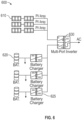
- Fig. 6 depicts a prior art multi input port inverter solar tracker system 600.
- This architecture for DC coupling solar and storage utilizes a multi input port inverter 630.
- the multi input port inverter 630 manages solar array 610, following the maximum power point tracking (MPPT) algorithm, and battery 620 charging and discharging separately for distributed and large applications.
- the solar array 610 to battery 620 ratio is determined by the specific situation for every installation.
- the multi input port inverter 630 will be oversized to meet large power requests from the grid and the responses from the solar array 610 or battery 620. Correlation between the central multi input port inverter 630 and battery charger 625 can be complicated and communication delay also limits this configuration for fast response micro-grid applications.
- An aspect of the present disclosure provides a method for implementing a multi power distributed power storage and generation system.
- the method includes feeding a single input port inverter an output voltage from a solar power plant and a DC storage plant via a common bus, the DC storage plant including a plurality of bi-directional DC/DC converters configured to charge and discharge a plurality of battery banks, maintaining constant power output of the DC storage plant in an MPPT region of the solar power plant for a given load using the power droop method, ramping down an output power of the DC/DC converters when a bus voltage is higher than the MPPT region, ramping up an output power of the DC/DC converters when a bus voltage is higher than the MPPT region, and maintaining maximum power output of the solar power plant, wherein the ramping up and ramping down of an output power is achieved, at least initially, without active control of the DC/DC converters.
- the method also includes monitoring with a controller a power demand of a load, monitoring with the controller a DC charging state battery health state of the DC storage plant, monitoring with the controller the output power and voltage of the solar power plant, and when the load demand is stabilized, the controller determines which of the plurality of battery banks are to supply output power to the bus.
- Another aspect of the present disclosure provides a multi-power distributed storage system including a first power source, a second power source electrically connected to a common bus with the first power source, a single input port inverter electrically connected to the common bus, and a controller configured to communicate with at least the second power source, and the single input port inverter.
- the second power source includes a DC storage plant including a plurality of battery banks and a plurality of bi-directional DC/DC converters configured to charge and discharge the plurality of battery banks and when a grid power curtailment command is received at the single input port inverter the bus voltage rises, and both the first and second power sources reduce output power without an active control, and wherein as load increases, the bus voltage lowers and both the first and second power sources increase output power without an active control.
- the first power source includes a solar power plant.
- the solar power plant utilizes MPPT to maintain maximum output power.
- the solar power plant includes a plurality of solar modules.
- the DC storage plant includes a controller including at least one processor, and a memory having stored thereon instructions which, when executed by the at least one processor, communicate with the bi-directional DC/DC converters to adjust the battery banks supplying power to the bus. Still further aspects describe every battery bank is separately managed.
- the batteries supply power to the bus to maintain the shape of the PV power curve, allowing the single input port inverter to operate at MPPT.
- the controller further maintains the operating state of charging of the DC storage plant at or above a minimum level of charge.
- the method includes feeding a single input port inverter an output voltage from a first power source and a second power source including a plurality of converters, maintaining constant power output of the DC storage plant in an MPPT region of the solar power plant for a given load using the power droop method, ramping down an output power of the DC/DC converters when a bus voltage is higher than the MPPT region, ramping up an output power of the DC/DC converters when a bus voltage is higher than the MPPT region, and maintaining maximum power output of the single input port inverter.
- the ramping up and ramping down of an output power is achieved, at least initially, without active control of the DC/DC converters.
- the first power source includes a solar power plant.
- the second power source includes a DC storage plant.
- the plurality of converters includes a bi-directional DC/DC converter.
- the present disclosure is directed to systems and methods for implementing a multi-power and distributed power storage system whereby a single load may be driven by two separate power sources, both individually and together.
- a solar tracking system that utilizes both a photovoltaic (solar) power plant and a DC storage plant to provide energy to drive an energy grid
- the systems, schematics, and algorithms described herein in any situation where there is are two power sources.
- the systems and algorithms of the present disclosure are useful where there is one power source that is the preferred power source to be utilized but the system should experience little to no lag in transitioning to the other power source.
- a photovoltaic power plant is connected to a large power grid, and may be associated with large battery banks that can be used to provide power to the grid when the solar panels are unable to meet demand.
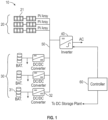
- Fig. 1 depicts a distributed solar and storage system 10 which may be deployed as part of a larger array. It is contemplated that this application could be utilized for solar tracker systems, fixed tilt solar systems, roof top solar, and any type of solar array.
- Each distributed solar and storage system 10 includes a single input port inverter 40 which is fed an output voltage from a first power source such as a solar power plant 20, and from a second power source such as a DC storage plant 30, by way of a common bus 50.
- Other types of power sources are contemplated such as steam, nuclear, geo-thermal, hydro-electric, wind, etc. It is contemplated that more than two power sources can be utilized.
- the single input port inverter 40 can be sized for the AC output requirements of the grid to which it is connected.
- the common bus 50 allows for near instantaneous response to changes in the system power requirements.
- the DC storage plant 30 typically includes a plurality of battery banks 31, bi-directional DC/DC converters 32, and a controller 60.
- the controller 60 can govern the charge and discharge rate.
- the bi-directional DC/DC converters 32 can be configured to charge the battery banks 31.
- the bi-directional DC/DC converters 32 can be sized to the battery output or input. Every battery bank 31 and DC/DC converter 32 is separately managed.
- the bi-directional DC/DC converters 32 employ a power droop algorithm which maintains constant power output in the normal MPPT region. When the voltage is higher or lower than the MPPT region, a bi-directional DC/DC converter 32 could ramp up power or ramp down power output to the bus 50.
- the power droop algorithm enables local control of power output from the DC power plant 30 based on the external load. Additionally internal resistance of the parallel connected bi-directional DC/DC converters 32 maintains relatively equal current sharing between the battery banks 31.
- the power droop algorithm, in combination with the battery banks 31 and the photovoltaic panel arrays 21 sharing a common bus 50 eliminates the need for additional communication and allows for a fast response to micro-grid applications (e.g., changes in load on the inverter 40).
- the single input port inverter 40 receives power from the common bus 50 and converts it to an AC voltage.
- the single input port inverter 40 can be sized for the AC output requirements of the distributed solar and storage system 10.
- the single input port inverter 40 maintains the output power at the Maximum Power Point (MPP) by using, for example, the voltage tracking method. It is contemplated that other methods known in the art can be used.
- Maximum Power Point Tracking (MPPT) which is the process of finding the keeping the load characteristic at the point where the system is optimized to give the highest power transfer, is run at the input port of the single input port inverter 40. The output power from the solar plant is sampled and the proper load characteristic (resistance) is applied so as to obtain maximum power.
- the single input port inverter 40 When a grid curtailment command arrives at the solar power plant 20 and the DC storage plant 30, the single input port inverter 40 experiences a rise in system voltage at the bus 50, and both the solar power plant 20 and the DC storage plant 30 reduce power output without active control. Similarly, in an increasing load scenario, the single input port inverter 40 experiences a drop in system voltage at the bus 50, and both the solar power plant 20 and the DC storage plant 30 increases power output without an active control. These changes in voltage are near instantaneous at the single input port inverter 40.
- the controller 60 can communicate with the individual bi-directional DC/DC converters to manage the output of each of the individual battery banks 31 to achieve the same power and current output in a more efficient manner and in accordance with the health and states of charge of each of the individual battery banks 31 as described in greater detail below. It is contemplated that the battery banks 31 and DC/DC converters 32 are separately managed.
- the single input port inverter 40 is thus able to maintain power output of the solar power plant 20 and the DC storage plant 30 in the MPPT region.
- Fig. 2 depicts a graph 200 depicting the MPPT region of a distributed solar and storage system 10 in accordance with the present disclosure.
- MPPT can be implemented generally to sources with variable power.
- the graph 200 depicts a series of V/I and P/V curves.
- the photovoltaic panel arrays 21 of the solar power plant 20 are equipped with a system for calculating and maintaining MPPT.
- the load characteristic which provides the maximum power transfer efficiency also changes. By changing the load and supply characteristic, the power transfer can be kept at a point of high efficiency.
- the distributed solar and storage system 10 depicted in Fig. 1 will operate such that the single input port inverter 40 can operate within the MPPT region, and simply add or shed supplied power in response to the demand.
- Fig. 3 depicts a graph of bi-directional DC/DC converter output curve 300 in accordance with the present disclosure.
- the curve depicts output power vs voltage.
- the power droop algorithm employed by the bi-directional DC/DC converters 32 and inverter 40 maintains the output at a relatively constant power.
- a constant power region 310 depicts the power output of the DC/DC converters 32 at a given voltage. Though relatively constant, a droop in power is depicted as the voltage increases.
- the constant power region 310 of the graph 300 substantially overlaps the MPPT region 210 of Fig. 2 .
- the bi- directional DC/DC converter can automatically react and increase its output voltage, as depicted in Fig. 3 , to a point higher than the MPPT region depicted in Fig. 2 .
- the bi-directional DC/DC converter can automatically react and the output power can be ramped up. This allows the bi-directional DC/DC converters 32 to respond changes in load automatically as a result of changes in current drawn from the battery banks 31 to maintain the inverter 40 at or near MPPT at all times.
- the controller 60 though lagging the near instantaneous response caused by the changes in bus 50 voltage caused by the change in load, is able to communicate with the bi-directional DC/DC converters to adjust how that reduced or increased power is being delivered to the common bus 50. That is the controller can adjust which battery banks 31 are actually feeding the common bus 50. In this way, controller can remove battery banks 31 from the common bus 50 to both adjust the delivered power, and to reduce the bus voltage, shifting the operating point of the inverter 40 to within the inverter nominal operating region, and to a more efficient point on the MPPT curves depicted in Fig. 2 .
- the response to load by the bi-directional DC /DC converters 32 both connecting to or separating from the common bus 50 is initially driven by the bus voltage. Secondarily it is driven by the controller 60 to manage more directly which battery banks 31 and bi-directional DC/DC converters 32 are supplying power to the common bus 50 and inverter 40 or are being charged by the solar power plant 20.
- Fig. 4 depicts a graph of grid demand response 400 in accordance with the present disclosure.
- an 80 kW solar power plant and ten 10 kW batteries sharing the common bus 50 could have all the battery banks 31 running full discharge as in the top trace in the graph 400.
- the system 10 maintains output power in the MPPT region as depicted in Fig. 2 .
- By turning off all of the batteries 31, only the solar power plant 20 would remain providing power to the grid, as in the middle trace 420. If for example, half of the battery banks 31 needed charging the curve would follow the lower trace 430.
- the distributed solar and storage system 10 would attempt to remain operating in the MPPT region as depicted in Fig.
- the single input port inverter 40 will still be able to provide maximum power. If the single input port inverter 40 voltage rises past the MPPT region and into the power curtailment region of the graph 400 in any of the above traces 410, 420, 430, the solar power plant 20 and the DC storage plant 30 will automatically respond by reducing power to the common bus 50, without the need for a command.
- the AC load demand when the AC load demand changes, it creates a change in frequency, which will translate as a change in bus voltage on the input side of the single input port inverter 40.
- the single input port inverter 40 When the grid frequency is low, and there is a need for frequency support, the single input port inverter 40 will reduce the system voltage on the common bus 50 to search for the system maximum power.
- Fig. 5 depicts a logic flow for a control algorithm in accordance with the present disclosure.
- the system controller 60 can monitor the power demand of a particular load at step 510.
- the controller 60 can monitor the DC charging state of the DC storage plant 30 at step 520, and monitor the output power and voltage of the solar power plant 20 at step 530.
- the controller 60 can detect whether the load has increased 540, and after the load has stabilized, the controller 60 can adjust at step 550 the power available from the DC storage plant 30 in accordance with the power droop algorithm.
- the controller 60 can detect or receive communications indicating at step 560 that there are one or more bad batteries in a battery bank 31.
- a bad battery can cause the entire battery bank 31 to be bad and thus unavailable for meeting load demands safely.
- the controller can switch the affected battery bank 31 off, preventing it from being employed to respond to changing load demands, and ensure that any battery bank 31 with a faulty battery is not permitted to be connected to the bus 50 and feed the inverter. It is contemplated that the controller 60 maintains the operating state of charging of the DC storage plant 30 at or above a minimum level of charge.
- the controller 60 can detect whether demand has dropped at step 580. Generally, the response to load by the bi-directional DC /DC converters 32 is initially driven by the bus voltage. However, when the load demand is stabilized, the controller 60 can adjust the amount of power being supplied from the DC storage plant 30. It is contemplated that any of the detecting steps 540, 560, and 580 can happen in parallel with each other.
Landscapes
- Engineering & Computer Science (AREA)
- Power Engineering (AREA)
- Physics & Mathematics (AREA)
- General Physics & Mathematics (AREA)
- Automation & Control Theory (AREA)
- Charge And Discharge Circuits For Batteries Or The Like (AREA)
- Supply And Distribution Of Alternating Current (AREA)
- Photovoltaic Devices (AREA)
Applications Claiming Priority (3)
| Application Number | Priority Date | Filing Date | Title |
|---|---|---|---|
| US15/965,108 US10951040B2 (en) | 2018-04-27 | 2018-04-27 | DC/DC converter for distributed storage and solar systems |
| PCT/US2019/028176 WO2019209627A1 (en) | 2018-04-27 | 2019-04-18 | Dc/dc converter for distributed storage and solar systems |
| EP19792495.4A EP3785342B1 (de) | 2018-04-27 | 2019-04-18 | Gleichspannungswandler für verteilte speicher- und solarsysteme |
Related Parent Applications (1)
| Application Number | Title | Priority Date | Filing Date |
|---|---|---|---|
| EP19792495.4A Division EP3785342B1 (de) | 2018-04-27 | 2019-04-18 | Gleichspannungswandler für verteilte speicher- und solarsysteme |
Publications (2)
| Publication Number | Publication Date |
|---|---|
| EP4475374A2 true EP4475374A2 (de) | 2024-12-11 |
| EP4475374A3 EP4475374A3 (de) | 2025-03-12 |
Family
ID=68292677
Family Applications (2)
| Application Number | Title | Priority Date | Filing Date |
|---|---|---|---|
| EP19792495.4A Active EP3785342B1 (de) | 2018-04-27 | 2019-04-18 | Gleichspannungswandler für verteilte speicher- und solarsysteme |
| EP24209554.5A Pending EP4475374A3 (de) | 2018-04-27 | 2019-04-18 | Dc/dc-wandler für verteilte speicher- und solaranlagen |
Family Applications Before (1)
| Application Number | Title | Priority Date | Filing Date |
|---|---|---|---|
| EP19792495.4A Active EP3785342B1 (de) | 2018-04-27 | 2019-04-18 | Gleichspannungswandler für verteilte speicher- und solarsysteme |
Country Status (7)
| Country | Link |
|---|---|
| US (3) | US10951040B2 (de) |
| EP (2) | EP3785342B1 (de) |
| CN (1) | CN112119558B (de) |
| AU (3) | AU2019260587B2 (de) |
| ES (1) | ES3012981T3 (de) |
| PL (1) | PL3785342T3 (de) |
| WO (1) | WO2019209627A1 (de) |
Cited By (1)
| Publication number | Priority date | Publication date | Assignee | Title |
|---|---|---|---|---|
| CN120237696A (zh) * | 2025-05-30 | 2025-07-01 | 锦浪科技股份有限公司 | 一种多路电池接口的多模式储能系统 |
Families Citing this family (22)
| Publication number | Priority date | Publication date | Assignee | Title |
|---|---|---|---|---|
| US11196278B2 (en) * | 2017-05-31 | 2021-12-07 | General Electric Company | Control system and method for an energy storage system |
| PL3788697T3 (pl) * | 2018-05-04 | 2024-11-04 | Nextracker Llc | Systemy i sposoby konwersji i transmisji mocy prądu stałego dla pól solarnych |
| US11183938B2 (en) | 2018-11-14 | 2021-11-23 | Toshiba International Corporation | Hybrid PV inverter with SCIB battery integration |
| CN110943478B (zh) * | 2019-11-22 | 2022-09-09 | 东北电力大学 | 可再生能源发电系统输出功率利用率最大化控制方法 |
| CN111224392A (zh) * | 2020-01-03 | 2020-06-02 | 云南电网有限责任公司电力科学研究院 | 一种三端口直流能量路由器功率协调控制方法 |
| CN111181194B (zh) * | 2020-01-09 | 2021-03-30 | 中国科学院电工研究所 | 一种含分布式能源的交直流配用电系统智能协调管控方法 |
| WO2021173136A1 (en) * | 2020-02-27 | 2021-09-02 | General Electric Company | System and method for control of hybrid renewable energy storage system |
| CN111478360A (zh) * | 2020-03-20 | 2020-07-31 | 国网浙江省电力有限公司电力科学研究院 | 含光伏接入的配电网集中-就地综合电压控制方法和装置 |
| CN111446735B (zh) * | 2020-04-07 | 2022-01-28 | 清华大学 | 用于光伏中压集散系统的控制系统及方法 |
| CN113644726B (zh) * | 2020-04-27 | 2025-04-08 | 台达电子企业管理(上海)有限公司 | 分布式供电系统及基于其的能量调节方法 |
| CN113424388A (zh) | 2020-06-17 | 2021-09-21 | 华为技术有限公司 | 电力储能系统以及储能供电系统 |
| CN115699493A (zh) * | 2020-06-30 | 2023-02-03 | 古河电气工业株式会社 | 电力变换器、电力变换器的控制方法、电力系统、电力系统的控制方法及程序 |
| CN112072705A (zh) * | 2020-09-22 | 2020-12-11 | 珠海冠宇动力电池有限公司 | 一种发电储能系统 |
| CN112467779B (zh) * | 2020-11-18 | 2023-04-07 | 西安热工研究院有限公司 | 一种消除多端柔性直流输电控制系统稳态电压偏差的方法 |
| CN115085245A (zh) * | 2021-03-10 | 2022-09-20 | 台达电子工业股份有限公司 | 光伏储能系统及其适用的控制方法 |
| WO2022198635A1 (zh) * | 2021-03-26 | 2022-09-29 | 华为数字能源技术有限公司 | 储能系统及其控制方法 |
| CN118017631A (zh) * | 2021-03-31 | 2024-05-10 | 华为数字能源技术有限公司 | 一种储能系统 |
| CA3224209A1 (en) * | 2021-07-08 | 2023-01-12 | Nextracker Llc | Common dc bus and common ac bus power electronics systems and methods |
| KR102793991B1 (ko) | 2021-10-06 | 2025-04-09 | 주식회사 엘지에너지솔루션 | 태양광 시스템과 연계하는 에너지 저장 시스템 및 에너지 저장 시스템의 제어 방법 |
| JP7758378B2 (ja) * | 2022-01-26 | 2025-10-22 | エルジー エナジー ソリューション リミテッド | Pv-ess直接連系型エネルギー管理システム及び太陽光発電システム連動装置 |
| US20240030716A1 (en) * | 2022-07-21 | 2024-01-25 | GE Grid GmbH | Systems and methods for overload control in renewable power systems |
| CN120386422A (zh) * | 2024-01-29 | 2025-07-29 | 安克创新科技股份有限公司 | 光伏储能设备输出功率调节方法、系统和光伏储能设备 |
Citations (1)
| Publication number | Priority date | Publication date | Assignee | Title |
|---|---|---|---|---|
| US20170288184A1 (en) | 2016-03-31 | 2017-10-05 | Flex Ltd. | Standard energy storage container platform |
Family Cites Families (16)
| Publication number | Priority date | Publication date | Assignee | Title |
|---|---|---|---|---|
| US8159178B2 (en) | 2009-08-21 | 2012-04-17 | Xantrex Technology Inc. | AC connected modules with line frequency or voltage variation pattern for energy control |
| KR101116483B1 (ko) * | 2009-12-04 | 2012-02-27 | 삼성에스디아이 주식회사 | 에너지 저장 시스템 |
| KR101084215B1 (ko) | 2009-12-16 | 2011-11-17 | 삼성에스디아이 주식회사 | 에너지 저장 시스템 및 이의 제어 방법 |
| GB2498790A (en) * | 2012-01-30 | 2013-07-31 | Solaredge Technologies Ltd | Maximising power in a photovoltaic distributed power system |
| US9853565B2 (en) | 2012-01-30 | 2017-12-26 | Solaredge Technologies Ltd. | Maximized power in a photovoltaic distributed power system |
| WO2013163350A1 (en) | 2012-04-25 | 2013-10-31 | Inovus Solar, Inc. | Optimization of energy generation from a wrapped photovoltaic panel |
| KR20130138611A (ko) * | 2012-06-11 | 2013-12-19 | 삼성에스디아이 주식회사 | 에너지 저장 시스템 |
| CN105144530B (zh) * | 2013-02-14 | 2017-04-26 | Abb 技术有限公司 | 控制太阳能发电厂的方法、功率转换系统、dc/ac逆变器和太阳能发电厂 |
| CN103545905B (zh) * | 2013-10-11 | 2015-11-18 | 国家电网公司 | 一种光伏直流微电网能量协调控制方法 |
| GB2535132A (en) * | 2014-10-09 | 2016-08-17 | Isis Innovation | Electrical energy storage device |
| US10008854B2 (en) | 2015-02-19 | 2018-06-26 | Enphase Energy, Inc. | Method and apparatus for time-domain droop control with integrated phasor current control |
| CN107924209B (zh) * | 2015-05-22 | 2020-09-04 | 迭戈能源有限公司 | 用于从功率逆变器的输入电容器快速耗散所存储的能量的系统和方法 |
| US20170077709A1 (en) | 2015-09-15 | 2017-03-16 | Abb Technology Ltd. | Pv system having distributed dc-dc converters |
| CN107394829B (zh) * | 2016-05-17 | 2022-06-07 | 中国电力科学研究院 | 一种基于无互联通信的直流供电系统协调控制系统及方法 |
| CN106505616B (zh) * | 2016-11-17 | 2018-12-18 | 华北电力大学(保定) | 一种直流配电网直流电压的调节方法 |
| US20180337385A1 (en) | 2017-05-17 | 2018-11-22 | Flex Ltd. | Direct current battery string aggregator for standard energy storage enclosure platform |
-
2018
- 2018-04-27 US US15/965,108 patent/US10951040B2/en active Active
-
2019
- 2019-04-18 EP EP19792495.4A patent/EP3785342B1/de active Active
- 2019-04-18 WO PCT/US2019/028176 patent/WO2019209627A1/en not_active Ceased
- 2019-04-18 ES ES19792495T patent/ES3012981T3/es active Active
- 2019-04-18 CN CN201980028303.5A patent/CN112119558B/zh active Active
- 2019-04-18 EP EP24209554.5A patent/EP4475374A3/de active Pending
- 2019-04-18 AU AU2019260587A patent/AU2019260587B2/en active Active
- 2019-04-18 PL PL19792495.4T patent/PL3785342T3/pl unknown
-
2021
- 2021-03-15 US US17/202,331 patent/US11804721B2/en active Active
- 2021-10-26 AU AU2021257945A patent/AU2021257945B2/en active Active
-
2023
- 2023-10-05 US US18/481,635 patent/US12519323B2/en active Active
- 2023-10-05 AU AU2023241337A patent/AU2023241337B2/en active Active
Patent Citations (1)
| Publication number | Priority date | Publication date | Assignee | Title |
|---|---|---|---|---|
| US20170288184A1 (en) | 2016-03-31 | 2017-10-05 | Flex Ltd. | Standard energy storage container platform |
Cited By (1)
| Publication number | Priority date | Publication date | Assignee | Title |
|---|---|---|---|---|
| CN120237696A (zh) * | 2025-05-30 | 2025-07-01 | 锦浪科技股份有限公司 | 一种多路电池接口的多模式储能系统 |
Also Published As
| Publication number | Publication date |
|---|---|
| US11804721B2 (en) | 2023-10-31 |
| EP3785342A1 (de) | 2021-03-03 |
| WO2019209627A1 (en) | 2019-10-31 |
| CN112119558A (zh) | 2020-12-22 |
| EP3785342A4 (de) | 2022-05-11 |
| AU2023241337B2 (en) | 2025-04-24 |
| US20190334349A1 (en) | 2019-10-31 |
| AU2023241337A1 (en) | 2023-10-26 |
| AU2019260587A1 (en) | 2020-10-22 |
| CN112119558B (zh) | 2024-12-31 |
| EP3785342C0 (de) | 2024-10-30 |
| AU2021257945B2 (en) | 2023-07-06 |
| US20210296904A1 (en) | 2021-09-23 |
| EP3785342B1 (de) | 2024-10-30 |
| ES3012981T3 (en) | 2025-04-10 |
| AU2019260587B2 (en) | 2021-08-05 |
| US12519323B2 (en) | 2026-01-06 |
| US10951040B2 (en) | 2021-03-16 |
| US20240030725A1 (en) | 2024-01-25 |
| EP4475374A3 (de) | 2025-03-12 |
| PL3785342T3 (pl) | 2025-03-24 |
| AU2021257945A1 (en) | 2021-11-25 |
Similar Documents
| Publication | Publication Date | Title |
|---|---|---|
| US12519323B2 (en) | DC/DC converter for distributed storage and solar systems | |
| US9641021B2 (en) | Photovoltaic power generation system including apparatus and method to buffer power fluctuations | |
| AU2015267158B2 (en) | Photovoltaic system protection | |
| US10404072B2 (en) | Method and apparatus for bidirectional storage and renewable power converter | |
| US8263276B1 (en) | Startup power control in a fuel cell system | |
| CN102386635B (zh) | 逆变器var支持的分配的系统以及方法 | |
| US10090701B2 (en) | Solar power generation system | |
| US20160329719A1 (en) | Solar power generation system | |
| US20170093187A1 (en) | Energy storage system | |
| US10651735B2 (en) | Series stacked DC-DC converter with serially connected DC power sources and capacitors | |
| US20150229131A1 (en) | Grid tie solar inverter system with storage | |
| CN110301081B (zh) | 分布式/集中式优化器架构 | |
| CA2734671A1 (en) | Power conversion system and method for providing maximum efficiency of power conversion for a photovoltaic system, and photovoltaic system employing a photovoltaic array and an energy storage device | |
| US8358489B2 (en) | Smart photovoltaic panel and method for regulating power using same | |
| KR101587488B1 (ko) | 계통 연계형 시스템에서의 고효율 배터리 충방전 시스템 및 방법 | |
| JP2021197823A (ja) | 直流マイクログリッドシステム及びその制御方法 | |
| CN107979114B (zh) | 一种稳定运行的光伏电站 | |
| Mirzabaev et al. | Experience in implementing modern energy storage systems in Uzbekistan | |
| Cai et al. | Decentralized autonomous operation for islanded photovoltaic-based DC microgrids | |
| JP2020191698A (ja) | 電力システム | |
| WO2019147887A1 (en) | Wind turbina with electric strorage | |
| US11431188B1 (en) | System for highly efficient transfer of energy produced by Photovoltaic panels into batteries for storage | |
| JP2024162248A (ja) | 電力融通システム | |
| CN114784786A (zh) | 一种直流母线电压的控制方法、装置、直流微电网系统及存储介质 |
Legal Events
| Date | Code | Title | Description |
|---|---|---|---|
| PUAI | Public reference made under article 153(3) epc to a published international application that has entered the european phase |
Free format text: ORIGINAL CODE: 0009012 |
|
| STAA | Information on the status of an ep patent application or granted ep patent |
Free format text: STATUS: THE APPLICATION HAS BEEN PUBLISHED |
|
| AC | Divisional application: reference to earlier application |
Ref document number: 3785342 Country of ref document: EP Kind code of ref document: P |
|
| AK | Designated contracting states |
Kind code of ref document: A2 Designated state(s): AL AT BE BG CH CY CZ DE DK EE ES FI FR GB GR HR HU IE IS IT LI LT LU LV MC MK MT NL NO PL PT RO RS SE SI SK SM TR |
|
| REG | Reference to a national code |
Ref country code: DE Ref legal event code: R079 Free format text: PREVIOUS MAIN CLASS: H02J0003320000 Ipc: H02J0003380000 |
|
| PUAL | Search report despatched |
Free format text: ORIGINAL CODE: 0009013 |
|
| P01 | Opt-out of the competence of the unified patent court (upc) registered |
Free format text: CASE NUMBER: APP_3030/2025 Effective date: 20250120 |
|
| AK | Designated contracting states |
Kind code of ref document: A3 Designated state(s): AL AT BE BG CH CY CZ DE DK EE ES FI FR GB GR HR HU IE IS IT LI LT LU LV MC MK MT NL NO PL PT RO RS SE SI SK SM TR |
|
| RIC1 | Information provided on ipc code assigned before grant |
Ipc: H02J 1/12 20060101ALN20250131BHEP Ipc: H02J 1/10 20060101ALN20250131BHEP Ipc: H02J 3/32 20060101ALI20250131BHEP Ipc: H02J 3/38 20060101AFI20250131BHEP |
|
| STAA | Information on the status of an ep patent application or granted ep patent |
Free format text: STATUS: REQUEST FOR EXAMINATION WAS MADE |
|
| 17P | Request for examination filed |
Effective date: 20250825 |