EP4475201A1 - Positivelektrode für energiespeicherelement mit wasserfreiem elektrolyt und energiespeicherelement mit wasserfreiem elektrolyt damit - Google Patents
Positivelektrode für energiespeicherelement mit wasserfreiem elektrolyt und energiespeicherelement mit wasserfreiem elektrolyt damit Download PDFInfo
- Publication number
- EP4475201A1 EP4475201A1 EP23780431.5A EP23780431A EP4475201A1 EP 4475201 A1 EP4475201 A1 EP 4475201A1 EP 23780431 A EP23780431 A EP 23780431A EP 4475201 A1 EP4475201 A1 EP 4475201A1
- Authority
- EP
- European Patent Office
- Prior art keywords
- active material
- positive active
- material particles
- particles
- nonaqueous electrolyte
- Prior art date
- Legal status (The legal status is an assumption and is not a legal conclusion. Google has not performed a legal analysis and makes no representation as to the accuracy of the status listed.)
- Pending
Links
Images
Classifications
-
- H—ELECTRICITY
- H01—ELECTRIC ELEMENTS
- H01M—PROCESSES OR MEANS, e.g. BATTERIES, FOR THE DIRECT CONVERSION OF CHEMICAL ENERGY INTO ELECTRICAL ENERGY
- H01M4/00—Electrodes
- H01M4/02—Electrodes composed of, or comprising, active material
- H01M4/13—Electrodes for accumulators with non-aqueous electrolyte, e.g. for lithium-accumulators; Processes of manufacture thereof
-
- H—ELECTRICITY
- H01—ELECTRIC ELEMENTS
- H01M—PROCESSES OR MEANS, e.g. BATTERIES, FOR THE DIRECT CONVERSION OF CHEMICAL ENERGY INTO ELECTRICAL ENERGY
- H01M4/00—Electrodes
- H01M4/02—Electrodes composed of, or comprising, active material
- H01M4/36—Selection of substances as active materials, active masses, active liquids
- H01M4/48—Selection of substances as active materials, active masses, active liquids of inorganic oxides or hydroxides
- H01M4/52—Selection of substances as active materials, active masses, active liquids of inorganic oxides or hydroxides of nickel, cobalt or iron
- H01M4/525—Selection of substances as active materials, active masses, active liquids of inorganic oxides or hydroxides of nickel, cobalt or iron of mixed oxides or hydroxides containing iron, cobalt or nickel for inserting or intercalating light metals, e.g. LiNiO2, LiCoO2 or LiCoOxFy
-
- H—ELECTRICITY
- H01—ELECTRIC ELEMENTS
- H01M—PROCESSES OR MEANS, e.g. BATTERIES, FOR THE DIRECT CONVERSION OF CHEMICAL ENERGY INTO ELECTRICAL ENERGY
- H01M10/00—Secondary cells; Manufacture thereof
- H01M10/05—Accumulators with non-aqueous electrolyte
- H01M10/052—Li-accumulators
- H01M10/0525—Rocking-chair batteries, i.e. batteries with lithium insertion or intercalation in both electrodes; Lithium-ion batteries
-
- H—ELECTRICITY
- H01—ELECTRIC ELEMENTS
- H01M—PROCESSES OR MEANS, e.g. BATTERIES, FOR THE DIRECT CONVERSION OF CHEMICAL ENERGY INTO ELECTRICAL ENERGY
- H01M4/00—Electrodes
- H01M4/02—Electrodes composed of, or comprising, active material
- H01M4/13—Electrodes for accumulators with non-aqueous electrolyte, e.g. for lithium-accumulators; Processes of manufacture thereof
- H01M4/131—Electrodes based on mixed oxides or hydroxides, or on mixtures of oxides or hydroxides, e.g. LiCoOx
-
- H—ELECTRICITY
- H01—ELECTRIC ELEMENTS
- H01M—PROCESSES OR MEANS, e.g. BATTERIES, FOR THE DIRECT CONVERSION OF CHEMICAL ENERGY INTO ELECTRICAL ENERGY
- H01M4/00—Electrodes
- H01M4/02—Electrodes composed of, or comprising, active material
- H01M4/36—Selection of substances as active materials, active masses, active liquids
-
- H—ELECTRICITY
- H01—ELECTRIC ELEMENTS
- H01M—PROCESSES OR MEANS, e.g. BATTERIES, FOR THE DIRECT CONVERSION OF CHEMICAL ENERGY INTO ELECTRICAL ENERGY
- H01M4/00—Electrodes
- H01M4/02—Electrodes composed of, or comprising, active material
- H01M4/36—Selection of substances as active materials, active masses, active liquids
- H01M4/48—Selection of substances as active materials, active masses, active liquids of inorganic oxides or hydroxides
- H01M4/50—Selection of substances as active materials, active masses, active liquids of inorganic oxides or hydroxides of manganese
- H01M4/505—Selection of substances as active materials, active masses, active liquids of inorganic oxides or hydroxides of manganese of mixed oxides or hydroxides containing manganese for inserting or intercalating light metals, e.g. LiMn2O4 or LiMn2OxFy
-
- H—ELECTRICITY
- H01—ELECTRIC ELEMENTS
- H01M—PROCESSES OR MEANS, e.g. BATTERIES, FOR THE DIRECT CONVERSION OF CHEMICAL ENERGY INTO ELECTRICAL ENERGY
- H01M4/00—Electrodes
- H01M4/02—Electrodes composed of, or comprising, active material
- H01M4/62—Selection of inactive substances as ingredients for active masses, e.g. binders, fillers
-
- H—ELECTRICITY
- H01—ELECTRIC ELEMENTS
- H01M—PROCESSES OR MEANS, e.g. BATTERIES, FOR THE DIRECT CONVERSION OF CHEMICAL ENERGY INTO ELECTRICAL ENERGY
- H01M4/00—Electrodes
- H01M4/02—Electrodes composed of, or comprising, active material
- H01M4/62—Selection of inactive substances as ingredients for active masses, e.g. binders, fillers
- H01M4/624—Electric conductive fillers
-
- H—ELECTRICITY
- H01—ELECTRIC ELEMENTS
- H01M—PROCESSES OR MEANS, e.g. BATTERIES, FOR THE DIRECT CONVERSION OF CHEMICAL ENERGY INTO ELECTRICAL ENERGY
- H01M4/00—Electrodes
- H01M4/02—Electrodes composed of, or comprising, active material
- H01M4/62—Selection of inactive substances as ingredients for active masses, e.g. binders, fillers
- H01M4/624—Electric conductive fillers
- H01M4/625—Carbon or graphite
-
- H—ELECTRICITY
- H01—ELECTRIC ELEMENTS
- H01M—PROCESSES OR MEANS, e.g. BATTERIES, FOR THE DIRECT CONVERSION OF CHEMICAL ENERGY INTO ELECTRICAL ENERGY
- H01M4/00—Electrodes
- H01M4/02—Electrodes composed of, or comprising, active material
- H01M2004/021—Physical characteristics, e.g. porosity, surface area
-
- H—ELECTRICITY
- H01—ELECTRIC ELEMENTS
- H01M—PROCESSES OR MEANS, e.g. BATTERIES, FOR THE DIRECT CONVERSION OF CHEMICAL ENERGY INTO ELECTRICAL ENERGY
- H01M4/00—Electrodes
- H01M4/02—Electrodes composed of, or comprising, active material
- H01M2004/026—Electrodes composed of, or comprising, active material characterised by the polarity
- H01M2004/028—Positive electrodes
-
- Y—GENERAL TAGGING OF NEW TECHNOLOGICAL DEVELOPMENTS; GENERAL TAGGING OF CROSS-SECTIONAL TECHNOLOGIES SPANNING OVER SEVERAL SECTIONS OF THE IPC; TECHNICAL SUBJECTS COVERED BY FORMER USPC CROSS-REFERENCE ART COLLECTIONS [XRACs] AND DIGESTS
- Y02—TECHNOLOGIES OR APPLICATIONS FOR MITIGATION OR ADAPTATION AGAINST CLIMATE CHANGE
- Y02E—REDUCTION OF GREENHOUSE GAS [GHG] EMISSIONS, RELATED TO ENERGY GENERATION, TRANSMISSION OR DISTRIBUTION
- Y02E60/00—Enabling technologies; Technologies with a potential or indirect contribution to GHG emissions mitigation
- Y02E60/10—Energy storage using batteries
Definitions
- the present invention relates to a positive electrode for a nonaqueous electrolyte energy storage device and a nonaqueous electrolyte energy storage device including the same.
- Nonaqueous electrolyte secondary batteries typified by lithium ion secondary batteries are often used for electronic devices such as personal computers and communication terminals, motor vehicles, and the like, because the batteries are high in energy density.
- the nonaqueous electrolyte secondary batteries generally include a pair of electrodes electrically separated from each other by a separator, and a nonaqueous electrolyte interposed between the electrodes, and are configured to allow charge transport ions to be transferred between the two electrodes for charge-discharge.
- capacitors such as lithium ion capacitors and electric double layer capacitors are also widely used as nonaqueous electrolyte energy storage devices other than the nonaqueous electrolyte secondary batteries.
- a positive electrode having a positive active material layer formed of a positive composite containing a positive active material, a conductive agent, a binder and the like is common (See Patent Documents 1 and 2).
- the nonaqueous electrolyte energy storage device for example, it is conceivable to reduce the content of the conductive agent and the like and increase the content of the positive active material in the positive active material layer.
- the capacity retention ratio of the nonaqueous electrolyte energy storage device after a charge-discharge cycle may be greatly reduced.
- An object of the present invention is to provide a positive electrode for a nonaqueous electrolyte energy storage device capable of suppressing a decrease in capacity retention ratio of the nonaqueous electrolyte energy storage device after a charge-discharge cycle, which occurs when the content of a conductive agent in a positive active material layer is reduced, and a nonaqueous electrolyte energy storage device including such a positive electrode.
- a positive electrode for a nonaqueous electrolyte energy storage device includes a positive active material layer containing: first positive active material particles having a Feret diameter of 5 pm or less in a projection image obtained by scanning electron microscope (SEM) observation; second positive active material particles having a Feret diameter of more than 5 pm in a projection image obtained by SEM observation; and a conductive agent, wherein a content of the conductive agent in the positive active material layer is less than 1.1% by mass, and the first positive active material particles are secondary particles having a ratio of an average secondary particle size to an average primary particle size of 3 or less, or primary particles which are not substantially aggregated.
- SEM scanning electron microscope
- a nonaqueous electrolyte energy storage device includes the positive electrode for a nonaqueous electrolyte energy storage device according to one aspect of the present invention.
- secondary particles having a ratio of the average secondary particle size to the average primary particle size of 3 or less, or primary particles that are not substantially aggregated (Hereinafter, these particles are also referred to as "single particle-based particles”.) have fewer grain boundaries than general secondary particles formed by aggregation of a large number of primary particles, and therefore particle cracking originating from a grain boundary which occurs at the beginning of a charge-discharge cycle or the like, and pulverization associated with the particle cracking are unlikely to occur.
- the positive electrode according to [1] it is presumed that since the first positive active material particles having a small particle size (Feret diameter) of 5 pm or less are such single particle-based particles, pulverization of the positive active material particles is suppressed, and a decrease in the capacity retention ratio of the nonaqueous electrolyte energy storage device after a charge-discharge cycle can be suppressed.
- the first positive active material particles having a small particle size (Feret diameter) of 5 pm or less are such single particle-based particles, pulverization of the positive active material particles is suppressed, and a decrease in the capacity retention ratio of the nonaqueous electrolyte energy storage device after a charge-discharge cycle can be suppressed.
- the Feret diameter of the positive active material particles (first positive active material particles and second positive active material particles) contained in the positive active material layer, and the average primary particle size and the average secondary particle size of the first positive active material particles are based on measured values of projection images of fifty positive active material particles arbitrarily extracted, which are observed in an SEM image of the positive active material particles acquired using an SEM. Specifically, it is obtained as follows.
- the positive electrode to be measured is fixed with a thermosetting resin. With the use of a cross-section polisher, a cross section of the positive electrode fixed with the resin is exposed to prepare a sample for measurement. It is to be noted that the positive electrode to be measured are prepared in accordance with the following procedure.
- the nonaqueous electrolyte energy storage device is discharged at a constant current with a current of 0.1 C until the voltage becomes an end-of-discharge voltage under normal usage, so that the energy storage device is brought to a discharged state.
- the term "normal use” refers to use of the nonaqueous electrolyte energy storage device under the charge-discharge conditions recommended or specified for the nonaqueous electrolyte energy storage device.
- the nonaqueous electrolyte energy storage device in the discharged state is disassembled to take out the positive electrode, and the positive electrode is sufficiently washed with dimethyl carbonate, and then dried under reduced pressure at room temperature.
- the operations from the disassembly of the nonaqueous electrolyte energy storage device to the preparation of the positive electrode to be measured are performed in a dry air atmosphere with a dew point of -40°C or lower.
- the positive electrode before the nonaqueous electrolyte energy storage device is assembled can be prepared, the positive electrode before the nonaqueous electrolyte energy storage device is assembled can be measured.
- JSM-7001F manufactured by JEOL Ltd.
- a scanning electron microscope For the SEM image, a secondary electron image is observed.
- the acceleration voltage is 15 kV.
- the observation magnification is set such that the number of positive active material particles appearing in one field of view is three or more and fifteen or less.
- the obtained SEM image is stored as an image file.
- various conditions such as spot diameter, working distance, irradiation current, luminance, and focus are appropriately set so as to make the contour of the positive active material particles clear.
- Fifty positive active material particles are arbitrarily extracted from the acquired SEM image, and the Feret diameter (constant direction diameter) of the projection image (region surrounded by the outline) of each positive active material particle is measured.
- the particles having a measured Feret diameter of 5 pm or less are the first positive active material particles, and the particles having a measured Feret diameter of more than 5 pm are the second positive active material particles. That is, the individual positive active material particles are classified into either the first positive active material particles or the second positive active material particles based on whether or not the Feret diameter is 5 pm or less.
- the Feret diameter (primary particle size) of primary particles constituting each of the first positive active material particles is determined.
- the primary particle is a particle in which no grain boundary is observed in appearance in the SEM image.
- the number average value of the measured primary particle size (Feret diameter of primary particles) is taken as the average primary particle size.
- the number average value of the Feret diameters of the first positive active material particles obtained in the above (3) is taken as the average secondary particle size of the first positive active material particles. Even when the first positive active material particles contain positive active material particles composed of only primary particles, the average secondary particle size is calculated including the Feret diameter of the positive active material particles.
- the average primary particle size and the average secondary particle size in the second positive active material particles can also be determined by the same procedure as in the case of the first positive active material particles.
- the "primary particles that are not substantially aggregated” refer to primary particles in which a plurality of primary particles exist independently without being aggregated, or primary particles in a state in which the primary particle and another primary particle are not generally directly bonded to each other in the SEM image.
- the conductive agent may be fibrous carbon.
- fibrous carbon By using fibrous carbon as the conductive agent, good conductivity can be secured although the content of the conductive agent is small, and the discharge capacity, energy density, and the like of the nonaqueous electrolyte energy storage device can be increased.
- the "fibrous carbon” refers to a carbonaceous material having a deformable elongated shape.
- the ratio of the average length to the average diameter of the fibrous carbon is, for example, 10 or more.
- the average diameter and average length of the fibrous carbon are based on the measured values of arbitrary ten fibrous carbons in an SEM image acquired by the same method as the Feret diameter of the positive active material particles.
- a positive electrode for a nonaqueous electrolyte energy storage device according to an embodiment of the present invention, a method for producing the positive electrode, a nonaqueous electrolyte energy storage device, an energy storage apparatus, a method for producing a nonaqueous electrolyte energy storage device, and other embodiments are described in detail. It is to be noted that the names of the respective constituent members (respective constituent elements) for use in the respective embodiments may be different from the names of the respective constituent members (respective constituent elements) for use in the background art.
- a positive electrode for a nonaqueous electrolyte energy storage device (hereinafter, also referred to simply as a "positive electrode") according to one embodiment of the present invention includes a positive substrate and a positive active material layer disposed directly on the positive substrate, or over the positive substrate with an intermediate layer interposed therebetween.
- the average thickness of the positive substrate is preferably 3 pm or more and 50 pm or less, more preferably 5 pm or more and 40 pm or less, still more preferably 8 pm or more and 30 pm or less, particularly preferably 10 pm or more and 25 pm or less.
- the average thickness of the positive substrate is within the above-described range, it is possible to enhance the energy density per volume of the nonaqueous electrolyte energy storage device while increasing the strength of the positive substrate.
- the intermediate layer is a layer disposed between the positive substrate and the positive active material layer.
- the intermediate layer includes a conductive agent such as carbon particles, thereby reducing contact resistance between the positive substrate and the positive active material layer.
- the configuration of the intermediate layer is not particularly limited, and includes, for example, a binder and a conductive agent.
- the negative substrate has conductivity.
- a metal such as copper, nickel, stainless steel, nickel-plated steel, or aluminum, an alloy thereof, a carbonaceous material, or the like is used.
- copper or a copper alloy is preferable.
- the negative substrate include a foil, a deposited film, a mesh, and a porous material, and a foil is preferable from the viewpoint of cost. Accordingly, the negative substrate is preferably a copper foil or a copper alloy foil.
- the copper foil include a rolled copper foil and an electrolytic copper foil.
- non-graphitic carbon refers to a carbon material in which the average lattice spacing (d 002 ) of a (002) plane determined by an X-ray diffraction method before charge-discharge or in a discharged state is 0.34 nm or more and 0.42 nm or less.
- Examples of the non-graphitic carbon include hardly graphitizable carbon and easily graphitizable carbon.
- Examples of the non-graphitic carbon include a resin-derived material, a petroleum pitch or a material derived from a petroleum pitch, a petroleum coke or a material derived from a petroleum coke, a plant-derived material, and an alcohol-derived material.
- easily graphitizable carbon refers to a carbon material in which the d 002 is 0.34 nm or more and less than 0.36 nm.
- the electron conductivity of the negative active material layer is improved.
- a crusher, a classifier, or the like is used in order to obtain a powder with a predetermined particle size.
- the crushing method and the classification method can be selected from, for example, the methods exemplified for the positive electrode.
- the negative active material is a metal such as metal Li
- the negative active material layer may have the form of a foil.
- the content of the negative active material in the negative active material layer is preferably 60% by mass or more and 99% by mass or less, more preferably 90% by mass or more and 98% by mass or less.
- the content of the negative active material falls within the range mentioned above, thereby allowing a balance to be achieved between the increased energy density and manufacturability of the negative active material layer.
- the separator can be appropriately selected from known separators.
- a separator composed of only a substrate layer a separator where a heat resistant layer including heat resistant particles and a binder is formed on one surface or both surfaces of the substrate layer, or the like can be used.
- the form of the substrate layer of the separator include a woven fabric, a nonwoven fabric, and a porous resin film. Among these forms, a porous resin film is preferable from the viewpoint of strength, and a nonwoven fabric is preferable from the viewpoint of liquid retaining property of the nonaqueous electrolyte.
- a polyolefin such as polyethylene or polypropylene is preferable from the viewpoint of shutdown function, and polyimide, aramid, or the like is preferable from the viewpoint of resistance to oxidative decomposition.
- a material obtained by combining these resins may be used.
- the heat resistant particles included in the heat resistant layer preferably have a mass loss of 5% or less in the case of temperature increase from room temperature to 500°C under the air atmosphere of 1 atm, and still more preferably have a mass loss of 5% or less in the case of temperature increase from room temperature to 800°C.
- Examples of materials that have a mass loss equal to or less than a predetermined value include inorganic compounds.
- the inorganic compound examples include oxides such as iron oxide, silicon oxide, aluminum oxide, titanium dioxide, zirconium oxide, calcium oxide, strontium oxide, barium oxide, magnesium oxide and aluminosilicate; nitrides such as aluminum nitride and silicon nitride; carbonates such as calcium carbonate; sulfates such as barium sulfate; hardly soluble ionic crystals such as calcium fluoride, barium fluoride, barium titanate; covalently bonded crystals such as silicon and diamond; and substances derived from mineral resources, such as talc, montmorillonite, boehmite, zeolite, apatite, kaolin, mullite, spinel, olivine, sericite, bentonite, and mica, and artificial products thereof.
- oxides such as iron oxide, silicon oxide, aluminum oxide, titanium dioxide, zirconium oxide, calcium oxide, strontium oxide, barium oxide, magnesium oxide and aluminosilicate
- the inorganic compounds a simple substance or a complex of these substances may be used alone, or two or more thereof may be used in combination.
- silicon oxide, aluminum oxide, or aluminosilicate is preferable from the viewpoint of safety of the nonaqueous electrolyte energy storage device.
- the porosity of the separator is preferably 80% by volume or less from the viewpoint of strength, and is preferably 20% by volume or more from the viewpoint of discharge performance.
- the "porosity” herein is a volume-based value, which means a value measured with a mercury porosimeter.
- a polymer gel composed of a polymer and a nonaqueous electrolyte may be used.
- the polymer include a polyacrylonitrile, a polyethylene oxide, a polypropylene oxide, a polymethyl methacrylate, a polyvinyl acetate, a polyvinylpyrrolidone, and a polyvinylidene fluoride.
- the use of the polymer gel has the effect of suppressing liquid leakage.
- the polymer gel may be used in combination with a porous resin film, a nonwoven fabric, or the like as described above.
- the nonaqueous electrolyte can be appropriately selected from known nonaqueous electrolytes.
- a nonaqueous electrolyte solution may be used.
- the nonaqueous electrolyte solution includes a nonaqueous solvent and an electrolyte salt dissolved in the nonaqueous solvent.
- the nonaqueous solvent can be appropriately selected from known nonaqueous solvents.
- the nonaqueous solvent include cyclic carbonates, chain carbonates, carboxylic acid esters, phosphoric acid esters, sulfonic acid esters, ethers, amides, and nitriles.
- solvents in which some of the hydrogen atoms included in these compounds are substituted with halogen may be used.
- cyclic carbonates examples include ethylene carbonate (EC), propylene carbonate (PC), butylene carbonate (BC), vinylene carbonate (VC), vinylethylene carbonate (VEC), chloroethylene carbonate, fluoroethylene carbonate (FEC), difluoroethylene carbonate (DFEC), styrene carbonate, 1-phenylvinylene carbonate, and 1,2-diphenylvinylene carbonate.
- EC is preferable.
- chain carbonate examples include diethyl carbonate (DEC), dimethyl carbonate (DMC), ethyl methyl carbonate (EMC), diphenyl carbonate, trifluoroethyl methyl carbonate, and bis(trifluoroethyl)carbonate.
- DEC diethyl carbonate
- DMC dimethyl carbonate
- EMC ethyl methyl carbonate
- diphenyl carbonate diphenyl carbonate
- trifluoroethyl methyl carbonate trifluoroethyl methyl carbonate
- bis(trifluoroethyl)carbonate examples of the chain carbonate.
- EMC is preferable.
- the nonaqueous solvent it is preferable to use the cyclic carbonate or the chain carbonate, and it is more preferable to use the cyclic carbonate and the chain carbonate in combination.
- the use of the cyclic carbonate allows the promoted dissociation of the electrolyte salt to improve the ionic conductivity of the nonaqueous electrolyte solution.
- the use of the chain carbonate allows the viscosity of the nonaqueous electrolyte solution to be kept low.
- the volume ratio of the cyclic carbonate to the chain carbonate preferably falls within the range from 5 : 95 to 50 : 50, for example.
- the electrolyte salt can be appropriately selected from known electrolyte salts.
- the electrolyte salt include a lithium salt, a sodium salt, a potassium salt, a magnesium salt, and an onium salt.
- the lithium salt is preferable.
- lithium salt examples include inorganic lithium salts such as LiPF 6 , LiPO 2 F 2 , LiBF 4 , LiClO 4 , and LiN(SO 2 F) 2 , lithium oxalates such as lithium bis(oxalate)borate (LiBOB), lithium difluorooxalatoborate (LiFOB), and lithium bis(oxalate)difluorophosphate (LiFOP), and lithium salts having a halogenated hydrocarbon group, such as LiSO 3 CF 3 , LiN(SO 2 CF 3 ) 2 , LiN(SO 2 C 2 F 5 ) 2 , LiN(SO 2 CF 3 )(SO 2 C 4 F 9 ), LiC(SO 2 CF 3 ) 3 , and LiC(SO 2 C 2 F 5 ) 3 .
- an inorganic lithium salt is preferable, and LiPF 6 is more preferable.
- the content of the electrolyte salt in the nonaqueous electrolyte solution is, at 20°C under 1 atm, preferably 0.1 mol/dm 3 or more and 2.5 mol/dm 3 or less, more preferably 0.3 mol/dm 3 or more and 2.0 mol/dm 3 or less, still more preferably 0.5 mol/dm 3 or more and 1.7 mol/dm 3 or less, particularly preferably 0.7 mol/dm 3 or more and 1.5 mol/dm 3 or less.
- the content of the electrolyte salt falls within the range mentioned above, thereby allowing the ionic conductivity of the nonaqueous electrolyte solution to be increased.
- the nonaqueous electrolyte solution may include an additive, besides the nonaqueous solvent and the electrolyte salt.
- the additive include aromatic compounds such as biphenyl, alkylbiphenyl, terphenyl, partly hydrogenated terphenyl, cyclohexylbenzene, t-butylbenzene, t-amylbenzene, diphenyl ether, and dibenzofuran; partial halides of the aromatic compounds such as 2-fluorobiphenyl, o-cyclohexylfluorobenzene, and p-cyclohexylfluorobenzene; halogenated anisole compounds such as 2,4-difluoroanisole, 2,5-difluoroanisole, 2,6-difluoroanisole, and 3,5-difluoroanisole; vinylene carbonate, methylvinylene carbonate, ethylvinylene carbonate, succinic anhydride, glutaric an
- the content of the additive contained in the nonaqueous electrolyte solution is preferably 0.01% by mass or more and 10% by mass or less, more preferably 0.1% by mass or more and 7% by mass or less, still more preferably 0.2% by mass or more and 5% by mass or less, and particularly preferably 0.3% by mass or more and 3% by mass or less, with respect to the total mass of the nonaqueous electrolyte solution.
- the content of the additive falls within the range mentioned above, thereby making it possible to improve capacity retention performance or cycle performance after high-temperature storage, and to further improve safety.
- nonaqueous electrolyte a solid electrolyte may be used, or a nonaqueous electrolyte solution and a solid electrolyte may be used in combination.
- the solid electrolyte can be selected from any material with ionic conductivity, which is solid at normal temperature (for example, 15°C to 25°C), such as lithium, sodium and calcium.
- Examples of the solid electrolyte include sulfide solid electrolytes, oxide solid electrolytes, nitride solid electrolytes, and polymer solid electrolytes.
- Examples of the sulfide solid electrolyte include Li 2 S-P 2 S 5 , LiI-Li 2 S-P 2 S 5 , and Li 10 Ge-P 2 S 12 in the case of a lithium ion secondary battery.
- the shape of the nonaqueous electrolyte energy storage device according to the present embodiment is not particularly limited, and examples thereof include cylindrical batteries, prismatic batteries, flat batteries, coin batteries, and button batteries.
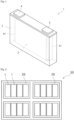
- Fig. 1 illustrates a nonaqueous electrolyte energy storage device 1 as an example of prismatic batteries. It is to be noted that Fig. 1 is a view illustrating the inside of a case in a perspective manner.
- An electrode assembly 2 including a positive electrode and a negative electrode wound with a separator interposed therebetween is housed in a prismatic case 3.
- the positive electrode is electrically connected to a positive electrode terminal 4 via a positive electrode lead 41.
- the negative electrode is electrically connected to a negative electrode terminal 5 via a negative electrode lead 51.
- the nonaqueous electrolyte energy storage device can be mounted as an energy storage unit (battery module) configured by assembling a plurality of nonaqueous electrolyte energy storage devices on a power source for automobiles such as electric vehicles (EV), hybrid vehicles (HEV), and plug-in hybrid vehicles (PHEV), a power source for electronic devices such as personal computers and communication terminals, or a power source for power storage, or the like.
- a power source for automobiles such as electric vehicles (EV), hybrid vehicles (HEV), and plug-in hybrid vehicles (PHEV), a power source for electronic devices such as personal computers and communication terminals, or a power source for power storage, or the like.
- the technique of the present invention may be applied to at least one nonaqueous electrolyte energy storage device included in the energy storage unit.
- Fig. 2 illustrates an example of an energy storage apparatus 30 formed by assembling energy storage units 20 in each of which two or more electrically connected nonaqueous electrolyte energy storage devices 1 are assembled.
- the energy storage apparatus 30 may include a busbar (not illustrated) for electrically connecting two or more nonaqueous electrolyte energy storage devices 1 and a busbar (not illustrated) for electrically connecting two or more energy storage units 20.
- the energy storage unit 20 or the energy storage apparatus 30 may include a state monitor (not illustrated) that monitors the state of one or more nonaqueous electrolyte energy storage devices.
- a method for manufacturing the nonaqueous electrolyte energy storage device can be appropriately selected from publicly known methods.
- the manufacturing method includes, for example, preparing an electrode assembly, preparing a nonaqueous electrolyte, and housing the electrode assembly and the nonaqueous electrolyte in a case.
- Preparing the electrode assembly includes: preparing a positive electrode and a negative electrode, and forming an electrode assembly by stacking or winding the positive electrode and the negative electrode with a separator interposed therebetween.
- housing the nonaqueous electrolyte in a case can be appropriately selected from known methods.
- the nonaqueous electrolyte solution may be injected from an inlet formed in the case, and the inlet may be then sealed.
- the nonaqueous electrolyte energy storage device is not limited to the embodiment described above, and various changes may be made without departing from the gist of the present invention.
- the configuration of another embodiment can be added, and a part of the configuration of an embodiment can be replaced by the configuration of another embodiment or a well-known technique.
- a part of the configuration according to one embodiment can be deleted.
- a well-known technique can be added to the configuration according to one embodiment.
- nonaqueous electrolyte energy storage device is used as a nonaqueous electrolyte secondary battery (for example, lithium ion secondary battery) that can be charged and discharged
- a nonaqueous electrolyte secondary battery for example, lithium ion secondary battery
- the type, shape, dimensions, capacity, and the like of the nonaqueous electrolyte energy storage device are arbitrary.
- the present invention can also be applied to various secondary batteries, and capacitors such as electric double layer capacitors and lithium ion capacitors.
- the electrode assembly may include no separator.
- the positive electrode and the negative electrode may be brought into direct contact with each other, with a non-conductive layer formed on the active material layer of the positive electrode or negative electrode.
- LiNi 0.8 Co 0.1 Mn 0.1 O 2 single particle-based particles A and LiNi 0.8 Co 0.1 Mn 0.1 O 2 secondary particles B were used as positive active material particles.
- CNT average diameter: 10 nm, average length: 25 pm
- PVDF polyvinylidene fluoride
- NMP N-methyl-pyrrolidone
- the average primary particle size and the average secondary particle size of the first positive active material particles (positive active material particles having a Feret diameter of 5 pm or less) and the second positive active material particles (positive active material particles having a Feret diameter of more than 5 pm) contained in the positive active material layer were as shown in Table 1.
- the second positive active material particles contained in the positive active material layer of each of the nonaqueous electrolyte energy storage devices of Reference Examples 3 and 4 are particles of the same size, but the average primary particle size and the average secondary particle size thereof are not measured.
- "AB" represents acetylene black.
- the discharge capacity after the charge-discharge cycle test was measured for each nonaqueous electrolyte energy storage device under the same conditions as in the measurement of the initial discharge capacity.
- the percentage of the discharge capacity after the charge-discharge cycle test to the initial discharge capacity was determined as a capacity retention ratio. With respect to the capacity retention ratio, nonaqueous electrolyte energy storage devices having the same type and average particle size of each positive active material particle constituting the positive active material layer were compared with each other.
Landscapes
- Chemical & Material Sciences (AREA)
- Chemical Kinetics & Catalysis (AREA)
- Electrochemistry (AREA)
- General Chemical & Material Sciences (AREA)
- Engineering & Computer Science (AREA)
- Materials Engineering (AREA)
- Inorganic Chemistry (AREA)
- Manufacturing & Machinery (AREA)
- Battery Electrode And Active Subsutance (AREA)
Applications Claiming Priority (2)
| Application Number | Priority Date | Filing Date | Title |
|---|---|---|---|
| JP2022060761 | 2022-03-31 | ||
| PCT/JP2023/012355 WO2023190422A1 (ja) | 2022-03-31 | 2023-03-28 | 非水電解質蓄電素子用の正極及びこれを備える非水電解質蓄電素子 |
Publications (2)
| Publication Number | Publication Date |
|---|---|
| EP4475201A1 true EP4475201A1 (de) | 2024-12-11 |
| EP4475201A4 EP4475201A4 (de) | 2024-12-11 |
Family
ID=88202465
Family Applications (1)
| Application Number | Title | Priority Date | Filing Date |
|---|---|---|---|
| EP23780431.5A Pending EP4475201A4 (de) | 2022-03-31 | 2023-03-28 | Positivelektrode für energiespeicherelement mit wasserfreiem elektrolyt und energiespeicherelement mit wasserfreiem elektrolyt damit |
Country Status (5)
| Country | Link |
|---|---|
| US (1) | US20250201837A1 (de) |
| EP (1) | EP4475201A4 (de) |
| JP (1) | JPWO2023190422A1 (de) |
| CN (1) | CN119318024A (de) |
| WO (1) | WO2023190422A1 (de) |
Family Cites Families (8)
| Publication number | Priority date | Publication date | Assignee | Title |
|---|---|---|---|---|
| JP4972624B2 (ja) * | 2008-09-30 | 2012-07-11 | 日立ビークルエナジー株式会社 | リチウム二次電池用正極材料及びそれを用いたリチウム二次電池 |
| JPWO2010106768A1 (ja) | 2009-03-18 | 2012-09-20 | パナソニック株式会社 | 非水電解質二次電池用正極、それを用いた非水電解質二次電池、およびその製造方法 |
| JP6158307B2 (ja) | 2013-03-28 | 2017-07-05 | 三洋電機株式会社 | 非水電解質二次電池用正極、非水電解質二次電池用正極の製造方法および非水電解質二次電池 |
| JP6170806B2 (ja) * | 2013-10-17 | 2017-07-26 | 日本ケミコン株式会社 | リチウムイオン二次電池用電極材料及びこの電極材料を用いたリチウムイオン二次電池 |
| CN108604676B (zh) * | 2016-02-24 | 2021-04-27 | 富士胶片株式会社 | 二次电池电极活性物质、全固态二次电池及其电极片、三者的制造方法和固体电解质组合物 |
| KR102359103B1 (ko) * | 2018-02-01 | 2022-02-08 | 주식회사 엘지에너지솔루션 | 이차전지용 양극 활물질, 그 제조방법 및 이를 포함하는 리튬 이차전지 |
| WO2020137296A1 (ja) * | 2018-12-28 | 2020-07-02 | パナソニックIpマネジメント株式会社 | 非水電解質二次電池用正極活物質、及び非水電解質二次電池 |
| WO2021029652A1 (ko) * | 2019-08-12 | 2021-02-18 | 주식회사 엘지화학 | 리튬 이차전지용 양극 및 이를 포함하는 리튬 이차전지 |
-
2023
- 2023-03-28 US US18/849,137 patent/US20250201837A1/en active Pending
- 2023-03-28 JP JP2024512501A patent/JPWO2023190422A1/ja active Pending
- 2023-03-28 WO PCT/JP2023/012355 patent/WO2023190422A1/ja not_active Ceased
- 2023-03-28 EP EP23780431.5A patent/EP4475201A4/de active Pending
- 2023-03-28 CN CN202380031987.0A patent/CN119318024A/zh active Pending
Also Published As
| Publication number | Publication date |
|---|---|
| JPWO2023190422A1 (de) | 2023-10-05 |
| CN119318024A (zh) | 2025-01-14 |
| US20250201837A1 (en) | 2025-06-19 |
| EP4475201A4 (de) | 2024-12-11 |
| WO2023190422A1 (ja) | 2023-10-05 |
Similar Documents
| Publication | Publication Date | Title |
|---|---|---|
| US20230207784A1 (en) | Positive electrode and energy storage device | |
| EP4343910A1 (de) | Energiespeicherelement | |
| US20240266499A1 (en) | Energy storage device | |
| EP4456169A1 (de) | Positivelektrode für ein energiespeicherelement, energiespeicherelement und energiespeichervorrichtung | |
| US20250015355A1 (en) | Nonaqueous electrolyte energy storage device | |
| EP4290617A1 (de) | Energiespeicherelement mit wasserfreiem elektrolyt | |
| US20240339606A1 (en) | Positive electrode, energy storage device, and energy storage apparatus | |
| EP4297122A1 (de) | Positivelektrodenaktivmaterial für energiespeicherelemente mit wasserfreiem elektrolyt, positivelektrode für energiespeicherelemente mit wasserfreiem elektrolyt, energiespeichereinheit und energiespeichervorrichtung | |
| EP4475201A1 (de) | Positivelektrode für energiespeicherelement mit wasserfreiem elektrolyt und energiespeicherelement mit wasserfreiem elektrolyt damit | |
| JP2024001780A (ja) | 正極及び非水電解質蓄電素子 | |
| EP4047678A1 (de) | Elektrizitätsspeicherelement und elektrizitätsspeichervorrichtung | |
| US20250192186A1 (en) | Energy storage device and energy storage apparatus | |
| US20240379942A1 (en) | Positive electrode for nonaqueous electrolyte energy storage device, nonaqueous electrolyte energy storage device, and energy storage apparatus | |
| EP4485606A1 (de) | Energiespeicherelement mit wasserfreiem elektrolyt | |
| EP4485605A1 (de) | Energiespeicherelement mit nichtwässrigem elektrolyt | |
| EP4525115A1 (de) | Energiespeicherelement | |
| EP4425634A1 (de) | Energiespeicherelement mit wasserfreiem elektrolyt, vorrichtung und verfahren zur verwendung eines energiespeicherelements mit wasserfreiem elektrolyt | |
| EP4542664A1 (de) | Energiespeicherelement | |
| EP4539167A1 (de) | Energiespeicherelement mit nichtwässrigem elektrolyt | |
| EP4507050A1 (de) | Speicherelement mit nichtwässrigem elektrolyt | |
| EP4632864A1 (de) | Elektrizitätsspeicherelement mit wasserfreiem elektrolyt | |
| EP4664546A1 (de) | Negativelektrode für energiespeicherelement mit wasserfreiem elektrolyt und energiespeicherelement mit wasserfreiem elektrolyt | |
| EP4539184A1 (de) | Speicherelement mit wasserfreiem elektrolyt, vorrichtung, verfahren zur verwendung eines speicherelements mit wasserfreiem elektrolyt und verfahren zur herstellung eines speicherelements mit wasserfreiem elektrolyt | |
| US20240234708A1 (en) | Nonaqueous electrolyte energy storage device and energy storage apparatus | |
| EP4250419A1 (de) | Energiespeicherelement mit wasserfreiem elektrolyt, elektronische vorrichtung und automobil |
Legal Events
| Date | Code | Title | Description |
|---|---|---|---|
| STAA | Information on the status of an ep patent application or granted ep patent |
Free format text: STATUS: THE INTERNATIONAL PUBLICATION HAS BEEN MADE |
|
| PUAI | Public reference made under article 153(3) epc to a published international application that has entered the european phase |
Free format text: ORIGINAL CODE: 0009012 |
|
| STAA | Information on the status of an ep patent application or granted ep patent |
Free format text: STATUS: REQUEST FOR EXAMINATION WAS MADE |
|
| 17P | Request for examination filed |
Effective date: 20240905 |
|
| A4 | Supplementary search report drawn up and despatched |
Effective date: 20241111 |
|
| AK | Designated contracting states |
Kind code of ref document: A1 Designated state(s): AL AT BE BG CH CY CZ DE DK EE ES FI FR GB GR HR HU IE IS IT LI LT LU LV MC ME MK MT NL NO PL PT RO RS SE SI SK SM TR |
|
| DAV | Request for validation of the european patent (deleted) | ||
| DAX | Request for extension of the european patent (deleted) |