EP4474841A1 - Bleisäurespeicherbatteriesystem und verfahren zur schätzung der lebensdauer einer bleisäurespeicherbatterie - Google Patents
Bleisäurespeicherbatteriesystem und verfahren zur schätzung der lebensdauer einer bleisäurespeicherbatterie Download PDFInfo
- Publication number
- EP4474841A1 EP4474841A1 EP23749619.5A EP23749619A EP4474841A1 EP 4474841 A1 EP4474841 A1 EP 4474841A1 EP 23749619 A EP23749619 A EP 23749619A EP 4474841 A1 EP4474841 A1 EP 4474841A1
- Authority
- EP
- European Patent Office
- Prior art keywords
- lead
- acid battery
- discharge
- upper limit
- voltage
- Prior art date
- Legal status (The legal status is an assumption and is not a legal conclusion. Google has not performed a legal analysis and makes no representation as to the accuracy of the status listed.)
- Withdrawn
Links
Images











Classifications
-
- G—PHYSICS
- G01—MEASURING; TESTING
- G01R—MEASURING ELECTRIC VARIABLES; MEASURING MAGNETIC VARIABLES
- G01R31/00—Arrangements for testing electric properties; Arrangements for locating electric faults; Arrangements for electrical testing characterised by what is being tested not provided for elsewhere
- G01R31/36—Arrangements for testing, measuring or monitoring the electrical condition of accumulators or electric batteries, e.g. capacity or state of charge [SoC]
- G01R31/367—Software therefor, e.g. for battery testing using modelling or look-up tables
-
- G—PHYSICS
- G01—MEASURING; TESTING
- G01R—MEASURING ELECTRIC VARIABLES; MEASURING MAGNETIC VARIABLES
- G01R31/00—Arrangements for testing electric properties; Arrangements for locating electric faults; Arrangements for electrical testing characterised by what is being tested not provided for elsewhere
- G01R31/36—Arrangements for testing, measuring or monitoring the electrical condition of accumulators or electric batteries, e.g. capacity or state of charge [SoC]
- G01R31/378—Arrangements for testing, measuring or monitoring the electrical condition of accumulators or electric batteries, e.g. capacity or state of charge [SoC] specially adapted for the type of battery or accumulator
- G01R31/379—Arrangements for testing, measuring or monitoring the electrical condition of accumulators or electric batteries, e.g. capacity or state of charge [SoC] specially adapted for the type of battery or accumulator for lead-acid batteries
-
- G—PHYSICS
- G01—MEASURING; TESTING
- G01R—MEASURING ELECTRIC VARIABLES; MEASURING MAGNETIC VARIABLES
- G01R31/00—Arrangements for testing electric properties; Arrangements for locating electric faults; Arrangements for electrical testing characterised by what is being tested not provided for elsewhere
- G01R31/36—Arrangements for testing, measuring or monitoring the electrical condition of accumulators or electric batteries, e.g. capacity or state of charge [SoC]
- G01R31/382—Arrangements for monitoring battery or accumulator variables, e.g. SoC
- G01R31/3828—Arrangements for monitoring battery or accumulator variables, e.g. SoC using current integration
-
- G—PHYSICS
- G01—MEASURING; TESTING
- G01R—MEASURING ELECTRIC VARIABLES; MEASURING MAGNETIC VARIABLES
- G01R31/00—Arrangements for testing electric properties; Arrangements for locating electric faults; Arrangements for electrical testing characterised by what is being tested not provided for elsewhere
- G01R31/36—Arrangements for testing, measuring or monitoring the electrical condition of accumulators or electric batteries, e.g. capacity or state of charge [SoC]
- G01R31/382—Arrangements for monitoring battery or accumulator variables, e.g. SoC
- G01R31/3842—Arrangements for monitoring battery or accumulator variables, e.g. SoC combining voltage and current measurements
-
- G—PHYSICS
- G01—MEASURING; TESTING
- G01R—MEASURING ELECTRIC VARIABLES; MEASURING MAGNETIC VARIABLES
- G01R31/00—Arrangements for testing electric properties; Arrangements for locating electric faults; Arrangements for electrical testing characterised by what is being tested not provided for elsewhere
- G01R31/36—Arrangements for testing, measuring or monitoring the electrical condition of accumulators or electric batteries, e.g. capacity or state of charge [SoC]
- G01R31/392—Determining battery ageing or deterioration, e.g. state of health
-
- H—ELECTRICITY
- H01—ELECTRIC ELEMENTS
- H01M—PROCESSES OR MEANS, e.g. BATTERIES, FOR THE DIRECT CONVERSION OF CHEMICAL ENERGY INTO ELECTRICAL ENERGY
- H01M10/00—Secondary cells; Manufacture thereof
- H01M10/06—Lead-acid accumulators
-
- H—ELECTRICITY
- H01—ELECTRIC ELEMENTS
- H01M—PROCESSES OR MEANS, e.g. BATTERIES, FOR THE DIRECT CONVERSION OF CHEMICAL ENERGY INTO ELECTRICAL ENERGY
- H01M10/00—Secondary cells; Manufacture thereof
- H01M10/42—Methods or arrangements for servicing or maintenance of secondary cells or secondary half-cells
- H01M10/425—Structural combination with electronic components, e.g. electronic circuits integrated to the outside of the casing
-
- H—ELECTRICITY
- H01—ELECTRIC ELEMENTS
- H01M—PROCESSES OR MEANS, e.g. BATTERIES, FOR THE DIRECT CONVERSION OF CHEMICAL ENERGY INTO ELECTRICAL ENERGY
- H01M10/00—Secondary cells; Manufacture thereof
- H01M10/42—Methods or arrangements for servicing or maintenance of secondary cells or secondary half-cells
- H01M10/48—Accumulators combined with arrangements for measuring, testing or indicating the condition of cells, e.g. the level or density of the electrolyte
-
- H—ELECTRICITY
- H02—GENERATION; CONVERSION OR DISTRIBUTION OF ELECTRIC POWER
- H02J—ELECTRIC POWER NETWORKS; CIRCUIT ARRANGEMENTS OR SYSTEMS FOR SUPPLYING OR DISTRIBUTING ELECTRIC POWER; SYSTEMS FOR STORING ELECTRIC ENERGY
- H02J7/00—Circuit arrangements for charging or discharging batteries or for supplying loads from batteries
-
- H—ELECTRICITY
- H02—GENERATION; CONVERSION OR DISTRIBUTION OF ELECTRIC POWER
- H02J—ELECTRIC POWER NETWORKS; CIRCUIT ARRANGEMENTS OR SYSTEMS FOR SUPPLYING OR DISTRIBUTING ELECTRIC POWER; SYSTEMS FOR STORING ELECTRIC ENERGY
- H02J7/00—Circuit arrangements for charging or discharging batteries or for supplying loads from batteries
- H02J7/80—Circuit arrangements for charging or discharging batteries or for supplying loads from batteries including monitoring or indicating arrangements
- H02J7/82—Control of state of charge [SOC]
-
- H—ELECTRICITY
- H01—ELECTRIC ELEMENTS
- H01M—PROCESSES OR MEANS, e.g. BATTERIES, FOR THE DIRECT CONVERSION OF CHEMICAL ENERGY INTO ELECTRICAL ENERGY
- H01M10/00—Secondary cells; Manufacture thereof
- H01M10/42—Methods or arrangements for servicing or maintenance of secondary cells or secondary half-cells
- H01M10/425—Structural combination with electronic components, e.g. electronic circuits integrated to the outside of the casing
- H01M2010/4271—Battery management systems including electronic circuits, e.g. control of current or voltage to keep battery in healthy state, cell balancing
-
- H—ELECTRICITY
- H01—ELECTRIC ELEMENTS
- H01M—PROCESSES OR MEANS, e.g. BATTERIES, FOR THE DIRECT CONVERSION OF CHEMICAL ENERGY INTO ELECTRICAL ENERGY
- H01M10/00—Secondary cells; Manufacture thereof
- H01M10/42—Methods or arrangements for servicing or maintenance of secondary cells or secondary half-cells
- H01M10/425—Structural combination with electronic components, e.g. electronic circuits integrated to the outside of the casing
- H01M2010/4278—Systems for data transfer from batteries, e.g. transfer of battery parameters to a controller, data transferred between battery controller and main controller
-
- Y—GENERAL TAGGING OF NEW TECHNOLOGICAL DEVELOPMENTS; GENERAL TAGGING OF CROSS-SECTIONAL TECHNOLOGIES SPANNING OVER SEVERAL SECTIONS OF THE IPC; TECHNICAL SUBJECTS COVERED BY FORMER USPC CROSS-REFERENCE ART COLLECTIONS [XRACs] AND DIGESTS
- Y02—TECHNOLOGIES OR APPLICATIONS FOR MITIGATION OR ADAPTATION AGAINST CLIMATE CHANGE
- Y02E—REDUCTION OF GREENHOUSE GAS [GHG] EMISSIONS, RELATED TO ENERGY GENERATION, TRANSMISSION OR DISTRIBUTION
- Y02E60/00—Enabling technologies; Technologies with a potential or indirect contribution to GHG emissions mitigation
- Y02E60/10—Energy storage using batteries
Definitions
- the present invention relates to a lead-acid battery system and a lead-acid battery life estimation method for estimating a remaining life of a lead-acid battery.
- Examples of such storage batteries include lead-acid batteries and lithium-ion secondary batteries. These storage batteries for power storage are installed in houses, offices, and sites of factories, electric power companies, and the like. The storage batteries are assumed to be used in units of several years to 10 years from the start of operation.
- a cycle characteristic of a general lead-acid battery will be described.
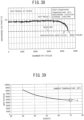
- a decrease in capacity of the lead-acid battery due to deterioration occurs, for example, from around 3900 cycles with respect to 4500 cycles of life, and there is a possibility that a characteristic change is not observed until the end of the life of the lead-acid battery.
- a main factor of the decrease in capacity of the lead-acid battery is a decrease in adhesion between a positive electrode grid and an active material. From the viewpoint of energy density, in a bipolar lead-acid battery that has attracted attention in recent years, there is a possibility that a further rapid decrease in capacity may occur toward the end of life.
- CT value capacity turnover value
- the capacity turnover value is a value obtained by dividing the total discharge capacity by a rated capacity of the storage battery, and is used as a life index of the storage battery.
- the number of discharges (cycle life) from the beginning to the end of life is obtained under certain conditions, and the capacity turnover value from the beginning to the end of life can be calculated.
- FIG. 39 illustrates an example of a relationship between a DOD representing a depth of discharge and the life of the storage battery.
- the remaining life of the lead-acid battery can be estimated by comparing the capacity turnover value from the beginning to the end of life with the capacity turnover value during operation.
- the lead-acid battery life prediction method described in PTL 1 integrates a charged electricity amount from a charge current value of a lead-acid battery, and predicts a life of the lead-acid battery from the integrated value.
- a relationship between a charging battery voltage and a battery temperature and a charging current is measured in advance using a standard lead-acid battery, a charging battery voltage and a battery temperature of a target lead-acid battery are detected, and a charge current value is determined based on the detected values and the above-described relationship.
- the SOC means the state of charge, and is obtained by dividing the sum of the rated capacity of the lead-acid battery and the total charge amount and the total discharge amount from completion of an equalization charge to a corresponding time point by the rated capacity, assuming that the SOC when the equalization charge is completed is 100%.
- the SOC can be expressed by the following Formula (1).
- a lead-acid battery system S illustrated in FIG. 1 is a system that stores, in a lead-acid battery B, a grid current generated by various power plants such as thermal power plants or from renewable energy such as wind power generation and transmitted, and transmits the power stored in the lead-acid battery B to a load such as a home, an office, or a factory as necessary.
- the lead-acid battery system S includes a BMU 1, an EMS 2, and a PCS 3 in addition to the lead-acid battery B.
- a function of the BMU 1 is not limited to the function described here, and may include other functions such as managing the balance of voltages in the respective cells, for example.
- the EMS 2 is a so-called energy management system, and is a system that grasps, manages, and optimizes a use state of power energy.
- the PCS 3 is a power conditioning system, and serves a role of converting a direct current generated from a grid current or the like into an alternating current and adjusting the alternating current to an output to the load or a stable output suitable for storage in the lead-acid battery B.
- the lead-acid battery B is a secondary battery using lead as an electrode.
- a bipolar lead-acid battery is preferably applied, but any structure may be used, and the number of installations, an installation method, and the like are not limited, and any setting can be used.
- information acquired from various sensors to be described later is transmitted to the BMU 1, but a transmission/reception device or the like for transmitting the acquired sensor information to the BMU 1 and receiving, for example, a command from the PCS 3 is provided.
- the lead-acid battery B includes various sensors (not illustrated in FIG. 1 ) for acquiring corresponding operation history information.
- the various sensors are sensors that acquire information indicating an operation history or state of the lead-acid battery B such as a current, a voltage, or a temperature. These sensors may be provided for each unit or for each individual lead-acid battery B.
- the direct current from the grid current from the power plant such as a thermal power plant or renewable energy is converted into the alternating current in the PCS 3, and output to the load or storage in the lead-acid battery B is performed.
- the BMU 1 estimates the remaining life of the lead-acid battery B, grasps a charge rate, the degree of deterioration, and the like of the lead-acid battery B, and issues an operation command to the EMS 2 according to the state of the lead-acid battery B.
- This operation command is further transmitted to the PCS 3 to appropriately issue a command for charging or discharging the lead-acid battery B and perform the above-described output to the load and the like.
- the BMU 1, the EMS 2, the PCS 3, and the lead-acid battery B are exemplified as four constituent elements of the lead-acid battery system S, but the constituent elements of the lead-acid battery system S are not limited thereto. It is also possible to impart the functions of the EMS 2 and the PCS 3 to the BMU 1, and in this case, the lead-acid battery system S is constituted by the BMU 1 and the lead-acid battery B.
- FIG. 2 is a block diagram illustrating an internal configuration of the BMUs included in the lead-acid battery systems S according to the first embodiment of the present invention and the second to sixth embodiments described below.
- the BMU 1 includes a measurement unit 11, a recording unit 12, a state determination unit 13, a setting unit 14, and a communication unit 15.
- the measurement unit 11 receives information regarding a measured value such as a current, a voltage, or a temperature measured via the above-described various sensors provided in the lead-acid battery B. Note that the measurement unit 11 may be set to continuously receive the above-described information, or may receive the above-described information between two time points arbitrarily set in advance. Alternatively, the measurement unit 11 may be set to periodically receive the information.
- a measured value such as a current, a voltage, or a temperature measured via the above-described various sensors provided in the lead-acid battery B.
- the measurement unit 11 may be set to continuously receive the above-described information, or may receive the above-described information between two time points arbitrarily set in advance. Alternatively, the measurement unit 11 may be set to periodically receive the information.
- the recording unit 12 records information regarding the measured value received from the various sensors by the measurement unit 11, information exchanged with the EMS 2, information necessary for calculating the capacity turnover value during operation and the capacity turnover value from the beginning to the end of life (for example, a rated capacity or the like of the lead-acid battery B), a result of processing executed by the state determination unit 13 (the remaining life of the lead-acid battery B and the capacity turnover value during operation calculated by state determination unit 13), and the like.
- the total charge amount and the total discharge amount of the lead-acid battery B from the beginning of operation to a corresponding time point are constantly calculated based on a current value when the lead-acid battery B is charged and discharged, the current value being received from a current sensor by the measurement unit 11, and the total charge amount and the total discharge amount of the lead-acid battery B from the beginning of operation to the corresponding time point are constantly recorded in the recording unit 12.
- the state determination unit 13 determines the state of the lead-acid battery B, specifically, estimates the remaining life of the lead-acid battery B by comparing the capacity turnover value from the beginning to the end of life and the capacity turnover value during operation.
- the capacity turnover value is a value obtained by dividing a total discharge capacity by a rated capacity of a storage battery, and is used as a life index of the storage battery.
- the capacity turnover value from the beginning to the end of life is obtained by dividing the total discharge capacity from the beginning to the end of life by the rated capacity of the storage battery. For example, in FIG.
- the capacity turnover value during operation is calculated by a method described below.
- the processing in the state determination unit 13 is executed as needed in normal operation, for example.
- the processing in the state determination unit 13 is executed from a time point a1 at the time of the n-th charge Cn of the lead-acid battery B to a time point b1 after the end of the n-th discharge Dn, and the processing is repeated at the time of charging and discharging.
- the setting unit 14 sets, for example, a first threshold, a second threshold, and the like of a current value used for charge/discharge determination, which are used when the state determination unit 13 determines the state of the lead-acid battery B, specifically, estimates the remaining life of the lead-acid battery B, and transmits the set information to the recording unit 12.
- a first threshold for charge/discharge determination
- a second threshold for charge/discharge determination
- an input unit and a display unit are used.
- the communication unit 15 transmits the result of the processing in the state determination unit 13 recorded in the recording unit 12 to the EMS 2.
- the BMU 1 is a computer system having an arithmetic processing function as described above and has a configuration in which a central processing unit (CPU), a read only memory (ROM), a random access memory (RAM), and an input/output interface are connected via a bus.
- CPU central processing unit
- ROM read only memory
- RAM random access memory
- input/output interface an input/output interface
- the input unit and the display unit used by a person who manages the lead-acid battery system S are connected to the input/output interface, and each unit illustrated in FIG. 2 described above is connected to the input/output interface.
- the CPU reads and executes a boot program for activating the BMU 1 from the ROM based on an input signal from the input unit, and reads various operating systems stored in the recording unit 12.
- the CPU may control the lead-acid battery B or the like based on an input signal from another external device (not illustrated in FIG. 2 ) via the input unit or the input/output interface.
- the CPU is a processing device that reads a program and data stored in the RAM, the recording unit 12, or the like and loads the program and the data into the RAM, and implements a series of processing such as calculation and processing of data necessary for estimating the remaining life of the lead-acid battery B based on a command of the program read from the RAM.
- the input unit is implemented by an input device such as a touch panel to which a person who manages the lead-acid battery system S inputs various operations, and an input signal is created based on the operation of the manager and transmitted to the CPU via the bus.
- an input device such as a touch panel to which a person who manages the lead-acid battery system S inputs various operations, and an input signal is created based on the operation of the manager and transmitted to the CPU via the bus.
- the display unit is, for example, a liquid crystal display.
- the display unit receives an output signal from the CPU via the bus and displays a processing result of the CPU.
- the input unit and the display unit do not have to be provided inside the BMU 1.
- the BMU 1 may have functions other than the above-described units.
- FIG. 5 is a block diagram illustrating the internal configurations of the recording unit 12 and the state determination unit 13 included in the BMU 1 illustrated in FIG. 2 in the lead-acid battery system S according to the first embodiment of the present invention.
- the recording unit 12 is implemented by, for example, a semiconductor or a magnetic disk.
- the recording unit 12 records information regarding the measured value received from the various sensors by the measurement unit 11, such as information regarding a current value and a voltage value when the lead-acid battery B is charged or discharged, or information regarding the temperature of the lead-acid battery B, information exchanged with the EMS 2, information necessary for calculating the capacity turnover value during operation and the capacity turnover value from the beginning to the end of life (for example, the rated capacity or the like of the lead-acid battery B), a result of processing executed by the state determination unit 13 (the remaining life of the lead-acid battery B and the capacity turnover value during operation calculated by state determination unit 13), and the like.
- the total charge amount and the total discharge amount (negative value) from completion of an equalization charge of the lead-acid battery B to the corresponding time point are constantly calculated based on the current value when the lead-acid battery B is charged and discharged, the current value being received from the current sensor by the measurement unit 11, and the total charge amount and the total discharge amount (negative value) from the completion of the equalization charge to the corresponding time point are constantly recorded in the recording unit 12.
- the state determination unit 13 of the first embodiment calculates the capacity turnover value during operation by using both an upper-limit-SOC-based correction coefficient K HSOC calculated based on a calculated upper limit state of charge (SOC), which is an SOC having the largest value when the lead-acid battery B is charged, and an upper-limit-voltage-based correction coefficient K HV calculated based on a calculated upper limit voltage, which is the highest voltage when the lead-acid battery B is charged.
- SOC state of charge
- the state determination unit 13 of the first embodiment calculates SOC sta(n) at the start of the discharge (n-th discharge Dn) of the lead-acid battery B to be subjected to calculation of the capacity turnover value during operation as the upper limit SOC.
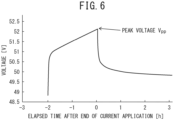
- the state determination unit 13 of the first embodiment calculates a peak voltage V pp,end(n) at the end of the charge (n-th charge Cn) immediately before the discharge (n-th discharge Dn) of the lead-acid battery B to be subjected to calculation of the capacity turnover value during operation as the upper limit voltage.
- the state determination unit 13 includes a first current value/voltage value acquisition unit 131, a discharge determination unit 132, an upper limit voltage calculation unit 133, an upper limit SOC calculation unit 134, a discharge current integration unit 135, a second current value/voltage value acquisition unit 136, a charge/discharge determination unit 137, a capacity turnover value calculation unit 138, and a life estimation unit 139 in order to estimate the remaining life of the lead-acid battery B.
- the first threshold is a negative current value near 0 amperes, and in a case where the current value is smaller than the first threshold, it is determined that the lead-acid battery B is in the discharge (n-th discharge Dn) state, and in a case where the current value is equal to or larger than the first threshold, it is determined that the lead-acid battery B is not in the discharge (n-th discharge Dn) state (the stop state or the charge (n-th charge Cn) state).
- the first threshold for the discharge determination is set by the setting unit 14 and recorded in the recording unit 12, and the discharge determination unit 132 acquires information regarding the first threshold from the recording unit 12.
- the upper limit voltage calculation unit 133 calculates the upper limit voltage which is the highest voltage when the lead-acid battery B is charged. More specifically, in a case where the determination result of the discharge determination unit 132 indicates that the lead-acid battery B is not in the discharge (n-th discharge Dn) state (the stop state or the charge (n-th charge Cn) state), it is determined whether or not the voltage value (V meas ) acquired by the first current value/voltage value acquisition unit 131 exceeds a voltage already set as a peak voltage V pp acquired from the recording unit 12.
- the voltage value (V meas ) exceeds the peak voltage V pp
- the voltage value (V meas ) is newly set as the peak voltage V pp
- the voltage already set as the peak voltage V pp is set as the peak voltage V pp . This setting is repeated until it is determined that the current value acquired by the first current value/voltage value acquisition unit 131 indicates the discharge state, and the finally set peak voltage V pp is calculated as the peak voltage V pp .
- the upper limit voltage calculation unit 133 calculates the peak voltage V pp,end(n) at the end of the charge (n-th charge Cn) immediately before the discharge (n-th discharge Dn) of the lead-acid battery B to be subjected to calculation of the capacity turnover value during operation (see FIG. 4 ), and sets the calculated peak voltage V pp,end(n) as the upper limit voltage.
- the upper limit SOC calculation unit 134 calculates the upper limit SOC, which is the SOC having the largest value when the lead-acid battery B is charged. More specifically, in a case where the determination result of the discharge determination unit 132 indicates that the lead-acid battery B is in the discharge (n-th discharge Dn) state, the upper limit SOC calculation unit 134 calculates SOC sta(n) at the start of the discharge (n-th discharge Dn) of the lead-acid battery B to be subjected to calculation of the capacity turnover value during operation as the upper limit SOC (see FIG. 3 ).
- the upper limit SOC calculation unit 134 acquires, from the recording unit 12, the rated capacity of the lead-acid battery B, the total charge amount of the lead-acid battery B from the completion of the equalization charge to a start time point of the n-th discharge Dn recorded in the recording unit 12 at the start of the n-th discharge Dn, and the total discharge amount (negative value) of the lead-acid battery B from the completion of the equalization charge to the start time point of the n-th discharge Dn recorded in the recording unit 12 at the start of the n-th discharge Dn, and calculates SOC sta(n) by the following Formula (2) similar to Formula (1) described above.
- Formula (2) Similar to Formula (1) described above.
- the discharge current integration unit 135 integrates discharge current values from the start of the discharge of the lead-acid battery B, and calculates an integrated discharge capacity value from the start of the discharge of the lead-acid battery B.
- the second current value/voltage value acquisition unit 136 acquires, from the recording unit 12, information regarding the current value and the voltage value of the lead-acid battery B input to the recording unit 12 via the measurement unit 11 from the start to the end of the processing in the state determination unit 13.
- the charge/discharge determination unit 137 determines whether the lead-acid battery B is in a discharge state, the stop state, or the charge state based on the current value of the lead-acid battery B acquired by the second current value/voltage value acquisition unit 136.
- the charge/discharge determination unit 137 determines that the lead-acid battery B is in the discharge (n-th discharge Dn) state
- the first threshold is the same value as the above-described first threshold, and the second threshold is a positive current value near 0 amperes.
- the capacity turnover value calculation unit 138 calculates the capacity turnover value during operation (hereinafter, referred to as a CT value during operation).
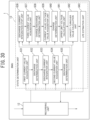
- FIG. 7 is a block diagram illustrating an internal configuration of the capacity turnover value calculation unit 138 included in the state determination unit 13 illustrated in FIG. 5 .
- the capacity turnover value calculation unit 138 includes a previous capacity turnover value acquisition unit 138a, an integrated discharge capacity acquisition unit 138b, a rated capacity acquisition unit 138c, an upper limit SOC acquisition unit 138d, an upper-limit-SOC-based correction coefficient calculation unit 138e, an upper limit voltage acquisition unit 138f, an upper-limit-voltage-based correction coefficient calculation unit 138g, and a capacity turnover value computation unit 138h.
- the previous capacity turnover value acquisition unit 138a acquires, from the recording unit 12, a capacity turnover value before the start of the processing in the state determination unit 13 (before the time point a1 in FIG. 3 ) (hereinafter, referred to as a previous CT value).
- the previous CT value is a CT value during operation calculated by the capacity turnover value calculation unit 138 at the time of the previous processing in the state determination unit 13, and already input from the capacity turnover value calculation unit 138 to the recording unit 12.
- the integrated discharge capacity acquisition unit 138b acquires information regarding the integrated discharge capacity value from the start of the discharge of the lead-acid battery B calculated by the discharge current integration unit 135.
- the rated capacity acquisition unit 138c acquires information regarding the rated capacity (Ah) of the lead-acid battery B from the recording unit 12.
- the upper limit SOC acquisition unit 138d acquires information regarding the upper limit SOC calculated by the upper limit SOC calculation unit 134.
- the upper-limit-SOC-based correction coefficient calculation unit 138e calculates the upper-limit-SOC-based correction coefficient K HSOC by using the upper limit SOC acquired by the upper limit SOC acquisition unit 138d.
- the upper-limit-SOC-based correction coefficient K HSOC is calculated with reference to a graph illustrating a relationship between the upper limit SOC and the upper-limit-SOC-based correction coefficient K HSOC illustrated in FIG. 10 .
- the upper-limit-SOC-based correction coefficient K HSOC between the respective numerical values is calculated by creating an approximation curve from values of two adjacent points.
- the upper limit voltage acquisition unit 138f acquires information regarding the upper limit voltage calculated by the upper limit voltage calculation unit 133.
- the upper-limit-voltage-based correction coefficient calculation unit 138g calculates the upper-limit-voltage-based correction coefficient K HV by using the upper limit voltage acquired by the upper limit voltage acquisition unit 138f.
- the upper-limit-voltage-based correction coefficient K HV is calculated with reference to a graph illustrating a relationship between the upper limit voltage and the upper-limit-voltage-based correction coefficient K HV illustrated in FIG. 11 .
- the upper-limit-voltage-based correction coefficient K HV between the respective numerical values is calculated by creating an approximation curve from values of two adjacent points.
- the upper-limit-voltage-based correction coefficient K HV 1, which is constant.
- the capacity turnover value computation unit 138h calculates the CT value during operation by the following Formula (3) using the previous CT value acquired by the previous capacity turnover value acquisition unit 138a, the integrated discharge capacity from the start of the discharge of the lead-acid battery B acquired by the integrated discharge capacity acquisition unit 138b, the rated capacity (Ah) of the lead-acid battery B acquired by the rated capacity acquisition unit 138c, the upper-limit-SOC-based correction coefficient K HSOC calculated by the upper-limit-SOC-based correction coefficient calculation unit 138e, and the upper-limit-voltage-based correction coefficient HV calculated by the upper-limit-voltage-based correction coefficient calculation unit 138g.
- CT value during operation Previous CT value + Integrated discharge capacity Rated capacity Ah ⁇ K HSOC ⁇ K HV
- the life estimation unit 139 estimates the remaining life of the lead-acid battery B by comparing the CT value from the beginning to the end of life acquired from the recording unit 12 with the CT value during operation calculated by the capacity turnover value calculation unit 138. That is, the life estimation unit 139 estimates the remaining life of the lead-acid battery B from a CT value obtained by subtracting the CT value during operation from the CT value from the beginning to the end of life.
- the life estimation unit 139 records an estimation result of the life estimation unit 139 including the CT value during operation in the recording unit 12.
- the life estimation unit 139 sets the peak voltage V pp calculated by the upper limit voltage calculation unit 133 to 0 and records the peak voltage V pp in the recording unit 12.
- the capacity turnover value calculation unit 138 calculates the CT value during operation by using both the upper-limit-SOC-based correction coefficient K HSOC calculated based on the upper limit SOC calculated by the upper limit SOC calculation unit 134 that calculates the upper limit SOC, which is the SOC having the largest value when the lead-acid battery B is charged, and the upper-limit-voltage-based correction coefficient K HV calculated based on the upper limit voltage calculated by the upper limit voltage calculation unit 133 that calculates the upper limit voltage, which is the highest voltage when the lead-acid battery B is charged.
- the CT value during operation can be calculated in consideration of both the upper limit SOC and the upper limit voltage, the progress of corrosion of a positive electrode and softening of an active material due to electrolyte loss can be considered, and the lead-acid battery system S capable of accurately estimating the remaining life of the lead-acid battery can be provided.
- the upper limit SOC calculation unit 134 calculates SOC sta(n) at the start of the discharge (n-th discharge Dn) of the lead-acid battery B to be subjected to calculation of the CT value during operation as the upper limit SOC, and the capacity turnover value calculation unit 138 calculates the upper-limit-SOC-based correction coefficient K HSOC based on the upper limit SOC calculated by the upper limit SOC calculation unit 134.
- the upper limit SOC can be determined and calculated at the start of the discharge (n-th discharge Dn) of the lead-acid battery B to be subjected to calculation of the CT value during operation, and the upper-limit-SOC-based correction coefficient K HSOC can be appropriately calculated based on the calculated upper limit SOC.
- the upper limit voltage calculation unit 133 calculates the peak voltage V pp,end(n) at the end of the charge (n-th charge Cn) immediately before the discharge (n-th discharge Dn) of the lead-acid battery B to be subjected to calculation of the CT value during operation as the upper limit voltage, and the capacity turnover value calculation unit 138 calculates the upper-limit-voltage-based correction coefficient K HV based on the upper limit voltage calculated by the upper limit voltage calculation unit 133.
- the upper limit voltage can be calculated by calculating the peak voltage V pp,end(n) at the end of the charge (n-th charge Cn) immediately before the discharge (n-th discharge Dn) of the lead-acid battery B to be subjected to calculation of the CT value during operation, and the upper-limit-voltage-based correction coefficient K HV can be appropriately calculated based on the calculated upper limit voltage.
- the lead-acid battery system S in a case where the lead-acid battery B is a bipolar lead-acid battery, it is possible to provide the lead-acid battery system S capable of accurately estimating the remaining life of the bipolar lead-acid battery.
- the state determination unit 13 starts the processing from the time point a1 in FIGS. 3 and 4 .
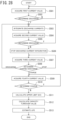
- the first current value/voltage value acquisition unit 131 of the state determination unit 13 acquires, from the recording unit 12, information regarding the current value and the voltage value (V meas ) of the lead-acid battery B input to the recording unit 12 via the measurement unit 11 from the start to the end (the time point b1 in FIGS. 3 and 4 ) of the processing in the state determination unit 13 (first current value/voltage value acquisition step).
- step S2 the discharge determination unit 132 determines whether or not the lead-acid battery B is in the discharge (n-th discharge Dn) state based on the current value of the lead-acid battery B acquired in step S1 (discharge determination step). Specifically, in a case where the current value of the lead-acid battery B acquired in step S1 is smaller than the first threshold, it is determined that the lead-acid battery B is in the discharge (n-th discharge Dn) state, and in a case where the current value is equal to or larger than the first threshold, it is determined that the lead-acid battery B is not in the discharge (n-th discharge Dn) state (the stop state or the charge (n-th charge Cn) state).
- the first threshold is a negative current value near 0 amperes, and in a case where the current value is smaller than the first threshold, it is determined that the lead-acid battery B is in the discharge (n-th discharge Dn) state, and in a case where the current value is equal to or larger than the first threshold, it is determined that the lead-acid battery B is not in the discharge (n-th discharge Dn) state (the stop state or the charge (n-th charge Cn) state).
- the first threshold for the discharge determination is set by the setting unit 14 and recorded in the recording unit 12, and the discharge determination unit 132 acquires information regarding the first threshold from the recording unit 12.
- step S2 In a case where it is determined in step S2 that the lead-acid battery B is not in the discharge (n-th discharge Dn) state (the stop state or the charge (n-th charge Cn) state), the processing proceeds to step S3, and in a case where it is determined in step S2 that the lead-acid battery B is in the discharge (n-th discharge Dn) state, the processing proceeds to step S4.
- step S3 the upper limit voltage calculation unit 133 calculates the upper limit voltage which is the highest voltage when the lead-acid battery B is charged (upper limit voltage calculation step). More specifically, in step S31, it is determined whether or not the voltage value (V meas ) acquired in step S1 exceeds the voltage already set as the peak voltage V pp acquired from the recording unit 12. In a case where the voltage value (V meas ) exceeds the peak voltage V pp , the voltage value (V meas ) is newly set as the peak voltage V pp in step S32.
- step S33 the voltage value already set as the peak voltage V pp in step S33 is set as the peak voltage V pp . Then, this setting is repeated until it is determined that the current value acquired in step S1 indicates the discharge state in step S2, and the finally set peak voltage V pp is calculated as the peak voltage V pp . That is, in step S3, the upper limit voltage calculation unit 133 calculates the peak voltage V pp,end(n) at the end of the charge (n-th charge Cn) immediately before the discharge (n-th discharge Dn) of the lead-acid battery B to be subjected to calculation of the capacity turnover value during operation (see FIG. 4 ), and sets the calculated peak voltage V pp,end(n) as the upper limit voltage.
- step S4 the upper limit SOC calculation unit 134 calculates the upper limit SOC, which is the SOC having the largest value when the lead-acid battery B is charged (upper limit SOC calculation step). Specifically, the upper limit SOC calculation unit 134 calculates SOC sta(n) at the start of the discharge (n-th discharge Dn) of the lead-acid battery B to be subjected to calculation of the capacity turnover value during operation, and sets the calculated SOC sta(n) as the upper limit SOC (see FIG. 3 ).
- the upper limit SOC calculation unit 134 acquires, from the recording unit 12, the rated capacity of the storage battery B, the total charge amount of the lead-acid battery B from the completion of the equalization charge to a start time point of the n-th discharge Dn recorded in the recording unit 12 at the start of the n-th discharge Dn, and the total discharge amount (negative value) of the lead-acid battery B from the completion of the equalization charge to the start time point of the n-th discharge Dn recorded in the recording unit 12 at the start of the n-th discharge Dn, and calculates SOC sta(n) by Formula (2) described above.
- step S5 the discharge current integration unit 135 integrates the discharge current values from the start of the discharge of the lead-acid battery B, and calculates the integrated discharge capacity value from the start of the discharge of the lead-acid battery B (integrated discharge capacity value calculation step).
- step S6 the second current value/voltage value acquisition unit 136 acquires, from the recording unit 12, information regarding the current value and the voltage value of the lead-acid battery B input to the recording unit 12 via the measurement unit 11 from the start to the end of the processing in the state determination unit 13 (second current value/voltage value acquisition step).
- step S7 the charge/discharge determination unit 137 determines whether the lead-acid battery B is in the discharge state, the stop state, or the charge state based on the current value of the lead-acid battery B acquired in step S6 (charge/discharge determination step).
- the charge/discharge determination unit 137 determines that the lead-acid battery B is in the discharge (n-th discharge Dn) state,
- the first threshold is the same value as the above-described first threshold, and the second threshold is a positive current value near 0 amperes.
- step S7 In a case where the determination result in step S7 indicates the stop state, the current value is set to 0 in step S8, and the processing returns to step S5.
- step S7 indicates the discharge state
- the processing returns to step S5.
- step S7 determines whether the charge (n+1-th charge Cn+1) state.
- step S9 the capacity turnover value calculation unit 138 calculates the CT value during operation (capacity turnover value calculation step).
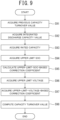
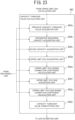
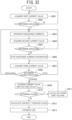
- FIG. 9 is a flowchart illustrating a flow of processing of step S9 (capacity turnover value calculation step) in the flowchart illustrated in FIG. 8 .
- the previous capacity turnover value acquisition unit 138a acquires the CT value before the start of the processing in the state determination unit 13 (before the time point a1 in FIG. 3 ) from the recording unit 12 (previous CT value acquisition step).
- the previous CT value is a CT value during operation calculated in step S9 at the time of the previous processing in the state determination unit 13, and already input from the capacity turnover value calculation unit 138 to the recording unit 12.
- step S92 the integrated discharge capacity acquisition unit 138b acquires information regarding the integrated discharge capacity value from the start of the discharge of the lead-acid battery B calculated in step S5 (integrated discharge capacity value acquisition step).
- step S93 the rated capacity acquisition unit 138c acquires information regarding the rated capacity (Ah) of the lead-acid battery B from the recording unit 12 (rated capacity acquisition step).
- step S94 the upper limit SOC acquisition unit 138d acquires information regarding the upper limit SOC calculated in step S4 (upper limit SOC acquisition step).
- the upper-limit-SOC-based correction coefficient calculation unit 138e calculates the upper-limit-SOC-based correction coefficient K HSOC by using the upper limit SOC acquired in step S94 (upper-limit-SOC-based correction coefficient calculation step).
- the upper-limit-SOC-based correction coefficient K HSOC is calculated with reference to a graph illustrating a relationship between the upper limit SOC and the upper-limit-SOC-based correction coefficient K HSOC illustrated in FIG. 10 .
- the upper-limit-SOC-based correction coefficient K HSOC between the respective numerical values is calculated by creating an approximation curve from values of two adjacent points.
- step S96 the upper limit voltage acquisition unit 138f acquires information regarding the upper limit voltage calculated in step S3 (upper limit voltage acquisition step).
- the upper-limit-voltage-based correction coefficient calculation unit 138g calculates the upper-limit-voltage-based correction coefficient K HV by using the upper limit voltage acquired in step S96 (upper-limit-voltage-based correction coefficient calculation step).
- the upper-limit-voltage-based correction coefficient K HV is calculated with reference to a graph illustrating a relationship between the upper limit voltage and the upper-limit-voltage-based correction coefficient K HV illustrated in FIG. 11 .
- the upper-limit-voltage-based correction coefficient K HV between the respective numerical values is calculated by creating an approximation curve from values of two adjacent points.
- the upper-limit-voltage-based correction coefficient K HV 1, which is constant.
- step S98 the capacity turnover value computation unit 138h calculates the CT value during operation by Formula (3) described above using the previous CT value acquired in step S91, the integrated discharge capacity from the start of the discharge of the lead-acid battery B acquired in step S92, the rated capacity (Ah) of the lead-acid battery B acquired in step S93, the upper-limit-SOC-based correction coefficient K HSOC calculated in step S95, and the upper-limit-voltage-based correction coefficient K HV calculated in step S97 (capacity turnover value computation step).
- step S10 the life estimation unit 139 of the state determination unit 13 estimates the remaining life of the lead-acid battery B by comparing the CT value from the beginning to the end of life acquired from the recording unit 12 with the CT value during operation calculated in step S9. That is, the life estimation unit 139 estimates the remaining life of the lead-acid battery B from a CT value obtained by subtracting the CT value during operation from the CT value from the beginning to the end of life (life estimation step).
- the life estimation unit 139 records an estimation result of the life estimation unit 139 including the CT value during operation in the recording unit 12.
- the life estimation unit 139 sets the peak voltage V pp calculated in step S3 to 0 and records the peak voltage V pp in the recording unit 12.
- the CT value during operation is calculated using both the upper-limit-SOC-based correction coefficient K HSOC calculated based on the upper limit SOC calculated in the upper limit SOC calculation step (step S4) of calculating the upper limit SOC, which is the SOC having the largest value when the lead-acid battery B is charged, and the upper-limit-voltage-based correction coefficient K HV calculated based on the upper limit voltage calculated in the upper limit voltage calculation step (step S3) of calculating the upper limit voltage, which is the highest voltage when the lead-acid battery B is charged.
- the CT value during operation can be calculated in consideration of both the upper limit SOC and the upper limit voltage, the progress of corrosion of a positive electrode and softening of an active material due to electrolyte loss can be considered, and the lead-acid battery life estimation method capable of accurately estimating the remaining life of the lead-acid battery can be provided.
- step S4 SOC sta(n) at the start of the discharge (n-th discharge Dn) of the lead-acid battery B to be subjected to calculation of the CT value during operation is calculated as the upper limit SOC, and in the capacity turnover value calculation step (step S9), the upper-limit-SOC-based correction coefficient K HSOC is calculated based on the upper limit SOC calculated in the upper limit SOC calculation step (step S4).
- the upper limit SOC can be determined and calculated at the start of the discharge (n-th discharge Dn) of the lead-acid battery B to be subjected to calculation of the CT value during operation, and the upper-limit-SOC-based correction coefficient K HSOC can be appropriately calculated based on the calculated upper limit SOC.
- the peak voltage V pp,end(n) at the end of the charge (n-th charge Cn) immediately before the discharge (n-th discharge Dn) of the lead-acid battery B to be subjected to calculation of the CT value during operation is calculated as the upper limit voltage
- the capacity turnover value calculation step (step S9) the upper-limit-voltage-based correction coefficient K HV is calculated based on the upper limit voltage calculated in the upper limit voltage calculation step (step S3).
- the upper limit voltage can be calculated by calculating the peak voltage V pp,end(n) at the end of the charge (n-th charge Cn) immediately before the discharge (n-th discharge Dn) of the lead-acid battery B to be subjected to calculation of the CT value during operation, and the upper-limit-voltage-based correction coefficient K HV can be appropriately calculated based on the calculated upper limit voltage.
- the lead-acid battery life estimation method in a case where the lead-acid battery B is a bipolar lead-acid battery, it is possible to provide a lead-acid battery life estimation method capable of accurately estimating the remaining life of the bipolar lead-acid battery.
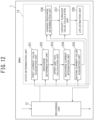
- FIG. 12 is a block diagram illustrating internal configurations of a recording unit and a state determination unit included in the BMU illustrated in FIG. 2 in the lead-acid battery system according to the second embodiment of the present invention.
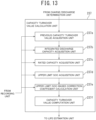
- FIG. 13 is a block diagram illustrating an internal configuration of a capacity turnover value calculation unit included in the state determination unit illustrated in FIG. 12 .
- the lead-acid battery system S according to the second embodiment has the same basic configuration as the lead-acid battery system S according to the first embodiment, and is different from the lead-acid battery system S according to the first embodiment in a configuration of the state determination unit 13.
- the state determination unit 13 in the lead-acid battery system S calculates a capacity turnover value during operation by using both an upper-limit-SOC-based correction coefficient K HSOC calculated based on a calculated upper limit SOC, which is an SOC having the largest value when a lead-acid battery B is charged, and an upper-limit-voltage-based correction coefficient K HV calculated based on a calculated upper limit voltage, which is the highest voltage when the lead-acid battery B is charged.
- the state determination unit 13 in the lead-acid battery system S according to the second embodiment is different in that the capacity turnover value during operation is calculated using only the upper-limit-SOC-based correction coefficient K HSOC out of the upper-limit-SOC-based correction coefficient K HSOC and the upper-limit-voltage-based correction coefficient K HV .
- the state determination unit 13 of the second embodiment calculates SOC sta(n) at the start of a discharge (n-th discharge Dn) of the lead-acid battery B to be subjected to calculation of the capacity turnover value during operation as the upper limit SOC.
- the processing in the state determination unit 13 in the lead-acid battery system S according to the second embodiment is executed from a time point a1 at the time of the n-th charge Cn of the lead-acid battery B to a time point b1 after the end of the n-th discharge Dn, and the processing is repeated at the time of charging and discharging.
- the state determination unit 13 of the second embodiment includes a first current value acquisition unit 231, a discharge determination unit 232, an upper limit SOC calculation unit 233, a discharge current integration unit 234, a second current value acquisition unit 235, a charge/discharge determination unit 236, a capacity turnover value calculation unit 237, and a life estimation unit 238 in order to estimate the remaining life of the lead-acid battery B.
- the first current value acquisition unit 231 acquires, from the recording unit 12, information regarding a current value of the lead-acid battery B input to the recording unit 12 via a measurement unit 11 from the start to the end of the processing in the state determination unit 13.
- the discharge determination unit 232 determines whether or not the lead-acid battery B is in a discharge (n-th discharge Dn) state based on the current value of the lead-acid battery B acquired by the first current value acquisition unit 231. Specifically, in a case where the current value of the lead-acid battery B acquired by the first current value acquisition unit 231 is smaller than a first threshold, it is determined that the lead-acid battery B is in the discharge (n-th discharge Dn) state, and in a case where the current value is equal to or larger than the first threshold, it is determined that the lead-acid battery B is not in the discharge (n-th discharge Dn) state (a stop state or a charge (n-th charge Cn) state).
- the first threshold is a negative current value near 0 amperes, and in a case where the current value is smaller than the first threshold, it is determined that the lead-acid battery B is in the discharge (n-th discharge Dn) state, and in a case where the current value is equal to or larger than the first threshold, it is determined that the lead-acid battery B is not in the discharge (n-th discharge Dn) state (the stop state or the charge (n-th charge Cn) state).
- the first threshold for the discharge determination is set by the setting unit 14 and recorded in the recording unit 12, and the discharge determination unit 132 acquires information regarding the first threshold from the recording unit 12.
- the upper limit SOC calculation unit 233 calculates the upper limit SOC, which is the SOC having the largest value when the lead-acid battery B is charged. More specifically, in a case where the determination result of the discharge determination unit 232 indicates that the lead-acid battery B is in the discharge (n-th discharge Dn) state, the upper limit SOC calculation unit 233 calculates SOC sta(n) at the start of the discharge (n-th discharge Dn) of the lead-acid battery B to be subjected to calculation of the capacity turnover value during operation as the upper limit SOC (see FIG. 3 ).
- the upper limit SOC calculation unit 233 acquires, from the recording unit 12, the rated capacity of the lead-acid battery B, the total charge amount of the lead-acid battery B from completion of an equalization charge to a start time point of the n-th discharge Dn recorded in the recording unit 12 at the start of the n-th discharge Dn, and the total discharge amount (negative value) of the lead-acid battery B from the completion of the equalization charge to the start time point of the n-th discharge Dn recorded in the recording unit 12 at the start of the n-th discharge Dn, and calculates SOC sta(n) by Formula (2) described above.
- the discharge current integration unit 234 integrates discharge current values from the start of the discharge of the lead-acid battery B, and calculates an integrated discharge capacity value from the start of the discharge of the lead-acid battery B.
- the second current value acquisition unit 235 acquires, from the recording unit 12, information regarding the current value and a voltage value of the lead-acid battery B input to the recording unit 12 via the measurement unit 11 from the start to the end of the processing in the state determination unit 13.
- the charge/discharge determination unit 236 determines whether the lead-acid battery B is in a discharge state, the stop state, or the charge state based on the current value of the lead-acid battery B acquired by the second current value acquisition unit 235.
- the charge/discharge determination unit 236 determines that the lead-acid battery B is in the discharge (n-th discharge Dn) state,
- the first threshold and the second threshold are values similar to those described above.
- the capacity turnover value calculation unit 237 calculates the capacity turnover value during operation (hereinafter, referred to as a CT value during operation).
- the capacity turnover value calculation unit 237 includes a previous capacity turnover value acquisition unit 237a, an integrated discharge capacity acquisition unit 237b, a rated capacity acquisition unit 237c, an upper limit SOC acquisition unit 237d, an upper-limit-SOC-based correction coefficient calculation unit 237e, and a capacity turnover value computation unit 237f.
- the previous capacity turnover value acquisition unit 237a acquires, from the recording unit 12, a capacity turnover value before the start of the processing in the state determination unit 13 (before the time point a1 in FIG. 3 ) (hereinafter, referred to as a previous CT value).
- the previous CT value is a CT value during operation calculated by the capacity turnover value calculation unit 138 at the time of the previous processing in the state determination unit 13, and already input from the capacity turnover value calculation unit 237 to the recording unit 12.
- the integrated discharge capacity acquisition unit 237b acquires information regarding the integrated discharge capacity value from the start of the discharge of the lead-acid battery B calculated by the discharge current integration unit 234.
- the rated capacity acquisition unit 237c acquires information regarding the rated capacity (Ah) of the lead-acid battery B from the recording unit 12.
- the upper limit SOC acquisition unit 237d acquires information regarding the upper limit SOC calculated by the upper limit SOC calculation unit 233.
- the upper-limit-SOC-based correction coefficient calculation unit 237e calculates the upper-limit-SOC-based correction coefficient K HSOC by using the upper limit SOC acquired by the upper limit SOC acquisition unit 237d.
- the upper-limit-SOC-based correction coefficient K HSOC is calculated with reference to a graph illustrating a relationship between the upper limit SOC and the upper-limit-SOC-based correction coefficient K HSOC illustrated in FIG. 10 .
- the upper-limit-SOC-based correction coefficient K HSOC between the respective numerical values is calculated by creating an approximation curve from values of two adjacent points.
- the capacity turnover value computation unit 237f calculates the CT value during operation by the following Formula (4) using the previous CT value acquired by the previous capacity turnover value acquisition unit 237a, the integrated discharge capacity from the start of the discharge of the lead-acid battery B acquired by the integrated discharge capacity acquisition unit 237b, the rated capacity (Ah) of the lead-acid battery B acquired by the rated capacity acquisition unit 237c, and the upper-limit-SOC-based correction coefficient K HSOC calculated by the upper-limit-SOC-based correction coefficient calculation unit 237e.
- CT value during operation Previous CT value + Integrated discharge capacity Rated capacity Ah ⁇ K HSOC
- the life estimation unit 238 estimates the remaining life of the lead-acid battery B by comparing the CT value from the beginning to the end of life acquired from the recording unit 12 with the CT value during operation calculated by the capacity turnover value calculation unit 237. That is, the life estimation unit 238 estimates the remaining life of the lead-acid battery B from a CT value obtained by subtracting the CT value during operation from the CT value from the beginning to the end of life.
- the life estimation unit 238 records an estimation result of the life estimation unit 238 including the CT value during operation in the recording unit 12.
- the capacity turnover value calculation unit 237 calculates the CT value during operation by using the upper-limit-SOC-based correction coefficient K HSOC calculated based on the upper limit SOC calculated by the upper limit SOC calculation unit 134 that calculates the upper limit SOC, which is the SOC having the largest value when the lead-acid battery B is charged.
- the CT value during operation can be calculated in consideration of the upper limit SOC, the progress of corrosion of a positive electrode and softening of an active material due to electrolyte loss can be considered, and the lead-acid battery system S capable of accurately estimating the remaining life of the lead-acid battery can be provided.
- the upper limit SOC calculation unit 233 calculates SOC sta(n) at the start of the discharge (n-th discharge Dn) of the lead-acid battery B to be subjected to calculation of the CT value during operation as the upper limit SOC, and the capacity turnover value calculation unit 138 calculates the upper-limit-SOC-based correction coefficient K HSOC based on the upper limit SOC calculated by the upper limit SOC calculation unit 134.
- the upper limit SOC can be determined and calculated at the start of the discharge (n-th discharge Dn) of the lead-acid battery B to be subjected to calculation of the CT value during operation, and the upper-limit-SOC-based correction coefficient K HSOC can be appropriately calculated based on the calculated upper limit SOC.
- the lead-acid battery system S in a case where the lead-acid battery B is a bipolar lead-acid battery, it is possible to provide the lead-acid battery system S capable of accurately estimating the remaining life of the bipolar lead-acid battery.
- the state determination unit 13 starts the processing from the time point a1 in FIG. 3 .
- the first current value acquisition unit 231 of the state determination unit 13 acquires, from the recording unit 12, information regarding the current value of the lead-acid battery B input to the recording unit 12 via the measurement unit 11 from the start to the end (the time point b1 in FIG. 3 ) of the processing in the state determination unit 13 (first current value acquisition step).
- step S102 the discharge determination unit 232 determines whether or not the lead-acid battery B is in the discharge (n-th discharge Dn) state based on the current value of the lead-acid battery B acquired in step S101 (discharge determination step). Specifically, in a case where the current value of the lead-acid battery B acquired in step S101 is smaller than the first threshold, it is determined that the lead-acid battery B is in the discharge (n-th discharge Dn) state, and in a case where the current value is equal to or larger than the first threshold, it is determined that the lead-acid battery B is not in the discharge (n-th discharge Dn) state (the stop state or the charge (n-th charge Cn) state).
- the first threshold is a negative current value near 0 amperes, and in a case where the current value is smaller than the first threshold, it is determined that the lead-acid battery B is in the discharge (n-th discharge Dn) state, and in a case where the current value is equal to or larger than the first threshold, it is determined that the lead-acid battery B is not in the discharge (n-th discharge Dn) state (the stop state or the charge (n-th charge Cn) state).
- the first threshold for the discharge determination is set by the setting unit 14 and recorded in the recording unit 12, and the discharge determination unit 132 acquires information regarding the first threshold from the recording unit 12.
- step S102 In a case where it is determined in step S102 that the lead-acid battery B is not in the discharge (n-th discharge Dn) state (the stop state or the charge (n-th charge Cn) state), the processing returns to step S101, and in a case where it is determined in step S102 that the lead-acid battery B is in the discharge (n-th discharge Dn) state, the processing proceeds to step S103.
- the upper limit SOC calculation unit 233 calculates the upper limit SOC, which is the SOC having the largest value when the lead-acid battery B is charged (upper limit SOC calculation step). Specifically, the upper limit SOC calculation unit 233 calculates SOC sta(n) at the start of the discharge (n-th discharge Dn) of the lead-acid battery B to be subjected to calculation of the capacity turnover value during operation, and sets the calculated SOC sta(n) as the upper limit SOC (see FIG. 3 ).
- the upper limit SOC calculation unit 233 acquires, from the recording unit 12, the rated capacity of the lead-acid battery B, the total charge amount of the lead-acid battery B from completion of an equalization charge to a start time point of the n-th discharge Dn recorded in the recording unit 12 at the start of the n-th discharge Dn, and the total discharge amount (negative value) of the lead-acid battery B from the completion of the equalization charge to the start time point of the n-th discharge Dn recorded in the recording unit 12 at the start of the n-th discharge Dn, and calculates SOC sta(n) by Formula (2) described above.
- step S104 the discharge current integration unit 234 integrates the discharge current values from the start of the discharge of the lead-acid battery B, and calculates the integrated discharge capacity value from the start of the discharge of the lead-acid battery B (integrated discharge capacity value calculation step).
- step S105 the second current value acquisition unit 235 acquires, from the recording unit 12, information regarding the current value and the voltage value of the lead-acid battery B input to the recording unit 12 via the measurement unit 11 from the start to the end of the processing in the state determination unit 13 (second current value acquisition step).
- step S106 the charge/discharge determination unit 236 determines whether the lead-acid battery B is in the discharge state, the stop state, or the charge state based on the current value of the lead-acid battery B acquired in step S105 (charge/discharge determination step).
- the charge/discharge determination unit 236 determines that the lead-acid battery B is in the discharge (n-th discharge Dn) state,
- the first threshold is the same value as the above-described first threshold, and the second threshold is a positive current value near 0 amperes.
- step S106 In a case where the determination result in step S106 indicates the stop state, the current value is set to 0 in step S107, and the processing returns to step S104. In addition, in a case where the determination result in step S106 indicates the discharge state, the processing returns to step S104.
- step S106 determines whether the charge (n+1-th charge Cn+1) state. If the determination result in step S106 indicates the charge (n+1-th charge Cn+1) state, the processing proceeds to step S108.
- step S108 the capacity turnover value calculation unit 237 calculates the CT value during operation (capacity turnover value calculation step).
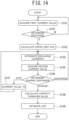
- FIG. 15 is a flowchart illustrating a flow of processing of step S108 (capacity turnover value calculation step) in the flowchart illustrated in FIG. 14 .
- the previous capacity turnover value acquisition unit 237a acquires the CT value before the start of the processing in the state determination unit 13 (before the time point a1 in FIG. 3 ) from the recording unit 12 (previous CT value acquisition step).
- the previous CT value is a CT value during operation calculated in step S9 at the time of the previous processing in the state determination unit 13, and already input from the capacity turnover value calculation unit 237 to the recording unit 12.
- step S1082 the integrated discharge capacity acquisition unit 237b acquires information regarding the integrated discharge capacity value from the start of the discharge of the lead-acid battery B calculated in step S104 (integrated discharge capacity value acquisition step).
- step S1083 the rated capacity acquisition unit 237c acquires information regarding the rated capacity (Ah) of the lead-acid battery B from the recording unit 12 (rated capacity acquisition step).
- step S1084 the upper limit SOC acquisition unit 237d acquires information regarding the upper limit SOC calculated in step S103 (upper limit SOC acquisition step).
- the upper-limit-SOC-based correction coefficient calculation unit 237e calculates the upper-limit-SOC-based correction coefficient K HSOC by using the upper limit SOC acquired in step S1084 (upper-limit-SOC-based correction coefficient calculation step).
- the upper-limit-SOC-based correction coefficient K HSOC is calculated with reference to a graph illustrating a relationship between the upper limit SOC and the upper-limit-SOC-based correction coefficient K HSOC illustrated in FIG. 10 .
- the upper-limit-SOC-based correction coefficient K HSOC between the respective numerical values is calculated by creating an approximation curve from values of two adjacent points.
- step S1086 the capacity turnover value computation unit 237f calculates the CT value during operation by Formula (4) using the previous CT value acquired in step 1081, the integrated discharge capacity from the start of the discharge of the lead-acid battery B acquired in step S1082, the rated capacity (Ah) of the lead-acid battery B acquired in step S1083, and the upper-limit-SOC-based correction coefficient K HSOC calculated in step S1085 (capacity turnover value computation step).
- step S109 the life estimation unit 238 of the state determination unit 13 estimates the remaining life of the lead-acid battery B by comparing the CT value from the beginning to the end of life acquired from the recording unit 12 with the CT value during operation calculated in step S108 (life estimation step). That is, the life estimation unit 238 estimates the remaining life of the lead-acid battery B from a CT value obtained by subtracting the CT value during operation from the CT value from the beginning to the end of life.
- the life estimation unit 238 records an estimation result of the life estimation unit 238 including the CT value during operation in the recording unit 12.
- the CT value during operation is calculated using the upper-limit-SOC-based correction coefficient K HSOC calculated based on the upper limit SOC calculated in the upper limit SOC calculation step (step S103) of calculating the upper limit SOC, which is the SOC having the largest value when the lead-acid battery B is charged.
- the CT value during operation can be calculated in consideration of the upper limit SOC, the progress of corrosion of a positive electrode and softening of an active material due to electrolyte loss can be considered, and the lead-acid battery life estimation method capable of accurately estimating the remaining life of the lead-acid battery can be provided.
- the upper limit SOC calculation step (step S103) SOC sta(n) at the start of the discharge (n-th discharge Dn) of the lead-acid battery B to be subjected to calculation of the CT value during operation is calculated as the upper limit SOC, and in the capacity turnover value calculation step (step S108), the upper-limit-SOC-based correction coefficient K HSOC is calculated based on the upper limit SOC calculated in the upper limit SOC calculation step (step S103).
- the upper limit SOC can be determined and calculated at the start of the discharge (n-th discharge Dn) of the lead-acid battery B to be subjected to calculation of the CT value during operation, and the upper-limit-SOC-based correction coefficient K HSOC can be appropriately calculated based on the calculated upper limit SOC.
- the lead-acid battery life estimation method according to the second embodiment in a case where the lead-acid battery B is a bipolar lead-acid battery, it is possible to provide a lead-acid battery life estimation method capable of accurately estimating the remaining life of the bipolar lead-acid battery.
- FIG. 16 is a block diagram illustrating internal configurations of a recording unit and a state determination unit included in the BMU illustrated in FIG. 2 in the lead-acid battery system according to the third embodiment of the present invention.
- FIG. 17 is a block diagram illustrating an internal configuration of a capacity turnover value calculation unit included in the state determination unit illustrated in FIG. 16 .
- the lead-acid battery system S according to the third embodiment has the same basic configuration as the lead-acid battery system S according to the first embodiment, and is different from the lead-acid battery system S according to the first embodiment in a configuration of a state determination unit 13.
- the state determination unit 13 in the lead-acid battery system S calculates a capacity turnover value during operation by using both an upper-limit-SOC-based correction coefficient K HSOC calculated based on a calculated upper limit SOC, which is an SOC having the largest value when a lead-acid battery B is charged, and an upper-limit-voltage-based correction coefficient K HV calculated based on a calculated upper limit voltage, which is the highest voltage when the lead-acid battery B is charged.
- the state determination unit 13 in the lead-acid battery system S according to the third embodiment is different in that the capacity turnover value during operation is calculated using only the upper-limit-voltage-based correction coefficient K HV out of the upper-limit-SOC-based correction coefficient K HSOC and the upper-limit-voltage-based correction coefficient K HV .
- the state determination unit 13 of the third embodiment calculates a peak voltage V pp,end(n) at the end of a charge (n-th charge Cn) immediately before a discharge (n-th discharge Dn) of the lead-acid battery B to be subjected to calculation of the capacity turnover value during operation as the upper limit voltage.
- the processing in the state determination unit 13 in the lead-acid battery system S according to the third embodiment is executed from a time point a1 at the time of the n-th charge Cn of the lead-acid battery B to a time point b1 after the end of the n-th discharge Dn, and the processing is repeated at the time of charging and discharging.
- the state determination unit 13 of the third embodiment includes a first current value/voltage value acquisition unit 331, a discharge determination unit 332, an upper limit voltage calculation unit 333, a discharge current integration unit 334, a second current value/voltage value acquisition unit 335, a charge/discharge determination unit 336, a capacity turnover value calculation unit 337, and a life estimation unit 338 in order to estimate the remaining life of the lead-acid battery B.
- the first current value/voltage value acquisition unit 331 acquires, from a recording unit 12, information regarding a current value of the lead-acid battery B and information regarding a voltage value V meas input to the recording unit 12 via the measurement unit 11 from the start to the end of the processing in the state determination unit 13.
- the discharge determination unit 332 determines whether or not the lead-acid battery B is in the discharge (n-th discharge Dn) state based on the current value of the lead-acid battery B acquired by the first current value/voltage value acquisition unit 331. Specifically, in a case where the current value of the lead-acid battery B acquired by the first current value/voltage value acquisition unit 331 is smaller than the first threshold, it is determined that the lead-acid battery B is in the discharge (n-th discharge Dn) state, and in a case where the current value is equal to or larger than the first threshold, it is determined that the lead-acid battery B is not in the discharge (n-th discharge Dn) state (a stop state or a charge (n-th charge Cn) state).
- the first threshold is a negative current value near 0 amperes, and in a case where the current value is smaller than the first threshold, it is determined that the lead-acid battery B is in the discharge (n-th discharge Dn) state, and in a case where the current value is equal to or larger than the first threshold, it is determined that the lead-acid battery B is not in the discharge (n-th discharge Dn) state (the stop state or the charge (n-th charge Cn) state).
- the first threshold for the discharge determination is set by a setting unit 14 and recorded in the recording unit 12, and the discharge determination unit 332 acquires information regarding the first threshold from the recording unit 12.
- the upper limit voltage calculation unit 333 calculates the upper limit voltage which is the highest voltage when the lead-acid battery B is charged. More specifically, in a case where the determination result of the discharge determination unit 332 indicates that the lead-acid battery B is not in the discharge (n-th discharge Dn) state (the stop state or the charge (n-th charge Cn) state), it is determined whether or not the voltage value (V meas ) acquired by the first current value/voltage value acquisition unit 331 exceeds a voltage already set as a peak voltage V pp acquired from the recording unit 12.
- the voltage value (V meas ) exceeds the peak voltage V pp
- the voltage value (V meas ) is newly set as the peak voltage V pp
- the voltage already set as the peak voltage V pp is set as the peak voltage V pp . This setting is repeated until it is determined that the current value acquired by the first current value/voltage value acquisition unit 331 indicates the discharge state, and the finally set peak voltage V pp is calculated as the peak voltage V pp .
- the upper limit voltage calculation unit 333 calculates the peak voltage V pp,end(n) at the end of the charge (n-th charge Cn) immediately before the discharge (n-th discharge Dn) of the lead-acid battery B to be subjected to calculation of the capacity turnover value during operation (see FIG. 4 ), and sets the calculated peak voltage V pp,end(n) as the upper limit voltage.
- the discharge current integration unit 334 integrates discharge current values from the start of the discharge of the lead-acid battery B, and calculates an integrated discharge capacity value from the start of the discharge of the lead-acid battery B.
- the second current value/voltage value acquisition unit 335 acquires, from the recording unit 12, information regarding the current value and the voltage value of the lead-acid battery B input to the recording unit 12 via the measurement unit 11 from the start to the end of the processing in the state determination unit 13.
- the charge/discharge determination unit 336 determines whether the lead-acid battery B is in a discharge state, the stop state, or the charge state based on the current value of the lead-acid battery B acquired by the second current value/voltage value acquisition unit 335.
- the charge/discharge determination unit 336 determines that the lead-acid battery B is in the discharge (n-th discharge Dn) state,
- the first threshold is the same value as the above-described first threshold, and the second threshold is a positive current value near 0 amperes.
- the capacity turnover value calculation unit 337 calculates the capacity turnover value during operation (hereinafter, referred to as a CT value during operation).
- the capacity turnover value calculation unit 337 includes a previous capacity turnover value acquisition unit 337a, an integrated discharge capacity acquisition unit 337b, a rated capacity acquisition unit 337c, an upper limit voltage acquisition unit 337d, an upper-limit-voltage-based correction coefficient calculation unit 337e, and a capacity turnover value computation unit 337f.
- the previous capacity turnover value acquisition unit 337a acquires, from the recording unit 12, a capacity turnover value before the start of the processing in the state determination unit 13 (before the time point a1 in FIG. 3 ) (hereinafter, referred to as a previous CT value).
- the previous CT value is a CT value during operation calculated by the capacity turnover value calculation unit 337 at the time of the previous processing in the state determination unit 13, and already input from the capacity turnover value calculation unit 337 to the recording unit 12.
- the integrated discharge capacity acquisition unit 337b acquires information regarding the integrated discharge capacity value from the start of the discharge of the lead-acid battery B calculated by the discharge current integration unit 334.
- the rated capacity acquisition unit 337c acquires information regarding the rated capacity (Ah) of the lead-acid battery B from the recording unit 12.
- the upper limit voltage acquisition unit 337d acquires information regarding the upper limit voltage calculated by the upper limit voltage calculation unit 333.
- the upper-limit-voltage-based correction coefficient calculation unit 337e calculates the upper-limit-voltage-based correction coefficient K HV by using the upper limit voltage acquired by the upper limit voltage acquisition unit 337d.
- the upper-limit-voltage-based correction coefficient K HV is calculated with reference to a graph illustrating a relationship between the upper limit voltage and the upper-limit-voltage-based correction coefficient K HV illustrated in FIG. 11 .
- the upper-limit-voltage-based correction coefficient K HV between the respective numerical values is calculated by creating an approximation curve from values of two adjacent points.
- the upper-limit-voltage-based correction coefficient K HV 1, which is constant.
- the capacity turnover value computation unit 337f calculates the CT value during operation by the following Formula (5) using the previous CT value acquired by the previous capacity turnover value acquisition unit 337a, the integrated discharge capacity from the start of the discharge of the lead-acid battery B acquired by the integrated discharge capacity acquisition unit 337b, the rated capacity (Ah) of the lead-acid battery B acquired by the rated capacity acquisition unit 337c, and the upper-limit-voltage-based correction coefficient HV based on the upper limit voltage calculated by the upper-limit-voltage-based correction coefficient calculation unit 337e.
- CT value during operation Previous CT value + Integrated discharge capacity Rated capacity Ah ⁇ K HV
- the life estimation unit 338 estimates the remaining life of the lead-acid battery B by comparing the CT value from the beginning to the end of life acquired from the recording unit 12 with the CT value during operation calculated by the capacity turnover value calculation unit 337. That is, the life estimation unit 338 estimates the remaining life of the lead-acid battery B from a CT value obtained by subtracting the CT value during operation from the CT value from the beginning to the end of life.
- the life estimation unit 338 records an estimation result of the life estimation unit 338 including the CT value during operation in the recording unit 12.
- the life estimation unit 338 sets the peak voltage V pp calculated by the upper limit voltage calculation unit 333 to 0 and records the peak voltage V pp in the recording unit 12.
- the capacity turnover value calculation unit 337 calculates the CT value during operation by using the upper-limit-voltage-based correction coefficient K HV calculated based on the upper limit voltage calculated by the upper limit voltage calculation unit 133 that calculates the upper limit voltage which is the highest voltage when the lead-acid battery B is charged.
- the CT value during operation can be calculated in consideration of the upper limit voltage, the progress of corrosion of a positive electrode and softening of an active material due to electrolyte loss can be considered, and the lead-acid battery system S capable of accurately estimating the remaining life of the lead-acid battery can be provided.
- the upper limit voltage calculation unit 333 calculates the peak voltage V pp,end(n) at the end of the charge (n-th charge Cn) immediately before the discharge (n-th discharge Dn) of the lead-acid battery B to be subjected to calculation of the CT value during operation as the upper limit voltage, and the capacity turnover value calculation unit 337 calculates the upper-limit-voltage-based correction coefficient K HV based on the upper limit voltage calculated by the upper limit voltage calculation unit 333.
- the upper limit voltage can be calculated by calculating the peak voltage V pp , at the end of the charge (n-th charge Cn) immediately before the discharge (n-th discharge Dn) of the lead-acid battery B to be subjected to calculation of the CT value during operation, and the upper-limit-voltage-based correction coefficient K HV can be appropriately calculated based on the calculated upper limit voltage.
- the lead-acid battery system S in a case where the lead-acid battery B is a bipolar lead-acid battery, it is possible to provide the lead-acid battery system S capable of accurately estimating the remaining life of the bipolar lead-acid battery.
- the state determination unit 13 starts the processing from the time point a1 in FIG. 4 .
- the first current value/voltage value acquisition unit 331 of the state determination unit 13 acquires, from the recording unit 12, information regarding the current value and the voltage value (V meas ) of the lead-acid battery B input to the recording unit 12 via the measurement unit 11 from the start to the end (the time point b1 in FIG. 4 ) of the processing in the state determination unit 13 (first current value/voltage value acquisition step).
- step S202 the discharge determination unit 332 determines whether or not the lead-acid battery B is in the discharge (n-th discharge Dn) state based on the current value of the lead-acid battery B acquired in step S201 (discharge determination step). Specifically, in a case where the current value of the lead-acid battery B acquired in step S201 is smaller than the first threshold, it is determined that the lead-acid battery B is in the discharge (n-th discharge Dn) state, and in a case where the current value is equal to or larger than the first threshold, it is determined that the lead-acid battery B is not in the discharge (n-th discharge Dn) state (the stop state or the charge (n-th charge Cn) state).
- the first threshold is a negative current value near 0 amperes, and in a case where the current value is smaller than the first threshold, it is determined that the lead-acid battery B is in the discharge (n-th discharge Dn) state, and in a case where the current value is equal to or larger than the first threshold, it is determined that the lead-acid battery B is not in the discharge (n-th discharge Dn) state (the stop state or the charge (n-th charge Cn) state).
- the first threshold for the discharge determination is set by the setting unit 14 and recorded in the recording unit 12, and the discharge determination unit 132 acquires information regarding the first threshold from the recording unit 12.
- step S202 In a case where it is determined in step S202 that the lead-acid battery B is not in the discharge (n-th discharge Dn) state (the stop state or the charge (n-th charge Cn) state), the processing proceeds to step S203, and in a case where it is determined in step S202 that the lead-acid battery B is in the discharge (n-th discharge Dn) state, the processing proceeds to step S204.
- step S203 the upper limit voltage calculation unit 333 calculates the upper limit voltage which is the highest voltage when the lead-acid battery B is charged (upper limit voltage calculation step). More specifically, it is determined whether or not the voltage value (V meas ) acquired in step S201 exceeds the voltage already set as the peak voltage V pp acquired from the recording unit 12. In a case where the voltage value (V meas ) exceeds the peak voltage V pp , the voltage value (V meas ) is newly set as the peak voltage V pp . In a case where the voltage value (V meas ) does not exceed the peak voltage V pp , the voltage value already set as the peak voltage V pp is set as the peak voltage V pp .
- step S203 the upper limit voltage calculation unit 333 calculates the peak voltage V pp,end(n) at the end of the charge (n-th charge Cn) immediately before the discharge (n-th discharge Dn) of the lead-acid battery B to be subjected to calculation of the capacity turnover value during operation (see FIG. 4 ), and sets the calculated peak voltage V pp,end(n) as the upper limit voltage.
- step S204 the discharge current integration unit 334 integrates the discharge current values from the start of the discharge of the lead-acid battery B, and calculates the integrated discharge capacity value from the start of the discharge of the lead-acid battery B (integrated discharge capacity value calculation step).
- step S205 the second current value/voltage value acquisition unit 335 acquires, from the recording unit 12, information regarding the current value and the voltage value of the lead-acid battery B input to the recording unit 12 via the measurement unit 11 from the start to the end of the processing in the state determination unit 13 (second current value/voltage value acquisition step).
- step S206 the charge/discharge determination unit 336 determines whether the lead-acid battery B is in the discharge state, the stop state, or the charge state based on the current value of the lead-acid battery B acquired in step S205 (charge/discharge determination step).
- the charge/discharge determination unit 336 determines that the lead-acid battery B is in the discharge (n-th discharge Dn) state,
- the first threshold and the second threshold are the same as the first threshold and the second threshold described above.
- step S206 In a case where the determination result in step S206 indicates the stop state, the current value is set to 0 in step S207, and the processing returns to step S204.
- step 206 In addition, in a case where the determination result in step 206 indicates the discharge state, the processing returns to step S204.
- step S206 determines whether the charge (n+1-th charge Cn+1) state. If the determination result in step S206 indicates the charge (n+1-th charge Cn+1) state, the processing proceeds to step S208.
- step S208 the capacity turnover value calculation unit 337 calculates the CT value during operation (capacity turnover value calculation step).
- FIG. 19 is a flowchart illustrating a flow of processing of step S208 (capacity turnover value calculation step) in the flowchart illustrated in FIG. 18 .
- the previous capacity turnover value acquisition unit 337a acquires the CT value before the start of the processing in the state determination unit 13 (before the time point a1 in FIG. 3 ) from the recording unit 12 (previous CT value acquisition step).
- the previous CT value is a CT value during operation calculated in step S208 at the time of the previous processing in the state determination unit 13, and already input from the capacity turnover value calculation unit 337 to the recording unit 12.
- step S2082 the integrated discharge capacity acquisition unit 337b acquires information regarding the integrated discharge capacity value from the start of the discharge of the lead-acid battery B calculated in step S204 (integrated discharge capacity value acquisition step).
- step S2083 the rated capacity acquisition unit 337c acquires information regarding the rated capacity (Ah) of the lead-acid battery B from the recording unit 12 (rated capacity acquisition step).
- step S2084 the upper limit voltage acquisition unit 337d acquires information regarding the upper limit voltage calculated in step S203 (upper limit voltage acquisition step).
- the upper-limit-voltage-based correction coefficient calculation unit 337e calculates the upper-limit-voltage-based correction coefficient K HV by using the upper limit voltage acquired in step S2084 (upper-limit-voltage-based correction coefficient calculation step).
- the upper-limit-voltage-based correction coefficient K HV is calculated with reference to a graph illustrating a relationship between the upper limit voltage and the upper-limit-voltage-based correction coefficient K HV illustrated in FIG. 11 .
- the upper-limit-voltage-based correction coefficient K HV between the respective numerical values is calculated by creating an approximation curve from values of two adjacent points.
- the upper-limit-voltage-based correction coefficient K HV 1, which is constant.
- step S2086 the capacity turnover value computation unit 337f calculates the CT value during operation by Formula (5) using the previous CT value acquired in step S2081, the integrated discharge capacity from the start of the discharge of the lead-acid battery B acquired in step S2082, the rated capacity (Ah) of the lead-acid battery B acquired in step S2083, and the upper-limit-voltage-based correction coefficient HV calculated in step S2085 (capacity turnover value computation step).
- step S209 the life estimation unit 338 of the state determination unit 13 estimates the remaining life of the lead-acid battery B by comparing the CT value from the beginning to the end of life acquired from the recording unit 12 with the CT value during operation calculated in step S208. That is, the life estimation unit 338 estimates the remaining life of the lead-acid battery B from a CT value obtained by subtracting the CT value during operation from the CT value from the beginning to the end of life (life estimation step).
- the life estimation unit 338 records an estimation result of the life estimation unit 338 including the CT value during operation in the recording unit 12.
- the life estimation unit 338 sets the peak voltage V pp calculated in step S203 to 0 and records the peak voltage V pp in the recording unit 12.
- the CT value during operation is calculated using the upper-limit-voltage-based correction coefficient K HV calculated based on the upper limit voltage calculated in the upper limit voltage calculation step (step S203) of calculating the upper limit voltage which is the highest voltage when the lead-acid battery B is charged.
- the CT value during operation can be calculated in consideration of the upper limit voltage, the progress of corrosion of a positive electrode and softening of an active material due to electrolyte loss can be considered, and the lead-acid battery life estimation method capable of accurately estimating the remaining life of the lead-acid battery can be provided.
- the peak voltage V pp,end(n) at the end of the charge (n-th charge Cn) immediately before the discharge (n-th discharge Dn) of the lead-acid battery B to be subjected to calculation of the CT value during operation is calculated as the upper limit voltage
- the capacity turnover value calculation step (step S208) the upper-limit-voltage-based correction coefficient K HV is calculated based on the upper limit voltage calculated in the upper limit voltage calculation step (step S203).
- the upper limit voltage can be calculated by calculating the peak voltage V pp,end(n) at the end of the charge (n-th charge Cn) immediately before the discharge (n-th discharge Dn) of the lead-acid battery B to be subjected to calculation of the CT value during operation, and the upper-limit-voltage-based correction coefficient K HV can be appropriately calculated based on the calculated upper limit voltage.
- the lead-acid battery life estimation method according to the third embodiment in a case where the lead-acid battery B is a bipolar lead-acid battery, it is possible to provide a lead-acid battery life estimation method capable of accurately estimating the remaining life of the bipolar lead-acid battery.
- FIG. 20 is a diagram for describing start and end timings of processing in a state determination unit and calculation of an SOC at the end of the next charge after the end of a discharge of a lead-acid battery to be subjected to calculation of a capacity turnover value during operation as an upper limit SOC in the lead-acid battery systems according to the fourth to sixth embodiments of the present invention.
- FIG. 20 is a diagram for describing start and end timings of processing in a state determination unit and calculation of an SOC at the end of the next charge after the end of a discharge of a lead-acid battery to be subjected to calculation of a capacity turnover value during operation as an upper limit SOC in the lead-acid battery systems according to the fourth to sixth embodiments of the present invention.
- FIG. 21 is a diagram for describing start and end timings of processing in the state determination unit and calculation of a peak voltage at the end of the next charge after the end of the discharge of the lead-acid battery to be subjected to calculation of the capacity turnover value during operation as an upper limit voltage in the lead-acid battery systems according to the fourth to sixth embodiments of the present invention.
- FIG. 22 is a block diagram illustrating internal configurations of a recording unit and the state determination unit included in the BMU illustrated in FIG. 2 in the lead-acid battery system according to the fourth embodiment of the present invention.
- FIG. 23 is a block diagram illustrating an internal configuration of a capacity turnover value calculation unit included in the state determination unit illustrated in FIG. 22 .
- the lead-acid battery system S according to the fourth embodiment has the same basic configuration as the lead-acid battery system S according to the first embodiment, and is different from the lead-acid battery system S according to the first embodiment in a configuration of a state determination unit 13.
- the state determination unit 13 of the fourth embodiment calculates the capacity turnover value during operation by using both an upper-limit-SOC-based correction coefficient K HSOC calculated based on a calculated upper limit state of charge (SOC), which is an SOC having the largest value when a lead-acid battery B is charged, and an upper-limit-voltage-based correction coefficient K HV calculated based on a calculated upper limit voltage, which is the highest voltage when the lead-acid battery B is charged.
- SOC calculated upper limit state of charge
- the state determination unit 13 of the fourth embodiment calculates SOC sta(n+1) at the end of the next charge (n+1-th charge Cn+1) after the end of the discharge (n-th discharge Dn) of the lead-acid battery B to be subjected to calculation of the capacity turnover value during operation as the upper limit SOC.
- the state determination unit 13 of the fourth embodiment calculates a peak voltage V pp,end(n+1) at the end of the next charge (n+1-th charge Cn+1) after the end of the discharge (n-th discharge Dn) of the lead-acid battery B to be subjected to calculation of the capacity turnover value during operation as the upper limit voltage.
- the processing in the state determination unit 13 in the lead-acid battery system S according to the fourth embodiment is executed from a time point a2 at the time of the n-th charge Cn of the lead-acid battery B to a time point b2 after the end of the n+1-th charge Cn+1, and the processing is repeated at the time of charging and discharging.
- the state determination unit 13 of the fourth embodiment includes a first current value acquisition unit 431, a discharge determination unit 432, a discharge current integration unit 433, a second current value acquisition unit 434, a discharge determination unit 435, a discharge current integration stop unit 436, a third current value acquisition unit 437, a charge/discharge determination unit 438, a current value/voltage value acquisition unit 439, a charge determination unit 440, an upper limit voltage calculation unit 441, an upper limit SOC calculation unit 442, a capacity turnover value calculation unit 443, and a life estimation unit 444 in order to estimate the remaining life of the lead-acid battery B.
- the first current value acquisition unit 431 acquires, from a recording unit 12, information regarding a current value of the lead-acid battery B input to the recording unit 12 via a measurement unit 11 from the start to the end of the processing in the state determination unit 13.
- the discharge determination unit 432 determines whether or not the lead-acid battery B is in a discharge (n-th discharge Dn) state based on the current value of the lead-acid battery B acquired by the first current value acquisition unit 431. Specifically, in a case where the current value of the lead-acid battery B acquired by the first current value acquisition unit 431 is smaller than a first threshold, it is determined that the lead-acid battery B is in the discharge (n-th discharge Dn) state, and in a case where the current value is equal to or larger than the first threshold, it is determined that the lead-acid battery B is not in the discharge (n-th discharge Dn) state (a stop state or a charge (n-th charge Cn) state).
- the first threshold is a negative current value near 0 amperes, and in a case where the current value is smaller than the first threshold, it is determined that the lead-acid battery B is in the discharge (n-th discharge Dn) state, and in a case where the current value is equal to or larger than the first threshold, it is determined that the lead-acid battery B is not in the discharge (n-th discharge Dn) state (the stop state or the charge (n-th charge Cn) state).
- the first threshold for the discharge determination is set by a setting unit 14 and recorded in the recording unit 12, and the discharge determination unit 432 acquires information regarding the first threshold from the recording unit 12.
- the discharge current integration unit 433 integrates discharge current values from the start of the discharge of the lead-acid battery B, and calculates an integrated discharge capacity value from the start of the discharge of the lead-acid battery B.
- the second current value acquisition unit 434 acquires, from the recording unit 12, information regarding the current value of the lead-acid battery B input to the recording unit 12 via the measurement unit 11 from the start to the end of the processing in the state determination unit 13.
- the discharge determination unit 435 determines whether or not the lead-acid battery B is in a discharge (n-th discharge Dn) state based on the current value of the lead-acid battery B acquired by the second current value acquisition unit 434. Specifically, in a case where the current value of the lead-acid battery B acquired by the second current value acquisition unit 434 is smaller than the first threshold, it is determined that the lead-acid battery B is in the discharge (n-th discharge Dn) state, and in a case where the current value is equal to or larger than the first threshold, it is determined that the lead-acid battery B is not in the discharge (n-th discharge Dn) state (a stop state or a charge (n+1-th charge Cn+1) state).
- the first threshold is a value similar to the first threshold described above.
- the first threshold for the discharge determination is set by a setting unit 14 and recorded in the recording unit 12, and the discharge determination unit 435 acquires information regarding the first threshold from the recording unit 12.
- the discharge current integration stop unit 436 stops integration of the discharge current values integrated by discharge current integration unit 433, and calculates the integrated discharge capacity value again.
- the third current value acquisition unit 437 acquires, from the recording unit 12, information regarding the current value of the lead-acid battery B input to the recording unit 12 via the measurement unit 11 from the start to the end of the processing in the state determination unit 13.
- the charge/discharge determination unit 438 determines whether the lead-acid battery B is in a discharge state, the stop state, or the charge state based on the current value of the lead-acid battery B acquired by the third current value acquisition unit 437.
- the charge/discharge determination unit 438 determines that the lead-acid battery B is in the discharge (n-th discharge Dn) state,
- the first threshold is the same value as the above-described first threshold, and the second threshold is a positive current value near 0 amperes.
- the current value/voltage value acquisition unit 439 acquires, from the recording unit 12, information regarding the current value of the lead-acid battery B and information regarding a voltage value V meas input to the recording unit 12 via the measurement unit 11 from the start to the end of the processing in the state determination unit 13.
- the charge determination unit 440 determines whether or not the lead-acid battery B is in the charge state based on the current value of the lead-acid battery B acquired by the current value/voltage value acquisition unit 439.
- the charge determination unit 440 determines that the lead-acid battery B is not in the charge state (the lead-acid battery B is in the discharge (n+1-th discharge Dn+1) state),
- the first threshold and the second threshold are the same values as those described above.
- the upper limit voltage calculation unit 441 calculates the upper limit voltage which is the highest voltage when the lead-acid battery B is charged. More specifically, in a case where it is determined by the charge determination unit 440 that the determination result indicates the charge (n+1-th charge Cn+1) state, similarly to the upper limit voltage calculation unit 133 of the first embodiment, it is determined whether or not the voltage value (V meas ) acquired by the current value/voltage value acquisition unit 439 exceeds a voltage already set as the peak voltage V pp acquired from the recording unit 12.
- the voltage value (V meas ) exceeds the peak voltage V pp
- the voltage value (V meas ) is newly set as the peak voltage V pp
- the voltage value already set as the peak voltage V pp is set as the peak voltage V pp . Then, this setting is repeated until it is determined that the current value acquired by the current value/voltage value acquisition unit 439 indicates that the lead-acid battery B is not in the charge state (the discharge (n+1-th discharge Dn+1) state or the stop state), and the finally set peak voltage V pp is calculated as the peak voltage V pp . That is, as illustrated in FIG.
- the upper limit voltage calculation unit 441 calculates the peak voltage V pp,end(n+1) at the end of the next charge (n+1-th charge Cn+1) after the end of the discharge (n-th discharge Dn) of the lead-acid battery B to be subjected to calculation of the capacity turnover value during operation as the upper limit voltage.
- the reason why the peak voltage V pp , is set as the upper limit voltage is that the peak voltage during the charge is set as the upper limit voltage because the voltage rapidly decreases when the charge current is not applied as illustrated in FIG. 6 .
- the upper limit SOC calculation unit 442 calculates the upper limit SOC, which is the SOC having the largest value when the lead-acid battery B is charged. More specifically, in a case where the determination result of the charge determination unit 440 indicates that the lead-acid battery B is not in the charge state (the discharge (n+1-th discharge Dn+1) state or the stop state), the upper limit SOC calculation unit 442 calculates SOC sta(n+1) at the end of the next charge (n+1-th charge Cn+1) after the end of the discharge (n-th discharge Dn) of the lead-acid battery B to be subjected to calculation of the capacity turnover value during operation as the upper limit SOC (see FIG. 20 ).
- the upper limit SOC calculation unit 442 acquires, from the recording unit 12, the rated capacity, the total charge amount of the lead-acid battery B from completion of an equalization charge to an end time point of the (n+1)-th charge Cn+1 recorded in the recording unit 12 at the end of the (n+1)-th charge Cn+1, and the total discharge amount (negative value) of the lead-acid battery B from the completion of the equalization charge to the end time point of the (n+1)-th charge Cn+1 recorded in the recording unit 12 at the end of the (n+1)-th charge Cn+1, and calculates SOC sta(n+1) by the following Formula (6) .
- SOC sta n + 1 Rated capacity + Total charge amount + Total discharge amount Rated capacity ⁇ 100
- the capacity turnover value calculation unit 443 calculates the capacity turnover value during operation (hereinafter, referred to as a CT value during operation).
- FIG. 23 is a block diagram illustrating an internal configuration of the capacity turnover value calculation unit 443 included in the state determination unit 13 illustrated in FIG. 22 .
- the capacity turnover value calculation unit 443 includes a previous capacity turnover value acquisition unit 443a, an integrated discharge capacity acquisition unit 443b, a rated capacity acquisition unit 443c, an upper limit SOC acquisition unit 443d, an upper-limit-SOC-based correction coefficient calculation unit 443e, an upper limit voltage acquisition unit 443f, an upper-limit-voltage-based correction coefficient calculation unit 443g, and a capacity turnover value computation unit 443h.
- the upper limit SOC acquisition unit 443d acquires information regarding the upper limit SOC calculated by the upper limit SOC calculation unit 442.
- the upper-limit-SOC-based correction coefficient calculation unit 443e calculates the upper-limit-SOC-based correction coefficient K HSOC by using the upper limit SOC acquired by the upper limit SOC acquisition unit 443d.
- the upper-limit-SOC-based correction coefficient K HSOC is calculated with reference to a graph illustrating a relationship between the upper limit SOC and the upper-limit-SOC-based correction coefficient K HSOC illustrated in FIG. 10 .
- the upper-limit-SOC-based correction coefficient K HSOC between the respective numerical values is calculated by creating an approximation curve from values of two adjacent points.
- the upper limit voltage acquisition unit 443f acquires information regarding the upper limit voltage calculated by the upper limit voltage calculation unit 441.
- the upper-limit-voltage-based correction coefficient calculation unit 443g calculates the upper-limit-voltage-based correction coefficient K HV by using the upper limit voltage acquired by the upper limit voltage acquisition unit 443f.
- the upper-limit-voltage-based correction coefficient K HV is calculated with reference to a graph illustrating a relationship between the upper limit voltage and the upper-limit-voltage-based correction coefficient K HV illustrated in FIG. 11 .
- the upper-limit-voltage-based correction coefficient K HV between the respective numerical values is calculated by creating an approximation curve from values of two adjacent points.
- the upper-limit-voltage-based correction coefficient K HV 1, which is constant.
- the capacity turnover value computation unit 443h calculates the CT value during operation by Formula (3) described above using the previous CT value acquired by the previous capacity turnover value acquisition unit 443a, the integrated discharge capacity from the start of the discharge of the lead-acid battery B acquired by the integrated discharge capacity acquisition unit 443b, the rated capacity (Ah) of the lead-acid battery B acquired by the rated capacity acquisition unit 443c, the upper-limit-SOC-based correction coefficient K HSOC calculated by the upper-limit-SOC-based correction coefficient calculation unit 443e, and the upper-limit-voltage-based correction coefficient K HV calculated by the upper-limit-voltage-based correction coefficient calculation unit 443g.
- the life estimation unit 444 records an estimation result of the life estimation unit 444 including the CT value during operation in the recording unit 12.
- the life estimation unit 444 sets the peak voltage V pp calculated by the upper limit voltage calculation unit 441 to 0 and records the peak voltage V pp in the recording unit 12.
- the capacity turnover value calculation unit 443 calculates the CT value during operation by using both the upper-limit-SOC-based correction coefficient K HSOC calculated based on the upper limit SOC calculated by the upper limit SOC calculation unit 442 that calculates the upper limit SOC, which is the SOC having the largest value when the lead-acid battery B is charged, and the upper-limit-voltage-based correction coefficient K HV calculated based on the upper limit voltage calculated by the upper limit voltage calculation unit 441 that calculates the upper limit voltage, which is the highest voltage when the lead-acid battery B is charged.
- the upper limit SOC calculation unit 442 calculates SOC sta(n+1) at the end of the next charge (n+1-th charge Cn+1) after the end of the discharge (n-th discharge Dn) of the lead-acid battery B to be subjected to calculation of the capacity turnover value during operation as the upper limit SOC, and the capacity turnover value calculation unit 443 calculates the upper-limit-SOC-based correction coefficient K HSOC calculated by the upper limit SOC calculation unit 442.
- the upper limit SOC can be determined and calculated at the end of the next charge (n+1-th charge Cn+1) after the end of the discharge (n-th discharge Dn) of the lead-acid battery B to be subjected to calculation of the capacity turnover value during operation, and the upper-limit-SOC-based correction coefficient K HSOC can be appropriately calculated based on the calculated upper limit SOC.
- the upper limit voltage calculation unit 441 calculates the peak voltage V pp,end(n+1) at the end of the next charge (n+1-th charge Cn+1) after the end of the discharge (n-th discharge Dn) of the lead-acid battery B to be subjected to calculation of the capacity turnover value during operation as the upper limit voltage, and the capacity turnover value calculation unit 443 calculates the upper-limit-voltage-based correction coefficient K HV calculated by the upper limit voltage calculation unit 441.
- the upper limit voltage can be calculated by calculating the peak voltage V pp,end(n+1) at the end of the next charge (n+1-th charge Cn+1) after the end of the discharge (n-th discharge Dn) of the lead-acid battery B to be subjected to calculation of the capacity turnover value during operation, and the upper-limit-voltage-based correction coefficient K HV can be appropriately calculated based on the calculated upper limit voltage.
- the lead-acid battery system S in a case where the lead-acid battery B is a bipolar lead-acid battery, it is possible to provide the lead-acid battery system S capable of accurately estimating the remaining life of the bipolar lead-acid battery.
- the state determination unit 13 starts the processing from the time point a2 in FIGS. 20 and 21 .
- the first current value acquisition unit 431 of the state determination unit 13 acquires, from the recording unit 12, information regarding the current value of the lead-acid battery B input to the recording unit 12 via the measurement unit 11 from the start to the end (b2 in FIGS. 20 and 21 ) of the processing in the state determination unit 13 (first current value acquisition step).
- the discharge determination unit 432 determines whether or not the lead-acid battery B is in the discharge (n-th discharge Dn) state based on the current value of the lead-acid battery B acquired in step S401 (discharge determination step). Specifically, in a case where the current value of the lead-acid battery B acquired in step S401 is smaller than the first threshold, it is determined that the lead-acid battery B is in the discharge (n-th discharge Dn) state, and in a case where the current value is equal to or larger than the first threshold, it is determined that the lead-acid battery B is not in the discharge (n-th discharge Dn) state (the stop state or the charge (n-th charge Cn) state).
- the first threshold is a value similar to that described above.
- step S402 determines whether the discharge (n-th discharge Dn) state. If the determination result in step S402 indicates the discharge (n-th discharge Dn) state, the processing proceeds to step S403, and in a case where the determination result in step S402 does not indicate the discharge (n-th discharge Dn) state (the stop state or the charge state), the processing returns to step S401.
- step S403 the discharge current integration unit 433 integrates the discharge current values from the start of the discharge of the lead-acid battery B, and calculates the integrated discharge capacity value from the start of the discharge of the lead-acid battery B (integrated discharge capacity value calculation step).
- step S404 the second current value acquisition unit 434 acquires, from the recording unit 12, information regarding the current value of the lead-acid battery B input to the recording unit 12 via the measurement unit 11 from the start to the end of the processing in the state determination unit 13 (second current value acquisition step).
- the discharge determination unit 435 determines whether or not the lead-acid battery B is in the discharge (n-th discharge Dn) state based on the current value of the lead-acid battery B acquired in step S404 (discharge determination step). Specifically, in a case where the current value of the lead-acid battery B acquired in step S404 is smaller than the first threshold, it is determined that the lead-acid battery B is in the discharge (n-th discharge Dn) state, and in a case where the current value is equal to or larger than the first threshold, it is determined that the lead-acid battery B is not in the discharge (n-th discharge Dn) state (the stop state or the charge (n+1-th charge Cn+1) state).
- the first threshold is a value similar to the first threshold described above.
- step S405 determines whether the discharge (n-th discharge Dn) state. If the determination result in step S405 indicates the discharge (n-th discharge Dn) state, the processing returns to step S403, and in a case where the determination result in step S405 does not indicate the discharge (n-th discharge Dn) state (the stop state or the charge (n+1-th charge Cn+1) state), the processing proceeds to step S406.
- step S406 the discharge current integration stop unit 436 stops the integration of the discharge current values integrated in step S403, and calculates the integrated discharge capacity value again (discharge current integration stop step).
- step S407 the third current value acquisition unit 437 acquires, from the recording unit 12, information regarding the current value of the lead-acid battery B input to the recording unit 12 via the measurement unit 11 from the start to the end of the processing in the state determination unit 13 (third current value acquisition step).
- step S408 the charge/discharge determination unit 438 determines whether the lead-acid battery B is in the discharge state, the stop state, or the charge state based on the current value of the lead-acid battery B acquired in step 407 (charge/discharge determination step).
- the charge/discharge determination unit 438 determines that the lead-acid battery B is in the discharge (n-th discharge Dn) state,
- the first threshold and the second threshold are values similar to those described above.
- step S408 In a case where the determination result in step S408 indicates the discharge state, the processing returns to step S403. In a case where the determination result in step S408 indicates the stop state, the processing returns to step S407. In a case where the determination result in step S408 indicates the charge state, the processing proceeds to step S409.
- step S409 the current value/voltage value acquisition unit 439 acquires, from the recording unit 12, information regarding the current value and information regarding the voltage value V meas of the lead-acid battery B input to the recording unit 12 via the measurement unit 11 from the start to the end of the processing in the state determination unit 13 (current value/voltage value acquisition step).
- step S410 the charge determination unit 440 determines whether or not the lead-acid battery B is in the charge state based on the current value of the lead-acid battery B acquired in step S409 (charge determination step).
- the charge determination unit 440 determines that the lead-acid battery B is not in the charge state (the lead-acid battery B is in the discharge (n+1-th discharge Dn+1) state),
- the first threshold and the second threshold are the same values as those described above.
- step S410 In a case where the determination result in step S410 indicates the charge (n+1-th charge Cn+1) state, the processing proceeds to step S411, and in a case where the determination result in step S410 indicates the discharge (n+1-th discharge Dn+1) state or the stop state), the processing proceeds to step S412.
- step S411 the upper limit voltage calculation unit 441 calculates the upper limit voltage which is the highest voltage when the lead-acid battery B is charged (upper limit voltage calculation step). More specifically, similarly to step S3 (upper limit voltage calculation step) of the first embodiment, it is determined whether or not the voltage value (V meas ) acquired in step S409 exceeds the voltage already set as the peak voltage V pp acquired from the recording unit 12. In a case where the voltage value (V meas ) exceeds the peak voltage V pp , the voltage value (V meas ) is newly set as the peak voltage V pp .
- the upper limit voltage calculation unit 441 calculates the peak voltage V pp,end(n+1) at the end of the next charge (n+1-th charge Cn+1) after the end of the discharge (n-th discharge Dn) of the lead-acid battery B to be subjected to calculation of the capacity turnover value during operation as the upper limit voltage.
- the upper limit SOC calculation unit 442 calculates the upper limit SOC which is the SOC having the largest value when the lead-acid battery B is charged (upper limit SOC calculation step). More specifically, the upper limit SOC calculation unit 442 calculates SOC sta(n+1) at the end of the next charge (n+1-th charge Cn+1) after the end of the discharge (n-th discharge Dn) of the lead-acid battery B to be subjected to calculation of the capacity turnover value during operation as the upper limit SOC (see FIG. 20 ).
- the upper limit SOC calculation unit 442 acquires, from the recording unit 12, the rated capacity, the total charge amount of the lead-acid battery B from completion of an equalization charge to an end time point of the (n+1)-th charge Cn+1 recorded in the recording unit 12 at the end of the (n+1)-th charge Cn+1, and the total discharge amount (negative value) of the lead-acid battery B from the completion of the equalization charge to the end time point of the (n+1)-th charge Cn+1 recorded in the recording unit 12 at the end of the (n+1)-th charge Cn+1, and calculates SOC sta(n+1) by Formula (6) described above.
- step S413 after calculating the upper limit SOC in step S412, the capacity turnover value calculation unit 443 calculates the capacity turnover value during operation (hereinafter, referred to as the CT value during operation) (capacity turnover value calculation step).
- the previous capacity turnover value acquisition unit 443a acquires, from the recording unit 12, a capacity turnover value before the start of the processing in the state determination unit 13 (before the time point a2 in FIG. 20 ) (hereinafter, referred to as a previous CT value) (previous CT value acquisition step).
- the previous CT value is a CT value during operation calculated by the capacity turnover value calculation unit 443 at the time of the previous processing in the state determination unit 13, and already input from the capacity turnover value calculation unit 443 to the recording unit 12.
- step S4132 the integrated discharge capacity acquisition unit 443b acquires the integrated discharge capacity value calculated again in step S406 (integrated discharge capacity value acquisition step).
- step S4133 the rated capacity acquisition unit 443c acquires information regarding the rated capacity (Ah) of the lead-acid battery B from the recording unit 12 (rated capacity acquisition step).
- step S4134 the upper limit SOC acquisition unit 443d acquires information regarding the upper limit SOC calculated in step S412 (upper limit SOC acquisition step).
- the upper-limit-SOC-based correction coefficient calculation unit 443e calculates the upper-limit-SOC-based correction coefficient K HSOC by using the upper limit SOC acquired in step S4134 (upper-limit-SOC-based correction coefficient calculation step).
- the upper-limit-SOC-based correction coefficient K HSOC is calculated with reference to a graph illustrating a relationship between the upper limit SOC and the upper-limit-SOC-based correction coefficient K HSOC illustrated in FIG. 10 .
- the upper-limit-SOC-based correction coefficient K HSOC between the respective numerical values is calculated by creating an approximation curve from values of two adjacent points.
- step S4136 the upper limit voltage acquisition unit 443f acquires information regarding the upper limit voltage calculated in step S401 (upper limit voltage acquisition step).
- the upper-limit-voltage-based correction coefficient calculation unit 443g calculates the upper-limit-voltage-based correction coefficient K HV by using the upper limit voltage acquired in step S4136 (upper-limit-voltage-based correction coefficient calculation step).
- the upper-limit-voltage-based correction coefficient K HV is calculated with reference to a graph illustrating a relationship between the upper limit voltage and the upper-limit-voltage-based correction coefficient K HV illustrated in FIG. 11 .
- the upper-limit-voltage-based correction coefficient K HV between the respective numerical values is calculated by creating an approximation curve from values of two adjacent points.
- the upper-limit-voltage-based correction coefficient K HV 1, which is constant.
- the capacity turnover value computation unit 443h calculates the CT value during operation by Formula (3) described above using the previous CT value acquired in step S4131, the integrated discharge capacity after the start of the discharge of the lead-acid battery B acquired in step S4132, the rated capacity (Ah) of the lead-acid battery B acquired in step S4133, the upper-limit-SOC-based correction coefficient K HSOC calculated in step S4135, and the upper-limit-voltage-based correction coefficient HV calculated in step S4137.
- step S414 the life estimation unit 444 estimates the remaining life of the lead-acid battery B by comparing the CT value from the beginning to the end of life acquired from the recording unit 12 with the CT value during operation calculated in step S413. That is, the life estimation unit 444 estimates the remaining life of the lead-acid battery B from a CT value obtained by subtracting the CT value during operation from the CT value from the beginning to the end of life.
- the life estimation unit 444 records an estimation result of the life estimation unit 444 including the CT value during operation in the recording unit 12.
- the life estimation unit 444 sets the peak voltage V pp calculated by the upper limit voltage calculation unit 441 to 0 and records the peak voltage V pp in the recording unit 12.
- the CT value during operation is calculated using both the upper-limit-SOC-based correction coefficient K HSOC calculated based on the upper limit SOC calculated in the upper limit SOC calculation step (step S412) of calculating the upper limit SOC, which is the SOC having the largest value when the lead-acid battery B is charged, and the upper-limit-voltage-based correction coefficient K HV calculated based on the upper limit voltage calculated in the upper limit voltage calculation step (step S411) of calculating the upper limit voltage, which is the highest voltage when the lead-acid battery B is charged.
- the CT value during operation can be calculated in consideration of both the upper limit SOC and the upper limit voltage, the progress of corrosion of a positive electrode and softening of an active material due to electrolyte loss can be considered, and the lead-acid battery life estimation method capable of accurately estimating the remaining life of the lead-acid battery can be provided.
- the upper limit SOC calculation step (step S412) SOC sta(n+1) at the end of the next charge (n+1-th charge Cn+1) after the end of the discharge (n-th discharge Dn) of the lead-acid battery B to be subjected to calculation of the capacity turnover value during operation is calculated as the upper limit SOC, and in the capacity turnover value calculation step (step S413), the upper-limit-SOC-based correction coefficient K HSOC is calculated based on the upper limit SOC calculated in the upper limit SOC calculation step (step S412).
- the upper limit SOC can be determined and calculated at the end of the next charge (n+1-th charge Cn+1) after the end of the discharge (n-th discharge Dn) of the lead-acid battery B to be subjected to calculation of the capacity turnover value during operation, and the upper-limit-SOC-based correction coefficient K HSOC can be appropriately calculated based on the calculated upper limit SOC.
- the peak voltage V pp,end(n+1) at the end of the next charge (n+1-th charge Cn+1) after the end of the discharge (n-th discharge Dn) of the lead-acid battery B to be subjected to calculation of the capacity turnover value during operation is calculated as the upper limit voltage
- the capacity turnover value calculation step (step S413) the upper-limit-voltage-based correction coefficient K HV is calculated based on the upper limit voltage calculated in the upper limit voltage calculation step (step S411).
- the upper limit voltage can be calculated by calculating the peak voltage V pp,end(n+1) at the end of the next charge (n+1-th charge Cn+1) after the end of the discharge (n-th discharge Dn) of the lead-acid battery B to be subjected to calculation of the capacity turnover value during operation, and the upper-limit-voltage-based correction coefficient K HV can be appropriately calculated based on the calculated upper limit voltage.
- FIG. 26 is a block diagram illustrating internal configurations of a recording unit and a state determination unit included in the BMU illustrated in FIG. 2 in the lead-acid battery system according to the fifth embodiment of the present invention.
- FIG. 27 is a block diagram illustrating an internal configuration of a capacity turnover value calculation unit included in the state determination unit illustrated in FIG. 26 .
- the state determination unit 13 of the fourth embodiment calculates a capacity turnover value during operation by using both an upper-limit-SOC-based correction coefficient K HSOC calculated based on a calculated upper limit state of charge (SOC), which is an SOC having the largest value when a lead-acid battery B is charged, and an upper-limit-voltage-based correction coefficient K HV calculated based on a calculated upper limit voltage, which is the highest voltage when the lead-acid battery B is charged.
- SOC state of charge
- the state determination unit 13 of the fifth embodiment is different from the state determination unit 13 of the fourth embodiment in that the capacity turnover value during operation is calculated using only the upper-limit-SOC-based correction coefficient K HSOC out of the upper-limit-SOC-based correction coefficient K HSOC and the upper-limit-voltage-based correction coefficient K HV .
- the state determination unit 13 of the fifth embodiment calculates SOC sta(n+1) at the end of the next charge (n+1-th charge Cn+1) after the end of the discharge (n-th discharge Dn) of the lead-acid battery B to be subjected to calculation of the capacity turnover value during operation as the upper limit SOC.
- the processing in the state determination unit 13 in the lead-acid battery system S according to the fifth embodiment is executed from a time point a2 at the time of the n-th charge Cn of the lead-acid battery B to a time point b2 after the end of the n+1-th charge Cn+1, and the processing is repeated at the time of charging and discharging.
- the state determination unit 13 of the fifth embodiment includes a first current value acquisition unit 531, a discharge determination unit 532, a discharge current integration unit 533, a second current value acquisition unit 534, a discharge determination unit 535, a discharge current integration stop unit 536, a third current value acquisition unit 537, a charge/discharge determination unit 538, a fourth current value acquisition unit 539, a charge determination unit 540, an upper limit SOC calculation unit 541, a capacity turnover value calculation unit 542, and a life estimation unit 543 in order to estimate the remaining life of the lead-acid battery B.
- the first current value acquisition unit 531 acquires, from a recording unit 12, information regarding a current value of the lead-acid battery B input to the recording unit 12 via a measurement unit 11 from the start to the end of the processing in the state determination unit 13.
- the discharge determination unit 532 determines whether or not the lead-acid battery B is in a discharge (n-th discharge Dn) state based on the current value of the lead-acid battery B acquired by the first current value acquisition unit 531. Specifically, in a case where the current value of the lead-acid battery B acquired by the first current value acquisition unit 432 is smaller than a first threshold, it is determined that the lead-acid battery B is in the discharge (n-th discharge Dn) state, and in a case where the current value is equal to or larger than the first threshold, it is determined that the lead-acid battery B is not in the discharge (n-th discharge Dn) state (a stop state or a charge (n-th charge Cn) state).
- the first threshold is a negative current value near 0 amperes, and in a case where the current value is smaller than the first threshold, it is determined that the lead-acid battery B is in the discharge (n-th discharge Dn) state, and in a case where the current value is equal to or larger than the first threshold, it is determined that the lead-acid battery B is not in the discharge (n-th discharge Dn) state (the stop state or the charge (n-th charge Cn) state).
- the first threshold for the discharge determination is set by a setting unit 14 and recorded in the recording unit 12, and the discharge determination unit 532 acquires information regarding the first threshold from the recording unit 12.
- the discharge current integration unit 533 integrates discharge current values from the start of the discharge of the lead-acid battery B, and calculates an integrated discharge capacity value from the start of the discharge of the lead-acid battery B.
- the second current value acquisition unit 534 acquires, from the recording unit 12, information regarding the current value of the lead-acid battery B input to the recording unit 12 via the measurement unit 11 from the start to the end of the processing in the state determination unit 13.
- the discharge determination unit 535 determines whether or not the lead-acid battery B is in a discharge (n-th discharge Dn) state based on the current value of the lead-acid battery B acquired by the second current value acquisition unit 534. Specifically, in a case where the current value of the lead-acid battery B acquired by the second current value acquisition unit 534 is smaller than the first threshold, it is determined that the lead-acid battery B is in the discharge (n-th discharge Dn) state, and in a case where the current value is equal to or larger than the first threshold, it is determined that the lead-acid battery B is not in the discharge (n-th discharge Dn) state (a stop state or a charge (n+1-th charge Cn+1) state).
- the first threshold is a value similar to the first threshold described above.
- the first threshold for the discharge determination is set by a setting unit 14 and recorded in the recording unit 12, and the discharge determination unit 535 acquires information regarding the first threshold from the recording unit 12.
- the discharge current integration stop unit 536 stops integration of the discharge current values integrated by discharge current integration unit 533, and calculates the integrated discharge capacity value again.
- the third current value acquisition unit 537 acquires, from the recording unit 12, information regarding the current value of the lead-acid battery B input to the recording unit 12 via the measurement unit 11 from the start to the end of the processing in the state determination unit 13.
- the charge/discharge determination unit 538 determines whether the lead-acid battery B is in a discharge state, the stop state, or the charge state based on the current value of the lead-acid battery B acquired by the third current value acquisition unit 537.
- the charge/discharge determination unit 538 determines that the lead-acid battery B is in the discharge (n-th discharge Dn) state,
- the first threshold is the same value as the above-described first threshold, and the second threshold is a positive current value near 0 amperes.
- the fourth current value acquisition unit 539 acquires, from the recording unit 12, information regarding the current value information of the lead-acid battery B input to the recording unit 12 via the measurement unit 11 from the start to the end of the processing in the state determination unit 13.
- the charge determination unit 540 determines whether or not the lead-acid battery B is in the charge state based on the current value of the lead-acid battery B acquired by the fourth current value acquisition unit 539.
- the first threshold and the second threshold are the same values as those described above.
- the upper limit SOC calculation unit 541 calculates the upper limit SOC, which is the SOC having the largest value when the lead-acid battery B is charged. More specifically, in a case where the determination result of the charge determination unit 440 indicates that the lead-acid battery B is not in the charge state (the discharge (n+1-th discharge Dn+1) state or the stop state), the upper limit SOC calculation unit 541 calculates SOC sta(n+1) at the end of the next charge (n+1-th charge Cn+1) after the end of the discharge (n-th discharge Dn) of the lead-acid battery B to be subjected to calculation of the capacity turnover value during operation as the upper limit SOC (see FIG. 20 ).
- the upper limit SOC calculation unit 541 acquires, from the recording unit 12, the rated capacity of the lead-acid battery B, the total charge amount of the lead-acid battery B from completion of an equalization charge to an end time point of the (n+1)-th charge Cn+1 recorded in the recording unit 12 at the end of the (n+1)-th charge Cn+1, and the total discharge amount (negative value) of the lead-acid battery B from the completion of the equalization charge to the end time point of the (n+1)-th charge Cn+1 recorded in the recording unit 12 at the end of the (n+1)-th charge Cn+1, and calculates SOC sta(n+1) by Formula (6) described above.
- the capacity turnover value calculation unit 542 calculates the capacity turnover value during operation (hereinafter, referred to as a CT value during operation).
- FIG. 27 is a block diagram illustrating an internal configuration of the capacity turnover value calculation unit 443 included in the state determination unit 13 illustrated in FIG. 26 .
- the capacity turnover value calculation unit 542 includes a previous capacity turnover value acquisition unit 542a, an integrated discharge capacity acquisition unit 542b, a rated capacity acquisition unit 542c, an upper limit SOC acquisition unit 542d, an upper-limit-SOC-based correction coefficient calculation unit 542e, and a capacity turnover value computation unit 542f.
- the previous capacity turnover value acquisition unit 542a acquires, from the recording unit 12, a capacity turnover value before the start of the processing in the state determination unit 13 (before the time point a2 in FIG. 20 ) (hereinafter, referred to as a previous CT value).
- the previous CT value is a CT value during operation calculated by the capacity turnover value calculation unit 542 at the time of the previous processing in the state determination unit 13, and already input from the capacity turnover value calculation unit 542 to the recording unit 12.
- the integrated discharge capacity acquisition unit 542b acquires the integrated discharge capacity value calculated again by the discharge current integration stop unit 536.
- the rated capacity acquisition unit 542c acquires information regarding the rated capacity (Ah) of the lead-acid battery B from the recording unit 12.
- the upper limit SOC acquisition unit 542d acquires information regarding the upper limit SOC calculated by the upper limit SOC calculation unit 541.
- the upper-limit-SOC-based correction coefficient calculation unit 542e calculates the upper-limit-SOC-based correction coefficient K HSOC by using the upper limit SOC acquired by the upper limit SOC acquisition unit 542d.
- the upper-limit-SOC-based correction coefficient K HSOC is calculated with reference to a graph illustrating a relationship between the upper limit SOC and the upper-limit-SOC-based correction coefficient K HSOC illustrated in FIG. 10 .
- the upper-limit-SOC-based correction coefficient K HSOC between the respective numerical values is calculated by creating an approximation curve from values of two adjacent points.
- the capacity turnover value computation unit 542f calculates the CT value during operation by Formula (4) described above using the previous CT value acquired by the previous capacity turnover value acquisition unit 542a, the integrated discharge capacity from the start of the discharge of the lead-acid battery B acquired by the integrated discharge capacity acquisition unit 542b, the rated capacity (Ah) of the lead-acid battery B acquired by the rated capacity acquisition unit 542c, and the upper-limit-SOC-based correction coefficient K HSOC calculated by the upper-limit-SOC-based correction coefficient calculation unit 542e.
- the life estimation unit 543 estimates the remaining life of the lead-acid battery B by comparing the CT value from the beginning to the end of life acquired from the recording unit 12 with the CT value during operation calculated by the capacity turnover value calculation unit 542. That is, the life estimation unit 543 estimates the remaining life of the lead-acid battery B from a CT value obtained by subtracting the CT value during operation from the CT value from the beginning to the end of life.
- the life estimation unit 543 records an estimation result of the life estimation unit 444 including the CT value during operation in the recording unit 12.
- the capacity turnover value calculation unit 542 calculates the CT value during operation by using the upper-limit-SOC-based correction coefficient K HSOC calculated based on the upper limit SOC calculated by the upper limit SOC calculation unit 541 that calculates the upper limit SOC, which is the SOC having the largest value when the lead-acid battery B is charged.
- the CT value during operation can be calculated in consideration of the upper limit SOC, the progress of corrosion of a positive electrode and softening of an active material due to electrolyte loss can be considered, and the lead-acid battery system S capable of accurately estimating the remaining life of the lead-acid battery can be provided.
- the upper limit SOC calculation unit 541 calculates SOC sta(n+1) at the end of the next charge (n+1-th charge Cn+1) after the end of the discharge (n-th discharge Dn) of the lead-acid battery B to be subjected to calculation of the capacity turnover value during operation as the upper limit SOC, and the capacity turnover value calculation unit 542 calculates the upper-limit-SOC-based correction coefficient K HSOC calculated by the upper limit SOC calculation unit 541.
- the upper limit SOC can be determined and calculated at the end of the next charge (n+1-th charge Cn+1) after the end of the discharge (n-th discharge Dn) of the lead-acid battery B to be subjected to calculation of the capacity turnover value during operation, and the upper-limit-SOC-based correction coefficient K HSOC can be appropriately calculated based on the calculated upper limit SOC.
- the lead-acid battery system S in a case where the lead-acid battery B is a bipolar lead-acid battery, it is possible to provide the lead-acid battery system S capable of accurately estimating the remaining life of the bipolar lead-acid battery.
- the discharge determination unit 532 determines whether or not the lead-acid battery B is in the discharge (n-th discharge Dn) state based on the current value of the lead-acid battery B acquired in step S501 (discharge determination step). Specifically, in a case where the current value of the lead-acid battery B acquired in step S501 is smaller than the first threshold, it is determined that the lead-acid battery B is in the discharge (n-th discharge Dn) state, and in a case where the current value is equal to or larger than the first threshold, it is determined that the lead-acid battery B is not in the discharge (n-th discharge Dn) state (the stop state or the charge (n-th charge Cn) state).
- the first threshold is a value similar to that described above.
- step S502 determines whether the discharge (n-th discharge Dn) state. If the determination result in step S502 indicates the discharge (n-th discharge Dn) state, the processing proceeds to step S503, and in a case where the determination result in step S502 does not indicate the discharge (n-th discharge Dn) state (the stop state or the charge (n-th charge Cn) state), the processing returns to step S501.
- step S503 the discharge current integration unit 533 integrates the discharge current values from the start of the discharge of the lead-acid battery B, and calculates the integrated discharge capacity value from the start of the discharge of the lead-acid battery B (integrated discharge capacity value calculation step).
- step S504 the second current value acquisition unit 534 acquires, from the recording unit 12, information regarding the current value of the lead-acid battery B input to the recording unit 12 via the measurement unit 11 from the start to the end of the processing in the state determination unit 13 (second current value acquisition step).
- the discharge determination unit 535 determines whether or not the lead-acid battery B is in the discharge (n-th discharge Dn) state based on the current value of the lead-acid battery B acquired in step S504 (discharge determination step). Specifically, in a case where the current value of the lead-acid battery B acquired in step S504 is smaller than the first threshold, it is determined that the lead-acid battery B is in the discharge (n-th discharge Dn) state, and in a case where the current value is equal to or larger than the first threshold, it is determined that the lead-acid battery B is not in the discharge (n-th discharge Dn) state (the stop state or the charge (n+1-th charge Cn) state).
- the first threshold is a value similar to the first threshold described above.
- step S505 determines whether the discharge (n-th discharge Dn) state. If the determination result in step S505 indicates the discharge (n-th discharge Dn) state, the processing returns to step S503, and in a case where the determination result in step S505 does not indicate the discharge (n-th discharge Dn) state (the stop state or the charge (n+1-th charge Cn) state), the processing proceeds to step S506.
- step S507 the third current value acquisition unit 537 acquires, from the recording unit 12, information regarding the current value of the lead-acid battery B input to the recording unit 12 via the measurement unit 11 from the start to the end of the processing in the state determination unit 13 (third current value acquisition step).
- the charge/discharge determination unit 538 determines that the lead-acid battery B is in the discharge (n-th discharge Dn) state,
- the first threshold and the second threshold are values similar to those described above.
- step S508 In a case where the determination result in step S508 indicates the discharge state, the processing returns to step S503. In a case where the determination result in step S508 indicates the stop state, the processing returns to step S507. In a case where the determination result in step S508 indicates the charge state, the processing proceeds to step S509.
- step S509 the fourth current value acquisition unit 539 acquires, from the recording unit 12, information regarding the current value of the lead-acid battery B input to the recording unit 12 via the measurement unit 11 from the start to the end of the processing in the state determination unit 13 (fourth current value acquisition step).
- step S510 the charge determination unit 540 determines whether or not the lead-acid battery B is in the charge state based on the current value of the lead-acid battery B acquired in step S509 (charge determination step).
- the charge determination unit 540 determines that the lead-acid battery B is not in the charge state (the lead-acid battery B is in the discharge (n+1-th discharge Dn+1) state),
- the first threshold and the second threshold are the same values as those described above.
- the upper limit SOC calculation unit 541 acquires, from the recording unit 12, the rated capacity of the lead-acid battery B, the total charge amount of the lead-acid battery B from completion of an equalization charge to an end time point of the (n+1)-th charge Cn+1 recorded in the recording unit 12 at the end of the (n+1)-th charge Cn+1, and the total discharge amount (negative value) of the lead-acid battery B from the completion of the equalization charge to the end time point of the (n+1)-th charge Cn+1 recorded in the recording unit 12 at the end of the (n+1)-th charge Cn+1, and calculates SOC sta(n) by Formula (6) described above.
- the previous capacity turnover value acquisition unit 542a acquires, from the recording unit 12, a capacity turnover value before the start of the processing in the state determination unit 13 (before the time point a2 in FIG. 20 ) (hereinafter, referred to as a previous CT value) (previous CT value acquisition step).
- the previous CT value is a CT value during operation calculated by the capacity turnover value calculation unit 542 at the time of the previous processing in the state determination unit 13, and already input from the capacity turnover value calculation unit 542 to the recording unit 12.
- step S5123 the rated capacity acquisition unit 542c acquires information regarding the rated capacity (Ah) of the lead-acid battery B from the recording unit 12 (rated capacity acquisition step).
- step S5124 the upper limit SOC acquisition unit 542d acquires information regarding the upper limit SOC calculated in step S511 (upper limit SOC acquisition step).
- the upper-limit-SOC-based correction coefficient calculation unit 542e calculates the upper-limit-SOC-based correction coefficient K HSOC by using the upper limit SOC acquired in step S5124 (upper-limit-SOC-based correction coefficient calculation step).
- the upper-limit-SOC-based correction coefficient K HSOC is calculated with reference to a graph illustrating a relationship between the upper limit SOC and the upper-limit-SOC-based correction coefficient K HSOC illustrated in FIG. 10 .
- the upper-limit-SOC-based correction coefficient K HSOC between the respective numerical values is calculated by creating an approximation curve from values of two adjacent points.
- step S5126 the capacity turnover value computation unit 542f calculates the CT value during operation by Formula (4) described above using the previous CT value acquired in step S5121, the integrated discharge capacity from the start of the discharge of the lead-acid battery B acquired in step S5122, the rated capacity (Ah) of the lead-acid battery B acquired in step S5123, and the upper-limit-SOC-based correction coefficient K HSOC calculated in step S5125.
- step S513 the life estimation unit 543 estimates the remaining life of the lead-acid battery B by comparing the CT value from the beginning to the end of life acquired from the recording unit 12 with the CT value during operation calculated in step S512. That is, the life estimation unit 543 estimates the remaining life of the lead-acid battery B from a CT value obtained by subtracting the CT value during operation from the CT value from the beginning to the end of life.
- the life estimation unit 543 records an estimation result of the life estimation unit 543 including the CT value during operation in the recording unit 12.
- the CT value during operation is calculated using the upper-limit-SOC-based correction coefficient K HSOC calculated based on the upper limit SOC calculated in the upper limit SOC calculation step (step S511) of calculating the upper limit SOC, which is the SOC having the largest value when the lead-acid battery B is charged.
- the CT value during operation can be calculated in consideration of the upper limit SOC, the progress of corrosion of a positive electrode and softening of an active material due to electrolyte loss can be considered, and the lead-acid battery life estimation method capable of accurately estimating the remaining life of the lead-acid battery can be provided.
- the upper limit SOC calculation step (step S511) SOC sta(n+1) at the end of the next charge (n+1-th charge Cn+1) after the end of the discharge (n-th discharge Dn) of the lead-acid battery B to be subjected to calculation of the capacity turnover value during operation is calculated as the upper limit SOC, and in the capacity turnover value calculation step (step S512), the upper-limit-SOC-based correction coefficient K HSOC is calculated based on the upper limit SOC calculated in the upper limit SOC calculation step (step S511).
- the upper limit SOC can be determined and calculated at the end of the next charge (n+1-th charge Cn+1) after the end of the discharge (n-th discharge Dn) of the lead-acid battery B to be subjected to calculation of the capacity turnover value during operation, and the upper-limit-SOC-based correction coefficient K HSOC can be appropriately calculated based on the calculated upper limit SOC.
- the lead-acid battery life estimation method in a case where the lead-acid battery B is a bipolar lead-acid battery, it is possible to provide a lead-acid battery life estimation method capable of accurately estimating the remaining life of the bipolar lead-acid battery.
- the lead-acid battery system S according to the sixth embodiment has the same basic configuration as the lead-acid battery system S according to the fourth embodiment, and is different from the lead-acid battery system S in a configuration of a state determination unit 13.
- the state determination unit 13 of the fourth embodiment calculates a capacity turnover value during operation by using both an upper-limit-SOC-based correction coefficient K HSOC calculated based on a calculated upper limit state of charge (SOC), which is an SOC having the largest value when a lead-acid battery B is charged, and an upper-limit-voltage-based correction coefficient K HV calculated based on a calculated upper limit voltage, which is the highest voltage when the lead-acid battery B is charged.
- SOC state of charge
- the state determination unit 13 of the sixth embodiment is different from the state determination unit 13 of the fourth embodiment in that the capacity turnover value during operation is calculated using only the upper-limit-voltage-based correction coefficient K HV out of the upper-limit-SOC-based correction coefficient K HSOC and the upper-limit-voltage-based correction coefficient K HV .
- the state determination unit 13 of the sixth embodiment calculates a peak voltage V pp,end(n+1) at the end of the next charge (n+1-th charge Cn+1) after the end of the discharge (n-th discharge Dn) of the lead-acid battery B to be subjected to calculation of the capacity turnover value during operation as the upper limit voltage.
- the processing in the state determination unit 13 in the lead-acid battery system S according to the sixth embodiment is executed from a time point a2 at the time of the n-th charge Cn of the lead-acid battery B to a time point b2 after the end of the n+1-th charge Cn+1, and the processing is repeated at the time of charging and discharging.
- the state determination unit 13 of the sixth embodiment includes a first current value acquisition unit 631, a discharge determination unit 632, a discharge current integration unit 633, a second current value acquisition unit 634, a discharge determination unit 635, a discharge current integration stop unit 636, a third current value acquisition unit 637, a charge/discharge determination unit 638, a current value/voltage value acquisition unit 639, a charge determination unit 640, an upper limit voltage calculation unit 641, a capacity turnover value calculation unit 642, and a life estimation unit 643 in order to estimate the remaining life of the lead-acid battery B.
- the first current value acquisition unit 631 acquires, from a recording unit 12, information regarding a current value of the lead-acid battery B input to the recording unit 12 via a measurement unit 11 from the start to the end of the processing in the state determination unit 13.
- the discharge determination unit 632 determines whether or not the lead-acid battery B is in a discharge (n-th discharge Dn) state based on the current value of the lead-acid battery B acquired by the first current value acquisition unit 631. Specifically, in a case where the current value of the lead-acid battery B acquired by the first current value acquisition unit 631 is smaller than a first threshold, it is determined that the lead-acid battery B is in the discharge (n-th discharge Dn) state, and in a case where the current value is equal to or larger than the first threshold, it is determined that the lead-acid battery B is not in the discharge (n-th discharge Dn) state (a stop state or a charge (n-th charge Cn) state).
- the first threshold is a negative current value near 0 amperes, and in a case where the current value is smaller than the first threshold, it is determined that the lead-acid battery B is in the discharge (n-th discharge Dn) state, and in a case where the current value is equal to or larger than the first threshold, it is determined that the lead-acid battery B is not in the discharge (n-th discharge Dn) state (the stop state or the charge (n-th charge Cn) state).
- the first threshold for the discharge determination is set by a setting unit 14 and recorded in the recording unit 12, and the discharge determination unit 632 acquires information regarding the first threshold from the recording unit 12.
- the discharge current integration unit 633 integrates discharge current values from the start of the discharge of the lead-acid battery B, and calculates an integrated discharge capacity value from the start of the discharge of the lead-acid battery B.
- the second current value acquisition unit 634 acquires, from the recording unit 12, information regarding the current value of the lead-acid battery B input to the recording unit 12 via the measurement unit 11 from the start to the end of the processing in the state determination unit 13.
- the discharge determination unit 635 determines whether or not the lead-acid battery B is in a discharge (n-th discharge Dn) state based on the current value of the lead-acid battery B acquired by the second current value acquisition unit 634. Specifically, in a case where the current value of the lead-acid battery B acquired by the second current value acquisition unit 634 is smaller than the first threshold, it is determined that the lead-acid battery B is in the discharge (n-th discharge Dn) state, and in a case where the current value is equal to or larger than the first threshold, it is determined that the lead-acid battery B is not in the discharge (n-th discharge Dn) state (a stop state or a charge (n+1-th charge Cn+1) state).
- the first threshold is a value similar to the first threshold described above.
- the first threshold for the discharge determination is set by a setting unit 14 and recorded in the recording unit 12, and the discharge determination unit 635 acquires information regarding the first threshold from the recording unit 12.
- the discharge current integration stop unit 636 stops integration of the discharge current values integrated by discharge current integration unit 633, and calculates the integrated discharge capacity value again.
- the third current value acquisition unit 637 acquires, from the recording unit 12, information regarding the current value of the lead-acid battery B input to the recording unit 12 via the measurement unit 11 from the start to the end of the processing in the state determination unit 13.
- the charge/discharge determination unit 638 determines whether the lead-acid battery B is in a discharge state, the stop state, or the charge state based on the current value of the lead-acid battery B acquired by the third current value acquisition unit 637.
- the charge/discharge determination unit 438 determines that the lead-acid battery B is in the discharge (n-th discharge Dn) state,
- the first threshold is the same value as the above-described first threshold, and the second threshold is a positive current value near 0 amperes.
- the current value/voltage value acquisition unit 639 acquires, from the recording unit 12, information regarding the current value of the lead-acid battery B and information regarding a voltage value V meas input to the recording unit 12 via the measurement unit 11 from the start to the end of the processing in the state determination unit 13.
- the charge determination unit 640 determines whether or not the lead-acid battery B is in the charge state based on the current value of the lead-acid battery B acquired by the current value/voltage value acquisition unit 639.
- the charge determination unit 640 determines that the lead-acid battery B is not in the charge state (the lead-acid battery B is in the discharge (n+1-th discharge Dn+1) state),
- the first threshold and the second threshold are the same values as those described above.
- the upper limit voltage calculation unit 461 calculates the upper limit voltage which is the highest voltage when the lead-acid battery B is charged. More specifically, in a case where it is determined by the charge determination unit 640 that the determination result indicates the charge (n+1-th charge Cn+1) state, similarly to the upper limit voltage calculation unit 133 of the first embodiment, it is determined whether or not the voltage value (V meas ) acquired by the current value/voltage value acquisition unit 639 exceeds a voltage already set as the peak voltage V pp acquired from the recording unit 12.
- the voltage value (V meas ) exceeds the peak voltage V pp , the voltage value (V meas ) is newly set as the peak voltage V pp , and in a case where the voltage value (V meas ) does not exceed the peak voltage V pp , the voltage value already set as the peak voltage V pp is set as the peak voltage V pp . Then, this setting is repeated until it is determined that the current value acquired by the current value/voltage value acquisition unit 639 indicates that the lead-acid battery B is not in the charge state (the discharge (n+1-th discharge Dn+1) state or the stop state), and the finally set peak voltage V pp is calculated as the peak voltage V pp . That is, as illustrated in FIG.
- the upper limit voltage calculation unit 641 calculates the peak voltage V pp,end(n+1) at the end of the next charge (n+1-th charge Cn+1) after the end of the discharge (n-th discharge Dn) of the lead-acid battery B to be subjected to calculation of the capacity turnover value during operation as the upper limit voltage.
- the reason why the peak voltage V pp, end(n+1) is set as the upper limit voltage is that the peak voltage during the charge is set as the upper limit voltage because the voltage rapidly decreases when the charge current is not applied as illustrated in FIG. 6 .
- the capacity turnover value calculation unit 642 calculates the capacity turnover value during operation (hereinafter, referred to as the CT value during operation).
- FIG. 31 is a block diagram illustrating an internal configuration of the capacity turnover value calculation unit 443 included in the state determination unit 13 illustrated in FIG. 30 .
- the capacity turnover value calculation unit 642 includes a previous capacity turnover value acquisition unit 642a, an integrated discharge capacity acquisition unit 642b, a rated capacity acquisition unit 642c, an upper limit voltage acquisition unit 642d, an upper-limit-voltage-based correction coefficient calculation unit 642e, and a capacity turnover value computation unit 642f.
- the previous capacity turnover value acquisition unit 642a acquires, from the recording unit 12, a capacity turnover value before the start of the processing in the state determination unit 13 (before the time point a2 in FIG. 21 ) (hereinafter, referred to as a previous CT value).
- the previous CT value is a CT value during operation calculated by the capacity turnover value calculation unit 642 at the time of the previous processing in the state determination unit 13, and already input from the capacity turnover value calculation unit 642 to the recording unit 12.
- the integrated discharge capacity acquisition unit 642b acquires the integrated discharge capacity value calculated again by the discharge current integration stop unit 636.
- the rated capacity acquisition unit 642c acquires information regarding the rated capacity (Ah) of the lead-acid battery B from the recording unit 12.
- the upper limit voltage acquisition unit 642d acquires information regarding the upper limit voltage calculated by the upper limit voltage calculation unit 641.
- the upper-limit-voltage-based correction coefficient calculation unit 642e calculates the upper-limit-voltage-based correction coefficient K HV by using the upper limit voltage acquired by the upper limit voltage acquisition unit 642d.
- the upper-limit-voltage-based correction coefficient K HV is calculated with reference to a graph illustrating a relationship between the upper limit voltage and the upper-limit-voltage-based correction coefficient K HV illustrated in FIG. 11 .
- the upper-limit-voltage-based correction coefficient K HV between the respective numerical values is calculated by creating an approximation curve from values of two adjacent points.
- the upper-limit-voltage-based correction coefficient K HV 1, which is constant.
- the life estimation unit 643 estimates the remaining life of the lead-acid battery B by comparing the CT value from the beginning to the end of life acquired from the recording unit 12 with the CT value during operation calculated by the capacity turnover value calculation unit 642. That is, the life estimation unit 643 estimates the remaining life of the lead-acid battery B from a CT value obtained by subtracting the CT value during operation from the CT value from the beginning to the end of life.
- the life estimation unit 643 records an estimation result of the life estimation unit 643 including the CT value during operation in the recording unit 12.
- the life estimation unit 643 sets the peak voltage V pp calculated by the upper limit voltage calculation unit 641 to 0 and records the peak voltage V pp in the recording unit 12.
- the capacity turnover value calculation unit 642 calculates the CT value during operation by using the upper-limit-voltage-based correction coefficient K HV calculated based on the upper limit voltage calculated by the upper limit voltage calculation unit 641 that calculates the upper limit voltage which is the highest voltage when the lead-acid battery B is charged.
- the CT value during operation can be calculated in consideration of the upper limit voltage, the progress of corrosion of a positive electrode and softening of an active material due to electrolyte loss can be considered, and the lead-acid battery system S capable of accurately estimating the remaining life of the lead-acid battery can be provided.
- the upper limit voltage calculation unit 641 calculates the peak voltage V pp,end(n+1) at the end of the next charge (n+1-th charge Cn+1) after the end of the discharge (n-th discharge Dn) of the lead-acid battery B to be subjected to calculation of the capacity turnover value during operation as the upper limit voltage, and the capacity turnover value calculation unit 642 calculates the upper-limit-voltage-based correction coefficient K HV calculated by the upper limit voltage calculation unit 641.
- the upper limit voltage can be calculated by calculating the peak voltage V pp,end(n+1) at the end of the next charge (n+1-th charge Cn+1) after the end of the discharge (n-th discharge Dn) of the lead-acid battery B to be subjected to calculation of the capacity turnover value during operation, and the upper-limit-voltage-based correction coefficient K HV can be appropriately calculated based on the calculated upper limit voltage.
- the lead-acid battery system S in a case where the lead-acid battery B is a bipolar lead-acid battery, it is possible to provide the lead-acid battery system S capable of accurately estimating the remaining life of the bipolar lead-acid battery.
- the state determination unit 13 starts the processing from the time point a2 in FIG. 21 .
- the first current value acquisition unit 631 of the state determination unit 13 acquires, from the recording unit 12, information regarding the current value of the lead-acid battery B input to the recording unit 12 via the measurement unit 11 from the start to the end (the time point b2 in FIG. 21 ) of the processing in the state determination unit 13 (first current value acquisition step).
- the discharge determination unit 632 determines whether or not the lead-acid battery B is in the discharge (n-th discharge Dn) state based on the current value of the lead-acid battery B acquired in step S601 (discharge determination step). Specifically, in a case where the current value of the lead-acid battery B acquired in step S601 is smaller than the first threshold, it is determined that the lead-acid battery B is in the discharge (n-th discharge Dn) state, and in a case where the current value is equal to or larger than the first threshold, it is determined that the lead-acid battery B is not in the discharge (n-th discharge Dn) state (the stop state or the charge (n-th charge Cn) state).
- the first threshold is a value similar to that described above.
- step S602 indicates the discharge (n-th discharge Dn) state
- the processing proceeds to step S603, and in a case where the determination result in step S602 does not indicate the discharge (n-th discharge Dn) state (the stop state or the charge (n-th charge Cn) state), the processing returns to step S601.
- step S604 the second current value acquisition unit 634 acquires, from the recording unit 12, information regarding the current value of the lead-acid battery B input to the recording unit 12 via the measurement unit 11 from the start to the end of the processing in the state determination unit 13 (second current value acquisition step).
- step S605 the discharge determination unit 635 determines whether or not the lead-acid battery B is in the discharge (n-th discharge Dn) state based on the current value of the lead-acid battery B acquired in step S604 (discharge determination step). Specifically, in a case where the current value of the lead-acid battery B acquired in step S604 is smaller than the first threshold, it is determined that the lead-acid battery B is in the discharge (n-th discharge Dn) state, and in a case where the current value is equal to or larger than the first threshold, it is determined that the lead-acid battery B is not in the discharge (n-th discharge Dn) state (the stop state or the charge (n+1-th charge Cn+1) state).
- the first threshold is a value similar to the first threshold described above.
- step S605 indicates the discharge (n-th discharge Dn) state
- the processing returns to step S603, and in a case where the determination result in step S605 does not indicate the discharge (n-th discharge Dn) state (the stop state or the charge (n+1-th charge Cn+1) state), the processing proceeds to step S606.
- step S606 the discharge current integration stop unit 636 stops the integration of the discharge current values integrated in step S603, and calculates the integrated discharge capacity value again (discharge current integration stop step).
- step S607 the third current value acquisition unit 437 acquires, from the recording unit 12, information regarding the current value of the lead-acid battery B input to the recording unit 12 via the measurement unit 11 from the start to the end of the processing in the state determination unit 13 (third current value acquisition step).
- step S608 the charge/discharge determination unit 638 determines whether the lead-acid battery B is in the discharge state, the stop state, or the charge state based on the current value of the lead-acid battery B acquired in step 607 (charge/discharge determination step).
- the charge/discharge determination unit 638 determines that the lead-acid battery B is in the discharge (n-th discharge Dn) state,
- the first threshold and the second threshold are values similar to those described above.
- step S608 In a case where the determination result in step S608 indicates the discharge state, the processing returns to step S603. In a case where the determination result in step S608 indicates the stop state, the processing returns to step S607. In a case where the determination result in step S608 indicates the charge state, the processing proceeds to step S609.
- step S609 the current value/voltage value acquisition unit 639 acquires, from the recording unit 12, information regarding the current value and information regarding the voltage value V meas of the lead-acid battery B input to the recording unit 12 via the measurement unit 11 from the start to the end of the processing in the state determination unit 13 (current value/voltage value acquisition step).
- step S610 the charge determination unit 640 determines whether or not the lead-acid battery B is in the charge state based on the current value of the lead-acid battery B acquired in step S609 (charge determination step).
- the charge determination unit 640 determines that the lead-acid battery B is not in the charge state (the lead-acid battery B is in the discharge (n+1-th discharge Dn+1) state),
- the first threshold and the second threshold are the same values as those described above.
- step S610 In a case where the determination result in step S610 indicates the charge (n+1-th charge Cn+1) state, the processing proceeds to step S611, and in a case where the determination result in step S610 indicates the discharge (n+1-th discharge Dn+1) state or the stop state), the processing proceeds to step S612.
- step S611 the upper limit voltage calculation unit 641 calculates the upper limit voltage which is the highest voltage when the lead-acid battery B is charged (upper limit voltage calculation step). More specifically, similarly to step S3 (upper limit voltage calculation step) of the first embodiment, it is determined whether or not the voltage value (V meas ) acquired in step S609 exceeds the voltage already set as the peak voltage V pp acquired from the recording unit 12. In a case where the voltage value (V meas ) exceeds the peak voltage V pp , the voltage value (V meas ) is newly set as the peak voltage V pp .
- step S609 the voltage value already set as the peak voltage V pp is set as the peak voltage V pp . Then, this setting is repeated until it is determined that the current value acquired in step S609 indicates that the lead-acid battery B is not in the charge state (the discharge (n+1-th discharge Dn+1) state or the stop state), and the finally set peak voltage V pp is calculated as the peak voltage V pp . That is, in step S611, as illustrated in FIG.
- the upper limit voltage calculation unit 641 calculates the peak voltage V pp,end(n+1) at the end of the next charge (n+1-th charge Cn+1) after the end of the discharge (n-th discharge Dn) of the lead-acid battery B to be subjected to calculation of the capacity turnover value during operation as the upper limit voltage.
- step S612 the capacity turnover value calculation unit 642 calculates the capacity turnover value during operation (hereinafter, referred to as the CT value during operation) (capacity turnover value calculation step).
- the previous capacity turnover value acquisition unit 642a acquires, from the recording unit 12, a capacity turnover value before the start of the processing in the state determination unit 13 (before the time point a2 in FIG. 21 ) (hereinafter, referred to as a previous CT value) (previous CT value acquisition step).
- the previous CT value is a CT value during operation calculated by the capacity turnover value calculation unit 642 at the time of the previous processing in the state determination unit 13, and already input from the capacity turnover value calculation unit 642 to the recording unit 12.
- step S6122 the integrated discharge capacity acquisition unit 642b acquires the integrated discharge capacity value calculated again in step S606 (integrated discharge capacity value acquisition step).
- step S6123 the rated capacity acquisition unit 642c acquires information regarding the rated capacity (Ah) of the lead-acid battery B from the recording unit 12 (rated capacity acquisition step).
- step S6124 the upper limit voltage acquisition unit 642d acquires information regarding the upper limit voltage calculated in step S611 (upper limit voltage acquisition step).
- the upper-limit-voltage-based correction coefficient calculation unit 642e calculates the upper-limit-voltage-based correction coefficient K HV by using the upper limit voltage acquired in step S6124 (upper-limit-voltage-based correction coefficient calculation step).
- the upper-limit-voltage-based correction coefficient K HV is calculated with reference to a graph illustrating a relationship between the upper limit voltage and the upper-limit-voltage-based correction coefficient K HV illustrated in FIG. 11 .
- the upper-limit-voltage-based correction coefficient K HV between the respective numerical values is calculated by creating an approximation curve from values of two adjacent points.
- the upper-limit-voltage-based correction coefficient K HV 1, which is constant.
- step S6126 the capacity turnover value computation unit 642f calculates the CT value during operation by Formula (5) described above using the previous CT value acquired in step S6121, the integrated discharge capacity from the start of the discharge of the lead-acid battery B acquired in step S6122, the rated capacity (Ah) of the lead-acid battery B acquired in step S6123, and the upper-limit-voltage-based correction coefficient K HV calculated in step S6125.
- step S613 the life estimation unit 643 estimates the remaining life of the lead-acid battery B by comparing the CT value from the beginning to the end of life acquired from the recording unit 12 with the CT value during operation calculated in step S642. That is, the life estimation unit 643 estimates the remaining life of the lead-acid battery B from a CT value obtained by subtracting the CT value during operation from the CT value from the beginning to the end of life.
- the life estimation unit 643 records an estimation result of the life estimation unit 643 including the CT value during operation in the recording unit 12.
- the life estimation unit 643 sets the peak voltage V pp calculated by the upper limit voltage calculation unit 641 to 0 and records the peak voltage V pp in the recording unit 12.
- the CT value during operation is calculated using the upper-limit-voltage-based correction coefficient K HV calculated based on the upper limit voltage calculated in the upper limit voltage calculation step (step S611) of calculating the upper limit voltage which is the highest voltage when the lead-acid battery B is charged.
- the CT value during operation can be calculated in consideration of the upper limit voltage, the progress of corrosion of a positive electrode and softening of an active material due to electrolyte loss can be considered, and the lead-acid battery life estimation method capable of accurately estimating the remaining life of the lead-acid battery can be provided.
- the peak voltage V pp,end(n+1) at the end of the next charge (n+1-th charge Cn+1) after the end of the discharge (n-th discharge Dn) of the lead-acid battery B to be subjected to calculation of the capacity turnover value during operation is calculated as the upper limit voltage
- the capacity turnover value calculation step (step S612) the upper-limit-voltage-based correction coefficient K HV is calculated based on the upper limit voltage calculated in the upper limit voltage calculation step (step S611).
- the lead-acid battery life estimation method according to the sixth embodiment in a case where the lead-acid battery B is a bipolar lead-acid battery, it is possible to provide a lead-acid battery life estimation method capable of accurately estimating the remaining life of the bipolar lead-acid battery.
- the upper limit SOC calculation units 134 and 233 calculate SOC sta(n) at the start of the discharge (n-th discharge Dn) of the lead-acid battery B to be subjected to calculation of the CT value during operation as the upper limit SOC.
- SOC end(n-1) after the end of the discharge (n-1-th discharge Dn-1) before the discharge (n-th discharge Dn) of the lead-acid battery B to be subjected to calculation of the CT value during operation may be calculated, and the charge amount at the time of the charge (n-th charge Cn) may be added to calculate SOC sta(n) at the start of the discharge (n-th discharge Dn) as the upper limit SOC.
- the upper limit SOC calculation units 134 and 233 acquire, from the recording units 12, the rated capacity, the total charge amount of the lead-acid battery B from the completion of the equalization charge to the end time point of the n-1-th discharge Dn-1 recorded in the recording unit 12 at the end of the n-1-th discharge Dn-1, and the total discharge amount (negative value) of the lead-acid battery B from the completion of the equalization charge to the end time point of the n-1-th discharge Dn-1 recorded in the recording unit 12 at the end of the n-1-th discharge Dn-1, and calculate SOC end(n-1) by the following Formula (7) .
- SOC end n ⁇ 1 Rated capacity + Total charge amount + Total discharge amount Rated capacity ⁇ 100
- the upper limit SOC calculation units 134 and 233 calculate SOC sta(n) at the start of the discharge (n-th discharge Dn) of the lead-acid battery B to be subjected to calculation of the CT value during operation as the upper limit SOC, as illustrated in FIG.
- SOC end(n) after the end of the discharge (n-th discharge Dn) of the lead-acid battery B to be subjected to calculation of the CT value during operation may be calculated, and then the discharge amount (negative value) at the time of the discharge (n-th discharge Dn) may be subtracted to calculate SOC sta(n) at the start of the discharge (n-th discharge Dn) as the upper limit SOC.
- the upper limit SOC calculation units 134 and 233 acquire the rated capacity, the total charge amount of the lead-acid battery B from the completion of the equalization charge to the end time point of the n-th discharge Dn recorded in the recording unit 12 at the end of the n-th discharge Dn, and the total discharge amount (negative value) of the lead-acid battery B from the completion of the equalization charge to the end time point of the n-th discharge Dn recorded in the recording unit 12 at the end of the n-th discharge Dn from the recording unit 12, and calculate SOC end(n) by the following Formula (9).
- SOC end n Rated capacity + Total charge amount + Total discharge amount Rated capacity ⁇ 100
- the upper limit SOC calculation units 442 and 541 calculate SOC sta(n+1) at the end of the next charge (n+1-th charge Cn+1) after the end of the discharge (n-th discharge Dn) of the lead-acid battery B to be subjected to calculation of the capacity turnover value during operation as the upper limit SOC.
- SOC end(n) after the end of the discharge (n-th discharge Dn) of the lead-acid battery B to be subjected to calculation of the capacity turnover value during operation is calculated, and the charge amount at the time of the next charge (n+1-th charge Cn+1) may be added to calculate SOC sta(n+1) at the end of the charge (n+1-th charge Cn+1) as the upper limit SOC.
- the upper limit SOC calculation units 442 and 541 acquire the rated capacity, the total charge amount of the lead-acid battery B from the completion of the equalization charge to the end time point of the n-th discharge Dn recorded in the recording unit 12 at the end of the n-th discharge Dn, and the total discharge amount (negative value) of the lead-acid battery B from the completion of the equalization charge to the end time point of the n-th discharge Dn recorded in the recording unit 12 at the end of the n-th discharge Dn from the recording unit 12, and calculate SOC end(n) by the following Formula (11).
- SOC end n Rated capacity + Total charge amount + Total discharge amount Rated capacity ⁇ 100
- SOC sta(n+1) at the end of the charge (n+1-th charge Cn+1) is calculated as the upper limit SOC by the following Formula (12) in addition to the total charge amount of Formula (11).
- SOC sta n + 1 Rated capacity + Total charge amount + Charge amount + Total discharge amount Rated capacity ⁇ 100
- SOC end(n+1) at the end of the next discharge (n+1-th discharge Dn+1) after the end of the discharge (n-th discharge Dn) of the lead-acid battery B to be subjected to calculation of the CT value during operation may be calculated, and the discharge amount (negative value) at the time of the discharge (n+1-th discharge Dn+1) may be subtracted to calculate SOC sta(n+1) at the end of the charge (n+1-th charge Cn+1) as the upper limit SOC.
- the upper limit SOC calculation units 134 and 233 acquire, from the recording units 12, the rated capacity, the total charge amount of the lead-acid battery B from the completion of the equalization charge to the end time point of the n+1-th discharge Dn+1 recorded in the recording unit 12 at the end of the n+1-th discharge Dn+1, and the total discharge amount (negative value) of the lead-acid battery B from the completion of the equalization charge to the end time point of the n+1-th discharge Dn+1 recorded in the recording unit 12 at the end of the n+1-th discharge Dn+1, and calculate SOC end(n-1) by the following Formula (13) .
- SOC end n + 1 Rated capacity + Total charge amount + Total discharge amount Rated capacity ⁇ 100
- the upper-limit-SOC-based correction coefficient K HSOC is calculated with reference to the graph illustrating the relationship between the upper limit SOC and the upper-limit-SOC-based correction coefficient K HSOC illustrated in FIG. 10 .
- the upper-limit-SOC-based correction coefficient K HSOC does not necessarily need to be calculated with reference to the graph illustrated in FIG. 10 .
- the upper-limit-voltage-based correction coefficient K HV is calculated with reference to the graph illustrating the relationship between the upper limit voltage and the upper-limit-voltage-based correction coefficient K HV illustrated in FIG. 11 .
- the upper-limit-voltage-based correction coefficient K HV does not necessarily need to be calculated with reference to the graph illustrated in FIG. 11 .
- the lead-acid battery system and the lead-acid battery life estimation method according to the present invention can accurately estimate a remaining life of a lead-acid battery by calculating a capacity turnover value during operation in consideration of at least one of an upper limit SOC or an upper limit voltage, and thus can be extremely advantageously used in various industries.
Landscapes
- Physics & Mathematics (AREA)
- General Physics & Mathematics (AREA)
- Engineering & Computer Science (AREA)
- Power Engineering (AREA)
- Manufacturing & Machinery (AREA)
- Chemical & Material Sciences (AREA)
- Chemical Kinetics & Catalysis (AREA)
- Electrochemistry (AREA)
- General Chemical & Material Sciences (AREA)
- Microelectronics & Electronic Packaging (AREA)
- Charge And Discharge Circuits For Batteries Or The Like (AREA)
- Secondary Cells (AREA)
Applications Claiming Priority (2)
| Application Number | Priority Date | Filing Date | Title |
|---|---|---|---|
| JP2022015640 | 2022-02-03 | ||
| PCT/JP2023/002259 WO2023149303A1 (ja) | 2022-02-03 | 2023-01-25 | 鉛蓄電池システム及び鉛蓄電池の寿命推定方法 |
Publications (1)
| Publication Number | Publication Date |
|---|---|
| EP4474841A1 true EP4474841A1 (de) | 2024-12-11 |
Family
ID=87552178
Family Applications (1)
| Application Number | Title | Priority Date | Filing Date |
|---|---|---|---|
| EP23749619.5A Withdrawn EP4474841A1 (de) | 2022-02-03 | 2023-01-25 | Bleisäurespeicherbatteriesystem und verfahren zur schätzung der lebensdauer einer bleisäurespeicherbatterie |
Country Status (5)
| Country | Link |
|---|---|
| US (1) | US20240385254A1 (de) |
| EP (1) | EP4474841A1 (de) |
| JP (1) | JPWO2023149303A1 (de) |
| CN (1) | CN118451335A (de) |
| WO (1) | WO2023149303A1 (de) |
Family Cites Families (6)
| Publication number | Priority date | Publication date | Assignee | Title |
|---|---|---|---|---|
| JP2003161768A (ja) * | 2001-11-28 | 2003-06-06 | Ntt Power & Building Facilities Inc | 蓄電池の劣化予測方法 |
| JP2008074257A (ja) * | 2006-09-21 | 2008-04-03 | Mazda Motor Corp | バッテリ劣化判定装置 |
| CN103529399B (zh) * | 2013-10-28 | 2015-04-22 | 湖南大学 | 一种基于铅酸电池改进型pngv模型的模拟方法 |
| JP6430054B1 (ja) * | 2018-05-21 | 2018-11-28 | 古河電池株式会社 | 蓄電池の容量把握方法および容量監視装置 |
| BR112023001414A2 (pt) * | 2020-08-05 | 2023-02-14 | Furukawa Electric Co Ltd | Liga de chumbo, eletrodo positivo para bateria de armazenamento de chumbo, bateria de armazenamento de chumbo e sistema de armazenamento de energia |
| CN112290637A (zh) * | 2020-11-06 | 2021-01-29 | 国网辽宁省电力有限公司电力科学研究院 | 延长电池储能寿命的双电池运行策略生成方法 |
-
2023
- 2023-01-25 WO PCT/JP2023/002259 patent/WO2023149303A1/ja not_active Ceased
- 2023-01-25 EP EP23749619.5A patent/EP4474841A1/de not_active Withdrawn
- 2023-01-25 CN CN202380015714.7A patent/CN118451335A/zh active Pending
- 2023-01-25 JP JP2023578501A patent/JPWO2023149303A1/ja active Pending
-
2024
- 2024-07-26 US US18/785,744 patent/US20240385254A1/en active Pending
Also Published As
| Publication number | Publication date |
|---|---|
| CN118451335A (zh) | 2024-08-06 |
| US20240385254A1 (en) | 2024-11-21 |
| JPWO2023149303A1 (de) | 2023-08-10 |
| WO2023149303A1 (ja) | 2023-08-10 |
Similar Documents
| Publication | Publication Date | Title |
|---|---|---|
| EP2447729B1 (de) | Batteriesteuerungsvorrichtung und batteriesteuerungsverfahren | |
| CN102648563A (zh) | 用于基于电流和温度的测量充电或放电电池以便确定充电或放电结束的方法 | |
| JP5644965B2 (ja) | 蓄電池システム | |
| JP6327356B2 (ja) | 蓄電池システム | |
| WO2014022391A1 (en) | System and method for posteriori adaptation of a state of charge model in a battery | |
| JP2019105565A (ja) | 蓄電池の経済性推定装置および経済性推定方法 | |
| EP3078073A1 (de) | Vorrichtung und verfahren zur steuerung mehrerer zellen einer batterie | |
| CN107078514B (zh) | 蓄电池系统 | |
| WO2023022224A1 (ja) | 二次電池の容量保持率推定方法及び二次電池の容量保持率推定プログラム並びに二次電池の容量保持率推定装置 | |
| JP7850459B2 (ja) | 二次電池の容量保持率推定方法及び二次電池の容量保持率推定プログラム並びに二次電池の容量保持率推定装置 | |
| Schaltz et al. | Partial charging method for lithium-ion battery state-of-health estimation | |
| US20240329149A1 (en) | Lead-Acid Battery System And Lead-Acid Battery Life Estimation Method | |
| EP4474841A1 (de) | Bleisäurespeicherbatteriesystem und verfahren zur schätzung der lebensdauer einer bleisäurespeicherbatterie | |
| JP2018205313A (ja) | 電池の劣化推定装置及び電池の劣化推定方法 | |
| WO2016063351A1 (ja) | 充放電管理装置 | |
| Lam et al. | State of charge, state of health, and degradation estimation for second-life batteries for maximum demand reductions | |
| EP4474842A1 (de) | Bleisäurebatteriesystem und verfahren zur schätzung der lebensdauer einer bleisäurebatterie | |
| US20240377464A1 (en) | Lead-Acid Battery System And Lead-Acid Battery Life Estimation Method | |
| US20230021521A1 (en) | Method and Apparatus for Estimating the Available Runtime of a Battery Backup System | |
| JP2018045844A (ja) | 蓄電装置診断システムおよび蓄電装置診断方法 | |
| US20240377463A1 (en) | Lead-Acid Battery System And Lead-Acid Battery Life Estimation Method | |
| US11486931B2 (en) | Battery capacity estimation device, battery capacity estimation method, and computer program product | |
| JP2010263755A (ja) | 充電制御方法 | |
| Sagar et al. | Estimation of battery management system | |
| Boman | Embedded impedance based state-of-charge estimation |
Legal Events
| Date | Code | Title | Description |
|---|---|---|---|
| STAA | Information on the status of an ep patent application or granted ep patent |
Free format text: STATUS: THE INTERNATIONAL PUBLICATION HAS BEEN MADE |
|
| PUAI | Public reference made under article 153(3) epc to a published international application that has entered the european phase |
Free format text: ORIGINAL CODE: 0009012 |
|
| STAA | Information on the status of an ep patent application or granted ep patent |
Free format text: STATUS: REQUEST FOR EXAMINATION WAS MADE |
|
| 17P | Request for examination filed |
Effective date: 20240327 |
|
| AK | Designated contracting states |
Kind code of ref document: A1 Designated state(s): AL AT BE BG CH CY CZ DE DK EE ES FI FR GB GR HR HU IE IS IT LI LT LU LV MC ME MK MT NL NO PL PT RO RS SE SI SK SM TR |
|
| DAV | Request for validation of the european patent (deleted) | ||
| DAX | Request for extension of the european patent (deleted) | ||
| STAA | Information on the status of an ep patent application or granted ep patent |
Free format text: STATUS: THE APPLICATION IS DEEMED TO BE WITHDRAWN |
|
| 18D | Application deemed to be withdrawn |
Effective date: 20250801 |