EP4474233A1 - Bremsaktuator, computerimplementiertes verfahren, computerprogramm, nichtflüchtiger datenträger und bremssystem für ein schienenfahrzeug - Google Patents
Bremsaktuator, computerimplementiertes verfahren, computerprogramm, nichtflüchtiger datenträger und bremssystem für ein schienenfahrzeug Download PDFInfo
- Publication number
- EP4474233A1 EP4474233A1 EP23178357.2A EP23178357A EP4474233A1 EP 4474233 A1 EP4474233 A1 EP 4474233A1 EP 23178357 A EP23178357 A EP 23178357A EP 4474233 A1 EP4474233 A1 EP 4474233A1
- Authority
- EP
- European Patent Office
- Prior art keywords
- brake
- sensor signal
- force
- electric motor
- unit
- Prior art date
- Legal status (The legal status is an assumption and is not a legal conclusion. Google has not performed a legal analysis and makes no representation as to the accuracy of the status listed.)
- Withdrawn
Links
Images

Classifications
-
- B—PERFORMING OPERATIONS; TRANSPORTING
- B60—VEHICLES IN GENERAL
- B60T—VEHICLE BRAKE CONTROL SYSTEMS OR PARTS THEREOF; BRAKE CONTROL SYSTEMS OR PARTS THEREOF, IN GENERAL; ARRANGEMENT OF BRAKING ELEMENTS ON VEHICLES IN GENERAL; PORTABLE DEVICES FOR PREVENTING UNWANTED MOVEMENT OF VEHICLES; VEHICLE MODIFICATIONS TO FACILITATE COOLING OF BRAKES
- B60T13/00—Transmitting braking action from initiating means to ultimate brake actuator with power assistance or drive; Brake systems incorporating such transmitting means, e.g. air-pressure brake systems
- B60T13/74—Transmitting braking action from initiating means to ultimate brake actuator with power assistance or drive; Brake systems incorporating such transmitting means, e.g. air-pressure brake systems with electrical assistance or drive
- B60T13/741—Transmitting braking action from initiating means to ultimate brake actuator with power assistance or drive; Brake systems incorporating such transmitting means, e.g. air-pressure brake systems with electrical assistance or drive acting on an ultimate actuator
-
- B—PERFORMING OPERATIONS; TRANSPORTING
- B60—VEHICLES IN GENERAL
- B60T—VEHICLE BRAKE CONTROL SYSTEMS OR PARTS THEREOF; BRAKE CONTROL SYSTEMS OR PARTS THEREOF, IN GENERAL; ARRANGEMENT OF BRAKING ELEMENTS ON VEHICLES IN GENERAL; PORTABLE DEVICES FOR PREVENTING UNWANTED MOVEMENT OF VEHICLES; VEHICLE MODIFICATIONS TO FACILITATE COOLING OF BRAKES
- B60T13/00—Transmitting braking action from initiating means to ultimate brake actuator with power assistance or drive; Brake systems incorporating such transmitting means, e.g. air-pressure brake systems
- B60T13/10—Transmitting braking action from initiating means to ultimate brake actuator with power assistance or drive; Brake systems incorporating such transmitting means, e.g. air-pressure brake systems with fluid assistance, drive, or release
- B60T13/66—Electrical control in fluid-pressure brake systems
- B60T13/665—Electrical control in fluid-pressure brake systems the systems being specially adapted for transferring two or more command signals, e.g. railway systems
-
- B—PERFORMING OPERATIONS; TRANSPORTING
- B60—VEHICLES IN GENERAL
- B60T—VEHICLE BRAKE CONTROL SYSTEMS OR PARTS THEREOF; BRAKE CONTROL SYSTEMS OR PARTS THEREOF, IN GENERAL; ARRANGEMENT OF BRAKING ELEMENTS ON VEHICLES IN GENERAL; PORTABLE DEVICES FOR PREVENTING UNWANTED MOVEMENT OF VEHICLES; VEHICLE MODIFICATIONS TO FACILITATE COOLING OF BRAKES
- B60T13/00—Transmitting braking action from initiating means to ultimate brake actuator with power assistance or drive; Brake systems incorporating such transmitting means, e.g. air-pressure brake systems
- B60T13/74—Transmitting braking action from initiating means to ultimate brake actuator with power assistance or drive; Brake systems incorporating such transmitting means, e.g. air-pressure brake systems with electrical assistance or drive
- B60T13/746—Transmitting braking action from initiating means to ultimate brake actuator with power assistance or drive; Brake systems incorporating such transmitting means, e.g. air-pressure brake systems with electrical assistance or drive and mechanical transmission of the braking action
-
- B—PERFORMING OPERATIONS; TRANSPORTING
- B60—VEHICLES IN GENERAL
- B60T—VEHICLE BRAKE CONTROL SYSTEMS OR PARTS THEREOF; BRAKE CONTROL SYSTEMS OR PARTS THEREOF, IN GENERAL; ARRANGEMENT OF BRAKING ELEMENTS ON VEHICLES IN GENERAL; PORTABLE DEVICES FOR PREVENTING UNWANTED MOVEMENT OF VEHICLES; VEHICLE MODIFICATIONS TO FACILITATE COOLING OF BRAKES
- B60T17/00—Component parts, details, or accessories of power brake systems not covered by groups B60T8/00, B60T13/00 or B60T15/00, or presenting other characteristic features
- B60T17/18—Safety devices; Monitoring
- B60T17/22—Devices for monitoring or checking brake systems; Signal devices
- B60T17/228—Devices for monitoring or checking brake systems; Signal devices for railway vehicles
-
- B—PERFORMING OPERATIONS; TRANSPORTING
- B60—VEHICLES IN GENERAL
- B60T—VEHICLE BRAKE CONTROL SYSTEMS OR PARTS THEREOF; BRAKE CONTROL SYSTEMS OR PARTS THEREOF, IN GENERAL; ARRANGEMENT OF BRAKING ELEMENTS ON VEHICLES IN GENERAL; PORTABLE DEVICES FOR PREVENTING UNWANTED MOVEMENT OF VEHICLES; VEHICLE MODIFICATIONS TO FACILITATE COOLING OF BRAKES
- B60T8/00—Arrangements for adjusting wheel-braking force to meet varying vehicular or ground-surface conditions, e.g. limiting or varying distribution of braking force
- B60T8/17—Using electrical or electronic regulation means to control braking
- B60T8/1701—Braking or traction control means specially adapted for particular types of vehicles
- B60T8/1705—Braking or traction control means specially adapted for particular types of vehicles for rail vehicles
-
- B—PERFORMING OPERATIONS; TRANSPORTING
- B60—VEHICLES IN GENERAL
- B60T—VEHICLE BRAKE CONTROL SYSTEMS OR PARTS THEREOF; BRAKE CONTROL SYSTEMS OR PARTS THEREOF, IN GENERAL; ARRANGEMENT OF BRAKING ELEMENTS ON VEHICLES IN GENERAL; PORTABLE DEVICES FOR PREVENTING UNWANTED MOVEMENT OF VEHICLES; VEHICLE MODIFICATIONS TO FACILITATE COOLING OF BRAKES
- B60T8/00—Arrangements for adjusting wheel-braking force to meet varying vehicular or ground-surface conditions, e.g. limiting or varying distribution of braking force
- B60T8/17—Using electrical or electronic regulation means to control braking
- B60T8/171—Detecting parameters used in the regulation; Measuring values used in the regulation
Definitions
- the present invention relates generally to retardation of rail vehicles. Especially, the invention relates to a brake actuator according to the preamble of claim 1. The invention also relates to a computer-implemented method performed by a control unit of the brake actuator, a computer program and a non-volatile data carrier storing such a computer program. Moreover, the invention pertains to a brake system including the proposed brake actuator.
- the braking system of a rail vehicle is employed to decelerate the rail vehicle, and usually also to implement a parking brake function.
- the same brakes are used both for service braking and emergency braking.
- the braking system does not malfunction, or fail.
- US 2020/0198605 shows a microcomputer-controlled electromechanical braking system that comprises an electromechanical braking control device and an electromechanical braking unit.
- the electromechanical braking control device comprises a braking microcomputer control unit, an electromechanical control unit and a standby power supply module.
- the braking microcomputer control unit receives a braking instruction signal sent by a driver or an automatic driving system, performs the calculation of a target braking force and braking management, and at the same time, can communicate with braking microcomputer control units of other vehicles in a train group.
- an electromechanical braking system can be controlled substantially quicker than a pneumatic braking system, there is room for improving the response time of today's electromechanical braking solutions.
- the feedback loop from the braking device to the brake actuator causes an undesired latency during the braking process.
- the object of the present invention is therefore to offer a solution that mitigates the above problem and enables swift and consistent braking of a rail vehicle at maintained or improved reliability.
- the object is achieved by a brake actuator for a rail vehicle, which brake actuator is configured to receive a brake command specifying a target force, and in response to the brake command, control an electrically operated brake unit to perform a braking operation.
- the brake actuator in turn, contains a control unit configured to generate a brake control signal based on the brake command.
- the brake control signal is adapted to control an electric motor in the electrically operated brake unit, such that an output shaft of the electric motor attains a specified angular position in which at least one pressing member is caused to apply a force against a rotating member being mechanically connected to a wheel axle of the rail vehicle, which applied force has the target force as a set point.
- the brake actuator is also configured to obtain a first sensor signal reflecting a measured position of the output shaft of the electric motor. The measured position indicates the specified angular position, and thus also constitutes an indication of the target force.
- the above brake actuator is advantageous because it enables controlling the at least one pressing member exclusively based on the first sensor signal, which may be obtained from an absolute encoder producing ubiquitous angular data, for example on a digital format. Consequently, the brake control process may be executed at minimal latency and error margin.
- the control unit is configured to generate the brake control signal until the first sensor signal attains a value indicating that the target force is estimated to have been reached.
- the electric motor may be a brushless DC motor
- the brake control signal may cause a drive current to the electric motor to be produced, which drive current is produced until the specified angular position and target force have been reached.
- the control unit is configured to obtain a second sensor signal reflecting a magnitude of the applied force.
- the second sensor signal may be obtained from a load-cell sensor.
- the control unit is further configured to check the second sensor signal against a force-to-position mapping describing a linear relationship between the specified angular position and an estimated magnitude of the applied force. In other words, the control unit verifies that the target force was reached. Thereby, any deviations from the relationship expressed by the force-to-position mapping may be identified.
- control unit is configured to await checking the second sensor signal against the force-to-position mapping until after having obtained the indication via the first sensor signal to the effect that the specified angular position and the target force have been attained. Namely, this reduces the verification time, and thus involves minimal latency.
- the force-to-position mapping reflects an expected delay between generating the brake control signal and obtaining the second sensor signal.
- the electric motor may be controlled to a position at which the target force is applied even quicker.
- the delay is presumed to be introduced by the inertia of the electric motor as such, and/or at least one component included in a control loop for the electric motor, which control loop is arranged between the control unit and the electric motor.
- the control loop may for example contain a driver unit, which is configured to generate a drive current to the electric motor based on the brake control signal.
- the control loop may contain a filter unit configured to obtain an unfiltered sensor signal, e.g. from the above-mentioned absolute encoder, and in response thereto produce the second sensor signal as a lowpass-filtered version of the unfiltered sensor signal. This is beneficial because it reduces noise and renders the design less sensitive to movements, such as in the form of rumble and jerk.
- control unit is configured to generate an alarm, if, for the specified angular position, the second sensor signal reflects that the applied force is outside of an hysteresis margin from said linear relationship. Namely, this indicates an anomaly that should be attended to.
- the brake actuator is configured to receive the brake command from a brake controller, which, in turn, is configured to send brake commands to at least one further brake actuator in the rail vehicle.
- the object is achieved by a computer-implemented method for controlling an electrically operated brake unit in a rail vehicle, which method is performed in processing unit of a control unit in the proposed brake actuator.
- the method involves: receiving a brake command, and in response thereto, controlling an electrically operated brake unit to perform a braking operation.
- the method further involves generating a brake control signal based on the brake command, which specifies a target force.
- the brake control signal is adapted to control an electric motor in the electrically operated brake unit, such that an output shaft of the electric motor attains a specified angular position in which at least one pressing member is caused to apply a force against a rotating member being mechanically connected to a wheel axle of the rail vehicle, which applied force has the target force as a set point.
- the method involves obtaining a first sensor signal reflecting a measured position of the output shaft of the electric motor, which measured position constitutes an indication of the specified angular position, and thus also the target force.
- the object is achieved by a computer program loadable into a non-volatile data carrier communicatively connected to a processing unit.
- the computer program includes software for executing the above method when the program is run on the processing unit.
- the object is achieved by a non-volatile data carrier containing the above computer program.
- the object is achieved by a brake system for a rail vehicle.
- the brake system includes an electrically operated brake unit configured to perform braking operations.
- the brake system also includes the above-proposed brake actuator, which is arranged to control the electrically operated brake unit.
- the above brake system is advantageous for the same reasons as presented above referring to the brake actuator.
- the brake system contains a Hall sensor and/or an absolute encoder, which is configured to generate the first sensor signal.
- the measured position of the output shaft of the electric motor may be conveniently reflected via the first sensor signal.
- the brake system contains a driver unit configured to generate a drive current to the electric motor based on the brake control signal. This allows for straightforward control of the at least one pressing member of the brake unit.
- the brake system includes a load-cell sensor, e.g. arranged in a gear-shaft mechanism between the electric motor and the at least one pressing member, which load-cell sensor is configured to generate an unfiltered sensor signal reflecting a magnitude of the applied force.
- the brake system further includes a filter unit configured to obtain the unfiltered sensor signal from the load-cell sensor, and in response thereto produce the second sensor signal as a lowpass-filtered version of the unfiltered sensor signal.
- a filter unit configured to obtain the unfiltered sensor signal from the load-cell sensor, and in response thereto produce the second sensor signal as a lowpass-filtered version of the unfiltered sensor signal. This reduces the noise in the load-cell sensor signal and renders the design less sensitive to movements, such as in the form of rumble and jerk.
- the alarm generated by the control unit if, for the specified angular position, the second sensor signal reflects that the applied force is outside of an hysteresis margin from said linear relationship indicates: an error in the load-cell sensor, an encoder error, a mechanical malfunction, an electrical error and/or wear of the at least one pressing member. Thereby, adequate troubleshooting may be initiated based on the alarm.
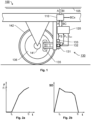
- Figure 1 we see a schematic illustration of a brake system according to one embodiment of the invention.
- the brake system may include at least one brake controller 110 and a number of electrically operated brake units 130, which each is operated by a respective brake actuator 120.
- the brake actuator 120 is configured to receive a brake command BC, for example from the brake controller 110, and in response to the brake command BC control the electrically operated brake unit 130 to perform a braking operation.
- the braking operation typically involves applying a force, which has a set point in the form of a target force specified by the brake command BC.
- the braking operation may also involve releasing the brake, or reducing an already applied brake force.
- the brake command BC may be generated based on a brake instruction BI from a train driver, and/or an automatic functionality in the rail vehicle 100 in which the brake system is comprised.
- the brake instruction BI may be forwarded to the brake controller 110 via a data bus105 in the rail vehicle 100.
- the brake controller 110 is configured to send brake commands BCx to at least one additional brake actuator in the rail vehicle 100.
- each brake controller 110 is arranged to control two or more brake controllers, for example in one rail vehicle.
- the brake actuator 120 contains a control unit 600 (see Figure 6 ), which is configured to generate a brake control signal BS based on the brake command BC.
- the brake control signal BS is adapted to control an electric motor 131 in the electrically operated brake unit 130 such that an output shaft of the electric motor 131 attains a specified angular position in which at least one pressing member 135 of the brake unit 130 is caused to apply a force against a rotating member 136 of the brake unit 130, for example via a gear-shaft mechanism.
- the applied force here aims at the target force.
- the rotating member 136 is mechanically connected to a wheel axle 141 of the rail vehicle 100. Consequently, the brake force applied by the at least one pressing member 135 against the rotating member 136 influences any rotation of said wheel axle 141.
- the electric motor 131 is a brushless DC motor.
- This type of motor is advantageous because it enables high torque and high precision in a relatively small-sized format.
- the brushless DC motor may be operated around 3000 rpm, which vouches for swift control of the at least one pressing member 135.
- the control unit 600 is further configured to obtain a first sensor signal P m reflecting a measured position of the output shaft of the electric motor 131, which measured position indicates the specified angular position, e.g. via an absolute encoder 132 producing ubiquitous angular data on a digital format.
- the first sensor signal P m may be produced by a Hall sensor included in the electric motor 131.
- the Hall sensor is typically less sensitive and somewhat slower than the absolute encoder. Due to the fix mechanical relationship between the specified angular position and the force applied by the at least one pressing member 135 onto the rotating member 136, the first sensor signal P m also constitutes an indication of the target force.
- Figure 2a shows a general graph illustrating a force F exerted by the at least one pressing member 135 onto the rotating member 136 as a function of time t according to one embodiment of the invention.
- Figure 2b shows a corresponding graph that illustrates a speed demand SD on the electric motor 131 as function of time t when the at least one pressing member 135 is controlled to apply the force F onto the rotating member 136.
- the at least one pressing member 135 moves towards the rotating member 136 without making any contact with it.
- the speed demand SD is relatively high on the electric motor 131.
- control unit 600 is configured to generate the brake control signal BS until the first sensor signal P m attains a value indicating that the target force F T is estimated to have been reached.
- the brake actuator 120 may include a driver unit 610 configured to generate a drive current l ctrl based on the brake control signal BS, which drive current l ctrl is adapted to control the electric motor 131, such that its output shaft rotates in a desired direction causing the at least one pressing member 135 to either move towards or away from the rotating member 136.
- a driver unit 610 configured to generate a drive current l ctrl based on the brake control signal BS, which drive current l ctrl is adapted to control the electric motor 131, such that its output shaft rotates in a desired direction causing the at least one pressing member 135 to either move towards or away from the rotating member 136.
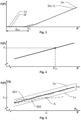
- Figure 3 shows a graph exemplifying how the force F(P) applied to the rotating member 136 by the at least one pressing member 135 as a function of the angular position P of the rotating shaft of the electric motor 131. According to the invention, the relationship shown in Figure 3 is used to control the electric motor 131.
- the respective force F(P) applied to the rotating member 136 is registered, e.g. by a load-cell sensor, and is plotted as a function of the angular position P.
- Figure 3 exemplifies data points 31, 32, ..., 3(n-1) and 3n respectively for such a set of angular positions P.
- the relationship between the angular position P and the respective force F(P) is almost perfectly linear except around an angular position Pc, where the at least one pressing member 135 begins to make contact with the rotating member 136.
- the measurements of the force F(P) around the contact angular position Pc are discarded.
- a linear function based on measurements of the positions when the at least one pressing member 135 makes solid contact with the rotating member 136 is extrapolated to the intersection point with the P axis in order to determine the contact angular position Pc.
- the proposed control principle relies on an unambiguous relationship between the target force F T specified by the brake command BC and a specified angular position P set of the output shaft of the electric motor 131, such that the target force F T may be attained by the output shaft of the electric motor 131 to the specified angular position P set .
- the force-to-position mapping must, however, be repeatedly updated/recalibrated during operation of the brake system.
- the force-to-position mapping is zeroed. This means that the contact angular position Pc is determined and a desired idle distance d idle is set, for instance as described above.
- the control unit 600 is configured to verify that force-to-position mapping is accurate by obtaining feedback data about the force actually applied by the at least one pressing member 135 against the rotating member 136. Therefore, according to one embodiment of the invention, the control unit 600 is further configured to obtain a second sensor signal FS, e.g. from a load-cell sensor 133 in the gear-shaft mechanism, which second sensor signal FS reflects a magnitude of the force applied by at least one pressing member 135 against the rotating member 136. Specifically, the control unit 600 is here configured to check the second sensor signal FS against the force-to-position mapping describing the linear relationship between the specified angular position P and the estimated magnitude of the force applied by the at least one pressing member 135 against the rotating member 136.
- control unit 600 is preferably configured to await checking the second sensor signal FS against the force-to-position mapping until after having obtained the indication via the first sensor signal P m that the specified angular position P has been attained, and thus also that the target force F T has been attained.
- control unit 600 is preferably configured to accept variations around a hysteresis margin H from the linear relationship expressed by the force-to-position mapping.
- the hysteresis margin H may be defined as a band between an upper threshold level Utn above a lower threshold level L th and below respectively the linear function describing the applied force F(P) as a function of the angular position P, as illustrated in Figure 5 .
- control unit 600 is configured to generate an alarm A, if, for a specified angular position P, the second sensor signal FS reflects that the applied force F(P) is outside of the hysteresis margin H.
- the alarm A may be supplemented by additional data, for example indicating an error in the load-cell sensor 133, error in the absolute encoder, a mechanical malfunction, e.g. in the at least one pressing member 135 or in the gear-shaft mechanism, an electrical error and wear of the at least one pressing member 135 and/or rotating member 136.
- Figure 5 shows a first graph 501 illustrating a relationship between the applied force F(P) reflected by the second sensor signal FS that is acceptable, and a second graph 502 illustrating a relationship between the applied force F(P) reflected by the second sensor signal FS that causes the control unit 600 to generate the alarm A at a point in time t A when the second graph 502 falls outside of the lower threshold level Ltn.
- Figure 6 shows a block diagram illustrating a brake actuator 120 according to one embodiment of the invention.
- the brake actuator 120 contains a driver unit 610 and a filter unit 620.
- the driver unit 610 is configured to generate a drive current l ctrl to the electric motor 131 based on the brake control signal BS.
- the filter unit 620 is configured to obtain an unfiltered sensor signal FS r , e.g. from the absolute encoder 132, and in response thereto, produce the second sensor signal FS as a lowpass-filtered version of the unfiltered sensor signal FS r . It is generally advantageous to lowpass filter the unfiltered sensor signal FS, because this renders the design less sensitive to movements, such as in the form of rumble and jerk.
- both the driver unit 610 and the filter unit 620 are included into the control loop for the brake unit.
- each of the units 610 and 620 introduces a respective delay in the control loop.
- the above force-to-position mapping reflects the expected delay between generating the brake control signal BS and obtaining the second sensor signal FS, which expected delay depends on a signal passage through the units 610 and/or 620 whichever unit is included in the control loop. It is further preferable if the force-to-position mapping reflects an expected delay, which is due an inertia of the electric motor 131.
- control unit 600 may include a memory unit 605, i.e. non-volatile data carrier, storing a computer program 607, which, in turn, contains software for making processing circuitry in the form of a processor 603 in the control unit 600 execute the actions mentioned in this disclosure when the computer program 607 is run on the processor 603.
- a memory unit 605 i.e. non-volatile data carrier
- computer program 607 which, in turn, contains software for making processing circuitry in the form of a processor 603 in the control unit 600 execute the actions mentioned in this disclosure when the computer program 607 is run on the processor 603.
- a brake command it is checked whether a brake command has been received, which brake command specifies a target force. If such a brake command has been received, steps 720 and 730 follow. Otherwise, the procedure loops back and stays in step 710.
- Step 720 generates a brake control signal based on the brake command, which brake control signal is adapted to control an electric motor in an electrically operated brake unit such that an output shaft of the electric motor attains a specified angular position in which at least one pressing member is caused to apply a force against a rotating member being mechanically connected to a wheel axle of the rail vehicle, which applied force has the target force as a set point.
- step 730 which is executed in parallel with step 720, a first sensor signal is obtained, which reflects a measured position of the output shaft of the electric motor. Due to a one-to-one relationship between specified angular position and the target force, the measured position constitutes an indication of target force.
- a step 740 checks whether the measured position designates that a target position equivalent to the target force has been reached. If so, a step 750 follows; and otherwise, the procedure loops back to steps 720 and 730 for continued control of the at least one pressing member.
- step 750 the procedure ends.
- the process steps described with reference to Figure 7 may be controlled by means of a programmed processor.
- the embodiments of the invention described above with reference to the drawings comprise processor and processes performed in at least one processor, the invention thus also extends to computer programs, particularly computer programs on or in a carrier, adapted for putting the invention into practice.
- the program may be in the form of source code, object code, a code intermediate source and object code such as in partially compiled form, or in any other form suitable for use in the implementation of the process according to the invention.
- the program may either be a part of an operating system, or be a separate application.
- the carrier may be any entity or device capable of carrying the program.
- the carrier may comprise a storage medium, such as a Flash memory, a ROM (Read Only Memory), for example a DVD (Digital Video/Versatile Disk), a CD (Compact Disc) or a semiconductor ROM, an EPROM (Erasable Programmable Read-Only Memory), an EEPROM (Electrically Erasable Programmable Read-Only Memory), or a magnetic recording medium, for example a floppy disc or hard disc.
- the carrier may be a transmissible carrier such as an electrical or optical signal which may be conveyed via electrical or optical cable or by radio or by other means.
- the carrier When the program is embodied in a signal, which may be conveyed, directly by a cable or other device or means, the carrier may be constituted by such cable or device or means.
- the carrier may be an integrated circuit in which the program is embedded, the integrated circuit being adapted for performing, or for use in the performance of, the relevant processes.
Landscapes
- Engineering & Computer Science (AREA)
- Transportation (AREA)
- Mechanical Engineering (AREA)
- Regulating Braking Force (AREA)
Priority Applications (2)
| Application Number | Priority Date | Filing Date | Title |
|---|---|---|---|
| EP23178357.2A EP4474233A1 (de) | 2023-06-09 | 2023-06-09 | Bremsaktuator, computerimplementiertes verfahren, computerprogramm, nichtflüchtiger datenträger und bremssystem für ein schienenfahrzeug |
| PCT/EP2024/060212 WO2024251419A1 (en) | 2023-06-09 | 2024-04-16 | Brake actuator, computer-implemented method, computer program, non-volatile data carrier and brake system for a rail vehicle |
Applications Claiming Priority (1)
| Application Number | Priority Date | Filing Date | Title |
|---|---|---|---|
| EP23178357.2A EP4474233A1 (de) | 2023-06-09 | 2023-06-09 | Bremsaktuator, computerimplementiertes verfahren, computerprogramm, nichtflüchtiger datenträger und bremssystem für ein schienenfahrzeug |
Publications (1)
| Publication Number | Publication Date |
|---|---|
| EP4474233A1 true EP4474233A1 (de) | 2024-12-11 |
Family
ID=86760283
Family Applications (1)
| Application Number | Title | Priority Date | Filing Date |
|---|---|---|---|
| EP23178357.2A Withdrawn EP4474233A1 (de) | 2023-06-09 | 2023-06-09 | Bremsaktuator, computerimplementiertes verfahren, computerprogramm, nichtflüchtiger datenträger und bremssystem für ein schienenfahrzeug |
Country Status (2)
| Country | Link |
|---|---|
| EP (1) | EP4474233A1 (de) |
| WO (1) | WO2024251419A1 (de) |
Citations (6)
| Publication number | Priority date | Publication date | Assignee | Title |
|---|---|---|---|---|
| EP0945322A2 (de) * | 1998-03-26 | 1999-09-29 | Toyota Jidosha Kabushiki Kaisha | Elektrisch betätigtes Feststellbremsgerät mit einer Bremskraftänderungsvorrichtung, die bei abgeschaltetem Antriebsleistungsschalter betriebsfähig ist |
| WO2014079490A1 (en) * | 2012-11-21 | 2014-05-30 | Bombardier Transportation Gmbh | Method for a braking operation of a wheel axle of a rail vehicle and braking system for a rail vehicle |
| US20200198605A1 (en) | 2017-09-06 | 2020-06-25 | Mengling WU | Microcomputer-controlled electromechanical braking system |
| WO2020135620A1 (zh) * | 2018-12-29 | 2020-07-02 | 比亚迪股份有限公司 | 用于轨道车辆的机电制动系统及其控制方法、轨道车辆 |
| WO2022037298A1 (zh) * | 2020-08-20 | 2022-02-24 | 南京中车浦镇海泰制动设备有限公司 | 一种轨道车辆电机械制动系统及电机械制动力控制方法 |
| WO2022037297A1 (zh) * | 2020-08-20 | 2022-02-24 | 南京中车浦镇海泰制动设备有限公司 | 一种轨道车辆电机械制动防滑控制系统及方法 |
-
2023
- 2023-06-09 EP EP23178357.2A patent/EP4474233A1/de not_active Withdrawn
-
2024
- 2024-04-16 WO PCT/EP2024/060212 patent/WO2024251419A1/en not_active Ceased
Patent Citations (6)
| Publication number | Priority date | Publication date | Assignee | Title |
|---|---|---|---|---|
| EP0945322A2 (de) * | 1998-03-26 | 1999-09-29 | Toyota Jidosha Kabushiki Kaisha | Elektrisch betätigtes Feststellbremsgerät mit einer Bremskraftänderungsvorrichtung, die bei abgeschaltetem Antriebsleistungsschalter betriebsfähig ist |
| WO2014079490A1 (en) * | 2012-11-21 | 2014-05-30 | Bombardier Transportation Gmbh | Method for a braking operation of a wheel axle of a rail vehicle and braking system for a rail vehicle |
| US20200198605A1 (en) | 2017-09-06 | 2020-06-25 | Mengling WU | Microcomputer-controlled electromechanical braking system |
| WO2020135620A1 (zh) * | 2018-12-29 | 2020-07-02 | 比亚迪股份有限公司 | 用于轨道车辆的机电制动系统及其控制方法、轨道车辆 |
| WO2022037298A1 (zh) * | 2020-08-20 | 2022-02-24 | 南京中车浦镇海泰制动设备有限公司 | 一种轨道车辆电机械制动系统及电机械制动力控制方法 |
| WO2022037297A1 (zh) * | 2020-08-20 | 2022-02-24 | 南京中车浦镇海泰制动设备有限公司 | 一种轨道车辆电机械制动防滑控制系统及方法 |
Also Published As
| Publication number | Publication date |
|---|---|
| WO2024251419A1 (en) | 2024-12-12 |
Similar Documents
| Publication | Publication Date | Title |
|---|---|---|
| US11292442B2 (en) | Electromechanical brake system | |
| CN112298134A (zh) | 制动控制方法、装置、存储介质及车辆 | |
| JPH11513336A (ja) | 電気モータによって操作される車輪ブレーキ用制御または調整装置 | |
| US10618505B2 (en) | Electric brake system and method of setting pressing force-current characteristics | |
| CN111037605A (zh) | 一种机器人关节电磁制动器的磨损检测方法 | |
| US12410841B2 (en) | Electromechanical brake and control method therefor | |
| JP2006232270A (ja) | 電気ブレーキを備えたブレーキシステムにおけるサーボコントロールの方法 | |
| EP4474233A1 (de) | Bremsaktuator, computerimplementiertes verfahren, computerprogramm, nichtflüchtiger datenträger und bremssystem für ein schienenfahrzeug | |
| US8692499B2 (en) | Control method for electro-mechanical brake system | |
| CN113928296B (zh) | 一种电子液压线控制动系统液压精度标定方法及装置 | |
| EP4474234A1 (de) | Bremsaktuator, computerimplementiertes verfahren, computerprogramm, nichtflüchtiger datenträger und bremssystem für ein schienenfahrzeug | |
| JP2002528681A (ja) | アクチュエータ運動監視方法および装置 | |
| JP5384974B2 (ja) | 電動ブレーキ | |
| JP2000190093A (ja) | 位置決め装置及びアクチュエータの制御方法 | |
| EP3462596B1 (de) | Verfahren zur messung des zustands der motorbremse | |
| CN108928336B (zh) | 电动液压制动装置的控制装置及其方法 | |
| CN115635948B (zh) | 电子液压线控制动系统内置伺服电机转速控制方法及ecu | |
| CN111422195A (zh) | 一种无人驾驶车辆的制动装置的控制方法及控制端 | |
| EP4245620B1 (de) | Bremssystem, computerimplementiertes verfahren zur steuerung eines bremssystems eines schienenfahrzeugs, computerprogramm und nichtflüchtiger datenträger | |
| EP4328103A1 (de) | Elektrisch betriebene bremsanordnung, computerimplementiertes verfahren zur steuerung einer elektrisch betriebenen bremsanordnung, computerprogramm und nichtflüchtiger datenträger | |
| KR101876212B1 (ko) | 액추에이터 제어 방법 | |
| US20250100518A1 (en) | Parking brake system, computer-implemented method of controlling a parking brake system of a rail vehicle, computer program and non-volatile data carrier | |
| CN110579997A (zh) | 基于可编程逻辑器件的数字靠模控制系统及方法 | |
| CN120481967A (zh) | 用于运行机电制动装置的方法和设备、制动装置和制动系统 | |
| CN120171309A (zh) | 用于控制电子机械式机动车辆制动器的力的方法以及电子机械式机动车辆制动器 |
Legal Events
| Date | Code | Title | Description |
|---|---|---|---|
| PUAI | Public reference made under article 153(3) epc to a published international application that has entered the european phase |
Free format text: ORIGINAL CODE: 0009012 |
|
| STAA | Information on the status of an ep patent application or granted ep patent |
Free format text: STATUS: THE APPLICATION HAS BEEN PUBLISHED |
|
| AK | Designated contracting states |
Kind code of ref document: A1 Designated state(s): AL AT BE BG CH CY CZ DE DK EE ES FI FR GB GR HR HU IE IS IT LI LT LU LV MC ME MK MT NL NO PL PT RO RS SE SI SK SM TR |
|
| STAA | Information on the status of an ep patent application or granted ep patent |
Free format text: STATUS: THE APPLICATION IS DEEMED TO BE WITHDRAWN |
|
| 18D | Application deemed to be withdrawn |
Effective date: 20250612 |