EP4474053A2 - Integrierter bioabdichtungszellsortierer - Google Patents
Integrierter bioabdichtungszellsortierer Download PDFInfo
- Publication number
- EP4474053A2 EP4474053A2 EP24195215.9A EP24195215A EP4474053A2 EP 4474053 A2 EP4474053 A2 EP 4474053A2 EP 24195215 A EP24195215 A EP 24195215A EP 4474053 A2 EP4474053 A2 EP 4474053A2
- Authority
- EP
- European Patent Office
- Prior art keywords
- main cabinet
- air
- fan
- biocontainment
- integrated
- Prior art date
- Legal status (The legal status is an assumption and is not a legal conclusion. Google has not performed a legal analysis and makes no representation as to the accuracy of the status listed.)
- Pending
Links
Images


Classifications
-
- G—PHYSICS
- G01—MEASURING; TESTING
- G01N—INVESTIGATING OR ANALYSING MATERIALS BY DETERMINING THEIR CHEMICAL OR PHYSICAL PROPERTIES
- G01N15/00—Investigating characteristics of particles; Investigating permeability, pore-volume or surface-area of porous materials
- G01N15/10—Investigating individual particles
- G01N15/14—Optical investigation techniques, e.g. flow cytometry
- G01N15/1456—Optical investigation techniques, e.g. flow cytometry without spatial resolution of the texture or inner structure of the particle, e.g. processing of pulse signals
- G01N15/1459—Optical investigation techniques, e.g. flow cytometry without spatial resolution of the texture or inner structure of the particle, e.g. processing of pulse signals the analysis being performed on a sample stream
-
- G—PHYSICS
- G01—MEASURING; TESTING
- G01N—INVESTIGATING OR ANALYSING MATERIALS BY DETERMINING THEIR CHEMICAL OR PHYSICAL PROPERTIES
- G01N15/00—Investigating characteristics of particles; Investigating permeability, pore-volume or surface-area of porous materials
- G01N15/10—Investigating individual particles
- G01N15/14—Optical investigation techniques, e.g. flow cytometry
- G01N15/149—Optical investigation techniques, e.g. flow cytometry specially adapted for sorting particles, e.g. by their size or optical properties
- G01N15/1492—Optical investigation techniques, e.g. flow cytometry specially adapted for sorting particles, e.g. by their size or optical properties within droplets
-
- B—PERFORMING OPERATIONS; TRANSPORTING
- B01—PHYSICAL OR CHEMICAL PROCESSES OR APPARATUS IN GENERAL
- B01L—CHEMICAL OR PHYSICAL LABORATORY APPARATUS FOR GENERAL USE
- B01L1/00—Enclosures; Chambers
- B01L1/02—Air-pressure chambers; Air-locks therefor
- B01L1/025—Environmental chambers
-
- G—PHYSICS
- G01—MEASURING; TESTING
- G01N—INVESTIGATING OR ANALYSING MATERIALS BY DETERMINING THEIR CHEMICAL OR PHYSICAL PROPERTIES
- G01N1/00—Sampling; Preparing specimens for investigation
- G01N1/02—Devices for withdrawing samples
- G01N1/22—Devices for withdrawing samples in the gaseous state
-
- G—PHYSICS
- G01—MEASURING; TESTING
- G01N—INVESTIGATING OR ANALYSING MATERIALS BY DETERMINING THEIR CHEMICAL OR PHYSICAL PROPERTIES
- G01N15/00—Investigating characteristics of particles; Investigating permeability, pore-volume or surface-area of porous materials
- G01N15/01—Investigating characteristics of particles; Investigating permeability, pore-volume or surface-area of porous materials specially adapted for biological cells, e.g. blood cells
-
- G—PHYSICS
- G01—MEASURING; TESTING
- G01N—INVESTIGATING OR ANALYSING MATERIALS BY DETERMINING THEIR CHEMICAL OR PHYSICAL PROPERTIES
- G01N15/00—Investigating characteristics of particles; Investigating permeability, pore-volume or surface-area of porous materials
- G01N15/10—Investigating individual particles
- G01N15/14—Optical investigation techniques, e.g. flow cytometry
- G01N15/1404—Handling flow, e.g. hydrodynamic focusing
- G01N15/1409—Handling samples, e.g. injecting samples
-
- G—PHYSICS
- G01—MEASURING; TESTING
- G01N—INVESTIGATING OR ANALYSING MATERIALS BY DETERMINING THEIR CHEMICAL OR PHYSICAL PROPERTIES
- G01N15/00—Investigating characteristics of particles; Investigating permeability, pore-volume or surface-area of porous materials
- G01N15/10—Investigating individual particles
- G01N15/14—Optical investigation techniques, e.g. flow cytometry
- G01N15/1434—Optical arrangements
-
- B—PERFORMING OPERATIONS; TRANSPORTING
- B01—PHYSICAL OR CHEMICAL PROCESSES OR APPARATUS IN GENERAL
- B01L—CHEMICAL OR PHYSICAL LABORATORY APPARATUS FOR GENERAL USE
- B01L2200/00—Solutions for specific problems relating to chemical or physical laboratory apparatus
- B01L2200/14—Process control and prevention of errors
- B01L2200/141—Preventing contamination, tampering
-
- G—PHYSICS
- G01—MEASURING; TESTING
- G01N—INVESTIGATING OR ANALYSING MATERIALS BY DETERMINING THEIR CHEMICAL OR PHYSICAL PROPERTIES
- G01N15/00—Investigating characteristics of particles; Investigating permeability, pore-volume or surface-area of porous materials
- G01N15/10—Investigating individual particles
- G01N15/14—Optical investigation techniques, e.g. flow cytometry
- G01N15/149—Optical investigation techniques, e.g. flow cytometry specially adapted for sorting particles, e.g. by their size or optical properties
-
- G—PHYSICS
- G01—MEASURING; TESTING
- G01N—INVESTIGATING OR ANALYSING MATERIALS BY DETERMINING THEIR CHEMICAL OR PHYSICAL PROPERTIES
- G01N1/00—Sampling; Preparing specimens for investigation
- G01N1/02—Devices for withdrawing samples
- G01N1/22—Devices for withdrawing samples in the gaseous state
- G01N1/2202—Devices for withdrawing samples in the gaseous state involving separation of sample components during sampling
- G01N2001/222—Other features
- G01N2001/2223—Other features aerosol sampling devices
-
- G—PHYSICS
- G01—MEASURING; TESTING
- G01N—INVESTIGATING OR ANALYSING MATERIALS BY DETERMINING THEIR CHEMICAL OR PHYSICAL PROPERTIES
- G01N15/00—Investigating characteristics of particles; Investigating permeability, pore-volume or surface-area of porous materials
- G01N2015/0019—Means for transferring or separating particles prior to analysis, e.g. hoppers or particle conveyors
-
- G—PHYSICS
- G01—MEASURING; TESTING
- G01N—INVESTIGATING OR ANALYSING MATERIALS BY DETERMINING THEIR CHEMICAL OR PHYSICAL PROPERTIES
- G01N15/00—Investigating characteristics of particles; Investigating permeability, pore-volume or surface-area of porous materials
- G01N15/10—Investigating individual particles
- G01N2015/1006—Investigating individual particles for cytology
-
- G—PHYSICS
- G01—MEASURING; TESTING
- G01N—INVESTIGATING OR ANALYSING MATERIALS BY DETERMINING THEIR CHEMICAL OR PHYSICAL PROPERTIES
- G01N35/00—Automatic analysis not limited to methods or materials provided for in any single one of groups G01N1/00 - G01N33/00; Handling materials therefor
- G01N2035/00178—Special arrangements of analysers
- G01N2035/00277—Special precautions to avoid contamination (e.g. enclosures, glove- boxes, sealed sample carriers, disposal of contaminated material)
Definitions
- Cell sorter flow cytometers have become an important laboratory tool.
- Cell sorters are capable of identifying certain types of biological cells and separating those cells from other cells.
- Commercial uses of cell sorters have also been implemented in several industries. There are many other uses of cell sorters, such as identifying and isolating various types of cells for laboratory applications. As such, cell sorters have many different and varied uses and applications.
- An embodiment of the present invention my therefore comprise an integrated biocontainment cell sorter flow cytometer comprising: a main cabinet of the integrated biocontainment cell sorter that is not hermetically sealed; an input sample area disposed in the main cabinet; a moveable partition in the main cabinet that moves in an access opening of the main cabinet, the moveable partition covering a constant amount of area of the access opening as the moveable partition is moved in the access opening which leaves a constant amount of area of the access opening that is not covered by the moveable partition and is open, as the moveable partition is moved in the access opening; a first fan that draws air from the main cabinet to create a first low pressure in the main cabinet that is substantially constant as the moveable partition is moved in the access opening, which limits contaminated air in the main cabinet from escaping from the main cabinet; an aerosol management containment area that is not hermetically sealed, which is disposed in the main cabinet, the aerosol management containment area having openings that are connected to the main cabinet so that the aerosol management containment area is disposed in
- Another embodiment of the present invention may therefore comprise a method of containing cells in an integrated biocontainment cell sorter comprising: providing a main cabinet containment area that contains an input area for sample cells to be sorted; generating a first low pressure in the main cabinet using a first fan that draws air from the main cabinet and air from outside the cabinet; generating a second low pressure in an aerosol management containment area, disposed in the main cabinet, using a second fan that draws air from the main cabinet and the aerosol management containment area through openings in the aerosol management containment area to create the second low pressure in the aerosol management containment area that is lower than the first low pressure; enclosing input cell samples in the main cabinet that is not hermetically sealed; enclosing a nozzle, sort plates, collection media and any droplet stream, created by the nozzle, in an aerosol management containment area that is not hermetically sealed; locating optical excitation devices outside of the main cabinet and the aerosol management containment area for easy access for adjustment and maintenance of the optical excitation devices
- the present invention is also defined by the following numbered embodiments.
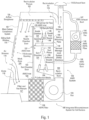
- FIG. 1 is a schematic diagram of one embodiment of an integrated biocontainment system 100.
- the system is comprised of a main cabinet containment system 101 and aerosol management system chambers 140, the AMS intake duct 138, AMS HEPA filter 141, AMS fan 144 and AMS exhaust duct 147, which are collectively referred to as the aerosol management system (AMS) 149.
- the aerosol management system (AMS) 149 is contained in or connected to the main cabinet containment system 101. Neither the main cabinet containment system 101 nor the aerosol management system (AMS) 149 are sealed systems.
- AMS aerosol management system
- Dangerous materials primarily exist as aerosols that contain sample cells.
- Sample cells are mixed with sheath fluid and passed through a nozzle 146.
- the nozzle creates a nozzle stream 153 ( Figure 2 ) that breaks up into a droplet stream 155 ( Figure 2 ). If the nozzle becomes clogged, an aerosol can be created that contains sample cells. Also, if the nozzle stream 153 or the droplet stream 155 hit a hard surface, aerosols can be created.
- the aerosols contain sample cells that should not be inhaled or ingested.
- the sample cells may be cancer cells.
- air drawn by the fan 122 first passes through the HEPA filter 120 to remove any dangerous materials such as sample cells. Consequently, the air drawn by the fan 122 is clean air and the fan is not contaminated.
- the fan 122 forces the clean air through the recirculation duct 108 under positive pressure, which also remains clean.
- the recirculation duct 108 and recirculation plenum do not have to be sealed, even though they are under positive pressure, since they contain clean air.
- Part of the air from the fan 122 is exhausted out of the exhaust vent 110, as illustrated by exhaust air 126. At the same time, some of the air from the fan 122 is recirculated, as illustrated by recirculation air 124.
- the recirculation duct 108 circulates clean air under positive pressure, and clean air is recirculated into the recirculation plenum 102 under positive pressure, while the remaining air is exhausted out of the exhaust vent 110.
- the recirculated air in the recirculation duct 108 and the recirculation plenum 102 is under positive pressure and as such may leak from these ducts to the outside air or to other parts of the integrated biocontainment system 100. Since the air under positive pressure is clean air, there are no problems with contamination, unlike many other containment systems.
- the recirculated air in the recirculation plenum 102 passes through an airflow straightener 128.
- the airflow straightener 128 is a device that has openings that cause the recirculated air to flow into the work area 104 as a substantially uniform, laminar air flow 130 with low turbulence. Low turbulence allows for maintenance of a uniform downward volume of air that prevents both contaminates from the inside of the cabinet from escaping the user access opening and prevents contaminates from the outside of the cabinet from depositing on the products present inside the cabinet.
- the aerosol management system chambers 140 have openings that connect to the main cabinet containment system 101, as also illustrated in Figure 1 .
- the aerosol management system (AMS) 149 has a separate AMS HEPA filter 141 and a separate AMS fan 144.
- AMS fan 144 draws air from the AMS intake duct 138, which is connected to the sort chamber 131. Since the aerosol management system chambers 140 are connected by openings to the main cabinet containment system 101, the aerosol management system chambers 140 are already at the first low pressure that is maintained in the main cabinet containment system 101.
- AMS fan 144 further lowers the pressure in the aerosol management system (AMS) 149 from the first low pressure of the work area 104 to a second low pressure that is lower than the first low pressure.
- the second low pressure in the aerosol management system chambers 140 will equalize with the first low pressure of the main cabinet containment system 101. So, as the pressures of the main cabinet containment system 101 and the aerosol management system chambers 140 equalize as a result of either the nozzle chamber door 136 or the sort chamber door 132 being opened, air initially flows from the main cabinet containment system 101 to the aerosol management system chambers 140 which prevents aerosols from escaping the aerosol management system chambers 140. However, once the pressures are equalized, there can be a migration of aerosols from the aerosol management system chambers 140 to the main cabinet containment system 101.
- the nozzle 146 is shut down and the AMS fan 144 is operated at an increased speed for a time to evacuate all aerosols from the aerosol management system chambers 140.
- the aerosol management system (AMS) 149 is not only a parallel containment system to the main cabinet containment system 101, the aerosol management system chambers 140 are connected by air inlets to the main cabinet containment system 101 to create a second lower pressure, which makes it doubly hard for dangerous materials located in the aerosol management system chambers 140 and the work area 104 to escape from the integrated biocontainment system 100.
- the aerosol management system chambers 140 are carefully constructed to enclose portions of the cell sorter that produce hazardous particles and not enclose portions of the cell sorter that do not produce hazardous particles, to minimize the size of the containment area and consequently minimize the size of the integrated biocontainment system 100 for cell sorters.
- the nozzle chamber 134 contains the nozzle 146 which is fed sample fluid 143 and sheath fluid 145.
- the nozzle 146 creates a nozzle stream 153 ( Figure 2 ) from the sample fluid 143 and sheath fluid 145 that passes through the interrogation point 148 and through an opening 152 in the optics mounting plate 150.
- the nozzle 146 is contained within the nozzle chamber 134 to prevent any dangerous aerosols from escaping the aerosol management system chambers 140.
- the optics mounting plate 150 separates the nozzle chamber 134 from the sort chamber 131. Opening 152 allows the interrogated droplet stream 155 ( Figure 2 ) to pass through the optics mounting plate 150 to the sort plates 154. Each droplet of the droplet stream 155 ( Figure 2 ) that is interrogated at interrogation point 148 is then separated by the sort plates 154.
- the deflected droplet streams 156 are then collected by the collection media 158. This is explained in more detail in U.S. Patent 8,557,587 issued on October 15, 2013 to Fox et al. , which is specifically incorporated herein, by reference, for all that it discloses and teaches.
- the main cabinet containment system 101 is primarily used to contain the sample input area 107 ( Figure 5 ) from the ambient air outside of the main cabinet containment system
- the main cabinet containment system 101 may therefore contain dangerous cells in the sample input area 107.
- the partition 114 which may comprise a transparent sliding sash window, allows an operator to easily access the sample input area and the sort chamber 131, through the sort chamber door 132 when the partition 114 is in an upper position in the access opening 115, as shown in Figure 1 , to insert and remove samples in the sample input area 107 ( Figure 5 ).
- the partition 114 can be moved to a lower position in the access opening 115 to allow direct access by an operator to the nozzle chamber 134, through nozzle chamber door 136.
- Fan 122 is sufficiently strong to maintain a low pressure in the work area 104 even though the access opening is only partially covered by the partition 114.
- the partition 114 can simply move up and down in the access opening 115. Accordingly, the amount of area that is closed or blocked off in the access opening 115 by the partition 114 and the amount of area that is open in the access opening 115, and is not closed or blocked off by partition 114, does not change no matter where the partition 114 is placed in the access opening 115. In other words, the same amount of open area of the access opening 115 is present no matter where the partition 114 is located in the access opening 115.
- a certain number of square inches of opening in the access opening 115 are present.
- the partition 114 is moved downwardly, the amount of open area in the access opening 115 has a constant size, i.e.
- the partition 114 has a constant size and the access opening 115 has a constant size.
- the amount of air that is transported by fan 122 can remain the same no matter where the partition 114 is located and still maintain a constant first low pressure in the work area 104.
- the fan 122 moves about 100 feet of air per minute through the user access opening 115 into the work area 104.
- the integrated biocontainment cell sorter system is based on the velocity of the air that moves through the cabinet. The velocity of the air must be fast enough in order to maintain containment since the integrated biocontainment cell sorter is not a sealed system.
- the air speed of the air that enters the grate 118 is measured to ensure proper velocity to maintain containment.
- the fan 122 is designed to operate so that the volume of air that passes through the grate 118 is sufficient to maintain the containment of hazardous materials in the main cabinet containment system 101.
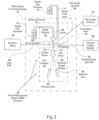
- FIG 2 is a schematic diagram illustrating portions of the aerosol management system (AMS) 149.
- Figure 2 specifically illustrates the portions of the cell sorter that are contained within the aerosol management system chambers 140.
- the nozzle 186, as well as the connecting tubing, are located in the nozzle chamber 134.
- the sort plates 176, collection tubes 182, 184 are located in the sort chamber 131. Opening 174 allows the droplet stream 155 to flow from the nozzle chamber 134 to the sort chamber 131 through the optics mounting plate 150 ( Figure 3 ).
- Figure 2 illustrates the primary components that are located within the nozzle chamber 134 and the sort chamber 131 that comprise the aerosol management system chambers
- the aerosol management system chambers 140 surround the sort plates, collection tubes 182, 184 and the deflected droplet streams 156.
- the nozzle chamber 134 and the sort chamber 131, as well as the opening 174 between these two chambers, comprise the aerosol management system chambers 140.
- the nozzle 186, the opening 174, the sort plates 176 and the collection tubes 182, 184 are the primary functional components that are contained within the aerosol management system chambers 140.
- the sample fluid container 172 which is placed in the sample input area 107 ( Figure 5 ) opens into the main cabinet containment system 101, and not in the aerosol management system chambers 140.
- the sheath fluid container 170, the excitation optics 162, the forward scatter detector 180 and the side scatter detector 178 are preferably all located outside of the main cabinet containment system 101.
- the side scatter light path 168 and the forward scatter light path 166 project light through an optical window, as illustrated in Figure 4 , to side scatter detector 178 and forward scatter detector 180, respectively.
- Other electronics and controllers, as well as lasers, are preferably located outside of the main cabinet containment system 101. For example, as disclosed in U.S.
- Patent 8,557,587 which is specifically incorporated herein by reference, for all that it discloses and teaches, timing and charge circuits, sort logic controllers, optical filters, detectors, acquisition electronics, and other electronic circuits and devices, collectively defined herein as cell sorter electronics and optical devices, are preferably all located outside of the main cabinet and the aerosol management containment area for easy access for maintenance and adjustment.
- the cell sorter electronics and optical devices are preferably located in areas that are easily accessed, and do not require access to contaminated areas within the main cabinet containment system 101 or the aerosol management system chambers 140. Consequently, the excitation optics 162, the side scatter detector 178 and the forward scatter detector 180 can preferably be easily accessed without accessing a biocontainment area.
- these devices need adjustment, and the accessibility of these devices, without the necessity of entering a dirty or biocontainment area, greatly increases the speed and maintenance of the system.
- the excitation optics 162 comprises the excitation lasers or other excitation optics such as LEDs, optically pumped plasma light generators, arc lamps or other excitation optics.
- the optics include the various mirrors, beam combiners, lenses, etc. Accordingly, the present invention, in accordance with one embodiment, may simply have the excitation optics 162 located outside of the main cabinet and the other portions, such as the side scatter detector 178, forward scatter detector 180, and other devices located inside of the main cabinet 101 and aerosol management system chambers 140.
- the optical detection devices such as side scatter detector 178 and forward scatter detector 180, may also be located outside of the main cabinet 101 along with the excitation optics 162, in accordance with another embodiment of the present invention, and as illustrated in Figure 2 .
- the fluidics such as the sheath fluid container 170, the various pumps associated with the sheath fluid, may also be located outside of either the aerosol management system chambers 140, or the main cabinet containment system 101, either individually or collectively.
- various combinations of equipment can be located outside of the main cabinet 101 and/or the aerosol management system chambers 140 to increase accessibility and increase the ease of maintenance of various systems and also reduce the size of the containment area.
- the volume of the main cabinet containment system 101 is greatly decreased.
- Many cell sorter systems are simply placed in a containment hood, which is very large and bulky.
- containment hoods are typically about nine feet high and can be six or seven feet wide.
- sample fluid container 172 By containing sample fluid container 172 in the input sample area 107, which is adjacent to the work area 104 of the main cabinet containment system 101, input fluids can be easily inserted and removed from the input sample area 107 since the sample fluid container 172 does not impose as much of a hazard as aerosols that can be created in the nozzle chamber 134 and the sort chamber 131.
- aerosol management system chambers 140 having openings to main cabinet containment system 101 provides additional safety for the operators since they are not subjected to any of the hazardous particles that are contained in the aerosols of the aerosol management system chambers 140.
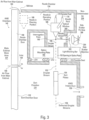
- FIG 3 is a schematic cutaway side view of the aerosol management system chambers 140.
- the nozzle chamber 134 contains the nozzle 186, which is illustrated in solid lines in the operating position. Sheath fluid 170 is provided through the nozzle 186, as well as the sample fluid 172.
- the nozzle 186 can also be moved to a cleaning position, as illustrated in dotted lines.
- the nozzle chamber door 198 can be opened so that the nozzle 186, in the cleaning position, is accessible through the nozzle chamber door 198. Nozzles, such as nozzle 186, can become clogged for various reasons, and a quick and easy access to the nozzle 186 is provided when the nozzle 186 is in the cleaning position.
- the negative pressure in the nozzle chamber 134 compared to the main work area 104, is equalized so that contaminated air can at that point in time migrate from the nozzle chamber 134 to the main work area 104.
- the droplet stream 155 from the nozzle 186 flows through an opening 152 and the optics mounting plate 150.
- the droplet stream 155 passes through an interrogation point 148 prior to the droplets separating from the stream.
- Laser beams interrogate the nozzle stream 153 at the interrogation point 148. Scattered and projected light from the interrogation point 148 is transmitted through the optical window 200 and past the light blocking bar 202 to a side scatter objective 204.
- Side scatter objective 204 collects the side scatter rays and transmits those rays through side scatter pin hole 206.
- Flexible seals 210, 212 and 214 provide a partial seal so that the droplet stream 155 does not transfer to the non-containment air 208.
- the droplet stream 155 passes through the sort plates 154 and is separated into deflected droplet streams 156.
- the AMS intake duct 138 is connected to the AMS HEPA filter 141 and the AMS fan 144, as illustrated in Figure 1 . Air from the sort chamber 131 is drawn through the AMS intake duct 138 to create a low pressure in both the sort chamber 131 and the nozzle chamber 134. Air from the main cabinet work area 104 passes through inlets 188 and 194.
- Airflow 190 from the main cabinet passes through inlet 188, while airflow 196 from the main cabinet passes through inlet 194.
- the sort chamber 131 has a sort chamber door 132 that can be opened to provide operator access to the sort plates 154 and collection tubes 182, 184 ( Figure 2 ) in the sort chamber 131. Again, because the sort chamber 131 has lower pressure than the main cabinet work area 104, opening of the sort chamber door 132 equalizes the pressure of the sort chamber and the main cabinet work area 104. To prevent hazardous aerosols from escaping the sort chamber 131 or nozzle chamber 134, both the sort chamber 131 and the nozzle chamber 134 must be evacuated using the AMS fan 144 ( Figure 1 ) prior to opening either the nozzle chamber door 198 or the sort chamber door 132. Once the aerosols are purged from the aerosol management chambers 140, the doors 198, 132 can be opened.
- Figure 4 is a front schematic view illustrating the nozzle chamber 134, the sort chamber 131 and various devices of the cell sorter that are located outside of the aerosol management system (AMS) 149 and the main cabinet containment system 101. As illustrated in Figure 4 , non-containment air 208 surrounds the nozzle chamber wall 213 of the nozzle chamber
- FIG. 5 is a perspective view of an embodiment of an implementation of the integrated biocontainment cell sorter 100.
- an exhaust vent 110 exhausts clean air out of the integrated biocontainment cell sorter 100.
- Clean air is provided to the recirculation plenum 102 by the recirculation duct 108.
- the filter and fan plenum 121 contain the filter and fan in a location that is in the back and the bottom of the integrated biocontainment cell sorter 100 so that other portions of the integrated biocontainment cell sorter 100 are easily accessible to an operator.
- Sliding sash window (partition) 114 moves with an angular vertical movement to provide an opening to the main cabinet containment system 101.
- the sample input area 107 is accessible by an operator.
- the nozzle chamber 134 and sample line are accessible.
- Grate 118 allows air from outside of the integrated biocontainment cell sorter 100 to be drawn into the main cabinet containment system 101 so that contaminated air does not pass out of the main cabinet containment system 101. By maintaining a lower pressure in the main cabinet containment system 101, contaminated air does not escape from the integrated biocontainment cell sorter 100.
- the integrated biocontainment cell sorter 100 provides containment only around the portions of the cell sorter that may create contaminated air.
- the integrated biocontainment cell sorter 100 has containment areas that are small and compact, have smaller fans and substantially smaller overall dimensions than cell sorters that are placed in large hoods or partially integrated biocontainment cell sorters.
- Partially integrated biocontainment cell sorters encapsulate numerous components of a cell sorter that do not require containment, and make it much more difficult to provide maintenance to specific areas of the cell sorter that do not require biocontainment.
- the smaller containment areas results in smaller fans and requires moving a reduced volume of air to maintain containment, thereby saving energy.
Landscapes
- Chemical & Material Sciences (AREA)
- Health & Medical Sciences (AREA)
- Life Sciences & Earth Sciences (AREA)
- Pathology (AREA)
- Physics & Mathematics (AREA)
- Analytical Chemistry (AREA)
- Biochemistry (AREA)
- General Health & Medical Sciences (AREA)
- General Physics & Mathematics (AREA)
- Immunology (AREA)
- Dispersion Chemistry (AREA)
- Biomedical Technology (AREA)
- Engineering & Computer Science (AREA)
- Molecular Biology (AREA)
- Clinical Laboratory Science (AREA)
- Chemical Kinetics & Catalysis (AREA)
- Apparatus Associated With Microorganisms And Enzymes (AREA)
- Sampling And Sample Adjustment (AREA)
- Ventilation (AREA)
- Filtering Of Dispersed Particles In Gases (AREA)
- Devices For Use In Laboratory Experiments (AREA)
Applications Claiming Priority (4)
| Application Number | Priority Date | Filing Date | Title |
|---|---|---|---|
| US201962866759P | 2019-06-26 | 2019-06-26 | |
| US16/910,538 US11307132B2 (en) | 2019-06-26 | 2020-06-24 | Integrated biocontainment cell sorter |
| PCT/US2020/039493 WO2020264075A1 (en) | 2019-06-26 | 2020-06-25 | Integrated biocontainment cell sorter |
| EP20832026.7A EP3948223B1 (de) | 2019-06-26 | 2020-06-25 | Integrierter bioabdichtungszellsortierer |
Related Parent Applications (1)
| Application Number | Title | Priority Date | Filing Date |
|---|---|---|---|
| EP20832026.7A Division EP3948223B1 (de) | 2019-06-26 | 2020-06-25 | Integrierter bioabdichtungszellsortierer |
Publications (2)
| Publication Number | Publication Date |
|---|---|
| EP4474053A2 true EP4474053A2 (de) | 2024-12-11 |
| EP4474053A3 EP4474053A3 (de) | 2025-02-19 |
Family
ID=74044413
Family Applications (2)
| Application Number | Title | Priority Date | Filing Date |
|---|---|---|---|
| EP24195215.9A Pending EP4474053A3 (de) | 2019-06-26 | 2020-06-25 | Integrierter bioabdichtungszellsortierer |
| EP20832026.7A Active EP3948223B1 (de) | 2019-06-26 | 2020-06-25 | Integrierter bioabdichtungszellsortierer |
Family Applications After (1)
| Application Number | Title | Priority Date | Filing Date |
|---|---|---|---|
| EP20832026.7A Active EP3948223B1 (de) | 2019-06-26 | 2020-06-25 | Integrierter bioabdichtungszellsortierer |
Country Status (6)
| Country | Link |
|---|---|
| US (3) | US11307132B2 (de) |
| EP (2) | EP4474053A3 (de) |
| JP (2) | JP7560496B2 (de) |
| KR (1) | KR102916295B1 (de) |
| CN (2) | CN114402189B (de) |
| WO (1) | WO2020264075A1 (de) |
Families Citing this family (8)
| Publication number | Priority date | Publication date | Assignee | Title |
|---|---|---|---|---|
| US11307132B2 (en) * | 2019-06-26 | 2022-04-19 | Life Technologies Corporation | Integrated biocontainment cell sorter |
| WO2022091740A1 (ja) * | 2020-10-26 | 2022-05-05 | 株式会社島津製作所 | 解析装置 |
| CN117098982A (zh) * | 2021-02-05 | 2023-11-21 | 厦泰生物科技公司 | 集成紧凑细胞分选仪 |
| US12285761B2 (en) * | 2021-02-05 | 2025-04-29 | Cytek Biosciences, Inc. | Integrated air filtering and conditioning of droplet chamber in a compact cell sorter |
| US12379301B2 (en) | 2021-03-24 | 2025-08-05 | Becton, Dickinson And Company | Closed-system sorting flow cytometer adapters and methods of use thereof |
| WO2023074548A1 (ja) * | 2021-10-29 | 2023-05-04 | ソニーグループ株式会社 | 微小粒子分取装置及び微小粒子分取キット |
| US20230375458A1 (en) * | 2022-05-17 | 2023-11-23 | Becton, Dickinson And Company | Particle sorter nozzles and methods of use thereof |
| US12325052B1 (en) | 2023-05-08 | 2025-06-10 | Labconco Corporation | Biosafety cabinet with divided plenum |
Citations (1)
| Publication number | Priority date | Publication date | Assignee | Title |
|---|---|---|---|---|
| US8557587B2 (en) | 2009-01-07 | 2013-10-15 | Xy, Llc | Self-tuning, biologically modeled sorter |
Family Cites Families (29)
| Publication number | Priority date | Publication date | Assignee | Title |
|---|---|---|---|---|
| BE793185A (fr) * | 1971-12-23 | 1973-04-16 | Atomic Energy Commission | Appareil pour analyser et trier rapidement des particules telles que des cellules biologiques |
| US3895570A (en) * | 1973-09-27 | 1975-07-22 | Baker Company Inc | Air-insulated work station |
| US3963606A (en) * | 1974-06-03 | 1976-06-15 | Coulter Electronics, Inc. | Semi-automatic adjusting delay for an electronic particle separator |
| US4230031A (en) * | 1978-04-26 | 1980-10-28 | Coulter Electronics, Inc. | Biohazard containment apparatus and method |
| US4279345A (en) * | 1979-08-03 | 1981-07-21 | Allred John C | High speed particle sorter using a field emission electrode |
| US4685385A (en) * | 1984-12-20 | 1987-08-11 | Rich Colin W | Refinishing unit |
| GB9322983D0 (en) * | 1993-11-05 | 1994-01-05 | Secr Defence | Toxic work enclosure |
| US5641457A (en) * | 1995-04-25 | 1997-06-24 | Systemix | Sterile flow cytometer and sorter with mechanical isolation between flow chamber and sterile enclosure |
| US5711705A (en) * | 1995-05-25 | 1998-01-27 | Flanders Filters, Inc. | Isolation work station |
| JP2000167416A (ja) * | 1998-11-30 | 2000-06-20 | Nomura Micro Sci Co Ltd | ドラフト装置及びドラフト装置排気処理方法 |
| US20020042148A1 (en) * | 2000-05-10 | 2002-04-11 | Simon Monard | Flow cytometer safety cabinet |
| US6698219B2 (en) * | 2001-11-30 | 2004-03-02 | National University Of Singapore | Energy-efficient variable-air-volume (VAV) system with zonal ventilation control |
| WO2003062796A1 (en) * | 2002-01-22 | 2003-07-31 | Dakocytomation Denmark A/S | Environmental containment system for a flow cytometer |
| JP6434248B2 (ja) * | 2014-08-01 | 2018-12-05 | 日本エアーテック株式会社 | 安全キャビネット |
| DE202005008763U1 (de) * | 2005-06-02 | 2006-10-19 | Universität Duisburg-Essen | Vorrichtung zum Sortieren von Mikropartikeln, insbesondere biogefährdender und zu schützender Stoffe |
| CN2880289Y (zh) * | 2006-02-28 | 2007-03-21 | 李小敏 | 涡轮负压多重保护零泄露生物安全柜 |
| US20100267321A1 (en) | 2007-06-22 | 2010-10-21 | Institute Of Occupational Safety And Health, Council Of Labor Affairs, Executive Yuan | Air curtain-isolated biosafety cabinet |
| KR101030329B1 (ko) | 2008-10-14 | 2011-04-20 | (주)에이치시티 | 입자 측정 유니트 |
| JP5382852B2 (ja) * | 2009-02-06 | 2014-01-08 | 株式会社オンチップ・バイオテクノロジーズ | 使い捨てチップ型フローセルとそれを用いたフローサイトメーター |
| AU2014217893A1 (en) | 2013-02-18 | 2015-07-30 | Theranos Ip Company, Llc | Systems and methods for multi-analysis |
| US9446159B2 (en) * | 2013-10-03 | 2016-09-20 | Becton, Dickinson And Company | Flow cytometer biosafety hood and systems including the same |
| ES2885623T3 (es) | 2014-04-21 | 2021-12-14 | Becton Dickinson Co | Cartucho de sellado de cinta deslizante para sellar de manera ajustable una cámara de manipulación de muestras de un citómetro de flujo |
| CN104458544B (zh) * | 2014-12-29 | 2017-04-05 | 中国科学院长春光学精密机械与物理研究所 | 一种流式细胞仪的液流系统 |
| JP6499054B2 (ja) * | 2015-10-19 | 2019-04-10 | 株式会社日立産機システム | 開放式ダクトおよび安全キャビネット |
| US11112345B2 (en) | 2016-06-10 | 2021-09-07 | Sony Corporation | Microparticle measurement device and cleaning method for microparticle measurement device |
| JP6711713B2 (ja) * | 2016-07-12 | 2020-06-17 | Phcホールディングス株式会社 | キャビネット |
| US10989724B1 (en) * | 2016-07-29 | 2021-04-27 | Labrador Diagnostics Llc | Systems and methods for multi-analysis |
| US10895582B2 (en) | 2017-09-07 | 2021-01-19 | Sysmex Corporation | Sample preparing apparatus, sample preparing system, sample preparing method, and particle analyzer |
| US11307132B2 (en) * | 2019-06-26 | 2022-04-19 | Life Technologies Corporation | Integrated biocontainment cell sorter |
-
2020
- 2020-06-24 US US16/910,538 patent/US11307132B2/en active Active
- 2020-06-25 WO PCT/US2020/039493 patent/WO2020264075A1/en not_active Ceased
- 2020-06-25 CN CN202080046626.XA patent/CN114402189B/zh active Active
- 2020-06-25 EP EP24195215.9A patent/EP4474053A3/de active Pending
- 2020-06-25 JP JP2021576478A patent/JP7560496B2/ja active Active
- 2020-06-25 KR KR1020217041687A patent/KR102916295B1/ko active Active
- 2020-06-25 EP EP20832026.7A patent/EP3948223B1/de active Active
- 2020-06-25 CN CN202510910050.1A patent/CN120741309A/zh active Pending
-
2022
- 2022-03-11 US US17/692,234 patent/US11808689B2/en active Active
-
2023
- 2023-08-31 US US18/240,415 patent/US12313525B2/en active Active
-
2024
- 2024-09-19 JP JP2024162672A patent/JP2024166405A/ja active Pending
Patent Citations (1)
| Publication number | Priority date | Publication date | Assignee | Title |
|---|---|---|---|---|
| US8557587B2 (en) | 2009-01-07 | 2013-10-15 | Xy, Llc | Self-tuning, biologically modeled sorter |
Also Published As
| Publication number | Publication date |
|---|---|
| JP7560496B2 (ja) | 2024-10-02 |
| JP2024166405A (ja) | 2024-11-28 |
| EP4474053A3 (de) | 2025-02-19 |
| EP3948223A4 (de) | 2023-02-08 |
| KR20220025732A (ko) | 2022-03-03 |
| JP2022538105A (ja) | 2022-08-31 |
| KR102916295B1 (ko) | 2026-01-21 |
| CN114402189A (zh) | 2022-04-26 |
| US12313525B2 (en) | 2025-05-27 |
| EP3948223B1 (de) | 2024-08-21 |
| US11307132B2 (en) | 2022-04-19 |
| CN114402189B (zh) | 2025-07-18 |
| EP3948223A1 (de) | 2022-02-09 |
| US20220252502A1 (en) | 2022-08-11 |
| CN120741309A (zh) | 2025-10-03 |
| EP3948223C0 (de) | 2024-08-21 |
| US20200408667A1 (en) | 2020-12-31 |
| US11808689B2 (en) | 2023-11-07 |
| US20240060871A1 (en) | 2024-02-22 |
| WO2020264075A1 (en) | 2020-12-30 |
Similar Documents
| Publication | Publication Date | Title |
|---|---|---|
| US12313525B2 (en) | Integrated biocontainment cell sorter | |
| JP4309202B2 (ja) | ソート用流動細胞測光計用ソートブロック及び液体収集装置 | |
| JPS631543B2 (de) | ||
| US9446159B2 (en) | Flow cytometer biosafety hood and systems including the same | |
| US4412849A (en) | Method and apparatus for control of gas-borne particulates | |
| US5380244A (en) | Safety cabinet | |
| US7884301B2 (en) | Device and method for separation of microparticles in particular biohazardous and hazardous materials | |
| EP1265707B1 (de) | Kammer zur handhabung giftiger oder steriler stoffe | |
| Clark | Safety cabinets, fume cupboards and other containment systems | |
| US20240278240A1 (en) | Methods for cell sorters with pivotal scuppers | |
| WO2001085088A1 (en) | Flow cytometer safety cabinet | |
| US20050022487A1 (en) | Biological safety cabinet | |
| CN206046058U (zh) | 一种耐用生物安全柜 | |
| CN117120166A (zh) | 紧凑型细胞分选仪中微滴腔室的集成式空气过滤和调节 | |
| Rayburn | Design and use of biological safety cabinets | |
| CN206046049U (zh) | 一种易清洗生物安全柜 |
Legal Events
| Date | Code | Title | Description |
|---|---|---|---|
| PUAI | Public reference made under article 153(3) epc to a published international application that has entered the european phase |
Free format text: ORIGINAL CODE: 0009012 |
|
| STAA | Information on the status of an ep patent application or granted ep patent |
Free format text: STATUS: THE APPLICATION HAS BEEN PUBLISHED |
|
| AC | Divisional application: reference to earlier application |
Ref document number: 3948223 Country of ref document: EP Kind code of ref document: P |
|
| AK | Designated contracting states |
Kind code of ref document: A2 Designated state(s): AL AT BE BG CH CY CZ DE DK EE ES FI FR GB GR HR HU IE IS IT LI LT LU LV MC MK MT NL NO PL PT RO RS SE SI SK SM TR |
|
| REG | Reference to a national code |
Ref country code: DE Ref legal event code: R079 Free format text: PREVIOUS MAIN CLASS: B01L0001020000 Ipc: G01N0015140000 |
|
| PUAL | Search report despatched |
Free format text: ORIGINAL CODE: 0009013 |
|
| AK | Designated contracting states |
Kind code of ref document: A3 Designated state(s): AL AT BE BG CH CY CZ DE DK EE ES FI FR GB GR HR HU IE IS IT LI LT LU LV MC MK MT NL NO PL PT RO RS SE SI SK SM TR |
|
| RIC1 | Information provided on ipc code assigned before grant |
Ipc: G01N 35/00 20060101ALN20250116BHEP Ipc: B01L 1/02 20060101ALI20250116BHEP Ipc: G01N 15/14 20240101AFI20250116BHEP |
|
| STAA | Information on the status of an ep patent application or granted ep patent |
Free format text: STATUS: REQUEST FOR EXAMINATION WAS MADE |
|
| 17P | Request for examination filed |
Effective date: 20250813 |