EP4472271A1 - Verfahren und vorrichtung zur beurteilung der durchführbarkeit - Google Patents
Verfahren und vorrichtung zur beurteilung der durchführbarkeit Download PDFInfo
- Publication number
- EP4472271A1 EP4472271A1 EP23755723.6A EP23755723A EP4472271A1 EP 4472271 A1 EP4472271 A1 EP 4472271A1 EP 23755723 A EP23755723 A EP 23755723A EP 4472271 A1 EP4472271 A1 EP 4472271A1
- Authority
- EP
- European Patent Office
- Prior art keywords
- information
- network
- network resource
- requirement information
- execution device
- Prior art date
- Legal status (The legal status is an assumption and is not a legal conclusion. Google has not performed a legal analysis and makes no representation as to the accuracy of the status listed.)
- Pending
Links
Images




Classifications
-
- H—ELECTRICITY
- H04—ELECTRIC COMMUNICATION TECHNIQUE
- H04W—WIRELESS COMMUNICATION NETWORKS
- H04W16/00—Network planning, e.g. coverage or traffic planning tools; Network deployment, e.g. resource partitioning or cells structures
- H04W16/18—Network planning tools
-
- H—ELECTRICITY
- H04—ELECTRIC COMMUNICATION TECHNIQUE
- H04W—WIRELESS COMMUNICATION NETWORKS
- H04W28/00—Network traffic management; Network resource management
- H04W28/16—Central resource management; Negotiation of resources or communication parameters, e.g. negotiating bandwidth or QoS [Quality of Service]
- H04W28/26—Resource reservation
-
- H—ELECTRICITY
- H04—ELECTRIC COMMUNICATION TECHNIQUE
- H04W—WIRELESS COMMUNICATION NETWORKS
- H04W24/00—Supervisory, monitoring or testing arrangements
- H04W24/02—Arrangements for optimising operational condition
-
- H—ELECTRICITY
- H04—ELECTRIC COMMUNICATION TECHNIQUE
- H04W—WIRELESS COMMUNICATION NETWORKS
- H04W4/00—Services specially adapted for wireless communication networks; Facilities therefor
- H04W4/50—Service provisioning or reconfiguring
Definitions
- Embodiments of this application relate to the field of communication technologies, and more specifically, to a feasibility evaluation method and an apparatus.
- a 5th generation mobile communication (5th generation mobile networks, 5G) technology has a more flexible network architecture compared with a previous-generation communication technology.
- the 5th generation mobile communication technology raises higher requirements on key performance indicators such as coverage, a capacity, a rate, and mobility of a network. This further increases difficulties in network O&M. Therefore, the communication field introduces an automation technology, in expectation of resolving problems of complexity and low efficiency in a network resource deployment process.
- network planning also needs to be considered when network resources are deployed, and this increases complexity of network deployment.
- feasibility evaluation needs to be performed on network requirements in advance. In this case, how to meet requirements of services such as reserving a corresponding network resource while performing feasibility evaluation on the network requirements by carriers, feeding back information about the network resource, and feeding back information about a modification recommendation of the network requirements becomes a problem to be urgently resolved in this field.
- Embodiments of this application provide a feasibility evaluation method and an apparatus, so that carriers can obtain, when performing feasibility evaluation on network requirement information, a reservation status of a network resource corresponding to the network requirement information, information about the network resource corresponding to the network requirement information, information about a modification recommendation of the network requirement information, and the like, to expand application scenarios of feasibility evaluation, further reduce service deployment time, and improve a service provisioning success rate.
- a feasibility evaluation method includes: An execution device receives first information sent by a control device, where the first information is for requesting the execution device to perform feasibility evaluation on first network requirement information, the first information includes the first network requirement information, and the first information includes at least one of first indication information, second indication information, or third indication information, where the first indication information indicates the execution device to reserve a network resource corresponding to the first network requirement information, the second indication information indicates the execution device to feed back information about the network resource corresponding to the first network requirement information, and the third indication information indicates the execution device to feed back information about a modification recommendation of the first network requirement; the execution device performs feasibility evaluation on the first network requirement information based on the first information, to determine second information, where the second information includes a feasibility evaluation result, and when the first information includes a first indication, the second information includes a reservation status of the network resource corresponding to the first network requirement information, or when the first information includes the second indication information, the second information includes the information about the network resource corresponding to the first network requirement
- the execution device may obtain the reservation status of the network resource of the first network requirement information, the information about the network resource corresponding to the first network requirement information, and the modification recommendation of the first network requirement information.
- the method when the first information includes the first indication information, the method further includes: The execution device determines a first network resource as the network resource corresponding to the first network requirement information; and the execution device sets the reservation status of the first network resource to reserved, where information about the reservation status of the network resource includes reserved, unreserved, or released.
- the execution device determines, based on the first information, the network resource corresponding to the first network requirement information, reserves the network resource, and determines that the reservation status of the network resource corresponding to the first network requirement information is reserved, so that a carrier reserves a corresponding network resource when performing feasibility evaluation on network requirement information, to ensure that there are abundant available network resources when a service deployment request is subsequently delivered. In this way, a success rate of service deployment is improved.
- third information indicates the execution device to release, when a network resource reserved for the first network requirement information is occupied, the network resource and reserve the network resource for the first network requirement information.
- the execution device when the execution device determines that the network resource corresponding to the first network requirement information is occupied by another piece of network requirement information, the execution device may release a network resource corresponding to the another piece of network requirement information and reserve the network resource for the first network requirement information, so that the carrier ensures that a corresponding network resource is reserved for an important service while performing feasibility evaluation on a service, and fully allocates the network resource based on different service requirements, to ensure proper resource utilization.
- the first indication information further includes the third information.
- the first indication information may further indicate first duration, and the first duration is duration in which the network resource is reserved for the first network requirement information.
- the method when duration in which the network resource is reserved for the first network requirement information exceeds the first duration, the method further includes: The execution device releases the network resource reserved for the first network requirement information.
- the method further includes: The execution device sends fourth information to the control device, where the fourth information indicates that the reservation status of the network resource reserved for the first network requirement information is updated to released.
- the execution device releases the network resource reserved for the first network requirement information, and determines that the reservation status is unreserved or released, so that the network resource can be allocated to the another piece of network requirement information in a state in which the reservation duration is exceeded, to ensure proper allocation of the network resource.
- the execution device when the first information includes the second indication information, that the execution device performs feasibility evaluation on the first network requirement information to determine second information includes: The execution device determines the information about the network resource corresponding to the first network requirement information, where the information about the network resource includes a network resource type of the first network requirement information and a network resource quantity of the first network requirement information.
- the execution device may determine, based on the first information, the information about the network resource of the first network requirement information, so that the carrier obtains information about the corresponding network resource while performing feasibility evaluation on the network requirement information. This further guides to determine pricing of different service requirements and review network resource information, and ensures proper use of the network resource.
- the method further includes: The execution device receives allocation request information of the network resource sent by the control device, where the allocation request information of the network resource includes the information about the network resource corresponding to the first network requirement information; and the execution device allocates the network resource corresponding to the first network requirement information to the first network requirement information.
- the execution device may allocate the corresponding network resource to the first network requirement information based on the allocation request information that is of the network resource and that is sent by the control device. This effectively reduces the service deployment time.
- the execution device when the first information includes the third indication information, that the execution device performs feasibility evaluation on the first network requirement information to determine second information includes: The execution device determines the information about the modification recommendation corresponding to the first network requirement information, where the information about the modification recommendation includes a parameter name of at least one recommended piece of network requirement information and a parameter value of the at least one piece of recommended network requirement information.
- the execution device may determine, based on the first information, the information about the modification recommendation corresponding to the first network requirement information, so that the carrier obtains information about a corresponding modification recommendation while performing feasibility evaluation on the network requirement information, to guide the carrier to select proper network requirement information based on a current network resource.
- the network resource includes at least one of the following resources: a radio resource, a core network resource, and a virtual resource.
- the radio resource includes a physical resource block PRB resource, a radio resource control RRC connection quantity, a data radio bearer DRB resource, and the like.
- the core network resource includes a protocol data unit PDU session establishment connection quantity.
- the virtual resource includes a virtual machine, a computing resource, a storage resource, a memory, and the like.
- a feasibility evaluation method includes: A control device sends first information to an execution device, where the first information is for requesting the execution device to perform feasibility evaluation on first network requirement information, the first information includes the first network requirement information, and the first information includes at least one of first indication information, second indication information, or third indication information, where the first indication information indicates the execution device to reserve a network resource corresponding to the first network requirement information, the second indication information indicates the execution device to feed back information about the network resource corresponding to the first network requirement information, and the third indication information indicates the execution device to feed back information about a modification recommendation of the first network requirement; and the control device receives second information sent by the execution device, where the second information includes a feasibility evaluation result, and when the first information includes the first indication information, the second information includes a reservation status of the network resource corresponding to the first network requirement information, or when the first information includes the second indication information, the second information includes the information about the network resource corresponding to the first network requirement information, or when the first information includes the third indication information,
- the control device when the control device sends the feasibility evaluation to the execution device, at least one of the first indication information, the second indication information, or the third indication information is introduced.
- the first indication information indicates the execution device to reserve the network resource corresponding to the first network requirement information
- the second indication information indicates the execution device to feed back the information about the network resource corresponding to the first network requirement information
- the third indication information indicates the execution device to feed back the information about the modification recommendation of the first network requirement.
- the method when the first information includes the first indication information, the method further includes: The control device receives a reservation status of a first network resource sent by the execution device, where the first network resource is the network resource corresponding to the first network requirement information, and the reservation status includes reserved, unreserved, or released.
- the control device may obtain that the reservation status of the network resource corresponding to the first network resource information sent by the execution device is reserved, so that a carrier reserves a corresponding network resource when performing feasibility evaluation on network requirement information, to ensure that there are abundant available network resources when a service deployment request is subsequently delivered. In this way, a success rate of service deployment is improved.
- the method further includes: The control device sends third information to the execution device, where the third information indicates the execution device to release, when a network resource reserved for the first network requirement information is occupied, the network resource and reserve the network resource for the first network requirement information.
- the control device may send the network requirement information to the execution device, where the first network requirement information may indicate the execution device to release a network resource corresponding to the another piece of network requirement information and reserve the network resource for the first network requirement information, so that the carrier ensures that a corresponding network resource is reserved for an important service while performing feasibility evaluation on a network requirement, and fully allocates the network resource based on different service requirements, to ensure proper resource utilization.
- the first indication information further includes the third information.
- the first indication information may further indicate first duration, and the first duration is duration in which the network resource is reserved for the first network requirement information.
- the method when duration in which the network resource is reserved for the first network requirement information exceeds the first duration, the method further includes: The control device receives fourth information sent by the execution device, where the fourth information indicates that the reservation status of the network resource reserved for the first network requirement information is updated to released.
- the control device may receive that the reservation status determined by the execution device is unreserved or released, so that the network resource can be allocated to the another piece of network requirement information in a state in which the reservation duration is exceeded, to ensure proper allocation of the network resource.
- the method when the first information includes the second indication information, the method further includes: The control device receives the information about the network resource corresponding to the first network requirement information that is sent by the execution device, where the information about the network resource includes a network resource type of the first network requirement information and a network resource quantity of the first network requirement information.
- the control device may obtain the information about the network resource of the first network requirement information that is sent by the execution device, so that the carrier obtains information about the corresponding network resource while performing feasibility evaluation on the network requirement information. This further guides to determine pricing of different service requirements.
- the method further includes: The control device sends allocation request information of the network resource to the execution device, where the allocation request information of the network resource includes the information about the network resource corresponding to the first network requirement information.
- control device may send the allocation request information of the network resource to the execution device, and the execution device allocates the corresponding network resource to the first network requirement information based on the information about the network resource corresponding to the first network requirement information in the allocation request information of the network resource. In this way, the service deployment time is effectively reduced.
- the method when the first information includes the third indication information, the method further includes: The control device receives the information about the modification recommendation corresponding to the first network requirement information sent by the execution device, where the information about the modification recommendation includes a parameter name of at least one piece of network requirement information and a parameter value of the at least one piece of network requirement information.
- the control device may obtain the information about the modification recommendation corresponding to the first network requirement information sent by the execution device, so that the carrier obtains information about a corresponding modification recommendation when performing feasibility evaluation on the network requirement information, to guide the carrier to select proper network requirement information based on a current network resource.
- a feasibility evaluation method includes: A control device sends first information to an execution device, where the first information is for requesting the execution device to perform feasibility evaluation on first network requirement information, the first information includes the first network requirement information, and the first information includes at least one of first indication information, second indication information, or third indication information, where the first indication information indicates the execution device to reserve a network resource corresponding to the first network requirement information, the second indication information indicates the execution device to feed back information about the network resource corresponding to the first network requirement information, and the third indication information indicates the execution device to feed back information about a modification recommendation of the first network requirement; the execution device performs feasibility evaluation on the first network requirement information based on the first information, to determine second information, where the second information includes a feasibility evaluation result, and when the first information includes the first indication information, the second information includes a reservation status of the network resource corresponding to the first network requirement information, or when the first information includes the second indication information, the second information includes the information about the network resource corresponding to the first network requirement information,
- the control device sends the first information to the execution device, and when performing feasibility evaluation on the first network requirement information based on the first information to obtain the feasibility evaluation result, the execution device may obtain the reservation status of the network resource of the first network requirement information, the information about the network resource corresponding to the first network requirement information, and the information about the modification recommendation of the first network requirement information.
- the method when the first information includes the first indication information, the method further includes: The execution device determines a first network resource as the network resource corresponding to the first network requirement information; the execution device sets the reservation status of the first network resource to reserved, where the reservation status includes reserved, unreserved, or released; and the execution device sends the reservation status of the first network resource to the control device.
- the execution device determines, based on the first information, the network resource corresponding to the first network requirement information, reserves the network resource, determines that the reservation status of the network resource corresponding to the first network requirement information is reserved, and feeds back the network resource to the control device, so that a carrier reserves a corresponding network resource when performing feasibility evaluation on network requirement information, to ensure that there are abundant available network resources when a service deployment request is subsequently delivered. In this way, a success rate of service deployment is improved.
- the method when the first information includes the second indication information, the method further includes: The execution device determines the information about the network resource corresponding to the first network requirement information, where the information about the network resource includes a network resource type of the first network requirement information and a network resource quantity of the first network requirement information; and the execution device sends the information about the network resource to the control device.
- the execution device may determine, based on the first information, the information about the network resource of the first network requirement information, and feed back the information to the control device, so that the carrier obtains information about the corresponding network resource while performing feasibility evaluation on the network requirement information. This further guides to determine pricing of different service requirements and review network resource information, and ensures proper use of the network resource.
- the method when the first information includes the third indication information, the method further includes: The execution device determines the information about the modification recommendation corresponding to the first network requirement information, where the information about the modification recommendation includes a parameter name of at least one recommended piece of network requirement information and a parameter value of the at least one recommended piece of network requirement information; and the execution device sends the information about the modification recommendation to the control device.
- the execution device may determine, based on the first information, the information about the modification recommendation corresponding to the first network requirement information, and feed back the information to the control device, so that the carrier obtains information about a corresponding modification recommendation while performing feasibility evaluation on the network requirement information, to guide the carrier to select proper network requirement information based on a current network resource.
- a communication apparatus includes devices configured to implement the method in any possible implementation of the first aspect or the second aspect.
- a feasibility evaluation system includes an apparatus configured to implement the method in any possible implementation of the first aspect or the second aspect.
- a computer-readable storage medium stores a computer program (which may also be referred to as code or instructions), and when the computer program is run on a computer, the computer is enabled to perform the method in any possible implementation of the first aspect or the second aspect.
- a chip system including a memory and a processor.
- the memory is configured to store a computer program.
- the processor is configured to store the computer program.
- the processor is configured to invoke the computer program from the memory and run the computer program, so that a communication device in which the chip system is installed performs the method in any possible implementation of the first aspect or the second aspect.
- the chip system may include an input chip or an interface configured to send information or data, and an output chip or an interface configured to receive information or data.
- Non-Standalone dual-anchor communication system.
- a user terminal in a connected state may simultaneously use radio resources of at least two different base stations.
- a 4G base station serves as a primary station, is an anchor for the user terminal to access a network, and provides a signaling control function for the user terminal to access the network, and can forward user plane data.
- a 5G base station serves as a secondary station and provides additional user-plane data forwarding resources for the user terminal.
- An NSA system includes two types of networks.
- a first network shares a control plane with a second network, and a user plane of the first network is independent of a user plane of the second network.
- the first network may be a 4th generation (4th generation, 4G) mobile communication system, for example, a long term evolution (long term evolution, LTE) system or a worldwide interoperability for microwave access (worldwide interoperability for microwave access, WiMAX) communication system, or may be a 5th generation (5th generation, 5G) mobile communication system, for example, a new radio (new radio, NR) system, or may be a future communication system, for example, a 6th generation (6th generation, 6G) mobile communication system. This is not limited.
- the second network may be a 4G mobile communication system such as an LTE system or a WiMAX communication system, or may be a 5G mobile communication system such as an NR system, or may be a future communication system such as a 6G mobile communication system. This is not limited.
- a carrier network has developed to a 5th generation mobile communication technology, and a network structure of the carrier network is more flexible than that of a previous generation.
- a core network is service-oriented, a central unit (central unit, CU) and a distributed unit (distributed unit, DU) of a radio access network (radio access network, RAN) are separated, and a network slice is flexibly customized. Therefore, in the 5th generation mobile communication technology, requirements for key performance indicators such as coverage, a capacity, a rate, and mobility of a network are continuously increasing, and further increases network O&M difficulty.
- the communication field introduces the automation technology, such as artificial intelligence, machine learning, and big data analysis, in expectation of resolving the problems of complexity and low efficiency in network O&M (including network planning, network deployment, network maintenance, network optimization, and the like).
- the automation technology can be used for automatically converting service requirements into network resource requirements and network configuration parameters, to implement automatic network deployment.
- the 5G network needs to support various industry services. Different industry services have different service quality requirements.
- SLA service level agreement
- a network planning or deployment intelligent function is introduced into a domain management unit, and a feasibility evaluation interface is provided externally, so that a carrier is allowed to deliver an evaluation task (for example, an SLA requirement of the service) before different network management phases (for example, resource survey and service provisioning), and obtain a corresponding evaluation result (for example, feasible or infeasible).
- Feasibility evaluation also referred to as resource pre-evaluation, can provide a capability of evaluating whether a current resource satisfies a specified service requirement, so that a pre-evaluation result of the resource is obtained by invoking a feasibility evaluation interface.
- the intent describes an expectation for a telecommunication system (including a network and management system), including one or more of the following: a requirement, an intent objective, and a restriction.
- the telecommunication system formulates a solution based on the expectation.
- the intent may be an intent object, in other words, a managed object of the intent.
- a capacity intent means that a proportion of high-load cells in an area 1 is 10%
- a coverage intent means that a proportion of weak coverage in the area 1 is 20%
- a rate intent means that a proportion of low-rate users in the area 1 is 5%.
- Managed object The managed object is used for describing information about a managed object or management task in the management system.
- a managed object information model may be used as an interaction parameter in a management interface. Creating the managed object indicates creating management information in the management system, and enabling the management system to manage the managed object or execute the management task based on the management information.
- the network resource includes at least one of the following: a radio resource, a core network resource, and a virtual resource.
- the radio resource includes a physical resource block (physical resource block, PRB), a radio resource control (radio resource control, RRC) connection quantity, a data radio bearer (data radio bearer, DRB) resource, and the like.
- the core network resource mainly includes a packet data unit (packet data unit, PDU) session establishment connection quantity.
- the virtual resource includes a virtual machine, a computing resource, a storage resource, a memory, and the like.
- FIG. 1 is a diagram of an architecture of a network O&M system according to an embodiment of this application.
- the architecture of the network O&M system includes a service management unit, an end-to-end network management unit, a domain management unit, and a network element.
- the service management unit may be referred to as a business support system or a service management system. This is not limited in embodiments of this application.
- the end-to-end network management unit may be a node such as a network management system (network management system, NMS), a management service producer (management service producer, MnS Producer), or a management service consumer (management service consumer, MnS Consumer), and the domain management function unit may be a node such as an element management system (element management system, EMS), a wireless automation engine (MBB automation engine, MAE), an MnS producer, or an MnS consumer.
- NMS network management system
- MnS Producer management service producer
- MnS Consumer management service consumer
- the domain management function unit may be a node such as an element management system (element management system, EMS), a wireless automation engine (MBB automation engine, MAE), an MnS producer, or an MnS consumer.
- a management service is a management service provided by the end-to-end network management unit
- the end-to-end network management unit is the management service producer
- the service management unit is the management service consumer.
- a feasibility evaluation execution device in embodiments of this application is implemented by the end-to-end network management unit, and a feasibility evaluation control device is implemented by the service management unit.
- the domain management unit is the management service producer, and the end-to-end network management unit is the management service consumer.
- the feasibility evaluation execution device in embodiments of this application is implemented by the domain management unit, and the feasibility evaluation control device is implemented by the end-to-end network management unit.
- the network element is the management service producer
- the end-to-end network management unit is the management service consumer
- the feasibility evaluation execution device in embodiments of this application is implemented by the network element, and the feasibility evaluation control device is implemented by the end-to-end network management unit.
- the service management unit may be configured to provide service operation functions, for example, functions such as service provisioning, service assurance, service scheduling, and user management.
- the service management unit may include a service operating system of a vertical industry or a service operating system of a carrier.
- the service operating system of the carrier may be a business support system or a communication service management system.
- the end-to-end network management unit may provide an end-to-end network O&M function.
- the end-to-end network management function unit may also be referred to as a cross-domain management function unit or a network management function unit (network management function, NMF), for example, a network management entity such as the network management system (network management system, NMS) or a network function management service consumer (network function management service consumer, NFMS_C).
- NMF network management function unit
- NMF network management function unit
- a network management entity such as the network management system (network management system, NMS) or a network function management service consumer (network function management service consumer, NFMS_C).
- the end-to-end network management unit may also provide one or more of the following management functions or management services: network life cycle management, network deployment, network fault management, network performance management, network configuration management, network assurance, network optimization function, translation of a network intent of a service producer (intent from communication service provider, Intent-CSP), translation of a network intent of a communication service user (intent from communication service consumer, intent-CSC), training of a network artificial intelligence (Artificial Intelligence, AI) model, inference of a network AI model, and the like.
- network life cycle management network deployment, network fault management, network performance management, network configuration management, network assurance, network optimization function, translation of a network intent of a service producer (intent from communication service provider, Intent-CSP), translation of a network intent of a communication service user (intent from communication service consumer, intent-CSC), training of a network artificial intelligence (Artificial Intelligence, AI) model, inference of a network AI model, and the like.
- AI Artificial Intelligence
- a network indicated by the management function or the management service in the end-to-end network management unit may include one or more network elements or subnets, or may be a network slice.
- the network management function unit may be a network slice management function (network slice management function, NSMF) unit, a cross-domain management data analytics function (management data analytical function, MDAF) unit, a cross-domain self-organization network function (self-organization network function, SONF) unit, or a cross-domain intent management function (intent driven management function, MnF) unit.
- the end-to-end network management unit may further provide functions of subnet life cycle management, subnet deployment, subnet fault management, subnet performance management, subnet configuration management, subnet assurance, subnet optimization and intelligent analysis, translation of a network intent of a service producer of the subnet (Intent-CSP) or a network intent of a communication service user of the subnet (intent from a communication service consumer, Intent-CSC), and the like.
- the subnet herein includes a plurality of small subnets, and may be a network slice subnet.
- an access network subnet of the carrier includes an access network subnet of a vendor 1 and an access network subnet of a vendor 2.
- the domain management unit is also referred to as a domain management function unit, or may be referred to as a subnet management function unit (network management function, NMF) or a network element management function unit.
- the domain management function unit may be an element management entity such as a wireless automation engine (MBB automation engine, MAE), an element management system (element management system, EMS), or a network function management service provider (network function management service provider, NFMS_P).
- the domain management unit may provide a subnet O&M function and a network element O&M function in a specific field, and specific functions include a lifecycle management function of a subnet or a network element, a configuration management function, a fault management function, a performance management function, an intent management function, an intelligent analysis function, intent translation of the subnet or the network element, training of a network AI model, inference of a network AI model, and the like.
- the subnet may include one or more network elements, or the subnet may include a subnet. That is, one or more subnets form a larger subnet.
- the specific field provided by the domain management unit may be a technology domain, to be specific, a radio access domain, a core domain, a transmission domain, or the like. Therefore, the architecture of the network O&M system includes a radio access domain management system, a core domain management system, and a transmission domain management system.
- the specific field may alternatively be a vendor domain. That is, each vendor corresponds to one domain, for example, a vendor 1 domain or a vendor 2 domain.
- the foregoing specific field may alternatively be a combination of the vendor domain and the technology domain, that is, a radio access domain of a vendor 1, a radio access domain of a vendor 2, or the like.
- the subnet may further be described in the following several manners:
- the subnet in the domain management unit may alternatively be a network slice subnet.
- the domain management unit may alternatively be a network slice subnet management function (network slice subnet management function, NSSMF) unit, a domain management data analytics function (management data analytical function, Domain MDAF) unit, a domain self-organization network function (self-organization network function, SON Function) unit, a domain intent management function unit Intent Driven MnS, or the like.
- the domain management unit may be divided based on a network type and an administrative region.
- the domain management unit may be classified into the following types: an access network domain management function unit (radio access network domain management function, RAN-Domain-MnF), a core network domain management function unit (core network domain management function, CN-Domain-MnF), a transport network domain management function unit (transport network domain management function, TN-Domain-MnF), and the like.
- the domain management function unit may alternatively be a domain network management system, and may be one or more of a management access network, a core network, or a transmission network.
- the domain management unit may be classified as follows: domain management function units of geographical areas, for example, a Shenzhen domain management function unit and a Shanghai domain management function unit.
- the network element is an entity that provides a network service, including a core network element, an access network element, and the like.
- the core network element includes an access and mobility management function (access and mobility management function, AMF), a session management function (session management function, SMF), a policy control function (policy control function, PCF), a network data analytics unit (network data analytical function, NWDAF), a network repository unit (NF Repository Function, NRF), a gateway, and the like.
- the access network element includes a base station (for example, a gNB or an eNB), a base station central control unit (gNB central unit control plane, gNBCUCP), a base station central unit (gNB central unit, gNBCU), a base station distributed unit (gNB distributed unit, gNBDU), a base station central user plane unit (gNB central unit user plane, gNBCUUP), and the like.
- a base station for example, a gNB or an eNB
- gNB central control plane, gNBCUCP base station central unit
- gNB central unit gNB central unit
- gNB distributed unit gNB distributed unit
- gNB central unit user plane gNB central unit user plane
- gNBCUUP base station central user plane
- the network element may provide one or more of the following management functions or management services: network element life cycle management, network element deployment, network element fault management, network element performance management, network element assurance, network element optimization function, translation of a network element intent, and the like.
- FIG. 2 is a schematic block diagram of an example of a communication system 200 according to an embodiment of this application.
- the communication system 200 includes a feasibility evaluation control device 210 and a feasibility evaluation execution device 220.
- the feasibility evaluation control device 210 is connected to the feasibility evaluation execution device 220 through a logical interface.
- the feasibility evaluation control device 210 sends first information to the feasibility evaluation execution device 220, where the first information is for requesting to perform feasibility evaluation on first network requirement information, and the first information includes the first network requirement information and at least one of the following information: reservation requirement information of a network resource of the first network requirement information, information feedback requirement information about the network resource corresponding to the first network requirement information, and feedback requirement information of a modification recommendation of the first network requirement information.
- the first network requirement information may be referred to as service requirement information or an intent objective, for example, a network latency, a network rate, a coverage area, a user type, a maximum quantity of users, a user quantity activation ratio, coverage quality (for example, a weak coverage proportion), a service type (for example, ultra-reliable low-latency communication (ultra-reliable low-latency communication, uRLLC), enhanced mobile broadband (enhanced mobile broadband, eMBB), Internet of Things (Internet of things, mIoT), and a vehicle wireless communication technology (vehicle to everything, V2X)), a packet transmission size, terminal distribution information, and a terminal mobility status.
- service requirement information for example, a network latency, a network rate, a coverage area, a user type, a maximum quantity of users, a user quantity activation ratio, coverage quality (for example, a weak coverage proportion), a service type (for example, ultra-reliable low-latency communication (ultra-reliable low-latency
- the feasibility evaluation execution device 220 performs feasibility evaluation on the first network requirement information, to determine second information.
- the second information includes a feasibility evaluation result and at least one of the following information: a reservation status of the network resource of the first network requirement information, the information about the network resource corresponding to the first network requirement information, and information about the modification recommendation of the first network requirement information.
- the feasibility evaluation execution device 220 sends the second information to the feasibility evaluation control device 210.
- the feasibility evaluation execution device 220 when the first information includes the reservation requirement information of the network resource of the first network requirement information, and the reservation requirement information of the network resource indicates that the network resource needs to be reserved for the first network requirement information, that the feasibility evaluation execution device 220 performs feasibility evaluation on the first network requirement information based on the first information to determine the second information includes: The feasibility evaluation execution device 220 determines the network resource corresponding to the first network requirement information; the feasibility evaluation execution device 220 reserves the network resource corresponding to the first network requirement information; and the feasibility evaluation execution device 220 determines the reservation status of the network resource corresponding to the first network requirement information, where the reservation status of the network resource includes reserved, unreserved, or released.
- the feasibility evaluation execution device 220 sends, to the feasibility evaluation control device 210, information about the reservation status of the network resource corresponding to the first network requirement information.
- the feasibility evaluation execution device 220 releases the network resource corresponding to the first network requirement information; and the feasibility evaluation execution device 220 determines that the reservation status of the network resource corresponding to the first network requirement information is an unreserved state or a released state.
- the feasibility evaluation execution device 220 sends, to the feasibility evaluation control device 210, information indicating that the reservation status of the network resource corresponding to the first network requirement information is the unreserved state or the released state.
- the feasibility evaluation control device 210 when the network resource corresponding to the first network requirement information is occupied by another piece of network requirement information, the feasibility evaluation control device 210 sends indication information to the feasibility evaluation execution device 220, where the indication information indicates the feasibility evaluation execution device 220 to release the network resource occupied by the another piece of network requirement information and reserve the network resource for the first network requirement information.
- the feasibility control device 210 when the first information includes the reservation requirement information of the network resource of the first network requirement information, the feasibility control device 210 sends query information of the reservation status of the network resource to the feasibility execution device 220.
- the feasibility evaluation execution device 220 performs feasibility evaluation on the first network requirement information to determine the second information includes: The feasibility evaluation execution device 220 determines the information about the network resource corresponding to the first network requirement information, where the information about the network resource includes a resource type of the first network requirement information and a resource quantity of the first network requirement information.
- the feasibility execution device 220 sends, to the feasibility control device 210, the information about the network resource corresponding to the first network requirement information.
- the feasibility evaluation control device 210 sends allocation request information of the network resource to the feasibility evaluation execution device 220, where the allocation request information of the network resource includes the information about the network resource corresponding to the first network requirement information.
- the feasibility evaluation control device 210 when the first information includes the information feedback requirement information about the network resource corresponding to the first network requirement information, the feasibility evaluation control device 210 sends query information of the information about the network resource to the feasibility evaluation execution device 220.
- the feasibility execution device 220 performs feasibility evaluation on the first network requirement information to determine the second information includes: The feasibility execution device determines the information about the modification recommendation corresponding to the first network requirement information, where the information about the modification recommendation includes a parameter name of at least one piece of recommended network requirement information and a parameter value of the at least one piece of recommended network requirement information.
- the feasibility evaluation execution device 220 sends, to the feasibility evaluation control device, the information about the modification recommendation corresponding to the first network requirement information.
- the feasibility evaluation control device 210 when the first information includes the feedback requirement information of the modification recommendation of the first network requirement information, the feasibility evaluation control device 210 sends query information of the modification recommendation to the feasibility evaluation execution device 220.
- the feasibility evaluation control device 210 sends deployment request information of the first network requirement information to the feasibility evaluation execution device 220.
- the feasibility evaluation execution device 220 deploys the first network requirement information based on the deployment request information of the first network requirement information.
- FIG. 3 is a schematic flowchart of an example of a feasibility evaluation method according to an embodiment of this application.
- S301 A device A sends first information to a device B.
- the device A may be a feasibility evaluation control device, and the device B may be a feasibility evaluation execution block.
- the device A may be a feasibility evaluation control device, and the device B may be a feasibility evaluation execution block. This is used as an example instead of a limitation. This is not limited in this embodiment of this application.
- the first information is for requesting the device B to perform feasibility evaluation on first network requirement information, and the first information includes the first network requirement information and at least one of the following information:
- the device B determines second information after performing feasibility evaluation on the first network requirement information.
- the second information includes a feasibility evaluation result and at least one of the following information:
- the device B determines the network resource corresponding to the first network requirement information; the device B reserves the network resource corresponding to the first network requirement information; and the device B determines the reservation status of the network resource corresponding to the first network requirement information, where the reservation status of the network resource includes reserved, unreserved, or released.
- the reservation requirement information of the network resource may further indicate duration in which the network resource needs to be reserved for the first network requirement information
- reservation time exceeds the duration in which the network resource is reserved for the first network requirement information
- the device B releases the network resource corresponding to the first network requirement information, and the device B determines that the status of the network resource corresponding to the first network requirement information is an unreserved state or a released state.
- the device A when the network resource corresponding to the first network requirement information is occupied by another piece of network requirement information, the device A sends indication information to the device B, where the indication information indicates the device B to release the network resource occupied by the another piece of network requirement information and reserve the network resource for the first network requirement information.
- the device B performs feasibility evaluation on the first network requirement information based on the first information to determine second information includes: The device B determines the information about the network resource corresponding to the first network requirement information, where the information about the network resource includes a network resource type of the first network requirement information and a network resource quantity of the first network requirement information.
- the device B performs feasibility evaluation on the first network requirement information to determine the second information includes: The device B determines, based on the first information, the information about the network resource corresponding to the first network requirement information, where the information about the network resource includes the network resource type of the first network requirement information and the network resource quantity of the first network requirement information.
- the device B performs feasibility evaluation on the first network requirement information based on the first information to determine the second information includes: The device B determines the information about the modification recommendation corresponding to the first network requirement information, where the information about the modification recommendation includes a parameter name of at least one recommended piece of network requirement information and a parameter value of the at least one recommended piece of network requirement information.
- the device B sends the second information to the device A.
- the method further includes: The device A receives the reservation status that is of the network resource corresponding to the first network requirement information and that is sent by the device B, where the reservation status of the network resource includes reserved, unreserved, or released.
- the reservation requirement information of the network resource may further indicate duration in which the network resource needs to be reserved for the first network requirement information
- the device A receives the reservation status that is of the network resource corresponding to the first network requirement information and that is sent by the device B, where the reservation status of the network resource is the unreserved state or the released state.
- the device A when the first information includes the information feedback requirement information about the network resource corresponding to the first network requirement information, and the information feedback requirement information about the network resource indicates that the information about the network resource corresponding to the first network requirement information needs to be fed back, the device A receives the information that is about the network resource corresponding to the first network requirement information and that is sent by the device B, where the information about the network resource includes the network resource type of the first network requirement information and the network resource quantity of the first network requirement information.
- the method further includes: The device A receives the information that is about the modification recommendation corresponding to the first network requirement information and that is sent by the device B, where the information about the modification recommendation includes a parameter name of at least one piece of network requirement information and a parameter value of the at least one piece of network requirement information; and the device A determines, with reference to a current status of the network resource and the first network requirement information, whether to receive the information about the modification recommendation corresponding to the first network requirement information, where when the device A obtains information about at least one modification recommendation corresponding to the first network requirement information, the device A determines one piece of information about a modification recommendation from the information about the at least one modification recommendation to deploy the first network requirement information.
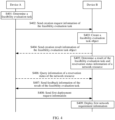
- FIG. 4 is a schematic flowchart of another example of a feasibility evaluation method according to an embodiment of this application.
- a device A determines a feasibility evaluation task based on first network requirement information.
- the feasibility evaluation task includes feasibility requirement information.
- feasibility evaluation requirement information in the feasibility evaluation task may include the following information:
- a user triggers the device A to formulate the feasibility evaluation task in the following cases:
- the feasibility evaluation task includes reservation requirement information of the network resource of the first network requirement information.
- a feasibility evaluation control device determines the feasibility evaluation task based on the first network requirement information.
- the feasibility evaluation task may include the first network requirement information and the reservation requirement information of the network resource of the first network requirement information, and the first network requirement information is a to-be-executed service.
- the device A sends creation request information of the feasibility evaluation task to the device B, where the creation request information of the feasibility evaluation task indicates the device B to create a feasibility evaluation task object based on the creation request information of the feasibility evaluation task.
- the creation request information of the feasibility evaluation task may include an identifier of the feasibility evaluation task, an identifier of the first network requirement information, the first network requirement information, and the reservation requirement information of the network resource of the first network requirement information.
- the feasibility evaluation control device sends the creation request information of the feasibility evaluation task to the feasibility evaluation execution device, where the creation request information of the feasibility evaluation task indicates the feasibility evaluation execution device to create the feasibility evaluation task object.
- the device B determines the feasibility evaluation task object based on the creation request information of the feasibility evaluation task, and configures, in the feasibility evaluation task object, the first network requirement information and the reservation requirement information of the network resource of the first network requirement information.
- the feasibility execution device creates the feasibility evaluation task object based on the creation request information of the feasibility evaluation task, and configures the feasibility evaluation requirement information in the feasibility evaluation task obj ect.
- the device B sends creation result information of the feasibility evaluation task object to the device A, where the creation result information of the feasibility evaluation task object includes the identifier of the feasibility evaluation task.
- the feasibility evaluation execution device sends the creation result information of the feasibility evaluation task object to the feasibility evaluation control device, where the creation result information of the feasibility evaluation task object feeds back a result of creating the feasibility evaluation task object by the feasibility evaluation execution device to the feasibility evaluation control device.
- the device B determines a result of the feasibility evaluation task and the reservation status of the network resource based on the creation result information of the feasibility evaluation task object.
- the feasibility evaluation execution device determines the result of the feasibility evaluation task based on the feasibility evaluation requirement information.
- the feasibility evaluation execution device executes a feasibility evaluation procedure based on the feasibility evaluation task object.
- the feasibility evaluation procedure includes: performing simulation calculation on a requirement of a network resource that meets a service requirement, and determining, based on the requirement of the network resource, whether there are abundant available network resources, to determine the network resource that meets the service requirement, and obtain the result of the feasibility evaluation task.
- radio resource simulation may include delay simulation, bandwidth simulation, and the like, and is used for calculating uplink and downlink reference signal received power (Reference signal received power, RSRP) and a signal to interference plus noise ratio (Signal to interference plus noise ratio, SINR), to obtain a resource reservation quantity of resource blocks (Resource block, RB) and a rate result.
- RSRP uplink and downlink reference signal received power
- SINR signal to interference plus noise ratio
- the result of the feasibility evaluation task determined by the feasibility evaluation execution device based on the feasibility evaluation requirement information is feasible or infeasible.
- the device B may perform the following operations: The device B may determine the network resource corresponding to the first network requirement information; the device B reserves the network resource corresponding to the first network requirement information; and the device B determines the reservation status of the network resource corresponding to the first network requirement information, where the reservation status of the network resource includes reserved, unreserved, or released.
- the feasibility evaluation execution device determines, during evaluation, that there are abundant PRB resources to meet the foregoing service requirements, reserves the PRB resource corresponding to the service requirement information, and determines that a reservation status of the network resource corresponding to the service requirement information is reserved.
- the device B may perform the following operations: The device B releases the network resource corresponding to the first network requirement information; and the device B determines that the reservation status of the network resource corresponding to the first network requirement information is an unreserved or a released state.
- the device B may release the network resource corresponding to the another piece of network requirement information and reserve the network resource for the first network requirement information.
- the feasibility evaluation execution device further allocates a reserved resource identifier to the network resource corresponding to the first network requirement information, and associates the reserved resource identifier with the identifier of the network requirement information.
- the device A sends query information of the reservation status of the network resource to the device B, where the query information of the reservation status of the network resource is used for querying the feasibility evaluation result of the first network requirement information and the reservation status of the network resource of the first network requirement information.
- the feasibility evaluation control device sends a query request of the reservation status of the network resource to the feasibility evaluation execution device, where the query request of the reservation status of the network resource is used for querying the reservation status of the network resource of the first network requirement information.
- the device B sends feedback information of the feasibility evaluation result to the device A, where the feedback information of the feasibility evaluation result includes the identifier of the feasibility evaluation task and the reservation status of the network resource.
- the feasibility evaluation execution device sends the feedback information of the feasibility evaluation result to the feasibility evaluation control device, where the feedback information of the feasibility evaluation result indicates the feasibility evaluation result of the first network requirement information and the reservation status of the network resource of the first network requirement information.
- the device B when the reservation requirement information of the network resource indicates that the network resource needs to be reserved for the first network requirement information, the device B sends, to the device A, the reservation status of the network resource corresponding to the first network requirement information, where the reservation status of the network resource is reserved, unreserved, or released.
- the device B when the reservation requirement information of the network resource may further indicate duration in which the network resource needs to be reserved for the first network requirement information, and when the reservation time exceeds the duration in which the network resource is reserved for the first network requirement information, the device B sends, to the device A, the reservation status of the network resource corresponding to the first network requirement information, where the reservation status of the network resource is the unreserved state or the released state.
- the device A sends first deployment request information to the device B, where the first deployment request information indicates to deploy the first network requirement information on a first resource, and the first resource indicates the network resource reserved for the first network requirement information.
- the feasibility evaluation control device obtains that the feasibility evaluation result is feasible, and the reservation status of the network resource of the first network requirement information is reserved, so that the feasibility evaluation control device sends the first deployment request information to the feasibility evaluation execution device.
- the first deployment request information indicates to deploy the first network requirement information on the first resource, and the first resource indicates the network resource reserved for the first network requirement information.
- the first deployment request information includes the identifier of the first network requirement information and the reservation requirement information of the network resource of the first network requirement information.
- the device B deploys the first network requirement information based on the first deployment request information.
- the feasibility evaluation execution device deploys the network resource of the first network requirement information based on the identifier of the first network requirement information in the first deployment request and the reservation status information of the network resource of the first network requirement information that are in the first deployment request.
- the feasibility evaluation execution device may be controlled to reserve the corresponding network resource for the first network requirement information; and then, by adding the reservation status of the network resource of the first network requirement information to the feasibility evaluation result, the feasibility evaluation control device obtains the reservation status of the network resource of the first network requirement information, to ensure that a carrier reserves a network resource while performing feasibility evaluation on service quality, and there is an available resource when a service deployment request is subsequently delivered, to improve a success rate of service deployment.
- FIG. 5 is a schematic flowchart of another example of a feasibility evaluation method according to an embodiment of this application.
- S501 A device A determines a feasibility evaluation task for a network requirement based on first network requirement information.
- the feasibility evaluation task includes information feedback information of a network resource corresponding to the first network requirement information.
- a feasibility evaluation control device determines the feasibility evaluation task based on the first network requirement information, where the feasibility evaluation task may include the information feedback information of the network resource corresponding to the first network requirement information, and the first network requirement information is a to-be-executed service.
- the device A sends creation request information of the feasibility evaluation task to a device B, where the creation request information of the feasibility evaluation task indicates the device B to create a feasibility evaluation task object based on the creation request information of the feasibility evaluation task.
- the creation request information of the feasibility evaluation task may include an identifier of the feasibility evaluation task, an identifier of the first network requirement information, the first network requirement information, and the information feedback information of the network resource corresponding to the first network requirement information.
- This step is similar to the method S402. For brevity, details are not described herein again.
- the device B determines the feasibility evaluation task object based on the creation request information of the feasibility evaluation task, and configures, in a second feasibility evaluation task, the first network requirement information and the information feedback information of the network resource corresponding to the first network requirement information.
- This step is similar to the method S403. For brevity, details are not described herein again.
- the device B sends creation result information of the feasibility evaluation task object to the device A, where the creation result information of the feasibility evaluation task object includes the identifier of the feasibility evaluation task.
- This step is similar to the method S404. For brevity, details are not described herein again.
- the device B determines a result of the feasibility evaluation task and the information about the network resource corresponding to the first network requirement information based on the creation result information of the feasibility evaluation task object.
- This step is similar to the method S405. For brevity, details are not described herein again.
- a feasibility evaluation execution device determines the information about the network resource allocated to the first network requirement information.
- the device B determines the information about the network resource corresponding to the first network requirement information, where the information about the network resource includes a network resource type of the first network requirement information and a resource quantity of the first network requirement information.
- the information about the network resource is a radio resource (including a PRB, an RRC connection quantity, a DRB resource, and the like)
- the information about the network resource may be represented as a list of cells that serve a service requirement, and a quantity or a proportion of radio resources allocated by each cell to the service requirement, for example, (a cell 1, a PRB: 500, an RRC connection quantity: 1000, and a DRB resource quantity: 600), (a cell 2, a PRB: 500, an RRC connection quantity: 800, and a DRB resource quantity: 300), or (a cell 1, a PRB: 30%, an RRC connection quantity: 20%, and a DRB resource quantity: 20%), (a cell 2, a PRB: 30%, an RRC connection quantity: 15%, and a DRB resource quantity: 15%).
- the information about the network resource is a core network resource (including a quantity of PDU session establishment connections and a quantity of subscription users)
- the information about the network resource may be represented as an SMF serving the service requirement and a unified management data (Unified data management, UDM) list, a quantity of PDU session connections allocated by each SMF to the service requirement, and a quantity of subscription users allocated by each UDM to the service requirement, for example, (an SMF 1, and a quantity of PDU session establishment connections: 1000) and (a UDM l,and a quantity of subscription users: 500).
- UDM Unified data management
- the information about the network resource may be represented as a quantity of virtual machines, a quantity of computing resources, a quantity of storage resources, and a quantity of memories that serve the service requirement.
- the device A sends query information of the information about the network resource to the device B, where the query information of the information about the network resource is used for querying the feasibility evaluation result of the first network requirement information and the information about the network resource of the first network requirement information.
- This step is similar to the method S406. For brevity, details are not described herein again.
- the device B sends feedback information of the feasibility evaluation result to the device A, where the feedback information of the feasibility evaluation result includes the identifier of the feasibility evaluation task and the information about the network resource of the first network requirement information.
- This step is similar to the method S407. For brevity, details are not described herein again.
- the feasibility evaluation execution device when the feasibility evaluation task includes the information feedback information of the network resource corresponding to the first network requirement information, and the feasibility result is feasible, the feasibility evaluation execution device sends the identifier of the feasibility evaluation task and the information about the network resource of the first network requirement information to the feasibility evaluation control device.
- the device B when the information feedback requirement information about the network resource indicates that the information about the network resource corresponding to the first network requirement information needs to be fed back, the device B sends, to the device A, the information about the network resource corresponding to the first network requirement information, where the information about the network resource includes the network resource type of the first network requirement information and the network resource quantity of the first network requirement information.
- the device A determines, based on the feedback information of the feasibility evaluation result, the information about the network resource allocated to the first network requirement information.
- the feasibility evaluation control device determines, based on the information about the network resource of the first network requirement information that is fed back, the network resource allocated to the first network requirement information.
- the device A sends allocation request information of the first network requirement information to the device B, where the allocation request information of the first network requirement information indicates to allocate the information about the network resource of the first network requirement information to the first network requirement information.
- the feasibility evaluation control device sends the allocation request information of the first network requirement information to the feasibility evaluation execution device, where the allocation request information of the first network requirement information indicates to allocate the information about the network resource of the first network requirement information to the first network requirement information.
- the allocation request information of the first network requirement information includes the identifier of the first network requirement information and the information about the network resource of the first network requirement information.
- the feasibility evaluation execution device may be controlled to obtain, through calculation, the information about the network resource of the first network requirement information and feed back the information.
- the feasibility evaluation control device obtains information about a network resource of a corresponding service requirement, and requests the feasibility evaluation execution device to perform allocation after the information is confirmed by the feasibility control device. Therefore, when performing feasibility evaluation on service quality, a carrier may obtain information about a corresponding network resource, to guide pricing of a service requirement, or configure a network resource for corresponding network requirement information through a network resource configuration interface, so that service deployment time is reduced.
- FIG. 6 is a schematic flowchart of another example of a feasibility evaluation method according to an embodiment of this application.
- a device A determines a feasibility evaluation task for a network requirement based on first network requirement information.
- the feasibility evaluation task includes feedback requirement information of a modification recommendation of the first network requirement information.
- a feasibility evaluation control device determines the feasibility evaluation task based on the first network requirement information, where the feasibility evaluation task may include the feedback requirement information of the modification recommendation of the first network requirement information, and the first network requirement information is a to-be-executed service.
- the device A sends creation request information of the feasibility evaluation task to a device B, where the creation request information of the feasibility evaluation task indicates the device B to create a feasibility evaluation task object based on the creation request information of the feasibility evaluation task.
- the creation request information of the feasibility evaluation task may include an identifier of the feasibility evaluation task, an identifier of the first network requirement information, the first network requirement information, and the feedback requirement information of the modification recommendation of the first network requirement information.
- This step is similar to the method S402. For brevity, details are not described herein again.
- the device B determines the feasibility evaluation task object based on the creation request information of the feasibility evaluation task, and configures, in a second feasibility evaluation task, the first network requirement information and the feedback requirement information of the modification recommendation of the first network requirement information.
- This step is similar to the method S403. For brevity, details are not described herein again.
- the device B sends creation result information of the feasibility evaluation task object to the device A, where the creation result information of the feasibility evaluation task object includes the identifier of the feasibility evaluation task.
- This step is similar to the method S404. For brevity, details are not described herein again.
- the device B determines a result of the feasibility evaluation task and information about the modification recommendation of the first network requirement information based on the creation result information of the feasibility evaluation task object.
- This step is similar to the method S405. For brevity, details are not described herein again.
- a feasibility evaluation execution device determines the information about the modification recommendation of the first network requirement information.
- the device B determines information about the modification recommendation corresponding to the first network requirement information, where the information about the modification recommendation includes a parameter name of at least one recommended piece of network requirement information and a parameter value of the at least one recommended piece of network requirement information.
- the feasibility evaluation execution device determines, through calculation based on an available network resource, configuration of a network resource that can meet the first network requirement information. That is, information about one or more modification recommendations is formed.
- the feasibility evaluation execution device determines, during evaluation, that there is no abundant PRB resource to meet service requirement information.
- the feasibility evaluation execution device may determine that the following two pieces of information of a modification recommendation can meet the first network requirement information, and form the following two pieces of information of the modification recommendation:
- the feasibility evaluation execution device calculates and determines, based on the available network resource, information about the network resource that can meet the first network requirement information, to form the information about the one or more modification recommendations.
- the feasibility evaluation execution device determines, through the calculation based on the available network resource, that the following network requirement information can be met, and the following information about the modification recommendation is formed: information about the modification recommendation: (service type: URLLC; coverage area: Pudong Jinqiao; maximum quantity of users: 500,000; latency: 5 ms; and rate: 700 Mbps).
- the device A sends query information of the information about the modification recommendation to the device B, where the query information of the information about the modification recommendation is used for querying the feasibility evaluation result of the first network requirement information and the information about the modification recommendation of the first network requirement information.
- the feasibility evaluation control device sends the query information of the modification recommendation to the feasibility evaluation execution device, where the query information of the information about the modification recommendation indicates to query information about one or more modification recommendations provided for the first network requirement information.
- the device B sends feedback information of the feasibility evaluation result to the device A, where the feedback information of the feasibility evaluation result includes the identifier of the feasibility evaluation task and the information about the modification recommendation of the first network requirement information.
- the device B when the feedback requirement information of the modification recommendation of the first network requirement information indicates that information about the modification recommendation corresponding to the first network requirement information needs to be fed back, the device B sends the information about the modification recommendation corresponding to the first network requirement information to the device A, where the information about the modification recommendation includes a parameter name of at least one piece of network requirement information and a parameter value of the at least one piece of network requirement information.
- the device A determines information about a proper modification recommendation based on information about the modification recommendation that is of one or more pieces of first network requirement information and that is sent by the device B, where the information about the proper modification recommendation is determined based on a current network resource and the first network requirement information.
- the feasibility evaluation control device determines, with reference to a network requirement of the feasibility evaluation control device, whether to accept the information about the modification recommendation. After the feasibility evaluation control device obtains the information about a plurality of modification recommendations, the feasibility evaluation control device further needs to select a proper piece of information about the modification recommendation from the information about the plurality of modification recommendations to deploy the first network requirement information.
- the device A sends second deployment request information to the device B, where the second deployment request information indicates to deploy the first network requirement information on a second resource, and the second resource indicates configuration of a network resource corresponding to the information about the modification recommendation of the first network requirement information.
- the feasibility evaluation control device sends the second deployment request information to the feasibility evaluation execution device, where the second deployment request information indicates to deploy the first network requirement information on the second resource, and the second resource indicates the configuration of the network resource corresponding to the information about the modification recommendation of the first network requirement information.
- the second deployment request information includes the identifier of the first network requirement information and the information about the modification recommendation of the first network requirement information.
- the device B deploys the first network requirement information based on the second deployment request information.
- the feasibility evaluation execution device deploys the network resource of the first network requirement information based on the identifier of the first network requirement information and the information about the modification recommendation of the first network resource that are in the second deployment request.
- the feasibility evaluation execution device may be controlled to determine the information about the modification recommendation of the first network requirement information.
- information about a modification recommendation that can meet the first network requirement information is determined; and when the current network resource can meet the first network requirement information, the information about the modification recommendation of the first network requirement information.
- the information about the modification recommendation of the first network requirement information is obtained in the feasibility evaluation result, so that the feasibility evaluation control device obtains the information about the modification recommendation of the first network requirement information, to adjust configuration of a corresponding network resource.
- a carrier may obtain a corresponding network requirement recommendation, to guide the carrier to select proper network requirement information based on a network capability.
- function device division may be performed on a transmitting end device or a receiving end device based on the foregoing method examples.
- each function device may be obtained through division corresponding to each function, or two or more functions may be integrated in one processing device.
- the integrated device may be implemented in a form of hardware, or may be implemented in a form of a software function device. It should be noted that, in this embodiment of this application, division into the devices is an example, and is merely a logical function division. In actual implementation, another division manner may be used.
- FIG. 7 is a schematic block diagram of an example of a communication device according to an embodiment of this application.
- the communication device includes a transceiver unit 701 and a processing unit 702.
- the transceiver unit 701 is configured to implement content interaction between the communication device and another unit or network element.
- the processing unit 702 is configured to implement data processing by the communication device.
- transceiver unit 701 in this embodiment of this application may be implemented by a transceiver or a transceiver-related circuit component
- processing unit 702 may be implemented by a processor or a processor-related circuit component (or referred to as a processing circuit).
- the communication device may be a communication apparatus device, or may be a chip applied to a communication apparatus device, or another combined component or component that has a function of the foregoing communication apparatus device.
- the transceiver unit 701 and the processing unit 702 can support an action completed by the device corresponding to the feasibility evaluation control device in the foregoing method examples.
- the transceiver unit 701 and the processing unit 702 can support an action completed by the device corresponding to the feasibility evaluation execution device in the foregoing method examples.
- the communication apparatus includes a processor 801, a communication interface 802, and a memory 803.
- the processor 801, the communication interface 802, and the memory 803 may be connected to each other by using a bus 804.
- the bus 804 may be a peripheral component interconnect (peripheral component interconnect, PCI) bus, an extended industry standard architecture (extended industry standard architecture, EISA) bus, or the like.
- PCI peripheral component interconnect
- EISA extended industry standard architecture
- the bus 804 may be classified into an address bus, a data bus, a control bus, and the like.
- the processor 801 may be a central processing unit (central processing unit, CPU), a network processor (network processor, NP), or a combination of a CPU and an NP.
- the processor may further include a hardware chip.
- the hardware chip may be an application-specific integrated circuit (application-specific integrated circuit, ASIC), a programmable logic device (programmable logic device, PLD), or a combination thereof.
- the PLD may be a complex programmable logic device (complex programmable logic device, CPLD), a field-programmable logic gate array (field-programmable gate array, FPGA), a generic array logic (generic array logic, GAL), or any combination thereof.
- the memory 803 may be a volatile memory or a nonvolatile memory, or may include both a volatile memory and a nonvolatile memory.
- the nonvolatile memory may be a read-only memory (read-only memory, ROM), a programmable read-only memory (programmable ROM, PROM), an erasable programmable read-only memory (erasable PROM, EPROM), an electrically erasable programmable read-only memory (electrically EPROM, EEPROM), or a flash memory.
- the volatile memory may be a random access memory (random access memory, RAM), used as an external cache.
- the processor 801 is configured to implement a data processing operation of the communication apparatus.
- the communication interface 802 is configured to implement a receiving and sending operation of the communication apparatus.
- a function and an implementation process of the transceiver unit in FIG. 7 may be implemented by using the communication interface 802 in the communication apparatus shown in FIG. 8 .
- the processor 801, the communication interface 802, and the memory 803 can support an action completed by the device corresponding to the feasibility evaluation control device in the foregoing method examples.
- the processor 801, the communication interface 802, and the memory 803 can support an action completed by the device corresponding to the feasibility evaluation execution device in the foregoing method examples.
- the communication apparatus 800 may further include another apparatus, for example, an input apparatus, an output apparatus, or a battery.
- the processor in this embodiment of this application may be a central processing unit (Central Processing Unit, CPU), or may be another general-purpose processor, a digital signal processor (Digital Signal Processor, DSP), an application-specific integrated circuit (Application Specific Integrated Circuit, ASIC), a field programmable gate array (Field Programmable Gate Array, FPGA) or another programmable logic device, a transistor logic device, a hardware component, or any combination thereof.
- the general-purpose processor may be a microprocessor or any regular processor or the like.
- the memory in this embodiment of this application may be a random access memory (Random Access Memory, RAM), a flash memory, a read-only memory (Read-Only Memory, ROM), a programmable read-only memory (Programmable ROM, PROM), an erasable programmable read-only memory (Erasable PROM, EPROM), an electrically erasable programmable read-only memory (Electrically EPROM, EEPROM), a register, a hard disk, a removable hard disk, a CD-ROM, or any other form of storage medium well known in the art.
- a storage medium is coupled to a processor, so that the processor can read information from the storage medium and write information into the storage medium.
- the storage medium may be a component of the processor.
- the processor and the storage medium may be disposed in an ASIC.
- the ASIC may be located in a network device or a terminal device. It is clear that the processor and the storage medium may alternatively exist as discrete components in a network device or a terminal device.
- a computer-readable medium may include but is not limited to: a magnetic storage component (for example, a hard disk, a floppy disk, or a magnetic tape), an optical disc (for example, a compact disc (compact disc, CD) and a digital versatile disc (digital versatile disc, DVD)), a smart card, and a flash memory component (for example, an erasable programmable read-only memory (erasable programmable read-only memory, EPROM), a card, a stick, or a key drive).
- a magnetic storage component for example, a hard disk, a floppy disk, or a magnetic tape
- an optical disc for example, a compact disc (compact disc, CD) and a digital versatile disc (digital versatile disc, DVD)
- a smart card for example, an erasable programmable read-only memory (erasable programmable read-only memory, EPROM), a card, a stick, or a key drive).
- EPROM erasable programmable read-only
- various storage media described in this specification may represent one or more devices and/or other machine-readable media that are configured to store information.
- machine-readable media may include but is not limited to various other media that can store, contain and/or carry instructions and/or data.
- this application further provides a computer program product.
- the computer program product includes a computer program or a group of instructions.
- the computer program or the group of instructions is run on a computer, the computer is enabled to perform the method according to any one of the embodiments shown in FIG. 3 to FIG. 6 .
- this application further provides a computer-readable storage medium.
- the computer-readable storage medium stores a program or a group of instructions. When the program or the group of instructions is run on a computer, the computer is enabled to perform the method according to any one of the embodiments shown in FIG. 3 to FIG. 6 .
- this application further provides a communication system.
- the communication system includes the foregoing apparatuses or devices.
- the computer-readable medium stores a computer program (also referred to as code or instructions).
- a computer program also referred to as code or instructions.
- This application further provides a chip.
- a processing circuit is disposed on the chip, and the processing circuit is configured to perform the foregoing method.
- All or some of the foregoing embodiments may be implemented by software, hardware, firmware, or any combination thereof.
- the computer program product includes one or more computer programs or instructions.
- the computer may be a general-purpose computer, a special-purpose computer, a computer network, a network device, a terminal device, or another programmable apparatus.
- the computer programs or the instructions may be stored in a computer-readable storage medium, or may be transmitted through the computer-readable storage medium.
- the computer-readable storage medium may be any usable medium accessible by a computer, or a data storage device such as a server integrating one or more usable media.
- the usable medium may be a magnetic medium, for example, a floppy disk, a hard disk, or a magnetic tape; may be an optical medium, for example, a DVD; or may be a semiconductor medium, for example, a solid-state drive (solid-state drive, SSD).
- B corresponding to A represents that B is associated with A, and B may be determined based on A.
- determining B based on A does not mean that B is determined based only on A.
- B may alternatively be determined based on A and/or other information.
- an expression used in this application similar to an expression that "an item includes one or more of the following: A, B, and C" usually means that the item may be any one of the following: A; B; C; A and B; A and C; B and C; A, B, and C; A and A; A, A, and A; A, A, and B; A, A, and C; A, B, and B; A, C, and C; B and B; B, B and B; B, B and C; C and C; C, C, and C; and another combination of A, B and C.
- three elements A, B, and C are used as an example to describe an optional case of the item.
Landscapes
- Engineering & Computer Science (AREA)
- Computer Networks & Wireless Communication (AREA)
- Signal Processing (AREA)
- Quality & Reliability (AREA)
- Data Exchanges In Wide-Area Networks (AREA)
Applications Claiming Priority (2)
| Application Number | Priority Date | Filing Date | Title |
|---|---|---|---|
| CN202210152285.5A CN116669047A (zh) | 2022-02-18 | 2022-02-18 | 一种可行性评估的方法和装置 |
| PCT/CN2023/075026 WO2023155720A1 (zh) | 2022-02-18 | 2023-02-08 | 一种可行性评估的方法和装置 |
Publications (2)
| Publication Number | Publication Date |
|---|---|
| EP4472271A1 true EP4472271A1 (de) | 2024-12-04 |
| EP4472271A4 EP4472271A4 (de) | 2025-05-14 |
Family
ID=87577552
Family Applications (1)
| Application Number | Title | Priority Date | Filing Date |
|---|---|---|---|
| EP23755723.6A Pending EP4472271A4 (de) | 2022-02-18 | 2023-02-08 | Verfahren und vorrichtung zur beurteilung der durchführbarkeit |
Country Status (4)
| Country | Link |
|---|---|
| US (1) | US20240406804A1 (de) |
| EP (1) | EP4472271A4 (de) |
| CN (1) | CN116669047A (de) |
| WO (1) | WO2023155720A1 (de) |
Family Cites Families (9)
| Publication number | Priority date | Publication date | Assignee | Title |
|---|---|---|---|---|
| CN101631039A (zh) * | 2009-08-13 | 2010-01-20 | 中兴通讯股份有限公司 | 一种网络资源评估系统及方法 |
| CN105704737B (zh) * | 2014-11-25 | 2019-07-05 | 中国移动通信集团黑龙江有限公司 | 一种小区容量评估的方法及装置 |
| US10212097B2 (en) * | 2015-10-09 | 2019-02-19 | Huawei Technologies Co., Ltd. | Method and apparatus for admission control of virtual networks in a backhaul-limited communication network |
| CN109600755B (zh) * | 2017-09-30 | 2022-04-22 | 华为技术有限公司 | 网络资源部署及评估的方法、和设备 |
| US10986540B2 (en) * | 2018-01-12 | 2021-04-20 | Huawei Technologies Co., Ltd. | Network slice provisioning and operation |
| CN113438681B (zh) * | 2020-03-23 | 2023-04-07 | 中国移动通信集团浙江有限公司 | 网络切片的可行性评估方法、装置及计算设备 |
| CN115244980B (zh) * | 2020-04-07 | 2024-07-09 | Oppo广东移动通信有限公司 | 会话释放方法与装置 |
| CN112651620A (zh) * | 2020-12-22 | 2021-04-13 | 深圳创维-Rgb电子有限公司 | 系统级软件需求处理方法、装置、终端设备及存储介质 |
| CN113381888B (zh) * | 2021-06-08 | 2024-03-05 | 广东电网有限责任公司清远供电局 | 控制方法、装置、设备及存储介质 |
-
2022
- 2022-02-18 CN CN202210152285.5A patent/CN116669047A/zh active Pending
-
2023
- 2023-02-08 EP EP23755723.6A patent/EP4472271A4/de active Pending
- 2023-02-08 WO PCT/CN2023/075026 patent/WO2023155720A1/zh not_active Ceased
-
2024
- 2024-08-15 US US18/806,316 patent/US20240406804A1/en active Pending
Also Published As
| Publication number | Publication date |
|---|---|
| WO2023155720A1 (zh) | 2023-08-24 |
| EP4472271A4 (de) | 2025-05-14 |
| US20240406804A1 (en) | 2024-12-05 |
| CN116669047A (zh) | 2023-08-29 |
Similar Documents
| Publication | Publication Date | Title |
|---|---|---|
| US20230337065A1 (en) | Network resource selection method, and terminal device and network device | |
| EP3735795B1 (de) | Netzwerkschichtbereitstellung und -betrieb | |
| EP3855841A1 (de) | Verfahren und vorrichtung zur zuweisung von bandbreite in einem drahtloskommunikationssystem auf basis der nachfrage | |
| JP6926208B2 (ja) | 情報送信方法および無線アクセスネットワークデバイス | |
| EP4072071A1 (de) | Slice-steuerungsverfahren und -vorrichtung | |
| US12375938B2 (en) | Traffic volume prediction method and apparatus | |
| EP3855839A1 (de) | Verfahren und vorrichtung zur verteilung und synchronisierung von funkressourcenzuweisungen in einem drahtlosen kommunikationssystem | |
| US12273251B2 (en) | Data analysis apparatus management and control method and communication apparatus | |
| CN117278409A (zh) | 算网融合方法和相关设备 | |
| EP4654539A1 (de) | Kommunikationsverfahren und kommunikationsvorrichtung | |
| US20240406804A1 (en) | Feasibility evaluation method and apparatus | |
| WO2021152630A1 (en) | Method and apparatus for allocating bandwidth in a wireless communication system based on demand | |
| WO2021152633A1 (en) | Method and apparatus for orthogonal resource allocation in a wireless communication system | |
| WO2024230530A1 (zh) | 通信方法、设备、系统、芯片、介质和程序产品 | |
| WO2024093682A1 (zh) | 一种业务数据处理方法和设备 | |
| CN113545111B (zh) | 资源预留方法、装置及终端 | |
| WO2016000165A1 (zh) | 无线资源的指示方法和设备 | |
| CN119948934A (zh) | 无线通信方法、网元和装置 | |
| EP4032231B1 (de) | Verfahren und vorrichtung zur abstraktion von netzwerkressourcen in einem mobilen kommunikationsnetz | |
| KR20230051059A (ko) | 무선 통신 시스템에서 최대 허용 비트율을 고려한 세션 연속성 지원 방법 및 장치 | |
| CN116132925A (zh) | 多播广播业务传输方法及装置 | |
| EP3661307B1 (de) | Verkehrsentpriorisierung durch verwendung von dynamisch angezeigter, ungültiger unterrahmen | |
| CN121968327A (zh) | 通信方法、通信设备及存储介质 | |
| CN109803381B (zh) | 索引分配、消息发送方法及装置、存储介质、处理器 | |
| CN121463226A (zh) | 用于通信的装置、方法和计算机可读介质 |
Legal Events
| Date | Code | Title | Description |
|---|---|---|---|
| STAA | Information on the status of an ep patent application or granted ep patent |
Free format text: STATUS: THE INTERNATIONAL PUBLICATION HAS BEEN MADE |
|
| PUAI | Public reference made under article 153(3) epc to a published international application that has entered the european phase |
Free format text: ORIGINAL CODE: 0009012 |
|
| STAA | Information on the status of an ep patent application or granted ep patent |
Free format text: STATUS: REQUEST FOR EXAMINATION WAS MADE |
|
| 17P | Request for examination filed |
Effective date: 20240830 |
|
| AK | Designated contracting states |
Kind code of ref document: A1 Designated state(s): AL AT BE BG CH CY CZ DE DK EE ES FI FR GB GR HR HU IE IS IT LI LT LU LV MC ME MK MT NL NO PL PT RO RS SE SI SK SM TR |
|
| REG | Reference to a national code |
Ref country code: DE Ref legal event code: R079 Free format text: PREVIOUS MAIN CLASS: H04W0024060000 Ipc: H04W0016180000 |
|
| A4 | Supplementary search report drawn up and despatched |
Effective date: 20250415 |
|
| RIC1 | Information provided on ipc code assigned before grant |
Ipc: H04W 24/06 20090101ALI20250409BHEP Ipc: H04W 16/18 20090101AFI20250409BHEP |
|
| DAV | Request for validation of the european patent (deleted) | ||
| DAX | Request for extension of the european patent (deleted) |