EP3735795B1 - Netzwerkschichtbereitstellung und -betrieb - Google Patents
Netzwerkschichtbereitstellung und -betrieb Download PDFInfo
- Publication number
- EP3735795B1 EP3735795B1 EP19738709.5A EP19738709A EP3735795B1 EP 3735795 B1 EP3735795 B1 EP 3735795B1 EP 19738709 A EP19738709 A EP 19738709A EP 3735795 B1 EP3735795 B1 EP 3735795B1
- Authority
- EP
- European Patent Office
- Prior art keywords
- network
- nssmf
- nssi
- nsmf
- slice
- Prior art date
- Legal status (The legal status is an assumption and is not a legal conclusion. Google has not performed a legal analysis and makes no representation as to the accuracy of the status listed.)
- Active
Links
Images
















Classifications
-
- H—ELECTRICITY
- H04—ELECTRIC COMMUNICATION TECHNIQUE
- H04W—WIRELESS COMMUNICATION NETWORKS
- H04W28/00—Network traffic management; Network resource management
- H04W28/16—Central resource management; Negotiation of resources or communication parameters, e.g. negotiating bandwidth or QoS [Quality of Service]
- H04W28/26—Resource reservation
-
- G—PHYSICS
- G06—COMPUTING OR CALCULATING; COUNTING
- G06F—ELECTRIC DIGITAL DATA PROCESSING
- G06F9/00—Arrangements for program control, e.g. control units
- G06F9/06—Arrangements for program control, e.g. control units using stored programs, i.e. using an internal store of processing equipment to receive or retain programs
- G06F9/44—Arrangements for executing specific programs
- G06F9/455—Emulation; Interpretation; Software simulation, e.g. virtualisation or emulation of application or operating system execution engines
- G06F9/45533—Hypervisors; Virtual machine monitors
- G06F9/45558—Hypervisor-specific management and integration aspects
-
- H—ELECTRICITY
- H04—ELECTRIC COMMUNICATION TECHNIQUE
- H04L—TRANSMISSION OF DIGITAL INFORMATION, e.g. TELEGRAPHIC COMMUNICATION
- H04L41/00—Arrangements for maintenance, administration or management of data switching networks, e.g. of packet switching networks
- H04L41/08—Configuration management of networks or network elements
- H04L41/0894—Policy-based network configuration management
-
- H—ELECTRICITY
- H04—ELECTRIC COMMUNICATION TECHNIQUE
- H04L—TRANSMISSION OF DIGITAL INFORMATION, e.g. TELEGRAPHIC COMMUNICATION
- H04L41/00—Arrangements for maintenance, administration or management of data switching networks, e.g. of packet switching networks
- H04L41/08—Configuration management of networks or network elements
- H04L41/0895—Configuration of virtualised networks or elements, e.g. virtualised network function or OpenFlow elements
-
- H—ELECTRICITY
- H04—ELECTRIC COMMUNICATION TECHNIQUE
- H04L—TRANSMISSION OF DIGITAL INFORMATION, e.g. TELEGRAPHIC COMMUNICATION
- H04L41/00—Arrangements for maintenance, administration or management of data switching networks, e.g. of packet switching networks
- H04L41/08—Configuration management of networks or network elements
- H04L41/0896—Bandwidth or capacity management, i.e. automatically increasing or decreasing capacities
- H04L41/0897—Bandwidth or capacity management, i.e. automatically increasing or decreasing capacities by horizontal or vertical scaling of resources, or by migrating entities, e.g. virtual resources or entities
-
- H—ELECTRICITY
- H04—ELECTRIC COMMUNICATION TECHNIQUE
- H04L—TRANSMISSION OF DIGITAL INFORMATION, e.g. TELEGRAPHIC COMMUNICATION
- H04L41/00—Arrangements for maintenance, administration or management of data switching networks, e.g. of packet switching networks
- H04L41/40—Arrangements for maintenance, administration or management of data switching networks, e.g. of packet switching networks using virtualisation of network functions or resources, e.g. SDN or NFV entities
-
- H—ELECTRICITY
- H04—ELECTRIC COMMUNICATION TECHNIQUE
- H04L—TRANSMISSION OF DIGITAL INFORMATION, e.g. TELEGRAPHIC COMMUNICATION
- H04L41/00—Arrangements for maintenance, administration or management of data switching networks, e.g. of packet switching networks
- H04L41/50—Network service management, e.g. ensuring proper service fulfilment according to agreements
- H04L41/5003—Managing SLA; Interaction between SLA and QoS
- H04L41/5006—Creating or negotiating SLA contracts, guarantees or penalties
-
- H—ELECTRICITY
- H04—ELECTRIC COMMUNICATION TECHNIQUE
- H04L—TRANSMISSION OF DIGITAL INFORMATION, e.g. TELEGRAPHIC COMMUNICATION
- H04L41/00—Arrangements for maintenance, administration or management of data switching networks, e.g. of packet switching networks
- H04L41/50—Network service management, e.g. ensuring proper service fulfilment according to agreements
- H04L41/5041—Network service management, e.g. ensuring proper service fulfilment according to agreements characterised by the time relationship between creation and deployment of a service
- H04L41/5051—Service on demand, e.g. definition and deployment of services in real time
-
- H—ELECTRICITY
- H04—ELECTRIC COMMUNICATION TECHNIQUE
- H04L—TRANSMISSION OF DIGITAL INFORMATION, e.g. TELEGRAPHIC COMMUNICATION
- H04L41/00—Arrangements for maintenance, administration or management of data switching networks, e.g. of packet switching networks
- H04L41/50—Network service management, e.g. ensuring proper service fulfilment according to agreements
- H04L41/5041—Network service management, e.g. ensuring proper service fulfilment according to agreements characterised by the time relationship between creation and deployment of a service
- H04L41/5054—Automatic deployment of services triggered by the service manager, e.g. service implementation by automatic configuration of network components
-
- H—ELECTRICITY
- H04—ELECTRIC COMMUNICATION TECHNIQUE
- H04W—WIRELESS COMMUNICATION NETWORKS
- H04W24/00—Supervisory, monitoring or testing arrangements
- H04W24/02—Arrangements for optimising operational condition
-
- H—ELECTRICITY
- H04—ELECTRIC COMMUNICATION TECHNIQUE
- H04W—WIRELESS COMMUNICATION NETWORKS
- H04W48/00—Access restriction; Network selection; Access point selection
- H04W48/16—Discovering, processing access restriction or access information
-
- H—ELECTRICITY
- H04—ELECTRIC COMMUNICATION TECHNIQUE
- H04W—WIRELESS COMMUNICATION NETWORKS
- H04W48/00—Access restriction; Network selection; Access point selection
- H04W48/20—Selecting an access point
-
- H—ELECTRICITY
- H04—ELECTRIC COMMUNICATION TECHNIQUE
- H04W—WIRELESS COMMUNICATION NETWORKS
- H04W72/00—Local resource management
- H04W72/50—Allocation or scheduling criteria for wireless resources
- H04W72/53—Allocation or scheduling criteria for wireless resources based on regulatory allocation policies
-
- H—ELECTRICITY
- H04—ELECTRIC COMMUNICATION TECHNIQUE
- H04W—WIRELESS COMMUNICATION NETWORKS
- H04W76/00—Connection management
- H04W76/10—Connection setup
- H04W76/12—Setup of transport tunnels
-
- H—ELECTRICITY
- H04—ELECTRIC COMMUNICATION TECHNIQUE
- H04W—WIRELESS COMMUNICATION NETWORKS
- H04W76/00—Connection management
- H04W76/10—Connection setup
- H04W76/18—Management of setup rejection or failure
-
- H—ELECTRICITY
- H04—ELECTRIC COMMUNICATION TECHNIQUE
- H04W—WIRELESS COMMUNICATION NETWORKS
- H04W8/00—Network data management
- H04W8/22—Processing or transfer of terminal data, e.g. status or physical capabilities
-
- H—ELECTRICITY
- H04—ELECTRIC COMMUNICATION TECHNIQUE
- H04W—WIRELESS COMMUNICATION NETWORKS
- H04W80/00—Wireless network protocols or protocol adaptations to wireless operation
- H04W80/08—Upper layer protocols
- H04W80/10—Upper layer protocols adapted for application session management, e.g. SIP [Session Initiation Protocol]
-
- G—PHYSICS
- G06—COMPUTING OR CALCULATING; COUNTING
- G06F—ELECTRIC DIGITAL DATA PROCESSING
- G06F9/00—Arrangements for program control, e.g. control units
- G06F9/06—Arrangements for program control, e.g. control units using stored programs, i.e. using an internal store of processing equipment to receive or retain programs
- G06F9/44—Arrangements for executing specific programs
- G06F9/455—Emulation; Interpretation; Software simulation, e.g. virtualisation or emulation of application or operating system execution engines
- G06F9/45533—Hypervisors; Virtual machine monitors
- G06F9/45558—Hypervisor-specific management and integration aspects
- G06F2009/45595—Network integration; Enabling network access in virtual machine instances
Definitions
- the present disclosure relates to wireless communications and particular embodiments or aspects relate to slice instances and mechanisms to provision and operate a slice instance in accordance therewith.
- the MNO's network resources and network functions (NFs) are shared with other virtual networks (VNs) in a manner substantially transparent to the customer and its end-users.
- VNs virtual networks
- VNF virtual NF
- a given PoP may have downloaded and instantiated thereon one or more than one VNF, each corresponding to one or more than one slice.
- the corresponding VNF may be terminated or deactivated or modified to reflect more appropriate functionality.
- a MNO designs or develops a given network slice and deploys an instance of it (network slice instance "NSI").
- An NSI is generally considered to extend across the extent (end-to-end) of the physical network.
- an NSI may be considered to comprise one or more network slice subnet instances (NSSI) that are each deployed by the download and instantiation of one or more VNFs corresponding to the design of the network slice subnet.
- NSI network slice subnet instances
- CP control plane
- CPFs control plane
- the NS(S)I may be referred to as a managed NS(S)I ("MNS(S)I").
- NSAAS network slice as a service
- NSSAAS network slice subnet as a service
- NSSMF manages the network slice subnet instance
- NFVO manages the NS instance.
- Telecom resources Network Slice Subnet instance
- Network Service instance Assumptions
- Network slice subnet instance includes the network function which is virtualized. Pre-conditions NSST has been already on-boarded and available in NSSMF. Begins when NSSMF receives network slice subnet related requirements, the NSST Id is included in the network slice subnet related requirements.
- Step 4 If an NSSI constitutent is an NF managed by NF manager, NSSMF request NF manager to deactivate the NF to stop its operation.
- Step 5 If there exists transport network within the NSSI and it needs to be deactivated, NSSMF sends the transport network related request to TN manager indicating that the TN part can stop supporting the NSSI.
- Step 6 NSSMF receives response indicating that NSSI constituents and TN part are deactivated or not deactivated for some reasons, e.g. share constituents cannot be deactivated.
- Step 7 NSSMF sets the state of the network slice subnet instance as inactive.
- NSSMF records the states of all constituents and TN part associated to the NSSI according to the results of step 6. Ends when All the steps identified above are successfully completed. Exceptions One of the steps identified above fails.
- Post-conditions A network slice subnet instance has been deactivated and cannot support user traffic.
- Traceability REQ-NSM_NSSMF-FUN-X, REQ NSM NSSMF-FUN-Y • the following table illustrates an example use case that has been described for the termination of an NSSI: Use case stage Evolution / Specification ⁇ Uses>> Related Use Goal To terminate an existing NSSI to satisfy the network slice subnet related request. Actors and Roles NSSMF manages the network slice subnet instance NFVO manages the NS instance TN Manager manages transport network.
- Step 6 If there exists transport network within NSSI to be terminated, NSSMF sends the transport network related request to TN manager indicating that the TN part is not necessary to support the NSSI to be terminated.
- Step 7 (M) NSSMF notifies its consumer of the NSSI termination information. Ends when All the steps identified above are successfully completed. Exceptions One of the steps identified above fails. Post-conditions The NSSI has been terminated.
- Step 4 NSMF receives the information of NSSI(s) (e.g. NSSI Id, service access point information of NSSI, external connection point information of NSSI).
- Step 5 M) NSMF sends the transport network related requirements to (e.g . external connection point, latency and bandwidth) to TN Manager.
- Step 6 M) NSMF receives the response from TN Manager.
- Step 7 M) NSMF associates the NSSI(s) with the corresponding NSI and triggers to establish the relationship between service access points of NSSI(s). Ends when All the steps identified above are successfully completed. Exceptions One of the steps identified above fails.
- NSI Post-conditions An NSI is ready to satisfy the network slice related requirements. Traceability REQ-NSM_NSSMF-FUN-1, REQ-NSM_NSSMF-FUN-2, REQ-NSM NSMF-FUN-3, REQ-NSM NSMF-FUN-4. • the following table illustrates an example use case that has been described for the activation of an NSI: Use case stage Evolution / Specification ⁇ Uses>> Related Use Goal To transit the state of an existing network slice instance from inactive to active. Then the network slice instance is ready to provide communication services.
- NSSMF Telecom resources Network slice subnet instance Network service instance Network slice subnet management function Assumptions N/A Begins when NSSMF receives the new sets of network slice subnet related requirements and decides to modify an existing NSSI (e.g. , changing capacity, changing topology).
- NSSMF identifies the NSSI constituent(s) (e.g. , constituent NSSI(s), NF(s)) as well as the transport network within the NSSI that need to be modified, and generates new sets of requirements for the NSSI constituent(s) and transport network. If the new network slice subnet related requirements could't be satisfied, NSSMF reports to the corresponding consumer(s).
- NSSMF checks whether the modification of the NSSI constituents may negatively impact other NSSIs sharing those NSSI constituents. If there is negative impact, NSSMF may re-generates the modification requirements, or NSSMF may decide not to modify the NSSI, the use case is completed, go to "Ends when”.
- Step 3 If there exist constituent NSSI managed by other NSSMF that needs to be modified, NSSMF sends the new set of requirements for the constituent NSSI to other NSSMF.
- Step 4 If there exist NS instance(s) associated with the NSSI to be modified, NSSMF triggers corresponding NS instance request to NFVO indicating that the NS instance needs to be modified.
- Step 5 If the transport network within the NSSI needs to be modified, NSSMF sends the new sets of transport network requirements (e.g ., latency, bandwidth) to TN Manager directly or indirectly ( e.g. , via MANO).
- Step 6 (M) NSSMF may receive the response from other management functions, and NSSMF may notify its consumer that the NSSI is modified. Ends when All the steps identified above are successfully completed. Exceptions One of the steps identified above fails.
- the NSSI is modified Traceability REQ-NSM NSSMF-FUN-X • the following table illustrates an example use case that has been described for the deactivation of an NSI: Use case stage Evolution / Specification ⁇ Uses>> Related Use Goal To transit the state of an existing network slice instance from active to inactive. Then the network slice instance cannot provide communication services. Actors and Roles NSMF managers the network slice instance NSSMF manages the network slice subnet instance Telecom resources Network slice instance Network slice subnet instance Assumptions N/A Pre-conditions An NSI has already been created and it is active. Begins when NSMF decides to deactivate an NSI based on the received network slice related request or pre-defined policies.
- Step 1 (M) NSMF may trigger the NSI to stop serving users or it may trigger the traffic migration to other NSIs to make sure there is not any traffic on the intended NSI.
- Step 2 (M) For NSSI associated with the NSI, NSMF requests NSSMF to deactivate the NSSI Newtork slice subnet deactivation use case
- Step 3 (M) NSMF receives response from NSSMF indicating that the NSSI is deactivated or not deactivated for some reasons.
- Step 4 (M) sets the state of the NSI as inactive, NSMF records the state of NSSI as active or inactive according to the response in step 3. Ends when All the steps identified above are successfully completed. Exceptions One of the steps identified above fails.
- the NSI ID is included in the network slice related request.
- Step 1 (M) Based on the network slice related request, NSMF decides to terminate an existing NSI if it is not necessary any longer. Otherwise, NSMF may trigger to modify the NSI. The use case is completed, go to "Ends when”.
- NSI modification use case Step 2 (M) If the NSI to be terminated is in active state, NSMF deactivates the NSI. Then the NSI to be terminated is inactive.
- NSI de-activation use case NOTE: The solution for NSI de-activation is studied in other clauses.
- Step 3 (M) NSMF identifies the network slice subnet related request for the NSSI of the NSI and sends the request to the NSSMF indicating that the NSSI is no longer needed for the NSI to be terminated. NSSMF may decide to terminate or modify the NSSI based on the request. Editor's note: whether NSMF can directly request NSSMF to terminate an NSSI is FFS. Step 4 (M) NSMF receives the response from NSSMF. Step 5 (M) NSMF notifies its consumer of the NSI termination information. Ends when All the steps identified above are successfully completed. Exceptions One of the steps identified above fails. Post-conditions The NSI has been terminated. Traceability REQ-NSM NSMF-FUN-X
- Such detailed procedures would conceivably describe network conditions, including without limitation, exposure and/or specific policies), service types, slice and service lifecycles and/or other relevant factors.
- the procedures may vary based on factors, including without limitation, service type and exposure levels between network entities, the service customer and the service provider.
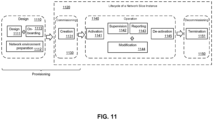
- slice provisioning can include four lifecycle phases, namely, preparation 1110, commissioning 1130, operation 1140 and decommissioning 1150.
- preparation phase 1110 the NS(S)I may be designed 1111, the network environment prepared 1112 and the NS(S)I may be on-boarded 1113 onto a PoP.
- commissioning phase 1130 the NS(S)I may be created 1131.
- the NS(S)I may be a modified form of a previously-created NS(S)I.
- the NS(S)I may be activated 1141 and eventually deactivated 1145.
- the management functions may supervise 1142 and report 1143 on the operation of the NS(S)I.
- the NS(S)I may be operationally modified 1144.
- the NS(S)I may be terminated 1151.
- provisioning is understood to encompass the combination of the preparation and commissioning phases.
- a method for allocating a slice instance of a communications network comprises the steps of claim 1.
- a network management function which includes a processor and a non-transient memory for storing machine-readable and machine executable instructions. The instructions, when executed by the processor, cause the network management function to carry out the methods of claims 1 - 12.
- Embodiments have been described above in conjunction with examples of the present disclosure upon which they can be implemented. Those skilled in the art will appreciate that embodiments may be implemented in conjunction with the example with which they are described, but may also be implemented with other embodiments of that example. When embodiments are mutually exclusive, or are otherwise incompatible with each other, it will be apparent to those skilled in the art. Some embodiments may be described in relation to one example, but may also be applicable to other examples, as will be apparent to those of skill in the art.
- Fig. 1 is a block diagram of an electronic device (ED) 52 illustrated within a computing and communications environment 50 that may be used for implementing the devices and methods disclosed herein.
- the ED 52 may be an element of communications network infrastructure, such as a base station (for example a NodeB, an evolved Node B (eNodeB or eNB), a next generation NodeB (sometimes referred to as a gNodeB or gNB), a home subscriber server (HSS), a gateway (GW) such as a packet gateway (PGW) or a serving gateway (SGW) or various other nodes or functions within a core network (CN) or Public Land Mobility Network (PLMN).
- a base station for example a NodeB, an evolved Node B (eNodeB or eNB), a next generation NodeB (sometimes referred to as a gNodeB or gNB), a home subscriber server (HSS), a gateway (GW) such as a packet gateway (PGW) or a
- the ED 52 typically includes a processor 54, such as a Central Processing Unit (CPU) and may further include specialized processors such as a Graphics Processing Unit (GPU) or other such processor, a memory 56, a network interface 58 and a bus 60 to connect the components of ED 52.
- ED 52 may optionally also include components such as a mass storage device 62, a video adapter 64, and an I/O interface 68 (shown in dashed outline).
- a Unified Data Management Function (UDM) 102 can present a service based Nudm interface to communicate with other NFs, and can provide data storage facilities to other NFs. Unified data storage can allow for a consolidated view of network information that can be used to ensure that the most relevant information can be made available to different NFs from a single resource. This can make implementation of other NFs easier, as they do not need to determine where a particular type of data is stored in the network.
- the UDM 102 may be implemented as a UDM Front End (UDM-FE) and a User Data Repository (UDR).
- the PCF 100 may be associated with the UDM 102 because it may be involved with requesting and providing subscription policy information to the UDR, but it should be understood that typically the PCF 100 and the UDM 102 are independent functions.
- the PCF 100 may have a direct interface to the UDR.
- the UDM-FE receives requests for content stored in the UDR, or requests for storage of content in the UDR, and is typically responsible for functionality such as the processing of credentials, location management and subscription management.
- the UDR-FE may also support any or all of authentication credential processing, user identification handling, access authorization, registration / mobility management, subscription management and Short Message Service (SMS) management.
- SMS Short Message Service
- the UDR is typically responsible for storing data provided by the UDM-FE.
- the stored data is typically associated with policy profile information (which may be provided by PCF 100) that governs the access rights to the stored data.
- the UDR may store policy data, as well as user subscription data which may include any or all of subscription identifiers, security credentials, access and mobility related subscription data and session related data.
- Application Function (AF) 104 represents the non-data plane also referred to as the non-user plane) functionality of an application deployed within a network operator domain and within a 3GPP-compliant network.
- the AF 104 interacts with other core NFs through a service-based Naf interface, and may access network capability exposure information, as well as provide application information for use in decisions such as traffic routing.
- the AF 104 can also interact with functions such as the PCF 100 to provide application-specific input into policy and policy enforcement decisions. It should be understood that in many situations the AF 104 does not provide network services to other NFs, and instead is often viewed as consumer or user of services provided by other NFs. An application outside the 3GPP network can perform many of the same functions as AF 104 through the use of NEF 96.
- ED 52 communicates with NFs that are in the UP 106, and the CP 108.
- the UPF 86 is a part of the CN UP 106 (DN 88 being outside the 5GCN).
- (R)AN 84 may be considered as a part of a UP, but because it is not strictly a part of the CN, it is not considered to be a part of the CN UP 106.
- AMF 90, SMF 92, AUSF 94, NEF 96, NRF 98, PCF 100 and UDM 102 are functions that reside within the CN CP 108, and are often referred to as CP Functions (CPFs).
- AF 104 may communicate with other functions within CN CP 108 (either directly or indirectly through the NEF 96), but is typically not considered to be a part of the CN CP 108.
- Fig. 3 illustrates a reference point representation of a 5GCN architecture 82.
- some of the NFs illustrated in Fig. 2 are omitted from this figure, but it should be understood that the omitted functions and those not illustrated in either Fig. 2 or Fig. 3 ) can interact with the illustrated functions.
- the ED 52 connects to both (R)AN 84 (in the UP 106) and AMF 90 (in the CP 108).
- the ED-to-AMF connection is an N1 connection.
- (R)AN 84 also connects to the AMF 90, and does so over an N2 connection.
- the (R)AN 84 connects to a UPF function 86 of an N3 connection.
- the UPF 86 is associated with a PDU session, and connects to the SMF 92 over an N4 interface to receive session control information. If the ED 52 has multiple PDU sessions active, they can be supported by multiple different UPFs 86, each of which is connected to an SMF 92 over an N4 interface.
- the UPFs 86 each connect to a DN 88 outside the 5GCN over an N6 interface.
- SMF 92 connects to the PCF 100 over an N7 interface, while the PCF 100 connects to an AF 104 over an N5 interface.
- the AMF 90 connects to the UDM 102 over an N8 interface. If two UPFs 86 in UP 106 connect to each other, they can do so over an N9 interface.
- the UDM 102 can connect to an SMF 92 over an N10 interface.
- the AMF 90 and SMF 92 connect to each other over an N11 interface.
- An N12 interface connects the AUSF 94 to the AMF 90.
- the AUSF 94 can connect to the UDM 102 over an N13 interface.
- they can connect to each other over an N14 interface.
- the PCF 100 can connect to an AMF 90 over the N15 interface. If there is a plurality of SMFs 92 in the network, they can communicate with each other over an N16 interface.
- any or all of the functions and nodes, discussed above with respect to the architectures 80 and 82 of the 5GCN, may be virtualized within a network, and the network itself may be provided as network slice of a larger resource pool, as will be discussed below.
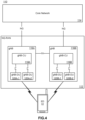
- Fig. 4 illustrates a proposed architecture110 for the implementation of a Next Generation Radio Access network (NG-RAN) 112, also referred to as a 5G RAN.
- NG-RAN 112 is the radio access network that connects an ED 52 to a CN 114.
- CN 114 may be the 5GCN (as illustrated in Fig. 2 and Fig. 3 ).
- the CN 114 may be a 4G Evolved Packet Core (EPC) network.
- Nodes with NG-RAN 112 connect to the 5G CN 114 over an NG interface.
- This NG interface can comprise both the N2 interface to a CP 108 and an N3 interface to a UPF 86 as illustrated in Fig.
- the N3 interface can provide a connection to a CN UPF.
- NG-RAN 112 includes a plurality of radio access nodes that can be referred to as a gNB.
- gNB 116A and gNB 116B are able to communicate with each other over an Xn interface.
- the functionality of the gNB may be decomposed into a Centralized Unit (gNB-CU) 118A and a set of distributed units (gNB-DU 120A-1 and gNB-DU 120A-2, collectively referred to as 120A).
- gNB-CU 118A is connected to a gNB-DU 120A over an F1 interface.
- gNB 116B has a gNB-CU 118B connecting to a set of distributed units gNB-DU 120B-1 and gNB-DU 120B-2, collectively referred to as 120B).
- Each gNB DU may be responsible for one or more cells providing radio coverage within the PLMN.
- the division of responsibilities between the gNB-CU and the gNB-DU has not been fully defined at this time.
- Different functions, such as the radio resource management functionality may be placed in one of the CU and the DU.
- any or all of the functions discussed above with respect to the NG-RAN 112 may be virtualized within a network, and the network itself may be provided as network slice of a larger resource pool, as will be discussed below.
- Fig. 5 illustrates an architecture 130 that connects a plurality of connectivity, compute and storage resources, and supports network slicing.
- resources are connected to other discrete resources through Connectivity Resources 134, 138, 140, 144 and 148. It will be understood that as NFs are instantiated within resources, they may be connected to each other by virtual connections that in some embodiments do not rely upon the physical connectivity resources illustrated, but instead may be connected to each other by virtual connections, which will also be considered as connectivity resources.
- Resource 1 132 is connected to Resource 2 136 by Connectivity Resource 134.
- Resource 2 136 is connected to unillustrated resources through Connectivity Resource 138, and is also connected to Resource 3 142 by Connectivity Resource 140, and Resource 1 132 is connected to Resource 4 146 by Connectivity Resource 148.
- Resource 1 132, Resource 2 136, Resource 3 142 and Resource 4 146 should be understood as representing both compute and storage resources, although specialized functions may also be included.
- a specialized NF may be represented by any or all of Resource 1 132, Resource 2 136, Resource 3 142 and Resource 4 146, in which case, it may be the capability or capacity of the NF that is being sliced.
- Connectivity Resources 134, 138, 140, 144 and 148 may be considered, for the following discussions, as logical links between two points ( e.g . between two data centers) and may be based on a set of physical connections.
- Resource 1 132 is partitioned to allocate resources to Slice A 132A, and Slice B 132B. A portion 132U of the resources available to Resource 1 132 remains unallocated.
- Connectivity Resource 134 is partitioned to provide connectivity to Slice A 134A and Slice B 134B, and also retains some unallocated bandwidth 134U.
- the amount of the resource e.g . the allocated bandwidth, memory, or number of processor cycles
- slices are able to support "breathing", which allows the resources allocated to the slice to increase and decrease along with any of the available resources, the required resources, anticipated resource need, or other such factors, alone or in combination with each other.
- the allocation of resources may be in the form of soft slices in which a fixed allocation is not committed and instead the amount of the resource provided may be flexible.
- a soft allocation may allocate a percentage of the resource to be provided over a given time window, for example 50% of the bandwidth of a connection over a time window. This may be accompanied by a minimum guaranteed allocation. Receiving a guarantee of 50% of the capacity of a connectivity resource at all times may provide very different service characteristics than receiving 50% of the capacity of the connectivity resource over a ten second window.
- Resource 2 136 is partitioned to support allocations of the available compute and storage resources to Slice A 136A, Slice C 136C and Slice B 136B. Because there is no allocation of resources in connectivity resource 134 to Slice C, Resource 2 136 may, in some embodiments, not provide a network interface to Slice C 136C to interact with connectivity resource 134. Resource 2 136 can provide an interface to different slices to Connectivity Resource 138 in accordance with the slices supported by Connectivity Resource 138. Connectivity Resource 140 is allocated to Slice A 140A and Slice C 140C with some unallocated capacity 140U. Connectivity Resource 140 connects Resource 2 136 with Resource 3 142.
- Resource 3 142 provides compute and storage resources that are allocated exclusively to Slice C 142C, and is also connected to Connectivity Resource 144 which in addition to the unallocated portion 144U includes an allocation of Connectivity Resource 144A to slice A. It should be noted that from the perspective of functions or processes within Slice A, Resource 3 142 may not be visible. Connectivity Resource 144 provides a connection between Resource 3 142 and Resource 4 146, whose resources are allocated entirely to Slice A 146.
- Resource 4 146 is connected to Resource 1 132 by Connectivity Resource 148, which has a portion of the connection allocated to Slice A 148, while the balance of the resources 148U are unallocated.
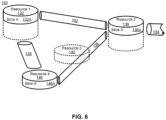
- Fig. 6 illustrates the view of the architecture 136 of Fig. 5 as would be seen from the perspective of Slice A. This may be understood as a view of the resources allocated to Slice A 150 across the illustrated network segment. From within Slice A 150, only the portions of the resources that have been allocated to Slice A 150 are visible. Thus, instead of being able to see the full capacity and capability of Resource 1 132, the capabilities and capacity of the portion allocated to Slice A 132A is available. Similarly, instead of being able to see the capacity and capabilities of Resource 2 136, only the capabilities and capacity of the portion allocated to Slice A 136A are available. Because nothing from Resource 3 142 had been allocated to Slice A 150, Resource 3 142 is not present within the topology of Slice A 150.
- All of the capacity and capability of Resource 4 146 was allocated to Slice A 146, and as such is present within Slice A 150.
- Slice A 132A of Resource 1 132 is connected to Slice A 136A of Resource 2 136 by logical link 152.
- Logical Link 152 may correspond to the portion of connectivity resource 134 allocated to Slice A 134A.
- Slice A 136A is connected to logical link 154 (representative of the portion of connectivity resource 138 allocated to Slice A 150), and is connected to Slice A 146A by logical link 156.
- Logical link 156 is representative of the portions of connectivity resource 140 and connectivity resource 144 that have been allocated to Slice A (portions 140A and 144A respectively).
- NFs can be instantiated using any of a number of known techniques, including network function virtualization (NFV), to create Virtual Network Functions (VNFs). While conventional telecommunications networks, including so-called Third Generation and Fourth Generation (3G/4G) networks, can be implemented using virtualized functions in their CNs, next generation networks, including so-called Fifth Generation (5G) networks, are expected to use NFV and other related technologies as fundamental building blocks in the design of a new CN and RAN. By using NFV, and technologies such as Software-Defined Networking (SDN), functions in a CN can be instantiated at a location in the network that is determined based on the needs of the network.
- SDN Software-Defined Networking
- Fig. 7 illustrates a system 160 in which a core/RAN network 162 provides radio access and CN services to EDs 52 such as UE1 164 and UE2 166.
- EDs 52 such as UE1 164 and UE2 166.
- NFs are instantiated upon the underlying resources of a data center.
- the functions are shown as being exploded out of the pool of resources upon which they are instantiated. This is done to indicate that the functions act as independent entities and from a logical perspective they are indistinguishable from a physical node carrying out the same function.
- a separate network slice can be created to support 4G networks.
- Traffic from EDs 52 can be routed through NFs, to a GW 168 that provide access to a packet data network 170 such as the Internet.
- Radio access services are typically provided by a RAN, which in this illustration is provided as a Cloud-RAN (C-RAN).
- C-RAN Cloud-RAN
- a C-RAN takes advantage of function virtualization to virtualize the Access Nodes (ANs) of the network.
- ANs Much as a physical AN, such as an eNB, was connected to an antenna by a front haul link, in the illustrated embodiment of a C-RAN, ANs, such as a gNB are connected to an antenna (or to a remote radio head (RRH)) through a front haul connection, but are functions that are instantiated upon computer resources in network 162.
- RRH remote radio head
- the virtualized DUs may in some embodiments be instantiated at or near the location of the antenna or RRH, while a CU may be instantiated at a data center to connect and serve a plurality of geographically dispersed DUs.
- UE1 164 is connected to the network through AN 172, which can provide radio access services through antenna 174.
- AN 172 is instantiated upon the compute and storage resources provided by a data center, in this case data center 198-1.
- AN 176 and AN 180 which are connected to the same set of antennae 178, are also instantiated upon the resources of data center 198-1.
- server 200 shows a representative functional architecture of a server 200, it being understood that this functional architecture may be implemented using any suitable combination of hardware and software. It will also be understood that server 200 may itself be a virtualized entity. Because a virtualized entity has the same properties as a physical entity from the perspective of another node, both virtualized and physical computing platforms may serve as the underlying resource upon which virtualized functions are instantiated.
- the illustrated server 200 generally comprises a hosting infrastructure 202 and an application platform 204.
- the hosting infrastructure 202 comprises the physical hardware resources 206, such as, for example, information processing, traffic forwarding and data storage resources) of the server 200, and virtualization layer 208 that presents an abstraction of the hardware resources 206 to the application platform 204.
- the specific details of this abstraction will depend on the requirements of the applications being hosted by the application layer (described below).
- an application that provides traffic forwarding functions may be presented with an abstraction of the hardware resources 206 that simplifies the implementation of traffic forwarding policies in one or more routers.
- an application that provides data stage functions may be presented with an abstraction of the hardware resources 206 that facilitates the storage and retrieval of data (for example using Lightweight Directory Access Protocol - LDAP).
- the application platform 204 provides the capabilities for hosting applications and includes a virtualization manager 210 and application platform services 212.
- the virtualization manager 210 supports a flexible and efficient multi-tenancy run-time and hosting environment for applications 214 by providing Infrastructure as a Service (laaS) facilities.
- the virtualization manager 210 may provide a security and resource "sandbox" for each application 214 being hosted by the platform 204.
- Each "sandbox" may be implemented as a Virtual Machine (VM) image 216 that may include an appropriate operating system and controlled access to (virtualized) hardware resources 206 of the server 200.
- the application-platform services 212 provide a set of middleware application services and infrastructure services to the applications 214 hosted on the application platform 204, as will be described in greater detail below.
- MANO MANagement and Orchestration
- SONAC Service Oriented Network Auto-Creation
- SDT Software-Defined Topology
- SDP Software-Defined Protocol
- SDRA Software-Defined Resource Allocation
- Communication services 218 may allow applications 214 hosted on a single server 200 to communicate with the application platform services 212 (through pre-defined Application Programming Interfaces (APIs) for example) and with each other (for example through a service-specific API).
- APIs Application Programming Interfaces
- a service registry 220 may provide visibility of the services available on the server 200.
- the service registry 220 may present service availability (e.g. status of the service) together with the related interfaces and versions. This may be used by applications 214 to discover and locate the end-points for the services they require, and to publish their own service end-point for other applications 214 to use.
- Network Information Services (NIS) 222 may provide applications 214 with low-level network information.
- NIS 222 may be used by an application 214 to calculate and present high-level and meaningful data such as: cell-ID, location of the subscriber, cell load and throughput guidance.
- a Traffic Off-Load function (TOF) service 224 may prioritize traffic, and route selected, policy-based, user-data streams to and from applications 214.
- the TOF service 224 may be supplied to applications 214 in various ways, including: a pass-through mode where (either or both of uplink and downlink) traffic is passed to an application 214, which can monitor, modify or shape it and then send it back to the original Packet Data Network (PDN) connection (e.g. a 3GPP bearer); and an End-point mode where the traffic is terminated by the application 214 that acts as a server.
- PDN Packet Data Network
- NFs The virtualization of NFs is considered to be a foundational technology for the architecture of flexible 5G networks.
- Function virtualization is a technology that allows for the creation of virtual functions on a base of compute, memory (which may include both executable memory and general storage) and connectivity or network resources. In many cases, these resources will exist within a data center. It should be understood that this discussion refers to resources instead of actual hardware because it is possible for virtualized resources to serve as the underlying resources for a next level of virtualization.
- Virtualization may take the form of instantiating a virtual machine (VM) 216 that, to another entity on a network and to software executed on the VM 216, is no different than a physical node in the network.
- a VM 216 has its own set of compute, memory and network resources, upon which an operating system can be executed.
- the VM 216 can have a virtual network interface that can be assigned a network address. Between the underlying resources and the VM 216, there is typically a hypervisor that manages the resource isolation and network interactions.
- One of the purposes of a VM 216 is to provide isolation from other processes run on the system.
- a VM 216 When initially developed, a VM 216 was a mechanism to allow different network processors to operate without concern that a single errant process would be able to cause a complete system crash. Instead, an errant process would be contained to its own VM 216. This isolation allows for each VM 216 to have its own set of network interfaces. Typically, a single underlying resource can support a plurality of virtualized entities.
- Each VM 216 typically includes its own operating system which typically increases redundant resource usage.
- Containers allow a single OS kernel to support a number of isolated virtual functions.
- a single OS hosts containers that are responsible for enforcing the resource isolation that would otherwise be provided by the VM 216.
- Each virtualized function within in its own container can be provided a virtualized network interface so that it appears as its own network entity.
- NFV Network Function Virtualization
- MANO Network Function Virtualization
- OSS Operation Support System
- BSS Business Support Subsystem
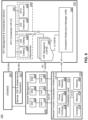
- an NFV-MANO system 232 includes an orchestrator 234 which can access libraries 236 such as Network Service catalog 238, VNF Catalog 240, VNF Instances repository 242 and NFVI resources repository 244.
- the NS Catalog 238 may include templates that can be used as the basis for supporting network services.
- VNF catalog 240 may contain templates for the instantiation of different classes of VNFs. A particular VNF, after being instantiated, may be referred to as a VNF instance, and its attributes may be stored in VNF instances repository 242.
- NFVI resources 244 may be used to track the availability of resources, including both virtual resources and the physical infrastructure upon which they are instantiated.
- the NFVI 244 can be connected to a number of VNF Managers 246 through an OR-VNFM interface, and to a Virtualized Infrastructure Manager (VIM) 248 through an OR-VI interface.
- VNFM 246 and VIM 248 can be connected to each other through a VI-VNFM interface.
- the NFV MANO 232 can communicate with an OSS/BSS system 250 through OS-MA interface, and to a Service, VNF & Infrastructure description database 252 through an SE-MA interface.
- the Service, VNF & Infrastructure description database 252 can contain operator information about the services, VNFs and infrastructure deployed in the network.
- Service, VNF & Infrastructure description database 252 and OSS/BSS 250 ca be connected to each other so that the OSS/BSS 250 can update and maintain the Service, VNF & Infrastructure description database 252 as needed.
- NFVI 270 interacts with the VIM 28 through the NF-VI interface.
- Underlying resources can often be classified as compute resources 274, memory resources 278 and network resources 282.
- Memory resources 278 may also be referred to as storage resources, while network resources 282 may also be referred to as connectivity resources.
- a virtualization layer 272 allows for the abstraction of the underlying resources that it is connected to through a VI-HA interface. It should be understood that the underlying resources may be either physical or virtual resources.
- the Virtualization layer 272 allows for the abstraction of the underlying resources into virtual compute resources 276, virtual memory resources 280 and virtual network resources 284.
- VNF1 258, VNF2 262 and VNF3 266) can be instantiated.
- An element manager (EM) 254 can be connected to the VNFM 246 within NFV MANO 232 through interface VE-VNFM, and to the OSS/BSS 250 through another interface.
- Each VNF instantiated upon the virtual resources provided by NFVI 270 can be associated with an EM (EM1 256, EM2 260 and EM3 264). The use of an EM allows the OSS/BSS 250 to have two paths through which the VNFs can be managed.
- a VNF can be managed through the VNFM 246, or through the EM associated with the VNF.
- Each EM can provide the same management controls that it would otherwise provide for a physical network element.
- the OSS/BSS 250 can treat each VNF as a conventional NF. Modification to the resource allocation associated with a VNF can be requested by an EM through the VNFM 246, or through a request from the OSS/BSS 250 over the OS-MA interface.
- Resources from more than one resource pool or data center can be allocated to a function so that it can be scaled-out, and resources from different pools can be removed to allow a function to be scaled-in.
- Functions can be moved by transferring their state information to another NF, and in some instances, a function can be moved through a combination of scaling-out and scaling-in functions.
- provisioning is understood to encompass the combination of the preparation and commissioning phases. It is also understood that provisioning may be defined as “allocating”.
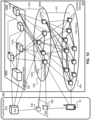
- Figure 10 illustrates a network architecture 300 in which the resources of the operator network 302 are divided into a set of logical planes, a UP 304, a CP 360 and a Management Plane (MP) 308.
- the UP 304 is typically focussed on packet transport, but certain functions including packet filtering and traffic shaping can be performed in the UP 304, although this is typically performed based on instructions from a NF in the CP 306.
- Functions in the MP 308 receive input from NFs within the customer domain 310 about the policies that should be enforced by the network control functions in the CP 306. If Operator Network 302 supports network slicing, functions within MP 308 may be responsible for slice design and creation.
- a single MP 308 may be used to provide management functionality for a plurality of network slices that each have different control and user planes. Functions within the MP 308 can communicate with each other to ensure that the differing policies for a possible plurality of customers are fitted together in a suitable set of instructions.
- NMFs 318 can receive external input from a customer node 312, and can communicate with each other. NMFs 318 can also communicate, over any of the MP-CP connections 320, with CPFs 316 to provide instructions about the policies to be enforced by CPFs 316. Changes in the resources underlying the network 302 are also communicated by an NMF 318 to CPFs 316. In CP 306, CPFs communicate with each other, and with ED 52. CPFs 316 are also in communication with UPFs 314, and through this communication they can receive information such as traffic loads on links and processing loads at NFs.
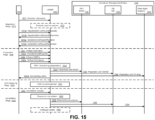
- the 3GPP entity 1301 approves and finalizes 1541 all resource reservations.
- the approval 1541 is a message 1541a similar to InstantiateNssiRequest with nsstID and instantiateNssiTime as parameters.
- the request 1541 is a different message and may include appropriate parameters.
- the 3GPP entity 1301 only sends an acknowledgment with an ID that may be an NSST ID.
- the approval 1541 may be a ServiceConfirmationRequest message from the 3GPP entity 1301, which may in some examples be, without limitation, the NSMF 1201, another NSSMF 1302 and/or the CSMF to the NSSMF 1202.
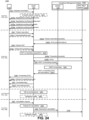
- Fig. 22 may be seen to be an alternative example showing, without limitation, NSI information message(s), activation request and/or constituents of the 3GPP slice management entities. Nevertheless, the NSMF 1201 again proceeds through stages, which may comprise discovery 2210, requirements 2220, feasibility 2230, preparation 2240 and creation of the NSI 2250. In some examples, the 3GPP entity 2101 requests that the created NSI be cancelled, whereupon a cancellation stage 2260 is entered.
- the NSMF 1201 may determine that more information is called for and it may query 2132, 2133 the NSSMF 1202 and the other management systems 2103 for additional capability information in a manner similar to that of Fig. 21 .
- the requirements request and/or query 2133 may be followed by a response 2136 from the other management systems 2103 to the NSMF 1201 in a manner similar to that of Fig. 21 .
- the NSSMF 1202 thereupon makes a formal determination 2137 of feasibility in a manner similar to that of Fig. 21 . If the request 2121 is feasible, the NSMF 1201 proceeds to the preparation stage 1340, accesses the request 2121 from the 3GPP entity 2101 and prepares a reply 2125 thereto in a manner similar to reply 2125 in Fig. 21 .
- the NSMF 1201 rejects the request 2121 from the 3GPP entity 2101 and prepares a reply 2125 thereto in a manner similar to reply 2125 in Fig. 21 .
- the NSMF 1201 reserves resources by sending 2141, 1242 reservation requests to the NSSMF 1202 and the other management systems 2103 in a manner similar to that of Fig. 21 .
- responses 2141, 2142 are shown from the NSSMF 1202 and the other management systems 2103. Such responses may be inferred in Fig. 21 .
- the 3GPP entity 2101 sends 2151 an acknowledgment of the reply 2125 in a manner similar to that of Fig. 21 .
- the NSMF 1201 creates (and/or modifies) (not shown but similar to 2156 in Fig. 21 ) the NSI process.
- the NSMF 1201 sends 2251 information about the created (and/or modified) NSI to the 3GPP entity 2103.
- the 3GPP entity 2103 may send 2252 a request to the NSMF 1201 to activate the NSI.
- the NSI is automatically activated. However caused, once the NSI has been activated, the NSMF 1201 sends 2253 a network slice activation notice to the 3GPP entity 2101, signifying completion of provisioning.
- the cancellation stage 2260 is initiated by a request 2161 from the 3GPP entity 2101 to the NSMF 1201 to cancel the created NSI.
- the NSMF 1201 cancels the created NSI (not shown) and in the course of so doing, may issue requests 2162, 2163 to the NSSMF 1202 and the other management systems 2103 to cancel reserved resources.
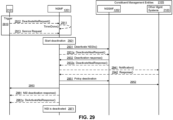
- Fig. 23 is a signal flow diagram showing example flows to prepare an NSI with catalogue and capability exposure shown generally at 2300.
- the figure shows communications between the 3GPP entity 2101, the NSMF 1201, the NSSMF 1202 and other manage systems 2013.
- the service catalogue and capabilities is exposed to the 3GPP entity 2101.
- This allows the NSMF 1201 to establish openness with its constituent management entities 2105, such as, by way of non-limiting example, to subscribe to updates on remaining capacity and/or obtaining interfaces for access to information.
- Such exposure also allows the 3GPP entity 2101 to, without limitation, check for the feasibility of the requests and/or design NSIs, which may facilitate the provisioning in that the amount of negotiations may be reduced.
- the scenario of Fig. 23 is well suited to Type2 slice deliverable types as described above, but may be applicable to any slice deliverable types.
- the NSMF 1201 requests 2311, 2312 openness from its constituent management entities 2105, to facilitate resource and capability discovery.
- the NSMF 1201 only requests openness 2311 from the NSSMF(s) 1202. If appropriate, it is the NSSMF 1202 that requests openness 1411, 1412, 1413 from its constituent management entities 1205 to obtain capability information therefrom.
- the NSMF 1201 obtains information, 2111, 2112 from its constituent management entities 2105 in a manner similar to that of Fig. 21 . However, if, without limitation, certain interfaces, access to databases and/or monitoring capabilities are provided to the NSMF 1201 as a result of the openness requests 2311, 2312, the NSMF 1201 does not send inquiries related to these.
- a service catalogue prepared 1414 by an NSSMF 1202 may be provided to the NSMF 1201 for inclusion in the service catalogue to be prepared 2314 by the NSMF 1201 as described below.
- the NSST(s) identified in the service catalogue of the NSSMF 1202 may be incorporated into the NST(s) created by the NSMF 1201 for its service catalogue.
- the NSMF 1201 may create, update and/or maintain 2314 a service catalogue, database and/or similar repository based on the information it has collected about its capabilities, including without limitation, the NSTs and/or types thereof.
- the NSMF 1201 may receive a request 2321 from the 3GPP entity 2101 to provide information on the network, that is, to expose its service catalogue.
- the request 2321 is a message 2321a similar to queryNetworkResourceRequest with filter() and attributeSelector() parameters.
- the request 2321 is a message 2321b similar to TemplateRequest() with templateType as a parameter.
- the request 2321 is a different message and may include parameters for, without limitation, capacity exposure, capability exposure and/or openness.
- the request 2321 may be a ServiceCapabilityRequest message from the CSMF and/or customer to the NSMF 1201.
- an input parameter of the ServiceCapabilityRequest may be a serviceCapabilityRequest identifier that asks for a service that can be provided and an output parameter may be a serviceCapability that lists possible services with capability, including without limitation, capacity exposure, capability exposure and/or openness.
- the NSSMF 1201 evaluates the access request 2322 and provides access 2323 to the service catalogue to the 3GPP entity 2101, which may in some examples be, without limitation, the customer and/or the CSMF, in the form of capability and/or remaining capacity information. In some examples, if the attributeSelector() is absent, the complete attributes of the network resource(s) are returned. In some examples, the response 2323 is a message 2323a similar to queryNetworkResourceResponse with networkResourceData as a parameter. In some examples, the response 2323 is a message 2323b similar to TemplateResponse(). In some examples, the response 2323 may be a Service CapabilityResponse message from the NSMF 1201 to the CSMF and/or customer.
- the NSMF 1201 receives 2324 an NSI provisioning request with NSI requirements.
- the request 2324 is a message 2324a similar to TemplateRequest with TemplateType as a parameter.
- the nstData may be one or more NST(s) selected from the service catalogue.
- the nstData may be one or more attributes with values as well as NSST(s).
- the NSMF 1201 validates 2331 the feasibility of the request 2324 using the most recent service catalogue information.
- the NSMF 120 sends queries 2332a, 2332b to its constituent management entities 2105 to ensure remaining capacity and to reserve resources and to prepare a suitable network environment.
- the constituent management entities 2105 send an acknowledgment back to the NSMF 1201 when the resources have been reserved. If one or more of the constituent management entities 2105 was unable to reserve the requested resources, the response to the query 2132a, 2132b may indicate what issue(s) were encountered.
- the NSMF 1201 updates 2333 its service catalogue accordingly.
- the NSMF 1201 may evaluate 2131 the possibility of re-using, whether or not with modification, an existing NSI for either or both of shared and non-shared services. In so doing, the NSMF 1201 obtains corresponding NSI ID and information which may include existing NSSI IDs. If feasible, the processing described in Fig. 26 is performed.
- the NSMF 1201 may determine NSI and non-3GPP requirements by querying 2332a and 2332b its constituent management entities 2105 (and to other NSMFs (not shown) about their capabilities. Further, if openness is provided with other network entities and/or functions, including, without limitation the NFV MANO 232 and/or TN manager (not shown), the NSMF 1201 can send queries to them as well. The NSMF 1201 receives responses back from such queries. It will be readily understood that the action of querying can include both the transmission of a query and the receiving of a response to said query.
- the NSMF 1201 thereupon makes a formal determination 2137 of feasibility. If the request 2324 is feasible, reservation requests 2335a, 2335b are sent to its constituent management entities 2105 with openness and responses obtained. If the responses are negative, additional queries may be sent.
- the NSMF 1201 replies 2325 to the NSI provisioning request 2324 with information about the network resources reserved, including without limitation, the NSI descriptor(s), NST(s), NSI attribute values and/or IDs of the shared NSI(s).
- the reply 2325 is a message 2325a similar to queryNetworkResourceResponse with networkResourceData as a parameter.
- such message 2325a may send nsstID as a parameter for related templates, ServiceRequireID as a parameter for the admitted service and/or other parameters and/or messages.
- the outcome of the establishment of policies 2337 is evaluated. If the 3GPP entity 2101 rejects the creation of the NSI, a negotiation stage 2470 may be entered. Otherwise, the preparation stage 2440 is entered.
- the NSMF 1201 activates 2651 the NSI (if not already active).
- such activation may comprise tests to validate the NSI.
- such activation may comprise commissioning of the NSSIs.
- such activation may comprise activation of the constituents of the NSI. In some examples, if the NSI was already active and being used by other services, the activation should not interrupt such services.
Landscapes
- Engineering & Computer Science (AREA)
- Computer Networks & Wireless Communication (AREA)
- Signal Processing (AREA)
- Software Systems (AREA)
- Theoretical Computer Science (AREA)
- Computer Security & Cryptography (AREA)
- General Engineering & Computer Science (AREA)
- General Physics & Mathematics (AREA)
- Physics & Mathematics (AREA)
- Quality & Reliability (AREA)
- Databases & Information Systems (AREA)
- Mobile Radio Communication Systems (AREA)
- Data Exchanges In Wide-Area Networks (AREA)
Claims (14)
- Verfahren zum Zuweisen einer Slice-Instanz eines Kommunikationsnetzwerks, wobei das Verfahren umfasst:Erhalten, durch eine Verwaltungsfunktion, von Anforderungen für die Slice-Instanz;Überprüfen (3130), durch die Verwaltungsfunktion, einer Durchführbarkeit der Slice-Instanz-Anforderungen im Hinblick auf eine oder mehrere Netzwerkressourcen und Netzwerkfähigkeiten;Vorbereiten (3140), durch die Verwaltungsfunktion, einer Netzwerkumgebung für die Slice-Instanz im Hinblick auf die Slice-Instanz-Anforderungen; undInbetriebnehmen (3150), durch die Verwaltungsfunktion, der Slice-Instanz;wobei, wenn das Überprüfen (3130) der Durchführbarkeit zu einer Bestimmung führt, dass die Anforderungen für die Slice-Instanz nicht durchführbar sind, das Verfahren ferner ein Aushandeln, durch die Verwaltungsfunktion, der Anforderungen für die Slice-Instanz mit einer 3GPP-Einheit umfasst.
- Verfahren nach Anspruch 1, wobei das Erhalten der Anforderungen für die Slice-Instanz eines oder mehrere einschließt von: Ableiten (3120) der Anforderungen, Empfangen der Anforderungen oder Empfangen einer Anforderung, um eine Slice-Instanz von einer 3GPP-Entität zuzuweisen, wobei die 3GPP-Entität eines oder mehrere von einem Kunden, einer Netzwerk-Slice-Verwaltungsfunktion (NSMF), einer Netzwerk-Slice-Teilnetzverwaltungsfunktion (NSSMF) und einer Kommunikationsdienstverwaltungsfunktion (CSMF) ist.
- Verfahren nach einem der Ansprüche 1 bis 2, das ferner ein Erkennen (3110), durch die Verwaltungsfunktion, einer oder mehrerer Ressourcen des Netzwerks und Fähigkeiten des Netzwerks umfasst.
- Verfahren nach Anspruch 3, wobei das Erkennen ein Aufrechterhalten eines Dienstkatalogs von Fähigkeiten umfasst.
- Verfahren nach Anspruch 3, wobei das Erkennen ein Abfragen einer Bestandteilverwaltungseinheit nach einer oder mehreren Ressourcen und Fähigkeiten davon einschließt, wobei die Bestandteilverwaltungseinheit eine oder mehrere von einer Netzwerk-Slice-Verwaltungsfunktion (NSMF), einer Netzwerk-Slice-Teilnetzverwaltungsfunktion (NSSMF), einer Netzwerkfunktionsvirtualisierungs(NFV)-Verwaltungs- und Betriebs(MANO)-Funktion, eines Domänenverwalters (DM), eines Elementverwalters (EM) und eines Transportnetzwerk(TN)-Verwalters ist.
- Verfahren nach Anspruch 3, wobei das Erkennen ein Abonnieren von Aktualisierungen bei einer Bestandteilverwaltungseinheit einschließt, wobei die Aktualisierungen eine oder mehrere verbleibende Ressourcen und verbleibende Fähigkeiten angeben.
- Verfahren nach einem der Ansprüche 1 bis 6, das ferner eine Abstraktion, durch die Verwaltungsfunktion, einer oder mehrerer Ressourcen des Netzwerks und Fähigkeiten des Netzwerks umfasst.
- Verfahren nach einem der Ansprüche 1 bis 7, wobei ein Vorbereiten (3140) einer Netzwerkumgebung für die Slice-Instanz ein Reservieren von Netzwerkressourcen für eine Zuweisung an die Slice-Instanz einschließt.
- Verfahren nach einem der Ansprüche 1 bis 8, wobei die Slice-Instanz eine Netzwerk-Slice-Teilnetz-Instanz (NSSI) eines Netzwerk-Slice-Teilnetzes (NSS) des Netzwerks basierend auf einer Netzwerk-Slice-Teilnetz-Vorlage (NSST) oder eine Netzwerk-Slice-Teilnetz-Instanz (NSSI), die mindestens ein Netzwerk-Slice-Teilnetz (NSS) umfasst, oder eine Netzwerk-Slice-Instanz (NSI) eines Netzwerk-Slice (NS) des Netzwerks basierend auf einer Netzwerk-Slice-Vorlage (NST) ist.
- Verfahren nach einem der Ansprüche 1 bis 9, wobei die Verwaltungsfunktion eine Netzwerk-Slice-Teilnetzverwaltungsfunktion (NSSMF) oder eine Netzwerk-Slice-Verwaltungsfunktion (NSMF) ist.
- Verfahren nach einem der Ansprüche 1 bis 10, wobei das Inbetriebnehmen (3150) der Slice-Instanz ein Erstellen einer neuen Slice-Instanz und/oder ein Modifizieren einer vorhandenen Slice-Instanz einschließt, wobei die vorhandene Slice-Instanz eine gemeinsam genutzte Slice-Instanz ist.
- Verfahren nach einem der Ansprüche 1 bis 11, das ferner eines oder mehrere umfasst von:Beenden einer in Betrieb genommenen Slice-Instanz;einer Konfiguration einer Richtlinie für die Slice-Instanz;Festlegen einer Richtlinie für die Slice-Instanz;Aktualisieren einer Richtlinie für die Slice-Instanz; oderKonfigurieren oder Festlegen einer Richtlinienkontrollfunktion zum Implementieren der Richtlinie für die Slice-Instanz.
- Netzwerkverwaltungsfunktion, die umfasst:einen Prozessor;einen nichtflüchtigen Speicher zum Speichern maschinenlesbarer und maschinenausführbarer Anweisungen, die, wenn sie durch den Prozessor ausgeführt werden, die Netzwerkverwaltungsfunktion veranlassen, das Verfahren nach einem der Ansprüche 1 bis 12 vorzunehmen.
- System, das eine Netzwerkverwaltungsfunktion nach Anspruch 13 und eine Entität, die konfiguriert ist, um Informationen, die mit den Anforderungen an die Netzwerkverwaltungsfunktion verknüpft sind, bereitzustellen, umfasst.
Applications Claiming Priority (3)
| Application Number | Priority Date | Filing Date | Title |
|---|---|---|---|
| US201862617133P | 2018-01-12 | 2018-01-12 | |
| US16/243,771 US10986540B2 (en) | 2018-01-12 | 2019-01-09 | Network slice provisioning and operation |
| PCT/CN2019/071378 WO2019137482A1 (en) | 2018-01-12 | 2019-01-11 | Network slice provisioning and operation |
Publications (3)
| Publication Number | Publication Date |
|---|---|
| EP3735795A1 EP3735795A1 (de) | 2020-11-11 |
| EP3735795A4 EP3735795A4 (de) | 2021-03-03 |
| EP3735795B1 true EP3735795B1 (de) | 2025-07-09 |
Family
ID=67213313
Family Applications (1)
| Application Number | Title | Priority Date | Filing Date |
|---|---|---|---|
| EP19738709.5A Active EP3735795B1 (de) | 2018-01-12 | 2019-01-11 | Netzwerkschichtbereitstellung und -betrieb |
Country Status (4)
| Country | Link |
|---|---|
| US (1) | US10986540B2 (de) |
| EP (1) | EP3735795B1 (de) |
| CN (1) | CN111587601B (de) |
| WO (1) | WO2019137482A1 (de) |
Families Citing this family (75)
| Publication number | Priority date | Publication date | Assignee | Title |
|---|---|---|---|---|
| CN109121170B (zh) * | 2017-06-26 | 2021-04-20 | 华为技术有限公司 | 会话管理的方法、装置、设备及系统 |
| BR112020018950A2 (pt) * | 2018-03-20 | 2020-12-29 | Affirmed Networks, Inc. | Sistemas e métodos para fatiamento de rede |
| CN110572272B (zh) * | 2018-06-06 | 2020-11-06 | 大唐移动通信设备有限公司 | 一种网络切片的创建方法及管理编排系统 |
| CN112368977B (zh) * | 2018-06-15 | 2023-10-13 | 瑞典爱立信有限公司 | 配置网络切片 |
| US10873950B2 (en) * | 2018-12-12 | 2020-12-22 | Verison Patent and Licensing Inc. | Network slice selection based on requested service |
| US10993177B2 (en) * | 2018-12-13 | 2021-04-27 | Verizon Patent And Licensing Inc. | Network slice instance creation |
| US10855757B2 (en) * | 2018-12-19 | 2020-12-01 | At&T Intellectual Property I, L.P. | High availability and high utilization cloud data center architecture for supporting telecommunications services |
| WO2020164022A1 (en) * | 2019-02-13 | 2020-08-20 | Nokia Shanghai Bell Co., Ltd. | Service based architecture management |
| WO2020164051A1 (en) * | 2019-02-14 | 2020-08-20 | Zte Corporation | Method and apparatus for minimization of drive tests |
| US11700628B2 (en) * | 2019-03-11 | 2023-07-11 | Intel Corporation | Multi-slice support for MEC-enabled 5G deployments |
| EP3942738A1 (de) * | 2019-03-22 | 2022-01-26 | Koninklijke KPN N.V. | Drittanbieternetzwerk und netzwerk-slice-management |
| US11171837B2 (en) * | 2019-07-17 | 2021-11-09 | Samsung Electronics Co., Ltd. | Methods and systems for management of shared network slice instance (NSI) in a wireless network |
| GB2587337A (en) * | 2019-09-17 | 2021-03-31 | Samsung Electronics Co Ltd | Network slice instance load distribution |
| CN110786039B (zh) * | 2019-09-17 | 2023-07-25 | 北京小米移动软件有限公司 | 测量配置方法及装置、测量信息上报方法及装置和基站 |
| US11916744B2 (en) * | 2019-11-25 | 2024-02-27 | Telefonaktiebolaget Lm Ericsson (Publ) | Technique for replacing VNFMs in a VNF based environment |
| WO2021110894A1 (en) | 2019-12-04 | 2021-06-10 | Koninklijke Kpn N.V. | Providing interface between network management and slice management |
| WO2021122516A1 (en) | 2019-12-16 | 2021-06-24 | Koninklijke Kpn N.V. | Reregistration during network slice failure |
| US12250121B2 (en) | 2019-12-21 | 2025-03-11 | Koninklijke Kpn N.V. | Managing resource utilization by multiple network slices |
| US11588751B2 (en) * | 2020-03-24 | 2023-02-21 | Apple Inc. | Combined network and computation slicing for latency critical edge computing applications |
| US11537386B2 (en) | 2020-04-06 | 2022-12-27 | Johnson Controls Tyco IP Holdings LLP | Building system with dynamic configuration of network resources for 5G networks |
| US11246088B2 (en) * | 2020-04-10 | 2022-02-08 | Cisco Technology, Inc. | Failover and management of multi-vendor network slices |
| US11444851B2 (en) * | 2020-04-13 | 2022-09-13 | Verizon Patent And Licensing Inc. | Systems and methods of using adaptive network infrastructures |
| CN115428497A (zh) * | 2020-04-18 | 2022-12-02 | 康普技术有限责任公司 | 调试云无线电接入网络中的中央控制器 |
| WO2021223103A1 (en) * | 2020-05-06 | 2021-11-11 | Nokia Shanghai Bell Co., Ltd. | Method and apparatus for preventing network attacks in a network slice |
| US11202234B1 (en) | 2020-06-03 | 2021-12-14 | Dish Wireless L.L.C. | Method and system for smart operating bandwidth adaptation during power outages |
| US11265135B2 (en) | 2020-06-03 | 2022-03-01 | Dish Wireless Llc | Method and system for slicing assigning for load shedding to minimize power consumption where gNB is controlled for slice assignments for enterprise users |
| US11258830B2 (en) * | 2020-06-10 | 2022-02-22 | Charter Communications Operating, Llc | Method and framework for internet of things network security |
| CN114025392A (zh) * | 2020-07-15 | 2022-02-08 | 中移物联网有限公司 | 网络切片创建方法及相关设备 |
| US11405941B2 (en) * | 2020-07-31 | 2022-08-02 | DISH Wireless L.L.C | Method and system for traffic shaping at the DU/CU to artificially reduce the total traffic load on the radio receiver so that not all the TTLs are carrying data |
| US11470549B2 (en) | 2020-07-31 | 2022-10-11 | Dish Wireless L.L.C. | Method and system for implementing mini-slot scheduling for all UEs that only are enabled to lower power usage |
| EP3952403B1 (de) * | 2020-08-06 | 2024-07-24 | Nokia Technologies Oy | Optimierung von verwaltung und registrierung eines netzwerkfunktionsprofils |
| WO2022036336A1 (en) * | 2020-08-13 | 2022-02-17 | Alibaba Group Holding Limited | Network communication method and apparatus |
| CN112202844B (zh) * | 2020-09-10 | 2022-05-06 | 中国联合网络通信集团有限公司 | 一种跨域多接入边缘计算能力开放的方法及设备 |
| CN112152855A (zh) * | 2020-09-25 | 2020-12-29 | 广州爱浦路网络技术有限公司 | 网络切片实例资源动态调整的方法 |
| CN112202917A (zh) * | 2020-10-14 | 2021-01-08 | 中国联合网络通信集团有限公司 | 一种多接入边缘计算业务终止的方法及设备 |
| US11665549B2 (en) * | 2020-10-23 | 2023-05-30 | Dish Wireless L.L.C. | Dynamic cellular network spectrum sharing |
| US11645104B2 (en) * | 2020-12-22 | 2023-05-09 | Reliance Jio Infocomm Usa, Inc. | Intelligent data plane acceleration by offloading to distributed smart network interfaces |
| FR3119067B3 (fr) * | 2021-01-20 | 2022-12-23 | Ebos Tech | Provisionnement flexible de tranches de réseau dans un réseau mobile par le biais d’une fonction d’exposition de réseau |
| EP4292335A4 (de) * | 2021-02-09 | 2024-10-30 | Nokia Technologies Oy | Dynamische verwaltung von netzwerk-slices |
| WO2022211553A1 (en) * | 2021-03-31 | 2022-10-06 | Samsung Electronics Co., Ltd. | Methods and systems for enabling ci-cd in wireless network |
| US11950218B2 (en) | 2021-05-14 | 2024-04-02 | Cisco Technology, Inc. | Auto-configuration of hybrid cells supporting shared cell and unique cell operating modes for user equipment in virtualized radio access network architectures |
| US12004025B2 (en) | 2021-05-14 | 2024-06-04 | Cisco Technology, Inc. | Supporting handovers in hybrid cell configuration environments |
| US11882611B2 (en) | 2021-05-17 | 2024-01-23 | Cisco Technology, Inc. | Dual-connectivity support for user equipment in a hybrid cell virtualized radio access network architecture |
| US11871271B2 (en) | 2021-05-17 | 2024-01-09 | Cisco Technology, Inc. | Dynamic switching for user equipment between unique cell and shared cell operating modes based on application traffic |
| CN113473562B (zh) * | 2021-06-29 | 2022-07-22 | 华为技术有限公司 | 网络切换方法、系统及相关设备 |
| US11910306B2 (en) * | 2021-07-21 | 2024-02-20 | Oracle International Corporation | Methods, systems, and computer readable media for providing updated network slice information to a network slice selection function (NSSF) |
| KR20240046854A (ko) | 2021-08-11 | 2024-04-11 | 삼성전자주식회사 | 네트워크 슬라이스 서브넷 가능성 관리 방법 및 시스템 |
| US12082307B2 (en) | 2021-09-01 | 2024-09-03 | Cisco Technology, Inc. | Techniques for binding operator-defined network service configurations to applications |
| CN113507729B (zh) * | 2021-09-10 | 2021-12-28 | 之江实验室 | 基于人工智能的ran侧网络切片管理系统和方法 |
| CN113824589B (zh) * | 2021-09-18 | 2023-05-16 | 国网河南省电力公司信息通信公司 | 基于RESTful的切片能力开放接口映射方法 |
| US11824674B2 (en) * | 2021-10-25 | 2023-11-21 | Cisco Technology, Inc. | Application specific network slices |
| US12160809B2 (en) | 2021-12-14 | 2024-12-03 | Cisco Technology, Inc. | Facilitating user equipment to user equipment communications in a mobile network environment |
| US12069494B2 (en) * | 2021-12-14 | 2024-08-20 | Dish Wireless L.L.C. | Orchestration of client-accessible test slices on a cellular network |
| CN116418703A (zh) * | 2021-12-31 | 2023-07-11 | 中国移动通信有限公司研究院 | 一种可行性检查的处理方法、装置及设备 |
| CN116669047A (zh) * | 2022-02-18 | 2023-08-29 | 华为技术有限公司 | 一种可行性评估的方法和装置 |
| US11750458B1 (en) * | 2022-03-22 | 2023-09-05 | Arista Networks, Inc. | Structured network change controls |
| US12587452B2 (en) | 2022-04-15 | 2026-03-24 | Boost SubscriberCo L.L.C. | Containerization of telecommunication network functions |
| US12126455B2 (en) | 2022-04-15 | 2024-10-22 | Dish Wireless L.L.C. | Management of redundant links |
| US12581353B2 (en) | 2022-04-15 | 2026-03-17 | Boost SubscriberCo L.L.C. | Utilization of virtualized distributed units at cell sites |
| US20250274794A1 (en) * | 2022-04-21 | 2025-08-28 | Lenovo (Singapore) Pte. Limited | Managed entity feasibility check with automatic enabler feasibility check |
| US11956131B2 (en) * | 2022-05-10 | 2024-04-09 | Microsoft Technology Licensing, Llc | End-to-end intent definition of network functions for network slice management |
| CN115361708A (zh) * | 2022-08-29 | 2022-11-18 | 中国移动通信集团广东有限公司 | 一种基于5g的用电数据检测技术 |
| US12342272B2 (en) * | 2022-09-30 | 2025-06-24 | Nokia Solutions And Networks Oy | Transport slice activation and deactivation control protocol |
| US12481533B2 (en) | 2022-10-26 | 2025-11-25 | Dish Wireless L.L.C. | Updated atomic deterministic next action |
| US12483909B2 (en) | 2022-10-26 | 2025-11-25 | Dish Wireless L.L.C. | Repair atomic deterministic next action |
| US12445955B2 (en) | 2022-10-27 | 2025-10-14 | Dish Wireless L.L.C. | Backup site identification |
| US12538194B2 (en) | 2022-10-27 | 2026-01-27 | Dish Wireless L.L.C. | Antenna identification tool |
| US12177092B2 (en) | 2022-12-12 | 2024-12-24 | Dish Wireless L.L.C. | AI driven 5G network and service management solution |
| US20240205751A1 (en) * | 2022-12-16 | 2024-06-20 | Amazon Technologies, Inc. | Dynamic bandwidth transport links for radio-based networks |
| US12549964B2 (en) | 2022-12-30 | 2026-02-10 | Boost SubscriberCo L.L.C. | Utilization of probes to detect anomalies and dynamically adjust network parameters |
| WO2024210528A1 (en) * | 2023-04-05 | 2024-10-10 | Samsung Electronics Co., Ltd. | Method and apparatus for network slicing management by network slice subnet management function |
| US20240348513A1 (en) * | 2023-04-17 | 2024-10-17 | Microsoft Technology Licensing, Llc | Slice-driven deployment of network functions |
| CN120982167A (zh) * | 2023-04-24 | 2025-11-18 | 三星电子株式会社 | 具有网络切片环境的无线通信系统中的管理节点及其操作方法 |
| WO2024225623A2 (ko) * | 2023-04-24 | 2024-10-31 | 삼성전자 주식회사 | 네트워크 슬라이싱 환경을 갖는 무선 통신 시스템에서의 관리 노드 및 그의 동작 방법 |
| WO2024232581A1 (ko) * | 2023-05-10 | 2024-11-14 | 삼성전자 주식회사 | 네트워크 슬라이싱 환경을 갖는 무선 통신 시스템에서의 관리 노드 및 그의 동작 방법 |
Family Cites Families (17)
| Publication number | Priority date | Publication date | Assignee | Title |
|---|---|---|---|---|
| CN101969391B (zh) * | 2010-10-27 | 2012-08-01 | 北京邮电大学 | 一种支持融合网络业务的云平台及其工作方法 |
| EP2901766A2 (de) | 2012-09-27 | 2015-08-05 | Interdigital Patent Holdings, Inc. | End-to-end-architektur, api-rahmen, entdeckung und zugang in einem virtualisierten netz |
| US9479443B2 (en) * | 2014-05-16 | 2016-10-25 | Cisco Technology, Inc. | System and method for transporting information to services in a network environment |
| WO2016048430A1 (en) | 2014-09-25 | 2016-03-31 | Intel IP Corporation | Network functions virtualization |
| CN106341832B (zh) | 2015-07-07 | 2020-11-06 | 中国移动通信集团公司 | 网络切片的管理及选择方法、系统、基站、路由交换设备 |
| US10644955B2 (en) | 2015-08-21 | 2020-05-05 | Huawei Technologies Co., Ltd. | Method and apparatus for network slicing |
| US20170164212A1 (en) * | 2015-09-29 | 2017-06-08 | Telefonaktiebolaget L M Ericsson (Publ) | Network slice management |
| WO2017063708A1 (en) | 2015-10-15 | 2017-04-20 | Telefonaktiebolaget Lm Ericsson (Publ) | Apparatus and method for attaching user equipment to a mobile communications network |
| US10129108B2 (en) | 2015-11-13 | 2018-11-13 | Huawei Technologies Co., Ltd. | System and methods for network management and orchestration for network slicing |
| WO2017123277A1 (en) * | 2016-01-15 | 2017-07-20 | Intel IP Corporation | Network slice selection in network systems |
| CN107222318A (zh) | 2016-03-21 | 2017-09-29 | 中兴通讯股份有限公司 | 一种网元的性能数据处理方法及装置和nms |
| US10142994B2 (en) | 2016-04-18 | 2018-11-27 | Electronics And Telecommunications Research Institute | Communication method and apparatus using network slicing |
| US20170339688A1 (en) | 2016-05-17 | 2017-11-23 | Industrial Technology Research Institute | Method of network slicing and related apparatuses using the same |
| US20180041578A1 (en) * | 2016-08-08 | 2018-02-08 | Futurewei Technologies, Inc. | Inter-Telecommunications Edge Cloud Protocols |
| WO2018170135A1 (en) * | 2017-03-16 | 2018-09-20 | Intel IP Corporation | Supporting son functions on network slice instances |
| US10601932B2 (en) * | 2017-06-09 | 2020-03-24 | At&T Intellectual Property I, L.P. | Next generation mobility core network controller for service delivery |
| US10070344B1 (en) * | 2017-07-25 | 2018-09-04 | At&T Intellectual Property I, L.P. | Method and system for managing utilization of slices in a virtual network function environment |
-
2019
- 2019-01-09 US US16/243,771 patent/US10986540B2/en active Active
- 2019-01-11 EP EP19738709.5A patent/EP3735795B1/de active Active
- 2019-01-11 CN CN201980007793.0A patent/CN111587601B/zh active Active
- 2019-01-11 WO PCT/CN2019/071378 patent/WO2019137482A1/en not_active Ceased
Also Published As
| Publication number | Publication date |
|---|---|
| WO2019137482A1 (en) | 2019-07-18 |
| CN111587601A (zh) | 2020-08-25 |
| US20190223055A1 (en) | 2019-07-18 |
| US10986540B2 (en) | 2021-04-20 |
| EP3735795A4 (de) | 2021-03-03 |
| CN111587601B (zh) | 2025-02-07 |
| EP3735795A1 (de) | 2020-11-11 |
Similar Documents
| Publication | Publication Date | Title |
|---|---|---|
| US10986540B2 (en) | Network slice provisioning and operation | |
| EP3527017B1 (de) | Erstellung und modifizierung von gemeinsam nutzbaren slice-instanzen | |
| EP3646572B1 (de) | Verfahren und systeme zum netzwerk-slicing | |
| US11711858B2 (en) | Shared PDU session establishment and binding | |
| US10708143B2 (en) | Method and apparatus for the specification of a network slice instance and underlying information model | |
| CN109906637B (zh) | 管理面中的网络切片管理系统和方法 | |
| US10856183B2 (en) | Systems and methods for network slice service provisioning | |
| US10129108B2 (en) | System and methods for network management and orchestration for network slicing | |
| RU2643451C2 (ru) | Система и способ виртуализации функции мобильной сети | |
| US20180317134A1 (en) | Nssmf nsmf interaction connecting virtual 5g networks and subnets | |
| US20180332485A1 (en) | Service provision steps using slices and associated definitions | |
| AU2019268489A1 (en) | Message and system for application function influence on traffic routing | |
| US12126459B2 (en) | Network slice charging method and apparatus | |
| EP3652980B1 (de) | Virtuelle verankerung in ankerlosen mobilen netzwerken | |
| CN116669047A (zh) | 一种可行性评估的方法和装置 |
Legal Events
| Date | Code | Title | Description |
|---|---|---|---|
| STAA | Information on the status of an ep patent application or granted ep patent |
Free format text: STATUS: THE INTERNATIONAL PUBLICATION HAS BEEN MADE |
|
| PUAI | Public reference made under article 153(3) epc to a published international application that has entered the european phase |
Free format text: ORIGINAL CODE: 0009012 |
|
| STAA | Information on the status of an ep patent application or granted ep patent |
Free format text: STATUS: REQUEST FOR EXAMINATION WAS MADE |
|
| 17P | Request for examination filed |
Effective date: 20200804 |
|
| AK | Designated contracting states |
Kind code of ref document: A1 Designated state(s): AL AT BE BG CH CY CZ DE DK EE ES FI FR GB GR HR HU IE IS IT LI LT LU LV MC MK MT NL NO PL PT RO RS SE SI SK SM TR |
|
| AX | Request for extension of the european patent |
Extension state: BA ME |
|
| REG | Reference to a national code |
Ref country code: DE Ref legal event code: R079 Free format text: PREVIOUS MAIN CLASS: H04W0072040000 Ipc: H04W0024020000 Ref country code: DE Ref legal event code: R079 Ref document number: 602019072287 Country of ref document: DE Free format text: PREVIOUS MAIN CLASS: H04W0072040000 Ipc: H04W0024020000 |
|
| A4 | Supplementary search report drawn up and despatched |
Effective date: 20210129 |
|
| RIC1 | Information provided on ipc code assigned before grant |
Ipc: H04W 24/02 20090101AFI20210125BHEP |
|
| DAV | Request for validation of the european patent (deleted) | ||
| DAX | Request for extension of the european patent (deleted) | ||
| STAA | Information on the status of an ep patent application or granted ep patent |
Free format text: STATUS: EXAMINATION IS IN PROGRESS |
|
| 17Q | First examination report despatched |
Effective date: 20230613 |
|
| GRAP | Despatch of communication of intention to grant a patent |
Free format text: ORIGINAL CODE: EPIDOSNIGR1 |
|
| STAA | Information on the status of an ep patent application or granted ep patent |
Free format text: STATUS: GRANT OF PATENT IS INTENDED |
|
| INTG | Intention to grant announced |
Effective date: 20250219 |
|
| GRAS | Grant fee paid |
Free format text: ORIGINAL CODE: EPIDOSNIGR3 |
|
| GRAA | (expected) grant |
Free format text: ORIGINAL CODE: 0009210 |
|
| STAA | Information on the status of an ep patent application or granted ep patent |
Free format text: STATUS: THE PATENT HAS BEEN GRANTED |
|
| AK | Designated contracting states |
Kind code of ref document: B1 Designated state(s): AL AT BE BG CH CY CZ DE DK EE ES FI FR GB GR HR HU IE IS IT LI LT LU LV MC MK MT NL NO PL PT RO RS SE SI SK SM TR |
|
| REG | Reference to a national code |
Ref country code: GB Ref legal event code: FG4D |
|
| REG | Reference to a national code |
Ref country code: CH Ref legal event code: EP |
|
| REG | Reference to a national code |
Ref country code: IE Ref legal event code: FG4D |
|
| REG | Reference to a national code |
Ref country code: DE Ref legal event code: R096 Ref document number: 602019072287 Country of ref document: DE |
|
| REG | Reference to a national code |
Ref country code: NL Ref legal event code: MP Effective date: 20250709 |
|
| PG25 | Lapsed in a contracting state [announced via postgrant information from national office to epo] |
Ref country code: PT Free format text: LAPSE BECAUSE OF FAILURE TO SUBMIT A TRANSLATION OF THE DESCRIPTION OR TO PAY THE FEE WITHIN THE PRESCRIBED TIME-LIMIT Effective date: 20251110 |
|
| PG25 | Lapsed in a contracting state [announced via postgrant information from national office to epo] |
Ref country code: NL Free format text: LAPSE BECAUSE OF FAILURE TO SUBMIT A TRANSLATION OF THE DESCRIPTION OR TO PAY THE FEE WITHIN THE PRESCRIBED TIME-LIMIT Effective date: 20250709 |
|
| REG | Reference to a national code |
Ref country code: AT Ref legal event code: MK05 Ref document number: 1813025 Country of ref document: AT Kind code of ref document: T Effective date: 20250709 |
|
| PG25 | Lapsed in a contracting state [announced via postgrant information from national office to epo] |
Ref country code: IS Free format text: LAPSE BECAUSE OF FAILURE TO SUBMIT A TRANSLATION OF THE DESCRIPTION OR TO PAY THE FEE WITHIN THE PRESCRIBED TIME-LIMIT Effective date: 20251109 |
|
| PGFP | Annual fee paid to national office [announced via postgrant information from national office to epo] |
Ref country code: GB Payment date: 20251204 Year of fee payment: 8 |
|
| PG25 | Lapsed in a contracting state [announced via postgrant information from national office to epo] |
Ref country code: NO Free format text: LAPSE BECAUSE OF FAILURE TO SUBMIT A TRANSLATION OF THE DESCRIPTION OR TO PAY THE FEE WITHIN THE PRESCRIBED TIME-LIMIT Effective date: 20251009 |
|
| REG | Reference to a national code |
Ref country code: LT Ref legal event code: MG9D |
|
| PG25 | Lapsed in a contracting state [announced via postgrant information from national office to epo] |
Ref country code: AT Free format text: LAPSE BECAUSE OF FAILURE TO SUBMIT A TRANSLATION OF THE DESCRIPTION OR TO PAY THE FEE WITHIN THE PRESCRIBED TIME-LIMIT Effective date: 20250709 |
|
| PG25 | Lapsed in a contracting state [announced via postgrant information from national office to epo] |
Ref country code: FI Free format text: LAPSE BECAUSE OF FAILURE TO SUBMIT A TRANSLATION OF THE DESCRIPTION OR TO PAY THE FEE WITHIN THE PRESCRIBED TIME-LIMIT Effective date: 20250709 |
|
| PG25 | Lapsed in a contracting state [announced via postgrant information from national office to epo] |
Ref country code: HR Free format text: LAPSE BECAUSE OF FAILURE TO SUBMIT A TRANSLATION OF THE DESCRIPTION OR TO PAY THE FEE WITHIN THE PRESCRIBED TIME-LIMIT Effective date: 20250709 |
|
| PG25 | Lapsed in a contracting state [announced via postgrant information from national office to epo] |
Ref country code: GR Free format text: LAPSE BECAUSE OF FAILURE TO SUBMIT A TRANSLATION OF THE DESCRIPTION OR TO PAY THE FEE WITHIN THE PRESCRIBED TIME-LIMIT Effective date: 20251010 |
|
| PG25 | Lapsed in a contracting state [announced via postgrant information from national office to epo] |
Ref country code: SE Free format text: LAPSE BECAUSE OF FAILURE TO SUBMIT A TRANSLATION OF THE DESCRIPTION OR TO PAY THE FEE WITHIN THE PRESCRIBED TIME-LIMIT Effective date: 20250709 |
|
| PG25 | Lapsed in a contracting state [announced via postgrant information from national office to epo] |
Ref country code: LV Free format text: LAPSE BECAUSE OF FAILURE TO SUBMIT A TRANSLATION OF THE DESCRIPTION OR TO PAY THE FEE WITHIN THE PRESCRIBED TIME-LIMIT Effective date: 20250709 |
|
| PG25 | Lapsed in a contracting state [announced via postgrant information from national office to epo] |
Ref country code: BG Free format text: LAPSE BECAUSE OF FAILURE TO SUBMIT A TRANSLATION OF THE DESCRIPTION OR TO PAY THE FEE WITHIN THE PRESCRIBED TIME-LIMIT Effective date: 20250709 Ref country code: PL Free format text: LAPSE BECAUSE OF FAILURE TO SUBMIT A TRANSLATION OF THE DESCRIPTION OR TO PAY THE FEE WITHIN THE PRESCRIBED TIME-LIMIT Effective date: 20250709 |
|
| PG25 | Lapsed in a contracting state [announced via postgrant information from national office to epo] |
Ref country code: RS Free format text: LAPSE BECAUSE OF FAILURE TO SUBMIT A TRANSLATION OF THE DESCRIPTION OR TO PAY THE FEE WITHIN THE PRESCRIBED TIME-LIMIT Effective date: 20251009 |
|
| PG25 | Lapsed in a contracting state [announced via postgrant information from national office to epo] |
Ref country code: ES Free format text: LAPSE BECAUSE OF FAILURE TO SUBMIT A TRANSLATION OF THE DESCRIPTION OR TO PAY THE FEE WITHIN THE PRESCRIBED TIME-LIMIT Effective date: 20250709 |
|
| PG25 | Lapsed in a contracting state [announced via postgrant information from national office to epo] |
Ref country code: SM Free format text: LAPSE BECAUSE OF FAILURE TO SUBMIT A TRANSLATION OF THE DESCRIPTION OR TO PAY THE FEE WITHIN THE PRESCRIBED TIME-LIMIT Effective date: 20250709 |
|
| PG25 | Lapsed in a contracting state [announced via postgrant information from national office to epo] |
Ref country code: DK Free format text: LAPSE BECAUSE OF FAILURE TO SUBMIT A TRANSLATION OF THE DESCRIPTION OR TO PAY THE FEE WITHIN THE PRESCRIBED TIME-LIMIT Effective date: 20250709 |
|
| PGFP | Annual fee paid to national office [announced via postgrant information from national office to epo] |
Ref country code: DE Payment date: 20251203 Year of fee payment: 8 |
|
| PG25 | Lapsed in a contracting state [announced via postgrant information from national office to epo] |
Ref country code: IT Free format text: LAPSE BECAUSE OF FAILURE TO SUBMIT A TRANSLATION OF THE DESCRIPTION OR TO PAY THE FEE WITHIN THE PRESCRIBED TIME-LIMIT Effective date: 20250709 |
|
| PG25 | Lapsed in a contracting state [announced via postgrant information from national office to epo] |
Ref country code: CZ Free format text: LAPSE BECAUSE OF FAILURE TO SUBMIT A TRANSLATION OF THE DESCRIPTION OR TO PAY THE FEE WITHIN THE PRESCRIBED TIME-LIMIT Effective date: 20250709 |
|
| PG25 | Lapsed in a contracting state [announced via postgrant information from national office to epo] |
Ref country code: EE Free format text: LAPSE BECAUSE OF FAILURE TO SUBMIT A TRANSLATION OF THE DESCRIPTION OR TO PAY THE FEE WITHIN THE PRESCRIBED TIME-LIMIT Effective date: 20250709 Ref country code: SK Free format text: LAPSE BECAUSE OF FAILURE TO SUBMIT A TRANSLATION OF THE DESCRIPTION OR TO PAY THE FEE WITHIN THE PRESCRIBED TIME-LIMIT Effective date: 20250709 |
|
| PLBE | No opposition filed within time limit |
Free format text: ORIGINAL CODE: 0009261 |
|
| STAA | Information on the status of an ep patent application or granted ep patent |
Free format text: STATUS: NO OPPOSITION FILED WITHIN TIME LIMIT |