EP4471237A1 - Agencement comprenant un système anti-impact doté d'au moins un module de la gestion durable - Google Patents
Agencement comprenant un système anti-impact doté d'au moins un module de la gestion durable Download PDFInfo
- Publication number
- EP4471237A1 EP4471237A1 EP24178951.0A EP24178951A EP4471237A1 EP 4471237 A1 EP4471237 A1 EP 4471237A1 EP 24178951 A EP24178951 A EP 24178951A EP 4471237 A1 EP4471237 A1 EP 4471237A1
- Authority
- EP
- European Patent Office
- Prior art keywords
- sustainability
- module
- fastening device
- grid bar
- mat
- Prior art date
- Legal status (The legal status is an assumption and is not a legal conclusion. Google has not performed a legal analysis and makes no representation as to the accuracy of the status listed.)
- Pending
Links
Images





Classifications
-
- E—FIXED CONSTRUCTIONS
- E01—CONSTRUCTION OF ROADS, RAILWAYS, OR BRIDGES
- E01F—ADDITIONAL WORK, SUCH AS EQUIPPING ROADS OR THE CONSTRUCTION OF PLATFORMS, HELICOPTER LANDING STAGES, SIGNS, SNOW FENCES, OR THE LIKE
- E01F15/00—Safety arrangements for slowing, redirecting or stopping errant vehicles, e.g. guard posts or bollards; Arrangements for reducing damage to roadside structures due to vehicular impact
- E01F15/02—Continuous barriers extending along roads or between traffic lanes
- E01F15/06—Continuous barriers extending along roads or between traffic lanes essentially made of cables, nettings or the like
-
- E—FIXED CONSTRUCTIONS
- E04—BUILDING
- E04H—BUILDINGS OR LIKE STRUCTURES FOR PARTICULAR PURPOSES; SWIMMING OR SPLASH BATHS OR POOLS; MASTS; FENCING; TENTS OR CANOPIES, IN GENERAL
- E04H17/00—Fencing, e.g. fences, enclosures, corrals
- E04H17/14—Fences constructed of rigid elements, e.g. with additional wire fillings or with posts
- E04H17/16—Fences constructed of rigid elements, e.g. with additional wire fillings or with posts using prefabricated panel-like elements, e.g. wired frames
- E04H17/161—Fences constructed of rigid elements, e.g. with additional wire fillings or with posts using prefabricated panel-like elements, e.g. wired frames using wire panels
-
- H—ELECTRICITY
- H02—GENERATION; CONVERSION OR DISTRIBUTION OF ELECTRIC POWER
- H02S—GENERATION OF ELECTRIC POWER BY CONVERSION OF INFRARED RADIATION, VISIBLE LIGHT OR ULTRAVIOLET LIGHT, e.g. USING PHOTOVOLTAIC [PV] MODULES
- H02S99/00—Subject matter not provided for in other groups of this subclass
-
- E—FIXED CONSTRUCTIONS
- E04—BUILDING
- E04H—BUILDINGS OR LIKE STRUCTURES FOR PARTICULAR PURPOSES; SWIMMING OR SPLASH BATHS OR POOLS; MASTS; FENCING; TENTS OR CANOPIES, IN GENERAL
- E04H17/00—Fencing, e.g. fences, enclosures, corrals
- E04H17/14—Fences constructed of rigid elements, e.g. with additional wire fillings or with posts
- E04H17/16—Fences constructed of rigid elements, e.g. with additional wire fillings or with posts using prefabricated panel-like elements, e.g. wired frames
- E04H17/161—Fences constructed of rigid elements, e.g. with additional wire fillings or with posts using prefabricated panel-like elements, e.g. wired frames using wire panels
- E04H17/164—Fences constructed of rigid elements, e.g. with additional wire fillings or with posts using prefabricated panel-like elements, e.g. wired frames using wire panels occultation devices therefor, e.g. slats, fence liners or panels blocking view therethrough
-
- E—FIXED CONSTRUCTIONS
- E04—BUILDING
- E04H—BUILDINGS OR LIKE STRUCTURES FOR PARTICULAR PURPOSES; SWIMMING OR SPLASH BATHS OR POOLS; MASTS; FENCING; TENTS OR CANOPIES, IN GENERAL
- E04H6/00—Buildings for parking cars, rolling-stock, aircraft, vessels or like vehicles, e.g. garages
- E04H6/42—Devices or arrangements peculiar to garages, not covered elsewhere, e.g. securing devices, safety devices, monitoring and operating schemes; centering devices
-
- F—MECHANICAL ENGINEERING; LIGHTING; HEATING; WEAPONS; BLASTING
- F24—HEATING; RANGES; VENTILATING
- F24S—SOLAR HEAT COLLECTORS; SOLAR HEAT SYSTEMS
- F24S20/00—Solar heat collectors specially adapted for particular uses or environments
- F24S20/60—Solar heat collectors integrated in fixed constructions, e.g. in buildings
- F24S20/62—Solar heat collectors integrated in fixed constructions, e.g. in buildings in the form of fences, balustrades or handrails
Definitions
- the present invention relates to an arrangement, in particular for use as fall protection in a parking garage, comprising an impact protection system with at least one sustainability module arranged on the impact protection system in a vertical orientation.
- So-called solar fences ie conventional fences on which photovoltaic modules are arranged, have been known for a long time and are used, for example, in the US 2011/0146668 A1
- the fences consist of posts and plate-shaped fence elements (panels) to which the photovoltaic modules are attached.
- solar fences with grid mats are known from the state of the art.
- the DE 20 2017 103 757 U1 a fence with fence panels made of rod mats.
- Angled clamp-like holding devices are attached to the posts using screws, and the solar modules are then attached to the vertical legs of these.
- the solar modules are also anchored to the posts of the fence construction, with the clamps being screwed to the posts and the solar modules being glued to one surface of the clamps.
- the DE 20 2022 106 213 U1 also discloses a fence with lattice mats arranged between two vertical fence posts.
- the solar panels are detachably attached to the fence elements using fastening means. Fastening is done using clamps, rivets, profiles or rails and brackets on a type of keyhole in the posts.
- the solar panels are also attached here by fastening them to the fence posts in the area of their surrounding frames. There is no provision for direct or even exclusive fastening of the solar panels directly to the lattice mats.
- this solution nor the solution known from the aforementioned document contains any devices that are specifically designed for an impact against the fence element that could cause the photovoltaic modules to come loose. Such a requirement does not arise for a conventional fence element, which primarily serves to demarcate properties or areas of land from the outside, since such fence elements are not exposed to higher mechanical loads.
- Photovoltaic modules specifically designed for parking garages such as those used in the WO 2021/089 679 A1 described are known from the state of the art, but these are mounted in the roof area so that the surfaces on which the sunlight falls are arranged either horizontally or at an angle.
- the vertical base elements that serve to support the solar modules are made of concrete.
- the individual photovoltaic modules are connected to one another via angled frame profiles into whose holders they can be inserted. In parking garages, there are currently no plans to use the areas on vertical barriers for the installation of photovoltaic modules.
- Particularly resilient barrier structures can be used to close off parking areas in multi-storey car parks. Since multi-storey car parks often have several floors with parking areas, there are regulations for the mechanical load-bearing capacity of the barriers. These barrier walls must be designed in such a way that they can withstand an impact from a vehicle at a certain speed, otherwise there would be a risk that the vehicle could break through the barrier if a driver made an error, which would result in the vehicle falling if a parking deck was on an upper floor. In order to meet this impact protection requirement, much more stable fastenings must be used for these barriers than for simple mesh mat fences.
- the object of the present invention is to provide an arrangement of the type mentioned at the outset which is suitable for withstanding particularly high mechanical loads and also satisfies high safety regulations, such as those required for parking garages or other buildings or, where appropriate, for barriers in the area.
- the arrangement according to the invention which is intended in particular for use as a fall protection device in a parking garage, comprises an impact protection system with at least one sustainability module arranged vertically on the impact protection system, wherein the impact protection system comprises at least one grid bar mat to which the sustainability module is attached via at least one first fastening device arranged in an upper region of the grid bar mat and at least one second fastening device arranged in a lower region of the grid bar mat, such that the second fastening device is released from its connection to the grid bar mat when a force is applied that exceeds a predetermined limit and that acts vertically or at an acute angle on the surface of the grid bar mat, whereas the connection of the first fastening device arranged in the upper region to the grid bar mat remains.
- the invention thus provides two devices that differ in terms of their structural design and their effect for fastening the sustainability module to the grid bar mat of the impact protection system.
- One device is referred to herein as the first, upper fastening device, while the other device is referred to herein as the second, lower fastening device, since it is located below the first fastening device when the sustainability module is fastened to the grid bar mat, viewed in the vertical direction.
- the invention is based on the idea that it is fundamentally advantageous to use vertical surfaces of impact protection systems or barriers in general for the attachment of sustainability modules in order to generate additional renewable energy, for example.
- the renewable energy generated in this way can, for example, be fed directly to a consumer or a power storage unit in the parking garage via a wall box.
- stainability module in the sense of the present invention includes, for example, photovoltaic modules, i.e. modules by means of which electrical energy can be obtained regeneratively from solar radiation.
- the term "sustainability module” further includes wind power modules for generating regenerative electrical energy from wind power, i.e. wind power plants, in particular smaller wind turbines.
- Wind turbines that require little space and can therefore be attached to surfaces of impact protection systems, such as wind turbines with vertical axis of rotation and curved rotor blades.
- Such smaller wind turbines have a small radius of rotation, cause little noise and use wind power very effectively to generate electricity.
- the term "sustainability module” further includes modules for the production of drinking water, which are used, for example, in areas with low rainfall.
- modules for the production of drinking water which are used, for example, in areas with low rainfall.
- MOF microporous aluminum-based metal organic frameworks
- systems are described for obtaining drinking water from the air in areas with arid climates, in which microporous aluminum-based metal organic frameworks (MOF) are used to adsorb water from the air humidity at night and desorb it during the day by heating it with the help of electricity generated from solar energy and then condense it. Since the electricity for heating in these systems is generated via photovoltaic elements, no external power supply is necessary.
- MOF microporous aluminum-based metal organic frameworks
- the term "sustainability module” also includes greening modules, i.e. devices that are designed to allow plants to grow on them.
- the plants arranged on the greening modules contribute to improving the air in a parking garage, for example, because they absorb carbon dioxide and produce oxygen and can also absorb and absorb other pollutants from the air.
- the greening modules advantageously comprise a mounting frame on which vertical flower boxes are arranged.
- one feature of the inventive solution is to design the attachment of the sustainability module in such a way that certain elements of the attachment form a predetermined breaking point when exposed to high forces, such as those that occur when a vehicle impacts, while other elements of the attachment withstand the mechanical stress and hold the sustainability module even after an impact in such a way that it cannot fall down but continues to be held to the grid mat of the impact protection system.
- At least one second, lower fastening device is used for fastening the sustainability module to the grid bar mat, which is released when subjected to mechanical stress approximately perpendicular to the surface of the grid bar mat, such as occurs when a vehicle impacts
- at least one upper fastening device is provided for fastening the sustainability module to the grid bar mat, which does not come loose when subjected to mechanical stress, so that when the stress occurs, the sustainability module performs a pivoting movement in which it folds upwards, but is still held to the grid bar mat by the upper fastening device.
- the term "lower” fastening device does not mean that it has to be attached to the bottom of the grid bar mat, but only states that this second fastening device is located below the first, upper fastening device, which can therefore also be in the middle of the grid bar mat (seen in the perpendicular/vertical direction), for example.
- the first, upper fastening device is located comparatively high up on the grid bar mat, but can also be arranged at a distance from the upper edge of the grid bar mat or the sustainability module.
- At least a first, upper fastening device exerts a tensile force on the upper region of the sustainability module when a lower fastening device is released, for example when it is under a pre-tension, and as a result the sustainability module is virtually pulled upwards, which triggers the aforementioned pivoting movement.
- the solution according to the invention differs in one essential point from the solutions known from the prior art, in which the photovoltaic modules, which are attached in a vertical orientation to fences, for example, are generally attached to the fence posts, since it is assumed that such a connection is more stable and can absorb higher forces.
- the grid bar mats In a barrier, in particular a dynamic impact protection system for a parking garage, the grid bar mats have standardized welded connections to ensure impact protection.
- the grid bar mats are attached to posts or beams of the steel structure of the parking garage by specific fastening devices, such as those used in the DE 103 56 220 B4 are installed in such a way that the anchoring of the grid bar mat can absorb high forces and does not give way when a vehicle hits it, so that the vehicle cannot break through the barrier.
- the grid bar mat itself therefore provides a stable surface for such a barrier, which can be used to attach the Sustainability modules, in particular photovoltaic modules, so that unlike the state of the art, it is not necessary to attach them to the posts
- the first, upper fastening device is arranged on the one hand on the sustainability module in its upper region and on the other hand on at least one bar of the grid bar mat.
- the first, upper fastening device comprises at least one traction device which is connected to the sustainability module, preferably to its, possibly upper, frame.
- This traction device has the task of holding the upper area of the sustainability module to the grid bar mat by means of traction when it impacts on the surface of the grid bar mat, so that only the lower area of the sustainability module detaches from the grid bar mat, while the module is held in its upper area and thus cannot fall down.
- the traction device is guided through at least one hole in the sustainability module and is arranged on the grid bar mat beyond this hole.
- a sustainability module already has holes in the area of the (assembly) frame, so that these holes can be used to guide the traction device through and in this way to fix the frame of the sustainability module to the grid bar mat.
- the first, upper fastening device comprises a clamping element which is arranged on at least one bar of the grid bar mat, wherein the at least one traction means is passed through the clamping element and connected to the sustainability module.
- the traction means can be guided through the clamping element in its longitudinal extension, so that at least one bar of the grid bar mat can then be grasped and finally guided through the sustainability module, in particular its frame, in order to fix it to the Lattice bar mat.
- the traction device is secured to the lattice bar mat, and it is also connected to the sustainability module by passing through it, preferably through its (assembly) frame, so that in the event of a load, the upper attachment of the sustainability module to the lattice bar mat remains intact, even if the lattice bar mat is deformed by the impact.
- the traction device can grip one or more vertical and/or horizontal bars of a lattice bar mat, which also depends on the type of lattice bar mat, the distances between the individual lattice bar mat bars, and the like. It is only important that the traction device secures the sustainability module if the second, lower fastening device has come loose due to an impact.
- the at least one traction means comprises at least two traction means strands, each traction means strand encircling at least one bar of the grid bar mat.
- the bars which are encircled by the two traction means strands are spaced apart from one another. This provides a better distribution of forces when the second, lower fastening device has come loose.
- both traction strands are guided through the same clamping element.
- only one clamping element is required for each of the two traction strands, which together with the clamping element form a fastening point for the sustainability module.
- the clamping element of the first, upper fastening device is arranged on at least two bars of the grid bar mat. This is recommended for secure fastening of the traction device to the grid bar mat, in particular when two traction device strands are used, which extend, for example, from the first, upper fastening device to both sides.
- connection of the traction device to the grid bar mat is therefore preferably achieved by the traction device gripping the grid bars of the grid bar mat and by the traction device being fixed to the grid bar mat, for example, using a clamp or an equivalent fastening device.
- the connection of the traction device to the sustainability module is in turn achieved by the traction device being passed through the (mounting frame) frame of the sustainability module at least once. It is particularly advantageous for an even distribution of the forces acting on the sustainability module if the traction device is passed through the sustainability module at least twice. In this case, one can For example, use two traction element strands running along the inside of the grid bar mat, which are attached to the grid bar mat and run into each other on the outside, beyond the sustainability module. This preferred variant therefore only involves a single traction element, which forms a loop that runs twice through the sustainability module.
- a steel cable is provided as the traction means of the first, upper fastening device.
- Steel cables can absorb high forces and can be enclosed, for example, using thimbles, in such a way that a secure connection is provided to the sustainability modules to which the steel cable is attached, which prevents the steel cable from tearing off the sustainability module or tearing out at the fastening point in the event of a load.
- a preferred development of the present invention provides that the second fastening device is released by the action of a force on the grid bar mat, in particular an impact, and the sustainability module is forced into a pivoting movement about a horizontal axis by the traction means of the first, upper fastening device.
- the sustainability module can move away from the grid bar mat in its lower area when the second fastening device is released, but is held in place by the first fastening device acting in the upper area of the sustainability module, resulting in the aforementioned pivoting movement of the sustainability module about an upper horizontal axis.
- two or more first fastening devices spaced apart from one another in the longitudinal direction of the grid bar mat can also be used to attach a sustainability module to the grid bar mat.
- at least one second fastening device can be provided for attaching two adjacent sustainability modules that are adjacent to one another in the longitudinal direction of the arrangement to a grid bar mat, which is arranged where the sustainability modules are adjacent to one another.
- the use of two first, upper fastening devices spaced apart from one another is recommended in order to hold the sustainability module securely and in an approximately horizontal position in the event of an impact.
- the second, lower fastening device which releases in the event of a load, it is advantageous if this is arranged between two adjacent sustainability modules and in this way holds two adjacent sustainability modules at the same time.
- the second, lower fastening device can be designed in such a way that the thrust acting on the sustainability modules from the inside via the grid mat on impact pushes the fastening device outwards (away from the grid mat), as a result of which one or both sustainability modules are no longer clamped by the fastening device and can move away from the grid mat.
- the grid mat is preferably designed in such a way that it deforms in the event of an impact but does not release from its anchorage, which is brought about by specific fastening devices on vertical posts, which are located at each end of a grid mat.
- the first, upper fastening device can comprise at least one clamp element which grips over a horizontal bar of the grid bar mat and is connected to the sustainability module, particularly preferably to its upper (assembly) frame.
- the second fastening device is released by the action of a force on the grid bar mat and the sustainability module is forced into a pivoting movement about a horizontal axis by the clamp element of the first, upper fastening device.
- the clamp element preferably comprises a U-shaped base element that grips over one or more horizontal bars of the grid bar mat and has at least one plate or flat element provided with a hole, which extends perpendicularly from the base element, i.e. parallel to the vertical struts of the grid bar mat.
- the clamp element comprises at least two plate or flat elements, each provided with a hole, and at least one recess between these plate or flat elements.
- the clamp element can have at least three plate or flat elements, each spaced apart from one another by recesses.
- one leg of the U-shaped base element is shorter than the plate or flat element provided with a hole running parallel to the leg.
- the clamp element is designed such that in the area of the upper U-shaped bend it has a leg that is shorter than the previously mentioned plate or flat element(s) of the clamp element and which then overlaps the horizontal bar.
- connection of the at least one clamp element to the sustainability module can preferably be made via a fastening means, such as a traction means, preferably a steel cable, or a spacer screw, particularly preferably by guiding this through at least one bore in the sustainability module and the plate or flat element.
- a fastening means such as a traction means, preferably a steel cable, or a spacer screw, particularly preferably by guiding this through at least one bore in the sustainability module and the plate or flat element.
- the at least one second fastening device is designed as a clamping device which grasps the at least one sustainability module, for example on its (mounting) frame, and clamps it to at least one bar of the grid bar mat.
- the barrier In a parking garage, the barrier must be designed and fastened so stably that a vehicle driving into the barrier is prevented from falling.
- the grid bar mats of the barrier are directed towards the area in which the vehicles drive, i.e. towards the interior of the parking garage, while the sustainability modules are then attached to the grid bar mats on the outside of the barrier.
- the lower clamp connection is released so that the sustainability module detaches from the grid bar mat, but is still held in its upper area on the barrier via the first fastening element and cannot fall into a lower area, which would pose a considerable danger to people in the surrounding area.
- the at least one second fastening device can directly overlap the edge region of the at least one sustainability module or the (assembly) frame of the sustainability module running in the edge region.
- the sustainability module can thus be grasped by the second fastening device in an edge region, preferably in an edge region on its vertical edge, and in this way be fixed to the grid bar mat or releasably fixed to it.
- the second fastening device can overlap the edge region of a first sustainability module and the edge region of a second sustainability module arranged adjacent to the first sustainability module.
- the at least one second fastening device is then arranged in the vertical space between two adjacent sustainability modules and overlaps both sustainability modules in an edge region, either directly or their (mounting) frame.
- the at least one second fastening device comprises two clamping elements, wherein the first clamping element grips the edge region of at least one sustainability module and the second clamping element is arranged in a direction perpendicular to the plane of the sustainability module at a distance from the first clamping element and has an abutment on at least one bar of the grid bar mat, preferably on at least two bars of the grid bar mat.
- the first clamping element of the second fastening device grips the one or two adjacent sustainability modules, either directly or their (assembly) frames, while the connection to the grid bar mat is established via the second clamping element. In the event of an impact against the grid bar mat, the connection between the two clamping elements is released, so that the connection between the sustainability module and the grid bar mat is released in turn.
- the first clamping element and the second clamping element of the second fastening device can be connected to one another via at least one threaded element, in particular via a threaded rod, a threaded bolt or a screw.
- a high force is applied to the surface of the grid bar mat, for example when a vehicle impacts, the grid bar mat is usually deformed.
- the second fastening device is subjected to such an action that it bends, for example the first clamping element is pushed apart, as a result of which the connection to the sustainability module is released and the latter is released from the grid bar mat.
- the force acting on the first upper fastening device is lower, since this is usually located above the impact area.
- the connection through this first, upper fastening device thus remains intact and continues to hold the sustainability module to the grid bar mat.
- the present invention further relates to an arrangement of the type described above, wherein the sustainability module comprises a photovoltaic module, a wind power module, a drinking water production module or a greening module or a combination of two or more of the modules mentioned.
- the sustainability module comprises a photovoltaic module, a wind power module, a drinking water production module or a greening module or a combination of two or more of the modules mentioned.
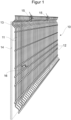
- FIG. 1 shows a schematic representation of a section of a barrier or an impact protection system, for example for a parking area of a parking garage according to an embodiment of the present invention, viewed from the inside.
- the grid bar mat 10 of the barrier which usually consists of vertical grid bars 11 and horizontal grid bars 12 connected to them, which cross each other.
- the grid bar mat 10 can have one or more corrugations 13 in which the grid bars protrude from the plane of the grid bar mat 10.
- the grid bar mat 10 is secured by means of specific fastening devices, which are shown in Figure 1 not shown, in their end area (seen in horizontal direction) in Both end areas are anchored to vertical posts of the building structure.
- the attachment of the sustainability modules 14, for example a photovoltaic module, to the grid bar mat 10 is carried out on the one hand by means of first fastening devices 15, which are arranged in an upper area of the grid bar mat 10 and later on using the Figure 4 will be explained in more detail.
- first fastening devices 15 can be provided for fastening a sustainability module or a photovoltaic module 14.
- second, lower fastening devices 16 are provided for fastening, which can be arranged, for example, in the space between two adjacent, adjoining sustainability modules 14, which overlap the two sustainability modules 14 in their edge area and fix them to a grid bar mat 10 by means of a clamping effect, wherein these second lower fastening devices 16 will be described in more detail later with reference to the Figure 3 be explained.
- the Figure 2 shows the view of the barrier from the outside.
- Two photovoltaic modules 14 can be seen, which are attached to a grid bar mat 10.
- two first, upper fastening devices 15 can be seen, as well as a second, lower fastening device 16, which covers two adjacent photovoltaic modules 14 in their edge area.
- This "lower" fastening device 16 can be arranged at a distance from the lower edge of the photovoltaic modules 14, preferably at a height, viewed from the ground, at which the impact forces become effective if there is an impact from a vehicle that accidentally drives into the grid bar mat 10 from the inside.
- This height of the arrangement of the fastening device 16 can be, for example, 50 cm to 1 m above the ground.
- the photovoltaic modules 14 are attached to the outside of the grid bar mat 10, in particular in the joint area of two adjacent grid bar mats 10.
- This fastening device is a clamping device comprising as clamping elements on the one hand a clamping plate 17, which is located on the inside of the barrier and presses against two adjacent vertical bars 11 of a grid bar mat 10. Furthermore, there is a threaded screw 18 which passes through the clamping plate 17 and onto which a nut 19 is screwed, which acts on the clamping plate 17. In this way, the clamping plate 17 serves as an abutment for the fastening device 16 and can be fixed to the grid bar mat 10.
- the fastening device 16 also comprises on the outside of the barrier a clamping rail 20 with an omega profile in cross section, the two outer legs 20a of which each form an edge area of the edge 14a of a Photovoltaic module 14 or its frame.
- the clamping rail 20 comprises a central section which lies in a plane offset inwards from the two outer legs 20a and thus forms a groove 21 in the clamping rail 20, wherein the head of the threaded screw 18 overlaps the two outer legs 20a of the clamping rail 20 in a radially outer edge region.
- the shaft of the threaded screw 18 passes through both the clamping plate 17 on the inside of the sandwich arrangement of grid bar mat 10 and photovoltaic module 14, and the clamping rail 20 on the outside of the arrangement, so that when the nut 19 is tightened, the clamping plate 17 is pressed against the vertical grid bars 11 on the inside and on the outside the clamping rail 20 pulls the two photovoltaic modules 14 towards itself and presses them against the grid bar mat 10.
- the Figure 3 The hatched areas shown and provided with the reference number 14 can in principle also form part of a (mounting) frame 27, via which the sustainability modules 14 can be fixed to the grid bar mat 10.
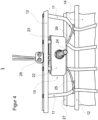
- the first, upper fastening device 15 comprises two clamping plates 22, 23, which are fixed by means of a screw connection 24 to two vertical grid bars 11, which are enclosed by the two clamping plates 22, 23.
- the first, upper fastening device 15 also comprises traction means in the form of two steel cables 25, 26, which are led through the space between the two clamping plates 22, 23, then each led around a vertical grid bar 11 and finally fixed to the frame 27 of the sustainability module 14.
- the other end of the steel cables 25, 26 is led above the two clamping plates 22, 23 between two horizontal grid bars 12 and fixed to these grid bars 12 by means of a clamp 28, so that the steel cables 25, 26 cannot slip.
- the impact causes the sustainability module 14 in its lower area to move outwards away from the grid mat 10, whereby the upper frame 27 of the sustainability module 14 is held in place by the two steel cables, so that the sustainability module or the photovoltaic module 14 performs a pivoting movement about a horizontal axis which lies approximately in the area of the upper frame 27.
- FIG 4 a view of the first, upper fastening device 15 seen from the inside of the barrier, so that one looks at the grid bar mat 10
- Figure 5 a corresponding view of the upper area of the barrier with the first, upper fastening device 15, but here the focus is on the outside of the Barrier, where the sustainability modules 14 are located, which is attached to the grid bar mat 10.
- the use of steel cables 25, 26 as traction means in the area of the first, upper fastening device 15 to hold the sustainability modules 14 in the event of an impact on the grid bar mat 10 has already been described above with reference to the Figure 4 explained.
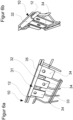
- FIG. 6a to 6d A further embodiment variant of a first, upper fastening device 15 is shown.
- this comprises a clamp element 31, which grips over a horizontal bar 12 of the grid bar mat 10 and is connected to a sustainability module 14, for example via a spacer screw 39 (see Figure 6c ).
- the clamp element 31 comprises a U-shaped base element 32, which in the present case grips over a horizontal bar 12 of the grid bar mat 10.
- the clamp element 31 has three plate or flat elements 34, each spaced apart from one another by recesses 33, which are each provided with a bore 35.
- the sustainability module 14 consists of a greening module 36.
- This comprises a (mounting) frame 27, which can consist, for example, of several horizontal and vertical mounting rails to which vertical flower boxes 37 are attached.
- Plants 38 can cover the surfaces of the grid mats 10 in order to improve the microclimate in the area of a parking garage.
Landscapes
- Engineering & Computer Science (AREA)
- Architecture (AREA)
- Civil Engineering (AREA)
- Structural Engineering (AREA)
- Aviation & Aerospace Engineering (AREA)
- Roof Covering Using Slabs Or Stiff Sheets (AREA)
- Photovoltaic Devices (AREA)
Applications Claiming Priority (1)
| Application Number | Priority Date | Filing Date | Title |
|---|---|---|---|
| DE102023114142.2A DE102023114142B3 (de) | 2023-05-30 | 2023-05-30 | Anordnung umfassend ein Anprallschutzsystem mit mindestens einem PV-Modul |
Publications (1)
| Publication Number | Publication Date |
|---|---|
| EP4471237A1 true EP4471237A1 (fr) | 2024-12-04 |
Family
ID=91278332
Family Applications (1)
| Application Number | Title | Priority Date | Filing Date |
|---|---|---|---|
| EP24178951.0A Pending EP4471237A1 (fr) | 2023-05-30 | 2024-05-29 | Agencement comprenant un système anti-impact doté d'au moins un module de la gestion durable |
Country Status (2)
| Country | Link |
|---|---|
| EP (1) | EP4471237A1 (fr) |
| DE (1) | DE102023114142B3 (fr) |
Citations (10)
| Publication number | Priority date | Publication date | Assignee | Title |
|---|---|---|---|---|
| KR20070107318A (ko) * | 2006-05-02 | 2007-11-07 | 윤종호 | 태양전지 모듈 구조물 |
| US20110146668A1 (en) | 2009-12-18 | 2011-06-23 | Raymond Saluccio | Solar fence |
| DE10356220B4 (de) | 2003-12-02 | 2012-01-19 | Projekt W Systeme Aus Stahl Gmbh | Sicherungseinrichtung für befahrbare oder begehbare Flächen |
| DE202016007387U1 (de) * | 2016-12-02 | 2017-01-26 | Gabionenbau HS GmbH | Universalhalterung für Gabionen und Gitterzäune |
| FR3042527A1 (fr) * | 2015-10-16 | 2017-04-21 | Morel S A | Systeme d'habillage d'un grillage |
| DE202017103757U1 (de) | 2017-06-23 | 2017-07-31 | Asset Management Beteiligungsgesellschaft mbH | Baueinheit für eine Abgrenzvorrichtung |
| EP3249139A1 (fr) * | 2016-05-24 | 2017-11-29 | SARL Clotures et Portails de France | Ensemble d'habillage pour clôture treillis |
| WO2021089679A1 (fr) | 2019-11-05 | 2021-05-14 | Goldbeck Solar Gmbh | Ensemble solaire pour la production d'énergie solaire |
| DE202022106213U1 (de) | 2022-11-04 | 2022-11-30 | Thomas Bockmeyer | Zaun |
| DE202022002493U1 (de) * | 2022-11-21 | 2022-12-07 | Klaus Reimann | Zaunhaus, Unterstand, Schutzabdeckung aus Metall, Kunststoff oder Glasfaser für Doppelstabmattenzäune aller Art, insbesondere für die Drahtzaundicken 6/5/6 und 8/6/8 aller Hersteller geeignet |
-
2023
- 2023-05-30 DE DE102023114142.2A patent/DE102023114142B3/de active Active
-
2024
- 2024-05-29 EP EP24178951.0A patent/EP4471237A1/fr active Pending
Patent Citations (10)
| Publication number | Priority date | Publication date | Assignee | Title |
|---|---|---|---|---|
| DE10356220B4 (de) | 2003-12-02 | 2012-01-19 | Projekt W Systeme Aus Stahl Gmbh | Sicherungseinrichtung für befahrbare oder begehbare Flächen |
| KR20070107318A (ko) * | 2006-05-02 | 2007-11-07 | 윤종호 | 태양전지 모듈 구조물 |
| US20110146668A1 (en) | 2009-12-18 | 2011-06-23 | Raymond Saluccio | Solar fence |
| FR3042527A1 (fr) * | 2015-10-16 | 2017-04-21 | Morel S A | Systeme d'habillage d'un grillage |
| EP3249139A1 (fr) * | 2016-05-24 | 2017-11-29 | SARL Clotures et Portails de France | Ensemble d'habillage pour clôture treillis |
| DE202016007387U1 (de) * | 2016-12-02 | 2017-01-26 | Gabionenbau HS GmbH | Universalhalterung für Gabionen und Gitterzäune |
| DE202017103757U1 (de) | 2017-06-23 | 2017-07-31 | Asset Management Beteiligungsgesellschaft mbH | Baueinheit für eine Abgrenzvorrichtung |
| WO2021089679A1 (fr) | 2019-11-05 | 2021-05-14 | Goldbeck Solar Gmbh | Ensemble solaire pour la production d'énergie solaire |
| DE202022106213U1 (de) | 2022-11-04 | 2022-11-30 | Thomas Bockmeyer | Zaun |
| DE202022002493U1 (de) * | 2022-11-21 | 2022-12-07 | Klaus Reimann | Zaunhaus, Unterstand, Schutzabdeckung aus Metall, Kunststoff oder Glasfaser für Doppelstabmattenzäune aller Art, insbesondere für die Drahtzaundicken 6/5/6 und 8/6/8 aller Hersteller geeignet |
Non-Patent Citations (1)
| Title |
|---|
| NIKITA HANIKEL ET AL., ACS CENT. SCI., vol. 5, no. 10, 17 August 2019 (2019-08-17), pages 1699 - 1706 |
Also Published As
| Publication number | Publication date |
|---|---|
| DE102023114142B3 (de) | 2024-06-20 |
Similar Documents
| Publication | Publication Date | Title |
|---|---|---|
| EP2423409B1 (fr) | Paroi de sécurité | |
| EP4331112B1 (fr) | Structure de support pour modules photovoltaïques | |
| EP2224185A1 (fr) | Carcan (liaison mécanique) | |
| EP2508694A1 (fr) | Abri de garage | |
| DE202021105573U1 (de) | Solar-Carport | |
| DE202009015885U1 (de) | Solarer Carport | |
| EP2525413A2 (fr) | Dispositif destiné à la fixation de modules photovoltaïques sur toit plat | |
| DE202016105226U1 (de) | Carport | |
| EP2872695A1 (fr) | Élément de déviation de vent latéral pour empêcher la sédimentation | |
| DE29809541U1 (de) | Vorrichtung zum Herstellen von hohen, hohlen, turmartigen Bauwerken von zweihundert Metern Höhe und mehr, insbesondere von Türmen für Windkraftanlagen | |
| EP3047083A1 (fr) | Toit de protection variable | |
| EP2213961A2 (fr) | Dispositif destiné à l'élévation de modules solaires | |
| DE102009003165A1 (de) | Montagesystem und Verfahren zur Montage von Solarmodulen | |
| EP3436638B1 (fr) | Structure de transition servant au pontage d'un joint de construction | |
| DE102010009698B4 (de) | Mit Solarmodulen bestückte Lärmschutzwand | |
| DE102018217108A1 (de) | Dachkonstruktion für carports mit pv-modulen sowie ein verfahren zum montieren eines derartigen carports | |
| DE102023114142B3 (de) | Anordnung umfassend ein Anprallschutzsystem mit mindestens einem PV-Modul | |
| EP0802324A1 (fr) | Eolienne | |
| DE102016117648A1 (de) | Carport | |
| DE102020004452A1 (de) | Tragkonstruktion zum Tragen von Solarmodulen und Deckenelementen | |
| EP2075377A2 (fr) | Dispositif de protection sur des voies de circulation | |
| DE10356220B4 (de) | Sicherungseinrichtung für befahrbare oder begehbare Flächen | |
| EP4328399A1 (fr) | Protection antichute pour bâtiments | |
| DE102010024156A1 (de) | Lärmschutzwandelement mit Solarkollektor | |
| EP2567030B1 (fr) | Glissière de sécurité |
Legal Events
| Date | Code | Title | Description |
|---|---|---|---|
| PUAI | Public reference made under article 153(3) epc to a published international application that has entered the european phase |
Free format text: ORIGINAL CODE: 0009012 |
|
| STAA | Information on the status of an ep patent application or granted ep patent |
Free format text: STATUS: THE APPLICATION HAS BEEN PUBLISHED |
|
| AK | Designated contracting states |
Kind code of ref document: A1 Designated state(s): AL AT BE BG CH CY CZ DE DK EE ES FI FR GB GR HR HU IE IS IT LI LT LU LV MC ME MK MT NL NO PL PT RO RS SE SI SK SM TR |
|
| STAA | Information on the status of an ep patent application or granted ep patent |
Free format text: STATUS: REQUEST FOR EXAMINATION WAS MADE |
|
| 17P | Request for examination filed |
Effective date: 20250508 |
|
| STAA | Information on the status of an ep patent application or granted ep patent |
Free format text: STATUS: EXAMINATION IS IN PROGRESS |
|
| 17Q | First examination report despatched |
Effective date: 20260519 |