EP4470730A1 - Vorrichtung, verfahren und programm zur erzeugung eines betriebspfades - Google Patents
Vorrichtung, verfahren und programm zur erzeugung eines betriebspfades Download PDFInfo
- Publication number
- EP4470730A1 EP4470730A1 EP22924158.3A EP22924158A EP4470730A1 EP 4470730 A1 EP4470730 A1 EP 4470730A1 EP 22924158 A EP22924158 A EP 22924158A EP 4470730 A1 EP4470730 A1 EP 4470730A1
- Authority
- EP
- European Patent Office
- Prior art keywords
- target object
- contact
- section
- transition
- state
- Prior art date
- Legal status (The legal status is an assumption and is not a legal conclusion. Google has not performed a legal analysis and makes no representation as to the accuracy of the status listed.)
- Pending
Links
Images










Classifications
-
- B—PERFORMING OPERATIONS; TRANSPORTING
- B25—HAND TOOLS; PORTABLE POWER-DRIVEN TOOLS; MANIPULATORS
- B25J—MANIPULATORS; CHAMBERS PROVIDED WITH MANIPULATION DEVICES
- B25J9/00—Program-controlled manipulators
- B25J9/16—Program controls
- B25J9/1656—Program controls characterised by programming, planning systems for manipulators
- B25J9/1664—Program controls characterised by programming, planning systems for manipulators characterised by motion, path, trajectory planning
-
- G—PHYSICS
- G06—COMPUTING OR CALCULATING; COUNTING
- G06F—ELECTRIC DIGITAL DATA PROCESSING
- G06F30/00—Computer-aided design [CAD]
- G06F30/10—Geometric CAD
- G06F30/17—Mechanical parametric or variational design
-
- B—PERFORMING OPERATIONS; TRANSPORTING
- B25—HAND TOOLS; PORTABLE POWER-DRIVEN TOOLS; MANIPULATORS
- B25J—MANIPULATORS; CHAMBERS PROVIDED WITH MANIPULATION DEVICES
- B25J9/00—Program-controlled manipulators
- B25J9/16—Program controls
- B25J9/1679—Program controls characterised by the tasks executed
- B25J9/1687—Assembly, peg and hole, palletising, straight line, weaving pattern movement
-
- G—PHYSICS
- G05—CONTROLLING; REGULATING
- G05B—CONTROL OR REGULATING SYSTEMS IN GENERAL; FUNCTIONAL ELEMENTS OF SUCH SYSTEMS; MONITORING OR TESTING ARRANGEMENTS FOR SUCH SYSTEMS OR ELEMENTS
- G05B2219/00—Program-control systems
- G05B2219/30—Nc systems
- G05B2219/40—Robotics, robotics mapping to robotics vision
- G05B2219/40033—Assembly, microassembly
-
- G—PHYSICS
- G05—CONTROLLING; REGULATING
- G05B—CONTROL OR REGULATING SYSTEMS IN GENERAL; FUNCTIONAL ELEMENTS OF SUCH SYSTEMS; MONITORING OR TESTING ARRANGEMENTS FOR SUCH SYSTEMS OR ELEMENTS
- G05B2219/00—Program-control systems
- G05B2219/30—Nc systems
- G05B2219/40—Robotics, robotics mapping to robotics vision
- G05B2219/40515—Integration of simulation and planning
Definitions
- the present disclosure relates to an operation path generation device, an operation path generation method, and an operation path generation program.
- Hitherto technology has been proposed for generating an operation path of a robot to execute a task to assemble a main target object gripped by a robot together with an auxiliary target object that is an assembly target.
- a multi-finger hand to reliably make a high speed insertion in an assembly process having a small clearance between bodies.
- Such a multi-finger hand features six degrees of freedom of back drivability and object orientation observability, and in order to achieve high speed insertion of small bodies together with each other, implements both impact reduction and position error compensation when two bodies make contact with each other (International Publication ( WO) No. 2020/194393 ).
- This path output method is a method that employs a computation device including an external interface, a storage section, and a computation section to output a path for a robot with plural moveable axes to transport a target object from a first position to a second position.
- the computation section acquires the first position and the second position using an external interface, and acquires transport conditions for when the robot transports the target object from the first position to the second position.
- a path is generated that satisfies the transport conditions across all paths that are paths for the robot to transport the target object from the first position to the second position ( Japanese Patent No. 6860863 ).
- an object of the present disclosure is to generate, from among existing paths for a task of assembling target objects together, an operation path that can be executed at high speed without a probing operation.
- an operation path generation device configured including an acquisition section, a simulation section, and a generation section.
- the acquisition section acquires a start position and orientation, and an end position and orientation, of the gripping section relative to the main target object, and acquires shape information of a task environment containing the main target object and the auxiliary target object.
- the simulation section Based on the information acquired by the acquisition section, the simulation section performs a simulation of a transition of contact states between the main target object and the auxiliary target object, from a contact state between the main target object and the auxiliary target object until there is a non-contact state between the main target object and the auxiliary target object. Based on the information acquired by the acquisition section and on the transition of contact states simulated by the simulation section, the generation section generates an operation path of the robot to reach a goal state from an initial state, which is the start position and orientation of the gripping section, until reaching one or another contact state included in the transition of contact states, along a transition of contact states including the one or the other of the contact states.
- an operation path generation method is a method that includes: an acquisition section acquiring, for an operation to assemble a main target object gripped by a gripping section of a robot together with an auxiliary target object that is an assembly target, a start position and orientation, and an end position and orientation, of the gripping section relative to the main target object, and acquiring shape information of a task environment containing the main target object and the auxiliary target object; a simulation section performing a simulation, based on the information acquired by the acquisition section, of a transition of contact states between the main target object and the auxiliary target object, from a contact state between the main target object and the auxiliary target object until there is a non-contact state between the main target object and the auxiliary target object; and a generation section generating, based on the information acquired by the acquisition section and on the transition of contact states simulated by the simulation section, an operation path of the robot to reach a goal state from an initial state, which is the start position and orientation of the gripping section, until reaching one or another contact
- An operation path generation program is a program that causes a computer to function as an acquisition section, a simulation section, and a generation section.
- the acquisition section acquires a start position and orientation, and an end position and orientation, of the gripping section relative to the main target object, and acquires shape information of a task environment containing the main target object and the auxiliary target object.
- the simulation section Based on the information acquired by the acquisition section, the simulation section performs a simulation of a transition of contact states between the main target object and the auxiliary target object, from a contact state between the main target object and the auxiliary target object until there is a non-contact state between the main target object and the auxiliary target object. Based on the information acquired by the acquisition section and on the transition of contact states simulated by the simulation section, the generation section generates an operation path of the robot to reach a goal state from an initial state, which is the start position and orientation of the gripping section, until reaching one or another contact state included in the transition of contact states, along a transition of contact states including the one or the other of the contact states.
- the operation path generation device, method, and program according to the present disclosure are able, from among existing paths for a task of assembling target objects together, to generate of an operation path that can be executed at high speed without a probing operation.
- a robot control system 1 is configured including an operation path generation device 10, a robot control device 40, a robot 42, and a sensor group 50.
- the robot 42 includes a robot arm 44 and a hand section 46.
- the hand section 46 is an example of a "gripping section" of the present disclosure.
- the robot arm 44 is configured including links, and joints that connect between the links and that also rotate or perform a linear motion extension or contraction under drive from motors. Motors in the robot arm 44 are driven according to command values output from the robot control device 40, and change the rotation angle or the extension/contraction state of the joints.
- the hand section 46 is accordingly controlled so as to adopt a specified position and specified orientation in three-dimensional space.
- positions and orientations are expressed using an X axis and a Y axis that are two orthogonal directions in a horizontal plane, a Z axis that is a vertical direction, with rotation about the X axis denoted by ⁇ , rotation about the Y axis denoted by ⁇ , and rotation about the Z axis denoted by ⁇ .
- the hand section 46 is provided at a distal end of the robot arm 44 and is a tool capable of gripping a main target object 90A.
- the hand section 46 may, for example, be a multi-joint multi-finger robot hand, a gripper robot hand, a suction pad, or the like.
- the robot 42 may be appropriately configured by a soft robot that performs behaviors to accustom itself to the external environment by joints and links being outpushed by reaction force from contact with the external environment, and may be configured by a soft robot including a hand section 46 with such properties.
- the sensor group 50 includes plural types of sensor, and the sensor data acquired by each of the sensors is output as time series data to the robot control device 40. Note that although the sensor group 50 is schematically represented in Fig. 1 as a single block in the vicinity of the hand section 46, each of the sensors contained in the sensor group 50 is actually provided at a respective position corresponding to the type and function of the sensor.
- the sensors may be provided as needed according to the task to be performed by the robot 42. However, in the present exemplary embodiment operation of the robot 42 is controlled based on an operation path of a task to assemble a main target object 90A and an auxiliary target object 90B together using contact.
- the sensor group 50 contains sensors capable of detecting external force during contact between the main target object 90A and the environment, for example force sensors, sensors (pad sensors) capable of measuring deformation amounts of a pad, and the like.
- Encoders of motors may also be utilized as sensors capable of detecting external force. In such cases a difference between the output value of the motor encoder and a command value to the motor is detected as external force.
- the sensor group 50 also contains, as other sensors, sensors capable of recognizing relative errors related to the position and orientation of the main target object 90A with respect to the control goal (hereafter referred to as "position and orientation errors"), for example vision sensors, proximity sensors, and the like.
- position and orientation errors for example vision sensors, proximity sensors, and the like.
- pad sensors may also be utilized as sensors capable of recognizing position and orientation errors.
- the robot control device 40 generates command values based on the operation path generated by the operation path generation device 10, and outputs the command values to the robot 42.
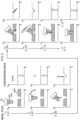
- FIG. 2 is of an operation path for a task to insert a circular rod shaped shaft as the main target object 90A into a hole (insertion position) of a circular cylindrical shaped ring as the auxiliary target object 90B.
- Fig. 2 illustrates schematic side views illustrating positional relationships between the main target object 90A and the auxiliary target object 90B for each operation, illustrated alongside a configuration space during each operation.
- a circle in configuration space represents coordinates of a position and an orientation of a bottom face right side of the shaft serving as the main target object 90A at a start time for each operation.
- Operation (1) is an operation to translate the main target object 90A from the initial state to above the insertion position of the auxiliary target object 90B.
- Operation (2) is an operation to tilt the main target object 90A at a specific angle (45° in the example of Fig. 2 ).
- Operation (3) is an operation to lower the main target object 90A toward the insertion position until there is contact between the main target object 90A and the auxiliary target object 90B.
- the configuration space of operation (3) shows that the main target object 90A is unable to reach the bottommost portion of the hole of the auxiliary target object 90B due to the main target object 90A being tilted.
- Operation (4) is an operation to move the main target object 90A toward the insertion position direction, while maintaining tilt of the main target object 90A and while maintaining contact between the main target object 90A and the auxiliary target object 90B, until another location of the main target object 90A contacts the auxiliary target object 90B.
- Operation (5) is an operation that uses alignment between the main target object 90A and the auxiliary target object 90B to return a tilt of the main target object 90A to an angle (10° in the example of Fig. 2 ) enabling the main target object 90A to be lowered along an inner periphery of the insertion position (hole) of the auxiliary target object 90B.
- Operation (6) is an operation to move the main target object 90A downward along the inner periphery of the insertion position (hole) of the auxiliary target object 90B.
- Operation (7) is an operation to place the main target object 90A at a goal angle ⁇ ° (0° in the example of Fig. 2 ).
- the present exemplary embodiment accordingly postulates an operation path that utilizes contact between the main target object 90A and the auxiliary target object 90B, which is one item in the environment.
- Fig. 2 illustrates the configuration space represented in two dimensions
- the configuration space in Fig. 2 includes an axis of ⁇ in a direction perpendicular to the page.
- Fig. 3 illustrates an example of a three-dimensional representation of configuration space.
- a circle in the configuration space represents the coordinates of the position and orientation of the bottom face right side of the shaft serving as the main target object 90A at a start time for each operation (1) to (7) of Fig. 2 .
- the operation path generation device 10 generates the operation path using a simulation, and outputs the operation path to the robot control device 40.
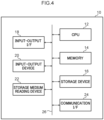
- Fig. 4 is a block diagram illustrating a hardware configuration of the operation path generation device 10 according to the present exemplary embodiment. As illustrated in Fig. 4 , the operation path generation device 10 includes a central processing unit (CPU) 12, memory 14, a storage device 16, an input-output interface (I/F) 18, an input-output device 20, a storage medium reading device 22, and a communication I/F 24. Each configuration is connected so as to be able to mutually communicate through a bus 26.
- CPU central processing unit
- I/F input-output interface
- the CPU 12 is a central processing unit for executing various programs and controlling each configuration. Namely, the CPU 12 reads the program from the storage device 16, and executes the program using the memory 14 as workspace. The CPU 12 controls each configuration and performs various computational processing according to the program stored on the storage device 16.
- the memory 14 is configured by random access memory (RAM) and serves as workspace for temporarily storing programs and data.
- the storage device 16 is configured by a read only memory (ROM), and a hard disk drive (HDD), solid state drive (SSD), or the like, and stores various programs including an operating system and various data.
- the input-output I/F 18 is an interface for connecting the operation path generation device 10 and the robot control device 40 together.
- the operation path generated by the operation path generation device 10 is output to the robot control device 40 through the input-output I/F 18.
- the input-output device 20 is, for example, an input device such as a keyboard, mouse, or the like to perform various input, and an output device such as a display device such as a display, a printer, or the like for performing output of various information. By adopting a touch panel display as the output device, this may also function as an input device.
- the storage medium reading device 22 reads data stored on various storage media such as a compact disc (CD)-ROM, digital versatile disc (DVD)-ROM, Blu-ray disc, universal serial bus (USB) memory, or the like, and writes data to the storage media.
- the communication I/F 24 is an interface to communicate with other devices, and employs a standard such as, for example, Ethernet (registered trademark), FDDI, or Wi-Fi (registered trademark).
- Fig. 5 is a block diagram illustrating an example of a functional configuration of the operation path generation device 10.
- the operation path generation device 10 is input with relative position and orientation information of the hand section 46 at a start position with respect to the main target object 90A (hereafter referred to as "start position and orientation"), and with relative position and orientation information of the hand section 46 at an end position with respect to the main target object 90A (hereafter referred to as "end position and orientation").
- the operation path generation device 10 is also input with environment information indicating a profile and placement of a task environment containing the main target object 90A and the auxiliary target object 90B.
- the environment information contains, for example, CAD data for both the main target object 90A and the auxiliary target object 90B, a configuration space representing the task environment with obstructions disposed therein, and the like.
- the operation path generation device 10 is also input with information to identify a resolution of operation of the robot 42 (hereafter referred to as "resolution identification information").
- the resolution identification information includes at least one out of a resolution of sensors contained in the sensor group 50 or a control precision of actuators to drive the robot 42.
- the operation path generation device 10 includes, as functional configuration, an acquisition section 32, a simulation section 34, a generation section 36, and a display control section 38.
- Each functional configuration is implemented by the CPU 12 reading the operation path generation program stored in the storage device 16, and expanding and executing the operation path generation program in the memory 14.
- the acquisition section 32 acquires the start position and orientation, the end position and orientation, and the environment information that were input to the operation path generation device 10, and passes these across to the simulation section 34.
- the acquisition section 32 also acquires the resolution identification information input to the operation path generation device 10 and passes these across to the generation section 36.
- the simulation section 34 simulates a transition of contact states between the main target object 90A and the auxiliary target object 90B, from a contact state between the main target object 90A and the auxiliary target object 90B until a non-contact state between the main target object 90A and the auxiliary target object 90B.
- a contact state in which a face of the main target object 90A and a face of the auxiliary target object 90B contact each other is called a face contact.
- a contact state in which an edge (or a point) of at least one out of the main target object 90A or the auxiliary target object 90B contacts the other out of the main target object 90A or the auxiliary target object 90B is called an edge (or point) contact.
- edge (or point) contact In the following, the "(or point)" in edge (or point) will be omitted, and this will be simply called “edge”.
- a face orthogonal to the X axis is called an "X face”
- a face orthogonal to the Y axis is called a “Y face”
- a face orthogonal to the Z axis is called a "Z face”.
- a contact location of face contact is represented by a solid line
- a contact location of edge contact is represented by a black circle.
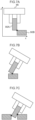
- Fig. 6A to Fig. 6C illustrate examples of face contact.
- the main target object 90A and the auxiliary target object 90B contact each other at a Z face
- the main target object 90A and the auxiliary target object 90B contact each other at an X face.
- Fig. 6A and Fig. 6B are treated as illustrating face contact of different respective contact states when the contact face is different.
- the entire Z face of the main target object 90A contacts the auxiliary target object 90B in Fig. 6A
- only part of the Z face is in contact in Fig. 6C .
- Fig. 6A and Fig. 6C are treated as illustrating face contact of different respective contact states.
- Fig. 7A to Fig. 7F illustrate examples of edge contact.
- Fig. 7A and Fig. 7B illustrate edge contact in which the main target object 90A and the auxiliary target object 90B contact each other along one edge.
- Such edge contact in which there is contact at one edge is hereafter referred to as "one-edge contact”.
- Fig. 7C , Fig. 7D, and Fig. 7E illustrate edge contact in which two edges of the main target object 90A and the auxiliary target object 90B contact each other.
- Such edge contacts in which two edges contact each other are hereafter referred to as "two-edge contacts".
- Fig. 7C illustrate edge contact in which two edges of the main target object 90A and the auxiliary target object 90B contact each other.
- Such edge contacts in which two edges contact each other are hereafter referred to as "two-edge contacts”.
- one edge at the lower side Z face left ( the left side X face bottom) of the main target object 90A
- Fig. 7E illustrates an example of three-edge contact in which the main target object 90A and the auxiliary target object 90B are in contact at three edges.
- the simulation section 34 is a simulation performed of transitions of contact states starting from the goal state.
- a non-movement state a two-edge contact state to a face contact state
- force continues to be applied but this time in a different direction when this again reaches a non-movement state
- force continues to be applied in a different direction from this state, with such operations being performed repeatedly.
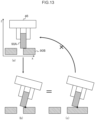
- Maintain displacements and separation displacements as illustrated in Fig. 8 should be considered as displacements of the main target object 90A with respect to the auxiliary target object 90B when searching for such contact state transitions.
- Maintain displacements are displacements in which the main target object 90A is displaced while maintaining the same contact state.
- maintain displacements include cases in which the main target object 90A is translated while face contact is maintained, and include cases in which the main target object 90A is rotated while one-edge contact or two-edge contact is maintained.
- Separation displacements are displacements in which the main target object 90A is displaced in a direction of increased degrees of freedom of contact state.
- separation displacements include translating the main target object 90A in a direction that intersects with a contact face of face contact with the auxiliary target object 90B that is a direction away from the auxiliary target object 90B.
- separation displacements include rotating the main target object 90A to give one-edge contact from face contact or from two-edge contact.
- the simulation section 34 generates a branch-tree including the goal state as a root node, and including nodes corresponding to the different respective contact states while searching transition of contact states as described above. More specifically, the simulation section 34 performs a simulation from any state out of a two-edge contact, three-edge contact, or face contact state, to simulate whether or not a new contact state is reached at a state immediately after a separation displacement movement has been performed, or by continuing to execute maintain displacement for a direction in which movement of the separation displacement was performed. In cases in which a new contact state has been reached, the simulation section 34 also executes a similar search (generation of a branch-tree) on this contact state for cases in which the new contact state is two-edge contact, three-edge contact, or face contact.
- the simulation section 34 also records only a one-edge contact state in the branch-tree for cases in which a contact state immediately after movement of a separation displacement is one-edge contact, and a new state reached by continuing to execute maintain displacement for the direction in which the separation displacement movement was performed is a state of no contact at all.
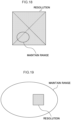
- the simulation section 34 finds a range that the main target object 90A is able to perform maintain displacement in the contact state corresponding to the respective node (hereafter referred to as a "maintain range"), and associates this range with the node.
- the simulation section 34 finds the maintain range for each direction of translations directions (X, Y, Z) and rotation directions ( ⁇ , ⁇ , ⁇ ).
- the generation section 36 Based on the information acquired by the acquisition section 32 and on the transition of contact states simulated by the simulation section 34, the generation section 36 generates an operation path of the robot to reach the goal state from an initial state, which is the start position and orientation of the main target object 90A, until reaching one or other contact state included in the transition of contact states, along a transition of contact states including the one or other of the contact states. Specifically, the generation section 36 identifies a node in the branch-tree that has been associated with a larger maintain range than the resolution of the operation of the robot 42. The generation section 36 identifies the nearest node from the root node of the branch-tree in cases in which there are plural nodes identified.
- the generation section 36 identifies a transition of contact states in the branch-tree corresponding to from the identified node to the root node, and generates a path of the robot 42 corresponding to the identified transition of contact states. Moreover, the generation section 36 generates a path from a position of the initial state to the contact state corresponding to the identified node that is a path avoiding obstructions in the surroundings. The generation section 36 then passes across to the display control section 38, as an operation path, a path resulting from joining the path from the initial state to the contact state corresponding to the identified node together with the path from the contact state corresponding to the identified node to the goal state. Note that a path is a series of positions and orientations of specific segment (for example a finger) of the hand section 46 of the robot 42.
- the generation section 36 regenerates the operation path while reflecting the user recorded position and orientation in the already generated operation path. Details are described later, however basically the user recorded position and orientation is recorded with a corrected position and orientation of the main target object 90A at an identified time on the operation path.
- the generation section 36 may regenerate the operation path by correcting the already generated operation path so as to pass through the specified position and orientation.
- the generation section 36 may search the branch-tree for a node that has been associated with the contact state corresponding to the user recorded position and orientation, and regenerate the operation path based on a transition of contact states passing through the contact state corresponding to the found node.
- the display control section 38 displays the operation path generated by the generation section 36 on a display device.
- the display control section 38 displays a first presentation screen 60 on the display device, for example as illustrated in Fig. 9 .
- the example of Fig. 9 includes a three-dimensional view 61 on the first presentation screen 60.
- the three-dimensional positions (X, Y, Z) and orientations ( ⁇ , ⁇ , ⁇ ) of the main target object 90A and the auxiliary target object 90B from the initial state to the goal state are previewed in a three-dimensional animation.
- a three-dimensional image of the environment may also be displayed together therewith.
- the positions and orientations of the main target object 90A and the auxiliary target object 90B may be configured so as to be movable using a mouse, like in three-dimensional CAD software.
- the first presentation screen 60 includes a time display 62 displayed with a replay time of the animation being displayed in the three-dimensional view 61.
- the time display 62 is displayed with a time associated with the frame being displayed on the three-dimensional view 61 from among the times associated with respective frames of the animation being displayed on the three-dimensional view 61.
- a freely selected time may be input to the time display 62, so as to display a frame corresponding to this time on the three-dimensional view 61.
- the first presentation screen 60 also includes a phase display 63.
- the phase display 63 includes a single axis display such as a strip shaped display or the like to indicate elapsed time from start to end of operation indicated by the operation path, with first marks (dashed lines in the phase display 63 of Fig. 9 ) displayed at positions corresponding to times on the operation path when a contact state between the main target object 90A and the auxiliary target object 90B changes.
- a second mark solid line and black triangle in the phase display 63 of Fig.
- phase display 63 is displayed on the phase display 63 at a position corresponding to the time being displayed on the time display 62.
- the time displayed on the time display 62 is specifiable by moving the second mark on the phase display 63.
- a third mark (dotted line in the phase display 63 of Fig. 9 ) illustrating a user recorded position and orientation, described later, is displayed on the phase display 63 at a position corresponding a time subject to a user recorded position and orientation.
- the first presentation screen 60 also includes a record button 64.
- a user specifies a given time, the position and orientation of the main target object 90A and the auxiliary target object 90B at this time are displayed on the three-dimensional view 61, and the user corrects the position and orientation of the main target object 90A using a mouse operation or the like, before then selecting the record button 64.
- the position and orientation of the main target object 90A as corrected by the user are recorded for the time specified on the operation path. This recording is called "user recorded position and orientation".
- the first presentation screen 60 also includes a regeneration button 65.
- the display control section 38 receives the user recorded position and orientation, passes the received user recorded position and orientation to the generation section 36, and instructs regeneration of the operation path.
- the display control section 38 also displays a second presentation screen 70 on the display device, for example as illustrated in Fig. 10 .
- the second presentation screen 70 includes a time display 62, a phase display 63, a record button 64, and a regeneration button 65, similarly to in the first presentation screen 60.
- the second presentation screen 70 also includes a three-dimensional view 71.
- the three-dimensional view 71 is displayed with a configuration space in which three variables selected from among three degrees of freedom of position (X, Y, Z) and the three degrees of freedom of orientation ( ⁇ , ⁇ , ⁇ ) are displayed on three axes.
- position and orientation can also be recorded by a user on the three-dimensional view 71.
- a user is able to correct the position and orientation of the main target object 90A by moving a coordinate point (the black point in the three-dimensional view 71 of Fig. 10 ) in the configuration space being displayed in the three-dimensional view 71.
- the second presentation screen 70 also includes a selection region 72 for selecting the three variables that are to be associated with the axes of the configuration space for display on the three-dimensional view 71.
- the display control section 38 may display the first presentation screen 60 and the second presentation screen 70 on the display device in different respective windows at the same time as each other.
- the display control section 38 may display second presentation screens 70 for different selections of three variables on plural respective separate windows at the same time.
- the display control section 38 may synchronize the time displays 62 of the first presentation screen 60 and the second presentation screen 70 corresponding to each window, so as to interlock the displays of each window.
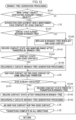
- Fig. 11 is a flowchart illustrating a flow of the operation path generation processing execute by the CPU 12 of the operation path generation device 10.
- the CPU 12 functions as each functional configuration of the operation path generation device 10, and the operation path generation processing illustrated in Fig. 11 is executed, by the CPU 12 reading the operation path generation program from the storage device 16 and expanding and executing the operation path generation program in the memory 14.
- the acquisition section 32 acquires a start position and orientation, an end position and orientation, environment information, and resolution identification information that have been input to the operation path generation device 10.
- the simulation section 34 identifies a goal state when the main target object 90A and the auxiliary target object 90B have been assembled based on the end position and orientation and the environment information acquired at step S10. Specifically, the simulation section 34 identifies a state of face contact with the greatest number of faces as the goal state from among assembled states of the main target object 90A and the auxiliary target object 90B at the end position and orientation. Note that the simulation section 34 identifies a state having the greatest number of edge contacts as the goal state in cases in which there is not even one face of face contact. In cases in which there are plural candidates for the goal state, any of these states may be identified as the goal state.
- step S14 the simulation section 34 executes branch-tree generation processing.
- the branch-tree generation processing will now be described with reference to Fig. 12 .
- the simulation section 34 determines whether or not the main target object 90A is contacting the auxiliary target object 90B. Processing transitions to loop processing L1 when there is contact therebetween, and the branch-tree generation processing is ended and returned when there is no contact therebetween.
- the loop processing L1 starts at step L1S, and steps S142 to S 145 and loop processing L2 are executed for the transition of contact states (hereafter referred to as "L1 transition") from the current contact state in a direction (including a rotation) that both maintains face contact or edge contact and results in a separation displacement.
- L1 transition transition of contact states
- the loop processing L1 is ended at step L1E when there are no longer any possible transition directions for the current contact state, except for directions that have already been found.
- the simulation section 34 determines whether or not the contact state after the L1 transition has already been recorded in the branch-tree. Processing transitions to step S146 when already recorded, and processing transitions to step S143 when not yet recorded.
- the simulation section 34 finds a maintain range of the contact state after the L1 transition. The simulation section 34 records the contact state after the L1 transition and the maintain range thereof by recording in association with a node in the branch-tree connected downstream of the node corresponding to the contact state prior to the L1 transition.
- the simulation section 34 limits the maintain range to a range where it is possible to return to the same contact state as that prior to the L1 transition when a transition in a direction to return along the L1 transition has been executed.
- the contact state prior to the L1 transition is face contact in which part of the lower side Z face of the main target object 90A contacts the auxiliary target object 90B.
- step S144 the simulation section 34 determines whether or not the contact state after the L1 transition is one-edge contact. Processing transitions to loop processing L2 when one-edge contact, and processing transitions to step S145 when not one-edge contact, namely when two or more edge contact or face contact.
- step S145 the simulation section 34 recursively executes the branch-tree generation processing with the contact state after the L1 transition as the contact state of the start time of branch-tree generation processing.
- the simulation section 34 takes the node(s) corresponding to the contact state(s) after the L1 transition already recorded in the branch-tree, and the node recorded this time, and uses a tree segment from the node further from the root node to leaf nodes to replace the node of the branch-tree nearer to the root node. Processing then transitions to loop processing L2. Note that the processing of the present step is skipped in cases in which the contact state after the L1 transition is one-edge contact.
- the loop processing L2 starts at step L2S, and steps S147 to S150 are executed for each of the transitions of contact states (hereafter referred to as "L2 transitions") that result in a new face contact or two or more edge contact by a transition in the same direction.
- the loop processing L2 is ended at step L2E when a new face contact or two or more edge contact is no longer reached.
- step S147 the simulation section 34 determines whether or not step S143 has been executed for the contact state prior to the L2 transition. Processing transitions to step S149 when executed, and processing transitions to step S148 when not executed.
- step S148 the contact state prior to the L2 transition and the maintain range thereof are recorded in the branch-tree similarly to in the processing of step S143, and processing transitions to step S149.
- step S149 the simulation section 34 records the contact state after the L2 transition and the maintain range thereof in the branch-tree similarly to in the processing of step S143.
- step S150 the simulation section 34 recursively executes the branch-tree generation processing with the contact state after the L2 transition as the contact state at the start time of branch-tree generation processing.
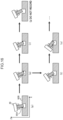
- Fig. 14 to Fig. 16 focus on transitions in the directions of X, Z, and ⁇ and illustrate only contact states needed for explanatory purposes, with contact states considering transitions in other directions omitted in the drawings.
- the simulation section 34 identifies a state of face contact in which the two faces of the left side X face and the lower side Z face of the main target object 90A contact the auxiliary target object 90B as the goal state for starting the branch-tree generation processing.
- the simulation section 34 executes, as the L1 transition, for example a transition that translates the main target object 90A in the X axis direction while maintaining face contact with the lower side Z face.
- the contact state after the L1 transition for this case is illustrated in (b).
- the simulation section 34 records the contact state (b) in the branch-tree by connecting a node associated with the contact state (b) and the maintain range thereof to downstream of the root node corresponding to the goal state (step S143).
- the contact state (b) is not one-edge contact (negative determination at step S144), and the simulation section 34 executes the L1 transition from contact state (b) (loop processing L1 in step S145).
- the simulation section 34 executes, for example, a transition to rotate the main target object 90A while maintaining one-edge contact at the lower side Z face right (right side X face bottom).
- the contact state after the L1 transition for this case is illustrated at (c).
- the simulation section 34 records the contact state (c) at a node downstream of the node corresponding to the contact state (b) (step S143).
- the contact state (c) is one-edge contact (affirmative determination at step S144), and so the loop processing L2 is executed.
- the two-edge contact state as illustrated at (d) results from the L2 transition continuing in the same direction as the transition from (b) to (c).
- the simulation section 34 Due to recording to the branch-tree already being performed for the contact state (c) prior to the L2 transition (affirmative determination at step S147), the simulation section 34 records the contact state (d) at a node downstream of the node corresponding to the contact state (c) (step S149). Next, the simulation section 34 executes the L1 transition from the contact state (d) (loop processing L1 in step S150).
- a contact state a transition that translates the main target object 90A in the Z axis direction upward from the contact state (d) while maintaining one-edge contact at the right side X face of the main target object 90A has been executed as the L1 transition is illustrated at (e).
- the contact state (e) is one-edge contact (affirmative determination at step S144), and transition to loop processing L2, as illustrated at (f), does not give rise to new face contact or two-edge contact even when maintain displacement is performed in the same direction as the L1 transition.
- the simulation section 34 accordingly ends the loop processing L2, returns to the loop processing L1 of the path generation processing with the contact state (d) as the initial contact state, and executes the L1 transition in a direction different to the transition from (d) to (e).
- the contact state (g) is similar to the contact state (c), is already recorded in the branch-tree (affirmative determination at step S142), and is one-edge contact, so step S146 is skipped and processing transitions to loop processing L2.
- step S146 is skipped and processing transitions to loop processing L2.
- the contact state (g) prior to the L2 transition has not passed through step S143 and so is not recorded in the branch-tree (negative determination at step S147).
- the simulation section 34 after recording the contact state (g) in the branch-tree (step S148), also records the contact state (h) in the branch-tree (step S149).
- Branch-tree generation processing similar to that described above is executed for the contact state (h) onwards.
- the simulation section 34 executes the L2 transition in the same direction as the L1 transition from (a) to (b). In this case this results in, as illustrated in Fig. 15(i) , a new face contact of contact at two faces of the lower side Z face and the right side X face.
- the simulation section 34 records the contact state (i) in the branch-tree (step S149), and recursively executes the branch-tree generation processing using the contact state (i) as the initial contact state (step S150).
- a contact state after a transition that moves the main target object 90A in the Z axis upward from the contact state (i) while maintaining face contact at the right side X face has been executed as the L1 transition is illustrated at (j).
- the simulation section 34 records the contact state (j) in the branch-tree by connecting a node associated with the contact state (j) and the maintain range thereof (step S143).
- the contact state (j) is not a one-edge contact (negative determination at step S144), and so the simulation section 34 recursively executes the branch-tree generation processing using the contact state (j) as the initial contact state (step S145).
- the contact state after a transition that rotates the main target object 90A from the contact state (j) while maintaining edge contact at the right side X face thereof has been executed as the L1 transition is illustrated at (k).
- the contact state (k) is similar to the contact state (e), is already recorded in the branch-tree (affirmative determination at step S142), and is one-edge contact, so step S146 is skipped and processing transitions to loop processing L2.
- a two-edge contact such as illustrated at (l) results from when the L2 transition has been continued in the same direction as the L1 transition.
- the contact state (k) prior to the L2 transition has not passed through the step S143, and so is not recorded in the branch-tree (negative determination at step S147).
- the simulation section 34 after recording the contact state (k) in the branch-tree (step S 148), also records the contact state (l) in the branch-tree (step S149). Branch-tree generation processing similar to as described above is executed for the contact state (k) (step S 150 in step S 150).
- a contact state after a transition that translates the main target object 90A from the contact state (l) in the Z axis direction upward and in the X axis right direction while maintaining one-edge contact at the right side X face thereof has been executed as the L1 transition is illustrated at (m).
- the contact state (m) is the same as the contact state (e) and a new face contact or edge contact does not result even when the L2 transition is performed, and so the contact state (m) is not recorded in the branch-tree.
- a contact state after a transition that rotates the main target object 90A from the contact state (l) while maintaining one-edge contact at the left side X face thereof has been executed as the L1 transition is illustrated at (n).
- the simulation section 34 records the contact state (n) in the branch-tree (step S143) and transitions to the loop processing L2. Then a new face contact such as illustrated at (o) results when the L2 transition has been continued in the same direction as the L1 transition.
- the simulation section 34 records the contact state (o) in the branch-tree (step S149), and recursively executes the branch-tree generation processing using the contact state (o) as the initial contact state (step S 150).
- a contact state after a transition that rotates the main target object 90A from the contact state (o) while maintaining one-edge contact at the left side X face thereof has been executed as the L1 transition is illustrated at (p).
- the simulation section 34 records the contact state (p) in the branch-tree (step S143) and transitions to the loop processing L2. Then a new two-edge contact such as illustrated at (q) of Fig. 16 results when the L2 transition has been continued in the same direction as the L1 transition.
- the simulation section 34 records the contact state (q) in the branch-tree (step S149), and recursively executes the branch-tree generation processing using the contact state (q) as the initial contact state (step S150).
- a contact state after a transition that translates the main target object 90A from the contact state (q) in the Z axis direction upward while maintaining one-edge contact at the right side X face thereof has been executed as the L1 transition is illustrated at (r).
- the simulation section 34 records the contact state (r) in the branch-tree (step S143) and transitions to the loop processing L2. As illustrated at (s), a new face contact or edge contact does not result even when the L2 transition is performed from the contact state (r), and so no recording is made to the branch-tree.
- a contact state after a transition that translates the main target object 90A from the contact state (q) to the X axis left side and Z axis upward while maintaining one-edge contact at the left side X face thereof has been executed as the L1 transition is illustrated at (t).
- the contact state (t) is similar to the contact state (p), is already recorded in the branch-tree (affirmative determination at step S142), and is one-edge contact, so step S146 is skipped and processing transitions to loop processing L2.
- a new face contact or two-edge contact does not result when the L2 transition is performed in the same direction as the L1 transition, and a non-contact state results.
- the simulation section 34 accordingly ends the loop processing L2, returns to the loop processing L1 of the branch-tree generation processing using the contact state (q) as the initial contact state, and executes the L1 transition in a direction different to the transition from (q) to (t).
- a contact state after a transition that rotates from the contact state (p) while maintaining two-edge contact at the X face left side and the X face right side (Z face right side) has been executed as the L1 transition is illustrated at (u).
- the simulation section 34 records the contact state (p) in the branch-tree (step S143), and the simulation section 34 recursively executes the branch-tree generation processing using the contact state (u) as the initial contact state (step S145).
- the simulation section 34 executes a transition that translates the main target object 90A in the Z axis upward while maintaining face contact with the left side X face as the L1 transition.
- the contact state after the L1 transition in such cases is illustrated at (w) of Fig. 14 .
- the contact state (w) is the same as the contact state (o) of Fig. 15 .
- the simulation section 34 uses a tree segment from the node corresponding to the contact state (o) to the leaf nodes to replace the node of the contact state (w) (step S146).
- a branch-tree is generated that connects the nodes corresponding to each of the contact states, as illustrated in Fig. 14 to Fig. 16 .
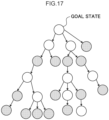
- Fig. 17 the nodes corresponding to each of the contact states are illustrated by circles, and the L1 transition and the L2 transition are illustrated by arrows.
- nodes illustrated by a shaded circle are nodes corresponding to a one-edge contact state from among contact states found by searching (corresponding to each of the states (a) to (w) of Fig. 14 to Fig. 16 ).
- nodes illustrated by a white circle are nodes corresponding to a two-edge contact, three-edge contact, or face contact state from among contact states found by searching.
- Fig. 17 there is always a single state, not branching, for states transitioning from a one-edge contact state. Namely, branching only occurs at states corresponding to the white circle nodes in Fig. 17 . However, sometimes states do not branch even at states corresponding to the white circle nodes.
- the leaf nodes (states with no further transitions, terminal ends) are one-edge contact states.
- there is a white circle node at a leaf node as long as this is a case in which state(s) corresponding to shaded nodes, which are ahead of the state corresponding to the white circle node, are already recorded in the branch-tree.
- i is used to represent an identification number appended to each sensor.
- the vision sensor recognizable length is taken as being for cases in which the vision sensor is utilized such that the long edge of the main target object 90A is not more than half the short side of the angle of view of the vision sensor.
- the generation section 36 identifies a contact state in the branch-tree having a larger maintain range than the resolution. For example, the generation section 36 identifies any nodes in the branch-tree that are associated with a maintain range capable of being contained in a region having one edge of ⁇ sd .
- a nearest node from the root node of the branch-tree is identified when there are plural such nodes present.
- the nearest node from the root node of the branch-tree may, for example, be a node having fewest nodes on the way from the root node, or may be a node nearest in terms of measured physical distance.
- the former has the merit of high control robustness, and the latter has the merit of short execution time.
- the former is adopted in the present exemplary embodiment.
- the generation section 36 identifies the contact state associated with the identified node.
- the generation section 36 generates an operation path based on a transition of contact states from the identified contact state to the goal state. Specifically, the generation section 36 generates a trace in the branch-tree from the identified contact state to the goal state by identifying and arranging the positions and orientations of the hand section 46 from the contact states corresponding to each of the nodes from the node corresponding to the contact state identified at step S 18 up to the root node.
- the generation section 36 generates a path that leads from the start position and orientation acquired at step S10 to the position and orientation corresponding to the contact state identified at step S18, and that is also a path avoiding obstructions. Then the generation section 36 joins the path generated at step S20 together with the path generated at the present step so as to generate the operation path with the contact states associated with each of the positions and orientations.
- the display control section 38 displays on the display device at least one from out of the first presentation screen 60 or the second presentation screen based on the operation path generated at step S22.
- the display control section 38 then receives a user recorded position and orientation that is a correction by the user to the position and orientation of the main target object 90A.
- step S26 in cases in which a user recorded position and orientation has been received at step S24, the generation section 36 regenerates the operation path so as to reflect in the operation path generated at step S24 the user recorded position and orientation that has been received. The generation section 36 then outputs the finally generated operation path to the robot control device 40, and ends the operation path generation processing.
- the robot control device 40 generates command values for force control to implement the operation path input from the operation path generation device 10, and outputs these to the robot 42.
- Fig. 21 illustrates admittance control as an example of an implementation example of a force control system as the target for implementation of the present disclosure.
- This example includes a goal position ⁇ ref specified by a user added to a corrected value produced by a force controller correcting a value resulting from subtracting an external torque ⁇ e received from the environment from a force goal ⁇ ref according to the operation path, and a position goal value is computed by subtracting a current position ⁇ m of the motor therefrom.
- a motor torque to implement this position goal value is then computed by the position controller, and used to control the robot.
- the current position ⁇ m of the motor is then acquired from the robot being controlled, and fed back to the position controller.
- a joint angle ⁇ act after (springy) speed reduction mechanism output is acquired based on contact between the robot and the environment, a value resulting from subtracting ⁇ act from ⁇ m is converted into an external torque ⁇ e received from the environment based on the springiness of the robot gears and torque sensors, and this difference value is fed back to the force controller.
- Fig. 22 illustrates an example of impedance control as an example of an implementation example of a force control system as the target for implementation of the present disclosure.
- a force goal ⁇ ref specified by a user is added to a corrected value produced by a position controller correcting a value resulting from subtracting a joint angle ⁇ act after (springy) speed reduction mechanism output from a goal position ⁇ ref according to the operation path, and a force goal value is computed by subtracting an external torque ⁇ e received from the environment therefrom.
- the motor torque to implement this force goal value is computed by a force controller, and the robot is controlled thereby.
- the current position ⁇ m of the motor is then acquired from the robot being controlled, a value resulting from subtracting ⁇ act from ⁇ m is converted into the external torque ⁇ e received from the environment based on the springiness of the robot gears and torque sensors, and this difference value is fed back to the force controller. Moreover, the j oint angle ⁇ act after the (springy) speed reduction mechanism output is fed back to the position controller.
- the operation path generation device acquires a start position and orientation and an end position and orientation of the gripping section relative to the main target object, and acquires shape information of a task environment containing the main target object and the auxiliary target object. Moreover based on the acquired information, the operation path generation device performs a simulation of a transition of contact states between the main target object and the auxiliary target object, from a contact state between the main target object and the auxiliary target object until there is a non-contact state between the main target object and the auxiliary target object.
- an operation path of the robot is generated to reach a goal state from an initial state, which is the start position and orientation of the main target object, until reaching one or other contact state included in the transition of contact states, along a transition of contact states including the one or other of the contact states.
- the position and orientation of an intermediate point may be set as the goal state when generating a branch-tree.
- a branch-tree to represent a transition of contact states including the state of the end position and orientation is generated. Note that in cases in which the end position and orientation is not included in the generated branch-tree, this indicates that the end position and orientation is unable to be reached from the specified intermediate point.
- the operation path generation processing may be implemented by distributed processing, with each of the functional configuration of the operation path generation device implemented by different respective devices.
- the operation path generation processing executed by the CPU reading software (a program) in the above exemplary embodiment may be executed by various processors other than a CPU.
- processors include programmable logic devices (PLD) that allow circuit configuration to be modified post-manufacture, such as field-programmable gate arrays (FPGA), and dedicated electronic circuits, these being processors including a circuit configuration custom-designed to execute specific processing, such as an application specific integrated circuits (ASIC).
- PLD programmable logic devices
- FPGA field-programmable gate arrays
- ASIC application specific integrated circuits
- the operation path generation processing may be executed by any one of these various types of processor, or may be executed by a combination of two or more of the same type or different types of processor (such as plural FPGAs, or a combination of a CPU and an FPGA).
- the hardware structure of these various types of processors is more specifically an electronic circuit combining circuit elements such as semiconductor elements.
- the operation path generation program was pre-stored (installed) on a storage device
- the program may be provided in a format stored on a storage medium such as a CD-ROM, a DVD-ROM, a Bluray disc, USB memory, or the like.
- the program may also be provided in a format downloadable from an external device over a network.
Landscapes
- Engineering & Computer Science (AREA)
- Physics & Mathematics (AREA)
- Geometry (AREA)
- General Physics & Mathematics (AREA)
- Theoretical Computer Science (AREA)
- Mechanical Engineering (AREA)
- Robotics (AREA)
- Mathematical Analysis (AREA)
- Computer Hardware Design (AREA)
- Evolutionary Computation (AREA)
- General Engineering & Computer Science (AREA)
- Pure & Applied Mathematics (AREA)
- Mathematical Optimization (AREA)
- Computational Mathematics (AREA)
- Manipulator (AREA)
- Numerical Control (AREA)
Applications Claiming Priority (2)
| Application Number | Priority Date | Filing Date | Title |
|---|---|---|---|
| JP2022012154A JP7815802B2 (ja) | 2022-01-28 | 2022-01-28 | 動作経路生成装置、方法、及びプログラム |
| PCT/JP2022/046970 WO2023145309A1 (ja) | 2022-01-28 | 2022-12-20 | 動作経路生成装置、方法、及びプログラム |
Publications (2)
| Publication Number | Publication Date |
|---|---|
| EP4470730A1 true EP4470730A1 (de) | 2024-12-04 |
| EP4470730A4 EP4470730A4 (de) | 2025-12-31 |
Family
ID=87471612
Family Applications (1)
| Application Number | Title | Priority Date | Filing Date |
|---|---|---|---|
| EP22924158.3A Pending EP4470730A4 (de) | 2022-01-28 | 2022-12-20 | Vorrichtung, verfahren und programm zur erzeugung eines betriebspfades |
Country Status (5)
| Country | Link |
|---|---|
| US (1) | US20250086341A1 (de) |
| EP (1) | EP4470730A4 (de) |
| JP (1) | JP7815802B2 (de) |
| CN (1) | CN118450969A (de) |
| WO (1) | WO2023145309A1 (de) |
Families Citing this family (3)
| Publication number | Priority date | Publication date | Assignee | Title |
|---|---|---|---|---|
| US11580627B2 (en) | 2020-01-06 | 2023-02-14 | Assurant, Inc. | Systems and methods for automatically grading pre-owned electronic devices |
| GB2627511B (en) * | 2023-02-24 | 2025-05-07 | Airbus Operations Ltd | Self aligning system |
| US20250216835A1 (en) * | 2023-12-27 | 2025-07-03 | Assurant, Inc. | Methods, systems, apparatuses, and computer program products for following an edge of an object |
Family Cites Families (8)
| Publication number | Priority date | Publication date | Assignee | Title |
|---|---|---|---|---|
| JPH09198121A (ja) * | 1996-01-19 | 1997-07-31 | Nippon Telegr & Teleph Corp <Ntt> | ロボット教示方法 |
| JP6860863B2 (ja) | 2017-07-05 | 2021-04-21 | オムロン株式会社 | 経路出力方法 |
| JP6879464B2 (ja) * | 2017-08-02 | 2021-06-02 | オムロン株式会社 | 干渉判定方法、干渉判定システム及びコンピュータプログラム |
| EP3530418A1 (de) * | 2018-02-21 | 2019-08-28 | Siemens Aktiengesellschaft | Verfahren und vorrichtung zum bestimmen eines optimierten bewegungsablaufs einer robotereinrichtung |
| US20220032462A1 (en) | 2019-03-22 | 2022-02-03 | Omron Corporation | Robot Hand, Robot Hand Control Method, and Program |
| JP2021030359A (ja) | 2019-08-22 | 2021-03-01 | オムロン株式会社 | 制御装置、制御方法、及び制御プログラム |
| JP7475841B2 (ja) * | 2019-11-22 | 2024-04-30 | キヤノン株式会社 | 情報処理方法、ロボットシステム、物品の製造方法、および情報処理装置 |
| US11813756B2 (en) | 2020-04-16 | 2023-11-14 | Fanuc Corporation | Disassembly based assembly planning |
-
2022
- 2022-01-28 JP JP2022012154A patent/JP7815802B2/ja active Active
- 2022-12-20 US US18/724,598 patent/US20250086341A1/en active Pending
- 2022-12-20 EP EP22924158.3A patent/EP4470730A4/de active Pending
- 2022-12-20 WO PCT/JP2022/046970 patent/WO2023145309A1/ja not_active Ceased
- 2022-12-20 CN CN202280086529.2A patent/CN118450969A/zh active Pending
Also Published As
| Publication number | Publication date |
|---|---|
| CN118450969A (zh) | 2024-08-06 |
| US20250086341A1 (en) | 2025-03-13 |
| WO2023145309A1 (ja) | 2023-08-03 |
| JP2023110601A (ja) | 2023-08-09 |
| JP7815802B2 (ja) | 2026-02-18 |
| EP4470730A4 (de) | 2025-12-31 |
Similar Documents
| Publication | Publication Date | Title |
|---|---|---|
| EP4470730A1 (de) | Vorrichtung, verfahren und programm zur erzeugung eines betriebspfades | |
| US20240042603A1 (en) | Controller of robot and control method | |
| US10846929B2 (en) | Information processing apparatus and control method of display apparatus | |
| US20240351205A1 (en) | Command value generating device, method, and program | |
| US12090666B2 (en) | Path generation device, path generation method, and recording medium storing path generation program | |
| CN112272601A (zh) | 参数识别装置、方法以及程序 | |
| CN100408278C (zh) | 机器人程序生成装置 | |
| CN112714683B (zh) | 机器人控制装置、方法以及程序 | |
| JP2010142910A (ja) | ロボットシステム | |
| US10406688B2 (en) | Offline programming apparatus and method having workpiece position detection program generation function using contact sensor | |
| JP7331616B2 (ja) | 回避軌道生成装置、方法、及びプログラム | |
| JP2014124735A (ja) | ロボット制御方法、ロボット制御装置、プログラム、及びロボット | |
| CN116745074B (zh) | 路径生成装置、路径生成方法以及路径生成程序 | |
| US20250100154A1 (en) | Computer-implemented method for controlling a robot, robot control method, system, article manufacturing method, and recording medium | |
| US20230109876A1 (en) | Information processing apparatus, information processing method, and method of manufacturing products | |
| JP7762108B2 (ja) | 修正装置、修正方法、及びロボットシステム | |
| JP7359543B2 (ja) | 機械の制御装置 | |
| JP7126364B2 (ja) | 判定装置、判定方法、及び判定プログラム | |
| JP4277272B2 (ja) | ロボットシステム | |
| JP2021171882A (ja) | 作業システム及び作業制御装置 | |
| US20260027717A1 (en) | Information processing method, robot system, information processing apparatus, method for manufacturing a product, and recording medium | |
| US20250205889A1 (en) | Determination of positional relationship between workpiece and robot | |
| WO2025069988A1 (ja) | ロボット教示方法、及び、教示システム | |
| JP2023134270A (ja) | 経路生成装置、方法、及びプログラム | |
| JPH04317105A (ja) | 移動装置の制御装置 |
Legal Events
| Date | Code | Title | Description |
|---|---|---|---|
| STAA | Information on the status of an ep patent application or granted ep patent |
Free format text: STATUS: THE INTERNATIONAL PUBLICATION HAS BEEN MADE |
|
| PUAI | Public reference made under article 153(3) epc to a published international application that has entered the european phase |
Free format text: ORIGINAL CODE: 0009012 |
|
| STAA | Information on the status of an ep patent application or granted ep patent |
Free format text: STATUS: REQUEST FOR EXAMINATION WAS MADE |
|
| 17P | Request for examination filed |
Effective date: 20240625 |
|
| AK | Designated contracting states |
Kind code of ref document: A1 Designated state(s): AL AT BE BG CH CY CZ DE DK EE ES FI FR GB GR HR HU IE IS IT LI LT LU LV MC ME MK MT NL NO PL PT RO RS SE SI SK SM TR |
|
| DAV | Request for validation of the european patent (deleted) | ||
| DAX | Request for extension of the european patent (deleted) | ||
| A4 | Supplementary search report drawn up and despatched |
Effective date: 20251128 |
|
| RIC1 | Information provided on ipc code assigned before grant |
Ipc: B25J 9/22 20060101AFI20251124BHEP Ipc: G05B 19/4069 20060101ALI20251124BHEP Ipc: G05B 19/42 20060101ALI20251124BHEP Ipc: B25J 9/16 20060101ALI20251124BHEP |