EP4468644A2 - Vorrichtung und verfahren für ein drahtloses netzwerk - Google Patents
Vorrichtung und verfahren für ein drahtloses netzwerk Download PDFInfo
- Publication number
- EP4468644A2 EP4468644A2 EP24190784.9A EP24190784A EP4468644A2 EP 4468644 A2 EP4468644 A2 EP 4468644A2 EP 24190784 A EP24190784 A EP 24190784A EP 4468644 A2 EP4468644 A2 EP 4468644A2
- Authority
- EP
- European Patent Office
- Prior art keywords
- channel
- primary channel
- csma
- further configured
- bandwidth
- Prior art date
- Legal status (The legal status is an assumption and is not a legal conclusion. Google has not performed a legal analysis and makes no representation as to the accuracy of the status listed.)
- Pending
Links
Images






Classifications
-
- H—ELECTRICITY
- H04—ELECTRIC COMMUNICATION TECHNIQUE
- H04W—WIRELESS COMMUNICATION NETWORKS
- H04W74/00—Wireless channel access
- H04W74/08—Non-scheduled access, e.g. ALOHA
- H04W74/0808—Non-scheduled access, e.g. ALOHA using carrier sensing, e.g. carrier sense multiple access [CSMA]
- H04W74/0816—Non-scheduled access, e.g. ALOHA using carrier sensing, e.g. carrier sense multiple access [CSMA] with collision avoidance
-
- H—ELECTRICITY
- H04—ELECTRIC COMMUNICATION TECHNIQUE
- H04L—TRANSMISSION OF DIGITAL INFORMATION, e.g. TELEGRAPHIC COMMUNICATION
- H04L5/00—Arrangements affording multiple use of the transmission path
- H04L5/0001—Arrangements for dividing the transmission path
- H04L5/0003—Two-dimensional division
- H04L5/0005—Time-frequency
- H04L5/0007—Time-frequency the frequencies being orthogonal, e.g. OFDM(A) or DMT
-
- H—ELECTRICITY
- H04—ELECTRIC COMMUNICATION TECHNIQUE
- H04L—TRANSMISSION OF DIGITAL INFORMATION, e.g. TELEGRAPHIC COMMUNICATION
- H04L5/00—Arrangements affording multiple use of the transmission path
- H04L5/003—Arrangements for allocating sub-channels of the transmission path
- H04L5/0037—Inter-user or inter-terminal allocation
Definitions
- the present disclosure relates generally to the field of wireless communication, and, more particularly, to accessing a channel in a wireless communication network.
- a device and a method performed by the device is disclosed, for a wireless network including a single primary channel and a plurality of secondary channels.
- the single primary channel having a first predefined bandwidth is configured as a common channel of operation for one or more devices associated with a specific access point, and the plurality of the secondary channels having a second predefined bandwidth within the first predefined bandwidth.
- FIG. 10 schematically illustrates the channel access problem in WiFi for a conventional access method.
- the conventional channel access method 1000 defines that a device can transmit only when the primary channel 1001 is idle. This means that, regardless of the status of the rest of the Bandwidth (BW) 1002, 1003, 1004, the availability of the primary channel 1001 defines the probability to access the channel and transmit.
- BW Bandwidth
- WiFi is a Test Driven Development (TDD) technology with no prescheduling algorithms. It means that only one device can transmit at a specific time slot and the decision regarding the transmission is done, immediately and before its start. In other words, there is no method that can promise successful channel access for a specific device at a specific time. This problem cannot be resolved due to backward compatibility that is mandatory in WiFi standards. Thus, if the device from the same network occupies the primary channel, there is no opportunity to transmit.
- TDD Test Driven Development
- the last version of the WiFi standard defined a spatial reuse method which allows the neighbor networks to carry out parallel transmissions using the same frequency resources if they do not interfere each other.
- this technique limits the power of the transmitted signal and also has several constraints that were introduced to preserve robustness.
- this conventional method is not optimized for latency reduction and cannot provide the desired efficiency for channel access.
- FIG. 11 schematically illustrates channel status in WiFi bands for a conventional method 1100.
- the conventional devices and methods have the disadvantages that they are either limited in their efficiency or require high additional complexity. Moreover, when the primary channel based rules are preserved, an available BW cannot be used, if the primary channel is busy.
- the present invention aims to improve the conventional devices and methods.
- the present invention has thereby the objective to provide a device, a system and a method for a wireless network.
- the present invention focuses on channel access efficiency for a single primary channel and provides a technique that can lead to latency reduction, and also, can be easily combined with other methods such as the multiple primary channels technique.
- a first aspect of the invention provides a device for a wireless network comprising a single primary channel having a first predefined bandwidth configured as a common channel of operation for one or more devices associated with a specific access point, and a plurality of secondary channels having a second predefined bandwidth within the first predefined bandwidth, wherein the device is configured to execute a first Carrier-Sense Multiple Access with Collision Avoidance, CSMA/CA, instance associated with the primary channel to gain access to the primary channel, wherein a first back-off is generated; and execute a second CSMA/CA instance associated with one of the secondary channels to gain access to the secondary channel, wherein a second back-off is generated.
- CSMA/CA Carrier-Sense Multiple Access with Collision Avoidance
- the device of the first aspect may address an issue related to the latency problem.
- the device of the first aspect may significantly reduce average delay and jitter in a Wi-Fi network for specific stations (STAs).
- the single primary channel may be configured as the common channel of operation such that it is the only channel that is known for all the one or more devices associated with the specific Access Point (AP).
- AP Access Point
- the device may comprise a circuitry.
- the circuitry may comprise hardware and software.
- the hardware may comprise analog or digital circuitry, or both analog and digital circuitry.
- the circuitry comprises one or more processors and a non-volatile memory connected to the one or more processors.
- the non-volatile memory may carry executable program code which, when executed by the one or more processors, causes the device to perform the operations or methods described herein.
- the device is further configured to execute a plurality of second CSMA/CA instances, each CSMA/CA instance being associated with a different secondary channel and a different maximum bandwidth.
- the second back-off is decreased only when the secondary channel is free and the primary channel is occupied by another device.
- the first aspect is further configured to, if any back-off reaches zero, transmit data on the bandwidth defined for a determined channel, for which the back-off was generated.
- the device is further configured to, if the primary channel is occupied by the other device and the second back-off reaches zero, transmit data on the secondary channel.
- the transmitted data may be any type of data.
- the transmitted data may be, in particular, latency sensitive data.
- the device is further configured to, if the primary channel become IDLE, refrain execution of at least one operation being currently performed.
- the device may refrain an action, e.g., as soon as the primary channel is IDLE.
- the device is further configured to, if the primary channel is occupied by another device being associated with another access point, determine the duration of a transmission by the other device on the primary channel.
- the device is further configured to adjust total duration of all transmissions on the secondary channel to be shorter than or equal to the duration of the transmission by the other device on the primary channel.
- the total duration of all transmissions should be adjusted.
- the device is further configured to, when ending a transmission on the secondary channel, wait for a determined time interval, before accessing the primary channel.
- the device is further configured to, if a duration of a transmission by the other device on the primary channel is smaller than a predefined threshold, do not resolve back-off counting for the secondary channel.
- the device may stay operating on the primary channel.
- the device is further configured to include a Network Allocation Vector, NAV, value to a data packet transmitted on the secondary channel, wherein the NAV value is smaller than or equal to duration of a single data packet.
- NAV Network Allocation Vector
- the NAV period may be a time period set by the device to prevent other devices to transmit during this period.
- the NAV value may be announced within the data packet.
- the NAV announcement may be missed or it may not be received due to operation on the secondary channel.
- the following two main rules may be applied:
- the device is further configured to transmit control information and/or management information, using only the primary channel.
- a second aspect of the invention provides a system comprising; a first device according to the first aspect or one of the implementation form of the first aspect; and a second device according to the second aspect or one of the implementation form of the second aspect.
- a third aspect of the invention provides a method performed by a device for a wireless network comprising a single primary channel having a first predefined bandwidth configured as a common channel of operation for one or more devices associated with a specific access point, and a plurality of secondary channels having a second predefined bandwidth within the first predefined bandwidth, wherein the method comprises executing a first Carrier-Sense Multiple Access with Collision Avoidance, CSMA/CA, instance associated with the primary channel to gain access to the primary channel, wherein a first back-off is generated; and executing a second CSMA/CA instance associated with one of the secondary channels to gain access to the secondary channel, wherein a second back-off is generated.
- the method further comprises executing a plurality of second CSMA/CA instances, each CSMA/CA instance being associated with a different secondary channel and a different maximum bandwidth.
- the second back-off is decreased only when the secondary channel is free and the primary channel is occupied by another device.
- the method further comprises, if any back-off reaches zero, transmitting data on the bandwidth defined for a determined channel, for which the back-off was generated.
- the method further comprises, if the primary channel is occupied by the other device and the second back-off reaches zero, transmitting data on the secondary channel.
- the method further comprises, if the primary channel become IDLE, refraining execution of at least one operation being currently performed.
- the method further comprises, if the primary channel is occupied by another device being associated with another access point, determining the duration of a transmission by the other device on the primary channel.
- the method further comprises adjusting total duration of all transmissions on the secondary channel to be shorter than or equal to the duration of the transmission by the other device on the primary channel.
- the method further comprises when ending a transmission on the secondary channel, waiting for a determined time interval, before accessing the primary channel.
- the method further comprises, if a duration of a transmission by the other device on the primary channel is smaller than a predefined threshold, do not resolving back-off counting for the secondary channel.
- the method further comprises including a Network Allocation Vector, NAV, value to a data packet transmitted on the secondary channel, wherein the NAV value is smaller than or equal to duration of a single data packet.
- NAV Network Allocation Vector
- the method further comprises transmitting control information and/or management information, using only the primary channel.
- FIG. 1 is a schematic view of a device 100 for a wireless network 1 comprising a single primary channel 101 having a first predefined bandwidth BW-101 configured as a common channel of operation for one or more devices 100, 110 associated with a specific access point 120, and a plurality of secondary channels 102, 103, 104 having a second predefined bandwidth within the first predefined bandwidth BW-101, according to an embodiment of the present invention.
- the device 100 is configured to execute a first Carrier-Sense Multiple Access with Collision Avoidance, CSMA/CA, instance associated with the primary channel 101 to gain access to the primary channel 101, wherein a first back-off is generated.
- CSMA/CA Carrier-Sense Multiple Access with Collision Avoidance
- the device 100 is further configured to execute a second CSMA/CA instance associated with one of the secondary channels 102, 103, 104 to gain access to the secondary channel 102, 103, 104, wherein a second back-off is generated.
- the device 100 may comprise a circuitry (not shown in FIG. 1 ), the circuitry may comprise hardware and software.
- the hardware may comprise analog or digital circuitry, or both analog and digital circuitry.
- the circuitry comprises one or more processors and a non-volatile memory connected to the one or more processors.
- the non-volatile memory may carry executable program code which, when executed by the one or more processors, causes the device to perform the operations or methods described herein.
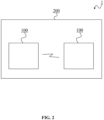
- FIG. 2 is a schematic view of a system, according to an embodiment of the present invention.
- the device 100 of the FIG. 1 is incorporated in the system 200 (e.g., as the first device and/or the second device).
- the system 200 comprises a first device 100.
- the system 200 further comprises a second device 100.
- the system 200 may be for the wireless network 1 comprising the single primary channel 101 having the first predefined bandwidth BW-101 configured as a common channel of operation (e.g., for the first device 100 and the second device 100 of the system 200), and a plurality of secondary channels 102, 103, 104 having a second predefined bandwidth within the first predefined bandwidth BW-101.
- the first device 100 and/or the second device 100 of the system 200 may execute a first Carrier-Sense Multiple Access with Collision Avoidance, CSMA/CA, instance associated with the primary channel 101 to gain access to the primary channel 101, wherein a first back-off is generated; and execute a second CSMA/CA instance associated with one of the secondary channels 102, 103, 104 to gain access to the secondary channel 102, 103, 104, wherein a second back-off is generated.
- CSMA/CA Carrier-Sense Multiple Access with Collision Avoidance
- FIG. 3 is another exemplary schematic view of the device 100 supporting latency sensitive transmission, according to an embodiment of the present invention.
- the device 100 may support latency-sensitive transmission.
- the device 100 may operate in terms of channel access as a combination multiple devices 301, 302, 303, and may allow more efficient operation within the BW defined by the single primary channel.
- FIG. 4 is schematic view of the single primary channel 101 having a first predefined bandwidth 80 MHz and the plurality of secondary channels 102, 103, 104 having a second predefined bandwidth within the first predefined bandwidth 80 MHz.
- one (a single) primary channel 101 is maintained (e.g., by the device 100 for the wireless network 1) for transmitting control information and/or management information.
- the solution may be kept transparent to other devices (e.g., not latency sensitive).
- the plurality of secondary channels 102, 103, 104 may be used for parallel CSMA mechanism which may be defined by the AP 120 (not shown in FIG. 4 ) and may further be indicated in advance.
- the parallel CSMA/CA instances may have two main rules as follow:
- the device 100 may execute the parallel CSMA/CA instances considering the above mentioned two main rules.
- FIG. 5 is a schematic view of back-off counting rules.
- the back-off rules counting may be performed, for example, by the device 100.
- each wireless network 1 there may be multiple CSMA/CA instances.
- the number of CSMA/CA instances and the exact BW of each instance should be defined within each wireless network 1 and may further be announced by the access point 120.
- all of the devices e.g., device 100, device 110, etc.
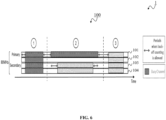
- FIG. 6 is a schematic view of executing two CSMA/CA instances by the device 100, when having three different phases of operation.
- FIG. 7 is a schematic view of adjusting the duration time.
- the device 100 may adjust the duration time.
- a duration of transmission may be limited on the plurality of secondary channels 102, 103, 104.
- OBSS neighbor network
- the duration of the transmission may be restricted (e.g., adjusted) on the secondary channel to be less than or equal to the duration of the OBSS signal on the primary channel 101. This implies that the devices that support this method may successfully detect a preamble of the OBSS signal.
- FIG. 8 is a schematic view of applying a waiting period after transmission on the secondary channel.
- the device 100 may apply the waiting period.
- hidden nodes are a common problem in the WiFi networks. It causes a scenario where different devices face different status of the channel. For instance, some devices may see no signal on the primary channel 101 and may try to transmit during the period of the OBSS signal. Moreover, any device that is transmitting during this period on a secondary channel 102, 103, 104 cannot be aware of what happened on the primary channel 101. Thus, when the transmission on a determined secondary channel 102, 103, 104 is finished, a special waiting period may be defied, e.g., before any action on the primary channel 101 can be taken. The waiting period may be relevant only for those devices that were operating on the secondary channel 102, 103, 101 during the OBSS transmission. In FIG. 8 , ay exemplarily waiting period is denoted period as T WAIT .
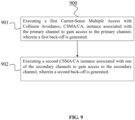
- FIG. 9 shows a method 900 performed by the device 100 for a wireless network 1 comprising a single primary channel 101 having a first predefined bandwidth BW-101 configured as a common channel of operation for one or more devices 100, 110 associated with a specific access point 120, and a plurality of secondary channels 102, 103, 104 having a second predefined bandwidth within the first predefined bandwidth BW-101, according to an embodiment of the invention.
- the method 900 may be carried out by the device 100, as it described above.
- the method 900 comprises a step 901 of executing a first Carrier-Sense Multiple Access with Collision Avoidance, CSMA/CA, instance associated with the primary channel 101 to gain access to the primary channel 101, wherein a first back-off is generated
- CSMA/CA Carrier-Sense Multiple Access with Collision Avoidance
- the method 900 further comprises a step 902 of executing a second CSMA/CA instance associated with one of the secondary channels 102, 103, 104 to gain access to the secondary channel 102, 103, 104, wherein a second back-off is generated
- Embodiment 1 A device (100) for a wireless network (1) comprising a single primary channel (101) having a first predefined bandwidth (BW-101) configured as a common channel of operation for one or more devices (100, 110) associated with a specific access point (120), and a plurality of secondary channels (102, 103, 104) having a second predefined bandwidth within the first predefined bandwidth (BW-101), wherein the device (100) is configured to:
- Embodiment 2 Device (100) according to embodiment 1, further configured to execute a plurality of second CSMA/CA instances, each CSMA/CA instance being associated with a different secondary channel (102, 103, 104) and a different maximum bandwidth.
- Embodiment 3 The device (100) according to embodiment 1 or 2, wherein the second back-off is decreased only when the secondary channel (102, 103, 104) is free and the primary channel (101) is occupied by another device.
- Embodiment 4 Device (100) according to one of the embodiments 1 to 3, further configured to if any back-off reaches zero, transmit data on the bandwidth defined for a determined channel, for which the back-off was generated.
- Embodiment 6 Device (100) according to one of the embodiments 1 to 5, further configured to, if the primary channel (101) become IDLE, refrain execution of at least one operation being currently performed.
- Embodiment 7 Device (100) according to one of the embodiments 1 to 6, further configured to if the primary channel (101) is occupied by another device being associated with another access point, determine the duration of a transmission by the other device on the primary channel (101).
- Embodiment 8 Device (100) according to one of the embodiment 7, further configured to adjust total duration of all transmissions on the secondary channel (102, 103, 104) to be shorter than or equal to the duration of the transmission by the other device on the primary channel (101).
- Embodiment 9 Device (100) according to one of the embodiments 1 to 8, further configured to when ending a transmission on the secondary channel (102, 103, 104), wait for a determined time interval, before accessing the primary channel (101).
- Embodiment 10 Device (100) according to one of the embodiments 1 to 9, further configured to if a duration of a transmission by the other device on the primary channel (101) is smaller than a predefined threshold, do not resolve back-off counting for the secondary channel (102, 103, 104).
- Embodiment 11 Device (100) according to one of the embodiments 1 to 10, further configured to include a Network Allocation Vector, NAV, value to a data packet transmitted on the secondary channel (102, 103, 104), wherein the NAV value is smaller than or equal to duration of a single data packet.
- NAV Network Allocation Vector
- Embodiment 12 Device (100) according to one of the embodiments 1 to 11, further configured to transmit control information and/or management information, using only the primary channel (101).
- Embodiment 13 A system (200) comprising; a first device (100) according to one of the embodiments 1 to 12; and a second device (100) according to one of the embodiments 1 to 12.
- Embodiment 14 A method (900) performed by a device (100) for a wireless network (1) comprising a single primary channel (101) having a first predefined bandwidth (BW-101) configured as a common channel of operation for one or more devices (100, 110) associated with a specific access point (120), and a plurality of secondary channels (102, 103, 104) having a second predefined bandwidth within the first predefined bandwidth (BW-101), wherein the method (900) comprises:
Landscapes
- Engineering & Computer Science (AREA)
- Computer Networks & Wireless Communication (AREA)
- Signal Processing (AREA)
- Mobile Radio Communication Systems (AREA)
Priority Applications (1)
| Application Number | Priority Date | Filing Date | Title |
|---|---|---|---|
| EP24190784.9A EP4468644A3 (de) | 2019-07-04 | 2019-07-04 | Vorrichtung und verfahren für ein drahtloses netzwerk |
Applications Claiming Priority (3)
| Application Number | Priority Date | Filing Date | Title |
|---|---|---|---|
| EP19935807.8A EP3994826B1 (de) | 2019-07-04 | 2019-07-04 | Vorrichtung und verfahren für zugriff auf ein drahtlosnetzwerk |
| EP24190784.9A EP4468644A3 (de) | 2019-07-04 | 2019-07-04 | Vorrichtung und verfahren für ein drahtloses netzwerk |
| PCT/CN2019/094695 WO2021000316A1 (en) | 2019-07-04 | 2019-07-04 | Device and method for a wireless network |
Related Parent Applications (2)
| Application Number | Title | Priority Date | Filing Date |
|---|---|---|---|
| EP19935807.8A Division EP3994826B1 (de) | 2019-07-04 | 2019-07-04 | Vorrichtung und verfahren für zugriff auf ein drahtlosnetzwerk |
| EP19935807.8A Division-Into EP3994826B1 (de) | 2019-07-04 | 2019-07-04 | Vorrichtung und verfahren für zugriff auf ein drahtlosnetzwerk |
Publications (2)
| Publication Number | Publication Date |
|---|---|
| EP4468644A2 true EP4468644A2 (de) | 2024-11-27 |
| EP4468644A3 EP4468644A3 (de) | 2025-02-19 |
Family
ID=74100129
Family Applications (2)
| Application Number | Title | Priority Date | Filing Date |
|---|---|---|---|
| EP24190784.9A Pending EP4468644A3 (de) | 2019-07-04 | 2019-07-04 | Vorrichtung und verfahren für ein drahtloses netzwerk |
| EP19935807.8A Active EP3994826B1 (de) | 2019-07-04 | 2019-07-04 | Vorrichtung und verfahren für zugriff auf ein drahtlosnetzwerk |
Family Applications After (1)
| Application Number | Title | Priority Date | Filing Date |
|---|---|---|---|
| EP19935807.8A Active EP3994826B1 (de) | 2019-07-04 | 2019-07-04 | Vorrichtung und verfahren für zugriff auf ein drahtlosnetzwerk |
Country Status (3)
| Country | Link |
|---|---|
| EP (2) | EP4468644A3 (de) |
| CN (2) | CN116528388A (de) |
| WO (1) | WO2021000316A1 (de) |
Families Citing this family (3)
| Publication number | Priority date | Publication date | Assignee | Title |
|---|---|---|---|---|
| CN115835290A (zh) * | 2022-12-29 | 2023-03-21 | 深信服科技股份有限公司 | 一种报文传输方法、装置及电子设备和存储介质 |
| KR20260020085A (ko) * | 2023-06-09 | 2026-02-10 | 엘지전자 주식회사 | 무선랜 시스템에서 세컨더리 채널 액세스 방법 및 장치 |
| CN120188518A (zh) * | 2023-10-18 | 2025-06-20 | 北京小米移动软件有限公司 | 通信方法、接入点设备、站点设备及通信系统 |
Family Cites Families (12)
| Publication number | Priority date | Publication date | Assignee | Title |
|---|---|---|---|---|
| CN103416017B (zh) * | 2010-11-12 | 2016-11-16 | 交互数字专利控股公司 | 用于执行信道聚合和媒介访问控制重传的方法和设备 |
| CN102665243B (zh) * | 2012-04-01 | 2014-07-09 | 东南大学 | 一种超高速无线局域网中的信道聚合方法 |
| EP4325997A3 (de) * | 2013-06-06 | 2024-05-15 | InterDigital Patent Holdings, Inc. | Wifi-kanalauswahl und subkanalselektive übertragungen |
| US9326157B1 (en) * | 2014-11-06 | 2016-04-26 | Intel IP Corporation | Subframe aligned listen-before-talk for cellular in unlicensed band |
| US10142985B2 (en) * | 2015-04-21 | 2018-11-27 | Apple Inc. | Opportunistic secondary channel access |
| KR102517089B1 (ko) | 2015-06-29 | 2023-04-03 | 주식회사 윌러스표준기술연구소 | 데이터 전송을 위한 채널 접근 방법, 이를 이용한 무선 통신 방법 및 무선 통신 단말 |
| GB2540450B (en) * | 2015-07-08 | 2018-03-28 | Canon Kk | Improved contention mechanism for access to random resource units in an 802.11 channel |
| CN106455114B (zh) * | 2015-08-12 | 2019-12-13 | 华为技术有限公司 | 基于多信道的退避方法及设备 |
| EP3335511A4 (de) * | 2015-08-14 | 2019-03-20 | Intel IP Corporation | Listen-ebfore-talk mit mehreren trägern |
| CN105682247B (zh) * | 2016-01-14 | 2019-04-23 | 西安电子科技大学 | 基于802.11ac协议中的介质访问控制方法 |
| US11166313B2 (en) * | 2016-02-29 | 2021-11-02 | Telefonaktiebolaget Lm Ericsson (Publ) | Technique for multi-carrier transmission in a transmit opportunity interval |
| FR3073114B1 (fr) * | 2017-10-31 | 2019-10-11 | Sagemcom Broadband Sas | Procede de selection de canal primaire pour des communications sans-fil |
-
2019
- 2019-07-04 EP EP24190784.9A patent/EP4468644A3/de active Pending
- 2019-07-04 CN CN202310458892.9A patent/CN116528388A/zh active Pending
- 2019-07-04 CN CN201980098164.3A patent/CN114041271B/zh active Active
- 2019-07-04 WO PCT/CN2019/094695 patent/WO2021000316A1/en not_active Ceased
- 2019-07-04 EP EP19935807.8A patent/EP3994826B1/de active Active
Also Published As
| Publication number | Publication date |
|---|---|
| CN114041271A (zh) | 2022-02-11 |
| CN114041271B (zh) | 2023-04-18 |
| CN116528388A (zh) | 2023-08-01 |
| EP4468644A3 (de) | 2025-02-19 |
| EP3994826C0 (de) | 2024-09-11 |
| EP3994826A1 (de) | 2022-05-11 |
| EP3994826B1 (de) | 2024-09-11 |
| EP3994826A4 (de) | 2022-07-06 |
| WO2021000316A1 (en) | 2021-01-07 |
Similar Documents
| Publication | Publication Date | Title |
|---|---|---|
| JP7851362B2 (ja) | 無線ネットワークにおけるマルチユーザーedca送信モードにおけるacの拡張型管理 | |
| US11071168B2 (en) | Multi-station access method, apparatus, and system | |
| US7489666B2 (en) | Media access control apparatus and method for guaranteeing quality of service in wireless LAN | |
| US20210368537A1 (en) | Communication method, access point, and station | |
| JP2023169311A (ja) | リソースユニットを実装するieee802.11ネットワークにおける修復された公平性 | |
| US20180167977A1 (en) | Ofdma contention method and access point | |
| KR100791300B1 (ko) | 무선 네트워크 시스템 및 상기 무선 네트워크상에서데이터를 송수신하는 방법 | |
| EP2708024B1 (de) | Moca-wifi-multiplexierung | |
| TWI718372B (zh) | 處理上行鏈路排程以及處理傳輸排程的方法 | |
| EP3322242B1 (de) | Verfahren und vorrichtung für übertragungsbefehl, übertragungsauslösung und übertragungsimplementierung für multistation | |
| US12225448B2 (en) | Information transmission method, network device, and user equipment | |
| WO2014193394A1 (en) | Wireless access points providing hybrid 802.11 and scheduled priority access communications | |
| CN102301636A (zh) | 用于频谱共享的分布式优先竞争 | |
| US10313906B2 (en) | Method and device for sending information | |
| JP7203861B2 (ja) | パラレル伝送方法及び装置 | |
| KR20230038104A (ko) | 사이드링크 통신을 위한 슬롯 구조, 채널 액세스 및 자원 할당을 위한 시스템, 방법 및 장치 | |
| EP3994826B1 (de) | Vorrichtung und verfahren für zugriff auf ein drahtlosnetzwerk | |
| JP7801342B2 (ja) | 優先チャネルアクセス | |
| KR20170028786A (ko) | 무선 통신 시스템에서 데이터를 전송하는 방법 및 장치 | |
| US10004035B2 (en) | Method of managing data transmission for wireless system | |
| CN105813087A (zh) | 数据传输方法、频谱资源的共享方法及装置 | |
| JP2018133657A (ja) | 無線通信装置、方法およびプログラム | |
| US12538274B2 (en) | Excess slot-time re-farming | |
| US9706441B2 (en) | Method and a device for regulating transmissions in a telecommunications network | |
| US9585146B2 (en) | Method of allocating slot and accessing channel in wireless local area network (WLAN) |
Legal Events
| Date | Code | Title | Description |
|---|---|---|---|
| PUAI | Public reference made under article 153(3) epc to a published international application that has entered the european phase |
Free format text: ORIGINAL CODE: 0009012 |
|
| STAA | Information on the status of an ep patent application or granted ep patent |
Free format text: STATUS: THE APPLICATION HAS BEEN PUBLISHED |
|
| AC | Divisional application: reference to earlier application |
Ref document number: 3994826 Country of ref document: EP Kind code of ref document: P |
|
| AK | Designated contracting states |
Kind code of ref document: A2 Designated state(s): AL AT BE BG CH CY CZ DE DK EE ES FI FR GB GR HR HU IE IS IT LI LT LU LV MC MK MT NL NO PL PT RO RS SE SI SK SM TR |
|
| REG | Reference to a national code |
Ref country code: DE Ref legal event code: R079 Free format text: PREVIOUS MAIN CLASS: H04L0005000000 Ipc: H04W0074081600 |
|
| PUAL | Search report despatched |
Free format text: ORIGINAL CODE: 0009013 |
|
| AK | Designated contracting states |
Kind code of ref document: A3 Designated state(s): AL AT BE BG CH CY CZ DE DK EE ES FI FR GB GR HR HU IE IS IT LI LT LU LV MC MK MT NL NO PL PT RO RS SE SI SK SM TR |
|
| RIC1 | Information provided on ipc code assigned before grant |
Ipc: H04L 5/00 20060101ALN20250114BHEP Ipc: H04W 74/0816 20240101AFI20250114BHEP |
|
| STAA | Information on the status of an ep patent application or granted ep patent |
Free format text: STATUS: REQUEST FOR EXAMINATION WAS MADE |
|
| 17P | Request for examination filed |
Effective date: 20250819 |
|
| STAA | Information on the status of an ep patent application or granted ep patent |
Free format text: STATUS: EXAMINATION IS IN PROGRESS |
|
| 17Q | First examination report despatched |
Effective date: 20260217 |