EP4467973A2 - Renewable paste electrode body for simultaneous averaging measurements - Google Patents
Renewable paste electrode body for simultaneous averaging measurements Download PDFInfo
- Publication number
- EP4467973A2 EP4467973A2 EP24175809.3A EP24175809A EP4467973A2 EP 4467973 A2 EP4467973 A2 EP 4467973A2 EP 24175809 A EP24175809 A EP 24175809A EP 4467973 A2 EP4467973 A2 EP 4467973A2
- Authority
- EP
- European Patent Office
- Prior art keywords
- electrode carrier
- electrode
- paste
- diameter
- sleeve
- Prior art date
- Legal status (The legal status is an assumption and is not a legal conclusion. Google has not performed a legal analysis and makes no representation as to the accuracy of the status listed.)
- Granted
Links
Images
Classifications
-
- G—PHYSICS
- G01—MEASURING; TESTING
- G01N—INVESTIGATING OR ANALYSING MATERIALS BY DETERMINING THEIR CHEMICAL OR PHYSICAL PROPERTIES
- G01N27/00—Investigating or analysing materials by the use of electric, electrochemical, or magnetic means
- G01N27/26—Investigating or analysing materials by the use of electric, electrochemical, or magnetic means by investigating electrochemical variables; by using electrolysis or electrophoresis
- G01N27/28—Electrolytic cell components
- G01N27/30—Electrodes, e.g. test electrodes; Half-cells
Definitions
- the subject matter of an invention is a renewable paste electrode body for averaged simultaneous measurements for use in electrochemical measurements.
- a three-electrode measuring system is used. Its most important element is the working electrode, which controls the measurement process with its small size, i.e., it limits the amount of charge or the intensity of the current flowing or the number of exchanged electrons during measurements.
- One of the working electrodes types used is the paste electrode.
- a common feature of working electrodes is that, on the one hand, an electrical contact is made for connection in an electrical circuit with the remaining elements of the measuring system and the elements controlling it. On the other hand, through the surface of the working material, in this case the paste, contact occurs with a conductive solution, the electrolyte, which is another element of the measuring system and guarantees the continuity of the electrical circuit through the contact with the remaining electrodes.
- working electrode bodies containing a portion of conductive paste are used, organized in a way that allows only a single contact surface with the electrolyte solution.
- the composition of the paste can be varied, adjusted to the requirements of particular analysis, but it must always be well conductive and not reactive with the analyte being tested, as well as insoluble in the supporting electrolyte solution.
- the conductive paste is made of carbon, e.g. powdered graphite, and a binder, e.g. paraffin oil, silicone oil, etc.
- the paste is mixed and then placed in the electrode body.
- the electrode prepared this way is used to measure electrochemical physicochemical phenomena occurring in the close vicinity of the electrode surface. After each measurement, the surface of the paste needs to be refreshed. The renewal procedure depends on the type of body used.
- the Czech patent application no. CZ20023939A3 describes a body in which the paste is renewed by squeezing out a specific portion of it with a micrometric screw, removing the excess and smoothing the surface, e.g. on wet filter paper.
- the renewal procedure is a mechanical operation. Its effectiveness and repeatability depend primarily on the experience and level of manual skills of the preparer, making it relatively difficult to achieve statistically consistent measurement results.
- Mercury electrodes and their smooth surface are considered to be perfectly repeatable.
- the measurement is conducted on an almost perfectly repeatable and reproducible droplet of mercury, especially under electromechanical generation conditions.
- the repeatability of the measurement can be problematic. This is because the standard measurement error is accompanied by the above-mentioned issue of mechanical refreshment and reproduction of the identical surface, including the microscopic cross-section and considering the actual electroactive surface.
- GLP Good Laboratory Practice
- the essence of the renewable paste electrode body for averaged simultaneous measurements according to the invention is that it consists of four components: sleeve made of chemically resistant material, cylindrical electrode carrier made of stainless steel, cylindrical electrode carrier rods made of stainless steel - each with one threaded end, and housing made of chemically resistant material.
- the sleeve has a hole on one side that matches the diameter of the wider part of the electrode carrier. On the other side it also has a hole that matches the electric contact diameter of the electrode carrier, ensuring chemical inertness and electrical insulation during handling and the refreshing process.
- the electrode carrier is machined in such a way that one end is narrower, serving as an electrical contact connecting the electrode with the potentiostat/electrical circuit, while the other end is wider and has threaded holes underneath into which the electrode carrier rods are screwed.
- the housing of the body is drilled to precisely match the distribution and diameter of the electrode carrier rods mounted in the electrode carrier.
- the main advantage of the paste electrode body according to the invention is that it utilizes a multi-surface body, enabling averaged results to be obtained from a single experimental measurement. Due to the use of a multiplied surface of the working electrode, it is possible to obtain n measurements during a single measurement, provided that n paste electrodes are used in the proposed body. This leads to more consistent and repeatable results with lower experimental error. Additionally, it results in lower consumption of reagents, consumables, electricity and time.
- An additional advantage is that all working surfaces are renovated simultaneously, preventing accidental errors that can impact the quality of electrochemical measurements.
- the solution offers an alternative, ecologically friendly approach of conducting multiple measurements, which is particularly important during optimization or analytical research.
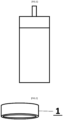
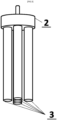
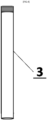
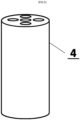
- the body of the paste electrode for averaged simultaneous measurements consists of sleeve 1 made of chemically resistant material, cylindrical electrode carrier 2 made of stainless steel, electrode carrier 3 rods made of stainless steel with a threaded one end and housing 4 made of chemically resistant material.
- Sleeve 1 has a hole on one side that matches the diameter of the wider part of the electrode carrier 2 and on the other side a hole that matches the contact diameter of the electrode carrier 2 to ensure chemical inertness and electrical insulation during handling and the refreshing process.
- Electrode carrier 2 is machined in such a way that one end is narrower, serving as an electrical contact connecting the electrode with the potentiostat/electrical circuit. The opposite end is wider and has five threaded holes underneath, designed to perfectly accommodate the rods of electrode carrier 3 when screwed in. Housing 4 is drilled in such a way that it perfectly matches the distribution and diameter of the electrode carrier 3 mounted in the electrode carrier 2.
- the principle of operation of the paste electrode body is that when it is connected to the electrical circuit and potentiostat and placed in the vessel with the electrolyte containing the test object, the measurements are simultaneously conducted on all surfaces of the paste electrodes. This is achieved by filling the body with paste in the space occupied by the electrode carrier rods. Due to individual differences in the structure of conductive materials, each of the working surfaces acts as a separate sensor without the influence of electrolytic processes on the surface of the other electrodes. In this way, the measurement result is obtained as the sum of currents from independent working surfaces, or alternatively, as obtained in subsequent measurement series. The resulting measurement outcome is divided by the number of working surfaces used so to obtain an averaged value.
Landscapes
- Chemical & Material Sciences (AREA)
- Life Sciences & Earth Sciences (AREA)
- Health & Medical Sciences (AREA)
- Physics & Mathematics (AREA)
- Chemical Kinetics & Catalysis (AREA)
- Electrochemistry (AREA)
- Molecular Biology (AREA)
- Analytical Chemistry (AREA)
- Biochemistry (AREA)
- General Health & Medical Sciences (AREA)
- General Physics & Mathematics (AREA)
- Immunology (AREA)
- Pathology (AREA)
- Investigating Or Analyzing Materials By The Use Of Electric Means (AREA)
- Measurement Of Resistance Or Impedance (AREA)
Abstract
Description
- The subject matter of an invention is a renewable paste electrode body for averaged simultaneous measurements for use in electrochemical measurements.
- In modern electrochemical measurements, especially polarographic, amperometric and voltammetric, a three-electrode measuring system is used. Its most important element is the working electrode, which controls the measurement process with its small size, i.e., it limits the amount of charge or the intensity of the current flowing or the number of exchanged electrons during measurements. One of the working electrodes types used is the paste electrode. A common feature of working electrodes is that, on the one hand, an electrical contact is made for connection in an electrical circuit with the remaining elements of the measuring system and the elements controlling it. On the other hand, through the surface of the working material, in this case the paste, contact occurs with a conductive solution, the electrolyte, which is another element of the measuring system and guarantees the continuity of the electrical circuit through the contact with the remaining electrodes.
- In measurements, working electrode bodies containing a portion of conductive paste are used, organized in a way that allows only a single contact surface with the electrolyte solution. The composition of the paste can be varied, adjusted to the requirements of particular analysis, but it must always be well conductive and not reactive with the analyte being tested, as well as insoluble in the supporting electrolyte solution. Typically, the conductive paste is made of carbon, e.g. powdered graphite, and a binder, e.g. paraffin oil, silicone oil, etc. The paste is mixed and then placed in the electrode body. The electrode prepared this way is used to measure electrochemical physicochemical phenomena occurring in the close vicinity of the electrode surface. After each measurement, the surface of the paste needs to be refreshed. The renewal procedure depends on the type of body used.
- The Czech patent application no.
CZ20023939A3 - Mercury electrodes and their smooth surface are considered to be perfectly repeatable. In case of mercury electrodes, the measurement is conducted on an almost perfectly repeatable and reproducible droplet of mercury, especially under electromechanical generation conditions. In other cases, such as for disk electrodes with working material made of solids (e.g. metals, carbon), as well as for paste electrodes, the repeatability of the measurement can be problematic. This is because the standard measurement error is accompanied by the above-mentioned issue of mechanical refreshment and reproduction of the identical surface, including the microscopic cross-section and considering the actual electroactive surface. Even with correct electrochemical measurements, in accordance with Good Laboratory Practice (GLP), the repeatability of paste electrodes is at the level of 10-15%.
- The essence of the renewable paste electrode body for averaged simultaneous measurements according to the invention is that it consists of four components: sleeve made of chemically resistant material, cylindrical electrode carrier made of stainless steel, cylindrical electrode carrier rods made of stainless steel - each with one threaded end, and housing made of chemically resistant material. The sleeve has a hole on one side that matches the diameter of the wider part of the electrode carrier. On the other side it also has a hole that matches the electric contact diameter of the electrode carrier, ensuring chemical inertness and electrical insulation during handling and the refreshing process. Alternately, the electrode carrier is machined in such a way that one end is narrower, serving as an electrical contact connecting the electrode with the potentiostat/electrical circuit, while the other end is wider and has threaded holes underneath into which the electrode carrier rods are screwed. The housing of the body is drilled to precisely match the distribution and diameter of the electrode carrier rods mounted in the electrode carrier.
- The main advantage of the paste electrode body according to the invention is that it utilizes a multi-surface body, enabling averaged results to be obtained from a single experimental measurement. Due to the use of a multiplied surface of the working electrode, it is possible to obtain n measurements during a single measurement, provided that n paste electrodes are used in the proposed body. This leads to more consistent and repeatable results with lower experimental error. Additionally, it results in lower consumption of reagents, consumables, electricity and time.
- An additional advantage is that all working surfaces are renovated simultaneously, preventing accidental errors that can impact the quality of electrochemical measurements. The solution offers an alternative, ecologically friendly approach of conducting multiple measurements, which is particularly important during optimization or analytical research.
- The invention is illustrated in embodiment and figures, where:
- [
Fig. 1 ] shows a side view of the paste electrode body as assembled. - [
Fig. 2 ] shows a sleeve made of chemically resistant material. - [
Fig. 3 ] shows a conductive electrode carrier with electrode support rods screwed into it. - [
Fig. 4 ] shows a single electrode carrier rod. - [
Fig. 5 ] shows a chemically resistant material enclosure. - The body of the paste electrode for averaged simultaneous measurements consists of
sleeve 1 made of chemically resistant material,cylindrical electrode carrier 2 made of stainless steel,electrode carrier 3 rods made of stainless steel with a threaded one end andhousing 4 made of chemically resistant material.Sleeve 1 has a hole on one side that matches the diameter of the wider part of theelectrode carrier 2 and on the other side a hole that matches the contact diameter of theelectrode carrier 2 to ensure chemical inertness and electrical insulation during handling and the refreshing process.Electrode carrier 2 is machined in such a way that one end is narrower, serving as an electrical contact connecting the electrode with the potentiostat/electrical circuit. The opposite end is wider and has five threaded holes underneath, designed to perfectly accommodate the rods ofelectrode carrier 3 when screwed in.Housing 4 is drilled in such a way that it perfectly matches the distribution and diameter of theelectrode carrier 3 mounted in theelectrode carrier 2. - The principle of operation of the paste electrode body is that when it is connected to the electrical circuit and potentiostat and placed in the vessel with the electrolyte containing the test object, the measurements are simultaneously conducted on all surfaces of the paste electrodes. This is achieved by filling the body with paste in the space occupied by the electrode carrier rods. Due to individual differences in the structure of conductive materials, each of the working surfaces acts as a separate sensor without the influence of electrolytic processes on the surface of the other electrodes. In this way, the measurement result is obtained as the sum of currents from independent working surfaces, or alternatively, as obtained in subsequent measurement series. The resulting measurement outcome is divided by the number of working surfaces used so to obtain an averaged value.
- After the measurement, in order to renew the surface, it is enough to press the conductive-push element formed after the connection of the
electrode carrier 2, theelectrode carrier rods 3 and thesleeve 1, which will cause the used paste to slide out of the housing body. It is necessary to remove the excess paste and smooth the surfaces of all electrodes again using wet filter paper. The renewal procedure can be repeated many times until the paste is depleted.
Claims (1)
- The body of a renewable paste electrode for averaged simultaneous measurements, characterized by consisting of a sleeve (1) made of chemically resistant material, an electrode carrier (2) cylindrical made of stainless steel, electrode carrier rods (3) in the shape of a cylinder made of stainless steel with a threaded one end, and a housing (4) made of chemically resistant material, with the sleeve (1) having a hole on one side adapted to the wider diameter parts of the electrode carrier (2), and on the opposite one having a hole matched to the contact diameter of the electrode carrier (2), which ensures chemical inertness and electrical insulation during handling and refreshment, while the electrode carrier (2) is machined in such a way that it has one narrower end, serving as an electrical contact connecting the electrode with the potentiostat/electrical circuit, and the other, wider end has five threaded holes underneath, allowing the electrode carrier rods (3) to be screwed in securely, and the housing (4) is drilled in such a way that it perfectly matches the distribution and diameter of the electrode carrier rods (3) mounted in the electrode carrier (2).
Applications Claiming Priority (1)
| Application Number | Priority Date | Filing Date | Title |
|---|---|---|---|
| PL445008A PL445008A1 (en) | 2023-05-26 | 2023-05-26 | Renewable paste electrode body for simultaneous averaged measurements |
Publications (4)
| Publication Number | Publication Date |
|---|---|
| EP4467973A2 true EP4467973A2 (en) | 2024-11-27 |
| EP4467973A3 EP4467973A3 (en) | 2024-12-04 |
| EP4467973C0 EP4467973C0 (en) | 2025-04-23 |
| EP4467973B1 EP4467973B1 (en) | 2025-04-23 |
Family
ID=91759358
Family Applications (1)
| Application Number | Title | Priority Date | Filing Date |
|---|---|---|---|
| EP24175809.3A Active EP4467973B1 (en) | 2023-05-26 | 2024-05-14 | Renewable paste electrode body for simultaneous averaging measurements |
Country Status (2)
| Country | Link |
|---|---|
| EP (1) | EP4467973B1 (en) |
| PL (1) | PL445008A1 (en) |
Citations (1)
| Publication number | Priority date | Publication date | Assignee | Title |
|---|---|---|---|---|
| CZ20023939A3 (en) | 2002-12-02 | 2004-07-14 | Ivan Doc. Dr. Ing. Švancara | Casing for carbon paste for electrochemical measurements |
Family Cites Families (3)
| Publication number | Priority date | Publication date | Assignee | Title |
|---|---|---|---|---|
| KR0151203B1 (en) * | 1994-12-08 | 1998-12-01 | 이헌조 | Multi-electrode Biosensor |
| GB0820817D0 (en) * | 2008-11-13 | 2008-12-24 | Wireless Biodevices Ltd | Electrode, electrochemical sensor and apparatus, and methods for operating the same |
| WO2023286864A1 (en) * | 2021-07-15 | 2023-01-19 | 株式会社ちとせ研究所 | System for inferring dynamic state of system to be measured using redox potential |
-
2023
- 2023-05-26 PL PL445008A patent/PL445008A1/en unknown
-
2024
- 2024-05-14 EP EP24175809.3A patent/EP4467973B1/en active Active
Patent Citations (1)
| Publication number | Priority date | Publication date | Assignee | Title |
|---|---|---|---|---|
| CZ20023939A3 (en) | 2002-12-02 | 2004-07-14 | Ivan Doc. Dr. Ing. Švancara | Casing for carbon paste for electrochemical measurements |
Also Published As
| Publication number | Publication date |
|---|---|
| EP4467973C0 (en) | 2025-04-23 |
| PL445008A1 (en) | 2024-12-02 |
| EP4467973A3 (en) | 2024-12-04 |
| EP4467973B1 (en) | 2025-04-23 |
Similar Documents
| Publication | Publication Date | Title |
|---|---|---|
| US3645875A (en) | Electrode assembly | |
| JPH0593713A (en) | Perfect oil analysis technique | |
| JP5832453B2 (en) | Electrochemical detection cell for liquid chromatography systems. | |
| WO2019018631A1 (en) | Corrosion testing system for multiphase environments using electrochemical and weight-loss methods | |
| EP4467973A2 (en) | Renewable paste electrode body for simultaneous averaging measurements | |
| US20060180479A1 (en) | Method, system and device for obtaining electrochemical measurements | |
| EP4467970B1 (en) | Paste multielectrode body for simultaneous averaging measurements | |
| CN101451973A (en) | Combined three-electrode | |
| Dang et al. | Integrated probe for electrochemical analysis of small volume droplets | |
| Oman et al. | Guidelines for potentiometric measurements in suspensions Part A. The suspension effect (IUPAC Technical Report) | |
| CN113686771A (en) | Quick corrosion measuring pen and testing method thereof | |
| JP3184375B2 (en) | Method for evaluating and restoring solderability of electronic components | |
| WO2024209287A1 (en) | A multiple disc electrode holder | |
| WO2016145539A1 (en) | Electrochemical flow cell and ultramicroelectrode | |
| US20030178321A1 (en) | Electrochemical cell, use of the electrochemical cell, and method for electrolytically contacting and electrochemically influencing a surface | |
| CN101736393B (en) | Fixing device of electrolytic polishing sample | |
| AU2001246959A1 (en) | Method and system for measuring active animal glue concentration in industrial electrolytes | |
| EP4293348B1 (en) | Systems for rapid testing of a working electrode | |
| RU2088913C1 (en) | Device for electrochemical measurements | |
| Bellamy | Simple procedure for producing a hanging mercury drop electrode of constant surface area | |
| SU934345A1 (en) | Electrolytic capillary tube for electrochemical investigations of crack resistance of materials | |
| GB2153079A (en) | Conductivity measuring electrode assembly | |
| JPS6129456B2 (en) | ||
| SU1315884A1 (en) | Carbon-paste electrode for voltammetric analysis | |
| SU1755163A1 (en) | Clamp cell for electrochemical analysis |
Legal Events
| Date | Code | Title | Description |
|---|---|---|---|
| PUAI | Public reference made under article 153(3) epc to a published international application that has entered the european phase |
Free format text: ORIGINAL CODE: 0009012 |
|
| STAA | Information on the status of an ep patent application or granted ep patent |
Free format text: STATUS: REQUEST FOR EXAMINATION WAS MADE |
|
| PUAL | Search report despatched |
Free format text: ORIGINAL CODE: 0009013 |
|
| 17P | Request for examination filed |
Effective date: 20240612 |
|
| AK | Designated contracting states |
Kind code of ref document: A2 Designated state(s): AL AT BE BG CH CY CZ DE DK EE ES FI FR GB GR HR HU IE IS IT LI LT LU LV MC ME MK MT NL NO PL PT RO RS SE SI SK SM TR |
|
| AK | Designated contracting states |
Kind code of ref document: A3 Designated state(s): AL AT BE BG CH CY CZ DE DK EE ES FI FR GB GR HR HU IE IS IT LI LT LU LV MC ME MK MT NL NO PL PT RO RS SE SI SK SM TR |
|
| RIC1 | Information provided on ipc code assigned before grant |
Ipc: G01N 27/30 20060101AFI20241030BHEP |
|
| GRAP | Despatch of communication of intention to grant a patent |
Free format text: ORIGINAL CODE: EPIDOSNIGR1 |
|
| STAA | Information on the status of an ep patent application or granted ep patent |
Free format text: STATUS: GRANT OF PATENT IS INTENDED |
|
| GRAS | Grant fee paid |
Free format text: ORIGINAL CODE: EPIDOSNIGR3 |
|
| INTG | Intention to grant announced |
Effective date: 20250212 |
|
| GRAA | (expected) grant |
Free format text: ORIGINAL CODE: 0009210 |
|
| STAA | Information on the status of an ep patent application or granted ep patent |
Free format text: STATUS: THE PATENT HAS BEEN GRANTED |
|
| AK | Designated contracting states |
Kind code of ref document: B1 Designated state(s): AL AT BE BG CH CY CZ DE DK EE ES FI FR GB GR HR HU IE IS IT LI LT LU LV MC ME MK MT NL NO PL PT RO RS SE SI SK SM TR |
|
| REG | Reference to a national code |
Ref country code: GB Ref legal event code: FG4D |
|
| REG | Reference to a national code |
Ref country code: CH Ref legal event code: EP |
|
| REG | Reference to a national code |
Ref country code: DE Ref legal event code: R096 Ref document number: 602024000076 Country of ref document: DE |
|
| REG | Reference to a national code |
Ref country code: IE Ref legal event code: FG4D |
|
| U01 | Request for unitary effect filed |
Effective date: 20250508 |
|
| U07 | Unitary effect registered |
Designated state(s): AT BE BG DE DK EE FI FR IT LT LU LV MT NL PT RO SE SI Effective date: 20250515 |
|
| U20 | Renewal fee for the european patent with unitary effect paid |
Year of fee payment: 2 Effective date: 20250527 |
|
| PG25 | Lapsed in a contracting state [announced via postgrant information from national office to epo] |
Ref country code: ES Free format text: LAPSE BECAUSE OF FAILURE TO SUBMIT A TRANSLATION OF THE DESCRIPTION OR TO PAY THE FEE WITHIN THE PRESCRIBED TIME-LIMIT Effective date: 20250423 |
|
| PG25 | Lapsed in a contracting state [announced via postgrant information from national office to epo] |
Ref country code: GR Free format text: LAPSE BECAUSE OF FAILURE TO SUBMIT A TRANSLATION OF THE DESCRIPTION OR TO PAY THE FEE WITHIN THE PRESCRIBED TIME-LIMIT Effective date: 20250724 Ref country code: NO Free format text: LAPSE BECAUSE OF FAILURE TO SUBMIT A TRANSLATION OF THE DESCRIPTION OR TO PAY THE FEE WITHIN THE PRESCRIBED TIME-LIMIT Effective date: 20250723 |
|
| PG25 | Lapsed in a contracting state [announced via postgrant information from national office to epo] |
Ref country code: PL Free format text: LAPSE BECAUSE OF FAILURE TO SUBMIT A TRANSLATION OF THE DESCRIPTION OR TO PAY THE FEE WITHIN THE PRESCRIBED TIME-LIMIT Effective date: 20250423 |
|
| PG25 | Lapsed in a contracting state [announced via postgrant information from national office to epo] |
Ref country code: HR Free format text: LAPSE BECAUSE OF FAILURE TO SUBMIT A TRANSLATION OF THE DESCRIPTION OR TO PAY THE FEE WITHIN THE PRESCRIBED TIME-LIMIT Effective date: 20250423 |
|
| PG25 | Lapsed in a contracting state [announced via postgrant information from national office to epo] |
Ref country code: RS Free format text: LAPSE BECAUSE OF FAILURE TO SUBMIT A TRANSLATION OF THE DESCRIPTION OR TO PAY THE FEE WITHIN THE PRESCRIBED TIME-LIMIT Effective date: 20250723 |
|
| PG25 | Lapsed in a contracting state [announced via postgrant information from national office to epo] |
Ref country code: IS Free format text: LAPSE BECAUSE OF FAILURE TO SUBMIT A TRANSLATION OF THE DESCRIPTION OR TO PAY THE FEE WITHIN THE PRESCRIBED TIME-LIMIT Effective date: 20250823 |
|
| PG25 | Lapsed in a contracting state [announced via postgrant information from national office to epo] |
Ref country code: SM Free format text: LAPSE BECAUSE OF FAILURE TO SUBMIT A TRANSLATION OF THE DESCRIPTION OR TO PAY THE FEE WITHIN THE PRESCRIBED TIME-LIMIT Effective date: 20250423 |
|
| PG25 | Lapsed in a contracting state [announced via postgrant information from national office to epo] |
Ref country code: CZ Free format text: LAPSE BECAUSE OF FAILURE TO SUBMIT A TRANSLATION OF THE DESCRIPTION OR TO PAY THE FEE WITHIN THE PRESCRIBED TIME-LIMIT Effective date: 20250423 |
|
| PG25 | Lapsed in a contracting state [announced via postgrant information from national office to epo] |
Ref country code: SK Free format text: LAPSE BECAUSE OF FAILURE TO SUBMIT A TRANSLATION OF THE DESCRIPTION OR TO PAY THE FEE WITHIN THE PRESCRIBED TIME-LIMIT Effective date: 20250423 |
|
| PG25 | Lapsed in a contracting state [announced via postgrant information from national office to epo] |
Ref country code: MC Free format text: LAPSE BECAUSE OF FAILURE TO SUBMIT A TRANSLATION OF THE DESCRIPTION OR TO PAY THE FEE WITHIN THE PRESCRIBED TIME-LIMIT Effective date: 20250423 |