EP4467654A2 - Genomfraktionierung - Google Patents
Genomfraktionierung Download PDFInfo
- Publication number
- EP4467654A2 EP4467654A2 EP24192606.2A EP24192606A EP4467654A2 EP 4467654 A2 EP4467654 A2 EP 4467654A2 EP 24192606 A EP24192606 A EP 24192606A EP 4467654 A2 EP4467654 A2 EP 4467654A2
- Authority
- EP
- European Patent Office
- Prior art keywords
- sequence
- sequencing
- nucleic acid
- aspects
- library
- Prior art date
- Legal status (The legal status is an assumption and is not a legal conclusion. Google has not performed a legal analysis and makes no representation as to the accuracy of the status listed.)
- Pending
Links
Images


Classifications
-
- C—CHEMISTRY; METALLURGY
- C12—BIOCHEMISTRY; BEER; SPIRITS; WINE; VINEGAR; MICROBIOLOGY; ENZYMOLOGY; MUTATION OR GENETIC ENGINEERING
- C12Q—MEASURING OR TESTING PROCESSES INVOLVING ENZYMES, NUCLEIC ACIDS OR MICROORGANISMS; COMPOSITIONS OR TEST PAPERS THEREFOR; PROCESSES OF PREPARING SUCH COMPOSITIONS; CONDITION-RESPONSIVE CONTROL IN MICROBIOLOGICAL OR ENZYMOLOGICAL PROCESSES
- C12Q1/00—Measuring or testing processes involving enzymes, nucleic acids or microorganisms; Compositions therefor; Processes of preparing such compositions
- C12Q1/68—Measuring or testing processes involving enzymes, nucleic acids or microorganisms; Compositions therefor; Processes of preparing such compositions involving nucleic acids
- C12Q1/6869—Methods for sequencing
- C12Q1/6874—Methods for sequencing involving nucleic acid arrays, e.g. sequencing by hybridisation
-
- C—CHEMISTRY; METALLURGY
- C12—BIOCHEMISTRY; BEER; SPIRITS; WINE; VINEGAR; MICROBIOLOGY; ENZYMOLOGY; MUTATION OR GENETIC ENGINEERING
- C12N—MICROORGANISMS OR ENZYMES; COMPOSITIONS THEREOF; PROPAGATING, PRESERVING, OR MAINTAINING MICROORGANISMS; MUTATION OR GENETIC ENGINEERING; CULTURE MEDIA
- C12N15/00—Mutation or genetic engineering; DNA or RNA concerning genetic engineering, vectors, e.g. plasmids, or their isolation, preparation or purification; Use of hosts therefor
- C12N15/09—Recombinant DNA-technology
- C12N15/10—Processes for the isolation, preparation or purification of DNA or RNA
- C12N15/1034—Isolating an individual clone by screening libraries
- C12N15/1093—General methods of preparing gene libraries, not provided for in other subgroups
-
- C—CHEMISTRY; METALLURGY
- C12—BIOCHEMISTRY; BEER; SPIRITS; WINE; VINEGAR; MICROBIOLOGY; ENZYMOLOGY; MUTATION OR GENETIC ENGINEERING
- C12Q—MEASURING OR TESTING PROCESSES INVOLVING ENZYMES, NUCLEIC ACIDS OR MICROORGANISMS; COMPOSITIONS OR TEST PAPERS THEREFOR; PROCESSES OF PREPARING SUCH COMPOSITIONS; CONDITION-RESPONSIVE CONTROL IN MICROBIOLOGICAL OR ENZYMOLOGICAL PROCESSES
- C12Q1/00—Measuring or testing processes involving enzymes, nucleic acids or microorganisms; Compositions therefor; Processes of preparing such compositions
- C12Q1/68—Measuring or testing processes involving enzymes, nucleic acids or microorganisms; Compositions therefor; Processes of preparing such compositions involving nucleic acids
-
- C—CHEMISTRY; METALLURGY
- C12—BIOCHEMISTRY; BEER; SPIRITS; WINE; VINEGAR; MICROBIOLOGY; ENZYMOLOGY; MUTATION OR GENETIC ENGINEERING
- C12Q—MEASURING OR TESTING PROCESSES INVOLVING ENZYMES, NUCLEIC ACIDS OR MICROORGANISMS; COMPOSITIONS OR TEST PAPERS THEREFOR; PROCESSES OF PREPARING SUCH COMPOSITIONS; CONDITION-RESPONSIVE CONTROL IN MICROBIOLOGICAL OR ENZYMOLOGICAL PROCESSES
- C12Q1/00—Measuring or testing processes involving enzymes, nucleic acids or microorganisms; Compositions therefor; Processes of preparing such compositions
- C12Q1/68—Measuring or testing processes involving enzymes, nucleic acids or microorganisms; Compositions therefor; Processes of preparing such compositions involving nucleic acids
- C12Q1/6811—Selection methods for production or design of target specific oligonucleotides or binding molecules
Definitions
- Some embodiments relate to methods of removing a nontarget sequence from a nucleic acid library. Some aspects of the se embodiments relate to methods of removing a nontarget sequence from a nucleic acid library comprising providing a nucleic acid library, comprising a plurality of nucleic acid molecules, wherein each nucleic acid molecule comprises a first adapter region, a target sequence region, and a second adapter region, and wherein at least one of said nucleic acid molecules comprises target sequence that comprises said nontarget sequence; contacting the nucleic acid library with a nucleic acid modifying moiety that modifies said nontarget sequence; and sequencing said nucleic acid library using a sequencing approach that requires a first universal adapter region and a second universal adapter region spanning a target sequence region.
- the sequencing comprises next-generation sequencing.
- the sequencing comprises amplifying said target sequence using a first primer that anneals to said first universal region and a second primer that anneals to said second universal region.
- the first adapter region is a universal adapter region, such as an adapter region compatible with a ⁇ next generation' sequencing platform such as a sequencing by synthesis platform.
- the contacting interferes with said sequencing.
- the contacting comprises cleaving said target sequence such that said first universal region and said second universal region are not physically joined through said target region.
- the contacting comprises binding said nontarget sequence.
- the contacting comprises methylating said specific nucleic acid sequence.
- the contacting comprises cleaving said specific nucleic acid sequence.
- the nucleic acid modifying moiety comprises a restriction endonuclease.
- the nucleic acid modifying moiety comprises a methyltransferase.
- the nucleic acid modifying moiety comprises an enzyme having base excision activity.
- the nucleic acid modifying moiety comprises a guide RNA molecule.
- the nucleic acid modifying moiety comprises a guide RNA molecule comprising a hairpin.
- the nucleic acid modifying moiety comprises a guide RNA molecule comprising a tracr hairpin.
- the nucleic acid modifying moiety comprises a guide RNA molecule comprises a protospacer adjacent motif sequence. In some aspects, the nucleic acid modifying moiety comprises a guide RNA molecule comprises a protospacer adjacent motif sequence comprising the sequence NGG. In some aspects, the nucleic acid modifying moiety comprises a guide RNA molecule comprises a protospacer adjacent motif sequence comprising the sequence NGGNG. In some aspects, the nucleic acid modifying moiety comprises a guide RNA molecule-directed endonuclease. In some aspects, the guide RNA molecule-directed endonuclease comprises a Cas9 endonuclease. In some aspects, the nontarget sequence comprises low-information content sequence.
- the nontarget sequence comprises repetitive sequence. In some aspects, the nontarget sequence comprises Alu repeat sequence. In some aspects, the nontarget sequence comprises SINE element sequence. In some aspects, the nontarget sequence comprises LINE sequence. In some aspects, the nontarget sequence comprises retroviral sequence. In some aspects, the nontarget sequence comprises DNA encoding ribosomal RNA. In some aspects, the nontarget sequence comprises telomeric sequence. In some aspects, the nontarget sequence comprises subtelomeric sequence. In some aspects, the nontarget sequence comprises centromeric sequence. In some aspects, the nontarget sequence comprises a single repeat. In some aspects, the nontarget sequence comprises nonrepetative sequence. In some aspects, the nontarget sequence comprises sequence encoding a protein.
- the nontarget sequence comprises at least one of a repetitive sequence, an Alu repeat sequence, a SINE element sequence, LINE sequence, DNA encoding ribosomal RNA, telomeric sequence, subtelomeric sequence, centromeric sequence, and a single repeat. In some aspects, the nontarget sequence comprises at least 10% of said nucleic acid library target sequence. In some aspects, the nontarget sequence comprises at least 20% of said nucleic acid library target sequence. In some aspects, the nontarget sequence comprises at least 30% of said nucleic acid library target sequence. In some aspects, the nontarget sequence comprises at least 40% of said nucleic acid library target sequence. In some aspects, the nontarget sequence comprises at least 50% of said nucleic acid library target sequence.
- the nontarget sequence comprises at least 60% of said nucleic acid library target sequence. In some aspects, the nontarget sequence comprises about 2/3 of said nucleic acid library target sequence. In some aspects, at least one nucleic acid of said library is bound to a next generation sequencing platform. In some aspects, the NGS sequencing platform comprises at least one of a solid platform, a bead, a lipid or oil droplet, and a well surface. In some aspects, the sequencing occurs in a first sequencing time duration that is reduced relative to a second sequencing time duration of said nucleic acid library in the absence of said contacting. In some aspects, the first sequencing time duration is less than 90% that of said second sequencing time duration. In some aspects, the first sequencing time duration is less than 80% that of said second sequencing time duration.
- the first sequencing time duration is less than 70% that of said second sequencing time duration. In some aspects, the first sequencing time duration is less than 60% that of said second sequencing time duration. In some aspects, the first sequencing time duration is less than 50% that of said second sequencing time duration. In some aspects, the first sequencing time duration is less than 40% that of said second sequencing time duration. In some aspects, the first sequencing time duration is less than 33% that of said second sequencing time duration.
- compositions comprising: a nucleic acid library comprising a plurality of nucleic acid molecules; and a nontarget nucleic acid binding moiety, wherein each nucleic acid molecule comprises a first universal sequence, a target sequence, and a second universal sequence, and wherein at least one target sequence of at least one nucleic acid molecule of said nucleic acid library comprises a nontarget sequence.
- the nontarget nucleic acid binding moiety comprises a first guide RNA.
- the first guide RNA comprises a protospacer adjacent motif sequence.
- the protospacer adjacent motif sequence comprises NGG.
- the protospacer adjacent motif sequence comprises NGGNG.
- the first guide RNA is hybridized to said nontarget sequence.
- the first guide RNA binds at least one substrate sequence selected from the list consisting of low-information content sequence, repetitive sequence, Alu repeat sequence, SINE element sequence, LINE sequence, DNA encoding ribosomal RNA, retroviral sequence, telomeric sequence, subtelomeric sequence, centromeric sequence, nonrepetative sequence, and sequence encoding a protein.
- the nontarget sequence comprises at least one sequence selected from the list consisting of low-information content sequence, repetitive sequence, Alu repeat sequence, SINE element sequence, LINE sequence, DNA encoding ribosomal RNA, retroviral sequence, telomeric sequence, subtelomeric sequence, centromeric sequence, nonrepetative sequence, and sequence encoding a protein.
- the nontarget nucleic acid binding moiety comprises a first guide RNA and a second guide RNA, wherein said second guide RNA binds at least one substrate that is not identical to a substrate bound by said first guide RNA.
- the composition comprises a DNA endonuclease.
- the DNA endonuclease comprises at least one endonuclease selected from the list consisting of a Zinc Finger Nuclease (ZFN), a Transcription activator like effector nuclease and a Clustered Regulatory Interspaced Short palindromic Repeat /Cas based RNA guided DNA nuclease.
- ZFN Zinc Finger Nuclease
- the DNA endonuclease binds said guide RNA.
- the DNA endonuclease is Cas9.
- the nontarget nucleic acid binding moiety comprises a restriction endonuclease.
- nucleic acid molecule such as a construct. Some embodiments relate to a nucleic acid molecule comprising a transcription promoter and a template, said template comprising a first region directing transcription of a tag sequence, and a second region directing transcription of a recognition sequence.
- the transcription promoter is a viral promoter. In some aspects, the transcription promoter is a phage T7 promoter.
- the first region directs transcription of a stem loop. In some aspects, the first region directs transcription of a tracr stem loop. In some aspects, the first region directs transcription of a tag that binds an endonuclease.
- the first region directs transcription of a tag that binds a Cas9 endonuclease. In some aspects, the first region and said second region are separated by a cloning site. In some aspects, the first region comprises a protospacer adjacent motif sequence. In some aspects, the protospacer adjacent motif comprises the sequence NGG. In some aspects, the protospacer adjacent motif comprises the sequence NGGNG.
- NGS Next Generation DNA sequencing technologies
- transcriptome nucleic acid libraries ribosomal RNA, viral, or other high copy accumulating sequences can dominate the nucleic acid pool and complicate the collection of information related to transcripts accumulating at low levels.
- Described herein are targeted sequencing techniques called genome fractioning that can focus on high information content regions of a genome, such as the genes and genomic loci on a region where a definitive diagnosis can be made, without limiting to a single locus or a single target amplicon.
- these targeted sequencing techniques work by removing regions of low information content or repetitive sequence, for example, from the set of nucleic acid molecules available for sequencing.
- sequencing reactions can be run much more quickly, with fewer reagents, to generate less sequencing data, which can in turn be assembled into contigs more quickly and which occupy less data storage space - and without any substantial loss in the amount of high-information content sequence to be obtained through the reaction.
- genome sequencing that remove all or a fraction of troublesome and/or unwanted regions of the genome for clinical use are described. Such methods will, in some instances, be comprehensive across all regions of clinical interest while avoiding those that are unwanted.
- genome fractioning focuses on removing the unwanted sequences, (e.g. repetitive sequences) from an NGS DNA library.
- the sequences removed may include, but are not limited to, DNA (e.g. genomic DNA) molecules that are unwanted in results and DNA converted from an RNA sample input (e.g. via reverse-transcription), or libraries thereof.
- RNA sample input e.g. via reverse-transcription
- RNA sample input e.g. via reverse-transcription
- ribosomal RNA, GLOBIN genes, and/or overexpressed transcripts which may minimize the cost effective use of massively parallel sequencing, are removed.
- ZFN Zinc Finger Nucleases
- CRISPR/Cas9 Clustered Regulatory Interspaced Short palindromic Repeat /Cas based RNA guided DNA nuclease
- the ability to target sequence specific locations for double stranded DNA cuts makes these genome editing tools compatible with Genome Fractioning.
- the NGS protocols require the production of DNA libraries. Numerous library generation methods have been described. The result of DNA library preparation is a pool of unknown sample derived sequences of about, for example, 100-1000 bp in length flanked by synthetic sequences of known configuration. The known sequences are used for other aspects of NGS sequencing including cluster generation and priming sites for sequencing by synthesis reactions. The generation of these NGS libraries may involve all, substantially all, or a selected fraction of the sequences in the sample genome from which it was generated. Genome Fractioning can be applied post library generation to remove undesired sequences from the DNA library prior to sequencing.
- NGS sequencing library for use with the methods and compositions disclosed herein.
- Some NGS sequencing libraries comprise a plurality of nucleic acid molecules, each molecule comprising a first conserved region, a target region and a second conserved region, wherein the first conserved region comprises nucleic acid sequence that is added to facilitate NGS sequencing efforts, wherein the target region comprises nucleic acid sequence of a target sample, and wherein the second conserved region comprises nucleic acid sequence that is added to facilitate NGS sequencing efforts.
- an NGS sequencing library comprises at least one constituent that is bound to an NGS sequencing platform such as a solid platform, a bead, a lipid or oil droplet, or a well surface.
- an NGS sequencing library is provided wherein each constituent of the library remains in solution.
- the methods and compositions herein are applied to a nucleic acid population other than an NGS library.
- a target sample from which target regions are generated comprises sequence of high information content and sequence of low information content in many cases.
- a target sample from which target regions are generated comprises nonrepetitive sequence and repetitive sequence.
- a target sample from which target regions are generated comprises single-copy sequence and multi-copy sequence.
- compositions and kits related to the selective enrichment of high information content sequence or single-copy sequence. Also provided herein are methods for the selective exclusion from a sequencing reaction or from a sequence data set of low information content sequence, repetitive sequence, multi-copy sequence.
- specific low-information content sequence, repetitive sequence, multi-copy sequence or sequence to be otherwise eliminated from a sample or from a sequencing dataset resulting from sequencing of that sample comprises sequence encoding ribosomal RNA (rRNA), sequence encoding globin proteins, sequencing encoding a transposon, sequence encoding retroviral sequence, sequence comprising telomere sequence, sequence comprising sub-telomeric repeats, sequence comprising centromeric sequence, sequence comprising intron sequence, sequence comprising Alu repeats, SINE repeats, LINE repeats, dinucleic acid repeats, trinucleic acid repeats, tetranucleic acid repeats, poly-A repeats, poly-T repeats, poly-C repeats, poly-G repeats, AT-rich sequence, or GC-rich sequence.
- rRNA ribosomal RNA
- sequence encoding globin proteins sequencing encoding a transposon
- sequence encoding retroviral sequence sequence comprising telomere sequence, sequence comprising sub-tel
- specific low-information content sequence, repetitive sequence, or sequence to be otherwise eliminated from a sample or from a sequencing dataset resulting from sequencing of that sample comprises sequence reverse-transcribed from RNA encoding ribosomal RNA, RNA encoding globins, RNA encoding overexpressed transcripts, or RNA that is otherwise disproportionately present or redundantly present in a sample.
- a specific low-information content sequence, repetitive sequence, or sequence to be otherwise eliminated from a sample or from a sequencing dataset resulting from sequencing of that sample is targeted, for example using a moiety that specifically binds to the sequence.
- a plurality of moieties comprises a first member that binds to a sequence to be eliminated from a sample or from a sequencing dataset resulting from sequencing of that sample, and a second member that binds to a second sequence to be eliminated from a sample or from a sequencing dataset resulting from sequencing of that sample.
- a plurality of moieties includes members that bind to 1%, 2%, 3%, 4%, 5%, 6%, 7%, 8%, 9%, 10%, 11%, 12%, 13%, 14%, 15%, 16%, 17%, 18%, 19%, 20%, 21%, 22%, 23%, 24%, 25%, 26%, 27%, 28%, 29%, 30%, 31%, 32%, 33%, 34%, 35%, 36%, 37%, 38%, 39%, 40%, 41%, 42%, 43%, 44%, 45%, 46%, 47%, 48%, 49%, 50%, 51%, 52%, 53%, 54%, 55%, 56%, 57%, 58%, 59%, 60%, 61%, 62%, 63%, 64%, 65%, 66%, 67%, 68%, 69%, 70%, 71%, 72%, 73%, 74%, 75%, 76%, 77%, 78%, 79%, 80%, 81%, 82%
- a plurality of moieties includes members that bind to 1%-100%, 2%-100%, 3%-100%, 4%-100%, 5%-100%, 6%-100%, 7%-100%, 8%-100%, 9%-100%, 10%-100%, 11%-100%, 12%-100%, 13%-100%, 14%-100%, 15%-100%, 16%-100%, 17%-100%, 18%-100%, 19%-100%, 20%-100%, 21%-100%, 22%-100%, 23%-100%, 24%-100%, 25%-100%, 26%-100%, 27%-100%, 28%-100%, 29%-100%, 30%-100%, 31%-100%, 32%-100%, 33%-100%, 34%-100%, 35%-100%, 36%-100%, 37%-100%, 38%-100%, 39%-100%, 40%-100%, 41%-100%, 42%-100%, 43%-100%, 44%-100%, 45%-100%, 46%-100%, 47%-100%, 48%-100%, 49%-100%, 40%
- a plurality of moieties includes members that bind to 1%, 1%-2%, 1%-3%, 1%-4%, 1%-5%, 1%-6%, 1%-7%, 1%-8%, 1%-9%, 1%-10%, 1%-11%, 1%-12%, 1%-13%, 1%-14%, 1%-15%, 1%-16%, 1%-17%, 1%-18%, 1%-19%, 1%-20%, 1%-21%, 1%-22%, 1%-23%, 1%-24%, 1%-25%, 1%-26%, 1%-27%, 1%-28%, 1%-29%, 1%-30%, 1%-31%, 1%-32%, 1%-33%, 1%-34%, 1%-35%, 1%-36%, 1%-37%, 1%-38%, 1%-39%, 1%-40%, 1%-41%, 1%-42%, 1%-43%, 1%-44%, 1%-45%, 1%-46%, 1%-47%, 1%-47%, 1%
- the low-information content sequence, repetitive sequence, or sequence to be otherwise eliminated from a sample or from a sequencing dataset resulting from sequencing of that sample of a target sample comprises 1%, 2%, 3%, 4%, 5%, 6%, 7%, 8%, 9%, 10%, 11%, 12%, 13%, 14%, 15%, 16%, 17%, 18%, 19%, 20%, 21%, 22%, 23%, 24%, 25%, 26%, 27%, 28%, 29%, 30%, 31%, 32%, 33%, 34%, 35%, 36%, 37%, 38%, 39%, 40%, 41%, 42%, 43%, 44%, 45%, 46%, 47%, 48%, 49%, 50%, 51%, 52%, 53%, 54%, 55%, 56%, 57%, 58%, 59%, 60%, 61%, 62%, 63%, 64%, 65%, 66%, 67%, 68%, 69%, 70%, 71%, 72%, 73%, 74%
- the target sample is a human genomic DNA sample.
- the low-information content sequence, repetitive sequence, or sequence to be otherwise eliminated from a sample or from a sequencing dataset resulting from sequencing of that sample of a target human genomic DNA sample comprises 1%, 2%, 3%, 4%, 5%, 6%, 7%, 8%, 9%, 10%, 11%, 12%, 13%, 14%, 15%, 16%, 17%, 18%, 19%, 20%, 21%, 22%, 23%, 24%, 25%, 26%, 27%, 28%, 29%, 30%, 31%, 32%, 33%, 34%, 35%, 36%, 37%, 38%, 39%, 40%, 41%, 42%, 43%, 44%, 45%, 46%, 47%, 48%, 49%, 50%, 51%, 52%, 53%, 54%, 55%, 56%, 57%, 58%, 59%, 60%, 61%, 62%, 63%, 64%, 65%, 66%, 67%
- the low-information content sequence, repetitive sequence, or sequence to be otherwise eliminated from a sample or from a sequencing dataset resulting from sequencing of that sample of a target human genomic DNA sample comprises 2/3 or about 2/3 of a sample. In some embodiments the low-information content sequence, repetitive sequence, or sequence to be otherwise eliminated from a sample (such as sequence categories recited herein) or from a sequencing dataset resulting from sequencing of that sample of a target human genomic DNA sample comprises 2/3 of a sample.
- a moiety that specifically binds to a specific low-information content sequence, repetitive sequence, or sequence to be otherwise eliminated from a sample or from a sequencing dataset resulting from sequencing of that sample comprises a restriction endonuclease, such as a specific endonuclease that binds and cleaves at a recognition site that is specific to low-information content sequence, repetitive sequence, or sequence to be otherwise eliminated from a sample or from a sequencing dataset resulting from sequencing of that sample.
- a population of moieties that specifically bind to a plurality of specific low-information content sequences, repetitive sequences, repetitive sequences or sequences to be otherwise eliminated from a sample or from a sequencing dataset resulting from sequencing of that sample comprises at least one restriction endonuclease, two restriction endonucleases or more than two restriction endonucleases.
- a moiety that specifically binds to a specific low-information content sequence, repetitive sequence, or sequence to be otherwise eliminated from a sample or from a sequencing dataset resulting from sequencing of that sample comprises a guide RNA molecule.
- a population of moieties that specifically bind to a specific low-information content sequence, repetitive sequence, or sequence to be otherwise eliminated from a sample or from a sequencing dataset resulting from sequencing of that sample comprises a population of guide RNA molecules, such as a population of guide molecules that bind to at least one specific low-information content sequence, repetitive sequence, or sequence to be otherwise eliminated from a sample or from a sequencing dataset resulting from sequencing of that sample.
- the guide RNA molecule interferes with sequencing directly, for example by binding the target sequence to prevent nucleic acid polymerization to occur across the bound sequence.
- the guide RNA molecule works in tandem with a RNA-DNA hybrid binding moiety such as a protein.
- the guide RNA molecule directs modification of member of the sequencing library to which it may bind, such as methylation, base excision, or cleavage, such that in some embodiments the member of the sequencing library to which it is bound becomes unsuitable for further sequencing reactions.
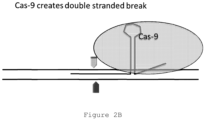
- the guide RNA molecule directs endonucleolytic cleavage of the DNA molecule to which it is bound, for example by a protein having endonuclease activity such as Cas9 protein.
- Zinc Finger Nucleases ZFN
- Transcription activator like effector nucleases and Clustered Regulatory Interspaced Short palindromic Repeat /Cas based RNA guided DNA nuclease (CRISPR/Cas9), among others, are compatible with some embodiments of the disclosure herein.
- CRISPR/Cas9 Clustered Regulatory Interspaced Short palindromic Repeat /Cas based RNA guided DNA nuclease
- a guide RNA molecule comprises sequence that base-pairs with target sequence that is to be removed from sequencing (non-target sequence within the target sequence region).
- the base-pairing is complete, while in some embodiments the base pairing is partial or comprises bases that are unpaired along with bases that are paired to nontarget sequence.
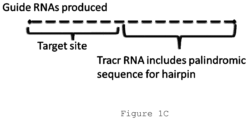
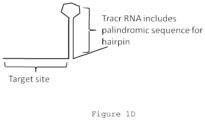
- a guide RNA may comprise a region or regions that form an RNA 'hairpin' structure. Such region or regions comprise partially or completely palindromic sequence, such that 5' and 3' ends of the region may hybridize to one another to form a double-strand ⁇ stem' structure, which in some embodiments is capped by a non-palindromic loop tethering each of the single strands in the double strand loop to one another.
- the Guide RNA comprises a stem loop such as a tracrRNA stem loop.
- a stem loop such as a tracrRNA stem loop may complex with or bind to a nucleic acid endonuclease such as Cas9 DNA endonuclease.
- a stem loop may complex with an endonuclease other than Cas9 or with a nucleic acid modifying enzyme other than an endonuclease, such as a base excision enzyme, a methyltransferase, or an enzyme having other nucleic acid modifying activity that interferes with one or more DNA polymerase enzymes.
- the tracrRNA / CRISPR / Endonuclease system was identified as an adaptive immune system in eubacterial and archaeal prokaryotes whereby cells gain resistance to repeated infection by a virus of a known sequence. See, for example, Deltcheva E, Chylinski K, Sharma CM, Gonzales K, Chao Y, Pirzada ZA et al. (2011) "CRISPR RNA maturation by trans-encoded small RNA and host factor RNase III” Nature 471 (7340): 602-7. doi:10.1038/nature09886. PMC 3070239.
- guide RNA are used in some embodiments to provide sequence specificity to a DNA endonuclease such as a Cas9 endonuclease.
- a guide RNA comprises a hairpin structure that binds to or is bound by an endonuclease such as Cas9 (other endonucleases are contemplated as alternatives or additions in some embodiments), and a guide RNA further comprises a recognition sequence that binds to or specifically binds to or exclusively binds to a sequence that is to be removed from a sequencing library or a sequencing reaction.
- the length of the recognition sequence in a guide RNA may vary according to the degree of specificity desired in the sequence elimination process.
- Long recognition sequences comprising infrequently occurring sequence in the sample or comprising underrepresented base combinations (abundance of GC in an AT-rich genome sample or abundance of AT in a GC-rich genome sample) are likely to identify a relatively small number of sites and therefore to direct infrequent nucleic acid modification such as endonuclease activity, base excision, methylation or other activity that interferes with at least one DNA polymerase activity. Accordingly, as disclosed herein, in some embodiments one may regulate the frequency of sequence removal from a sequence reaction through modifications to the length or content of the recognition sequence.
- RNA sequences may be designed through a number of methods. For example, in some embodiments, non-genic repeat sequences of the human genome are broken up into, for example, 100bp sliding windows. Double stranded DNA molecules can be synthesized in parallel on a microarray using photolithography.
- the windows may vary in size.
- 30-mer target sequences can be designed with a short trinucleotide protospacer adj acent motif (PAM) sequence of N-G-G flanking the 5' end of the target design sequence, which in some cases facilitates cleavage.
- PAM trinucleotide protospacer adj acent motif
- a PAM sequence may be introduced via a combination strategy using a guide RNA coupled with a helper DNA comprising the PAM sequence.
- the helper DNA can be synthetic and/or single stranded.
- the PAM sequence in the helper DNA will not be complimentary to the gDNA knockout target in the NGS library, and may therefore be unbound to the target NGS library template, but it can be bound to the guide RNA.
- the guide RNA can be designed to hybridize to both the target sequence and the helper DNA comprising the PAM sequence to form a hybrid DNA:RNA:DNA complex that can be recognized by the Cas9 system.
- the PAM sequence may be represented as a single stranded overhang or a hairpin.
- the hairpin can, in some cases, comprise modified nucleotides that may optionally be degraded.
- the hairpin can comprise Uracil, which can be degraded by Uracil DNA Glycosylase.
- modified Cas9 proteins without the need of a PAM sequence or modified Cas9 with lower sensitivity to PAM sequences may be used without the need for a helper DNA sequence.
- the guide RNA sequence used for Cas9 recognition may be lengthened and inverted at one end to act as a dual cutting system for close cutting at multiple sites.
- the guide RNA sequence can produce two cuts on a NGS DNA library target. This can be achieved by designing a single guide RNA to alternate strands within a restricted distance. One end of the guide RNA may bind to the forward strand of a double stranded DNA library and the other may bind to the reverse strand. Each end of the guide RNA can comprise the PAM sequence and a Cas9 binding domain. This may result in a dual double stranded cut of the NGS library molecules from the same DNA sequence at a defined distance apart.
- the DNA digestion by Cas9 may be performed before or after NGS library generation.
- the Cas9 protein can be added to the DNA (e.g. NGS library molecules) in vitro (i.e. outside of a cell).
- NGS libraries can be introduced to a pool of guide RNAs and a Cas9 protein. Double stranded breaks can occur upstream of the PAM sequences in the target specific domain of the guide RNA. This process in effect cuts the target NGS library molecules in half, rendering the templates unusable for downstream PCR processes that are common in NGS library prep.
- genomic DNA can be amplified by a strand displacing polymerase using a random primer with a 5' adapter sequence.
- biotinylated ddNTPs can be incorporated, which may terminate the copied strand, wherein the ratio of ddNTP to native NTP can be used to determine the average strand length.
- the copied DNA molecules comprising the adaptor tails can be isolated on a solid support (e.g. streptavidin coated magnetic bead).
- a second random priming reaction can be initiated with a primer comprising a second 5' adapter sequence.
- the most distal random primer extension reaction can displace those primers that bound downstream so that only a single molecule is hydrogen bound to the streptavidin bead that consists of both A and B sequencing adapters.
- the beads can be washed to remove excess enzyme, NTPs primers and/or short library molecules that were displaced in the second primer extension reaction.
- the pool of guide RNAs and Cas9 protein complex can be introduced to cut all unwanted library molecules.
- the remaining un-cut library molecules can be PCR amplified to incorporate the full length sequencing adapters.
- the adapter sequences can be used for this PCR reaction, so that only molecules with both adapter sequences may amplify.
- the library molecules that were cut by the RNA guided Cas9 system will not contain both adapter sequences on an intact library molecule and may thus be reduced to background in the final library.
- the reduced complexity of the library can reduce the sequencer capacity required for clinical depth sequencing and/or reduce the computational requirement for accurate mapping of non-repetitive sequences.
- Alternative versions of the assay comprise at least one sequence-specific nuclease, and in some cases a combination of sequence-specific nucleases, such as at least one restriction endonuclease having a recognition site that is abundant in a nontarget repeat region.
- an enzyme comprises an activity that yields double-stranded breaks in response to a specific sequence.
- an enzyme comprises any nuclease or other enzyme that digests double-stranded nucleic acid material in RNA / DNA hybrids.
- At least one target-specific oligo that inhibits PCR is used to block the additional library preparation steps such as PCR amplification with the same result as removing them from the downstream processing steps.
- synthetic DNA oligos can be produced that allow for crosslinking of single-stranded DNA oligonucleotides that would not denature during PCR or other amplification strategies.
- Some examples comprise Psoralen crosslinking of synthetic DNA sequences as hybridization probes.
- Other examples comprise the use of PNAs or locked nucleic acids in the synthetic oligos to block amplification.
- Nucleic acid probes complementary to bait nucleic acids can be hybridized to nucleic acids in solution and pulled down with, e.g., magnetic streptavidincoated beads. Non bound nucleic acids can be washed away and the captured nucleic acids may then be eluted and amplified for sequencing or genotyping.
- the methods provided above can be used to reduce the complexity of the bound nucleic acids by cleaving, for example, bound nucleic acids with unwanted regions, e.g. repetitive regions.
- practice of the methods herein reduces the sequencing time duration of a sequencing reaction, such that a nucleic acid library is sequenced in a shorter time, or using fewer reagents, or using less computing power. In some embodiments, practice of the methods herein reduces the sequencing time duration of a sequencing reaction for a given nucleic acid library to about 90%, 80%, 70%, 60%, 50%, 40%, 33%, 30% or less than 30% of the time required to sequence the library in the absence of the practice of the methods herein.
- a specific read sequence from a specific region is of particular interest in a given sequencing reaction. Measures to allow the rapid identification of such a specific region are beneficial as they may decrease computation time or reagent requirements or both computation time and reagent requirements.
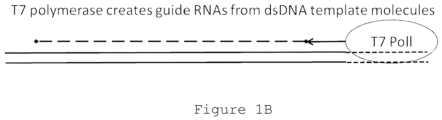
- RNA molecules are in some cases transcribed from DNA templates.
- a number of RNA polymerases may be used, such as T7 polymerase, RNA PolI, RNA PolII, RNA PolIII, an organellar RNA polymerase, a viral RNA polymerase, or a eubacterial or archaeal polymerase.
- the polymerase is T7.
- Guide RNA generating templates comprise a promoter, such as a promoter compatible with transcription directed by T7 polymerase, RNA PolI, RNA PolII, RNA PolIII, an organellar RNA polymerase, a viral RNA polymerase, or a eubacterial or archaeal polymerase.
- a promoter such as a promoter compatible with transcription directed by T7 polymerase, RNA PolI, RNA PolII, RNA PolIII, an organellar RNA polymerase, a viral RNA polymerase, or a eubacterial or archaeal polymerase.
- the promoter is a T7 promoter.
- Guide RNA templates encode a tag sequence in some cases.
- a tag sequence binds to a nucleic acid modifying enzyme such as a methylase, base excision enzyme or an endonuclease.
- a tag sequence tethers an enzyme to a nucleic acid nontarget region, directing activity to the nontarget site.
- An exemplary tethered enzyme is an endonuclease such as Cas9.
- the tag sequence comprises a stem-loop, such as a partial or total stem-loop structure.
- the ⁇ stem' of the stem loop structure is encoded by a palindromic sequence in some cases, either complete or interrupted to introduce at least one 'kink' or turn in the stem.
- the 'loop' of the stem loop structure is not involved in stem base pairing in most cases.
- Stem loop 'hairpin' structures are depicted in Figures 1D-2B .
- the stem loop is encoded by a tracr sequence, such as a tracr sequence disclosed in references incorporated herein.
- Some stem loops bind, for example, Cas9 or other endonuclease.
- RNA molecules additionally comprise a recognition sequence.
- the recognition sequence is completely or incompletely reverse-complementary to a nontarget sequence to be eliminated from a nucleic acid library sequence set.
- G:U base pairing for example
- the recognition sequence does not need to be an exact reverse complement of the nontarget sequence to bind.
- small perturbations from complete base pairing are tolerated in some cases.
- the pairing is complete over the length of the recognition sequence. In some cases, the pairing is sufficient for the recognition sequence to tether the tag sequence to the vicinity of a nontarget sequence, or to tether the tag sequence bound to an enzyme to the nontarget sequence.
- Guide RNA templates comprise a promoter, a tag sequence and a recognition sequence.
- the tag sequence precedes the recognition sequence, while in some cases the recognition sequence precedes the tag sequence.
- the construct is bounded by a transcription termination sequence.
- a tag sequence and a recognition sequence are separated by a cloning site, such that a recognition sequence can be cloned into and cloned out of a construct comprising a promoter and a template encoding a tag sequence.
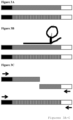
- Figures 3A-3C is seen an embodiment of the present disclosure.
- a library comprising nucleic acids having universal adapter sequences (black, left, and white, right) and comprising target sequence that is either repetitive, ⁇ nontarget sequence' (diagonal hashed box) or nonrepetitive target sequence (vertical striped box).
- the universal adapter sequences are compatible with a next generation sequencing platform involving sequence by synthesis.
- a Cas-9 RNA is contacted to the library and binds to the nontarget library sequence.
- a DNA endonuclease not shown, identifies the bound Cas-9 structure and is directed to the nontarget sequence, cleaving it.
- primers (indicated as black arrows, with the arrow point indicating the 3' end of each primer) binding the universal adapters are contacted to the library.
- the cleaved library molecule comprising nontarget sequence is not able to support polymerase chain reaction amplification because neither half of the cleaved molecule comprises forward and reverse primer binding sites.
- the library molecule comprising target sequence is able to support polymerase chain reaction amplification because the library molecules comprise a forward (black) and reverse (white) universal adapter region capable of primer binding.
- the Cas-9 RNA molecule is replaced with an alternative RNA molecule.
- a restriction endonuclease having specificity to a nontarget region is used.
- a guide RNA template may be a free molecule or may be cloned in a plasmid, such as a plasmid that directs replication in a cell.
- a 'target sequence' is a sequence of a nucleic acid molecule, alone or in a library.
- sequence information is desired for a target sequence.
- sequence information is desired for a target sequence only if it does not comprise repetitive, information poor, or otherwise undesirable sequence for downstream applications.
- a 'nontarget sequence' is a sequence of a sequencing library molecule that is to be excluded from a library prior to sequencing or that is to be excluded from sequence data generated from a sequencing reaction.
- Nontarget sequence is a subset of target sequence that is to be excluded from target sequencing for any number of reasons, such as because it comprises repetitive sequence, information poor sequence, or otherwise undesirable sequence for downstream applications.
- to 'modify' a nucleic acid is to cause a change to a covalent bond in the nucleic acid, such as methylation, base removal, or cleavage of a phosphodiester backbone.
- to 'direct transcription' is to provide template sequence from which a specified RNA molecule can be transcribed.
- a nucleic acid sequencing library is generated from a nucleic acid sample known to comprise a substantial amount of GC-rich repetitive regions.
- the library comprises nucleic acid molecules each comprising a first adapter and a second adapter flanking a region of about 100-500 bases of target sequence.
- the library is bound to a sequencing chip surface through the first adapter and the second adapter of each library member.
- the bound library molecules are contacted with the restriction endonuclease NotI, which targets palindromic sequences having a ⁇ 5 end of CGCC.
- NGS is performed on the treated nucleic acid sequencing library. It is observed that no sequence comprising a 5' CGCC palindromic sequence is included in the sequencing results, although palindromic sequences having 5' CGCC ends are known to be common in the genome of the sample source.
- Example 2 A nucleic acid sequencing library is generated from a nucleic acid sample from a human. The library is divided into equal aliquots, each of which comprises target sequence in excess of 1x coverage of the complete genome of the human sample.
- the guide RNA population comprises guide RNA comprising a recognition sequence reverse-complementary to an Alu repeat sequence, as well as guide RNA comprising a recognition sequence reverse complementary to SINE repeats and guide RNA comprising a recognition sequence reverse complementary to LINE repeats.
- Each guide RNA recognition is linked immediately downstream to a stem-loop tag sequencing that binds a Cas9 endonuclease.
- the Cas9 guide RNA complexes bind to their respective Alu, SINE and LINE recognition sequences within the sequencing library and cleave the library molecules harboring recognition sequence.
- the treated library is bound to a sequencing chip surface through at least one of the first adapter and the second adapter of each library member.
- a sequencing reaction is performed and sequence data for the target region of each library molecule having a first and a second adapter is generated.
- a second, untreated aliquot is bound to a sequencing chip surface through the first adapter and the second adapter of each library member.
- sequencing data generated from the first aliquot does not include Alu, SINE and LINE repeat sequence
- sequencing data from the second aliquot includes Alu, SINE and LINE repeat sequence.
- the sequencing data from the first aliquot is about 1/3 the size, requires substantially less computing time to assemble into contigs, and requires substantially fewer reagents than does the second aliquot.
- the first and second aliquot despite their difference in total data size, contain substantially the same information aside from the Alu, SINE and LINE sequences.
- the Alu, SINE and LINE repeats are computationally removed from the sequence generated from the second aliquot, the remaining data is not substantially different between the first and second aliquots' sequence.
- Example 3 A nucleic acid sequencing library is generated from a nucleic acid sample from a human and partitioned into two aliquots, as in Example 2, above. The library in each aliquot is separately bound to a sequencing chip surface through the first adapter and the second adapter of each library member.
- the guide RNA population comprises guide RNA comprising a recognition sequence reverse-complementary to an Alu repeat sequence, as well as guide RNA comprising a recognition sequence reverse complementary to SINE repeats and guide RNA comprising a recognition sequence reverse complementary to LINE repeats.
- Each guide RNA recognition is linked immediately downstream to a stem-loop sequencing that binds a Cas9 endonuclease.
- the Cas9 guide RNA complexes bind to their respective Alu, SINE and LINE recognition sequences within the sequencing library and cleave the library molecules harboring recognition sequence.
- the sequencing data generated from the first aliquot does not include Alu, SINE and LINE repeat sequence, while the sequencing data from the second aliquot includes Alu, SINE and LINE repeat sequence.
- the sequencing data from the first aliquot is about 1/3 the size, requires substantially less computing time to assemble into contigs, and requires substantially fewer reagents than does the second aliquot.
- the first and second aliquot despite their difference in total data size, contain substantially the same information aside from the Alu, SINE and LINE sequences.
- the Alu, SINE and LINE repeats are computationally removed from the sequence generated from the second aliquot, the remaining data is not substantially different between the first and second aliquots' sequence.
- Example 4 A nucleic acid sequencing library is generated from an RNA sample from a human patient. Total RNA is extracted and reverse-transcribed to generate cDNA, and adapters are added to the 5' and 3' ends of the cDNA generated.
- the library is separated into aliquots, each of which representing greater than 1x coverage of the transcriptome.
- a first and a second aliquot of the library are separately bound to a sequencing chip surface through the first adapter and the second adapter of each library member.
- the guide RNA population comprises guide RNA comprising a recognition sequence reverse-complementary to large subunit 5S ribosomal RNA sequence, 5.8S ribosomal RNA sequence, and 28S ribosomal RNA sequence, and to small subunit 18S ribosomal RNA sequence.
- Each guide RNA recognition is linked immediately downstream to a stem-loop sequencing that binds a Cas9 endonuclease.
- the Cas9 guide RNA complexes bind to their respective ribosomal RNA recognition sequences within the sequencing library and cleave the library molecules harboring recognition sequence.
- the sequencing data generated from the first aliquot does not include 'non-target' ribosomal RNA sequence bound by the guide RNA, while the sequencing data from the second aliquot includes 5S, 5.8S, 28S and 18S sequence.
- the sequencing data from the first aliquot is about 1/10 the size, requires substantially less computing time to assemble into contigs, and requires substantially fewer reagents than does the second aliquot.
- the first and second aliquot despite their difference in total data size, contain substantially the same information aside from the 5S, 5.8S, 28S and 18S sequences.
- the 5S, 5.8S, 28S and 18S sequence are computationally removed from the sequence generated from the second aliquot, the remaining data is not substantially different between the first and second aliquots' sequence.
Landscapes
- Chemical & Material Sciences (AREA)
- Life Sciences & Earth Sciences (AREA)
- Organic Chemistry (AREA)
- Health & Medical Sciences (AREA)
- Engineering & Computer Science (AREA)
- Wood Science & Technology (AREA)
- Zoology (AREA)
- Proteomics, Peptides & Aminoacids (AREA)
- Genetics & Genomics (AREA)
- General Engineering & Computer Science (AREA)
- Bioinformatics & Cheminformatics (AREA)
- Biotechnology (AREA)
- Molecular Biology (AREA)
- General Health & Medical Sciences (AREA)
- Microbiology (AREA)
- Biochemistry (AREA)
- Physics & Mathematics (AREA)
- Biophysics (AREA)
- Immunology (AREA)
- Analytical Chemistry (AREA)
- Biomedical Technology (AREA)
- Bioinformatics & Computational Biology (AREA)
- Crystallography & Structural Chemistry (AREA)
- Plant Pathology (AREA)
- Measuring Or Testing Involving Enzymes Or Micro-Organisms (AREA)
- Chemical Kinetics & Catalysis (AREA)
Applications Claiming Priority (5)
| Application Number | Priority Date | Filing Date | Title |
|---|---|---|---|
| US201461935827P | 2014-02-04 | 2014-02-04 | |
| US201462040307P | 2014-08-21 | 2014-08-21 | |
| EP20192599.7A EP3795697B1 (de) | 2014-02-04 | 2015-02-03 | Genomfraktionierung |
| PCT/US2015/014242 WO2015119941A2 (en) | 2014-02-04 | 2015-02-03 | Genome fractioning |
| EP15746731.7A EP3102722B1 (de) | 2014-02-04 | 2015-02-03 | Genomfraktionierung |
Related Parent Applications (3)
| Application Number | Title | Priority Date | Filing Date |
|---|---|---|---|
| EP20192599.7A Division EP3795697B1 (de) | 2014-02-04 | 2015-02-03 | Genomfraktionierung |
| EP20192599.7A Division-Into EP3795697B1 (de) | 2014-02-04 | 2015-02-03 | Genomfraktionierung |
| EP15746731.7A Division EP3102722B1 (de) | 2014-02-04 | 2015-02-03 | Genomfraktionierung |
Publications (2)
| Publication Number | Publication Date |
|---|---|
| EP4467654A2 true EP4467654A2 (de) | 2024-11-27 |
| EP4467654A3 EP4467654A3 (de) | 2025-02-19 |
Family
ID=53778601
Family Applications (3)
| Application Number | Title | Priority Date | Filing Date |
|---|---|---|---|
| EP20192599.7A Active EP3795697B1 (de) | 2014-02-04 | 2015-02-03 | Genomfraktionierung |
| EP15746731.7A Revoked EP3102722B1 (de) | 2014-02-04 | 2015-02-03 | Genomfraktionierung |
| EP24192606.2A Pending EP4467654A3 (de) | 2014-02-04 | 2015-02-03 | Genomfraktionierung |
Family Applications Before (2)
| Application Number | Title | Priority Date | Filing Date |
|---|---|---|---|
| EP20192599.7A Active EP3795697B1 (de) | 2014-02-04 | 2015-02-03 | Genomfraktionierung |
| EP15746731.7A Revoked EP3102722B1 (de) | 2014-02-04 | 2015-02-03 | Genomfraktionierung |
Country Status (6)
| Country | Link |
|---|---|
| US (4) | US10604802B2 (de) |
| EP (3) | EP3795697B1 (de) |
| DK (1) | DK3102722T3 (de) |
| ES (1) | ES2833299T3 (de) |
| PL (1) | PL3102722T3 (de) |
| WO (1) | WO2015119941A2 (de) |
Families Citing this family (63)
| Publication number | Priority date | Publication date | Assignee | Title |
|---|---|---|---|---|
| WO2007053245A2 (en) | 2005-09-20 | 2007-05-10 | Immunivest Corporation | Methods and composition to generate unique sequence dna probes, iabeling of dna probes and the use of these probes |
| EP2425240A4 (de) | 2009-04-30 | 2012-12-12 | Good Start Genetics Inc | Verfahren und zusammensetzung zur bewertung genetischer marker |
| US9163281B2 (en) | 2010-12-23 | 2015-10-20 | Good Start Genetics, Inc. | Methods for maintaining the integrity and identification of a nucleic acid template in a multiplex sequencing reaction |
| CA2853829C (en) | 2011-07-22 | 2023-09-26 | President And Fellows Of Harvard College | Evaluation and improvement of nuclease cleavage specificity |
| US8209130B1 (en) | 2012-04-04 | 2012-06-26 | Good Start Genetics, Inc. | Sequence assembly |
| US10227635B2 (en) | 2012-04-16 | 2019-03-12 | Molecular Loop Biosolutions, Llc | Capture reactions |
| US9163284B2 (en) | 2013-08-09 | 2015-10-20 | President And Fellows Of Harvard College | Methods for identifying a target site of a Cas9 nuclease |
| US9359599B2 (en) | 2013-08-22 | 2016-06-07 | President And Fellows Of Harvard College | Engineered transcription activator-like effector (TALE) domains and uses thereof |
| US9737604B2 (en) | 2013-09-06 | 2017-08-22 | President And Fellows Of Harvard College | Use of cationic lipids to deliver CAS9 |
| US9322037B2 (en) | 2013-09-06 | 2016-04-26 | President And Fellows Of Harvard College | Cas9-FokI fusion proteins and uses thereof |
| US9340799B2 (en) | 2013-09-06 | 2016-05-17 | President And Fellows Of Harvard College | MRNA-sensing switchable gRNAs |
| US10851414B2 (en) | 2013-10-18 | 2020-12-01 | Good Start Genetics, Inc. | Methods for determining carrier status |
| US10584358B2 (en) | 2013-10-30 | 2020-03-10 | North Carolina State University | Compositions and methods related to a type-II CRISPR-Cas system in Lactobacillus buchneri |
| US20150166985A1 (en) | 2013-12-12 | 2015-06-18 | President And Fellows Of Harvard College | Methods for correcting von willebrand factor point mutations |
| US10787654B2 (en) | 2014-01-24 | 2020-09-29 | North Carolina State University | Methods and compositions for sequence guiding Cas9 targeting |
| EP3795697B1 (de) | 2014-02-04 | 2024-09-18 | Jumpcode Genomics, Inc. | Genomfraktionierung |
| US10150985B2 (en) | 2014-02-13 | 2018-12-11 | Takara Bio Usa, Inc. | Methods of depleting a target molecule from an initial collection of nucleic acids, and compositions and kits for practicing the same |
| JP2017512481A (ja) | 2014-04-08 | 2017-05-25 | ノースカロライナ ステート ユニバーシティーNorth Carolina State University | Crispr関連遺伝子を用いた、rna依存性の転写抑制のための方法および組成物 |
| EP3177718B1 (de) | 2014-07-30 | 2022-03-16 | President and Fellows of Harvard College | Cas9-proteine mit ligandenabhängigen inteinen |
| US20180320226A1 (en) * | 2014-08-19 | 2018-11-08 | President And Fellows Of Harvard College | RNA-Guided Systems For Probing And Mapping Of Nucleic Acids |
| EP3186375A4 (de) | 2014-08-28 | 2019-03-13 | North Carolina State University | Neuartige cas9-proteine und führungsmerkmale für dna-targeting und genomeditierung |
| WO2016040446A1 (en) * | 2014-09-10 | 2016-03-17 | Good Start Genetics, Inc. | Methods for selectively suppressing non-target sequences |
| EP3234200B1 (de) * | 2014-12-20 | 2021-07-07 | Arc Bio, LLC | Verfahren zur gezielten abreicherung von nukleinsäuren unter verwendung von crispr/cas-systemproteinen |
| US10066259B2 (en) | 2015-01-06 | 2018-09-04 | Good Start Genetics, Inc. | Screening for structural variants |
| EP3262175A4 (de) | 2015-02-25 | 2018-10-31 | Jumpcode Genomics, Inc. | Verfahren und zusammensetzungen zur in-silico-sequenzierung langer leseabschnitte |
| CA2983023A1 (en) | 2015-05-29 | 2016-12-08 | North Carolina State University | Methods for screening bacteria, archaea, algae, and yeast using crispr nucleic acids |
| WO2016205276A1 (en) | 2015-06-15 | 2016-12-22 | North Carolina State University | Methods and compositions for efficient delivery of nucleic acids and rna-based antimicrobials |
| AU2016308283B2 (en) | 2015-08-19 | 2022-04-21 | Arc Bio, Llc | Capture of nucleic acids using a nucleic acid-guided nuclease-based system |
| EP3356533A1 (de) | 2015-09-28 | 2018-08-08 | North Carolina State University | Verfahren und zusammensetzungen für sequenzspezifische antimikrobielle mittel |
| SG10202104041PA (en) | 2015-10-23 | 2021-06-29 | Harvard College | Nucleobase editors and uses thereof |
| WO2017112620A1 (en) | 2015-12-22 | 2017-06-29 | North Carolina State University | Methods and compositions for delivery of crispr based antimicrobials |
| US11339427B2 (en) | 2016-02-12 | 2022-05-24 | Jumpcode Genomics, Inc. | Method for target specific RNA transcription of DNA sequences |
| CN107488655B (zh) * | 2016-06-12 | 2021-07-09 | 中国科学院分子细胞科学卓越创新中心 | 测序文库构建中5’和3’接头连接副产物的去除方法 |
| WO2017218979A1 (en) * | 2016-06-17 | 2017-12-21 | The Broad Institute, Inc. | Unbiased detection of nucleic acid modifications |
| EP3494215A1 (de) | 2016-08-03 | 2019-06-12 | President and Fellows of Harvard College | Adenosenukleobaseneditoren und verwendungen davon |
| CN109804066A (zh) | 2016-08-09 | 2019-05-24 | 哈佛大学的校长及成员们 | 可编程cas9-重组酶融合蛋白及其用途 |
| WO2018039438A1 (en) | 2016-08-24 | 2018-03-01 | President And Fellows Of Harvard College | Incorporation of unnatural amino acids into proteins using base editing |
| AU2017342543B2 (en) | 2016-10-14 | 2024-06-27 | President And Fellows Of Harvard College | AAV delivery of nucleobase editors |
| WO2018119359A1 (en) | 2016-12-23 | 2018-06-28 | President And Fellows Of Harvard College | Editing of ccr5 receptor gene to protect against hiv infection |
| CN110662556A (zh) | 2017-03-09 | 2020-01-07 | 哈佛大学的校长及成员们 | 癌症疫苗 |
| US11898179B2 (en) | 2017-03-09 | 2024-02-13 | President And Fellows Of Harvard College | Suppression of pain by gene editing |
| KR20190127797A (ko) | 2017-03-10 | 2019-11-13 | 프레지던트 앤드 펠로우즈 오브 하바드 칼리지 | 시토신에서 구아닌으로의 염기 편집제 |
| IL269458B2 (en) | 2017-03-23 | 2024-02-01 | Harvard College | Nucleic base editors that include nucleic acid programmable DNA binding proteins |
| WO2018209320A1 (en) | 2017-05-12 | 2018-11-15 | President And Fellows Of Harvard College | Aptazyme-embedded guide rnas for use with crispr-cas9 in genome editing and transcriptional activation |
| WO2019023680A1 (en) | 2017-07-28 | 2019-01-31 | President And Fellows Of Harvard College | METHODS AND COMPOSITIONS FOR EVOLUTION OF BASIC EDITORS USING PHAGE-ASSISTED CONTINUOUS EVOLUTION (PACE) |
| US11319532B2 (en) | 2017-08-30 | 2022-05-03 | President And Fellows Of Harvard College | High efficiency base editors comprising Gam |
| WO2019079347A1 (en) | 2017-10-16 | 2019-04-25 | The Broad Institute, Inc. | USES OF BASIC EDITORS ADENOSINE |
| US12406749B2 (en) | 2017-12-15 | 2025-09-02 | The Broad Institute, Inc. | Systems and methods for predicting repair outcomes in genetic engineering |
| US12157760B2 (en) | 2018-05-23 | 2024-12-03 | The Broad Institute, Inc. | Base editors and uses thereof |
| EP3820495A4 (de) | 2018-07-09 | 2022-07-20 | The Broad Institute Inc. | Rna-programmierbare epigenetische rna-modifikatoren und deren verwendungen |
| WO2020072253A1 (en) | 2018-10-01 | 2020-04-09 | North Carolina State University | Recombinant type i crispr-cas system and uses thereof for screening for variant cells |
| WO2020072250A1 (en) | 2018-10-01 | 2020-04-09 | North Carolina State University | Recombinant type i crispr-cas system and uses thereof for genome modification and alteration of expression |
| WO2020072248A1 (en) | 2018-10-01 | 2020-04-09 | North Carolina State University | Recombinant type i crispr-cas system |
| WO2020072254A1 (en) | 2018-10-01 | 2020-04-09 | North Carolina State University | Recombinant type i crispr-cas system and uses thereof for killing target cells |
| WO2020092453A1 (en) | 2018-10-29 | 2020-05-07 | The Broad Institute, Inc. | Nucleobase editors comprising geocas9 and uses thereof |
| US12351837B2 (en) | 2019-01-23 | 2025-07-08 | The Broad Institute, Inc. | Supernegatively charged proteins and uses thereof |
| WO2020167795A1 (en) * | 2019-02-12 | 2020-08-20 | Jumpcode Genomics, Inc. | Methods for targeted depletion of nucleic acids |
| AU2020242032A1 (en) | 2019-03-19 | 2021-10-07 | Massachusetts Institute Of Technology | Methods and compositions for editing nucleotide sequences |
| US12473543B2 (en) | 2019-04-17 | 2025-11-18 | The Broad Institute, Inc. | Adenine base editors with reduced off-target effects |
| US12435330B2 (en) | 2019-10-10 | 2025-10-07 | The Broad Institute, Inc. | Methods and compositions for prime editing RNA |
| KR20220083700A (ko) * | 2019-10-18 | 2022-06-20 | 에피제네론, 인크. | 표적 핵산의 검출 방법, 핵산 결합 분자의 검출 방법 및 핵산 결합능의 평가 방법 |
| JP2023525304A (ja) | 2020-05-08 | 2023-06-15 | ザ ブロード インスティテュート,インコーポレーテッド | 標的二本鎖ヌクレオチド配列の両鎖同時編集のための方法および組成物 |
| EP4196604A4 (de) * | 2020-08-12 | 2024-08-21 | Jumpcode Genomics, Inc. | Verfahren zur gezielten depletion von nukleinsäuren |
Family Cites Families (54)
| Publication number | Priority date | Publication date | Assignee | Title |
|---|---|---|---|---|
| WO1999016908A2 (en) | 1997-09-29 | 1999-04-08 | THE GOVERNMENT OF THE UNITED STATES OF AMERICA, as represented by THE SECRETARY OF THE DEPARTMENT OF HEALTH AND HUMAN SERVICES 6011 Executive Boulevard, Suite 325 | Display technique for identifying line-1 insertion site polymorphisms |
| CA2329060C (en) | 1998-05-28 | 2011-09-13 | John A. Chiorini | Aav5 vector and uses thereof |
| WO2000004193A1 (en) | 1998-07-20 | 2000-01-27 | Yale University | Method for detecting nucleic acids using target-mediated ligation of bipartite primers |
| AU6720700A (en) | 1999-09-07 | 2001-04-10 | Decode Genetics Ehf. | Detection of alterations in a gene by long range pcr using human mobile elements |
| CA2392959A1 (en) | 1999-12-02 | 2001-06-07 | Signalgene Inc. | Preparation of sequence libraries from non-denatured rna and kits therefor |
| CA2426824A1 (en) | 2000-10-24 | 2002-07-25 | The Board Of Trustees Of The Leland Stanford Junior University | Direct multiplex characterization of genomic dna |
| US6902914B2 (en) | 2001-09-28 | 2005-06-07 | Sigma-Aldrich, Co. | Recombinant DNA processes using a dNTP mixture containing modified nucleotides |
| US7575865B2 (en) | 2003-01-29 | 2009-08-18 | 454 Life Sciences Corporation | Methods of amplifying and sequencing nucleic acids |
| US20060035245A1 (en) | 2004-04-20 | 2006-02-16 | Ason Brandon L | Modulators of enzymatic nucleic acid elements mobilization |
| US20090264299A1 (en) | 2006-02-24 | 2009-10-22 | Complete Genomics, Inc. | High throughput genome sequencing on DNA arrays |
| EP2339022A3 (de) | 2007-04-25 | 2011-10-26 | John Wayne Cancer Institute | Verwendung methylierter oder unmethylierter line-1-dna als krebsmarker |
| US20090036325A1 (en) | 2007-05-25 | 2009-02-05 | Applera Corporation | Directed assembly of amplicons to enhance read pairing signature with massively parallel short read sequencers |
| WO2009099602A1 (en) * | 2008-02-04 | 2009-08-13 | Massachusetts Institute Of Technology | Selection of nucleic acids by solution hybridization to oligonucleotide baits |
| US20120252015A1 (en) | 2011-02-18 | 2012-10-04 | Bio-Rad Laboratories | Methods and compositions for detecting genetic material |
| CA3018687C (en) | 2009-04-02 | 2021-07-13 | Fluidigm Corporation | Multi-primer amplification method for barcoding of target nucleic acids |
| EP2421980A2 (de) | 2009-04-23 | 2012-02-29 | Transposagen Biopharmaceuticals, Inc. | Gentechnisch veränderte rattenmodelle für krebs |
| WO2011017404A2 (en) | 2009-08-05 | 2011-02-10 | The Salk Institute For Biological Studies | Retroelements and mental disorders and methods of measuring l1 retrotransposition |
| US10174368B2 (en) | 2009-09-10 | 2019-01-08 | Centrillion Technology Holdings Corporation | Methods and systems for sequencing long nucleic acids |
| US9005891B2 (en) * | 2009-11-10 | 2015-04-14 | Genomic Health, Inc. | Methods for depleting RNA from nucleic acid samples |
| WO2012048113A2 (en) | 2010-10-07 | 2012-04-12 | The General Hospital Corporation | Biomarkers of cancer |
| CA2821299C (en) | 2010-11-05 | 2019-02-12 | Frank J. Steemers | Linking sequence reads using paired code tags |
| US20120258892A1 (en) | 2011-04-08 | 2012-10-11 | Yan Wang | Methods, Compositions, and Kits for Making Targeted Nucleic Acid Libraries |
| WO2013141680A1 (en) * | 2012-03-20 | 2013-09-26 | Vilnius University | RNA-DIRECTED DNA CLEAVAGE BY THE Cas9-crRNA COMPLEX |
| RS59199B1 (sr) * | 2012-05-25 | 2019-10-31 | Univ California | Metode i jedinjenja za rnk-upravljanu ciljanu dnk modifikaciju i za rnk- upravljanu modulaciju transkripta |
| WO2013191775A2 (en) * | 2012-06-18 | 2013-12-27 | Nugen Technologies, Inc. | Compositions and methods for negative selection of non-desired nucleic acid sequences |
| WO2014043143A1 (en) | 2012-09-11 | 2014-03-20 | Life Technologies Corporation | Nucleic acid amplification |
| US9732390B2 (en) | 2012-09-20 | 2017-08-15 | The Chinese University Of Hong Kong | Non-invasive determination of methylome of fetus or tumor from plasma |
| US11414695B2 (en) | 2013-05-29 | 2022-08-16 | Agilent Technologies, Inc. | Nucleic acid enrichment using Cas9 |
| WO2015002780A1 (en) | 2013-07-01 | 2015-01-08 | The Board Of Regents Of The University Of Texas System | Transcription activator-like effector (tale) libraries and methods of synthesis and use |
| US9163284B2 (en) | 2013-08-09 | 2015-10-20 | President And Fellows Of Harvard College | Methods for identifying a target site of a Cas9 nuclease |
| CN110951779B (zh) | 2013-12-11 | 2024-04-16 | 瑞泽恩制药公司 | 用于靶向修饰基因组的方法和组合物 |
| IL300974A (en) | 2013-12-11 | 2023-04-01 | Accuragen Holdings Ltd | Preparations and methods for the detection of rare sequence variants |
| US20150166985A1 (en) | 2013-12-12 | 2015-06-18 | President And Fellows Of Harvard College | Methods for correcting von willebrand factor point mutations |
| EP3795697B1 (de) | 2014-02-04 | 2024-09-18 | Jumpcode Genomics, Inc. | Genomfraktionierung |
| US10150985B2 (en) | 2014-02-13 | 2018-12-11 | Takara Bio Usa, Inc. | Methods of depleting a target molecule from an initial collection of nucleic acids, and compositions and kits for practicing the same |
| EP3110945B1 (de) | 2014-02-27 | 2021-09-08 | Monsanto Technology LLC | Zusammensetzungen und verfahren zur stellengerichteten genommodifikation |
| ES2894048T3 (es) | 2014-02-27 | 2022-02-11 | Jumpcode Genomics Inc | Procedimientos para el análisis de elementos móviles somáticos y usos de los mismos |
| JP2017516500A (ja) | 2014-05-28 | 2017-06-22 | ツールゲン インコーポレイテッドToolgen Incorporated | 標的特異的ヌクレアーゼを用いた標的dnaの敏感な検出方法 |
| US20160053304A1 (en) | 2014-07-18 | 2016-02-25 | Whitehead Institute For Biomedical Research | Methods Of Depleting Target Sequences Using CRISPR |
| EP3183367B1 (de) | 2014-08-19 | 2019-06-26 | Pacific Biosciences Of California, Inc. | Zusammensetzungen und verfahren zur anreicherung von nukleinsäuren |
| EP3191604B1 (de) | 2014-09-09 | 2021-04-14 | Igenomx International Genomics Corporation | Verfahren und zusammensetzungen zur schnellen nukleinsäurebibliothekenherstellung |
| EP3234200B1 (de) | 2014-12-20 | 2021-07-07 | Arc Bio, LLC | Verfahren zur gezielten abreicherung von nukleinsäuren unter verwendung von crispr/cas-systemproteinen |
| KR20170135834A (ko) | 2015-02-10 | 2017-12-08 | 일루미나, 인코포레이티드 | 세포 성분을 분석하기 위한 방법 및 조성물 |
| EP3262175A4 (de) | 2015-02-25 | 2018-10-31 | Jumpcode Genomics, Inc. | Verfahren und zusammensetzungen zur in-silico-sequenzierung langer leseabschnitte |
| US10894980B2 (en) | 2015-07-17 | 2021-01-19 | President And Fellows Of Harvard College | Methods of amplifying nucleic acid sequences mediated by transposase/transposon DNA complexes |
| US20170101674A1 (en) | 2015-08-21 | 2017-04-13 | Toma Biosciences, Inc. | Methods, compositions, and kits for nucleic acid analysis |
| US11624064B2 (en) | 2016-06-13 | 2023-04-11 | Grail, Llc | Enrichment of mutated cell free nucleic acids for cancer detection |
| EP3831958B1 (de) | 2016-06-30 | 2023-09-06 | Grail, LLC | Differenzielle markierung von rna zur herstellung einer zellfreien dna/rna-sequenzierungsbibliothek |
| ES2855748T3 (es) | 2016-07-12 | 2021-09-24 | Hoffmann La Roche | Enriquecimiento de diana de extensión de cebador |
| WO2018064653A1 (en) | 2016-09-30 | 2018-04-05 | Indiana University Research And Technology Corporation | Concurrent subtractive and subtractive assembly for comparative metagenomics |
| CN110062809B (zh) | 2016-12-20 | 2023-05-05 | 豪夫迈·罗氏有限公司 | 用于环状共有序列测序的单链环状dna文库 |
| US20200149036A1 (en) | 2017-01-02 | 2020-05-14 | Exosome Diagnostics, Inc. | Methods to distinguish rna and dna in a combined preparation |
| AU2019240046B2 (en) | 2018-03-22 | 2022-04-14 | Illumina, Inc. | Preparation of nucleic acid libraries from RNA and DNA |
| US11414701B2 (en) | 2018-05-24 | 2022-08-16 | The Broad Institute, Inc. | Multimodal readouts for quantifying and sequencing nucleic acids in single cells |
-
2015
- 2015-02-03 EP EP20192599.7A patent/EP3795697B1/de active Active
- 2015-02-03 ES ES15746731T patent/ES2833299T3/es active Active
- 2015-02-03 EP EP15746731.7A patent/EP3102722B1/de not_active Revoked
- 2015-02-03 DK DK15746731.7T patent/DK3102722T3/da active
- 2015-02-03 EP EP24192606.2A patent/EP4467654A3/de active Pending
- 2015-02-03 US US15/116,404 patent/US10604802B2/en active Active
- 2015-02-03 PL PL15746731T patent/PL3102722T3/pl unknown
- 2015-02-03 WO PCT/US2015/014242 patent/WO2015119941A2/en not_active Ceased
-
2020
- 2020-02-18 US US16/793,908 patent/US11708606B2/en active Active
-
2021
- 2021-10-20 US US17/506,431 patent/US11761039B2/en active Active
-
2023
- 2023-08-08 US US18/446,208 patent/US20240035086A1/en active Pending
Non-Patent Citations (6)
| Title |
|---|
| BROUNS SJ: "A swiss army knife of immunity", SCIENCE, vol. 337, no. 6096, 2012, pages 808 - 9, XP055113718, DOI: 10.1126/science.1227253 |
| DELTCHEVA ECHYLINSKI KSHARMA CMGONZALES KCHAO YPIRZADA ZA ET AL.: "CRISPR RNA maturation by trans-encoded small RNA and host factor RNase III", NATURE, vol. 471, no. 7340, 2011, pages 602 - 7, XP055619637, DOI: 10.1038/nature09886 |
| GIEDRIUS GASIUNAS ET AL.: "Cas9-crRNA ribonucleoprotein complex mediates specific DNA cleavage for adaptive immunity in bacteria", PROC. NATL. ACAD. SCI. USA., vol. 109, no. 39, 2012, pages E2579 - E2586 |
| JINEK MCHYLINSKI KFONFARA IHAUER MDOUDNA JACHARPENTIER E: "A Programmable Dual-RNA-Guided DNA Endonuclease in Adaptive Bacterial Immunity", SCIENCE, vol. 337, no. 6096, 2012, pages 816 - 21, XP055229606, DOI: 10.1126/science.1225829 |
| TERNS MPTERNS RM: "CRISPR-based adaptive immune systems", CURR OPIN MICROBIOL, vol. 14, no. 3, 2011, pages 321 - 7, XP055097823, DOI: 10.1016/j.mib.2011.03.005 |
| WENZHI JIANGHUANBIN ZHOUHONGHAO BIMICHAEL FROMMBING YANGDONALD P. WEEKS: "Demonstration of CRISPR/Cas9/sgRNA-mediated targeted gene modification in Arabidopsis, tobacco, sorghum and rice", NUCLEIC ACIDS RES., vol. 41, no. 20, 2013, pages e188, XP055219328, DOI: 10.1093/nar/gkt780 |
Also Published As
| Publication number | Publication date |
|---|---|
| EP3102722A2 (de) | 2016-12-14 |
| US20220042094A1 (en) | 2022-02-10 |
| US20200181700A1 (en) | 2020-06-11 |
| EP3795697A1 (de) | 2021-03-24 |
| EP4467654A3 (de) | 2025-02-19 |
| US11761039B2 (en) | 2023-09-19 |
| CA2938669A1 (en) | 2015-08-13 |
| EP3795697B1 (de) | 2024-09-18 |
| DK3102722T3 (da) | 2020-11-16 |
| US20240035086A1 (en) | 2024-02-01 |
| US10604802B2 (en) | 2020-03-31 |
| WO2015119941A3 (en) | 2015-09-24 |
| WO2015119941A2 (en) | 2015-08-13 |
| PL3102722T3 (pl) | 2021-03-08 |
| EP3102722A4 (de) | 2017-10-04 |
| US20160348169A1 (en) | 2016-12-01 |
| EP3102722B1 (de) | 2020-08-26 |
| ES2833299T3 (es) | 2021-06-14 |
| US11708606B2 (en) | 2023-07-25 |
| EP3795697C0 (de) | 2024-09-18 |
Similar Documents
| Publication | Publication Date | Title |
|---|---|---|
| US11761039B2 (en) | Genome fractioning | |
| US11028429B2 (en) | Full interrogation of nuclease DSBs and sequencing (FIND-seq) | |
| US20220389416A1 (en) | COMPOSITIONS AND METHODS FOR CONSTRUCTING STRAND SPECIFIC cDNA LIBRARIES | |
| US20130123117A1 (en) | Capture probe and assay for analysis of fragmented nucleic acids | |
| JP2023519782A (ja) | 標的化された配列決定の方法 | |
| US20240384264A1 (en) | Guide Strand Library Construction and Methods of Use Thereof | |
| US20220145359A1 (en) | Methods for targeted depletion of nucleic acids | |
| HK40120013A (en) | Genome fractioning | |
| CA2938669C (en) | Genome fractioning | |
| HK40040783A (en) | Genome fractioning | |
| HK40040783B (en) | Genome fractioning | |
| US20230265528A1 (en) | Methods for targeted depletion of nucleic acids | |
| US12416045B2 (en) | Method of capturing CRISPR endonuclease cleavage products |
Legal Events
| Date | Code | Title | Description |
|---|---|---|---|
| PUAI | Public reference made under article 153(3) epc to a published international application that has entered the european phase |
Free format text: ORIGINAL CODE: 0009012 |
|
| STAA | Information on the status of an ep patent application or granted ep patent |
Free format text: STATUS: THE APPLICATION HAS BEEN PUBLISHED |
|
| AC | Divisional application: reference to earlier application |
Ref document number: 3102722 Country of ref document: EP Kind code of ref document: P Ref document number: 3795697 Country of ref document: EP Kind code of ref document: P |
|
| AK | Designated contracting states |
Kind code of ref document: A2 Designated state(s): AL AT BE BG CH CY CZ DE DK EE ES FI FR GB GR HR HU IE IS IT LI LT LU LV MC MK MT NL NO PL PT RO RS SE SI SK SM TR |
|
| REG | Reference to a national code |
Ref country code: DE Ref legal event code: R079 Free format text: PREVIOUS MAIN CLASS: C12P0019340000 Ipc: C12Q0001681100 |
|
| PUAL | Search report despatched |
Free format text: ORIGINAL CODE: 0009013 |
|
| AK | Designated contracting states |
Kind code of ref document: A3 Designated state(s): AL AT BE BG CH CY CZ DE DK EE ES FI FR GB GR HR HU IE IS IT LI LT LU LV MC MK MT NL NO PL PT RO RS SE SI SK SM TR |
|
| RIC1 | Information provided on ipc code assigned before grant |
Ipc: C12P 19/34 20060101ALI20250116BHEP Ipc: C40B 30/04 20060101ALI20250116BHEP Ipc: C40B 40/06 20060101ALI20250116BHEP Ipc: C40B 40/08 20060101ALI20250116BHEP Ipc: C12Q 1/68 20180101ALI20250116BHEP Ipc: C12Q 1/6811 20180101AFI20250116BHEP |
|
| REG | Reference to a national code |
Ref country code: HK Ref legal event code: DE Ref document number: 40120013 Country of ref document: HK |
|
| STAA | Information on the status of an ep patent application or granted ep patent |
Free format text: STATUS: REQUEST FOR EXAMINATION WAS MADE |
|
| 17P | Request for examination filed |
Effective date: 20250818 |