EP4467335A1 - Verbundglas, insbesondere für ein fahrzeug - Google Patents
Verbundglas, insbesondere für ein fahrzeug Download PDFInfo
- Publication number
- EP4467335A1 EP4467335A1 EP24175139.5A EP24175139A EP4467335A1 EP 4467335 A1 EP4467335 A1 EP 4467335A1 EP 24175139 A EP24175139 A EP 24175139A EP 4467335 A1 EP4467335 A1 EP 4467335A1
- Authority
- EP
- European Patent Office
- Prior art keywords
- coating
- glass
- pane
- laminated glass
- vol
- Prior art date
- Legal status (The legal status is an assumption and is not a legal conclusion. Google has not performed a legal analysis and makes no representation as to the accuracy of the status listed.)
- Pending
Links
Images


Classifications
-
- B—PERFORMING OPERATIONS; TRANSPORTING
- B32—LAYERED PRODUCTS
- B32B—LAYERED PRODUCTS, i.e. PRODUCTS BUILT-UP OF STRATA OF FLAT OR NON-FLAT, e.g. CELLULAR OR HONEYCOMB, FORM
- B32B17/00—Layered products essentially comprising sheet glass, or glass, slag, or like fibres
- B32B17/06—Layered products essentially comprising sheet glass, or glass, slag, or like fibres comprising glass as the main or only constituent of a layer, next to another layer of a specific material
- B32B17/10—Layered products essentially comprising sheet glass, or glass, slag, or like fibres comprising glass as the main or only constituent of a layer, next to another layer of a specific material of synthetic resin
- B32B17/10005—Layered products essentially comprising sheet glass, or glass, slag, or like fibres comprising glass as the main or only constituent of a layer, next to another layer of a specific material of synthetic resin laminated safety glass or glazing
- B32B17/10009—Layered products essentially comprising sheet glass, or glass, slag, or like fibres comprising glass as the main or only constituent of a layer, next to another layer of a specific material of synthetic resin laminated safety glass or glazing characterized by the number, the constitution or treatment of glass sheets
- B32B17/10036—Layered products essentially comprising sheet glass, or glass, slag, or like fibres comprising glass as the main or only constituent of a layer, next to another layer of a specific material of synthetic resin laminated safety glass or glazing characterized by the number, the constitution or treatment of glass sheets comprising two outer glass sheets
-
- B—PERFORMING OPERATIONS; TRANSPORTING
- B32—LAYERED PRODUCTS
- B32B—LAYERED PRODUCTS, i.e. PRODUCTS BUILT-UP OF STRATA OF FLAT OR NON-FLAT, e.g. CELLULAR OR HONEYCOMB, FORM
- B32B17/00—Layered products essentially comprising sheet glass, or glass, slag, or like fibres
- B32B17/06—Layered products essentially comprising sheet glass, or glass, slag, or like fibres comprising glass as the main or only constituent of a layer, next to another layer of a specific material
- B32B17/10—Layered products essentially comprising sheet glass, or glass, slag, or like fibres comprising glass as the main or only constituent of a layer, next to another layer of a specific material of synthetic resin
- B32B17/10005—Layered products essentially comprising sheet glass, or glass, slag, or like fibres comprising glass as the main or only constituent of a layer, next to another layer of a specific material of synthetic resin laminated safety glass or glazing
- B32B17/10165—Functional features of the laminated safety glass or glazing
- B32B17/10339—Specific parts of the laminated safety glass or glazing being colored or tinted
-
- C—CHEMISTRY; METALLURGY
- C03—GLASS; MINERAL OR SLAG WOOL
- C03C—CHEMICAL COMPOSITION OF GLASSES, GLAZES OR VITREOUS ENAMELS; SURFACE TREATMENT OF GLASS; SURFACE TREATMENT OF FIBRES OR FILAMENTS MADE FROM GLASS, MINERALS OR SLAGS; JOINING GLASS TO GLASS OR OTHER MATERIALS
- C03C3/00—Glass compositions
- C03C3/04—Glass compositions containing silica
- C03C3/076—Glass compositions containing silica with 40% to 90% silica, by weight
- C03C3/11—Glass compositions containing silica with 40% to 90% silica, by weight containing halogen or nitrogen
-
- B—PERFORMING OPERATIONS; TRANSPORTING
- B32—LAYERED PRODUCTS
- B32B—LAYERED PRODUCTS, i.e. PRODUCTS BUILT-UP OF STRATA OF FLAT OR NON-FLAT, e.g. CELLULAR OR HONEYCOMB, FORM
- B32B1/00—Layered products having a non-planar shape
-
- B—PERFORMING OPERATIONS; TRANSPORTING
- B32—LAYERED PRODUCTS
- B32B—LAYERED PRODUCTS, i.e. PRODUCTS BUILT-UP OF STRATA OF FLAT OR NON-FLAT, e.g. CELLULAR OR HONEYCOMB, FORM
- B32B17/00—Layered products essentially comprising sheet glass, or glass, slag, or like fibres
- B32B17/06—Layered products essentially comprising sheet glass, or glass, slag, or like fibres comprising glass as the main or only constituent of a layer, next to another layer of a specific material
- B32B17/10—Layered products essentially comprising sheet glass, or glass, slag, or like fibres comprising glass as the main or only constituent of a layer, next to another layer of a specific material of synthetic resin
- B32B17/10005—Layered products essentially comprising sheet glass, or glass, slag, or like fibres comprising glass as the main or only constituent of a layer, next to another layer of a specific material of synthetic resin laminated safety glass or glazing
- B32B17/10009—Layered products essentially comprising sheet glass, or glass, slag, or like fibres comprising glass as the main or only constituent of a layer, next to another layer of a specific material of synthetic resin laminated safety glass or glazing characterized by the number, the constitution or treatment of glass sheets
- B32B17/10082—Properties of the bulk of a glass sheet
- B32B17/10119—Properties of the bulk of a glass sheet having a composition deviating from the basic composition of soda-lime glass, e.g. borosilicate
-
- B—PERFORMING OPERATIONS; TRANSPORTING
- B32—LAYERED PRODUCTS
- B32B—LAYERED PRODUCTS, i.e. PRODUCTS BUILT-UP OF STRATA OF FLAT OR NON-FLAT, e.g. CELLULAR OR HONEYCOMB, FORM
- B32B17/00—Layered products essentially comprising sheet glass, or glass, slag, or like fibres
- B32B17/06—Layered products essentially comprising sheet glass, or glass, slag, or like fibres comprising glass as the main or only constituent of a layer, next to another layer of a specific material
- B32B17/10—Layered products essentially comprising sheet glass, or glass, slag, or like fibres comprising glass as the main or only constituent of a layer, next to another layer of a specific material of synthetic resin
- B32B17/10005—Layered products essentially comprising sheet glass, or glass, slag, or like fibres comprising glass as the main or only constituent of a layer, next to another layer of a specific material of synthetic resin laminated safety glass or glazing
- B32B17/10165—Functional features of the laminated safety glass or glazing
-
- B—PERFORMING OPERATIONS; TRANSPORTING
- B32—LAYERED PRODUCTS
- B32B—LAYERED PRODUCTS, i.e. PRODUCTS BUILT-UP OF STRATA OF FLAT OR NON-FLAT, e.g. CELLULAR OR HONEYCOMB, FORM
- B32B17/00—Layered products essentially comprising sheet glass, or glass, slag, or like fibres
- B32B17/06—Layered products essentially comprising sheet glass, or glass, slag, or like fibres comprising glass as the main or only constituent of a layer, next to another layer of a specific material
- B32B17/10—Layered products essentially comprising sheet glass, or glass, slag, or like fibres comprising glass as the main or only constituent of a layer, next to another layer of a specific material of synthetic resin
- B32B17/10005—Layered products essentially comprising sheet glass, or glass, slag, or like fibres comprising glass as the main or only constituent of a layer, next to another layer of a specific material of synthetic resin laminated safety glass or glazing
- B32B17/10165—Functional features of the laminated safety glass or glazing
- B32B17/10247—Laminated safety glass or glazing containing decorations or patterns for aesthetic reasons
- B32B17/10256—Laminated safety glass or glazing containing decorations or patterns for aesthetic reasons created by printing techniques
- B32B17/10266—Laminated safety glass or glazing containing decorations or patterns for aesthetic reasons created by printing techniques on glass pane
-
- B—PERFORMING OPERATIONS; TRANSPORTING
- B32—LAYERED PRODUCTS
- B32B—LAYERED PRODUCTS, i.e. PRODUCTS BUILT-UP OF STRATA OF FLAT OR NON-FLAT, e.g. CELLULAR OR HONEYCOMB, FORM
- B32B17/00—Layered products essentially comprising sheet glass, or glass, slag, or like fibres
- B32B17/06—Layered products essentially comprising sheet glass, or glass, slag, or like fibres comprising glass as the main or only constituent of a layer, next to another layer of a specific material
- B32B17/10—Layered products essentially comprising sheet glass, or glass, slag, or like fibres comprising glass as the main or only constituent of a layer, next to another layer of a specific material of synthetic resin
- B32B17/10005—Layered products essentially comprising sheet glass, or glass, slag, or like fibres comprising glass as the main or only constituent of a layer, next to another layer of a specific material of synthetic resin laminated safety glass or glazing
- B32B17/10165—Functional features of the laminated safety glass or glazing
- B32B17/10339—Specific parts of the laminated safety glass or glazing being colored or tinted
- B32B17/10348—Specific parts of the laminated safety glass or glazing being colored or tinted comprising an obscuration band
-
- B—PERFORMING OPERATIONS; TRANSPORTING
- B32—LAYERED PRODUCTS
- B32B—LAYERED PRODUCTS, i.e. PRODUCTS BUILT-UP OF STRATA OF FLAT OR NON-FLAT, e.g. CELLULAR OR HONEYCOMB, FORM
- B32B17/00—Layered products essentially comprising sheet glass, or glass, slag, or like fibres
- B32B17/06—Layered products essentially comprising sheet glass, or glass, slag, or like fibres comprising glass as the main or only constituent of a layer, next to another layer of a specific material
- B32B17/10—Layered products essentially comprising sheet glass, or glass, slag, or like fibres comprising glass as the main or only constituent of a layer, next to another layer of a specific material of synthetic resin
- B32B17/10005—Layered products essentially comprising sheet glass, or glass, slag, or like fibres comprising glass as the main or only constituent of a layer, next to another layer of a specific material of synthetic resin laminated safety glass or glazing
- B32B17/1055—Layered products essentially comprising sheet glass, or glass, slag, or like fibres comprising glass as the main or only constituent of a layer, next to another layer of a specific material of synthetic resin laminated safety glass or glazing characterized by the resin layer, i.e. interlayer
-
- B—PERFORMING OPERATIONS; TRANSPORTING
- B32—LAYERED PRODUCTS
- B32B—LAYERED PRODUCTS, i.e. PRODUCTS BUILT-UP OF STRATA OF FLAT OR NON-FLAT, e.g. CELLULAR OR HONEYCOMB, FORM
- B32B17/00—Layered products essentially comprising sheet glass, or glass, slag, or like fibres
- B32B17/06—Layered products essentially comprising sheet glass, or glass, slag, or like fibres comprising glass as the main or only constituent of a layer, next to another layer of a specific material
- B32B17/10—Layered products essentially comprising sheet glass, or glass, slag, or like fibres comprising glass as the main or only constituent of a layer, next to another layer of a specific material of synthetic resin
- B32B17/10005—Layered products essentially comprising sheet glass, or glass, slag, or like fibres comprising glass as the main or only constituent of a layer, next to another layer of a specific material of synthetic resin laminated safety glass or glazing
- B32B17/1055—Layered products essentially comprising sheet glass, or glass, slag, or like fibres comprising glass as the main or only constituent of a layer, next to another layer of a specific material of synthetic resin laminated safety glass or glazing characterized by the resin layer, i.e. interlayer
- B32B17/10651—Layered products essentially comprising sheet glass, or glass, slag, or like fibres comprising glass as the main or only constituent of a layer, next to another layer of a specific material of synthetic resin laminated safety glass or glazing characterized by the resin layer, i.e. interlayer comprising colorants, e.g. dyes or pigments
-
- B—PERFORMING OPERATIONS; TRANSPORTING
- B32—LAYERED PRODUCTS
- B32B—LAYERED PRODUCTS, i.e. PRODUCTS BUILT-UP OF STRATA OF FLAT OR NON-FLAT, e.g. CELLULAR OR HONEYCOMB, FORM
- B32B17/00—Layered products essentially comprising sheet glass, or glass, slag, or like fibres
- B32B17/06—Layered products essentially comprising sheet glass, or glass, slag, or like fibres comprising glass as the main or only constituent of a layer, next to another layer of a specific material
- B32B17/10—Layered products essentially comprising sheet glass, or glass, slag, or like fibres comprising glass as the main or only constituent of a layer, next to another layer of a specific material of synthetic resin
- B32B17/10005—Layered products essentially comprising sheet glass, or glass, slag, or like fibres comprising glass as the main or only constituent of a layer, next to another layer of a specific material of synthetic resin laminated safety glass or glazing
- B32B17/1055—Layered products essentially comprising sheet glass, or glass, slag, or like fibres comprising glass as the main or only constituent of a layer, next to another layer of a specific material of synthetic resin laminated safety glass or glazing characterized by the resin layer, i.e. interlayer
- B32B17/10761—Layered products essentially comprising sheet glass, or glass, slag, or like fibres comprising glass as the main or only constituent of a layer, next to another layer of a specific material of synthetic resin laminated safety glass or glazing characterized by the resin layer, i.e. interlayer containing vinyl acetal
-
- B—PERFORMING OPERATIONS; TRANSPORTING
- B32—LAYERED PRODUCTS
- B32B—LAYERED PRODUCTS, i.e. PRODUCTS BUILT-UP OF STRATA OF FLAT OR NON-FLAT, e.g. CELLULAR OR HONEYCOMB, FORM
- B32B17/00—Layered products essentially comprising sheet glass, or glass, slag, or like fibres
- B32B17/06—Layered products essentially comprising sheet glass, or glass, slag, or like fibres comprising glass as the main or only constituent of a layer, next to another layer of a specific material
- B32B17/10—Layered products essentially comprising sheet glass, or glass, slag, or like fibres comprising glass as the main or only constituent of a layer, next to another layer of a specific material of synthetic resin
- B32B17/10005—Layered products essentially comprising sheet glass, or glass, slag, or like fibres comprising glass as the main or only constituent of a layer, next to another layer of a specific material of synthetic resin laminated safety glass or glazing
- B32B17/10807—Making laminated safety glass or glazing; Apparatus therefor
- B32B17/10899—Making laminated safety glass or glazing; Apparatus therefor by introducing interlayers of synthetic resin
- B32B17/10935—Making laminated safety glass or glazing; Apparatus therefor by introducing interlayers of synthetic resin as a preformed layer, e.g. formed by extrusion
-
- B—PERFORMING OPERATIONS; TRANSPORTING
- B32—LAYERED PRODUCTS
- B32B—LAYERED PRODUCTS, i.e. PRODUCTS BUILT-UP OF STRATA OF FLAT OR NON-FLAT, e.g. CELLULAR OR HONEYCOMB, FORM
- B32B27/00—Layered products comprising a layer of synthetic resin
- B32B27/30—Layered products comprising a layer of synthetic resin comprising vinyl (co)polymers; comprising acrylic (co)polymers
-
- B—PERFORMING OPERATIONS; TRANSPORTING
- B32—LAYERED PRODUCTS
- B32B—LAYERED PRODUCTS, i.e. PRODUCTS BUILT-UP OF STRATA OF FLAT OR NON-FLAT, e.g. CELLULAR OR HONEYCOMB, FORM
- B32B33/00—Layered products characterised by particular properties or particular surface features, e.g. particular surface coatings; Layered products designed for particular purposes not covered by another single class
-
- B—PERFORMING OPERATIONS; TRANSPORTING
- B32—LAYERED PRODUCTS
- B32B—LAYERED PRODUCTS, i.e. PRODUCTS BUILT-UP OF STRATA OF FLAT OR NON-FLAT, e.g. CELLULAR OR HONEYCOMB, FORM
- B32B7/00—Layered products characterised by the relation between layers; Layered products characterised by the relative orientation of features between layers, or by the relative values of a measurable parameter between layers, i.e. products comprising layers having different physical, chemical or physicochemical properties; Layered products characterised by the interconnection of layers
- B32B7/02—Physical, chemical or physicochemical properties
- B32B7/022—Mechanical properties
-
- B—PERFORMING OPERATIONS; TRANSPORTING
- B32—LAYERED PRODUCTS
- B32B—LAYERED PRODUCTS, i.e. PRODUCTS BUILT-UP OF STRATA OF FLAT OR NON-FLAT, e.g. CELLULAR OR HONEYCOMB, FORM
- B32B7/00—Layered products characterised by the relation between layers; Layered products characterised by the relative orientation of features between layers, or by the relative values of a measurable parameter between layers, i.e. products comprising layers having different physical, chemical or physicochemical properties; Layered products characterised by the interconnection of layers
- B32B7/04—Interconnection of layers
- B32B7/12—Interconnection of layers using interposed adhesives or interposed materials with bonding properties
-
- B—PERFORMING OPERATIONS; TRANSPORTING
- B60—VEHICLES IN GENERAL
- B60J—WINDOWS, WINDSCREENS, NON-FIXED ROOFS, DOORS, OR SIMILAR DEVICES FOR VEHICLES; REMOVABLE EXTERNAL PROTECTIVE COVERINGS SPECIALLY ADAPTED FOR VEHICLES
- B60J1/00—Windows; Windscreens; Accessories therefor
- B60J1/001—Double glazing for vehicles
-
- C—CHEMISTRY; METALLURGY
- C03—GLASS; MINERAL OR SLAG WOOL
- C03C—CHEMICAL COMPOSITION OF GLASSES, GLAZES OR VITREOUS ENAMELS; SURFACE TREATMENT OF GLASS; SURFACE TREATMENT OF FIBRES OR FILAMENTS MADE FROM GLASS, MINERALS OR SLAGS; JOINING GLASS TO GLASS OR OTHER MATERIALS
- C03C17/00—Surface treatment of glass, not in the form of fibres or filaments, by coating
- C03C17/001—General methods for coating; Devices therefor
- C03C17/002—General methods for coating; Devices therefor for flat glass, e.g. float glass
-
- C—CHEMISTRY; METALLURGY
- C03—GLASS; MINERAL OR SLAG WOOL
- C03C—CHEMICAL COMPOSITION OF GLASSES, GLAZES OR VITREOUS ENAMELS; SURFACE TREATMENT OF GLASS; SURFACE TREATMENT OF FIBRES OR FILAMENTS MADE FROM GLASS, MINERALS OR SLAGS; JOINING GLASS TO GLASS OR OTHER MATERIALS
- C03C17/00—Surface treatment of glass, not in the form of fibres or filaments, by coating
- C03C17/006—Surface treatment of glass, not in the form of fibres or filaments, by coating with materials of composite character
- C03C17/007—Surface treatment of glass, not in the form of fibres or filaments, by coating with materials of composite character containing a dispersed phase, e.g. particles, fibres or flakes, in a continuous phase
-
- C—CHEMISTRY; METALLURGY
- C03—GLASS; MINERAL OR SLAG WOOL
- C03C—CHEMICAL COMPOSITION OF GLASSES, GLAZES OR VITREOUS ENAMELS; SURFACE TREATMENT OF GLASS; SURFACE TREATMENT OF FIBRES OR FILAMENTS MADE FROM GLASS, MINERALS OR SLAGS; JOINING GLASS TO GLASS OR OTHER MATERIALS
- C03C17/00—Surface treatment of glass, not in the form of fibres or filaments, by coating
- C03C17/006—Surface treatment of glass, not in the form of fibres or filaments, by coating with materials of composite character
- C03C17/008—Surface treatment of glass, not in the form of fibres or filaments, by coating with materials of composite character comprising a mixture of materials covered by two or more of the groups C03C17/02, C03C17/06, C03C17/22 and C03C17/28
-
- C—CHEMISTRY; METALLURGY
- C03—GLASS; MINERAL OR SLAG WOOL
- C03C—CHEMICAL COMPOSITION OF GLASSES, GLAZES OR VITREOUS ENAMELS; SURFACE TREATMENT OF GLASS; SURFACE TREATMENT OF FIBRES OR FILAMENTS MADE FROM GLASS, MINERALS OR SLAGS; JOINING GLASS TO GLASS OR OTHER MATERIALS
- C03C17/00—Surface treatment of glass, not in the form of fibres or filaments, by coating
- C03C17/02—Surface treatment of glass, not in the form of fibres or filaments, by coating with glass
-
- C—CHEMISTRY; METALLURGY
- C03—GLASS; MINERAL OR SLAG WOOL
- C03C—CHEMICAL COMPOSITION OF GLASSES, GLAZES OR VITREOUS ENAMELS; SURFACE TREATMENT OF GLASS; SURFACE TREATMENT OF FIBRES OR FILAMENTS MADE FROM GLASS, MINERALS OR SLAGS; JOINING GLASS TO GLASS OR OTHER MATERIALS
- C03C3/00—Glass compositions
- C03C3/04—Glass compositions containing silica
- C03C3/062—Glass compositions containing silica with less than 40% silica by weight
- C03C3/064—Glass compositions containing silica with less than 40% silica by weight containing boron
-
- C—CHEMISTRY; METALLURGY
- C03—GLASS; MINERAL OR SLAG WOOL
- C03C—CHEMICAL COMPOSITION OF GLASSES, GLAZES OR VITREOUS ENAMELS; SURFACE TREATMENT OF GLASS; SURFACE TREATMENT OF FIBRES OR FILAMENTS MADE FROM GLASS, MINERALS OR SLAGS; JOINING GLASS TO GLASS OR OTHER MATERIALS
- C03C3/00—Glass compositions
- C03C3/04—Glass compositions containing silica
- C03C3/062—Glass compositions containing silica with less than 40% silica by weight
- C03C3/064—Glass compositions containing silica with less than 40% silica by weight containing boron
- C03C3/066—Glass compositions containing silica with less than 40% silica by weight containing boron containing zinc
-
- C—CHEMISTRY; METALLURGY
- C03—GLASS; MINERAL OR SLAG WOOL
- C03C—CHEMICAL COMPOSITION OF GLASSES, GLAZES OR VITREOUS ENAMELS; SURFACE TREATMENT OF GLASS; SURFACE TREATMENT OF FIBRES OR FILAMENTS MADE FROM GLASS, MINERALS OR SLAGS; JOINING GLASS TO GLASS OR OTHER MATERIALS
- C03C3/00—Glass compositions
- C03C3/04—Glass compositions containing silica
- C03C3/062—Glass compositions containing silica with less than 40% silica by weight
- C03C3/064—Glass compositions containing silica with less than 40% silica by weight containing boron
- C03C3/068—Glass compositions containing silica with less than 40% silica by weight containing boron containing rare earths
-
- C—CHEMISTRY; METALLURGY
- C03—GLASS; MINERAL OR SLAG WOOL
- C03C—CHEMICAL COMPOSITION OF GLASSES, GLAZES OR VITREOUS ENAMELS; SURFACE TREATMENT OF GLASS; SURFACE TREATMENT OF FIBRES OR FILAMENTS MADE FROM GLASS, MINERALS OR SLAGS; JOINING GLASS TO GLASS OR OTHER MATERIALS
- C03C3/00—Glass compositions
- C03C3/04—Glass compositions containing silica
- C03C3/076—Glass compositions containing silica with 40% to 90% silica, by weight
- C03C3/089—Glass compositions containing silica with 40% to 90% silica, by weight containing boron
-
- C—CHEMISTRY; METALLURGY
- C03—GLASS; MINERAL OR SLAG WOOL
- C03C—CHEMICAL COMPOSITION OF GLASSES, GLAZES OR VITREOUS ENAMELS; SURFACE TREATMENT OF GLASS; SURFACE TREATMENT OF FIBRES OR FILAMENTS MADE FROM GLASS, MINERALS OR SLAGS; JOINING GLASS TO GLASS OR OTHER MATERIALS
- C03C3/00—Glass compositions
- C03C3/04—Glass compositions containing silica
- C03C3/076—Glass compositions containing silica with 40% to 90% silica, by weight
- C03C3/089—Glass compositions containing silica with 40% to 90% silica, by weight containing boron
- C03C3/091—Glass compositions containing silica with 40% to 90% silica, by weight containing boron containing aluminium
-
- C—CHEMISTRY; METALLURGY
- C03—GLASS; MINERAL OR SLAG WOOL
- C03C—CHEMICAL COMPOSITION OF GLASSES, GLAZES OR VITREOUS ENAMELS; SURFACE TREATMENT OF GLASS; SURFACE TREATMENT OF FIBRES OR FILAMENTS MADE FROM GLASS, MINERALS OR SLAGS; JOINING GLASS TO GLASS OR OTHER MATERIALS
- C03C3/00—Glass compositions
- C03C3/04—Glass compositions containing silica
- C03C3/076—Glass compositions containing silica with 40% to 90% silica, by weight
- C03C3/089—Glass compositions containing silica with 40% to 90% silica, by weight containing boron
- C03C3/091—Glass compositions containing silica with 40% to 90% silica, by weight containing boron containing aluminium
- C03C3/093—Glass compositions containing silica with 40% to 90% silica, by weight containing boron containing aluminium containing zinc or zirconium
-
- C—CHEMISTRY; METALLURGY
- C03—GLASS; MINERAL OR SLAG WOOL
- C03C—CHEMICAL COMPOSITION OF GLASSES, GLAZES OR VITREOUS ENAMELS; SURFACE TREATMENT OF GLASS; SURFACE TREATMENT OF FIBRES OR FILAMENTS MADE FROM GLASS, MINERALS OR SLAGS; JOINING GLASS TO GLASS OR OTHER MATERIALS
- C03C3/00—Glass compositions
- C03C3/04—Glass compositions containing silica
- C03C3/076—Glass compositions containing silica with 40% to 90% silica, by weight
- C03C3/095—Glass compositions containing silica with 40% to 90% silica, by weight containing rare earths
-
- C—CHEMISTRY; METALLURGY
- C03—GLASS; MINERAL OR SLAG WOOL
- C03C—CHEMICAL COMPOSITION OF GLASSES, GLAZES OR VITREOUS ENAMELS; SURFACE TREATMENT OF GLASS; SURFACE TREATMENT OF FIBRES OR FILAMENTS MADE FROM GLASS, MINERALS OR SLAGS; JOINING GLASS TO GLASS OR OTHER MATERIALS
- C03C4/00—Compositions for glass with special properties
- C03C4/02—Compositions for glass with special properties for coloured glass
-
- C—CHEMISTRY; METALLURGY
- C03—GLASS; MINERAL OR SLAG WOOL
- C03C—CHEMICAL COMPOSITION OF GLASSES, GLAZES OR VITREOUS ENAMELS; SURFACE TREATMENT OF GLASS; SURFACE TREATMENT OF FIBRES OR FILAMENTS MADE FROM GLASS, MINERALS OR SLAGS; JOINING GLASS TO GLASS OR OTHER MATERIALS
- C03C8/00—Enamels; Glazes; Fusion seal compositions being frit compositions having non-frit additions
-
- C—CHEMISTRY; METALLURGY
- C03—GLASS; MINERAL OR SLAG WOOL
- C03C—CHEMICAL COMPOSITION OF GLASSES, GLAZES OR VITREOUS ENAMELS; SURFACE TREATMENT OF GLASS; SURFACE TREATMENT OF FIBRES OR FILAMENTS MADE FROM GLASS, MINERALS OR SLAGS; JOINING GLASS TO GLASS OR OTHER MATERIALS
- C03C8/00—Enamels; Glazes; Fusion seal compositions being frit compositions having non-frit additions
- C03C8/02—Frit compositions, i.e. in a powdered or comminuted form
-
- C—CHEMISTRY; METALLURGY
- C03—GLASS; MINERAL OR SLAG WOOL
- C03C—CHEMICAL COMPOSITION OF GLASSES, GLAZES OR VITREOUS ENAMELS; SURFACE TREATMENT OF GLASS; SURFACE TREATMENT OF FIBRES OR FILAMENTS MADE FROM GLASS, MINERALS OR SLAGS; JOINING GLASS TO GLASS OR OTHER MATERIALS
- C03C8/00—Enamels; Glazes; Fusion seal compositions being frit compositions having non-frit additions
- C03C8/02—Frit compositions, i.e. in a powdered or comminuted form
- C03C8/04—Frit compositions, i.e. in a powdered or comminuted form containing zinc
-
- C—CHEMISTRY; METALLURGY
- C03—GLASS; MINERAL OR SLAG WOOL
- C03C—CHEMICAL COMPOSITION OF GLASSES, GLAZES OR VITREOUS ENAMELS; SURFACE TREATMENT OF GLASS; SURFACE TREATMENT OF FIBRES OR FILAMENTS MADE FROM GLASS, MINERALS OR SLAGS; JOINING GLASS TO GLASS OR OTHER MATERIALS
- C03C8/00—Enamels; Glazes; Fusion seal compositions being frit compositions having non-frit additions
- C03C8/14—Glass frit mixtures having non-frit additions, e.g. opacifiers, colorants, mill-additions
-
- B—PERFORMING OPERATIONS; TRANSPORTING
- B32—LAYERED PRODUCTS
- B32B—LAYERED PRODUCTS, i.e. PRODUCTS BUILT-UP OF STRATA OF FLAT OR NON-FLAT, e.g. CELLULAR OR HONEYCOMB, FORM
- B32B2255/00—Coating on the layer surface
- B32B2255/20—Inorganic coating
-
- B—PERFORMING OPERATIONS; TRANSPORTING
- B32—LAYERED PRODUCTS
- B32B—LAYERED PRODUCTS, i.e. PRODUCTS BUILT-UP OF STRATA OF FLAT OR NON-FLAT, e.g. CELLULAR OR HONEYCOMB, FORM
- B32B2307/00—Properties of the layers or laminate
- B32B2307/40—Properties of the layers or laminate having particular optical properties
- B32B2307/402—Coloured
- B32B2307/4023—Coloured on the layer surface, e.g. ink
-
- B—PERFORMING OPERATIONS; TRANSPORTING
- B32—LAYERED PRODUCTS
- B32B—LAYERED PRODUCTS, i.e. PRODUCTS BUILT-UP OF STRATA OF FLAT OR NON-FLAT, e.g. CELLULAR OR HONEYCOMB, FORM
- B32B2307/00—Properties of the layers or laminate
- B32B2307/40—Properties of the layers or laminate having particular optical properties
- B32B2307/41—Opaque
-
- B—PERFORMING OPERATIONS; TRANSPORTING
- B32—LAYERED PRODUCTS
- B32B—LAYERED PRODUCTS, i.e. PRODUCTS BUILT-UP OF STRATA OF FLAT OR NON-FLAT, e.g. CELLULAR OR HONEYCOMB, FORM
- B32B2307/00—Properties of the layers or laminate
- B32B2307/40—Properties of the layers or laminate having particular optical properties
- B32B2307/412—Transparent
-
- B—PERFORMING OPERATIONS; TRANSPORTING
- B32—LAYERED PRODUCTS
- B32B—LAYERED PRODUCTS, i.e. PRODUCTS BUILT-UP OF STRATA OF FLAT OR NON-FLAT, e.g. CELLULAR OR HONEYCOMB, FORM
- B32B2307/00—Properties of the layers or laminate
- B32B2307/50—Properties of the layers or laminate having particular mechanical properties
- B32B2307/546—Flexural strength; Flexion stiffness
-
- B—PERFORMING OPERATIONS; TRANSPORTING
- B32—LAYERED PRODUCTS
- B32B—LAYERED PRODUCTS, i.e. PRODUCTS BUILT-UP OF STRATA OF FLAT OR NON-FLAT, e.g. CELLULAR OR HONEYCOMB, FORM
- B32B2307/00—Properties of the layers or laminate
- B32B2307/50—Properties of the layers or laminate having particular mechanical properties
- B32B2307/558—Impact strength, toughness
-
- B—PERFORMING OPERATIONS; TRANSPORTING
- B32—LAYERED PRODUCTS
- B32B—LAYERED PRODUCTS, i.e. PRODUCTS BUILT-UP OF STRATA OF FLAT OR NON-FLAT, e.g. CELLULAR OR HONEYCOMB, FORM
- B32B2307/00—Properties of the layers or laminate
- B32B2307/50—Properties of the layers or laminate having particular mechanical properties
- B32B2307/584—Scratch resistance
-
- B—PERFORMING OPERATIONS; TRANSPORTING
- B32—LAYERED PRODUCTS
- B32B—LAYERED PRODUCTS, i.e. PRODUCTS BUILT-UP OF STRATA OF FLAT OR NON-FLAT, e.g. CELLULAR OR HONEYCOMB, FORM
- B32B2307/00—Properties of the layers or laminate
- B32B2307/70—Other properties
- B32B2307/714—Inert, i.e. inert to chemical degradation, corrosion
-
- B—PERFORMING OPERATIONS; TRANSPORTING
- B32—LAYERED PRODUCTS
- B32B—LAYERED PRODUCTS, i.e. PRODUCTS BUILT-UP OF STRATA OF FLAT OR NON-FLAT, e.g. CELLULAR OR HONEYCOMB, FORM
- B32B2307/00—Properties of the layers or laminate
- B32B2307/70—Other properties
- B32B2307/732—Dimensional properties
- B32B2307/737—Dimensions, e.g. volume or area
- B32B2307/7375—Linear, e.g. length, distance or width
- B32B2307/7376—Thickness
-
- B—PERFORMING OPERATIONS; TRANSPORTING
- B32—LAYERED PRODUCTS
- B32B—LAYERED PRODUCTS, i.e. PRODUCTS BUILT-UP OF STRATA OF FLAT OR NON-FLAT, e.g. CELLULAR OR HONEYCOMB, FORM
- B32B2605/00—Vehicles
-
- B—PERFORMING OPERATIONS; TRANSPORTING
- B32—LAYERED PRODUCTS
- B32B—LAYERED PRODUCTS, i.e. PRODUCTS BUILT-UP OF STRATA OF FLAT OR NON-FLAT, e.g. CELLULAR OR HONEYCOMB, FORM
- B32B2605/00—Vehicles
- B32B2605/08—Cars
-
- C—CHEMISTRY; METALLURGY
- C03—GLASS; MINERAL OR SLAG WOOL
- C03C—CHEMICAL COMPOSITION OF GLASSES, GLAZES OR VITREOUS ENAMELS; SURFACE TREATMENT OF GLASS; SURFACE TREATMENT OF FIBRES OR FILAMENTS MADE FROM GLASS, MINERALS OR SLAGS; JOINING GLASS TO GLASS OR OTHER MATERIALS
- C03C2217/00—Coatings on glass
- C03C2217/20—Materials for coating a single layer on glass
- C03C2217/21—Oxides
- C03C2217/213—SiO2
-
- C—CHEMISTRY; METALLURGY
- C03—GLASS; MINERAL OR SLAG WOOL
- C03C—CHEMICAL COMPOSITION OF GLASSES, GLAZES OR VITREOUS ENAMELS; SURFACE TREATMENT OF GLASS; SURFACE TREATMENT OF FIBRES OR FILAMENTS MADE FROM GLASS, MINERALS OR SLAGS; JOINING GLASS TO GLASS OR OTHER MATERIALS
- C03C2217/00—Coatings on glass
- C03C2217/20—Materials for coating a single layer on glass
- C03C2217/21—Oxides
- C03C2217/216—ZnO
-
- C—CHEMISTRY; METALLURGY
- C03—GLASS; MINERAL OR SLAG WOOL
- C03C—CHEMICAL COMPOSITION OF GLASSES, GLAZES OR VITREOUS ENAMELS; SURFACE TREATMENT OF GLASS; SURFACE TREATMENT OF FIBRES OR FILAMENTS MADE FROM GLASS, MINERALS OR SLAGS; JOINING GLASS TO GLASS OR OTHER MATERIALS
- C03C2217/00—Coatings on glass
- C03C2217/20—Materials for coating a single layer on glass
- C03C2217/21—Oxides
- C03C2217/228—Other specific oxides
-
- C—CHEMISTRY; METALLURGY
- C03—GLASS; MINERAL OR SLAG WOOL
- C03C—CHEMICAL COMPOSITION OF GLASSES, GLAZES OR VITREOUS ENAMELS; SURFACE TREATMENT OF GLASS; SURFACE TREATMENT OF FIBRES OR FILAMENTS MADE FROM GLASS, MINERALS OR SLAGS; JOINING GLASS TO GLASS OR OTHER MATERIALS
- C03C2217/00—Coatings on glass
- C03C2217/20—Materials for coating a single layer on glass
- C03C2217/21—Oxides
- C03C2217/23—Mixtures
-
- C—CHEMISTRY; METALLURGY
- C03—GLASS; MINERAL OR SLAG WOOL
- C03C—CHEMICAL COMPOSITION OF GLASSES, GLAZES OR VITREOUS ENAMELS; SURFACE TREATMENT OF GLASS; SURFACE TREATMENT OF FIBRES OR FILAMENTS MADE FROM GLASS, MINERALS OR SLAGS; JOINING GLASS TO GLASS OR OTHER MATERIALS
- C03C2217/00—Coatings on glass
- C03C2217/40—Coatings comprising at least one inhomogeneous layer
- C03C2217/425—Coatings comprising at least one inhomogeneous layer consisting of a porous layer
-
- C—CHEMISTRY; METALLURGY
- C03—GLASS; MINERAL OR SLAG WOOL
- C03C—CHEMICAL COMPOSITION OF GLASSES, GLAZES OR VITREOUS ENAMELS; SURFACE TREATMENT OF GLASS; SURFACE TREATMENT OF FIBRES OR FILAMENTS MADE FROM GLASS, MINERALS OR SLAGS; JOINING GLASS TO GLASS OR OTHER MATERIALS
- C03C2217/00—Coatings on glass
- C03C2217/40—Coatings comprising at least one inhomogeneous layer
- C03C2217/43—Coatings comprising at least one inhomogeneous layer consisting of a dispersed phase in a continuous phase
- C03C2217/44—Coatings comprising at least one inhomogeneous layer consisting of a dispersed phase in a continuous phase characterized by the composition of the continuous phase
- C03C2217/45—Inorganic continuous phases
- C03C2217/452—Glass
-
- C—CHEMISTRY; METALLURGY
- C03—GLASS; MINERAL OR SLAG WOOL
- C03C—CHEMICAL COMPOSITION OF GLASSES, GLAZES OR VITREOUS ENAMELS; SURFACE TREATMENT OF GLASS; SURFACE TREATMENT OF FIBRES OR FILAMENTS MADE FROM GLASS, MINERALS OR SLAGS; JOINING GLASS TO GLASS OR OTHER MATERIALS
- C03C2217/00—Coatings on glass
- C03C2217/40—Coatings comprising at least one inhomogeneous layer
- C03C2217/43—Coatings comprising at least one inhomogeneous layer consisting of a dispersed phase in a continuous phase
- C03C2217/46—Coatings comprising at least one inhomogeneous layer consisting of a dispersed phase in a continuous phase characterized by the dispersed phase
- C03C2217/48—Coatings comprising at least one inhomogeneous layer consisting of a dispersed phase in a continuous phase characterized by the dispersed phase having a specific function
- C03C2217/485—Pigments
Definitions
- the invention relates generally to a laminated glass, in particular for a vehicle.
- the invention relates to a laminated glass, for example for a vehicle, which is suitable for use as a windshield, for example, and has particularly good strength and very good operator safety.
- Laminated glass is chosen for vehicle glazing, for example, especially in particularly critical areas such as the windshield.
- Laminated glass usually comprises at least two panes of glass which are connected to one another by a polymeric layer arranged between the panes. If breakage occurs due to mechanical impact, the polymeric layer, which can be designed as a film, for example, holds the fragments of the glass panes together, thus reducing injuries to vehicle occupants due to broken glass.
- a pane comprising a glass with the components SiO 2 and B 2 O 3 as the outer glass pane of this pane composite.
- Such glass is also generally referred to as borosilicate glass in the context of the present disclosure.
- Such glasses are known to have good scratch resistance as well as a number of other advantages such as generally good mechanical and thermal resistance.
- borosilicate glass such as that commercially available under the trade name Borofloat ®, in the exterior glazing of vehicles.
- Borofloat ® borosilicate glass
- Such glass is very well suited for laminate glazing, for example, and is characterized by by a very high transmission in the visible light range.
- borosilicate glasses generally have very good heat resistance, high chemical resistance and good mechanical strength.
- the international patent application describes WO 2015/059406 A laminated glass panes.
- One of these panes can comprise borosilicate glass, for example the outer pane.
- the international patent application WO 2017/157660 A1 describes a laminated glass pane for a head-up display.
- one of the panes of the laminated glass can comprise borosilicate glass.
- the CO 2017/0005596 A1 also describes a car window pane with high durability.
- windshields are designed as laminated glass panes for the safety of vehicle occupants. They also usually have a coating in the edge area. This coating serves on the one hand to optically conceal, for example, adhesive bonds or components such as antennas, and on the other hand to protect them from UV radiation. As a rule, this coating, which can therefore be arranged in the form of a frame, for example, is arranged between the two glass panes of a composite.
- the composite also includes, as also already stated above, a polymeric layer, i.e. a layer comprising a polymer or consisting of a polymer, between the two glass panes, which connects the glass panes to one another.
- the glass panes with the coating arranged between them in at least one area, in particular in the edge area, are often placed on top of one another and bent in a thermal forming process.
- the glass panes of a composite it is also possible for the glass panes of a composite to be formed individually and separately from one another. A polymer layer is then placed between the two panes and the curved glass panes are connected to one another, so that a laminated glass pane is finally obtained.
- laminated glass pane is also referred to simply as "laminated glass”.
- laminated glass pane is also referred to simply as "laminated glass”.
- the terms "glass composite” or “composite” can also be used synonymously for such laminated glasses.
- glass panes that are included in such a composite. Since the bending processes are thermal, the glass panes and the coating applied to them must be able to withstand these temperatures. The glass panes and the coating must be able to bond with the polymer layer in such a way that a stable bond is formed and delamination between the glass and the polymer does not occur. Finally, the coating must have sufficient optical tightness so that components arranged in the frame area of the windshield are not disturbingly visible. This prevents the driver from being distracted and thus increases driving safety. Microcracks or other defects in the coating should also be avoided if possible or at least minimized.
- the coating is preferably uniform, preferably black or dark. It is generally known that coatings on glass panes, including in the context of laminated glass panes, can impair the strength of a glass pane - and thus ultimately the strength of the resulting glass composite - especially if they are particularly adhesive. Difficulties also arise in that, on the one hand, particularly adhesive layers are desirable in order to prevent layer delamination, but on the other hand, it is precisely these adhesive layers that reduce the strength of the glass.
- such layers can be porous, for example, or have a sol-gel binder instead of a glass-based binder.
- the reduction in strength by one or more layers is almost certainly partly due to the formation of a so-called "melting reaction zone", which results when using conventional glass-based coatings.
- the formation of very dense layers also leads to a reduction in strength if the thermal expansion of the layer and the substrate is very different. This can be reduced, for example, by making the coating porous. This can be achieved, for example, by using a sol-gel binder, in which a so-called melting reaction zone is not formed - which is also advantageous for strength.
- the disadvantage of a porous coating and/or the use of a sol-gel binder is that it has not been possible to produce particularly good glass composites in this way.
- the glass composite is created by laminating at least two panes of the composite using a polymer layer.
- the compatibility with a polymer can be reduced, meaning that a stable composite is not possible, particularly in the area of the coating.
- Porous coatings can also either not adhere sufficiently or lead to a very uneven, spotty appearance of the coating, which can be critical for the safety of the driver, as an uneven appearance can distract the driver.
- the object of the invention relates to the provision of a laminated glass which at least partially reduces the weaknesses of the prior art.
- the invention therefore generally relates to a laminated glass, in particular for a vehicle, which comprises two glass panes, wherein at least one glass pane is a partially coated glass pane comprising a glass comprising SiO 2 and B 2 O 3 , which has a first and a second side.
- At least one coating is applied to at least one region of the second side of the at least one glass pane.
- the at least one coating is designed as an enamel coating comprising at least one pigment, a glassy component and preferably at least one additive.
- the additive can in particular be designed as a filler.
- the at least one coating comprises pores, preferably open pores, so that in the at least one coating preferably a direct connection results between a side of the at least one coating facing the second side of the at least one glass pane and a side of the at least one coating facing away from the second side of the at least one glass pane.
- the at least one glass pane has a flexural strength of between at least 5 and at most 170 MPa, preferably at least 20 and at most 170 MPa, particularly preferably at least 35 MPa, very particularly preferably at least 60 MPa, and most preferably at least 80 MPa.
- the laminated glass further comprises at least one polymeric layer arranged between the glass panes, wherein a polymer of the polymeric layer is uncolored, and wherein in the region of the at least one coating at least a part of the polymeric layer at least partially fills the pores of the at least one coating.
- a laminated glass is generally understood to be a composite comprising at least two panes of glass which are firmly connected to one another by means of an intermediate layer.
- a laminated glass can also generally be referred to as a "composite”, “pane composite”, “glass composite”, “laminated glass pane” or similar.
- a disk is generally understood to be a shaped body whose lateral dimension in a first spatial direction of a Cartesian coordinate system is at least one order of magnitude smaller than the lateral dimensions in the two other spatial directions perpendicular to the first spatial direction.
- This lateral dimension along the first spatial direction can generally also be referred to as the "thickness" of the disk, the other two lateral dimensions as “length” and “width”.
- the thickness is at least one order of magnitude smaller than its length and width.
- the length and width of the disk can be of the same order of magnitude within the scope of the present disclosure, or the length of the disk can be significantly greater than the width.
- a disk within the meaning of the present disclosure therefore also includes a design as a strip.
- a glass pane is generally understood to mean that the pane comprises a glass, for example is made of glass.
- a glass pane can generally be coated, i.e. can be made as a coated glass pane.
- a pane is a shaped body in which the thickness is significantly less than the length and width.
- the length and width of such a disc-shaped shaped body (or pane) define the main surfaces, which together make up more than 50% of the total surface, often significantly more, especially in the case of very thin panes.
- the main surfaces or sides are thus in contrast to the peripheral edge surfaces of the pane.
- a pane in the sense of the present disclosure therefore comprises two sides, which can also be referred to as the top and bottom or the front and back, depending on the case.
- a layer is understood to mean a material layer which is applied to a substrate of a generally different composition than the material of the coating or layer by means of a special process (a so-called coating process).
- coating processes can in particular be coating processes such as printing, preferably screen or pad printing, spreading, rolling, applying as a film, or doctoring, but also dipping and spraying or other further coating processes are generally conceivable. It is generally conceivable to apply a coating or material layer in the form of a lamination, for example by laminating a film.
- the polymeric layer of the composite can therefore generally be understood in the context of the present disclosure as a material layer in the sense of the disclosure.
- an enamel coating is generally understood to mean a coating which comprises at least one glassy component which adheres to a substrate by means of a thermal process.
- the enamel coating can comprise further components, in particular at least one pigment and optionally one or more additives, such as one or more fillers or a so-called blowing agent.
- a glassy component is understood here to mean a component which is inorganic and amorphous, in particular comprising SiO 2 .
- the glassy component can have resulted from a melting process or be made of glass.
- a glass is understood to mean an inorganic, amorphous Solid body which is obtained from a melting process. This is usually a silicate glass.
- the glassy component of the enamel coating can in particular be in the form of glass flux or glass frit. These terms are known to those skilled in the art in the field of glass coating.
- the enamel coating can be designed such that the glassy component is completely melted, flows onto the underlying substrate, in this case in particular the glass pane, and envelops other components of the coating, such as pigment particles, but it is also possible for the enamel coating to be designed as a sintered coating, which means that the glassy component is only partially melted during the thermal process (which can also be referred to as firing). This can be preferred, in particular if a layer comprising pores is desired.
- a pigment is understood to mean a color body, i.e. a solid that has its own color. This is usually in particle form. If, in the context of the present disclosure, a coating comprises a pigment, this is understood to mean that the coating comprises particles of a solid with a specific composition. This also applies accordingly to so-called fillers. Fillers are solids that are added to a coating or layer in particulate form in order to influence certain properties of the coating, whereby the fillers do not primarily affect the color of the coating, but rather other properties, such as thermal expansion, scratch resistance, etc.
- a polymeric layer is understood to be a material layer comprising or made of a polymer.
- the polymeric layer can be designed as a polymer film.
- a polymer is an organic macromolecule.
- An "uncoloured" formation of a material or a material layer is understood to mean that it is colourless in the range of visible light, i.e. from 380 nm to 780 nm. i.e. has a neutral color location and preferably has a high level of transparency in this wavelength range.
- the transmission ( ⁇ vis ) in this wavelength range is preferably at least 70% or more in order to meet requirements which, for example, enable the use of a composite pane as a windshield.
- the minimum transmission for windshields is generally more than 70%.
- Glare reduction wedges in the upper secondary vision area are permitted to shade against glare, provided they occur over an area of less than 0.1 m 2. The formation of such areas for shading as a gradient down to 0% transmission at the edge of the pane is possible.
- ECE R43 (Regulation No. 43 of the Economic Commission for Europe of the United Nations (UNECE) - Uniform provisions concerning the approval of safety glazing materials and their installation in vehicles - Official Journal of the European Union L 42/1; November 3, 2013).
- a layer or coating comprising pores is understood to mean a coating which is porous.
- this can be understood to mean a coating which has an open porosity, preferably even with continuous pores.
- Continuous pores or a continuous porosity is understood to mean that there are fluid channels which connect the first side of a material layer with a second side of the material layer which is opposite the first side.
- a design of a laminated glass as described above has a number of advantages, which are discussed below as examples.
- the laminated glass comprises at least two panes of glass, with at least one pane of glass being a pane of glass comprising SiO 2 and B 2 O 3 , i.e. it is designed as a borosilicate glass pane.
- a pane of glass has good mechanical strength (in particular breaking strength), high thermal resistance and also good scratch resistance (which can also be understood as resistance to attack with small, sharp objects or is systemically similar to this).
- the chemical resistance of these glasses is also very good compared to, for example, soda-lime glasses. This is particularly relevant for vehicle windows, as these can be exposed to salt spray in winter, for example. which can also lead to so-called glass corrosion.
- the higher chemical resistance of borosilicate glasses can be an advantage over well-known soda-lime glasses.
- At least one coating is arranged in at least one area of the at least one pane made of or comprising a borosilicate glass.
- the laminated glass comprises at least one coating, whereby it can also be provided in particular that the laminated glass comprises only a single coating.
- the laminated glass comprises further coatings. These can be arranged in the area that has the at least one coating, or partially overlap with it; however, this is not absolutely necessary.
- the at least one coating is a coating which has the purpose of being designed as a type of preferably opaque area, preferably in the edge area of the at least one pane of glass or in a corresponding manner of the laminated glass, for example as a type of concealment of cables or the like, but also partly as sun or glare protection for vehicle occupants, for example a driver.
- the at least one coating can be designed in the form of a frame, i.e. an area running around the edge of one side of the pane of glass.
- the at least one coating is designed as a pigmented coating, i.e. colored.
- the at least one pigment which is comprised by the at least one coating, ensures that the coating has sufficient optical density so that electronic components are not obtrusively visible and/or that the coating can perform its purpose as shading/glare protection.
- the at least one coating is designed as an enamel coating, which, as stated, comprises at least one pigment and a glassy component. Due to their glassy formation, such enamel coatings are not only chemically and mechanically resistant, but also well compatible with a glassy substrate such as the glass pane in question here, so that in this way a relatively good adhesive strength can generally be achieved.
- the glass pane can be designed, in particular by the formation of the at least one coating itself, such that it has a bending strength of at least 5 and at most 170 MPa, preferably at least 20 and at most 170 MPa, particularly preferably at least 35 MPa, very particularly preferably at least 60 MPa, and most preferably at least 80 MPa.
- the coating and/or the at least one glass pane is designed such that the inherent strength of the glass pane is maintained or only slightly reduced.
- the laminated glass comprises a polymer layer arranged between the glass panes, with one polymer of the polymer layer being uncolored.
- the plastic of the polymer layer and thus the polymer layer as a whole is transparent.
- the polymer layer can be colored in the area of the at least one coating.
- laminated glass of the prior art for example, it can be provided that in the frame area, for example the area of the at least one coating, a polymer layer that replicates this frame and is itself colored is arranged. In the visible area, an uncolored polymer layer is then arranged in the visible area for obvious reasons.
- two different polymer layers for example two different polymer films, are therefore sometimes necessary in the prior art.
- a polymeric uncolored layer is formed between the panes of the laminated glass.
- this is preferably also uncolored in the area of the at least one coating.
- the polymeric layer is arranged over the entire surface between the two glass panes.
- the laminated glass according to the present disclosure a uniform, dark color location of the laminated glass, determined in the viewing direction from the first to the second side of the at least one glass pane in the at least one region in which the at least one coating is arranged, is possible, even when using only a single polymeric layer that is arranged over the entire surface between the glass panes.
- the at least one coating is porous, preferably with an open, continuous porosity, and because in the region of the at least one coating at least part of the polymeric layer at least partially fills the pores of the at least one coating.
- the porous nature of the at least one coating means that this coating does not critically affect the mechanical strength of the at least one glass pane, for example it only reduces it slightly. However, this also leads to an insufficiently neutral, dark color of the coating or, accordingly, of the glass composite. The pores cause scattering, resulting in an uneven appearance, which means that components cannot be adequately concealed and the vehicle occupant can be distracted. This is unfavorable for safety reasons.
- components of the polymeric layer can at least partially fill the pores.
- “Components of the polymeric layer” does not mean that individual components of the polymeric layer go into the pores, but that the polymeric layer is partially drawn into the pores and at least partially fills them. This can happen, for example, when the polymeric layer is arranged between the glass panes as part of the formation of the glass composite, for example in the form of a film, and during the lamination process the polymeric layer becomes so low-viscosity that it is drawn into the pores due to capillary forces. According to one embodiment, this can happen in such a way that the pores are essentially completely filled, i.e. at least 80% by volume, by the polymeric layer, preferably even more than 80% by volume. However, it is generally difficult to prepare the laminated glass in such a way that the degree of filling can be determined analytically.
- a color location of the laminated glass determined in the viewing direction from the first to the second side of the at least one glass pane in the at least one region in which the at least one coating is applied to the second side of the at least one glass pane, can then be realized very easily in the CIEL*a*b* system, where L* is at most 12 and preferably at least 1, and a* and b* are each in the range between +5 and -5.
- the polymeric layer comprises polyvinyl butyran (PVB) or is formed, for example, as a so-called PVB film.
- PVB polyvinyl butyran
- the polymeric layer can have a thickness between 650 ⁇ m and 850 ⁇ m.
- Typical thicknesses of exemplary suitable films are, for example, 700 ⁇ m and 760 ⁇ m.
- the at least one coating can have a thickness of between 2 and 10 mm, for example up to a maximum of 7 ⁇ m.
- the at least one pane comprising a borosilicate glass can be a floated glass pane.
- the at least one coating is preferably applied to the so-called atmosphere side of the glass pane.
- the light transmission, ⁇ vis , determined in the at least one region is less than 5%, preferably less than 2%, particularly preferably less than 1% and particularly preferably less than 0.5%.
- the light transmission is of course achieved where the at least one coating is applied over the entire surface.
- the low light transmission shows that, according to this embodiment, the at least one coating has a very high shading and concealing effect.
- the at least one coating is often applied in the form of a coating around the edge of the at least one pane of glass and thus also around the edge of the laminated glass.
- the frame applied over the entire surface merges into an area with a coverage level in which the coating is applied in the form of a grid with a lower coverage level. This is quite common, for example, in the case of viewing windows in the vehicle sector.
- the pigment content of the at least one coating is between 1 vol.% and 40 vol.%, preferably less than 37.5 vol.%, with a generally preferred lower limit being 5 vol.%.
- the content of the at least one coating of glassy component, based on the solid content of the at least one coating is between 60 vol.% and 99 vol.%. Preferably between 62.5 vol.% and 95 vol.%.
- the solid content missing to reach 100 vol.% can in particular be formed by at least one pigment, to which other components, such as a filler or several fillers, can optionally be added, as well as other pigments, if appropriate.
- composition of the at least one coating is not given in vol.% but in wt.%, this is between about 1 wt.% and 60 wt.% pigment with regard to the pigment content of the at least one coating.
- the content of the at least a coating of glassy component is about 35 wt.% to about 98 wt.%. If the at least one coating comprises an additive that is designed as a filler, contents in wt.% between 1 wt.% and 15 wt.% are possible.
- the at least one coating comprises an additive in addition to at least one pigment and the glassy component.
- the additive can be designed as a filler, for example as a filler that increases the scratch resistance or influences the thermal expansion of the coating.
- the additive can be a blowing agent, which can also be referred to as a pore former or foaming agent. Such a blowing agent decomposes when the at least one coating is fired, forming gas that contributes to the formation of pores and in particular advantageously supports the formation of open porosity, as is particularly advantageous here.
- An additive designed as a blowing agent can be added in corresponding amounts to an additive designed as a filler in a paste for producing at least one coating according to embodiments, but for obvious reasons, namely decomposition, it no longer counts towards the solids content of the at least one coating.
- the glassy component of the at least one coating comprises, in weight percent on an oxide basis: SiO 2 10 to 70 B 2 O 3 5 to 30, preferably 6 to 25
- the glassy component (or glass flux or glass frit) according to this embodiment is itself designed to comprise a borosilicate glass. This is of course advantageous because in this way a high level of compatibility is possible between the glass flux and the at least one glass pane to which the at least one coating is applied in some areas.
- the glassy component also comprises Al 2 O 3 , preferably in an amount of less than 10 wt.%.
- the glass flow or the glassy component can be designed differently according to further preferred embodiments within the framework mentioned.
- the glassy component of the at least one coating comprises, in weight percent on an oxide basis: SiO 2 10 to 50 B 2 O 3 10 to 26 ZnO 20 to 50, wherein preferably the sum of the alkali oxides (R 2 O) is between less than 0.5 wt.% and 10 wt.% and/or the sum of the alkaline earth oxides is between 0 wt.% and 2.5 wt.%.
- the glass flux is formed as a zinc borate glass flux. This is advantageous because it lowers the melting temperature of the frit and thus provides sufficient flowability at firing temperatures (500-750°C) despite the pigment and filler content.
- the glassy component of the at least one coating comprises, in weight percent on an oxide basis, SiO 2 30 to 60 B 2 O 3 15 to 25 Bi 2 O 3 8 to 45, wherein the sum of the alkali oxides (R 2 O) is preferably between 3.5 wt.% and 8.5 wt.%, preferably between 4 wt.% and 6.5 wt.%, and/or the sum of the alkaline earth oxides is 0.5 wt.% or less.
- the glassy component comprises at least 2.5 wt.% of at least one oxide from the group Li 2 O, Na 2 O and K 2 O, wherein generally the ratio of the alkali oxides (R 2 O) to aluminum oxide, based on the molar fraction, is less than 6, i.e. ⁇ R 2 O Al 2 O 3 ⁇ 6 .
- the glassy component comprises, in weight percent on an oxide basis, SiO 2 50 to 70 B 2 O 3 15 to 30 Bi 2 O 3 0 to 15 ZnO 0 to 5, wherein preferably the sum of the alkali oxides is between 4 and 6.5 wt.% and/or the sum of the alkaline earth oxides is between 0 and 2.5 wt.%.
- the at least one coating comprises an additive in the form of a filler, the filler preferably having a linear thermal expansion coefficient between -7*10 -6 /K and 1.5*10 -6 /K.
- the linear thermal expansion coefficient can also be referred to as ⁇ for short, whereby the temperature range for which the expansion coefficient was determined can also be specified as an index. If the thermal expansion is referred to in the context of the present disclosure, this is understood to mean linear thermal expansion.
- the terms "linear thermal expansion coefficient”, “thermal expansion coefficient”, “expansion coefficient”, “CTE” and “ ⁇ ” are used synonymously in the context of the present disclosure, unless explicitly stated otherwise.
- the linear thermal expansion coefficient can be determined using a method according to ISO 7991.
- Fillers whose thermal expansion coefficient lies in the above-mentioned range are advantageous because in this way the thermal expansion of the at least one coating, which results from its components, can be influenced and in particular reduced. Since pigments generally have a rather higher thermal expansion coefficient than a borosilicate glass, which is the substrate material according to the present disclosure, it may be advantageous to add a filler with a relatively low thermal expansion coefficient to the coating so that the resulting strength of the glass pane/composite does not become too low.
- the ratio of the pigment and nanoparticulate filler content usually be adjusted by specifically adjusting the ratio of the pigment and nanoparticulate filler content.
- the pigments used usually have a diameter that is at least one order of magnitude larger than that of nanoparticulate fillers. Preferred diameters or sizes of the pigments are also given below in the examples section.
- At least one coating comprises an additive in the form of a filler, the content of which is between 0.5 vol.% and 20 vol.%, preferably less than 15 vol.%.
- the at least one coating can have two fillers which differ in their properties, for example in terms of their particle size.
- particle size the reference is always made here to the equivalent diameter, based on the d 50 value of the particle size distribution. Therefore, if the "particle size” or the “diameter” is mentioned in general terms within the scope of the disclosure, this refers to the d 50 value of the particle size distribution, unless expressly stated otherwise.
- one filler can be a nano-filler, i.e. to have a particle size of less than 100 nm, while another filler has a particle size that is at least half an order of magnitude larger than that of the nanoparticulate filler.
- the nanoparticulate filler can, for example, have a particle size of at most 50 nm, whereby the further filler should then have a particle size of advantageously at least 0.5 ⁇ m. In this way, a good porosity in the coating can be achieved particularly well.
- Typical sizes of non-nanoparticulate fillers are around 0.5 ⁇ m to 1.5 ⁇ m.
- a preferably nanoparticulate filler i.e. a filler with a particle diameter of at most 50 nm
- the pigments used usually have a diameter that is at least an order of magnitude larger than that of nanoparticulate fillers.
- this is preferably 1 ⁇ m or smaller, preferably 0.8 ⁇ m or smaller, particularly preferably 0.6 ⁇ m or smaller.
- Preferred diameters or sizes of the pigments are also given below in the examples section.
- the at least one coating and/or the paste comprises a further additive which is designed as a blowing agent.
- the blowing agent content of the paste, with which a corresponding at least one coating according to embodiments for a laminated glass according to the disclosure can be produced is in this case preferably between 5 vol.% and 25 vol.%, particularly preferably less than 15 vol.%.
- the at least one glass pane comprises at least 60 wt.% and at most 85 wt.% SiO 2 , at least 8 wt.% and at most 26 wt.% B 2 O 3 , at least 0.5 wt.% and at most 12 wt.% Al 2 O 3 and at least 0.5 wt.% and at most 6 wt.% Na 2 O, wherein preferably also comprised may be up to 1 wt.% Li 2 O, up to 4 wt.% K 2 O, up to 5 wt.% MgO, up to 3.5 wt.% CaO, 4 wt.% SrO, up to 3 wt.% ZnO, up to 3 wt.% ZrO 2 , and also secondary constituents, such as refining agents, wherein the sum of these secondary constituents does not exceed 2 wt.%.
- SiO 2 is the primary network former and the main component of the glass of at least one glass pane.
- the SiO 2 content of the glass pane should be at least 60 wt.%.
- the SiO 2 content of the glass pane is preferably limited and, in one embodiment, comprises no more than 85% by weight.
- B 2 O 3 is a further component of the at least one glass pane and is preferably contained in the glass at a level of at least 8% by weight. In this way, the melt viscosity of the glass can be kept low, which is advantageous from a production point of view.
- the B 2 O 3 content of the glass is not too high in order to obtain a sufficiently chemically stable glass.
- the glass also comprises at least 0.5% by weight of Al 2 O 3 .
- Al 2 O 3 is a so-called intermediate oxide which is preferably added to borosilicate glasses in order to reduce the tendency towards segregation present in these glasses.
- Al 2 O 3 can also improve the hardness of a glass.
- a preferred upper limit is therefore a maximum of 12 wt.% Al 2 O 3 .
- the glass also contains Na 2 O in a concentration of at least 0.5 wt.% and a maximum of 6 wt.%. In this way, the melting point of the glass can be further reduced, while at the same time ensuring that there are no excessively high concentrations of Na 2 O, which would reduce the chemical resistance of the glass too much.
- Other components can also be included in the glass.
- it can include up to 1 wt.% Li 2 O, up to 4 wt.% K 2 O, up to 5 wt.% MgO, up to 3.5 wt.% CaO, up to 4 wt.% SrO, up to 3 wt.% ZnO, up to 3 wt.% ZrO 2 .
- These components can influence different properties of the glass, for example further counteracting a tendency to segregation (such as the addition of K 2 O), improving the strength of the glass and the like.
- the glass may generally comprise other minor components, such as refining agents, the sum of these minor components not exceeding 2% by weight.
- the further glass pane comprises or consists of a soda-lime glass.
- Soda-lime glass is generally a glass comprising, as main components, SiO 2 , CaO and Na 2 O and is produced in large quantities. It is available cheaply, but also has certain weaknesses, for example relatively low chemical and mechanical resistance. Due to the good availability, it can be very advantageous to provide such a glass for the laminated glass, preferably on the side of the laminate which is exposed to less mechanical stress and/or corrosion during use. In the case of a vehicle window made of or comprising a laminated glass, this can advantageously be the side of the laminated glass facing the vehicle interior. This represents a good compromise between very good resistance of the laminated glass and acceptable costs.
- the composite has a level of at least 3 in a so-called pummel test.
- the composite which can also be referred to as "laminated safety glass”
- the glass fragments must stick to the polymer layer, for example designed as a PVB film, between the glass panes of the composite. This is checked with the "pummel test”, in which a laminated glass comprising two glass panes with a maximum thickness of 2 * 4 mm is worked on with a hammer on an inclined metal base, i.e. hit on it.
- the glass is destroyed by the mechanical impact. This is followed by a visual inspection.
- the adhesion level is divided into "pummel values" between 0 and 10 for each exposed film area or exposed area of the polymeric layer, with higher values indicating better adhesion of the glass fragments to the polymeric layer.
- the disclosure also generally relates to a method for producing a glass pane comprising at least one coating and/or for producing a composite comprising a glass pane comprising at least one coating.
- a paste for the manufacture of the glass pane comprising at least one coating, a paste can generally be used which contains a glass flux, at least one pigment and preferably at least one additive, which is preferably designed as a filler.
- the above statements on the composition of the at least one coating according to embodiments with regard to the pigment and binder content is to be applied in a corresponding manner, ie the information on the content refers to the solid content of the paste.
- the paste usually also contains between about 30% by weight and 45% by weight of a medium or dispersion medium, usually a high-boiling solvent or solvent mixture. In particular, this can be a so-called "screen printing oil", especially if the paste is applied to the glass pane by screen printing.
- the paste can be applied by means of conventional coating processes, in particular by means of printing processes such as screen printing.
- the paste contains an additive in the form of a blowing agent.
- the composition of the paste in particular with regard to the at least one glassy component, and the glass used in the glass pane to which the at least one coating is or will be applied, is coordinated with one another in such a way that the firing temperatures and times of the at least one coating preferably correspond to the bending temperatures and times of this pane, provided that it is bent.
- the formation of the at least one coating designed as a porous enamel layer, takes place at those temperatures at which the pane has a viscosity of Ig [ ⁇ ]/dPas of 8-11, preferably 9-10, i.e. at temperatures between preferably at least 590°C and at most 850°C.
- compositions of suitable glass panes according to embodiments of the disclosure, together with relevant data on the properties achieved with these glass compositions.
- the compositions are each given in weight percent on an oxide basis. Deviations from 100% in the total are rounded off as a result of the analysis.
- compositions of suitable glass fluxes can be found in the table below. Here, too, the compositions are given in % by weight. Any deviations from the sum of 100 % by weight are due to rounding.
- the following table lists suitable pigments for coatings according to embodiments.
- the pigment class specified refers to the so-called “Color Index”, in which the pigments are divided into classes, with “Bk” standing for “Black”, “Br” for “Brwon” and “Gr” for “Green".
- the pigments listed are generally suitable for producing dark layers according to embodiments, especially for those that produce a black color impression.
- Suitable additives for a paste or a coating according to design can be found in the following table: fillers Density (g/cm 3 ) particle size ( ⁇ m) BET (m 2 /g) ⁇ (10 6 /K) ⁇ -eucryptite 2.35 1.2 -1.1 to -6.5 silica (1) 2.2 0.04 35-65 ⁇ 0.5 silica (2) 2.2 270-330 ⁇ 0.5 CoralPor ® 1000 2.4 1 7-130 0.5-1 CoralPor ® 2000 2.4 1 0.5-1 flatulent pore former shape of the pore formers bulk density (kg/m3) decomposition temperature (°C) Strength rice starch elongated ⁇ 200 potato starch rounded 300 corn starch rounded wheat starch elongated 550-700 manioc elongated fructose rounded 103 glucose 146 maltose needle-shaped 162.5 sucrose from 160
- low-expansion fillers are particularly suitable, for example silica.
- Silica can be used in different variants, for example as silica with a rather compact but small particle shape (silica (1) in the table above), or in the form of a silica that has a particularly high surface area (silica (2) in the table above).
- Amorphous or crystalline fillers that are themselves porous can also generally be used, such as the fillers mentioned above as "CoralPor". These are fillers made of porous borosilicate glass.
- Other fillers are conceivable, for example zeolites that are porous and crystalline, or other low-expansion fillers other than ⁇ -eucryptite, such as cordierite.
- fillers is also very effective in improving the double ring bending strength;
- the addition of just 1.75 vol.% (based on the resulting coating) of a filler leads to an improvement in strength (double ring bending tensile strength) of between 12.5% and 14.5% compared to a paste/coating with otherwise the same composition but without filler.
- the fillers used were "silica (1)", ⁇ -eucryptite and a CoralPor ® filler.
- inorganic and organic blowing agents are possible for the blowing agents, with organic blowing agents being preferred, for example sugar (maltose, glucose or similar) or starches, as also listed above.
- blowing agents or pore formers
- the strength of the glass pane and, accordingly, the resulting composite also shows, in addition to the positive effect on the color, an improvement in strength (double ring bending tensile strength) of over 40% (starch as blowing agent/pore former) compared to a coating of the same composition but without pore former/blowing agent, or more than 30% (sugar).
- 10 vol.% pore former/blowing agent was added to the paste. This leads to 10 vol.% more pores in the coating than would be the case without the addition of blowing agents.
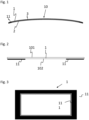
- Fig. 1 is a schematic and not to scale representation of a composite or a laminated glass 10 according to an embodiment of the present disclosure.
- the laminated glass 10 comprises two glass panes 1, 2.
- Pane 1 here represents the at least one with at least one coating applied in some areas.
- Pane 2 is another glass pane and can be made of soda-lime glass, for example.
- a polymeric layer 3 is arranged, as well as, here in the edge region of the laminated glass 10, the coating 11. This is on one side (not referred to) of the glass pane 1 and can, in the context of the following description, each comprise the at least one coating or the at least one coating together with, if appropriate, a further coating as an intermediate layer.
- the coating 11 has been shown here as thick, i.e. comparable in thickness to that of the two panes 1, 2; however, as stated, this is only for the sake of better illustration.
- the coating 11 is generally significantly thinner than each of the two panes 1, 2 and generally also thinner than the polymeric layer 3.
- the polymeric layer 3 can also be a film.
- Example thicknesses of the polymeric layer are between 650 and 850 ⁇ m, with the at least one coating usually having thicknesses in the single-digit micrometer range.
- a preferred upper limit for the layer thickness of the at least one coating is, for example, 7 ⁇ m or 6 ⁇ m.
- the at least one coating can, for example, be between 3 ⁇ m and 5 ⁇ m thick.
- the laminated glass 10 is, as can be seen, designed as a curved laminated glass pane, such as can be used as a windshield.
- the laminated glass 10 does not comprise curved panes 1, 2, but is flat.
- the curvature of the laminated glass 10 is formed just the opposite of that in Fig. 1 shown figure.
- the glass pane 1 would be the outside of a windshield, but it is generally also possible for the glass pane 1 to be arranged on the inside of a windshield. In any case, however, the coating 3 is arranged between the two glass panes 1, 2.
- Fig. 1 The representation according to Fig. 1 is preferred, however, because in this way the first pane of glass 1 would be exposed to stone chips or chemical stresses such as salt spray when used as a windshield, for example, which a pane of glass made of borosilicate glass can withstand better than, for example, a commercially available soda-lime glass pane. As also explained above, it can be advantageous for cost reasons if not both panes of the laminated glass comprise borosilicate glass.
- the glass pane 1 comprises SiO 2 and B 2 O 3 as components of the glassy material.
- a borosilicate glass is more scratch-resistant than, for example, a soda-lime glass, so that it can be advantageous if the glass pane 1 as in Fig. 1 shown in the assembly 10 is designed in such a way that it points "outwards", i.e. if used as a windshield, it would point outwards. This would provide better protection against stone chips and similar mechanical stresses.
- Fig. 2 shows a side view.
- the glass pane 1 is not yet curved.
- the glass pane 1 In general, without limitation to the Fig. 1 In the example shown of a glass pane 1 or a laminated glass 10, it is also possible for the glass pane to be curved. However, it can be advantageous if a flat, non-curved pane 1 is used first, which is then bent later, for example in a thermal process.
- the thickness of the coating 11 is shown significantly larger than in reality.
- the arrangement of disc 1 corresponds to that in Fig. 1 , as stated with the exception that the disc in Fig. 2 is not bent.
- the coating 11 is formed here on the side 102 which faces the second pane 2 in the composite 10.
- the polymeric layer 3 which is arranged in the composite between the pane 1 and the pane 2. It is expressly pointed out here that the polymeric layer 3 both directly contacts the side 102 of the pane and is arranged on the coating 11 arranged in the area (or areas) of the pane 1 (or the side 102 of the pane 1).
- the coating 11 is arranged here in the edge area of the pane 1, in the illustration of the Fig. 2 left and right respectively.
- the coating may be applied in the form of a "frame".
- Fig. 3 also shows a schematic and not to scale view of a laminated glass 10 according to one embodiment.
- the coating 11 is designed here as a frame running around the edge of the pane 1, whereby the coating is initially opaque, i.e. as a layer without interruptions, and merges into the uncoated area towards the middle of the pane 1 via a grid or dot pattern 111.
- This uncoated area is the viewing area of a windshield, for example, if the pane 1 is used in a laminated glass 10.
- the frame is not designed as evenly as schematically in Fig. 3 but rather has bulges, for example, as is often the case with windshields in the area of the rear-view mirrors.
- Fig. 4 and 6 are scanning electron micrographs of partially coated glass panes comprising a glass comprising SiO 2 and B 2 O 3 , which have a first and a second side, according to embodiments of the disclosure.
- the coating here is generally at least one coating applied in at least one region of the second side of the glass pane. It is generally designed as an enamel coating comprising at least one pigment, a glassy component and preferably at least one additive, for example a filler.
- the at least one coating comprises pores, preferably open pores, as can be seen from the illustration of the Figures 4 and 6 can be removed. Therefore, in the at least one coating, a direct connection preferably results between a side of the at least one coating facing the second side of the at least one glass pane and a side of the at least one coating facing away from the second side of the at least one glass pane.
Landscapes
- Chemical & Material Sciences (AREA)
- Engineering & Computer Science (AREA)
- Life Sciences & Earth Sciences (AREA)
- Chemical Kinetics & Catalysis (AREA)
- General Chemical & Material Sciences (AREA)
- Geochemistry & Mineralogy (AREA)
- Materials Engineering (AREA)
- Organic Chemistry (AREA)
- Mechanical Engineering (AREA)
- Composite Materials (AREA)
- Dispersion Chemistry (AREA)
- Laminated Bodies (AREA)
- Surface Treatment Of Glass (AREA)
- Compositions Of Macromolecular Compounds (AREA)
- Joining Of Glass To Other Materials (AREA)
- Glass Compositions (AREA)
Abstract
Description
- Die Erfindung betrifft allgemein ein Verbundglas, insbesondere für ein Fahrzeug. Im Speziellen betrifft die Erfindung ein Verbundglas, beispielsweise für ein Fahrzeug, welches beispielsweise für den Einsatz als Windschutzscheibe geeignet ist und eine besonders gute Festigkeit sowie eine sehr gute Bedienersicherheit aufweist.
- Verbundgläser werden beispielsweise für Fahrzeugverglasungen gewählt, insbesondere in besonders kritischen Bereichen wie der Windschutzscheibe. Verbundgläser umfassen in der Regel wenigstens zwei Glasscheiben, welche durch eine polymerische Lage, die zwischen den Scheiben angeordnet ist, miteinander verbunden werden. Kommt es aufgrund von mechanischer Einwirkung zum Bruch, hält die polymerische Lage, die beispielsweise als Folie ausgebildet sein kann, die Bruchstücke der Glasscheiben aneinander, sodass Verletzungen der Fahrzeuginsassen durch Glasbruch vermindert werden.
- Da solche Fahrzeugscheiben abrasiven Bedingungen, nämlich durch bei hoher Geschwindigkeit auf sie auftreffende Teilchen (beispielsweise auch dem bekannten "Steinschlag") ausgesetzt sind, kann es vorteilhaft sein, als äußere Glasscheibe dieses Scheibenverbundes eine Scheibe umfassend ein Glas mit den Komponenten SiO2 und B2O3 vorzusehen. Ein solches Glas wird im Rahmen der vorliegenden Offenbarung auch allgemein als Borosilikatglas bezeichnet. Solche Gläser weisen bekanntermaßen eine gute Kratzbeständigkeit auf sowie eine Reihe weiterer Vorteile wie eine allgemein gute mechanische und thermische Beständigkeit.
- Es ist bekannt, in der Außenverglasung von Fahrzeugen beispielsweise Borosilikatglas, wie es beispielsweise unter dem Handelsnamen Borofloat ® kommerziell erhältlich ist, einzusetzen. Ein solches Glas ist beispielsweise sehr gut geeignet für Laminatverglasungen und zeichnet sich durch eine sehr hohe Transmission im Bereich des sichtbaren Lichts aus. Weiterhin verfügen Borosilikatgläser allgemein über eine sehr gute Wärmebeständigkeit, eine hohe chemische Beständigkeit und eine gute mechanische Festigkeit.
- Beispielsweise beschreibt die internationale Patentanmeldung
WO 2015/059406 A laminierte Glasscheiben. Eine dieser Scheiben kann beispielsweise ein Borosilikatglas umfassen, beispielsweise die äußere Scheibe. - Die internationale Patentanmeldung
WO 2017/157660 A1 beschreibt eine Verbundglasscheibe für ein Head-Up-Display. Auch hier kann eine der Scheiben des Verbundglases Borosilikatglas umfassen. - Die
CO 2017/0005596 A1 - Die internationale Patentanmeldung
WO 2019/130285 A1 beschreibt ein Laminat mit hoher Beständigkeit gegen Abrasion und Umwelteinflüsse. - Schließlich beschreibt die internationale Patentanmeldung
WO 2018/122769 A1 ein Laminat mit hoher Bruchfestigkeit. - Wie ausgeführt, sind Windschutzscheiben zur Sicherheit der Fahrzeuginsassen als Verbundglasscheiben ausgebildet. Auch weisen sie im Randbereich üblicherweise eine Beschichtung auf. Diese Beschichtung dient zum einen der optischen Kaschierung beispielsweise von Verklebungen oder Komponenten, wie beispielsweise Antennen, zum anderen auch deren Schutz vor UV-Strahlung. In der Regel ist diese Beschichtung, welche also beispielsweise in Form eines Rahmens angeordnet sein kann, zwischen den beiden Glasscheiben eines Verbundes angeordnet. Der Verbund umfasst ferner, wie ebenfalls vorstehend bereits ausgeführt, noch eine polymerische, somit eine ein Polymer umfassende oder aus einem Polymer bestehende Lage zwischen den beiden Glasscheiben, welche die Glasscheiben miteinander verbindet. Die Glasscheiben mit der zwischen ihnen angeordneten Beschichtung in wenigstens einem Bereich, insbesondere im Randbereich, werden häufig aufeinander gelegt und in einem thermischen Umformungsprozess gebogen. Allgemein, ohne Beschränkung auf dieses hier beschriebene Beispiel, ist es aber auch möglich, dass die Umformung der Glasscheiben eines Verbundes auch einzeln und getrennt voneinander vorgenommen werden. Anschließend wird eine polymerische Lage zwischen beide Scheiben gebracht und die gebogenen Glasscheiben miteinander verbunden, sodass schließlich eine Verbundglasscheibe erhalten wird. Im Rahmen der vorliegenden Offenbarung wird eine solche Verbundglasscheibe auch vereinfacht als "Verbundglas" bezeichnet. Synonym können für solche Verbundgläser auch die Begriffe "Glasverbund" oder "Verbund" verwendet werden.
- An Glasscheiben, welche von einem solchen Verbund umfasst sind, werden daher eine Reihe von Anforderungen gestellt. Da die Biegeprozesse thermisch erfolgen, müssen die Glasscheiben und die darauf aufgebrachte Beschichtung diesen Temperaturen gewachsen sein. Die Glasscheiben und die Beschichtung müssen mit der polymerischen Lage eine Verbindung in der Form eingehen können, dass ein stabiler Verbund gebildet wird und es nicht zu Delaminationen zwischen Glas und Polymer kommt. Schließlich ist es erforderlich, dass die Beschichtung eine ausreichende optische Dichtigkeit aufweist, damit Komponenten, die im Rahmenbereich der Windschutzscheibe angeordnet sind, nicht störend sichtbar sind. Dies verhindert eine Ablenkung des Fahrzeugführers und erhöht so die Fahrsicherheit. Auch Mikrorisse oder sonstige Defekte der Beschichtung sind nach Möglichkeit zu vermeiden oder mindestens zu minimieren.
- Neben der Temperaturbeständigkeit von Glas und Beschichtung, der angesprochenen Kompatibilität von Glas bzw. Beschichtung mit einem polymerischen Material zur Bildung eines Verbundes, der optischen Dichte und der Minimierung möglicher Defekte und allgemein der mechanischen Festigkeit der einzelnen Glasscheiben (hier insbesondere der beschichteten Glasscheibe) ist es besonders wichtig, dass die Beschichtung bevorzugt gleichmäßig, bevorzugt schwarz bzw. dunkel, ausgebildet ist. Bei Beschichtungen auf Glasscheiben, auch im Rahmen von Verbundglasscheiben, ist allgemein bekannt, dass sie, gerade in dem Fall, dass sie besonders haftfest sind, die Festigkeit einer Glasscheibe beinträchtigen können - und damit auch letztlich die Festigkeit des resultierenden Glasverbundes. Schwierigkeiten bestehen auch darin, dass einerseits besonders haftfeste Schichten wünschenswert sind, um zu verhindern, dass es zu Schichtdelaminationen kommt, andererseits gerade diese haftfesten Schichten die Glasfestigkeit herabsetzen.
- Um eine gute mechanische Beständigkeit der Glasscheibe und des resultierenden Verbundes zu realisieren, können solche Schichten beispielsweise porös ausgebildet sein oder anstelle eines glasbasierten Bindemittels ein Sol-Gel-Bindemittel aufweisen. Das Herabsetzen der Festigkeit durch eine Schicht oder mehrere Schichten beruht nämlich mit einiger Sicherheit teilweise auf dem Bilden einer sogenannten "Anschmelz-Reaktionszone", welche bei der Verwendung üblicher glasbasierter Beschichtungen resultiert. Zum anderen kommt es aber auch durch die Ausbildung sehr dichter Schichten zu einer Herabsetzung der Festigkeit, wenn die thermische Dehnung der Schicht und des Substrats stark unterschiedlich ist. Dies kann beispielsweise durch eine poröse Ausbildung der Beschichtung vermindert werden. Dies kann beispielsweise mit der Verwendung eines Sol-Gel-Bindemittels erfolgen, bei welcher auch eine sogenannte Anschmelz-Reaktionszone nicht ausgebildet wird - was ebenfalls vorteilhaft für die Festigkeit ist.
- Nachteilig an einer porösen Ausbildung einer Beschichtung und/oder der der Verwendung eines Sol-Gel-Bindemittels ist allerdings, dass auf diese Weise bislang keine besonders guten Glasverbunde herstellbar waren. Denn der Glasverbund entsteht, wie vorstehend ausgeführt, durch das Laminieren der wenigstens zwei Scheiben des Verbundes mittels einer polymerischen Lage. Je nach der Zusammensetzung eines Sol-Gel-Bindemittels kann die Kompatibilität mit einem Polymer verringert sein, sodass kein stabiler Verbund gerade im Bereich der Beschichtung möglich ist. Poröse Beschichtungen können weiterhin entweder nicht ausreichend haftfest sein oder zu einem sehr unruhigen, fleckigen Erscheinungsbild der Beschichtung führen, was kritisch für die Sicherheit des Fahrzeugführers sein kann, da ein unruhiges Erscheinungsbild den Fahrzeugführer ablenken kann.
- Es besteht damit ein Bedarf an Verbundgläsern, welche die vorgenannten Schwächen des Standes der Technik zumindest mildern.
- Die Aufgabe der Erfindung betrifft die Bereitstellung eines Verbundglases, welches die Schwächen des Standes der Technik zumindest teilweise mindert.
- Die Aufgabe der Erfindung wird gelöst durch den Gegenstand der unabhängigen Ansprüche. Vorteilhafte, bevorzugte und spezielle Ausführungsformen finden sich in den abhängigen Ansprüchen, der Beschreibung und der Zeichnungen der vorliegenden Offenbarung.
- Die Erfindung betrifft daher allgemein ein Verbundglas, insbesondere für ein Fahrzeug, welche i zwei Glasscheiben umfasst, wobei wenigstens eine Glasscheibe eine bereichsweise beschichtete Glasscheibe umfassend ein Glas umfassend SiO2 und B2O3 ist, die eine erste und eine zweite Seite aufweist.
- Wenigstens in wenigstens einem Bereich der zweiten Seite der wenigstens einen Glasscheibe ist wenigstens eine Beschichtung aufgetragen.
- Die wenigstens eine Beschichtung ist als Emaillebeschichtung umfassend wenigstens ein Pigment, einen glasigen Bestandteil und vorzugsweise wenigstens einen Zusatzstoff ausgebildet. Der Zusatzstoff kann insbesondere als Füllstoff ausgebildet sein.
- Die wenigstens eine Beschichtung umfasst Poren, vorzugsweise offene Poren, sodass in der wenigstens einen Beschichtung vorzugsweise eine direkte Verbindung zwischen einer der zweiten Seite der wenigstens einen Glasscheibe zugewandten Seite der wenigstens einen Beschichtung und einer der zweiten Seite der wenigstens einen Glasscheibe abgewandten Seite der wenigstens einen Beschichtung resultieren.
- Vorzugsweise weist die wenigstens eine Glasscheibe eine Biegefestigkeit zwischen wenigstens 5 und höchstens 170 MPa, bevorzugt wenigstens 20 und höchstens 170 MPa, besonders bevorzugt wenigstens 35 MPa, ganz besonders bevorzugt wenigstens 60 MPa, und am meisten bevorzugt wenigstens 80 MPa, auf.
- Das Verbundglas umfasst weiter wenigstens eine zwischen den Glasscheiben angeordnete polymerische Lage, wobei ein Polymer der polymerischen Lage ungefärbt vorliegt, und wobei im Bereich der wenigstens einen Beschichtung zumindest ein Teil der polymerischen Lage die Poren der wenigstens einen Beschichtung zumindest teilweise ausfüllt.
- Somit resultiert ein Farbort des Verbundglases, gegeben im CIEL*a*b*-System, bestimmt in Betrachtungsrichtung von der ersten zur zweiten Seite der wenigstens einen Glasscheibe in dem wenigstens einen Bereich, in dem auf der zweiten Seite der wenigstens einen Glasscheibe die erste Beschichtung aufgetragen ist, wobei L* höchstens 12 ist und vorzugsweise wenigstens 1, und A* und b* jeweils im Bereich zwischen +5 und -5 liegen. Mit anderen Worten wird der Farbort also durch die Glasscheibe hindurch gemessen bzw. bestimmt.
- Im Rahmen der vorliegenden Offenbarung gelten die folgenden Definitionen:
Unter einem Verbundglas wird allgemein ein Verbund umfassend wenigstens zwei Glasscheiben verstanden, welche mittels einer Zwischenlage fest miteinander verbunden sind. Ein Verbundglas kann allgemein auch als "Verbund", "Scheibenverbund", "Glasverbund", "Verbundglasscheibe" o.ä. bezeichnet werden. - Unter einer Scheibe wird allgemein ein Formkörper verstanden, dessen laterale Abmessung in einer ersten Raumrichtung eines kartesischen Koordinatensystems wenigstens eine Größenordnung geringer ist als die lateralen Abmessungen in den beiden weiteren, zur ersten Raumrichtungen senkrechten, Raumrichtungen. Diese laterale Abmessung entlang der ersten Raumrichtung kann allgemein auch als "Dicke" der Scheibe bezeichnet werden, die beiden anderen lateralen Abmessungen als "Länge" und "Breite". Mit anderen Worten ist bei einer Scheibe im Sinne der vorliegenden Offenbarung die Dicke wenigstens eine Größenordnung geringer als deren Länge und Breite. Länge und Breite der Scheibe können im Rahmen der vorliegenden Offenbarung in derselben Größenordnung liegen oder die Länge der Scheibe kann deutlich größer sein als die Breite. Mithin umfasst eine Scheibe im Sinne der vorliegenden Offenbarung auch eine Ausgestaltung als Band.
- Unter einer Glasscheibe wird allgemein verstanden, dass die Scheibe ein Glas umfasst, beispielsweise aus Glas ausgebildet ist. Eine Glasscheibe kann allgemein beschichtet vorliegen, also als beschichtete Glasscheibe ausgebildet sind.
- Unter den Seiten einer Glasscheibe wird im Rahmen der vorliegenden Offenbarung eine Hauptfläche oder Hauptoberfläche verstanden. Wie vorstehend ausgeführt, ist eine Scheibe ein Formkörper, bei dem die Dicke deutlich geringer ist als die Länge und die Breite. Länge und Breite eines solchen scheibenförmigen Formkörpers (oder einer Scheibe) definieren die Hauptflächen, welche zusammen mehr als 50% der Gesamtoberfläche ausmachen, häufig auch deutlich mehr, gerade bei sehr dünnen Scheiben. Die Hauptflächen oder Seiten stehen damit im Gegensatz zu den umlaufenden Kantenflächen der Scheibe. Allgemein umfasst eine Scheibe damit im Sinne der vorliegenden Offenbarung zwei Seiten, die je nachdem auch als Ober- und Unterseite oder Vorder- und Rückseite bezeichnet werden können.
- Im Rahmen der vorliegenden Offenbarung werden die Begriffe der "Schicht" und der "Beschichtung" synonym in dem Sinne verstanden, dass unter einer Schicht eine Materiallage verstanden wird, welche mittels eines speziellen Verfahrens (eines sogenannten Beschichtungsverfahrens) auf ein Substrat einer zumeist anderen Zusammensetzung als das Material der Beschichtung bzw. Schicht aufgebracht wird. Solche Beschichtungsverfahren können im Rahmen der vorliegenden Offenbarung insbesondere Beschichtungsverfahren sein, wie Drucken, bevorzugt Sieb- oder Tampondruck, Auftreichen Rollen, als Film applizieren, oder Rakeln, aber auch Tauchen und Sprühen oder sonstige weitere Beschichtungsverfahren sind allgemein denkbar. Es ist allgemein denkbar, eine Beschichtung oder Materiallage auch in Form einer Laminierung aufzubringen, beispielsweise mittels des Laminierens einer Folie. Die polymerische Lage des Verbundes kann daher allgemein im Rahmen der vorliegenden Offenbarung als Materiallage im Sinne der Offenbarung verstanden werden.
- Unter einer Emaillebeschichtung wird im Rahmen der vorliegenden Offenbarung allgemein eine Beschichtung verstanden, welche wenigstens einen glasigen Bestandteil umfasst, welcher durch einen thermischen Prozess auf einem Substrat anhaftet. Die Emaillebeschichtung kann neben dem glasigen Bestandteil weitere Bestandteile umfassen, insbesondere wenigstens ein Pigment und ggf. einen oder mehrere Zusatzstoffe, wie beispielsweise einen oder mehrere Füllstoffe oder ein sogenanntes Blähmittel. Unter einem glasigen Bestandteil wird vorliegend ein Bestandteil verstanden, welcher anorganisch und amorph ausgebildet ist, insbesondere umfassend SiO2. Insbesondere kann der glasige Bestandteil aus einem Schmelzprozess hervorgegangen sein oder aus Glas ausgebildet sein. Allgemein wird unter einem Glas ein anorganischer, amorpher Festkörper verstanden, welcher aus einem Schmelzprozess erhalten ist. In der Regel handelt es sich dabei um ein silikatisches Glas. Der glasige Bestandteil der Emaillebeschichtung kann insbesondere als Glasfluss oder Glasfritte ausgebildet sein. Diese Begriffe sind dem Fachmann auf dem Gebiet der Beschichtung von Glas bekannt. Die Emaillebeschichtung kann im Rahmen der vorliegenden Offenbarung so ausgebildet sein, dass der glasige Bestandteil vollständig aufgeschmolzen ist, auf das unterliegende Substrat, hier also insbesondere die Glasscheibe, auffließt und sonstige Bestandteile der Beschichtung umhüllt, wie beispielsweise Pigmentpartikel, es ist aber auch möglich, dass die Emaillebeschichtung als gesinterte Beschichtung ausgebildet ist, worunter verstanden wird, dass der glasige Bestandteil beim thermischen Prozess (der auch als Einbrand bezeichnet werden kann), lediglich partiell aufgeschmolzen vorliegt. Dies kann bevorzugt sein, insbesondere, wenn eine Schicht umfassend Poren angestrebt wird.
- Unter einem Pigment wird im Rahmen der vorliegenden Offenbarung ein Farbkörper verstanden, also ein Feststoff, welcher eine Eigenfarbe aufweist. Dieser liegt üblicherweise in Partikelform vor. Sofern also im Rahmen der vorliegenden Offenbarung eine Beschichtung ein Pigment umfasst, wird darunter verstanden, dass die Beschichtung Partikel eines Feststoffes mit einer bestimmten Zusammensetzung umfasst. Dies gilt in entsprechender Weise auch für sogenannte Füllstoffe. Füllstoffe sind dabei Feststoffe, welche einer Beschichtung oder einer Schicht in partikulärer Form zugesetzt werden, um bestimmte Eigenschaften der Beschichtung zu beeinflussen, wobei die Füllstoffe primär nicht die Farbe der Beschichtung, sondern andere Eigenschaften, wie beispielsweise thermische Dehnung, Kratzfestigkeit o.ä, betreffen.
- Unter einer polymerischen Lage wird eine Materiallage umfassend oder aus einem Polymer verstanden. Insbesondere kann die polymerische Lage als Polymerfolie ausgebildet sein. Ein Polymer ist ein organisches Makromolekül. Wenn im Rahmen der vorliegenden Offenbarung davon gesprochen wird, dass eine Lage oder eine Folie die "aus" einem bestimmten Polymer ist, wird darunter verstanden, dass diese Lage dieses Polymer als wesentlichen Bestandteil umfasst, aber - wie in der Kunststoffindustrie allgemein üblich - auch noch weitere Bestandteile aufweisen kann, die als sogenannte Zuschlagsstoffe bezeichnet werden können.
- Unter einer "ungefärbten" Ausbildung eines Materials oder einer Materiallage wird verstanden, dass diese im Bereich des sichtbaren Lichts, also von 380 nm bis 780 nm, farblos ausgebildet ist, also einen neutralen Farbort aufweist und vorzugsweise eine hohe Transparenz in diesem Wellenlängenbereich aufweist. Vorzugsweise beträgt die Transmission (τvis) in diesem Wellenlängenbereich wenigstens 70% oder mehr, um Anforderungen zu erfüllen, welche beispielsweise den Einsatz eines Scheibenverbundes als Windschutzscheibe ermöglichen. Die Mindesttransmission für Windschutzscheiben beträgt allgemein mehr als 70 %. Blendreduktionskeile im oberen Nebensichtbereich sind zur Abschattung von Blendlicht zulässig, sofern diese auf einer Fläche von weniger als 0,1 m2 auftreten. Die Ausbildung solcher Bereiche zur Abschattung als Gradient bis 0 % Transmission am Rand der Scheibe ist möglich. Die Norm dazu ist in Europa die ECE R43 (Regelung Nr. 43 der Wirtschaftskommission der Vereinten Nationen für Europa (UNECE) - Einheitliche Bedingungen für die Genehmigung der Sicherheitsverglasungswerkstoffe und ihres Einbaus in Fahrzeuge - Amtsblatt der Europäischen Union L 42/1; 03.11.2013).
- Unter einer Poren umfassenden Schicht oder Beschichtung wird eine Beschichtung verstanden, welche porös ausgebildet ist. Insbesondere kann darunter eine Beschichtung verstanden werden, welche eine offene Porosität, vorzugsweise sogar mit durchgehenden Poren, aufweist. Unter durchgehenden Poren oder einer durchgehenden Porosität wird verstanden, dass es Fluidkanäle gibt, welche die erste Seite einer Materiallage mit einer zweiten, der ersten Seite gegenüberliegenden Seite der Materiallage verbinden.
- Eine Ausgestaltung eines Verbundglases wie vorstehend beschrieben weist eine Reihe von Vorteilen auf, auf welche im Folgenden beispielhaft eingegangen wird.
- Das Verbundglas umfasst wenigstens zwei Glasscheiben, wobei wenigstens eine Glasscheibe eine Glasscheibe umfassend ein Glas umfassend SiO2 und B2O3 ist, ist also als Borosilikatglasscheibe ausgebildet. Eine solche Glasscheibe weist, wie vorstehend auch bereits diskutiert, eine gute mechanische Festigkeit (insbesondere Bruchfestigkeit), eine hohe thermische Beständigkeit und auch eine gute Kratzfestigkeit (die auch als Beständigkeit gegen Angriff mit kleinen, spitzen Gegenständen verstanden werden kann bzw. dieser systemisch ähnlich ist) auf. Auch die chemische Beständigkeit dieser Gläser ist im Vergleich beispielsweise mit Kalk-Natron-Gläsern sehr gut ausgeprägt. Dies ist insbesondere auch für Fahrzeugscheiben von Relevanz, da diese beispielsweise im Winter Salzsprühnebel ausgesetzt sein können, welcher auch zu sogenannter Glaskorrosion führen kann. Hier kann die höhere chemische Resistenz von Borosilikatgläsern von Vorteil gegenüber bekannten Kalk-Natron-Gläsern sein.
- In wenigstens einem Bereich der wenigstens einen Scheibe aus bzw. umfassend ein Borosilikatglas ist wenigstens eine Beschichtung angeordnet. Darunter wird hier allgemein verstanden, dass das Verbundglas wenigstens eine Beschichtung umfasst, wobei insbesondere auch vorgesehen sein kann, dass das Verbundglas nur eine einzige Beschichtung umfasst. Es ist aber auch möglich und kann vorgesehen sein, dass das Verbundglas weitere Beschichtungen umfasst. Diese können im Bereich, der die wenigstens eine Beschichtung aufweist, angeordnet sein, oder mit diesem teilweise überlappen; dies ist aber nicht zwingend erforderlich.
- Die wenigstens eine Beschichtung ist eine Beschichtung, welche den Zweck hat, als eine Art vorzugsweise blickdichter Bereich, vorzugsweise im Randbereich der wenigstens einen Glasscheibe bzw. in entsprechender Weise des Verbundglases, ausgebildet zu sein, beispielsweise als eine Art Kaschierung von Leitungen o.ä., aber teilweise auch als Sonnen- oder Blendschutz für Fahrzeuginsassen, beispielsweise einen Fahrzeugführer. Nach einer Ausführungsform kann die wenigstens eine Beschichtung in Form eines Rahmens, also eines um die Kante einer Seite der Glasscheibe umlaufenden Bereichs, ausgebildet sein.
- Zu diesem Zweck ist die wenigstens eine Beschichtung als pigmentierte Beschichtung, also eingefärbt, ausgebildet. Das wenigstens eine Pigment, welches von der wenigstens einen Beschichtung umfasst ist, sorgt dafür, dass die Beschichtung eine hinreichende optische Dichte aufweist, sodass elektronische Komponenten nicht störend sichtbar ist und/oder dass die Beschichtung ihren Zweck als Abschattung/Blendschutz ausüben kann. Die wenigstens eine Beschichtung ist als Emaillebeschichtung ausgebildet, welche wenigstens, wie ausgeführt, ein Pigment und einen glasigen Bestandteil umfasst. Solche Emaillebeschichtung sind wegen ihrer glasigen Ausbildung nicht nur chemisch und mechanisch gut beständig, sondern auch gut mit einem glasigen Substrat wie der hier in Rede stehenden Glasscheibe kompatibel, sodass auf diese Weise auch im Allgemeinen eine relativ gute Haftfestigkeit erzielt werden kann.
- Vorzugsweise kann die Glasscheibe, insbesondere durch die Ausbildung der wenigstens einen Beschichtung selbst, so ausgebildet sein, dass sie eine Biegefestigkeit zwischen wenigstens 5 und höchstens 170 MPa, bevorzugt wenigstens 20 und höchstens 170 MPa, besonders bevorzugt wenigstens 35 MPa, ganz besonders bevorzugt wenigstens 60 MPa, und am meisten bevorzugt wenigstens 80 MPa, aufweist. Vorzugsweise ist also die Beschichtung und/oder die wenigstens eine Glasscheibe so ausgebildet, dass die inhärente Festigkeit der Glasscheibe erhalten bleibt oder nur wenig herabgesetzt wird.
- Wie ausgeführt, umfasst das Verbundglas eine zwischen den Glasscheiben angeordnete polymerische Lage, wobei ein Polymer der polymerischen Lage ungefärbt vorliegt. Mit anderen Worten ist der Kunststoff der polymerischen Lage und damit diese insgesamt transparent ausgebildet. Dies ist selbstverständlich nicht nur vorteilhaft, sondern im Sichtbereich einer Fahrzeugscheibe auch zwingend erforderlich. Bei bekannten Verbundgläsern des Standes der Technik ist es aber auch bekannt, dass die polymerische Lage im Bereich der wenigstens einen Beschichtung gefärbt ausgebildet sein kann. Bei Verbundgläsern des Standes der Technik kann beispielsweise vorgesehen sein, dass im Rahmenbereich, beispielsweise also dem Bereich der wenigstens einen Beschichtung, eine diesen Rahmen nachbildende polymerische Lage, die selbst eingefärbt ist, angeordnet ist. Im Sichtbereich ist dann wiederum aus naheliegenden Gründen eine ungefärbte polymerische Lage angeordnet. Um also im Sichtbereich eine ausreichende Transparenz des Verbundglases zu ermöglichen, gleichzeitig aber auch eine ausreichende Opazität im Randbereich zu erzeugen, sind daher im Stand der Technik manchmal zwei unterschiedliche polymerische Lagen, beispielsweise zwei unterschiedliche Polymerfolien, notwendig.
- Dies ist nach der vorliegenden Offenbarung nicht notwendig, sondern vielmehr ist vorzugsweise vorgesehen, dass eine polymerische ungefärbte Lage zwischen den Scheiben des Verbundglases ausgebildet ist. Insbesondere ist diese bevorzugt auch im Bereich der wenigstens einen Beschichtung ungefärbt ausgebildet. Beispielsweise kann vorgesehen sein, dass die polymerische Lage ganzflächige zwischen den beiden Glasscheiben angeordnet ist.
- Selbst verständlich es möglich, aus anderen Gründen, beispielsweise einer besseren Haftfestigkeit eines bestimmten Polymers auf einer Beschichtung, auch nach der vorliegenden Offenbarung eine "zwei Folien" bzw. "zwei Polymere"-Lösung vorzunehmen.
- Dennoch ist mit dem Verbundglas nach der vorliegenden Offenbarung ein einheitlicher, dunkler Farbort des Verbundglases, bestimmt in Betrachtungsrichtung von der ersten zur zweiten Seite der wenigstens einen Glasscheibe in dem wenigstens einen Bereich, in welchem die wenigstens eine Beschichtung angeordnet ist, möglich, und zwar auch bei Verwendung nur einer einzigen polymerischen Lage, die vollflächig zwischen den Glasscheiben angeordnet ist. Dies ist möglich, weil die wenigstens eine Beschichtung porös ausgebildet ist, vorzugsweise mit einer offenen, durchgehenden Porosität, und weil im Bereich der wenigstens einen Beschichtung zumindest ein Teil der polymerischen Lage die Poren der wenigstens einen Beschichtung zumindest teilweise auffüllt.
- Die poröse Ausbildung der wenigstens einen Beschichtung führt dazu, dass diese Beschichtung die mechanische Festigkeit der wenigstens einen Glasscheibe nicht kritisch beeinträchtigt, beispielsweise nur wenig herabsetzt. Dies führt aber gleichzeitig zu einer nicht ausreichend neutralen, dunklen Farbe der Beschichtung bzw. in entsprechender Weise des Glasverbundes. Durch die Poren kommt es nämlich zur Streuung, sodass ein unruhiges Erscheinungsbild resultiert, wodurch keine ausreichende Kaschierung von Komponenten möglich ist und der Fahrzeuginsasse abgelenkt werden kann. Dies ist aus Sicherheitsgründen ungünstig.
- Durch die spezielle Ausbildung der Beschichtung mit offenen Poren mit einer vorzugsweise durchgehenden Porosität, wie vorstehend beschrieben, können allerdings Bestandteile der polymerischen Lage die Poren zumindest teilweise auffüllen. Unter "Bestandteilen der polymerischen Lage" wird hierbei nicht verstanden, dass einzelne Komponenten der polymerischen Lage in die Poren hineingehen, sondern dass die polymerische Lage teilweise in die Poren hineingezogen wird und diese zumindest teilweise auffüllt. Dies kann beispielsweise dann geschehen, wenn im Rahmen der Ausbildung des Glasverbundes die polymerische Lage zwischen den Glasscheiben angeordnet wird, beispielsweise in Form einer Folie, und während des erfolgenden Laminiervorgangs die polymerische Lage so niedrigviskos wird, dass sie aufgrund von Kapillarkräften in die Poren hineingezogen wird. Gemäß einer Ausführungsform kann dies in der Form geschehen, dass die Poren im Wesentlichen vollständig, also zu wenigstens 80 Vol.-%, von der polymerischen Lage aufgefüllt sind, gerne auch zu mehr als 80 Vol.-%. Allerdings ist es allgemein schwierig, die Verbundgläser so zu präparieren, dass eine entsprechende Bestimmung des Füllgrades analytisch möglich ist.
- Durch das Auffüllen der Poren mit einem polymerischen (oder Kunststoff-)Material kann dabei überraschenderweise auch dann ein einheitlicher, sehr dunkler, Farbort erzielt werden, wenn das Polymer der polymerischen Lage selbst gar nicht eingefärbt vorliegt. Damit entfällt die Notwendigkeit, zwei unterschiedliche polymerische Lagen, nämlich eine eingefärbte für den Bereich der wenigstens einen Beschichtung und eine ungefärbte/transparente im "Sichtbereich" des Verbundglases, vorzusehen. Dies vereinfacht die Herstellung eines Verbundglases ganz außerordentlich.
- Auf diese Weise kann dann sehr einfach ein Farbort des Verbundglases, bestimmt in Betrachtungsrichtung von der ersten zur zweiten Seite der wenigstens einen Glasscheibe in dem wenigstens einen Bereich, in dem auf der zweiten Seite der wenigstens einen Glasscheibe die wenigstens eine Beschichtung aufgetragen ist, gegeben im CIEL*a*b*-System realisiert werden, wobei L* höchstens 12 ist und vorzugsweise wenigstens 1, und a* und b* jeweils im Bereich zwischen +5 und-5 liegen.
- Vorzugsweise umfasst die polymerische Lage Polyvinylbutyran (PVB) oder ist beispielsweise als sogenannte PVB-Folie ausgebildet.
- Nach einer Ausführungsform kann die polymerische Lage eine Dicke zwischen 650 µm und 850 µm aufweisen. Typische Dicken von beispielhaft geeigneten Folien sind beispielsweise 700 µm und 760 µm.
- Nach einer weiteren Ausführungsform kann die wenigstens eine Beschichtung zwischen 2 und 10 mm aufweisen, beispielsweise bis höchstens 7 µm.
- Vorzugsweise kann die wenigstens eine ein Borosilikatglas umfassende Scheibe eine gefloatete Glasscheibe sein. Die wenigstens eine Beschichtung ist in diesem Fall vorzugsweise auf der sogenannten Atmosphärenseite der Glasscheibe aufgebracht.
- Nach einer Ausführungsform ist die Lichttransmission, τvis, bestimmt in dem wenigstens einen Bereich, weniger als 5 % ist, bevorzugt weniger als 2%, besonders bevorzugt weniger als 1% und besonders bevorzugt weniger als 0,5%. Die Lichttransmission wird dabei selbstverständlich dort realisiert, wo die wenigstens eine Beschichtung vollflächig aufgebracht ist. Die geringe Lichttransmission zeigt, dass nach dieser Ausführungsform eine sehr hohe Abschattungs- und Kaschierungswirkung der wenigstens einen Beschichtung vorliegt.
- Allgemein wird darauf hingewiesen, dass die wenigstens eine Beschichtung häufig in Form eines um die Kante der wenigstens einen Glasscheibe und somit in entsprechender Weise auch die Kante des Verbundglases herum aufgebracht ist. Dabei kann vorgesehen sein, dass in bestimmten Bereichen eine Ausbuchtung vorliegt, beispielsweise in dem Bereich, in welchem bei einer Windschutzscheibe ein Rückspiegel angeordnet ist. Auch kann vorgesehen, dass in den Bereichen zum Inneren des Verbundglases hin der vollflächig aufgebrachte Rahmen in einen Bereich mit einem Belegungsgrad übergeht, in welchem die Beschichtung in Form eines Rasters mit einem geringeren Belegungsgrad aufgebracht ist. Dies ist beispielsweise bei Sichtscheiben im Fahrzeugbereich durchaus üblich.
- Gemäß einer Ausführungsform liegt der Pigmentgehalt der wenigstens einen Beschichtung zwischen 1 Vol.-% und 40 Vol.-%, bevorzugt bei weniger als 37,5 Vol.-%, wobei allgemein eine bevorzugte Untergrenze bei 5 Vol.-% liegt. Auf diese Weise lassen sich optische eingefärbte, dunkle Beschichtungen realisieren, wobei gleichzeitig eine noch immer ausreichende Haftfestigkeit der Beschichtung auf dem Substrat, also hier der Glasscheibe, gewährleistet ist.
- Dies wird gemäß einer weiteren Ausführungsform vorteilhaft dadurch unterstützt, dass der Gehalt der wenigstens einen Beschichtung an glasigem Bestandteil, bezogen auf den Feststoffgehalt der wenigstens einen Beschichtung, zwischen 60 Vol.-% und 99 Vol.-% liegt. Bevorzugt zwischen 62,5 Vol.-% und 95 Vol.-%. Der zu 100 Vol.-% fehlende Gehalt an Feststoff kann insbesondere von wenigstens einem Pigment gebildet werden, wozu gegebenenfalls noch weitere Bestandteile, wie beispielsweise ein Füllstoff oder auch mehrere Füllstoffe kommen können, genauso wie gegebenenfalls weitere Pigmente.
- Sofern die Zusammensetzung der wenigstens einen Beschichtung nicht in Vol.-% angegeben wird, sondern in Gew.-%, sind dies hinsichtlich des Pigmentgehalts der wenigstens einen Beschichtung zwischen etwa 1 Gew.-% und 60 Gew.-% Pigment. Der Gehalt der wenigstens einen Beschichtung an glasigem Bestandteil liegt bei etwa 35 Gew.-% bis etwa 98 Gew.-%. Sofern die wenigstens einen Beschichtung einen Zusatzstoff, der als Füllstoff ausgebildet ist, umfasst, sind Gehalte in Gew.-% zwischen 1 Gew.-% und 15 Gew.-% möglich. Diese Angaben beziehen sich, wie auch die Vol.-%-Angaben, jeweils auf den Feststoffgehalt der wenigstens einen Beschichtung, und gelten damit in entsprechender Weise auch für den Feststoffgehalt einer Paste, die zum Herstellen einer entsprechenden wenigstens einen Beschichtung einer Glasscheibe nach Ausführungsformen verwendet werden kann.
- Gemäß einer weiteren Ausführungsform umfasst die wenigstens eine Beschichtung neben wenigstens einem Pigment und dem glasigen Bestandteil einen Zusatzstoff. Selbstverständlich ist es möglich, dass die wenigstens eine Beschichtung mehrere Zusatzstoffe, die unterschiedlich ausgebildet sind, umfasst. Der Zusatzstoff kann beispielsweise als Füllstoff ausgebildet sein, beispielsweise als die Kratzfestigkeit erhöhender oder die thermische Dehnung der Beschichtung beeinflussender Füllstoff. Es ist auch möglich, dass der Zusatzstoff ein Blähmittel ist, was auch als Porenformer oder Schäumungsmittel bezeichnet werden kann. Ein solches Blähmittel zersetzt sich beim Einbrand der wenigstens einen Beschichtung, wobei sich Gas bildet, welches zur Bildung von Poren beiträgt und insbesondere die Ausbildung auch einer offenen Porosität, wie sie hier besonders vorteilhaft ist, in vorteilhafter Weise unterstützt. Ein als Blähmittel ausgebildeter Zusatzstoff kann in entsprechenden Mengen wie ein als Füllstoff ausgebildeter Zusatzstoff einer Paste zum Herstellen einer wenigstens einen Beschichtung nach Ausführungsformen zugegeben werden, zählt aber aus naheliegenden Gründen, nämlich der Zersetzung, nicht mehr zum Feststoffgehalt der wenigstens einen Beschichtung.
- Gemäß einer weiteren Ausführungsform umfasst der glasige Bestandteil der wenigstens einen Beschichtung, gegeben in Gew.-% auf Oxidbasis:
SiO2 10 bis 70 B2O3 5 bis 30, bevorzugt 6 bis 25 - Mit anderen Worten ist der glasige Bestandteil (oder Glasfluss oder Glasfritte) nach dieser Ausführungsform selbst als umfassend ein Borsilikatglas ausgebildet. Dies ist selbstverständlich vorteilhaft, weil auf diese Weise eine hohe Kompatibilität zwischen dem Glasfluss und der wenigstens einen Glasscheibe, auf welche die wenigstens eine Beschichtung bereichsweise aufgebracht ist, möglich ist.
- Zusätzlich kann allgemein vorgesehen sein, dass der glasige Bestandteil noch Al2O3 umfasst, vorzugsweise in einer Menge von weniger als 10 Gew.-%.
- Je nach genauem Schwerpunkt kann der Glasfluss bzw. der glasige Bestandteil gemäß weiterer, bevorzugter Ausführungsformen im genannten Rahmen unterschiedlich ausgebildet sein.
- Beispielsweise ist es möglich, dass der glasige Bestandteil der wenigstens einen Beschichtung, in Gew.-% auf Oxidbasis, umfasst:
SiO2 10 bis 50 B2O3 10 bis 26 ZnO 20 bis 50, - In diesem Fall ist also der Glasfluss als Zinkboratglasfluss ausgebildet. Dies ist vorteilhaft, weil dadurch die Schmelztemperatur der Fritte erniedrigt wird und somit eine genügende Fließfähigkeit bei Einbrandtemperaturen (500-750°C) trotz Pigment und Füllstoffgehaltes gegeben ist.
- Gemäß einer anderen Ausführungsform umfasst der glasige Bestandteil der wenigstens einen Beschichtung, in Gew.-% auf Oxidbasis,
SiO2 30 bis 60 B2O3 15 bis 25 Bi2O3 8 bis 45, 
- In diesem Fall handelt es sich also um einen Bismut-Borat-Glasfluss. Dieser ist besonders vorteilhaft, wenn ein Optimum zwischen den thermischen Ausdehnungskoeffizienten des Substrats und Glasfluss unter Berücksichtigung der Einbrandtemperatur adressiert werden soll. Auf diese Weise lassen sich dann besonders gute Festigkeitswerte erzielen.
- Nach einer weiteren Ausführungsform umfasst der glasige Bestandteil, in Gew.-% auf Oxidbasis,
SiO2 50 bis 70 B2O3 15 bis 30 Bi2O3 0 bis 15 ZnO 0 bis 5, - Gemäß einer weiteren Ausführungsform umfasst die wenigstens eine Beschichtung einen als Füllstoff ausgebildeten Zusatzstoff, wobei der Füllstoff bevorzugt einen linearen thermischen Ausdehnungskoeffizienten zwischen -7*10-6/K und 1,5*10-6/K. Der lineare thermische Ausdehnungskoeffizient kann auch kurz als α bezeichnet werden, wobei als Index auch der Temperaturbereich, für den der Ausdehnungskoeffizient bestimmt wurde, angegeben sein kann. Sofern im Rahmen der vorliegenden Offenbarung auf die thermische Dehnung abgestellt wird, wird darunter die lineare thermische Dehnung verstanden. Die Begriffe "linearer thermische Ausdehnungskoeffizient", "thermischer Ausdehnungskoeffizient", "Ausdehnungskoeffizient", "CTE" und "α" werden dabei im Rahmen der vorliegenden Offenbarung synonym verwendet, sofern dies nicht explizit anders angegeben ist. Insbesondere kann der lineare thermische Ausdehnungskoeffizient bestimmt werden in einer Methode nach ISO 7991.
- Füllstoffe, deren thermischer Ausdehnungskoeffizient im vorstehend genannten Bereich liegt, sind vorteilhaft, weil auf diese Weise die thermische Dehnung der wenigstens einen Beschichtung, die ja aus deren Bestandteilen resultiert, beeinflusst und insbesondere verringert werden kann. Da Pigmente in der Regel einen eher höheren thermischen Ausdehnungskoeffizienten aufweisen als ein Borosilikatglas, welches ja das Substratmaterial nach der vorliegenden Offenbarung ist, kann es vorteilhaft sein, einen Füllstoff mit einem relativ niedrigen thermischen Ausdehnungskoeffizienten der Beschichtung zuzugeben, sodass die resultierende Festigkeit der Glasscheibe/des Verbundes nicht zu gering wird.
- Es hat sich so nach einer Ausführungsform gezeigt, dass es bei Zugabe eines Füllstoffs durch gezielte Einstellung von Verhältnis des Gehalts von Pigment und nanopartikulärem Füllstoff möglich ist, einen Scheibenverbund mit guten mechanischen Eigenschaften und hoher Opazität zu erzielen. Verwendete Pigmente weisen üblicherweise einen Durchmesser auf, welcher wenigstens eine Größenordnung größer ist als der nanopartikulärer Füllstoffe. Bevorzugte Durchmesser bzw. Größen der Pigmente sind auch weiter unten im Beispielteil angegeben.
- Gemäß einer Ausführungsform umfasst die wenigsten eine Beschichtung einen als Füllstoff ausgebildeten Zusatzstoff, dessen Gehalt zwischen 0,5 Vol.-% und 20 Vol.-% liegt, vorzugsweise bei weniger als 15 Vol.-%.
- Vorzugsweise kann vorgesehen sein, dass die wenigstens eine Beschichtung zwei Füllstoffe aufweist, welche sich in ihren Eigenschaften, beispielsweise hinsichtlich ihrer Partikelgröße, unterscheiden. Hinsichtlich der Partikelgröße wird vorliegend stets auf den Äquivalentdurchmesser, bezogen auf den d50-Wert der Partikelgrößenverteilung, abgestellt. Sofern daher im Rahmen der Offenbarung pauschal die "Partikelgröße" oder der "Durchmesser" genannt sind, handelt es sich dabei, sofern nicht ausdrücklich anders angegeben, um die d50-Wert der Partikelgrößenverteilung.
- Eine solche Ausgestaltung mit zwei Füllstoffen, die hinsichtlich ihrer Partikelgrößen unterschiedlich ausgebildet sind, kann vorteilhaft sein, weil auf diese Weise eine besonders vorteilhafte Porengrößenverteilung resultiert, mit der insbesondere das Eindiffundieren bzw. das Eindringen der des Polymers in die Poren der wenigstens einen Beschichtung besonders einfach möglich ist. Beispielsweise ist es möglich, dass ein Füllstoff ein Nano-Füllstoff ist, also eine Partikelgröße von weniger als 100 nm aufweist, ein anderer Füllstoff jedoch eine Partikelgröße aufweist, die wenigstens eine halbe Größenordnung größer ist als der des nanopartikulären Füllstoffs. Der nanopartikuläre Füllstoff kann beispielsweise eine Partikelgröße von höchstens 50 nm aufweisen, wobei der weitere Füllstoff dann eine Partikelgröße von vorteilhafter Weise wenigstens 0,5 µm aufweisen sollte. Auf diese Weise kann besonders gut eine gute Porosität in der Beschichtung erzielt werden Übliche Größen von nicht-nanopartikulären Füllstoffen liegen bei etwa 0,5 µm bis 1,5 µm.
- Es hat sich allerdings auch gezeigt, dass es bei Zugabe eines vorzugsweise nanopartikulären Füllstoffs, also eines Füllstoffs mit einem Partikeldurchmesser von höchstens 50 nm, sogar ausreichend sein kann, wenn kein weiterer Füllstoff vorhanden sind, sondern lediglich das Verhältnis des Gehalts von Pigment und nanopartikulärem Füllstoff gut eingestellt ist. Denn verwendete Pigmente weisen üblicherweise einen Durchmesser auf, welcher wenigstens eine Größenordnung größer ist als der nanopartikulärer Füllstoffe. Für Weißpigmente ist dieser vorzugsweise 1 µm oder kleiner, bevorzugt 0,8 µm oder kleiner, besonders bevorzugt 0,6 µm oder kleiner. Bevorzugte Durchmesser bzw. Größen der Pigmente sind auch weiter unten in im Beispielteil angegeben.
- Gemäß einer weiteren Ausführungsform umfasst die wenigstens eine Beschichtung und/oder die Paste einen weiteren Zusatzstoff, welcher als Blähmittel ausgebildet ist. Der Blähmittelgehalt der Paste, mit welcher eine entsprechende wenigstens eine Beschichtung nach Ausführungsformen für ein Verbundglas nach der Offenbarung hergestellt werden kann, liegt in diesem Fall bevorzugt zwischen 5 Vol.-% und 25 Vol.-%, besonders bevorzugt bei weniger als 15 Vol.-%.
- Gemäß einer weiteren Ausführungsform umfasst die wenigstens eine Glasscheibe wenigstens 60 Gew.-% und höchstens 85 Gew.-% SiO2, wenigstens 8 Gew.-% und höchstens 26 Gew.-% B2O3, wenigstens 0,5 Gew.-% und höchstens 12 Gew.-% Al2O3 und wenigstens 0,5 Gew.-% und höchstens 6 Gew.-% Na2O, wobei bevorzugt weiterhin umfasst sein können bis zu 1 Gew.-% Li2O, bis zu 4 Gew.-% K2O, bis zu 5 Gew.-% MgO, bis zu 3,5 Gew.-% CaO, 4 Gew.-% SrO, bis zu 3 Gew.-% ZnO, bis zu 3 Gew.-% ZrO2, sowie weiterhin Nebenbestandteile, wie beispielsweise Läutermittel, wobei die Summe dieser Nebenbestandteile nicht mehr als 2 Gew.-% beträgt.
- SiO2 ist der primäre Netzwerkbildner und der Hauptbestandteil des Glases der wenigstens einen Glasscheibe. Damit die Glasscheibe ausreichend chemisch und mechanisch stabil ist, sollte daher der Gehalt der Glasscheibe an SiO2 wenigstens 60 Gew.-% betragen. Um eine gute Schmelzbarkeit zu gewährleisten, ist allerdings der Gehalt der Glasscheibe an SiO2 vorzugsweise begrenzt und umfasst nach einer Ausführungsform nicht mehr als 85 Gew.-%. B2O3 ist ein weiterer Bestandteil der wenigstens einen Glasscheibe und vorzugsweise zu wenigstens 8 Gew.-% im Glas enthalten. Auf diese Weise kann die Schmelzviskosität des Glases gering gehalten werden, was aus Produktionssicht günstig ist. Vorteilhaft ist der Gehalt des Glases an B2O3 nicht zu hoch, um eine ausreichend chemisch stabiles Glas zu erhalten. Das Glas umfasst weiterhin wenigstens 0,5 Gew.-% Al2O3. Al2O3 ist ein sogenanntes Zwischenoxid, welches in Borosilikatgläsern vorzugsweise zugegeben wird, um die in diesen Gläsern gegebene Entmischungstendenz zu vermindern. Auch kann Al2O3 die Härte eines Glases verbessern. Da es aber gleichzeitig die chemische Beständigkeit herabsetzen und dabei auch die Schmelztemperatur erhöhen kann, sollte es in nicht zu hohen Gehalten im Glas vorhanden sein und eine bevorzugte Obergrenze beträgt daher hier höchstens 12 Gew.-% Al2O3. Schließlich umfasst das Glas noch Na2O zu wenigstens 0,5 Gew.-% und höchstens 6 Gew.-%. Auf diese Weise kann der Schmelzpunkt des Glases weiter gesenkt werden, wobei gleichzeitig sichergestellt wird, dass keine zu hohen Gehalte an Na2O vorliegen, welche die chemische Beständigkeit des Glases zu stark verringern würden.
- Weitere Bestandteile können ebenfalls vom Glas umfasst sein. Beispielsweise kann bis zu 1 Gew.-% Li2O umfasst sein, bis zu 4 Gew.-% K2O, bis zu 5 Gew.-%MgO, bis zu 3,5 Gew.-% CaO, bis zu 4 Gew.-% SrO, bis zu 3 Gew.-% ZnO, bis zu 3 Gew.-% ZrO2. Diese Komponenten können unterschiedliche Eigenschaften des Glases beeinflussen, beispielsweise einer Entmischungstendenz weiter entgegenwirken (wie beispielsweise der Zusatz von K2O), die Festigkeit des Glases verbessern und dergleichen.
- Selbstverständlich kann das Glas allgemein weitere Nebenbestandteile umfassen, wie beispielsweise Läutermittel, wobei die Summe dieser Nebenbestandteile nicht mehr als 2 Gew.% beträgt.
- Gemäß einer weiteren Ausführungsform umfasst die weitere Glasscheibe ein Kalk-Natron-Glas oder besteht aus einem solchen.
- Ein Kalk-Natron-Glas ist allgemein ein Glas umfassend, als Hauptbestandteile, SiO2, CaO und Na2O und wird in großen Mengen hergestellt. Es ist günstig verfügbar, weist jedoch auch gewisse Schwächen auf, beispielsweise eine relativ geringe chemische und mechanische Beständigkeit. Aufgrund der guten Verfügbarkeit kann es allerdings sehr vorteilhaft sein, ein solches Glas für das Verbundglas vorzusehen, und zwar vorzugsweise auf der Seite des Verbundes, welche im Gebrauch einer geringeren mechanischen Beanspruchung und/oder Korrosion ausgesetzt ist. Bei einer Fahrzeugscheibe aus einem bzw. umfassend ein Verbundglas kann dies vorteilhaft die dem Fahrzeuginnenraum zugewandte Seite des Verbundglases sein. Dies stellt einen guten Kompromiss zwischen sehr guter Beständigkeit des Verbundglases und akzeptablen Kosten dar.
- Gemäß einer weiteren Ausführungsform weist der Verbund ein Level von wenigstens 3 in einem sogenannten Pummel-Test auf. Der Pummel-Test, von englisch "to pummel" = schlagen, ist ein Maß für die Beständigkeit bzw. die Qualität des Verbundes und wird in der Norm ASTM C1908-21 beschrieben. Allgemein gilt, dass bei der Zerstörung des Verbundes, welches beispielsweise auch als "Verbundsicherheitsglas" bezeichnet werden kann, die Glasbruchstücke an der polymerischen Lage, beispielsweise ausgestaltet als PVB-Folie, zwischen den Glasscheiben des Verbundes haften bleiben müssen. Überprüft wird dies mit dem "Pummel-Test", bei welchem ein Verbundglas umfassend zwei Glasscheiben mit einer maximalen Dicke von 2 * 4 mm auf einer geneigten Metallunterlage mit einem Hammer bearbeitet wird, also auf diese geschlagen wird. Dabei wird das Glas durch die mechanische Einwirkung zerstört. Anschließend erfolgt die visuelle Begutachtung. Das Haftungsniveau wird je freigelegter Folienfläche bzw. freigelegter Fläche der polymerischen Lage in "Pummelwerte" eingeteilt zwischen 0 und 10, wobei höhere Werte für ein besseres Haften der Glasbruchstücke auf der polymerischen Lage stehen.
- Die Offenbarung betrifft allgemein auch ein Verfahren zum Herstellen einer Glasscheibe umfassend wenigstens eine Beschichtung und/oder zum Herstellen eines Verbundes umfassend eine Glasscheibe umfassend wenigstens eine Beschichtung.
- Für das Herstellen der Glasscheibe umfassend wenigstens eine Beschichtung kann allgemein eine Paste verwendet werden, welche einen Glasfluss, wenigstens ein Pigment und vorzugsweise wenigstens einen Zusatzstoff, welcher vorzugsweise als Füllstoff ausgebildet ist, verwendet wird. In diesem Fall sind die vorstehenden Ausführungen zur Zusammensetzung der wenigstens eine Beschichtung nach Ausführungsformen bezüglich des Pigment- und Bindemittelgehalts in entsprechender Weise anzuwenden, d.h. die Angaben zum Gehalt beziehen sich auf den Feststoffgehalt der Paste. Neben den entsprechenden Feststoffgehalten in den entsprechenden Mengen umfasst die Paste in der Regel zusätzlich zwischen etwa 30 Gew.% und 45 Gew.-% eines Mediums oder Dispersionsmediums, in der Regel ein hochsiedendes Lösungsmittel oder Lösungsmittelgemisch. Insbesondere kann es sich hierbei um ein sogenanntes "Siebdrucköl" handeln, insbesondere, wenn die Paste mittels Siebdruck auf die Glasscheibe aufgebracht wird.
- Die Paste kann mittels üblicher Beschichtungsverfahren, insbesondere mittels Druckverfahren, wie Siebdruck, aufgebracht werden.
- Es ist weiterhin möglich, dass die Paste einen Zusatzstoff in Form eines Blähmittels umfasst.
- Vorzugsweise ist die Zusammensetzung der Paste, insbesondere hinsichtlich des wenigstens einen glasigen Bestandteils, und des verwendeten Glases der Glasscheibe, auf welcher die wenigstens eine Beschichtung aufgebracht ist oder wird, so aufeinander abgestimmt, dass die Einbrandtemperaturen und -zeiten der wenigstens einen Beschichtung bevorzugt den Biegetemperaturen und -zeiten dieser Scheibe entsprechen, sofern diese gebogen wird. Aus Viskositätssicht erfolgt die Bildung der wenigstens einen, als porösen Emailleschicht ausgebildeten Beschichtung, bei denjenigen Temperaturen, bei denen die Scheibe eine Viskosität von Ig [η]/dPas von 8-11, bevorzugt 9-10 aufweist, also bei Temperaturen zwischen vorzugsweise wenigstens 590°C und höchstens 850°C.
- In der folgenden Tabelle sind einige Zusammensetzungen von geeigneten Glasscheiben nach Ausführungsformen der Offenbarung zusammengestellt, zusammen mit relevanten Daten zu den mit diesen Glaszusammensetzungen erzielten Eigenschaften. Die Zusammensetzungen sind jeweils in Gew.-% auf Oxidbasis angegeben. Abweichungen von 100 % in der Summer geben sich durch Rundungen als Ergebnis der Analyse.
Glas Nummer 1 2 3 4 5 6 7 8 SiO2 78,00 72,10 80,80 80,30 74,80 79,00 78,10 64,00 B2O3 18,50 24,50 12,70 13,10 10,45 10,00 9,80 9,00 Al2O3 1,00 1,10 2,40 2,50 2,50 4,30 2,50 10,50 Li2O 0,40 Na2O 2,50 1,10 3,50 3,85 2,35 5,00 2,80 5,00 K2O 0,80 0,60 0,00 3,00 0,60 2,50 0,80 MgO 1,80 4,50 CaO 2,40 1,30 2,50 3,00 SrO 3,20 BaO ZnO 2,00 TiO2 ZrO2 2,50 P2O5 Additiv (falls vorhanden) SnO2 NaCl 0,15 0,10 0,10 0,25 0,22 0,25 Summe 100,15 100,00 100,10 99,85 100,25 100,42 100,00 100,25 Physikalische Daten α (*10-6/K) 2,80 3,29 3,25 3,22 4,10 4,11 4,15 5,50 Tg(°C) 535 467 530 520 590 580 589 615 Dichte (g/cm3) 2,18 2,13 2,22 2,22 2,35 2,28 2,31 2,44 T14.5 (°C) 521 505 532 518 545 565 568 593 T11 (°C) 627 594 637 631 646 661 669 691 T9 (°C) 720 729 729 728 735 746 758 773 T7.6 (°C) 810 750 818 820 822 830 843 850 E-Modul (GPa) 58 52 63 64 70 67 69 Hydrolyt. Best H (Klasse) 1 1 1 1 1 1 1 Säurebest. S (Klasse) 1 1 1 1 1 1 1 - Beispielhafte Zusammensetzungen geeigneter Glasflüsse finden sich in der nachfolgenden Tabelle. Auch hier sind die Zusammensetzungen in Gew.-% angegeben. Etwaige Abweichungen von der Summe von 100 Gew.-% sind rundungstechnisch bedingt.
Glasfluss Nummer 1 2 3 4 5 6 7 8 9 10 11 Al2O3 8,2 7,2 5,4 0,6 5,9 0,10 1,00 5,1 5,3 5,0 2,0 B2O3 17,5 22,8 24,0 24,6 21,5 15,7 12,8 21,9 22, 9 23,4 8,3 BaO Bi2O3 14,2 10,0 10,0 11,0 43,3 CaO 1,3 1,2 0,5 0,5 0,1 CoO 2,9 K2O 0,1 1,7 1,8 0,8 1,8 Li2O 3,2 4,4 4,9 0,8 0,8 4,8 0,8 MgO 0,3 Na2O 5,2 1,2 0,2 6,1 2,4 2,5 2,8 SiO2 54,9 55,6 56,0 66,6 58,0 32,7 24,3 63,4 66, 2 55,0 29,5 SrO 1,0 TiO2 1,6 ZnO 0,4 3,3 51,5 62,0 8,9 ZrO2 1,3 1,1 - In der nachfolgenden Tabelle sind geeignete Pigmente für Beschichtungen nach Ausführungsformen aufgeführt. Die angegebene Pigmentklasse bezieht sich auf den sogenannten "Color Index", in welchem die Pigmente in Klassen eingeteilt sind, wobei in der Tabelle "Bk" für "Black" steht, "Br" für "Brwon" und "Gr" für "Green". Die aufgeführten Pigmente sind dabei allgemein für die Herstellung dunkler Schichten nach Ausführungsformen geeignet, insbesondere auch für solche, welche einen schwarzen Farbeindruck hervorrufen. Dies gilt insbesondere auch für die in der Tabelle als "braun" oder "grün" einklassifizierten Pigmente, da diese allgemein so zusammengesetzt sind, dass sie stark absorbierend sind und diese "Farbe" bei Beschichtungen umfassend diese Pigmente oft zumeist lediglich in Form einer leichten Farbschattierung (als braun- oder grünstichiges Schwarz), falls überhaupt, zutage tritt und der allgemeine Farbeindruck einer solchen Beschichtung doch dunkel bzw. schwarz ist.
Pigmentklasse Chemie Partikelgröße (Datenblatt)/ µm Dichte (Datenblatt)/ g/cm3 d10 (Mie)/ µm d50 (Mie)/ µm d90 (Mie)/ µm d99 (Mie)/ µm Bk26 Mn-Fe-Ferrit Spinell (Fe,Mn)3O4 4,1 6,9 0,26 4,27 13,21 18,58 Bk26 (Fe,Mn)2O3 1 5 Bk27 Co-Cr-Fe-Spinell (Cr-Fe-Co-Mn, It. XRF) 0,7 5,3 0,54 0,84 1,29 1,79 Bk27 Cr-Fe-Co-Spinell 2,1 5,8 0,78 2,05 3,68 5,06 Bk27 Co-Cr-Fe-Spinell (Cr-Fe-Co-Mn-Ni, It. XRF) 2,6 Bk28 Cu-Cr-Spinell 0,7 5,4 0,22 0,52 1,01 1,53 Bk28 Cu-Cr-Spinell 0,9 5,6 0,52 0,83 1,39 2,04 Bk28 Cu-Cr-Spinell 0,77 Bk28 Co-Cr-Spinell 0,92 Bk30 Ni-Fe-Cr-Spinell 1,1 5,3 0,62 0,96 1,64 2,36 Bk30 Ni-Cr-Fe Spinell 0,9 Bk33 Fe-Mn-Oxide (Fe,Mn)2O3 0,6 µm 4,6 0,7 1,28 2,85 5,34 Bk33 Fe-Mn-Spinell 0,89 Gr17/Br29* Cr-Fe-Oxid 1,2 5,8 0,68 1,09 1,89 2,82 Br29 Cr-Fe-Oxid 0,77 - Geeignete Zusatzstoffe für eine Paste bzw. eine Beschichtung nach Ausführungsformen finden sich in der nachfolgenden Tabelle:
Füllstoffe Dichte (g/cm3) Partikelgröße (µm) BET (m2/g) α (106/K) β-Eukryptit 2,35 1,2 -1,1 bis -6,5 Kieselsäure (1) 2,2 0,04 35-65 ∼0,5 Kieselsäure (2) 2,2 270-330 ∼0,5 CoralPor® 1000 2,4 1 7-130 0,5-1 CoralPor® 2000 2,4 1 0,5-1 Blähmittel Porenformer Form der Porenformer Schüttdichte (kg/m3) Zersetzungstemp. (°C) Stärke Reisstärke länglich ∼200 Kartoffelstärke gerundet 300 Maisstärke gerundet Weizenstärke länglich 550-700 Maniok länglich Fructose gerundet 103 Glucose 146 Maltose nadelförmig 162,5 Sacharose ab 160 - Bei Füllstoffen kommen insbesondere niedrigdehnende Füllstoffe, wie vorstehend in der Tabelle aufgelistet, in Betracht, beispielsweise Kieselsäuren. Kieselsäuren können dabei in unterschiedlichen Varianten verwendet werden, beispielsweise als Kieselsäure mit eher kompakter, aber kleiner Partikelform (Kieselsäure (1) in der vorstehenden Tabelle), oder in Form einer Kieselsäure, die eine besonders hohe Oberfläche aufweist (Kieselsäure (2) in der vorstehenden Tabelle). Verwendet werden können allgemein auch amorphe oder kristalline Füllstoffe, die selbst porös ausgebildet sind, wie beispielsweise die Füllstoffe, die vorstehend als "CoralPor" genannt sind. Dabei handelt es sich um Füllstoffen aus porös ausgebildetem Borosilikatglas. Andere Füllstoffe sind denkbar, beispielsweise Zeolithe, die porös und kristallin ausgebildet sind, oder auch andere niedrigdehnende Füllstoffe abseits von β-Eukryptit, wie beispielsweise Cordierit. Die Zugabe von Füllstoffen ist dabei auch sehr effizient in der Verbesserung der Doppelringbiegefestigkeit; bereits eine Zugabe von lediglich 1,75 Vol.-% (bezogen auf die resultierende Beschichtung) eines Füllstoffs führt zu einer Verbesserung der Festigkeit (Doppelringbiegezugfestigkeit) gegenüber einer Paste/Beschichtung ansonsten gleicher Zusammensetzung, aber ohne Füllstoff, von zwischen 12,5% und 14,5%. Verwendete Füllstoffe waren dabei die "Kieselsäure (1)", β-Eukryptit und ein CoralPor®-Füllstoff.
- Bei den Blähmitteln sind allgemein anorganische und organische Blähmittel möglich, wobei organische Blähmittel bevorzugt sind, beispielsweise Zucker (Maltose, Glucose o.ä.) oder Stärken, wie auch vorstehend aufgeführt. Werden solche Blähmittel (oder auch Porenformer) zugesetzt, zeigt sich beispielsweise auch in der Festigkeit der Glasscheibe und in entsprechender Weise auch des resultierenden Verbundes neben dem positiven Einfluss auf die Farbe auch eine Verbesserung der Festigkeit (Doppelringbiegezugfestigkeit) von über 40% (Stärke als Blähmittel/Porenformer) im Vergleich zu einer Beschichtung gleicher Zusammensetzung, aber ohne Porenformer/Blähmittel, bzw. mehr als 30% (Zucker). Zugegeben wurden zur Paste dabei 10 Vol.-% Porenformer/Blähmittel. Dies führt in der Beschichtung zu 10 Vol.-% mehr Poren, als dies ohne Blähmittelzugabe der Fall wäre.
- Die Erfindung wird im Folgenden anhand von Figuren weiter erläutert. Es zeigen
- Fig. 1
- eine schematische und nicht maßstabsgetreue Darstellung eines Schnittes durch ein Verbundglas nach einer Ausführungsform,
- Fig.
- eine schematische und nicht maßstabsgetreue Darstellung einer Glasscheibe nach einer Ausführungsform,
- Fig. 3
- eine schematische und nicht maßstabsgetreue Aufsicht auf ein Verbundglas nach einer Ausführungsform, sowie
- Fig. 4 bis 7
- rasterelektronenmikroskopische Aufnahmen von Glasscheiben mit wenigstens einer Beschichtung in laminiertem und unlaminiertem Zustand.
-
Fig. 1 ist eine schematische und nicht maßstabsgetreue Darstellung eines Verbunds bzw. eines Verbundglases 10 nach einer Ausführungsform der vorliegenden Offenbarung. Das Verbundglas 10 umfasst zwei Glasscheiben 1, 2. Scheibe 1 stellt dabei hier die wenigstens eine mit wenigstens einer bereichsweise aufgetragenen wenigstens einen Beschichtung dar. Scheibe 2 ist eine weitere Glasscheibe und kann beispielsweise aus einem Kalknatronglas ausgebildet sein. Zwischen den beiden Glasscheiben 1, 2 ist eine polymerische Lage 3 angeordnet sowie, hier im Randbereich des Verbundglases 10, die Beschichtung 11. Diese ist auf einer Seite (nicht bezeichnet) der Glasscheibe 1 angeordnet und kann jeweils im Rahmen der nachfolgenden Beschreibung die wenigstens eine Beschichtung oder die wenigstens eine Beschichtung zusammen mit gegebenenfalls einer weiteren Beschichtung als Zwischenschicht umfassen. - Aus Gründen der besseren Darstellung wurde hier die Beschichtung 11 als dick, in der Dicke also vergleichbar mit derjenigen der beiden Scheiben 1, 2 dargestellt; dies ist aber, wie ausgeführt, lediglich der besseren Darstellung geschuldet. Die Beschichtung 11 ist in der Regel deutlich dünner als jede der beiden Scheiben 1, 2 und in der Regel auch dünner als die polymerische Lage 3. Bei der polymerischen Lage 3 kann es sich auch um eine Folie handeln. Beispielhafte Dicken der polymerischen Lage liegen zwischen 650 und 850 µm, wobei die wenigstens eine Beschichtung üblicherweise Dicken im einstelligen Mikrometerbereich aufweist. Eine bevorzugte Obergrenze für die Schichtdicke der wenigstens einen Beschichtung ist beispielsweise 7 µm oder 6 µm. Weiterhin kann die wenigstens eine Beschichtung beispielsweise zwischen 3 µm und 5 µm dicke sein.
- Das Verbundglas 10 ist hier, wie sichtbar, als gebogene Verbundglasscheibe ausgebildet, wie sie beispielsweise auch als Windschutzscheibe verwendet werden kann. Allgemein, ohne Beschränkung auf das in
Fig. 1 dargestellte Beispiel, ist es jedoch auch möglich, dass das Verbundglas 10 keine gebogenen Scheiben 1, 2 umfasst, sondern eben ausgebildet ist. Auch ist es möglich, dass die Krümmung des Verbundglases 10 gerade umgekehrt ausgebildet ist zu der inFig. 1 dargestellten Abbildung. Im Beispiel derFig. 1 wäre die Glasscheibe 1 die Außenseite einer Windschutzscheibe, es ist jedoch allgemein auch möglich, dass die Glasscheibe 1 an der Innenseite einer Windschutzscheibe angeordnet ist. In jedem Fall ist allerdings die Beschichtung 3 zwischen den beiden Glasscheiben 1, 2 angeordnet. - Die Darstellung nach
Fig. 1 ist dabei allerdings bevorzugt, da auf diese Weise die erste Glasscheibe 1 beispielsweise bei einer Verwendung als Windschutzscheibe Steinschlag ausgesetzt wäre oder chemischen Belastungen wie einem Salzsprühnebel, was eine Glasscheibe aus Borosilikatglas besser verträgt als beispielsweise eine handelsübliche Kalk-Natron-Glasscheibe. Wie auch weiter oben ausgeführt, kann es aber aus Kostengründen vorteilhaft sein, wenn nicht beide Scheiben des Verbundglases Borosilikatglas umfassen. - Eine Anordnung wie in
Fig. 1 kann also wie ausgeführt vorteilhaft sein, da die Glasscheibe 1 als Komponenten des glasigen Materials SiO2 und B2O3 umfasst. Ein solches Borosilikatglas ist kratzbeständiger als beispielsweise ein Kalk-Natron-Glas, sodass es vorteilhaft sein kann, wenn die Glasscheibe 1 wie inFig. 1 dargestellt im Verbund 10 so ausgebildet ist, dass sie nach "außen" weist, also im Falle einer Verwendung als Windschutzscheibe nach außen weisen würde. Denn auf diese Weise wäre ein besserer Schutz vor Steinschlag und ähnlichen mechanischen Belastungen gegeben. - Zur Verdeutlichung des Aufbaus der Glasscheibe 1 nach Ausführungsformen ist diese in den
Fig. 2 in Form einer schematischen und maßstabsgetreuen Abbildung dargestellt.Fig. 2 zeigt dabei eine Seitenansicht. Hier ist die Glasscheibe 1 allerdings noch nicht gebogen ausgebildet. Allgemein, ohne Beschränkung auf das inFig. 1 gezeigte Beispiel einer Glasscheibe 1 bzw. eines Verbundglases 10, ist es auch möglich, dass die Glasscheibe gebogen vorliegt. Vorteilhaft kann es aber sein, wenn zunächst eine flache, nicht gebogene Scheibe 1 verwendet wird, welche dann später gebogen wird, und zwar beispielsweise in einem thermischen Verfahren. Auch hier ist aus Gründen der besseren Darstellung die Dicke der Beschichtung 11 deutlich größer dargestellt als in der Realität. - Die Anordnung der Scheibe 1 entspricht derjenigen in
Fig. 1 , wie ausgeführt mit der Ausnahme, dass die Scheibe inFig. 2 nicht gebogen ausgeführt ist. Wie man erkennen kann, ist die Beschichtung 11 hier auf der Seite 102 ausgebildet, welche im Verbund 10 der zweite Scheibe 2 zugewandt ist. Nicht abgebildet ist hier die polymerische Lage 3, welche im Verbund zwischen der Scheibe 1 und der Scheibe 2 angeordnet ist. Es wird hier ausdrücklich darauf hingewiesen, dass die polymerische Lage 3 sowohl direkt die Seite 102 der Scheibe kontaktiert als auch auf der in dem Bereich (oder den Bereichen) der Scheibe 1 (bzw. der Seite 102 der Scheibe 1) angeordneten Beschichtung 11 angeordnet ist. - Die Beschichtung 11 ist hier im Randbereich der Scheibe 1 angeordnet, in der Darstellung der
Fig. 2 jeweils links und rechts. Hier kann es beispielsweise sein, dass die Beschichtung insgesamt in Form eines "Rahmens" aufgebracht ist. - Hierzu wird auf die
Fig. 3 verwiesen, welche in ebenfalls schematischer und nicht maßstabsgetreuer Abbildung eine Aufsicht auf ein Verbundglas 10 nach einer Ausführungsform zeigt. Die Beschichtung 11 ist hier als um den Rand der Scheibe 1 umlaufender Rahmen ausgebildet, wobei die Beschichtung zunächst deckend, also als Schicht ohne Unterbrechungen, ausgebildet ist, und zur Mitte der Scheibe 1 hin über ein Raster- oder Punktmuster 111 in den unbeschichteten Bereich übergeht. Dieser unbeschichtete Bereich ist für den Fall einer Verwendung der Scheibe 1 in einem Verbundglas 10 der Sichtbereich beispielsweise einer Windschutzscheibe. Selbstverständlich ist es allgemein möglich, dass der Rahmen nicht so gleichmäßig ausgebildet ist wie schematisch inFig. 3 dargestellt, sondern beispielsweise Ausbuchtungen aufweist, wie dies beispielsweise bei den Windschutzscheiben im Bereich der Rückspiegel häufig der Fall ist. -
Fig. 4 und6 sind rasterelektronenmikroskopische Aufnahmen von bereichsweise beschichteten Glasscheiben umfassend ein Glas umfassend SiO2 und B2O3, die eine erste und eine zweite Seite aufweisen, nach Ausführungsformen der Offenbarung ist. - Die Beschichtung ist hier allgemein eine in wenigstens einem Bereich der zweiten Seite der Glasscheibe aufgetragene wenigstens eine Beschichtung. Sie ist allgemein als Emaillebeschichtung umfassend wenigstens ein Pigment, einen glasigen Bestandteil und vorzugsweise wenigstens einen Zusatzstoff, beispielsweise einen Füllstoff, ausgebildet.
- Wie man sieht, umfassend die wenigstens eine Beschichtung Poren, vorzugsweise offene Poren, wie man der Darstellung der
Figuren 4 und6 entnehmen kann. Daher resultiert hier vorzugsweise in der wenigstens einen Beschichtung eine direkte Verbindung zwischen einer der zweiten Seite der wenigstens einen Glasscheibe zugewandten Seite der wenigstens eine Beschichtung und einer der zweiten Seite der wenigstens einen Glasscheibe abgewandten Seite der wenigstens einen Beschichtung. - Wie man den Darstellungen der laminierten Proben in
Fig. 5 und7 (wobeiFig. 5 die laminierte Probe derFig. 4 undFig.7 die laminierte Probe derFig. 6 ist) entnehmen kann, infiltriert im Laminationsprozess die polymerische Lage die Poren der wenigstens einen Beschichtung zumindest teilweise auf. -
1 Glasscheibe 10 Verbund, Verbundscheibe 11 Beschichtung 101, 102 Seiten der Glasscheibe 111 Punktraster 2 Weitere Glasscheibe 3 Polymerische Lage
Claims (10)
- Verbundglas, insbesondere für ein Fahrzeug, umfassend zwei Glasscheiben, wobei wenigstens eine Glasscheibe eine bereichsweise beschichtete Glasscheibe umfassend ein Glas umfassend SiO2 und B2O3, ist, die eine erste und eine zweite Seite aufweist,wenigstens eine in wenigstens einem Bereich der zweiten Seite der wenigstens einen Glasscheibe aufgetragene wenigstens eine Beschichtung,wobei die wenigstens eine Beschichtung als Emaillebeschichtung umfassend wenigstens ein Pigment, einen glasigen Bestandteil und vorzugsweise wenigstens einen Zusatzstoff, insbesondere einen Füllstoff, ausgebildet ist,wobei die wenigstens eine Beschichtung Poren umfasst, vorzugsweise offene Poren, sodass in der wenigstens einen Beschichtung vorzugsweise eine direkte Verbindung zwischen einer der zweiten Seite der wenigstens einen Glasscheibe zugewandten Seite der wenigstens eine Beschichtung und einer der zweiten Seite der wenigstens einen Glasscheibe abgewandten Seite der wenigstens einen Beschichtung resultieren,wobei die wenigstens eine Glasscheibe vorzugsweise eine Biegefestigkeit zwischen wenigstens 5 und höchstens 170 MPa, bevorzugt wenigstens 20 und höchstens 170 MPa, besonders bevorzugt wenigstens 35 MPa, ganz besonders bevorzugt wenigstens 60 MPa, und am meisten bevorzugt wenigstens 80 MPa, aufweist,weiter umfassend wenigstens eine zwischen den Glasscheiben angeordnete polymerische Lage, wobei ein Polymer der polymerischen Lage ungefärbt vorliegt, und wobei im Bereich der wenigstens einen Beschichtung zumindest ein Teil der polymerischen Lage die Poren der wenigstens einen Beschichtung zumindest teilweise ausfüllt,sodass ein Farbort des Verbundglases, bestimmt in Betrachtungsrichtung von der ersten zur zweiten Seite der wenigstens einen Glasscheibe in dem wenigstens einen Bereich, in dem auf der zweiten Seite der wenigstens einen Glasscheibe die wenigstens eine Beschichtung aufgetragen ist, gegeben im CIEL*a*b*-System resultiert, wobei L* höchstens 12 ist und vorzugsweise wenigstens 1, und a* und b* jeweils im Bereich zwischen +5 und -5 liegen.
- Verbundglas nach Anspruch 1, wobei die Lichttransmission, τvis, bestimmt in dem wenigstens einen Bereich, weniger als 5 % ist, bevorzugt weniger als 2%, besonders bevorzugt weniger als 1% und besonders bevorzugt weniger als 0,5%.
- Verbundglas nach einem der Ansprüche 1 oder 2, aufweisend wenigstens eines der folgenden Merkmale:- Der Pigmentgehalt der wenigstens einen Beschichtung liegt zwischen 1 Vol.-% und 40 Vol.-%, bevorzugt bei weniger als 37,5 Vol.-%, wobei allgemein eine bevorzugte Untergrenze bei 5 Vol.% liegt,- Der Gehalt der wenigstens einen Beschichtung an glasigem Bestandteil liegt, bezogen auf den Feststoffgehalt der wenigstens einen Beschichtung, zwischen 60 Vol.-% und 95 Vol.-%.
- Verbundglas nach einem der Ansprüche 1 bis 3, wobei der glasige Bestandteil der wenigstens einen Beschichtung umfasst, gegeben in Gew.-% auf Oxidbasis:
SiO2 10 bis 70 B2O3 5 bis 30, bevorzugt 6 bis 25 - Verbundglas nach Anspruch 4, wobei der glasige Bestandteil der wenigstens einen Beschichtung, in Gew.-% auf Oxid-Basis, umfasst:
SiO2 10 bis 50 B2O3 10 bis 26 ZnO 20 bis 50, wobei vorzugsweise die Summe der Alkalioxide zwischen kleiner 0,5 Gew.-% und 10 Gew.-% liegt und/oder die Summe der Erdalkalioxide zwischen 0 Gew.-% und 2,5 Gew.-% liegt.
oderSiO2 30 bis 60 B2O3 15 bis 25 Bi2O3 8 bis 45, wobei vorzugsweise die Summe der Alkalioxide zwischen 3,5 Gew.-% und 8,5 Gew.-% liegt, insbesondere vorzugsweise zwischen 4 Gew.-% und 8 Gew.-% liegt und/oder die Summe der Erdalkalioxide 0,5 Gew.-% oder weniger beträgt,
oderSiO2 50 bis 70 B2O3 15 bis 30 Bi2O3 0 bis 15 ZnO 0 bis 5, wobei vorzugsweise die Summe der Alkalioxide zwischen 4 und 6,5 Gew.-% liegt und/oder die Summe der Erdalkalioxide zwischen 0 und 2,5 Gew.-% liegt. - Verbundglas nach einem der Ansprüche 1 bis 5, wobei die wenigstens eine Beschichtung einen als Füllstoff ausgebildeten Zusatzstoff umfasst, wobei der Füllstoff bevorzugt einen linearen thermischen Ausdehnungskoeffizienten zwischen -7*10-6/K und 1,5*10-6/K aufweist.
- Verbundglas nach einem der Ansprüche 1 bis 5, wobei die wenigstens eine Beschichtung einen als Füllstoff ausgebildeten Zusatzstoff umfasst, dessen Gehalt zwischen 0,5 Vol.-% und 20 Vol.-% liegt, bevorzugt weniger als 15 Vol.-%.
- Verbundglas nach einem der Ansprüche 1 bis 7, wobei die wenigstens eine Glasscheibe wenigstens 60 Gew.-% und höchstens 85 Gew.-% SiO2, wenigstens 8 Gew.-% und höchstens 26 Gew.-% B2O3, wenigstens 0,5 Gew.-% und höchstens 12 Gew.-% Al2O3 und wenigstens 0,5 Gew.-% und höchstens 6 Gew.-% Na2O umfasst, wobei bevorzugt weiterhin umfasst sein können bis zu 1 Gew.-% Li2O, bis zu 4 Gew.-% K2O, bis zu 5 Gew.-% MgO, bis zu 3,5 Gew.-% CaO, bis zu 4 Gew.-% SrO, bis zu 3 Gew.-% ZnO, bis zu 3 Gew.-% ZrO2, sowie weiterhin Nebenbestandteile, wie beispielsweise Läutermittel, wobei die Summe dieser Nebenbestandteile nicht mehr als 2 Gew.-% beträgt.
- Verbundglas nach einem der Ansprüche 1 bis 8, wobei die weitere Glasscheibe ein Kalk-Natron-Glas umfasst oder aus einem solchen besteht.
- Verbundglas nach einem der Ansprüche 1 bis 9, aufweisend ein Ergebnis von wenigstens 3 in einem sogenannten Pummel-Test.
Applications Claiming Priority (1)
| Application Number | Priority Date | Filing Date | Title |
|---|---|---|---|
| DE102023113419.1A DE102023113419B3 (de) | 2023-05-23 | 2023-05-23 | Verbundglas, insbesondere für ein Fahrzeug |
Publications (1)
| Publication Number | Publication Date |
|---|---|
| EP4467335A1 true EP4467335A1 (de) | 2024-11-27 |
Family
ID=91852466
Family Applications (1)
| Application Number | Title | Priority Date | Filing Date |
|---|---|---|---|
| EP24175139.5A Pending EP4467335A1 (de) | 2023-05-23 | 2024-05-10 | Verbundglas, insbesondere für ein fahrzeug |
Country Status (8)
| Country | Link |
|---|---|
| US (1) | US20240391215A1 (de) |
| EP (1) | EP4467335A1 (de) |
| JP (1) | JP2024169373A (de) |
| KR (1) | KR20240169530A (de) |
| CN (1) | CN119017793A (de) |
| DE (1) | DE102023113419B3 (de) |
| MX (1) | MX2024005998A (de) |
| PE (1) | PE20250251A1 (de) |
Citations (7)
| Publication number | Priority date | Publication date | Assignee | Title |
|---|---|---|---|---|
| WO2015059406A1 (fr) | 2013-10-23 | 2015-04-30 | Saint-Gobain Glass France | Verre feuilleté mince |
| US20170005596A1 (en) | 2015-07-02 | 2017-01-05 | Seiko Epson Corporation | Piezoelectric actuator, motor, robot, and method of driving piezoelectric actuator |
| WO2017157660A1 (de) | 2016-03-17 | 2017-09-21 | Saint-Gobain Glass France | Verbundscheibe mit elektrisch leitfähiger beschichtung für ein head-up-display |
| WO2018122769A1 (en) | 2016-12-30 | 2018-07-05 | Agp America S.A. | Lightweight automotive laminate with high resistance to breakage |
| WO2019130285A1 (en) | 2017-12-31 | 2019-07-04 | Agp America S.A. | Laminate with high resistance to abrasion and weathering |
| EP4166519A1 (de) * | 2021-10-14 | 2023-04-19 | Schott Ag | Glasscheibe umfassend wenigstens eine in wenigstens einem bereich wenigstens einer seite der glasscheibe aufgetragene beschichtung, paste zur herstellung einer solchen glasscheibe und verbund umfassend eine solche scheibe sowie dessen verwendung |
| WO2023224799A1 (en) * | 2022-05-18 | 2023-11-23 | Corning Incorporated | Decorative enamel for automotive glasses and associated methods |
Family Cites Families (2)
| Publication number | Priority date | Publication date | Assignee | Title |
|---|---|---|---|---|
| CN113924278A (zh) | 2019-04-16 | 2022-01-11 | 康宁公司 | 用于离子交换和汽车玻璃的填充孔装饰层 |
| WO2023234799A1 (ru) | 2022-06-02 | 2023-12-07 | ГАБЛИЯ, Юрий Александрович | Автоматический выключатель с аэрозолеобразующей или газообразующей системой пожаротушения |
-
2023
- 2023-05-23 DE DE102023113419.1A patent/DE102023113419B3/de active Active
-
2024
- 2024-05-10 EP EP24175139.5A patent/EP4467335A1/de active Pending
- 2024-05-15 PE PE2024001082A patent/PE20250251A1/es unknown
- 2024-05-16 MX MX2024005998A patent/MX2024005998A/es unknown
- 2024-05-20 KR KR1020240064956A patent/KR20240169530A/ko active Pending
- 2024-05-22 CN CN202410639316.9A patent/CN119017793A/zh active Pending
- 2024-05-22 US US18/671,416 patent/US20240391215A1/en active Pending
- 2024-05-22 JP JP2024083150A patent/JP2024169373A/ja active Pending
Patent Citations (7)
| Publication number | Priority date | Publication date | Assignee | Title |
|---|---|---|---|---|
| WO2015059406A1 (fr) | 2013-10-23 | 2015-04-30 | Saint-Gobain Glass France | Verre feuilleté mince |
| US20170005596A1 (en) | 2015-07-02 | 2017-01-05 | Seiko Epson Corporation | Piezoelectric actuator, motor, robot, and method of driving piezoelectric actuator |
| WO2017157660A1 (de) | 2016-03-17 | 2017-09-21 | Saint-Gobain Glass France | Verbundscheibe mit elektrisch leitfähiger beschichtung für ein head-up-display |
| WO2018122769A1 (en) | 2016-12-30 | 2018-07-05 | Agp America S.A. | Lightweight automotive laminate with high resistance to breakage |
| WO2019130285A1 (en) | 2017-12-31 | 2019-07-04 | Agp America S.A. | Laminate with high resistance to abrasion and weathering |
| EP4166519A1 (de) * | 2021-10-14 | 2023-04-19 | Schott Ag | Glasscheibe umfassend wenigstens eine in wenigstens einem bereich wenigstens einer seite der glasscheibe aufgetragene beschichtung, paste zur herstellung einer solchen glasscheibe und verbund umfassend eine solche scheibe sowie dessen verwendung |
| WO2023224799A1 (en) * | 2022-05-18 | 2023-11-23 | Corning Incorporated | Decorative enamel for automotive glasses and associated methods |
Also Published As
| Publication number | Publication date |
|---|---|
| KR20240169530A (ko) | 2024-12-03 |
| PE20250251A1 (es) | 2025-01-29 |
| JP2024169373A (ja) | 2024-12-05 |
| DE102023113419B3 (de) | 2024-08-01 |
| MX2024005998A (es) | 2024-12-06 |
| CN119017793A (zh) | 2024-11-26 |
| US20240391215A1 (en) | 2024-11-28 |
Similar Documents
| Publication | Publication Date | Title |
|---|---|---|
| EP3558668B1 (de) | Verbundglasscheibe | |
| EP4166519A1 (de) | Glasscheibe umfassend wenigstens eine in wenigstens einem bereich wenigstens einer seite der glasscheibe aufgetragene beschichtung, paste zur herstellung einer solchen glasscheibe und verbund umfassend eine solche scheibe sowie dessen verwendung | |
| EP3390044B1 (de) | Beheizbares verbundglas mit dünner innenscheibe und dünner aussenscheibe | |
| DE69801712T2 (de) | Verbundglasscheibe für Fahrzeuge | |
| DE69723392T2 (de) | Glasscheibe mit antireflektierender beschichtung | |
| DE68928329T2 (de) | Elektrisch leitende Glasscheibe, erhalten durch Pyrolyse von pulverigen Verbindungen, verwendbar als Schutzscheibe für Fahrzeuge | |
| DE102013103573B4 (de) | Chemisch vorspannbares Glaselement mit hoher Kratztoleranz, und Verfahren zur Herstellung des Glaselementes | |
| DE102013114225B4 (de) | Chemisch vorspannbares Glas und daraus hergestelltes Glaselement | |
| DE69321817T2 (de) | Glaszusammensetzungen zur Herstellung von Verglasungen | |
| EP3356139B1 (de) | Verbundglas mit dünner innenscheibe und schalldämpfender thermoplastischer zwischenschicht | |
| EP3131753A1 (de) | Verbundglas mit dünner innenscheibe | |
| DE60101912T2 (de) | Zusammensetzung einer schwarzen glasur auf einem glassubstrat | |
| DE202012013654U1 (de) | Leichte Hybrid-Glaslaminate | |
| WO2015010923A1 (de) | Verbundelement und dessen verwendung | |
| DE112022002228T5 (de) | Glasplatte, laminiertes glas, fensterscheibe für fahrzeuge und fensterscheibe für gebäude | |
| EP3971146A1 (de) | Glaselement umfassend emaillebeschichtung und dessen verwendung, beschichtungsmittel zu dessen herstellung und verfahren zur herstellung des beschichtungsmittels | |
| DE102021126693A1 (de) | Glasscheibe umfassend wenigstens eine in wenigstens einem Bereich wenigstens einer Seite der Glasscheibe aufgetragene Beschichtung, Paste zur Herstellung einer solchen Glasscheibe und Verbund umfassend eine solche Scheibe sowie dessen Verwendung | |
| EP3148797B1 (de) | Brandschutzscheibe und brandschutzverglasung | |
| DE112024001006T5 (de) | Glas, fensterscheibe für fahrzeuge, glas für sensoren und laminiertes glas | |
| EP3372569B1 (de) | Emaille-zusammensetzung und verfahren zur herstellung emaillierter glaskeramikartikel sowie deren verwendung | |
| WO2022223179A1 (de) | Fahrzeugscheibe mit einer ir-reflektierenden beschichtung mit einer diskontinuierlichen metallischen schicht aus metall-nanokristallen | |
| DE102023113419B3 (de) | Verbundglas, insbesondere für ein Fahrzeug | |
| DE112019001777B4 (de) | Laminiertes glas | |
| DE102022111945A1 (de) | Glasscheibe umfassend wenigstens eine in wenigstens einem Bereich wenigstens einer Seite der Glasscheibe aufgetragene Beschichtung, Paste zur Herstellung einer solchen Glasscheibe und Verbund umfassend eine solche Scheibe sowie dessen Verwendung | |
| DE112023001909T5 (de) | Alkaliborosilikatglas, gebogenes glas, laminiertes glas, fensterscheibe für bauzwecke und fahrzeugfensterscheibe |
Legal Events
| Date | Code | Title | Description |
|---|---|---|---|
| PUAI | Public reference made under article 153(3) epc to a published international application that has entered the european phase |
Free format text: ORIGINAL CODE: 0009012 |
|
| STAA | Information on the status of an ep patent application or granted ep patent |
Free format text: STATUS: THE APPLICATION HAS BEEN PUBLISHED |
|
| AK | Designated contracting states |
Kind code of ref document: A1 Designated state(s): AL AT BE BG CH CY CZ DE DK EE ES FI FR GB GR HR HU IE IS IT LI LT LU LV MC ME MK MT NL NO PL PT RO RS SE SI SK SM TR |
|
| P01 | Opt-out of the competence of the unified patent court (upc) registered |
Free format text: CASE NUMBER: APP_1433/2025 Effective date: 20250109 |
|
| STAA | Information on the status of an ep patent application or granted ep patent |
Free format text: STATUS: REQUEST FOR EXAMINATION WAS MADE |
|
| 17P | Request for examination filed |
Effective date: 20250515 |