EP4465352A2 - Semiconductor device and method of stacking semiconductor die for system-level esd protection - Google Patents
Semiconductor device and method of stacking semiconductor die for system-level esd protection Download PDFInfo
- Publication number
- EP4465352A2 EP4465352A2 EP24204628.2A EP24204628A EP4465352A2 EP 4465352 A2 EP4465352 A2 EP 4465352A2 EP 24204628 A EP24204628 A EP 24204628A EP 4465352 A2 EP4465352 A2 EP 4465352A2
- Authority
- EP
- European Patent Office
- Prior art keywords
- semiconductor die
- semiconductor
- die
- protection circuit
- leadframe
- Prior art date
- Legal status (The legal status is an assumption and is not a legal conclusion. Google has not performed a legal analysis and makes no representation as to the accuracy of the status listed.)
- Pending
Links
Images




Classifications
-
- H10W95/00—
-
- H10W20/023—
-
- H10W42/60—
-
- H10W72/0198—
-
- H10W74/01—
-
- H10W74/111—
-
- H10W90/00—
-
- H10W90/811—
-
- H—ELECTRICITY
- H10—SEMICONDUCTOR DEVICES; ELECTRIC SOLID-STATE DEVICES NOT OTHERWISE PROVIDED FOR
- H10D—INORGANIC ELECTRIC SEMICONDUCTOR DEVICES
- H10D89/00—Aspects of integrated devices not covered by groups H10D84/00 - H10D88/00
- H10D89/60—Integrated devices comprising arrangements for electrical or thermal protection, e.g. protection circuits against electrostatic discharge [ESD]
- H10D89/601—Integrated devices comprising arrangements for electrical or thermal protection, e.g. protection circuits against electrostatic discharge [ESD] for devices having insulated gate electrodes, e.g. for IGFETs or IGBTs
- H10D89/611—Integrated devices comprising arrangements for electrical or thermal protection, e.g. protection circuits against electrostatic discharge [ESD] for devices having insulated gate electrodes, e.g. for IGFETs or IGBTs using diodes as protective elements
-
- H10P52/00—
-
- H10P54/00—
-
- H10W72/01—
-
- H10W72/012—
-
- H10W72/01223—
-
- H10W72/01225—
-
- H10W72/01235—
-
- H10W72/01238—
-
- H10W72/01257—
-
- H10W72/01935—
-
- H10W72/01938—
-
- H10W72/07232—
-
- H10W72/07236—
-
- H10W72/07254—
-
- H10W72/07532—
-
- H10W72/07533—
-
- H10W72/244—
-
- H10W72/247—
-
- H10W72/248—
-
- H10W72/252—
-
- H10W72/29—
-
- H10W72/325—
-
- H10W72/354—
-
- H10W72/536—
-
- H10W72/5363—
-
- H10W72/552—
-
- H10W72/5522—
-
- H10W72/5524—
-
- H10W72/5525—
-
- H10W72/59—
-
- H10W72/874—
-
- H10W72/877—
-
- H10W72/879—
-
- H10W72/90—
-
- H10W72/922—
-
- H10W72/9226—
-
- H10W72/923—
-
- H10W72/9415—
-
- H10W72/942—
-
- H10W72/944—
-
- H10W72/952—
-
- H10W74/014—
-
- H10W74/114—
-
- H10W74/137—
-
- H10W74/473—
-
- H10W80/312—
-
- H10W80/334—
-
- H10W90/26—
-
- H10W90/297—
-
- H10W90/722—
-
- H10W90/724—
-
- H10W90/726—
-
- H10W90/732—
-
- H10W90/736—
-
- H10W90/752—
-
- H10W90/754—
-
- H10W90/756—
-
- H10W90/792—
Definitions
- the present invention relates in general to semiconductor devices and, more particularly, to a semiconductor device and method of stacking semiconductor die to provide system-level electro-static discharge (ESD), electrical overstress (EOS), and electrical fast transient (EFT) protection in a small semiconductor package.
- ESD system-level electro-static discharge
- EOS electrical overstress
- EFT electrical fast transient
- Semiconductor devices are commonly found in modern electronic products. Semiconductor devices vary in the number and density of electrical components. Discrete semiconductor devices generally contain one type of electrical component, e.g., a light emitting diode (LED), small signal transistor, resistor, capacitor, inductor, or power metal-oxide-semiconductor field-effect transistor (MOSFET). Integrated semiconductor devices typically contain hundreds to millions of electrical components. Examples of integrated semiconductor devices include microcontrollers, microprocessors, charged-coupled devices (CCDs), solar cells, and digital micro-mirror devices (DMDs).
- LED light emitting diode
- MOSFET power metal-oxide-semiconductor field-effect transistor
- Semiconductor devices perform a wide range of functions such as signal processing, high-speed calculations, transmitting and receiving electromagnetic signals, controlling electronic devices, transforming sunlight to electricity, and creating visual projections for television displays.
- Semiconductor devices are found in the fields of entertainment, communications, power conversion, networks, computers, and consumer products. Semiconductor devices are also found in military applications, aviation, automotive, industrial controllers, and office equipment.
- One goal of semiconductor manufacturing is to produce smaller semiconductor devices. Smaller devices typically consume less power, can be produced more efficiently, and have higher performance. In addition, smaller semiconductor devices have a smaller footprint, which is desirable for increasing the density of devices on printed circuit boards and reducing the size of end products.
- a smaller die size may be achieved by improvements in the front-end process resulting in semiconductor die with smaller, higher density active and passive components.
- Back-end processes may result in semiconductor device packages with a smaller footprint by improvements in electrical interconnection and packaging materials.
- ESD events Semiconductor devices are known to be susceptible to damage from electrostatic discharge (ESD), electrical overstress (EOS), and electrical fast transients (EFT), collectively referred to as ESD events.
- ESD electrostatic discharge
- EOS electrical overstress
- EFT electrical fast transients
- Semiconductor devices may contain a protection circuit for ESD events.
- the protection circuit has limited capability to discharge the current from the ESD event.
- the semiconductor package is typically made larger to include more die area and handle a higher electric current.
- increasing semiconductor package size is inconsistent with the goal of smaller packages and end products. Many applications simply do not allow for larger semiconductor packages, even in situations that require greater ESD protection.
- FIG. 1 illustrates electronic device 50 having a chip carrier substrate or PCB 52 with a plurality of semiconductor packages mounted on a surface of PCB 52.
- Electronic device 50 can have one type of semiconductor package, or multiple types of semiconductor packages, depending on the application. The different types of semiconductor packages are shown in FIG. 1 for purposes of illustration.
- Electronic device 50 can be a stand-alone system that uses the semiconductor packages to perform one or more electrical functions.
- electronic device 50 can be a subcomponent of a larger system.
- electronic device 50 can be part of a tablet, cellular phone, digital camera, or other electronic device.
- electronic device 50 can be a graphics card, network interface card, or other signal processing card that can be inserted into a computer.
- the semiconductor package can include microprocessors, memories, application specific integrated circuits (ASIC), microelectromechanical systems (MEMS), logic circuits, analog circuits, radio frequency (RF) circuits, discrete devices, or other semiconductor die or electrical components. Miniaturization and weight reduction are essential for the products to be accepted by the market. The distance between semiconductor devices may be decreased to achieve higher density.
- PCB 52 provides a general substrate for structural support and electrical interconnect of the semiconductor packages mounted on the PCB.
- Conductive signal traces 54 are formed over a surface or within layers of PCB 52 using evaporation, electrolytic plating, electroless plating, screen printing, or other suitable metal deposition process. Signal traces 54 provide for electrical communication between each of the semiconductor packages, mounted components, and other external system components. Traces 54 also provide power and ground connections to each of the semiconductor packages.
- FIG. 2a shows a semiconductor wafer 120 with a base substrate material 122, such as silicon, germanium, aluminum phosphide, aluminum arsenide, gallium arsenide, gallium nitride, indium phosphide, silicon carbide, or other bulk semiconductor material for structural support.
- a plurality of semiconductor die or components 124 is formed on wafer 120 separated by a non-active, inter-die wafer area or saw street 126 as described above.
- Saw street 126 provides cutting areas to singulate semiconductor wafer 120 into individual semiconductor die 124.
- semiconductor wafer 120 has a width or diameter of 200-300 millimeters (mm) and thickness of 700 micrometers ( ⁇ m). In another embodiment, semiconductor wafer 120 has a width or diameter of 100-450 mm.
- FIG. 2b shows a cross-sectional view of a portion of semiconductor wafer 120.
- Each semiconductor die 124 has a back or non-active surface 128 and an active surface 130 containing analog or digital circuits implemented as active devices, passive devices, conductive layers, and dielectric layers formed within the die and electrically interconnected according to the electrical design and function of the die.
- Semiconductor wafer 120 has a high resistivity, on the order of 1k ohms/cm or greater. Active surface 130 can be implanted with oxide to suppress surface conduction.
- a plurality of blind vias is formed partially through base substrate material 122 using laser drilling, mechanical drilling, deep reactive ion etching (DRIE), or other suitable process.
- the through vias are filled with aluminum (Al), copper (Cu), tin (Sn), nickel (Ni), gold (Au), silver (Ag), titanium (Ti), tungsten (W), poly-silicon, or other suitable electrically conductive material using electrolytic plating, electroless plating process, or other suitable metal deposition process to form z-direction vertical interconnect structures or conductive through silicon vias (TSV) 132.
- An electrically conductive layer 134 is formed over active surface 130 using PVD, CVD, electrolytic plating, electroless plating, or other suitable metal deposition process.
- Conductive layer 134 includes a surface coplanar with active surface 130. In another embodiment, conductive layer 134 is formed partially or completely over active surface 130.
- Conductive layer 134 includes one or more layers of Al, Cu, Sn, Ni, Au, Ag, or other suitable electrically conductive material or combination thereof. Conductive layer 134 operates as contact pads electrically connected to the circuits on active surface 130, as well as conductive TSV 132. Conductive layer 134 is formed as contact pads disposed side-by-side a first distance from the edge of semiconductor die 124, as shown in FIG. 2b . Alternatively, conductive layer 134 is formed as contact pads that are offset in multiple rows such that a first row of contact pads is disposed a first distance from the edge of the die, and a second row of contact pads alternating with the first row is disposed a second distance from the edge of the die. In one embodiment, semiconductor die 124 is a discrete transient voltage suppression (TVS) diode, and only two contact pads 134 are provided for the two diode terminals.
- TVS discrete transient voltage suppression
- conductive layer 134 Portions of conductive layer 134 are electrically common or electrically isolated depending on the routing design and function of semiconductor die 124.
- conductive layer 134 operates as a redistribution layer (RDL) to extend electrical connection from conductive TSV 132 and laterally redistribute electrical signals to other areas of semiconductor die 124.
- RDL redistribution layer
- conductive layer 134 operates as a wire bondable pad or layer for electrical interconnection to and from conductive TSV 132.
- back surface 128 of semiconductor wafer 120 undergoes a backgrinding operation with grinder 138 or other suitable mechanical, chemical, or etching process to remove a portion of base material 122.
- the backgrinding operation reduces the thickness of semiconductor wafer 120 including semiconductor die 124 and reveals conductive TSV 132.
- semiconductor die has a post-grinding thickness of 50-200 ⁇ m.
- TSV 132 include surfaces coplanar with the new back surface 128 of semiconductor die 124.
- an electrically conductive bump material is deposited over conductive layer 134 using an evaporation, electrolytic plating, electroless plating, ball drop, or screen printing process.
- the bump material includes Al, Sn, Ni, Au, Ag, lead (Pb), bismuth (Bi), Cu, solder, or combinations thereof, with an optional flux solution.
- the bump material can be eutectic Sn/Pb, high-lead solder, or lead-free solder.
- the bump material is bonded to conductive layer 134 using a suitable attachment or bonding process. In one embodiment, the bump material is reflowed by heating the material above its melting point to form spherical balls or bumps 140.
- bumps 140 are reflowed a second time to improve electrical contact to conductive layer 134.
- the bumps can also be compression bonded to conductive layer 134.
- Bumps 140 represent one type of interconnect structure that is formed over conductive layer 134.
- the interconnect structure can also use bond wires, stud bump, micro bump, or other electrical interconnect.
- Bumps 140 or other interconnect structures are optional and can be formed after singulation of semiconductor wafer 120.
- semiconductor wafer 120 is singulated through saw street 126 using a saw blade or laser cutting tool 142 into individual semiconductor die 124. In another embodiment, semiconductor wafer 120 is singulated into individual semiconductor die 124 using DRIE.
- Semiconductor die 124 operates with semiconductor packages 56-72 on PCB 52 to provide protection from an ESD event.
- electrostatic charge accumulates on a human body, a high static voltage potential is formed with respect to ground. If the human body electrically contacts the semiconductor device, the static potential injects large currents and discharges through the device, which can damage the active and passive circuits on the device.
- semiconductor die 124 is dedicated to ESD protection.
- semiconductor die 124 includes one or more transistors, diodes, and other circuit elements formed within active surface 130 to implement an ESD protection circuit, which provides fifty amps or more of peak current discharge or dissipation.
- each semiconductor die 124 is a discrete TVS diode that conducts electricity from terminal 140a to terminal 140b when a voltage across the terminals exceeds a threshold. When the voltage potential across terminals 140a and 140b is below the threshold, the TVS diode of semiconductor die 124 approximates an open circuit between the terminals.
- FIG. 3 shows TVS diode or protection circuit 150 of semiconductor die 124.
- An input of protection circuit 150 is commonly coupled to conductive layer 134a, conductive TSV 132a, and bump 140a.
- An output of protection circuit 150 is commonly coupled to conductive layer 134b, conductive TSV 132b, and bump 140b.
- Bump 140a of semiconductor die 124 is connected to a circuit node on PCB 52, common with one or more semiconductor packages 56-72, on which the ESD event may occur.
- Bump 140b is coupled to a ground potential node.
- protection circuit 150 In normal operation with say 2.5 volts, protection circuit 150 is non-active and electrical signals flow to semiconductor packages 56-72 on PCB 52.
- a voltage spike or transient condition on the circuit node of PCB 52 is also incident to bump 140a and activates protection circuit 150 (or turns on TVS 150).
- protection circuit 150 discharges the current spike associated with the ESD event through conductive layer 134b and bump 140b to ground.
- the ESD event could be caused by a human body containing an electrostatic charge contacting one or more semiconductor packages 56-72 on PCB 52. Protection circuit 150 detects the resulting voltage transient at bump 140a and discharges the high current through semiconductor die 124 to ground.
- Protection circuit 150 can be implemented with a voltage clamping circuit connected to bump 140a and containing one or more transistors with sufficient rating to discharge or dissipate a large ESD current of 50 amps or more.
- Semiconductor packages 56-72 are protected from the ESD event by electrical current being shunted through semiconductor die 124 rather than through the packages on PCB 52.
- Other bumps 140 of other semiconductor die 124 are connected to other circuit nodes on PCB 52 that are susceptible to an ESD event.
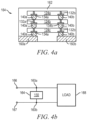
- FIG. 4a illustrates a device with increased ESD current discharge capability and a small semiconductor package size.
- semiconductor die 124 undergo backgrinding to reduce die thickness.
- a plurality of semiconductor die 124 are stacked on substrate or leadframe 160 to form semiconductor package 164.
- Semiconductor die 124c as singulated from semiconductor wafer 120 in FIG. 2e , is disposed over leadframe 160 with bumps 140 bonded to terminals 160a and 160b.
- Bumps 140 of semiconductor die 124c are within a footprint of an individual leadframe contact 160a and 160b, and between an individual leadframe contact and semiconductor die 124c.
- Bumps 140 of semiconductor die 124c are reflowed to mechanically and electrically couple semiconductor die 124c to leadframe 160 through the bumps.
- Semiconductor die 124b is disposed over semiconductor die 124c with bumps 140 of semiconductor die 124b bonded to conductive TSV 132 of semiconductor die 124c.
- Semiconductor die 124a is disposed over semiconductor die 124b with bumps 140 of semiconductor die 124a bonded to conductive TSV 132 of semiconductor die 124b. Accordingly, semiconductor die 124a-124c are stacked and electrically connected in parallel between leadframe contacts 160a and 160b through the interconnect structure comprising conductive layer 134, conductive TSVs 132, and bumps 140. While each active surface 130 of each semiconductor die 124 is oriented in a common directions, many TVS diode embodiments are symmetrical and may be stacked face-to-face or back-to-back at the die or wafer level.
- the interconnect structure between semiconductor die 124a-124c can also be implemented with wire bonds, stud bumps, conductive paste, direct die attach, or other electrical interconnect structures.
- protection circuit 150 in each semiconductor die 124a-124c are commonly connected with wire bonds.
- the thickness of semiconductor package 164 can be further reduced by bonding conductive layer 134a of semiconductor die 124c directly to terminals 160a-160b, i.e., without bumps 140.
- Conductive layer 134a of semiconductor die 124b is bonded directly to conductive TSV 132a of semiconductor die 124c, and conductive layer 134a of semiconductor die 124a is bonded directly to conductive TSV 132a of semiconductor die 124b.
- Direct metal-to-metal bonding of contact pads 134a to terminals 160a-160b, or to conductive vias 132 is done using thermocompression bonding on one embodiment.
- An encapsulant or molding compound 162 is deposited over semiconductor die 124a-124c and leadframe 160 as an insulating material using a paste printing, compressive molding, transfer molding, liquid encapsulant molding, vacuum lamination, spin coating, or other suitable applicator.
- Encapsulant 162 includes polymer composite material, such as epoxy resin, epoxy acrylate, or polymer with proper filler. Encapsulant 162 is non-conductive and environmentally protects the semiconductor device from external elements and contaminants.
- FIG. 4b illustrates semiconductor package 164 with protection circuits 150 coupled between input terminals 166-167 and a load circuit 168 to protect the load circuit from ESD events on input terminals 166.
- Load circuit 168 represents semiconductor packages or other electrical circuits of electronic device 50 for which ESD protection is desired.
- Input terminals 166-167 represent electrical power and ground inputs to electronic device 50. In other embodiments, input terminals 166-167 represent analog or digital inputs or outputs of electronic device 50, e.g., a headphone jack or universal serial bus port of a cell phone or tablet computer.
- Semiconductor package 164 is coupled between input terminal 166 and input terminal 167, which operates as a ground node for signal transmission.
- protection circuits 150 on semiconductor die 124a-124c are non-active and electrical signals flow to semiconductor packages 56-72 on PCB 52.
- the electrical signals to semiconductor packages 56-72 are coupled to package 164 so that, during an ESD event, a voltage spike or transient condition on a circuit node of PCB 52 is also incident on bump 140a.
- the voltage spike is simultaneously incident on conductive layer 134a and conductive TSV 132a of each semiconductor die 124a-124c.
- Protection circuits 150 on each semiconductor die 124a-124c are coupled in parallel between an electrical signal and a ground voltage node. Each semiconductor die 124 senses the voltage transient condition simultaneously and activates to collectively discharge electrical charge from the ESD event as a relatively high electrical current through conductive layer 134b, conductive TSVs 132b, and bumps 140b to ground.
- the ESD event could be caused by a human body containing an electrostatic charge contacting one or more semiconductor packages 56-72 on PCB 52.
- Protection circuits 150 on semiconductor die 124a-124c detect or are activated by the resulting voltage spike and discharge electric current through conductive layer 134b, conductive TSVs 132b, and bumps 140b to ground.
- the ESD event exceeds the turn-on voltage of the TVS diodes of each semiconductor die coupled in parallel. Electrical current from the ESD event is routed through each semiconductor die 124 in parallel to a ground voltage node. Semiconductor packages 56-72 are thus isolated from the ESD event. Multiple semiconductor packages 164 can be used to couple multiple ESD sensitive circuit nodes on PCB 52 to ground when an ESD event occurs on the particular node.
- protection circuits 150 on semiconductor die 124a-124c increases the ESD protection capability of semiconductor package 164 without a significant increase in the package footprint. Electrically connecting multiple semiconductor die 124 in parallel within package 164 causes electric current from an ESD event to be routed through any number of parallel protection circuits 150. While a single protection circuit 150 may only be rated to route say one-hundred milliamps of current, connecting three semiconductor die 124 in parallel within package 164 creates a package that can handle three times the current, or up to three-hundred milliamps.
- the increased ESD protection capability is thanks to the parallel semiconductor die 124 distributing the high ESD current among the multiple protection circuits 150 of the stacked semiconductor die.
- Protection circuits 150 on the stacked semiconductor die 124a-124c operate collectively to increase the total silicon surface area allocated for discharge or dissipation of the ESD current spike through conductive layer 134b, conductive TSVs 132b, and bumps 140b to ground.
- the increase in current-handling capability occurs without a significant increase in package footprint because the additional current-handling capability is provided by additional semiconductor die 124 stacked within the same footprint as other semiconductor die.
- Semiconductor package 164 in FIG. 4a contains three stacked semiconductor die 124a-124c, each having a protection circuit 150 commonly connected through the interconnect structures comprising conductive layer 134, conductive TSVs 132, and bumps 140.
- the high ESD protection capability for semiconductor package 164 is achieved in a small package size by nature of minimizing the thickness of semiconductor die 124a-124c, as described in FIG. 2c , and then stacking the thinned semiconductor die, as shown in FIG. 4 .
- the length and width dimensions of each semiconductor die 124 is 1 mm x 1 mm with a thickness of 50-200 ⁇ m.
- the number of stacked semiconductor die 124 in semiconductor package 164 can vary depending on the protection requirements.
- Semiconductor package 164 can contain as many semiconductor die 124 stacked and electrically coupled in parallel as practical and necessary to realize the target ESD protection capability, e.g., 5-7 stacked semiconductor die are used in some embodiments.
- active surface 130 may include analog circuits or digital circuits, such as digital signal processor (DSP), ASIC, MEMS, memory, or other signal processing circuit.
- DSP digital signal processor
- active surface 130 contains a MEMS, such as an accelerometer, gyroscope, strain gauge, microphone, or other sensor responsive to various external stimuli.
- MEMS such as an accelerometer, gyroscope, strain gauge, microphone, or other sensor responsive to various external stimuli.
- Semiconductor die 124 may also contain integrated passive devices (IPDs), such as inductors, capacitors, and resistors, for signal processing or conditioning.
- IPDs integrated passive devices
- FIGs. 5a-5c illustrate another embodiment with the singulated semiconductor die 124 from FIG. 2e mounted over semiconductor die 170 of semiconductor wafer 172.
- Semiconductor wafer 172 follows a similar construction as semiconductor wafer 120.
- Conductive layer 174, conductive TSV 176, and bumps 178 are formed for semiconductor die 170, similar to FIG. 2b .
- Semiconductor die 124 and 170 each contain protection circuit 150, e.g., a TVS diode.
- FIG. 5a after backgrinding semiconductor wafer 172, similar to FIG. 2c , semiconductor die 124 are picked and placed in alignment with corresponding semiconductor die 170. Bumps 140 of semiconductor die 124 are bonded to conductive TSV 176 in semiconductor die 170.
- semiconductor wafer 172 is singulated using a saw blade or laser cutting tool 180 into individual stacks of semiconductor die 124 and 170.
- FIG. 5c shows semiconductor package 182 with stacked semiconductor die 124 and 170 mounted to substrate or leadframe 184 and covered with encapsulant 186, similar to FIG. 4 .
- Semiconductor package 182 provides increased ESD protection capability, due to a plurality of protection circuits 150 coupled in parallel in a small semiconductor package as described for semiconductor package 164.
- FIGs. 6a-6c illustrate another embodiment with semiconductor wafer 192 mounted over semiconductor wafer 190.
- Semiconductor wafer 190 and 192 follow a similar construction as semiconductor wafer 120.
- Conductive layer 194, conductive TSV 196, and bumps 197 are formed for semiconductor die 198, similar to FIG. 2b .
- conductive layer 200, conductive TSV 202, and bumps 204 are formed for semiconductor die 206.
- Semiconductor die 198 and 206 each contain protection circuit 150.
- semiconductor wafer 192 is mounted to semiconductor wafer 190 with semiconductor die 206 aligned to semiconductor die 198.
- Bumps 204 of semiconductor die 206 are bonded to conductive TSV 196 in semiconductor die 198.
- semiconductor wafers 190 and 192 are singulated using a saw blade or laser cutting tool 210 into individual stacked semiconductor die 198 and 206.
- FIG. 6c shows semiconductor package 212 with stacked semiconductor die 198 and 206 mounted to substrate or leadframe 214 and covered with encapsulant 216, similar to FIG. 4 .
- Semiconductor package 212 provides high ESD protection capability, as described for semiconductor package 164, in a small semiconductor package.
- FIGs. 6a-6c illustrate wafer-to-wafer bonding of protection devices, while FIGs. 5a-5c illustrate die-to-wafer bonding.
- wafer-to-wafer bonding is combinable with die-to-wafer bonding.
- semiconductor die 124 from FIG. 5a can be bonded over semiconductor wafer 192 in FIG. 6a before or after semiconductor wafer 192 is bonded to semiconductor wafer 190.
- FIGs. 7a-7d illustrate forming a conductive layer 230 over back surface 128 of semiconductor die 124 after backgrinding semiconductor wafer 120 in FIG. 2c .
- conductive layer 230 forms contact pads over each conductive via 132 for improved bonding of bumps 140 to back surface 128 of the semiconductor die.
- conductive layer 230 includes conductive traces for redistribution of electrical signals to alternative locations on back surface 128. Conductive layer 230 is formed in a similar manner to conductive layer 134.
- an optional insulating or passivation layer 232 is formed over back surface 128 around conductive layer 230.
- Insulating layer 232 is formed using PVD, CVD, printing, lamination, spin coating or spray coating.
- Insulating layer 232 contains one or more layers of silicon dioxide (SiO2), silicon nitride (Si3N4), silicon oxynitride (SiON), tantalum pentoxide (Ta2O5), aluminum oxide (Al2O3), solder resist, or other material having similar insulating and structural properties.
- a portion of insulating layer 232 is removed by etching or laser direct ablation (LDA) to form openings in the insulating layer and expose conductive layer 230 for subsequent electrical interconnect.
- LDA laser direct ablation
- a portion of insulating layer 232 is removed by backgrinding to expose conductive layer 230 from the insulating layer and create a surface of the insulating layer that is coplanar with a surface of the conductive layer.
- a plurality of conductive wafers 120 with conductive layer 230 are stacked and connected through conductive bumps 140.
- Conductive bumps 140 are reflowed between contact pads 134 of one semiconductor wafer 120 and contact pads 230 of a second semiconductor wafer to mechanically bond and electrically couple the wafers to each other. Any desired number of semiconductor wafers 120 can be stacked and connected in parallel.
- the semiconductor wafers 120 are then singulated into individual devices by saw blade or laser cutting tool 233.
- Semiconductor die 124 with conductive layer 230 can also be stacked die-to-die after singulating or die-to-wafer.
- the singulated units of stacked semiconductor die 124 singulated in FIG. 7c are disposed over leadframe 160 and connected to contacts 160a-160b through bumps 140 of semiconductor die 124b in FIG. 7d .
- Encapsulant 162 is deposited over leadframe 160 and semiconductor die 124 for electrical isolation and environmental protection.
- Semiconductor die 124a and 124b are coupled in parallel between terminals 160a and 160b.
- leadframe 160 is provided as a relatively large sheet and many units of stacked semiconductor die 124 are disposed over a single leadframe and encapsulated together.
- Encapsulant 162 extends between each semiconductor die 124 and between leadframe 160 and semiconductor die 124b.
- Leadframe 160 is normally on a carrier while encapsulant 162 is deposited, resulting in a lower surface of encapsulant 162 that is coplanar with the bottom of leadframe 160.
- the plurality of TVS packages 234 are singulated through leadframe 160 and encapsulant 162 to separate the individual packages. Singulation cuts through leadframe 160 and creates new side surfaces or flanks of terminals 160a-160b that are exposed from encapsulant 162.
- TVS package 234 is disposed on PCB 52 in FIG. 1 , and terminals 160a and 160b are soldered to conductive pads or traces on the PCB to protect a circuit element from ESD events.
- the exposed side surfaces of terminals 160a-160b are wettable by solder and increase the surface area for solder between TVS package 234 and PCB 52.
- FIGs. 8a-8c illustrate stacking a plurality of semiconductor wafers 120 with the wafers mechanically and electrically connected to each other by thermocompression or diffusion bonding.
- FIG. 8a illustrates wafer 120 with contact pads 230 and without conductive bumps 140 or insulating layer 232.
- FIG. 8b a plurality of wafers 120 from FIG. 8a are stacked between a bottom plate 240 and a top plate 244 of a thermocompression fixture. Plates 240 and 244 are used to apply force and heat to semiconductor wafers 120. The heat and pressure between contact pads 230 and contact pads 134 causes metal atoms within aligned contact pads to diffuse into each other.
- the stacked wafers are singulated and mounted onto leadframe 160 using conductive bumps 140.
- the stacked semiconductor die 124 are coupled to leadframe 160 by thermocompression without conductive bumps 140 in other embodiments.
- Thermocompression of wafers 120 to leadframe 160 can be in a common thermocompression step with the bonding of wafers 120 to each other, or performed as another thermocompression step.
- Thermocompression can be wafer-to-wafer, die-to-wafer, or die-to-die.
- Encapsulant 162 is deposited over semiconductor die 124 and leadframe 160 to form a panel, and then the panel is singulated to separate TVS packages 250 from each other. Using thermocompression bonding reduces the overall thickness of TVS package 250 by eliminating the thickness of conductive bumps 140 between some or all device layers.
- FIG. 9 illustrates another embodiment with leadframe 260 having a die pad 262 in addition to leads 264.
- Any of the previously disclosed semiconductor die stacks are disposed on die pad 262 with an optional adhesive layer 266.
- Stacks of semiconductor die 124 can be disposed over die pad 262 with active surfaces 130 oriented either toward or away from the die pad. In some embodiments, active surfaces 130 of semiconductor die 124 are oriented in opposite directions.
- Adhesive layer 266 provides electrical isolation between semiconductor die 124 and die pad 262 in embodiments where desired.
- Contact pads 230 or 134, depending on the orientation of the top semiconductor die 124, are coupled to leads 264 by bond wires 268.
- Bond wires 268 are mechanically and electrically coupled to contact pads 230 and terminals 264 by thermocompression bonding, ultrasonic bonding, wedge bonding, stitch bonding, ball bonding, or other suitable bonding technique.
- Bond wires 268 include a conductive material such as Cu, Al, Au, Ag, a combination thereof, or another suitable conductive material.
- Encapsulant 270 is deposited over semiconductor die 124, leadframe 260, and bond wires 268 to form a sheet of encapsulated devices.
- the sheet is singulated by a saw blade or laser cutting tool to produce individual TVS devices 272.
- TVS device 272 increases protection capability by coupling a plurality of thinned protection devices in parallel without significantly increasing device size.
- the stacked semiconductor die with interconnected protection circuits provide a system-level ESD protection with a small package form-factor.
- the power handling capability (power rating) per unit dimension of the semiconductor package is increased by the stacking topology to increase the total silicon surface area allocated for discharge or dissipation of the ESD current spike, while maintaining a small package form factor by stacking protection circuits in a common footprint.
- the energy from an ESD event is distributed and dissipated through the commonly connected protection circuits of each stacked semiconductor die.
- the stacked nature of multiple semiconductor die each with a protection circuit provides the ability to increase the ESD protection capability without significantly increasing package size.
- the stacked topology can be achieved by die-to-die, die-to-wafer, or wafer-to-wafer stacking processes.
Landscapes
- Engineering & Computer Science (AREA)
- Power Engineering (AREA)
- Microelectronics & Electronic Packaging (AREA)
- Computer Hardware Design (AREA)
- Physics & Mathematics (AREA)
- Condensed Matter Physics & Semiconductors (AREA)
- General Physics & Mathematics (AREA)
- Manufacturing & Machinery (AREA)
- Semiconductor Integrated Circuits (AREA)
- Internal Circuitry In Semiconductor Integrated Circuit Devices (AREA)
- Dicing (AREA)
- Metal-Oxide And Bipolar Metal-Oxide Semiconductor Integrated Circuits (AREA)
Abstract
Description
- The present application claims the benefit of
U.S. Provisional Application No. 62/301,045, filed February 29, 2016 - The present invention relates in general to semiconductor devices and, more particularly, to a semiconductor device and method of stacking semiconductor die to provide system-level electro-static discharge (ESD), electrical overstress (EOS), and electrical fast transient (EFT) protection in a small semiconductor package.
- Semiconductor devices are commonly found in modern electronic products. Semiconductor devices vary in the number and density of electrical components. Discrete semiconductor devices generally contain one type of electrical component, e.g., a light emitting diode (LED), small signal transistor, resistor, capacitor, inductor, or power metal-oxide-semiconductor field-effect transistor (MOSFET). Integrated semiconductor devices typically contain hundreds to millions of electrical components. Examples of integrated semiconductor devices include microcontrollers, microprocessors, charged-coupled devices (CCDs), solar cells, and digital micro-mirror devices (DMDs).
- Semiconductor devices perform a wide range of functions such as signal processing, high-speed calculations, transmitting and receiving electromagnetic signals, controlling electronic devices, transforming sunlight to electricity, and creating visual projections for television displays. Semiconductor devices are found in the fields of entertainment, communications, power conversion, networks, computers, and consumer products. Semiconductor devices are also found in military applications, aviation, automotive, industrial controllers, and office equipment.
- One goal of semiconductor manufacturing is to produce smaller semiconductor devices. Smaller devices typically consume less power, can be produced more efficiently, and have higher performance. In addition, smaller semiconductor devices have a smaller footprint, which is desirable for increasing the density of devices on printed circuit boards and reducing the size of end products. A smaller die size may be achieved by improvements in the front-end process resulting in semiconductor die with smaller, higher density active and passive components. Back-end processes may result in semiconductor device packages with a smaller footprint by improvements in electrical interconnection and packaging materials.
- Semiconductor devices are known to be susceptible to damage from electrostatic discharge (ESD), electrical overstress (EOS), and electrical fast transients (EFT), collectively referred to as ESD events. When electrostatic charges accumulate on a human body for instance, a high static potential is formed with respect to ground. If the human body electrically contacts a semiconductor device, the static potential of the human body discharges an electrical current through the semiconductor device, which can damage the active and passive circuits of the semiconductor device given a sufficiently large electrical current. If a breakdown voltage of an individual circuit element is exceeded, then the semiconductor device can be rendered defective well before its useful life expectancy.
- Semiconductor devices may contain a protection circuit for ESD events. The protection circuit has limited capability to discharge the current from the ESD event. To increase the protection capability, the semiconductor package is typically made larger to include more die area and handle a higher electric current. However, increasing semiconductor package size is inconsistent with the goal of smaller packages and end products. Many applications simply do not allow for larger semiconductor packages, even in situations that require greater ESD protection.
-
-
FIG. 1 illustrates a printed circuit board (PCB) with different types of packages mounted to a surface of the PCB; -
FIGs. 2a-2e illustrate a process of forming a semiconductor wafer with semiconductor die; -
FIG. 3 illustrates a protection circuit formed on the semiconductor die; -
FIGs. 4a-4b illustrate a semiconductor package with stacked semiconductor die each containing the protection circuit, and the semiconductor package coupled to protect a load from ESD events; -
FIGs. 5a-5c illustrate stacking a semiconductor die over a semiconductor wafer; -
FIGs. 6a-6c illustrate stacking a first semiconductor wafer over a second semiconductor wafer; -
FIGs. 7a-7d illustrate contact pads formed on back surfaces of the semiconductor wafers or semiconductor die; -
FIGs. 8a-8c illustrate bonding semiconductor wafer or semiconductor die together using thermocompression; and -
FIG. 9 illustrates coupling a stack of semiconductor die to a leadframe using bond wires. - The present invention is described in one or more embodiments in the following description with reference to the figures, in which like numerals represent the same or similar elements. While the invention is described in terms of the best mode for achieving the invention's objectives, those skilled in the art will appreciate that the description is intended to cover alternatives, modifications, and equivalents as may be included within the spirit and scope of the invention as defined by the appended claims and the claims' equivalents as supported by the following disclosure and drawings.
-
FIG. 1 illustrateselectronic device 50 having a chip carrier substrate orPCB 52 with a plurality of semiconductor packages mounted on a surface ofPCB 52.Electronic device 50 can have one type of semiconductor package, or multiple types of semiconductor packages, depending on the application. The different types of semiconductor packages are shown inFIG. 1 for purposes of illustration. -
Electronic device 50 can be a stand-alone system that uses the semiconductor packages to perform one or more electrical functions. Alternatively,electronic device 50 can be a subcomponent of a larger system. For example,electronic device 50 can be part of a tablet, cellular phone, digital camera, or other electronic device. Alternatively,electronic device 50 can be a graphics card, network interface card, or other signal processing card that can be inserted into a computer. The semiconductor package can include microprocessors, memories, application specific integrated circuits (ASIC), microelectromechanical systems (MEMS), logic circuits, analog circuits, radio frequency (RF) circuits, discrete devices, or other semiconductor die or electrical components. Miniaturization and weight reduction are essential for the products to be accepted by the market. The distance between semiconductor devices may be decreased to achieve higher density. - In
FIG. 1 , PCB 52 provides a general substrate for structural support and electrical interconnect of the semiconductor packages mounted on the PCB.Conductive signal traces 54 are formed over a surface or within layers ofPCB 52 using evaporation, electrolytic plating, electroless plating, screen printing, or other suitable metal deposition process.Signal traces 54 provide for electrical communication between each of the semiconductor packages, mounted components, and other external system components.Traces 54 also provide power and ground connections to each of the semiconductor packages. -
FIG. 2a shows asemiconductor wafer 120 with abase substrate material 122, such as silicon, germanium, aluminum phosphide, aluminum arsenide, gallium arsenide, gallium nitride, indium phosphide, silicon carbide, or other bulk semiconductor material for structural support. A plurality of semiconductor die orcomponents 124 is formed onwafer 120 separated by a non-active, inter-die wafer area or sawstreet 126 as described above. Saw street 126 provides cutting areas tosingulate semiconductor wafer 120 into individual semiconductor die 124. In one embodiment,semiconductor wafer 120 has a width or diameter of 200-300 millimeters (mm) and thickness of 700 micrometers (µm). In another embodiment,semiconductor wafer 120 has a width or diameter of 100-450 mm. -
FIG. 2b shows a cross-sectional view of a portion ofsemiconductor wafer 120. Each semiconductor die 124 has a back ornon-active surface 128 and anactive surface 130 containing analog or digital circuits implemented as active devices, passive devices, conductive layers, and dielectric layers formed within the die and electrically interconnected according to the electrical design and function of the die.Semiconductor wafer 120 has a high resistivity, on the order of 1k ohms/cm or greater.Active surface 130 can be implanted with oxide to suppress surface conduction. - A plurality of blind vias is formed partially through
base substrate material 122 using laser drilling, mechanical drilling, deep reactive ion etching (DRIE), or other suitable process. The through vias are filled with aluminum (Al), copper (Cu), tin (Sn), nickel (Ni), gold (Au), silver (Ag), titanium (Ti), tungsten (W), poly-silicon, or other suitable electrically conductive material using electrolytic plating, electroless plating process, or other suitable metal deposition process to form z-direction vertical interconnect structures or conductive through silicon vias (TSV) 132. - An electrically
conductive layer 134 is formed overactive surface 130 using PVD, CVD, electrolytic plating, electroless plating, or other suitable metal deposition process.Conductive layer 134 includes a surface coplanar withactive surface 130. In another embodiment,conductive layer 134 is formed partially or completely overactive surface 130. -
Conductive layer 134 includes one or more layers of Al, Cu, Sn, Ni, Au, Ag, or other suitable electrically conductive material or combination thereof.Conductive layer 134 operates as contact pads electrically connected to the circuits onactive surface 130, as well asconductive TSV 132.Conductive layer 134 is formed as contact pads disposed side-by-side a first distance from the edge of semiconductor die 124, as shown inFIG. 2b . Alternatively,conductive layer 134 is formed as contact pads that are offset in multiple rows such that a first row of contact pads is disposed a first distance from the edge of the die, and a second row of contact pads alternating with the first row is disposed a second distance from the edge of the die. In one embodiment, semiconductor die 124 is a discrete transient voltage suppression (TVS) diode, and only twocontact pads 134 are provided for the two diode terminals. - Portions of
conductive layer 134 are electrically common or electrically isolated depending on the routing design and function of semiconductor die 124. In some embodiments,conductive layer 134 operates as a redistribution layer (RDL) to extend electrical connection fromconductive TSV 132 and laterally redistribute electrical signals to other areas of semiconductor die 124. In another embodiment,conductive layer 134 operates as a wire bondable pad or layer for electrical interconnection to and fromconductive TSV 132. - In
FIG. 2c , backsurface 128 ofsemiconductor wafer 120 undergoes a backgrinding operation withgrinder 138 or other suitable mechanical, chemical, or etching process to remove a portion ofbase material 122. The backgrinding operation reduces the thickness ofsemiconductor wafer 120 including semiconductor die 124 and revealsconductive TSV 132. In one embodiment, semiconductor die has a post-grinding thickness of 50-200 µm. After the backgrinding operation,TSV 132 include surfaces coplanar with thenew back surface 128 of semiconductor die 124. - In
FIG. 2d , an electrically conductive bump material is deposited overconductive layer 134 using an evaporation, electrolytic plating, electroless plating, ball drop, or screen printing process. The bump material includes Al, Sn, Ni, Au, Ag, lead (Pb), bismuth (Bi), Cu, solder, or combinations thereof, with an optional flux solution. For example, the bump material can be eutectic Sn/Pb, high-lead solder, or lead-free solder. The bump material is bonded toconductive layer 134 using a suitable attachment or bonding process. In one embodiment, the bump material is reflowed by heating the material above its melting point to form spherical balls or bumps 140. In some applications, bumps 140 are reflowed a second time to improve electrical contact toconductive layer 134. The bumps can also be compression bonded toconductive layer 134.Bumps 140 represent one type of interconnect structure that is formed overconductive layer 134. The interconnect structure can also use bond wires, stud bump, micro bump, or other electrical interconnect.Bumps 140 or other interconnect structures are optional and can be formed after singulation ofsemiconductor wafer 120. - In
FIG. 2e ,semiconductor wafer 120 is singulated throughsaw street 126 using a saw blade orlaser cutting tool 142 into individual semiconductor die 124. In another embodiment,semiconductor wafer 120 is singulated into individual semiconductor die 124 using DRIE. - Semiconductor die 124 operates with semiconductor packages 56-72 on
PCB 52 to provide protection from an ESD event. When electrostatic charge accumulates on a human body, a high static voltage potential is formed with respect to ground. If the human body electrically contacts the semiconductor device, the static potential injects large currents and discharges through the device, which can damage the active and passive circuits on the device. - In one embodiment, semiconductor die 124 is dedicated to ESD protection. For example, semiconductor die 124 includes one or more transistors, diodes, and other circuit elements formed within
active surface 130 to implement an ESD protection circuit, which provides fifty amps or more of peak current discharge or dissipation. In another embodiment, each semiconductor die 124 is a discrete TVS diode that conducts electricity from terminal 140a to terminal 140b when a voltage across the terminals exceeds a threshold. When the voltage potential acrossterminals -
FIG. 3 shows TVS diode orprotection circuit 150 of semiconductor die 124. An input ofprotection circuit 150 is commonly coupled toconductive layer 134a,conductive TSV 132a, and bump 140a. An output ofprotection circuit 150 is commonly coupled toconductive layer 134b,conductive TSV 132b, and bump 140b.Bump 140a of semiconductor die 124 is connected to a circuit node onPCB 52, common with one or more semiconductor packages 56-72, on which the ESD event may occur.Bump 140b is coupled to a ground potential node. - In normal operation with say 2.5 volts,
protection circuit 150 is non-active and electrical signals flow to semiconductor packages 56-72 onPCB 52. During an ESD event, a voltage spike or transient condition on the circuit node ofPCB 52 is also incident to bump 140a and activates protection circuit 150 (or turns on TVS 150). When activated,protection circuit 150 discharges the current spike associated with the ESD event throughconductive layer 134b and bump 140b to ground. For example, the ESD event could be caused by a human body containing an electrostatic charge contacting one or more semiconductor packages 56-72 onPCB 52.Protection circuit 150 detects the resulting voltage transient atbump 140a and discharges the high current through semiconductor die 124 to ground. -
Protection circuit 150 can be implemented with a voltage clamping circuit connected to bump 140a and containing one or more transistors with sufficient rating to discharge or dissipate a large ESD current of 50 amps or more. Semiconductor packages 56-72 are protected from the ESD event by electrical current being shunted through semiconductor die 124 rather than through the packages onPCB 52.Other bumps 140 of other semiconductor die 124 are connected to other circuit nodes onPCB 52 that are susceptible to an ESD event. - The space available on
PCB 52 for ESD protection is limited.FIG. 4a illustrates a device with increased ESD current discharge capability and a small semiconductor package size. As described inFIG. 2c , semiconductor die 124 undergo backgrinding to reduce die thickness. A plurality of semiconductor die 124 are stacked on substrate or leadframe 160 to formsemiconductor package 164. Semiconductor die 124c, as singulated fromsemiconductor wafer 120 inFIG. 2e , is disposed over leadframe 160 withbumps 140 bonded toterminals Bumps 140 ofsemiconductor die 124c are within a footprint of anindividual leadframe contact Bumps 140 ofsemiconductor die 124c are reflowed to mechanically and electrically couple semiconductor die 124c to leadframe 160 through the bumps. - Semiconductor die 124b, as also singulated from
semiconductor wafer 120, is disposed over semiconductor die 124c withbumps 140 of semiconductor die 124b bonded toconductive TSV 132 of semiconductor die 124c. Semiconductor die 124a, as singulated fromsemiconductor wafer 120, is disposed over semiconductor die 124b withbumps 140 of semiconductor die 124a bonded toconductive TSV 132 of semiconductor die 124b. Accordingly, semiconductor die 124a-124c are stacked and electrically connected in parallel betweenleadframe contacts conductive layer 134,conductive TSVs 132, and bumps 140. While eachactive surface 130 of each semiconductor die 124 is oriented in a common directions, many TVS diode embodiments are symmetrical and may be stacked face-to-face or back-to-back at the die or wafer level. - The interconnect structure between semiconductor die 124a-124c can also be implemented with wire bonds, stud bumps, conductive paste, direct die attach, or other electrical interconnect structures. For example,
protection circuit 150 in each semiconductor die 124a-124c are commonly connected with wire bonds. Alternatively, the thickness ofsemiconductor package 164 can be further reduced by bondingconductive layer 134a of semiconductor die 124c directly toterminals 160a-160b, i.e., withoutbumps 140.Conductive layer 134a ofsemiconductor die 124b is bonded directly toconductive TSV 132a of semiconductor die 124c, andconductive layer 134a ofsemiconductor die 124a is bonded directly toconductive TSV 132a of semiconductor die 124b. Direct metal-to-metal bonding ofcontact pads 134a toterminals 160a-160b, or toconductive vias 132, is done using thermocompression bonding on one embodiment. - An encapsulant or
molding compound 162 is deposited over semiconductor die 124a-124c and leadframe 160 as an insulating material using a paste printing, compressive molding, transfer molding, liquid encapsulant molding, vacuum lamination, spin coating, or other suitable applicator.Encapsulant 162 includes polymer composite material, such as epoxy resin, epoxy acrylate, or polymer with proper filler.Encapsulant 162 is non-conductive and environmentally protects the semiconductor device from external elements and contaminants. -
FIG. 4b illustratessemiconductor package 164 withprotection circuits 150 coupled between input terminals 166-167 and aload circuit 168 to protect the load circuit from ESD events oninput terminals 166.Load circuit 168 represents semiconductor packages or other electrical circuits ofelectronic device 50 for which ESD protection is desired. Input terminals 166-167 represent electrical power and ground inputs toelectronic device 50. In other embodiments, input terminals 166-167 represent analog or digital inputs or outputs ofelectronic device 50, e.g., a headphone jack or universal serial bus port of a cell phone or tablet computer.Semiconductor package 164 is coupled betweeninput terminal 166 andinput terminal 167, which operates as a ground node for signal transmission. - In normal operation with a voltage of say 2.5 volts,
protection circuits 150 onsemiconductor die 124a-124c are non-active and electrical signals flow to semiconductor packages 56-72 onPCB 52. The electrical signals to semiconductor packages 56-72 are coupled to package 164 so that, during an ESD event, a voltage spike or transient condition on a circuit node ofPCB 52 is also incident onbump 140a. With the die stacking and common interconnect structure forprotection circuits 150 onsemiconductor die 124a-124c, the voltage spike is simultaneously incident onconductive layer 134a andconductive TSV 132a of each semiconductor die 124a-124c. -
Protection circuits 150 on each semiconductor die 124a-124c are coupled in parallel between an electrical signal and a ground voltage node. Each semiconductor die 124 senses the voltage transient condition simultaneously and activates to collectively discharge electrical charge from the ESD event as a relatively high electrical current throughconductive layer 134b,conductive TSVs 132b, and bumps 140b to ground. For example, the ESD event could be caused by a human body containing an electrostatic charge contacting one or more semiconductor packages 56-72 onPCB 52.Protection circuits 150 onsemiconductor die 124a-124c detect or are activated by the resulting voltage spike and discharge electric current throughconductive layer 134b,conductive TSVs 132b, and bumps 140b to ground. - In embodiments where semiconductor die 124 contain a discrete TVS diode, the ESD event exceeds the turn-on voltage of the TVS diodes of each semiconductor die coupled in parallel. Electrical current from the ESD event is routed through each semiconductor die 124 in parallel to a ground voltage node. Semiconductor packages 56-72 are thus isolated from the ESD event. Multiple semiconductor packages 164 can be used to couple multiple ESD sensitive circuit nodes on
PCB 52 to ground when an ESD event occurs on the particular node. - The stacked nature and common electrical connection of
protection circuits 150 onsemiconductor die 124a-124c increases the ESD protection capability ofsemiconductor package 164 without a significant increase in the package footprint. Electrically connecting multiple semiconductor die 124 in parallel withinpackage 164 causes electric current from an ESD event to be routed through any number ofparallel protection circuits 150. While asingle protection circuit 150 may only be rated to route say one-hundred milliamps of current, connecting three semiconductor die 124 in parallel withinpackage 164 creates a package that can handle three times the current, or up to three-hundred milliamps. - The increased ESD protection capability is thanks to the parallel semiconductor die 124 distributing the high ESD current among the
multiple protection circuits 150 of the stacked semiconductor die.Protection circuits 150 on the stacked semiconductor die 124a-124c operate collectively to increase the total silicon surface area allocated for discharge or dissipation of the ESD current spike throughconductive layer 134b,conductive TSVs 132b, and bumps 140b to ground. The increase in current-handling capability occurs without a significant increase in package footprint because the additional current-handling capability is provided by additional semiconductor die 124 stacked within the same footprint as other semiconductor die. -
Semiconductor package 164 inFIG. 4a contains three stacked semiconductor die 124a-124c, each having aprotection circuit 150 commonly connected through the interconnect structures comprisingconductive layer 134,conductive TSVs 132, and bumps 140. The high ESD protection capability forsemiconductor package 164 is achieved in a small package size by nature of minimizing the thickness of semiconductor die 124a-124c, as described inFIG. 2c , and then stacking the thinned semiconductor die, as shown inFIG. 4 . In one embodiment, the length and width dimensions of each semiconductor die 124 is 1 mm x 1 mm with a thickness of 50-200 µm. The number of stacked semiconductor die 124 insemiconductor package 164 can vary depending on the protection requirements.Semiconductor package 164 can contain as many semiconductor die 124 stacked and electrically coupled in parallel as practical and necessary to realize the target ESD protection capability, e.g., 5-7 stacked semiconductor die are used in some embodiments. - In addition to
protection circuit 150,active surface 130 may include analog circuits or digital circuits, such as digital signal processor (DSP), ASIC, MEMS, memory, or other signal processing circuit. In one embodiment,active surface 130 contains a MEMS, such as an accelerometer, gyroscope, strain gauge, microphone, or other sensor responsive to various external stimuli. Semiconductor die 124 may also contain integrated passive devices (IPDs), such as inductors, capacitors, and resistors, for signal processing or conditioning. -
FIGs. 5a-5c illustrate another embodiment with the singulated semiconductor die 124 fromFIG. 2e mounted over semiconductor die 170 ofsemiconductor wafer 172.Semiconductor wafer 172 follows a similar construction assemiconductor wafer 120.Conductive layer 174,conductive TSV 176, and bumps 178 are formed for semiconductor die 170, similar toFIG. 2b . Semiconductor die 124 and 170 each containprotection circuit 150, e.g., a TVS diode. InFIG. 5a , after backgrindingsemiconductor wafer 172, similar toFIG. 2c , semiconductor die 124 are picked and placed in alignment with corresponding semiconductor die 170.Bumps 140 of semiconductor die 124 are bonded toconductive TSV 176 in semiconductor die 170. - In
FIG. 5b ,semiconductor wafer 172 is singulated using a saw blade orlaser cutting tool 180 into individual stacks of semiconductor die 124 and 170.FIG. 5c showssemiconductor package 182 with stacked semiconductor die 124 and 170 mounted to substrate orleadframe 184 and covered withencapsulant 186, similar toFIG. 4 .Semiconductor package 182 provides increased ESD protection capability, due to a plurality ofprotection circuits 150 coupled in parallel in a small semiconductor package as described forsemiconductor package 164. -
FIGs. 6a-6c illustrate another embodiment withsemiconductor wafer 192 mounted oversemiconductor wafer 190.Semiconductor wafer semiconductor wafer 120.Conductive layer 194,conductive TSV 196, and bumps 197 are formed for semiconductor die 198, similar toFIG. 2b . Likewise,conductive layer 200,conductive TSV 202, and bumps 204 are formed for semiconductor die 206. Semiconductor die 198 and 206 each containprotection circuit 150. InFIG. 6a , after backgrindingsemiconductor wafers FIG. 2c ,semiconductor wafer 192 is mounted tosemiconductor wafer 190 with semiconductor die 206 aligned to semiconductor die 198.Bumps 204 of semiconductor die 206 are bonded toconductive TSV 196 in semiconductor die 198. - In
FIG. 6b ,semiconductor wafers laser cutting tool 210 into individual stacked semiconductor die 198 and 206.FIG. 6c showssemiconductor package 212 with stacked semiconductor die 198 and 206 mounted to substrate orleadframe 214 and covered withencapsulant 216, similar toFIG. 4 .Semiconductor package 212 provides high ESD protection capability, as described forsemiconductor package 164, in a small semiconductor package. -
FIGs. 6a-6c illustrate wafer-to-wafer bonding of protection devices, whileFIGs. 5a-5c illustrate die-to-wafer bonding. In some embodiments, wafer-to-wafer bonding is combinable with die-to-wafer bonding. For instance, semiconductor die 124 fromFIG. 5a can be bonded oversemiconductor wafer 192 inFIG. 6a before or aftersemiconductor wafer 192 is bonded tosemiconductor wafer 190. -
FIGs. 7a-7d illustrate forming aconductive layer 230 overback surface 128 of semiconductor die 124 after backgrindingsemiconductor wafer 120 inFIG. 2c . InFIG. 7a ,conductive layer 230 forms contact pads over each conductive via 132 for improved bonding ofbumps 140 to backsurface 128 of the semiconductor die. In other embodiments,conductive layer 230 includes conductive traces for redistribution of electrical signals to alternative locations onback surface 128.Conductive layer 230 is formed in a similar manner toconductive layer 134. - In
FIG. 7b , an optional insulating orpassivation layer 232 is formed overback surface 128 aroundconductive layer 230. Insulatinglayer 232 is formed using PVD, CVD, printing, lamination, spin coating or spray coating. Insulatinglayer 232 contains one or more layers of silicon dioxide (SiO2), silicon nitride (Si3N4), silicon oxynitride (SiON), tantalum pentoxide (Ta2O5), aluminum oxide (Al2O3), solder resist, or other material having similar insulating and structural properties. A portion of insulatinglayer 232 is removed by etching or laser direct ablation (LDA) to form openings in the insulating layer and exposeconductive layer 230 for subsequent electrical interconnect. In some embodiments, a portion of insulatinglayer 232 is removed by backgrinding to exposeconductive layer 230 from the insulating layer and create a surface of the insulating layer that is coplanar with a surface of the conductive layer. - In
FIG. 7c , a plurality ofconductive wafers 120 withconductive layer 230 are stacked and connected throughconductive bumps 140.Conductive bumps 140 are reflowed betweencontact pads 134 of onesemiconductor wafer 120 andcontact pads 230 of a second semiconductor wafer to mechanically bond and electrically couple the wafers to each other. Any desired number ofsemiconductor wafers 120 can be stacked and connected in parallel. Thesemiconductor wafers 120 are then singulated into individual devices by saw blade orlaser cutting tool 233. Semiconductor die 124 withconductive layer 230 can also be stacked die-to-die after singulating or die-to-wafer. - The singulated units of stacked semiconductor die 124 singulated in
FIG. 7c are disposed over leadframe 160 and connected tocontacts 160a-160b throughbumps 140 of semiconductor die 124b inFIG. 7d .Encapsulant 162 is deposited over leadframe 160 and semiconductor die 124 for electrical isolation and environmental protection. Semiconductor die 124a and 124b are coupled in parallel betweenterminals Encapsulant 162 extends between each semiconductor die 124 and between leadframe 160 and semiconductor die 124b. Leadframe 160 is normally on a carrier whileencapsulant 162 is deposited, resulting in a lower surface ofencapsulant 162 that is coplanar with the bottom of leadframe 160. - After encapsulation, the plurality of
TVS packages 234 are singulated through leadframe 160 andencapsulant 162 to separate the individual packages. Singulation cuts through leadframe 160 and creates new side surfaces or flanks ofterminals 160a-160b that are exposed fromencapsulant 162.TVS package 234 is disposed onPCB 52 inFIG. 1 , andterminals terminals 160a-160b are wettable by solder and increase the surface area for solder betweenTVS package 234 andPCB 52. -
FIGs. 8a-8c illustrate stacking a plurality ofsemiconductor wafers 120 with the wafers mechanically and electrically connected to each other by thermocompression or diffusion bonding.FIG. 8a illustrateswafer 120 withcontact pads 230 and withoutconductive bumps 140 or insulatinglayer 232. InFIG. 8b , a plurality ofwafers 120 fromFIG. 8a are stacked between abottom plate 240 and atop plate 244 of a thermocompression fixture.Plates semiconductor wafers 120. The heat and pressure betweencontact pads 230 andcontact pads 134 causes metal atoms within aligned contact pads to diffuse into each other. - After
wafers 120 are bonded together by thermocompression, the stacked wafers are singulated and mounted onto leadframe 160 usingconductive bumps 140. The stacked semiconductor die 124 are coupled to leadframe 160 by thermocompression withoutconductive bumps 140 in other embodiments. Thermocompression ofwafers 120 to leadframe 160 can be in a common thermocompression step with the bonding ofwafers 120 to each other, or performed as another thermocompression step. Thermocompression can be wafer-to-wafer, die-to-wafer, or die-to-die.Encapsulant 162 is deposited over semiconductor die 124 and leadframe 160 to form a panel, and then the panel is singulated to separateTVS packages 250 from each other. Using thermocompression bonding reduces the overall thickness ofTVS package 250 by eliminating the thickness ofconductive bumps 140 between some or all device layers. -
FIG. 9 illustrates another embodiment withleadframe 260 having adie pad 262 in addition to leads 264. Any of the previously disclosed semiconductor die stacks are disposed ondie pad 262 with an optionaladhesive layer 266. Stacks of semiconductor die 124 can be disposed overdie pad 262 withactive surfaces 130 oriented either toward or away from the die pad. In some embodiments,active surfaces 130 of semiconductor die 124 are oriented in opposite directions.Adhesive layer 266 provides electrical isolation between semiconductor die 124 and diepad 262 in embodiments where desired. Contactpads leads 264 bybond wires 268.Bond wires 268 are mechanically and electrically coupled to contactpads 230 andterminals 264 by thermocompression bonding, ultrasonic bonding, wedge bonding, stitch bonding, ball bonding, or other suitable bonding technique.Bond wires 268 include a conductive material such as Cu, Al, Au, Ag, a combination thereof, or another suitable conductive material. -
Encapsulant 270 is deposited over semiconductor die 124,leadframe 260, andbond wires 268 to form a sheet of encapsulated devices. The sheet is singulated by a saw blade or laser cutting tool to produceindividual TVS devices 272.TVS device 272 increases protection capability by coupling a plurality of thinned protection devices in parallel without significantly increasing device size. - The stacked semiconductor die with interconnected protection circuits provide a system-level ESD protection with a small package form-factor. The power handling capability (power rating) per unit dimension of the semiconductor package is increased by the stacking topology to increase the total silicon surface area allocated for discharge or dissipation of the ESD current spike, while maintaining a small package form factor by stacking protection circuits in a common footprint. The energy from an ESD event is distributed and dissipated through the commonly connected protection circuits of each stacked semiconductor die. The stacked nature of multiple semiconductor die each with a protection circuit provides the ability to increase the ESD protection capability without significantly increasing package size. The stacked topology can be achieved by die-to-die, die-to-wafer, or wafer-to-wafer stacking processes.
- While one or more embodiments of the present invention have been illustrated in detail, the skilled artisan will appreciate that modifications and adaptations to those embodiments may be made without departing from the scope of the present invention as set forth in the following claims.
- The following is a list of further preferred embodiments of the invention:
- Embodiment 1. A method of making a semiconductor device, comprising:
- providing a first semiconductor die including a first protection circuit;
- disposing a second semiconductor die including a second protection circuit over the first semiconductor die; and
- forming an interconnect structure to commonly connect the first protection circuit and second protection circuit, wherein a transient condition incident to the interconnect structure is collectively discharged through the first protection circuit and second protection circuit.
- Embodiment 2. The method of embodiment 1, further including removing a portion of the first semiconductor die and second semiconductor die to reduce die thickness.
- Embodiment 3. The method of embodiment 1, wherein forming the interconnect structure includes:
- forming a first conductive via through the first semiconductor die;
- forming a second conductive via through the second semiconductor die; and
- connecting the first conductive via to the second conductive via.
- Embodiment 4. The method of embodiment 1, further including:
- providing a substrate;
- disposing the first semiconductor die and second semiconductor die over the substrate; and
- depositing an encapsulant over the first semiconductor die, second semiconductor die, and substrate.
- Embodiment 5. The method of embodiment 1, further including:
- providing a first semiconductor wafer including the first semiconductor die;
- disposing a second semiconductor wafer including the second semiconductor die over the first semiconductor wafer; and
- singulating the first semiconductor wafer and second semiconductor wafer leaving the second semiconductor die disposed over the first semiconductor die.
- Embodiment 6. The method of embodiment 1, further including:
- providing a first semiconductor wafer including the first semiconductor die;
- disposing the second semiconductor die over the first semiconductor wafer after singulating the second semiconductor die from a second semiconductor wafer; and
- singulating the first semiconductor wafer leaving the second semiconductor die disposed over the first semiconductor die.
-
Embodiment 7. A method of making a semiconductor device, comprising:- providing a first semiconductor die including a first protection circuit;
- disposing a second semiconductor die including a second protection circuit over the first semiconductor die with a first conductive via of the first semiconductor die aligned to a second conductive via of the second semiconductor die; and
- providing an interconnect structure between the first conductive via and second conductive via.
- Embodiment 8. The method of
embodiment 7, wherein providing the interconnect structure includes:- forming a first contact pad on a surface of the first semiconductor die over the first conductive via;
- forming a second contact pad on a surface of the second semiconductor die over the second conductive via; and
- bonding the first contact pad to the second contact pad by thermocompression.
- Embodiment 9. The method of
embodiment 7, wherein providing the interconnect structure includes:- forming a contact pad on a surface of the second semiconductor die and aligned with the first conductive via; and
- disposing a conductive bump between the contact pad and the first conductive via.
- Embodiment 10. The method of
embodiment 7, further including disposing the second semiconductor die over the first semiconductor die while the first semiconductor die remains as part of a first semiconductor wafer. - Embodiment 11. The method of embodiment 10, further including disposing the second semiconductor die over the first semiconductor die while the second semiconductor die remains as part of a second semiconductor wafer.
- Embodiment 12. The method of
embodiment 7, further including disposing the first semiconductor die and second semiconductor die over a leadframe with the first conductive via and second conductive via directly over a first terminal of the leadframe. - Embodiment 13. The method of embodiment 12, further including depositing an encapsulant over the first semiconductor die, second semiconductor die, and leadframe, wherein the first protection circuit and second protection circuit are electrically coupled in parallel between the first terminal of the leadframe and a second terminal of the leadframe.
- Embodiment 14. A method of making a semiconductor device, comprising:
- providing a first semiconductor die including a first protection circuit; and
- disposing a second semiconductor die including a second protection circuit over the first semiconductor die with the first protection circuit and second protection circuit electrically coupled in parallel.
- Embodiment 15. The method of embodiment 14, further including disposing the first semiconductor die and second semiconductor die over a leadframe, with the first protection circuit and second protection circuit electrically coupled in parallel between a first terminal of the leadframe and a second terminal of the leadframe.
- Embodiment 16. The method of embodiment 15, further including bonding the first semiconductor die to the leadframe using a conductive bump.
- Embodiment 17. The method of embodiment 14, further including bonding the first semiconductor die to the second semiconductor die using a conductive bump.
- Embodiment 18. The method of embodiment 14, further including bonding the first semiconductor die to the second semiconductor die using thermocompression.
- Embodiment 19. The method of embodiment 14, further including:
- forming a conductive via in the first semiconductor die;
- backgrinding the first semiconductor die to expose the conductive via; and
- disposing the second semiconductor die over the first semiconductor die with a contact pad of the second semiconductor die aligned with the conductive via.
- Embodiment 20. A semiconductor device, comprising:
- a first semiconductor die including a first protection circuit;
- a second semiconductor die including a second protection circuit disposed over the first semiconductor die; and
- a leadframe, with the first protection circuit and second protection circuit electrically coupled in parallel between a first terminal of the leadframe and a second terminal of the leadframe.
- Embodiment 21. The semiconductor device of embodiment 20, wherein the first protection circuit includes a first transient voltage suppression (TVS) diode and the second protection circuit includes a second TVS diode.
- Embodiment 22. The semiconductor device of embodiment 20, further including a contact pad of the first semiconductor die directly bonded to a second contact pad of the second semiconductor die.
- Embodiment 23. The semiconductor device of embodiment 20, further including a first conductive bump extending from the first semiconductor die to the second semiconductor die.
- Embodiment 24. The semiconductor device of embodiment 23, further including a second conductive bump extending from the first semiconductor die to the leadframe.
- Embodiment 25. The semiconductor device of embodiment 24, further including a conductive via formed through the first semiconductor die between the first conductive bump and second conductive bump.
Claims (15)
- A method of making an electrostatic discharge protection semiconductor package, comprising:providing a first semiconductor die (124c) including a first protection circuit (150);disposing a second semiconductor die (124b) including a second protection circuit (150) over the first semiconductor die;disposing an interconnect structure (140a) between the first semiconductor die and second semiconductor die;disposing the first semiconductor die and second semiconductor die over a leadframe with the first protection circuit and second protection circuit electrically coupled in parallel between a first terminal (160a) of the leadframe and a second terminal (160b) of the leadframe; anddepositing an encapsulant (162) over the first semiconductor die and the second semiconductor die with the first terminal and second terminal exposed from the encapsulant.
- The method of claim 1, wherein further including disposing a third semiconductor die (124a) including a third protection circuit (150) over the second semiconductor die, wherein depositing the encapsulant (162) includes depositing the encapsulant over the third semiconductor die.
- The method of claim 1, further including configuring the electrostatic discharge protection semiconductor package to protect a separate semiconductor package from electrostatic discharge events using both the first protection circuit and second protection circuit in parallel.
- The method of claim 3, further including bonding the first semiconductor die to the leadframe using a conductive bump (140a).
- The method of claim 1, wherein the first semiconductor die is a first discrete transient voltage suppression diode with only two contact pads, and wherein the second semiconductor die is a second discrete transient voltage suppression diode with only two contact pads.
- The method of claim 1, further including disposing the second semiconductor die over the first semiconductor die while the first semiconductor die remains as part of a first semiconductor wafer (190).
- The method of claim 6, further including disposing the second semiconductor die over the first semiconductor die while the second semiconductor die remains as part of a second semiconductor wafer (192).
- The method of claim 1, further including aligning a first conductive via of the first semiconductor die to a second conductive via of the second semiconductor die.
- An electrostatic discharge protection semiconductor package, comprising:a first semiconductor die (124c) including a first protection circuit (150);a second semiconductor die (124b) including a second protection circuit (150) disposed over the first semiconductor die;an interconnect structure (140a) disposed between the first semiconductor die and second semiconductor die;a leadframe, wherein the first protection circuit and second protection circuit are coupled in parallel between a first terminal (160a) of the leadframe and a second terminal (160b) of the leadframe; andan encapsulant (162) deposited around the first semiconductor die and second semiconductor die with the first terminal and the second terminal exposed from the encapsulant.
- The electrostatic discharge protection semiconductor package of claim 9, wherein the electrostatic discharge protection semiconductor die is configured to protect a separate semiconductor package from electrostatic discharge events.
- The electrostatic discharge protection semiconductor package of claim 9, wherein:the first semiconductor die is a first discrete transient voltage suppression diode with only two contact pads; andthe second semiconductor die is a second discrete transient voltage suppression diode with only two contact pads.
- The electrostatic discharge protection semiconductor package of claim 9, further including:a first conductive via (132a) formed in the first semiconductor die; anda second conductive via (132a) formed in the second semiconductor die, wherein the first conductive via is aligned to the second conductive via.
- The electrostatic discharge protection semiconductor package of claim 12, wherein the interconnect structure is disposed between first conductive via and second conductive via.
- The electrostatic discharge protection semiconductor package of claim 13, wherein the interconnect structure includes:a first contact pad (134) on a surface of the first semiconductor die; anda second contact pad (230) on a surface of the second semiconductor die, wherein the first contact pad is bonded to the second contact pad by thermocompression.
- The electrostatic discharge protection semiconductor package of claim 9, further including a third semiconductor die (124a) including a third protection circuit (150) disposed over the first semiconductor die and second semiconductor die, wherein the first protection circuit, second protection circuit, and third protection circuit are coupled in parallel between the first terminal of the leadframe and the second terminal of the leadframe.
Applications Claiming Priority (3)
| Application Number | Priority Date | Filing Date | Title |
|---|---|---|---|
| US201662301045P | 2016-02-29 | 2016-02-29 | |
| US15/431,528 US11373990B2 (en) | 2016-02-29 | 2017-02-13 | Semiconductor device and method of stacking semiconductor die for system-level ESD protection |
| EP17157412.2A EP3236497B1 (en) | 2016-02-29 | 2017-02-22 | Semiconductor device and method of stacking semiconductor die on a leadframe for system-level esd protection |
Related Parent Applications (2)
| Application Number | Title | Priority Date | Filing Date |
|---|---|---|---|
| EP17157412.2A Division EP3236497B1 (en) | 2016-02-29 | 2017-02-22 | Semiconductor device and method of stacking semiconductor die on a leadframe for system-level esd protection |
| EP17157412.2A Division-Into EP3236497B1 (en) | 2016-02-29 | 2017-02-22 | Semiconductor device and method of stacking semiconductor die on a leadframe for system-level esd protection |
Publications (2)
| Publication Number | Publication Date |
|---|---|
| EP4465352A2 true EP4465352A2 (en) | 2024-11-20 |
| EP4465352A3 EP4465352A3 (en) | 2025-06-18 |
Family
ID=59679856
Family Applications (2)
| Application Number | Title | Priority Date | Filing Date |
|---|---|---|---|
| EP24204628.2A Pending EP4465352A3 (en) | 2016-02-29 | 2017-02-22 | Semiconductor device and method of stacking semiconductor die for system-level esd protection |
| EP17157412.2A Active EP3236497B1 (en) | 2016-02-29 | 2017-02-22 | Semiconductor device and method of stacking semiconductor die on a leadframe for system-level esd protection |
Family Applications After (1)
| Application Number | Title | Priority Date | Filing Date |
|---|---|---|---|
| EP17157412.2A Active EP3236497B1 (en) | 2016-02-29 | 2017-02-22 | Semiconductor device and method of stacking semiconductor die on a leadframe for system-level esd protection |
Country Status (5)
| Country | Link |
|---|---|
| US (2) | US11373990B2 (en) |
| EP (2) | EP4465352A3 (en) |
| KR (5) | KR20170101824A (en) |
| CN (2) | CN107134430B (en) |
| TW (1) | TWI713146B (en) |
Families Citing this family (25)
| Publication number | Priority date | Publication date | Assignee | Title |
|---|---|---|---|---|
| US9225199B2 (en) | 2011-03-22 | 2015-12-29 | Triune Ip, Llc | Variable power energy harvesting system |
| EP3449502B1 (en) | 2016-04-26 | 2021-06-30 | Linear Technology LLC | Mechanically-compliant and electrically and thermally conductive leadframes for component-on-package circuits |
| US20180182665A1 (en) | 2016-12-28 | 2018-06-28 | Invensas Bonding Technologies, Inc. | Processed Substrate |
| US10879212B2 (en) | 2017-05-11 | 2020-12-29 | Invensas Bonding Technologies, Inc. | Processed stacked dies |
| US10056317B1 (en) * | 2017-10-20 | 2018-08-21 | Semiconductor Components Industries, Llc | Semiconductor package with grounding device and related methods |
| WO2019160566A1 (en) * | 2018-02-15 | 2019-08-22 | Didrew Technology (Bvi) Limited | Method of simultaneously fabricating multiple wafers on large carrier with warpage control stiffener |
| US10497635B2 (en) | 2018-03-27 | 2019-12-03 | Linear Technology Holding Llc | Stacked circuit package with molded base having laser drilled openings for upper package |
| KR20190125888A (en) * | 2018-04-30 | 2019-11-07 | 에스케이하이닉스 주식회사 | Method of stacking multiple semiconductor dies |
| US10727204B2 (en) * | 2018-05-29 | 2020-07-28 | Advances Micro Devices, Inc. | Die stacking for multi-tier 3D integration |
| US10522489B1 (en) * | 2018-06-28 | 2019-12-31 | Western Digital Technologies, Inc. | Manufacturing process for separating logic and memory array |
| US12406959B2 (en) | 2018-07-26 | 2025-09-02 | Adeia Semiconductor Bonding Technologies Inc. | Post CMP processing for hybrid bonding |
| CN109103181A (en) * | 2018-08-22 | 2018-12-28 | 长江存储科技有限责任公司 | A kind of semiconductor structure |
| US11296044B2 (en) | 2018-08-29 | 2022-04-05 | Invensas Bonding Technologies, Inc. | Bond enhancement structure in microelectronics for trapping contaminants during direct-bonding processes |
| US10985134B2 (en) * | 2018-11-09 | 2021-04-20 | Nanya Technology Corporation | Method and system of manufacturing stacked wafers |
| US11410977B2 (en) | 2018-11-13 | 2022-08-09 | Analog Devices International Unlimited Company | Electronic module for high power applications |
| TWI694581B (en) | 2018-12-26 | 2020-05-21 | 財團法人工業技術研究院 | Electrostatic discharge protection device and integrated passive component with capacitance |
| TWI703700B (en) * | 2019-08-29 | 2020-09-01 | 華邦電子股份有限公司 | Semiconductor package and manufacturing method thereof |
| US11145627B2 (en) | 2019-10-04 | 2021-10-12 | Winbond Electronics Corp. | Semiconductor package and manufacturing method thereof |
| EP3817044A1 (en) * | 2019-11-04 | 2021-05-05 | Infineon Technologies Austria AG | Semiconductor package with a silicon carbide power semiconductor chip diffusion soldered to a copper leadframe part and a corresponding manufacturing method |
| JP7618392B2 (en) * | 2020-05-14 | 2025-01-21 | キヤノン株式会社 | Photoelectric conversion device, imaging system, and mobile object |
| US11844178B2 (en) | 2020-06-02 | 2023-12-12 | Analog Devices International Unlimited Company | Electronic component |
| US11908812B2 (en) * | 2020-12-17 | 2024-02-20 | Micron Technology, Inc. | Multi-die memory device with peak current reduction |
| US11664334B2 (en) * | 2021-03-12 | 2023-05-30 | Infineon Technologies Austria Ag | Semiconductor package with temporary ESD protection element |
| US11695003B2 (en) * | 2021-08-06 | 2023-07-04 | Nanya Technology Corporation | Semiconductor device, electronic system, and electrostatic discharge protection method for semiconductor device thereof |
| US12532775B2 (en) * | 2022-02-18 | 2026-01-20 | Micron Technology, Inc. | Methods and assemblies for measurement and prediction of package and die strength |
Family Cites Families (15)
| Publication number | Priority date | Publication date | Assignee | Title |
|---|---|---|---|---|
| US8144441B2 (en) * | 2006-08-30 | 2012-03-27 | Triquint Semiconductor, Inc. | Electrostatic discharge protection circuit for compound semiconductor devices and circuits |
| US20090051046A1 (en) | 2007-08-24 | 2009-02-26 | Semiconductor Energy Laboratory Co., Ltd. | Semiconductor device and manufacturing method for the same |
| US20090115026A1 (en) | 2007-11-05 | 2009-05-07 | Texas Instruments Incorporated | Semiconductor device having through-silicon vias for high current,high frequency, and heat dissipation |
| US20110089557A1 (en) * | 2009-10-19 | 2011-04-21 | Jeng-Jye Shau | Area reduction for die-scale surface mount package chips |
| TWI413236B (en) | 2010-06-11 | 2013-10-21 | 財團法人工業技術研究院 | Electrostatic discharge protection scheme for stacking process of semiconductor devices |
| KR20120012602A (en) * | 2010-08-02 | 2012-02-10 | 삼성전자주식회사 | Semiconductor device, manufacturing method thereof and manufacturing method of semiconductor package |
| TW201214584A (en) * | 2010-09-23 | 2012-04-01 | Walton Advanced Eng Inc | Flip-chip bonding method to reduce voids in underfill material |
| KR20130004783A (en) | 2011-07-04 | 2013-01-14 | 삼성전자주식회사 | Stacked semiconductor device including esd protection circuits and method of fabricating the stacked semiconductor device |
| JP2013065835A (en) * | 2011-08-24 | 2013-04-11 | Sumitomo Bakelite Co Ltd | Semiconductor device manufacturing method, block laminate and successive laminate |
| US9172242B2 (en) | 2012-11-02 | 2015-10-27 | Taiwan Semiconductor Manufacturing Co., Ltd. | Electrostatic discharge protection for three dimensional integrated circuit |
| KR20140104379A (en) * | 2013-02-20 | 2014-08-28 | 페어차일드 세미컨덕터 코포레이션 | Clamping circuit and device for eos/surge/iec |
| JP2015005626A (en) * | 2013-06-21 | 2015-01-08 | ピーエスフォー ルクスコ エスエイアールエルPS4 Luxco S.a.r.l. | Semiconductor device |
| US9472948B2 (en) * | 2013-09-30 | 2016-10-18 | Infineon Technologies Ag | On chip reverse polarity protection compliant with ISO and ESD requirements |
| KR102302523B1 (en) * | 2014-01-06 | 2021-09-15 | 루미리즈 홀딩 비.브이. | Thin led flash for camera |
| TWI651830B (en) * | 2015-02-17 | 2019-02-21 | 立昌先進科技股份有限公司 | Multifunctinal miniaturized smd electronic components and process for manufacturing the same |
-
2017
- 2017-02-13 US US15/431,528 patent/US11373990B2/en active Active
- 2017-02-18 TW TW106105448A patent/TWI713146B/en active
- 2017-02-22 EP EP24204628.2A patent/EP4465352A3/en active Pending
- 2017-02-22 EP EP17157412.2A patent/EP3236497B1/en active Active
- 2017-02-28 KR KR1020170025823A patent/KR20170101824A/en not_active Ceased
- 2017-02-28 CN CN201710234357.XA patent/CN107134430B/en active Active
- 2017-02-28 CN CN202310474789.3A patent/CN116504649A/en active Pending
-
2021
- 2021-09-27 KR KR1020210127286A patent/KR102370080B1/en active Active
-
2022
- 2022-02-28 KR KR1020220025664A patent/KR102522313B1/en active Active
- 2022-05-24 US US17/664,841 patent/US11881476B2/en active Active
-
2023
- 2023-04-11 KR KR1020230047188A patent/KR102688787B1/en active Active
-
2024
- 2024-07-22 KR KR1020240096106A patent/KR102859614B1/en active Active
Also Published As
| Publication number | Publication date |
|---|---|
| KR20220032029A (en) | 2022-03-15 |
| CN107134430B (en) | 2023-05-26 |
| US20170250172A1 (en) | 2017-08-31 |
| CN116504649A (en) | 2023-07-28 |
| KR20210122218A (en) | 2021-10-08 |
| CN107134430A (en) | 2017-09-05 |
| US20220285334A1 (en) | 2022-09-08 |
| KR102859614B1 (en) | 2025-09-22 |
| US11373990B2 (en) | 2022-06-28 |
| EP4465352A3 (en) | 2025-06-18 |
| US11881476B2 (en) | 2024-01-23 |
| KR102370080B1 (en) | 2022-03-04 |
| KR20170101824A (en) | 2017-09-06 |
| EP3236497A1 (en) | 2017-10-25 |
| KR20240117513A (en) | 2024-08-01 |
| EP3236497B1 (en) | 2024-12-04 |
| KR102522313B1 (en) | 2023-04-14 |
| TW201801245A (en) | 2018-01-01 |
| KR102688787B1 (en) | 2024-07-26 |
| TWI713146B (en) | 2020-12-11 |
| KR20230053573A (en) | 2023-04-21 |
Similar Documents
| Publication | Publication Date | Title |
|---|---|---|
| US11881476B2 (en) | Semiconductor device and method of stacking semiconductor die for system-level ESD protection | |
| US8623702B2 (en) | Semiconductor device and method of forming conductive THV and RDL on opposite sides of semiconductor die for RDL-to-RDL bonding | |
| TWI594343B (en) | Semiconductor device and method for forming a wire post as a vertical interconnect in a fan-out wafer level package | |
| US9153544B2 (en) | Semiconductor device and method of forming discontinuous ESD protection layers between semiconductor die | |
| TWI623048B (en) | Semiconductor device and method using a substrate having a pedestal and a conductive pillar to form a vertical interconnect structure in an embedded die package | |
| US9142515B2 (en) | Semiconductor device with protective layer over exposed surfaces of semiconductor die | |
| US9190297B2 (en) | Semiconductor device and method of forming a stackable semiconductor package with vertically-oriented discrete electrical devices as interconnect structures | |
| US8288203B2 (en) | Semiconductor device and method of forming a wafer level package structure using conductive via and exposed bump | |
| US9136144B2 (en) | Method of forming protective material between semiconductor die stacked on semiconductor wafer to reduce defects during singulation | |
| TWI689075B (en) | Semiconductor device and method of depositing encapsulant along sides and surface edge of semiconductor die in embedded wlcsp | |
| US8445990B2 (en) | Semiconductor device and method of forming an inductor within interconnect layer vertically separated from semiconductor die | |
| TW202531402A (en) | Semiconductor device and method of making a molded ipd-cow |
Legal Events
| Date | Code | Title | Description |
|---|---|---|---|
| PUAI | Public reference made under article 153(3) epc to a published international application that has entered the european phase |
Free format text: ORIGINAL CODE: 0009012 |
|
| STAA | Information on the status of an ep patent application or granted ep patent |
Free format text: STATUS: THE APPLICATION HAS BEEN PUBLISHED |
|
| AC | Divisional application: reference to earlier application |
Ref document number: 3236497 Country of ref document: EP Kind code of ref document: P |
|
| AK | Designated contracting states |
Kind code of ref document: A2 Designated state(s): AL AT BE BG CH CY CZ DE DK EE ES FI FR GB GR HR HU IE IS IT LI LT LU LV MC MK MT NL NO PL PT RO RS SE SI SK SM TR |
|
| REG | Reference to a national code |
Ref country code: DE Ref legal event code: R079 Free format text: PREVIOUS MAIN CLASS: H01L0023495000 Ipc: H01L0023600000 |
|
| PUAL | Search report despatched |
Free format text: ORIGINAL CODE: 0009013 |
|
| AK | Designated contracting states |
Kind code of ref document: A3 Designated state(s): AL AT BE BG CH CY CZ DE DK EE ES FI FR GB GR HR HU IE IS IT LI LT LU LV MC MK MT NL NO PL PT RO RS SE SI SK SM TR |
|
| RIC1 | Information provided on ipc code assigned before grant |
Ipc: H01L 25/065 20230101ALN20250509BHEP Ipc: H01L 21/98 20060101ALN20250509BHEP Ipc: H01L 23/495 20060101ALI20250509BHEP Ipc: H01L 21/60 20060101ALI20250509BHEP Ipc: H01L 23/60 20060101AFI20250509BHEP |
|
| STAA | Information on the status of an ep patent application or granted ep patent |
Free format text: STATUS: REQUEST FOR EXAMINATION WAS MADE |
|
| 17P | Request for examination filed |
Effective date: 20251110 |